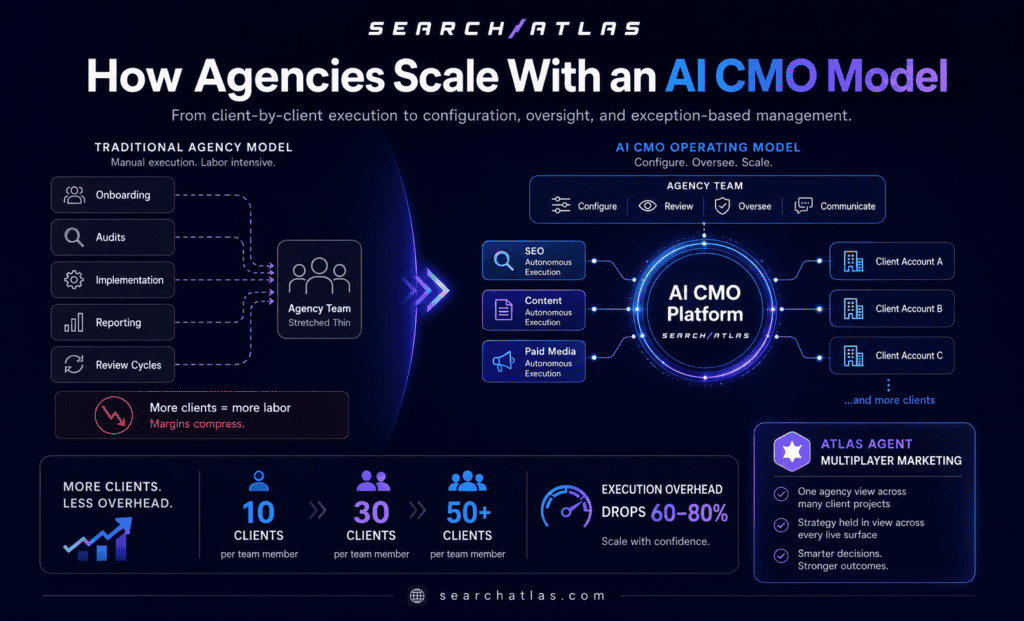
The standard agency growth model has a structural ceiling: each new client adds roughly proportional labor. Onboarding, audits, implementation, reporting, and review cycles multiply with the client count. At some point, the agency can only grow by adding headcount, and margins compress accordingly.
An AI CMO model breaks that relationship — see AI CMO vs. Marketing Agency for how the two models compare directly. An AI CMO platform is a software platform that executes marketing operations autonomously across SEO, content, and paid media. It shifts the team’s role from executing marketing tasks to configuring and overseeing systems that execute those tasks autonomously.
The result is a different cost structure: more clients served per team member, with quality maintained through system design rather than individual output.
This guide covers how agencies apply an AI CMO operational model across multi-client account bases: what the workflow looks like, where configuration effort concentrates, and how the review cadence changes as client count scales.
Key takeaways:
- The operational shift is from execution to configuration and oversight
- Per-client configuration quality determines how much ongoing management each account requires
- Review cadences change at scale: hands-on weekly at 10 clients, exception-based monitoring at 50
- The agencies that scale successfully treat platform configuration as the core competency, not a setup step
Why automation tools are not the same as an AI CMO model
Most agencies have already added automation tools: scheduled reports, templated deliverables, batch keyword pulls, and recurring audit scripts. These reduce individual task time but do not change the fundamental operational model. Someone still has to interpret the output, decide what to implement, write the content, and coordinate the changes.
An AI CMO model is different because the AI CMO platform acts on goals rather than executing predefined scripts. The difference becomes clear in how each approach handles a new ranking opportunity:
- Automation model: A monitoring script alerts the team that a target page dropped in position. The team reviews the alert, audits the page, writes a brief, sends it to a writer, waits for the draft, reviews it, coordinates with the developer, and deploys. The cycle takes days or weeks.
- AI CMO model: The AI CMO platform monitors ranking signals continuously, identifies the opportunity, applies on-page fixes directly to the live site, and logs the changes for team review. The team reviews what was deployed and approves or adjusts. The cycle takes hours.
What an AI CMO is and how autonomous execution differs from automation
The key difference is not speed. It is where the human effort goes. In the automation model, human effort goes into implementation. In the AI CMO model, human effort goes into configuration, review, and client communication.
The distinction goes further than workflow efficiency. Single-player tools execute one asset at a time with no view of the full strategy: a script that fixes a title tag does not know whether that title tag still reflects current positioning. Multiplayer marketing, as Atlas Agent implements it, holds the strategy across all client surfaces simultaneously and flags when any surface drifts from its current positioning.
Drift is silent: it passes every local metric and still misrepresents the company. No automation script catches that because no automation script holds the strategy in the first place.
The agency scaling problem in concrete terms
An agency managing 10 clients with a team of 3 might spend time roughly as follows:
- Onboarding and strategy: 2 hours per client per month = 20 hours
- SEO audits and implementation coordination: 3 hours per client per month = 30 hours
- Content production oversight: 2 hours per client per month = 20 hours
- Reporting and client communication: 2 hours per client per month = 20 hours
- Paid media management: 2 hours per client per month = 20 hours
That is roughly 110 hours per month for 10 clients, just over a full-time person. To grow to 30 clients, the agency either adds two more people or finds a different model.
The AI CMO model targets the middle three categories. SEO implementation, content production, and paid media management shift to an AI CMO platform execution. The team still owns onboarding, strategy, and client communication, but the execution overhead per client drops significantly for well-configured accounts.
Agencies that successfully make this transition report time compression in the execution categories by roughly 60 to 80 percent per client. The remainder goes into reviewing and adjusting platform outputs rather than producing them from scratch.
Multi-client account structure in an AI CMO platform
The agency operational model requires that each client be isolated: separate data, separate configuration, separate reporting, while remaining accessible from a single agency-level view.
In a well-designed AI CMO platform, the project-level architecture achieves this:
- Each client is a separate project with its own configuration
- Agency-level dashboards aggregate status across all clients without merging data
- White-label reporting surfaces client-specific data under the agency brand
- User permissions can be configured so that clients see only their own data if given access
The practical workflow: an account manager opens the agency dashboard to see which client accounts have active alerts, pending changes requiring approval, or performance anomalies. They navigate to the relevant client account, review the specific issue, and take action, without switching between platforms or pulling separate reports.
This is meaningfully different from managing five separate tool subscriptions, each requiring its own login, each producing its own report format, and none aware of what the others are showing.
At the agency scale, the bigger the client count, the more places drift can hide. A client’s ad copy may still reflect positioning from six months ago. A GBP listing may no longer match the current offer. Atlas Agent (+Copilot CMO) watches live surfaces across all active accounts and surfaces drift before it compounds. The account manager responds to alerts rather than auditing every surface by hand.
Configuration: the highest-leverage investment
In an AI CMO model, the quality of per-client configuration determines the quality of everything the AI CMO platform does for that client. Poor configuration produces outputs that require constant human correction. A good configuration produces outputs that the team can approve with minimal revision.
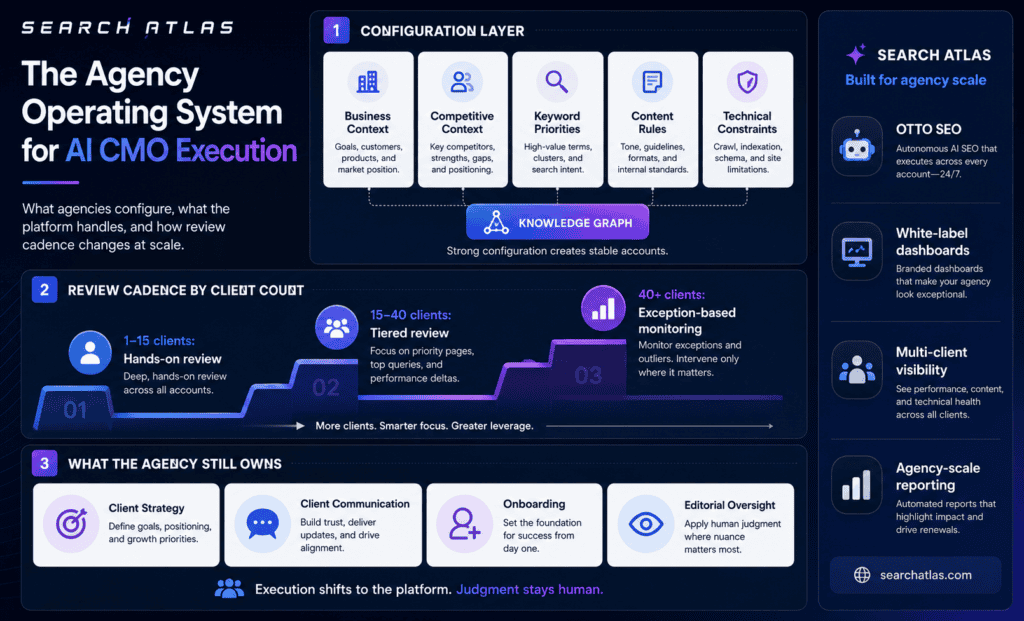
The configuration input that matters most is the Knowledge Graph: the structured business profile covering business identity, competitors, keyword priorities, and content rules that feeds every optimization decision the AI CMO platform makes.
A complete per-client configuration includes:
- Business context. Company name, industry, product or service categories, geographic focus (especially important for local SEO clients), and a specific description of the target customer.
- Competitive context. The three to five competitors a client’s prospects actually compare them to. Not broad industry competitors, just the specific alternatives that appear in “X vs Y” searches and in the buyer’s consideration set.
- Keyword priorities. The topic clusters the client wants to build authority in, not just individual target keywords. This allows the AI CMO platform to make coherent optimization decisions across a site rather than treating each page independently.
- Content rules. Terms the client requires, terms the client prohibits, and any brand voice constraints that the AI CMO platform should respect in generated content.
- Technical constraints. Pages that should not be modified, URL structures that must be preserved, and any CMS-specific limitations that affect how the AI CMO platform deploys changes.
For a new client onboarding, this configuration takes 45 to 90 minutes per client. It is not a technical task. It is a strategy task that happens to feed a technical system. Agencies that treat it as a setup formality produce accounts that require ongoing firefighting. Agencies that treat it as the primary strategic deliverable produce accounts that run stably. Ecommerce clients carry a few extra configuration wrinkles — see AI CMO for Ecommerce Brands.
Review cadence at different scales
The review model changes as the client count grows. There are three distinct operational modes:
Hands-on review (1–15 clients). Each client gets a dedicated weekly or bi-weekly review covering: what the AI CMO platform deployed, what is pending approval, ranking movement, content performance, and paid efficiency. This model is thorough but does not scale past 15 to 20 clients per account manager.
Tiered review (15–40 clients). Clients are tiered by volatility and value. High-value or high-activity clients get the hands-on review cadence. Stable, lower-activity clients shift to exception-based monitoring: the account manager reviews only when an alert threshold is triggered. The alert thresholds (ranking drops above a defined percentage, traffic declines beyond a floor, and technical errors above a count) are configured in advance.
Exception-based monitoring (40+ clients). The default state for every account is “no action needed.” The team reviews only the accounts that surface active alerts. Well-configured accounts running stably are checked monthly at most. The team’s calendar shifts from scheduled reviews to on-demand issue resolution.
The economics of this model: an account manager handling 15 clients in hands-on mode typically has no capacity remaining. The same account manager handling 40 clients in exception-based mode has meaningful capacity for onboarding, strategy, and client communication.
What the agency still owns
The AI CMO model shifts execution but does not eliminate the need for strategic and relational work. Agencies that implement this model successfully are explicit about what stays human.
The Multiplayer Marketing model reframes the team’s role: rather than executing tasks, the team co-holds strategy with Atlas Agent. The team sets the direction, configures the rules, and defines what good looks like. Atlas Agent holds that direction against every live surface and proposes corrections when they diverge. The team’s job is to approve, adjust, and escalate, not to implement.
Client strategy. The goal-setting that feeds the AI CMO platform configuration is a human task. What the client wants to achieve, which channels matter, and what metrics define success: these inputs require conversation and judgment.
Client communication. Explaining AI CMO platform outputs to clients, translating data into business narratives, and managing expectations around timeline and results are relationship tasks.
Onboarding. The initial configuration requires a structured intake conversation with the client to gather the inputs the AI CMO platform needs. That conversation has strategic value beyond the data it produces.
Escalations. When an AI CMO platform output is unexpected, incorrect, or requires a judgment call the team has not pre-specified, a human resolves it.
Content editorial oversight. Platform-generated content drafts require a human reviewer to verify claims, check brand voice, and confirm the output matches what the client would actually want published.
How Search Atlas supports agency-scale operations
Search Atlas is explicitly designed for agency use at scale. Atlas Agent, Search Atlas’s AI system that coordinates execution across OTTO SEO, Content Genius, Smart Ads, and LLM Visibility, powers over 50,000 websites and is trusted by more than 5,000 agencies.
The features that matter for agency operations:
OTTO SEO per-client deployment. OTTO SEO is Search Atlas’s autonomous SEO execution agent that deploys live on-page modifications via a JavaScript pixel. Each client site gets its own OTTO SEO project with its own Knowledge Graph, GSC connection, and change log. OTTO SEO saves 90% of manual SEO labor. For agencies managing SEO implementation across multiple client sites, that compression is significant.
White-label dashboards. The Pro plan ($399/month) includes full white-label reporting. Client-facing dashboards display under the agency brand with no Search Atlas branding visible.
Multi-client visibility. The agency-level view aggregates status across all active client projects without requiring separate logins or report exports.
Scalable plan structure. The Pro plan supports 4 OTTO SEO projects, unlimited GSC connections, and 5 user seats. Agencies managing more than 4 active OTTO SEO deployments move to the Enterprise plan, which provides unlimited scale and API access for custom reporting integrations.
OTTO SEO full setup and agency deployment details.
The bottom line
The agencies that grow efficiently past 20, 30, or 50 clients are not the ones that hire faster. They are the ones who invest in the configuration layer that makes each client account run with less ongoing human input.
That investment concentrates on onboarding: 45 to 90 minutes of structured configuration per client, done correctly once, produces an account that the team can manage in 5 to 10 minutes per week. That same configuration done hastily produces an account that consumes an hour per week indefinitely.
The AI CMO model does not replace the agency. It replaces the execution layer that was previously billed at agency hourly rates. What remains (strategy, relationships, configuration, and judgment calls) is where agency value actually lives.
Related Reading