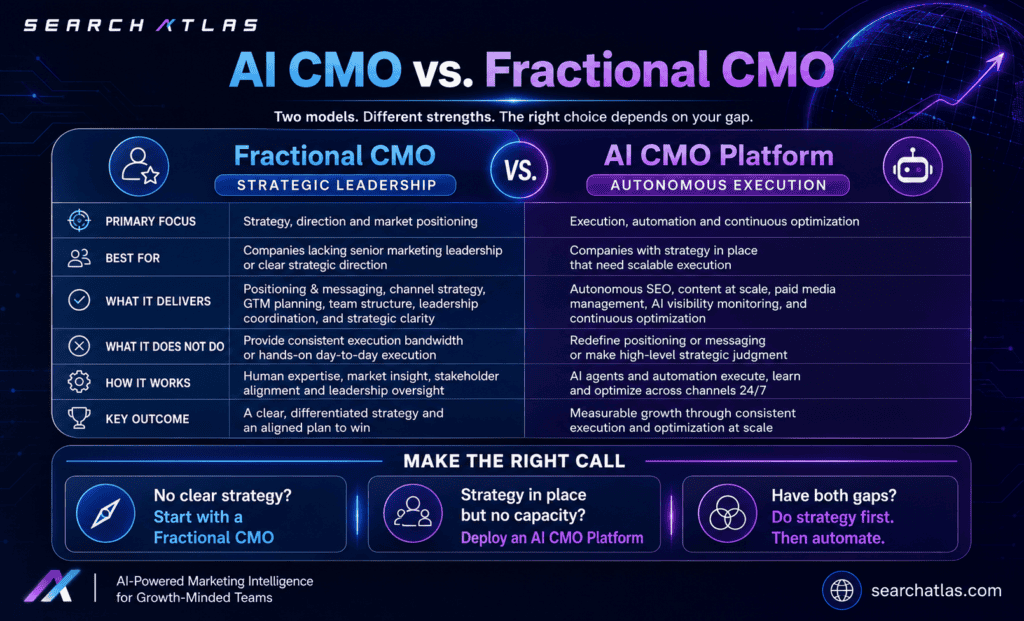
The choice between an AI CMO and a fractional CMO depends on where your marketing gap actually sits, not on which option costs less.
Both models exist to fill a marketing leadership void without a full-time executive hire. But they solve different problems for different company stages. A company that lacks strategic direction needs a different solution than a company with a clear strategy and no capacity to run it. See What Is an AI CMO? for the full definition, and AI CMO for Startups for how this plays out at the lean-team stage specifically.
Getting this wrong is expensive. Companies that hire a fractional CMO to solve an execution problem end up with better strategy documents that still do not get implemented. Companies that buy an AI CMO platform to solve a strategy problem execute efficiently against the wrong objectives. Neither outcome is the model’s fault.
Key takeaways:
- A fractional CMO fills a strategic gap: direction, positioning, team structure, and leadership coordination
- An AI CMO platform fills an execution gap: autonomous SEO, content production, paid media, and AI visibility operations
- The decision variable is gap type, not price
- Most early-stage companies carry both gaps; the right sequence is to resolve the strategic gap before deploying autonomous execution
What is a fractional CMO?
A fractional CMO is a senior marketing executive who splits time across multiple companies, typically on a monthly retainer. The model emerged from the same logic as fractional CFOs and fractional CTOs: not every company at every stage can justify or afford a full-time executive, but they still need experienced leadership.
The scope of a fractional CMO retainer varies widely. Some operate in a pure advisory capacity: attending a weekly strategy call, reviewing plans, and providing feedback on campaigns already in progress. Others take on operational responsibility: managing a marketing team, owning channel budgets, and driving execution alongside the in-house team.
What a fractional CMO typically delivers:
- Brand positioning and messaging. Defining what the company stands for, who the target customer is, and how the value proposition differentiates from competitors. This is the foundational strategy layer that everything downstream depends on.
- Channel strategy. Deciding which acquisition channels to prioritize, in what order, and with what budget allocation. This requires judgment about where the target customer actually spends attention and what the company can credibly execute.
- Go-to-market planning. For product launches, market expansions, or pivots: sequencing the marketing activities, coordinating with sales and product, and setting the criteria for what success looks like.
- Team building and structure. Assessing whether the current marketing team has the right skills, identifying gaps, building hiring roadmaps, and creating the accountability structures that let a team perform without constant management.
- Leadership coordination. Connecting marketing decisions to product roadmap, to sales targets, and to the board-level narrative. A fractional CMO participates in leadership conversations in a way that a marketing manager or an external agency typically cannot.
What a fractional CMO does not provide: consistent execution bandwidth. They set direction. The execution happens through the in-house team, an agency, a platform, or more commonly, some combination of all three.
What is an AI CMO?
An AI CMO is a software platform that autonomously executes the marketing operations layer (SEO, content, paid media, and brand visibility), acting on decisions rather than recommending them. It handles the continuous, repeatable work that fills marketing calendars: SEO optimization, content production at scale, paid media management, and brand visibility monitoring across traditional and AI search.
This is the model Search Atlas calls Multiplayer Marketing. Most AI tools are single-player: one person, one prompt, one asset, with no view of the full strategy. Atlas Agent, Search Atlas’s Copilot CMO, is the multiplayer implementation: it holds the strategy with the team, watches live surfaces against that strategy, and flags when what is live no longer reflects what the strategy says.
The distinction matters because a single-player tool optimizes one page while the rest of the site drifts; a multiplayer system watches everything at once.
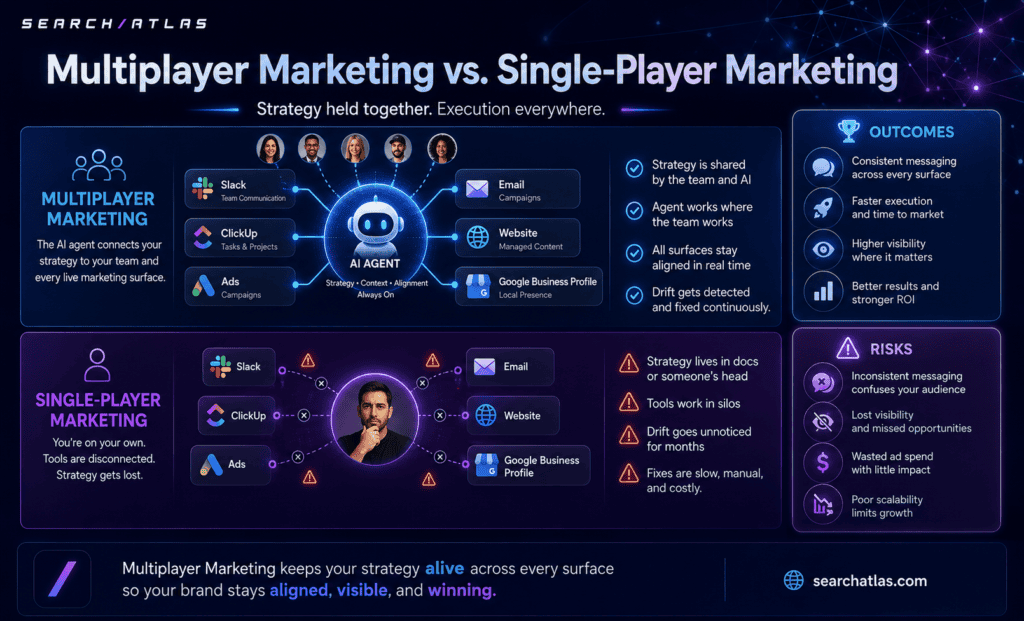
The defining characteristic of an AI CMO platform is that it acts rather than recommends. Traditional SEO software audits a site and produces a list of issues for a human to implement. An AI CMO platform audits the same site and applies the fixes directly, logging every change and providing rollback capability.
The functions a mature AI CMO platform covers:
SEO execution. Continuous on-page optimization (titles, headings, metadata, internal links, schema, canonical tags) applied directly to live sites without developer involvement.
Content production. Keyword-grounded content creation at volume, scored against structured quality dimensions before publication. The platform generates drafts that a human editor reviews and publishes, rather than a writer building from a blank page.
Paid media management. Campaign structure, keyword clustering, ad copy generation, bid optimization, and negative keyword management run continuously against conversion data. Changes deploy directly into live campaigns at approval checkpoints.
AI visibility monitoring. Tracking brand mentions, share of voice, and sentiment across AI-generated responses from ChatGPT, Claude, Gemini, and Perplexity. This channel did not exist in traditional marketing stacks and is not covered by any fractional CMO’s standard scope.
What a fractional CMO does that autonomous platforms cannot
A fractional CMO covers:
- Strategic positioning. Repositioning a company in a market, redefining who the customer is, what the value proposition is, or what category the company belongs to, is a qualitative judgment task. It requires synthesizing competitive intelligence, customer feedback, product direction, and market trends into a coherent strategic bet.
- Qualitative customer insight. A good fractional CMO conducts customer interviews, reviews sales call recordings, and translates qualitative signals into strategic implications. Understanding why customers actually buy, why they churn, and what jobs they are hiring the product for is not derivable from keyword data or ranking signals.
- Organizational judgment. Deciding whether the marketing team needs a content strategist or a demand gen manager, whether the agency relationship is producing results, or whether the current channel mix reflects actual opportunity or historical inertia: these are judgment calls that require organizational context.
- Stakeholder management. A fractional CMO attends leadership meetings, manages expectations with the board or investors, and connects marketing outcomes to the financial narrative. That relationship layer is not automatable.
- Pre-product-market-fit strategy. For companies that have not yet found product-market fit, an AI CMO platform has limited signal to work from. There is no content history, no ranking data, no conversion baseline.
What an autonomous platform does that a fractional CMO does not
An autonomous CMO platform contributes:
- Continuous execution. A fractional CMO works part-time, typically 10 to 20 hours per month at the advisory level. An AI CMO platform runs every hour of every day. For SEO, content, and paid operations, the difference between continuous execution and periodic attention is significant.
- Speed of implementation. When a fractional CMO identifies a technical SEO problem, fixing it still requires a developer, a content writer, and a project cycle. An AI CMO platform identifies and fixes the same problem in the same session.
- Volume at scale. Content production, keyword tracking for thousands of keywords, and continuous technical monitoring are difficult to sustain through human teams at a reasonable cost. AI CMO platforms handle the volume without a proportional cost increase.
- LLM visibility. No fractional CMO currently monitors brand presence across AI-generated responses as a standard deliverable. This channel matters increasingly for B2B buyers who start their research with an AI assistant rather than a Google search.
- Data continuity. A fractional CMO who leaves takes their institutional knowledge. An AI CMO platform retains all historical data, change logs, and performance records.
- Drift detection. A fractional CMO sets positioning and channel strategy, then checks in periodically. In between, live surfaces (ads, landing pages, GBP listings) accumulate copy that no longer reflects current positioning. That drift is invisible to local quality checks: a headline can pass readability scoring and still misrepresent the company.
Atlas Agent runs the sense-detect-propose-approve-heal loop continuously: it watches strategy and live surfaces simultaneously, detects when a live surface has drifted from current positioning, drafts the corrective change, and gates it behind a human approval step before applying it.
The real decision: where is your gap?
Before choosing, identify which type of gap your company actually has.
-
Strategic gap. The marketing function does not have clear answers to: who is the target customer, what problem does the product solve better than alternatives, which acquisition channels are worth investing in, and why the current performance is not matching expectations. If these questions are unanswered or contested internally, you have a strategic gap.
-
Execution gap. The strategic answers are clear, but marketing operations are inconsistent, understaffed, or falling behind. Content does not get published on schedule. SEO recommendations never get implemented. Paid campaigns are underoptimized. You know what to do; there is not enough capacity to do it.
Most early-stage companies carry both gaps simultaneously. The sequencing matters: deploying an autonomous execution platform before resolving the strategic gap produces efficient execution of the wrong plan. The right sequence is strategy first, then execution.
A diagnostic test: can your team answer the following questions in one sentence each?
– Who is your ICP, described by role, company size, and specific problem?
– What acquisition channel has the strongest signal for your market?
– Why does a prospect choose you over the closest alternative?
If those answers are clear and agreed on internally, you have a defined strategy to execute against. If they are contested or vague, start with the fractional CMO.
Decision matrix: company stage and the right CMO model
| Stage | Primary gap | Right model |
| Pre-product-market fit | Strategic | Fractional CMO |
| Post-PMF, no marketing team | Execution | AI CMO platform |
| Post-PMF, lean team (1–2 people) | Execution + light strategy | AI CMO platform + fractional advisory |
| Post-PMF, team of 3–5 | Execution at scale | AI CMO platform |
| Series A with brand inflection point | Strategic + execution | Fractional CMO for strategy + AI platform for execution |
| Agency managing multiple clients | Execution across accounts | AI CMO platform |
How the hybrid model works
A hybrid model works when strategic decisions and execution decisions stay clearly separated.
In practice: the fractional CMO owns the channel strategy, the content cluster priorities, the campaign briefs, and the positioning work. The AI CMO platform executes against those priorities: deploying SEO fixes, producing content drafts against approved briefs, managing paid campaigns, and monitoring AI visibility.
The fractional CMO reviews AI CMO platform outputs every two to four weeks and adjusts strategic priorities based on what the data shows. The AI CMO platform executes continuously between those reviews.
This model has one significant constraint: the fractional CMO needs to understand how to configure and interpret an AI CMO platform. A fractional CMO who cannot read a GSC trend line, does not understand how Knowledge Graph (the structured business profile that feeds platform optimization decisions) inputs affect SEO priorities, or treats the platform’s reporting as uninterpretable, will duplicate effort and miss the platform’s actual outputs. When evaluating fractional CMO candidates for a hybrid model, platform literacy is a relevant criterion.
What to look for in an AI CMO platform
The evaluation criterion that matters most is execution depth: does the AI CMO platform act, or does it recommend?
A recommendation tool produces an audit with a list of changes to make. The human team translates that list into tasks, coordinates implementation, and revisits the audit next quarter. An AI CMO platform applies the changes directly, logs what it did, and continuously monitors the impact.
Secondary criteria:
– Does the AI CMO platform share a data layer across SEO, content, and paid, or are they separate modules with separate data?
– What are the approval checkpoint options? Can the team run a review period before switching to autonomous deployment?
– What does rollback look like if a change produces unexpected results?
– Does the AI CMO platform track AI visibility (LLM mentions), or only traditional search?
One more criterion that separates platforms at the architecture level: ask whether the platform holds strategy across the whole team and watches live surfaces for drift, or whether it executes one asset at a time with no view of the whole. A tool that optimizes a single page on request is still single-player. A platform that keeps the strategy in scope, monitors what is live against it, and routes corrections through a human approval step is multiplayer. That gap is not a feature difference; it is a structural one.
Search Atlas covers all four execution layers (SEO, content, paid, and AI visibility) from one platform with a shared Knowledge Graph. OTTO SEO (Search Atlas’s autonomous SEO execution agent) handles on-page fixes, technical corrections, and internal link deployment directly on live sites. Plans start at $99/month for the Starter tier, scaling to $399/month for the Pro tier with four OTTO SEO projects and full white-label capability.
Related Reading