Semantic search optimization is the process of structuring content around meaning, intent, and entity relationships instead of isolated keywords. The meaning of semantic search optimization explains how search systems interpret queries through context, which determines how content is retrieved, ranked, and reused across search engines and AI-generated answers. This explanation clarifies how semantic search optimization works in practice.
Semantic search optimization matters because modern search systems evaluate contextual relevance, entity clarity, and topical depth when selecting content. Systems that rely on semantic understanding analyze relationships between concepts, which improves accuracy beyond keyword matching. This evaluation shows how semantic search optimization works in SEO, where meaning and intent define visibility instead of exact phrases.
Semantic search optimization operates through interconnected systems that process language, structure knowledge, and retrieve relevant information. These systems include semantic ranking models, knowledge graphs, and hybrid retrieval architectures that combine keyword and vector search. Together, these systems interpret user intent, map entities, and rank content based on contextual alignment, which explains how semantic search systems function.
Semantic search optimization creates measurable advantages for content performance across search and AI environments. Optimized content improves ranking consistency, increases engagement, and strengthens inclusion in AI-generated answers. Content that aligns with semantic systems gains higher visibility because it matches how search engines and AI models interpret and reuse information.
Semantic search optimization requires structured implementation through entity-based content, topic clusters, intent alignment, and technical optimization. Content that integrates these elements builds strong semantic signals, which improve retrieval accuracy and ranking performance. The ability to implement semantic search optimization consistently ensures content remains relevant, authoritative, and visible across evolving search environments.
What Is Semantic Search Optimization?
Semantic Search Optimization is an advanced SEO approach that prioritizes understanding context and intent behind queries instead of keyword matching. Semantic Search Optimization defines how content structure, entity clarity, and topic depth improve how search systems interpret meaning. This approach organizes content so search engines understand relationships between concepts, which increases relevance, accuracy, and visibility across results.
Semantic Search Optimization evolved through major search system updates that improved language understanding and contextual interpretation. The Google Knowledge Graph introduced entity relationships in 2012, which changed how search interprets meaning. The Google Hummingbird update refined query interpretation in 2013, which improved intent matching. The RankBrain system in 2015 and BERT in 2019 expanded contextual understanding, which strengthened semantic relevance. The rise of Google AI Overviews in 2024 shifted search toward generated answers, which increased the importance of semantic structure.
Semantic Search Optimization belongs to a broader group of digital marketing strategies focused on improving visibility through relevance and intent alignment. Semantic Search Optimization replaces keyword density with topic coverage, which shifts focus toward meaning and relationships. This shift aligns content with user intent, which improves accuracy and satisfaction across search results. Semantic Search Optimization connects closely with user experience and content strategy, which reinforces clarity, structure, and contextual depth.
What defines the core components of Semantic Search Optimization? There are 4 main components of semantic search optimization. Firstly, content strategy focuses on intent-driven answers written in natural language. Content strategy improves clarity because structured answers match query intent and increase visibility. Secondly, semantic keyword research identifies topic-based keywords grouped by intent and meaning. Semantic keyword research improves planning because topic clusters organize content into clear semantic structures.
Thirdly, structured data implementation defines content using schema markup for machine-readable context. Structured data improves interpretation because search engines identify entity relationships and contextual relevance. Fourthly, the internal linking strategy connects related pages using descriptive anchor text. Internal linking improves structure because semantic relationships between pages strengthen topical authority.
What are the main attributes of Semantic Search Optimization? There are 3 main attributes of semantic search optimization. Firstly, contextual understanding explains how systems interpret meaning beyond exact keyword matches. Contextual understanding relies on Natural Language Processing (NLP) and Machine Learning, which identify the intent behind queries. Secondly, entity recognition identifies people, places, and concepts within queries and connects them through relationships. Entity recognition uses knowledge graphs, which strengthen semantic connections and improve answer accuracy. Thirdly, AI alignment measures how the content structure matches AI retrieval systems and ranking logic. AI alignment increases visibility because a higher similarity between the query and the content improves citation frequency in AI-generated results.
Why does Semantic Search Optimization exist as a system requirement? Semantic Search Optimization exists because search systems require contextual interpretation instead of keyword matching. Semantic Search Optimization increases as AI systems analyze intent, which demands structured and meaningful content. This requirement explains why traditional keyword-focused methods lose effectiveness across modern search systems. Semantic Search Optimization improves accuracy because content reflects real meaning instead of isolated terms. This improvement increases visibility, engagement, and conversion performance across search environments.
Semantic Search Optimization functions as a control system for relevance and meaning in modern search environments. Semantic Search Optimization determines whether content aligns with user intent or fails to match contextual expectations. This control defines ranking outcomes because search systems prioritize meaning, relationships, and entity clarity over keyword repetition.
Why Does Semantic Search Optimization Matter?
Semantic search optimization matters because it improves relevance, performance, authority, adaptability, technological alignment, and search accuracy across modern search systems. Semantic search optimization defines how content connects with intent, which increases visibility, engagement, and conversion outcomes. This importance grows as AI systems prioritize meaning and relationships instead of keyword repetition.
Enhanced user experience improves relevance through intent-driven results. Enhanced user experience increases engagement because search systems interpret context instead of matching exact words. Improved business performance increases visibility, traffic, and conversions. Improved business performance occurs because structured content aligns with intent and ranks higher across queries.
Brand authority strengthens entity recognition and trust signals. Brand authority grows because consistent entity presence increases credibility across search systems. Voice search adaptation improves performance for conversational queries. Voice search adaptation works because natural language queries require contextual interpretation.
Technological alignment ensures compatibility with evolving AI systems. Technological alignment improves rankings because content matches how systems process language. Faster and more accurate search results increase satisfaction and efficiency. Faster and more accurate results improve outcomes because users receive precise answers with less friction.
How does semantic search optimization enhance user experience? Semantic search optimization enhances user experience through intent-based interpretation and contextual relevance. Semantic search optimization processes natural language, which improves how systems match queries with meaningful results. This approach increases engagement because results reflect actual user intent. For example, a search for “Saturn” returns astronomy content for space-focused queries, which shows contextual personalization.
Why does semantic search optimization improve business performance? Semantic search optimization improves business performance through higher visibility, traffic growth, and stronger ranking positions. Semantic search optimization increases visibility because topic-based content aligns with user intent and search system expectations. For example, a financial services site increased organic visibility by 142% within six months after adopting topic clusters. An e-commerce site increased organic traffic by 76% within four months, while a local service site improved non-branded visibility by 27%.
What makes brand authority critical in semantic search optimization? Brand authority becomes critical because entity recognition defines trust and visibility across AI-driven systems. Brand authority strengthens when a brand appears consistently across sources, which increases recognition inside systems (Google Knowledge Graph). A study of 75,000 brands shows correlation values between 0.66 and 0.71 for visibility across AI systems, which confirms strong authority signals.
How does semantic search optimization adapt to voice search growth? Semantic search optimization adapts to voice search through natural language understanding and conversational query processing. Semantic search optimization matches spoken queries with contextual answers, which improves accuracy for voice interactions. Voice search usage reaches 62% among adults, while smart speaker adoption reaches 35%, which increases demand for semantic interpretation.
Why does continuous technological evolution matter for semantic search optimization? Continuous technological evolution matters because semantic systems improve through AI and language model advancements. Semantic search optimization aligns with systems (Google Hummingbird, RankBrain, BERT, and MUM). These systems refine interpretation, which increases accuracy and contextual relevance.
How do faster and more accurate searches benefit users and businesses? Faster and more accurate searches increase satisfaction, engagement, and conversion rates. Semantic search optimization improves relevance because content matches intent and context precisely. For example, e-commerce conversion rates become 3 times higher for pages loading in 1 second compared to 5 seconds, which shows the impact of efficient retrieval and user satisfaction.
Semantic search optimization functions as a performance driver across modern search environments. Semantic search optimization determines whether content aligns with intent, which defines visibility, authority, and competitive advantage.
How Does Semantic Search Work?
Semantic search works by interpreting query intent and contextual meaning instead of matching exact keywords to retrieve results. Semantic search processes language, entities, and relationships, which allows systems to return relevant and human-like answers. This process improves accuracy and efficiency because systems understand what a query means instead of what a query says.
Semantic search operates through a structured system of components that enable contextual interpretation and semantic matching. NLP interprets human language, which extracts meaning and intent from queries. Machine learning identifies patterns, which improves accuracy through continuous learning. Vector embeddings represent meaning as numerical vectors, which enable similarity comparison across queries and documents. The Google Knowledge Graph connects entities, which enriches context and relationship mapping. Vector databases store embeddings, which enable fast retrieval across millions of records. Large Language Models (LLMs) process complex queries, which generate contextual responses.
What are the main steps in how semantic search works? There are 6 main steps in semantic search processing. The 6 main steps define how systems interpret queries, match meaning, and refine results continuously.
1. Query analysis. Interprets intent and extracts entities, which improves understanding because systems identify meaning behind words and phrases.
2. Query vectorization. Converts the query into a numerical embedding, which enables comparison because semantic meaning becomes measurable in vector space.
3. Document vectorization. Transforms indexed content into embeddings, which organizes content because similar meanings cluster closely in vector space.
4. Similarity calculation. Compares query and document vectors, which retrieves relevant content because mathematically close vectors indicate similar meaning.
5. Contextual ranking. Orders results based on relevance and user context, which improves accuracy because personalization signals refine output quality.
6. Result presentation and feedback loops. Refine system performance, which improves learning because interaction data updates ranking models continuously.
How does query analysis and intent interpretation work in semantic search? Query analysis works by breaking a query into tokens, entities, and contextual signals. Query analysis uses Natural Language Processing, which identifies structure and meaning inside language. LLMs interpret intent, which differentiates between similar phrases based on purpose. This step improves accuracy because systems understand informational, navigational, and transactional intent.
How does vectorization enable semantic similarity matching? Vectorization converts queries and documents into embeddings that encode meaning across hundreds of dimensions. Vectorization uses models (BERT), which generate dense numerical representations. Similarity matching calculates the distance between vectors, which identifies conceptually related content even without shared keywords. This mechanism increases relevance because meaning replaces keyword overlap.
How does semantic indexing and retrieval work in practice? Semantic indexing processes all documents into vector embeddings stored inside vector databases. Semantic indexing positions related content close together, which enables rapid retrieval during search queries. Retrieval compares query vectors with document vectors, which identifies the closest matches in milliseconds. This process enables a large-scale search across millions of documents efficiently.
How does contextual ranking refine semantic search results? Contextual ranking evaluates retrieved content based on relevance, intent alignment, and contextual signals. Contextual ranking considers location, history, device type, and time, which personalizes results. Transformer-based rerankers analyze structure and meaning, which refine ranking order. This refinement increases precision because results align closely with the user context.
How do feedback loops improve semantic search systems over time? Feedback loops collect interaction signals that refine ranking models and improve future performance. Feedback loops analyze clicks, bounce rates, and conversions, which indicate relevance quality. Machine learning updates models based on feedback, which increases accuracy and reduces irrelevant results. This process improves performance by up to 20% annually through continuous learning.
What are the key mechanisms behind semantic search systems? There are 3 main mechanisms behind semantic search systems. Firstly, vector embeddings encode meaning into numerical form. Vector embeddings enable similarity comparison because semantic relationships become measurable. Secondly, NLP interprets language structure and intent. NLP improves understanding because systems process nuance and context. Thirdly, knowledge graphs connect entities and relationships. Knowledge graphs improve context because linked data provides structured meaning across concepts.
Semantic search functions as a meaning-based retrieval system that replaces keyword matching with contextual interpretation. Semantic search defines how modern systems retrieve, rank, and present information based on intent, relationships, and relevance.
How Does Google Understand Meaning Instead of Keywords?
Google understands meaning instead of keywords by interpreting context, intent, and relationships between words using advanced AI systems. Google processes language through entities, embeddings, and semantic relationships, which allows systems to match meaning instead of exact terms. This approach improves relevance because results reflect what a query means instead of what a query contains.
Google evolved from keyword matching into meaning-based retrieval through major system advancements that improved contextual understanding. The Google Knowledge Graph introduced entity relationships in 2012, which enabled structured understanding of concepts. The Google Hummingbird system refined query interpretation in 2013, which improved intent matching. The RankBrain system in 2015 introduced machine learning into ranking, which enabled interpretation of unfamiliar queries. Google continues to refine meaning interpretation through large-scale language models, which process billions of queries daily.
Google understanding of meaning relies on a combination of technologies that transform language into structured, comparable representations. NLP interprets sentence structure and context, which allows systems to extract meaning from language. Word embeddings convert words and phrases into numerical vectors, which allows systems to compare meaning mathematically. Semantic search retrieves results based on conceptual similarity, which removes dependency on exact keyword matches.
Cosine similarity measures the distance between vectors, which determines how closely meanings align. Knowledge graphs connect entities and attributes, which provide structured context across topics. Machine learning systems refine interpretation continuously, which improves performance through pattern recognition and feedback.
Word embeddings and vector systems represent words, phrases, and sentences inside a high-dimensional space where distance defines similarity. Similar meanings appear closer together, which allows systems to identify relationships between concepts. For example, “car repair” and “automobile maintenance” appear close in vector space, which enables matching without shared keywords. This mechanism increases relevance because meaning replaces keyword dependency.
Semantic search retrieves documents based on conceptual similarity between the query meaning and the document meaning. Semantic search analyzes relationships between terms, which identifies relevant content even without exact matches. This retrieval method improves accuracy because systems prioritize meaning and intent instead of literal wording.
Cosine similarity calculates the angle between vectors to measure semantic similarity between meanings. Values close to 1 indicate high similarity, which signals strong conceptual alignment between query and content. This calculation improves ranking because systems select content with the closest semantic match.
Knowledge Graph improves meaning interpretation by storing entities, attributes, and relationships across domains. Knowledge Graph connects concepts, which allows systems to interpret queries with context and precision. For example, “Apple” maps to a company or a fruit based on the surrounding context, which improves result accuracy.
RankBrain interprets new and unfamiliar queries by mapping words into vectors and identifying similar known patterns. RankBrain compares query entities with stored knowledge, which enables interpretation of new or rare searches. This system improves coverage because 10 to 15 percent of daily queries appear for the first time.
Google processes search queries through a structured methodology that transforms input into refined meaning. The process begins with thematic classification, which assigns the query to a contextual category. Entity recognition identifies core entities and their meaning, which connects queries with structured knowledge. Semantic understanding interprets relationships between terms, which improves accuracy. Intent identification defines the purpose behind the query, which aligns results with user goals. Semantic annotation enriches queries with contextual data, which refines meaning. Query refinement rewrites queries for precision, which improves final results.
User behavior influences meaning interpretation through interaction signals and feedback mechanisms. Click patterns, dwell time, and query refinements provide data that reflects relevance quality. This data improves models because systems learn which results satisfy user intent.
Google’s understanding of meaning defines how modern search retrieves, ranks, and presents information based on intent, relationships, and conceptual relevance.
How Do AI Answer Engines Decide Which Content to Cite?
AI answer engines decide which content to cite by combining model-native synthesis and retrieval-augmented generation to evaluate relevance, clarity, and trust. AI answer engines scan multiple sources, compare overlapping information, and select content that aligns with consistent facts and structured meaning. This process ensures citations reflect agreement, reliability, and extractable information across the web.
AI answer engines operate through 2 core architectures that define how answers and citations are generated. Model-native synthesis generates responses from learned patterns in training data, which produces fast answers without live sourcing. Retrieval-Augmented Generation (RAG) retrieves documents in real time, which grounds answers in external content and improves factual accuracy. This dual system balances speed and reliability, which determines whether citations appear.
AI answer engines apply a structured pipeline to evaluate and select content for citation. The pipeline consists of 5 main stages. The 5 main stages are query interpretation, source retrieval, content extraction, answer synthesis, and citation decision. Each stage filters content based on alignment, usability, and credibility, which removes most content before final citation selection.
AI answer engines require 3 non-negotiable conditions for citation eligibility. The 3 non-negotiable conditions are retrievability, extractability, and trustworthiness. Retrievability ensures systems locate content through semantic alignment. Extractability ensures systems isolate clear facts from structured content. Trustworthiness ensures content aligns with verified information across multiple sources. Content fails citation if any condition is missing.
AI answer engines evaluate content through consistent criteria that define citation selection. Content clarity and structure increase selection probability because systems extract information more easily. Credibility and validation signals strengthen selection because systems prioritize verified information. Technical structure improves selection because machine-readable formats reduce ambiguity. Recency improves selection because updated content aligns with current information. Neutral tone improves selection because factual content reduces risk during reuse.
AI answer engines prioritize content that presents clear, direct, and structured information. Declarative statements increase selection probability because systems extract facts without rewriting. Structured sections increase selection probability because headings and short paragraphs isolate information clearly. Single-topic focus increases selection probability because mixed intent reduces extractability. This preference explains why simple factual pages outperform complex narrative content.
AI answer engines rely on cross-source agreement to validate information before citation. Repeated claims across independent sources increase confidence, which strengthens citation likelihood. Conflicting information reduces confidence, which removes content from the final selection. This consensus-driven system ensures citations reflect widely supported knowledge instead of isolated claims.
AI answer engines define citation as an outcome of passing structured filters across the retrieval, extraction, and validation stages. AI answer engines determine visibility based on alignment, clarity, and verification, which replaces traditional ranking signals with citation-based selection.
What Is the Semantic Search Architecture?
Semantic search architecture is a structured system that retrieves information based on meaning, context, and intent instead of exact keyword matches. Semantic search architecture defines how content moves from raw text into entities, embeddings, vectors, retrieval pipelines, and ranking systems. Semantic search architecture answers what the semantic search architecture is by defining a multi-layer system that interprets meaning, compares similarity, retrieves relevant content, and ranks results by contextual relevance.
Semantic search architecture evolved from traditional information retrieval systems that depended on lexical matching, TF-IDF, and BM25. Semantic search architecture expanded through machine learning, deep learning, and transformer models after 2018, which improved contextual understanding. Semantic search architecture now operates as a core system for AI search, internal search, e-commerce search, customer support, and RAG.
Semantic search architecture consists of 5 main layers. The 5 main layers are entities and knowledge graphs, embeddings and vector similarity, vector systems, retrieval systems, and ranking systems. Each layer defines a specific function that transforms language into searchable meaning.
1. Entities and Knowledge Graphs
Entities and knowledge graphs define the meaning layer of the semantic search architecture. Entities represent distinct concepts, people, places, products, and topics. Knowledge graphs connect those entities through relationships, attributes, and context, which gives search systems structured meaning beyond words.
Entities reduce ambiguity because keywords change meaning across contexts. The word “Apple” means a company, fruit, or brand, depending on the surrounding entities. Knowledge graphs resolve this ambiguity by connecting Apple to products, founders, locations, and industry categories.
Knowledge graphs use nodes and edges to represent connected knowledge. Nodes represent entities or concepts. Edges represent relationships between those entities. This structure allows semantic search systems to understand context, infer relationships, and retrieve relevant information based on meaning.
Knowledge graphs strengthen semantic retrieval because they connect query meaning with entity relationships. Query expansion adds related concepts to improve coverage. Entity extraction identifies concepts inside queries and documents. Relationship mapping connects those concepts to structured knowledge.
Entities and knowledge graphs create the interpretive foundation of semantic search architecture. This layer defines what concepts mean, how concepts relate, and how search systems disambiguate language.
2. Embeddings and Vector Similarity
Embeddings and vector similarity define the numerical meaning layer of the semantic search architecture. Embeddings transform text, queries, images, or documents into dense numerical vectors that represent semantic meaning. Vector similarity compares those vectors to find content with related meaning.
Embeddings capture context because machine learning models analyze how words appear across large datasets. The word “bank” receives different meanings in “river bank” and “financial bank.” This contextual representation allows semantic search systems to understand nuance, synonyms, and related concepts.
Embeddings use high-dimensional spaces to represent meaning mathematically. Small models often use 128 to 384 dimensions. Medium models often use 512 to 768 dimensions. Large models often use 1,024 to 3,072 dimensions. Higher dimensions increase detail but raise storage and compute costs.
Vector similarity measures how close two embeddings are in a vector space. Cosine similarity measures the angle between vectors. Euclidean distance measures straight-line distance. The dot product compares direction and magnitude. These metrics allow search systems to rank content by semantic closeness.
Embeddings and vector similarity create the comparison foundation of semantic search architecture. This layer turns meaning into measurable distance, which allows systems to retrieve related content without exact keyword overlap.
3. Vector Systems
Vector systems define the storage and similarity search layer of the semantic search architecture. Vector systems store embeddings, index high-dimensional vectors, and return nearest matches for a query vector. This layer explains how semantic search performs fast, meaning-based retrieval at scale.
Vector systems begin with data transformation. Documents, product descriptions, support articles, or media files become embeddings through an embedding model. Large documents get split into smaller chunks, which keeps each vector focused and searchable.
Vector databases store those embeddings for fast retrieval. Common vector databases include FAISS, Pinecone, Qdrant, Weaviate, Milvus, and Chroma. These systems optimize nearest-neighbor search, metadata filtering, and large-scale vector comparison.
Vector systems use exact search or approximate nearest neighbor search. Exact search compares every vector, which works for small datasets. Approximate nearest neighbor search uses algorithms (HNSW, IVF, and LSH), which improve speed across large datasets.
Vector systems often work inside hybrid search models. Hybrid search combines lexical retrieval with vector retrieval, which improves precision and contextual depth. This combination reduces false positives because keyword constraints and semantic similarity work together.
Vector systems create the operational foundation of semantic search architecture. This layer stores meaning, compares meaning, and returns semantically similar results at production speed.
4. Retrieval Systems
Retrieval systems define the candidate selection layer of the semantic search architecture. Retrieval systems identify an initial set of relevant documents from a larger corpus based on query meaning. This layer narrows millions of documents into a smaller candidate set for ranking.
Retrieval systems begin with document ingestion and embedding. Documents get parsed, chunked, embedded, and stored with metadata. Chunking often uses 200 to 500 token segments, which keeps retrieval precise and manageable.
Retrieval systems use query-time retrieval to match a user query with stored content. The query becomes an embedding through the same model used for documents. The system compares the query embedding with stored embeddings and returns the top matching documents.
Retrieval systems evolved from lexical methods to semantic retrievers. BM25 and TF-IDF match words and frequencies. Dense retrievers, late-interaction models, neural sparse retrieval, and cross-encoders capture meaning and context with greater accuracy.
Retrieval systems often pass results to rerankers for refinement. A retriever returns top candidates quickly. A reranker reviews those candidates with deeper semantic evaluation. This process balances speed, accuracy, and computing cost.
Retrieval systems create the selection foundation of semantic search architecture. This layer finds the most relevant candidates before ranking systems decide the final order.
5. Ranking Systems
Ranking systems define the final ordering layer of semantic search architecture. Ranking systems sort retrieved candidates based on relevance, intent alignment, authority, freshness, and contextual signals. This layer determines which results appear first.
Ranking systems evolved from keyword scoring toward semantic evaluation. Modern ranking systems assess whether a page represents a concept clearly and whether the source demonstrates topical authority. Google systems (RankBrain, BERT, MUM, neural matching, and passage ranking) reflect this shift.
Semantic ranking systems often use a retriever and reader architecture. The retriever finds relevant passages. The reader evaluates those passages and identifies the strongest answers. This structure improves answer quality because ranking considers meaning beyond keyword overlap.
Ranking systems use several evaluation approaches. Pointwise ranking scores each item individually. Pairwise ranking compares two items at a time. Listwise ranking evaluates the full result list. Metrics include Precision@k, Mean Reciprocal Rank, Mean Average Precision, and Normalized Discounted Cumulative Gain.
Hybrid search and reranking improve final result quality. Reciprocal Rank Fusion combines lexical and semantic results. Rerankers adjust order based on relevance, freshness, diversity, and usefulness. This process reduces irrelevant matches and improves answer precision.
Ranking systems create the decision foundation of semantic search architecture. This layer transforms retrieved candidates into ordered results that match meaning, intent, and context.
Semantic Search vs Traditional SEO vs Hybrid Search: What Is the Difference?
The difference between semantic search, traditional SEO, and hybrid search lies in interpretation, retrieval method, and ranking logic across search systems. Semantic search interprets meaning and intent, traditional SEO matches exact keywords, and hybrid search combines both approaches. This distinction defines whether a system prioritizes contextual relevance, strict precision, or a balanced retrieval strategy.
Semantic search focuses on meaning and relationships between words, which allows systems to understand the intent behind queries. Traditional SEO focuses on exact keyword matching, which limits interpretation to literal terms and phrases. Hybrid search combines semantic similarity with keyword matching, which balances contextual understanding and exact precision.
This contrast explains why semantic search improves relevance, traditional SEO improves accuracy for exact queries, and hybrid search improves overall coverage across different query types.
The core differences between semantic search, traditional SEO, and hybrid search are below.
| Aspect | Semantic Search | Traditional SEO | Hybrid Search |
| Core mechanism | Interprets meaning, intent, and relationships using AI and embeddings. | Matches exact words and phrases using lexical scoring. | Combines semantic similarity and keyword matching. |
| Query interpretation | Expands queries with context, synonyms, and related concepts. | Relies on exact terms without understanding meaning. | Uses both exact matches and contextual interpretation. |
| Strength | High relevance for natural language and intent-driven queries. | High precision for structured and exact-match queries. | Balanced relevance and precision across all query types. |
| Limitation | Lower precision for strict queries and higher compute requirements. | No contextual understanding or synonym recognition. | Higher complexity due to dual-system execution. |
| Use case | Q&A systems, content discovery, conversational search. | SKU lookup, error codes, file, and document search. | E-commerce, documentation, and internal knowledge bases. |
| Performance | Moderate latency due to embedding and semantic processing. | Very fast with minimal compute cost. | Moderate latency with improved recall and precision. |
| Ranking logic | Based on semantic similarity and contextual relevance. | Based on keyword frequency and exact matching signals. | Combines lexical scores and semantic similarity. |
What does semantic search do in search systems? Semantic search interprets query meaning and retrieves content based on context and relationships between concepts. This interpretation increases relevance because systems match intent instead of exact wording. This relevance improves engagement, reduces zero-result queries, and strengthens discovery across complex datasets.
What does traditional SEO do in search systems? Traditional SEO retrieves content through exact keyword matching and lexical scoring methods. This retrieval increases precision because results match exact queries without ambiguity. This precision improves performance for structured queries, identifiers, and technical searches where accuracy is critical.
Why does hybrid search combine semantic and traditional methods? Hybrid search combines both methods to balance contextual relevance and exact precision in search results. This combination reduces weaknesses from each approach because semantic recall and keyword precision operate together. This balance improves accuracy, reduces missed results, and increases user satisfaction.
When does semantic search outperform traditional SEO? Semantic search outperforms traditional SEO in natural language queries and intent-driven searches where wording varies. This advantage appears because semantic systems interpret meaning, relationships, and synonyms. This capability reduces the mismatch between how users search and how content is written.
When does traditional SEO outperform semantic search? Traditional SEO outperforms semantic search in exact-match queries that require strict precision and no ambiguity. This advantage appears in searches for SKUs, codes, file names, and legal or technical terms. This precision prevents irrelevant results from conceptual similarity.
When does hybrid search provide the best results? Hybrid search provides the best results in environments with mixed query types and complex content structures. This advantage appears in e-commerce platforms, documentation systems, and enterprise search environments. This balance ensures both exact matches and context-driven results appear correctly.
Semantic search, traditional SEO, and hybrid search define three distinct retrieval strategies that control how systems interpret queries and rank results. Semantic search prioritizes meaning, traditional SEO prioritizes precision, and hybrid search combines both to optimize relevance, accuracy, and coverage across modern search environments.
Can Semantic SEO and Keyword-Based SEO Be Combined?
Yes. Semantic SEO and keyword-based SEO work together because search performance depends on intent alignment, topical depth, and precise query targeting. Semantic SEO builds contextual relevance, while keyword-based SEO captures exact queries with clear intent. This combination creates a balanced strategy that improves visibility, rankings, and traffic across modern search systems.
Semantic SEO and keyword-based SEO work together because semantic structure expands coverage beyond single keywords into full topic clusters. Keyword-based SEO targets specific queries that drive direct traffic to landing pages. This combination increases reach because content ranks for both exact matches and related concepts.
Semantic SEO and keyword-based SEO work together because search systems prioritize meaning, entities, and relationships instead of isolated keywords. Systems (Google Knowledge Graph) connect concepts, which improves contextual interpretation. Models (BERT) interpret intent, which improves ranking for semantically aligned content.
Semantic SEO and keyword-based SEO work together because keyword targeting creates entry points while semantic optimization builds authority across topics. A page optimized for one keyword ranks for dozens of related queries after semantic expansion. This expansion explains why content attracts traffic far beyond initial keyword volume.
Semantic SEO and keyword-based SEO work together because internal linking and site architecture connect related topics into structured clusters. A well-linked site reinforces entity relationships, which strengthens topical authority. This structure improves crawlability, indexing, and ranking consistency across pages.
Semantic SEO and keyword-based SEO work together because modern algorithms interpret intent in real time instead of matching isolated phrases. The Google Hummingbird system connects multiple related terms to a single query, which expands ranking potential. This behavior allows content to rank for dozens of variations from one optimized page.
Semantic SEO and keyword-based SEO work together because combined strategies outperform isolated approaches in both short-term and long-term performance. Keyword-based SEO drives immediate traffic from specific queries. Semantic SEO builds sustained visibility through topic coverage and contextual relevance. This combination ensures consistent growth, stronger authority, and higher ranking stability.
How to Implement Semantic Search Optimization?
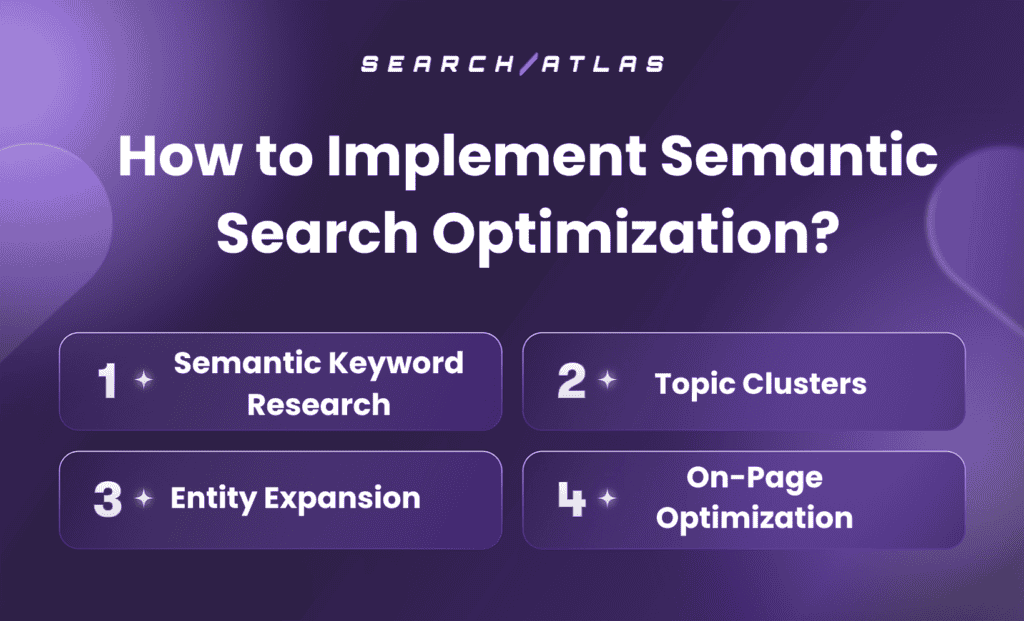
Semantic search optimization is implemented by mapping topics, structuring content around intent, expanding entities, and optimizing on-page elements for semantic systems. Semantic search optimization improves how search engines understand meaning, context, and relationships across content. This implementation process replaces isolated keyword targeting with structured topic coverage, entity clarity, and machine-readable content organization.
The 4 methods to implement semantic search optimization are listed below.
- Semantic Keyword Research: Mapping Topics Instead of Strings.
- Topic Clusters: Structuring Content Around Intent.
- Entity Expansion: Finding Related Entities and Questions.
- On-Page Optimization: Structuring Content for Semantic Systems.
1. Semantic Keyword Research: Mapping Topics Instead of Strings
Semantic keyword research maps topics instead of strings by grouping keywords according to meaning, intent, and conceptual relationships. Semantic keyword research identifies how people describe the same idea across different queries, which allows content to cover a topic comprehensively. This method improves semantic search optimization because search systems evaluate meaning, not isolated keyword repetition.
Semantic keyword research differs from traditional keyword research because it studies relationships between queries instead of exact phrases. Traditional keyword research prioritizes search volume, keyword difficulty, and exact match usage. Semantic keyword research prioritizes intent, entities, related concepts, and topical coverage. This difference matters because modern search systems understand that “car repair,” “automobile maintenance,” and “vehicle service” refer to related ideas.
Semantic keyword research begins with a core topic. The core topic defines the main subject that the page or content cluster targets. For example, a core topic “semantic search optimization,” “internal linking,” or “technical SEO.” Each core topic expands into subtopics, related entities, attributes, questions, and use cases. This expansion creates a topic map instead of a keyword list.
Semantic keyword research uses 5 main inputs. The 5 main inputs are seed keywords, People Also Ask questions, related searches, competitor headings, and entity databases. Seed keywords define the starting point. People Also Ask questions reveal user intent. Related searches expose adjacent concepts. Competitor headings show topic expectations. Entity databases clarify relationships between concepts.
Machine learning improves semantic keyword research by clustering keywords based on meaning. Models (sBERT) convert queries into embeddings, which group similar meanings together. K-Means clustering groups related queries into topic clusters. BERTopic identifies themes inside large keyword datasets. These methods reduce manual sorting and preserve semantic nuance across large lists.
Semantic keyword research avoids string matching because strings miss meaning. String matching compares characters, spelling, and phrase similarity. Semantic matching compares intent, context, and meaning. This distinction explains why fuzzy matching finds “optimize” and “optimise,” while semantic matching connects “improve search visibility” with “rank higher in Google.”
Mapping topics with semantic keyword research follows 6 main steps. First, define the core topic. Second, collect keyword and question data. Third, cluster queries by semantic similarity. Fourth, label each cluster by intent. Fifth, map clusters to pages. Sixth, identify gaps where no content exists.
Intent mapping gives semantic keyword research its practical value. Informational intent requires definitions, explanations, and guides. Commercial intent requires comparisons, benefits, and decision criteria. Transactional intent requires product pages, pricing pages, and conversion content. Navigational intent requires brand, product, or category alignment.
Semantic keyword research improves content planning because it prevents keyword cannibalization. Cannibalization happens if multiple pages target the same intent with similar content. A semantic map assigns one intent to one primary page. Related pages cover adjacent subtopics without competing for the same query set.
Semantic keyword research strengthens topical authority because it creates complete topic coverage. Complete topic coverage shows that search systems that a website understands the full subject. This coverage improves semantic relevance because the site connects core concepts, supporting details, and related questions in a logical structure.
Semantic keyword research now matters for AI search because generative systems extract answers from clearly mapped concepts. AI systems cite pages that answer questions directly and align with established topic language. A page that defines one concept clearly, answers related questions, and uses consistent entity terms becomes easier to retrieve and reuse.
Semantic keyword research defines the foundation of semantic search optimization. This method transforms scattered keyword data into structured topic intelligence, which guides content creation, internal linking, and AI citation readiness.
2. Topic Clusters: Structuring Content Around Intent
Topic clusters structure content around intent by organizing one broad topic into a pillar page and several related cluster pages. Topic clusters create a connected content system that answers the main topic and its supporting subtopics. This method improves semantic search optimization because search engines understand relationships between pages, concepts, and user needs.
Topic clusters follow a hub and spoke model. The pillar page acts as the hub. The cluster pages act as spokes. The pillar page gives a broad explanation of the topic, while cluster pages cover specific questions or subtopics in depth. This structure creates a clear semantic relationship between the main topic and related content. Tools like SEO Topical Maps build this hub-and-spoke structure automatically, turning a single seed keyword into a full pillar-and-cluster content plan organized around entities.
Topic clusters differ from disconnected blog posts because every page has a defined role. A disconnected post targets a single keyword without a clear connection to other pages. A cluster page targets a subtopic that reinforces the pillar page. This connection improves crawl paths, authority distribution, and topical clarity.
Topic clusters begin with content auditing. Content auditing identifies existing pages, performance patterns, and missing subtopics. High-performing pages become pillar page candidates. Weak pages get refreshed, merged, or removed. Missing topics become new cluster page opportunities.
Content auditing uses 5 main checks. The 5 main checks are page performance, search intent match, keyword overlap, content freshness, and internal linking. Page performance shows traffic and engagement. Search intent match shows whether the page satisfies the query. Keyword overlap reveals cannibalization. Content freshness identifies outdated information. Internal linking shows whether pages connect properly.
Core topics and pillar pages define the center of the cluster. A core topic needs to be broad enough for multiple subtopics and focused enough to remain coherent. A pillar page needs to answer the main intent behind the topic. The pillar page usually covers definitions, benefits, methods, examples, and links to supporting cluster pages.
Cluster pages cover narrower subtopics that deserve independent treatment. A cluster page needs to answer a specific intent that the pillar page cannot fully cover. For example, a semantic SEO pillar page links to cluster pages on entity optimization, schema markup, topic clusters, and AI search visibility. Each cluster page deepens the subject without repeating the pillar page.
Internal linking makes topic clusters work. Every cluster page links back to the pillar page. The pillar page links to every important cluster page. Related cluster pages link to each other when the connection adds context. This linking pattern signals that all pages belong to one semantic topic system.
Anchor text matters because descriptive anchors explain page relationships. Generic anchors weaken meaning. Descriptive anchors (semantic keyword research process) clarify the destination topic. Search engines use anchor text to understand the connection between source and target pages.
Topic clusters improve user experience because they guide readers from broad explanations to specific answers. A reader starts with the pillar page and moves into deeper cluster pages. This journey keeps information organized and reduces friction. Strong structure increases engagement because readers find related answers without leaving the site.
Topic clusters improve SERP visibility because they create multiple ranking opportunities across one subject. The pillar page targets broad intent. Cluster pages target long-tail questions and specific subtopics. This structure increases coverage across informational, commercial, and transactional queries.
Topic clusters require ongoing monitoring. Rankings, clicks, impressions, and engagement reveal whether the cluster performs. Search Console identifies new queries that deserve new sections or pages. Analytics shows which cluster pages guide readers toward conversions. Content updates keep the cluster current and competitive.
Topic clusters face 4 main risks. The 4 main risks are weak intent mapping, keyword cannibalization, content overlap, and poor internal linking. Weak intent mapping creates pages that fail to satisfy search needs. Keyword cannibalization splits ranking signals. Content overlap creates repetition. Poor internal linking breaks the semantic connection between pages.
Topic clusters define the structural foundation of semantic search optimization. This method transforms isolated content into a connected topic system, which improves authority, relevance, and search visibility.
3. Entity Expansion: Finding Related Entities and Questions
Entity expansion finds related entities and questions by identifying concepts connected to the main topic. Entity expansion broadens semantic coverage beyond keywords and helps search systems understand the full meaning of a subject. This method improves semantic search optimization because entities define what the content is about and how it connects to other concepts.
Entities are distinct concepts with a clear meaning. Entities include people, organizations, products, places, methods, technologies, and topics. In semantic search, entities reduce ambiguity because they connect language to real concepts. The phrase “Java” means a programming language, an island, or coffee, depending on related entities.
Entity expansion begins with the main entity. The main entity defines the central concept of the page. A page about semantic search optimization has related entities (embeddings, vector databases, knowledge graphs, RankBrain, BERT, search intent, and structured data). These related entities expand context and strengthen topical depth.
Entity expansion uses 5 main sources. The 5 main sources are Google Knowledge Graph, People Also Ask, competitor content, Wikipedia, and internal site content. Google Knowledge Graph reveals recognized entity relationships. People Also Ask reveals question relationships. Competitor content shows expected coverage. Wikipedia provides structured context. Internal content shows existing entity gaps.
Entity expansion improves precision because it disambiguates meaning. A page about “ranking systems” becomes clearer when it mentions search ranking, semantic ranking, retrieval systems, and relevance scoring. These surrounding entities prevent confusion with unrelated ranking contexts (sports rankings or university rankings).
Entity expansion improves recall because it adds related concepts that users search for without using the exact main keyword. A page about semantic SEO rank for queries about entity optimization, topic modeling, AI Overviews, and contextual search. These related queries expand visibility because semantic systems match meaning across concept networks.
Entity expansion requires question mapping. Questions reveal how users express intent around an entity. A topic (semantic search) generates questions about how it works, why it matters, how it differs from keyword search, and how to optimize for it. These questions guide content sections and FAQ blocks.
Entity expansion follows 6 main steps. First, define the primary entity. Second, identify related entities. Third, group entities by relationship type. Fourth, collect user questions around each entity. Fifth, map entities to headings and sections. Sixth, connect entities through internal links and schema.
Relationship types improve entity mapping. Parent entities define broad categories. Child entities define narrower concepts. Peer entities define alternatives or related methods. Attribute entities define features and properties. Process entities define steps or workflows. This relationship structure improves content depth and semantic clarity.
Entity expansion works with schema markup because schema defines entities for machines. Article schema, FAQ schema, Organization schema, Product schema, and Breadcrumb schema clarify what a page contains. Schema does not replace content quality, but it strengthens machine interpretation when the visible content matches the markup.
Entity expansion improves AI citation potential because AI systems prefer clear, stable, and connected concepts. A page that defines entities consistently becomes easier to extract. A page that connects entities through factual statements becomes easier to synthesize. A page that aligns with other trusted sources becomes easier to validate.
Entity expansion prevents thin content because it forces broader topic coverage. Thin content answers one narrow query without explaining the surrounding context. Expanded content explains related entities, attributes, examples, and questions. This depth signals expertise and improves topical authority.
Entity expansion requires careful boundaries. Not every related entity belongs on the same page. A page needs to include entities that reinforce the main intent. Distant entities belong in separate cluster pages. Strong semantic optimization balances coverage with focus.
Entity expansion defines the meaning expansion layer of semantic search optimization. This method connects a page to the broader knowledge network, which improves contextual relevance, disambiguation, and AI retrieval readiness.
4. On-Page Optimization: Structuring Content for Semantic Systems
On-page optimization structures content for semantic systems by organizing headings, answers, metadata, schema, internal links, and technical elements around meaning. On-page optimization makes content easier for search engines and AI systems to parse, understand, and reuse. This method improves semantic search optimization because page structure turns topic knowledge into machine-readable signals.
On-page optimization begins with intent alignment. Every page needs to answer one primary intent clearly. A page with mixed intent confuses search systems because informational, commercial, and transactional signals compete. A semantically optimized page defines the intent early and reinforces it throughout the content.
Headings create the semantic outline of the page. H1 defines the main topic. H2 sections define major subtopics. H3 sections define supporting details. This heading hierarchy helps crawlers and AI systems understand the content structure. Clear headings improve extraction because each section communicates a single idea.
Answer-first writing improves semantic clarity. Each section needs to answer its heading in the first paragraph. This structure gives search systems a direct answer to extract. The following paragraphs expand with examples, mechanisms, and details. This pattern works well for AI Overviews, featured snippets, and generative answer engines.
Content depth matters because semantic systems evaluate topic completeness. A page needs to define the concept, explain why it matters, describe how it works, compare alternatives, and answer related questions. This structure creates a complete topical footprint. Search systems reward depth when the content remains focused and useful.
Keyword strategy still matters, but keywords need to fit the semantic context. Primary keywords define the main topic. Secondary keywords define related subtopics. Semantic keywords define contextual concepts. Entity terms define recognized objects and relationships. This structure creates natural relevance without keyword stuffing.
Internal linking reinforces semantic relationships across the website. Important pages need internal links from relevant pages. Pillar pages link to cluster pages. Cluster pages link back to pillar pages. Related pages connect through descriptive anchor text. This linking structure tells search engines how topics connect.
Metadata improves interpretation and click performance. Title tags identify the page topic and search promise. Meta descriptions summarize the value of the page. Clean URLs describe the topic in a readable language. These elements guide search engines and readers before they enter the page.
Structured data improves machine readability. Schema markup defines the page type, author, organization, questions, breadcrumbs, and key entities. JSON-LD format keeps structured data clean and easy to maintain. Structured data works best when markup matches visible page content.
Technical optimization protects semantic performance. Slow pages reduce engagement and crawl efficiency. Mobile issues weaken usability. Duplicate pages create confusion. Broken internal links disrupt topic relationships. Missing alt text limits image interpretation. Technical health ensures semantic signals remain accessible.
AI Overview optimization requires direct answers, clear facts, and a strong structure. AI systems extract definitions, lists, steps, comparisons, and concise explanations. Pages that bury answers under long introductions create extraction friction. Pages that state answers clearly improve reuse potential.
E-E-A-T signals strengthen trust in semantic systems. Experience comes from real examples and first-hand insights. Expertise comes from accurate explanations and the author’s credibility. Authoritativeness comes from consistent entity presence and external mentions. Trustworthiness comes from citations, factual accuracy, and clear ownership.
On-page optimization uses 7 main elements. The 7 main elements are intent alignment, heading hierarchy, answer-first structure, internal linking, metadata, schema markup, and technical health. Each element improves how semantic systems interpret, index, and rank content.
On-page optimization defines the execution layer of semantic search optimization. This method transforms research and entity mapping into structured content, which improves ranking potential, AI visibility, and long-term topical authority.
What Are the Core Semantic Search Systems?
Core semantic search systems are systems that interpret meaning, intent, and context instead of relying only on exact keyword matches. Core semantic search systems define how search engines, AI answer engines, and internal platforms retrieve, rank, and generate information based on semantic relevance rather than surface-level text matching.
Core semantic search systems matter because modern search environments evaluate concepts, entities, and relationships instead of isolated keywords. Traditional keyword systems fail to capture meaning, which creates mismatches between queries and results. Semantic systems solve this limitation by connecting queries with contextually relevant information, which improves accuracy, relevance, and user satisfaction.
Core semantic search systems rely on shared technical mechanisms. Core semantic search systems use NLP for language interpretation, vector embeddings for semantic similarity, knowledge graphs for entity relationships, and hybrid retrieval pipelines for combining lexical and semantic signals. These mechanisms ensure that systems retrieve accurate, context-aware information across large-scale datasets.
The 3 main core semantic search systems are listed below.
1. Google Semantic Ranking Systems: Hummingbird, RankBrain, BERT, MUM
The Google semantic ranking systems rank search results by interpreting query meaning, user intent, and content relationships. These systems analyze entities, context, and topic coverage before determining which pages best answer a query. Hummingbird introduced full-query interpretation, which shifted search from keyword matching to intent understanding. RankBrain applied machine learning to connect unfamiliar queries with known concepts, which improved handling of new and long-tail searches.
BERT advanced contextual understanding by analyzing how words change meaning based on surrounding terms, which improved the interpretation of complex queries. MUM expanded this capability across languages, formats, and tasks, which allows Google to process multimodal and multi-step queries. These systems operate together as a unified semantic layer, which continuously improves how Google interprets meaning and ranks content.
The Google semantic ranking systems organize information around entities instead of keywords. The Knowledge Graph connects people, places, products, and concepts through structured relationships, which enables disambiguation and contextual relevance. This entity-centric model allows Google to understand that different phrases refer to the same concept, which improves ranking accuracy across diverse queries.
The Google semantic ranking systems define how content appears in traditional search results and AI-enhanced features. These systems determine visibility through semantic alignment, topical authority, and contextual clarity rather than keyword density alone.
2. AI Answer Engines: AI Overviews, ChatGPT, Perplexity
AI answer engines generate direct answers by combining semantic retrieval with large language model synthesis. These systems interpret queries, retrieve relevant sources, compare information across sources, and produce a summarized response. AI answer engines shift search behavior from browsing links to consuming synthesized answers.
AI answer engines rely on 2 core architectures. Model-native synthesis generates answers from learned patterns in training data, which enables fast responses but limits traceability. Retrieval-augmented generation retrieves real-time information from external sources, which improves factual accuracy and allows citation. These architectures often operate together, which balances speed and reliability.
AI answer engines process queries through structured pipelines. Query interpretation analyzes language and intent. Retrieval systems identify semantically relevant documents. Content extraction selects usable information from those documents. Answer synthesis combines extracted information into a coherent response. Citation selection identifies which sources contributed meaningfully based on consistency and trust signals.
AI answer engines evaluate content through strict filters. Content needs to be retrievable through semantic alignment, extractable through clear structure, and trustworthy through external validation. Content that lacks clarity, structure, or verification fails during the extraction or citation stages, which prevents reuse inside generated answers.
AI answer engines redefine search visibility. Visibility depends on inclusion inside generated answers rather than ranking position alone. This shift requires content to align with how AI systems interpret, extract, and reuse information across multiple sources.
3. Internal Semantic Search Systems: RAG and Vector Databases
Internal semantic search systems retrieve organization-specific information by matching query meaning with internal documents, knowledge bases, and structured data. These systems replace keyword-based enterprise search, which often fails due to terminology variation and complex internal language.
Internal semantic search systems rely on vector embeddings and retrieval pipelines. Documents and queries are converted into high-dimensional vectors that represent semantic meaning. Vector databases store these embeddings and enable fast similarity search, which allows systems to find conceptually related information even without shared keywords.
Retrieval-augmented generation defines a core mechanism in internal systems. RAG retrieves relevant internal documents and injects them into the model context during response generation. This process ensures that answers remain grounded in internal knowledge, which improves accuracy and reduces hallucination risk.
Internal semantic search systems operate through multi-stage pipelines. Query analysis identifies entities, intent, and context. Embedding models convert queries into vectors. Retrieval systems find the most similar document vectors. Re-ranking models refine results based on relevance. Generation systems synthesize responses or return ranked documents.
Internal semantic search systems improve efficiency across organizations. Employees find relevant information faster because systems interpret meaning instead of requiring exact keyword matches. These systems reduce search time, improve decision accuracy, and enable knowledge reuse across departments.
Internal semantic search systems define the private knowledge layer of semantic search. These systems ensure that internal data remains accessible, structured, and usable through meaning-based retrieval, which supports enterprise workflows and AI-driven operations.
What Are the Key Benefits of Semantic Search Optimization?
The key benefits of semantic search optimization include improved relevance, stronger visibility, higher content quality, and measurable business growth. Semantic search optimization aligns content with how search systems interpret meaning, entities, and intent. This alignment increases accuracy, engagement, and long-term performance across search environments.
Semantic search optimization matters because search systems evaluate meaning instead of isolated keywords. Traditional keyword strategies miss context, which reduces relevance and limits visibility. Semantic optimization solves this limitation by structuring content around topics, entities, and relationships, which improves how systems retrieve and rank information.
The 5 main benefits of semantic search optimization are listed below.
1. Enhanced user experience and engagement. Enhanced user experience increases satisfaction, which leads to longer sessions, higher interaction, and reduced bounce rates. Enhanced user experience occurs when content answers intent clearly and completely. This clarity improves engagement signals and strengthens performance across search systems.
2. Improved search engine visibility and ranking. Improved visibility increases discoverability, which expands impressions, rankings, and traffic potential. Improved visibility occurs when content aligns with semantic relevance, entity clarity, and topic coverage. This alignment improves ranking across both traditional search and AI-generated answers.
3. Content quality and relevance improvement. Content quality increases accuracy, which strengthens trust, authority, and consistency across topics. Content quality improves when pages cover concepts deeply instead of repeating keywords. This depth creates stronger topical signals and improves semantic evaluation.
4. Strategic advantages and business growth. Strategic advantages increase competitive positioning, which leads to higher conversions, stronger authority, and market differentiation. Strategic advantages occur when content connects topics, entities, and intent across the full customer journey. This connection improves acquisition, retention, and brand recognition.
5. Operational efficiencies and future-proofing. Operational efficiencies reduce content fragmentation, which improves scalability, maintenance, and long-term performance. Operational efficiencies occur when teams structure content around topics instead of isolated keywords. This structure aligns with evolving search systems and protects visibility across future algorithm changes.
What Are Common Semantic SEO Mistakes and How to Fix Them?
Common semantic SEO mistakes reduce rankings, weaken engagement, and limit long-term growth because content fails to align with meaning and intent. Semantic SEO mistakes occur when content targets keywords without context, lacks structure, or ignores technical and user experience signals. Fixing these mistakes improves semantic clarity, which strengthens visibility, relevance, and performance across search systems.
Semantic SEO mistakes matter because search systems evaluate intent, entities, and relationships instead of isolated keywords. Content that fails to match meaning creates weak signals, which leads to low rankings and poor engagement. Correcting these mistakes aligns content with how search engines interpret topics and user needs.
The 5 main semantic SEO mistakes and fixes are listed below.
1. Misunderstanding user intent. Misunderstanding user intent creates mismatched content, which leads to low engagement and unstable rankings. Misunderstanding user intent occurs when pages target the wrong query type (informational content for transactional queries). This mismatch causes users to leave quickly, which weakens ranking signals. Fix this issue by analyzing top-ranking pages, identifying intent type, and matching page format to user expectations.
2. Keyword stuffing and over-optimization. Keyword stuffing reduces readability, which damages trust and semantic clarity. Keyword stuffing occurs through excessive repetition, unnatural phrasing, and forced keyword placement. This pattern signals manipulation instead of relevance, which weakens rankings. Fix this issue by writing naturally, using synonyms and related terms, and focusing on clarity instead of keyword density.
3. Thin or low-quality content. Thin content limits topical coverage, which reduces authority and relevance signals. Thin content occurs when pages lack depth, examples, explanations, or supporting details. This limitation prevents search systems from understanding the full topic scope. Fix this issue by expanding content with definitions, examples, FAQs, and related concepts that fully answer user intent.
4. Content duplication and cannibalization. Content duplication creates confusion, which weakens ranking signals across multiple pages. Duplication occurs when similar pages target the same topic or reuse identical content. This overlap prevents search engines from identifying the most relevant page. Fix this issue by consolidating similar pages, differentiating topics clearly, and ensuring each page targets a distinct intent.
5. Neglecting technical and structural SEO basics. Weak technical structure reduces crawlability, which limits indexing and visibility. Technical mistakes include poor title tags, missing headings, slow pages, unoptimized images, and weak internal linking. These issues block search systems from understanding and accessing content properly. Fix this issue by optimizing titles, headings, URLs, page speed, structured data, and internal links to improve clarity and accessibility.
Semantic SEO mistakes define how content fails in modern search environments. Fixing these mistakes aligns content with semantic systems, which improves rankings, engagement, and long-term growth.
How Do You Optimize Content for Semantic Search?
Semantic search optimization improves content performance by aligning meaning, entities, and intent with how search systems interpret queries and rank results. Semantic search optimization defines how pages connect to user intent, which determines visibility, engagement, and inclusion in AI-generated answers across modern search environments.
Semantic search optimization matters because search systems rely on embeddings, entity relationships, and contextual signals instead of exact keyword matching. Weak semantic structure creates poor alignment between page meaning and query intent, which reduces ranking precision and limits AI citation potential. Strong semantic structure builds a clearer context, which improves retrieval accuracy and content reuse across search engines and AI systems.
Semantic search optimization depends on balance. Limited topical coverage creates shallow content, while excessive or unfocused expansion creates noise and weak semantic signals. Content quality depends on structured coverage, clear entity relationships, and consistent intent alignment. This balance ensures search systems interpret content accurately without confusion or dilution.
Search Atlas optimizes semantic search performance by transforming website content into structured, entity-rich, and machine-readable information. Search Atlas improves how search engines and LLMs interpret and reuse content across search environments. Content Genius strengthens semantic coverage, entity clarity, and topical depth, which improves retrieval quality and citation frequency. OTTO SEO improves technical structure, internal linking, and schema implementation, which strengthens machine-readable context and indexing efficiency across the site.
Entity-based optimization improves semantic search performance by structuring content around clearly defined concepts and relationships. Entity modeling defines people, places, products, and ideas with associated attributes, which creates structured meaning. This structure allows search systems to map content into knowledge graphs and embeddings, which improves contextual understanding and ranking relevance.
Topical authority improves semantic search performance by expanding content depth across related topics and subtopics. Topic clusters connect pillar pages and supporting content, which creates a network of semantic relationships. This network signals expertise and completeness, which improves ranking strength and increases inclusion in AI-generated answers.
Intent alignment improves semantic search performance by matching content structure and format to the user’s goal. Search intent defines informational, navigational, commercial, and transactional queries. Content that directly answers the intended query improves engagement, which strengthens ranking signals and semantic relevance across search systems.
Structured content improves semantic search performance by making information easier to extract, interpret, and reuse. Headings, lists, tables, and concise answers create clear content segments, which improve machine readability. This structure increases the likelihood of appearing in featured snippets and AI-generated responses.
Technical optimization improves semantic search performance by ensuring content remains accessible, crawlable, and interpretable. Schema markup defines entity relationships, which improves contextual understanding. Internal linking reinforces topic connections, which strengthens semantic clusters. Fast loading speed, clean URLs, and mobile responsiveness ensure consistent access and indexing across systems.
Semantic search optimization improves further through AI-driven content analysis and continuous refinement. Search Atlas identifies missing entities, weak topical coverage, and unclear semantic relationships, which provide a clear optimization direction. Continuous updates maintain relevance, which ensures content adapts to evolving search behavior and AI retrieval patterns.
Semantic search optimization ultimately improves through clear entity structure, deep topical coverage, strong intent alignment, structured formatting, and consistent technical signals. Search Atlas strengthens this process by turning content into structured, semantically rich, and technically accessible information, which improves visibility, ranking, and AI citation across modern search environments.
What Metrics Indicate Semantic Relevance Success?
Semantic relevance success is measured through metrics that evaluate meaning alignment, contextual similarity, and ranking quality across search systems and LLM outputs. Semantic relevance metrics define how accurately content matches intent, which determines retrieval precision, ranking performance, and usefulness in AI-generated answers. Effective evaluation combines lexical, embedding-based, and ranking metrics to capture both surface similarity and deep semantic alignment.
Semantic relevance metrics matter because traditional keyword-based evaluation fails to capture meaning, intent, and conceptual relationships. Systems that rely only on lexical overlap produce inaccurate evaluations, which misrepresent true relevance. Semantic evaluation uses embeddings, contextual models, and ranking signals to measure how closely content aligns with user queries and expected answers. This approach improves evaluation accuracy, which leads to better optimization and stronger performance across search and AI systems.
Semantic relevance evaluation depends on balance. Single metrics create an incomplete evaluation, while combined metrics provide a complete view of similarity, ranking quality, and user satisfaction. Strong evaluation frameworks combine automated scoring with human judgment, which ensures systems measure both technical accuracy and real-world usefulness.
Cosine similarity improves semantic relevance measurement by comparing vector embeddings of queries and content. Cosine similarity calculates alignment in vector space, which measures how closely meanings match instead of words. This metric provides fast and scalable evaluation, which works well for embedding-based systems and semantic retrieval pipelines.
BLEU and ROUGE improve semantic relevance measurement by evaluating the overlap between the generated and reference texts. BLEU focuses on precision through exact phrase matching, while ROUGE focuses on recall through coverage of reference content. These metrics measure structural similarity, which works well for translation and summarization tasks but lacks deep semantic understanding.
BERTScore improves semantic relevance measurement by using transformer embeddings to compare tokens based on contextual meaning. BERTScore evaluates precision, recall, and F1 through soft matching, which captures synonymy, paraphrasing, and contextual variation. This method provides a more accurate evaluation for complex language tasks than traditional N-gram metrics.
Advanced semantic methods improve semantic relevance measurement by capturing deeper conceptual relationships. Latent Semantic Analysis identifies hidden patterns through matrix decomposition, while Word Mover’s Distance measures transformation cost between texts using embeddings. Sentence-BERT generates sentence-level embeddings, which enable efficient and accurate similarity comparisons for long-form content and clustering tasks.
Semantic Answer Similarity improves semantic relevance measurement by evaluating meaning equivalence between answers instead of exact wording. SAS assigns scores between 0 and 1, which reflect semantic closeness even without lexical overlap. This metric aligns closely with human judgment, which makes it effective for evaluating question-answering systems and LLM outputs.
Ranking metrics improve semantic relevance measurement by evaluating result order and usefulness. Metrics include Precision@k, Recall@k, Mean Reciprocal Rank, Mean Average Precision, and Normalized Discounted Cumulative Gain. These metrics measure how well relevant results appear at the top, which reflects real user behavior and satisfaction. NDCG provides the strongest evaluation because it prioritizes highly relevant results and accounts for ranking position.
User interaction metrics improve semantic relevance measurement by capturing real-world engagement signals. Click-through rate, average click rank, and interaction frequency indicate perceived relevance. These metrics reveal whether users find content useful, which complements automated scoring methods with behavioral validation.
Semantic relevance evaluation improves when combining multiple metrics with human review and continuous calibration. Contextual weighting adjusts metrics based on task requirements, while automated calibration refines thresholds using performance data. Human evaluation validates nuanced meaning, which ensures systems measure true relevance instead of numerical approximation.
Semantic relevance success ultimately depends on accurate similarity measurement, strong ranking evaluation, and real user validation. Search Atlas strengthens this process by aligning content with intent, entities, and semantic structure, which improves measurable relevance across search engines and AI-driven systems.
What Are the 3 Main Surfaces of Semantic Search Optimization?
The 3 main surfaces of semantic search optimization are voice search optimization, search intent alignment, and topic-focused content development. These surfaces define how content connects to modern search behavior, which determines visibility, engagement, and inclusion across search engines and AI-driven systems. Each surface targets a different layer of semantic understanding, which ensures content aligns with how queries are interpreted and processed.
Semantic search optimization relies on structured execution across these surfaces. Voice queries require natural language alignment, intent requires correct content format, and topics require deep semantic coverage. These combined mechanisms improve how search systems interpret, rank, and reuse content across environments.
The 3 main surfaces of semantic search optimization are listed below.
1. Voice Search Optimization. Voice search optimization aligns content with conversational queries, which improves performance for natural language search. Voice queries use longer phrases and question-based structures, which differ from traditional keyword inputs. Content that reflects spoken language patterns improves semantic matching and retrieval accuracy. This approach includes question-driven headings, direct answers, and conversational phrasing, which increases visibility in voice assistants and AI-generated responses. Voice search optimization strengthens semantic relevance because it matches how users naturally express intent.
2. Search Intent Alignment. Search intent alignment matches content structure and purpose with the user’s goal, which improves engagement and ranking performance. Intent defines informational, navigational, commercial, and transactional queries, which determine content format requirements. Content that aligns with intent satisfies user expectations, which increases dwell time and interaction signals. This alignment improves semantic relevance because search systems prioritize content that fulfills the exact purpose of a query. Clear intent matching ensures content ranks consistently and maintains long-term visibility.
3. Topic-Focused Content Development. Topic-focused content development builds semantic depth by organizing content around entities and related concepts instead of isolated keywords. Topic coverage expands through pillar pages and supporting content, which creates structured semantic relationships. This structure signals authority and completeness, which improves ranking strength and AI citation likelihood. Keywords remain as supporting signals, while topics define the primary semantic framework. Topic-focused content strengthens contextual understanding, which improves how search systems interpret and rank content.
Semantic search optimization improves when these 3 surfaces operate together as a unified system. Voice search captures natural language queries, intent alignment ensures correct content delivery, and topic focus builds authority and depth. This combined approach creates strong semantic signals, which improve visibility, ranking, and AI-driven content reuse across modern search environments.
What Schema Types Matter Most for Semantic Search?
Schema types matter most for semantic search by defining entities, relationships, and structured meaning that search engines and AI systems use during retrieval and synthesis. Schema markup translates content into machine-readable signals, which determine visibility, interpretability, and reuse across search engines and AI-generated answers.
Schema matters because semantic systems rely on structured data to understand context and entity relationships. Content without schema lacks explicit signals, which reduces interpretability and limits inclusion in rich results and AI outputs. Structured data strengthens entity clarity, which improves retrieval accuracy and increases citation likelihood.
Article schema improves semantic search performance by defining content structure and authorship. The article schema organizes titles, authors, and publication details, which clarifies credibility and context. This structure improves extraction and increases reuse in AI-generated answers.
FAQ schema improves semantic search performance by structuring question and answer pairs. The FAQ schema aligns content with query patterns, which improves featured snippets and voice search visibility. This structure increases inclusion in AI-generated responses.
Product schema improves semantic search performance by defining attributes and commercial details. Product schema structures price, availability, and reviews, which improves transactional relevance and visibility in e-commerce search results.
Schema effectiveness depends on relevance and accuracy. Precise schema strengthens semantic signals, which improves interpretation, ranking support, and AI visibility across search systems.
What Is the Future of Semantic Search and AI Retrieval Systems?
The future of semantic search and AI retrieval systems is defined by hybrid retrieval, multimodal understanding, and real-time, context-aware information processing. This shift matters because search systems now prioritize meaning, intent, and entity relationships instead of keyword matching, which changes how content is retrieved, ranked, and synthesized into AI-generated answers. Semantic search evolves into a continuous system that combines retrieval, reasoning, and generation across dynamic data environments.
How do hybrid systems reshape semantic search? Hybrid systems reshape semantic search by combining keyword precision with vector-based contextual understanding inside a single retrieval pipeline. Keyword search ensures exact matching, while vector search interprets meaning and relationships. This integration improves accuracy, reduces zero-result queries, and balances speed with relevance. Systems that unify both approaches outperform isolated methods because they capture both explicit queries and implicit intent within the same workflow.
What future capabilities will define semantic search systems? Future semantic search systems rely on multimodal understanding, conversational interaction, and personalized relevance. Multimodal systems interpret text, images, audio, and video within a shared semantic context, which expands query capabilities. Conversational systems refine intent through dialogue, which improves accuracy across multiple interactions. Personalized systems adapt to user behavior and preferences, which increases relevance and reduces friction during information discovery.
What is the current state of semantic search and AI retrieval? The current state shows strong adoption of hybrid search, rapid integration of generative AI, and increasing reliance on vector databases and knowledge graphs. Systems achieve high relevance but remain sensitive to retrieval quality, embedding accuracy, and data consistency. Many implementations still face challenges with latency, cost, and explainability, which limit scalability across large environments.
How will semantic search evolve in the next phase? Semantic search evolves toward unified retrieval-generation systems that produce direct answers instead of ranked lists. RAG becomes a core architecture, which connects real-time data with generative models. Future systems generate summaries, recommendations, and actions based on retrieved context, which transforms search into an interactive and task-oriented experience rather than passive information lookup.
What risks will shape the future of semantic search systems? Key risks include ambiguity in language interpretation, bias in training data, high computational cost, and reduced transparency in AI-driven decisions. These risks matter because incorrect interpretation or biased outputs reduce trust and reliability. Systems mitigate risk through improved evaluation metrics, better data curation, and controlled retrieval pipelines that balance accuracy, performance, and fairness.
The future of semantic search and AI retrieval systems favors architectures that combine hybrid retrieval, multimodal understanding, and generative reasoning within a unified system. Search systems reward implementations that maintain relevance, adapt to new information, and deliver accurate, context-aware results. Search Atlas reinforces this direction by optimizing content for entity clarity, semantic structure, and AI visibility, which ensures consistent retrieval and citation across evolving search environments.