What Is Answer Engine Optimization (AEO)?
Answer engine optimization (AEO) is the practice of making information clear, inspectable, and retrievable when an answer system assembles a response to a user’s question. SEO still governs a page’s ability to be crawled, indexed, and shown in ordinary search, while AEO focuses on how that information can support an answer experience.
AEO helps a team prepare content for answer systems, but it cannot guarantee a mention, citation, or visit. The work starts with accessible content, then adds clearer answers, entities, evidence, links, and answer-level measurement.
What do answer engines do?
Answer engines interpret a question, retrieve relevant pages or passages, synthesize a response, and may provide supporting links. The exact sequence differs by system, model, query, and access to live web information, so there is no single formula that predicts every answer or source link.
1. Query interpretation
An answer system interprets the subject, goal, entities, constraints, and related subquestions in a prompt. “How should a team measure AEO?” calls for a process, while “what is AEO?” calls for a definition. The system can therefore look beyond a page whose title contains the exact words.
Google describes AI features as generating answers from information found through its search systems, sometimes using related searches to find supporting pages. Its AI features guidance says responses and links can vary, so answer the reader’s question directly instead of targeting a fixed answer template.
2. Retrieval
The system retrieves pages or passages that appear relevant to the interpreted question. Retrieval can depend on the index, web access, model, language, location, and phrasing. A page that ranks for a traditional query may be absent from one answer and considered by another system.
Search Atlas’s study “How GPT Results Differ from Search Engine Results” illustrates that difference in a defined sample. It compared 18,377 matched large language model (LLM) and search-engine query pairs. Median domain overlap was about 25% to 30% for Perplexity and below 15% for GPT and Gemini; median URL overlap was about 20% for Perplexity and below 10% for GPT and Gemini. Those figures describe the measured engines and sample, not a universal relationship between rankings and answer visibility.
3. Synthesis
The system combines retrieved information into a response that fits the question. It may quote, paraphrase, or summarize one or more sources, and the wording can change between runs as the model, retrieved material, or context changes.
4. Supporting links and source references
Some answers include links to pages that support a statement. A link gives a path to the source, but does not promise traffic or endorse every claim on the page. A brand mention and a source citation are separate observations: an answer can name a brand without linking to its site, or link to a page without describing it accurately.
Google’s requirements define the technical floor. A page must be indexed and eligible for a normal search snippet before it can be considered for Google AI features. Eligibility does not guarantee inclusion, and Google does not require a special AEO file or schema type.
How is AEO different from SEO, GEO, and AIO?
AEO focuses on how information appears in answer experiences. SEO addresses crawlability, indexability, and visibility in conventional search. GEO covers preparation for generative systems more broadly, while AIO often refers to Google AI Overviews. The labels overlap across published guidance, so define the term used in each brief or report.
| Practice | Main focus | Question it helps a team answer |
|---|---|---|
| AEO | Making information clear and retrievable in answer experiences | Does an answer system find, represent, mention, or cite the right source for this question? |
| SEO | Crawling, indexing, and visibility in conventional search results | Can the page earn impressions, rankings, and clicks for the intended search? |
| GEO | Preparing information for generative systems across answer and discovery experiences | How is the brand or entity represented across generative systems and prompts? |
| AIO | A label often used for work aimed at Google AI Overviews | Is the page eligible and useful as a possible source for a Google AI feature? |
The distinction is practical. SEO makes a page accessible and useful to searchers; AEO adds answer-first structure, entity consistency, inspectable evidence, and answer-level observation. GEO can describe the wider generative practice, while AIO often refers to Google AI Overviews. Define the label used in each brief or report.
For a detailed comparison of the two core disciplines, see AEO versus traditional SEO. For the acronym boundaries, use AEO, AIO, and GEO. A separate GEO definition covers the broader term and its use outside the AEO label.
How can a team prepare content for answer engines?
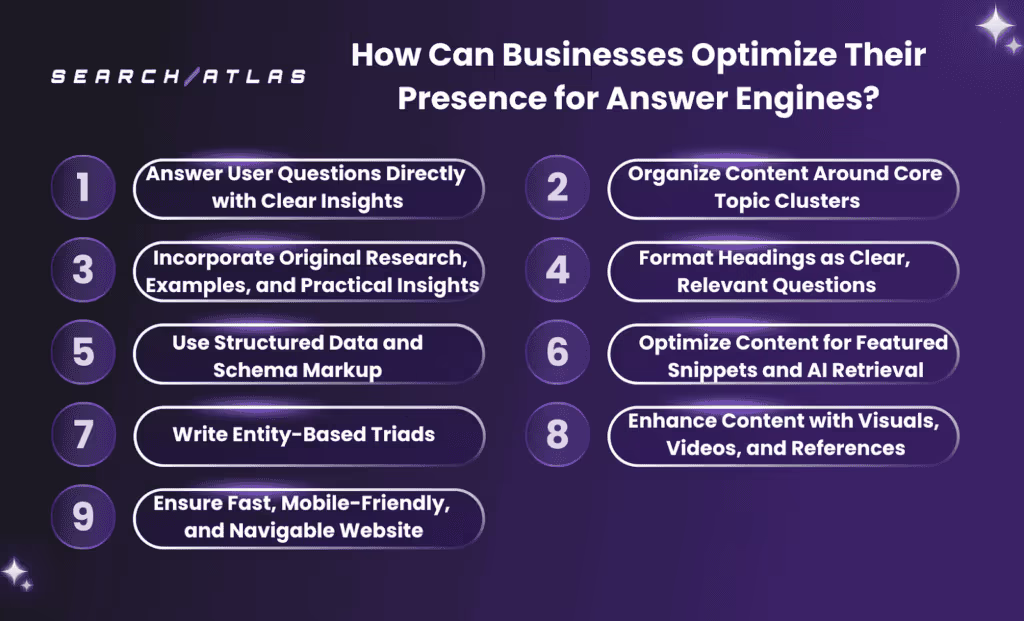
A team can prepare content for answer engines by answering the target question clearly, defining entities, supporting claims, connecting related pages, checking technical eligibility, and matching structured data to visible content.
1. Answer the target question early
Put the direct answer near the start. Define the topic in plain language, then explain the conditions, examples, or limits a reader needs. Use question-led headings and answer each heading in its first sentence.
This structure helps people and retrieval systems inspect the page. It does not create a ranking or citation guarantee. Keep each short answer accurate when separated from the article, because a system may use one passage.
2. Define entities and keep names consistent
Identify the people, organizations, products, places, concepts, and relationships that matter. Use the same entity name across the page set, navigation, and references. Define an acronym once, then use one shortened form.
Consistent names reduce ambiguity. An educational definition explains answer visibility; a monitoring page records how a brand appears across a defined prompt set. Keep those reader needs distinct even when both pages use “AI visibility.”
Organize related pages around a clear topic and link each to the next useful question. The topic clusters guide explains that relationship. Links should move a reader from definition to comparison, implementation, or measurement without repeating one anchor everywhere.
3. Support claims with current, inspectable evidence
Give important claims an inspectable source. Prefer first-party documentation for product behavior, research reports for measured findings, and dated evidence for facts that can change. Separate observation from editorial recommendation.
Use Google’s AI-features guidance for indexing and snippet eligibility, and the Search Atlas overlap study for its measured LLM and search differences. Neither supports a promise that a page will be cited.
Remove unsupported statistics, forecasts, competitor rankings, and time-to-result claims. If a source does not prove causation, describe the observation without adding one. “Visibility distributions were similar across schema-coverage groups” is narrower than “schema increases citations.”
4. Connect related pages where the next question is clear
Build a path that follows likely questions. A definition page can point to an AEO and SEO comparison, then to an implementation page or Google AI Mode explanation. Link when the destination adds information the paragraph does not provide.
Readers who need agent-specific access can continue with agentic AEO, while Google’s conversational search context is covered in Google AI Mode.
5. Check crawl, index, snippet, and text-rendering eligibility
Confirm that the page can be crawled, indexed, and shown as a normal snippet. Check robots directives, canonical signals, status codes, internal links, snippet controls, and rendered text.
Google says AI features rely on the same foundational requirements as ordinary search. A page does not need a special AI file, an llms.txt file, or schema type. Eligibility permits consideration; it does not determine retrieval or a link.
6. Use structured data when it matches visible content
Add structured data only when it accurately describes the visible page and supports a relevant search feature. Match its type, properties, and values to what users can see. It can support eligible rich-result content, but it does not create AI citations.
Search Atlas’s study “The Limits of Schema Markup for AI Search” grouped domains by schema coverage and found no reliable link between higher coverage and higher LLM visibility across measured Perplexity, Gemini, and OpenAI results. The finding limits a common assumption; it does not argue against accurate schema for ordinary search. See structured data for AEO for implementation detail.
How should AEO performance be measured?
AEO reporting works best when a team tests the same bounded prompt set over time and keeps answer observations separate from ordinary SEO and analytics data. One response is a sample, not a complete view of the web.
For each test, save the system and model when known, prompt, date, location or personalization context, response, and cited URLs. Then capture the signals that answer different questions:
- Mention and framing: Did the answer name the brand or entity, and was the description accurate, neutral, or misleading?
- Citation: Did the answer link to or explicitly attribute a source page? Store the URL and check whether it supports the claim. Keep an unlinked source name in a separate field.
- Visibility or share of voice: How often did the brand appear across the prompt set relative to the comparison domains? State the denominator, since a mention share, citation share, and platform score measure different things.
- Prompt coverage: Which question types produced visibility, and where did competitors appear instead? This shows whether the next action belongs on the source page, a supporting page, or the entity record.
- Referral and conversion: Record visits and actions attributed to answer links when referral data is available, while noting that users may search again and some systems do not pass a clear referrer.
Rankings, impressions, clicks, and click-through rate (CTR) remain SEO signals. Google reports traffic from AI features within the Web search type in Search Console, so Search Console can add search-performance context but cannot replace the prompt record.
Frequently asked questions about AEO
Is AEO a replacement for SEO?
AEO complements SEO by measuring a different surface. Both rely on accessible, useful content and sound technical foundations; SEO metrics describe conventional search visibility, while AEO metrics describe mentions, citations, prompt coverage, and framing.
Does schema markup guarantee AI citations?
Schema markup does not guarantee an AI citation. Google does not require special schema for AI Overviews or AI Mode, and Search Atlas research found no reliable relationship between higher schema coverage and higher LLM visibility in the measured results. Use accurate structured data for the search features it supports and keep the visible content authoritative on its own.
How long does AEO take?
The approved sources document no universal AEO timeline. A team should define its prompt set, record a baseline, make a bounded content or technical change, and compare later observations under the same conditions. The interval should reflect the site and measurement plan rather than a promised number of weeks or months.
Can AEO results be measured?
AEO results can be measured with a repeatable prompt log that records mentions, citations, visibility, framing, competitors, and cited URLs. Referral and conversion data can add outcome context, while rankings, impressions, clicks, and click-through rate (CTR) remain separate SEO signals. The report should name its systems, prompts, dates, denominator, and attribution limits.
Start with a bounded question set, improve the source content that answers those questions, and measure the resulting responses over time. For ongoing monitoring, see track AI visibility over time. For a one-time baseline, use a free AI visibility check.