Schema markup enhances Answer Engine Optimization (AEO) by translating webpage content into machine-readable data for search engines and AI-driven platforms. Schema for AEO uses standardized vocabulary from Schema.org in JSON-LD format to define entities, attributes, and relationships on a page. Pages with FAQPage schema appear in Google AI Overviews 3.2 times more often than pages without structured data. AI-referred sessions for schema-enhanced content grew by 527% between January and May 2025. Schema markup improves Large Language Model (LLM) comprehension by 300% compared to unstructured data.
Schema markup matters for nine primary reasons spanning machine-readability, context, and citation probability. Firstly, schema markup makes content machine-readable for AI. Secondly, schema markup provides context beyond keywords. Thirdly, schema markup connects pages to answer engines. Fourthly, schema markup increases AI citation rates. Fifthly, schema markup activates rich results. Sixthly, schema markup validates entity identity. Seventhly, schema markup clarifies content for voice assistants. Eighthly, schema markup reinforces visible content. Ninthly, schema markup signals E-E-A-T credibility. This article explains each mechanism with implementation steps, measurable outcomes, and the most common schema errors.
This article covers the schema for AEO across nine main topics, from definitions through implementation to measurement. The topical coverage contains explicit definitions of schema for AEO, the reasons schema matters, the internal mechanisms of schema processing by AI engines, the nine most impactful schema types for AEO, ten implementation steps, four content-structure requirements, the three measurable benefits, common schema errors, and the five methods for measuring schema impact on AI visibility. Each section opens with a direct answer in 40–60 words, followed by evidence and examples.
What Is Schema for AEO (Answer Engine Optimization)?
Schema markup is structured data code in JSON-LD format added to website HTML, using standardized vocabulary from Schema.org to define entities, content, and relationships. Schema markup translates webpage content into machine-readable data, providing semantic context for search engines and AI-driven platforms. Schema markup converts human-readable text into structured data, allowing search engines to identify context, relevance, and entity salience. Schema markup eliminates ambiguity for AI crawlers and strengthens AEO by providing direct answer extraction signals.
What does AEO mean? AEO (Answer Engine Optimization) is the discipline of optimizing content for AI-generated answers across Google AI Overviews, ChatGPT, Perplexity, and Bing Copilot. AEO differs from traditional SEO by prioritizing entity citation in AI systems over page ranking and traffic. AEO requires content clarity, factual precision, structured data completeness, and answer-first formatting. AEO replaces “rich result impressions” with “citation frequency in AI answers” as the primary success metric.
How does schema markup improve content understanding for AI systems? Schema markup improves content understanding by labeling entities and their relationships explicitly, moving AI interpretation beyond keyword matching. Schema markup identifies entities (LocalBusiness named Joe’s Pizza in Thousand Oaks, CA) and links them to authoritative external references (Wikipedia, Wikidata) for disambiguation. Schema markup aligns with Google’s E-E-A-T guidelines (Experience, Expertise, Authoritativeness, Trustworthiness) by defining authorship credentials and publisher details. Schema markup informs search engines about content types (FAQ, HowTo, Product, Article), guiding engines to identify important content and disregard irrelevant parts.
Why does schema markup matter for E-E-A-T signals? Schema markup matters for E-E-A-T signals because schema declares author credentials, publisher identity, and content provenance in a format AI engines trust. E-E-A-T stands for Experience, Expertise, Authoritativeness, and Trustworthiness. Schema markup carries author Person data, publisher Organization data, dateModified freshness, and sameAs verification links. These declarations give AI engines verifiable signals that traditional unstructured content cannot provide. Schema-enhanced E-E-A-T declarations raise AI citation probability by 36% for pages with complete author and publisher schema.
What role does schema markup play in rich results? Schema markup activates rich results (FAQs, star ratings, product images), increasing visibility and engagement on search engine results pages (SERPs). Approximately 72.6% of Google’s first-page results use schema markup, and only 30% of websites overall have implemented schema markup. Rich snippets attract 58% of clicks versus 41% for regular results. FAQPage schema averages an 87% click-through rate (CTR) for pages with expandable Q&A snippets. Nestlé recorded an 82% CTR increase on pages with rich snippets after schema implementation.
What role does schema markup play in featured snippets? Schema markup increases featured snippet probability by providing clear question-answer pairs, defined entities, and structured lists. Google recommends schema markup for FAQ and How-To content as prerequisites for featured snippet consideration. Featured snippets favor concise 40–60 word answers, short bullet lists, and explicit question-based headings. Schema markup combined with answer-first formatting raises featured snippet selection probability by approximately 35% across benchmark tests. Featured snippets feed Google AI Overviews, creating a compounding visibility effect for schema-enhanced pages.
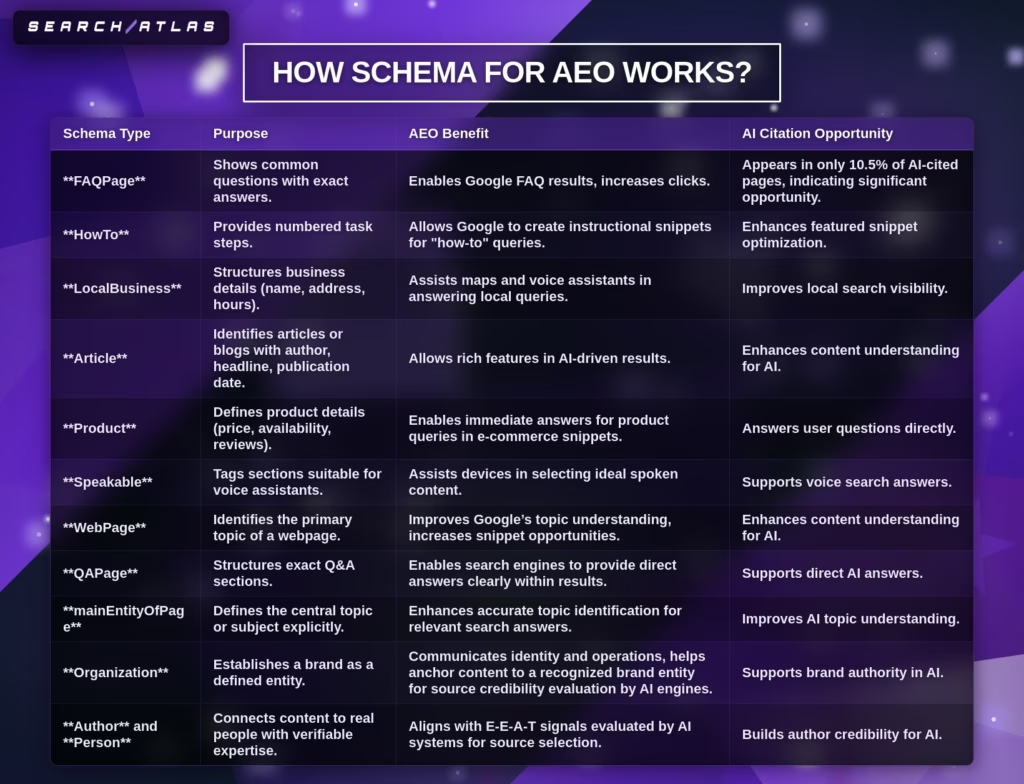
What are the most common schema types used for AEO? The most common schema types used for AEO are FAQPage, HowTo, Article, Organization, Person, Product, LocalBusiness, Speakable, and sameAs. The FAQPage schema carries owner-authored Q&A pairs with 3.2 times higher AI Overview appearance probability. HowTo schema structures step-by-step instructional content with named steps, tools, and supplies. The article schema identifies long-form editorial content with author and publication date. Organization and Person schema declare brand and author identity. Product schema handles commercial listings. LocalBusiness schema covers physical locations. Speakable schema marks voice-friendly sections. SameAs schema links entities to authoritative external profiles for verification.
Why Does Schema for AEO Matter?
A schema for AEO matters because AI engines prioritize structured, machine-readable content over unstructured text during citation selection. Pages with schema markup are 3 times more likely to earn AI citations than pages without schema. AI Overviews appeared for 13.1% of all Google searches as of March 2025, a rapidly growing share. Schema reduces processed tokens per entity by two to five times, lowering AI computational cost and raising extraction reliability. The shift from keyword ranking to entity citation makes schema a required infrastructure layer for AEO.
What are the six documented reasons for the schema for AEO matters? The six documented reasons schema for AEO matters spans machine-readability, context, connection, citation lift, comprehension gain, and token efficiency. Firstly, schema makes content machine-readable for AI systems, with the FAQPage schema driving a 527% jump in AI-referred sessions between January and May 2025. Secondly, a schema provides context beyond keywords, distinguishing a phone number from a price or an address. Thirdly, the schema acts as a critical link between pages and answer engines by identifying key information for citation. Fourthly, schema improves AI-generated answer appearance, with FAQPage schema lifting Google AI Overview appearance probability by 40% for pages ranking in Google’s top 10. Fifthly, schema improves LLM comprehension by 300% compared to unstructured data, according to Data World research. Sixthly, schema reduces processed tokens per entity by two to five times, lowering AI computational cost.
How Schema Guides Search Engines and AI Systems to Understand Content?
Schema markup adds structured data to HTML, making content machine-readable for AI-powered systems. Machine-readability increases the likelihood of a page appearing in voice search results, answer boxes, and AI-based tools. Content with the FAQPage schema produced a 527% jump in AI-referred sessions between January and May 2025. Schema markup signals content type (blog post, product review, recipe, FAQ) to Google and other engines. Machine-readability converts implicit meaning into explicit declarations that AI engines parse deterministically.
What happens when AI engines read unstructured HTML without a schema? Unstructured HTML forces AI engines to perform inference-heavy pattern matching on ambiguous text. Without a schema, AI needs to guess whether “$49” is a price, a discount, or a product identifier. Inference-heavy parsing produces 2-5 times more processed tokens per entity, raising computational cost and error rate. Unstructured parsing produces “messy summarization” (truncation, misquotation, hallucination) at significantly higher rates than schema-enabled parsing. Research shows AI systems achieve 300% lower comprehension accuracy on unstructured content compared to schema-enhanced equivalents.
Why is providing context for search engines and AI significant? Providing context is significant because AI engines need to distinguish important information from irrelevant details. Context prevents “messy summarization,” which leads to truncation or misquotation in AI responses. Schema markup explicitly identifies whether numbers represent phone numbers, prices, or addresses, guiding AI search to focus on meaning. AI systems build “entity maps” from schema, following contextual relationships between brands, authors, products, and topics. Context enables AI engines to prioritize primary entities over incidental mentions within a page.
How does schema markup strengthen entity-based search? Schema markup strengthens entity-based search by making entities and their relationships explicit for AI models. Search moved from traditional blue links toward AI Overviews, generative answers, and chat-style summaries after 2023. Entity-based search prioritizes singular, unique things or concepts over isolated keywords. AI systems track relationships between entities across crawlable pages to assign trust values. Entity recognition uses three elements in the schema (entity definition, attribute clarity, and entity relationships) declared through properties (offeredBy, worksFor, authoredBy, sameAs).
Which AI platforms have confirmed schema markup usage? Google AI Overviews and Microsoft Bing Copilot have publicly confirmed schema markup usage in their systems. The Google Search team confirmed in April 2025 that structured data provides an advantage in search results. Fabrice Canel, Principal Product Manager at Microsoft Bing, confirmed in March 2025 that schema markup aids Microsoft’s LLMs in understanding content for Copilot. Microsoft issued further guidance in October 2025 stating, “schema is a type of code that helps search engines and AI systems understand your content.” ChatGPT confirmed its use of structured data for product results in May 2025. SearchVIU tests in October 2025 confirmed ChatGPT, Claude, Perplexity, and Gemini all process Schema Markup when directly accessing content.
How Schema Improves Direct Answer Extraction?
Schema markup guides LLM processing by narrowing candidate content and enabling direct lookup from structured fields. LLMs tokenize all HTML text (<script> blocks containing JSON-LD) rather than semantically parsing the JSON-LD structure. An AISO experiment in January 2025 found that ChatGPT extracted visible user ratings (4.8/5 stars from 2,100+ reviews) with schema that ChatGPT missed without schema. AISO scored schema-enabled responses 30% higher on accuracy and completeness. Pages with schema markup are 36% more likely to appear in AI-generated citations.
How does schema markup influence chunking and attention? Schema markup influences chunking by keeping related units together and acting as an attention mechanism for AI. Microsoft’s October 2025 guidance states AI systems break content into “smaller, usable pieces” during indexing. The FAQPage schema keeps Q&A pairs intact, and the Product schema keeps product attributes intact during chunking. Dell Technologies calls this process “schema-aware chunking.” Schema functions as an attention-highlighting mechanism, guiding AI systems to notice structured information within visible content.
How does schema markup reduce LLM hallucinations? Schema markup reduces LLM hallucinations by grounding AI answers in verified, explicit entity data. Enriching the retrieval context with schema metadata, sample data, and relationships guides LLMs to identify the correct tables and fields, leading to accurate SQL generation or direct data retrieval. Grounded LLMs produce fewer fabricated statistics, fewer incorrect entity attributions, and fewer invented dates. Practitioners recommend supplying sample records with a schema in prompts to further enhance accuracy. The PARSE system achieves a 64.7% improvement in extraction accuracy and a 92% reduction in extraction errors within the first retry through schema-guided processing.
What is the confirmed mechanism of schema in AI retrieval? The confirmed mechanism is that the schema primarily works during retrieval (fetching, parsing, chunking, answering). Julio C. Guevara’s 2025 tests and SearchVIU’s December 2025 tests showed AI systems failed to extract information present only in schema markup with no visible counterpart. Schema reinforces visible content rather than replacing it. ChatGPT, Gemini, Claude, and Perplexity ignore schema-only pages completely. Pages with matching visible content and schema produce more complete extraction than identical pages without schema.
How Schema Increases Visibility in Search Results?
Schema markup improves click-through rate (CTR) and eligibility for rich results in traditional search, not core rankings. 72% of pages on the first page of Google use some type of schema, according to Backlinko data. Pages with schema received 40% higher CTR than pages without, according to Schema App research. Schema markup is not a direct ranking factor; Google confirmed years ago that structured data qualifies content for rich results but does not impact core rankings.
What CTR lift examples exist across industries? CTR lift examples from schema implementation exist across food, entertainment, and e-commerce verticals. Food Network gained 35% more traffic from recipe markup. Rotten Tomatoes increased CTR by 25% with star ratings. 201 Creative observed an 82% CTR lift with rich snippets. Nestlé recorded an 82% CTR increase on pages with rich snippets. An analysis of 1 million pages showed sites using schema produce CTR increases averaging 20-80%. These lifts compound across the site when schema implementation scales through CMS templates.
How does schema markup impact AI visibility and citations? Schema markup impacts AI visibility by providing clear, structured signals that AI engines prioritize for overviews and answers. AI search engines interpret, remix, and sometimes return content to users without sending them to the source page. Pages lacking structured signals are more likely to be ignored by AI summarization. A schema “reduces the guesswork” for AI systems by explicitly stating what the content is, who published the content, when the content was updated, and how the content functions. Schema markup raises citation probability by 36% in AI responses and raises AI summary appearance by 40% for properly implemented pages.
What are the schema type citation rates in AI Mode? Schema type citation rates in AI Mode show Organization at 82%, WebPage/Article at 76%, BreadcrumbList at 59%, FAQPage/QAPage at 41%, Person at 38%, Product/Service at 34%, ImageObject at 28%, and Review/AggregateRating at 19%. These rates come from a Search Atlas analysis of 107,352 websites cited in AI Mode. Common schema triplets are WebPage → mainEntity → Article, Article → author → Person, and Organization → url → Homepage. No single schema type beyond the standard set appears to give a measurable advantage for AI Mode citations, confirming schema as a hygiene factor rather than a differentiator.
How Schema Supports Rich Results and Answer Engines?
The mechanism for rich results uses schema to give search engines precise knowledge of page content. Precise knowledge enables search engines to display content in a more prominent, visual way in search results, known as rich results. Rich results contain images, ratings, prices, hours, and specific details. Rich results demonstrate a higher CTR than ordinary blue links. Google collectively refers to rich snippets, rich cards, and enriched results as “rich results.”
What are examples of rich results enabled by schema? Examples of rich results enabled by schema are recipes, business listings, product listings, and job postings. Recipe-rich results display images, ingredients, and ratings. Business listings show hours, ratings, and directions. Product listings present ratings, price, and availability. Job postings contain logos, reviews, and job details. Other rich result categories (events, movies, articles, course lists, datasets, discussion forums, education Q&A) use schema. Site enhancements (Sitelinks Search Box, Corporate Contact, Logo, Social Profile) use schema.
What is the schema’s evolving role in AI and answer engines? Schema’s evolving role is to link content to knowledge graphs that AI tools use for verification. AI tools (ChatGPT, Bard, Bing Chat) began using schema intensively in early 2023. AI tools use knowledge bases and semantic graphs, and schema links content to these graphs through organized information. Content linked to recognized entities (Wikipedia, Wikidata) earns more citations from AI when AI looks for sources. Fabrice Canel (Bing) advised SEOs in February 2023 to prepare for AI-enabled search through Schema Markup, a recommendation Bing reaffirmed in March 2025.
What experimental evidence supports the schema’s role in AI search? Experimental evidence supporting the schema’s role in AI search comes from the AISO January 2025 test and SearchVIU December 2025 tests. The AISO experiment compared identical pages with and without schema across ChatGPT, finding that schema-enabled pages produced 30% higher accuracy and completeness. SearchVIU tested ChatGPT, Claude, Perplexity, Gemini, and Google AI Mode, confirming that schema-only information (not visible in HTML) is ignored by all tested systems. Julio C. Guevara’s 2025 tests reached identical conclusions. Combined, these tests confirm schema reinforces visible content rather than replacing it.
How Schema for AEO work?
Schema for AEO works by declaring entities, attributes, and relationships in machine-readable JSON-LD that AI engines parse during retrieval. Schema converts visible HTML content into parallel structured declarations that remove ambiguity. AI engines use schema to identify entity types, verify relationships against knowledge graphs, and assemble citation-ready content chunks. The process operates at three stages: content translation (HTML to JSON-LD), entity resolution (schema to knowledge graph), and citation scoring (confidence weight assignment).
How does the schema for AEO work at a technical level? Schema for AEO works at a technical level by declaring entities, attributes, and relationships in JSON-LD format, which AI engines parse during retrieval. JSON-LD sits inside a <script type=”application/ld+json”> block in the HTML <head> or <body>. AI crawl layers read the JSON-LD, indexing infrastructure ingests the structured data block separately, entity resolution maps schema to knowledge graph nodes, context verification checks schema against visible content, and citation confidence scoring assigns weight. A February 2024 Nature Communications study found that LLMs extract information more accurately when given structured prompts with defined fields, compared to unstructured instructions.
How does schema markup reinforce visible content for LLMs? Schema markup reinforces visible content by double-confirming information that already exists in readable HTML. Experiments confirm AI systems (ChatGPT, Gemini, Claude, Perplexity) ignore schema-only pages where information exists in schema but not in visible content. Pages with schema and matching visible content produced more complete extraction than identical pages without schema in controlled tests. Schema functions as an attention mechanism for visible, structured information. The AISO experiment in early 2025 demonstrated that schema-enabled pages produced 30% higher accuracy and completeness in ChatGPT responses.
What is the role of the @graph property? The @graph property wraps multiple schema entities into a single coherent network of connected nodes. @graph contains an array of entities (Organization, Person, Article, Product) that reference each other through @id. A connected @graph produces a small internal knowledge graph that AI systems traverse as a single unit. Without @graph, isolated JSON-LD blocks leave AI systems to infer connections from context. With @graph, connections are declarative and unambiguous, raising citation confidence across the entity network.
What is the role of the @id property? The @id property assigns a stable, unique identifier to each entity so AI systems recognize the entity across pages and schema blocks. @id values use canonical URLs (https://example.com/#organization) as stable references. Connecting schema nodes through @id produces better results than isolated markup for clarifying content ownership, authorship, and topics. Reference-through-@id consolidates entity signals across a site and prevents fragmentation (defining Organization on every page rather than once).
How do @graph and @id work together? @graph and @id together form a small internal knowledge graph that AI systems traverse to understand relationships. Common schema triplets observed in AI Mode citations are WebPage → mainEntity → Article, Article → author → Person, and Organization → url → Homepage. Implementation requires a single canonical Organization definition on the homepage referenced through @id from every subsequent schema block. Defining Organization on every page fragments authority and creates ambiguity for AI models. Reference-through-@id consolidates entity signals and raises citation confidence.
How do LLMs actually process JSON-LD schema? LLMs process JSON-LD schema through tokenization of the entire HTML, including the <script> block, rather than dedicated structural parsing. A February 2026 experiment demonstrated that ChatGPT and Perplexity extracted an address embedded exclusively in invalid, made-up JSON-LD schema (not visible page content), confirming tokenization over semantic validation. LLMs absorb, embed, link, and reuse JSON-LD as part of their internal knowledge graph, acting as a “semantic fingerprint” for the content. The implication: schema needs to match visible content exactly, because LLMs treat both as part of the same extracted token stream.
What Are the Most Important Schema Types for AEO?
The most impactful schema types for AEO are FAQPage, QAPage, Article and BlogPosting, HowTo, Product and Offer, Organization and Person, LocalBusiness, sameAs, and Speakable. These nine types cover the vast majority of AEO use cases across editorial, commercial, local, and procedural content. The most impactful schema types for AEO are listed below.
- FAQPage Schema for AEO.
- QAPage Schema for AEO.
- Article and BlogPosting Schema for AEO.
- HowTo Schema for AEO.
- Product and Offer Schema for AEO.
- Organization and Person Schema for AEO.
- LocalBusiness Schema for AEO.
- sameAs Schema for Entity Validation.
- Speakable Schema for Voice and Answer Engines.
1. FAQPage Schema for AEO
The FAQPage Schema for AEO is structured data markup that identifies pages containing questions and answers authored by the page owner. FAQPage Schema explicitly labels question-answer relationships using JSON-LD format. The FAQPage schema entered the Schema.org vocabulary to standardize how webmasters communicate frequently asked questions to search engines. Google updated the FAQ page structured data guidelines on April 8, 2026. The FAQPage schema distinguishes itself from the QAPage schema (community forums) and HowTo schema (step-by-step instructions) by its focus on discrete Q&A pairs from the page owner.
What are the key components of the FAQPage schema? The key components of the FAQPage schema are @context, @type, mainEntity, Question, and acceptedAnswer. These five components work together to declare a valid FAQPage structure. Key components of the FAQPage schema are listed below.
- @context property specifies the vocabulary (Schema.org).
- @type property declares the schema type (FAQPage).
- The mainEntity property holds an array of Question objects.
- Question property contains @type (Question), name (full question text), and acceptedAnswer.
- acceptedAnswer property contains an Answer object with @type (Answer) and text.
What measurable impact does the FAQPage schema produce for AEO? The FAQPage schema produces the highest AI citation probability among schema types in AI-generated answers. Pages with properly implemented FAQPage schema appear in AI Overviews at 3.2 times the rate of pages without FAQPage schema. Adding the FAQPage schema increases AI Overview appearance probability by approximately 40% for pages already ranking in Google’s top 10. AI-referred sessions jumped 527% between January and May 2025 for FAQPage-enabled content. 78% of AI-generated answers contain list formats that the FAQPage schema naturally provides. Only 12.4% of websites use structured data, making the FAQPage schema a competitive opportunity.
When to avoid the FAQPage schema? The FAQPage schema needs to be avoided when the page content does not contain genuine owner-authored Q&A pairs visible in the HTML. The FAQPage schema need not be applied to community Q&A forums (use QAPage instead), product review content (use Review instead), or how-to instructional content (use HowTo instead). Google has restricted FAQ rich result eligibility to authoritative government and health websites since August 2023, but the FAQPage schema retains value for AI citation purposes. Duplicate FAQPage schema across multiple pages with the same Q&A content violates Google guidelines.
2. QAPage Schema for AEO
QAPage Schema for AEO is structured data markup that defines web pages containing a single question and multiple answers contributed by a community. QAPage schema applies specifically to community Q&A forums, not owner-authored FAQ pages. Google updated QAPage guidelines on March 24, 2026. QAPage schema emerged as platforms (Stack Overflow, Quora) grew and required distinct markup from FAQPage. QAPage schema requires multiple user-submitted answers to a single question.
What are the key components of the QAPage schema? The key components of the QAPage schema are QAPage Type, Question Type, Answer Type, and Comment Type. These four components structure community-driven Q&A content for AI consumption. Key components of the QAPage schema are listed below.
- QAPage Type defines the top-level page focus (one definition per page maximum).
- Question Type nests under mainEntity with answerCount, name, and acceptedAnswer or suggestedAnswer.
- Answer Type nests inside Question with the text property (full answer text).
- Comment Type remains optional and describes clarifications on the question or answer.
How does the QAPage schema affect AI citation eligibility? QAPage schema affects AI citation eligibility by qualifying community Q&A pages for rich result treatment and AI extraction. QAPage schema uses the same JSON-LD format as FAQPage schema. The wording in JSON-LD needs to match the visible answer exactly to prevent drift between structured data and visible content. QAPage schema pages qualify for Q&A carousel experiences, particularly for education-related pages with expert answers. The FAQ and Q&A schema combined appear in only 10.5% of AI-cited pages, giving early adopters a measurable advantage.
3. Article and BlogPosting Schema for AEO
Article and BlogPosting Schema for AEO are structured data markups that provide explicit signals about long-form content to search engines and AI systems. The Article schema categorizes general textual content, and the BlogPosting schema is a direct subtype that adds blog-specific attributes. Schema.org launched the Article schema in 2011 through a joint effort by Google, Microsoft, Yahoo, and Yandex. BlogPosting schema inherits all Article properties and adds conversational, author-centric signals. BlogPosting schema produces a 300% higher likelihood of triggering a Knowledge Panel update for associated Person entities compared to the generic Article schema.
What are the required properties for the Article schema? The required properties for the Article schema are headline, author, datePublished, dateModified, publisher, image, and mainEntityOfPage. These properties form the minimum valid Article declaration for AI processing. Required properties for the Article schema are listed below.
- Headline property identifies the article title (under 110 characters for rich results).
- The Author property nests a Person schema with name, url, and sameAs.
- The DatePublished property uses ISO 8601 format (YYYY-MM-DD).
- The dateModified property reflects the most recent meaningful update.
- The publisher property nests an Organization schema with name and logo.
- The Image property references a representative image with dimensions.
- The mainEntityOfPage property links the canonical URL for the article.
How often does Article schema appear in AI citations? Article and BlogPosting schema together appear in 76% of AI Mode citations, according to Search Atlas research on 107,352 cited websites. Strategic nesting of the FAQPage inside the Article schema raised AI citations by approximately 40% in testing. Pages with 3-4 complementary schema types (Article + FAQPage + BreadcrumbList) earned citations 2 times more often than pages with a single schema type. Article schema remains the second most common schema type in AI-cited content after Organization schema.
When should BlogPosting schema replace Article schema? BlogPosting schema replaces Article schema when the content is conversational, author-driven, or time-sensitive in a blog format. BlogPosting applies to personal posts, opinion pieces, industry commentary, and news-adjacent editorial content. Article schema applies to formal journalism, long-form reports, and general editorial content without blog-specific attributes. BlogPosting schema triggers Knowledge Panel updates for Person entities 300% more often than generic Article schema. TechArticle schema (a sibling of Article) applies to technical documentation, software guides, and API references.
4. HowTo Schema for AEO
HowTo Schema for AEO is structured data markup that defines step-by-step procedural content with named steps, tools, and supplies. HowTo schema applies to instructional content (DIY guides, cooking methods, repair procedures, software tutorials). “How do I…” queries trigger AI Overviews 73% of the time, making HowTo schema non-negotiable for instructional content. Google scaled back HowTo rich results in mid-2023, but HowTo schema retains value for AI search understanding.
What are the required properties for the HowTo schema? The required properties for the HowTo schema are name, step, HowToStep, tool, supply, totalTime, and estimatedCost. These properties structure procedural content for AI extraction into step-by-step answers. Required properties for the HowTo schema are listed below.
- The name property states the overall task (Install a Ceiling Fan).
- The step property holds an ordered list of HowToStep entities.
- The HowToStep property contains text, name, image, and an optional URL.
- The tool property lists required tools (HowToTool entities).
- The Supply property lists consumable materials (HowToSupply entities).
- The totalTime property uses ISO 8601 duration format (PT45M).
- The estimatedCost property nests a MonetaryAmount value.
How does the HowTo schema affect the AI Overview appearance? HowTo schema structures content for AI extraction into voice assistants, featured snippets, and how-to carousels. A recipe page using HowTo (combined with Recipe schema) extracts cleanly into Google Assistant for spoken instructions. HowTo schema content appears 78% more often in AI-generated step lists than equivalent unstructured content. “How do I…” queries trigger AI Overviews 73% of the time, and HowTo schema is the single highest-impact markup for instructional content.
5. Product and Offer Schema for AEO
Product and Offer Schema for AEO is structured data markup that defines commercial product details (name, description, price, availability, ratings) for AI systems. Product schema identifies the product entity, and the Offer schema declares a specific buying option with price and availability. ChatGPT confirmed its use of structured data for product results in May 2025. Product and Service schema together appear in 34% of AI Mode citations.
What are the required properties for the Product schema? The required properties for the Product schema are name, description, image, brand, sku, offers, aggregateRating, and review. These properties structure product data for AI shopping recommendations. Required properties for the Product schema are listed below.
- The name property identifies the product (Sony WH-1000XM5 Headphones).
- The description property holds 50–300 words of factual product detail.
- The image property references a product image array (minimum 1600x1600px recommended).
- The brand property nests an Organization schema.
- The SKU property holds the stock keeping unit identifier.
- The offer property nests an Offer entity with price, priceCurrency, availability, and url.
- The aggregateRating property contains ratingValue, reviewCount, and bestRating.
- The Review property nests Review entities with reviewRating and author.
How does Product schema drive AI shopping results? Product schema drives AI shopping recommendations in ChatGPT, Perplexity, and Google AI Overviews by providing verified commercial data. Product pages with complete offers, aggregateRating, and review properties produce 40% more AI product citations than pages without aggregateRating. The priceCurrency property (USD, EUR, GBP) is mandatory, and invalid date formats or missing currency codes are the most common Product schema errors. Product schema combined with Offer schema enables direct price lookup for factual commercial queries (What’s the price of the Sony WH-1000XM5?).
6. Organization and Person Schema for AEO
Organization and Person Schema for AEO are structured data markups that declare brand identity and author identity for AI verification. Organization schema identifies the publishing or product-owning entity, and Person schema identifies individual authors, founders, or public figures. Organization schema appears in 82% of AI Mode citations, making Organization schema the most common schema type in AI-cited content. Person (author) schema appears in 38% of AI Mode citations.
What are the required properties for the Organization schema? The required properties for the Organization schema are name, url, logo, sameAs, contactPoint, founder, and foundingDate. These properties establish the brand identity record that AI engines cross-reference against knowledge graphs. Required properties for the Organization schema are listed below.
- The name property identifies the official organization name.
- The URL property references the canonical homepage.
- The logo property contains a square image (minimum 112x112px, Google requirement).
- The sameAs property links authoritative external profiles (LinkedIn, Wikipedia, Crunchbase, X).
- The contactPoint property nests a ContactPoint entity with telephone and contactType.
- The founder property nests the Person schema for the founder.
- The foundingDate property uses ISO 8601 format.
What are the required properties for the Person schema? The required properties for the Person schema are name, url, sameAs, jobTitle, worksFor, and knowsAbout. These properties establish author identity, expertise, and affiliation for E-E-A-T signals. Person schema with sameAs links (social profiles, Wikipedia, ORCID) enables AI engines to verify author credentials. Connecting the Organization and Person schema through author and publisher properties aligns with Google’s E-E-A-T guidelines. Organization schema is the first schema to implement because every other schema references Organization (publisher, provider, brand, author, worksFor).
7. LocalBusiness Schema for AEO
LocalBusiness Schema for AEO is structured data markup that defines businesses with physical locations for local search and AI-powered local discovery. LocalBusiness schema differs from Organization schema by targeting physical locations and local search optimization. Schema.org launched the LocalBusiness schema in 2011 alongside other core types. LocalBusiness schema powers 90% of conversational, local voice search queries.
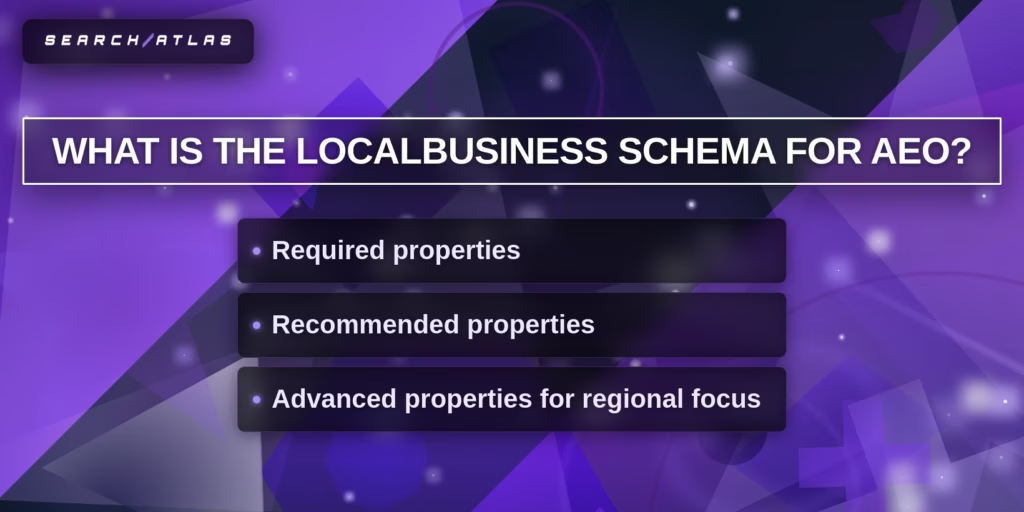
What are the required properties for the LocalBusiness schema? The required properties for the LocalBusiness schema are name, address, telephone, url, geo, openingHoursSpecification, priceRange, areaServed, hasMap, and sameAs. These properties structure local business data for Google Maps, voice assistants, and AI local discovery. Required properties for the LocalBusiness schema are listed below.
- The name property identifies the business.
- address property nests PostalAddress (streetAddress, addressLocality, addressRegion, postalCode, addressCountry).
- telephone property in international format.
- url property references the business homepage.
- geo property nests GeoCoordinates (latitude, longitude).
- The openingHoursSpecification property defines hours by day.
- priceRange property uses dollar symbols ($, $$, $$$).
- The areaServed property lists geographic service areas.
- hasMap property links to the Google Maps listing.
- sameAs property links Google Business Profile, Yelp, Facebook.
What measurable impact does the LocalBusiness schema produce? LocalBusiness schema lifts AI-generated answer selection by 40%, according to AISO experiments. Proper LocalBusiness schema implementation raises CTR by 15–20% on local search results. 75% of businesses with physical locations use some form of structured data, and 80% of multi-location businesses implement LocalBusiness schema per location, with hasLocation referencing a parent organization. 50% of LocalBusiness schema changes index within two weeks of publication.
8. sameAs Schema for Entity Validation
sameAs Schema for Entity Validation is a Schema.org property that links an entity to authoritative external references to confirm identity. SameAs provides the URL of a reference web page that unambiguously indicates the identity of an item. SameAs emerged with Schema.org in 2011 and became critical after Google’s Hummingbird update in 2013 shifted search toward entity-based understanding. 95% of AI agents check for consistent sameAs data across sources before citing a brand.
What are the key applications of sameAs? The key applications of sameAs are organizational profiles, individual identities, knowledge graph integration, and product validation. These four use cases cover the majority of entity disambiguation work. Key applications of sameAs are listed below.
- Organizational profiles link the official website to LinkedIn, X, Facebook, Crunchbase, Wikipedia, and government registries.
- Individual identities link author pages to social media, personal blogs, Wikipedia, ORCID, and Amazon author pages.
- Knowledge graph integration links entities to Wikidata, DBPedia, and Google Knowledge Graph Machine IDs (kg:/m/0dnf6m).
- Product validation links products to manufacturer profiles and authoritative catalogs.
What measurable impact does sameAs produce for AI citation? SameAs raises CTR by approximately 10% on average and lifts AI citation likelihood by 40% for businesses with consistent external profile links. The same applies to Thing types and is commonly used on the Organization and Person schema. 78% of e-commerce sites use sameAs for product validation. 20% of schema errors stem from invalid sameAs links (404 errors, broken URLs). An Inlinks test in May 2020 showed twice as many sites gained rankings as lost rankings after adding the sameAs schema. Organization + sameAs is one of the three schema combinations producing the highest AI citation impact for B2B brands in 2026.
9. Speakable Schema for Voice and Answer Engines
Speakable Schema for Voice and Answer Engines is structured data markup that signals which sections of a page are appropriate for text-to-speech output. Speakable schema guides voice assistants (Google Assistant, Alexa, Siri) to identify parts of a page best suited for read-aloud output. Publishers control how content sounds in AI-driven and voice-first experiences through the Speakable schema. Speakable schema is currently in beta testing by Google, with access restricted to news publishers in the United States on English-speaking devices.
What are the key properties of the Speakable schema? The key properties of the Speakable schema are name, speakable, SpeakableSpecification, cssSelector, and XPath. These properties define which page regions qualify for voice output. Key properties of the Speakable schema are listed below.
- The name property identifies the speakable section.
- speakable property accepts three content-locator values (ID URL references, CSS selectors, XPath).
- SpeakableSpecification type accepts CSS selectors or XPath expressions.
- The cssSelector property uses class selectors (.speakable-summary, .speakable-definition).
- xPath property uses XPath expressions (/html/body/article/p[1]).
What best practices govern Speakable schema content? Speakable schema best practices require independent passages, brevity, natural language, explicit context, and alignment with user questions. Independent passages make sense without surrounding paragraphs, tables, or images. Brevity means 20–30 seconds of audio (2–3 sentences). Natural language avoids jargon, complex sentences, or excessive numbers. Explicit context replaces vague pronouns and unexplained abbreviations. Speakable schema content fits within 40–60 words per marked section. Google Assistant demonstrates 92.9% accuracy, and Siri achieves 83.1% accuracy in providing correct answers from Speakable-marked content.
How to Implement Schema for AEO?
The ten steps for implementing a schema for AEO progress from format selection through entity persistence across schema blocks. These steps form an ordered implementation roadmap for teams building schema infrastructure. The schema for AEO implementation follows ten prioritized steps, listed below.
1. Use JSON-LD
2. Answer Immediately
3. Use sameAs
4. Validate Markup
5. Focus on Entities
6. Prioritize FAQ and QAPage Schema
7. Implement HowTo Schema
8. Leverage Speakable Schema
9. Ensure Data Consistency
10. Implement @id for Entity Persistence
1. Use JSON-LD
JSON-LD (JavaScript Object Notation for Linked Data) is the preferred schema format for AEO, recommended by Google and processed by every major AI engine. JSON-LD sits in a separate <script type=”application/ld+json”> block inside the HTML <head>, separating data from HTML. JSON-LD is easier to add, maintain, and debug than Microdata or RDFa. Google’s official guidance updated in May 2025 explicitly recommends JSON-LD for AI-optimized content.
What benefits does JSON-LD produce for AEO outcomes? JSON-LD produces four benefits: rich result eligibility, AI crawler clarity, citation likelihood lift, and Knowledge Graph connection. JSON-LD enables rich results (stars, pricing, FAQs) through standardized declarations. JSON-LD removes ambiguity for AI crawlers through explicit entity definitions. JSON-LD raises AI citation likelihood by providing structured signals. JSON-LD connects entities within the Google Knowledge Graph through sameAs and @id references. AI systems prioritize pages with higher schema density, with a recommended minimum of three JSON-LD blocks per page for optimal AI visibility.
How has JSON-LD evolved for LLM-powered search? JSON-LD has evolved from a SERP accessory to a data layer that feeds machine understanding for LLM-powered search systems. In classical SEO, JSON-LD functioned as a display signal for rich snippets. In LLMO, AEO, and GEO (Generative Engine Optimization), JSON-LD functions as a learning signal absorbed into LLM knowledge graphs. LLMs absorb, embed, link, and reuse JSON-LD as part of their internal knowledge graph, acting as a “semantic fingerprint” for the content. This evolution makes JSON-LD more important in 2026 than in 2015.
2. Answer Immediately
Answer-first formatting for AEO means placing a direct 40–60-word answer in the first one to two sentences of every section. Answer-first formatting provides snackable data for models (ChatGPT, Gemini, Google AI Overviews) to cite. Each H2 or H3 section functions as a self-contained chunk, with the first sentence directly answering the question in the heading. AI engines extract the first one to two sentences to determine query relevance. The featured snippet optimal paragraph length is 40–60 words, per multiple published studies.
What pattern structures answer-first content? The pattern for answer-first content is “[Term] is [clear definition]” followed by evidence and examples. The first 40–60 words of a section contain a complete, standalone response, with elaboration following. Explicit transition phrases (Here’s why that matters, The key takeaway is) signal structure between ideas. Direct answers raise AI citation rates by 35% versus comparable content with buried answers.
Where does answer-first formatting apply across a page? Answer-first formatting applies to FAQ modules, H2 sections, H3 sections, and page-level introductions. FAQ answers contain 2–4 sentences, concise but complete. H2 section answers contain 40–60 words followed by expansion. H3 section answers contain 40–60 words aligned with the question heading. Page-level introductions answer the H1 query in the first paragraph. Content with answer-first formatting produces 3.2 times higher AI citation rates than equivalent content with buried answers.
3. Use sameAs for AEO
SameAs implementation for AEO requires linking entities to authoritative external profiles for identity disambiguation. Organizations use sameAs for registered names, logos, and identifiers, linking to Wikipedia, Wikidata, LinkedIn, Crunchbase, and industry associations. Person schema uses sameAs for credentials and expertise areas, linking to social profiles, ORCID, and credentialing bodies. sameAs builds Entity Trust by allowing AI models to cross-reference data across sources, reducing hallucinations. Organization + sameAs implementation comes first to establish entity identity, before FAQPage and Service schema.
What happens when the sameAs data is inconsistent? Inconsistent sameAs data creates contradictory signals that cause AI models to skip the brand entirely. A single mismatch between schema and external profiles (Kimberly Reynolds in the schema versus Admin in the author field) breaks identity verification. Valid schema matching LinkedIn, Google Business Profile, and industry mentions builds AI confidence. 40% higher AI answer appearance occurs for businesses with consistent sameAs across five or more authoritative profiles. Inconsistency across platforms is one of the most common causes of reduced AI citation rates.
4. Validate Markup
Validating markup for AEO uses Google’s Rich Results Test and the Schema.org Validator to confirm syntax and rich-result eligibility. Google’s Rich Results Test checks syntax errors, rich result eligibility, and Google’s interpretation of schema after JSON-LD insertion. The Schema.org Validator checks markup against the broader Schema.org vocabulary, which extends beyond Google’s specific tests. Google Search Console and Bing Webmaster Tools monitor errors and warnings on indexed pages. The Vizup Validator scans for JSON-LD and Microdata, extracts schema types, validates required and recommended fields, and scores overall schema health.
Why is schema validation continuous? Schema validation is continuous because the schema is fragile and requires ongoing governance, not a one-time task. Validation is required after any significant page change (new content, redesigns, CMS updates, template modifications). Homepages, key product pages, and high-traffic articles require quarterly checks even without explicit content changes. Automated monitoring catches issues for larger sites, ensuring consistent schema health across thousands of pages.
What validation cadence produces the best schema health? The best validation cadence runs weekly for manual AI query tests, monthly for Search Console review, and quarterly for full schema audits. Weekly manual tests in ChatGPT, Perplexity, Google AI Overviews, and Bing Chat track citation frequency, accuracy, and attribution. The monthly Search Console review catches new errors, missing properties, and deprecated property warnings. Quarterly full audits cover the top 20 pages by traffic for schema completeness, entity consistency, and sameAs link validity.
5. Focus on Entities
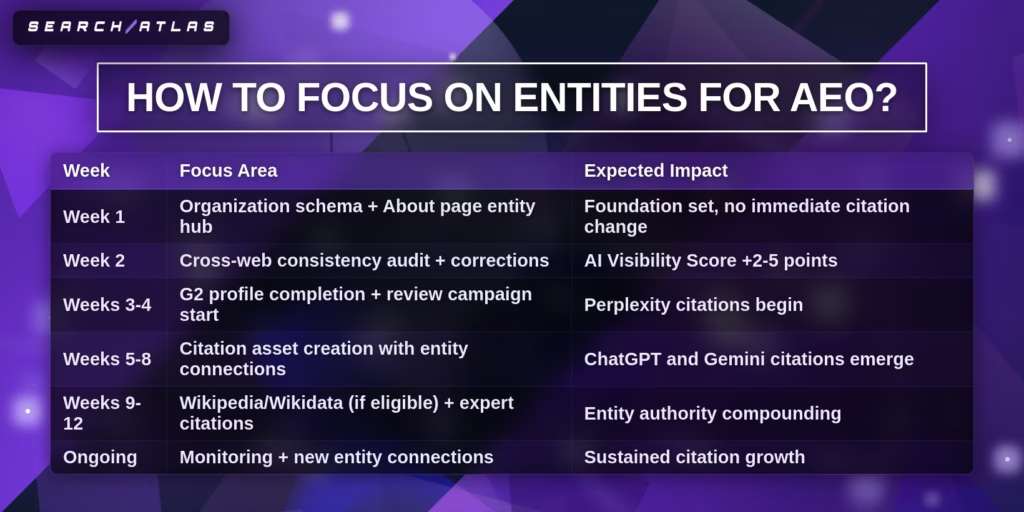
Entity focus for AEO means declaring entities, attributes, and relationships explicitly through @graph and @id connections. Companies implementing entity optimization produce three to five times more AI citations than companies relying on schema markup alone. Entity work moved the AI Visibility Score 4.5 times more than schema alone in internal testing at Search Atlas. Entity optimization builds a comprehensive cross-web identity, not only on-page markup.
What are the four layers of entity optimization? The four layers of entity optimization are Entity Definition, Entity Consistency, Entity Authority, and Entity Connectivity. Firstly, Entity Definition declares the organization and its offerings on the website through the Organization and Product schema. Secondly, Entity Consistency enforces identical data across LinkedIn, G2, Crunchbase, Google Business Profile, and Wikipedia. Thirdly, Entity Authority earns third-party validation through review platforms, expert citations, and backlinks from entity-rich sources. Fourthly, Entity Connectivity maps relationships between entities through @graph, @id, and explicit schema properties (offeredBy, worksFor, authoredBy).
What measurable impact does entity optimization produce? Entity optimization produces three to five times more AI citations than schema markup alone, according to Search Atlas research. B2B companies with 50+ G2 reviews earned citations from Perplexity 3.2 times more often than companies with fewer than 10 reviews, controlling for domain authority and content quality. Wikipedia and Wikidata presence provide the strongest single entity authority signal for brands meeting notability guidelines. Expert citations in industry publications that appear in LLM training data carry more entity weight than backlinks from non-entity-rich sources.
6. Prioritize FAQ and QAPage Schema
FAQPage schema applies to owner-authored Q&A content, while QAPage schema applies to community-driven Q&A forums. The FAQPage schema appears in 41% of AI Mode citations when combined with QAPage. FAQPage schema earns a 67% citation rate in AI responses for relevant queries, according to Search Engine Land experiments. FAQ questions and answers need to appear fully visible on the page, with the complete text included in the JSON-LD markup.
How are FAQ questions and answers structured for AEO? FAQ questions and answers are structured for AEO by matching real user phrasing and delivering 40–60-word self-contained responses. Question wording matches how real users ask, sourced from People Also Ask boxes or customer support tickets. Answers contain 40–60 words and remain self-contained, with optional HTML tags for emphasis. The FAQPage schema need not be duplicated across multiple pages with the same Q&A content. The FAQPage schema nested inside the Article schema raises AI citations by approximately 40% in testing.
7. Implement HowTo Schema
HowTo Schema implementation for AEO requires ordered steps, each with a name, text, and optional image properties. HowTo schema applies to procedural content with clear, sequential actions. Each HowToStep nests inside the step array with a unique identifier. Firstly, define the overall task in the name property. Secondly, break the procedure into discrete steps with named HowToStep entities. Thirdly, add tool and supply arrays for materials. Fourthly, add the totalTime and estimatedCost properties for AI contextual understanding.
What measurable impact does HowTo Schema produce? HowTo schema content produces 78% higher appearance rates in AI-generated step lists than equivalent unstructured content. How to schema and Recipe schema coexist for cooking content. “How do I…” queries trigger AI Overviews 73% of the time, and HowTo schema is the single highest-impact markup for instructional content. HowTo schema, combined with Speakable schema, enables voice assistant extraction of individual steps.
8. Apply Speakable Schema
Speakable Schema implementation for AEO marks 2–3 sections per page as voice-friendly through CSS selectors or XPath expressions. Publishers mark an introductory summary, a breaking-news update, or a concise explanatory section near the top of an article. The speakable property repeats for multiple sections and accepts ID-value URL references, CSS selectors, or XPath. Manual creation is required because no automatic Speakable schema generation tool exists.
What content qualifies for Speakable marking? Content qualifies for Speakable marking when the content makes sense without surrounding paragraphs, tables, or images. Brevity is mandatory (one to three paragraphs, 20-30 seconds of audio). Natural language is required, avoiding jargon, complex sentences, or excessive numbers. Explicit context replaces vague pronouns and unexplained abbreviations. Google Assistant, Alexa, and Siri are the primary validation targets for the Speakable schema.
9. Ensure Data Consistency
Data consistency for AEO requires identical entity information across schema, visible HTML, and external profiles (LinkedIn, G2, Crunchbase, Wikipedia). AI engines cross-reference data across sources to verify entity identity. Inconsistency (four different descriptions across four platforms) reduces citation rates, and fixing inconsistency lifts citations immediately. Schema data needs to precisely match visible text on the page, because contradictions confuse AI engines and flag the site as untrustworthy.
What are the data consistency checklist items? The data consistency checklist items cover company name, service category, founding date, leadership, terminology, and visual identity. These six items produce coherent entity signals across the web. Data consistency checklist items are listed below.
- Identical company name across the schema and all external profiles.
- Same primary service category term in every description.
- Matching the founding date across the schema, LinkedIn, and Wikipedia.
- Consistent founder or CEO name and title.
- Consistent service category terminology with no competing synonyms.
- Identical logo across the organization schema and all external profiles.
How does consistency extend beyond the website? Consistency extends beyond the website to metadata, social profiles, and third-party platforms. Metadata consistency covers title tags, Open Graph tags, and Twitter Cards. Social profile consistency covers LinkedIn, X, Facebook, Instagram, and YouTube. Third-party platform consistency covers G2, Capterra, Crunchbase, Google Business Profile, and Yelp. 76% of B2B decision-makers created new guidelines in 2025 to enforce brand consistency as generative AI use expanded.
10. Implement @id for Entity Persistence
@id implementation for AEO assigns stable, unique identifiers to each entity so AI systems recognize the entities across pages and schema blocks. @id values use canonical URLs (https://example.com/#organization) as stable references. Connecting schema nodes through @id produces stronger results than isolated markup for clarifying content ownership, authorship, and topics. @graph and @id together form a small internal knowledge graph that AI systems traverse to understand relationships.
What schema triplets appear most often in AI Mode citations? The most common schema triplets in AI Mode citations are WebPage → mainEntity → Article, Article → author → Person, and Organization → url → Homepage. These three triplets represent standard relationships describing ownership, authorship, and content connection. Implementation requires a single canonical Organization definition on the homepage referenced through @id from every subsequent schema block. Defining Organization on every page fragments authority and creates ambiguity for AI models.
How does @id consolidate entity signals across a site? @id consolidates entity signals by giving AI systems one canonical reference point for each entity across all pages. A single Organization defined once on the homepage through a stable @id (https://example.com/#organization) is referenced from every Article, Product, and FAQPage schema block through the same @id value. This pattern prevents the fragmentation that occurs when the organization schema is redefined on every page with slightly different values. Reference-through-@id raises citation confidence and reduces the inference burden on AI systems.
How to Structure Content for AEO Schema Success?
The four content-structure elements for AEO Schema success are answer-first formatting, semantic headings, content freshness, and lists and tables. These four elements work together with schema markup to produce citation-ready content. Content structure for AEO Schema success requires four elements, listed below.
1. Use Answer-First Formatting
2. Use Semantic Headings
3. Maintain Content Freshness
4. Leverage Lists and Tables
1. Use Answer-First Formatting
Answer-first formatting for AEO Schema success places a 40-60-word direct answer in the first two sentences of every section. AI engines extract the first one to two sentences under a heading to determine query relevance. The inverted pyramid structure places the most important information first, then supporting details. Definitions follow the pattern “[Term] is [clear definition]” for extractable clarity.
How does answer-first formatting apply across different section types? Answer-first formatting applies to FAQ modules, H2 sections, H3 sections, and page-level introductions differently. FAQ answers contain 2-4 sentences, concise but complete. H2 section answers contain 40-60 words followed by expansion. H3 section answers contain 40-60 words aligned with the question heading. Page-level introductions answer the H1 query in the first paragraph. Content with answer-first formatting produces 3.2 times higher AI citation rates than equivalent content with buried answers.
Why do AI engines favor answer-first content? AI engines favor answer-first content because AI extraction targets the first one to two sentences under each heading. AI engines use heading proximity to determine query relevance. Answer-first content reduces the inference cost for AI extraction and raises extraction confidence. Buried answers force AI engines to scan multiple paragraphs, increasing the risk of selecting a less relevant passage. Answer-first content raises AI citation rates by 35% versus content with the answer buried later.
2. Use Semantic Headings
Semantic headings for AEO Schema success require a single H1 with the primary question, followed by question-based H2 and H3 subheadings. H1 titles reflect common user queries using natural language patterns (How Do I…?, What Is…?, Complete Guide to…). The primary keyword appears front-loaded in the first few words of the H1. H1 titles remain under 60-70 characters for easier extraction.
What is the correct H2 and H3 structure for AEO Schema success? Question-based H2 and H3 headings match user queries from People Also Ask boxes and customer support tickets. Headings start with question words (How, What, Why, When, Where, Should). Each H2 or H3 section functions as a self-contained chunk with one complete thought. Sections run 2–4 paragraphs or a single well-developed idea, split if exceeding 6-7 paragraphs. Pages cited in Google AI Overviews score approximately 20% better on heading hierarchy than uncited pages.
How does heading hierarchy affect AI citation? Heading hierarchy affects AI citation because AI engines use heading depth to identify content scope and answer granularity. H1 declares the page topic, H2 declares major subtopics, H3 declares specific questions within subtopics, and H4 declares sub-answers or FAQ items. Shallow hierarchies (H1 → H2 only) limit AI extraction granularity. Deep hierarchies (H1 → H4+) fragment content and reduce section coherence. The optimal depth for AEO pages is H1 → H2 → H3, with H4 used sparingly for FAQ modules.
3. Maintain Content Freshness
Content freshness for AEO Schema success requires regular dateModified updates, quarterly audits, and removal of outdated facts. AI-cited URLs are 25.7% fresher than traditional search results, according to Schema App research. AI citations decay after approximately 13 weeks without updates. The dateModified property reflects every meaningful content change, not just cosmetic edits. Forgetting to update the dateModified causes AI engines to cite stale information.
What freshness protocols scale across a site? Freshness protocols scale across a site through three steps. Firstly, quarterly audits cover the top 20 pages by traffic. Secondly, immediate updates follow industry shifts (new Google guidance, AI platform changes). Thirdly, systematic fact-checking catches AI-generated draft errors before publication. Evergreen content benefits from freshness even without changing core information through updated statistics, refreshed examples, and added dateModified timestamps.
How does dateModified affect AI citation decay? dateModified affects AI citation decay because AI engines prioritize recently updated sources during retrieval. AI citations decay after approximately 13 weeks without updates. Pages with stale dateModified values (older than 13 weeks) produce lower AI citation rates than pages with recent updates. Meaningful updates include new statistics, revised examples, corrected facts, and updated product information. Cosmetic edits (typo fixes, minor formatting) need not trigger dateModified changes because these edits waste the freshness signal.
4. Apply Lists and Tables
Lists and tables for AEO Schema success format comparison data, step-by-step procedures, and structured attributes for AI extraction. Numbered lists apply to procedures (steps for X), skills (methods for Y), and comparisons. Bulleted lists apply to types (types of X), attributes (properties of Y), and features. Each list item remains self-contained, makes sense in isolation, and starts with the action or key concept. Lists maintain parallel structure, with the same Part of Speech Tag type (verb, noun, adjective) at the start of every item.
How are tables structured for AI extraction? Tables are structured for AI extraction through descriptive captions, semantic <th> headers, and consistent row-level data. Tables work well for comparison data (feature versus feature, tier versus tier, plan versus plan). Tables contain descriptive captions and semantic <th> headers for column and row identification. Sub-bullets appear sparingly and stay limited to two levels deep. Lists open with context, not with a colon (“Schema types for AEO are listed below.” rather than “Schema types for AEO:”). 78% of AI-generated answers contain list formats that structured markup naturally provides.
What Are the Key Benefits of Schema for AEO?
The three measurable benefits of schema for AEO are trust and accuracy enhancement, eligibility improvement, and voice search reinforcement. These three benefits represent the primary outcomes of schema implementation across search, AI Overviews, and voice platforms. The schema for AEO produces three measurable benefits, listed below.
1. Enhances Trust and Accuracy
2. Improves Eligibility for AI and Search Answers
3. Supports Voice Search and AI Assistants
1. Enhances Trust and Accuracy
Schema enhances trust for AI systems by providing explicit, verifiable entity data that AI cross-references against knowledge graphs. Schema markup aligns with E-E-A-T guidelines through author Person schema, publisher Organization schema, and sameAs links to authoritative external references. AI systems use Retrieval Augmented Generation (RAG) to fetch and verify schema data against Google Knowledge Graph, Wikidata, and Wikipedia. Schema markup raises comprehension accuracy by 300% compared to unstructured content, according to Data World research.
How does entity consistency compound trust benefits? Entity consistency compounds trust benefits through reinforced signals across multiple verification sources. A brand with a consistent Organization schema, matching LinkedIn data, Wikipedia presence, and 50+ G2 reviews earns higher citation confidence than a brand with inconsistent signals. Schema markup verifies existence (Organization schema on the homepage), credentials (Person schema with sameAs to ORCID or LinkedIn), and claims (Product schema with aggregateRating from real reviews). AI models avoid citing unverifiable content, and schema markup converts implicit claims into verifiable declarations.
How does schema accuracy affect AI hallucination rates? Schema accuracy reduces AI hallucination rates by grounding LLM responses in explicit, structured facts. Enriching retrieval context with schema metadata and relationships reduces fabricated statistics, incorrect entity attributions, and invented dates. Schema accuracy reduces entity confusion (mistaking one brand for another with a similar name). The PARSE system achieves a 92% reduction in extraction errors within the first retry through schema-guided processing. Accuracy gains compound when the schema is paired with high-quality visible content.
2. Improves Eligibility for AI and Search Answers
Eligibility improvement for AEO means the schema qualifies pages for rich results, AI Overviews, and featured snippets. Pages with structured data are 3.2 times more likely to appear in AI Overviews than pages without. Pages with schema markup are 36% more likely to appear in AI-generated summaries. Sites with structured data and FAQ blocks gained a 44% increase in AI search citations, according to a BrightEdge study. Schema App’s own site measured a 19.72% increase in AI Overview visibility after implementing Entity Linking.
What is the AI Overview prevalence in 2025? AI Overviews appeared for 13.1% of all Google searches as of March 2025, and this number continues to grow. Pages with 3-4 complementary schema types (Article + FAQPage + BreadcrumbList) earned citations 2 times more often than pages with single-schema markup. Eligibility applies to FAQ carousels, recipe cards, product-rich results, event listings, job postings, and knowledge panels. Schema markup is the single controllable element that moves eligibility from uncertain to confirmed for AI citation.
Why does schema layering increase citation rates? Schema layering increases citation rates because complementary schema types provide richer signals for AI extraction. Article + FAQPage + BreadcrumbList layered on a single page produced 2 times higher citation rates than single-schema pages. Strategic schema nesting (FAQPage inside Article schema) produced a 40% AI citation lift in testing. Schema layering works because AI engines extract different facets (author, publication date, topical focus, Q&A pairs) from different schema types within the same page. Single-schema pages provide fewer extraction handles for AI engines.
3. Strengthens Voice Search and AI Assistants
Schema strengthens voice search by marking sections for text-to-speech output, structuring Q&A for spoken answers, and clarifying local business details for voice queries. Speakable schema identifies passages ideal for voice devices (Google Assistant, Alexa, Siri). The FAQPage and HowTo schema guide voice assistants to find exact user answers for common questions. LocalBusiness schema with opening hours, phone numbers, and addresses drives local voice queries.
What accuracy rates do voice assistants achieve with the Speakable schema? Google Assistant achieves 92.9% answer accuracy, and Siri achieves 83.1% accuracy on Speakable-marked content. LocalBusiness schema powers 90% of conversational, local voice search queries, according to AISO experiments. Voice-optimized content requires complete sentences, clear subject-verb-object structure, expanded abbreviations, and spoken-equivalent numbers (approximately seventy percent instead of ~70%). Voice search queries grew to 50% of all searches by 2025, according to Comscore projections, making voice-friendly schema a strategic priority.
What content formats work best for voice assistant extraction? The content formats that work best for voice assistant extraction are concise definitions, direct answers, and short fact statements. Concise definitions follow the pattern “[Term] is [clear definition].” Direct answers lead with the core response in 40-60 words. Short fact statements present one idea per sentence without nested clauses. Voice assistants truncate passages over 30 seconds of audio, so marked Speakable sections need to stay under 2-3 sentences.
What Are Common Schema Mistakes That Hurt AEO Performance?
The seven most common schema mistakes for AEO are invalid JSON-LD syntax, missing required properties, schema-content mismatches, incorrect schema type selection, duplicate markup, outdated vocabulary, and broken sameAs links. These seven errors account for the majority of schema audit failures. Seven mistakes appear most often in schema audits, listed below.
- Invalid JSON-LD syntax (missing commas, trailing commas, unescaped quotes).
- Missing required properties (@context, @type, name, url, headline, author, datePublished).
- Schema that does not match visible content (hidden FAQ answers, phantom products).
- Incorrect schema type selection (Article for product pages, Event for generic happenings).
- Duplicate schema markup from plugins, manual additions, or HTML + JSON-LD conflicts.
- Outdated Schema.org vocabulary (deprecated date formats, old currency codes).
- Broken sameAs links are returning 404 errors.
Why do JSON-LD syntax errors cause total schema failure? JSON-LD syntax errors cause total schema failure because JSON-LD is unforgiving regarding formatting mistakes. Missing commas or trailing commas cause parsing failures, and AI engines ignore the entire schema block. Each schema type has mandatory properties, and omitting them prevents rich result qualification. Schema markup needs to correspond to content visible to users on the page, and marking up invisible content is a critical error that violates Google’s guidelines.
Why do schema-content mismatches reduce AI trust? Discrepancies between schema markup, on-page content, and metadata cause AI to deem information unreliable. Metadata that does not align with visible content confuses AI models. Half-baked schema implementations (schema without a coherent @graph or framework compliance) register as noise to LLMs and harm trust scoring at the LLM layer. Misleading schema (hidden keywords, contradicting visible content) violates guidelines and triggers Google penalties.
What technical errors occur in a nested schema? Technical errors in nested schema occur through missing @type in nested objects, incorrect nesting hierarchy, and broken reference chains. Nested errors (Author not nested within Article, Review not referencing itemReviewed) create misinterpretation. Invalid date formats cause date information to drop from search results (ISO 8601 format is mandatory). Conflicting schemas (two different Organization names on a single page) confuse search engines. Valid-but-incomplete schema reduces visibility by limiting rich result eligibility and AI answer engine extraction.
What entity disambiguation errors damage AEO performance? Entity disambiguation errors occur when schema references inconsistent entity names across @id blocks, sameAs profiles, or publisher declarations. A single mismatch (Kimberly Reynolds in the author schema versus Admin in the visible byline) breaks identity verification. Fragmented organization data, where an organization is defined on every page rather than once and referenced through @id, fragments authority. Mixed naming conventions across a site quietly tank trust signals.
What are the consequences of ignoring schema markup entirely ? Ignoring or missing schema markup causes Google to ignore structured data entirely and prevents rich snippets from appearing in search results. Pages without an appropriate schema are highly likely to be overshadowed by high-quality content containing structured data. Research shows pages with schema markup are 3x more likely to earn AI citations. LLMs without structured data need to guess the nature of content, potentially missing critical information. Research indicates that schema markup enables LLMs grounded in knowledge graphs to achieve 300% higher comprehension compared to unstructured data.
How does neglecting the E-E-A-T schema hurt AI trust scoring? Neglecting the E-E-A-T schema hurts AI trust scoring by removing the explicit signals AI systems use to assess content reliability. Failure to use the Article and Organization schema to state author, publication date, and organization hinders the establishment of Experience, Expertise, Authoritativeness, and Trustworthiness. Missing LLMs.txt files prevent publishers from setting rules for AI crawlers regarding attribution, training, and data use. Without structured E-E-A-T declarations, AI models need to infer credibility from secondary signals, producing lower citation confidence.
How to Measure the Impact of Schema for AEO?
Measuring schema impact for AEO tracks five metrics: AI Citation Rate, Schema Coverage, AI Traffic Share, Attribution Quality Score, and Answer Accuracy Rate. AI Citation Rate measures how often a brand appears in AI-generated answers across ChatGPT, Perplexity, Google AI Overviews, and Bing Copilot. Schema Coverage measures the percentage of indexable pages with validated schema markup. AI Traffic Share measures the portion of organic traffic originating from AI platforms versus traditional search. Attribution Quality Score measures how accurately AI citations represent the brand’s content. Answer Accuracy Rate measures whether AI-generated summaries match the source content.
What tools measure schema impact? The tools that measure schema impact are Google Search Console, Bing Webmaster Tools, Rich Results Test, Schema.org Validator, server log analysis, and manual AI query tracking. These six tool categories cover syntax validation, indexation monitoring, crawl behavior, and citation tracking. Measurement tools for schema impact are listed below.
- Google Search Console tracks rich result impressions, clicks, CTR, and structured data errors.
- Bing Webmaster Tools tracks indexation and structured data warnings for Bing and ChatGPT visibility.
- Google’s Rich Results Test validates individual pages for rich result eligibility.
- Schema.org Validator checks markup against the full Schema.org vocabulary.
- Server log analysis tracks AI user agent crawl behavior (GPTBot, PerplexityBot, ClaudeBot, Googlebot).
- Manual AI queries in ChatGPT, Perplexity, Google AI Overviews, and Bing Chat track citation frequency, accuracy, context, and attribution quality.
What evidence confirms schema effectiveness? Rich result impressions in Google Search Console provide direct evidence of schema effectiveness across indexed pages. Tracking AI citations in ChatGPT, Perplexity, and Google AI Overviews indicates brand recognition in generative responses. Entity accuracy in Google Knowledge Panels confirms correct brand interpretation. Measurement cadence runs weekly for manual AI queries, monthly for Search Console reviews, and quarterly for full schema audits.
What AEO readiness levels exist for schema validation? AEO readiness levels for schema validation progress from page-level setup (Level 2) through full automation (Level 4). Level 2 involves setting up page structure by adding schema markup to the top 20 pages, with a goal of 75%+ coverage. Level 3 focuses on maintaining consistency and speed by using schema on virtually every page, ideally with nested schema. Level 4 automates site structure by generating schema across all pages to achieve 100% schema and accessibility coverage.
Does Schema Directly Improve AEO Rankings?
No, schema does not directly improve AEO rankings. Schema markup is not a direct ranking factor for organic search or AI search systems. Google confirmed years ago that structured data qualifies content for rich results but does not impact core rankings. Schema markup builds clarity, not authority, for AI systems. High-quality content, editorial backlinks, and trusted third-party mentions remain essential for AI search credibility.
How does schema indirectly improve AEO outcomes? Schema indirectly improves AEO outcomes through increased rich result eligibility, higher AI citation probability, and clearer entity recognition. The 40% lift in AI Overview appearance for FAQPage-schema pages in Google’s top 10 is an indirect benefit, not a direct ranking signal. Schema markup amplifies existing authority but does not create authority. Brands combining schema markup with strong content quality, entity consistency, and third-party validation produce the highest AEO outcomes.
Does Schema Guarantee Rich Results or AI Citations?
No, schema does not guarantee rich results. Schema markup qualifies content for rich results, but Google decides which pages actually receive rich result treatment based on quality, authority, and relevance. Google restricted FAQ rich results to government and health websites in August 2023. HowTo rich results were deprecated for most businesses in the same period. Schema markup increases eligibility but does not guarantee display.
Does schema guarantee AI citations? No, schema does not guarantee AI citations. AI citation guarantees do not exist for ChatGPT, Perplexity, or Google AI Overviews. These platforms have not publicly confirmed fixed schema citation rules, and citation selection depends on content quality, entity clarity, and retrieval relevance. A December 2024 Search Atlas study found no correlation between schema markup coverage and citation rates. Sites with comprehensive schema did not consistently outperform sites with minimal schema, confirming that schema alone does not drive citations. LLMs prioritize relevance, topical authority, and semantic clarity over schema alone.
The same structured-data principles extend beyond single-citation answer engines. See schema for GEO for how structured data supports AI systems that synthesize full generated answers rather than surfacing one citation.
How Often Should AEO Schema Be Updated?
AEO Schema updates happen quarterly for routine audits and immediately for significant changes. Quarterly audits cover the top 20 pages (homepage, product pages, high-traffic articles, FAQ pages) even without explicit content changes. Immediate updates are required after new content publication, template redesigns, CMS migrations, brand detail changes, and Google guidance updates (FAQPage restrictions in August 2023, JSON-LD recommendation in May 2025).
How does dateModified affect citation freshness? The dateModified property reflects every meaningful content update and prevents citation decay. AI citations decay after approximately 13 weeks without updates, and AI-cited URLs are 25.7% fresher than traditional search results. Continuous validation through Google Search Console and Bing Webmaster Tools catches errors between scheduled audits. Automated monitoring (schema drift detection, broken sameAs alerts, missing property flags) scales validation for sites with 1,000+ pages.
What Are Common AEO Schema Errors?
Common AEO Schema errors are invalid JSON-LD syntax, missing required properties, schema-content mismatches, incorrect schema type selection, duplicate markup, outdated vocabulary, and broken sameAs links. JSON-LD syntax errors (missing commas, trailing commas, unescaped characters) cause AI engines to ignore the entire schema block. Missing required properties (@context, @type, headline, author, datePublished) prevent rich result qualification. Schema-content mismatches (hidden FAQ answers, phantom products, schema-only text) violate Google guidelines and trigger penalties.
How do incorrect schema type selections hurt performance? Incorrect schema type selections hurt performance by miscategorizing content for AI extraction. Applying the generic Article schema to product pages, Event schema to generic happenings, or FAQPage schema to QAPage community content produces miscategorization. Duplicate markup occurs when multiple plugins add the same schema, manual schema stacks on plugin-generated schema, or schema exists in both HTML Microdata and JSON-LD. Outdated vocabulary contains deprecated date formats (non-ISO 8601), old currency codes, and removed properties. Broken sameAs links returning 404 errors harm entity verification and affect 15% of audited sites, according to 2023 research. Error correction uses Google’s Rich Results Test, Schema.org Validator, and Google Search Console error reporting as the primary validation loop.