Content plagiarism is the act of using words, ideas, or structure from another person without proper attribution. The meaning of plagiarism explains how content loses originality when repeated material appears without credit, which reduces trust, visibility, and authority across search systems. This explanation clarifies what plagiarism means in practice.
Content plagiarism matters because search engines evaluate originality, semantic value, and source trust when ranking pages and generating answers. Systems that detect plagiarism identify duplicated phrasing, repeated structures, and overlapping ideas, which lowers ranking potential and limits how content appears in search results. This evaluation shows what plagiarism means in SEO, where duplication weakens both indexing priority and site quality.
Content plagiarism creates measurable risks for businesses operating in search and AI-driven environments. Plagiarism reduces rankings, limits backlink acquisition, and weakens entity trust signals across search ecosystems. Content that fails to remain original loses visibility in both traditional results and AI-generated answers, where citation and uniqueness determine inclusion.
Content plagiarism requires prevention through structured writing, clear attribution, and original contribution across every section. Content that avoids duplication introduces new insights, distinct structure, and verified references that search systems recognize as valuable. The ability to detect plagiarism and correct duplication patterns ensures that content maintains originality, credibility, and long-term visibility.
What is Content Plagiarism?
Content plagiarism is the act of presenting words, ideas, or original work from another source as original without proper attribution. The meaning of plagiarism becomes clear through actions that reuse text, paraphrase ideas, or replicate structure without acknowledgment, which removes recognition from the original source and weakens content originality. Content plagiarism shifts ownership away from the original author and assigns false authorship to the person presenting the work.
Content plagiarism exists across multiple content formats. Content plagiarism includes written text, visual assets, and digital media. This expanded scope shows that plagiarism applies to articles, images, videos, and research outputs equally.
What defines the core characteristics of Content Plagiarism? There are three main characteristics of content plagiarism. Firstly, a lack of attribution removes credit from the original creator. Lack of attribution defines the core condition of plagiarism. This absence appears in 100% of plagiarism cases. Secondly, the scope of appropriation includes words, ideas, and media. The scope of appropriation expands plagiarism beyond text into full creative output. This scope covers nearly all intellectual content. Thirdly, intent does not change consequences in most institutions. Intent affects severity evaluation, but penalties remain consistent. This rule explains why accidental plagiarism receives equal treatment.
Why does Content Plagiarism exist as a systemic issue? Content plagiarism depends on access to existing content and the pressure to produce original work. Content plagiarism increases with digital access, which reduces barriers to copying and reuse. This access expansion explains the rise of accidental and AI-driven plagiarism. Content plagiarism enables false originality, which creates unfair academic and professional advantages. Content plagiarism allows individuals to bypass research and writing effort.
Content plagiarism functions as the control system for authorship integrity. Content plagiarism determines whether work reflects original thinking or copied material. This control defines credibility because modern evaluation systems rely on originality instead of replication.
What Are the Different Types of Plagiarism?
The different types of plagiarism are direct plagiarism, mosaic plagiarism, paraphrasing plagiarism, self-plagiarism, accidental plagiarism, source-based plagiarism, structural plagiarism, idea plagiarism, authorship plagiarism, and AI plagiarism. These types define how duplicated or reused content appears across SEO environments, which impacts originality, ranking signals, and content trust.
Plagiarism affects SEO performance because search engines evaluate uniqueness, structure, and authority rather than duplicate or recycled content. These duplication patterns reduce ranking strength, split authority across pages, and weaken content in competitive SERPs.
The 10 main types of plagiarism are listed below.
- Direct plagiarism. Direct plagiarism creates exact duplication, which triggers search engine filtering and ranking suppression. Direct plagiarism occurs through copying content word-for-word without attribution. This duplication reduces rankings and weakens authority signals.
- Mosaic plagiarism. Mosaic plagiarism creates disguised duplication, which reduces semantic uniqueness in search evaluation systems. Mosaic plagiarism occurs through rewriting content with minor changes while preserving structure and meaning. This similarity limits content differentiation in competitive SERPs.
- Paraphrasing plagiarism. Paraphrasing plagiarism creates low differentiation, which limits ranking potential across similar queries. Paraphrasing plagiarism occurs through rewriting content without adding new value or attribution. This reuse maintains the same intent and reduces originality.
- Self-plagiarism. Self-plagiarism creates internal duplication, which splits ranking signals across multiple URLs. Self-plagiarism occurs through republishing existing content without meaningful changes. This duplication weakens indexing efficiency and authority consolidation.
- Accidental plagiarism. Accidental plagiarism results from poor content processes, which still produce duplication signals. Accidental plagiarism occurs through missing citations or improper content reuse. This duplication affects SEO performance regardless of intent.
- Source-based plagiarism. Source-based plagiarism reduces factual trust, which weakens authority signals in search systems. Source-based plagiarism occurs through misrepresenting, omitting, or fabricating references. This inconsistency impacts credibility and content reliability.
- Structure plagiarism. Plagiarism in structure creates similar content frameworks, which reduces uniqueness in SERP comparisons. Plagiarism in structure occurs through copying headings, layout, and content flow. This similarity signals low originality to search engines.
- Idea plagiarism. Idea plagiarism removes conceptual originality, which limits authority building across topical clusters. Idea plagiarism occurs through using original concepts without attribution. This reuse transfers value without credit.
- Authorship plagiarism. Authorship plagiarism breaks credibility signals, which affects trust and expertise evaluation. Authorship plagiarism occurs through claiming ownership over content created by another entity. This misrepresentation damages brand authority.
- AI plagiarism. AI plagiarism creates repetitive patterns that reduce visibility and increase the risk of devaluation. AI plagiarism occurs when AI-generated content is published without originality or validation. This pattern lowers overall domain quality.
What is the Difference Between Paraphrasing vs. Plagiarism?
The difference between paraphrasing and plagiarism lies in attribution, transformation, and originality within content creation workflows. Paraphrasing rewrites ideas with clear attribution, while plagiarism presents external content as original without credit. This distinction defines whether content builds authority or triggers duplication and trust issues in SEO systems.
Paraphrasing preserves meaning while changing wording and structure, which maintains originality signals in search evaluation. Plagiarism removes attribution and originality, which creates duplication signals and weakens content trust. This contrast explains why paraphrasing strengthens content performance while plagiarism reduces visibility and credibility.
The core differences between paraphrasing and plagiarism are below.
| Aspect | Paraphrasing | Plagiarism |
|---|---|---|
| Purpose | Rewrites external ideas to fit original content while maintaining attribution. | Reuses external ideas or content without attribution, presenting them as original. |
| Primary goal | Integrates information while preserving originality and clarity. | Copies or imitates content without maintaining originality. |
| Attribution requirement | Requires a clear citation for the original idea. | Removes or omits credit for the original source. |
| Word usage | Changes wording, phrasing, and expression completely. | Keeps original wording or makes minimal changes. |
| Sentence structure | Alters the structure, length, and flow of sentences. | Maintains original structure or closely mirrors it. |
| SEO impact | Strengthens uniqueness, which improves ranking potential. | Creates duplication signals, which reduce rankings. |
| Content value | Adds interpretation and contextual relevance. | Adds no new value, which lowers content quality signals. |
| Risk level | Low risk when executed correctly with attribution. | High risk due to penalties, devaluation, and trust loss. |
| Intent | Demonstrates understanding and synthesis of information. | Represents copied material as original work. |
| Outcome | Produces unique, authoritative content. | Produces duplicate or low-value content. |
What does paraphrasing do in SEO content? Paraphrasing rewrites existing information into original language while preserving meaning and attribution. This rewriting creates unique content signals, which improve ranking potential and semantic differentiation. This differentiation strengthens topical authority and content quality evaluation.
What does plagiarism do in SEO content? Plagiarism introduces duplicated or unoriginal content without attribution. This duplication triggers filtering systems, which reduce rankings and limit indexing efficiency. This reduction weakens domain authority and lowers trust signals across search systems.
Why is paraphrasing required instead of plagiarism? Paraphrasing maintains originality while integrating external knowledge into content. This originality aligns with search engine evaluation systems, which prioritize unique and valuable content. This alignment ensures that pages compete effectively instead of being filtered.
When should paraphrasing replace direct copying? Paraphrasing replaces copying when content requires integration of external ideas into original writing. This replacement ensures attribution and transformation, which maintain compliance with SEO and content standards. This approach protects rankings and builds long-term authority.
How Does Plagiarism Affect SEO and Website Performance?
Plagiarism affects SEO and website performance by creating duplicate signals that reduce rankings, visibility, and traffic. Search engines evaluate originality, which means duplicated or recycled content weakens authority signals and lowers ranking potential. Plagiarism introduces competing versions of the same content, which forces search systems to choose one version and ignore the rest.
Plagiarism weakens SEO performance because search engines prioritize unique, high-value content over duplicated material. This prioritization reduces visibility for plagiarized pages, which leads to traffic loss and ranking instability. Plagiarism creates long-term performance decline, which impacts indexing, authority, and overall domain trust.
How does Google penalize websites for plagiarized content? Google penalizes plagiarized content by lowering rankings and filtering duplicate pages from search results. Search systems detect duplication patterns, which classify content as low value and reduce its ability to rank. This filtering removes visibility for weaker versions, which results in traffic loss and reduced impressions.
What are the specific algorithmic effects of plagiarism on rankings? Plagiarism reduces rankings, splits authority, and lowers content quality signals. Search engines group similar pages, which creates internal and external competition between duplicated content. This competition weakens ranking signals because authority is distributed across multiple versions instead of one strong page.
How does plagiarism affect a website’s visibility and traffic? Plagiarism reduces visibility by preventing pages from competing effectively in search results. Duplicated content fails to rank consistently, which causes traffic decline over time. This decline appears as unstable rankings, reduced impressions, and lower click-through rates.
What are Google’s quality guidelines regarding copied content? Google defines copied or low originality content as low quality, which limits ranking potential. Content that lacks originality or added value fails to meet quality thresholds, which reduces its ability to appear in search results. This classification creates a structural disadvantage for duplicated pages.
What is the acceptable level of plagiarism for SEO performance? Plagiarism tolerance remains extremely low because search systems prioritize originality over similarity. Minor overlap from common phrases appears naturally, but high duplication levels reduce ranking potential significantly. Strong SEO performance requires near-complete originality across content.
How does plagiarism impact SEO campaigns and organic growth? Plagiarism weakens SEO campaigns by reducing the effectiveness of content strategies. Duplicate content fails to build authority, which limits keyword growth and topical coverage. This limitation reduces organic traffic and slows long-term performance gains.
What are the extreme consequences of plagiarism for a website? Plagiarism leads to deindexing, ranking suppression, and loss of domain credibility in severe cases. Search engines remove low-value or duplicated pages, which eliminates visibility. This removal creates significant traffic loss and long-term recovery challenges.
How does plagiarism affect website credibility and user experience? Plagiarism reduces credibility because duplicated content signals low expertise and low trust. Users recognize repeated or copied information, which lowers engagement and increases bounce rates. This behavior reinforces negative ranking signals.
How does plagiarized content impact user trust and brand reputation? Plagiarized content damages brand trust because originality defines authority and expertise. Users lose confidence in duplicated content, which reduces conversions and brand perception. This loss affects long-term growth and customer retention.
Why is Plagiarism an Issue in Content and SEO?
Plagiarism is an issue in content and SEO because it reduces rankings, weakens trust, and limits long-term growth. Duplicate content occurs when pages reuse the same or similar information, which splits authority and confuses search engines. Plagiarism creates this duplication, which prevents content from competing effectively in search results.
Plagiarism weakens SEO performance because search engines prioritize original content over repeated material. This prioritization filters duplicated pages, which reduces visibility and traffic. Plagiarism creates unstable rankings, which impacts indexing, authority signals, and overall site performance.
How does plagiarism impact search engine rankings and visibility? Plagiarism reduces rankings because search systems filter duplicate content and select only one version to display. This filtering removes competing pages, which lowers impressions and traffic. Internal duplication wastes crawl budget, which prevents important pages from ranking properly.
Why does plagiarism create a negative user experience? Plagiarism creates repetitive content, which reduces perceived value and trust. Users leave duplicated pages quickly, which increases bounce rates and lowers engagement signals. These signals reduce ranking potential across search systems.
How does plagiarism reduce backlink potential? Plagiarism limits backlinks because authoritative sites avoid linking to duplicated content. This limitation prevents authority growth, which weakens ranking strength and domain credibility.
What are the ethical implications of plagiarism? Plagiarism violates ethical standards because it presents copied work as original. This violation removes recognition from creators and damages credibility. This damage affects both individuals and organizations.
What challenges does AI-generated content create for plagiarism? AI-generated content increases duplication risk because similar patterns repeat across multiple pages. This repetition creates low differentiation, which search engines classify as low-value content. This classification reduces visibility and ranking stability.
What Are the Legal and Ethical Consequences of Plagiarism?
The legal and ethical consequences of plagiarism include financial penalties, reputational damage, and long-term credibility loss. Plagiarism violates copyright laws and ethical standards. These consequences define how plagiarism moves from a content issue into measurable legal risk and authority loss.
Plagiarism creates legal exposure because intellectual property laws protect original work from unauthorized use. This protection enforces penalties, which range from fines to lawsuits and, in severe cases, criminal charges. Plagiarism creates ethical violations because originality and attribution define credibility, which directly impacts reputation and institutional trust.
The 10 main legal and ethical consequences of plagiarism are listed below.
- Copyright infringement lawsuits. Copyright infringement lawsuits create financial liability, which results in fines, legal costs, and potential damages. Copyright infringement lawsuits occur through unauthorized use of protected content. This violation leads to penalties that reach up to $150,000 per work in the United States.
- Reputational damage. Reputational damage reduces trust, which affects public perception and professional credibility. Reputational damage occurs when plagiarism becomes public. This exposure leads to long-term authority loss.
- Academic penalties. Academic penalties reduce academic standing, which leads to failure, suspension, or expulsion. Academic penalties occur when institutions detect plagiarism in submitted work. This enforcement creates permanent academic records.
- Loss of funding and opportunities. Loss of funding reduces access to research, partnerships, and career growth. Loss of funding occurs when plagiarism damages credibility. This limitation blocks future opportunities.
- Work retraction and discrediting. Work retraction removes published content, which invalidates research and public contributions. Work retraction occurs when plagiarism appears in published materials. This removal damages credibility across all work.
- Professional career termination. Professional career termination removes employment opportunities, which limits long-term career progression. Professional career termination occurs when plagiarism violates professional standards. This outcome creates lasting barriers.
- Ethical violation and deception. Ethical violations break integrity, which defines trust in academic and professional systems. Ethical violation occurs through presenting copied work as original. This deception damages credibility.
- Undermining academic integrity. Undermining academic integrity weakens institutional standards, which define knowledge validation. Undermining academic integrity occurs when plagiarism replaces original thinking. This breakdown reduces the value of credentials.
- Damage to organizational reputation. Damage to organizational reputation reduces customer trust, which affects brand perception and revenue. Damage to organizational reputation occurs when employees publish plagiarized content. This impact extends across stakeholders.
- Hindrance to knowledge and research progress. Hindrance to knowledge slows innovation, which affects research quality and discovery. Hindrance to knowledge occurs when duplicated or misleading work enters academic systems. This disruption wastes resources.
What are the long-term consequences of plagiarism? Long-term consequences include loss of credibility, reduced career opportunities, and persistent reputational damage. These effects remain because plagiarism records and public exposure continue to influence evaluation systems.
How Do Search Engines Detect Plagiarism?
Search engines detect plagiarism by analyzing content similarity across indexed pages, which identifies duplicate or near-duplicate material. Plagiarism occurs when content matches existing pages with minimal transformation, which creates overlapping signals across domains. Search engines resolve this duplication by comparing content patterns and selecting the most original or authoritative version for ranking.
Similarity detection drives plagiarism identification because search systems evaluate wording, structure, and semantic meaning across documents. This evaluation groups similar pages together, which allows search engines to filter redundant versions and prioritize unique content. This filtering reduces visibility for duplicated pages and reinforces the importance of originality in SEO.
How do search engines detect plagiarized content? Search engines detect plagiarized content through similarity analysis, clustering systems, and pattern recognition models. These systems compare text across billions of pages, which identifies exact matches and near duplicates. This detection enables filtering and ranking adjustments based on originality.
What advanced methods does Google use to evaluate duplicated content? Google uses clustering, canonical selection, and similarity scoring to evaluate duplicated content. These systems group similar pages and select the most authoritative version for ranking. This selection ensures that one version gains visibility while others lose ranking potential.
How does Google interpret repeated or similar content across websites? Google interprets repeated content as competing signals that reduce clarity about which page best answers a query. Search systems cluster similar documents, which limits how many results appear from the same domain. This limitation reduces visibility for duplicated versions and concentrates rankings on the strongest page.
What are the impacts of plagiarism detection on rankings and visibility? Plagiarism detection reduces rankings, filters duplicate pages, and limits indexing for repeated content. Multiple similar pages divide authority instead of concentrating it. This division weakens ranking signals and reduces total traffic because visibility shifts to one selected version.
What limitations exist in search engine plagiarism detection? Search engine detection systems identify similarity patterns but cannot fully evaluate intent or context. These systems detect exact and near duplicates effectively, but heavily modified or partially rewritten content reduces detection accuracy. This limitation explains why semantic evaluation continues to evolve across search algorithms.
How to Avoid Plagiarism in Content Writing?
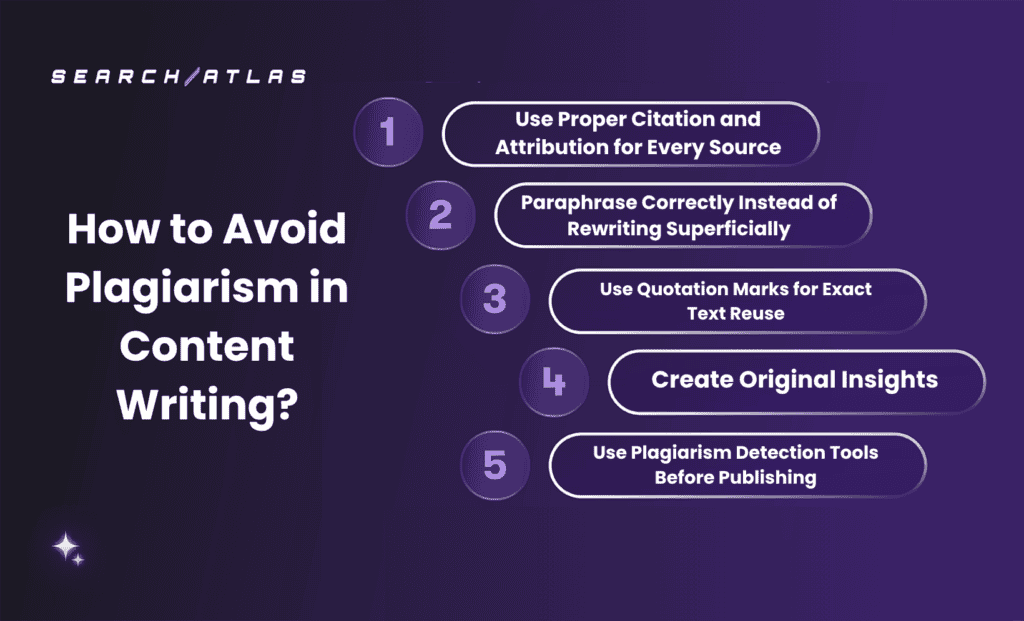
Avoiding plagiarism in content writing means using outside information with proper attribution, original interpretation, and clear differentiation from existing content. This process matters because plagiarism damages trust, weakens originality signals, and reduces content value in search systems that prioritize unique information. Strong plagiarism prevention protects credibility, preserves semantic uniqueness, and improves how search engines evaluate quality, expertise, and authority across published pages.
The 5 ways to avoid plagiarism in content writing are listed below.
1. Use Proper Citation and Attribution for Every Source
Proper citation and attribution mean identifying the original source of any borrowed idea, fact, quote, structure, or dataset. This practice prevents plagiarism because attribution preserves ownership and shows that the material did not originate from the current writer. Attribution improves trust because readers and search systems recognize transparent sourcing as a signal of credibility and factual responsibility. Businesses apply attribution by citing articles, studies, reports, interviews, charts, and images whenever those materials shape the final content. Strong attribution practices matter most in SEO content that references statistics, expert claims, or industry research. A practical rule is that every borrowed point needs a visible source trail.
2. Paraphrase Correctly Instead of Rewriting Superficially
Proper paraphrasing means rebuilding an idea with a new sentence structure, new phrasing, and clear attribution while preserving the original meaning. This method prevents plagiarism because superficial rewriting keeps the same semantic blueprint, which creates content similarity and weak originality signals. Correct paraphrasing improves trust and retrieval because search systems evaluate differentiation, not minor synonym swaps. Businesses apply paraphrasing by reading the source, stepping away from it, writing from understanding, and then checking whether the final version uses a distinct structure and wording. Proper citation remains necessary after paraphrasing. A practical takeaway is to change the structure first, then the wording, and always cite the source.
3. Use Quotation Marks for Exact Text Reuse
Quotation marks identify exact borrowed language and separate original writing from verbatim source material. This distinction prevents plagiarism because exact wording without quotation marks creates false authorship, even when a citation appears nearby. Quoted material protects trust by showing readers exactly which words came from the source and which words belong to the current writer. Businesses apply quotations in real content when a phrase carries unique authority, precise wording, or technical meaning that paraphrasing would weaken. Short quotations work best because excessive quoted text reduces originality and limits content differentiation. A practical rule is to reuse exact wording only when necessary, place it in quotation marks, and cite it immediately.
4. Create Original Insights
Original insights are interpretations, comparisons, examples, conclusions, or frameworks that add new value beyond sourced material. This method prevents plagiarism because original thinking reduces dependence on borrowed language and borrowed logic. Original insights improve visibility and trust because search systems reward differentiated content that contributes something distinct to the topic. Businesses apply this method by combining sourced facts with internal expertise, firsthand examples, customer context, industry observations, or strategic analysis that competitors do not publish. This combination creates content that stands apart in both search and user evaluation. A practical takeaway is to use sources for evidence, then add a perspective, example, or conclusion that only your brand provides.
5. Use Plagiarism Detection Tools Before Publishing
Plagiarism detection tools scan drafts for exact matches, close overlaps, and missing attribution before publication. This validation process matters because accidental duplication often survives drafting, editing, and paraphrasing unless a final review catches it. Detection improves trust and protects visibility because businesses reduce the risk of publishing content that appears copied, recycled, or insufficiently transformed. Businesses apply this step during final quality control by reviewing flagged passages, rewriting weak paraphrases, adding missing citations, and confirming that quoted material is marked correctly. A practical takeaway is to treat plagiarism scanning as a final pre-publish checkpoint, not an optional extra.
What Are The Best Practices to Ensure Content Originality?
The best practices to ensure content originality involve creating unique insights, structuring information with clear differentiation, and validating content to avoid duplication across the web. Content originality matters because search engines prioritize distinct value, which improves visibility, trust, and ranking stability. A structured originality process ensures that each page contributes new information instead of repeating existing content, which strengthens semantic relevance and authority.
What are the best practices to ensure content originality in SEO content? The best practices to ensure content originality in SEO content include combining research with original insights, applying full structural paraphrasing, and maintaining consistent attribution. These practices prevent duplicate signals and help search systems identify content as a primary source rather than a derivative version.
How do businesses apply content originality best practices in real-world content creation? Businesses apply content originality best practices by integrating proprietary data, real examples, and brand-specific perspectives into every piece of content. This approach transforms common topics into differentiated assets that improve engagement, trust, and long-term search performance.
How do validation and quality control support content originality best practices? Content validation supports originality best practices by using plagiarism detection, editorial workflows, and structured reviews before publishing. These processes identify duplication risks and ensure that each page delivers unique value.
What Tools Help Detect and Prevent Plagiarism?
The tools that help detect and prevent plagiarism analyze content similarity, validate originality, and guide improvements before publication. Plagiarism detection tools matter because search engines prioritize unique content, which impacts rankings, trust, and visibility across search results. These tools compare text against large databases, identify duplication signals, and help ensure semantic uniqueness and proper attribution.
The 10 best tools that help detect and prevent plagiarism are Search Atlas, Turnitin, iThenticate, Scribbr, Copyscape, Grammarly Premium, QuillBot, Copyleaks, and Quetext.
1. Search Atlas
Search Atlas SCHOLAR evaluates content originality through semantic scoring, factual validation, and information gain analysis. The system measures how much unique value a page adds compared to existing content, which reflects how search engines assess originality. SCHOLAR identifies low-value or repetitive content patterns that resemble duplication. This evaluation matters because originality depends on semantic contribution, not just avoiding exact matches. Businesses use SCHOLAR to ensure content meets high-quality standards aligned with search engine ranking systems.
Search Atlas Content Genius prevents plagiarism during content creation by structuring text around entities, search intent, and semantic relationships. The system guides writers to produce differentiated content instead of rewriting existing pages. Content Genius analyzes SERP structures and ensures each section delivers unique value. This process matters because prevention is more effective than post-detection. Businesses use Content Genius to create original, optimized content that aligns with how search systems interpret meaning.
2. Turnitin
Turnitin detects plagiarism by comparing submitted content against extensive academic databases, student submissions, and web sources. The platform generates detailed similarity reports that highlight exact matches, citation gaps, and overlapping phrases. This detection matters because it provides a clear view of where duplication occurs and whether attribution is missing. Turnitin is widely used in academic and institutional environments where originality standards are strict. Businesses and educators rely on Turnitin to ensure content integrity before publication or evaluation, especially for long-form or research-based material.
3. iThenticate
iThenticate identifies plagiarism in professional, academic, and publishing environments by scanning content against journals, research papers, and proprietary databases. The tool is designed for high-level validation, where originality requirements are stricter than general web content. iThenticate detects reused or improperly cited material across scholarly publications, which helps prevent ethical and legal issues. This capability matters because professional content must meet higher standards of uniqueness and credibility. Publishers, researchers, and enterprises use iThenticate to verify manuscripts and ensure compliance before distribution.
4. Scribbr
Scribbr detects plagiarism using advanced similarity detection powered by Turnitin technology, which identifies both direct copying and heavily paraphrased content. The system provides detailed reports with matched sources, similarity percentages, and highlighted sections requiring revision. This accuracy matters because paraphrased duplication still harms originality signals. Scribbr supports multiple languages and is commonly used for academic writing and professional documents. Writers use Scribbr to validate content before submission, ensuring proper citation and reducing the risk of unintentional plagiarism.
5. Copyscape
Copyscape scans web content to detect duplicate or stolen text across online pages. The tool identifies whether content already exists elsewhere, which helps prevent publishing non-unique material. This detection matters because duplicate content reduces SEO performance and limits ranking potential. Copyscape is widely used by website owners, agencies, and publishers to verify originality before publishing and to monitor unauthorized reuse of their content. This dual function supports both plagiarism prevention and content protection.
6. Grammarly Premium
Grammarly Premium combines writing assistance with plagiarism detection by scanning content against billions of web pages and academic sources. The tool highlights duplicated sections while improving grammar, clarity, and tone. This integration matters because originality depends not only on uniqueness. Grammarly helps users refine content while ensuring it remains distinct from existing sources. Businesses use Grammarly as part of their editorial workflow to improve both quality and originality simultaneously.
7. QuillBot
QuillBot includes both a plagiarism checker and a paraphrasing tool, which helps users rewrite content while maintaining meaning and proper attribution. The system detects duplication and suggests alternative phrasing that improves uniqueness. This combination matters because rewriting without structural change often leads to plagiarism. QuillBot supports content transformation by guiding users toward deeper rephrasing rather than surface-level edits. Writers use QuillBot to enhance originality during drafting and reduce duplication risk before final validation.
8. Copyleaks
Copyleaks uses AI-based detection models to identify plagiarism, including paraphrased content, cross-language duplication, and semantic similarity. The system analyzes writing patterns beyond exact matches, which allows it to detect more complex forms of plagiarism. This capability matters because modern content often involves rewriting or translation rather than direct copying. Copyleaks supports multiple file formats and languages, making it suitable for global content validation. Businesses use Copyleaks to ensure originality across diverse content types and multilingual environments.
9. Quetext
Quetext detects plagiarism through contextual analysis using DeepSearch technology, which identifies both exact matches and near-duplicate content. The platform provides detailed reports that differentiate between levels of similarity and highlight areas needing revision. This insight matters because not all matches represent plagiarism, and understanding context improves accuracy. Quetext offers citation assistance, which helps users correct attribution issues directly. Writers and businesses use Quetext to refine content, ensure originality, and improve citation practices before publishing.
How do plagiarism checkers work?
Plagiarism checkers work by comparing submitted text against large content databases to detect similarity and duplication patterns. This process matters because search engines and institutions evaluate originality, which affects rankings, trust, and content credibility across platforms.
Plagiarism checkers work by breaking submitted text into smaller sequences and comparing those sequences against indexed databases. These databases contain billions of web pages, academic papers, books, and previous submissions. This comparison identifies exact matches and near matches, which reveal where duplication occurs and which sources overlap with the submitted content.
Plagiarism checkers work by applying similarity algorithms that measure how closely two pieces of text align. Algorithms evaluate character edits, term frequency, and phrase overlap to detect both exact copying and partial rewriting. This analysis identifies duplicated structures even when words change slightly, which strengthens detection accuracy beyond simple matching.
Plagiarism checkers work by using machine learning and natural language processing to detect paraphrased or structurally similar content. These systems analyze meaning, sentence structure, and entity relationships to identify deeper forms of duplication. This capability matters because modern plagiarism often involves rewriting instead of direct copying.
Plagiarism checkers work by generating detailed reports that highlight matched text, assign similarity percentages, and list original sources. These reports guide revisions by showing where duplication exists and how much of the content overlaps with existing material. This output ensures that content meets originality standards before publication or submission.
What Are Common Examples of Content Plagiarism?
Common examples of content plagiarism show how duplication appears in real content, not just defined categories of plagiarism. These examples matter because search systems detect repeated patterns, which reduce originality signals, trust, and ranking performance.
The 9 most common examples of content plagiarism are listed below.
- Copying a paragraph from a blog without citation. A writer pastes a full paragraph from another website into an article without quotation marks or attribution. This example creates an exact duplication that search engines detect immediately.
- Rewriting competitor content with minor word changes. A page mirrors another article’s structure and ideas while swapping a few words with synonyms. This example keeps the same meaning and flow, which signals low originality.
- Using definitions from sources without quotation marks. A page includes a textbook or glossary definition word-for-word but presents it as original writing. This example fails to distinguish quoted material from original content.
- Combining sentences from multiple sources into one paragraph. A writer pulls phrases from different articles and merges them into a single section without citations. This example creates patchwork content that lacks clear ownership.
- Reusing old blog posts on a new page without disclosure. A company republishes past content across different URLs without indicating duplication. This example creates internal duplication that weakens SEO performance.
- Publishing AI-generated content that closely matches existing pages. A generated article reproduces existing structures and phrasing found across top-ranking pages. This example creates semantic duplication even without exact matches.
- Citing a source incorrectly or linking to the wrong reference. A page references a study or statistic but points to an unrelated or nonexistent source. This example misrepresents and breaks content credibility.
- Submitting identical guest posts to multiple websites. A writer sends the same article to different publishers without modification or disclosure. This example creates cross-domain duplication that limits ranking potential.
- Translating content from another language without attribution. A page converts foreign content into a new language and publishes it as original work. This example hides the source while keeping the same ideas and structure.
These examples show that plagiarism appears through duplication of words, structure, and meaning. Strong content avoids these patterns by introducing new insights, clear attribution, and distinct semantic value.
How much similarity percentage counts as plagiarism?
Similarity percentage does not define plagiarism because plagiarism depends on context, attribution, and content use rather than a fixed number. Similarity percentage matters because tools report overlap, but overlap alone does not confirm copied or unethical content.
Similarity percentage does not define plagiarism because low scores still contain copied sentences without attribution. A document with 5% similarity still includes exact sentences taken from a source without citation. This scenario shows that even minimal overlap creates plagiarism if attribution is missing or incorrect.
Similarity percentage does not define plagiarism because moderate scores often reflect proper citations, references, or repeated terminology. A document with 20% similarity includes quotes, bibliographies, or standard phrases common in a topic. This overlap appears legitimate and does not indicate plagiarism when attribution exists.
Similarity percentage does not define plagiarism because high scores sometimes result from structure, formatting, or required references rather than copied ideas. A document with 40% similarity includes long quotations, templates, or repeated instructions. This pattern inflates similarity without confirming unethical copying.
Similarity percentage does not define plagiarism because detection tools flag matches, not intent or correctness of use. Reports highlight overlapping text and sources, but human review determines whether the content includes proper citation or misuse. This limitation means similarity scores guide review, not the final judgment of plagiarism.
Does paraphrasing remove plagiarism completely?
No, Paraphrasing does not remove plagiarism completely because plagiarism depends on attribution, originality, and how ideas are represented. Paraphrasing matters because rewriting words without proper citation or transformation still misrepresents ownership of ideas.
Paraphrasing does not remove plagiarism completely because minor word changes keep the original structure and meaning intact. A rewritten paragraph that mirrors the same sentence flow and logic still reflects the original source. This similarity signals patchwriting, which search systems and reviewers classify as duplication.
Paraphrasing does not remove plagiarism completely because ideas remain owned by the original author even after rewriting. A paragraph that explains the same concept without citation still presents another person’s idea as original. This lack of attribution creates plagiarism even with fully changed wording.
Paraphrasing does not remove plagiarism completely because proper paraphrasing requires both transformation and citation together. A valid paraphrase restructures sentences, changes perspective, and adds new context while crediting the source. This combination ensures the content reflects new value instead of recycled meaning.
Paraphrasing does not remove plagiarism completely because superficial rewriting fails to introduce new insight or interpretation. A paragraph that repeats the same points without added analysis remains derivative. This limitation reduces originality signals and weakens trust, visibility, and content quality.
Is citing a source enough to avoid plagiarism?
No, citing a source is not enough to avoid plagiarism because plagiarism depends on originality, structure, and proper use of sources. Citation matters because it credits the source, but citation alone does not make content original or independent.
Citing a source is not enough to avoid plagiarism because copying text word-for-word still creates duplication even with attribution. A paragraph that repeats the exact wording of a source requires quotation marks, not just a citation. This distinction prevents misrepresentation of authorship.
Citing a source is not enough to avoid plagiarism because closely following the original structure presents another author’s reasoning as original work. A page that mirrors argument flow, examples, and sequence reproduces the same intellectual framework. This similarity signals derivative content despite attribution.
Citing a source is not enough to avoid plagiarism because content must introduce new insight, interpretation, or analysis beyond the cited material. A page built entirely from referenced ideas without original contribution lacks independent value. This limitation reduces originality signals and content quality.
Citing a source is not enough to avoid plagiarism because detection systems evaluate similarity patterns beyond citations. Reports highlight overlapping text and structure even when sources appear in references. This evaluation confirms that citation supports attribution, but originality defines whether content avoids plagiarism.
Can AI-generated content be considered plagiarism?
AI-generated content is sometimes considered plagiarism because plagiarism depends on originality, attribution, and how the content reflects existing sources. AI-generated content matters because models reuse patterns from training data, which creates risks of duplication and misrepresentation.
AI-generated content is sometimes considered plagiarism because outputs sometimes reproduce existing structures, phrasing, or ideas without attribution. A generated paragraph that closely matches published content reflects the same logic and sequence. This similarity creates semantic duplication even without exact word matches.
AI-generated content is sometimes considered plagiarism because rewriting source material with AI tools still requires proper citation. A rewritten passage that keeps the original idea without credit presents another author’s work as original. This misuse creates plagiarism despite changed wording.
AI-generated content is sometimes considered plagiarism because fabricated citations and hallucinated sources misrepresent evidence and authorship. A generated reference that does not exist creates false attribution and breaks content credibility. This issue introduces academic and factual risk.
AI-generated content is sometimes considered plagiarism because originality depends on human transformation and validation of the output. A reviewed and rewritten draft that adds new insight and verified sources avoids duplication risks. This process ensures content reflects original contribution instead of generated repetition.