Knowledge graphs represent structured networks of entities and relationships that encode real-world meaning for machines and AI systems. This definition explains how knowledge graphs replace isolated data storage with connected, semantic structures that improve how systems retrieve, interpret, and reason over information. Knowledge graphs transform raw data into contextual knowledge by linking entities through explicit relationships.
Knowledge graphs matter because modern AI systems depend on context, relationships, and structured meaning to generate accurate outputs. Traditional databases store data in tables, which limits how systems understand connections between entities. Knowledge graphs solve this limitation by modeling relationships directly, which improves semantic understanding, disambiguation, and reasoning across complex datasets.
Knowledge graphs create measurable performance advantages across search and AI systems by improving accuracy, personalization, and decision-making. Use cases (semantic search systems, recommendation engines, fraud detection, healthcare research, enterprise knowledge management) define how knowledge graphs apply across industries. Semantic search improves relevance through entity understanding, while recommendation systems increase engagement through relationship-based personalization. Fraud detection identifies hidden patterns across connected entities, and enterprise systems unify fragmented data into a single source of truth.
Knowledge graphs rely on a structured architecture that connects entities, relationships, ontologies, and data sources into a unified system. Architectures combine graph databases, schema models, and query languages to control how data is stored, linked, and retrieved. Graph traversal retrieves connected information, while ontology layers define entity types and constraints. This architecture improves reasoning because systems operate on relationships instead of isolated records.
Knowledge graph optimization focuses on data quality, entity resolution, schema design, and query performance to maintain accuracy and scalability. Clean data improves consistency, while strong entity resolution prevents duplication and ambiguity. Optimized schemas improve query efficiency, and indexing strategies improve traversal speed across large graphs. These optimizations ensure that knowledge graphs remain reliable as data volume and complexity increase.
Knowledge graphs align AI systems with real-world applications by enabling structured reasoning, real-time updates, and scalable knowledge integration. Systems that combine knowledge graphs with retrieval pipelines and AI models maintain accuracy across dynamic environments. Knowledge graphs define the next stage of AI systems, where performance depends on structured context, connected data, and continuous knowledge refinement.
What Is a Knowledge Graph?
A knowledge graph is a structured representation of entities and relationships that stores data in a graph model with formal semantics. A knowledge graph defines how entities connect through relationships, which creates meaning through structure instead of isolated records. A knowledge graph represents data as nodes, edges, and labels, which enables contextual understanding and semantic reasoning across systems.
A knowledge graph evolved through several foundational systems and research efforts. The term knowledge graph appeared in 1972 through Edgar W. Schneider. The concept gained global adoption with Google Knowledge Graph in 2012, which expanded entity-based search. Earlier systems (WordNet, DBpedia, and Freebase) established semantic structures that enabled large-scale entity linking and relationship mapping.
Knowledge graph operates across what data systems? A knowledge graph operates across databases, ontologies, and semantic systems that organize and interpret connected information. A knowledge graph differs from relational databases because relationships exist as first-class elements instead of computed joins. A knowledge graph differs from simple RDF graphs because semantic meaning and interconnection depth define structure and usage. A knowledge graph aligns with ontologies, where ontologies define rules, constraints, and entity classifications inside the system.
What are the key characteristics of a knowledge graph? A knowledge graph contains 3 main characteristics (graph structure, semantic encoding, and large-scale collaboration). Graph structure organizes data as connected networks, which enables traversal across paths and indirect relationships. Semantic encoding defines meaning through ontologies, which enables reasoning and contextual interpretation of data. Large-scale collaboration expands coverage across billions of entities and relationships, which increases accuracy and domain depth across systems.
Knowledge graph operates within a broader data and AI ecosystem. A knowledge graph depends on multiple data sources, machine learning systems, and graph databases to construct and maintain its structure. Machine learning extracts entities and relationships through natural language processing (NLP), which transforms raw data into structured nodes and edges. Graph databases store relationships natively, which improves performance for complex queries across connected datasets.
Knowledge graph enables what capabilities? A knowledge graph enables question answering, semantic search, and knowledge discovery through structured relationships. A knowledge graph enables search systems to retrieve direct answers, which replaces fragmented data retrieval with connected responses. A knowledge graph enables new knowledge creation, which emerges from linking previously disconnected entities across domains.
Why Does a Knowledge Graph Matter?
A knowledge graph matters because modern data environments require structured relationships to manage complexity, scale, and reasoning. A knowledge graph transforms disconnected datasets into interconnected knowledge systems, which improves accuracy, discovery, and decision-making across applications.
How do knowledge graphs address information complexity and volume? A knowledge graph addresses complexity by modeling information as a network of nodes and relationships that capture context and meaning. A knowledge graph organizes data into connected structures, which enables efficient navigation across large datasets and reduces fragmentation present in traditional systems.
Why is industry adoption significant for knowledge graphs? Industry adoption reflects a major shift in data management, where Gartner predicts graph technologies will reach 80% adoption in analytics innovations by 2025. This growth shows that knowledge graphs define modern data strategies and enterprise architectures.
How do knowledge graphs improve LLM accuracy? A knowledge graph improves LLM accuracy by grounding responses in verified entity relationships and structured context. A knowledge graph injects factual data into generation workflows, which stabilizes outputs and reduces hallucinations across enterprise use cases.
What does transforming static data into connected systems mean? A knowledge graph transforms static inventories into dynamic knowledge networks that evolve with new data inputs. A knowledge graph structures information through ontologies, which enables continuous updates, reasoning, and real-time visibility across systems.
How do knowledge graphs enable human and machine interpretation? A knowledge graph enables interpretation by representing entities and relationships in a structured format that both humans and machines understand. A knowledge graph enables reasoning tasks, which allow systems to infer new relationships and extract deeper insights from data.
Why are knowledge graphs foundational for data catalogs? A knowledge graph transforms data catalogs into connected systems that reveal relationships across business terms, processes, and datasets. A knowledge graph enables context-rich discovery, which improves data accessibility and relevance across organizations.
How Does a Knowledge Graph Work?
A knowledge graph works by structuring data into entities and relationships that enable reasoning, retrieval, and contextual understanding. A knowledge graph transforms raw data into connected knowledge, which enables systems to answer complex queries with precision.
A knowledge graph requires core components that define structure and operation. Nodes represent entities (concepts, objects, or users), which act as the primary elements of the system. Edges represent relationships between nodes, which define how entities connect inside the graph. Properties describe attributes of nodes and edges, which provide additional context and detail. Ontologies define rules and schemas, which ensure consistency and enable reasoning across the graph.
How does a knowledge graph process data step by step? A knowledge graph processes data through entity definition, relationship creation, schema application, attribute enrichment, and validation. Entity definition identifies core concepts as nodes, which establish the foundation of the graph. Relationship creation connects nodes through edges, which builds the network structure. Schema application enforces rules, which ensure consistency and enable reasoning. Attribute enrichment adds context, which improves data depth and interpretability. Validation ensures accuracy, which maintains reliability across evolving datasets.
Knowledge graph uses key mechanisms to generate intelligence from data. Semantic enrichment uses NLP, which extracts entities and relationships with high accuracy from raw inputs. Automated reasoning derives new knowledge, which increases insight generation compared to traditional databases. Graph databases store relationships directly, which enables fast traversal across highly connected data structures.
Knowledge graph includes limitations that affect performance and reliability. Data inconsistency introduces conflicting information, which reduces accuracy and leads to incorrect relationships. Schema drift occurs when structures become outdated, which limits integration with new data types. Scalability challenges affect reasoning processes, which increase computational cost in large-scale systems.
A knowledge graph defines modern data infrastructure through connected entities and relationships. A knowledge graph enables intelligent systems to operate with context, accuracy, and continuous knowledge expansion across evolving environments.
What is the knowledge graph architecture?
Knowledge graph architecture is a structured system that organizes entities**, relationships, and semantics into layers that enable data integration, reasoning, and retrieval**. Knowledge graph architecture defines how data flows from raw inputs into connected knowledge, which transforms fragmented information into a unified semantic network. Knowledge graph architecture answers what the knowledge graph architecture is by defining a multi-layer system that structures, connects, stores, and interprets knowledge across domains.
Knowledge graph architecture evolved from semantic web technologies built on Resource Description Framework in 1999, which introduced structured triples for data representation. Knowledge graph architecture expanded with Google Knowledge Graph in 2012, which shifted systems toward entity understanding and semantic relationships. Knowledge graph architecture now operates as a core system for AI, search, and enterprise environments, where structured relationships define meaning and enable reasoning.
Knowledge graph architecture consists of 5 main layers. The 5 main layers are data ingestion, entity extraction, relationship mapping, graph storage, and query and reasoning. Each layer defines a specific function that transforms raw data into structured knowledge.
1. Data Ingestion Layer: Collecting Structured And Unstructured Data
The data ingestion layer collects and prepares data from multiple sources, which establishes the foundation of the knowledge graph architecture. Data ingestion layer transforms structured data, semi-structured data, and unstructured data into a unified pipeline, which enables consistent processing across systems. The data ingestion layer defines how information enters the architecture, which directly affects data quality, completeness, and reliability of the final graph.
The data ingestion layer performs several core operations that ensure usable data. The data ingestion layer collects data from databases, APIs, documents, logs, and media files, which expands coverage across diverse formats. Data ingestion layer validates data by checking errors, inconsistencies, and missing values, which prevents incorrect graph construction. Data ingestion layer standardizes formats through normalization and transformation, which aligns data with expected schemas and models. Data ingestion layer enriches data with metadata and contextual signals, which improves downstream entity extraction and relationship mapping.
Data ingestion layer follows a structured pipeline that ensures consistent flow. Data discovery identifies available sources, formats, and potential use cases, which define the ingestion scope. Data acquisition retrieves information from selected sources, which establishes raw input streams. Data validation checks structural integrity and consistency, which ensures data reliability. Data transformation converts raw data into standardized formats, which prepares data for modeling. Data loading stores processed data into storage systems (data lakes or graph pipelines), which enables access for downstream layers.
Data ingestion layer faces several challenges that impact system performance. Data heterogeneity introduces complexity because sources contain different formats, schemas, and structures. Data quality issues create noise, duplication, and ambiguity, which reduce accuracy in later stages. Data scale increases processing requirements, which introduces performance bottlenecks across large datasets. Data security introduces risks because pipelines connect sensitive systems, which require strict governance and access control.
Advanced ingestion systems use AI to improve efficiency and accuracy. AAI-poweredingestion extracts structure from unstructured content, which reduces manual preprocessing. AI systems perform classification, tagging, and entity detection during ingestion, which improves downstream performance. GraphRAG pipelines combine ingestion with embeddings and semantic mapping, which transform raw text into graph-ready structures. These approaches improve scalability and reduce operational complexity across large datasets.
The data ingestion layer integrates with the rest of the knowledge graph architecture. Data ingestion layer feeds processed data into the entity extraction layer, which identifies entities and attributes. The data ingestion layer provides candidate relationships, which support mapping and connections between nodes. The data ingestion layer contributes metadata and provenance, which enable traceability and validation across the system.
The data ingestion layer includes 5 main ingestion types. Batch processing handles large volumes at intervals, which suits historical analysis. Real-time ingestion processes data instantly, which supports immediate insights. Stream processing analyzes continuous data flows, which enables dynamic systems. Microbatching balances performance and latency, which supports near real-time updates. Lambda Architecture combines batch and real-time approaches, which enables both historical and live processing.
The data ingestion layer defines the starting point of the knowledge graph architecture. Data ingestion layer ensures that data enters the system in a consistent, accurate, and structured form, which enables effective transformation into knowledge.
2. Entity Extraction Layer: Identifying Core Entities And Attributes
The entity extraction layer identifies entities and attributes from ingested data, which transforms raw information into structured graph elements. The entity extraction layer defines how the knowledge graph architecture recognizes meaningful objects inside data, which establishes the foundation for nodes and properties. The entity extraction layer converts unstructured and semi-structured inputs into structured representations, which enables semantic modeling and relationship mapping.
The entity extraction layer performs several core functions that define graph structure. The entity extraction layer detects named entities (people, organizations, locations, products, and concepts), which represent the primary nodes in the graph. The entity extraction layer assigns entity types, which classify each entity according to ontology definitions. The entity extraction layer extracts attributes (dates, locations, roles, and values), which enrich nodes with detailed context. The entity extraction layer resolves duplicates and ambiguities, which ensures consistency across the graph.
The entity extraction layer uses advanced techniques to process complex data. NLP identifies entity mentions within text, which converts unstructured content into structured data. Named entity recognition detects entity boundaries and categories, which enables the classification of concepts. Entity disambiguation resolves multiple meanings, which prevents duplication of entities with similar names. Coreference resolution links repeated mentions of the same entity, which maintains continuity across documents. Relationship extraction identifies interactions between entities, which prepares data for mapping.
The entity extraction layer follows a structured workflow that ensures accuracy. Text preprocessing removes noise and irrelevant formatting, which prepares data for analysis. Chunking divides large documents into manageable segments, which preserves context while improving processing efficiency. Entity detection identifies candidate nodes, which establish initial graph elements. Attribute extraction enriches entities with properties, which adds detail and depth. Ontology alignment maps entities to predefined schemas, which ensures consistency and semantic integrity.
The entity extraction layer improves knowledge graph accuracy by enforcing structure on raw data. Structured extraction reduces ambiguity, which improves entity clarity across the graph. Ontology alignment ensures consistent classification, which prevents duplication and fragmentation. Attribute enrichment increases context, which enhances reasoning and query capabilities. Validation processes verify extracted entities, which improves the reliability of downstream layers.
The entity extraction layer faces challenges that affect performance and quality. Ambiguous language creates difficulty in identifying correct entity meanings, which leads to errors in classification. Domain-specific vocabulary introduces complexity, which requires specialized models and training data. Data noise introduces irrelevant or incomplete information, which reduces extraction accuracy. Relationship detection introduces complexity because implicit connections require contextual understanding.
The entity extraction layer integrates closely with other layers in the knowledge graph architecture. Extracted entities become nodes in the graph, which form the foundation of the network. Extracted attributes become properties, which enrich node descriptions. Extracted relationships provide input for the relationship mapping layer, which builds connections between nodes. Ontology alignment ensures compatibility with schema definitions, which supports reasoning and inference.
The entity extraction layer supports advanced applications across AI and data systems. Accurate entity extraction improves search relevance, which enables better query matching and retrieval. Structured entities improve recommendation systems, which depend on understanding relationships and attributes. Entity extraction improves fraud detection, which relies on identifying connections across entities. Entity extraction enhances AI reasoning, which depends on structured knowledge for accurate outputs.
The entity extraction layer defines how raw data becomes meaningful knowledge. The entity extraction layer ensures that the knowledge graph architecture captures entities, attributes, and context accurately, which enables effective modeling, reasoning, and analysis across connected systems.
3. Relationship Mapping Layer: Connecting Entities Through Graph Edges
The relationship mapping layer connects entities through defined edges, which transforms isolated nodes into a structured knowledge network. The relationship mapping layer defines how entities interact, which creates meaning through connections instead of standalone data points. The relationship mapping layer answers how entities relate by assigning semantic relationships that reflect real-world interactions and dependencies.
The relationship mapping layer performs several core functions that define graph structure. The relationship mapping layer creates edges between nodes, which establishes connections across entities. The relationship mapping layer assigns relationship types, which define how entities interact across contexts. The relationship mapping layer applies directionality, which determines how relationships flow between entities. Relationship mapping layer adds properties to edges, which enrich relationships with context (time, weight, or confidence).
The relationship mapping layer uses multiple techniques to identify and validate connections. Explicit relationships come from structured data, which directly defines connections between entities. Implicit relationships come from unstructured data, which requires inference based on context and patterns. Machine learning models detect relationships from text, which improves coverage across large datasets. Rule-based systems validate relationships, which ensures logical consistency across the graph.
Relationship mapping layer improves knowledge graph usability through structured connections. Connected entities enable multi-hop traversal, which allows systems to explore indirect relationships across data. The relationship mapping layer enables the discovery of hidden patterns, which reveal insights that isolated data cannot provide. Relationship mapping layer improves query capabilities, which allows systems to answer complex questions involving multiple entities.
Relationship mapping layer faces challenges that impact accuracy and scalability. Ambiguous relationships create uncertainty, which requires validation and disambiguation processes. Large-scale graphs introduce complexity, which affects performance and consistency across billions of edges. Incomplete data creates missing connections, which reduces graph completeness and reasoning capability. The relationship mapping layer requires continuous updates, which ensure relevance as data evolves.
The relationship mapping layer integrates with other layers in the knowledge graph architecture. The entity extraction layer provides entities and candidate relationships, which serve as input for mapping. The graph storage layer stores mapped relationships, which enables efficient retrieval and traversal. The query and reasoning layer uses relationships to generate answers, which depend on accurate and complete connections. The relationship mapping layer acts as the core layer that transforms structured data into meaningful knowledge networks.
The relationship mapping layer defines how the knowledge graph architecture captures real-world complexity. The relationship mapping layer connects entities through meaningful edges, which enables systems to interpret, analyze, and reason about data with contextual depth.
4. Graph Storage Layer: Storing Nodes And Edges In Graph Databases
The graph storage layer stores nodes and edges in graph databases, which enables efficient management of connected data. The graph storage layer defines how the knowledge graph architecture persists entities and relationships, which supports fast traversal and scalable queries. Graph storage layer answers how knowledge graphs store data by using systems optimized for relationship-centric structures.
The graph storage layer performs key functions that ensure performance and scalability. Graph storage layer stores nodes as entities and edges as relationships, which preserves connections directly in the data model. Graph storage layer indexes nodes and edges, which improves query performance across large graphs. The graph storage layer manages properties for nodes and edges, which provides context and detail for each element. Graph storage layer enables traversal operations, which allow systems to navigate connections efficiently.
Graph storage layer improves performance compared to traditional databases. Native relationship storage enables faster traversal, which executes queries up to 10 to 100 times faster for connected data. Graph storage layer reduces query complexity, which simplifies multi-hop queries across entities. Graph storage layer scales horizontally, which supports billions of nodes and edges in enterprise systems.
Graph storage layer integrates with vector embeddings and AI systems. Graph databases store embeddings alongside nodes, which enables hybrid retrieval across semantic and structural data. Vector indexes enable similarity search, which complements graph traversal for context-aware queries. Hybrid systems combine graph and vector retrieval, which improves accuracy and relevance in AI applications.
Graph storage layer faces challenges related to scale and consistency. Large graphs require efficient indexing and partitioning, which ensures performance across distributed systems. Schema flexibility introduces complexity, which requires governance and validation mechanisms. Data updates require synchronization, which maintains consistency across nodes and relationships. Security concerns require access control, which protects sensitive graph data.
The graph storage layer integrates with other architecture layers. Data ingestion layer feeds processed data into storage systems, which enables persistence of entities and relationships. The relationship mapping layer defines connections that storage systems maintain, which ensures structural integrity. The query and reasoning layer retrieves data from storage, which depends on efficient indexing and traversal. The graph storage layer provides the infrastructure that supports all operations across the knowledge graph.
The graph storage layer defines how the knowledge graph architecture handles scale and performance. Graph storage layer ensures that connected data remains accessible, efficient, and reliable, which enables real-time applications and complex analytics.
5. Query And Reasoning Layer: Retrieving And Interpreting Knowledge
The query and reasoning layer retrieves and interprets knowledge from the graph, which enables systems to generate insights, answers, and decisions. The query and reasoning layer defines how the knowledge graph architecture transforms stored data into actionable outputs. The query and reasoning layer answers how knowledge graphs produce value by enabling retrieval, inference, and analysis across connected data.
The query and reasoning layer performs several core functions that enable intelligent systems. The query layer retrieves nodes and relationships, which provide direct access to structured data. Query layer traverses paths across entities, which enables multi-hop queries and complex exploration. The reasoning layer derives new knowledge, which infers relationships and facts not explicitly stored. Reasoning layer validates consistency, which ensures logical accuracy across the graph.
The query and reasoning layer uses specialized query languages and techniques. Languages (SPARQL) enable semantic queries across triples, which support reasoning and inference. Graph query languages (Cypher) enable pattern-based queries, which simplify traversal across relationships. Hybrid queries combine vector search and graph traversal, which improves retrieval accuracy across AI systems.
The query and reasoning layer enables advanced AI capabilities. Structured queries improve search accuracy, which retrieves precise answers based on entity relationships. Reasoning enables inference, which derives new knowledge from existing connections. The query and reasoning layer improves explainability, which allows systems to trace how answers are generated. The query and reasoning layer supports decision-making, which depends on accurate and contextual information.
The query and reasoning layer improves performance in complex scenarios. Multi-hop queries allow systems to explore indirect relationships, which reveal deeper insights across data. Pattern matching enables efficient retrieval, which simplifies complex query logic. Precomputed inferences improve response time, which reduces runtime processing for repeated queries. Query optimization techniques improve scalability, which supports large enterprise graphs.
The query and reasoning layer faces challenges that affect performance and accuracy. Large graphs increase computational complexity, which affects query execution time. Complex reasoning introduces overhead, which requires optimization strategies. Incomplete data limits inference, which reduces the accuracy of derived knowledge. Query design requires expertise, which affects usability and efficiency.
The query and reasoning layer integrates with all other layers in the knowledge graph architecture. The graph storage layer provides data for retrieval, which enables query execution. The relationship mapping layer defines connections that queries traverse, which enables meaningful results. The entity extraction layer ensures structured data exists for querying, which supports accurate retrieval. The data ingestion layer ensures continuous updates, which keep query results current.
The query and reasoning layer defines how the knowledge graph architecture delivers value. Query and reasoning layer transforms structured data into insights, answers, and decisions, which enables intelligent systems to operate with context, accuracy, and explainability.
What Is The Difference Between A Knowledge Graph And A Traditional Database?
The difference between a knowledge graph and a traditional database lies in how each system models data, represents relationships, and enables meaning. A knowledge graph stores entities and relationships as a connected network, while a traditional relational database stores structured data in tables with predefined schemas. This distinction defines how systems interpret data, how queries perform at scale, and how easily models adapt to change across evolving environments.
A knowledge graph and a traditional database address different data problems through different architectures. A knowledge graph focuses on meaning, context, and connections, which enables systems to answer complex questions across multiple entities. A traditional database focuses on storage, consistency, and transactions, which enables reliable handling of structured data at scale. This contrast explains why knowledge graphs dominate relationship-driven use cases, while relational databases dominate transactional systems.
The core differences between a knowledge graph and a traditional database are below.
| Aspect | Knowledge Graph | Traditional Database |
|---|---|---|
| Purpose | Surfaces meaning from connected data. | Stores and retrieves structured records. |
| Data modeling | Represents data as nodes and edges. | Represents data as tables with rows and columns. |
| Schema structure | Uses flexible or schema, optional models. | Uses rigid predefined schemas. |
| Query approach | Traverses relationships directly through graph queries. | Uses SQL joins to connect tables. |
| Relationship handling | Stores relationships as first-class elements. | Stores relationships through foreign keys. |
| Inferencing | Supports inference from existing relationships. | Requires external logic for inference. |
| Maintenance | Adapts easily to new data structures. | Requires schema updates and migrations. |
| Performance | Optimized for multi-hop relationship queries. | Degrades with complex joins across tables. |
What does a knowledge graph do in data systems? A knowledge graph connects entities and relationships into a semantic network, which enables systems to interpret meaning and derive insights from connections. This structure enables multi-hop traversal, which reveals indirect relationships across large datasets. This capability improves discovery and reasoning in complex environments.
What does a traditional database do in data systems? A traditional database stores structured data in tables, which enables efficient retrieval and transactional consistency. This structure supports high-volume operations, which require accuracy and strict data integrity. This capability ensures reliable performance for applications that depend on fixed schemas and predictable queries.
Why do knowledge graphs outperform relational databases for relationship queries? Knowledge graphs outperform relational databases because knowledge graphs store relationships directly, which enables fast traversal across connected data. Relational databases require joins, which increase computational cost as relationships grow. This difference explains why graph systems execute complex queries significantly faster.
When does a knowledge graph provide the best advantage? A knowledge graph provides the best advantage when systems require context, relationships, and semantic understanding across entities. This advantage supports use cases (recommendation systems, fraud detection, and semantic search). This structure enables the discovery of hidden patterns that table-based systems cannot easily model.
When does a traditional database provide the best advantage? A traditional database provides the best advantage when systems require structured storage, transactional processing, and predictable queries. This advantage supports use cases (financial systems, CRM platforms, and reporting systems). This structure ensures stability, scalability, and performance for high-volume operations.
A knowledge graph and a traditional database operate together in modern systems. A hybrid architecture uses relational databases for transactional storage and knowledge graphs for relationship-driven insights. This combination enables both operational efficiency and advanced analytics, which supports complex enterprise environments.
What Is Google Knowledge Graph?
Google Knowledge Graph is a knowledge base that stores billions of facts about entities and their relationships to improve search understanding. Google Knowledge Graph defines how entities connect across people, places, and things, which enables semantic interpretation instead of keyword matching. Google Knowledge Graph represents data as a network of entities and relationships, which allows Google to generate direct answers inside search results.
Google Knowledge Graph was launched on May 16, 2012, by Google to improve entity understanding in search. Google Knowledge Graph expanded rapidly, reaching 570 million entities and 18 billion facts within seven months. Google Knowledge Graph reached 70 billion facts by 2016, which supported roughly one-third of 100 billion monthly searches. Google Knowledge Graph now contains over 54 billion entities and more than 1,600 billion facts, which demonstrates massive scale across domains.
Google Knowledge Graph operates across what data systems? Google Knowledge Graph operates across graph databases, semantic systems, and enterprise knowledge graphs used in search engines. Google Knowledge Graph differs from traditional databases because relationships exist as connected structures instead of isolated records. Google Knowledge Graph shares the same structure as other knowledge graphs, where entities and relationships form a connected network.
Google Knowledge Graph consists of 3 main components. Nodes represent entities, edges represent relationships, and attributes define properties. Nodes identify unique entities (people, places, and organizations, which act as the foundation of the graph). Edges connect nodes through relationships, which define how entities relate across contexts. Attributes describe nodes and edges, which provide detailed information (dates, locations, and associated data points).
Google Knowledge Graph depends on what systems? Google Knowledge Graph depends on public datasets, proprietary Google systems, and search behavior signals. Google Knowledge Graph uses sources (Freebase and the CIA World Factbook) for foundational data. Google Knowledge Graph uses internal systems (Google Books and Google Business Profiles), which expand entity coverage across domains. Google Knowledge Graph adjusts based on search patterns, which refines entity relationships and relevance over time.
Google Knowledge Graph enables what capabilities? Google Knowledge Graph enables direct answers, entity understanding, and semantic search across Google services. Google Knowledge Graph powers search features (Google knowledge panels), which display structured information beside results. Google Knowledge Graph powers voice systems (Google Assistant), which answer spoken queries using entity data. Google Knowledge Graph integrates into AI systems (Google Gemini), which uses entity relationships to generate responses.
How Does Google Use Knowledge Graphs In Search?
Google uses Knowledge Graph to provide direct answers by organizing entity relationships and surfacing factual information inside search results pages. Google Knowledge Graph enables Google to answer questions instantly, which reduces reliance on clicking external links. Google Knowledge Graph interprets intent by matching queries to entities, which improves relevance beyond keyword matching.
What is the core function and purpose of Google Knowledge Graph? The core function of Google Knowledge Graph is to organize facts about entities and display them directly in search results. Google Knowledge Graph enables factual answers, which appear inside knowledge panels and answer boxes. Google Knowledge Graph aims to understand the world through entities, which aligns search results with real-world meaning instead of text matching.
How has Google Knowledge Graph impacted search functionality? Google Knowledge Graph transformed search from keyword matching into entity-based understanding in 2012. Google Knowledge Graph enables direct answers (age, height, and relationships), which improves user experience. Google Knowledge Graph resolves ambiguity by distinguishing entities with similar names, which improves accuracy across complex queries.
How is Google Knowledge Graph information displayed in search results? Google Knowledge Graph displays information through knowledge panels that appear beside search results on desktop. Google Knowledge Graph generates panels automatically, which depend on data availability and query relevance. Google Knowledge Graph organizes information visually, which presents entities, attributes, and relationships in a structured format.
What are the data sources and automation mechanisms of Google Knowledge Graph? Google Knowledge Graph collects data from multiple authoritative sources and processes that data through automated systems. Google Knowledge Graph uses sources (IMDb, MusicBrainz, and LinkedIn) to gather structured information. Google Knowledge Graph receives licensed data for sports scores, stock prices, and weather, which expands coverage into real-time domains.
Google Knowledge Graph determines facts through automation. Google Knowledge Graph processes billions of searches daily, which requires automated systems for scalability. Google Knowledge Graph does not allow direct control over core data, which ensures consistency and prevents manipulation. Google Knowledge Graph allows limited edits in knowledge panels, which affects presentation but not underlying facts.
How does Google Knowledge Graph integrate with AI systems? Google Knowledge Graph integrates with AI systems by providing structured entity data that improves understanding and response generation. Google Knowledge Graph supports systems (Google Search, Google Assistant, and Google Gemini), which rely on entity relationships for reasoning. Google Knowledge Graph enhances AI responses by grounding outputs in factual data, which improves accuracy and reduces hallucination risk.
What are the criticisms of Google Knowledge Graph? Google Knowledge Graph faces criticism related to attribution, bias, and accuracy. Google Knowledge Graph often presents answers without clear sources, which limits verification of information. Google Knowledge Graph impacts traffic to source platforms (Wikipedia), which reduces external visibility. Google Knowledge Graph produces inaccurate or biased outputs, which occur when source data lacks quality or consistency.
Google Knowledge Graph defines modern search infrastructure through entity-based understanding and large-scale data integration. Google Knowledge Graph connects entities, relationships, and facts, which enables search systems to deliver direct, structured, and context-aware answers.
What Is Knowledge Graph Optimization?
Knowledge Graph Optimization is a digital marketing strategy that improves a brand’s presence inside Google Knowledge Graph for search and AI visibility. Knowledge Graph Optimization defines how a brand becomes an entity that search systems and AI systems recognize, connect, and trust. Knowledge Graph Optimization represents a shift from keyword rankings toward entity-based visibility, which determines inclusion inside knowledge panels and AI-generated answers.
Knowledge Graph Optimization emerged after Google launched the Knowledge Graph in 2012, which introduced entity-based search and knowledge panels. Knowledge Graph Optimization builds on traditional SEO, which adapts optimization toward structured data and semantic relationships. Knowledge Graph Optimization gained importance as Knowledge Graph data began appearing inside AI systems (Google Gemini), which increased demand for entity-level accuracy and consistency. Knowledge Graph Optimization now plays a central role in AI search, where projections indicate that 75% of revenue will come from AI-driven search surfaces by 2028.
Knowledge Graph Optimization operates across what SEO systems? Knowledge Graph Optimization operates across semantic SEO, technical SEO, and AI search optimization systems. Knowledge Graph Optimization differs from traditional SEO because it focuses on entity clarity instead of keyword targeting. Knowledge Graph Optimization aligns with semantic SEO, where structured data and relationships define how systems interpret meaning and authority. A topical map framework applies that same entity-and-relationship logic to content planning, organizing pages around a central entity and its connected subtopics instead of a flat keyword list.
Knowledge Graph Optimization depends on what factors? Knowledge Graph Optimization depends on structured data, entity consistency, and third-party validation. Structured data defines entities using schema formats, which enables machine readability. Entity consistency reinforces identity across sources, which requires 20 to 30 confirmations across the web. Third-party validation strengthens authority, which comes from sources (Wikipedia, Wikidata, and Crunchbase).
Knowledge Graph Optimization enables what outcomes? Knowledge Graph Optimization enables inclusion in AI Overviews, improves E-E-A-T signals, and builds machine-readable brand identity. Knowledge Graph Optimization increases visibility inside AI answers, which expands reach beyond traditional rankings. Knowledge Graph Optimization strengthens trust signals, which improves ranking and entity selection across systems.
Why Does Knowledge Graph Optimization Matter For SEO And AI?
Knowledge Graph Optimization matters because search systems prioritize entities, structured data, and semantic understanding instead of keyword matching. Knowledge Graph Optimization defines how brands appear inside AI-generated answers, which shifts visibility from rankings toward citations and mentions.
There are 6 main reasons why Knowledge Graph Optimization matters. The 6 main reasons are semantic search improvement, algorithm integration, brand authority, visibility shift, machine readability, and business performance. The reasons define how Knowledge Graph Optimization impacts modern search systems.
Semantic search improvement defines how systems interpret queries. Knowledge Graph Optimization enables systems to understand meaning and context, which powers features (knowledge panels and AI Overviews). Algorithm integration defines how search systems operate. Knowledge Graph Optimization aligns with entity-based algorithms, which drive systems (Search Generative Experience and AI assistants). Brand authority defines trust and credibility.
Knowledge Graph Optimization strengthens entity signals, which improves E-E-A-T and increases selection probability inside AI outputs. Visibility shift defines new performance metrics. Knowledge Graph Optimization shifts focus from rankings toward AI citations, mentions, and entity inclusion. Machine readability defines how content is processed. Knowledge Graph Optimization requires structured data, which enables systems to interpret relationships and context accurately. Business performance defines measurable impact. Knowledge Graph Optimization increases traffic, improves conversion rates, and strengthens brand positioning across AI-driven environments.
How does Knowledge Graph Optimization enhance semantic search and user experience? Knowledge Graph Optimization enhances semantic search by structuring data into entities and relationships, which enables systems to interpret meaning instead of keywords. Knowledge Graph Optimization improves user experience by delivering direct, accurate answers inside search results, which reduces friction and increases engagement.
Why is Knowledge Graph Optimization central to modern SEO and AI systems? Knowledge Graph Optimization is central because search systems use entity-based models that rely on structured data and relationships. Knowledge Graph Optimization enables AI systems to retrieve and validate information, which improves response accuracy and reduces hallucinations.
How does Knowledge Graph Optimization shift search visibility metrics? Knowledge Graph Optimization shifts visibility from rankings toward inclusion inside AI answers and knowledge panels. Knowledge Graph Optimization measures performance through citations, mentions, and entity accuracy instead of position-based rankings.
Why is structured data critical for Knowledge Graph Optimization? Structured data defines entities and relationships in machine-readable formats, which enables accurate interpretation by search and AI systems. Knowledge Graph Optimization depends on schema markup, which increases inclusion probability inside AI-generated results.
What outcomes does Knowledge Graph Optimization deliver for businesses? Knowledge Graph Optimization delivers increased traffic, higher click-through rates, and stronger conversion performance. Knowledge Graph Optimization improves visibility inside AI-driven search environments, which increases revenue potential and long-term brand authority.
How To Build A Knowledge Graph?
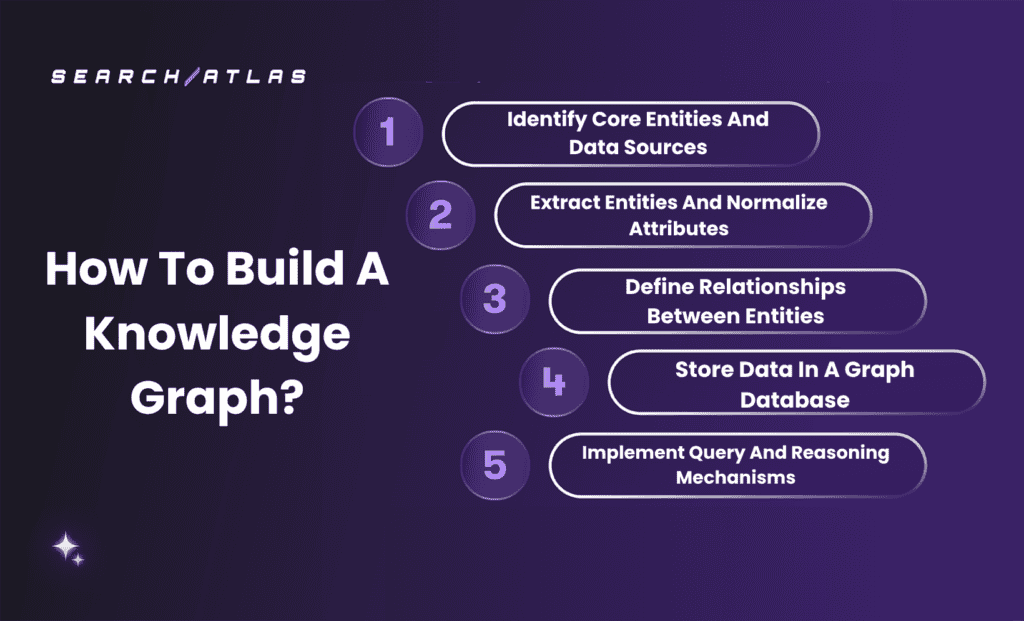
A knowledge graph is built by identifying entities, extracting attributes, defining relationships, storing graph data, and implementing query and reasoning mechanisms. This process turns raw data into connected knowledge that machines search, interpret, and reason over. Knowledge graphs improve AI systems because they ground outputs in structured context, explicit relationships, and traceable facts.
The 5 steps to build a knowledge graph are listed below.
- Identify Core Entities And Data Sources.
- Extract Entities And Normalize Attributes.
- Define Relationships Between Entities.
- Store Data In A Graph Database.
- Implement Query And Reasoning Mechanisms.
1. Identify Core Entities And Data Sources
Identify core entities and data sources by defining the objects, concepts, and datasets that the knowledge graph needs to represent. Core entities become the nodes of the knowledge graph, while data sources provide the information required to describe and connect those nodes. This step matters because weak entity selection creates duplicate nodes, missing relationships, and inaccurate graph outputs.
Entities represent real-world objects, events, concepts, people, places, organizations, products, assets, or geolocations. Entities need unique identifiers, labels, attributes, and source references. For example, a company entity contains a name, industry, location, website, and identifier. A person entity contains a name, role, organization, and related records. These entity definitions create the foundation for the graph structure.
Data sources define where entity information comes from. Knowledge graphs use structured data from databases, spreadsheets, and APIs. Knowledge graphs use semi-structured data from JSON, XML, and HTML pages. Knowledge graphs use unstructured data from documents, reports, emails, transcripts, and web pages. Knowledge graphs use multimedia data after OCR or speech transcription converts images, video, and audio into text.
Entity identification requires entity recognition, entity linking, entity clustering, and entity resolution. Entity recognition detects names and concepts inside data. Entity linking connects detected entities to canonical identifiers from sources (Wikidata or DBpedia). Entity clustering groups variants, abbreviations, and alternate names that refer to the same object. Entity resolution merges duplicate records, which prevents fragmented identities across the graph.
A strong entity strategy uses ontologies and schemas. Ontologies define entity classes, attributes, and relationship rules. Schema.org vocabulary gives standardized types and properties for machine-readable data. RDF triples express entity relationships through subject, predicate, and object structures. These structures make entity definitions consistent across datasets and systems.
Data preparation begins with chunking**, cleaning, and mapping**. Data cleaning removes duplicates, noise, irrelevant fields, and malformed values. Schema mapping connects source fields to graph nodes, properties, and relationships. This mapping ensures that raw records become structured graph elements.
Entity and source selection shape graph quality. A knowledge graph built for fraud detection needs entities (accounts, transactions, devices, addresses, and organizations). A knowledge graph built for product recommendations needs entities (users, products, categories, brands, and behaviors). A knowledge graph built for enterprise search needs entities (documents, authors, departments, projects, and topics).
A practical insight for this step is to start with one clear use case and one high-value dataset. Broad graph projects fail when teams model every possible entity too early. Strong knowledge graphs begin with focused entities, clean identifiers, reliable sources, and clear business questions.
2. Extract Entities And Normalize Attributes
Extract entities and normalize attributes by converting raw data into consistent nodes, properties, and identifiers. Entity extraction identifies meaningful objects inside unstructured or semi-structured data, while attribute normalization standardizes the details attached to those objects. This step matters because inconsistent names, formats, and values create duplicate entities and unreliable relationships.
Entity extraction uses natural language processing and LLMs to identify entities in text. Tools (spaCy) detect standard entity types, including people, organizations, locations, and dates. LLM-based extraction tools from LangChain or LlamaIndex identify nuanced entities, descriptions, and relationships from complex documents.
Entity extraction often follows a structured workflow. Text preprocessing cleans documents and removes formatting noise. Chunking divides large content into smaller segments. Named entity recognition detects entity mentions. Coreference resolution connects pronouns and repeated mentions to the correct entity. Entity linking maps extracted mentions to canonical identifiers. This workflow turns raw text into graph-ready objects.
Attribute normalization standardizes entity properties so that records become comparable. Attribute normalization aligns names, dates, units, locations, identifiers, and categories. For example, “NYC,” “New York City,” and “New York, NY” need to resolve to one location entity. “Birthday” and “Date of Birth” need to be normalized into one property. This consistency improves matching, retrieval, and reasoning.
Normalization reduces duplicate nodes and broken identities. Duplicate entities weaken graph quality because relationships are split across multiple records. Entity resolution identifies records that refer to the same real-world entity. Lightweight matching uses fuzzy logic for basic duplicates. Advanced resolution uses machine learning for complex cases (customers, suppliers, sanctions lists, and fraud networks).
LLMs improve normalization when rules and dictionaries fail. LLMs use surrounding context to disambiguate abbreviations, classify novel entities, and link difficult cases. However, LLMs introduce cost, latency, and hallucination risk. A strong workflow uses rules and dictionaries for simple cases, then sends difficult cases to LLMs for contextual resolution.
Normalization quality needs validation. Confidence scores flag uncertain mappings. Gold standard datasets measure extraction and linking accuracy. Expert review validates high-risk entities. Provisional identifiers allow novel entities to enter the graph without corrupting canonical records. These checks keep the graph reliable as data expands.
A practical insight for this step is to normalize early and refine later. Early normalization catches obvious errors before graph insertion. Post-processing finds deeper duplicates after more context becomes available. Strong systems use both stages to protect graph quality.
3. Define Relationships Between Entities
Define relationships between entities by creating edges that explain how nodes connect. Relationships give the knowledge graph meaning because they show interactions, dependencies, ownership, similarity, hierarchy, location, authorship, and influence. This step matters because a graph without meaningful relationships becomes a list of disconnected entities.
Relationships are the edges of a knowledge graph. Each relationship connects a subject entity to an object entity through a predicate. For example, “Apple produces iPhone” connects Apple to iPhone through the relationship produces. Relationship direction matters because “Company owns product” differs from “Product owned by company.” Reciprocal associations often require separate relationships in each direction.
Relationship types define how entities interact. Common relationship types include founded by, located in, owned by, works for, bought, belongs to, mentions, competes with, and related to. Domain-specific graphs need domain-specific relationships. Healthcare graphs use treatments, diagnoses, prescriptions, and contraindicated with. Finance graphs use owns, transfers to, controls, and are flagged by.
Relationships require properties and context. A relationship between a customer and a product includes purchase date, price, quantity, and channel. A relationship between a person and an organization includes role, start date, end date, and confidence score. Relationship properties make edges richer and improve downstream analysis.
Relationship definition uses multiple models. RDF represents relationships as subject, predicate, object triples. Property graphs represent relationships as edges with labels and properties. Descriptive knowledge graphs represent relationships with sentence descriptions, which improve human readability. Each model fits different needs for semantics, performance, and explainability.
Relationship extraction uses structured fields, NLP, rules, and LLMs. Structured data provides explicit links through IDs and fields. NLP extracts relationships from sentences and documents. Rules enforce valid patterns based on domain logic. LLMs identify implicit connections across complex text. Human validation improves quality when relationships affect compliance, finance, medicine, or legal outcomes.
Relationship mapping creates the reasoning layer foundation. Multi-hop relationships allow systems to answer deeper questions. For example, a graph identifies customers connected to suspicious devices through shared addresses and transactions. A vector search system finds similar text, but a graph explains how entities connect through verified paths.
Relationship quality depends on precision, consistency, and explainability. Vague relationships (related to weakened graph value). Specific relationships (acquired, headquartered in, manufactured by, and regulated by) improve graph usefulness. Consistent relationship naming prevents fragmented query logic. Explainable relationships allow users and AI systems to trace why a connection exists.
A practical insight for this step is to define fewer high-value relationships first. Overloaded relationship taxonomies slow implementation and confuse queries. Strong graphs start with relationships that directly answer the target use case.
4. Store Data In A Graph Database
Store data in a graph database by saving nodes, relationships, labels, and properties in a system designed for connected data. Graph databases store relationships natively, which makes traversal faster and simpler than table joins. This step matters because storage architecture determines query speed, scalability, update performance, and integration with AI systems.
Graph databases store core elements as nodes and edges. Nodes represent entities. Edges represent relationships. Labels classify nodes and relationships. Properties store values on nodes and edges. For example, a Person node has properties (name and birthdate). A WORKS_FOR relationship has properties (role and start date).
Graph databases use different storage models. Property graph databases store nodes and edges with key-value properties. Neo4j, TigerGraph, and Memgraph follow this model. RDF triple stores store data as subject, predicate, object triples. GraphDB and RDFox follow this semantic model. Hybrid systems combine property graph performance with RDF reasoning features.
Graph storage improves relationship traversal. Traditional databases use joins to connect tables during query time. Graph databases store adjacency directly, so connected nodes are easier to traverse. Index-free adjacency stores pointers between connected records, which keeps traversal performance tied to the number of connections explored rather than the total database size.
Graph databases need indexing and constraints. Indexes improve lookup speed for frequently queried properties (id, name, email, and canonical identifier). Constraints prevent duplicate records and enforce required values. Over-indexing slows writes, so graph indexes need careful selection. Strong indexing keeps graph queries fast without weakening ingestion performance.
Graph databases integrate with vector search for AI applications. Modern graph systems store embeddings on nodes or chunks. Vector indexes find semantically similar content. Graph traversal expands retrieved results through relationships. This hybrid retrieval improves AI answers because it combines meaning similarity with verified structure.
Graph storage requires governance. Access control protects sensitive entities and relationships. Provenance records show where facts came from. Versioning tracks changes across graph updates. Audit trails explain who changed data and why. These controls matter in enterprise, healthcare, finance, and regulated environments.
Graph databases fit highly connected data. They work well for fraud detection, identity resolution, supply chains, knowledge management, and GraphRAG. They fit poorly when the data has few relationships or only needs a simple key-value lookup. Storage choice needs to match the use case.
A practical insight for this step is to choose storage after defining queries. Query patterns reveal whether the graph needs RDF reasoning, property graph traversal, vector search, or hybrid storage. Strong storage decisions come from expected workloads, not tool popularity.
5. Implement Query And Reasoning Mechanisms
Implement query and reasoning mechanisms by enabling the graph to retrieve facts, traverse paths, infer new knowledge, and generate traceable answers. Query mechanisms access stored nodes and relationships, while reasoning mechanisms derive facts not explicitly stored. This step matters because a knowledge graph becomes valuable when systems ask complex questions and receive reliable answers.
Query mechanisms use graph query languages. SPARQL queries RDF graphs and supports semantic constraints, named graphs, and ontology-based retrieval. Cypher queries property graphs with readable pattern matching. Gremlin supports graph traversal across multiple systems. These languages allow queries that ask what an entity connects to and how those connections form meaning.
Reasoning mechanisms infer new facts from existing data. A graph can infer that Oxford is located in the United Kingdom if Oxford is located in Oxfordshire, Oxfordshire is located in England, and England is located in the United Kingdom. A graph inferences inverse relationships, transitive relationships, class membership, and hierarchy membership through semantic rules.
Reasoning depends on ontologies and rule sets. RDFS and OWL define class hierarchies, property constraints, inverse properties, and transitive rules. Datalog defines logical rules that derive new triples from existing facts. Custom rules encode business policies, eligibility checks, compliance logic, and domain expertise. These rules turn stored data into interpreted knowledge.
Query and reasoning systems use two main inference approaches. Forward chaining materializes inferred facts during data loading or updates. This approach speeds query time because inferred facts already exist in storage. Backward chaining performs reasoning during query execution. This approach reduces stored data but increases runtime complexity. Many enterprise systems choose materialization for performance.
GraphRAG combines query and reasoning with retrieval augmented generation. Vector search finds semantically relevant chunks. Graph traversal expands context through connected entities and relationships. Reasoning validates whether retrieved facts make real-world sense. This combination improves AI answers because the system retrieves both similar text and structured evidence.
Query and reasoning mechanisms improve explainability. Each answer traces back to entities, relationships, documents, and rules. This transparency matters for banking, healthcare, insurance, legal, and compliance use cases. A system shows which facts produced an output, which relationships connected them, and which rule created an inference.
Query and reasoning mechanisms face pitfalls. Over-engineered ontologies slow inference and make results hard to trust. Weak relationship definitions produce vague answers. Incomplete data limits reasoning quality. Shortest path assumptions miss important context. Poor query design creates slow or misleading results. Strong systems balance expressive logic with practical performance.
A practical insight for this step is to start with concrete questions that the graph needs to answer. Query examples expose missing entities, weak relationships, and unnecessary ontology complexity. Strong reasoning systems evolve from real questions, validated paths, and measurable answer quality.
What Are The Key Benefits Of A Knowledge Graph?
The key benefits of a knowledge graph are improved semantic search accuracy, enhanced entity understanding and context interpretation, faster data retrieval through graph traversal, better AI reasoning and knowledge inference, and unified data integration across multiple sources. These benefits define how systems understand data, connect entities, retrieve information, generate insights, and operate across complex environments.
Knowledge graphs improve data systems because knowledge graphs organize information as connected entities instead of isolated records. This structure enables machines to interpret meaning, follow relationships, and generate answers grounded in context rather than keywords.
The 5 key benefits of a knowledge graph are listed below.
1. Improves semantic search accuracy. Knowledge graphs improve semantic search accuracy by connecting entities, relationships, and context inside a structured network. This structure replaces keyword matching with meaning-based retrieval. Systems interpret intent by analyzing connected entities, which reduces ambiguity and improves result relevance. Accuracy improves because knowledge graphs distinguish entities with the same name through explicit relationships and attributes. For example, a knowledge graph separates Apple as a company from Apple as a fruit through entity types and connected context. This disambiguation ensures search results reflect intent rather than surface-level text similarity.
2. Enhances entity understanding and context interpretation. Knowledge graphs enhance entity understanding and context interpretation by modeling entities, attributes, and relationships inside a semantic structure. This structure allows systems to understand what an entity is, how it connects, and why it matters. Context interpretation improves because knowledge graphs link entities across domains, datasets, and interactions. Systems resolve ambiguous terms, map user intent to structured queries, and retrieve precise results through relationship traversal. This capability enables accurate answers for complex queries that require understanding multiple connected entities rather than isolated facts.
3. Enables faster data retrieval through graph traversal. Knowledge graphs enable faster data retrieval through graph traversal by storing relationships directly instead of reconstructing them at query time. This storage removes expensive join operations and allows direct navigation across connected nodes. Retrieval speed improves because systems follow edges instead of scanning tables. Graph traversal supports multi-hop queries without exponential complexity growth, which maintains performance as the relationship depth increases. This capability allows systems to retrieve insights from millions of connections in milliseconds, which supports real-time applications and complex analytics.
4. Improves AI reasoning and knowledge inference. Knowledge graphs improve AI reasoning and knowledge inference by providing structured relationships that support logical deduction. This structure allows systems to infer new facts from existing data through defined rules and connections. Reasoning improves because knowledge graphs connect entities across multiple steps, which enables multi-hop inference. For example, a system infers that a company operates in a country if it owns a subsidiary located in that country. This inference reduces hallucinations in AI systems because outputs rely on verified relationships rather than statistical guesses.
5. Unifies data integration across multiple sources. Knowledge graphs unify data integration across multiple sources by connecting structured, semi-structured, and unstructured data through shared entities and relationships. This integration creates a single, consistent representation of information across systems. Data integration improves because knowledge graphs align different schemas, formats, and identifiers into one model. This alignment removes silos, reduces duplication, and improves data consistency. Organizations gain a unified view of customers, products, processes, and knowledge, which improves decision-making and operational efficiency.
These benefits occur because knowledge graphs represent data as interconnected meaning rather than isolated records. Systems become more accurate, contextual, scalable, and explainable when data exists inside a connected graph structure.
What Are Common Challenges In Knowledge Graph Implementation?
The common challenges in knowledge graph implementation are data inconsistency across sources, entity resolution and disambiguation complexity, scalability of large graph datasets, maintenance of real-time updates, and complexity of relationship modeling. These challenges affect how knowledge graphs ingest data, unify entities, scale systems, maintain freshness, and model connections.
Knowledge graph implementation becomes difficult because knowledge graphs connect many data sources, entities, and relationships inside one evolving system. This complexity introduces technical, operational, and modeling constraints that impact performance, accuracy, and long-term maintenance.
The 5 common challenges in knowledge graph implementation are listed below.
1. Data inconsistency across sources. Data inconsistency across sources occurs because knowledge graphs integrate structured, semi-structured, and unstructured data from different systems. These sources often contain conflicting values, duplicate records, and incompatible formats. Inconsistency reduces reliability because systems cannot determine which facts are correct. Inconsistent data weakens reasoning because contradictory relationships break logical inference paths. For example, a customer appears with different names across datasets, which creates duplicate nodes and incorrect relationships. This duplication increases noise and reduces trust in outputs.
2. Entity resolution and disambiguation complexity. Entity resolution and disambiguation complexity arise because knowledge graphs need to identify when different records refer to the same real-world entity. This process involves matching names, attributes, and contextual signals across datasets. Complexity increases because entities often appear with variations, abbreviations, or ambiguous references. Incorrect resolution creates duplicate nodes, fragmented relationships, and inaccurate graph structure. Disambiguation errors occur when systems confuse entities with similar names but different meanings. This confusion leads to incorrect connections, which affect analytics, search accuracy, and AI outputs.
3. Scalability of large graph datasets. The scalability of large graph datasets becomes a challenge because knowledge graphs grow in nodes, edges, and relationships over time. Large graphs require significant memory, storage, and processing resources to maintain performance. Query performance degrades as graph size increases, especially for multi-hop queries across many connections. Scaling infrastructure requires distributed systems, optimized indexing, and efficient storage models. Without proper scaling strategies, knowledge graphs become slow, expensive, and difficult to maintain at an enterprise scale.
4. Maintenance of real-time updates. Maintenance of real-time updates challenges knowledge graph systems because data changes continuously across connected sources. Systems need to ingest, validate, and update data without breaking existing relationships or degrading performance. Real-time updates introduce latency constraints because systems need to process new data quickly while maintaining accuracy. Frequent updates increase the risk of inconsistent or outdated data if validation processes fail. Maintaining freshness requires continuous pipelines, monitoring, and synchronization across systems.
5. Complexity of relationship modeling. The complexity of relationship modeling arises because knowledge graphs represent diverse and dynamic connections between entities. Defining relationship types requires clear semantic meaning, consistent structure, and alignment with domain logic. Complex domains require thousands of relationship types, which increases modeling difficulty and maintenance effort. Poorly defined relationships create ambiguity, reduce query accuracy, and limit reasoning capabilities. Balancing relationship richness with system performance becomes difficult because more expressive models increase computational cost.
These challenges occur because knowledge graphs operate as interconnected systems where data quality, entity accuracy, system scale, update speed, and relationship clarity directly affect performance. Knowledge graph success depends on managing these constraints through strong data governance, scalable architecture, and precise modeling practices.
Can Small Businesses Implement Knowledge Graphs Effectively?
Yes, small businesses implement knowledge graphs effectively when they start with a focused use case, simple data sources, and accessible tools. Small businesses do not need a full engineering team to begin because basic knowledge graphs start from spreadsheets, structured business information, schema markup, and existing website data. This approach makes knowledge graphs practical for search visibility, customer data organization, and better decision-making.
Knowledge graphs work for small businesses because they organize business facts into entities and relationships. These facts include products, services, locations, people, reviews, categories, FAQs, and business attributes. This structure helps search engines and AI systems understand what the business does, where it operates, and how its offerings connect.
A small business builds an entry-level knowledge graph with simple tools. A spreadsheet defines core entities (business, services, locations, team members, and products). Schema markup publishes those entities in a machine-readable format on the website. A schema plugin adds structured data without custom code. This setup improves AI recognition within 60 to 90 days when information stays consistent across the website, GBP, directories, and third-party sources.
Knowledge graphs improve small business visibility because they clarify entity identity. Search systems and AI tools rely on consistent facts to recognize a business. Inconsistent names, addresses, service descriptions, or category labels create confusion. A knowledge graph reduces this confusion by aligning business information across sources. This alignment strengthens local search, AI search visibility, and brand representation inside generated answers.
Knowledge graphs improve small business operations by turning scattered data into connected knowledge. A business connects customers, services, orders, locations, support requests, and content topics inside one structure. This connection helps teams understand patterns, answer questions faster, and make better decisions. For example, a service business connects high-value services with customer questions, reviews, and location demand.
Small businesses face implementation challenges when projects become too broad. Manual knowledge graph construction becomes difficult without experience in data modeling, entity resolution, and schema design. Local LLMs create graphs from documents, but the processing speed becomes slow.
Small businesses get the best results from narrow implementation. A local business needs to start by mapping the business entity, service entities, location entities, review entities, and FAQ entities. An e-commerce business needs to start by mapping products, categories, brands, attributes, and customer questions. A professional service business needs to start by mapping expertise areas, authors, services, case studies, and locations.
Knowledge graph implementation becomes effective when the graph stays accurate and is maintained. Business information changes often, including hours, services, prices, staff, and locations. Updates need to appear across the website, schema markup, GBP, and trusted directories. Consistent updates keep the knowledge graph reliable and prevent outdated facts from weakening visibility.
Small businesses implement knowledge graphs effectively because modern tools lower the technical barrier. The strongest approach starts small, focuses on high-value entities, publishes structured data, and maintains consistency across sources. This practical workflow gives small businesses a realistic path toward stronger search visibility, cleaner data, and better AI recognition.
How Do You Measure Knowledge Graph Performance And Accuracy?
Knowledge graph performance and accuracy improve by measuring structural quality, semantic accuracy, retrieval precision, reasoning support, and downstream impact across systems. Knowledge graphs fail when entities are incorrect, relationships are weak, or retrieval returns irrelevant context, which reduces usefulness for search, AI, and decision-making.
Knowledge graph performance depends on balance. Too few entities create weak coverage, while too many low-quality entities create noise and incorrect inference paths. This imbalance reduces retrieval accuracy and reasoning reliability. Controlled graph construction, clean entity definitions, and consistent relationship modeling improve performance and prevent graph degradation.
Search Atlas improves knowledge graph performance by making entity data cleaner, structured, and easier for AI systems to interpret. OTTO SEO strengthens schema, internal linking, and crawlability, which improves how entities connect across pages. Content Genius improves semantic coverage, entity clarity, and topical depth, which gives knowledge graphs higher-quality input for retrieval and reasoning.
Structural metrics measure knowledge graph performance by evaluating node count, edge count, connectivity, and graph density. These metrics show whether the graph contains enough entities and relationships to represent real-world knowledge. Poor structure reduces traversal efficiency and limits multi-hop reasoning, which weakens downstream applications.
Semantic metrics measure knowledge graph accuracy by evaluating entity correctness, relationship validity, ontology coverage, and semantic alignment. These metrics detect errors (entity over-merging, duplicate nodes, and incorrect relationships). High semantic accuracy improves reasoning quality because the graph represents facts correctly.
Retrieval metrics measure knowledge graph performance by evaluating query response time, hit rate, ranking quality, and relevance of retrieved subgraphs. These metrics show whether the graph returns the right information for a given query. Strong retrieval performance improves RAG systems because the model receives accurate context before generation.
Reasoning metrics measure knowledge graph usefulness by evaluating multi-hop inference accuracy, traceability, and consistency. These metrics show whether the graph supports complex reasoning tasks across multiple connected entities. Accurate reasoning reduces hallucinations because answers follow structured, verifiable paths.
Application metrics measure real-world impact by evaluating answer accuracy, citation accuracy, hallucination rate, recommendation quality, and fraud detection improvement. These metrics confirm whether the knowledge graph improves actual systems instead of only internal graph quality. Performance gains appear when structured knowledge improves outputs across use cases.
MINE-1 improves knowledge graph evaluation by measuring knowledge retention from source data. This method checks how many verified facts remain recoverable from the graph after extraction. High retention shows that the graph preserves important information needed for reasoning and retrieval.
MINE-2 improves knowledge graph evaluation by measuring graph-assisted retrieval performance. This method tests whether knowledge graph triples improve question answering accuracy compared to baseline retrieval methods. Strong results show that the graph improves real AI system performance.
Precision, recall, and F1 scores measure node and edge accuracy inside the graph. Node F1 evaluates entity extraction quality. Edge F1 evaluates relationship accuracy. Graph Quality Score combines both metrics, which shows whether the graph is usable for downstream tasks.
Knowledge graph performance improves through continuous monitoring and validation. Monitoring detects stale data, broken relationships, duplicate entities, and slow queries. Regular validation ensures that updates maintain accuracy, consistency, and retrieval quality across the graph.
Search Atlas strengthens this process by improving the quality of knowledge sources before graph construction. OTTO SEO ensures structured, crawlable data across the website. Content Genius ensures clear entities and consistent semantics across content. These improvements make knowledge graphs more accurate, easier to measure, and more effective across AI and search systems.
Knowledge graph performance and accuracy improve through clean data, controlled graph structure, strong retrieval systems, and continuous measurement. Accurate entities, valid relationships, and reliable retrieval create knowledge graphs that improve reasoning, search, and AI-generated outputs.
What Metrics Evaluate Knowledge Graph Accuracy?
Knowledge graph accuracy improves by measuring triple correctness, entity precision, relationship validity, retrieval relevance, and reasoning consistency. These metrics detect incorrect facts, weak connections, and missing knowledge that reduce graph reliability.
Knowledge graph accuracy improves by measuring triple correctness. Triple accuracy calculates the percentage of subject–predicate–object facts that match real-world truth. High triple accuracy ensures that the graph stores reliable information for downstream systems.
Knowledge graph accuracy improves by measuring entity precision. Entity precision evaluates the correct identification, separation, and disambiguation of nodes. This metric prevents over-merging, duplication, and incorrect entity representation, which preserves graph clarity.
Knowledge graph accuracy improves by measuring relationship validity. Relationship validity checks whether edges correctly represent connections between entities. Accurate relationships ensure that graph traversal and inference produce valid results.
Knowledge graph accuracy improves by measuring reasoning consistency. Reasoning metrics evaluate multi-hop inference accuracy, traceability, and logical consistency across connected entities. Strong reasoning accuracy ensures reliable conclusions from graph data.
Knowledge graph accuracy improves through statistical validation metrics. Confidence intervals and margin of error estimate reliability across sampled triples. Wilson intervals provide stable accuracy estimation compared to baseline methods.
Knowledge graph accuracy improves through these metrics because they evaluate correctness, completeness, retrieval quality, and reasoning performance across the entire graph system.
What Are The Most Common Use Cases For Knowledge Graphs?
The most common use cases for knowledge graphs are search engines and semantic search systems, recommendation systems and personalization engines, fraud detection and risk analysis, healthcare data integration and research, and enterprise knowledge management systems. These use cases depend on connected data, entity understanding, relationship traversal, and contextual reasoning.
Knowledge graphs improve these systems because they represent information as entities and relationships instead of isolated records. This structure allows applications to interpret meaning, connect facts, retrieve context, and generate accurate answers across complex data environments.
The 5 most common use cases for knowledge graphs are listed below.
1. Search engines and semantic search systems. Knowledge graphs improve search engines and semantic search systems by enabling meaning-based retrieval instead of keyword matching. Search systems use entities, attributes, and relationships to understand intent and context. This structure helps search engines distinguish ambiguous terms, connect related concepts, and generate direct answers. Google Knowledge Graph shows this use case at a large scale because it organizes facts about real-world entities and their relationships. Semantic search systems use this structure to return results that match meaning, not just exact words.
2. Recommendation systems and personalization engines. Knowledge graphs improve recommendation systems and personalization engines by connecting users, items, attributes, behaviors, and preferences. Recommendation systems use these connections to identify relevant products, movies, music, articles, or services. This structure reduces cold start problems because the graph contains contextual information beyond direct user interactions. Personalization improves because knowledge graphs reveal why items relate, which makes recommendations more explainable and relevant. For example, a movie recommendation graph connects actors, genres, directors, themes, and viewing behavior.
3. Fraud detection and risk analysis. Knowledge graphs improve fraud detection and risk analysis by connecting accounts, devices, transactions, identities, merchants, addresses, and risk signals. Fraud detection systems use these relationships to identify suspicious patterns that isolated records miss. This structure detects shared devices, circular money flows, shell companies, synthetic identities, and mule networks. Risk analysis improves because investigators trace multi-hop relationships across entities. Knowledge graphs reduce false positives because systems evaluate context, not just individual transactions.
4. Healthcare data integration and research. Knowledge graphs improve healthcare data integration and research by connecting patients, diagnoses, medications, symptoms, lab results, clinical trials, genes, proteins, and diseases. Healthcare systems use this structure to unify fragmented data across electronic health records, medical literature, genomic datasets, and clinical guidelines. Research improves because knowledge graphs reveal connections between diseases, drugs, biomarkers, and treatment outcomes. Clinical decision systems use knowledge graphs to identify interactions, support diagnosis, and personalize treatment plans.
5. Enterprise knowledge management systems. Knowledge graphs improve enterprise knowledge management systems by connecting documents, people, projects, teams, tools, processes, policies, and business concepts. Enterprise systems use this structure to create a unified view of organizational knowledge. Search improves because employees retrieve information through meaning and relationships instead of file names or keywords. AI systems improve because enterprise knowledge graphs ground answers in a verified business context. Governance improves because lineage, ownership, and provenance become visible across connected data assets.
These use cases occur because knowledge graphs make relationships explicit and machine-readable. Applications become more accurate, contextual, explainable, and scalable when they use connected knowledge instead of disconnected data.
What Is The Future Of Knowledge Graphs And AI Systems?
The future of knowledge graphs and AIsystems is defined by unified graph models, real-time data integration, and hybrid AI architectures that combine reasoning with generation. This shift matters because AI systems require structured context, consistent data relationships, and dynamic updates to produce reliable and explainable outputs.
How do knowledge graphs reshape AI system architecture? Knowledge graphs reshape AI systems by introducing structured context layers that guide retrieval, reasoning, and decision-making. AI systems rely on relationships between entities, not just patterns in text, which improves accuracy and reduces hallucinations. This structure enables systems to answer complex queries through multi-hop reasoning instead of isolated predictions.
How are knowledge graph engines evolving? Knowledge graph engines evolve into generalized data systems that unify structured, semi-structured, and unstructured data sources. These systems connect relational databases, graph databases, and streaming pipelines into a single architecture. This evolution enables consistent data access, faster updates, and better interoperability across enterprise environments.
How do knowledge graphs integrate with AI models? Knowledge graphs integrate with AI models through hybrid architectures that combine symbolic reasoning with neural generation. Systems use retrieval pipelines, graph traversal, and structured embeddings to inject context into language models. This integration improves factual accuracy because AI outputs rely on verified relationships instead of probabilistic guesses.
What role do RAG and GraphRAG play in the future? RAG and GraphRAG define the next phase of AI systems by combining retrieval with structured knowledge graphs. RAG retrieves relevant documents, while GraphRAG retrieves connected entities and relationships from graphs. This combination improves answer quality because AI systems access both raw content and structured context during generation.
What is the long-term direction of knowledge graphs and AI? The long-term direction combines knowledge graphs and AI into unified intelligence systems that reason, retrieve, and generate within the same workflow. These systems move beyond static data storage and become active reasoning layers that guide AI behavior. This convergence enables AI systems to operate with deeper context, higher accuracy, and stronger decision-making capabilities.