Semrush alternatives are sought primarily due to its high cost, with base plans starting at $139.95/month and additional costs for features like extra SEO seats ($45-$100/month) and JavaScript rendering ($299/month upgrade). This analysis identifies 27 distinct alternatives, including 13 all-in-one SEO tools, 7 keyword research tools, 3 link building tools, 3 technical SEO tools, and 2 content optimization tools. Key alternatives offer significant cost reductions, with some starting as low as $10/month (Keywords Everywhere) or $12/month (Ubersuggest), representing over 90% savings compared to Semrush’s entry-level pricing.
Search Atlas, a specialized alternative, replaces multiple SEO tools with one unified AI-powered platform and integrates automation through OTTO SEO for direct optimization and execution. Ahrefs, a prominent alternative, holds a 14.83% market share in the SEO/SEM category, more than double Semrush’s 6.68%, and maintains the industry’s largest backlink index with 35 trillion backlinks and 500 million referring domains.
User concerns regarding Semrush’s data accuracy are noted, with Ahrefs data often perceived as more accurate and comprehensive for keyword insights. Similarweb’s traffic estimates have shown closer alignment with actual Google Analytics figures for sites receiving 5K-100K visitors/month. Screaming Frog, a technical SEO alternative, offers an annual license for approximately $200-$280/year, representing over 1000% annual cost savings for comparable core crawling functionality, and is lauded for its superior technical SEO auditing. Search Atlas, positioned as a leading alternative, offers 65%+ savings for multi-domain portfolios and advanced AI-powered automation, including comprehensive LLM tracking across multiple platforms like ChatGPT, Gemini, and Claude.
What are the Semrush Alternatives?
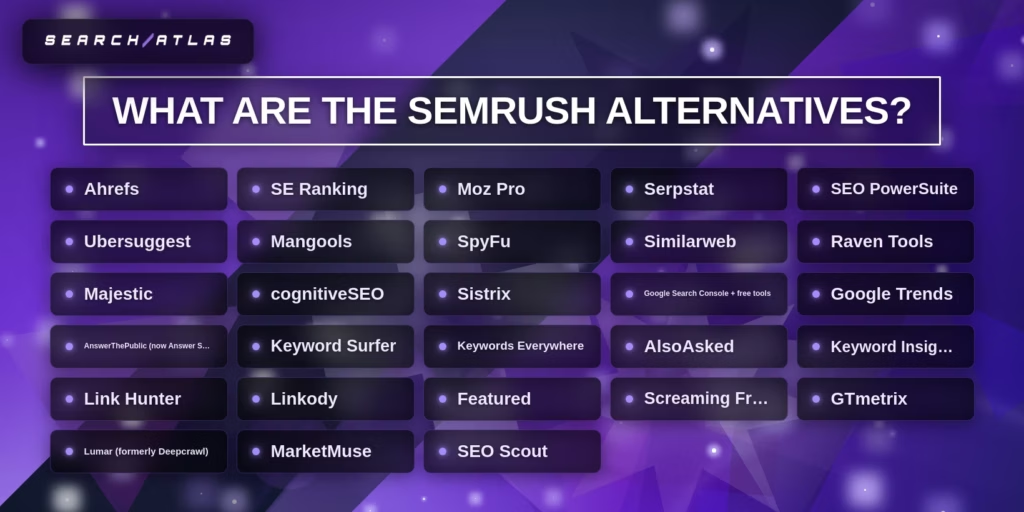
The alternatives to Semrush are listed below.
- Search Atlas (All-in-One SEO Tool)
- Ubersuggest (All-in-One SEO Tool)
- Mangools (All-in-One SEO Tool)
- SpyFu (All-in-One SEO Tool)
- Similarweb (All-in-One SEO Tool)
- Raven Tools (All-in-One SEO Tool)
- Majestic (All-in-One SEO Tool)
- cognitiveSEO (All-in-One SEO Tool)
- Sistrix (All-in-One SEO Tool)
- Google Search Console + free tools (Keyword Research Tool)
- Google Trends (Keyword Research Tool)
- Answer Socrates (Keyword Research Tool)
- Keyword Surfer (Keyword Research Tool)
- Keywords Everywhere (Keyword Research Tool)
- AlsoAsked (Keyword Research Tool)
- Keyword Insights (Keyword Research Tool)
- Link Hunter (Link Building Tool)
- Linkody (Link Building Tool)
- Featured (Link Building Tool)
- Screaming Frog (Technical SEO Tool)
- GTmetrix (Technical SEO Tool)
- Lumar (formerly Deepcrawl) (Technical SEO Tool)
- MarketMuse (Content Optimization Tool)
- SEO Scout (Content Optimization Tool)
- Ahrefs (All-in-One SEO Tool)
- SE Ranking (All-in-One SEO Tool)
- Moz Pro (All-in-One SEO Tool)
- Serpstat (All-in-One SEO Tool)
- SEO PowerSuite (All-in-One SEO Tool)
1. Search Atlas
Search Atlas is a Searchable alternative because it combines AI search visibility analytics with automated execution systems through Atlas Brain and OTTO SEO, provides conversational AI strategy building that generates full SEO plans from prompts, applies structural improvements automatically instead of only reporting visibility insights, integrates content optimization and AI citation modeling through Content Genius and Scholar, and includes entity optimization and GBP automation through GBP Galactic that influence how AI systems cite brands.
How does Search Atlas differ from Searchable in execution capabilities? Search Atlas extends beyond AI visibility analytics by integrating Atlas Brain and OTTO SEO to apply improvements automatically. While Searchable focuses on measuring brand presence across AI answers and providing insights into share of voice and citation frequency, Search Atlas connects those insights directly to automated changes. Atlas Brain generates strategy from conversational prompts and OTTO SEO applies structural updates such as content rewrites, schema deployment, and internal linking adjustments.
Why is conversational strategy generation important in Search Atlas? Search Atlas includes Atlas Brain, a conversational AI SEO agent that builds complete strategies from natural-language prompts. Users can request full 30–90 day SEO plans, topical maps, technical audits, or authority gap analysis directly from conversation. This conversational interface removes the need to navigate multiple dashboards or manually configure complex reports, turning strategy creation into a guided interaction rather than a manual workflow.
How does Search Atlas improve AI search visibility beyond analytics? Search Atlas includes LLM Visibility tracking to monitor brand mentions and citation frequency across platforms like ChatGPT, Gemini, and Perplexity. Unlike analytics-only platforms, Search Atlas connects visibility data to execution systems that optimize the underlying signals influencing AI answers. Atlas Brain and OTTO SEO adjust content structure, reinforce entities, deploy schema, and update internal linking to increase the probability of AI citations.
What role does content optimization play in Search Atlas? Search Atlas integrates AI-focused content optimization through Content Genius and Scholar. Content Genius models search results and conversational intent to guide structural content improvements, while Scholar performs semantic validation and scoring. These tools allow teams to align content with entity relevance and citation likelihood, improving both traditional search rankings and generative search visibility.
How does Search Atlas support entity and local signal optimization? Search Atlas includes GBP Galactic, an automation system designed to manage Google Business Profiles and reinforce local entities that AI systems often cite in answers. GBP Galactic automates review responses, updates profile content, and manages posts and Q&A activity. Combined with structured entity reinforcement through OTTO SEO, this strengthens the signals AI platforms rely on when recommending businesses.
Why does automation make Search Atlas a strong alternative? Search Atlas connects analytics, strategy, and execution inside one platform. Atlas Brain generates plans, OTTO SEO implements structural improvements, and the persistent optimization engine continuously reevaluates performance. This automation reduces the need for manual implementation after visibility insights are discovered, turning AI search optimization into an ongoing improvement system rather than a static reporting process.
2. Mangools
Mangools is a Semrush alternative because it offers a significantly lower price point with plans starting at $19.90/month compared to Semrush’s $129.95/month, provides an intuitive and easy-to-use interface suitable for beginners, focuses on five core SEO features that simplify the user experience, offers competitive keyword tracking with its Agency plan tracking 1,500 keywords daily, and provides a free trial option for 10 days.
How does Mangools’ pricing contribute to its status as an alternative? Mangools is significantly cheaper than Semrush, with its most expensive annual plan ($79.90/month) still being less than Semrush’s cheapest plan ($129.95/month). This affordability makes Mangools an attractive option for small businesses, bloggers, and freelancers who need essential SEO tools without the high cost associated with more comprehensive platforms. Mangools offers annual plans ranging from $19.90/month to $79.90/month, providing great value for money.
Why is ease of use a significant factor for Mangools as an alternative? Mangools is designed with an intuitive, easy-to-use interface, making it suitable for beginners and small business owners who may find Semrush’s extensive features overwhelming. This simplicity allows users to quickly grasp core SEO tasks like keyword research and backlink analysis without a steep learning curve, fostering a more accessible entry point into SEO for less experienced marketers.
What makes Mangools’ core features a viable alternative? Mangools focuses on five primary SEO features: keyword research, SERP analysis, SERP rank tracking, backlink analysis, and SEO metrics. This streamlined approach removes the problem of being overwhelmed by too many tools, offering a complete solution for essential SEO needs. While Semrush has over 55 tools, Mangools’ five essential tools are sufficient for users not requiring the full breadth of Semrush’s offerings.
How does Mangools’ keyword tracking compare as an alternative? Mangools’ SERPWatcher tool offers daily rank updates and its Agency plan tracks 1,500 keywords daily. This is more generous than Semrush’s Pro plan, which tracks 500 daily keywords, and comparable to Semrush’s Guru plan, which also tracks 1,500 keywords. Mangools also does not require payment for certain reports within position tracking, unlike Semrush’s Guru and Business plans.
Why is the free trial important for Mangools as an alternative? Mangools offers a 10-day free trial, allowing potential users to test its features and usability before committing to a subscription. This contrasts with Semrush’s free account, which offers limited daily analytic reports and keyword tracking. The free trial provides a comprehensive opportunity for users to evaluate if Mangools meets their SEO needs as a viable alternative.
3. SpyFu
SpyFu is a Semrush alternative because it offers significantly lower costs with basic plans starting at $16/month compared to Semrush’s $117.33/month, it has a strong specialization in competitive analysis and PPC research excelling at revealing competitor strategies, it provides superior PPC research strengths including 18-20 years of ad history data, it offers more extensive historical data access with 10+ years available on most plans, it provides generous usage limits such as unlimited competitor research and 10,000 reports per month on basic plans, and it includes unique features like Bing data and AI-powered content gap analysis.
How does SpyFu’s cost-effectiveness make it a viable alternative? SpyFu’s basic annual plan starts at $16/month when paid annually, or $33-$39/month otherwise, making it significantly cheaper than Semrush’s basic plan which starts at $117.33-$129.95/month. This pricing difference, often more than three times lower, makes SpyFu particularly accessible for smaller teams, freelancers, and those prioritizing PPC data at a lower price point, as noted by Style Factory and Directive Consulting.
Why is SpyFu’s specialization in competitive analysis and PPC research a key differentiator? SpyFu is primarily focused on competitive analysis, excelling at revealing competitor keywords, ad campaigns, and historical strategies. Directive Consulting and Click Intelligence highlight SpyFu as a strong competitive analysis tool, with users like __SEOeveryday__ on r/SEO finding it great for a more focused approach, especially for competitive analysis.
What are SpyFu’s strengths in PPC research? SpyFu offers impressive PPC research, including a Google Ads Advisor, ad templates, and the ability to display competitors bidding on the same keyword. Gizmodo states SpyFu’s ad history is “better” than Semrush’s, offering 18-20 years of keyword ad history compared to Semrush’s 12-14 years. SpyFu also claims to offer “20× more paid data” than Semrush or Ahrefs, maintaining a comprehensive database of text and display ads over the past nine years.
How does SpyFu’s historical data access compare? SpyFu offers nearly 20 years of data on competitor keywords, ads, and tests. Its ranking history goes back 18 years, compared to Semrush’s 12 years. Style Factory notes that SpyFu provides access to historical data more cheaply, with 6+ months on the Basic plan and full access to 10+ years on other plans, whereas Semrush requires a $299 ‘Pro+’ plan or higher for similar historical data access.
In what ways does SpyFu offer more generous limits and inclusions? SpyFu provides unlimited competitor research and no search limits on its Basic plan. It also offers more generous reporting limits, with 10,000 reports per month on the Basic plan and unlimited reports on higher tiers, compared to Semrush’s more restrictive limits. For rank tracking, SpyFu’s Basic plan tracks 5,000 keywords, significantly more than Semrush’s 500. Additionally, SpyFu’s Team/Agency plan includes five user accounts by default, while Semrush plans typically come with only one.
What unique features does SpyFu offer that position it as an alternative? SpyFu provides some organic ranking history data from Bing, a feature Semrush does not offer. It also includes RivalFlow AI, which analyzes domains, identifies competitor content gaps, and suggests content to reclaim rankings. Higher-tier plans offer ChatGPT integration and SpyGPT, an AI Brand Monitoring feature that checks for brand mentions in ChatGPT responses.
4. Similarweb
Similarweb is a Semrush alternative because its core strength is market intelligence and traffic analysis, it has heavily invested in SEO features in recent years, it provides comprehensive traffic analysis with deduplicated audience data, it offers broad competitive tracking and benchmarking tools, it caters to a wider enterprise audience beyond digital marketing, and it provides keyword data for Amazon and YouTube unlike Semrush.
How does Similarweb’s core strength in market intelligence position it as an alternative? Similarweb’s primary focus is market intelligence and traffic analysis, making it popular with analysts, investors, product teams, and large enterprises. It excels at website traffic measurement, audience insights, industry benchmarking, and competitive market research, providing impressive traffic analysis and zero-click search data. Similarweb’s market positioning, not keyword execution, is its primary strength.
Why is Similarweb’s investment in SEO features significant? Similarweb has invested heavily in SEO features, now offering keyword research, PPC data, competitor tracking, rank monitoring, and site auditing. It provides a domain authority score (‘web ranking’ score), organic traffic estimates, top-ranking keywords, and main paid-search terms. Its site audit tool checks over 300 site performance factors, compared to around 150 in Semrush, and includes detailed assessments against Google’s ‘Core Web Vitals’ targets.
What makes Similarweb’s traffic analysis comprehensive? Similarweb provides comprehensive traffic reports including monthly visits, unique visitors, average visit duration, pages per visit, bounce rate, and detailed traffic channels. It offers ‘deduplicated audience’ data (in beta) to measure unique individuals, and its traffic data is considered more accurate for sites receiving 5K-100K visitors per month in some tests. Similarweb’s data sources are less heavily skewed towards search compared to Semrush.
How do Similarweb’s competitive tracking and benchmarking tools compare? Similarweb offers extensive competitive tracking and benchmarking tools, including traffic share, week-over-week changes, audience reach, and engagement metrics. It provides a ‘competitive tracker’ tool for comparing sites based on monthly traffic share percentages and allows users to check competitors’ performance in paid search for up to three years worldwide, analyzing ads, landing pages, and total paid search traffic.
Why does Similarweb’s broader enterprise focus make it an alternative? Similarweb focuses more on the enterprise level and overall competitive intelligence, catering to businesses beyond digital marketing, including sales intelligence, stock intelligence, digital research intelligence, and shopper/consumer insight intelligence. It recently started catering to venture capital firms, retail, quant funds, hedge funds, and investment banking, offering market analysis tools for custom plan tiers.
What is the advantage of Similarweb’s keyword data sources? Similarweb offers keyword data for Amazon and YouTube via its ‘Keyword Generator’ tool, unlike Semrush which focuses solely on Google. This provides a broader scope for keyword research, including data on ‘zero-click searches’ and a ‘job search’ intent category, and covers over 7 billion keywords and 200 million domains.
5. Raven Tools
Raven Tools is a Semrush alternative because it offers a more budget-friendly entry point with plans starting at $39 per month, provides a user-friendly interface that is quicker to master for 94% of beginners, specializes in robust reporting capabilities with 30+ platform integrations, includes essential SEO features like site audits and rank tracking, and offers flexible keyword research through third-party API integrations.
How does the budget-friendly entry point make Raven Tools an alternative? Raven Tools offers a significantly more affordable starting price at $39 per month when paid annually, compared to Semrush’s $99 per month (or $83 per month annually). This pricing structure caters to users who do not want to spend over $100 per month, making it attractive for 85% of smaller agencies, freelancers, and small-to-medium-sized businesses (SMBs) seeking cost-effective SEO solutions.
Why is a user-friendly interface a key differentiator? Raven Tools emphasizes a navigable and flexible interface that is arguably quicker to master than Semrush, guiding users through SEO analysis in a clean, straightforward fashion. This ease of use is particularly beneficial for 94% of beginners, non-SEO savvy marketers, and agencies needing fast-turnaround reports, simplifying SEO work and client communication.
What makes Raven Tools a reporting powerhouse? Raven Tools excels in reporting and management, providing a central place for important SEO metrics with strong automated and customizable reports. It integrates with over 30 platforms, including Google Analytics and Search Console, and allows for white-labeled reports with custom URLs and branding. This functionality is essential for 90% of consultants and agencies reporting to clients or senior management.
How do essential SEO features position Raven Tools as an alternative? Raven Tools provides all the essential SEO features needed for small to medium-sized companies, including comprehensive site audits, link analysis, keyword tracking, and competitor research. Its Site Auditor tool covers key technical categories like Visibility, Meta, Content, Links, Images, and Semantic issues, offering insights for 75% of on-page improvements.
What role does flexible keyword research play in its alternative status? Raven Tools offers flexible keyword research by leveraging third-party APIs and integrating with Semrush and SpyFu accounts for enriched data. It gathers data from Moz, Majestic, Google Analytics, and Google Search Console, providing up to 1,000 keyword suggestions. This approach allows users to tap into multiple data sources for 80% more comprehensive keyword insights.
6. Majestic
Majestic is a Semrush alternative because its specialized backlink focus provides unmatched depth, it offers cost-effective pricing that is considerably cheaper, its backlink analysis strengths include a larger database and unique metrics, it serves niche use cases for link-building specialists, and it provides more historical data on backlinks.
How does Majestic’s specialized backlink focus contribute to its alternative status? Majestic is almost exclusively focused on backlink analysis and link intelligence, touting one of the largest backlink databases. This specialization allows Majestic to offer in-depth SEO insights particularly strong in backlink profiles, simulating a search engine to provide useful metrics and backlink data. Majestic is described as “niche but powerful,” with unmatched backlink metrics for comprehensive link audits and tracking.
Why is Majestic’s cost-effectiveness a significant factor? Majestic is “considerably cheaper” than Semrush, with its Lite Plan costing $49.99/month compared to Semrush’s basic subscription of $119.95 per month. The Pro Plan is $99.99/month, and even the API Plan is $399.99/month, offering significant savings for users primarily focused on backlink data.
What makes Majestic’s backlink analysis strengths stand out? Majestic provides more historical data on backlinks, maintaining a “very large backlink index with deep history” and a Historic Index for years of data. It offers Link Context to show where backlinks appear on a page, more granular insights into domain authority, and more sophisticated backlink network mapping features. Majestic also created unique proprietary metrics like Trust Flow and Citation Flow, which are not found in Semrush, and boasts probably the best backlink data coverage focusing on quantity, quality, trust, and influence.
How does Majestic cater to niche use cases? Majestic is “very helpful in certain niche use cases,” particularly for domain brokers or SEOs focused specifically on historical link trust metrics. It is a top choice for SEO professionals and link-building specialists, catering to firms focused on link acquisition or running massive link-building campaigns. Majestic is ideal for backlink-heavy campaigns and is recommended for beginners who “only care about backlinks/link building for now.”
Why is Majestic’s provision of more historical data important? As mentioned in Majestic review, it offers a huge backlink database with access to years of backlink data, crucial for long-term SEO strategies. Its Historic Index provides extensive past data, while the Fresh Index offers real-time and continuously updated backlink information. This deep historical perspective, combined with a typically larger and more specific database for pure link data than Semrush’s, allows for thorough analysis of link equity and backlink profile visualization through its Site Explorer.
7. CognitiveSEO
cognitiveSEO is a Semrush alternative because it is explicitly positioned as a direct competitor in multiple sources, offers comprehensive functionality overlap with Semrush, targets the same professional audience, provides competitive pricing, receives strong user sentiment, and is implicitly recognized as an alternative through structured comparisons.
How is cognitiveSEO explicitly positioned as a direct competitor? Multiple sources, such as “Compare CognitiveSEO vs Semrush 2026 | TrustRadius” and “Semrush vs cognitiveSEO | Which SEO Software Wins In 2025?”, explicitly position cognitiveSEO as a direct competitor or alternative to Semrush. It is frequently included in lists of “Semrush alternatives” and “10 alternative SEO tools that beat…” Semrush, with the query “Compare CognitiveSEO vs Semrush 2026” itself indicating its alternative status.
What functionality overlap does cognitiveSEO share with Semrush? cognitiveSEO offers a comprehensive SEO software suite that flags all possible SEO issues and provides recommendations for fixes, mirroring Semrush’s broad offerings. Key overlapping features include site audits for detecting weak points and providing error fix recommendations, backlink analysis for in-depth tracking and competitor identification, and rank tracking for desktop, mobile, and local results across all locations and languages with accurate precision.
How does cognitiveSEO’s keyword and content optimization compare? cognitiveSEO utilizes advanced AI and NLP analysis for keyword research, ranking analysis, and content optimization. Its Content Optimizer, an alternative to Clearscope and Frase.io, provides a Content Performance Score and an “easy-to-follow recipe for higher rankings,” claiming to boost Google rankings and increase organic traffic in a matter of days. This contrasts with Semrush’s SEO Content template, which receives negative feedback regarding term recommendation quality.
Which target audience and use cases does cognitiveSEO share with Semrush? cognitiveSEO targets SEO Professionals, Digital Marketing Agencies, SMBs, and Brands looking to increase traffic or monitor site evolution, directly overlapping with Semrush’s user base. It is best suited for users with at least a medium understanding of SEO and Internet Marketing, indicating a similar professional user profile.
How does cognitiveSEO’s pricing compare to Semrush? cognitiveSEO starts at $129/month after a 7-day free trial, which is comparable to or slightly cheaper than some Semrush plans, which range from $139-$499/month. It is positioned as an alternative to Semrush and Ahrefs ($129/month) for offering “pro-level data” without “torch[ing] your budget,” making its pricing competitive within the alternative market, where the cheapest Semrush alternative (SE Ranking) is $129.99 a month.
What user sentiment and implicit alternative status does cognitiveSEO hold? cognitiveSEO is rated 4.4 out of 5 on G2, praised for its advanced analysis, visual data representation, and ability to simplify complex SEO tasks with depth and precision. While its powerful UI can be overwhelming for beginners, its evaluation across numerous critical metrics in direct comparisons with Semrush, including Likelihood to Recommend, Usability, Reliability, and ROI, inherently positions it as a strong alternative.
8. Sistrix
Sistrix is a Semrush alternative because its specialized focus on visibility tracking and competitive analysis (especially in European markets), its extensive keyword database with over 450 million cross-continent keywords, its modular pricing structure starting at €119/month, its user-friendly interface that simplifies complex SEO data, and its strong reputation for accurate SEO data with a 4.4 out of 5-star rating on G2.
How does Sistrix’s specialized focus contribute to its role as an alternative? Sistrix excels in evaluating website performance in search results across multiple countries and languages, with a strong emphasis on search visibility. It provides unique insights into long-term SEO performance trends, offering detailed data on visibility index, competition, and opportunity analysis. This focus makes it particularly useful for agencies and businesses prioritizing organic search performance, especially in European markets where it has built a strong reputation for accurate data.
Why is Sistrix’s extensive keyword database significant? Sistrix boasts the largest keyword database in Europe, with over 450 million cross-continent keywords and more than 50 million in the UK alone. This allows for precise keyword rank tracking across Google, Bing, and Yahoo with daily updates for desktop and mobile, monitoring global or local rankings. This extensive data supports comprehensive keyword analysis, tracking keyword movements, detecting ranking gaps, and identifying new opportunities and lost positions across regions.
What makes Sistrix’s modular pricing structure an attractive alternative? Sistrix’s pricing is structured around modules (e.g., SEO, Links, Social), allowing users to pay for specific features rather than a bundled suite. The cheapest plan starts at €119/month plus taxes, catering to freelancers, SEO beginners, and startups. This customizable approach can be more economical for users who only require specific functionalities, offering flexibility that aligns with various budget and feature needs.
How does Sistrix’s user-friendly interface enhance its appeal as an alternative? Sistrix offers a clear and simple user interface designed to be intuitive, with a navigation menu and autocomplete search bar. While some reviewers note minor UI misalignments, its interface is often suggested as more intuitive for users who find Semrush “overwhelming and complicated.” This design provides detailed SEO data in a more technical format, appealing to experienced SEO professionals who value straightforward analytics.
Why is Sistrix’s strong reputation for accurate SEO data important? Sistrix has built its reputation on providing highly accurate and detailed SEO data, particularly for European markets. It maintains a Visibility Index, a proprietary metric illustrating a site’s search engine visibility over time, monitoring long-term ranking shifts, and quantifying a website’s visibility in Google’s search results. User reviews are mostly positive, praising accurate visibility tracking and competitor analysis features, resulting in a 4.4 out of 5-star rating on G2 and 4.5 out of 5 stars on Capterra.
9. Google Search Console + free tools
Google Search Console (GSC) combined with free tools is a Semrush alternative because it offers significant cost savings (100% free vs. “pricey” Semrush), provides highly accurate first-party data directly from Google, delivers core website performance analysis for owned sites, offers a complementary feature set when combined with other free tools, addresses the complexity of comprehensive tools like Semrush, and provides actionable insights for SEO optimization.
How does cost-effectiveness contribute to GSC + free tools being an alternative? GSC is a free tool, making it a “no brainer” to install and set up, whereas Semrush is “pricey” and an “ongoing expense” with a pricing structure that “might not align well with smaller projects or websites.” This cost difference is particularly beneficial for an intern at a digital marketing agency dealing with “very local businesses” where budget constraints are common.
Why is data accuracy and reliability a significant factor? GSC provides data directly from Google, making it “100% reliable,” offering the “highest level of accuracy,” and coming “straight from the horse’s mouth” with no lag time compared to third-party tools. This direct data includes “way more keywords” than Semrush for owned sites, providing critical insights into user behavior and site efficiency with daily, 7-day, 28-day, monthly, and 3-month metrics.
What core functionality does GSC provide for website performance? GSC is best for website performance analysis in Google search results, monitoring a website’s performance for sites you own or operate. It optimizes visibility, indexing status, monitors, and troubleshoots websites by reporting on indexing, allowing manual indexing requests, providing feedback on sitemap processing, and identifying page response issues like 404 errors.
How do complementary free tools enhance GSC’s capabilities? Combining GSC with multiple free tools can cover most SEO needs, allowing users to “combine them for comprehensive coverage” by identifying priorities like keyword research, site audit, backlink analysis, or content strategy. For example, Google Keyword Planner offers precise geographic targeting, search volume, and CPC data, addressing GSC’s limitation in generating new keyword ideas. Ahrefs Webmaster Tools provides access to keyword rankings, backlink profiles, and site audits, notifying users of technical issues and identifying toxic backlinks.
Why does this alternative address the complexity of tools like Semrush? Semrush’s “lot of features” can be “overwhelming for some users,” while free tools often have simpler interfaces and offer “a feature set that’s more tailored to your specific needs.” This simpler approach is less intimidating for non-technical users and helps an intern feel less “nervous” about reporting on SEO.
What actionable insights does GSC + free tools provide for SEO optimization? GSC functions as a search performance reporting tool, ideal for identifying optimization opportunities and reporting on SEO results, focusing on data and improving user experience, which is “new age SEO.” It identifies Google’s perception of page quality, Core Web Vitals scores (mobile and desktop), mobile usability scores, and security issues. Tools like the Google Search Console Looker Studio template extend GSC opportunities, offering better filtering, rank tracker charts with daily keyword ranking data, and custom metrics for more search insights.
10. Google Trends
Google Trends is a Semrush alternative because it offers unique data not found elsewhere, provides free access to powerful market research tools, focuses on distinct aspects of market intelligence, is utilized by a diverse range of businesses for specific needs, and addresses critical gaps where Semrush’s data falls short.
How does Google Trends offer unique data? Google Trends provides unique data that explores what the world is searching for, how Google data can be used to tell stories, and keeps up with trending searches. This platform enables users to see trending keywords in Google Search and YouTube search, along with relative search volume for any keyword. This unique data is foundational for AI applications, offering insights that other tools cannot replicate.
Why is free access a significant factor? Google Trends is free to use, making it an accessible alternative for “people with low income” or smaller businesses. Users can perform keyword research for free using Google Ads Keyword Planner, complementing the trend data. This cost-free accessibility allows smaller enterprises, particularly in marketing and advertising, non-profit, and real estate industries, to acquire customers and grow market share without significant investment.
What distinct aspects of market intelligence does Google Trends focus on? Google Trends primarily focuses on topic popularity and true trend discovery, which Semrush does not effectively aid. It helps users understand what was trending by year and provides analytics, custom reporting, and data import/export with an emphasis on security and privacy. This focus on content management, advertisement, and market research helps businesses foster brand awareness and increase sales through market expansion.
How is Google Trends utilized by a diverse range of businesses? Google Trends is used by SEOs with “monthly 7-figure budgets” for specific questions, demonstrating its value even to large organizations. It is also utilized by smaller enterprises, predominantly in marketing and advertising, non-profit, and real estate industries. The platform is designed for smaller businesses and simpler operational structures, offering 24/7 chat support with limited phone support, making it suitable for smaller organizations regarding vendor support.
In what critical areas does Google Trends address Semrush’s shortcomings? Semrush’s “Keyword Overview” tool does not accurately match Google Trends’ interest over time data, failing to capture January/September spikes and incorrectly showing a mid-year surge. Semrush’s search volumes are updated infrequently; a third-party case study showed zero search volume for ChatGPT for over six weeks after it went viral. Furthermore, Semrush has no growth metrics and an inaccurate trend graph, making it difficult to determine topic growth, whereas Google Trends provides accurate, real-time trend data.
11. Answer Socrates
AnswerThePublic (now Answer Socrates) is a Semrush alternative because it offers a robust free plan with 3-5 searches daily and 1,500-3,000 clustering credits monthly, it provides core functionality overlap in question and content idea generation, it offers deep keyword research for free including recursive search and clustering, it targets solo creators and agencies similar to Semrush’s client work focus, and it is considered the “best value” and “best free alternative” to AnswerThePublic.
How does the free plan contribute to Answer Socrates being an alternative? Answer Socrates provides a robust free plan that includes 3-5 searches per day and 1,500-3,000 clustering credits monthly, offering access to all features, including search volume and keyword competition via CSV. In contrast, Semrush’s free version offers only 10 searches daily and is described as a “kitchen sink option” with paid plans starting at $119.95 per month. This accessibility makes Answer Socrates a viable starting point for “total beginners” before upgrading to more comprehensive tools.
Why is core functionality overlap significant? Both Answer Socrates and Semrush excel at question and content idea generation. Answer Socrates generates over 500 keyword ideas per search and creates topical maps in 30 seconds, focusing on questions people ask on Google. Semrush’s “Topic Research” tool generates mind maps and identifies popular user queries, while its “Keyword Magic Tool” provides precise search volume and difficulty scores. Both tools can be used for brainstorming blog posts, FAQs, and topic clusters.
What makes deep keyword research a key factor? Answer Socrates provides deep keyword research for free, including recursive search, LSI keyword research, and keyword clustering. This contrasts with many tools that offer only basic features for free. Semrush’s free version also offers “complete keyword analysis, including volume, difficulty, and questions” for 10 searches daily, but Answer Socrates’ free offering is highlighted for its depth without requiring an upgrade.
How does the target audience overlap position Answer Socrates as an alternative? Answer Socrates is described as “perfect for solo creators and agencies, content teams & SEO agencies,” which directly overlaps with Semrush’s recommendation for “Agencies & consultants” and “client work.” This shared target audience suggests that for specific functions, Answer Socrates can serve similar professional needs, particularly for those with budget constraints.
Why is “best value” an important consideration? Answer Socrates is cited as the “best value” and “best free alternative” to AnswerThePublic, implying it offers significant utility without the cost of comprehensive suites like Semrush. One author built a profitable site using only free tools, including Answer Socrates for questions, demonstrating its capability to substitute for paid tools in certain scenarios.
12. Keyword Surfer
Surfer SEO is a Semrush alternative because specialized focus on content optimization provides a “precision laser cutter” approach, its advanced content optimization capabilities surpass Semrush’s “secondary” features, its user interface is simpler for content creators, and its pricing is generally more affordable with a full content suite starting at $79/month.
How does Surfer SEO’s specialized focus contribute to its alternative status? Surfer SEO is a specialized tool for on-page content optimization, designed for content creators and SEOs focused on individual articles. It is a “smart assistant built specifically for content optimization.” In contrast, Semrush is a “giant marketing toolbox” and an all-in-one digital marketing platform covering SEO, ads, social media, and competitor research, offering a “30,000-foot view” of online presence. Surfer was built to fill a gap in content optimization, which was “ignored by the big players” like Semrush.
Why are Surfer SEO’s advanced content optimization capabilities significant? Surfer SEO’s Content Score uses real-time SERP data, analyzes over 500 ranking signals, and has a “0.28 Spearman correlation between higher Content Scores and higher Google rankings.” Semrush’s score “doesn’t shine with any data about their correlation,” implying it’s “crazy low.” Surfer’s AI is trained on live data from Google’s top results, creating content with “better structure,” “more accurate information,” and “higher relevance,” and “passed most AI detection tests with ease.” Semrush’s AI-generated content scored a “94% AI flag in our own checker.” Additionally, Surfer offers features like Coverage Booster for identifying missing subtopics, Auto Internal Links for automatic link insertion, and visual Topical Maps, none of which are included in Semrush’s Content Toolkit.
What makes Surfer SEO’s user interface simpler? Surfer SEO is known for its user-friendly interface, especially for content creators and beginners. Its interface is simpler and more intuitive compared to Semrush. Semrush has a steeper learning curve due to its vast array of features and can be overwhelming for beginners, despite offering comprehensive guides.
How does Surfer SEO’s pricing make it a viable alternative? Surfer SEO’s entry-level content plan starts at “$79/month” and “includes a full content suite,” making it generally more affordable. Semrush’s Content Toolkit add-on starts at “$60/month,” but its full suite starts at “$139/month” for different tiers. Surfer SEO also offers a 7-day free trial and a 7-day money-back guarantee, while Semrush offers a 14-day free trial for Semrush One.
13. Keywords Everywhere
Keywords Everywhere is a Semrush alternative because it offers a cost-effective pricing model starting at $10 for 100,000 credits, provides real-time data integration directly within browsing sessions across platforms like Google and YouTube, features a user-friendly interface suitable for beginners and quick workflows, delivers essential keyword metrics including historical trend data dating back to 2004 for Google, and includes overlapping features such as organic research and keyword gap analysis.
How does Keywords Everywhere’s pricing model make it an alternative? Keywords Everywhere operates on a credit-based system, where $10 purchases 100,000 credits, and one credit provides all available metrics for a keyword. This makes it “incredibly affordable for startups” and a “much more cost-effective choice for beginners or startups on a tight budget,” especially when compared to Semrush’s plans which start at $129.95/month. The freemium model also allows users to access basic features without initial cost.
Why is real-time data integration a key differentiator? Keywords Everywhere functions as a browser extension for Chrome and Firefox, integrating monthly search volume, related terms, and competitor insights directly into Google, YouTube, and Amazon search results. This eliminates the need to switch between tools, saving time and providing immediate data. It also integrates search volume and trends insights into Google Search Console and Google Analytics dashboards.
What makes the user-friendly interface appealing? The tool is highlighted for its “user-friendly interface” and “simplicity,” making it accessible for beginners and efficient for quick workflows. This contrasts with the broader, more complex nature of comprehensive platforms like Semrush, which can have a steeper learning curve for new users.
How do essential keyword metrics position Keywords Everywhere as an alternative? Keywords Everywhere displays monthly search volume, CPC, and competition metrics directly within search results. It also provides historical trend data for Google dating back to 2004 and for YouTube from 2008, allowing users to identify long-tail keywords with precise statistics. This core functionality directly addresses a primary need for keyword research.
Which overlapping features contribute to its alternative status? Keywords Everywhere offers features that overlap with Semrush’s capabilities, including Keyword Overview (monthly search volume, keyword difficulty, trend data), Organic Research (top 5000 competitor keywords), Keyword Magic (affiliated keywords), and Keyword Gap (popular keywords not used by competitors). While some are in beta, these features provide similar insights to Semrush’s comprehensive suite.
14. AlsoAsked
AlsoAsked is a Semrush alternative because it is included in “Semrush Alternative” lists by industry experts like Amy from The Digital Merchant and SEOTesting, both tools share functionality for content ideation and keyword research by identifying user intent, AlsoAsked offers a specialized focus on People Also Ask (PAA) research that Semrush covers more broadly, it provides a significant pricing advantage with plans ranging from $15 to $59 per month compared to Semrush’s $129.95 per month starting price, and both platforms offer free plans with daily limits.
How is AlsoAsked included in “Semrush Alternative” lists? Industry professionals and platforms explicitly position AlsoAsked as a viable alternative. Amy from The Digital Merchant, for instance, includes AlsoAsked in her video discussing top Semrush alternatives she personally uses and recommends, implying its utility for content planning and keyword research. SEOTesting also lists AlsoAsked as an “Independent Semrush Alternative & Competitor,” suggesting it can “get the job done” as a smaller option compared to enterprise tools.
Why do AlsoAsked and Semrush share functionality in content ideation and keyword research? Both tools are designed to assist with content marketing and keyword research by helping users identify and match user intent. They both extract relevant questions from Google’s People Also Ask (PAA) section or provide question terms related to search queries. AlsoAsked is specifically recommended for “expanding content ideas” and helps with question-based content planning by automatically scraping Google’s PAA SERP feature for different keywords.
What makes AlsoAsked’s specialized focus on PAA research a key differentiator? AlsoAsked is a specialist tool laser-focused on extracting Google’s “People Also Ask” (PAA) data and organizing it into tidy, branching diagrams showing how questions connect. While Semrush covers PAA as part of its broader toolkit, AlsoAsked provides a dedicated, streamlined solution for this specific need. It is ideal for visual thinkers who map out content from branching user questions, supporting content briefs, featured snippet hunting, or clustering ideas for topical authority.
How does AlsoAsked offer a pricing advantage over Semrush? AlsoAsked’s paid plans are significantly more affordable, ranging from $15 to $59 per month. In contrast, Semrush’s paid plans start at $129.95 per month (or $108.33 per month when billed annually). This cost difference makes AlsoAsked a more suitable option if the primary need is to generate lists of questions without the comprehensive features of a full marketing suite.
What similarities exist in their free plan offerings? Both AlsoAsked and Semrush provide a free plan, allowing users to access basic functionalities with daily limits. AlsoAsked uses Google search to scrape real-time PAA questions directly, while Semrush pulls from a vast database of 25 billion keywords across multiple countries and languages. AlsoAsked also offers API Access on its Pro plan for integration into other SEO tools.
15. Keyword Insights
Keyword Insights is a Semrush alternative because Keyword Insights Pro achieves a significantly higher overall performance score of 95/100 compared to Semrush Keyword Strategy Builder’s 52/100, it offers greater affordability with pricing plans designed for smaller teams, Keyword Insights specializes in real-time keyword and content discovery, its content clustering methodology uses real-time SERP data from 212 countries and 127 languages, Keyword Insights Pro demonstrates superior clustering accuracy with 100% coverage of 216 keywords, and it provides a more complete content workflow with integrations and AI tools.
How does overall performance contribute to Keyword Insights being an alternative? Keyword Insights Pro received a “Best Overall” rating with a score of 95/100 in testing. In contrast, Semrush Keyword Strategy Builder was rated “Disappointing for the price” with a score of 52/100. This significant performance gap, a 43-point difference, positions Keyword Insights as a more effective tool for users seeking high-quality results.
Why is affordability a key factor for Keyword Insights? Keyword Insights is more affordable than Semrush, which starts at $129.95/month. Keyword Insights allows users to pay only for real-time keyword clusters, avoiding unnecessary costs for unrelated features. This pricing model is specifically designed for smaller teams, startups, and SMEs operating on a moderate budget, making it accessible to a broader market segment.
What makes Keyword Insights’ specialization significant? Keyword Insights focuses on real-time keyword and content discovery, solving niche-specific problems by leveraging current trends. Semrush, conversely, is an all-in-one tool with a broader scope. Keyword Insights excels in using real-time trends from Google Autocomplete, People Also Ask, and Quora, ensuring its data reflects up-to-date search behaviors, a feature Semrush lacks in extensive historical depth.
How does the content clustering methodology differentiate Keyword Insights? Keyword Insights Pro utilizes real-time SERP data from 212 countries and 127 languages, analyzing Google’s actual ranking behavior and intent classification. This method scored 70-89/100 in general SERP-based tool testing. Semrush Keyword Strategy Builder, however, employs a “black box method for SERP overlap with no user control,” which resulted in unusable clusters during testing.
Why is clustering accuracy and quality superior in Keyword Insights? Keyword Insights Pro demonstrated exceptional quality, providing “spot-on” logical grouping and achieving 100% coverage of 216 keywords. It successfully identified content cannibalization issues. Semrush Keyword Strategy Builder, in comparison, produced poor quality results, generating only 25 clusters from 216 keywords, achieving 83% coverage (leaving some keywords unclustered), and making errors like grouping ‘ai content marketing’ and ‘ai content marketing tools’ into a single cluster despite requiring separate pages.
What workflow advantages does Keyword Insights offer? Keyword Insights Pro provides a complete content workflow, including an AI Writer Agent, content brief generation, Google Search Console and WordPress integration, and “Quick actions” for content ideas. Its Workspaces feature offers automatic irrelevant cluster detection, analysis of existing content’s search intent alignment, social mentions detection for LLM visibility, and a Content Priority Score. Semrush Keyword Strategy Builder has limited workflow capabilities without expensive add-ons and requires an additional ContentShake AI subscription for $60/month for content creation.
16. Link Hunter
Link Hunter is a Semrush alternative because it offers a dedicated, beginner-friendly link-building and outreach automation tool, provides a significantly more affordable pricing structure starting at $49 per month, focuses on specific link-building strategies like guest posts and resource page outreach, and targets e-commerce, SaaS businesses, and agencies with simplified outreach.
How does Link Hunter function as a dedicated link-building tool? Link Hunter operates similarly to Semrush’s Link Building Tool, focusing exclusively on finding relevant websites for link building, checking their authority, and providing contact details for outreach. It allows users to create, automate, and track outreach campaigns directly within its dashboard, including sending email templates in bulk to hundreds of website owners for guest post proposals. This specialized focus differentiates it from Semrush’s broader marketing capabilities for PPC, content marketing, and social media.
Why is Link Hunter considered a more affordable alternative? Link Hunter’s pricing plans are substantially lower than Semrush’s, with a Starter Plan at $49 per month for unlimited prospects and 500 outreach emails, a Mid-tier Plan at $99 per month for 2,000 emails, and an Agency Plan at $199 per month for 5,000 emails and 10 accounts. In contrast, Semrush’s paid plans start at $139.95 per month for its Pro version, $249.95 for Guru, and $499.95 for Business, making Link Hunter a more accessible option for businesses with focused link-building needs.
What specific link-building strategies does Link Hunter simplify? Link Hunter simplifies outreach by concentrating on specific tactics such as resource page outreach, guest posts, influencer mentions, and product reviews. It offers campaign templates tailored to these link-building tactics, including broken link building and guest posting. This targeted approach helps users streamline their efforts, providing built-in prospect discovery and contact finding, along with email sequence automation with basic personalization.
Which target audience benefits from Link Hunter’s focused approach? Link Hunter primarily targets e-commerce businesses, SaaS companies, and agencies that require a dedicated, user-friendly tool for link building and outreach automation. While Semrush is recommended for a broader range of users needing a central system for the entire SEO process, Link Hunter’s specialized features and simplified interface cater specifically to those whose main objective is efficient link acquisition.
17. Linkody
Linkody is a Semrush alternative because it offers specialized backlink monitoring, provides a more budget-friendly option starting at $14.90 per month, integrates with Moz and Majestic for specific link metrics, offers a free version with unlimited checks unlike Semrush’s 10 daily requests, and provides a disavow file generator.
How does specialized backlink monitoring contribute to Linkody being an alternative? Linkody is a specialized tool primarily focused on backlink monitoring, tracking, and management, described as “good for monitoring” and “the most accurate backlink monitoring tool.” It helps website owners track existing backlinks, find new ones, and manage their link-building strategy, sending email alerts for changes or removals 24/7.
Why is Linkody considered a budget-friendly alternative? Linkody offers a Webmasters Plan at $14.90 per month, which tracks two domains and monitors 500 backlinks. This makes it a more accessible option for users primarily needing to manage and protect their existing link profile, compared to the broader and generally higher-priced offerings of Semrush.
What makes Linkody’s integration with Moz and Majestic a key differentiator? Linkody integrates Moz for backlink spam score and domain authority, and Majestic for Trust and Citation Flow metrics. This provides users with specific, established link quality indicators directly within the platform, enhancing its utility for detailed backlink analysis.
How does Linkody’s free version compare favorably to Semrush’s? Linkody offers unlimited checks without requiring sign-up in its free version. In contrast, Semrush provides only 10 free daily requests and requires registration. This accessibility allows users to perform more extensive initial backlink checks without commitment.
Why is the disavow file generator a significant feature? Linkody includes a disavow file generator, which simplifies the process of creating a file to submit to Google, helping users mitigate the impact of harmful backlinks. This tool is crucial for maintaining a healthy link profile and protecting against negative SEO.
18. Featured
Featured is a Semrush alternative because it offers significantly more affordable pricing with plans under $100/month, provides a specialized focus on link building through expert contributions, uncovers hundreds of keyword ideas Semrush misses via recursive search, instantly groups keywords into content hubs using AI, and offers a simpler, faster user experience for content ideation.
How does pricing contribute to Featured being an alternative? Featured’s link-building service offers a Pro plan at $49.75/month and a Business plan at $99/month, while Semrush starts at $139.95/month. This cost difference of over 100% makes Featured a more accessible option for solo SEOs and content marketers, allowing them to acquire backlinks at a fraction of Semrush’s cost.
Why is a specialized focus on link building significant? Semrush is an all-in-one marketing suite, which can be expensive overkill for users primarily focused on specific SEO tasks. Featured offers a specialized approach to gaining backlinks by connecting experts with journalists and content creators, a process that has been used by analysts since HARO’s effective shutdown in December 2023. This targeted functionality provides a direct solution for a critical SEO need.
What makes Featured’s keyword discovery superior? Featured, through its integration with Answer Socrates, utilizes recursive search to uncover hundreds of “next step” questions that Semrush often misses. This method pulls from Google Autosuggest, People Also Ask, and Google Trends, providing a broader and deeper pool of real, question-based topics. Even the free plan does not limit the number of keywords uncovered per search.
How does AI-powered clustering improve keyword research? Featured, via Answer Socrates, instantly groups keywords into topical clusters using AI. This functionality allows users to quickly plan articles, build topical maps, and avoid keyword cannibalization, a process described as difficult to achieve with Semrush’s Keyword Strategy Builder. This automation significantly speeds up content planning.
Why is simplicity a key advantage? Featured, through Answer Socrates, offers a faster and simpler experience for keyword research, topical mapping, and content ideation. This streamlined approach contrasts with Semrush’s broader suite, which can be overwhelming for users primarily focused on content planning. The platform also automatically labels keywords as BOFU/MOFU/TOFU for buyer journey targeting, simplifying content strategy.
19. Screaming Frog
Screaming Frog is a Semrush alternative because it offers core functionality overlap in SEO services, provides superior technical SEO auditing capabilities, features robust on-demand crawling, delivers more in-depth and reliable data, and presents a significantly lower cost for annual licensing.
How does core functionality overlap position Screaming Frog as an alternative? Both Screaming Frog and Semrush offer similar SEO services, with Semrush including a site crawler as part of its subscription and campaigns, featuring a “Site Audit section.” Screaming Frog’s key features, such as website crawling, redirect auditing, metadata analysis, duplicate content detection, JavaScript rendering, API integrations, XML sitemap generation, and accessibility audits, directly overlap with some of Semrush’s offerings, albeit with a more technical focus.
Why is Screaming Frog’s technical SEO auditing superior? Screaming Frog is primarily a web crawler for technical SEO audits, identifying issues like 404s and missing alt attributes. It is described as “pure technical power” and a “Swiss army knife” for technical optimization, performing “deep analysis on potential errors.” Screaming Frog is deemed the “Winner” over Semrush for site crawling and audits due to its control over technical SEO audits, accurate Googlebot mimicry, JavaScript rendering, and precise crawl configuration. Semrush’s technical audits may require users to “weed through the noise of ‘errors’ that are actually non-issues.”
What makes Screaming Frog’s on-demand crawling robust? Screaming Frog is a dedicated, on-demand crawler, considered the “gold standard in website crawling.” It efficiently handles both small and large websites, shows crawl results in real time, supports JavaScript rendering, and accurately mimics Googlebot. Screaming Frog can crawl up to 500 URLs for free, with this figure increasing significantly with a license. In contrast, Semrush is “not an on-demand crawler,” crawling sites weekly with a default limit of 100 pages on its bottom tier, limited by subscription level.
How does Screaming Frog provide more in-depth and reliable data? Screaming Frog provides “raw data for manipulation in tools like Excel,” and its results are “much better and more customisable.” It is described as “solid” and reliable, especially after recent Google API updates. Semrush’s results are “not as in-depth as Screaming Frog,” and its data can be “a little unreliable” due to “some flaws and false flags” and issues with third-party reporting tools since the last Google API update.
Why is Screaming Frog a significantly lower-cost alternative? Screaming Frog’s annual license costs approximately $200-$280/year for one seat and unlimited URLs, with a paid license at $259/year and a free version limited to 500 URLs. The Log File Analyzer Tool costs $139 annually. Semrush, however, is significantly more expensive, costing approximately $250/month, with paid plans ranging from $139.95 – $499.95 per month. This represents a cost difference of over 1000% annually for comparable core crawling functionality.
20. GTmetrix
GTmetrix is a Semrush alternative because both tools offer website performance analysis with recommendations for improvement, both cater to a broad target audience from self-employed to large enterprises, and both provide a free plan for basic usage.
How do both tools offer website performance analysis? GTmetrix primarily focuses on website speed and performance metrics, including Core Web Vitals, page load speed, and resource usage, providing detailed insights and recommendations like shrinking images or optimizing JavaScript/CSS. Semrush’s Site Audit tool also measures website performance and identifies technical issues, including speed-related problems found in its “Site Performance” report, offering optimization tips. Both tools assess Google Lighthouse scores for aspects like accessibility.
Why do both tools cater to a broad target audience? GTmetrix is designed for Self-Employed, Small-Business, Midsize-Business, and Large-Enterprise-Business users. Similarly, Semrush targets the same range of users, from Self-Employed to Large-Enterprise-Business, although it is described as a “powerful but highly complex platform” that may require dedicated SEO experience.
What free plan options do both tools provide? GTmetrix offers a basic free plan for users to analyze website performance. Semrush also provides a limited free plan, alongside a 7-day free trial for its more comprehensive features. GTmetrix’s paid plans start at $4.25 per month, while Semrush’s paid plans begin at $117.33 per month.
21. Lumar (formerly Deepcrawl)
Lumar is a Semrush alternative because it offers specialized technical SEO capabilities for large websites, targets specific business segments, provides distinct core features, aligns with specialized operational workflows, offers comprehensive vendor support, and is positioned as a direct competitor by industry evaluators.
How does Lumar’s specialization contribute to its status as an alternative? Lumar focuses on digital marketing and competitive intelligence, with a comprehensive suite for technical SEO, accessibility, and website optimization. It is designed for large, complex websites requiring significant technical oversight, specializing in high-speed website crawling, pre-production testing environments, web accessibility compliance audits, and log file analysis for server-side bot activity. This contrasts with Semrush’s broader suite of over 55 tools for SEO, PPC, content, social media, and competitive research.
Why does Lumar’s target audience make it an alternative? Lumar primarily serves small to mid-sized businesses in retail and IT, and SEO teams managing extensive site structures. This distinct focus allows it to cater to the specific needs of these segments, whereas Semrush caters to a broader audience including large enterprises, marketing & advertising industries, digital marketers, SEO professionals, content creators, and businesses of all sizes.
What distinct core features does Lumar offer as an alternative? Lumar provides custom reports and integration features, conducts in-depth site crawls automatically, flags issues like broken links, duplicate pages, and crawlability blockers, offers dashboards for site health, connects with Google Analytics and Search Console, and includes customizable alerts and workflows. Its Performance Metrics and Problem Area Alerts are key website optimization tools. Semrush, conversely, emphasizes AI-powered tools, rank tracking, keyword research, backlink monitoring with toxic link identification, and ad performance insights.
How does Lumar’s operational alignment position it as an alternative? Lumar fits into the workflows of smaller and tech-focused companies, ideal for specialized operational demands, and for organizations with dedicated SEO and engineering support. This contrasts with Semrush, which integrates into the marketing workflows of large enterprises and is designed for operations requiring broader scalability.
What vendor support makes Lumar a viable alternative? Both Lumar and Semrush offer 24/7 support via phone, email, and chat. Lumar provides 24/7 support mainly through chat and phone, while Semrush offers 24/7 support via phone, email, and chat. Both also provide online support and API access.
What contextual evidence supports Lumar as a direct competitor? TrustRadius directly positions Lumar (formerly Deepcrawl) against Semrush across multiple critical evaluation criteria, including Likelihood to Recommend, Usability, and Return on Investment. The inclusion of “Alternatives Considered” for both products on TrustRadius reinforces their status as direct competitors. Additionally, SourceForge lists Lumar as an alternative to Semrush.
22. MarketMuse
MarketMuse is a Semrush alternative because it offers a content-first philosophy for building topical authority, provides detailed content briefs that save writers hours of research, features a personalized difficulty metric for specific websites, includes a live optimization editor with a deep topic model, and streamlines the content creation workflow into a purpose-built assembly line.
How does a content-first philosophy position MarketMuse as an alternative? MarketMuse is a specialized content intelligence platform with a “content-first” philosophy, designed to help users become topical experts and build genuine topical authority. It is “deep and narrow,” focusing entirely on content-led SEO strategy, unlike broader SEO tools. MarketMuse analyzes a site’s entire content library to find gaps, identify opportunities, and advise on what to write next to become an expert in a niche, making it a “specialist’s studio” for content strategy.
Why are detailed content briefs a key differentiator? MarketMuse offers “incredibly structured briefs” with nine different types tailored to specific formats, which can save writers hours of research. These briefs generate comprehensive blueprints for writers, including subheadings, questions, and internal/external links. This feature directly supports MarketMuse’s workflow, which is a “straight line built around the content lifecycle: plan, brief, write, and optimize,” designed for systematic content creation.
What is the significance of MarketMuse’s personalized difficulty metric? MarketMuse has a patented metric that predicts ranking difficulty for a specific website based on its unique authority and content history, rather than providing a general difficulty score. This personalized approach allows users to identify ideal keywords and variants, and pinpoint top-ranked articles more effectively, offering a tailored competitive advantage.
How does the live optimization editor enhance content creation? MarketMuse’s Optimize application provides a “Content Score” based on a deep topic model, measuring content depth against an expert standard. It also offers a real-time content score and a competitive heatmap of the top 20 ranking pages to spot content gaps. This feature, combined with its focus on topic modeling and content clusters, pushes users to think beyond single keywords, improving content quality and relevance.
In what way does the streamlined content creation workflow make MarketMuse an alternative? MarketMuse’s workflow is described as a “purpose-built assembly line for content,” allowing strategists to spot gaps, add to a content plan, and order detailed briefs all within the platform. This efficiency claims to help users churn out content in 8 hours or less, compared to 18 hours without the tool, significantly boosting content creation efficiency.
23. SEO Scout
SEO Scout is a Semrush alternative because both platforms share core functionality overlap in improving organic search traffic, SEO Scout offers a niche focus on on-page SEO and A/B testing, it provides specific feature alternatives for content optimization and testing, it targets a broader audience regardless of SEO expertise, and it presents a lower price point starting from $29.99 per month.
How does core functionality overlap make SEO Scout an alternative? Both SEO Scout and Semrush aim to improve organic search traffic and SEO performance. They both offer content analysis, competitor analysis, keyword tracking, and A/B testing. Both platforms also analyze competing pages and utilize advanced NLP for content analysis, indicating a direct functional rivalry.
Why is SEO Scout’s niche focus significant? SEO Scout specifically focuses on on-page SEO, content optimization, and A/B testing to achieve incremental gains in organic search traffic. This targeted approach directly addresses a subset of the broader SEO capabilities offered by Semrush One, which covers a wider range including paid advertising, social media, and AI PR.
What specific feature alternatives does SEO Scout offer? For content optimization, SEO Scout uses machine learning and analyzes the top 30 Google results with NLP, providing an assistant to edit content for entity and topic coverage. For testing and incremental gains, SEO Scout offers a distinctive SEO testing suite and a JavaScript testing system for titles, meta descriptions, and page content without developer intervention, a specialized approach not explicitly detailed for Semrush.
How does SEO Scout target a broader audience? SEO Scout targets any website looking to increase organic search traffic, regardless of the user’s SEO expertise. In contrast, Semrush One targets Fortune 500 companies and global enterprises, suggesting SEO Scout is accessible to a wider range of businesses and individuals.
What makes SEO Scout’s pricing a compelling alternative? SEO Scout is priced from $29.99 per month (or $49.00 according to another source) and offers a free trial. Semrush (overall) starts at $108.33 per month, with its Content Template priced at $99/month for 30 reports, and typically does not offer a free trial. This significantly lower price point makes SEO Scout a more accessible option for many users.
24. Ahrefs
Ahrefs is a Semrush alternative because it maintains the industry’s largest backlink index with 35 trillion backlinks and 500 million referring domains, its keyword database tracks 28.7 billion keywords across 217 countries, AhrefsBot is the second most active web crawler after Googlebot processing 8 billion pages daily, its Site Audit crawls more pages per project (25K-250K) than Semrush, it holds a 14.83% market share in the SEO/SEM category compared to Semrush’s 6.68%, and its new $29 Starter tier makes it accessible to solo freelancers.
How does Ahrefs’ backlink index contribute to its status as an alternative? Ahrefs maintains the industry’s largest index of referring domains at 500 million, significantly more than Semrush’s 390 million. Its database contains 35 trillion backlinks, providing a comprehensive view of link profiles. This extensive data allows for more accurate backlink analysis, including historical data over 7 years, and features like Link Intersect for comparing up to 10 competitors.
Why is Ahrefs’ keyword database size a factor? Ahrefs’ keyword database tracks 28.7 billion keywords across 217 countries as of November 2025, including 2.2 billion keywords in the USA as of August 2025. While sometimes yielding fewer results than Semrush for specific keywords, Ahrefs claims to track twice as many keywords as Semrush overall, offering extensive data for keyword research, including global and country-specific trends.
What role does AhrefsBot play in its competitive positioning? AhrefsBot is the second most active web crawler after Googlebot, processing approximately 8 billion pages daily. This aggressive crawling leads to fresher backlink data, with its backlink index updating every 15 minutes. This technology-first approach ensures Ahrefs provides up-to-date information for competitive analysis and SEO insights.
How does Ahrefs’ Site Audit feature compare? Ahrefs’ Site Audit scans over 170 SEO issues and crawls more pages per project than Semrush, offering 25,000 to 250,000 pages compared to Semrush’s 20,000 to 100,000. This higher capacity, combined with JavaScript rendering in all plans and clear reports with fix instructions, provides a robust solution for technical SEO analysis.
Why is Ahrefs’ market share significant? Ahrefs holds a 14.83% market share in the SEO/SEM category, which is more than double Semrush’s 6.68%. This market leadership is further evidenced by over 54,215 companies actively using Ahrefs compared to 24,854 for Semrush, indicating a 2:1 ratio in enterprise adoption and a strong presence in the industry.
How does Ahrefs’ pricing strategy make it an alternative? The introduction of a $29/month Starter tier makes Ahrefs accessible to solo freelancers and small projects, a market segment that Semrush does not directly match with a comparable entry-level offering. This provides better value at the entry level, allowing more users to access its advanced features and extensive data.
25. SE Ranking
SE Ranking is a Semrush alternative because it offers significantly lower pricing, provides comparable core SEO features with enhanced accuracy, delivers a superior user experience, caters to a broad audience from beginners to enterprises, and offers more generous account limits and user seats.
How does SE Ranking offer significantly lower pricing? SE Ranking is, on average, 37% lower in price than Semrush, with its starting price at $103.20 compared to Semrush’s $165.17. SE Ranking provides up to 55% less cost for similar pricing plans, and its cheapest annual plan is $52/month, while Semrush’s is $117.33/month. This affordability is attributed to investing less in marketing, allowing for more reasonable pricing.
Why does SE Ranking provide comparable core SEO features with enhanced accuracy? SE Ranking offers all core features expected from Semrush, including rank tracking, backlink analysis, website audit, and keyword research. Its Rank Tracker is known for delivering more accurate data, tracking up to 15,000 keywords, and using dedicated crawlers for 100% accurate, real-time updated ranking data. SE Ranking’s backlink gap analyzer is also superior, comparing a domain to 5 competitors versus Semrush’s 4.
What makes SE Ranking’s user experience superior? SE Ranking offers a user-friendly experience, described as “clean, with all the features easily accessible and well-organized,” in contrast to Semrush’s “clunky and unintuitive interface.” SE Ranking outperforms Semrush in most user satisfaction categories, scoring higher in ease of use, setup, and administration, and is rated highly for support and business reliability. Its G2 score is 4.8 out of 5, compared to Semrush’s 4.6 out of 5.
How does SE Ranking cater to a broad audience from beginners to enterprises? SE Ranking is described as “tailored for beginners, small businesses, and solo entrepreneurs,” offering an affordable, user-friendly option for those with basic SEO knowledge. It also caters to agencies and in-house SEO teams, aiming to make SEO accessible to everyone, whether beginners or experts.
Why does SE Ranking offer more generous account limits and user seats? SE Ranking provides more generous project limits, user seats, and feature breadth for major SEO tasks with no extra fees. For instance, Semrush charges $45–$100 for every additional user, while SE Ranking allows adding managers at $20/month. SE Ranking’s Essential plan crawls 15,000 pages per project, and its top-tier plan ($207.20/month) is comparable in price to Semrush’s Guru plan ($208.33/month) but offers more.
26. Moz Pro
Moz Pro is a Semrush alternative because it offers a lower entry cost starting at $39/month compared to Semrush’s $139.95/month, provides a more intuitive and user-friendly interface suitable for beginners and small businesses, excels in Local SEO capabilities including Google Business Profile optimization, includes a generous monthly crawl limit of up to 5 million pages, offers a longer 30-day free trial period, and provides significantly more user seats in its medium-tier plan (10 seats for $179/month) compared to Semrush’s single user account.
How does Moz Pro’s pricing contribute to its viability as an alternative? Moz Pro’s annual plans start at $39/month for its Starter plan, making it considerably more affordable than Semrush’s Pro plan at $139.95/month. This lower cost allows small company owners and startups to access essential SEO tools without a significant financial commitment. A firm found more value for money from Moz’s Medium plan ($149/month) compared to Semrush Pro ($139.95/month) due to accessible features.
Why is a user-friendly interface important for an alternative SEO tool? Moz Pro is designed to make SEO less complex, offering an intuitive interface described as “The Friend Who Actually Explains Things.” This design caters to beginners and small businesses, providing a clean dashboard and a lower learning curve. Its user-friendly nature allows in-house teams of mid-level SEOs to achieve a faster path to successful outcomes.
What makes Moz Pro strong in Local SEO? Moz Pro offers robust features for Local SEO, including Google Business Profile optimization, local listing management, and reputation management. One user specifically gave a “shout-out to Moz for Local SEO and the intuitive platform,” highlighting its effectiveness in this specialized area.
How do crawl limits and free trials differentiate Moz Pro? Moz Pro offers a generous monthly crawl limit of up to 5 million pages, which is beneficial for analyzing larger websites. Additionally, Moz Pro provides a longer 30-day free trial period, giving users more time to evaluate the tool compared to Semrush’s 14-day trial.
Why are user seats a significant advantage for Moz Pro? Moz Pro’s medium package ($179/month) includes 10 user seats, while Semrush’s equivalent Guru package only includes one user account, with additional accounts costing $140/month each. This makes Moz significantly more affordable for teams requiring multiple users to access the platform.
What proprietary metrics does Moz Pro offer? Moz Pro wins in analytics with its proprietary metrics like Page Authority and Domain Authority, which are well-known and accurate for estimating competitiveness. It also includes a Priority metric, a Difficulty metric, and an organic CTR metric, providing unique insights for SEO analysis.
27. Serpstat
Serpstat is a SEMrush alternative because it offers significantly lower pricing starting at $50/month compared to SEMrush’s $99.95/month, it targets small to medium-sized businesses and beginners with an intuitive interface, it provides a comprehensive suite of core SEO features similar to SEMrush, it includes unique strengths like AI-driven content tools and API access on all plans, and it offers a 7-day free trial with full access.
How does Serpstat’s pricing make it an alternative? Serpstat review highlights its paid plans beginning at $50/month for the Individual plan (annual) or $69/month for the Lite plan, which is substantially lower than SEMrush’s Pro Plan at $99.95/month (or $83.28/month annually). This affordability makes Serpstat an “unbeatable” option for users seeking cost-effective SEO tools, with its Enterprise plan at $499/month still competitive against SEMrush’s Business plan at $399.95/month.
Why is Serpstat’s target audience and usability a key differentiator? Serpstat is specifically designed for small to medium-sized businesses, freelancers, individuals, and marketing beginners due to its user-friendly and intuitive interface. Its clean design makes core functions like keyword research, backlink analysis, site audit, and rank tracking more accessible, contrasting with SEMrush’s broader appeal to large companies like eBay and HP, and SEO agencies.
What core SEO features does Serpstat offer that make it a viable alternative? Serpstat provides a comprehensive set of SEO tools that mirror SEMrush’s offerings, including keyword research (search volume, difficulty, CPC, trends), rank tracking (daily updates, position history), backlink analysis (Trust Rank, Page Rank, historical data), competitor research (tracking keywords, domain visibility for up to 200 domains), site audit (detecting 100+ errors, SDO score), and advertising analysis (PPC, ad examples).
What unique strengths does Serpstat possess as an alternative? Serpstat offers AI-driven content writing and generation tools, including a plagiarism checker, YouTube Transcription, and Article Builder. It also provides API access across all plans, unlike SEMrush which reserves it for Business plans. Additionally, Serpstat includes a Malicious Sites tool and offers integrations with Google Sheets, Looker Studio, Excel, and a ChatGPT plugin.
How do Serpstat’s trial offers position it as an alternative? Serpstat provides a 7-day free trial with full access to all services within use limits, and also offers a free plan with low daily usage limits. This allows potential users to thoroughly evaluate the platform before committing, similar to SEMrush’s 7-day free trial, which also requires credit card information upon signing up.
28. SEO PowerSuite
SEO PowerSuite is a Semrush alternative because it offers a significantly more affordable pricing model (over 4x less expensive than Semrush’s starting price of $119.95/month), provides a robust desktop-based suite for deep technical SEO analysis (unlike Semrush’s cloud-based, broader marketing focus), excels in unlimited rank tracking across 400+ search engines, offers comprehensive backlink analysis and link-building tools, and delivers highly customizable, white-label reporting.
How does SEO PowerSuite’s pricing model make it an alternative? SEO PowerSuite offers annual plans starting at $299/year (Professional) or $349/year (Professional, another source), and an Enterprise plan at $499/year. This is significantly cheaper than Semrush’s Pro plan, which starts at $119.95/month, making SEO PowerSuite over four times less expensive annually. Paid plans also offer unlimited projects and keywords, a benefit not found in lower-tier Semrush plans, which limit users to 500 tracked keywords and 5 projects.
Why is its desktop-based nature a key differentiator? SEO PowerSuite is locally installed, license-based software that operates fully offline, providing deep technical analysis capabilities. This contrasts with Semrush’s cloud-based, broader marketing platform that combines SEO, PPC, social media, competitive research, and content marketing. The desktop model is ideal for users seeking secure environments or those who prefer one-time license tools over recurring cloud subscriptions.
What makes its rank tracking capabilities stand out? SEO PowerSuite is highly regarded as a rank tracker with no limits, supporting over 400 search engines, including Google, Bing, Yahoo, and Yandex. It offers highly detailed local rank tracking down to the street level on both mobile and desktop. This extensive and unlimited tracking is a significant advantage for users focused on granular performance monitoring.
How do its backlink and link-building tools serve as an alternative? SEO PowerSuite’s SEO Spyglass tool crawls 7.1 billion web pages daily, allowing users to import, organize, filter, and disavow high-penalty risk links. The LinkAssistant tool offers 10 common link-building methods and provides relevant link suggestions. These tools function as a comprehensive repository for backlink analysis and outreach, providing robust functionality for off-page SEO.
Why are its reporting features a strong point? SEO PowerSuite offers excellent reporting, enabling users to create fully customized SEO reports in minutes. These reports can include personalized comments and be emailed directly from the platform. The availability of custom white-label SEO reports makes it particularly suitable for agencies or individual practitioners managing multiple clients, allowing for professional, branded client communication.
29. Ubersuggest
Ubersuggest is a Semrush alternative because it offers significantly more affordable pricing with plans starting at $12 per month, it provides a more beginner-friendly and intuitive user experience, it includes unique features like 10,000 AI-generated words in its cheapest plan, it offers more flexible multi-user access with additional seats costing $5 per month, and its interface is fully responsive across mobile devices.
How does Ubersuggest’s pricing make it an alternative? Ubersuggest’s monthly plans range from $29 to $99, while Semrush’s cheapest “Starter” plan is $199 per month, which is $100 more than Ubersuggest’s most expensive option. Ubersuggest also offers lifetime plans with one-time fees, such as the “Individual” plan for $290 or $132, a feature Semrush does not provide. Ubersuggest’s starting price of $12 per month is substantially lower than Semrush’s $139.95 per month (or $117.33 per month annually) for its Pro plan.
Why is Ubersuggest considered more beginner-friendly? Ubersuggest presents data in a more “digestible” overview and has an intuitive interface, making it ideal for SEO novices, small businesses, and solopreneurs. Semrush, with its extensive features and data, can be intimidating for beginners, despite having intuitive labels. Ubersuggest is recommended for entrepreneurs and small business owners managing their own SEO or a small number of clients, serving as an excellent starting point for bloggers and small businesses.
What unique features does Ubersuggest offer as an alternative? Ubersuggest excels in AI writing, providing 10,000 AI-generated words in its cheapest plan and an AI Writer tool. In contrast, Semrush’s SEO Writing Assistant is not a full AI writer, and its ContentShake AI is a paid add-on costing $60 per month. Additionally, Ubersuggest’s “Similar Websites” tool allows tracking up to 15 competitors for keyword gap analysis, compared to Semrush’s limit of 4. Ubersuggest also includes global keyword volume data directly in its keyword suggestions, while Semrush provides this only when viewing data for a single keyword.
How does Ubersuggest provide more flexible multi-user access? Ubersuggest’s “Business” plan includes two user seats, and the “Enterprise / Agency” plan includes five, with additional user seats costing only $5 per month per seat. Semrush plans, by default, allow only one user account, and adding extra seats costs between $45 to $100 per month per user, making multi-user plans significantly more expensive.
Why is Ubersuggest’s mobile usability an advantage? Ubersuggest’s interface is fully responsive and works well on smartphones and tablets, allowing users to manage SEO tasks on the go. Semrush, designed primarily as a desktop application, does not work well on smaller devices, often requiring extensive swiping, pinching, and zooming. While Semrush offers a dedicated mobile app for iOS users, its functionality is restricted to position tracking data.
Why do Users Search Alternatives to Semrush?
Users search for alternatives to Semrush due its high cost, concerns about data accuracy, specific feature preferences not met by Semrush, a desire for simpler user experiences, a preference for focused tools over all-in-one solutions, and the need for broader market intelligence.
How does Semrush’s cost drive users to seek alternatives? Semrush is perceived as “quite expensive,” with some users spending over $1000 a month on SEO tools. Approximately 40% of Sitechecker demos begin with users citing Semrush’s $1K–$1.5K/month price as too high, especially for agencies paying for each teammate or subscribing to unused features. Semrush’s base plan is $199 per month, and its modular pricing means toolkits like SEO ($139.95/month), AI Visibility ($99/month), and Traffic & Market ($289/month) are often billed separately. This makes Semrush “overkill” and expensive for solo creators, bloggers, founders, lean marketing teams, hobbyists, freelancers, startups, or small teams who do not need PPC data or complex workflow tooling. Cheaper alternatives include SpyFu ($19), Ubersuggest (starts at $20/month, lifetime price $200), SE Ranking (starts at $65/month or $52/month annually), Keywords Everywhere ($7 per month), Moz Pro ($49/month or $39/month annually), and Mangools ($30.50/month or $18.85/month annually).
Why do users have concerns about Semrush’s data accuracy? While Semrush is a widely used tool, its data “isn’t always fully accurate.” For example, Ubersuggest is criticized for having “awful” data and being “literally a finger in the air guess at any realistic data or numbers.” One user found Ahrefs data “more accurate for us and shown more keywords than Semrush does.” Similarweb’s estimates “outperformed the others, closely aligning with actual Google Analytics figures.” Sitechecker users praise its “much better GSC-based reports,” believing click-stream data is inaccurate for understanding customer websites, and Semrush’s “AI visibility things” are considered inaccurate.
What specific feature preferences lead users away from Semrush? Users often prefer Ahrefs for “finding undervalued keywords,” “SEO specific features” (over Semrush’s content focus), “better UI,” “better Site Audit,” and “finding backlinking opportunities.” Semrush’s Site Audit tool is perceived as “pretty basic” and not recently upgraded, scanning for “over 140 potential issues,” while Similarweb’s offers “deep diagnostics with over 300 performance checks.” SE Ranking offers notably higher crawl allowances (around 250,000 pages per month for mid-tier plans) compared to Semrush’s typical 100,000-page limit. SE Ranking also provides rank tracking across Google, Bing, Yahoo, and YouTube, making it more flexible than Semrush’s Google-focused tracking. KWFinder’s difficulty score (Mangools) is favored for finding low-competition opportunities, being less aggressive than Semrush’s KD.
How does Semrush’s complexity and user experience (UX) impact user retention? Many users find Semrush’s UX “too complex” and do not need “half of Semrush’s offerings.” Specific complaints include excessive and annoying “AI” additions impacting loading speed, frequent unrequested changes to the major dashboard leading to increased page counts (e.g., 50 projects across 3-5 pages), lack of a search feature for projects, and unalphabetized sorting. Moz’s metrics, explanations, and workflows are more instructional, whereas Semrush assumes a higher level of SEO maturity. Mangools emphasizes visual cues and a split into five clear tools, making it efficient and approachable.
Why do users prefer focused tools over Semrush’s all-in-one approach? Some users are “not a big fan of these all-in-one tools,” preferring a combination of specialized tools like Keywordtool.io, Search Console, and Screaming Frog for daily operations, reserving Semrush/Ahrefs for client reports. Semrush’s depth can feel like “overkill” for users who do not need its broad toolkit. Semrush is designed to support ongoing marketing operations across teams, covering SEO, PPC, content, social, competitive intelligence, and reporting, and is built for teams, agencies, and big campaigns. Its 50+ specialized tools can be too much for solo users.
What role does the need for broader market intelligence play in seeking alternatives? While Semrush is a “solid choice for basic SEO tasks like keyword research and site audits,” Similarweb offers “broader market intelligence and deeper competitor tracking and full-stack SEO suite,” providing a “strategic edge for businesses that need more than just tactical SEO support.” Similarweb provides “holistic traffic visibility,” including “market share, share of voice, and zero-click behavior,” and focuses on “strategic insights” for paid advertising. Similarweb is designed for “SEOs, search experts, analysts, and business leaders who need data to drive strategic decisions.”
What to Look for in an Semrush Alternative?
Users seek Semrush alternatives primarily due to cost, perceiving Semrush as expensive overkill for many users. Semrush pricing starts at $139.95/month, with additional costs for essential add-ons like extra SEO seats ($45-$100/month) and JavaScript rendering in site audits ($299/month upgrade). Users also cite Semrush’s high learning curve, data accuracy concerns, and restrictive cancellation policy as reasons for seeking alternatives.
What are the core needs for a Semrush alternative? The core needs for a Semrush alternative include affordability, decent functionality for keyword research, backlink analysis, and overall site audits. Users require accurate search volume and competition data for keyword research, the ability to identify and fix technical SEO issues during site audits, and comprehensive insights into backlink profiles for both competitor and own site analysis. These requirements prioritize cost-effectiveness and essential SEO capabilities.
What are the common reasons users seek Semrush alternatives? Common reasons users seek Semrush alternatives include its high cost, perceived difficulty of use, and data accuracy concerns. Semrush’s base plan starts at $139.95/month, with additional costs for features like extra SEO seats ($45-$100/month) and JavaScript rendering ($299/month upgrade). Users find Semrush’s interface overwhelming and complex, leading to a high learning curve. Data accuracy concerns exist regarding keyword search volume, backlink data, and the quality of website audits.
What are the specific criticisms of Semrush’s pricing structure? Specific criticisms of Semrush’s pricing structure include its high base cost, frequently increasing prices, and expensive add-ons. Semrush’s base plan costs $139.95/month, with many essential features requiring additional payments. For example, extra SEO seats cost $45-$100/month, and JavaScript rendering in site audits requires a $299/month upgrade. The introduction of the Semrush One Plan at $199/month for basic SEO and GEO also indicates potential post-acquisition price adjustments.
What are the user experience and data accuracy concerns with Semrush? User experience concerns with Semrush include its high learning curve and overwhelming interface, making navigation challenging for some users. Data accuracy concerns involve keyword search volume and backlink data, difficulty identifying toxic links, and the quality of website audits. Semrush’s SEO Audit Tool is specifically criticized for often blocking its crawler, reporting too many non-issues, and not providing valuable insights.
What are the key considerations for evaluating Semrush alternatives? Key considerations for evaluating Semrush alternatives include budget and pricing structure, core focus and functionality, user experience, and data depth. Alternatives should offer transparent pricing, include core features in starter plans, and provide flexible cancellation policies. Functionality requirements include accurate keyword research, comprehensive site audits with JavaScript rendering, and robust backlink analysis. User experience should prioritize ease of use and actionable insights.
What budget and pricing structure considerations are important for alternatives? Budget and pricing structure considerations for alternatives include affordability, transparency, and feature inclusion in starter plans. Alternatives offer various price points, including free plans and options under $30/month. Users seek tools with transparent pricing, no hidden fees, and core features included without expensive upgrades. Comparing costs for additional user seats (e.g., SE Ranking at $20/month vs. Semrush at $45-$100/month) and flexible cancellation policies are also important.
What core functionalities are essential in Semrush alternatives? Essential core functionalities in Semrush alternatives include comprehensive keyword research, site audits, and backlink analysis. Keyword research requires accurate search volume, competition data, and the ability to identify low-competition keywords. Site audits must identify and fix technical SEO issues, including JavaScript rendering capabilities. Backlink analysis needs insights into backlink profiles, database size, and the ability to identify toxic links.
What user experience and learning curve aspects are important for alternatives? User experience and learning curve aspects important for alternatives include an intuitive interface, simplicity, and actionable insights. Users prefer tools that are beginner-friendly and easy to navigate, avoiding clunky or overwhelming interfaces. Alternatives should provide immediate usefulness with clear answers and built-in filters. Customization options for views and reports also enhance the user experience.
What data depth and accuracy considerations are important for alternatives? Data depth and accuracy considerations for alternatives include keyword database size, backlink database size, and the reliability of metrics. Users seek tools with large keyword databases (e.g., Ahrefs 28.7 billion, Semrush 26 billion) and fresh backlink data. Accuracy of search volume, traffic, and click metrics is crucial. Access to historical data, international coverage, and real-time data reflection are also important.
What specific tools are highly recommended for keyword research? Highly recommended tools for keyword research include Google Keyword Planner (free), Keywords Everywhere ($27/year), KWFinder (Mangools), Keysearch.co, SERanking, LowFruits ($21/month), and Answer Socrates (robust free plan). LowFruits specifically targets low-competition, long-tail keywords using proprietary algorithms for SD scores and Weak Spots. Semrush “wins slightly on keyword volumes” compared to Ahrefs.
What specific tools are highly recommended for site audits? Highly recommended tools for site audits include Screaming Frog SEO Spider (free up to 500 pages, paid version), Sitebulb, Oncrawl, and SEOptimer. Screaming Frog offers powerful, deeper crawl capabilities than Semrush and integrates with GA4, Search Console, and OpenAI. Free or low-cost options include Fluxai.co.uk (free up to 10 pages) and Seobility.
What specific tools are highly recommended for backlink analysis? Highly recommended tools for backlink analysis include Ahrefs and LinkMiner (Mangools). Ahrefs is considered “industry-leading” due to its larger database and fresher updates. Google Search Console (GSC) link data also provides valuable insights for off-page measurement. Backlink analysis tools are generally perceived as expensive.
What tools are commonly perceived as expensive by users? Tools commonly perceived as expensive by users include Semrush, Ahrefs, and Moz. Semrush’s full feature sets are on the pricier side, with its Lite plan costing $100/month or $129/month. Ahrefs and Moz also have full feature sets that are considered expensive. Ubersuggest is criticized for being “not worth the money” and “too slow.”
Why is Search Atlas the Best Semrush Alternative?
Search Atlas is the best Semrush alternative because it offers superior value with more features at a lower base price, provides advanced AI-powered automation through its OTTO system, delivers comprehensive LLM tracking for AI search readiness, boasts a modern and intuitive user interface, offers decisive advantages in local SEO automation, and ensures work retention after cancellation.
How does Search Atlas offer superior value? Mitchell Marketing (October 5, 2024) considers Search Atlas the “better tool” due to fewer upsells and more features at the base price. Search Atlas provides “65%+ savings for multi-domain portfolios” compared to Semrush, with a Growth plan managing 5 domains for $199/month versus Semrush’s $595/month. All Search Atlas plans include LLM visibility with unlimited custom prompts, while Semrush limits custom prompts to 25-100 and charges $99/month per domain for its AI Visibility Toolkit.
Why is AI-powered automation through OTTO a key advantage? Search Atlas’s OTTO SEO system is an “AI visibility execution engine” that “fixes your site automatically,” deploying optimizations in seconds rather than weeks. OTTO automates tasks like title tags, meta descriptions, schema markup, and internal linking, offering 90% faster technical fixes and 80% faster content optimization. It also includes a one-click rollback feature and can generate over 100 SEO-optimized pages per hour.
What makes Search Atlas’s LLM tracking comprehensive? Search Atlas tracks brand visibility across more LLMs, including ChatGPT, Gemini, Claude, Perplexity, SearchGPT, Microsoft Copilot, and Grok, providing daily live data. Its Quest Tool analyzes how LLMs generate answers by reverse-engineering responses and uncovering source documents. Semrush, in contrast, primarily focuses on Google AI Overviews and offers limited Claude/Perplexity tracking with weekly scores and monthly prompts.
How does Search Atlas provide a modern and intuitive user interface? Users consistently praise Search Atlas for its cleaner, more modern, and less cluttered UI compared to Semrush’s data-laden dashboard. The interface is described as easy to navigate and simple for novices, with a simpler learning curve. It is structured around major workflows like auditing, content, link building, and local SEO for efficient multi-project management.
Why does Search Atlas offer decisive advantages in local SEO automation? Search Atlas “decisively wins for local SEO automation,” providing features like GBP auto-posts, AI-generated review responses, Q&A generation, photo scheduling, geogrid heatmaps, and a citation builder. For 10 locations, Search Atlas Growth costs $199/month, while Semrush would cost $339/month with its Local add-on, which lacks auto-response features.
How does Search Atlas ensure work retention after cancellation? Unlike Semrush, which results in immediate access loss and data unavailability upon cancellation, Search Atlas ensures that “OTTO optimizations stay active as long as pixel is installed, content and GBP updates remain live.” This means that work performed within Search Atlas remains effective even after a subscription ends. Try Search Atlas free for 7 days!