AEO for SaaS is the practice of structuring software product data, comparative documentation, and digital authority so answer engines cite your platform in B2B buying recommendations. Answer Engine Optimization (AEO) shifts search marketing from blue links to conversational recommendations.
B2B software buyers evaluate software by asking ChatGPT, Perplexity, and Claude for categorized tool recommendations. When an enterprise software evaluation starts in an answer engine, inclusion on that initial shortlist directly determines pipeline volume.
How Does AEO for SaaS Differ From Traditional B2B SEO?
AEO for SaaS differs from traditional B2B SEO because answer engines synthesize a single consensus answer instead of returning a ten-link search results page. Traditional SEO measures success through organic keyword rankings and impression share. AEO measures brand presence, citation frequency, sentiment framing, and shortlist inclusion.
| Evaluation Metric | Traditional B2B SEO | AEO for SaaS |
|---|---|---|
| Primary Surface | Google Web Search results | ChatGPT, Perplexity, Claude, Gemini, Copilot |
| Primary Success Unit | Rank position (1–10) | Citation frequency and shortlist inclusion |
| Content Structure | Comprehensive long-form guides | Modular, extractable answers and comparison tables |
| Competitive Moat | Backlink volume and Domain Rating | Digital entity consensus and structured documentation |
| User Journey | Browse, click link, evaluate landing page | Conversational synthesis, verify citation, direct trial |
B2B software purchasing committees involve six to ten stakeholders evaluating overlapping feature matrices. Traditional organic search captures individual researchers researching informational definitions. Answer engines serve decision-makers generating head-to-head comparisons and technical requirement filters.
For teams managing foundational search strategies, our B2B SEO guide outlines keyword architectures and pipeline attribution. AEO builds upon that foundation by making your product specifications crawlable and reusable by LLM retrieval systems.
Why Do B2B Software Buyers Use Answer Engines for Tool Shortlists?
B2B software buyers use answer engines because conversational AI synthesizes disparate vendor reviews, technical specifications, and pricing tiers in seconds. Instead of opening twenty tabs, a software buyer asks for five tools matching exact compliance standards.
Perplexity and ChatGPT Search run real-time web searches to gather documentation across third-party software reviews, product landing pages, and developer wikis. They synthesize these findings into structured comparison matrices with cited source links.
If your product specifications hide behind gated demo requests or complex JavaScript tabs, answer engines fail to retrieve your capabilities. The model then recommends a competitor whose feature definitions and API limits remain publicly readable.
What Are the Core Citation Mechanics in ChatGPT and Perplexity?
The core citation mechanics in ChatGPT and Perplexity rely on two retrieval layers: pre-trained parametric memory and real-time retrieval-augmented generation (RAG).
Buyer Query -> Query Decomposition -> Index Retrieval -> Passage Reranking -> LLM Synthesis -> Cited Output
- Query Decomposition: The model parses complex buyer constraints (such as "SOC-2 compliant CRM for healthcare with open API").
- Search Index Retrieval: The engine queries live web indices (Bing for Copilot/ChatGPT, multi-index web crawlers for Perplexity).
- Passage Extraction: The retrieval model identifies semantically relevant text passages containing direct answers and tabular data.
- Context Window Grounding: The model places selected passages into its prompt context window alongside authoritative source URLs.
- Generative Synthesis: The LLM drafts the recommendation, appending inline footnote links to verified sources.
To understand how mentions compare to linked citations, read our breakdown on AI citations vs mentions. Citations provide verifiable attribution, while raw mentions establish baseline brand recall.
How Do You Structure SaaS Content to Win LLM Citations?
You structure SaaS content to win LLM citations by placing clear definitions in the first sentence of every section, formatting specifications into HTML tables, and deploying structured data.
1. State Clear Feature Definitions First
Answer engines extract factual statements that follow direct grammatical structures. Avoid marketing filler, buzzwords, and vague promises.
State what your platform does, which platforms it connects to, and which pricing tier includes each feature. Explicit statements allow the model to match your product against prompt constraints without ambiguity.
2. Publish Open Technical and Pricing Comparisons
Unpriced SaaS platforms suffer significant citation penalties in commercial software queries. When a user asks an answer engine for software options under $200 per month, the engine excludes platforms that withhold transparent pricing data.
Publishing transparent plan tiers, seat inclusions, and overage rates gives retrieval models verifiable facts to cite. Platforms that list explicit plan details dominate answer engine comparison grids.
3. Maintain Machine-Readable Comparison Pages
Create dedicated comparison assets comparing your platform against primary category alternatives. Structure these pages with side-by-side HTML comparison tables rather than subjective promotional paragraphs.
Models favor third-party verification, but they also cite first-party documentation when competitors leave feature boundaries unstated. Detailed coverage of our platform methodology is detailed in our guide on generative engine optimization.
How Do You Track SaaS Trial Registrations From AI Referrals in GA4?
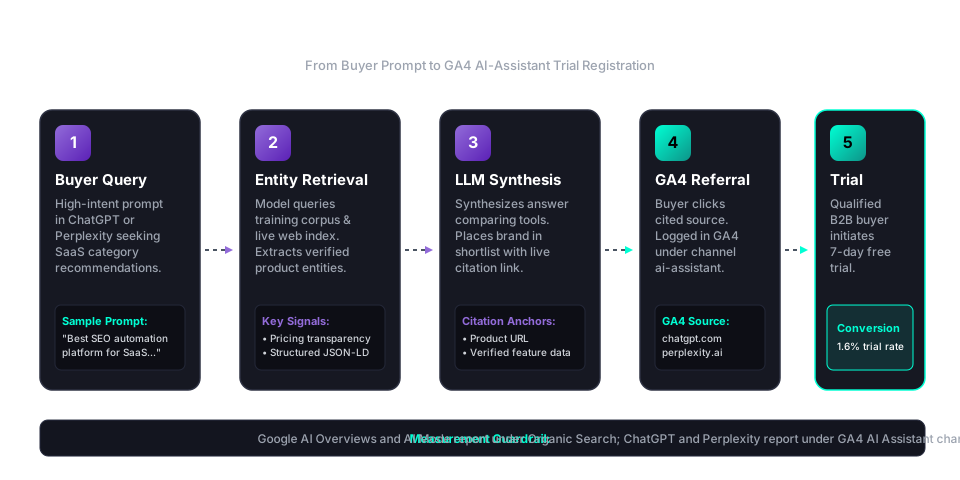
You track SaaS trial registrations from AI referrals in Google Analytics 4 by monitoring the default channel group named AI Assistant.
Google Analytics added the AI Assistant channel group (medium: ai-assistant) on May 13, 2026. This channel groups referral visits from platforms such as ChatGPT, Perplexity, Claude, and Gemini.
[!NOTE] Google AI Overviews and AI Mode traffic continue to report under the Organic Search channel group. Only conversational platforms like ChatGPT and Perplexity report under
AI Assistant.
Across verified SaaS analytics baselines, AI-assisted sessions convert to direct trial starts at 1.6%. While AI referral volume is lower than traditional organic search traffic, its conversion rate is substantially higher because the user arrived after reading a synthesized recommendation.
To measure cross-engine brand presence and track movement over time, software teams use Search Atlas LLM Visibility to track prompts, sentiment scores, and citation sources across six models.
Frequently Asked Questions About AEO for SaaS
What is the primary difference between AEO and GEO for SaaS companies?
AEO focuses on answer selection and direct citation within conversational answer engines, while GEO encompasses broader search visibility across generative synthesis environments including Google AI Overviews.
Does schema markup guarantee citations in ChatGPT or Perplexity?
Schema markup does not guarantee citations. Structured JSON-LD assists web crawlers in resolving company entities, but LLM retrieval engines rely primarily on plain-text HTML content and third-party authority consensus.
How quickly do answer engines update their SaaS recommendations?
Real-time search models like Perplexity and ChatGPT Search reflect newly published web pages within hours of indexation. Parametric training weights update only when providers release base model refreshes.