AI marketing automation fails in predictable ways. The failure modes are not random. They follow from specific configuration decisions, oversight gaps, and structural mismatches between what the platform needs to operate correctly and what the team provides.
But AI market automation failures are often invisible until significant damage is done. An autonomous SEO agent deploying changes continuously against a poorly configured Knowledge Graph can spend months optimizing for the wrong audience. A paid automation system running without a conversion baseline can reallocate budget toward clicks that never convert. Neither problem surfaces immediately in a weekly dashboard review.
We cover seven recurring failure modes, what causes each one, and the governance fix that prevents it.
Key takeaways:
- Most AI marketing automation failures trace to configuration, not to the platform itself
- The Knowledge Graph is the highest-risk configuration input: errors here propagate to every downstream decision
- “Human-in-the-loop” is a governance structure, not a philosophy. It requires specific approval checkpoints defined in advance
- Siloed data layers produce conflicting optimization signals across channels
- Live marketing surfaces can drift from current positioning while passing every local metric; no single-player tool flags this
- LLM visibility gaps are invisible without dedicated monitoring, so they compound unnoticed
What are the most common AI marketing automation mistakes?
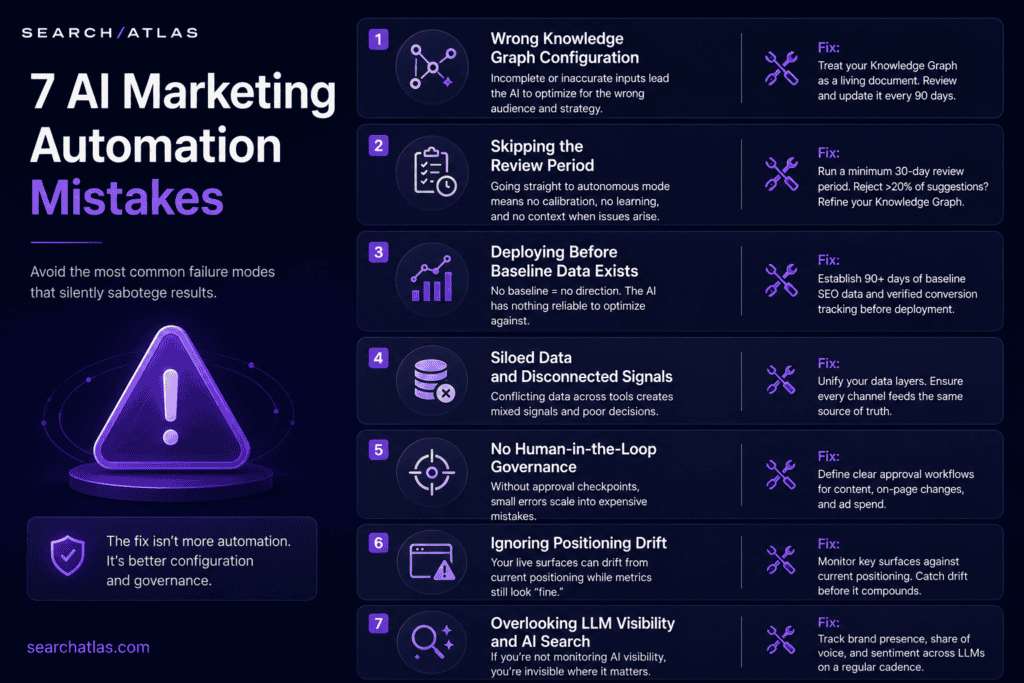 Top 7 AI marketing automation mistakes to avoid for success.
Failure mode 1: Wrong Knowledge Graph configuration
The Knowledge Graph is the structured business profile that feeds every decision the platform makes, including target customer, competitive alternatives, keyword priorities, and content constraints. It defines who the target customer is, what the product does, what the competitive differentiation is, what keywords to prioritize, and what the brand should not be associated with.
When the Knowledge Graph is incomplete or inaccurate, every downstream decision inherits the error. Am autonomous SEO execution agent, optimizing against a Knowledge Graph that describes the wrong ICP, could generate titles and headings that attract the wrong searchers.
A draft generated from the same Knowledge Graph produces content that speaks to the wrong audience. The AI marketing platform is executing correctly; it is just executing the wrong strategy.
The specific errors that recur:
- Generic business descriptions. “We help small businesses grow” tells the platform nothing useful. “We provide automated SEO execution for marketing agencies managing 10 to 50 client accounts” is specific enough to produce meaningful optimizations.
- Missing competitive context. Without knowing who the actual alternatives are in the buyer’s consideration set, the platform cannot optimize for differentiation. The Knowledge Graph should include three to five specific competitors, not broad category names.
- Unspecified content constraints. If there are topics the brand should not cover, terminology that is prohibited, or claims that require legal review before publishing, those constraints belong in the Knowledge Graph. If they are not specified, the platform will not respect them.
Fix: Treat the Knowledge Graph as a living document. Review it every 90 days against what is actually converting and what the sales team hears from prospects. Update it when the product positioning changes. Do not configure it once at onboarding and leave it unchanged for a year.
Failure mode 2: Skipping the review period
Most autonomous SEO and paid media platforms offer a review mode: the platform generates suggested changes, a human approves or rejects them, and only approved changes deploy.
Advanced mode in Atlas Agent (Search Atlas’s AI system that coordinates execution across the platform’s modules, including the Advanced mode approval workflow) provides step-by-step approval governance. This mode exists specifically to give teams the confidence to learn what the platform is optimizing before switching to autonomous deployment.
Teams that skip the review period and go straight to autonomous deployment encounter two problems.
First, they have no calibration data. They do not know whether the platform’s suggestions match their editorial standards, comply with their brand voice, or reflect their business constraints. When something unexpected appears in the search results months later, they have no change log context to diagnose it.
Second, they lose the review period’s secondary value: learning the platform. A team that reviews 200 suggested changes over 30 days understands what the platform prioritizes and how to configure it better. A team that skips directly to autonomous mode is flying blind.
Fix: Run a minimum 30-day review period before switching to autonomous deployment on any new site or significant account change. Use the rejection rate as a calibration metric: if the team is rejecting more than 20% of suggestions, the Knowledge Graph needs refinement before autonomous mode is appropriate.
Failure mode 3: Deploying before baseline data exists
Autonomous optimization requires a baseline. For SEO, that baseline is 90+ days of GSC data showing which queries the site is currently surfacing for, at what positions, with what click-through rates. For paid, it is conversion tracking configured and verified before any campaign launches.
Teams that deploy an AI marketing platform on a new site with no ranking history, or on an ad account with broken conversion tracking, give OTTO SEO nothing to optimize against. The system can execute changes, but it cannot prioritize them by impact because there is no signal to rank against.
The observable outcome: OTTO SEO deploys changes at high volume, but performance metrics do not improve. The team concludes the platform does not work. The actual problem is that OTTO SEO was asked to optimize signal-free.
Fix: Before deploying OTTO SEO, verify that GSC is connected and has at least 60 days of data. Before launching Smart Ads (Search Atlas’s AI PPC automation system) automation, verify that conversion tracking is firing correctly on the actual conversion events (not just page views). For new sites with no ranking history, run the platform in audit-and-track mode for the first 60 days while the baseline builds.
Failure mode 4: Siloed paid and SEO data layers
A marketing stack that uses separate platforms for SEO execution, content production, and paid media management produces three isolated data streams. The paid team sees ROAS by campaign. The SEO team sees rankings by keyword. The content team sees sessions by post. None of these views talks to the others.
The practical cost of data siloing is misallocated effort. The keywords converting at the highest rates in paid campaigns are the strongest candidates for organic content production. If that signal never reaches the content team, content production follows a separate prioritization logic and competes with paid rather than reinforcing it.
A second siloing cost: conflicting optimization signals. An autonomous SEO agent pushing organic visibility for keyword cluster A, while a paid automation system pulls budget away from that cluster based on low direct conversion rates, is optimizing in opposite directions.
Fix: Consolidate execution across channels into a platform that shares a data layer. If consolidation is not immediately possible, create a monthly data-sharing process: export the top-converting paid keywords and review them against the SEO content calendar every 30 days. It is less efficient than a shared platform, but it prevents the worst conflicting-signal outcomes.
Failure mode 5: Misreading AI reporting as decision-ready output
AI marketing platforms generate reporting automatically. OTTO SEO produces change logs and performance summaries. Smart Ads generates campaign health scores and conversion reports. The reporting is detailed and well-organized.
Teams often interpret this as meaning the reporting is decision-ready without human review. It is not.
Automated reporting shows what happened. It does not interpret why, flag context that requires business judgment, or identify whether a metric movement reflects the platform’s work or an external factor. A 12% ranking improvement in the same week as a major competitor’s site went down is not attributable to the platform. The AI platform’s report will not tell you that.
The recurring mistake: treating an AI-generated performance summary as the answer rather than as the data that informs the answer. This leads to incorrect optimization decisions, inflated confidence in platform performance, and missed signals when something is actually going wrong.
Fix: Define a review protocol that pairs platform reporting with human judgment. At minimum: check change log volume (is the platform running at expected pace?), check if any performance movements coincide with external events (algorithm updates, competitor changes, seasonality), and flag any category of change that shows consistently negative correlation with performance.
Failure mode 6: Letting live surfaces drift from the current positioning
Drift is what happens when live marketing assets (ads, landing pages, GBP content, web copy) quietly fall out of sync with current positioning while still hitting their local metrics. CTR is acceptable. Quality score is fine. Bounce rate is normal. No alert fires, because no single metric measures coherence between the live surface and the strategy it is supposed to represent.
The result is a company actively running marketing that misrepresents where it actually is. The positioning may have changed, a new product surface may have launched, or the core value proposition may have shifted. The ads and landing pages have not caught up. They are still selling the old version of the product, and nothing in the dashboard flags it.
No single-player tool catches drift, because catching it requires holding the full strategy in view at the same time as every live surface and noticing the gap between them. A tool that executes one asset at a time cannot do this. It has no strategy layer to compare against. It only sees the asset in front of it, and by that measure, the asset is performing fine.
Fix: Run Atlas Agent (as Search Atlas’s Copilot CMO) in multiplayer mode. Atlas Agent holds the current strategy alongside the team, watches live surfaces against it continuously, and surfaces drift when it detects a gap.
The sense-detect-propose-approve-heal loop closes it: Atlas Agent proposes the specific fix, a human approves it, and the surface updates. No manual audit cycle required, and no gap compounds undetected for months.
Failure mode 7: Ignoring LLM visibility gaps
As B2B buyers increasingly research using AI assistants before they search Google, brand presence in AI-generated responses has become a relevant marketing signal. A company that ranks well organically but does not appear in ChatGPT or Perplexity responses for its core category queries is invisible to an increasing share of its target audience.
The invisibility of this failure mode is the problem. Unlike an organic ranking drop, which appears in GSC data and triggers alerts, an LLM visibility gap produces no alert. The company simply misses a growing acquisition channel with no notification that the miss is occurring.
The gap compounds over time. Brands that are cited frequently in AI responses get cited more frequently. The content and structure choices that drive LLM citation take months to build. Teams that start monitoring and optimizing for LLM visibility in 2026 will have a structural advantage over teams that start in 2028.
Fix: Set up LLM visibility monitoring for the 10 to 20 queries most important to the business. Review share of voice and sentiment quarterly. When new content is produced, evaluate whether its structure (direct answers, specific claims, verifiable data) is optimized for AI citation, not just for Google ranking.
How Search Atlas addresses these failure modes structurally
Search Atlas’s platform design reflects direct observation of these failure modes at scale, across 50,000+ active OTTO SEO deployments.
The Knowledge Graph setup process is structured to surface specificity gaps before the platform goes live. Atlas Agent’s Advanced mode runs step-by-step approval for every significant action, making it the correct starting point for new accounts before switching to autonomous operation. The GSC integration requirement prevents deployment without a ranking baseline. The shared data layer across OTTO SEO, Content Genius, Smart Ads, and LLM Visibility (Search Atlas’s brand presence monitoring module) prevents the siloed-optimization failure that affects multi-tool stacks. And the LLM Visibility module addresses the monitoring gap that most teams currently have.
Atlas Agent’s multiplayer design specifically addresses drift. Because Atlas Agent holds the current strategy alongside the team (not just individual execution tasks), it can compare live surfaces against that strategy continuously. A single-player tool that executes one asset at a time has no strategy layer to compare against; Atlas Agent does, and that difference is what makes drift detectable before it compounds.
The seven failure modes above are fixable. The governance structures are not complex. The teams that avoid them are the ones that treat configuration as the primary competency, not as a one-time setup task.