Dataset redundancy in Large Language Models (LLMs) is the presence of repeated patterns, duplicated content, and structurally similar representations across training data and model architecture. Dataset redundancy explains how models process overlapping information multiple times, which reduces efficiency, increases cost, and weakens learning quality across tasks. This definition clarifies what redundancy means in modern LLM systems.
Dataset redundancy matters because LLMs learn from frequency, repetition, and pattern exposure during training. Systems that process duplicated content allocate compute to repeated signals instead of new information, which reduces training efficiency and increases memorization risk. This behavior shows how redundancy affects both dataset quality and model outputs, where repeated exposure shifts learning toward memorized patterns instead of generalized reasoning.
Dataset redundancy creates a measurable impact across model performance, cost, and evaluation reliability. Redundant data increases training cost by 26% to 39% through unnecessary token processing, while over 1% of generated output appears as verbatim memorization from training data. Redundancy inflates evaluation metrics through train-test overlap, with more than 4% of validation sets affected by duplication. These effects demonstrate how redundancy distorts both model capability and benchmark accuracy.
Dataset redundancy requires detection through structural analysis, similarity measurement, and distribution evaluation across datasets. Detection systems identify exact duplicates, near-duplicates, and semantic overlap using methods that analyze both text similarity and meaning alignment. Effective detection separates useful repetition from harmful redundancy, which preserves dataset integrity while reducing unnecessary duplication.
Dataset redundancy requires mitigation through deduplication pipelines that combine removal, reweighting, and representative selection. Deduplication reduces dataset size by up to 19%, lowers memorization rates by 10x, and improves generalization by limiting repeated exposure to identical patterns. Systems that apply structured deduplication maintain diversity, improve efficiency, and produce more reliable evaluation results.
Dataset redundancy evolves with advanced deduplication methods that integrate probabilistic matching, semantic clustering, and data weighting strategies. Techniques (MinHash LSH) enable large-scale duplicate detection, while SoftDedup adjusts sample importance without removing data. Embedding-based selection methods improve dataset composition by preserving meaningful variation while eliminating redundant patterns.
Dataset redundancy management defines the future of LLM training because data scale continues to expand toward hundreds of zettabytes. Systems that control redundancy through structured pipelines achieve better performance, lower cost, and higher reliability. Effective redundancy management ensures that LLMs learn from diverse, representative, and high-quality data instead of repeated noise.
What Is Dataset Redundancy in LLMs?
Dataset redundancy in LLMs is a structural inefficiency where similar layers and outputs repeat information without improving performance. Dataset redundancy appears when LLMs contain overlapping computations across layers, which creates unnecessary processing and redundant responses. Dataset redundancy explains why entire layers are removed while downstream task performance remains nearly unchanged.
Dataset redundancy emerged after Transformer architecture models scaled rapidly in size and complexity. Dataset redundancy gained attention through studies (The Unreasonable Ineffectiveness of the Deeper Layers and ShortGPT), which showed that deeper layers contribute minimal additional value. These findings revealed that pretraining methods fail to fully utilize parameters across large-scale models.
Dataset redundancy in LLMs operates across what structures? Dataset redundancy operates across layers, attention heads, outputs, and parameters inside LLMs. These structures repeat similar computations, which reduces efficiency because multiple components produce overlapping representations and responses.
Dataset redundancy appears through layer redundancy, width redundancy, output redundancy, and parameter redundancy. Layer redundancy occurs when multiple layers perform similar transformations, which explains why removing ten layers from a forty-layer model reduces performance by only 5.1%. Width redundancy occurs across attention heads, where several heads produce similar attention patterns, which shows that attention mechanisms repeat internal representations. Output redundancy occurs when responses contain unnecessary reasoning steps, where ChatGPT generates redundant calculations in 47.1% of answers, which increases response length without improving accuracy. Parameter redundancy occurs when smaller models achieve comparable results, where ShortGPT maintains 92% performance after removing 25% of parameters, which proves that many parameters remain unused.
What are the key characteristics of dataset redundancy in LLMs? The 3 main characteristics are layer similarity, pruning potential, and cost impact. Layer similarity measures how closely adjacent layers resemble each other, where the Block Influence metric evaluates similarity and shows that high similarity indicates redundant computation. Pruning potential defines how many layers are removed safely, where removing 55% of layers from LLaMA 2-13B still preserves strong benchmark performance, which proves that deep layers add limited incremental value. Cost impact reflects increased latency and compute usage, where redundant reasoning increases inference time and API cost, which grows because repeated calculations consume additional resources.
What does dataset redundancy impact in LLM performance? Dataset redundancy impacts efficiency, cost, and accuracy during inference. Dataset redundancy increases latency because repeated computations slow response generation. Dataset redundancy reduces accuracy in some cases because excessive reasoning introduces errors during complex tasks.
Dataset redundancy connects directly to optimization techniques. Dataset redundancy differs from quantization and pruning because it focuses on functional overlap instead of compression. Dataset redundancy enables targeted optimization through methods that remove redundant layers and reduce unnecessary reasoning. Addressing dataset redundancy improves model efficiency and deployment flexibility, where techniques (layer pruning, quantization, and parameter-efficient training) reduce compute requirements and enable efficient deployment.
What Is the Difference Between Dataset Redundancy vs Model Redundancy vs ZeRO Optimization?
The difference between dataset redundancy, model redundancy, and ZeRO optimization lies in data duplication, model state replication, and distributed memory optimization. Dataset redundancy duplicates data for architectural purposes, model redundancy replicates model states across GPUs inefficiently, and ZeRO optimization removes that replication through sharding. This distinction defines how data systems scale, how models train, and how computational resources are allocated efficiently.
Dataset redundancy exists inside data architectures where duplicated data preserves raw inputs and ensures reliability. Model redundancy exists inside distributed training where each GPU stores full copies of parameters, gradients, and optimizer states. ZeRO Optimizer eliminates that redundancy by partitioning model states across devices, which reduces memory usage and enables large-scale model training.
The core differences between dataset redundancy, model redundancy, and ZeRO optimization are below.
| Aspect | Dataset Redundancy | Model Redundancy | ZeRO Optimization |
| Core concept | Duplicates data inside architecture layers for system-level purposes. | Replicates full model states across GPUs during training. | The shards model states across GPUs to remove duplication. |
| Context | Data engineering systems and lakehouse architectures. | Distributed machine learning training workflows. | Distributed training frameworks (DeepSpeed and PyTorch FSDP). |
| Purpose | Preserves raw data, ensures integrity, and enables reprocessing. | Creates inefficiency with no direct benefit. | Enables large-scale model training with reduced memory usage. |
| Primary location | Stored in the bronze layer of data lakehouse systems. | Stored on every GPU during standard distributed training. | Distributed across GPUs, where each device owns a shard. |
| Memory impact | Uses low-cost storage as an architectural decision. | Consumes large GPU memory due to full duplication. | Reduces per-GPU memory linearly with the number of devices. |
| Scalability impact | Improves data scalability through decoupling from source systems. | Limits model size due to memory constraints. | Enables training of models up to tens of billions of parameters. |
| Communication overhead | Not applicable to model computation. | Uses standard gradient synchronization across GPUs. | Adds controlled communication for state reconstruction during training. |
What does dataset redundancy do in data systems? Dataset redundancy stores duplicated raw data to preserve integrity and ensure reliable reprocessing across data pipelines. This duplication creates an immutable record, which allows systems to trace transformations and maintain consistent data quality over time.
What does model redundancy do in distributed training? Model redundancy replicates parameters, gradients, and optimizer states across all GPUs, which increases memory usage significantly. This replication wastes memory because each device holds identical data, which limits the size of models that fit into GPU memory.
What does ZeRO optimization do in distributed training? ZeRO optimization partitions model states across GPUs, which removes duplication and reduces memory usage across devices. This partitioning allows training of much larger models because each GPU stores only a fraction of the total model states.
Why is dataset redundancy not the same as model redundancy? Dataset redundancy exists as a deliberate architectural pattern, while model redundancy exists as an inefficient side effect of naive distributed training. This difference explains why dataset redundancy improves data reliability while model redundancy restricts scalability and increases cost.
When does ZeRO optimization replace model redundancy? ZeRO optimization replaces model redundancy during large-scale training where memory limits block further scaling. This replacement enables training of models that exceed single-device capacity, which expands model size and improves training efficiency.
Why Does Deduplicating LLM Training Data Matter?
Deduplicating LLM training data matters because duplicated content reduces efficiency, increases cost, and degrades model performance. Deduplicating LLM training data removes repeated documents and substrings, which improves training quality and prevents wasted computation on identical information. Deduplication defines a critical optimization step because modern datasets contain large-scale redundancy from web-sourced data.
Deduplication became essential as datasets built on web crawls and public corpora scaled rapidly. Deduplication addresses duplication from mirrored pages, reposted content, and minor document variations. Deduplication exists as a core bottleneck in large-scale training because repeated tokens consume compute without adding new knowledge.
What are the primary reasons for deduplicating LLM training datasets? Deduplicating LLM training datasets matters because near-duplicate content dominates modern corpora and reduces training efficiency. Deduplication removes repeated examples and repetitive substrings, which improves signal quality because models train on unique information instead of redundant patterns.
Deduplication addresses three core issues. The three core issues are near-duplicate prevalence, diminishing marginal gains, and training bottlenecks. Near-duplicate prevalence appears when similar documents repeat across domains, which creates redundancy across datasets. Diminishing marginal gains occur because adding more tokens produces smaller improvements, which limits scaling benefits. Training bottlenecks arise because duplicated data increases the computational cost without increasing the learning value.
How pervasive is duplication in common NLP datasets? Duplication is widespread across major datasets, where datasets (C4, Wiki-40B, RealNews, and LM1B) contain repeated examples and substrings. Duplication appears in both training and validation sets, which creates evaluation leakage because models see similar data during training and testing.
Duplication rates vary across datasets but remain significant. Web-scale datasets contain between 3.04 percent and 13.63 percent near-duplicates, while some datasets show repeated sentences tens of thousands of times. Duplication clusters appear at scale, where a single cluster reaches over 250,000 repeated examples, which proves that redundancy concentrates heavily in large corpora.
What are the consequences of duplicated content in LLM training datasets? Duplicated content creates inefficiency, overfitting, memorization, and evaluation distortion. Duplicated content wastes compute because repeated examples do not add new information, which increases training time and cost.
Duplicated content increases overfitting because models learn repeated patterns instead of generalizable structures. Duplicated content increases memorization risk because models reproduce training data verbatim, where over 1% of outputs match training text exactly. Duplicated content causes evaluation leakage because overlap between training and validation sets inflates benchmark scores, which misrepresents model quality.
What are the benefits of deduplication for LLM training? Deduplication improves efficiency, generalization, and evaluation accuracy across model development. Deduplication reduces memorization because models rely less on repeated sequences, which decreases verbatim output frequency by up to ten times.
Deduplication improves training efficiency because smaller datasets require fewer compute resources, where datasets shrink by up to 19% without performance loss. Deduplication improves generalization because models train on diverse examples, which increases performance on unseen data. Deduplication improves evaluation accuracy because reduced overlap between training and validation sets produces reliable benchmarks.
Why is deduplication considered mission-critical infrastructure for LLMs? Deduplication is mission-critical because it ensures data quality at scale and enables efficient large-scale training. Deduplication defines a foundational preprocessing step because large LLM pipelines depend on clean datasets before training begins.
Deduplication operates as core infrastructure in enterprise workflows, where providers process billions of documents before ingestion. Deduplication defines model reliability because clean datasets reduce redundancy, improve efficiency, and maintain accurate evaluation across training pipelines.
Does Deduplication Reduce Memorization and Training Data Leakage?
Yes, deduplication reduces memorization and training data leakage because it removes repeated sequences that models tend to reproduce. Deduplication limits exposure to duplicate patterns, which lowers the probability of verbatim generation during inference. This reduction explains why deduplicated models emit memorized text up to ten times less frequently.
Deduplication reduces memorization because repeated sequences amplify generation probability. A sequence that appears ten times in training is generated exponentially more often than a unique sequence. This amplification creates leakage risk because models reproduce exact training data instead of generating new responses.
Why does deduplication reduce memorization in LLMs? Deduplication reduces memorization because it removes frequency bias created by duplicated examples. LLMs learn probability distributions from token frequency, which means repeated data increases the likelihood of exact reproduction. Deduplication lowers repetition frequency, which directly reduces memorization behavior.
Deduplication reduces training data leakage because leakage occurs when models reproduce training content verbatim. Deduplicated datasets remove repeated substrings and near-duplicate documents, which reduces the chance of exact sequence regeneration. This reduction strengthens privacy because sensitive or proprietary data appears less frequently in outputs. A controlled study on knowledge retention and leakage in LLMs tested this exposure risk directly, injecting non-public fact pairs into leading platforms to measure whether that content resurfaces after exposure ends.
Deduplication improves model security because duplication drives most memorization-based attacks. Privacy attacks exploit repeated sequences that models recall easily. Deduplication weakens these attack vectors because fewer duplicated sequences exist inside the training distribution.
Deduplication does not eliminate memorization entirely because large models still memorize rare patterns. Larger models memorize more due to increased capacity, which means deduplication reduces risk but does not remove it. This limitation explains why deduplication works as a mitigation layer rather than a complete solution.
How does deduplication influence training trade-offs? Deduplication introduces a trade-off between memorization reduction and task reliability. Removing too many repeated examples reduces performance on edge cases where repetition reinforces correct behavior. This trade-off appears in sensitive tasks where repeated patterns improve consistency.
Deduplication balances privacy and utility because cleaner datasets reduce leakage while preserving essential patterns. Smart dataset design retains necessary repetitions while removing excessive duplication. This balance ensures that models generalize effectively without overfitting to repeated training data.
What Is the Impact of Duplicate Data on Training Efficiency and Compute Cost?
Duplicate data increases compute cost and reduces training efficiency because repeated examples waste resources without adding new information. Duplicate data expands the dataset size artificially, which increases storage, processing time, and energy consumption during training. This expansion explains why poor data quality leads to significant financial losses, reaching up to 12.9 million dollars annually.
Duplicate data impacts training efficiency by forcing models to process the same information multiple times. Duplicate data impacts compute cost because larger datasets require more memory, more compute cycles, and longer training durations. This relationship shows that redundancy directly increases infrastructure load without improving learning quality.
Duplicate data increases storage usage because repeated entries occupy additional space across databases and data systems. Duplicate data increases processing strain because training pipelines iterate over redundant samples, which slows down training cycles and increases compute demand. This strain leads to higher operational costs, which explains why organizations lose millions due to inefficient data management.
Duplicate data appears heavily in NLP datasets, where repetition occurs at scale. The C4 dataset contains clusters with over 200,000 near duplicates, which shows that redundancy concentrates in specific patterns. This concentration increases computational waste because models repeatedly process identical sequences instead of learning new patterns.
Duplicate data reduces training efficiency because models gain diminishing returns from repeated tokens. Training on duplicate-aware subsampling performs worse than cleaner sampling strategies, which proves that redundancy harms learning efficiency. Deduplication reduces dataset size, which lowers compute cost and improves training speed.
Duplicate data impacts model performance and data integrity by biasing training distributions and increasing overfitting risk. Duplicate data increases the weight of repeated observations, which distorts probability estimates and reduces generalization to new data. Duplicate data creates memorization patterns because repeated sequences appear more frequently during training.
Duplicate data skews data integrity because repeated entries distort relationships between variables. This distortion leads to biased predictions, which reduces model reliability across real-world scenarios. Duplicate data creates misleading evaluation signals because models perform well on repeated samples instead of unseen data.
Deduplication improves efficiency because smaller datasets require fewer compute resources and shorter training cycles. Deduplication improves reliability because cleaner datasets produce accurate probability estimates and stronger generalization. Deduplication ensures that training pipelines operate on high-quality data, which reduces cost and improves model performance.
What Are the Main Types of Duplicate Data in LLM Training?
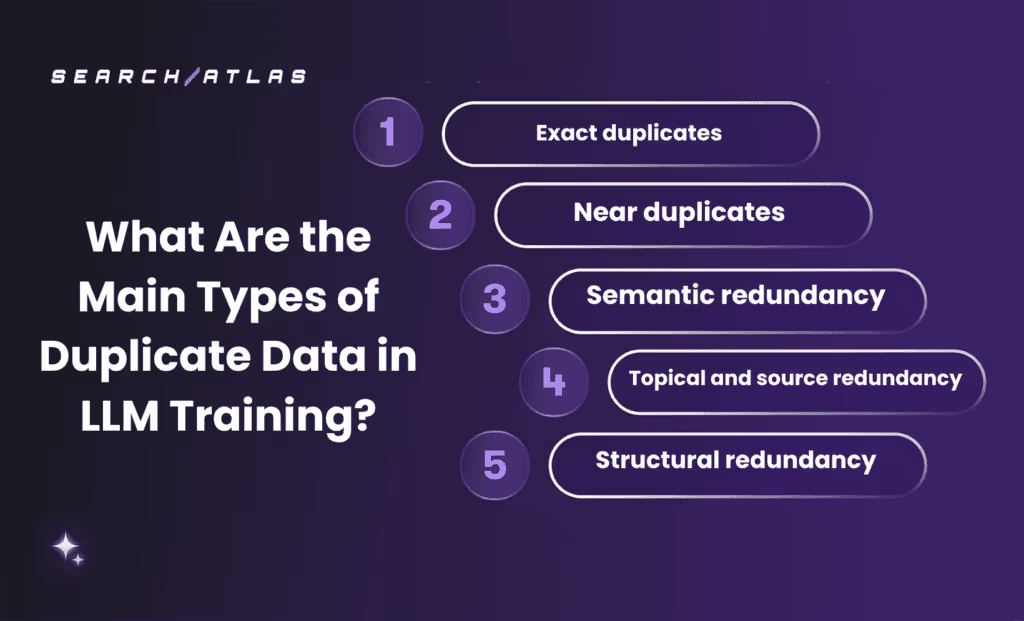
The main types of duplicate data in LLM training show how redundancy appears across words, meaning, sources, and structure. These types matter because duplicated data increases memorization, computation cost, evaluation leakage, and weak generalization. Duplicate data appears in exact copies, near duplicates, semantic redundancy, topical and source redundancy, and structural redundancy.
There are 5 main types of duplicate data in LLM training, listed below.
1. Exact duplicates. Exact duplicates are identical records or substrings that match word-for-word across training data. This type appears through copied pages, repeated boilerplate, syndicated articles, and mirrored documents. Exact duplicates create memorization risk because models see the same sequence multiple times.
2. Near duplicates. Near duplicates are documents that share most content but differ in formatting, headers, dates, names, or small edits. This type appears when articles, code, support pages, and scraped content reappear across domains. Near duplicates are harder to remove because exact matching misses small textual changes.
3. Semantic redundancy. Semantic redundancy repeats the same meaning with different wording. This type appears when paraphrased content, translated pages, or rewritten examples express the same information. Semantic redundancy matters because lexical deduplication misses meaning-level duplication.
4. Topical and source redundancy. Topical and source redundancy happen when datasets overrepresent the same topics or rely on repeated sources. This type appears when many corpora draw from Common Crawl, Wikipedia mirrors, GitHub forks, or syndicated news. Topical and source redundancy weakens diversity and increases contamination risk.
5. Structural redundancy. Structural redundancy repeats the same format, template, or pattern across many examples. This type appears in product pages, cookie notices, legal text, test cases, code templates, and auto-generated pages. Structural redundancy reduces training value because models learn repeated forms instead of varied reasoning patterns.
These duplicate data types show that redundancy occurs beyond exact copying. Strong LLM data preparation identifies duplicated text, duplicated meaning, repeated sources, and repeated structures before training. This preparation reduces memorization, improves efficiency, and creates cleaner evaluation signals.
How Do You Find Duplicate Data in LLM Datasets?
You find duplicate data in LLM datasets by combining exact matching, approximate similarity, semantic embeddings, and probabilistic reweighting across large corpora. Duplicate detection aligns data processing with how LLMs learn from frequency, similarity, and meaning. Effective detection reduces redundancy, improves training efficiency, and prevents memorization across datasets.
The 5 methods for finding duplicate data in LLM datasets are listed below.
1. Hash-based matching for exact duplicate detection. 2. MinHash and locality sensitive hashing for near duplicate detection. 3. LSHBloom for trillion token scale deduplication. 4. Embedding-based deduplication for semantic redundancy. 5. Soft deduplication and reweighting methods.
1. Hash-Based Matching for Exact Duplicate Detection
Hash-based matching detects exact duplicates by converting documents into fixed hash values and comparing those values across datasets. Hash-based matching works because identical inputs produce identical outputs, which allows systems to group duplicate content instantly. This method identifies byte-level duplication across large corpora with high precision and minimal computational overhead.
Hash-based matching operates through a deterministic transformation process. Each document passes through a hash function, which produces a fixed-length signature regardless of input size. These signatures act as unique identifiers, which means two identical documents generate the same hash value. Systems group documents by hash value, which forms clusters of exact duplicates without comparing full text.
Hash-based matching improves efficiency because it replaces pairwise comparison with lookup operations. A dataset with one million documents requires one million hash computations instead of trillions of comparisons. This difference reduces computational complexity from quadratic to linear, which enables scalable duplicate detection in large pipelines.
Hash-based matching identifies duplication across common web patterns. News articles syndicated across multiple outlets produce identical content, which results in identical hashes. Boilerplate elements (cookie banners, navigation menus, and legal disclaimers) repeat across pages, which creates consistent duplicate substrings. Web scraping pipelines amplify these patterns, which makes hashing essential for initial filtering.
Hash-based matching relies on cryptographic functions (MD5, SHA-1, and SHA-256). These functions guarantee that small changes in input produce completely different outputs. This property ensures precision because only identical documents match exactly. Strong hash functions reduce collision probability, which maintains accuracy even at a large scale.
Hash-based matching integrates with indexing systems for continuous deduplication. Pipelines store hash values alongside document metadata, which allows new data to be checked instantly against existing corpora. This approach supports incremental ingestion workflows where duplicate detection occurs in real time.
Hash-based matching fails to detect near duplicates or semantic duplicates. A single character change produces a completely different hash, which means formatting differences, paraphrasing, or translation bypass detection. This limitation requires additional methods to capture approximate similarity and meaning level duplication.
Hash-based matching forms the foundation of deduplication pipelines. Teams use it as a first pass filter to remove exact copies before applying more complex methods. This staged approach reduces dataset size early, which lowers computational cost for downstream processes.
2. MinHash and Locality Sensitive Hashing for Near Duplicate Detection
MinHash and locality sensitive hashing detect near duplicates by approximating similarity between documents instead of requiring exact matches. This method identifies documents that share most content but differ slightly in formatting, wording, or structure. Near duplicate detection matters because large-scale datasets contain massive amounts of lightly modified content.
MinHash works by transforming documents into sets of shingles. Shingles are overlapping sequences of words or tokens, which capture local structure inside the document. For example, a sentence splits into multiple overlapping segments, which preserves content similarity even when wording changes slightly. This representation allows comparison based on shared segments instead of exact text.
MinHash generates signatures by applying multiple hash functions to each shingle set. Each hash function produces a value for every shingle, and the minimum value becomes part of the signature vector. This process repeats across multiple functions, which creates a compact representation of the document. Similar documents produce similar signature vectors because they share many shingles.
MinHash estimates similarity using Jaccard similarity between sets. The proportion of shared shingles approximates the similarity between documents. Signature comparison replaces full text comparison, which reduces computational cost significantly. This estimation allows systems to process millions of documents efficiently.
Locality sensitive hashing improves scalability by grouping similar signatures into buckets. Signature vectors are split into bands, and each band hashes separately. Documents that share at least one band fall into the same bucket, which marks them as candidate duplicates. This process reduces the search space drastically by avoiding full comparisons.
MinHash and locality sensitive hashing detect duplication across web crawls, code repositories, and templated content. News articles with minor edits, mirrored pages with different formatting, and code forks with small changes all produce similar shingles. This method captures these patterns effectively.
MinHash and locality sensitive hashing balance recall and efficiency. Systems detect most near duplicates without processing every possible pair. Parameter tuning controls sensitivity, which allows teams to adjust detection thresholds based on dataset characteristics.
MinHash and locality sensitive hashing cannot detect semantic duplicates where wording changes completely. Paraphrased content, translated text, and rewritten documents require embedding-based methods. This limitation means MinHash works best as a second stage after exact matching.
MinHash and locality sensitive hashing play a central role in large-scale deduplication pipelines. Teams use this method to remove near duplicates before applying semantic methods, which reduces dataset size while preserving diverse content.
3. LSHBloom for Trillion Token Scale Deduplication
LSHBloom detects duplicates at extreme scale by combining MinHash signatures with Bloom filters for efficient storage and lookup. LSHBloom extends locality sensitive hashing to support datasets with billions of documents and trillions of tokens. This method matters because modern LLM training datasets exceed the limits of traditional deduplication systems.
LSHBloom operates by replacing traditional index structures with probabilistic Bloom filters. Bloom filters store compact representations of data, which reduces memory usage dramatically. Each filter tracks membership of hashed elements without storing full data, which enables efficient large-scale processing.
LSHBloom processes documents through MinHash signature generation. These signatures are split into bands, similar to locality sensitive hashing. Each band maps into a Bloom filter, which tracks whether similar signatures exist. Documents that activate similar filters are flagged as duplicates.
LSHBloom improves performance by optimizing memory layout and computation. Bloom filters use contiguous bit arrays, which improves cache efficiency. This design reduces latency during lookup operations, which allows high-throughput processing across distributed systems.
LSHBloom scales efficiently across large datasets. Systems process billions of documents by distributing Bloom filters across nodes. This architecture supports parallel processing, which allows deduplication to run across clusters instead of single machines. This scalability is essential for modern LLM pipelines.
LSHBloom reduces storage requirements significantly compared to traditional methods. Bloom filters store compressed representations instead of full signatures, which lowers disk usage. This reduction allows processing of datasets that would otherwise exceed storage limits.
LSHBloom maintains high recall while controlling false positive rates. Bloom filters introduce probabilistic errors, which means some unique documents appear as duplicates. Systems tune parameters to minimize these errors, which balances accuracy and efficiency.
LSHBloom detects near duplicates across massive web-scale datasets. Common Crawl, large code corpora, and multi-source datasets rely on this method for initial deduplication. This method prevents the exponential growth of duplicate content during data aggregation.
LSHBloom introduces tradeoffs between accuracy and efficiency. False positives require additional validation steps, which adds complexity. Despite this limitation, LSHBloom enables deduplication at scales where exact methods fail.
LSHBloom represents a critical infrastructure component for large-scale LLM training. Teams use this method to process massive datasets before applying finer-grained deduplication techniques.
4. Embedding-Based Deduplication for Semantic Redundancy
Embedding-based deduplication detects semantic duplicates by converting text into vector representations and measuring similarity in embedding space. This method identifies documents that share meaning even when the wording differs completely. Semantic detection matters because large datasets contain extensive paraphrased and translated content.
Embedding-based deduplication works by encoding documents into high-dimensional vectors. Models (sentence transformers) generate embeddings that capture semantic relationships between words and phrases. These vectors represent meaning instead of surface text.
Embedding-based deduplication compares vectors using similarity metrics. Cosine similarity measures the angle between vectors, which indicates how closely meanings align. Documents with similar meanings cluster together in vector space, which allows grouping of semantic duplicates.
Embedding-based deduplication uses clustering algorithms to group similar documents. Techniques (k-means and DBSCAN) organize vectors into clusters based on distance. Approximate nearest neighbor search accelerates similarity lookup across large datasets.
Embedding-based deduplication detects paraphrased content, translated text, and rewritten articles. For example, different phrasings of the same question produce similar embeddings. This capability captures duplication that lexical methods miss.
Embedding-based deduplication reduces dataset size significantly while preserving diversity. Removing semantic duplicates prevents overrepresentation of repeated ideas. This reduction improves training efficiency and generalization.
Embedding-based deduplication requires substantial computational resources. Encoding large datasets requires GPU acceleration and distributed processing. Similarity search across millions of vectors adds additional cost.
Embedding-based deduplication introduces threshold tuning challenges. Similarity thresholds determine which documents count as duplicates. Strict thresholds remove more data, while loose thresholds retain more diversity. Teams adjust thresholds based on task requirements.
Embedding-based deduplication complements lexical methods. Pipelines apply it after exact and near duplicate removal to capture remaining redundancy. This layered approach ensures comprehensive deduplication.
Embedding-based deduplication forms the final stage of advanced deduplication pipelines. Teams use it to refine datasets and eliminate meaning-level redundancy before training.
5. Soft Deduplication and Reweighting Methods
Soft deduplication reduces duplication impact without removing data by adjusting sampling weights based on frequency. This method treats duplication as a distribution problem instead of a removal problem. Soft deduplication matters because hard removal discards useful data.
Soft deduplication works by assigning weights inversely proportional to frequency. Frequently occurring samples receive lower weights, while rare samples receive higher weights. This weighting reduces the influence of duplicated data during training.
Soft deduplication uses statistical models to estimate data commonness. N-gram models calculate the probability of sequences, which identify repeated patterns. High probability sequences indicate duplication, which lowers their sampling weight.
Soft deduplication integrates directly into training pipelines. Instead of preprocessing datasets, systems adjust sampling during training. This approach avoids expensive preprocessing steps and allows dynamic balancing.
Soft deduplication improves efficiency by reducing redundant learning steps. Models converge faster because repeated patterns contribute less to optimization. This reduction lowers the compute cost while maintaining performance.
Soft deduplication improves generalization by emphasizing diverse samples. Models trained with weighted sampling learn broader patterns instead of memorizing repeated sequences. This improves performance on unseen data.
Soft deduplication avoids aggressive data removal. Hard deduplication removes duplicates completely, which risks losing useful variation. Soft methods preserve all data while controlling influence. Soft deduplication introduces parameter tuning challenges. Weighting functions and thresholds require careful adjustment. Incorrect settings distort training distribution or reduce performance.
Soft deduplication complements traditional deduplication methods. Pipelines apply it after removing exact and near duplicates to balance the remaining data. This combination produces efficient and diverse training datasets.
Soft deduplication represents a shift from binary filtering to probabilistic optimization. Teams use this method to fine-tune dataset quality without sacrificing valuable information.
What Granularity Should You Use for Deduplication?
Granularity does not have one correct size because deduplication depends on data type, duplication patterns, and system constraints rather than a fixed block size. Granularity matters because smaller units detect more duplicates, while larger units reduce overhead. This tradeoff defines how much duplication is removed versus how much compute and memory are required.
Granularity does not have one correct size because fine-grain deduplication detects more duplicates but increases metadata and processing cost. A 64-byte granularity captures small repeated segments across documents, which increases the deduplication ratio and memory efficiency. This scenario shows why fine-grain methods achieve over 2x compaction in large-scale workloads.
Granularity does not have one correct size because medium granularity often balances efficiency and performance. Chunk-level deduplication at 4 KB to 8 KB reduces duplication while controlling metadata growth. This balance explains why many systems use 4 KB as a default, since it maintains strong deduplication without excessive overhead.
Granularity does not have one correct size because large granularity reduces overhead but misses many duplicates. File-level or page-level deduplication compares entire documents or large blocks, which lowers computational complexity. This approach fails to capture partial duplication because small changes break matching across large blocks.
Granularity does not have one correct size because variable-size chunking adapts to content structure instead of fixed boundaries. Variable chunking isolates local changes, which prevents boundary shifting problems seen in fixed-size methods. This behavior improves the deduplication ratio while maintaining efficient storage utilization.
Granularity does not have one correct size because hierarchical methods combine multiple levels of granularity for better results. Hierarchical deduplication applies recursive compression across structures, which achieves extreme compaction in some datasets. This approach shows that combining granularities often outperforms using a single fixed size.
Granularity does not have one correct size because workload characteristics change optimal settings. Sparse datasets benefit from fine-grained detection, while dense datasets benefit from larger chunks to reduce overhead. This variation means the deduplication strategy needs to align with the dataset distribution and system goals.
Granularity does not have one correct size because performance impact depends on memory bandwidth, cache behavior, and access patterns. Fine-grain deduplication increases cache efficiency in many workloads, which produces slight performance gains. Larger granularity reduces CPU overhead but increases redundant data movement.
Granularity does not have one correct size because deduplication goals differ across systems. Storage optimization favors fine granularity, while real-time processing favors coarse granularity. This difference explains why cloud storage systems use variable chunking while memory systems use fine-grain deduplication.
Granularity does not have one correct size because deduplication introduces tradeoffs between compute, memory, and accuracy. Smaller chunks increase the deduplication ratio but raise metadata cost. Larger chunks reduce overhead but lower duplicate detection accuracy. This tradeoff defines how systems choose granularity based on constraints.
Granularity does not have one correct size because effective deduplication combines multiple approaches. Systems often start with coarse filtering, then apply finer methods for deeper detection. This layered strategy maximizes efficiency while maintaining high deduplication quality.
How Much Duplicate Data Exists in Common LLM Datasets?
Duplicate data exists at a measurable scale in common LLM datasets, with 3.04% to 19.4% duplication depending on the dataset and detection method. Duplicate data matters because repeated content inflates dataset size, increases compute cost, and distorts model evaluation.
Duplicate data exists at a measurable scale because all major NLP datasets contain both exact and near duplicates. Datasets (C4 dataset, Wiki-40B dataset, RealNews dataset, and LM1B dataset) show duplication across training and validation splits. This consistency confirms duplication as a structural property of web-scale corpora.
Duplicate data exists at a measurable scale because near-duplicate rates range from 0.39% to 13.63% across datasets. RealNews shows the highest near-duplicate rate at 13.63% in training and 14.35% in validation. Wiki-40B shows the lowest near duplicate rate at 0.39% in training and 0.72% in validation. This variation shows how the dataset source influences duplication density.
Duplicate data exists at a measurable scalen because exact substring duplication reaches even higher levels than near duplicates. RealNews reaches 19.4% exact 50 token substring duplication in training data. C4 reaches 7.18% exact substring duplication in training tokens. LM1B shows the lowest exact duplication at 0.76% in training tokens. This pattern shows exact duplication concentrates heavily in certain corpora.
Duplicate data exists at a measurable scale because deduplication significantly reduces the dataset size across all benchmarks. C4 reduces from 177.3 billion tokens to 165.4 billion tokens after exact substring removal, a 6.71% reduction. RealNews reduces from 24.7 billion tokens to 20.1 billion tokens, an 18.62% reduction. LM1B reduces by 10%, while Wiki-40B reduces by 2.67%. These reductions show how duplication directly increases storage and compute requirements.
Duplicate data exists at a measurable scale because extreme repetition cases appear even inside curated datasets. A single 61-word sentence appears over 60,000 times in C4 training data. This repetition alone represents 0.02% of the dataset, which shows how small patterns scale massively in large corpora.
Duplicate data exists at a measurable scale because large-scale datasets amplify duplication as data volume increases. The DCLM baseline dataset contains 33% fuzzy duplicates in smaller configurations and 83% fuzzy duplicates when scaling input sources. This increase shows duplication grows faster than the dataset size due to repeated web content.
Duplicate data exists at a measurable scale because deduplicated datasets outperform raw datasets in efficiency and performance. GPT-3 achieved better performance using 45 terabytes of deduplicated data compared to 100 terabytes of raw data. This result shows that removing duplicates improves signal quality while reducing compute cost.
Duplicate data exists at a measurable scale because duplication affects both training dynamics and evaluation accuracy. Duplicates inflate benchmark scores through train-test overlap and memorization effects. This distortion makes models appear more accurate than real-world performance, which creates misleading evaluation outcomes.
Duplicate data exists at a measurable scale because duplication originates from web-scale data collection processes. Content syndication, scraping, templated pages, and reposted articles create repeated sequences across sources. This process explains why duplication persists across all major datasets.
Duplicate data exists at a measurable scale because duplication represents a core constraint in LLM training pipelines. Data pipelines need to balance scale and quality because larger datasets increase duplication. This constraint makes deduplication a critical step for efficient and reliable model training.
How Do You Build a Deduplication Pipeline for LLM Training Data?
A deduplication pipeline for LLM training data combines staged filtering, multi-level similarity detection, and controlled data retention to remove redundancy while preserving the learning signal. A deduplication pipeline matters because large-scale datasets contain systemic duplication that increases cost, reduces generalization, and inflates evaluation metrics.
A deduplication pipeline works because it processes data in layers, where each layer removes a specific type of duplication. This layered approach ensures that exact, near, and semantic duplicates are addressed without over-filtering valuable data. This structure improves dataset quality while maintaining diversity, which strengthens model performance.
What are the best practices to build a deduplication pipeline for LLM training data? The best practices to build a deduplication pipeline for LLM training data include staged processing, multi-method detection, and controlled retention strategies. These practices ensure that duplication is removed efficiently while preserving meaningful variation across the dataset.
How do teams structure a deduplication pipeline in real-world LLM workflows? Teams structure a deduplication pipeline using a multi-stage workflow that processes data from coarse filtering to fine semantic analysis. This structure reduces dataset size early and reserves expensive operations for smaller subsets.
The 5 core stages of a deduplication pipeline are listed below.
1. Data cleaning and normalization. Clean data removes formatting noise, standardizes text, and prepares consistent input for matching algorithms. Normalization includes lowercase conversion, whitespace cleanup, and encoding fixes. This stage ensures that identical content appears identical at the byte and token level, which improves detection accuracy.
2. Exact duplicate removal using hashing. Hashing detects byte-level duplicates by assigning a unique fingerprint to each document. Documents with identical hashes are grouped and reduced to one representative. This stage removes large volumes of redundant data quickly with minimal compute cost.
3. Near-duplicate detection using approximate matching. Approximate matching identifies documents with high lexical similarity using algorithms (MinHash) and locality-sensitive hashing. This stage captures duplicated content with small variations (formatting changes or minor edits).
4. Semantic deduplication using embeddings. Embedding-based methods detect meaning-level duplication by comparing vector representations of content. Clustering and similarity thresholds identify semantically equivalent documents even when wording differs. This stage removes conceptual redundancy that lexical methods miss.
5. Soft deduplication and reweighting. Soft deduplication reduces the influence of highly repeated patterns without removing them completely. Sampling weights adjust the contribution of each example based on frequency. This stage preserves useful repetition while limiting overfitting.
This staged structure ensures efficient processing because early stages remove the largest duplication volume with low computational cost.
How do businesses apply deduplication pipelines in large-scale training systems?
Businesses apply deduplication pipelines by combining distributed processing, scalable indexing, and automated workflows across massive datasets. This approach ensures that pipelines operate efficiently at a trillion-token scale.
Distributed systems split datasets into partitions and process each partition in parallel. This design reduces memory pressure and enables horizontal scaling across clusters. Vector databases store embeddings for semantic deduplication and enable fast similarity search. Systems (FAISS and Milvus) perform nearest neighbor search efficiently across millions or billions of vectors.
Pipeline orchestration tools automate execution and ensure repeatability across runs. Platforms (Apache Airflow) manage scheduling, dependencies, and monitoring. This orchestration ensures that deduplication runs consistently across evolving datasets.
How do validation and quality control support deduplication pipelines? Validation and quality control support deduplication pipelines by measuring duplication levels, tracking performance impact, and preventing over-filtering. These controls ensure that the pipeline improves data quality without removing critical information.
Validation checks measure dataset size reduction, duplication rates, and downstream model performance. Metrics track how much data is removed at each stage and how that removal affects training outcomes. This measurement ensures that deduplication improves efficiency without harming accuracy.
Quality control includes manual review and automated evaluation. Sampling methods inspect the removed and retained data to confirm correctness. Automated tests detect anomalies (excessive data loss or unexpected duplication patterns).
Continuous monitoring updates thresholds and methods based on dataset changes. This feedback loop ensures that the pipeline adapts as data sources evolve, which maintains long-term effectiveness.
Why does a structured deduplication pipeline improve LLM training outcomes? A structured deduplication pipeline improves LLM training outcomes because it removes redundant information while preserving meaningful variation. This balance increases training efficiency, reduces compute cost, and improves generalization.
Efficient datasets reduce training time because models process fewer repeated tokens. Reduced redundancy lowers memory usage and compute requirements, which directly impacts cost at scale. Improved generalization occurs because models learn diverse patterns instead of memorizing repeated sequences. Reduced memorization decreases privacy risks and improves robustness across new inputs.
Accurate evaluation emerges because deduplication removes overlap between training and validation data. This separation ensures that benchmark scores reflect real model capability instead of memorized content. A structured pipeline transforms raw web-scale data into a high-signal dataset that supports scalable and reliable LLM training.
How Do You Deduplicate Instruction Fine-Tuning Datasets?
Deduplicating instruction fine-tuning datasets removes repeated instruction–response pairs through layered matching, similarity detection, and controlled retention across the full dataset. Deduplication matters because instruction datasets contain 30 to 50% near-duplicates, which amplify a small set of patterns, waste compute resources, and reduce generalization quality during fine-tuning.
Effective deduplication appears when instruction datasets preserve unique behaviors instead of repeated variations of the same prompt or response. Exact duplicates are eliminated by hashing normalized instruction plus output pairs, which removes identical entries at scale with minimal cost. Near-duplicates are identified through similarity methods that capture small wording changes, formatting differences, or templated variations across sources.
Semantic duplicates are detected through embedding-based clustering, which groups instruction–response pairs that express the same intent even when phrasing differs. This layered process ensures that duplication is removed across lexical and conceptual levels without collapsing meaningful diversity.
Successful deduplication depends on applying the process globally before any dataset splitting occurs. Global deduplication ensures that identical or similar instruction–response pairs do not appear across training, validation, and test sets, which prevents evaluation leakage. Leakage occurs when models memorize repeated examples instead of learning generalizable patterns, which inflates benchmark accuracy without improving real performance. A correct pipeline processes the entire dataset first, removes duplicates across all entries, and only then creates stratified splits from the cleaned data. This order preserves evaluation integrity and reflects true model capability.
Balanced deduplication appears when pipelines remove redundancy while preserving useful variation in responses. Instruction datasets often contain repeated prompts with slightly different outputs, which represent legitimate diversity rather than noise. Hard removal of all similar examples reduces exposure to valid response variations, which weakens instruction-following flexibility. Soft deduplication addresses this issue by reducing the weight of highly repeated patterns instead of removing them entirely. Weighting strategies prioritize rare or unique examples while limiting the dominance of frequent patterns, which improves training efficiency and downstream accuracy.
Scalable deduplication emerges through distributed processing and similarity indexing across large datasets. Instruction datasets range from thousands to millions of examples, which requires efficient detection methods. Hash-based matching removes exact duplicates quickly across large corpora. Approximate similarity methods identify near-duplicates without pairwise comparison, which reduces computational cost. Embedding-based clustering enables semantic deduplication by grouping instruction–response pairs in vector space, which captures deeper redundancy patterns. These systems ensure that deduplication remains feasible as the dataset size grows.
High-quality instruction datasets emerge when deduplication aligns with data cleaning and quality filtering processes. Deduplication removes redundancy, while quality filtering removes noise (incomplete responses, boilerplate outputs, or irrelevant content). Combining both steps produces datasets that contain unique, high-signal instruction–response pairs. This combination improves training efficiency, reduces overfitting, and strengthens the model’s ability to follow diverse instructions.
Deduplicated instruction datasets improve fine-tuning outcomes because they reduce memorization and increase exposure to varied examples. Reduced duplication lowers the compute cost because fewer repeated tokens are processed during training. Increased diversity improves generalization because the model learns broader patterns instead of repeating memorized outputs. Clean separation between training and evaluation data ensures that performance metrics reflect real capability instead of overlap-driven accuracy.
A structured deduplication process transforms noisy instruction datasets into high-quality supervision signals. This transformation ensures that instruction fine-tuning produces models that respond consistently, generalize effectively, and operate efficiently at scale.
How Do You Deduplicate RAG Corpora for Retrieval Systems?
Deduplicating RAG corpora removes repeated documents, chunks, and semantic overlaps before indexing to improve retrieval precision, reduce storage cost, and stabilize answer generation. Deduplication matters because enterprise corpora contain 50% to 90% duplicate data, which inflates vector indexes, increases latency, and produces repetitive or conflicting responses during retrieval.
Effective deduplication appears when corpora maintain one authoritative version of each piece of information across documents and chunks. Document-level deduplication removes identical pages using hashing and URL normalization, which prevents duplicated sources from entering the pipeline. Near-duplicate filtering identifies semantically similar documents using embedding similarity, which captures syndicated content, templated pages, and minor variations across sources. Chunk-level governance ensures that repeated fragments across documents are tracked, consolidated, and resolved before retrieval. This layered approach ensures that redundancy is removed without breaking valid relationships between content pieces.
Successful deduplication depends on applying the process before chunking and embedding. Pre-chunk deduplication prevents identical or similar documents from generating repeated chunks, which would otherwise flood vector databases with redundant embeddings. Post-chunk deduplication refines results further by identifying overlapping fragments that originate from different documents but carry the same meaning. This order ensures that duplication is controlled both at the source level and at the retrieval unit level, which improves downstream system performance.
High-quality retrieval emerges when deduplicated corpora produce diverse and non-redundant candidate results. Retrieval systems select top-k chunks based on similarity, and duplicated chunks consume these slots without adding new information. This limitation reduces coverage and prevents relevant but unique content from appearing in results. Deduplication ensures that each retrieved chunk contributes distinct information, which improves answer completeness and reduces repetition in generated responses.
Stable system behavior appears when deduplication prevents metadata conflicts and lineage ambiguity. Duplicate chunks across multiple documents often carry inconsistent metadata, which leads to overwrite issues, permission conflicts, and incorrect attribution during retrieval. Deduplicated corpora maintain clear provenance by linking each chunk to a single authoritative source or a controlled set of references. This clarity prevents data leakage and ensures that access control policies remain consistent across retrieval operations.
Scalable deduplication emerges through a combination of exact matching, similarity detection, and hybrid retrieval-aware approaches. Exact hashing removes identical documents efficiently across large corpora. Approximate matching methods identify near-duplicates using lexical and embedding similarity, which balances accuracy and computational cost. Advanced approaches integrate retrieval itself into the deduplication process by using hybrid search and model-based evaluation to detect duplicates that traditional methods miss. These systems enable deduplication at scale without sacrificing retrieval quality.
Reliable evaluation appears when deduplication removes artificial inflation in retrieval metrics. Duplicate documents increase the probability of retrieving multiple identical results, which falsely improves recall and precision scores. Deduplicated corpora produce more realistic evaluation outcomes because retrieved results reflect true diversity and relevance instead of repetition. This reliability ensures that system improvements translate into real-world performance gains.
A structured deduplication process transforms noisy RAG corpora into clean, high-signal knowledge bases. This transformation improves retrieval accuracy, reduces system cost, prevents data conflicts, and ensures that generated answers remain diverse, consistent, and trustworthy across queries.
What Are the Most Common Mistakes in LLM Dataset Deduplication?
The most common mistakes in LLM dataset deduplication are over-removal, under-removal, poor evaluation hygiene, and weak engineering choices. These mistakes matter because deduplication changes what a model learns, what a benchmark measures, and what training infrastructure costs at scale.
The 10 most common mistakes in LLM dataset deduplication are listed below.
1. Ignoring data quality. Ignoring data quality breaks deduplication because duplication interacts with labeling, structure, and distribution rather than existing as isolated noise. This mistake leaves memorization patterns, benchmark leakage, and repeated phrasing that models learn verbatim instead of generalizing. A dataset that keeps duplicated customer complaints, repeated legal clauses, and mirrored articles signals false importance because repetition becomes frequency. This frequency distorts model priorities, which shifts ranking, reasoning, and output calibration during inference.
2. Underestimating data scale. Underestimating data scale breaks deduplication because methods that work on thousands of documents collapse on billions of samples. This mistake creates memory exhaustion, slow ingestion pipelines, and infeasible pairwise comparisons that never complete in production environments. A pipeline that uses naive similarity comparisons across billions of documents triggers quadratic growth in compute, which blocks training timelines. Large-scale deduplication requires streaming, partitioning, and approximate methods that maintain performance under heavy throughput.
3. Relying only on document-level deduplication. Relying only on document-level deduplication fails because duplication exists inside documents, not only across documents. This mistake leaves repeated paragraphs, templates, boilerplate sections, and shared fragments across multiple sources. A news article rewritten across sites shares large segments even when titles differ, which document-level hashing misses. Fine-grained detection at paragraph, chunk, or substring level captures these overlaps and reduces hidden redundancy inside datasets.
4. Using exact matching alone. Using exact matching alone fails because exact matching detects only identical byte sequences and ignores minor edits. This mistake leaves near-duplicates created by formatting changes, paraphrasing, translation, and templated content reuse. A product page copied across domains with slight wording changes bypasses hash-based detection, which inflates the dataset size. Near-duplicate detection methods identify these variations and reduce repeated information that models otherwise memorize.
5. Choosing poor MinHash and LSH parameters. Choosing poor MinHash and LSH parameters breaks deduplication because similarity detection depends on configuration choices. This mistake produces unstable results with excessive false positives that remove useful data or false negatives that keep duplicates. A small shingle size inflates similarity scores, while a large shingle size hides real overlaps, which shifts detection accuracy. Balanced parameter tuning maintains recall and precision across large corpora and prevents distorted dataset composition.
6. Ignoring benchmark contamination. Ignoring benchmark contamination breaks the evaluation because duplicated samples appear across training and testing splits. This mistake inflates accuracy, lowers perplexity artificially, and hides memorization behind high benchmark scores. A model that sees test questions during training predicts correct answers through recall rather than reasoning. Proper deduplication across all splits ensures evaluation reflects generalization instead of memorized overlap.
7. Deleting valuable edge cases. Deleting valuable edge cases breaks dataset coverage because rare examples represent boundary conditions and failure modes. This mistake removes low-frequency but high-importance samples that define robustness in real-world tasks. A safety dataset that removes rare, harmful prompts reduces the model’s ability to respond correctly under adversarial conditions. Balanced deduplication keeps unique edge cases while removing redundant common patterns.
8. Using deletion instead of reweighting. Using deletion instead of reweighting breaks distribution balance because repeated data often reflects real-world frequency. This mistake removes useful repetition that signals importance, while reweighting preserves information with controlled influence. A dataset where common queries appear thousands of times loses realistic frequency when reduced to one instance. Reweighting maintains statistical structure while preventing overfitting to repeated samples.
9. Trusting unreliable metadata. Trusting unreliable metadata breaks deduplication because metadata often contains inconsistencies, missing fields, or conflicting labels. This mistake groups unrelated samples or fails to group true duplicates, which reduces deduplication accuracy. A dataset with conflicting labels for identical text creates multiple representations of the same sample, which confuses training signals. Reliable deduplication depends on content-based signals rather than weak metadata assumptions.
10. Stopping at duplicate pair generation. Stopping at duplicate pair generation breaks deduplication because identifying pairs does not resolve full duplicate clusters. This mistake leaves groups of related duplicates without clear representative selection or consolidation rules. A cluster of ten similar documents still appears multiple times if only pair relationships exist without grouping logic. Effective pipelines cluster duplicates, select representatives, and enforce consistency across the dataset.
These mistakes occur because LLM dataset deduplication requires both data judgment and engineering precision. Strong pipelines combine exact matching, near-duplicate detection, semantic clustering, benchmark decontamination, and controlled retention strategies.
What Is the Future of Dataset Deduplication in LLM Training Pipelines?
The future of dataset deduplication in LLM training pipelines is defined by hybrid deduplication, semantic understanding, and distribution-aware data weighting instead of simple removal. This shift matters because duplication affects how models learn patterns, not only how datasets shrink. Deduplication evolves from a cleaning step into a core training strategy that shapes model behavior, efficiency, and evaluation reliability.
Dataset deduplication in LLM pipelines depends on how duplication appears, how duplication affects learning, and how duplication interacts with scaling laws. Current datasets contain measurable duplication levels, from 0.39% to 19.4% across corpora, which signals that redundancy remains a structural property of web-scale data. Future pipelines treat duplication as a signal to manage, not only a problem to eliminate.
How does deduplication change in large-scale LLM training? Deduplication changes in large-scale LLM training because scale transforms duplication from noise into a dominant training signal. This change redefines deduplication as a balance between removing redundancy and preserving meaningful frequency patterns. Large datasets amplify repeated content, which increases memorization risk and computational waste.
Large-scale pipelines prioritize efficiency and representation at the same time. Systems reduce redundant tokens to improve training speed while preserving representative samples that reflect real-world distributions. This balance prevents overfitting while maintaining coverage across topics, entities, and edge cases.
What signals define future deduplication strategies? Future deduplication strategies depend on semantic similarity, distribution awareness, and cross-split validation. These signals matter because duplication exists across meaning, frequency, and dataset boundaries rather than exact text matches. Strong deduplication strategies evaluate content beyond surface-level similarity.
Semantic similarity identifies near-duplicates that express the same meaning with different wording. Distribution awareness preserves repetition patterns that signal importance instead of removing them entirely. Cross-split validation ensures duplicates do not leak between training and evaluation datasets, which maintains reliable performance measurement.
What role does data weighting play in the future of deduplication? Data weighting plays a central role in future deduplication because repetition often carries meaning rather than noise. Weighting replaces deletion as the primary mechanism for controlling duplication influence. This shift preserves information while preventing overfitting. Weighting systems assign lower importance to highly repeated samples and higher importance to rare samples. This adjustment maintains the dataset structure while improving learning efficiency. Models learn balanced representations without losing critical signals from frequent patterns.
What strategic directions define the future of deduplication? The future of deduplication follows hybrid methods, dynamic data management, and governance-driven pipelines. These directions define how systems handle increasing data volume and complexity.
Hybrid deduplication combines exact matching, near-duplicate detection, and semantic clustering. This combination improves accuracy across different duplication types. Dynamic data management introduces curriculum learning, adaptive sampling, and continuous dataset updates. These systems adjust data exposure during training. Governance-driven pipelines enforce privacy, attribution, and compliance rules across datasets. These rules ensure responsible use of large-scale data.
The future of dataset deduplication in LLM training pipelines favors systems that combine semantic detection, distribution-aware weighting, and continuous validation. LLMs perform best when training data remains diverse, representative, and free from redundant noise while preserving meaningful repetition patterns