AI agents vs. bots differ in reasoning capability, adaptability, and execution architecture across automation workflows. Bots execute predefined instructions through deterministic rules, while AI agents interpret context, generate decisions, and adjust actions dynamically during runtime. This distinction explains how automation systems handle unexpected inputs, evolving conditions, and multi-step operational workflows across modern business environments.
AI agents and bots matter because automation systems now operate across customer support, marketing, SEO, research, and operational infrastructure on a large scale. Bots process repetitive and predictable tasks efficiently through fixed execution paths, while AI agents manage workflows that require contextual reasoning and adaptive decision-making. This separation defines where deterministic automation succeeds and where reasoning-based execution becomes operationally necessary.
AI agents and bots create different operational outcomes because workflow complexity determines whether predefined logic remains sufficient over time. Bots fail after workflows exceed encoded conditions or require interpretation beyond fixed rules. AI agents continue operating across changing conditions by evaluating context, generating plans, and revising execution paths dynamically. This adaptability changes how organizations scale automation across complex operational systems.
AI agents and bots require different implementation strategies because reasoning systems and deterministic systems solve different categories of automation problems. Bots perform effectively across stable workflows that prioritize consistency, auditability, and predictable execution. AI agents perform effectively across workflows that depend on memory, contextual awareness, and autonomous execution across multiple connected systems. Understanding this distinction determines whether automation projects require rule-based scripting or reasoning-based operational systems.
What Is a Bot?
A bot is a software program that executes predefined instructions automatically through fixed rules and structured execution logic. Bots process inputs, evaluate conditions, and trigger outputs without reasoning, planning, or independent decision-making.
A bot follows the exact workflow defined during configuration, which means the same input produces the same output across repeated executions. Bots automate repetitive digital tasks across websites, applications, search systems, and business operations through deterministic execution.
What does a bot execute during automation workflows? A bot executes predefined commands, task sequences, and rule-based actions configured before deployment. These actions follow a structured logic that determines what happens after a condition matches a recognized input. Bot execution remains stable because the workflow never changes independently between executions.
Where do bots operate inside digital systems? Bots operate across websites, enterprise systems, messaging platforms, ecommerce environments, and search workflows. Organizations deploy bots to automate repetitive operational tasks that follow structured rules and predictable execution paths. Common examples include chatbot scripts, web crawlers, monitoring bots, and data extraction systems.
How do bots process inputs and outputs? Bots process inputs through condition matching instead of reasoning or contextual understanding. The bot reads a trigger, compares that trigger against stored rules, and executes the matching output automatically. This process creates deterministic automation where repeated inputs generate repeated outputs consistently across environments.
Why do bots depend on predefined logic instead of reasoning? Bots depend on predefined logic because bots do not interpret goals, evaluate context, or generate adaptive strategies independently. Bot systems execute workflows exactly as configured during setup. This fixed execution model creates predictable automation but prevents adaptation once conditions change unexpectedly.
What Are the Different Types of Bots?
The different types of bots are web crawlers, chatbots, robotic process automation (RPA) bots, social media bots, and monitoring bots. These bot categories define how rule-based automation operates across websites, software systems, messaging environments, and operational workflows. Each bot category executes fixed instructions repeatedly inside a specific task environment, which creates scalable automation without independent reasoning or contextual interpretation.
Bots affect digital operations because bots automate repetitive workflows through deterministic execution instead of adaptive decision-making. Organizations use bots to process structured tasks faster and more consistently across systems that depend on predictable rules and repeated actions. Bot categories differ by operational environment, but every bot category follows the same execution principle based on predefined logic.
The 5 main types of bots are listed below.
1. Web crawlers. Web crawlers automate URL discovery and content indexing, which powers search engines and SEO auditing systems. Web crawlers request pages, follow links, extract metadata, and map site structures through predefined crawling instructions. Search engines use crawlers to index websites, while SEO platforms use crawlers to detect broken links, redirect chains, and internal linking patterns.
2. Chatbots. Chatbots automate scripted conversations, which allows businesses to answer repetitive questions through predefined responses. Chatbots process user inputs through keyword matching and decision trees instead of contextual understanding or reasoning. Retail websites deploy chatbots for store hours, appointment scheduling, and return policies because those interactions follow predictable conversational paths.
3. RPA bots. Robotic process automation bots automate interface actions, which replace repetitive screen-based operational tasks. RPA bots replicate mouse clicks, keyboard inputs, file transfers, and form submissions across enterprise software environments. Businesses deploy RPA bots for invoice processing, dashboard reporting, PDF extraction, and system synchronization workflows that depend on stable interfaces.
4. Social media bots. Social media bots automate publishing and engagement actions, which increases posting speed across digital platforms. Social media bots publish scheduled content, respond to predefined triggers, and distribute updates automatically through connected accounts. Marketing workflows use social media bots to maintain publishing frequency and automate repetitive engagement actions.
5. Monitoring bots. Monitoring bots automate system observation, which allows organizations to detect operational changes continuously across environments. Monitoring bots track uptime, metrics, performance thresholds, and error states through predefined monitoring conditions. Infrastructure teams deploy monitoring bots to trigger alerts after downtime events, traffic spikes, or system failures occur.
What Can Bots Do and Where Do They Break Down?
Bots execute repetitive, rule-based, and structurally stable tasks through predefined automation logic. Bots process predictable inputs, evaluate conditions, and trigger fixed outputs without contextual reasoning or adaptive decision making. This execution model allows bots to automate workflows at scale across websites, software systems, customer operations, and monitoring environments.
Bots operate effectively because deterministic execution creates fast and consistent automation across repetitive digital processes. Organizations deploy bots to reduce manual repetition inside workflows where every possible condition and response remains predefined. This automation increases operational speed but creates strict architectural limits once environments become unpredictable or context-dependent.
What tasks do bots handle effectively? Bots handle repetitive workflows, threshold-based actions, and structured data operations effectively through predefined execution rules. Bots perform reliably when the correct output exists for every recognized input condition. Common examples include scheduled data scraping, form routing, uptime monitoring, invoice processing, and automated notification triggers.
Why do bots perform well in structured environments? Bots perform well in structured environments because structured environments contain stable inputs, fixed workflows, and predictable outcomes. Bots depend on deterministic execution, where every condition maps directly to a predefined action. Stable environments prevent unexpected scenarios that break execution logic or require contextual interpretation.
Where do bots fail during automation workflows? Bots fail once workflows require reasoning, sequential judgment, or contextual adaptation beyond predefined rules. A customer service bot repeats irrelevant scripts or escalates conversations after receiving requests outside its programmed trigger set. This limitation exists because bots cannot evaluate intent, generate strategy, or determine new response categories independently.
Why do bots break after a system change? Bots break after system changes because bot logic depends on fixed interfaces, predefined structures, and expected workflow conditions. A scraping bot fails after HTML structures change, while an RPA bot fails after interface layouts introduce new fields or workflow steps. These failures occur because bots cannot rewrite execution logic independently.
What maintenance costs appear with bots at scale? Bots create maintenance overhead at scale because every connected system evolves independently over time. Engineering teams update bot rules continuously after interface changes, workflow updates, or structural modifications across integrated systems. Large bot ecosystems accumulate operational maintenance costs that reduce the long-term efficiency gains created through automation.
What Is an AI Agent?
An AI agent is a software system that perceives information, reasons through objectives, selects actions, executes tasks, and evaluates outcomes across multi-step workflows. AI agents operate through dynamic reasoning loops instead of fixed scripts, which allows the system to adapt actions based on goals, context, and changing task conditions.
AI agents connect large language models (LLMs), memory systems, tools, and execution layers into autonomous operational systems that continue working without requiring human instructions after every step.
How do AI agents process tasks across multi-step workflows? AI agents process workflows through continuous reasoning, execution, observation, and revision cycles. The agent interprets inputs, generates a plan, executes one action, evaluates the result, and adjusts the next action based on updated information. This reasoning loop allows the same AI agent to complete different tasks without requiring separate hardcoded workflows for every scenario.
What systems power modern AI agents? Modern AI agents operate through combinations of large language models, memory systems, retrieval systems, APIs, and external tools. These systems allow AI agents to retrieve information, interact with software environments, execute commands, and maintain task continuity across long-running workflows. The integrated architecture transforms AI agents from passive response systems into autonomous execution systems.
What does an AI agent optimize during execution? AI agents optimize task completion, decision quality, and workflow adaptation during execution. The reasoning system evaluates current progress continuously, so the agent selects actions that move closer toward the defined objective. This optimization process allows AI agents to react to changing conditions instead of repeating fixed responses.
How Does an AI Agent Make Decisions Without Human Input?
An AI agent makes decisions through a continuous reasoning loop that evaluates context, selects actions, executes tasks, and analyzes outcomes autonomously. AI agents receive task information, generate a proposed action through a reasoning model, execute that action through connected tools, observe the result, and determine the next step based on updated conditions. This execution loop continues until the AI agent reaches the objective, encounters a termination condition, or requests human approval for sensitive actions.
What mechanism allows AI agents to select and execute actions autonomously? AI agents operate through reasoning loops that connect language models, execution systems, and contextual memory into continuous decision cycles. The reasoning model interprets the current situation, generates the next action, and converts that action into executable operations across connected systems. This mechanism allows AI agents to adapt workflows dynamically instead of following fixed, predefined scripts.
How do AI agents evaluate the next step during execution? AI agents evaluate the next step by analyzing task progress, retrieved information, and observed outcomes after every completed action. The reasoning layer compares the current state against the target objective and determines which action moves the workflow closer toward completion. This evaluation process allows AI agents to revise plans continuously during execution.
Why do production AI agents include human oversight checkpoints? Production AI agents include human oversight checkpoints because reasoning quality changes across different task types and operational conditions. Organizations place approval layers around sensitive decisions, financial actions, compliance workflows, and irreversible operations. These checkpoints reduce operational risk while preserving autonomous execution across lower-risk workflow stages.
What Is the Difference Between a Bot and an AI Agent?
The difference between a bot and an AI agent lies in reasoning, adaptability, and execution architecture across automation workflows. Bots execute predefined instructions through fixed rules, while AI agents interpret context, generate plans, and adjust actions dynamically during execution. This distinction determines whether a system follows static workflows or reasons through changing conditions autonomously.
Bots operate through deterministic execution, which creates predictable outputs across repetitive and structured workflows. AI agents operate through reasoning loops, which create adaptive execution across multi-step and context-dependent tasks.
The core differences between bots and AI agents are listed below.
| Aspect | Bots | AI Agents |
| Execution model | Executes predefined rules and fixed workflows. | Generates actions dynamically through reasoning loops. |
| Decision making | Follows hardcoded conditions and responses. | Evaluates context and selects actions during runtime. |
| Adaptability | Remains static between manual updates. | Adapts continuously based on goals and outcomes. |
| Workflow structure | Operates through deterministic task paths. | Operates through variable and evolving task paths. |
| Context handling | Processes predefined inputs only. | Interprets context and adjusts execution accordingly. |
| Maintenance model | Requires frequent manual rule updates. | Reduces manual updates through adaptive reasoning. |
| Task complexity | Handles repetitive and structured tasks. | Handles ambiguous and multi-step workflows. |
| Failure behavior | Stops, repeats scripts, or escalates errors. | Revises plans and attempts alternative actions. |
| Tool interaction | Executes limited predefined integrations. | Selects tools dynamically based on objectives. |
| Operational scope | Automates narrow workflows. | Coordinates broad operational workflows autonomously. |
What is the most important distinction between a bot and an AI agent? The most important distinction is how each system reacts outside predefined conditions. Bots fail, repeat fallback logic, or stop execution after encountering unexpected inputs. AI agents evaluate the situation, generate new actions, and reason toward alternative solutions dynamically.
How do bots and AI agents differ in adaptability? Bots require manual updates after workflows change or new scenarios appear during execution. AI agents adapt during execution by analyzing context, revising plans, and generating responses based on goals instead of predefined rules. This adaptability reduces the maintenance overhead associated with rule-based automation systems.
How do bots and AI agents differ in the tasks they complete? Bots complete workflows with fixed sequences and predictable execution paths across stable environments. AI agents complete workflows where task steps change dynamically based on retrieved information, observed outcomes, and evolving objectives. Structured reporting workflows fit bots, while competitive research and strategic analysis fit AI agents.
What determines whether a workflow requires a bot or an AI agent? The determining factor is whether the workflow remains fully specifiable before execution begins. Bots work best when every condition, rule, and response exists in advance through deterministic logic. AI agents work best after workflows require interpretation, contextual judgment, adaptive sequencing, or evaluation during runtime execution.
What Are the Different Categories of Bots vs. AI Agents?
The different categories of bots and AI agents are separated by architecture, reasoning capability, and execution scope across automation systems. Bots are categorized by operational function, while AI agents are categorized by autonomy level, planning depth, and reasoning complexity. This distinction explains why bot categories describe task environments, and AI agent categories describe decision-making capability.
Bots operate through predefined logic and deterministic execution across repetitive workflows. AI agents operate through reasoning loops and adaptive planning across dynamic workflows. This architectural difference changes how both systems respond after conditions change, tasks evolve, or unexpected inputs appear during execution.
The main categories of bots and AI agents are listed below.
| Category Type | System Type | Primary Characteristic |
| Web crawlers | Bots | Discover and index web content through fixed crawling rules. |
| Monitoring bots | Bots | Track metrics and trigger alerts through predefined conditions. |
| RPA bots | Bots | Automate interface actions through scripted workflows. |
| Rule-based chatbots | Bots | Respond through keyword matching and decision trees. |
| Reactive agents | AI Agents | Respond to immediate inputs without persistent memory. |
| Deliberative agents | AI Agents | Maintain contextual models and plan across tasks. |
| Autonomous agents | AI Agents | Execute multi-step workflows with minimal human intervention. |
| Multi-agent systems | AI Agents | Coordinate specialized agents across complex workflows. |
How are bots categorized by capability level? Bots are categorized by operational function rather than reasoning capability or autonomy level. Web crawlers, monitoring bots, RPA bots, and chatbots operate across different environments but follow the same deterministic execution architecture. The category name identifies the task domain instead of describing differences in decision-making systems.
How are AI agents categorized differently from bots? AI agents are categorized by reasoning depth, contextual memory, and workflow autonomy during execution. Reactive agents respond immediately without maintaining long-term context, while deliberative and autonomous agents plan and revise execution strategies dynamically. Multi-agent systems extend this capability further by coordinating specialized reasoning systems across connected workflows.
What practical distinction exists between bot categories and AI agent categories? Bot categories describe what operational domain the system automates, while AI agent categories describe how the system reasons during execution. A web crawler bot and an RPA bot automate different workflows but share an identical rule-based architecture. A reactive AI agent and a multi-agent system share an adaptive reasoning architecture but differ significantly in planning scope and operational complexity.
What does a multi-agent system look like in practice? A multi-agent system coordinates multiple specialized AI agents through orchestration layers that manage task routing and context transfer. One agent performs research, another agent synthesizes information, and a third agent evaluates quality against predefined standards. The orchestration system passes outputs between agents automatically, which creates coordinated execution without requiring humans to manage workflow handoffs manually.
Where Do Bots Work Best vs. Where Do AI Agents Take Over?
Bots work best inside structured and fully specified workflows, while AI agents take over after workflows require reasoning, adaptation, or contextual judgment. This distinction depends on how the workflow behaves during execution rather than how advanced the final output appears. Bots execute deterministic paths successfully after every condition and response exists in advance, while AI agents generate execution paths dynamically after workflows change based on context and observed outcomes.
Bots work best because deterministic workflows create predictable execution across repetitive and stable operational environments. AI agents take over because adaptive workflows require contextual interpretation and runtime decision-making across changing conditions. This separation defines where rule-based automation remains efficient and where reasoning-based systems become operationally necessary.
Bots work best where workflows remain stable and predictable across repeated executions. A reporting bot generates weekly dashboard summaries successfully because the workflow, inputs, and required outputs remain fixed every execution cycle. This stability allows the bot to execute the same predefined logic repeatedly without evaluating changing conditions.
AI agents take over where workflows require interpretation, sequential planning, or adaptive responses during execution. A research agent evaluating competitors, selecting relevant insights, and generating strategic recommendations changes execution paths continuously based on retrieved information. This variability requires reasoning instead of deterministic rule execution.
Bots work best because structured environments eliminate ambiguity during execution. Structured workflows contain known inputs, predefined conditions, and expected outcomes that map directly to fixed actions. This predictability allows bots to execute efficiently with minimal computational reasoning or contextual analysis.
AI agents take over because dynamic environments create changing conditions that require continuous contextual evaluation. Dynamic workflows contain incomplete information, unexpected states, and evolving objectives that prevent full specification before execution begins. This variability requires reasoning loops that revise plans during runtime.
Bots work best where organizations prioritize predictability, stability, and operational consistency across repetitive workflows. AI agents take over where organizations require adaptive execution across workflows that contain uncertainty, variation, and multi-step reasoning requirements. This operational distinction determines whether fixed automation or autonomous reasoning produces stronger execution outcomes.
When Does a Workflow Require an AI Agent Instead of a Bot?
A workflow requires an AI agent instead of a bot after the workflow depends on reasoning, contextual interpretation, or dynamic decision-making during execution. AI agents become necessary after workflows contain ambiguous inputs, evolving conditions, or multi-step dependencies where every next action depends on previous outcomes. Bots execute predefined logic successfully across fixed workflows, while AI agents generate execution paths dynamically during runtime.
Workflows require AI agents because dynamic environments prevent complete specification before execution begins. Dynamic workflows contain uncertainty, changing states, and contextual variation that fixed rules cannot manage reliably. This distinction explains why deterministic automation succeeds inside stable operational systems while reasoning systems manage adaptive execution.
What workflow characteristics indicate that an AI agent is required instead of a bot? AI agent workflows contain ambiguous interpretation, contextual judgment, and variable execution paths across multi-step operations. Customer complaint analysis, fraud investigation, strategic research, and personalized engagement workflows require AI agents because every execution path changes based on discovered information. These workflows depend on runtime reasoning instead of fixed trigger response conditions.
How does multi-step dependency distinguish AI agent workflows from bot workflows? Bot workflows follow predefined sequences where transitions remain fixed regardless of intermediate outcomes. AI agent workflows generate the next step dynamically after evaluating the output of the previous step. This dependency creates adaptive execution where different inputs produce entirely different workflow paths during runtime.
Why do dynamic workflows require reasoning-based execution? Dynamic workflows require reasoning because dynamic environments introduce unexpected states, incomplete information, and changing objectives continuously during execution. Fixed rules cannot predict every possible condition or determine the correct response after new information changes the workflow direction. Reasoning systems evaluate context continuously and revise actions based on observed outcomes.
What does an AI agent workflow look like in marketing operations? AI agent marketing workflows evaluate behavioral signals, infer intent, select messaging, generate personalized outputs, and execute delivery autonomously. A rule-based marketing bot sends predefined emails after specific triggers occur, while an AI agent analyzes interaction history, identifies buying stage progression, generates contextual messaging, and determines the best delivery sequence dynamically. Every action inside the workflow depends on reasoning generated from previous interactions and the updated customer context.
Can Bots and AI Agents Work Together in the Same Workflow?
Yes, bots and AI agents work together inside combined automation architectures where bots manage execution tasks, and AI agents manage reasoning tasks. Bots process structured operations through predefined logic, while AI agents interpret information, generate decisions, and determine the next action dynamically. This combination creates workflows that maintain execution reliability while adding adaptive decision-making across changing conditions.
Bots and AI agents work together because each system handles different operational responsibilities effectively. Bots execute repetitive actions consistently across stable environments, while AI agents evaluate context and generate decisions across ambiguous workflows. This separation creates scalable automation architectures where reasoning and execution operate through coordinated layers instead of competing systems.
Bots and AI agents work together because structured execution and adaptive reasoning require different architectural models. A crawler bot gathers audit data reliably through fixed workflows, while an AI agent evaluates the findings against ranking priorities and business objectives. This coordination allows deterministic systems and reasoning systems to operate inside the same workflow without overlapping responsibilities.
Bots and AI agents work together because workflows contain both deterministic tasks and judgment-based decisions. Data collection, formatting, validation, and execution remain predictable operational stages that bots complete efficiently. Context interpretation, prioritization, and strategic decision-making remain adaptive stages that AI agents perform more effectively.
Bots and AI agents work together inside layered automation workflows where each component performs the task aligned with its architecture. A crawler bot extracts technical SEO data, an AI agent prioritizes remediation actions, and an RPA bot deploys approved updates across a CMS or website infrastructure. This layered structure creates automation systems that combine stable execution with adaptive planning.
Bots and AI agents work together because the integration boundary depends on where judgment enters the workflow. Tasks before judgment, tasks after judgment, and repetitive execution stages align naturally with deterministic bots. Context evaluation, action selection, and strategic interpretation align naturally with AI agents because those stages require runtime reasoning instead of fixed rules.
How Are AI Agents Replacing Bots in Business Workflows?
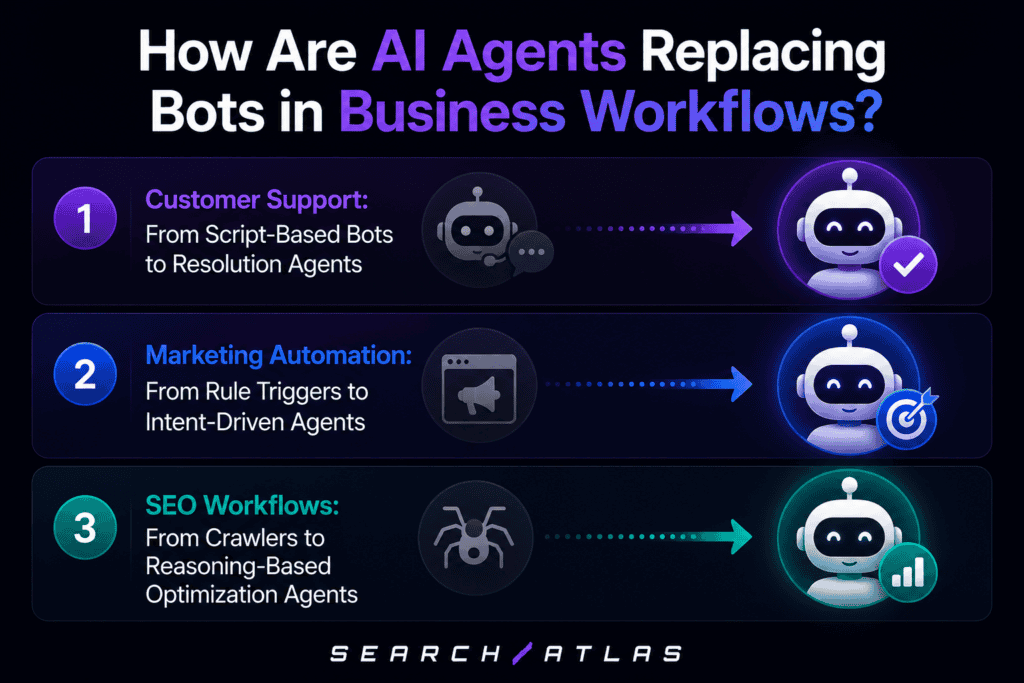
AI agents replace bots in business workflows by moving automation from fixed execution into adaptive reasoning and autonomous decision-making. Bots automate repetitive actions through predefined rules, while AI agents evaluate context, generate plans, and execute workflows dynamically across changing operational conditions. This transition changes automation from static trigger systems into continuous execution systems that interpret goals, prioritize actions, and manage outcomes autonomously.
AI agents replace bots because business workflows now require contextual interpretation, adaptive sequencing, and multi-step reasoning across connected systems. Rule-based bots fail after workflows exceed predefined conditions or require decisions that cannot be encoded into static logic. AI agents remove the operational burden of maintaining thousands of brittle rules by generating responses and actions dynamically during execution.
The 3 main business workflows where AI agents replace bots are listed below.
- Customer Support: From Script-Based Bots to Resolution Agents.
- Marketing Automation: From Rule Triggers to Intent-Driven Agents.
- SEO Workflows: From Crawlers to Reasoning-Based Optimization Agents.
1. Customer Support: From Script-Based Bots to Resolution Agents
Script-based customer support bots automate repetitive support questions through predefined conversation trees and keyword matching systems. These bots answer narrow and predictable requests effectively but fail after conversations require contextual understanding or issue interpretation. This limitation creates escalation bottlenecks because unusual issues fall outside predefined scripts.
What limitations existed in script-based customer support bots? Script-based customer support bots failed after customer requests required contextual reasoning or information outside predefined trigger conditions. Bots repeated irrelevant scripts, requested unnecessary rephrasing, or escalated conversations after encountering unfamiliar situations. This architectural limitation prevented bots from resolving complex customer interactions autonomously.
How do AI resolution agents handle customer support differently? AI resolution agents analyze account history, interpret natural language requests, retrieve relevant policies, and generate contextual responses dynamically during conversations. AI agents reason about the customer’s situation instead of matching messages against fixed scripts. This reasoning capability allows AI agents to resolve unfamiliar issues and maintain continuity across multi-turn interactions.
What operational changes happen after AI agents replace support bots? AI resolution agents reduce escalation rates, lower average handling times, and expand the number of issues resolved without human intervention. Human support teams shift toward complex edge cases that require authority, empathy, or specialized operational access. This operational shift increases support efficiency while improving customer experience quality.
2. Marketing Automation: From Rule Triggers to Intent-Driven Agents
Rule trigger marketing automation executes campaigns after predefined user actions occur across marketing systems. These systems operate effectively for predictable workflows but fail after user behavior requires contextual interpretation beyond fixed triggers. This limitation creates repetitive messaging that ignores buying stage progression and behavioral nuance.
What limitations existed in rule-triggered marketing automation? Rule trigger automation evaluated isolated actions instead of interpreting the full behavioral context across customer journeys. Contacts who downloaded the same resource received identical nurture sequences regardless of sales conversations, engagement history, or purchase intent. This limitation reduced personalization accuracy and engagement quality.
How do intent-driven AI agents change marketing automation? Intent-driven AI agents evaluate behavioral signals, CRM stages, content interactions, and communication history continuously during campaign execution. AI agents generate messaging dynamically based on inferred customer intent instead of static trigger conditions. This reasoning process creates adaptive customer journeys that respond to evolving behavior patterns.
What infrastructure changes are required for intent-driven automation? Intent-driven automation requires unified behavioral data across websites, CRM systems, email platforms, and product environments. AI agents depend on integrated context to reason accurately about customer intent and engagement readiness. This requirement exposes integration gaps that rule-based systems never needed to solve.
Search Atlas positions Atlas Agentic as an agentic marketing system that executes SEO, PPC, content, and AI search workflows through autonomous reasoning and execution layers.
3. SEO Workflows: From Crawlers to Reasoning-Based Optimization Agents
Crawler-based SEO automation identifies technical issues and extracts website data through predefined crawling systems. These crawlers automate discovery efficiently but leave prioritization, decision making, and implementation work to human teams. This separation limits optimization scalability across large websites.
What did crawler-based SEO automation leave unaddressed? Crawler-based automation generated audit findings without determining which issues mattered most or how fixes affected ranking performance. SEO practitioners still prioritized pages, wrote optimizations, implemented updates, and validated outcomes manually after crawlers completed discovery. This limitation restricted operational scale across large URL inventories.
How do reasoning-based SEO agents change SEO workflows? Reasoning-based SEO agents evaluate audit findings, prioritize fixes by ranking impact, generate optimization changes, and deploy updates autonomously across websites. Search Atlas positions OTTO SEO as an execution layer that installs through a JavaScript pixel and applies live optimizations across titles, schema, meta descriptions, and internal links automatically. This architecture transforms SEO automation from reporting into continuous execution.
What does reasoning-based SEO automation make possible at scale? Reasoning-based SEO automation enables continuous optimization across thousands of URLs without proportional increases in operational headcount. AI agents identify underperforming pages, generate contextual optimizations, and deploy updates continuously across large websites. SEO teams define strategic priorities and review critical decisions while the AI agent manages execution across the full optimization workflow. Choosing which platform to run this way matters, since reasoning quality and integration depth vary widely across the best AI agents for SEO on the market.
What Should You Evaluate When Choosing Between a Bot and an AI Agent?
The factors to evaluate when choosing between a bot and an AI agent are workflow structure, decision complexity, contextual reasoning requirements, execution variability, maintenance overhead, data dependency, operational scale, and autonomy requirements. These evaluation factors determine whether deterministic automation or adaptive reasoning produces stronger execution outcomes across business workflows.
Bot and AI agent selection affects operational scalability because workflow architecture determines how systems behave after conditions change during execution. Rule-based automation performs efficiently inside predictable workflows, while reasoning systems perform efficiently inside adaptive workflows that contain uncertainty and contextual variation.
The 8 main evaluation factors for choosing between a bot and an AI agent are listed below.
1. Workflow structure. Workflow structure determines whether execution paths remain fixed or change dynamically during runtime. Bots operate effectively after workflows follow predictable sequences with predefined transitions. AI agents operate effectively after workflows generate different execution paths based on discovered information and evolving conditions.
2. Decision complexity. Decision complexity determines whether workflow decisions remain deterministic or require contextual reasoning. Bots execute workflows successfully after every condition maps directly to a predefined action. AI agents evaluate ambiguous situations and generate decisions dynamically after predefined rules become insufficient.
3. Contextual reasoning requirements. Contextual reasoning requirements determine whether workflows depend on interpretation beyond explicit input conditions. Bots process structured inputs through fixed logic without interpreting meaning or intent. AI agents analyze behavioral context, historical information, and operational goals during decision-making.
4. Execution variability. Execution variability determines whether workflows repeat identical actions or generate different actions across executions. Bots repeat stable workflows consistently across repetitive operational tasks. AI agents adapt execution paths continuously based on retrieved information, observed outcomes, and updated task conditions.
5. Maintenance overhead. Maintenance overhead determines how frequently systems require manual updates after workflows or environments change. Bots accumulate maintenance costs because every new condition requires explicit rule modification. AI agents reduce rule maintenance by generating adaptive responses through reasoning systems.
6. Data dependency. Data dependency determines whether workflows require isolated triggers or integrated contextual information across systems. Bots function effectively with limited operational inputs tied to specific trigger conditions. AI agents require unified data environments that provide behavioral, contextual, and historical information continuously.
7. Operational scale. Operational scale determines whether automation systems remain manageable across large workflow inventories and changing environments. Bots scale effectively across repetitive tasks with stable execution requirements. AI agents scale effectively across dynamic operations where contextual adaptation becomes operationally necessary.
8. Autonomy requirements. Autonomy requirements determine how independently the system operates during execution without human intervention. Bots automate predefined actions but stop after workflows exceed configured conditions. AI agents interpret objectives, generate plans, revise actions, and continue execution autonomously across multi-step workflows.
Does the System Need to Learn or Adapt Across Sessions?
Systems need to learn or adapt across sessions because future decisions often depend on previous outcomes, historical context, and accumulated operational knowledge. Session-to-session adaptation allows AI agents to retain memory, evaluate prior results, and improve execution quality continuously across workflows. Bots do not adapt across sessions because bots execute identical rules repeatedly without adjusting behavior based on previous executions.
Systems need to learn or adapt across sessions because workflows frequently depend on what happened during earlier interactions. A customer service workflow fails after the system forgets previous conversations and requests the same information repeatedly. This failure reduces operational continuity and weakens customer experience quality across ongoing support interactions.
Systems need to learn or adapt across sessions because optimization workflows require feedback loops tied to historical performance outcomes. A content optimization system that ignores which changes improved rankings continues applying actions without evaluating effectiveness. This limitation prevents continuous improvement because the workflow lacks operational memory tied to prior outcomes.
Systems need to learn or adapt across sessions because persistent memory allows AI agents to refine future decisions dynamically. AI agents track previous actions, evaluate performance shifts, and adjust execution priorities based on accumulated operational data. This adaptation improves execution quality continuously without requiring humans to rewrite workflow rules manually.
How Important Is Context Retention Across Multiple Steps?
Systems need to learn or adapt across sessions after future decisions depend on outcomes, context, or performance data from previous executions. Session-to-session adaptation allows AI agents to retain operational memory, evaluate historical outcomes, and improve decision quality continuously across workflows. Bots do not adapt across sessions because bots execute identical rules repeatedly without modifying behavior based on previous results.
Session-to-session adaptation matters because long-running workflows depend on historical continuity and feedback-driven optimization. AI agents use memory systems to retain context, track outcomes, and refine future decisions dynamically across repeated executions. This adaptive capability allows reasoning systems to improve operational performance without requiring humans to rewrite rules manually.
Systems need session-to-session adaptation because workflows evolve continuously across customer interactions, marketing campaigns, and optimization processes. A customer support workflow fails after the system forgets previous interactions with the same customer. An SEO workflow loses optimization continuity after the system ignores historical ranking outcomes and prior remediation actions. These failures demonstrate why memory and adaptation matter across autonomous workflows.
Systems need session-to-session adaptation because feedback loops improve execution quality over time. AI agents evaluate what actions succeeded previously, which allows future workflows to incorporate performance-based adjustments automatically. Bots repeat the same actions regardless of whether previous executions produced successful or unsuccessful outcomes.
Systems need session-to-session adaptation because persistent memory creates operational continuity across complex workflows. This persistent state allows the system to track resolved issues, evaluate ranking changes, and prioritize future optimizations based on historical performance patterns.
Systems need session-to-session adaptation because adaptive reasoning depends on retained context and accumulated operational knowledge. AI agents improve execution quality after analyzing previous outcomes and integrating those outcomes into future reasoning loops. This learning capability separates autonomous agents from deterministic bots that restart every execution without historical awareness.
How Important Is Context Retention Across Multiple Steps? Context retention is critically important across multi-step workflows because downstream decisions depend on information gathered earlier during execution. Context retention allows AI agents to carry operational memory across workflow stages and apply that memory during later decisions. Bots transfer predefined variables between steps but cannot reinterpret earlier observations dynamically during execution.
Context retention matters because complex workflows require continuous awareness of previous actions, retrieved information, and evolving task conditions. AI agents maintain running contextual memory across the entire workflow, which allows each subsequent action to reflect everything learned previously. This continuity creates coordinated execution instead of isolated task handling.
Context retention matters because missing operational context creates workflow fragmentation and execution failures. A support workflow breaks after the transferred systems lose customer history, issue details, or retrieved account information. AI agents retain conversation history, retrieved data, and workflow state continuously, which allows downstream decisions to reflect the complete operational context.
Context retention matters because multi-dimensional workflows require connected reasoning across related findings and actions. An SEO crawler identifies slow page speed and thin content as isolated technical findings. An AI agent with retained context evaluates both issues together, prioritizes remediation based on traffic impact and ranking position, and generates a sequenced optimization plan instead of disconnected recommendations.
Context retention matters because coordinated workflows depend on memory-driven reasoning across execution stages. AI agents interpret relationships between previous actions, current conditions, and future objectives continuously during runtime. This capability transforms automation from isolated task execution into adaptive workflow orchestration across connected operational systems.
Are AI Agents Better Than Bots?
Yes, AI agents are better than bots for workflows that require reasoning, adaptation, and multi-step decision-making across changing conditions.
AI agents outperform bots because AI agents interpret context, generate plans dynamically, retain memory, and adjust execution paths during runtime. Bots execute predefined rules repeatedly without understanding goals, evaluating ambiguity, or adapting behavior after workflows change unexpectedly. This architectural difference gives AI agents a significantly higher operational capability ceiling across modern business workflows.
AI agents are better because modern workflows rarely remain fully deterministic across execution cycles. Customer support, marketing operations, SEO execution, research workflows, and sales automation depend on contextual interpretation and sequential reasoning continuously. Bots fail after workflows exceed predefined conditions, while AI agents continue operating by generating new actions dynamically from available information.
AI agents are better because adaptive reasoning eliminates the maintenance burden created by rule-based systems. Bots require manual rule updates every time workflows, interfaces, or operational conditions evolve. AI agents evaluate new situations contextually and generate responses without requiring humans to rewrite execution logic continuously. This adaptability increases operational scalability across dynamic environments.
AI agents are better because memory and feedback loops improve execution quality continuously over time. AI agents retain operational history, evaluate previous outcomes, and refine future decisions based on accumulated workflow data. Bots repeat identical execution patterns indefinitely, regardless of whether previous outcomes succeeded or failed. This difference allows AI agents to improve operational effectiveness across repeated executions.
AI agents are better because business operations increasingly depend on systems that interpret goals instead of following static instructions. Bots remain useful for narrow deterministic tasks, but AI agents replace bots after workflows require contextual awareness, adaptive planning, and autonomous execution across evolving operational conditions.
Is ChatGPT a Bot or an AI Agent?
Yes, ChatGPT functions as an AI agent after deployment, including tools, memory, and autonomous task execution capabilities. ChatGPT operates as an LLM interface by default, but ChatGPT becomes an AI agent after the system gains tool access, contextual memory, and execution capabilities across external systems. This distinction matters because language models generate responses only, while AI agents interpret goals, execute actions, evaluate outcomes, and manage workflows autonomously.
ChatGPT functions differently depending on deployment architecture because architecture determines whether the system generates text only or executes operational workflows. A standalone language model responds to prompts without interacting with external environments. An AI agent deployment connects the model to tools, memory systems, APIs, and execution layers that extend reasoning into autonomous operations.
ChatGPT functions as an AI agent because connected tools allow the system to perceive environments, retrieve information, execute commands, and evaluate outcomes continuously. A deployment with web browsing, database access, code execution, and workflow orchestration allows ChatGPT to generate plans dynamically and execute multi-step workflows autonomously. This operational capability separates AI agents from passive text generation systems.
ChatGPT functions as a language model assistant because standalone deployments lack execution authority and persistent operational memory. A prompt response interface generates outputs that humans review and execute manually. This configuration creates conversational assistance instead of autonomous workflow execution.
Can a Bot Become an AI Agent With the Right Integrations?
No, adding AI capabilities to a bot does not automatically turn the system into an AI agent. A bot becomes an AI agent only after the system replaces rule-based decision logic with adaptive reasoning and autonomous action generation. Language models improve response generation quality, but language generation alone does not create agentic behavior. AI agent functionality emerges from reasoning architecture, contextual memory, tool orchestration, and runtime decision making instead of predefined execution rules.
Adding AI capabilities does not automatically create an AI agent because rule-based systems still control workflow execution. A chatbot that generates natural-sounding replies through a language model remains a bot after predefined rules determine which trigger activates which workflow path. The language model changes output quality, but the decision architecture remains deterministic.
Adding AI capabilities does not automatically create an AI agent because AI agents require reasoning loops instead of decision trees. Bots evaluate fixed conditions and execute predefined responses through static workflow logic. AI agents interpret context, evaluate goals, select actions dynamically, and revise execution paths continuously during runtime. This architectural difference determines whether the system operates through automation or autonomous reasoning.
Bots become AI agents after the system replaces rule-based execution with contextual reasoning and adaptive planning. AI agent architectures provide language models with workflow context, operational goals, connected tools, and memory systems that determine the next action dynamically. This reasoning loop replaces hardcoded workflow transitions with runtime decision generation.
Bots become AI agents after workflows depend on contextual interpretation instead of predefined trigger matching. A customer support bot maps incoming messages to scripted responses through decision tables and fixed categories. A customer support AI agent retrieves account history, evaluates issue severity, determines the appropriate resolution path, and generates responses dynamically based on operational context. The visible response appears similar, but the execution architecture differs fundamentally.
Are AI Agents More Expensive to Implement Than Bots?
Yes, AI agents are generally more expensive to implement than bots during the initial deployment stage. AI agents require reasoning models, memory systems, tool integrations, orchestration layers, prompt engineering, and broader testing coverage across unpredictable scenarios. Bots require simpler deterministic workflows built around predefined rules and finite input conditions. This architectural complexity increases the initial implementation cost of AI agents compared to traditional automation bots.
AI agents cost more initially because reasoning-based systems require validation across significantly larger execution spaces. Bots operate through explicit rules that engineering teams test against predictable workflows and known conditions. AI agents generate actions dynamically during runtime, which requires testing across ambiguous inputs, contextual variations, and unexpected operational states.
AI agents become more cost-efficient over time because adaptive reasoning reduces ongoing maintenance overhead. Bots require manual rule updates after workflows, products, interfaces, or operational conditions change beyond the original configuration. AI agents interpret new situations contextually and continue operating without requiring continuous workflow rewrites. This adaptability reduces the operational cost associated with maintaining large rule-based systems.
AI agents remain more expensive for narrow and stable workflows because deterministic automation handles predictable tasks efficiently with lower infrastructure requirements. Fixed reporting workflows, stable data processing pipelines, and repetitive transactional systems align naturally with bots because workflow conditions rarely change. These environments reduce the long-term value created through adaptive reasoning systems.
AI agents become financially advantageous for dynamic workflows because maintenance costs compound rapidly across changing operational environments. Customer support systems, SEO optimization workflows, and marketing execution environments evolve continuously through new conditions, updated interfaces, and expanding operational complexity. AI agents absorb those changes through reasoning-based adaptation instead of manual rule reconstruction.
AI agents often recover implementation costs after maintenance savings accumulate across long-running workflows. A bot handling evolving workflows requires continuous engineering intervention after conditions change repeatedly across months or years. AI agents reduce those recurring operational updates, which allows implementation costs to break even after sustained workflow execution across adaptive environments.
AI agents create stronger long-term operational value because autonomous reasoning reduces dependency on manual workflow maintenance at scale.
What Happens When You Use a Bot for a Task That Needs an Agent?
Using a bot for a task that requires an AI agent creates escalating exceptions, growing rule complexity, and increasing human intervention across workflows.
Bots fail after workflows require contextual reasoning, adaptive planning, or dynamic decision making beyond predefined execution rules. Teams respond by adding more rules, exceptions, and fallback conditions continuously until the automation system becomes difficult to maintain and still fails across unanticipated scenarios. This pattern signals a structural mismatch between deterministic automation architecture and reasoning-dependent operational requirements.
Using a bot for an AI agent task creates operational instability because rule-based systems cannot generalize across evolving workflow conditions. Bots process only the situations encoded during configuration, while real operational environments introduce new inputs, edge cases, and contextual variations continuously. This mismatch forces teams to expand rule sets indefinitely without achieving full workflow coverage.
Using a bot for an AI agent task creates rising exception rates because deterministic logic fails after workflows exceed predefined operational boundaries. Customer support bots escalate conversations after encountering unfamiliar requests, while rule-based marketing systems trigger irrelevant messaging after user behavior diverges from expected patterns. These failures increase human intervention across workflows that require contextual interpretation.
Using a bot for an AI agent task creates hidden operational costs because human teams absorb the failures produced by incomplete automation coverage. Support agents resolve escalated conversations, engineers maintain expanding rule sets, and operational teams manage workflow breakdowns manually. These costs rarely appear inside automation budgets directly because the overhead spreads across multiple organizational functions.
Using a bot for an AI agent task creates technical debt because rule complexity compounds continuously after new edge cases emerge. Small automation systems with limited rules remain manageable initially, but growing exception handling logic eventually creates brittle workflows that become difficult to audit, maintain, or replace. This complexity increases migration costs after organizations eventually transition toward reasoning-based systems.
Using a bot for an AI agent task creates a measurable warning signal through rising human intervention rates over time. Stable escalation rates indicate deterministic workflows remain aligned with operational requirements. Growing escalation rates indicate workflows increasingly depend on contextual reasoning and adaptive decision-making that bots cannot provide reliably. This trend reveals the point where deterministic automation stops matching workflow complexity.
Using a bot for an AI agent task delays the operational benefits created through autonomous reasoning systems. This architecture reduces escalating maintenance cycles and human escalation overhead by allowing the system to interpret changing conditions dynamically instead of depending on continuously expanding rule sets.