Most AI SEO tool lists in 2026 still rank platforms through feature checklists instead of real execution capability. This ranking evaluated what each AI SEO agent actually executes across a live SEO workflow.
The testing focused on workflow depth instead of marketing claims. Platforms were ranked based on execution coverage, deployment capability, AI visibility tracking, and how much of the SEO process they handled without manual handoffs between tools, teams, or publishing systems.
The 12 platforms featured in this ranking represent the strongest AI SEO agents tested across real-world SEO workflows in 2026.
Scope: this list covers SEO-specific execution agents — tools scoped to the SEO workflow. If you need a platform that orchestrates SEO, content, paid media, and AI visibility together from one system, see 10 Best AI CMO Platforms instead.
What is an AI agent for SEO?
An AI agent for SEO is an autonomous system that plans, executes, and improves SEO work without requiring manual step-by-step input. AI SEO agents connect large language models with crawlers, search data, content systems, analytics, and deployment layers to run complete workflows automatically.
Traditional AI SEO tools respond to prompts. AI agents operate around goals. Instead of generating one article or one keyword list at a time, the agent handles continuous execution across research, content, optimization, technical SEO, and reporting.
A modern AI SEO agent typically manages five execution stages:
- Keyword and entity research.
- Content brief creation.
- Content generation and optimization.
- On-page and technical deployment.
- Visibility tracking across Google and AI search engines.
The strongest AI SEO agents integrate all SEO stages into a single operational loop, where analysis, execution, and optimization occur continuously.
Why do AI SEO agents matter in 2026?
AI SEO agents matter in 2026 because search visibility now depends on AI-generated answers, not only traditional rankings. AI search systems now influence more than 55% of informational query volume across the web. Platforms like Google, OpenAI, and Perplexity AI increasingly control how users discover information, products, and brands.
The optimization model shifted from “ranking pages” to “earning citations inside generated answers.”
AI SEO agents track how brands appear inside AI-generated responses, monitor brand mentions across conversational engines, identify which entities AI systems associate with a company, and continuously optimize content to improve AI citation frequency, semantic relevance, and retrieval performance.
This shift changes how SEO operates. Visibility no longer depends only on keyword rankings. AI systems evaluate semantic relevance, entity relationships, topical authority, structured data, factual consistency, and trust signals before deciding which brands appear inside synthesized answers.
AI SEO agents matter because execution complexity has increased dramatically at the same time. Teams now manage Google Search, AI Overviews, ChatGPT Search, Gemini, Perplexity, internal linking, semantic optimization, entity coverage, topical authority, and structured data simultaneously across large content ecosystems. Google's own agentic entry into this space is worth evaluating on its own merits — see this Gemini Agents review for pricing, features, and limitations.
Manual workflows cannot react fast enough to constantly changing AI retrieval systems and conversational search environments. AI SEO agents solve that problem by turning strategy into continuous execution across research, optimization, deployment, and visibility tracking inside one operational workflow.
How does an AI SEO agent differ from an AI SEO tool?
The difference between an AI SEO agent and an AI SEO tool lies in execution. An AI SEO tool assists with individual tasks, while an AI SEO agent executes complete SEO workflows autonomously.
An AI SEO tool usually performs one action at a time after a human request. You ask the system to generate keywords, write a meta description, create content, or analyze rankings. The workflow stops after the output appears.
An AI SEO agent keeps operating after the first step. The agent analyzes data, decides what needs optimization, applies changes, monitors results, and improves performance continuously without requiring constant human input between each action.
For example, a tool generates a meta description after a prompt. An AI SEO agent generates the description, deploys it to the live page, monitors click-through rate performance, and rewrites the description automatically if CTR declines below a target threshold.
Here is a comparison between the two models:
| Capability | AI SEO Tool | AI SEO Agent |
| Workflow Type | Single-task execution | Multi-step execution |
| Decision Making | Human controlled | AI controlled |
| Deployment | Manual deployment | Direct deployment |
| Optimization | Static output | Continuous optimization |
| Execution Model | Prompt based | Goal based |
| Monitoring | Reporting only | Reporting + action |
| Learning Loop | Stops after output | Adjusts to outcomes |
This execution layer matters because SEO has become too complex for disconnected workflows. Teams now manage rankings, AI citations, semantic optimization, internal linking, structured data, topical authority, and content refresh cycles simultaneously.
How these AI SEO agents were tested?
These AI SEO agents were tested by running the same five-stage SEO workflow against the same keyword cluster and comparing execution quality, automation depth, and output accuracy.
The testing environment used a mid-competition B2B SaaS topic with 12 supporting search queries. Every platform received the same workflow and evaluation criteria.
Each AI SEO agent was scored across five execution stages:
- SERP and competitor research.
- Content brief generation.
- Content drafting and optimization.
- On-page deployment and schema implementation.
- AI visibility and citation tracking.
Platforms were excluded if the workflow stopped at content generation or required manual execution between critical stages. AI visibility tracking impacted rankings heavily. Platforms without tracking for AI-generated search ecosystems did not place in the top tier.
Some platforms performed well during content generation but stopped before deployment. Others handled optimization but lacked AI visibility tracking across conversational search engines. Only a small number of AI SEO agents executed continuously across the full workflow.
The 12 Best AI Agents for SEO in 2026
The best AI SEO agents in 2026 do more than generate content or surface recommendations. The strongest platforms execute complete SEO workflows across research, content, optimization, deployment, and AI visibility tracking inside one connected system.
The platforms below were ranked based on workflow completion, deployment capability, AI visibility tracking, research depth, and execution autonomy.
1. Search Atlas
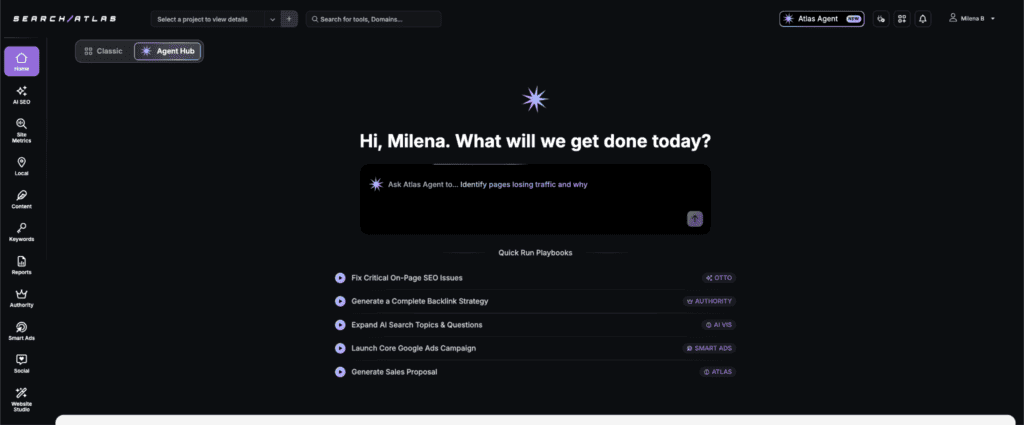
Search Atlas delivered the most complete AI SEO agent system tested in 2026. The platform connected research, content generation, optimization, deployment, AI visibility tracking, and reporting into one continuous execution workflow.
Most AI SEO platforms still depend on CMS plugins, exports, connectors, or developer implementation between optimization and deployment. OTTO Pixel removes that execution bottleneck by applying changes directly to live websites through a single JavaScript pixel.
What Does Atlas Agent Do?
Atlas Agent is the AI SEO agent inside Search Atlas that executes full marketing workflows through one conversational interface.
The system operates across SEO, content, authority building, PPC, local SEO, reporting, and AI search visibility simultaneously. Every command moves directly from strategy into execution without requiring disconnected tools or manual coordination between teams.
Atlas Agent runs specialized workflows for keyword research, SERP analysis, content planning, optimization prioritization, reporting, and AI visibility analysis. Built-in agents and playbooks continue operating across channels after the workflow begins.
Campaigns launch, optimizations deploy, content publishes, and reporting updates continuously inside one operational system.
What Is OTTO SEO?
OTTO SEO is the autonomous SEO deployment system inside Search Atlas and the first AI autopilot SEO agent built around pixel-based deployment. OTTO SEO audits the website, identifies optimization gaps, and applies live SEO fixes automatically without requiring developers, plugins, or manual CMS implementation.
The system deploys title updates, metadata changes, schema markup, internal links, content optimizations, canonical tags, Open Graph tags, Twitter Cards, indexing fixes, GBP updates, citations, and authority-building activities directly to production environments.
That deployment model scored highest during testing because optimization and implementation operated inside one continuous workflow.
How Does Search Atlas Track AI Visibility?
Search Atlas tracks AI search performance through LLM Visibility, a platform built to measure how often brands appear inside AI-generated answers and conversational search systems. LLM Visibility tracks brand mentions, citations, sentiment, share of voice, entity associations, and competitor benchmarks across AI platforms like:
- OpenAI.
- Google.
- Perplexity AI.
- OpenAI.
The platform records how frequently brands appear inside AI-generated responses, which competitors receive the most visibility, which sources conversational engines cite, and which entities AI systems associate with the company across the evolving AI search ecosystem.
Who Is Search Atlas Best For?
Search Atlas fits agencies, enterprise SEO teams, and in-house marketing organizations that want one system handling research, optimization, deployment, AI visibility, and reporting together.
Agencies managing large client portfolios and internal teams adopt Atlas Agent to compress strategy-to-execution timelines from weeks into days while maintaining centralized control over deployment, approvals, rollback capability, and optimization tracking.
2. Frase
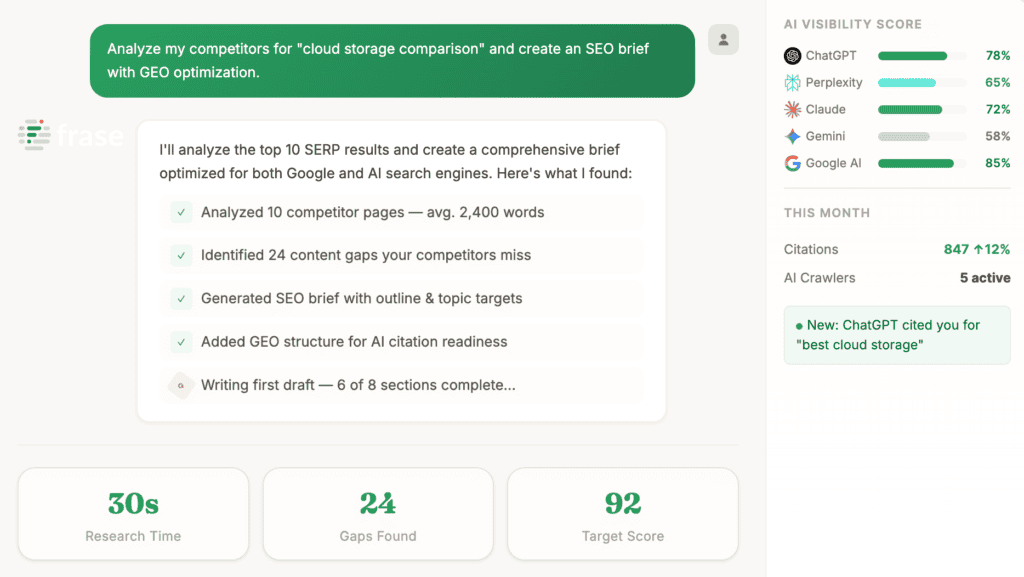
Frase is an AI content research and drafting platform built around SERP analysis, content briefs, and long-form content generation. The platform performed strongly during the research and drafting stages of testing, but stopped short of full-stack SEO execution.
Frase primarily covers two workflow stages:
- Content brief generation.
- AI content drafting.
The platform focuses heavily on accelerating research and writing workflows instead of deployment, technical SEO execution, or AI visibility tracking.
What Does Frase Do Well?
Frase performed well during content research and brief generation testing.
The platform analyzes top-ranking search results, extracts headings, questions, entities, and topical patterns, then builds structured content briefs around that SERP data.
Briefs typically include recommended headings, question coverage, suggested word counts, and topical terms tied to ranking pages.
What Is the Two-URL Stronghold Limitation?
One limitation appeared consistently during testing.
Frase relies heavily on smaller comparison windows inside its research workspace, which creates friction during broader SERP analysis. Teams analyzing highly competitive search landscapes often need wider entity and competitor coverage across larger result sets.
That limitation becomes more noticeable for enterprise SEO teams managing large topical maps or extensive competitive research workflows.
Where Does Frase Fall Short in 2026?
Frase falls short in deployment, technical SEO execution, schema implementation, and AI visibility tracking. Teams still need additional systems for deployment, optimization implementation, schema management, technical SEO fixes, and conversational AI visibility tracking.
The platform does not natively track citations, brand mentions, or entity visibility across AI search environments like OpenAI or Perplexity AI. This creates a fragmented workflow for teams trying to manage execution across the full SEO stack.
Who Is Frase Best For?
Frase fits freelance writers, solo SEOs, and small content teams focused primarily on research, outlining, and AI-assisted drafting. Teams looking for complete execution workflows across deployment, technical SEO, AI visibility, and continuous optimization typically require additional platforms alongside Frase.
3. Surfer AI
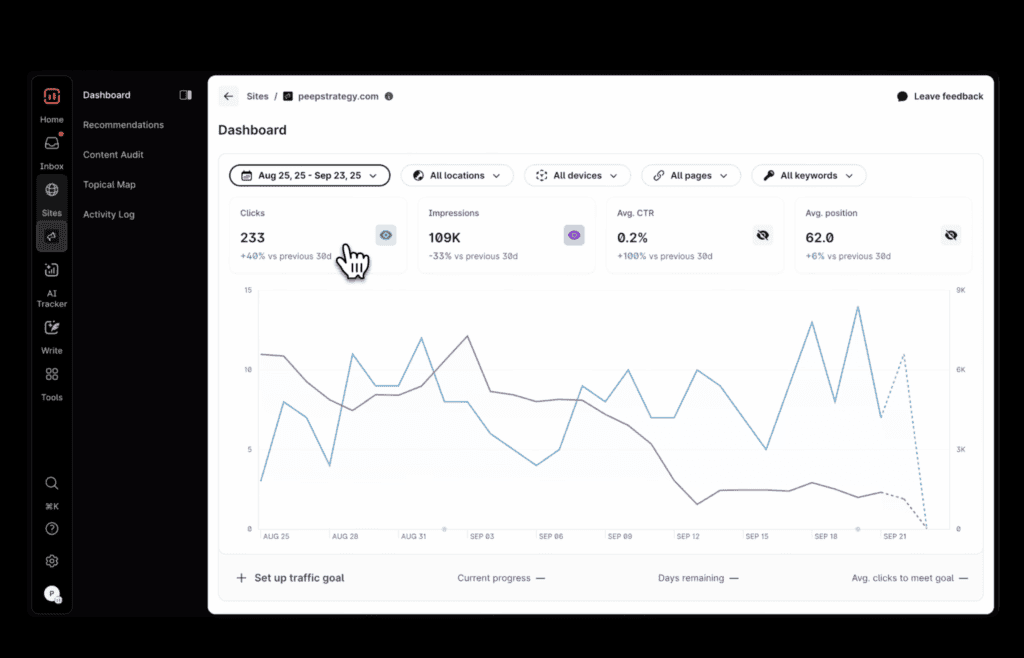
Surfer SEO is an AI content optimization platform focused on SERP-driven content scoring, entity coverage, and AI-assisted article generation. The platform performed well during the brief and drafting stages of testing, particularly for teams optimizing around traditional Google rankings.
Surfer AI generates full articles by analyzing top-ranking SERP results and embedding NLP entities, headings, topical terms, and structural patterns directly into the draft. Users can configure tone, article length, structure, and optimization targets before generation begins.
What Does Surfer AI Do Well?
Surfer SEO performed strongly during entity optimization and content scoring tests.
The platform compares drafts against SERP-derived entity coverage and measures how closely the content aligns with ranking competitors. The workflow feels particularly effective for in-house SEO teams producing high volumes of search-focused content.
Surfer AI includes article generation, optimization scoring, content audits, suggested headings, internal link prompts, and FAQ schema recommendations inside one editor environment.
Where Does Surfer AI Fall Short?
Surfer SEO stops short of full execution workflows.
The platform does not deploy live website changes, does not support broader schema deployment beyond FAQ markup, and does not track AI visibility across conversational search environments like OpenAI, Google, or Perplexity AI. Teams managing deployment, technical SEO implementation, or AI citation tracking still require additional systems to complete the workflow.
Who Is Surfer AI Best For?
Surfer SEO fits content-focused SEO teams that prioritize SERP optimization, entity coverage, and AI-assisted article drafting. The platform works best for organizations optimizing traditional organic search content workflows rather than full-stack AI search execution or autonomous deployment systems.
4. MarketMuse
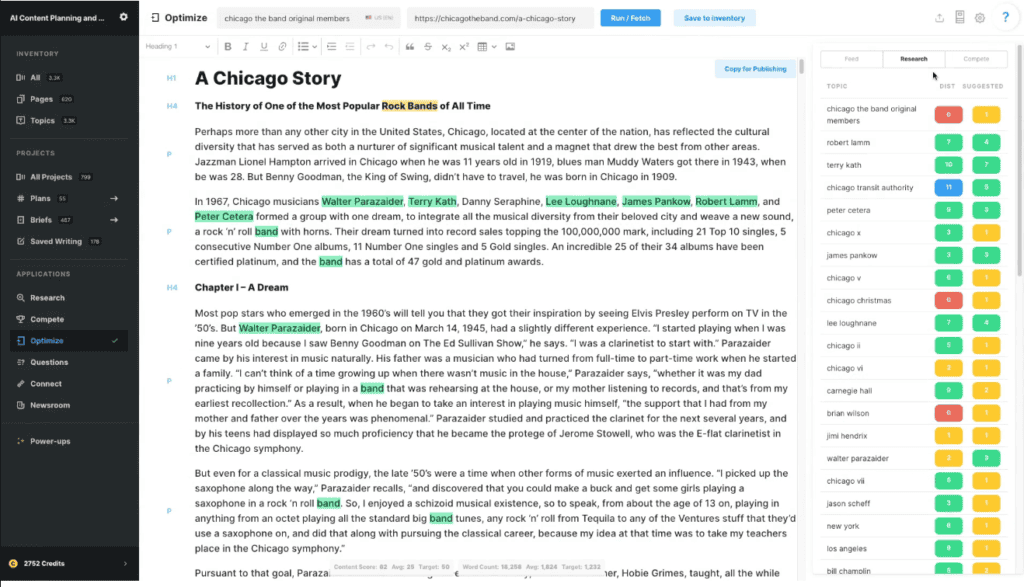
MarketMuse is an AI-driven content planning and topical authority platform focused on domain-level content analysis and cluster prioritization. The platform performed strongest during topic modeling, authority analysis, and content planning stages of testing.
MarketMuse approaches SEO from a strategic content perspective rather than a deployment or execution perspective. The platform analyzes existing domain content, identifies topical gaps, scores authority depth, and recommends which topic clusters deserve expansion first.
What Does MarketMuse Do Well?
MarketMuse performed strongly during topical authority analysis and large-scale content inventory evaluation.
The platform maps relationships between topics across an entire domain and identifies where content depth remains weak compared to competitors. The Inventory tool catalogs existing pages, while the Compete feature identifies authority gaps against competing domains.
Output includes topic gap reports, cluster recommendations, content scoring, target word counts, and structured content briefs designed for editorial planning workflows.
Where Does MarketMuse Fall Short?
MarketMuse does not operate as a full execution platform. The system does not deploy on-page optimizations, generate advanced schema implementations, publish content directly, or track AI visibility across conversational search ecosystems.
The workflow typically stops after content planning and brief generation, which means execution still requires separate systems for drafting, deployment, optimization, and AI visibility tracking.
Who Is MarketMuse Best For?
MarketMuse fits enterprise content teams managing large editorial calendars and complex topical authority strategies. Organizations focused heavily on content planning, cluster mapping, and domain-level authority analysis receive the most value from the platform. Smaller teams often find that the strategic depth exceeds the scale of their publishing workflows.
5. Clearscope
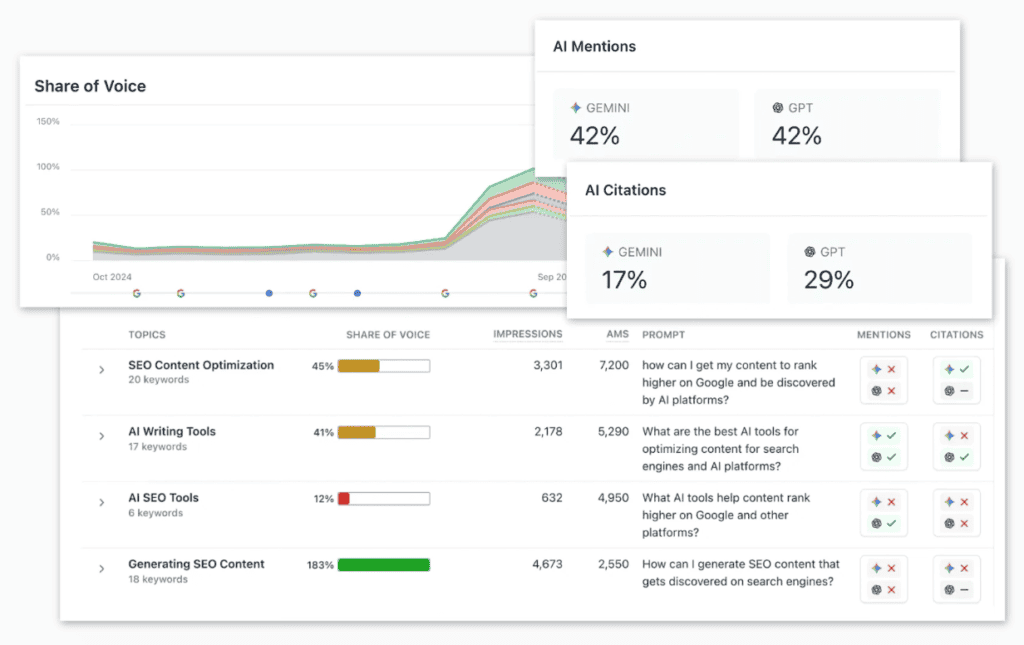
Clearscope is an AI-powered content optimization platform focused on entity scoring, term coverage, and editorial optimization workflows. The platform performed strongest during draft optimization and content refinement testing.
Clearscope analyzes top-ranking pages for a target keyword, extracts important terms and entities, and scores content against that SERP profile. Writers paste content into the editor or Google Docs integration, and the platform returns optimization recommendations alongside a content grade.
What Does Clearscope Do Well?
Clearscope performed well during content scoring and editorial workflow testing.
The Google Docs integration remains one of the platform’s strongest advantages. Writers receive entity recommendations, optimization suggestions, and relevance scoring directly inside the writing workflow without switching platforms. The workflow feels lightweight and editor-friendly, especially for content teams managing collaborative drafting environments.
Where Does Clearscope Fall Short?
Clearscope operates primarily as an optimization layer instead of a full AI SEO execution platform. The system does not deploy live website changes, automate technical SEO implementation, or generate advanced schema.
The workflow still depends heavily on manual publishing and separate deployment systems after optimization finishes.
Who Is Clearscope Best For?
Clearscope fits editorial teams writing inside Google Docs that want clean optimization scoring and entity recommendations without adding operational complexity. The platform works best for content refinement workflows rather than full-stack SEO automation or autonomous execution systems.
6. NeuronWriter
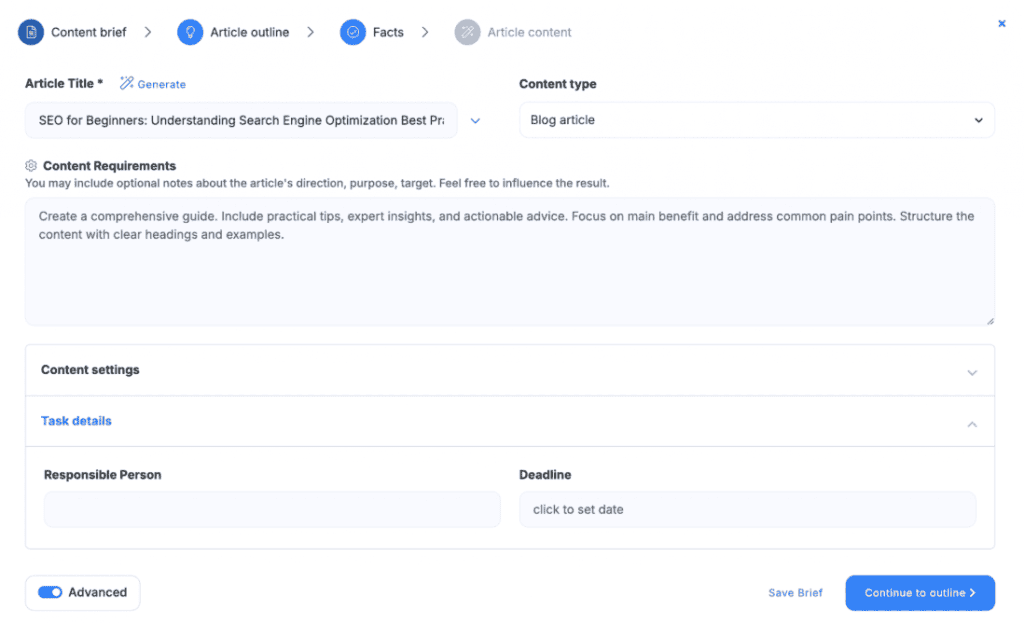
NeuronWriter is an AI content optimization and drafting platform focused on SERP-driven outlines, multilingual SEO workflows, and budget-friendly content production. The platform covers the research, brief, and draft stages while emphasizing multilingual content operations across international search markets.
NeuronWriter analyzes top-ranking SERP results, extracts competitor headings and entity coverage, then generates outlines and drafts optimized around those patterns. The system supports more than 170 languages and integrates directly with WordPress for publishing workflows.
What Does NeuronWriter Do Well?
NeuronWriter performed strongly during multilingual optimization testing.
The platform handled international SERP analysis well across multiple language environments, which made it particularly useful for teams managing international SEO campaigns. The WordPress integration streamlined content publishing for teams already operating inside that CMS ecosystem.
Where Does NeuronWriter Fall Short?
NeuronWriter focuses primarily on content workflows instead of full SEO execution.
The platform does not automate technical SEO fixes, advanced schema deployment, internal linking systems, or AI visibility tracking across conversational engines like Google and OpenAI.
The workflow largely ends after publishing content to WordPress. Teams managing technical SEO, deployment automation, or AI citation tracking still require additional systems.
Who Is NeuronWriter Best For?
NeuronWriter fits multilingual content teams, WordPress publishers, and smaller SEO operations looking for SERP-driven optimization workflows at a lower price point.
The platform works best for organizations prioritizing multilingual content production over enterprise-level technical SEO automation or AI search visibility management.
7. Outranking
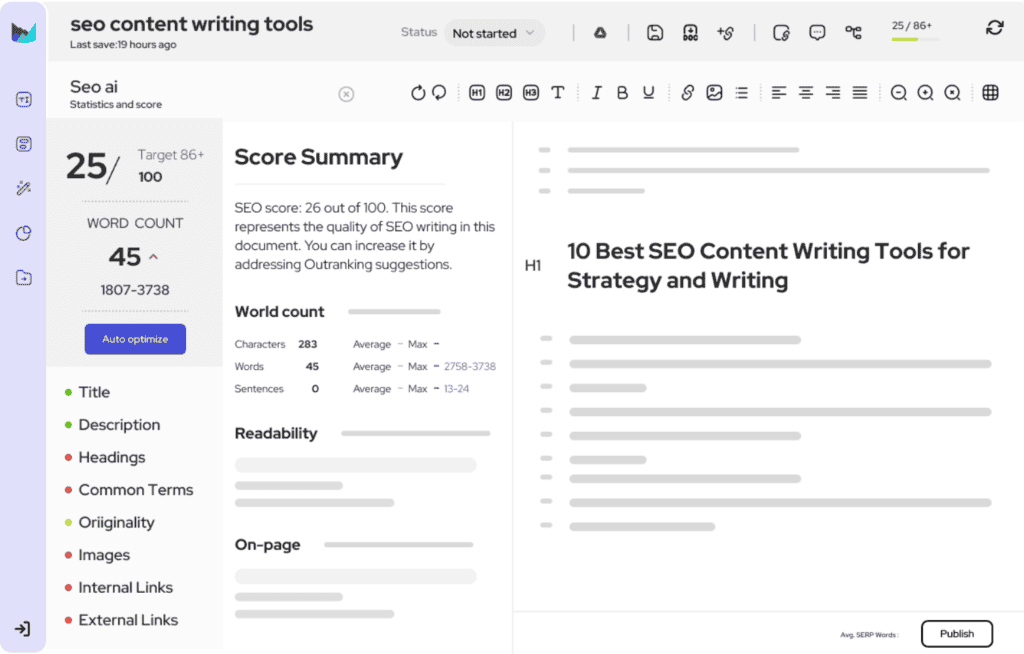
Powerful SEO tools for content strategy and ranking improvement.
Outranking is an AI content workflow platform focused on connecting SERP research, brief generation, drafting, and optimization inside one workspace. The platform performed well during the research-to-draft stages of testing, especially for writer productivity workflows.
Outranking analyzes SERP results, builds structured briefs, generates long-form drafts, and scores content against target keywords and entity profiles inside a single editor environment.
What Does Outranking Do Well?
Outranking performed strongly during workflow continuity testing.
The platform keeps research, outlines, drafting, optimization, and scoring connected inside one interface, which reduces context switching during content production. The concept graph visualization stood out during testing because it mapped relationships between entities and subtopics clearly for writers covering unfamiliar topics.
Where Does Outranking Fall Short?
Outranking stops short of deployment and AI visibility execution. The platform does not deploy live website changes, automate schema implementation, or track citations across conversational AI systems like OpenAI and Google.
The workflow largely ends after draft export, which means deployment and visibility tracking still require additional systems.
Who Is Outranking Best For?
Outranking fits content teams that want research, outlining, drafting, and optimization connected inside one workspace. The platform works best for editorial production workflows rather than full-stack SEO execution or deployment automation.
8. AlliAI
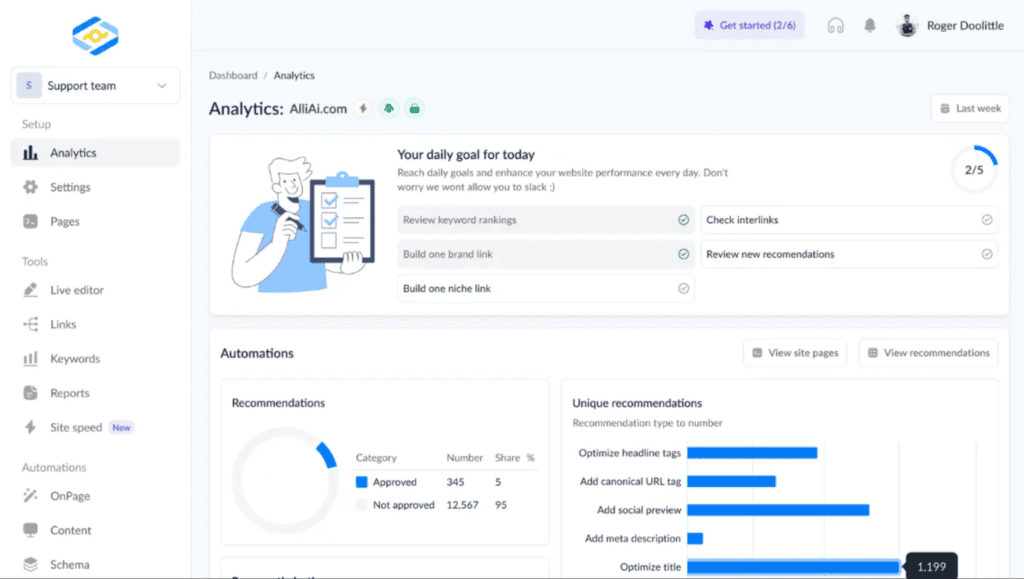
Alli AI is an on-page SEO automation platform focused primarily on deployment and technical execution. The platform performed strongest during live optimization deployment testing through its code-snippet implementation model.
Alli AI handles meta tags, headings, alt text, internal links, redirects, and other on-page changes across large groups of pages through a JavaScript snippet installed on the site.
What Does Alli AI Do Well?
Alli AI performed well during at-scale deployment testing.
The platform supports bulk optimization workflows across thousands of URLs simultaneously, which makes it useful for agencies and enterprise websites managing large page inventories. The Live Editor feature simplifies on-page updates visually without requiring direct CMS access. For pricing details and hands-on testing notes, see the full Alli AI review.
How Does Alli AI Compare to OTTO SEO?
Alli AI uses a deployment model similar to OTTO SEO through a code snippet installed on the website. The major difference is workflow depth.
Alli AI focuses primarily on implementation and deployment. The platform does not include content drafting, SERP research, brief generation, or AI visibility tracking, which positions it more as a deployment engine than a full AI SEO execution system.
Where Does Alli AI Fall Short?
Alli AI does not generate content, perform advanced SERP entity analysis, or track AI citations across conversational search ecosystems. The platform handles execution layers well, but strategy, research, content production, and AI visibility management still require additional systems.
Who Is Alli AI Best For?
Alli AI fits agencies and enterprise SEO teams that already have established content workflows and want a deployment layer for large-scale on-page implementation. The platform works best for execution-focused teams rather than organizations looking for end-to-end research-to-deployment AI SEO workflows.
9. SEO.ai
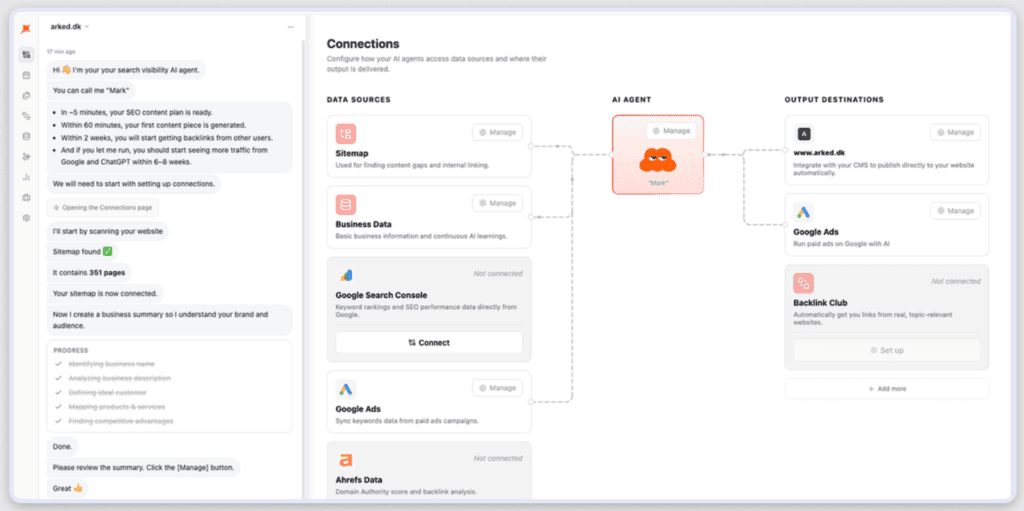
SEO.ai is an AI content generation and optimization platform focused on long-form article drafting, multilingual workflows, and SERP-based SEO scoring. The platform performed best during fast draft generation testing across international content environments.
SEO.ai generates articles from keyword inputs, analyzes SERP entities and topical patterns, and scores drafts against optimization targets inside the editor workflow. The system supports more than 50 languages, which makes it useful for teams managing multilingual publishing operations.
What Does SEO.ai Do Well?
SEO.ai performed strongly during high-volume drafting workflows. The platform generated multilingual articles quickly while maintaining reasonable entity coverage and SEO structure out of the box. Drafts included suggested headings, FAQ sections, and internal linking recommendations, which reduced research and outline preparation time for writers.
Where Does SEO.ai Fall Short?
The main limitation during testing was ecosystem depth outside core SEO operations. The platform does not provide the same breadth of autonomous execution across technical deployment, authority building, local SEO, PPC workflows, and pixel-based live optimization that broader execution-first platforms deliver inside one connected system.
Who Is SEO.ai Best For?
SEO.ai fits content teams that are producing large volumes of multilingual content at a lower cost per article. The platform works best for draft generation workflows rather than research-to-deployment SEO execution or AI citation optimization.
10. Jasper Brand Voice + SEO Mode
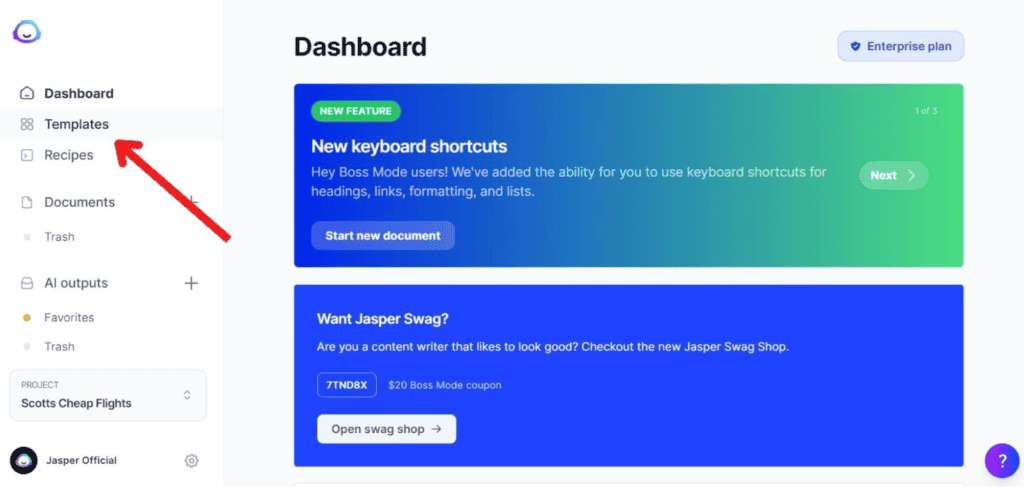
Jasper is an AI writing platform focused heavily on brand-consistent content generation. The platform performed strongest during long-form drafting and editorial consistency testing.
Jasper combines Brand Voice controls with SEO scoring through its Surfer integration. The system stores style rules, tone preferences, product terminology, and restricted phrases to keep AI-generated content aligned with company guidelines across large publishing programs.
What Does Jasper Do Well?
Jasper performed well during brand voice consistency testing. The Brand Voice system reduced editorial cleanup requirements significantly during large-scale content generation workflows. Enterprise teams managing strict editorial standards benefited from consistent tone and formatting across AI-generated drafts.
The platform supports long-form content creation, campaign copy generation, and structured editorial workflows inside one environment.
Where Does Jasper Fall Short?
Jasper’s main limitations rely on SEO execution depth compared to more execution-first AI SEO platforms. Jasper performed strongly for brand-consistent content generation and marketing workflows, but research, deployment, technical SEO implementation, and live optimization still depended more heavily on integrations and connected systems rather than one unified native execution layer.
Who Is Jasper Best For?
Jasperfits enterprise marketing teams prioritize brand voice consistency across large content operations. The platform works best for editorial and brand-focused workflows rather than full-stack SEO automation, deployment, or AI search visibility management.
11. Semrush
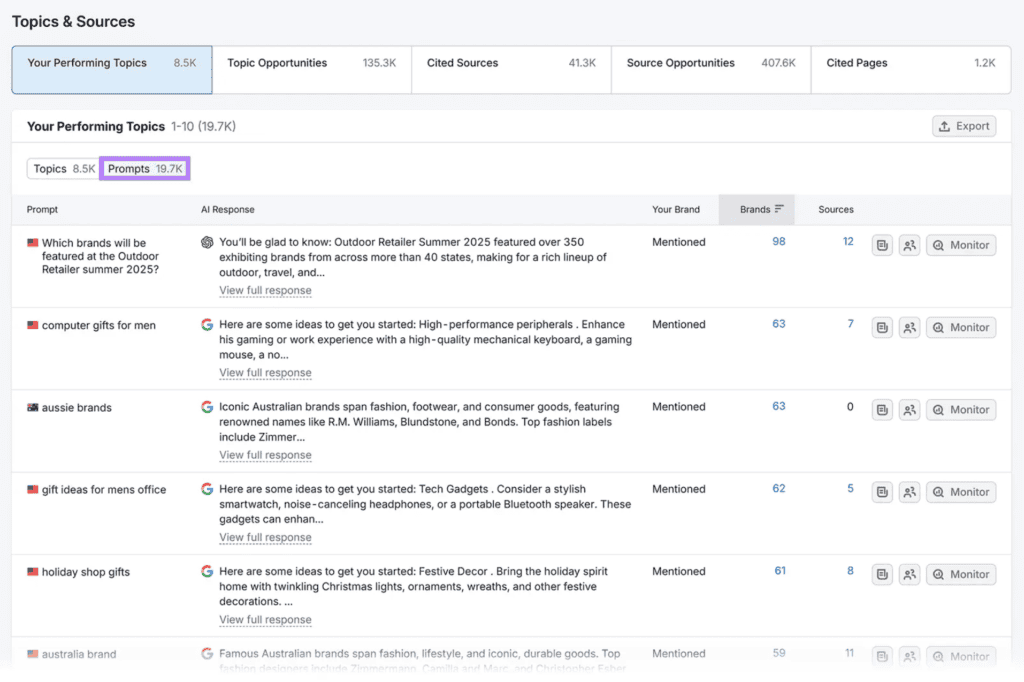
Semrush is evolving toward agentic search optimization with a growing focus on AI visibility, AI-generated search experiences, and brand monitoring across conversational engines.
The platform expanded heavily into AI search workflows following its acquisition by Adobe, introducing systems focused on AI visibility tracking, AI search analysis, and agentic commerce optimization.
What Does Semrush Do Well?
Semrush performed strongly during search visibility analysis and SEO research testing.
The platform provides extensive keyword databases, competitive analysis, backlink research, rank tracking, and AI visibility reporting workflows. The AI Visibility Toolkit helps teams analyze how brands appear inside AI-generated answers and conversational search environments.
Where Does Semrush Fall Short?
Semrush focuses more heavily on analysis and visibility reporting than on autonomous execution. Most optimization actions still require manual implementation or external systems after the analysis finishes. The workflow centers more around research, monitoring, and reporting than execution-first SEO automation.
Who Is Semrush Best For?
Semrush fits enterprise marketing teams, agencies, and SEO departments that prioritize large-scale search intelligence, competitive analysis, and visibility monitoring. The platform works best for research-heavy workflows rather than autonomous research-to-deployment execution systems.
12. seoClarity Sia
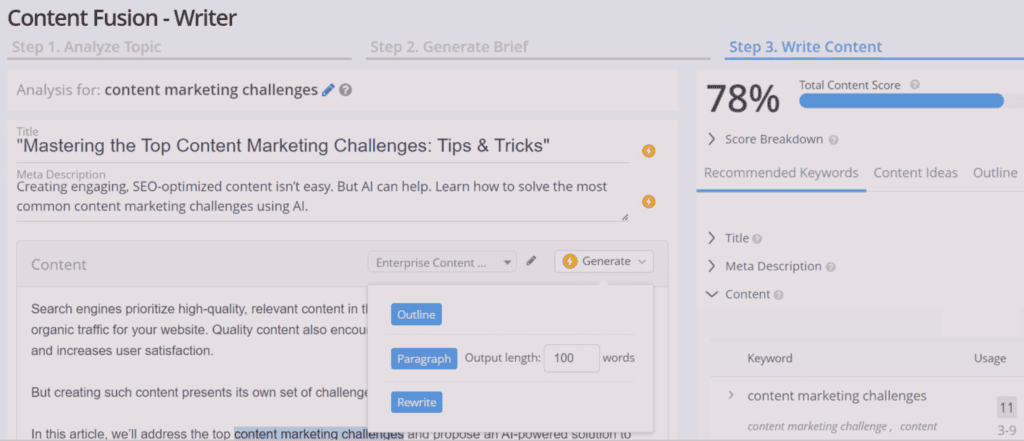
seoClarity Sia is an enterprise AI SEO assistant focused on large-scale content optimization, technical analysis, and workflow acceleration across massive website portfolios. Sia combines content brief generation, AI-assisted drafting, technical SEO analysis, and portfolio-wide optimization recommendations inside the seoClarity platform.
What Does Sia Do Well?
Sia performed strongly during enterprise-scale SEO analysis testing. The platform handled large content inventories, technical issue analysis, and portfolio-wide optimization workflows effectively across thousands of URLs simultaneously.
Enterprise SEO teams managing large e-commerce sites, publishers, and media platforms benefit most from Sia’s scale-oriented architecture. The system surfaces technical SEO issues, generates optimization recommendations, creates content briefs, and prioritizes opportunities across extensive domain environments.
Where Does Sia Fall Short?
seoClarity does not operate as a live deployment platform.
The system does not deploy on-page changes through pixel-based implementation and does not provide native AI Overview citation tracking across conversational search systems. Most recommendations still require internal development teams or separate deployment workflows for implementation.
Who Is Sia Best For?
seoClarity fits enterprise SEO organizations managing massive websites with internal development resources and dedicated SEO operations teams. The platform works best for large-scale analysis and optimization management rather than autonomous deployment or execution-first SEO automation.
AI SEO Agent Comparison Matrix (2026)
The matrix below scores each AI SEO agent across five workflow stages: SERP research depth, brief generation, drafting, on-page deployment, and AI visibility tracking. Most platforms handled research, optimization, or drafting well. Very few connected research, deployment, optimization, and AI visibility tracking inside one continuous workflow.
| AI SEO Agent | SERP Research | Briefs | Drafting | On-Page Deployment | AI Visibility Tracking |
|---|---|---|---|---|---|
| Search Atlas | Full SERP + entity analysis | Yes | Yes | OTTO pixel deployment | Full LLM Visibility™ |
| Frase | SERP analysis | Yes | Yes | No | Limited |
| Surfer SEO | Top 30 SERP analysis | Yes | Yes | No | No |
| MarketMuse | Domain-level authority analysis | Yes | Limited | No | No |
| Clearscope | SERP term analysis | Limited | No | No | Limited |
| NeuronWriter | SERP-based research | Yes | Yes | WordPress publishing | No |
| Outranking | SERP-based research | Yes | Yes | No | No |
| Alli AI | Limited | No | No | Code snippet deployment | No |
| SEO.ai | SERP-based research | Yes | Yes | No | Limited |
| Jasper | Via Surfer integration | Yes | Yes | No | No |
| Semrush | Extensive SEO database | Yes | Yes | Limited integrations | Limited |
| seoClarity | Enterprise-scale analysis | Yes | Yes | No | Limited |
The key takeaway from the matrix is that most AI SEO platforms still stop at research, optimization, or content generation.
Search Atlas was the only platform tested that covers all five workflow stages. It connected full SERP research, drafting, autonomous deployment, and native AI visibility tracking inside one continuous execution workflow.
How to choose the right AI SEO agent?
The right AI SEO agent depends on workflow coverage, deployment capability, and AI visibility tracking. The strongest platforms reduce stack complexity by connecting research, optimization, deployment, and reporting inside one execution system.
Here are the main factors to evaluate before choosing an AI SEO agent in 2026:
- Prioritize workflow coverage first. Workflow coverage determines how many separate tools the team still needs after adoption.
- Evaluate deployment capability second. Deployment speed determines how quickly optimizations move from recommendation to live production environments.
- Prioritize AI visibility tracking third. AI visibility tracking determines whether the platform measures citations, brand mentions, and entity visibility across conversational search systems.
- Check which workflow stages the platform covers. Some systems stop at drafting, while others handle research, deployment, optimization, and reporting together.
- Analyze which AI search ecosystems the platform tracks. Platforms tracking OpenAI, Google, and Perplexity AI provide broader AI visibility coverage.
- Match the platform to the operational model. Agencies usually prioritize multi-client deployment, scalability, and reporting workflows. Internal marketing teams usually prioritize CMS integrations, brand governance, and workflow consolidation.
- Choose execution-first systems for full-stack SEO operations. Platforms like Search Atlas reduce handoffs between SEO, content, engineering, and reporting by connecting every workflow stage inside one operational environment.
Why Search Atlas is Ranked as the Best AI SEO Agent in 2026
Search Atlas ranked as the best AI SEO agent in 2026 because it was the only platform tested that connected research, content generation, deployment, optimization, and AI visibility tracking inside one continuous execution workflow.
Most platforms stopped at recommendations or draft generation. Search Atlas continued through deployment, monitoring, and continuous optimization across both traditional search and AI-generated search environments.
That execution-first architecture created the deepest AI SEO workflow in this comparison.
Experience full marketing execution inside one platform. Start a free trial today!
FAQ: AI SEO agents
What is the best AI agent for SEO in 2026?
Search Atlas Agent ranks as the best AI agent for SEO in 2026 because the platform covers research, briefs, drafts, on-page deployment via the OTTO pixel, and AI visibility tracking inside one system. Other agents cover fewer workflow stages and require pairing with two or three other tools.
Are AI SEO Agents Replacing SEO Professionals?
AI SEO agents are not replacing SEO professionals because the systems automate execution while teams still control strategy, prioritization, oversight, and decision-making.
What Is the Difference Between an AI Writing Tool and an AI SEO Agent?
The difference between an AI writing tool and an AI SEO agent lies in workflow coverage because writing tools stop after content generation, while AI SEO agents continue through research, deployment, optimization, monitoring, and visibility tracking.
How Do AI SEO Agents Track AI Overview Citations?
AI SEO agents track AI visibility by running scheduled prompts across conversational search systems and recording brand mentions, citations, sentiment, and entity associations inside AI-generated answers.
Is Frase a Full AI SEO Agent?
Frase is not a full AI SEO agent because the workflow stops after research and drafting without handling deployment, technical SEO execution, or AI visibility tracking.
Which AI SEO Agent Fits Agencies Managing Large Client Portfolios?
Search Atlas fits agencies managing large client portfolios because OTTO SEO removes CMS bottlenecks through pixel deployment while Atlas Agent automates research, drafting, optimization, and reporting workflows at scale.
Where Does AI SEO Agent Capability Go Next?
AI SEO agents are moving toward autonomous portfolio management where systems continuously prioritize opportunities, deploy optimizations, monitor AI visibility, and adjust execution across entire websites without manual coordination between steps.