Entity authority defines an identifiable entity’s credibility, recognition, and operational legitimacy in search systems and AI engines. AI systems prioritize entity authority through clarity, consistency, and trust reinforcement across information environments. Entity authority works as the foundation of Answer Engine Optimization (AEO), increasing selection probability for AI-driven search results. Content connected to 15 or more entities shows a 4.8 times higher AI Overview selection probability. Brands with strong Knowledge Graph presence achieve 35% higher AI visibility.
Entity SEO uses structured data, brand consistency, topical authority, and external corroboration to build machine-readable signals. JSON-LD schema implementation improves AI citation probability by over 50%. AI models often skip high Domain Authority sites due to low factual density and weak entity signals. Ahrefs (DA 92) gets cited by AI platforms only 5% of the time, while a low-DA site achieved a 15% citation rate on day one.
Building entity authority takes 6 to 18 months for initial results and 2 or more years for recognized authority. The article explains entity authority definitions, the signals that build entity authority, the differences between entity authority, domain authority, and topical authority, the seven steps to build entity authority, and the tools that measure entity authority and visibility.
What Is Entity Authority?
Entity authority is the credibility, recognition, and operational legitimacy of a uniquely identifiable entity in search systems and AI engines. Entity authority relies on stable signals that reduce uncertainty about an entity’s identity and boundaries. Search engines and AI systems assign entity authority based on consistent factual profiles across the web. Entity authority belongs to the broader class of information governance frameworks for digital identity.
What are the three forms of entity authority? Entity authority differs from popularity through three pillars. The pillars are clarity, consistency, and trust reinforcement. Entity authority defines how AI systems assign confidence to a brand based on connected information environments. Entity authority increases the selection probability of an entity in AI-driven search results. The three forms of entity authority are AI system entity authority, brand entity authority, and topical entity authority. Firstly, the AI system entity authority focuses on selection confidence based on clarity and consistency. Secondly, brand entity authority covers digital identity reinforcement across platforms. Thirdly, topical entity authority ties an entity to specific subject areas through repeated associations.
What are the three main attributes of entity authority? The three main attributes of entity authority are clarity and consistency, structured data presence, and external corroboration. Clarity and consistency build entity authority through stable terminology across pages and sections. Structured data presence makes entity attributes machine-readable for AI systems. External corroboration validates entity claims through mentions on Wikipedia, Wikidata, Crunchbase, and Trustpilot.
How does entity authority interact with search and AI ecosystems? Entity authority depends on coherent internal linking that reinforces entity boundaries and claims supported by evidence, constraints, and structured references. Entity authority enables Answer Engine Optimization (AEO) by providing the underlying recognition and trust structure that increases selection probability. Lack of entity authority creates entity ambiguity and redundancy saturation, undermining the trust essential for AI citations.
The June 2025 Google Core Update solidified the importance of explicit brand citations in AI Overviews, indicating mentions represent a top position even without a direct link. Entity authority works as a fundamental requirement for legitimate search visibility and reliable AI information processing. Entity authority impacts how information gets retrieved and presented to users through AI Overviews, ChatGPT, Perplexity, and Google Gemini.
What Defines an Entity in Search?
An entity in search is a single, unique, well-defined, and distinguishable thing or idea that search engines recognize and understand. Entities are tangible objects (people, organizations, products) or abstract concepts (theories, creative works, ideas). An entity in search has 5 defining properties (name, type, attributes, relationships, and a unique ID). Google refers to entities as “topics” within its information architecture.
What are the components of an entity in search? An entity has names that represent referencing variations, types that classify it (location, person, business, concept), attributes that describe properties, relationships that connect it to other entities, and a unique ID (Google’s MREID=/m/23456 or KGMID=/g/121y50m4). An entity in search exists in catalogs (Wikipedia, Wikidata, DBpedia, Freebase, Yago), which strongly indicate validity. Entities are language-agnostic, recognized regardless of language labels (e.g., “Eiffel Tower” versus “Torre Eiffel”).
How do entities differ from keywords and topics? Entities represent universally understood concepts, while keywords are specific words searchers use in queries. Entities resolve ambiguity (e.g., “Java” as a programming language or an island) that keywords cannot. Topics are broader subject areas containing multiple related entities and keywords. For example, “digital marketing” as a topic contains entities (Google, Facebook, SEO). For the underlying mechanics of how search systems process these relationships, see entity-based search fundamentals.
What is the historical context of entity search? Metaweb started Freebase in 2005 as a shared database of world knowledge. Google purchased Metaweb (Freebase) on July 16, 2010, after $50 million in capital funding. Entity SEO was born in May 2012 when Google’s machine learning began understanding meaning beyond keywords. Google closed Freebase in 2016 and migrated its data into the Knowledge Graph. Google’s Knowledge Graph grew from 570 million entities and 18 billion facts to 8 billion entities and 800 billion facts in less than 10 years.
Freebase assigned each entity a unique ID and connected articles through relationships. Google synced much of its entity data with Wikidata after closing Freebase. Google partnered with Bing and Yahoo to create Schema.org, providing tools for website managers to help Google understand content. Schema.org focuses on things, not strings, marking the shift from keyword matching to entity understanding. The Knowledge Graph supports entity disambiguation (e.g., distinguishing apple as a brand vs a fruit) and factual validation. Google does not assign an explicit entity score. Entity prominence comes from structural placement (titles, headings), contextual consistency, and relationships between entities. Entities possess contextual meaning beyond mere words, which search engines use for relevant results.
How Does Entity Authority Work?
Entity authority works by establishing an AI system’s confidence in understanding an entity and trusting it as a source for answers. Entity authority operates through a 5-step process (entity identification, cross-channel corroboration, credibility assessment, Knowledge Graph integration, and content selection). Strong entity authority drives content with 4.8 times higher AI Overview selection probability when connected to 15 or more entities.
How do AI systems identify a distinct entity? Firstly, AI systems identify a distinct entity (brand, person, organization) and collect core attributes by scanning websites, social media, and third-party mentions. The system looks for clear entity references and structured data that explicitly defines the entity. Secondly, AI engines evaluate attributes through cross-channel corroboration, comparing information across social media, Reddit, unlinked mentions, and official websites. Thirdly, AI systems assess credibility by analyzing citations from authoritative publications. Sites with profile presence on Trustpilot, G2, Capterra, Sitejabber, and Yelp have 3 times higher chances of being chosen by ChatGPT as a source. Fourthly, AI agents query Wikipedia and the Knowledge Graph in real-time. If a Wikipedia entity page exists, the agent pulls definitions, founders, methodologies, and citations. Fifthly, AI engines select fragments from trusted sources and stitch them into a coherent response.
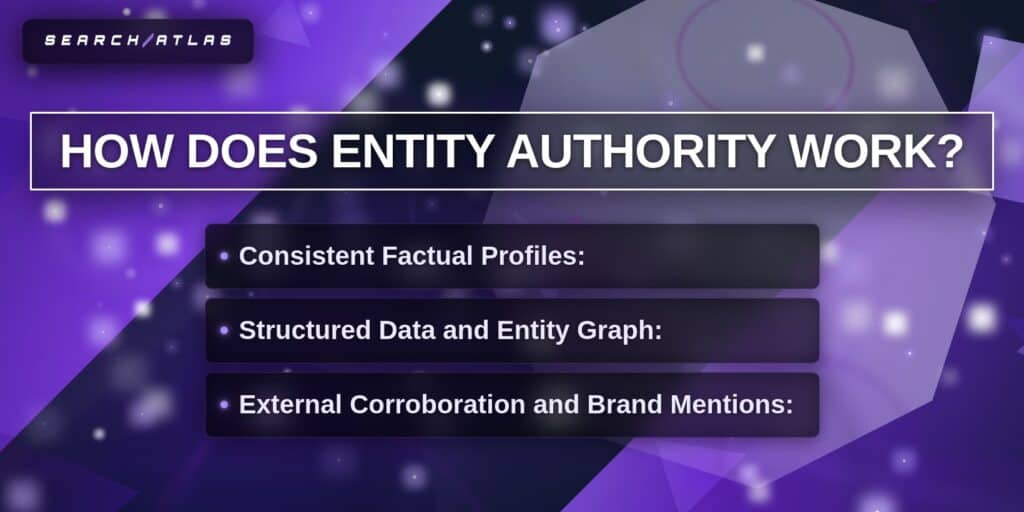
What are the key mechanisms behind entity authority? The three key mechanisms are consistent factual profiles, structured data with @id graphs, and external corroboration. Consistent factual profiles reinforce entity identity through repetition of names, descriptions, and details. Structured data with @id creates an entity graph by reusing identifiers across pages, organizations, authors, and products. External corroboration from Quora and Reddit gives domains roughly 4 times higher citation chances versus minimal-activity domains.
What edge cases weaken entity authority? The three edge cases are entity ambiguity, redundancy saturation, and technical issues. Entity ambiguity occurs when scope shifts across sources, eroding AI trust. Redundancy saturation happens when multiple pages repeat the same definition without adding value. Technical issues include inconsistent canonicals, weak internal linking, orphaned author pages, and JavaScript-dependent content.
How Google Identifies Entities?
Google identifies entities through the Knowledge Graph, machine learning classifiers, and Named Entity Recognition. Google’s Knowledge Graph contains 8 billion entities and 800 billion facts as of mid-2024. Google extracts entity information from websites, structured data (Schema.org), unstructured content, and curated databases (Wikipedia, Wikidata).
How does Google’s Knowledge Graph support entity identification? The Knowledge Graph functions as a graph-structured database, where each entity has a unique ID and attributes. Google’s Knowledge Vault combines extractions from web content with information from existing knowledge bases. The Knowledge Vault uses supervised machine learning for fusing distinct information sources. Knowledge Vault features a probabilistic inference system for fact correctness.
What are the four steps in Google’s entity detection process? The four steps in Google’s entity detection process are preprocessing, feature extraction, model application, and inference. Firstly, preprocessing handles tokenization, stopword removal, stemming, lemmatization, and part-of-speech tagging. Secondly, feature extraction uses BERT embeddings, semantic analysis, pattern recognition, and context analysis. Thirdly, model application runs transformer models, neural networks, confidence scoring, and classification. Fourthly, inference performs Named Entity Recognition (NER), relationship analysis, confidence evaluation, and database matching to Knowledge Graph entries.
How does Google identify and disambiguate entities? Google identifies entities by mapping terms in a page or query to known real-world things in the Knowledge Graph. Google resolves ambiguous names based on context. Google does not assign an explicit “entity score.” Entity prominence comes from structural placement (titles, headings), contextual consistency, and relationships between entities. Entity salience analysis answers, “What is this page primarily about?” For entities not in the Knowledge Graph, Google uses NLP for identification and thematic classification.
How do business names and primary categories influence entity identification? Google evaluates business name and primary category as a single location element, parsed in parallel through the same semantic model to create the “entity boundary.” Keyword-rich names rank 15-35% higher for those keyword terms compared to keyword-free names (Whitespark 2025 GBP analysis). The primary category outweighs reviews, links, and citations combined for Local Pack rankings (2026 Local Search Ranking Factors survey). Highly specific name tokens cause “niche lockdown,” limiting eligibility for broader searches by an average of 73% (Local Falcon 2025).
What is the role of structured data in entity identification? Structured data (JSON-LD schema) makes it easier for Google to verify the intended entity and its attributes. Vidio saw a 3x increase in video impressions and a 2x increase in video clicks after implementing VideoObject markup. Monster India’s JobPosting markup led to a 94% increase in organic job-page traffic. Bing Product Manager Krishna Madhavan stated in October 2025 that schema labels content as a product, review, FAQ, or event, turning plain text into structured data that machines interpret with confidence.
What Signals Build Entity Authority?
5 signals build entity authority for SEO and AI visibility. The 5 signals build entity authority across digital ecosystems through repeated reinforcement. AI systems and search engines weigh these signals to determine content credibility and citation priority. The 5 entity authority signals are listed below.
- Consistent Brand Mentions Across the Web.
- Structured Data and Schema Markup.
- External Validation From Trusted Sources.
- Topical Authority and Content Depth.
- Entity Relationships and Context.
1. Consistent Brand Mentions Across the Web
Consistent brand mentions are the synchronized appearance of a brand’s name, messaging, and identity across digital channels. Consistent brand mentions establish a stable entity within an AI system’s internal knowledge graph. Consistent brand mentions improve AI visibility by up to 10 times for brands with high mention counts.
The 5 forms of brand mentions are direct mentions (exact brand name), indirect mentions (slogans or products), linked mentions (with hyperlinks), unlinked mentions (without links), and tonal mentions (sentiment-based). Over 70% of consumers trust brand mentions more than traditional advertising, according to Search Engine Land. Consistent brand mentions yield dense semantic entity clusters around product entities, problem-solution relationships, and trust signals. A narrative forms inside an LLM after only 250 consistent documents about a brand. Inconsistent branding causes signal dilution, reducing visibility and ranking prominence by 30%. Consistent brand mentions build entity authority through 90% of successful brands employing content governance for centralized identity management.
What is the historical context and market scale of brand mentions? In 2016, Duane Forrester of Bing highlighted brand mentions without links as crucial authority signals. Gary Illyes of Google in 2017 noted that high-quality content cited via mentions indicates a company is doing the right things. The June 2025 Google Core Update solidified the importance of explicit brand citations in AI Overviews. Direct mentions get found in 85% of brand tracking reports. Indirect mentions appear in 60% of organic social media conversations. Linked mentions work as a primary goal for 75% of digital PR campaigns. Unlinked mentions contribute to 60% of off-page SEO signals. Brand mentions get sourced from news articles (earned media), social media posts (shared media), blogs, forums, podcasts, videos, and customer reviews (user-generated content). The global market for brand reputation management, heavily influenced by consistent mentions, is projected to reach $10.5 billion by 2028, growing at a CAGR of 12.8%.
2. Structured Data and Schema Markup
Structured data is a standardized format that provides explicit clues about a page’s meaning to search engines. Schema markup is the code added to a website that implements structured data using Schema.org vocabulary. Schema.org was developed in 2011 by Google, Bing, and Yahoo to provide a universal format for structured data.
The three implementation types of structured data are JSON-LD (JavaScript Object Notation for Linked Data), Microdata, and RDFa. JSON-LD became Google’s preferred markup script on February 3, 2020. Structured data enables rich results, increasing user interaction with search listings. Rotten Tomatoes reported a 25% higher click-through rate (CTR) for 100,000 pages with structured data. The Food Network saw a 35% increase in visits after converting 80% of pages to enable search features. Nestlé observed an 82% higher CTR for pages showing as rich results. Structured data does not work as a direct ranking factor for Google. Structured data improves AI citation probability by over 50% for content using structured entities. Over 45 million web domains, approximately 12.4% of all registered domains, have implemented Schema.org structured data as of 2025.
What are the dependencies, validation tools, and common types for structured data? Rakuten reported users spending 1.5x more time on pages with structured data and a 3.6x higher interaction rate on AMP pages with search features. Structured data depends on standardized vocabularies (Schema.org), which provides hundreds of Types and Properties. Implementation requires adherence to general structured data guidelines and type-specific guidelines for rich result eligibility. Validation tools include the Rich Results Test for development validation, the URL Inspection tool to confirm Google has found structured data, and Rich result status reports for monitoring after deployment. Businesses commonly use schema markup for Organization/LocalBusiness, Article/BlogPosting, Product, Review/AggregateRating, FAQPage, BreadcrumbList, and Event types. Implementation does not guarantee rich result display, but Google states that using structured data enables a feature to be present, with search engines deciding based on authority, trustworthiness, and location.
3. External Validation From Trusted Sources
External validation from trusted sources is the confirmation a brand receives from authoritative publications, industry recognition, and third-party platforms. External validation accelerates entity authority growth through credible third-party signals. The four types of external validation are media citations, industry directory listings, peer-reviewed research mentions, and user reviews on platforms (G2, Trustpilot, Capterra). Sites with profile presence on Trustpilot, G2, Capterra, Sitejabber, and Yelp have 3 times higher chances of being chosen by ChatGPT as a source. Domains with millions of brand mentions on Quora and Reddit have 4 times higher citation chances versus minimal-activity domains. External validation builds authoritativeness through co-mentions alongside reputable entities, causing AI models to cluster the brand close to them in knowledge graphs. One backlink from a credible news outlet with positive framing outperforms dozens of generic, unrelated backlinks. News sites provide premium authority signals through editorial fact-checking processes. Building external validation takes 6-12 months for citations and inbound links to compound, and 2 or more years to achieve recognized authority.
What are the acceleration tactics for earning external validation? External validation acceleration tactics involve being quotable with unique, data-backed points of view. Being available for media opportunities (HARO, Qwoted, Help a B2B Writer) earns expert citations. Participating in the podcast circuit associates the entity name with topics across audio formats. Writing for industry publications builds credibility through editorial review. Contributing data to industry surveys and reports positions the brand as a primary source. Sharing genuine expertise in relevant subreddits builds community recognition.
Targeting recognized, topic-relevant websites (industry publishers, niche blogs, universities, major SaaS tools) for quality backlinks works more effectively than chasing volume. In-body editorial backlinks are the most powerful for conveying authority. Ahrefs research indicates brand mentions have strong correlations with visibility in Google’s AI Overviews (AIOs). External validation uses both linked and unlinked mentions, with Google’s NLP crediting the site for brand mentions even without clickable hyperlinks.
4. Topical Authority and Content Depth
Topical authority is a website’s ability to be a reliable source of information in a specific field through deep expertise and credibility. Content depth involves creating content strategically structured to demonstrate comprehensive expertise across an entire topic. Topical authority shifted with Google’s Hummingbird update in 2013, moving from keyword matching to semantic search. Subsequent updates (RankBrain, BERT, Helpful Content System) emphasize subject coverage. Google announced its Topic Authority System for news content in mid-2023.
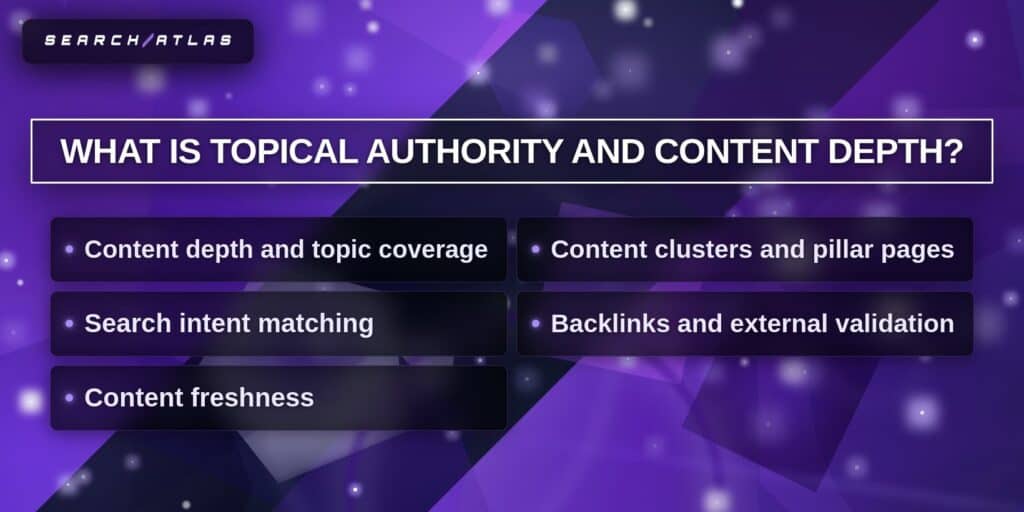
The 5 components of topical authority are content depth and topic coverage, content clusters with pillar pages, search intent matching, backlinks and external validation, and content freshness. Entity-focused sites typically choose 3 to 7 core topics, build pillar pages for each, and surround pillars with structured supporting articles. AirOps research found that over 53% of content cited in ChatGPT had been updated within the last six months. McKinsey 2025 research shows brands with concentrated topical depth receive 3 to 5 times higher AI citation rates. Topical authority allows focused websites to outrank larger competitors for specific, high-intent queries.
How does topical authority differ from domain authority and align with E-E-A-T? The Topic Authority System considers three factors (relevance to topic and location, history of original reporting, and publication reputation). Topical authority differs from domain authority by its specific focus on expertise within a single niche. Domain authority measures an entire website’s overall strength. Topical authority demonstrates subject-level trust for a specific industry. Authoritative websites satisfy user queries more effectively, leading to higher rankings. Clean, interconnected content clusters get quoted, used as source material, or recommended by AI.
Topical authority directly aligns with Google’s E-E-A-T signals through deep knowledge demonstration. The zero-click era shifts focus from producing more content to creating strategically structured content. Google’s Helpful Content System favors sites demonstrating genuine subject-matter expertise. Topical authority depends on consistent effort, quality content creation, and active participation in relevant communities. Building topical authority typically requires several months of sustained work.
5. Entity Relationships and Context
What are entity relationships and context? Entity relationships are the connections between an entity and other entities, attributes, and concepts that define its meaning in search. Entity relationships build context through co-occurrence patterns, semantic links, and structured data references. The three types of entity relationships are hierarchical relationships (parent-child entities), associative relationships (related concepts), and causal relationships (cause-effect connections). Entity relationships strengthen entity authority through structured data using @id properties to create stable identifiers across pages.
Entity relationships connect organizations, authors, services, and products into a coherent entity graph. Co-mentions alongside other reputable entities cause AI models to cluster the brand close to them in knowledge graphs. Entity relationships enable AI systems to understand context beyond isolated keywords. Entity-Based Keyword Research correlates keyword data with semantic tools (Google’s NLP API, InLinks) to identify related people, places, and concepts. Entity relationships demonstrate breadth of expertise through linked content covering subjects from multiple angles.
How are entity relationships mapped and reinforced through the schema? Strong topical pages have one page that defines the topic, and others explain sub-concepts, comparisons, use cases, problems, and outcomes. For example, a central page on “lavender oil” links to “how to make a lavender sleep spray,” “can I use lavender oil as a sleep aid,” and “best lavender essential oil for stress relief.” Entity relationships get mapped through visual entity relationship diagrams. Strength training works as a central entity, with weights, hypertrophy, protein intake, and muscle recovery as related entities. Entity relationships use synonyms and related concepts naturally within content. For “lavender oil,” related concepts include aromatherapy, natural remedies, and natural stress relief. Entity relationships strengthen through the Article schema’s mainEntity and relatedLink properties. Entity relationships use the Organization schema’s knowsAbout property to demonstrate expertise. Entity relationships through hasOfferCatalog show the breadth of services or products.
Why Does Brand Consistency Matter for Entity Recognition?
Brand consistency matters for entity recognition because it builds trust, creates instant recognition, differentiates competitive markets, boosts revenue, and reduces customer effort. The average person needs to see a brand eight times across different settings before considering a purchase. Brand consistency boosts revenue by up to 23%, with companies maintaining long-term consistency seeing profit gains twice as high as inconsistent brands.
Brands with a memorable color palette are 80% more recognizable when colors are used consistently. A rebrand focusing on systematic visual consistency resulted in a 39.7% increase in search visibility and a 13.5% jump in conversion rates for one company. Increasing brand loyalty by just 5% boosts profits by up to 95%, and 33% of businesses boost revenue by 20% or more through consistency.
How does brand consistency build trust and loyalty? Brand consistency builds trust and loyalty through repeated exposure to branding elements that reinforce identity in consumers’ minds. Familiarity built through consistency contributes to brand equity. Brand equity is the added value a brand carries due to recognition and trust, turning awareness into trust, and trust into loyalty.
Why is instant recognition crucial for entity recognition? Instant recognition starts with visual cues (a logo, chosen colors, or specific typography), e.g., Nike’s swoosh. The brain processes images instantly, recognizing consistent patterns intuitively. Consistent branding creates a mental shortcut, allowing customers to identify and recall a brand quickly without conscious effort.
How does brand consistency reduce customer effort? Brand consistency reduces customer effort through the Mere Exposure Effect, where repeated exposure leads to increased preference. Brand consistency reinforces a brand’s message and values, making it easier for customers to understand the brand’s stance. Brand consistency creates a stable entity within AI systems’ knowledge graphs, preventing entity fragmentation. Brand consistency ensures AI models cite the entity accurately rather than skipping it due to ambiguity.
Entity Authority vs. Domain Authority vs. Topical Authority
Entity Authority, Domain Authority (DA), and Topical Authority (TA) differ in scope, measurement, and strategic application. Entity Authority assesses the credibility of a specific brand identity in search and AI systems. Domain Authority is a third-party predictive score (1 to 100) estimating a site’s overall ranking potential, coined by Moz. Topical Authority demonstrates in-depth knowledge and comprehensive expertise on a specific subject area or niche.
Entity Authority focuses on recognized concepts and their relationships within content, enhanced through structured data and external corroboration. Entity Authority gets measured through the co-occurrence of relevant entities and related terms within semantic clusters. Building Entity Authority requires aligning content with Google’s Knowledge Graph, schema markup, and contextual references.
Domain Authority works as a site-wide score reflecting the entire website. DA gets calculated from backlink quantity, quality, and technical SEO. Building DA takes 12 to 24 months for established sites to move from DA 40 to 50. Topical Authority focuses on topic-specific expertise within particular niches. TA gets evaluated by search engines through natural language processing and Knowledge Graph analysis. Building TA shows results in 3 to 6 months for initial signals, with meaningful ranking improvements within 4 to 8 months.
When should businesses choose Entity Authority? Businesses choose Entity Authority when targeting AI-driven search results, building comprehensive topic clusters, and seeking long-term recognition across platforms. When do businesses need to choose Domain Authority? Businesses choose Domain Authority when competing in broad, high-volume markets, establishing foundational trust for new domains, and using high-equity linkable assets.
When do businesses need to choose Topical Authority? Businesses choose Topical Authority when entering defined niche markets with limited resources, when competitors have higher DA but shallow content, and when E-E-A-T signals are critical for YMYL categories. The estimated cost to increase DA by one point ranges from $500 to $2,000 in competitive industries. Building a new topic cluster (pillar + 5 to 10 supporting articles) requires $1,000 to $3,000 in content investment. Sites focusing on TA first see ranking gains up to 3x faster than those chasing DA alone.
How do Entity Authority, Domain Authority, and Topical Authority compare in durability? Entity Authority is durable, compounding over time as Topical Authority develops through structured data and external corroboration. Domain Authority is fragile and drops with link profile decay. Topical Authority is durable and compounds over time through consistent depth and clarity within a niche. A startup in sustainable home building (DA 12) ranked on page one for high-value keywords within 14 months by publishing 150+ deeply researched articles.
A small site beat a DA 90+ publication for specific long-tail finance keywords by creating 60+ interlinked articles and earning 15 expert citations, improving rankings by 220% in 9 months. Domain Authority is logarithmic, meaning moving from DA 70 to 80 is exponentially harder and more costly than moving from DA 20 to 30. Netlify grew from DA 25 to 71 (a 46-point increase) in 1 year with 304 referring domains. Approximately 23,000 to 25,000 referring domains correlate with mid-to-high 80s DA scores.
Why High Domain Authority Sites Get Ignored by AI?
High Domain Authority sites get ignored by AI due to low factual density, lack of declarative phrasing, and technical accessibility issues. AI models treat content with buried facts in conversational language as “noise.” Content lacking declarative, sticky phrasing makes clear, standalone claims harder for transformer models to parse and cite with confidence. Server configurations or bot filtering (Reddit blocking AI crawlers via robots.txt and X (Twitter) serving content through JavaScript) block AI bots entirely. AI’s parser extracts a fact but drops the citation if unique data is not explicitly wrapped in a strict, nested Semantic Entity Graph (advanced JSON-LD schema).
Websites designed for keyword crawlers, not language model comprehension, create architectural mismatches with AI models. BrightEdge, in late 2025, found that fewer than 20% of Fortune 500 companies had content architectures optimized for AI retrieval. SEMrush 2025 found that pages with complete entity markup and structured schema get cited in AI Overviews approximately four times higher than pages without markup. Domain Authority shows zero correlation with AI citation rates in standalone LLMs. Ahrefs (DA 92) gets cited by AI platforms only 5% of the time. Citability.dev, launched with DA under 10, achieved a 15% citation rate on day one. Standalone LLMs (ChatGPT, Perplexity) show only a 12% overlap with Google’s top 10 results for cited URLs. Google AI Overviews show a 76% overlap, suggesting traditional SEO and high DA assist Google’s specific AI product. Semrush research indicates 95% of ChatGPT citations come from recently updated content. Content with Flesch-Kincaid reading complexity between 10 and 14 shows measurably higher AI citation rates (Content Science Review 2025).
How do Retrieval Augmented Generation (RAG) mechanics influence source selection? RAG mechanics filter sources through a complex hierarchy of signals beyond domain authority. The four signals RAG mechanics evaluate are topical depth, content structure, semantic precision, and verifiable factual claims. Weak entity disambiguation or poorly structured content hierarchies lead to systematic deprioritization of content. Content architecture affects LLM legibility because most enterprise web content is built for visual resonance, not semantic legibility.
LLMs parse and extract meaning from semantic density, sentence precision, logical claim structure, and explicit relationships between assertions and evidence. JavaScript rendering dependencies hinder LLM crawlers because many enterprise websites, especially single-page applications without server-side rendering, are opaque to LLM crawlers. AI crawlers cannot execute JavaScript, preventing them from accessing and processing content served through JavaScript. Medium’s citation fragmentation affects AI attribution by routing content through a platform domain rather than author domains. Medium’s fragmentation makes it harder for AI models to attribute facts to specific authors or brands.
How to Build Entity Authority Step by Step?
Building entity authority requires seven sequential steps over 6 to 18 months. The seven steps build entity authority through consistency, evidence, and systematic reinforcement across digital ecosystems. The seven steps to build entity authority are listed below.
- Step 1: Define Core Entity & Niche.
- Step 2: Ensure NAP Consistency.
- Step 3: Implement Structured Data (Schema).
- Step 4: Create Topical Content Clusters.
- Step 5: Build External Credibility.
- Step 6: Maintain Multi-Platform Presence.
- Step 7: Monitor and Refine Entity Signals.
Step 1: Define Core Entity & Niche
Defining core entity and niche requires identifying primary entities, leadership input, and specificity in audience targeting. Defining core entity and niche reduces ambiguity in AI systems through consistent factual profiles. The core entity in digital identity defines the brand’s purpose, audience, and unique value proposition. Defining the core entity starts with leadership input on company direction, target ICP segments, and competitive differentiation. Defining a core entity requires specificity, choosing 3 to 7 core topics rather than chasing every keyword. Shopify exemplifies niche mastery through e-commerce platform specialization. HubSpot exemplifies niche mastery through inbound marketing methodology ownership.
How does defining core entities differ from traditional keyword SEO? Defining core entity differs from traditional Keyword SEO by focusing on entity relationships, not isolated search terms. Defining core entity uses Entity SEO to establish a brand’s online search relevance through Knowledge Graph integration. Defining a core entity requires content depth, semantic coverage, and entity-focused content strategies. Defining core entity uses entity salience, co-occurrence, and the vector space model to position content for AI extraction. Specialists outrank generalists in search algorithms through concentrated topical depth. Defining a core entity requires pruning irrelevant content that dilutes topical focus. The practical insight, businesses define core entity by documenting a single source of truth, mapping topic clusters to ICP buying stages, and executing content with velocity rather than drip-feeding.
What are the four pillars of entity authority? The four pillars of entity authority are Clarity, Depth, Proof, and Corroboration. Clarity requires making it obvious who the entity is, what the entity does, and why the entity matters. Depth involves choosing a few topics to own and going deep, rather than chasing every keyword. Proof demonstrates experience with tangible evidence instead of rewording existing content. Corroboration earns validation from credible individuals or reputable publications.
How does the 60-minute niche authority roadmap look? The 60-minute niche authority roadmap involves three steps. Step 1 (15 minutes) gathers stakeholder input on company direction, ICP segments, and differentiation. Step 2 (20 minutes) identifies priority clusters by aligning topics with company strategy and revenue potential. Step 3 (25 minutes) turns priority clusters into a 90-day micro-topic roadmap with twelve high-impact content assets. Entity-Based Keyword Research correlates keyword data with semantic tools (Google’s NLP API, InLinks) to find related people, places, and concepts. Relationships are mapped by creating visual entity relationship diagrams. For example, “Strength training” works as a central entity, with “weights,” “hypertrophy,” “protein intake,” and “muscle recovery” as related entities. People Also Ask (PAA) data is scraped 3 to 4 layers deep to understand user intent and form the skeleton of the topical map.
Step 2: Ensure NAP Consistency
Ensuring NAP consistency requires uniform Name, Address, and Phone number across all online platforms. NAP consistency works as a ranking factor for Google and Bing, reinforcing entity recognition. Businesses with consistent NAP data appear more legitimate and trustworthy to search engines. Citation consistency ranks as the second most important local search ranking factor (Darren Shaw study). According to BrightLocal, 73% of users lose trust in a brand if its business listing contains inaccurate data. Furthermore, 68% of consumers stop using a local business after finding incorrect information in online directories. Businesses with consistent NAP data across major directories experience a 23% improvement in local pack rankings within 90 days of cleanup.
How do local citations work? Local citations work as mentions of a business name and contact information across the internet. Citations build entity authority through Google My Business, Bing Places, Apple Maps Connect, social media, and local directories. Businesses establish a master NAP format by documenting the canonical version of business name, address, and phone number. The business name uses the exact legal name without abbreviations. The address follows a consistent format with consistent abbreviations. The phone number uses a standard format with consistent country codes. The practical insight, businesses ensure NAP consistency through a master format document, regular audits with citation tracking tools, and centralized responsibility for listing updates.
What challenges do multi-location businesses face? Multi-location businesses face challenges in maintaining NAP consistency due to the need for separate master NAP documents for each location. Each location requires its own consistent NAP across all relevant platforms (a local phone number). Centralized oversight is beneficial, but accuracy for each location’s specific information is crucial. Each location has its own Google Business Profile linked to a location-specific landing page. Regular updates, reviews, and location-focused content help maintain consistency and improve local SEO performance.
What are the steps for conducting a NAP audit? The steps for conducting a NAP audit involve identifying existing citations, documenting inconsistencies, and prioritizing corrections. Businesses search for listings on major directories, social platforms, and industry-specific directories. Citation tracking tools aid systematic identification. Inconsistencies get documented and prioritized. Effective local SEO requires maintaining a high degree of NAP consistency, though slight variations in common abbreviations are acceptable. Google normalizes local citation data for minor differences (e.g., “Ave” versus “Avenue”). Businesses strive for maximum consistency, as search engines do not always interpret variations correctly. NAP consistency requires regular updates whenever contact information changes. Monitoring services automatically track new citations and inconsistencies. Businesses maintain well-optimized profiles on Google My Business and Bing Places.
For a deeper look at applying these entity signals specifically to multi-location and map-pack visibility, see our guide to local entity authority.
Step 3, Implement Structured Data (Schema)
Implementing structured data requires JSON-LD schema markup for organizations, persons, articles, products, and FAQs. Implementing structured data reduces ambiguity and reinforces identity, authorship, topic relevance, and entity relationships for machines. Structured data clarifies organization and author identity for search engines and AI systems. Structured data defines the main entity of a page, reducing ambiguity. Structured data connects related entities across a site, building a cohesive content graph.
The eight key structured data strategies are listed below.
- Build a single, stable organization identity using the Organization or LocalBusiness schema.
- Use @id properties to create a real entity graph with stable identifiers.
- Treat author identity as part of entity authority through the Person schema.
- Match page types to actual purpose (Service, Product, Article, FAQPage, HowTo).
- Use FAQ markup for extraction with natural questions and 40-60-word direct answers.
- Define topical relationships through strategic internal linking.
- Align structured data with visible evidence on the page.
- Add governance to maintain schema accuracy through quarterly audits.
What does a minimum viable entity graph contain? A minimum viable entity graph contains an Organization entity on the homepage, Author entities for contributors, Service or Product entities on commercial pages, BlogPosting entities for editorial content, ProfilePage entities for authors, and FAQPage entities where applicable. Person and Organization Schema (JSON-LD code) explicitly defines the company and key experts (CEO, physical address, logo, awards, job titles). The SameAs property within schema code links the website to official social profiles and high-authority nodes (Wikipedia, Wikidata), creating a unified entity footprint. Brightview Senior Living recorded measurable gains in entity recognition and visibility (higher impressions, improved CTR for pages with entity linking). The practical insight, businesses implement structured data through JSON-LD on every key page, validate with Google’s Rich Results Test, and audit schema quarterly for accuracy.
How does Schema focus? Schema focuses by business model vary based on business type. Local business optimization starts with the LocalBusiness schema (NAPW, geo-coordinates, hours, core offerings). Review and AggregateRating schema work for AI, citing the best local businesses. Multi-location businesses benefit from individualized location pages with corresponding schema. E-commerce applications use the Organization schema to push identity and reputation signals. E-commerce applications use database-driven generation of the product schema for all core products. Review and AggregateRating schema work on a product level for superlative searches. Product FAQs with FAQPage schema work for complex, feature-rich, or niche products. B2B and professional services use the Organization schema as a foundation on the homepage. B2B services use geographic targeting with location-specific landing pages and LocalBusiness schema. B2B services build industry authority by optimizing service pages with Industries We Serve sections. B2B services establish credibility signals using Person schema for individuals, foundingDate in Organization schema, industry certifications in Service schema, and Article and CreativeWork schema.
Step 4: Create Topical Content Clusters
Creating topical content clusters requires building pillar pages, supporting cluster articles, and tight internal linking. Creating topical content clusters demonstrates total coverage of a subject through hub-and-spoke architecture. The pillar page works as the hub, while supporting posts function as spokes. Cluster pages cover specific subtopics from the pillar in comprehensive depth. Each cluster article links back to the pillar page and to 2 to 4 related cluster articles. The pillar page links to every cluster article using descriptive anchor text. An optimal starting point for most business websites is 3 to 5 core topic clusters. A minimum viable cluster has 1 pillar page and 5 to 8 cluster articles. A comprehensive cluster for a broad topic has 15 to 25 cluster articles plus supporting content. Every core topic page needs to have a direct, concise answer in the first 1 to 2 sentences for AI model extraction. Each cluster page ships one evidence asset (original data, screenshots, calculator) to earn legitimate links. Different content types (guides, comparisons, FAQs) cover every search intent linked to entities. Content for missing nodes in a topical graph ensures coverage completeness. Internal linking signals real topical authority to search engines. No orphan pages exist; every page needs at least 3 internal links. Authority favors velocity, meaning faster, comprehensive content deployment yields better results. The practical insight, businesses create topical content clusters by starting with 3 to 5 core topics, building 1 pillar page and 5 to 8 supporting articles per cluster, and publishing content rapidly rather than drip-feeding.
How does E-E-A-T 2.0 (Experience, Expertise, Authoritativeness, Trustworthiness) prioritize content? E-E-A-T 2.0 (Experience, Expertise, Authoritativeness, Trustworthiness) prioritizes content authored by recognized experts. Experience signals come from documented lessons, customer stories, case studies, screenshots of actual results, and specific examples from internal work. Effective content demonstrates experience by stating, “We tested this approach for 3 months. Here’s the actual data. Here’s what surprised us.” Expertise signals come from real author pages with relevant experience, background, credentials, and links to professional profiles. Author bios contain degrees, certifications, years in the industry, and links to LinkedIn or Twitter profiles. Specificity in author bios (e.g., “John has 8 years of experience in B2B SaaS marketing, specializing in content strategy and SEO”) works more effectively than generic descriptions.
Where do authoritativeness signals come from? Authoritativeness signals come from external recognition, citations by other websites, mentions in press/media, guest posts on respected publications, podcast appearances, and speaking at conferences. Trust signals come from transparency, accuracy, and freshness of information. Transparency requires clear contact information, real address, email, and phone number, along with an accessible privacy policy and terms pages. Freshness gets demonstrated through “Last updated” dates on content (e.g., “Last updated, January 2026”). The branded content cluster strategy starts with one core service. One pillar post serves as a comprehensive piece introducing and owning the topic. The pillar gets surrounded by 5-7 supporting content pieces (FAQs, how-tos, comparisons, myths, objections, case studies).
Step 5, Build External Credibility
Building external credibility requires citation-worthy content, strategic outreach, and third-party validation. Building external credibility ensures a brand’s reputation is not solely based on self-claims. Citable content solves a problem, answers a question, or saves time through small studies, how-to guides, or frameworks. Each content piece includes at least one piece of proof, small experiments, data sets, process checklists, frameworks, mini case studies, anonymized client data, calculators, or interviews with respected peers. Visual evidence (screenshots, data tables, charts, step-by-step examples) demonstrates work done. Strategic outreach involves pitching ideas to relevant industry publications, leading with value rather than links. Real-world engagement happens through events, panels, or podcasts, with shared slides and key takeaways online afterward.
What do third-party validation strategies include? Third-party validation strategies include securing mentions from reputable sources and using consumer reviews. According to BrightLocal’s 2025 Consumer Review Survey, 42% of consumers trust business reviews as much as personal recommendations. The quality of reviews matters more than quantity, as 53% of consumers feel more positively about a business when a review describes a positive experience. Furthermore, 46% of consumers’ trust in a business increases when the business owner responds to reviews. Original research and proprietary data attract natural backlinks by providing “new news” that journalists and high-DR sites want to cite. Digital PR and newsjacking gain high-quality backlinks from Forbes or TechCrunch through expert commentary on breaking news. Podcast and webinar tours associate the entity’s name with topics across audio, video, and text formats. The practical insight, businesses build external credibility by publishing citation-worthy original research, pitching value-led ideas to industry publications, and earning mentions in news outlets that LLMs index.
What are the focuses of rational authority strategies for 2026? Relational authority strategies for 2026 focus on strategic collaborations and data creation that position an entity alongside established industry players. Creating citation-worthy original data involves publishing proprietary data or insights that authoritative sources want to cite (market analysis, industry survey data, benchmark reports). Strategic HARO (Help A Reporter Out) and expert positioning target getting quoted in authoritative publications (Wall Street Journal, CNBC) in articles mentioning established industry players. Collaborative content with established entities involves partnering with authorities for co-authored research, expert roundups, podcast interviews, or conference presentations. Authority borrowing through expert contributors features established industry experts on the entity’s platform (guest posts, advisory board, customer logos, podcast guests).
How do linkable moats build authority? Linkable moats build authority through unique, high-quality content assets (specialized tools, deep case studies, unique data sets) difficult for competitors to replicate. Linkless mentions contribute to entity authority because Google uses Natural Language Processing (NLP) to credit the site for brand mentions on other websites, even without a clickable hyperlink. Community-led authority involves consistently helping others on Reddit, Quora, or specialized industry forums. Being a top contributor with highly upvoted answers signals expertise to search engines.
Step 6: Maintain Multi-Platform Presence
Maintaining a multi-platform presence requires consistent entity representation, content distribution, and engagement across digital channels. Maintaining a multi-platform presence reinforces entity recognition across LinkedIn, Crunchbase, G2, Wikipedia, and industry directories. Consistent entity representation extends entity authority through identical brand information on the website, Google Business Profile, and social media.
The 5 multi-platform strategies are listed below.
- Establish a presence in Wikidata and obtain a Google Knowledge Panel.
- Secure listings in authoritative directories (LinkedIn, Crunchbase, G2, Capterra).
- Publish in peer-reviewed journals for research-oriented entities.
- Maintain active social profiles aligned with entity messaging.
- Participate in industry associations and events as established players.
How does platform-specific content distribution build entity authority? Link sharing on platforms (Facebook, Twitter, LinkedIn, Instagram) distributes content to wider audiences. Over 83% of Instagram users discover new products on the platform. Over 67% of 290 billion brand engagements on social media last year occurred on Instagram. Content syndication on Medium and Substack exposes brands to different target audiences.
Tailoring CTAs matters. Twitter expects short copy, while LinkedIn and Facebook accept longer posts. Video creation matters because 54% of consumers desire more video content from brands. Publishing videos on YouTube with optimized titles, descriptions, keywords, and thumbnails expands reach. Authority grows in active online communities (LinkedIn, Reddit, industry forums) by contributing insights rather than self-promoting. The practical insight, businesses maintain a multi-platform presence through documented brand language, active social participation, video content distribution, and consistent entity language across all external profiles.
What are the multi-platform strategies that reinforce entity recognition? Multi-platform presence strategies extend entity authority through diverse content distribution. Earning mentions in news articles, blog posts, podcasts, and industry publications provides external entity references that validate existence and relevance. Encouraging and responding to customer reviews contributes to overall brand entity strength. Establishing a presence in Wikidata and obtaining a Google Knowledge Panel enhances entity visibility. Securing listings in authoritative directories (LinkedIn, Crunchbase, G2, Capterra) is important. For research-oriented entities, publishing in peer-reviewed journals and conferences builds academic authority.
Maintaining listings in authoritative industry directories and databases is ongoing work. Contributing to established platforms and publications in your industry reinforces expertise. Actively joining and participating in industry associations and events extends the entity’s authority. Cross-promotion integrates website and social media profiles by adding social media icons and links to the website and vice versa. Actively responding to comments, sharing valuable content, participating in discussions, and posting regular updates engages and shares. Showing vulnerability and evolution by sharing the development of thoughts or processes over time demonstrates growth.
Consistently delivering valuable content and ensuring product or service promotions remain relevant creates value and builds trust. Tailoring content for each platform adapts messages to suit the tone and style while maintaining a consistent underlying theme. Being relatable and engaging involves interacting with the audience, showing empathy, and being approachable through personal stories aligned with brand values.
Step 7: Monitor and Refine Entity Signals
Monitoring and refining entity signals requires tracking AI citations, Knowledge Graph presence, third-party mentions, and brand co-occurrence. Monitoring entity signals ensures accurate representation across knowledge graphs, social media, and search engine results.
The seven core monitoring components are listed below.
- Knowledge graph and Wikipedia presence verification.
- Google Business Profile and review monitoring.
- Social media and forum mention tracking.
- NAP and fact consistency audits.
- Authority and backlink analysis.
- Brand visibility and mention growth.
- AI Overview citation tracking.
What gets verified within each entity monitoring component? Knowledge graph monitoring verifies Google Knowledge Panel presence on desktop search results. Wikipedia page presence gets monitored, with creation considered if absent but notable. Wikidata entries for the company and key personnel stay up-to-date. Google Business Profile (GBP) monitoring ensures information remains accurate and current. Google reviews, Yelp, and Trustpilot are continuously monitored to gauge public sentiment. Social media monitoring searches Reddit and Twitter/X for brand mentions.
NAP consistency audits compile key facts (founding year, CEO, customer count) and verify across the About page, Wikipedia, Crunchbase, and news articles. Backlink audits gauge domain authority and inclusion in industry “top 10” lists. AI Citation Tracking monitors appearances in Google AI Overviews through Semrush AI Visibility and BrightEdge AI Search Analytics. Querying ChatGPT and Claude for citation rates extends monitoring to specialized AI search platforms (Perplexity). Structured data audits happen quarterly to prevent broken references or content-schema mismatches. The practical insight, businesses monitor entity signals through monthly Brand SERP review, quarterly schema audits, and continuous tracking of AI citations across Google AI Overviews, ChatGPT, and Perplexity.
What specific checks do AI audit tools perform on entity authority? Specific checks performed by AI systems and audits include Glippy’s 240+ checks across 16 categories and GEOAudit’s key assessments. Glippy checks for author names, bios, structured author schema, datePublished and dateModified metadata, organization schema, about pages, contact information, sameAs references to authoritative profiles (LinkedIn, Wikipedia, social media), and legal pages (privacy policy, terms of use). GEOAudit assigns Entity Authority a 6% weight in the overall GEOAudit score.
The key assessments in a GEOAudit include organization schema presence and completeness, author schema with name and credentials, and sameAs links to authoritative profiles. GEOAudit assesses brand name consistency, knowledge graph indicator signals, clarity of entity definitions for AI recognition, and expertise and credential indicators. Missing Organization schema results in a significant failure within the GEOAudit. The 90-day authority sprint involves three phases. Month 1 fixes foundations, verifying the site, updating About and Contact pages, creating solid Author pages, and ensuring accurate structured data. Months 2 to 3 build a content cluster, choosing one real audience problem, creating a main guide, and developing supporting pieces. The final month focuses on distribution, pitching one guest article, sharing data with relevant publications, and checking analytics for early signs of movement.
How to Measure Entity Authority?
Entity authority gets measured through branded search demand, AI citation rates, topic-level citation breadth, independent reputation coverage, and search interface exposure. Measuring entity authority requires tracking 5 core metrics across traditional and AI-driven search environments.
What metrics indicate strong entity authority? The 5 metrics indicating strong entity authority are listed below.
- Branded search demand growth tracked in Google Search Console.
- AI citation rate measured across informational queries.
- Topic-level citation breadth across related informational queries.
- Independent reputation coverage from third-party mentions.
- Search interface exposure within search results and AI summaries.
How do branded search demand and AI citation rate signal entity authority? Branded search demand tracks how often users search for a specific brand name over time. SparkToro analyzed over 330 million Google searches over 21 months, finding 44% of Google searches included a branded term (SparkToro 2024a). The AI citation rate measures the percentage of tracked informational queries where a brand appears as a cited source in an AI Overview. Seer
Interactive studied 3,119 informational queries across 25.1 million organic impressions and 1.1 million paid impressions (Seer Interactive 2025). When a brand was cited in an AI Overview, organic clicks rose by 35% and paid clicks rose by 91% compared to when the brand was not cited (Seer Interactive 2025). When no AI Overview appeared, the average organic CTR was 1.45%. When an AI Overview appeared without citing the brand, organic CTR dropped to 0.52%. When the brand appeared as a cited source, organic CTR increased to 0.70% (Seer Interactive 2025).
How do topic-level citation breadth and independent reputation coverage measure entity authority? Topic-level citation breadth assesses how often a brand appears as a cited source across related informational queries. Independent reputation coverage documents verified third-party mentions and reviews, and source credibility. Google’s Search Quality Rater Guidelines instruct human raters to conduct formal reputation research using independent sources (news articles, Wikipedia pages, blog posts, magazine articles, forum discussions, ratings from external organizations) (Google 2025).
What correlations and KPIs quantify entity authority for AI visibility? Brand mention frequency correlates with AI visibility at a coefficient of 0.664, versus only 0.218 for backlinks. Domain authority shows an r=0.18 correlation with AI Overview citation, a decrease from 0.23 in 2024. Pages with 15 or more connected entities in Google’s Knowledge Graph show 4.8 times higher selection probability for AI Overview inclusion. The Google Knowledge Graph Search API provides a unique Entity ID and a Result Score that indicates entity recognition strength. Modern SEO tools assess Salience (importance) and Confidence (trust) scores. The new KPIs for Generative AI shift from measuring traffic to Share of Model (SOM), which is the percentage of time a brand or entity is included in generative responses. AI Visibility Score and Citation Likelihood are critical, as backlinks give way to citations (confirmations).
What are the AVSEO Framework dimensions for measurement? The AVSEO Framework includes visibility volume, share of voice, AI overview presence, citation quality, visibility scoring, and AI referral traffic. Visibility volume quantifies how often a brand appears across AI systems for prompts tied to a specific topic. Share of voice measures how often a brand appears compared to competitors across the same prompts. AI overview presence tracks how often a brand appears inside AI Overviews and similar answer layers. Citation quality tracks how often brand citations come from authoritative sources. Visibility scoring combines mentions, citations, sentiment, and prompt coverage into a single metric. AI referral traffic tracks visitors arriving from AI-generated answers. Manual testing of high-intent questions across AI interfaces tracks brand citations, pages surfaced, competitor citations, and accurate expertise representation.
Quarterly audits of markup check for broken references, missing authors, template changes, outdated sameAs links, content-schema mismatch, and orphaned entities. Branded search volume tracks searches for the specific brand name combined with a topic, indicating user trust. Referral traffic growth monitors visitors arriving from links on other sites. Trust Flow and Citation Flow (Majestic) audit the purity of the link profile, aiming for a balanced ratio with high Trust Flow indicating links from respectable entities. Share of Voice (SOV) tracks the percentage of time the brand is mentioned or cited in AI-generated answers compared to competitors.
What Tools Measure Entity Authority and Visibility?
Multiple tools measure entity authority and visibility through AI citation tracking, share of voice analysis, and Knowledge Graph monitoring. The eight tool categories that measure entity authority and visibility are listed below.
- LLM Visibility by Search Atlas is the best tool for measuring entity authority and AI visibility. LLM Visibility tracks AI Visibility Score, Share of Model, mentions, citations, sentiment, and prompt-level visibility. LLM Visibility connects insights to OTTO for content, entity, schema, and internal linking updates.
- Profound measures include mentions, citations, sentiment, prompt-level visibility, share of voice, traffic lift, and ROI analysis.
- AthenaHQ tracks mentions, citations, competitor presence, share of voice, and revenue linked to AI discovery.
- Semrush AI features pull AI and organic search results side-by-side for client reporting with Authority Score estimates.
- Conductor measures mentions, citations, topic visibility, sentiment, and persona-level visibility through topic mapping.
- Evertune connects directly to model APIs, captures consumer app behavior, and measures mentions, citations, sentiment, and word associations.
- Ahrefs Brand Radar tracks AI Share of Voice, mention frequency, estimated impressions, and prompt-level brand presence.
- Writesonic GEO measures overall visibility, brand mentions, AI citations, share of voice, sentiment, and citation quality.
Why LLM Visibility by Search Atlas is the best tool for entity authority measurement? LLM Visibility by Search Atlas provides the most comprehensive entity authority measurement through prompt-level visibility tracking. LLM Visibility identifies citation gaps, competitor mentions, and entity authority weaknesses across ChatGPT, Perplexity, Gemini, and Claude.
LLM Visibility connects directly to OTTO SEO for actionable schema updates, content recommendations, and internal linking improvements. Specialized entity tools (InLinks, WordLift, Kalicube) analyze schema and content for machine-readability and visualize internal knowledge graphs. Mid-tier tools (Peec AI, Surfer AI Tracker, AIclicks) measure visibility, position, sentiment, and source gap analysis. Indie tools (Otterly, Waikay, Mentionable, Qory) track brand visibility, share of voice, citation logs, and competitor mention frequency. The practical insight, businesses select tools based on tracking needs, with LLM Visibility by Search Atlas providing the most complete entity authority measurement across AI platforms.
What are the capabilities and limitations of AI visibility tools? AI visibility tools provide data on mentions, citations, sentiment, share of voice, prompt-level visibility, and competitor analysis. Tool capabilities include automated citation monitoring, GEO audits, content readiness analysis, and AI crawler compatibility checks. Tool limitations include monitoring-only functionality without actionable insights for many tools. Attribution remains complex, as no clean Google Analytics 4 (GA4) “AI channel” exists. Tying AI visibility improvements to real pipeline growth presents a challenge for many organizations.
Local AI visibility is highly inconsistent across different platforms and queries. The market for these tools is volatile and rapidly changing. Mentionable helps users understand the why behind citation gaps (schema, topical authority, competitor drowning out) and shifts focus to fixing underlying entity signals. Conductor measures mentions, citations, topic visibility, sentiment, share of voice, persona-level visibility, branded vs non-branded presence, and provides optimization recommendations through topic mapping and authority analysis. HubSpot grader, AIclicks, Surfer AI Tracker, Omnia, LLMClicks.ai, Envisioner.io, Rank Prompt, Geoptie, Passionfruit Labs, and Goodie work as additional tested tools. Meridian gets used alongside GSC and branded query lift tracking to correlate AI citation frequency with demand signals. Qory provides a comprehensive audit with adapted queries and a clear action plan.
What factors correlate with AI mentions and semantic trust? The 5 factors correlating with AI mentions and semantic trust are clear entity positioning, strong schema/structured data, consistent brand mentions, topical depth, and reviews/reputation. Clear entity positioning ensures AI systems accurately identify and categorize a brand. Strong schema and structured data provide explicit signals about brand attributes and relationships. Consistent brand mentions reinforce a brand’s presence and authority. Topical depth demonstrates comprehensive expertise within a specific subject area. Positive reviews and a strong reputation enhance a brand’s trustworthiness. These factors emphasize semantic trust and authority rather than AI hacks for visibility. Entity stacking associates a brand with trusted, relevant websites and communities (Avvo for legal, Mayo Clinic for healthcare, Gartner for technology, FINRA for financial services) to reinforce authority.
How Entity Authority Impacts AI Search and LLMs?
Entity authority impacts AI search and LLMs by determining whether a brand gets cited, summarized accurately, or skipped in AI-generated answers. Semantic search optimization structures digital content for machine readability and entity understanding. Generative Engine Optimization (GEO) maximizes inclusion in AI-generated answers from ChatGPT, Perplexity, and Google’s AI Overviews. AI-driven systems operate on structured entity ecosystems, transforming the search engine into a reasoning engine.
What are the three phases in the evolution of search? The evolution of search progresses through three phases. They are strings, things, and entities. Phase 1 (Strings) involved traditional SEO focused on keyword strings. Phase 2 (Things) advanced to modern search understanding entities through knowledge graphs. Phase 3 (Entities) features AI-driven systems operating on structured entity ecosystems. AI systems manage comprehension budget by prioritizing structured data to reduce expensive GPU cycles. Unstructured or inconsistent data forces AI to overspend its comprehension budget, leading to defaults, hallucinations, competitor substitution, or entity ignorance. Deep, nested Schema.org markup provides a comprehension subsidy, shifting the burden from expensive inference to fast knowledge graph lookups.
How do knowledge graphs and deep schema enhance AI comprehension? Knowledge graphs and deep schema enhance AI comprehension through interconnected entity networks built in Schema.org vocabularies and expressed in JSON-LD. A correctly implemented content knowledge graph (CKG) maps entities hierarchically (Organization → Brand → Product → Offer → Review). Enterprise CKGs provide factual grounding, potentially improving LLM response accuracy by 300%. Sites deploying deeply nested, error-free advanced schema have seen a 20-40% traffic lift. AI citation likelihood increases significantly when LLMs internalize E-E-A-T (Experience, Expertise, Authoritativeness, Trustworthiness) signals. Brands with concentrated topical depth receive 3 to 5 times higher AI citation rates (McKinsey 2025). Pages with complete entity markup get cited in AI Overviews approximately four times higher than unmarked equivalents (SEMrush 2025).
Why does entity recognition matter for AI search? Entity recognition matters for AI search because AI systems prioritize content where they confidently identify the entities discussed. Entity recognition reduces hallucination risk by tying claims to known entities in the Knowledge Graph. Content with clear entity references gets a higher selection probability in AI Overviews. AI systems use Named Entity Recognition (NER) to extract entities from content, then validate those entities against the Knowledge Graph. Pages where entity recognition succeeds become candidates for AI citation.
Pages where entity recognition fails get excluded from AI-generated answers. Strong entity recognition requires consistent naming, structured data with @id properties, and external corroboration through SameAs links. The four common authority gaps causing AI search invisibility are weak entity definitions, missing structured data, inconsistent NAP information, and a lack of third-party citations. AI Overviews cite websites demonstrating concentrated authority, backed by external sources, on specific entities.
The compounding effect of entity authority creates a positive feedback loop, where brands cited today are more likely to be cited tomorrow. LLM models retrain on data weighted toward recognized entities. An “AI Invisibility Gap” exists, where AI platforms recommend only 1.2% of local businesses compared to 35.9% in traditional Google local results. Brands optimizing for answer engines now capture 3.4 times more visibility than late adopters, and this gap widens monthly. The shift from “search, evaluate, click, read, decide” to “ask, receive synthesized answer, act” means brands need to appear in the initial AI response to be in the user’s consideration set.
What is the callability layer in the agentic web? The callability layer in the agentic web requires brands to be callable via schema actions (BuyAction, ReserveAction, ScheduleAction, OrderAction). These actions declare operational capabilities, allowing AI agents to act on behalf of users. Without explicit declarations, AI agents bypass the brand, preventing transactional interactions. Schema drift is the greatest threat to visibility in the agentic web, occurring when human-visible content changes but machine-readable schema remains static. Schema drift lowers AI confidence scores, leading to zero citations for the brand. The four governance pillars to defeat schema drift are entity ownership, template-level integration, automated validation, and real-time indexing. Entity ownership ensures clear accountability for structured data. Template-level integration embeds the schema directly into content templates for consistency. Automated validation checks for errors and inconsistencies. Real-time indexing through IndexNow ensures structured data updates get recognized quickly by AI systems.
How do platform-specific retrieval preferences vary among AI models? Platform-specific retrieval preferences vary among AI models. Perplexity AI favors real-time web sources with high domain authority and recent publication dates. Google AI Overviews privileges content from domains already ranking in the top three for semantically related queries. ChatGPT with web browsing prefers content with clear semantic structure, explicit factual claims, and verifiable data points. AI models manage comprehension budget by prioritizing structured data to reduce expensive GPU cycles. Unstructured or inconsistent data forces AI to overspend its comprehension budget, leading to defaults, hallucinations, competitor substitution, or entity ignorance. Deep, nested Schema.org markup provides a comprehension subsidy, shifting the burden from expensive inference to fast knowledge graph lookups. The most efficient entity is the one most likely to be cited due to finite computing resources.
What Are Common Mistakes in Building Entity Authority?
Eight common mistakes weaken entity authority building. The eight common mistakes in building entity authority are listed below.
- Treating entity SEO as a one-time setup, ignoring that entity authority requires ongoing maintenance.
- Inconsistent brand information across platforms (varying NAP details, conflicting descriptions).
- Neglecting structured data implementation, leaving search engines without a machine-readable entity context.
- Focusing only on backlinks while ignoring unlinked mentions, limiting entity recognition signals.
- Weak brand signals on the website (missing physical addresses, generic About Us pages).
- Lack of topical authority through scattered content, diluting expertise across unrelated topics.
- Building relational authority without a topical foundation, lacking the 15-20 high-quality articles needed.
- Ignoring local or niche authorities, overlooking valuable, targeted audiences.
What technical and structural issues weaken entity authority? Inconsistent brand information weakens credibility signals with search engines and users. Entity ambiguity occurs when scope shifts frequently across sources, eroding AI trust. Entity fragmentation happens when related concepts (e.g., “Bachelor of Science in Nursing” and “BSN Program”) exist on the same site without a clear semantic connection. Redundancy saturation emerges when multiple pages repeat the same definition without adding value. Schema drift occurs when human-visible content changes, but the machine-readable schema remains static, lowering AI confidence scores. Technical issues (inconsistent canonicals, weak internal linking, orphaned author pages, and missing publisher details) weaken entity authority. Critical content built with JavaScript-dependent rendering blocks AI systems from processing entity information. Generic schema markup that fails to connect an entity to the Knowledge Graph wastes implementation effort. Just setting and forgetting the schema fails because AI search is dynamic, requiring continuous testing, tracking, and refinement.
What strategic mistakes undermine entity authority growth? Common mistakes include treating entity SEO as a one-time setup. Entity SEO is an ongoing process, not a one-time setup. Maintaining entity signals over years, not months, is crucial as training data snapshots capture sustained presence. Inconsistent brand information across pages and profiles weakens credibility signals with search engines. Focusing only on backlinks while neglecting unlinked mentions limits overall entity growth and recognition. Chasing any mention instead of relevant connections within the industry dilutes authority. Ignoring local or niche authorities in favor of only national or mainstream ones overlooks valuable, targeted audiences. Building relational authority without establishing a basic topical foundation lacks a credible base, requiring 15-20 high-quality articles. Relying only on links instead of valuing unlinked brand mentions in authoritative content misses a significant component of entity recognition. Publishing across too many unrelated topic areas dilutes expertise. Building clusters without a pillar page weakens topical structure. Publishing thin cluster articles damages topic depth. Ignoring internal linking between cluster pages weakens semantic relationships. Excessively broad pillar topics (e.g., “marketing”) dilute authority. Over-optimization for algorithms at the expense of user experience negatively impacts performance.
Why Entity Authority Is Critical for the Future of SEO and AI Search?
Entity authority is critical for the future of SEO and AI Search because AI interfaces summarize answers from multiple sources, prioritizing trusted entities. Entity authority is not a future trend but already shapes how search works today. Entity authority defines the level of trust and recognition a business has within search systems. Without entity-level coordination, brands risk failing to gain traction in AI search surfaces and losing AI citation opportunities to competitors.
Why is brand authority non-negotiable for AI-generated answers? Brand authority is non-negotiable for AI-generated answers, especially for high-value decisions in B2B sectors (tech, healthcare, legal, finance). Trusted entities are prioritized for rankings, AI answers, and knowledge-driven results. Stronger authority signals lead to higher-quality leads and reduced sales friction, resulting in shorter sales cycles, less price resistance, and higher-quality leads. Entity authority works as a strategic asset that compounds over time, reducing reliance on paid acquisition and increasing control over visibility.
AI systems evaluate entity authority across three primary dimensions: recognition, relationships, and corroboration. Recognition determines if search systems identify which entities’ content addresses. Relationships assess if search systems understand how those entities connect within the broader web. Corroboration validates entity representations through external sources.
ChatGPT cites Wikipedia at 7.8% of total citations, and Wikipedia is the most-cited domain in Google AI Overviews at 18% of all citations. A Google Knowledge Panel works as a public declaration of a brand as a verified entity, signaling trust to AI Overviews, Google Gemini, and other AI systems. AI trust signals prioritize entity clarity, authority validation, content quality, and sentiment over traditional SEO metrics.
What is a Digital Source of Truth for AI discoverability? A Digital Source of Truth is a centralized, structured repository of brand information that AI systems reliably access. The four core pillars of a Digital Source of Truth are accurate entity definitions, consistent brand attributes, verified third-party corroboration, and machine-readable structured data. Implementing a Digital Source of Truth produces measurable outcomes (higher AI citation rates, improved Knowledge Graph integration, reduced entity drift). Entity drift occurs when brand information becomes inconsistent across platforms over time. Inconsistent public entity data causes AI systems to skip the brand or substitute competitor information. Resolving entity drift requires regular audits, schema validation, and content governance workflows.
How to Improve Entity Authority?
Improving entity authority requires strengthening credibility, proving real-world authority, and creating a digital footprint that connects the brand to trusted sources. Improving entity authority moves beyond traditional keyword-centric SEO. The 5 core principles for improving entity authority are listed below.
- Strengthen credibility signals through HTTPS, transparent contact details, and verified business data.
- Prove real-world authority through original research, proprietary data, and expert citations.
- Build authoritative backlinks from industry publications, news sites, and trusted directories.
- Establish consistent brand mentions across LinkedIn, Crunchbase, G2, and Wikipedia.
- Implement structured data through Organization, Person, and SameAs schema.
How does improving entity authority strengthen trust signals across SEO and AI Search? Improving entity authority strengthens credibility through clear trust signals to search engines. Strong topical authority covers a subject so well that Google considers the entity a master of that niche. Author expertise signals build credibility through detailed author bios, professional credentials, and links to LinkedIn or Twitter profiles. Content authority provides comprehensive, in-depth information on an entire topic. Semantic content coverage uses related terms and concepts that naturally belong with the main topic.
External entity links connect content to highly authoritative sites (government studies, industry leaders), strengthening trust. Entity stacking associates the brand with trusted, relevant websites and communities (Gartner, Forrester, G2 for Tech/SaaS; Avvo, Justia for Legal; Mayo Clinic, WebMD for Healthcare). Knowledge Graph optimization claims Google Business Profile, becomes active on Wikipedia (if eligible), and uses the SameAs schema. The future of entity trust in AI Search by 2026 indicates AI models will prioritize entities with high volumes of consistent, factual mentions across diverse, authoritative sources. Brands establishing entity authority now, before AI search surfaces fully mature, will be significantly harder to displace later.
What is the step-by-step process to build entity trust in SEO? The step-by-step process to build entity trust in SEO involves three phases. Firstly, businesses define the brand entity by providing a clear, standardized definition starting with the About Us page and extending to all official profiles. Implement Organization Schema (JSON-LD) on the homepage and create Author Profiles for content creators. Secondly, businesses create entity-focused content that owns a whole topic. Topic Clusters group related web pages linking back to a central pillar page. Semantic SEO includes related concepts and entities within a topic. Thirdly, businesses build entity associations by connecting the entity to other established, high-trust entities.
Knowledge Graph Optimization claims Google Business Profile and uses the SameAs schema. External Entity Links within content point to authoritative sources. Common entity trust mistakes include weak brand signals (missing physical addresses, hidden contact information, generic About Us pages), inconsistent entity data (variations in NAP across platforms), and a lack of topical authority (covering too many unrelated topics). Entity trust gets measured through SEO tools that assess Salience and Confidence scores. The Google Knowledge Graph provides a unique Entity ID and Result Score via the Google Knowledge Graph Search API. Presence in Knowledge Panels serves as a strong indicator of entity trust. Specialized SEO entity tools (InLinks, WordLift, Kalicube) analyze schema and content for machine-readability.
How Long Does It Take to Build Entity Authority?
Building entity authority takes 12 months following a structured roadmap, with recognized authority requiring 2 or more years. Building entity authority works as a marathon, not a sprint, accumulating benefits (compound interest). The 12-month authority roadmap breaks down into four quarterly phases.
The 12-month authority roadmap timeline is listed below.
- Months 1 to 3 (90 days) focus on technical SEO, Person/Organization Schema implementation, trust signals, author bios, and core entity consistency.
- Months 4 to 6 (90 days) involve building experience signals, topical map development, and pillar/cluster content creation.
- Months 7 to 9 (90 days) prioritize original research, proprietary data reports, and snippets to ready visuals.
- Months 10 to 12 (90 days) concentrate on digital PR, podcast guesting, news mentions, and community discussions.
What are the timelines for ranking gains and authority-building tactics? Initial movement in Google Search Console appears within 60 to 90 days (8.5 to 13 weeks). First-page rankings for pillar keywords appear four to six months (120 to 180 days) after full cluster publication. Overall ranking times for clusters vary from 2 to 3 months (60 to 90 days) to 9 to 12 months (270 to 365 days), depending on site size, keyword difficulty, internal linking, and content matching search intent. Each cluster requires 5 to 9 supporting content pieces. Citations, mentions, and inbound links compound between Months 6 to 12, showing initial gains in authority. Achieving recognized authority in a specific niche typically takes 2 or more years of sustained effort.
Specific authority-building tactics have varying timelines, creating linkable assets (guides, research) requires 2 to 3 months (60 to 90 days). Broken link building takes 4 to 6 weeks (28 to 42 days). Unlinked mention outreach requires 2 to 4 weeks (14 to 28 days). Digital PR and newsworthy content take 1 to 3 months (30 to 90 days). Guest posting requires 3 to 8 weeks (21 to 56 days). Resource page placement takes 2 to 3 weeks (14 to 21 days). Factors influencing authority-building time include consistency, avoiding shortcuts, preventing content decay, and earning high-tier backlinks. Brands that prioritize quantity over credibility face rapid demotion. Outdated or irrelevant content erodes Expertise signals, requiring regular content audits. Initial difficulty in earning high-tier backlinks exists, but momentum builds as entity trust grows.
What signs of progress appear at each phase of building entity authority? Phase 1 progress signs (Months 1 to 2) include consistent NAP across major directories, completed schema implementation, and verified Google Search Console access. Phase 2 progress signs (Months 3 to 6) include published content clusters, growing branded search volume, and new author bios with credentials. Phase 3 progress signs (Months 6 to 12) include citations from industry publications, podcast appearances, and expanded social engagement. Phase 4 progress signs (Months 10 to 12 and beyond) include Google Knowledge Panel appearance, AI Overview citations, and Wikipedia mentions.
Brand SERP review monthly ensures the first page of search results tells the desired story. Analytics review checks for early signs of movement, more branded searches, stronger engagement, or new citations. The 12-month authority roadmap follows the formula (foundations in Q1, content depth in Q2, original assets in Q3, distribution and recognition in Q4).