Entity-Based Link Valuation is the evaluation of backlinks based on semantic entity relationships, contextual relevance, and knowledge graph alignment rather than isolated authority metrics. Entity-Based Link Valuation measures how strongly a link reinforces a defined entity within a structured semantic network. Entity SEO shifts link assessment from keyword matching and Domain Authority proxies to entity association strength, salience, and topical coherence. Unlike traditional link evaluation, which prioritizes volume and surface-level metrics, entity-based SEO evaluates whether linking sources strengthen canonical entities, structured identifiers, and semantic proximity across related documents.
Entity-Based Link Valuation matters for SEO because search engines operate as entity matchers that prioritize meaning, contextual relevance, and relationship mapping. Knowledge Graph systems store billions of entities and relationships, which enables ranking systems to validate links based on entity alignment rather than raw PageRank. Search engines evaluate entity co-occurrence, entity disambiguation, and entity authority signals to determine semantic confidence. Contextual Relevance Over Authority, Entity Association Strength, SameAs connections, and Topical Authority function as primary evaluation factors. Links increase value when they reinforce verified entity clusters, improve entity salience, and consolidate topic-level authority across interconnected pages.
Knowledge Graphs support Entity-Based Link Valuation by structuring entities as subject–predicate–object triples with unique identifiers. Entity resolution eliminates duplication, strengthens centrality scoring, and enables multi-hop reasoning across related concepts. Search engines evaluate entity relationships through co-occurrence patterns, canonical identifiers, structured data, and corroborated references across independent domains. Implementation requires defining and mapping core entities, applying schema markup with consistent @id references, targeting links from entity-rich sources, and creating entity-focused content organized into topic clusters. Entity optimization consolidates semantic signals and transforms link building into relationship reinforcement rather than transactional placement.
Entity-Based Link Valuation delivers Higher Visibility, Knowledge Panel Inclusion, Improved ROI, and Future-Proofing benefits because entity reinforcement compounds authority within semantic retrieval systems. Knowledge Panel eligibility reflects entity recognition and structured identity validation. ROI improves when fewer, contextually aligned links generate a durable ranking impact. AI search systems and LLMs retrieve information based on entity embeddings, citation frequency, and structured clarity, which makes entity authority the dominant visibility driver. Common challenges include identifying entity-aligned opportunities, maintaining semantic consistency, avoiding toxic placements, and sustaining long-term execution discipline. Entity-Based Link Valuation aligns SEO strategy with semantic search evolution, AI-driven retrieval, and durable entity recognition across digital ecosystems.
What Is Entity-Based Link Valuation?
Entity-Based Link Valuation is the process of evaluating a backlink based on entity relevance, semantic relationships, and knowledge graph alignment rather than raw domain authority or keyword anchors. Entity-Based Link Valuation measures how strongly a linking page reinforces a defined SEO entity instead of how powerful the linking domain appears in isolation. This model reflects entity based seo google systems that prioritize meaning, context, and relationships over exact-match keywords.
What are entities in SEO? Entities in SEO are uniquely identifiable concepts, brands, people, places, or topics that search engines store in knowledge graphs with defined attributes and relationships. SEO entities contain attributes and semantic connections that allow search engines to interpret meaning without relying only on keywords. Entity seo evaluates how links strengthen those structured relationships across documents.
How does Entity-Based Link Valuation differ from traditional link evaluation? Entity-Based Link Valuation differs from traditional link evaluation by prioritizing contextual entity alignment instead of authority metrics alone. Traditional link evaluation focuses on PageRank, domain authority, and anchor text frequency. Entity-Based Link Valuation focuses on whether the linking entity and the target entity share semantic proximity, topical overlap, and knowledge graph relationships.
How do knowledge graphs influence Entity-Based Link Valuation? Knowledge graphs influence Entity-Based Link Valuation by organizing entities into connected nodes with attributes and relationships that search engines evaluate during ranking. Google systems analyze entity co-occurrence, structured data signals, and contextual consistency to confirm relevance. A backlink from an entity-rich page increases semantic confidence in the target entity.
Why does Entity-Based Link Valuation matter in entity based seo google systems? Entity-Based Link Valuation matters because search engines rank topics based on entity relationships instead of isolated keyword signals. Link value increases when contextual relevance strengthens entity association strength. Link value decreases when a backlink lacks semantic alignment with the target entity. Entity based seo emphasizes building links that reinforce entity clusters rather than accumulating disconnected authority signals.
How Entity-Based Link Valuation Differs From Traditional Link Evaluation?
Entity-Based Link Valuation evaluates backlinks based on semantic entity relationships and hierarchical relevance, while Traditional Link Evaluation evaluates backlinks based on authority metrics and exact match accuracy. Entity-Based Link Valuation measures conceptual alignment between entities within a knowledge graph. Traditional Link Evaluation measures surface-level correspondence between anchor text, domain authority, and keyword presence.
How does hierarchical awareness create a structural difference? Entity-Based Link Valuation incorporates hierarchical relationships between entities, while Traditional Link Evaluation ignores hierarchical depth and subclass relationships. Entity-Based Link Valuation quantifies semantic proximity using match distance and hierarchical mapping. Traditional evaluation classifies matches as correct or incorrect without measuring overspecific, underspecific, or orthogonal relationships.
How does semantic comparison replace surface matching? Entity-Based Link Valuation compares concepts within a knowledge structure, while Traditional Link Evaluation compares text labels and keyword signals. Entity-Based Link Valuation shifts from string-level validation to entity-level validation. Traditional evaluation focuses on exact label correspondence, which fails to capture conceptual similarity between related entities.
How does contextual integration differ between the two models? Entity-Based Link Valuation integrates knowledge graph context and entity neighborhood signals, while Traditional Link Evaluation evaluates links in isolation. Entity-Based frameworks analyze entity co-occurrence, contextual alignment, and structured relationships. Traditional methods rely on standalone accuracy metrics without embedding links within a broader semantic network.
How does error analysis differ between Entity-Based and Traditional evaluation? Entity-Based Link Valuation provides fine-grained error categorization, while Traditional Link Evaluation applies aggregate precision, recall, and F1 scores without semantic granularity. Entity-Based analysis categorizes mismatch types, span errors, and disambiguation patterns. Traditional evaluation penalizes incorrect spans and labels without distinguishing hierarchical severity or contextual nuance.
How does real-world robustness differ between the two approaches? Entity-Based Link Valuation addresses dataset bias, generalization gaps, and distribution drift, while Traditional Link Evaluation depends on limited benchmark datasets with overlap biases. Entity-Based frameworks introduce novel set evaluation and alternative annotation handling to improve realism. Traditional benchmarks inflate metrics due to training-test overlap and narrow entity distributions.
Why Is Entity-Based Link Valuation Important for SEO?
Entity-Based Link Valuation is important for SEO because search engines evaluate semantic entity relationships instead of isolated keyword signals. Search engine processing shifted from string matching to entity understanding through updates (Hummingbird 2013, RankBrain, BERT). Entity-Based Link Valuation aligns backlinks with entity clusters that modern ranking systems analyze.
How did Google shift from keywords to entities? Google shifted from keyword-based processing to entity-based processing through Hummingbird, RankBrain, and BERT. Hummingbird moved query interpretation from strings to things. BERT applies Natural Language Processing to detect entities and relationships within queries and documents. This shift established entity-based evaluation across Google Search, Google Business Profile, and Google Maps.
Why is the Knowledge Graph central to Entity-Based Link Valuation? The Knowledge Graph is central to Entity-Based Link Valuation because it stores structured facts and entity relationships that search engines use for semantic ranking. The Knowledge Graph contains 1.6 trillion facts about 54 billion entities as of May 2024. This database enables entity disambiguation, contextual validation, and Knowledge Panel generation. Entity-aligned backlinks reinforce recognition within this structured graph.
Why does Entity-Based Link Valuation improve search visibility? Entity-Based Link Valuation improves search visibility because entity linking strengthens semantic clarity and contextual authority signals. A documented case recorded a 440% increase in impressions and a 52% increase in clicks within 3 months after implementing entity-based SEO. Entity reinforcement improves contextual interpretation and ranking stability.
How does Entity-Based Link Valuation enhance user engagement? Entity-Based Link Valuation enhances user engagement because entity-connected content matches intent with semantic precision. Entities create structured networks of related concepts that expand contextual coverage. Structured entity linking increases dwell time, reduces bounce rate, and strengthens topical continuity across internal pages.
Why do entities eliminate keyword ambiguity in SEO? Entities eliminate keyword ambiguity because entities represent uniquely identifiable concepts with defined attributes and relationships. The keyword “Python” represents multiple meanings at the string level. Entity context resolves whether the reference relates to a programming language or a snake. Knowledge Graph relationships confirm correct interpretation through structured signals.
Why is Entity-Based Link Valuation critical for AI and LLM optimization? Entity-Based Link Valuation is critical for AI and LLM optimization because AI systems process content through Named Entity Recognition and structured entity relationships. AI tools (Google Gemini, ChatGPT) analyze entity context during query parsing and response synthesis. Entity optimization increases interpretability, reuse potential, and alignment with large language model processing frameworks.
How Entity Signals Influence Search Rankings?
Entity signals influence search rankings by shaping retrieval, classification, and re-ranking systems rather than acting as standalone ranking factors. Entity signals function as semantic interpretation mechanisms inside embedding-based retrieval pipelines. Search systems use entity embeddings to match meaning, not exact keywords.
How do entity signals operate within the search pipeline? Entity signals operate early in retrieval and persist through quality classifiers and re-ranking layers. Entity recognition attaches real-world concepts to queries and documents. Retrieval systems select candidate pages based on semantic similarity, and classification systems confirm topical alignment using entity data.
How do entity embeddings affect ranking decisions? Entity embeddings convert entities into numerical vectors that measure semantic similarity and intent alignment. Embeddings compare the conceptual distance between query and document representations. Ranking systems prioritize documents whose entity vectors align closely with query intent.
How does entity salience influence ranking confidence? Entity salience influences ranking confidence by identifying the central entity that defines a document’s primary topic. Salience increases when entities appear in titles, headings, and lead sections with contextual consistency. Clear primary entities reduce classification uncertainty and increase evaluation confidence.
How do topical depth and information gain contribute to search quality? Topical depth and information gain influence ranking by evaluating semantic coverage and originality instead of entity count alone. Systems compare embeddings to detect redundancy or novel contribution. Signals (contentEffort and OriginalContentScore) measure depth and uniqueness.
How do Knowledge Graph relationships impact ranking systems? Knowledge Graph relationships impact ranking systems by validating entity connections, disambiguation accuracy, and contextual coherence. Structured entity relationships reduce ambiguity and reinforce correct classifier routing. Correct resolution strengthens downstream retrieval and evaluation accuracy.
How do site-level entity patterns affect ranking stability? Site-level entity consistency affects ranking stability by reinforcing topical coherence and classifier confidence. Signals (siteFocusScore and siteRadius) measure how tightly content clusters around consistent entity themes. Strong clustering increases evaluation reliability across the domain.
How do re-ranking systems use entity-derived signals? Re-ranking systems use entity-derived signals to detect duplication, identify novelty, and diversify result sets. Entity-based comparisons prevent redundant content from dominating results. Systems adjust ordering based on semantic differentiation rather than keyword overlap.
How Does Entity Understanding Impact Search Rankings?
Entity understanding impacts search rankings by improving retrieval accuracy, classification precision, and semantic alignment rather than assigning direct ranking points. Entity understanding strengthens how search systems interpret queries and documents through embeddings and structured entity relationships. Ranking outcomes improve because retrieval and evaluation systems operate with higher semantic confidence.
What role do entities play in the Google search stack? Entities function as interpretation layers within the Google search stack by converting language into structured conceptual representations. Entity embeddings represent concepts as numerical vectors that measure semantic similarity and intent proximity. These vectors influence retrieval systems, quality classifiers, and re-ranking layers from the earliest stage of query processing.
How do entities impact search rankings directly and indirectly? Entities impact search rankings indirectly by generating semantic features consumed by ranking systems. Entities improve contextual understanding, which strengthens candidate retrieval and intent matching. Entity-aligned pages rank for broader query clusters because semantic recall retrieves conceptually related documents beyond exact keyword overlap.
What mechanisms enable entities to influence ranking systems? Entities influence ranking systems through contextual disambiguation, semantic recall, and quality evaluation signals. Entity context resolves ambiguity in queries and documents. Entity salience, topical depth, and information gain contribute to evaluation signals used by quality systems. Knowledge Graph relationships reinforce factual validation and classification accuracy.
How has entity understanding evolved across Google algorithm updates? Entity understanding evolved from keyword-based indexing to semantic entity-based evaluation across major updates. The Knowledge Graph launch in 2012 introduced structured entity mapping. Hummingbird integrated semantic interpretation in 2013. RankBrain applied machine learning for intent understanding in 2015. AI Overviews in 2024 further emphasized entity recognition for visibility inside AI-generated summaries.
What Are the Differences Between Traditional Link Building vs Entity-Based Link Building?
Traditional Link Building prioritizes backlink quantity, anchor text relevance, and authority metrics, while Entity-Based Link Building prioritizes semantic entity alignment, contextual reinforcement, and knowledge graph consistency. Traditional strategies treat links as isolated authority transfers. Entity-Based strategies treat links as entity relationship validators inside semantic search systems.
How does the primary focus differ between the two approaches? Traditional Link Building focuses on keyword rankings and link volume, while Entity-Based Link Building focuses on strengthening entity identity and topical coherence. Traditional strategies measure success through Domain Rating and traffic estimates. Entity-Based strategies measure success through contextual alignment and entity reinforcement signals.
How does search engine evaluation differ between the two models? Traditional Link Building assumes search engines reward link count and keyword matching, while Entity-Based Link Building aligns with entity recognition and relationship-based evaluation. Traditional evaluation operates at surface-level metrics. Entity-Based evaluation operates at the semantic relationship and knowledge graph levels.
How does authority formation differ between the two strategies? Traditional Link Building builds page-level authority, while Entity-Based Link Building builds entity-level authority anchored in meaning. Traditional authority weakens in competitive markets and fluctuates during algorithm updates. Entity-Based authority compounds through consistent entity association and remains resilient to core updates.
How does the link acquisition strategy differ structurally? Traditional Link Building treats links as isolated assets, while Entity-Based Link Building treats links as structured signals within a unified brand narrative. Traditional strategies prioritize placement volume. Entity-Based strategies prioritize contextual placement that strengthens entity fingerprints.
How does long-term performance differ between the two methods? Traditional Link Building produces short-term ranking lifts with volatility risk, while Entity-Based Link Building produces stable, compounding growth with reduced signal gaps. Traditional methods require continuous acquisition to maintain rankings. Entity-Based methods increase authority per link and reduce customer acquisition cost over time.
How do Traditional Link Building and Entity-Based Link Building compare structurally?
| Feature | Traditional Link Building | Entity-Based Link Building |
|---|---|---|
| Primary Focus | Keyword relevance and link volume | Entity identity and contextual reinforcement |
| Evaluation Model | Authority metrics and anchor text | Semantic relationships and Knowledge Graph alignment |
| Authority Scope | Page-level trust | Entity-level trust |
| Stability | Volatile under core updates | Resilient under core updates |
| Link Treatment | Isolated authority asset | Compounding a semantic signal |
| Long-Term ROI | Increasing CAC over time | Decreasing CAC over time |
How does this comparison affect strategic decision-making? Traditional Link Building fits short-term keyword ranking goals, while Entity-Based Link Building fits long-term brand authority and AI-driven search visibility goals. Modern search systems function as entity matchers rather than keyword counters. Entity-Based Link Building aligns with how semantic retrieval and AI-driven ranking systems operate.
What Are the Key Factors in Entity-Based Link Valuation?
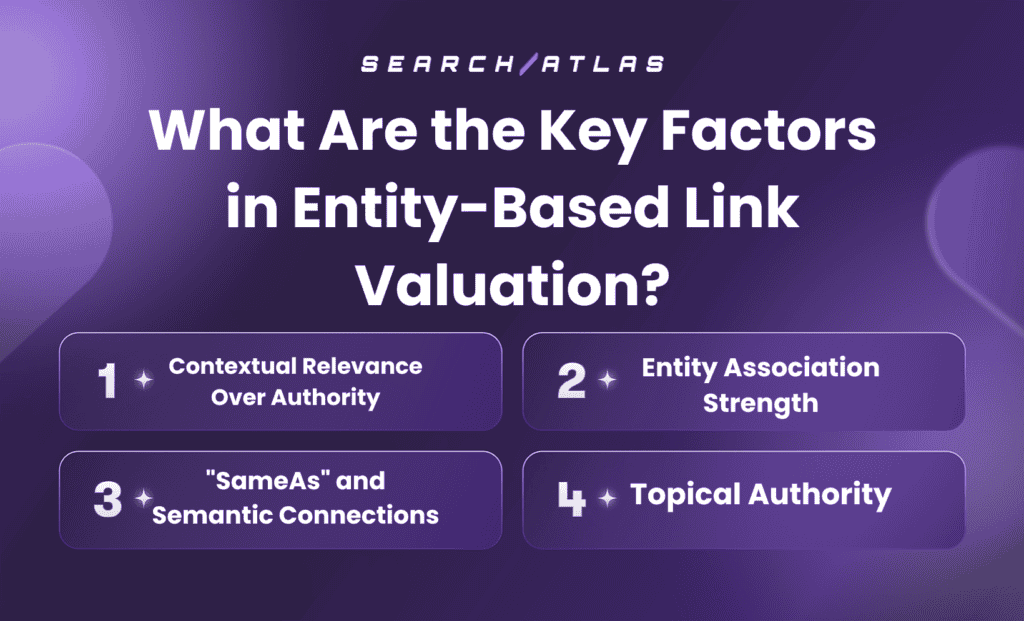
The 4 key factors in Entity-Based Link Valuation are Contextual Relevance Over Authority, Entity Association Strength, “SameAs” and Semantic Connections, and Topical Authority. These factors determine how a backlink reinforces entity identity, semantic clarity, and knowledge graph alignment instead of relying on surface-level authority metrics.
The key factors in entity-based link valuation are listed below.
1. Contextual Relevance Over Authority
Contextual Relevance Over Authority is the principle that backlink value depends primarily on semantic alignment between the linking content and the target entity rather than on domain metrics alone. Contextual relevance measures thematic consistency, entity proximity, and topical congruence between two documents. Authority functions as a supporting factor, not the primary determinant.
Contextual Relevance Over Authority influences ranking systems by reinforcing entity-topic alignment inside retrieval and classification pipelines. Search engines analyze surrounding content, semantic coherence, and intent match to evaluate link naturalness. Contextually aligned links strengthen entity clarity and reduce classification ambiguity.
Contextual relevance outweighs raw domain authority because search systems prioritize semantic match and user value over isolated authority metrics. A highly relevant link from a niche-aligned source increases trust signals and improves retrieval precision. An unrelated high-authority link weakens semantic reinforcement despite strong surface metrics.
AI-driven systems prioritize contextual relevance by evaluating semantic coherence, topic alignment, and engagement consistency across linked documents. Machine learning models assess link placement, intent congruence, and authenticity. Contextually integrated links increase evaluation confidence across retrieval and re-ranking layers.
2. Entity Association Strength
Entity Association Strength is the measurable intensity of semantic connections between a target entity and other authoritative entities across structured and unstructured data sources. Entity Association Strength evaluates how frequently, consistently, and coherently entities co-occur within knowledge graphs and contextual documents.
Entity Association Strength differs from traditional link metrics because it measures relational depth rather than link quantity or domain authority. Traditional metrics evaluate backlink counts and popularity signals. Entity Association Strength evaluates semantic triples, co-occurrence patterns, and graph-based relationships.
Entity Association Strength is measured through semantic triples frequency, graph link volume, relation support signals, and knowledge graph propagation models. Structured data relationships, PageRank relevance, anchor semantic congruence, and entity salience contribute to measurable association intensity. Graph-based Learning to Rank models improve precision by leveraging subgraph features.
Entity Association Strength impacts search performance by strengthening topical authority, improving entity disambiguation, and increasing retrieval confidence. Case studies demonstrate ranking growth and organic traffic expansion after reinforcing entity relationships. Strong entity associations compound authority and increase semantic visibility across AI-driven systems.
3. “SameAs” and Semantic Connections
“SameAs” and Semantic Connections are structured identity signals that declare two references represent the same real-world entity and confirm cross-source entity equivalence. The property owl:sameAs and schema:sameAs connect distributed identifiers to one unified entity node. This connection strengthens entity disambiguation, identity consolidation, and knowledge graph alignment.
owl:sameAs functions as a formal equivalence declaration that states two URIs refer to the identical entity. The relation operates as reflexive and symmetric inside RDF graphs. Machine systems merge attributes, relationships, and contextual descriptions across linked resources, which increases entity completeness and validation strength.
schema:sameAs reinforces entity identity by connecting a page entity to authoritative external profiles and knowledge graph entries. Schema.org allows linking a brand, person, or organization to verified identifiers (Wikipedia, IMDB, or structured databases). This explicit linking reduces ambiguity and improves Knowledge Graph resolution.
Semantic Connections increase entity-based link value by reinforcing consistent entity relationships across multiple data sources. Structured properties (mentions, about, sameAs) and consistent URIs create cumulative identity validation. Consistent semantic alignment strengthens machine confidence in entity authenticity and authority.
4. Topical Authority
Topical Authority is the measurable demonstration of deep, consistent expertise across a defined subject cluster that signals entity credibility to search systems. Topical Authority reflects comprehensive coverage, semantic consistency, and structured entity relationships within a thematic domain. Entity-based link valuation prioritizes links from domains that exhibit concentrated subject expertise.
Topical Authority focuses on subject-level expertise within a semantic cluster, while Domain Authority reflects general backlink strength across an entire site. Domain authority measures link popularity metrics. Topical Authority measures semantic depth, entity consistency, and subject concentration.
Topical Authority increases entity-based link value because links from semantically concentrated domains reinforce entity relevance and classification accuracy. Search systems evaluate subject coherence through signals (siteFocusScore and siteRadius). Concentrated thematic coverage increases retrieval confidence and ranking stability.
Why does Topical Authority improve long-term ranking stability? Topical Authority improves long-term ranking stability by strengthening classifier confidence and semantic clustering across the site. Consistent entity coverage reduces misclassification risk and enhances Knowledge Graph alignment. Strong topical clusters compound authority and increase resilience against algorithm updates.
How Do Knowledge Graphs Support Entity-Based Link Valuation?
Knowledge Graphs support Entity-Based Link Valuation by structuring entities and their relationships into machine-readable networks that validate semantic link relevance instead of surface metrics. Knowledge Graphs encode facts as subject–predicate–object triples, which formalize relationships between entities. This structure allows search systems to evaluate whether a backlink strengthens a verified entity relationship.
How do Knowledge Graph structures improve link evaluation accuracy? Knowledge Graph structures improve link evaluation accuracy by assigning unique identifiers to entities and preventing string-level ambiguity. Each entity operates as a uniquely defined node with attributes, categories, and hierarchical relationships. Unique identifiers allow multiple references to consolidate under one entity, which strengthens entity association validation during link analysis.
How does entity resolution strengthen link valuation inside Knowledge Graphs? Entity resolution strengthens link valuation by merging duplicate or fragmented entity nodes into unified representations. Duplicate nodes dilute relational accuracy and weaken graph analytics. Entity Resolved Knowledge Graphs increase clarity by linking records that refer to the same real-world entity, which improves path analysis, centrality scoring, and association precision.
How do graph algorithms influence entity-based link value? Graph algorithms influence entity-based link value by calculating path relationships, nearest neighbors, and centrality scores between entities. Accurate centrality measurements identify influential nodes and trusted connectors within the graph. Resolved graphs prevent distorted centrality metrics and improve link prediction accuracy.
How do Knowledge Graphs enhance multi-hop reasoning in link evaluation? Knowledge Graphs enhance multi-hop reasoning by enabling deterministic traversal across entity relationships. Structured graph traversal allows systems to connect indirect associations through verified relationships. Multi-hop reasoning strengthens semantic validation beyond direct backlink presence.
How do Knowledge Graphs support AI-driven entity retrieval and ranking? Knowledge Graphs support AI-driven retrieval by grounding search systems in verified entity relationships and structured data. Entity-based retrieval frameworks use knowledge base annotations to refine query representation and improve semantic recall. Structured entity mapping prevents intent drift and increases ranking precision across AI-driven systems.
How do Knowledge Graphs quantify entity relationships for valuation? Knowledge Graphs quantify entity relationships using graph-based metrics, link propagation models, and learning-to-rank frameworks. Structured subgraph features measure entity proximity and influence. Quantitative improvements in precision and ranking metrics demonstrate measurable enhancement from entity-resolved graph models.
How Search Engines Evaluate Entity Relationships?
Search engines evaluate entity relationships by analyzing semantic co-occurrence patterns, resolving ambiguity through disambiguation systems, and measuring authority reinforcement across structured data sources. Entity relationship evaluation operates inside retrieval, classification, and knowledge graph pipelines. The 3 primary evaluation mechanisms are listed below.
1. Entity Co-Occurrence
Entity Co-Occurrence is the statistical measurement of how frequently two or more entities appear together within a defined textual context, indicating potential semantic association. Entity Co-Occurrence quantifies proximity at the sentence, paragraph, or document level. Frequent co-occurrence suggests relational strength, although it does not confirm explicit semantic linkage.
Entity Co-Occurrence operates by analyzing frequency patterns and contextual proximity to detect conceptual relatedness between entities. Search systems construct co-occurrence matrices and apply statistical measures (PMI, LLR) to distinguish meaningful relationships from random overlap. High-frequency proximity increases semantic association confidence during retrieval and ranking.
Entity Co-Occurrence influences Entity-Based Link Valuation by strengthening contextual validation between linking and target entities. Repeated semantic proximity across authoritative documents increases perceived relational legitimacy. Weak or incidental co-occurrence reduces association reliability and lowers entity reinforcement strength.
2. Entity Disambiguation
Entity Disambiguation is the process of resolving ambiguous mentions in text by mapping them to the correct real-world entity within a knowledge base. Entity Disambiguation determines whether a term refers to one entity or another based on contextual signals. This process reduces semantic uncertainty and strengthens machine interpretation accuracy.
Entity Disambiguation functions through three structured steps: recognition, candidate generation, and contextual selection. Named Entity Recognition identifies entity mentions. Candidate generation retrieves possible matches from knowledge bases. Contextual comparison selects the most semantically aligned entity based on surrounding text and relational data.
Entity Disambiguation impacts search performance by preventing misclassification and improving intent matching accuracy. Accurate disambiguation increases retrieval precision and reduces false ranking matches. Systems improve relevance scores when ambiguous entities are resolved correctly.
3. Entity Authority Signals
Entity Authority Signals are structured indicators that confirm the credibility, consistency, and trustworthiness of an entity across multiple verified sources. Entity Authority Signals determine whether AI systems recognize an entity as reliable for citation and reuse. These signals extend beyond backlink quantity to structured validation and cross-source
Entity Authority Signals measure machine-recognized entity trust, while domain authority measures link-based popularity across a domain. Entity Authority depends on consistent factual profiles, structured identifiers, and corroborated mentions. Domain authority evaluates backlink metrics without measuring semantic identity validation.
Entity Authority Signals influence Entity-Based Link Valuation by increasing confidence in entity relationships reinforced by backlinks. Structured data (Schema.org), consistent naming, verified identifiers, and authoritative citations strengthen entity recognition within knowledge graphs. Strong entity authority increases the semantic value of contextually aligned links.
How to Implement Entity-Based Link Building?
Entity-Based Link Building is implemented by aligning link acquisition with structured entity definition, semantic clarity, and topical reinforcement rather than link quantity. Entity optimization strengthens semantic relationships between a brand and its associated entities. The 4 steps to implement entity-based link building are listed below.
- Define and Map Core Entities.
- Use Schema Markup and Entity Clarity.
- Target Links From Entity-Rich Sources.
- Create Entity-Focused Content.
1. Define and Map Core Entities
Define and Map Core Entities by identifying the primary brand entity, its supporting entities, and their structured relationships within a semantic framework. Core entities include the brand, products, services, people, locations, and dominant subject clusters. Each entity must have a stable identifier, consistent naming, and unified categorization across digital properties.
Entity identification functions by extracting distinct real-world concepts and assigning them clear semantic roles within a topic ecosystem. Search systems evaluate entities as structured nodes with attributes and relationships rather than keyword strings. Accurate identification establishes the foundation for entity optimization and link alignment.
Entity mapping strengthens link acquisition by clarifying which external entities must reinforce the core entity cluster. Mapping reveals association gaps and topical inconsistencies. Structured mapping ensures that outreach targets contextually aligned entities instead of random high-metric domains.
Structure entity relationships using subject–predicate–object logic that defines explicit semantic connections. Define hierarchical relationships, subcategories, and attribute dependencies. Clear relationship modeling improves knowledge graph recognition and strengthens semantic validation across search systems.
Consistent entity definition improves search visibility by reducing ambiguity and increasing classifier confidence. Unified entity descriptions across site content, structured data, and external profiles increase recognition accuracy. Stable entity alignment compounds authority signals over time and strengthens entity-based link valuation.
2. Use Schema Markup and Entity Clarity
Use Schema Markup for Entity Clarity by assigning stable entity identifiers and defining explicit relationships between entities using structured data. Schema Markup defines entities through Schema.org types and connects them using properties that clarify identity, attributes, and relationships. Entity optimization requires consistent @id values and precise entity typing to eliminate ambiguity — the same discipline covered in depth under entity schema modeling.
Schema Markup establishes entity identity by defining a primary entity with a unique @id and consistent naming across all pages. The @id attribute acts as a persistent identifier that links multiple references to the same entity. Stable identifiers prevent duplicate entity creation and strengthen Knowledge Graph consolidation.
How does Schema Markup define relationships between entities? Schema Markup defines relationships by using structured properties that connect entities within and across documents. Properties (author, worksFor, offeredBy, sameAs, mentions) explicitly link related entities. Relationship mapping clarifies authorship, organizational association, and topical context, which increases entity recognition accuracy.
Schema Markup improves AI interpretation by providing machine-readable context that reduces semantic uncertainty. JSON-LD formatting separates structured data from visible HTML and enables deterministic parsing. AI systems process structured data to validate identity, attributes, and entity associations during retrieval and synthesis.
How do consistent Schema implementations increase citation probability? Consistent Schema implementation increases citation probability by reinforcing entity clarity across multiple pages. Pages with structured data appear in AI summaries more frequently due to improved contextual alignment. Nested schema structures and complementary types strengthen semantic coherence and increase citation likelihood.
Implement Schema Markup using JSON-LD with accurate, visible content alignment and specific Schema.org types. Validate markup against content to prevent mismatch errors. Use Organization, Person, Article, Service, FAQPage, and Product types where applicable. Maintain updated properties (dateModified, image, publisher) and monitor structured data in validation tools to sustain entity clarity.
3. Target Links From Entity-Rich Sources
Target Links From Entity-Relevant Sources by prioritizing backlinks from domains that reinforce the same core entities, topic clusters, and semantic associations as the target entity. Entity-relevant sources demonstrate contextual alignment, topical authority, and structured entity recognition. Entity-based link building values semantic reinforcement over raw authority metrics.
How does entity relevance differ from general link relevance? Entity relevance differs from general link relevance because it evaluates whether the linking domain strengthens the same entity cluster rather than only sharing topical similarity. General link relevance measures keyword overlap and thematic proximity. Entity relevance measures entity co-occurrence, structured identifiers, and knowledge graph consistency.
Identify entity-relevant link prospects by mapping authoritative entities connected to the core topic and analyzing their association networks. Analyze which publications, directories, associations, and platforms consistently reference related entities. Prioritize domains that repeatedly co-occur with target entities in authoritative contexts.
Evaluate contextual placement by confirming semantic alignment between linking content, anchor context, and the target entity definition. Assess page titles, surrounding text, anchor phrasing, and entity proximity. Strong entity-relevant links appear within thematically aligned sections and reinforce consistent semantic meaning.
How does structured data enhance targeting precision? Structured data enhances targeting precision by confirming whether a linking source implements entity markup and recognized identifiers. Domains that use Schema.org properties, consistent entity naming, and knowledge graph references provide stronger semantic reinforcement. Structured validation increases entity association strength within search systems.
How does authority integrate with entity relevance in targeting? Authority integrates with entity relevance by amplifying reinforcement only when contextual alignment exists. High-authority but unrelated domains provide a weaker semantic impact. Moderate-authority but highly aligned domains often generate stronger entity association signals. Balanced acquisition prioritizes contextual alignment first and authority second.
4. Create Entity-Focused Content
Create Entity-Focused Content by structuring each page around a clearly defined primary entity and reinforcing its relationships, attributes, and context across supporting content. Entity-focused content centers on real-world concepts (people, brands, products, places, ideas) instead of isolated keywords. Search systems evaluate whether the page clearly defines what the entity is, what it represents, and how it connects to related entities.
Entity-first structuring improves search interpretation by aligning visible signals, structured data, and internal links around one canonical entity. Titles, H1, and schema mainEntityOfPage must reference the same entity consistently. Stable identifiers and consistent naming prevent entity fragmentation and strengthen knowledge graph recognition.
Embed entity relationships by explicitly connecting the primary entity to secondary entities through contextual explanation and structured linking. Use descriptive anchor text that reflects entity names rather than vague phrases. Reference related entities through clear semantic bridges so search systems understand association patterns.
How does comprehensive contextual coverage strengthen entity signals? Comprehensive contextual coverage strengthens entity signals by addressing attributes, subtopics, and related questions tied to the core entity. Define the entity, explain its characteristics, and connect it to measurable outcomes or related concepts. Structured question-based sections increase extractability for AI systems and improve semantic recall.
Structured data reinforces entity-focused content by explicitly declaring entity types, identifiers, and relationships using Schema.org properties. Apply consistent @id values and sameAs references to connect the entity to authoritative external identifiers. Schema alignment reduces ambiguity and increases citation probability in AI-driven systems.
Maintaining entity consistency across platforms increases authority by ensuring identical naming, descriptions, and attributes across web properties and third-party references. Consistent entity representation strengthens machine recognition and prevents authority dilution caused by fragmented profiles. Entity-focused content becomes more resilient as structured identity signals compound over time.
How to Build Entity Authority?
Build Entity Authority by reinforcing structured entity relationships, expanding consistent mentions, and concentrating expertise within defined topic clusters. Entity authority reflects machine-recognized credibility rather than backlink quantity alone. The 3 core methods to build entity authority are listed below.
- Strengthen Entity Associations Across the Web
- Increase Mentions and Semantic Signals
- Align Content With Topic Clusters
1. Strengthen Entity Associations Across the Web
Strengthen Entity Associations Across the Web by consistently connecting the primary entity to authoritative, contextually aligned entities across multiple trusted platforms. Entities represent singular, well-defined concepts stored in structured systems (Knowledge Graph), which contains over 500 billion facts about 5 billion entities. Strong associations reinforce how search systems interpret identity, context, and relevance.
Claim and optimize verified entity profiles to confirm ownership and consolidate identity signals. Claim Knowledge Panels, optimize directory listings, and maintain consistent Name, Address, and Phone data across all properties. Verified profiles reduce ambiguity and strengthen semantic confirmation within knowledge graph systems.
Strategic link placement reinforces entity recognition by securing contextual mentions on authoritative, industry-aligned platforms. Prioritize placements where the entity co-occurs with recognized industry leaders, reference lists, and topical resources. Entity-relevant placements strengthen association networks more effectively than unrelated high-metric links.
Consistent cross-platform representation increases entity clarity by aligning brand descriptions, identifiers, and service definitions across websites, directories, and media mentions. Inconsistent naming fragments entity recognition. Unified descriptions consolidate entity identity signals across the web.
How do E-E-A-T and authoritative citations compound entity associations? E-E-A-T signals compound entity associations by linking the entity to trusted experts, publications, and verified credentials. Third-party citations, documented expertise, and transparent authorship strengthen E-E-A-T signals. Trusted entity associations increase classification confidence and improve long-term visibility across semantic search systems.
2. Increase Mentions and Semantic Signals
Increase Mentions and Semantic Signals by expanding consistent, contextually aligned brand references across authoritative and semantically relevant sources. Mentions strengthen entity embeddings inside semantic search systems by increasing connections to related entities and improving cosine similarity within vector-based models.
High-value mentions appear in authoritative, topically aligned content alongside related entities, while low-value mentions appear on irrelevant or low-quality platforms without semantic reinforcement. High-value mentions strengthen existing entity relationships and improve contextual association strength. Random or spam-driven mentions provide minimal semantic impact.
Brand mentions influence AI-driven search systems by reinforcing entity embeddings and strengthening relational confidence across multiple trusted sources. AI search systems prioritize brands referenced by other authoritative entities. Repeated contextual mentions increase the likelihood of citation in AI-generated answers.
Systematically increase mentions by identifying relevant industry publications, niche platforms, and entity-aligned domains where contextual placement reinforces semantic relationships. Segment prospecting by domain type (.com, .org, .edu, industry-specific TLDs) and analyze competitor co-occurrence patterns to identify strategic placement opportunities.
How does semantic depth amplify mention impact? Semantic depth amplifies mention impact by embedding the entity within comprehensive topic clusters supported by internal linking and structured data. Dense contextual linking, entity-rich language, and schema markup reinforce semantic connections. Strong topical clustering increases entity recognition confidence across search systems.
Consistency compounds semantic signals by maintaining uniform naming, messaging, and entity positioning across platforms and mentions. Stable entity representation strengthens machine recognition and prevents fragmentation. Sustained reinforcement increases long-term authority and improves AI visibility.
3. Align Content With Topic Clusters
Align Content With Topic Clusters by organizing pages around one central entity (pillar) and supporting it with tightly interlinked sub-entities (cluster pages) that reinforce semantic depth and topical authority. Topic clusters create a structured content hierarchy that signals expertise and strengthens entity relationships within a defined domain.
Define a pillar entity as a broad, authoritative core topic that represents the primary semantic focus of the cluster. The pillar page provides comprehensive coverage of the main entity and targets high-volume, broad-intent queries. The pillar establishes the central node in the internal entity graph and distributes authority to supporting cluster pages.
Structure cluster entities as focused subtopics that explore specific aspects, attributes, or use cases of the main entity. Each cluster page targets a distinct long-tail or intent-driven query and links back to the pillar. Cluster pages interlink contextually to reinforce entity proximity and strengthen semantic clustering.
Internal linking reinforces entity alignment by connecting related pages through descriptive, entity-rich anchor text. Each cluster page links to the pillar, and the pillar links to all clusters. Cross-linking between related subtopics increases semantic cohesion and improves crawl efficiency.
Topical clustering improves entity authority by demonstrating comprehensive subject coverage across interconnected pages. Concentrated coverage increases search engine confidence in subject expertise. Structured clusters increase ranking stability, improve semantic recall, and strengthen AI-driven citation probability.
How should content be maintained within topic clusters over time? Maintain topic clusters through periodic audits, content refresh cycles, and expansion of emerging sub-entities. Review clusters every 3-6 months to update data, refine entity coverage, and close semantic gaps identified through a topic saturation analysis. Continuous refinement strengthens long-term entity authority and preserves classification accuracy.
How to Measure Entity-Based Link Value?
Measure Entity-Based Link Value by tracking entity cluster visibility, internal relationship density, SERP feature inclusion, behavioral performance, and AI retrieval presence. Entity-based link value reflects semantic reinforcement rather than raw backlink count. Measurement focuses on how strongly links improve entity clarity, association strength, and topical authority.
How does cluster-level performance measure entity-based link value? Cluster-level performance measures entity-based link value by monitoring impressions and clicks across all pages tied to a shared entity cluster. Rising visibility across interconnected pages signals that search systems recognize strengthened entity relationships. Google Search Console reveals impression growth patterns across 30-50 semantically linked URLs, which confirms entity consolidation impact.
How does internal link density indicate entity reinforcement strength? Internal link density indicates entity reinforcement strength by evaluating how tightly related pages interconnect around the core entity. Higher density of contextual internal links improves semantic cohesion and entity association clarity. Consistent relationship mapping between subtopics increases topic authority signals by 15-25% when implemented effectively.
How do SERP features reflect entity clarity? SERP feature appearances reflect entity clarity by showing increased inclusion in featured snippets, knowledge panels, and AI-generated summaries. Pages with strong entity salience experience a 30-50% higher likelihood of appearing in entity-driven search features. Increased visibility in these placements confirms improved semantic interpretation.
How does engagement correlate with entity authority strength? Engagement correlates with entity authority strength through measurable increases in time-on-page, interaction depth, and conversion consistency. Mature entity clusters commonly produce 10–20% increases in average session duration and 5-10% improvements in conversion performance. Behavioral improvements confirm stronger semantic alignment with user intent.
How do AI search graders evaluate entity-based link impact? AI search graders evaluate entity-based link impact by measuring brand presence and retrieval frequency across AI search systems (ChatGPT, Gemini, Perplexity). Strong entity signals improve LLM retrieval probability by approximately 20-30%. AI-based grading tools assess entity recognition strength rather than backlink quantity.
How should entity-based link value be tracked over time? Track entity-based link value over time by conducting quarterly audits of topic scores, visibility metrics, and semantic signal growth. Continuous content refinement strengthens entity salience and association strength by 5-10% per quarter. Sustained measurement ensures compound authority growth instead of isolated link spikes.
What Are the Benefits of Entity-Based Link Valuation?
The benefits of Entity-Based Link Valuation are Higher Visibility, Knowledge Panel Inclusion, Improved ROI, and Future-Proofing. Entity-Based Link Valuation increases semantic clarity, strengthens entity authority, and compounds long-term ranking stability. The benefits of entity-based link valuation are listed below.
- Higher Visibility.
- Knowledge Panel Inclusion.
- Improved ROI.
- Future-Proofing.
1. Higher Visibility
Higher Visibility is the benefit of Entity-Based Link Valuation because entity reinforcement increases semantic clarity, which improves eligibility for AI summaries, Knowledge Panels, and expanded SERP features. Entity-based link valuation strengthens how search systems interpret a brand’s identity and relationships. Strong entity signals increase discoverability beyond traditional keyword rankings.
How does entity clarity increase AI Overview visibility? Entity clarity increases AI Overview visibility by reducing ambiguity and improving contextual alignment within semantic retrieval systems. Structured entity linking strengthens recognition inside AI-driven features. Schema App measured a 19.72% increase in AI Overview visibility for keywords containing “entit” between October 15, 2025, and December 15, 2025, after implementing robust entity linking.
How does Entity-Based Link Valuation improve SERP feature inclusion? Entity-Based Link Valuation improves SERP feature inclusion by reinforcing identity signals that qualify content for Knowledge Panels, sitelinks, and AI-generated summaries. Consistent entity associations consolidate authoritative facts within knowledge graph systems. Enhanced recognition increases placement probability in prominent search features.
How does Entity-Based Link Valuation strengthen local and non-branded visibility? Entity-Based Link Valuation strengthens local and non-branded visibility by clarifying service, location, and entity relationships across structured data and contextual links. Non-branded queries featuring the “assisted living” entity recorded a 25% increase in clicks and a 30% increase in impressions. Community pages recorded a 16% year-over-year increase in clicks and a 26% increase in impressions.
How does Entity-Based Link Valuation expand the semantic range? Entity-Based Link Valuation expands semantic range by enabling content to rank across related queries beyond direct keyword targeting. Strong entity recognition allows AI systems to associate the brand with broader concept clusters. Expanded semantic associations increase citation likelihood and long-term visibility stability.
2. Knowledge Panel Inclusion
Why Knowledge Panel Inclusion is the Benefit of Entity-Based Link Valuation? Knowledge Panel Inclusion is the benefit of Entity-Based Link Valuation because it confirms that search systems recognize the entity as authoritative, verified, and distinct within the Knowledge Graph. Entity-Based Link Valuation consolidates consistent, trustworthy signals across multiple sources. Knowledge Panel appearance reflects semantic validation rather than keyword ranking alone.
How do Knowledge Panels enhance credibility and legitimacy? Knowledge Panels enhance credibility and legitimacy by signaling that Google recognizes the entity as established and trustworthy. Google grants Knowledge Panels only to entities supported by consistent, corroborated references across independent sources. This recognition functions as an algorithmic endorsement based on structured entity alignment.
How does Google determine eligibility for Knowledge Panel creation? Google determines eligibility for Knowledge Panel creation by verifying entity consistency across authoritative databases and independent references. Recognition depends on presence within the Knowledge Graph, supported by sources (Wikipedia, Wikidata, Google Business Profile, official sites with structured data). Redundant confirmation across multiple trusted domains strengthens eligibility.
How do Knowledge Panels increase search visibility? Knowledge Panels increase search visibility by occupying dedicated SERP real estate independent of organic ranking fluctuations. Panels appear prominently in desktop and mobile results, often dominating the right-side column or top mobile viewport. This placement increases exposure without reliance on position-based ranking factors.
How do Knowledge Panels support competitive advantage in AI-driven search? Knowledge Panels support competitive advantage by positioning the entity as a primary source for AI systems and conversational search platforms. Voice search and AI assistants rely on structured Knowledge Graph data for direct answers. Recognized entities receive preferential inclusion in AI-driven retrieval environments.
How does Knowledge Panel inclusion reinforce entity authority over time? Knowledge Panel inclusion reinforces entity authority by consolidating verified attributes, relationships, and identifiers into a unified semantic profile. Structured identity signals improve long-term trust, stabilize visibility, and strengthen machine-recognized credibility across evolving search systems.
3. Improved ROI
Improved ROI is the benefit of Entity-Based Link Valuation because each contextually aligned link compounds entity authority instead of requiring continuous link volume to maintain rankings. Entity-Based Link Valuation increases authority per placement rather than distributing value across disconnected backlinks. Compounding semantic reinforcement reduces acquisition cost over time.
How does Entity-Based Link Valuation reduce acquisition costs? Entity-Based Link Valuation reduces acquisition costs by consolidating fragmented authority signals into unified entity associations. Traditional link strategies require a high link quantity to maintain performance. Entity-based strategies strengthen core entity signals, which lowers dependency on constant link acquisition and stabilizes ranking output.
How does Entity-Based Link Valuation prevent financial inefficiencies? Entity-Based Link Valuation prevents financial inefficiencies by eliminating redundant authority-building efforts across disconnected pages and topics. Consolidated entity clusters reduce duplicated content production and overlapping keyword targeting. Unified entity reinforcement increases measurable performance efficiency.
How does Entity-Based Link Valuation improve operational efficiency? Entity-Based Link Valuation improves operational efficiency by centralizing authority around defined entity hubs rather than dispersing link equity randomly. Clear entity mapping streamlines outreach prioritization and resource allocation. Concentrated semantic reinforcement produces measurable ranking improvements with fewer placements.
How does Entity-Based Link Valuation enable predictive growth? Entity-Based Link Valuation enables predictive growth by aligning link investment with long-term entity authority development instead of short-term keyword gains. Structured entity reinforcement produces stable cluster-level growth patterns. Compounded authority increases visibility, durability, conversion stability, and strategic forecasting accuracy.
How does Improved ROI manifest in measurable performance metrics? Improved ROI manifests through increased conversion efficiency, reduced volatility, and improved cluster-level ranking consistency. Strong entity authority increases engagement signals and sustained visibility across related queries. Compounded entity reinforcement decreases cost per acquisition and increases lifetime content value.
4. Future-Proofing
Future-Proofing is the benefit of Entity-Based Link Valuation because entity reinforcement aligns with how modern search systems prioritize structured identity, semantic relationships, and AI-driven retrieval. Search engines shifted from keyword matching to entity recognition through Knowledge Graph expansion and semantic algorithms. Entity-Based Link Valuation strengthens durable signals that remain valid across algorithm changes.
How does Entity-Based Link Valuation reduce algorithm volatility risk? Entity-Based Link Valuation reduces algorithm volatility risk by anchoring authority in entity relationships rather than isolated ranking signals. Keyword density and superficial link metrics fluctuate with updates. Entity associations, structured identifiers, and contextual reinforcement provide stable semantic foundations that resist ranking instability.
How does Entity-Based Link Valuation prepare brands for AI-driven search? Entity-Based Link Valuation prepares brands for AI-driven search by strengthening machine-recognized entity identity and contextual trust signals. AI systems retrieve and cite entities rather than pages ranked only by keyword match. Strong entity authority increases citation probability in AI summaries and conversational search environments.
How does Future-Proofing support long-term strategic positioning? Future-Proofing supports long-term strategic positioning by consolidating authority within defined topic clusters instead of chasing short-term ranking tactics. Concentrated entity hubs increase semantic clarity and classifier confidence. Structured reinforcement compounds over time, which stabilizes visibility across evolving retrieval models.
How does Entity-Based Link Valuation enable sustainable growth? Entity-Based Link Valuation enables sustainable growth by aligning link acquisition with semantic depth, structured data consistency, and authoritative corroboration. Durable entity signals persist even as ranking systems adopt probabilistic and AI-driven evaluation models. Long-term resilience replaces reactive optimization cycles.
What Are the Common Challenges of Entity-Based Link Building?
The common challenges of Entity-Based Link Building include strategic, technical, operational, and reputational obstacles that limit entity reinforcement and semantic authority growth. Entity-Based Link Building requires contextual precision, structured identity alignment, and long-term execution discipline.
The 15 main challenges of entity-based link building are listed below.
1. Finding High-Quality Entity-Relevant Link Opportunities. Finding entity-relevant opportunities creates difficulty because placements must reinforce semantic alignment instead of only domain metrics. High-metric domains without entity proximity weaken association strength and reduce authority transfer.
2. Outreach and Relationship Building Complexity. Outreach complexity slows entity authority growth because relationship-driven placements require credibility, negotiation, and contextual integration. Entity-relevant placements depend on editorial alignment instead of transactional exchanges.
3. Securing Backlinks Without Payment. Securing backlinks without payment creates difficulty because high-authority placements prioritize value-driven contributions. Lack of unique insights or assets reduces acceptance rates and limits link acquisition opportunities.
4. Adapting to Algorithm Changes and Evaluation Systems. Algorithm volatility increases risk exposure because ranking systems continuously refine entity interpretation and spam detection models. Misaligned link strategies trigger ranking instability and reduce semantic trust signals.
5. Avoiding Spammy or Toxic Backlinks. Spammy backlinks create risk because low-quality or irrelevant links weaken entity clarity and damage trust signals. Toxic link patterns reduce credibility and increase the likelihood of algorithmic devaluation.
6. Maintaining High-Quality Entity-Focused Content. Content quality affects link value because entity-based links require strong contextual support through relevant, structured, and authoritative content. Weak content reduces semantic reinforcement and limits authority growth.
7. Cost and Resource Allocation Constraints. Resource allocation affects execution quality because entity-based link building requires content depth, structured data alignment, and continuous monitoring. Limited resources lead to fragmented execution and weak entity signals.
8. Strategic Mindset and Planning Gaps. Strategic gaps create inconsistency because entity-based link building requires long-term planning instead of isolated campaigns. Lack of a structured strategy weakens positioning and reduces authority compounding.
9. Risk of Search Engine Penalties. Penalty risk increases because manipulative or unnatural link patterns trigger spam detection systems. Poor link quality and over-optimization reduce trust and harm long-term visibility.
10. Website and Brand Reputation Damage. Reputation damage occurs because associations with low-quality or irrelevant sources weaken perceived credibility. Poor placements reduce trust signals across search engines and AI systems.
11. Domain Email Deliverability Issues. Email deliverability issues reduce outreach success because spam filters block communication attempts. Poor domain reputation limits relationship building and decreases link acquisition efficiency.
12. Low Domain Authority in Early Stages. Low authority creates difficulty because new sites lack trust signals required for high-quality placements. Limited credibility reduces acceptance rates and slows initial link growth.
13. Confusion and Industry Misinformation. Misinformation creates ineffective strategies because outdated link-building tactics ignore entity-based evaluation systems. Incorrect approaches reduce relevance and weaken semantic authority signals.
14. Intense Competitive Environments. Competition increases difficulty because high-authority brands dominate valuable placements and relationships. Competitive pressure limits access to high-quality, entity-relevant opportunities.
15. Complexity of Modern Link Evaluation Systems. Evaluation complexity creates challenges because modern systems assess context, relevance, and entity alignment instead of simple link quantity. Misunderstanding these systems reduces link effectiveness and authority impact.
How Entity-Based Link Valuation Supports AI Search and LLMs?
Entity-Based Link Valuation supports AI search and LLMs by prioritizing semantic relevance, canonical entity alignment, and structured context over traditional domain metrics. LLM-based search engines retrieve information at the passage level and assemble answers grounded in entities instead of keywords. Entity-based valuation increases extractability, disambiguation clarity, and citation probability.
How do AI systems recognize and process entities during retrieval? AI systems recognize and process entities using Named Entity Recognition, Entity Linking, and Canonical Entity Identifiers. Named Entity Recognition extracts entity mentions from unstructured text. Entity Linking maps those mentions to canonical IDs (Wikidata Q-ID, Knowledge Graph MID). Canonical identifiers consolidate synonyms and aliases into one unified entity node.
How does Entity-Based Link Valuation improve LLM retrieval precision? Entity-Based Link Valuation improves LLM retrieval precision by strengthening topical relevance and semantic proximity between linked sources and entity hubs. AI engines expand queries into multiple entity-based variations, retrieve documents through entity biasing, and synthesize grounded answers. Strong entity reinforcement increases selection likelihood during passage-level retrieval.
How do Knowledge Graphs validate entity-linked content for AI systems? Knowledge Graphs validate entity-linked content by grounding mentions in structured, verified entity relationships. Public and proprietary knowledge bases confirm identity consistency, attribute relationships, and contextual alignment. Embedding models score entity-context similarity to reduce ambiguity and improve citation reliability.
How does entity authority influence machine trust in LLM outputs? Entity authority influences machine trust by accumulating semantic mass through repeated corroboration across independent sources. AI systems evaluate citation frequency, structural clarity, and cross-source verification before selecting references. Strong entity signals increase statistical confidence scores in generative outputs.
How does Entity-Based Link Valuation align with Generative Engine Optimization metrics? Entity-Based Link Valuation aligns with Generative Engine Optimization metrics by shifting evaluation from keyword rankings to entity citation frequency and AI visibility share. GEO KPIs track entity recognition, AI mentions, and citation accuracy instead of position-based metrics. Entity authority becomes the dominant signal in AI-driven search environments.
How does Entity-Based Link Valuation prepare brands for the future of AI-powered search? Entity-Based Link Valuation prepares brands for AI-powered search by reinforcing structured identity signals that AI systems lock into as trusted sources. AI traffic continues to shift toward conversational interfaces and entity-driven retrieval models. Early reinforcement of entity clarity increases long-term visibility durability as AI interfaces expand.
Do Backlinks Still Matter in Entity-Based SEO?
Yes, backlinks still matter in Entity-Based SEO because they function as trust and validation signals that reinforce entity authority within semantic ranking systems. Backlinks remain a foundational authority indicator even as search systems shift toward entity recognition and contextual evaluation.
What evidence confirms that backlinks remain influential? Empirical analysis confirms backlink influence across ranking datasets. Semrush reported that 92.3% of the top 100 ranking domains had at least one backlink. Ahrefs found that 96.55% of pages receive zero Google traffic, primarily due to a lack of backlinks. The number-one Google result averages 3.8 times more backlinks than positions two through ten.
How has the role of backlinks evolved in Entity-Based SEO? The role of backlinks evolved from quantity-based signals to quality-based semantic reinforcement. Search systems now evaluate contextual relevance, editorial placement, and entity alignment rather than raw volume. High-authority contextual placements reinforce entity salience more effectively than mass link acquisition.
Do backlinks influence AI-driven search systems? Backlinks influence AI-driven search systems because AI models interpret them as trust signals that support citation confidence. AI summaries prioritize sources with strong entity corroboration and contextual validation. High-authority brand mentions and relevant nofollow links contribute to AI citation eligibility.
What is the modern interpretation of backlink value? Modern backlink value depends on contextual relevance, entity proximity, and structured authority signals rather than isolated metrics (Domain Authority). Backlinks remain essential, but only when aligned with entity identity and topical coherence. Quality and semantic alignment determine impact in Entity-Based SEO.
Do Brand Mentions Influence Entity-Based Link Value?
Yes, brand mentions influence Entity-Based Link Value because they function as implied entity validation signals that strengthen semantic recognition across search and AI systems. Unlinked brand mentions reinforce entity association strength even without direct hyperlink equity.
What evidence confirms that brand mentions affect search systems? Google’s 2012 patent (US8682892B1) confirms that search systems evaluate implied links as signals of authority. Ahrefs analyzed 75,000 brands and found that brands with the highest mention volume appeared in AI-generated summaries up to 10 times more often. Approximately 60% of ranking factors are tied to off-page signals, which include contextual brand references.
How do brand mentions influence AI-driven visibility? Brand mentions influence AI-driven visibility by increasing entity embedding strength and citation probability within LLM-based retrieval systems. AI search platforms recommend entities frequently referenced by other authoritative sources. Consistent mentions across trusted domains increase semantic mass and improve citation frequency in AI summaries.
Are unlinked mentions as strong as backlinks? No, unlinked mentions are not as strong as backlinks because they do not pass explicit link equity. Backlinks transfer structured authority signals and direct referral potential. Google reaffirmed at Search Central Live APAC 2025 that backlinks remain a crucial ranking factor. Mentions act as corroborative signals, while backlinks act as explicit authority transfers.
How do backlinks and brand mentions work together in Entity-Based SEO? Backlinks and brand mentions work together by combining explicit authority transfer with contextual entity reinforcement. Backlinks provide measurable ranking power and link equity. Brand mentions reinforce identity, consistency, and semantic trust. Combined signals strengthen entity recognition across both traditional search and AI-driven environments.
How to Identify High-Value Entity-Based Links?
Identify High-Value Entity-Based Links by evaluating semantic relevance, entity proximity, page-level authority, contextual placement, and source diversity instead of relying only on domain metrics. High-value entity-based links reinforce entity relationships inside knowledge graphs and semantic retrieval systems.
Semantic relevance determines entity-based link value by confirming that the linking page reinforces the same core entity or related entity cluster. Links from thematically aligned domains increase contextual association strength. Links from unrelated topics weaken semantic validation even when authority metrics appear strong.
Page-level authority affects link evaluation more than domain-level metrics. A link from a high-authority page within a relevant entity cluster carries greater value than a link from a high-authority domain with low topical alignment. Authority must exist at the page level and within editorial content.
Link placement and anchor context identify high-value links by ensuring the link appears naturally within body content and reinforces the target entity explicitly. Descriptive anchor text that reflects entity names or attributes strengthens semantic clarity. Links embedded in editorial sections carry stronger entity signals than links in footers or sidebars.
Source diversity influences entity-based link strength by increasing corroboration from unique domains within the same semantic field. Multiple references from distinct, entity-aligned domains compound association strength. Repeated links from a single source create diminishing returns.
Structured data validation enhances link quality identification by confirming that the linking page uses consistent entity identifiers and semantic markup. Schema properties (sameAs, Organization, Person) and canonical IDs increase entity disambiguation reliability. Links from structured, entity-rich sources strengthen knowledge graph alignment.
Internal linking reveals high-value entity reinforcement opportunities by consolidating authority around one canonical entity page per topic. Avoid content cannibalization by selecting one authoritative entity hub. Use descriptive, entity-focused anchor text to reinforce topical clustering and semantic depth.