A listicle is an article written in list format where information appears as numbered or bulleted items with clear headings and explanations. What are listicles in practice? Listicles are structured content formats used for product roundups, how-to guides, and tool comparisons, because the listicle format improves scannability, reduces cognitive load, and matches how readers consume information. Listicle examples (top 10 tools, 7 tips, 5 steps) show how each item delivers a standalone answer, which aligns with AI extraction and search behavior. AI is well-suited for listicle production because AI processes structured inputs, generates repeatable list patterns, and maintains consistency across items, while humans add originality, validate facts, and refine voice.
How to write listicles with AI follows a structured AI listicle workflow that combines keyword research, SERP analysis, prompt design, drafting, and validation. The process starts by identifying plural keywords and intent, then analyzing SERP structures to match the correct listicle format, angle, and item count. AI generates structured drafts using constraint-based prompts, while human editors inject original data, examples, and brand voice to improve quality. The workflow continues with structural validation, editing, and fact-checking to remove errors and ensure clarity, because AI outputs require verification for accuracy and logic.
SEO and AI search optimization for listicles focus on structure, entity clarity, and extractable answer blocks to increase rankings and LLM citations. Optimized listicles place direct answers early, use consistent heading hierarchy, and format content into lists, tables, and FAQs for featured snippets and AI overviews. Generative Engine Optimization (GEO) prioritizes credibility, freshness, and structured formatting, while internal linking, schema markup, and updated data strengthen visibility. AI-written listicles perform best when content remains concise, fact-based, and clearly structured, because AI systems reuse well-defined answer segments and prioritize trustworthy, easy-to-cite sources.
What Is a Listicle?
A listicle is an article written in list format that organizes information into numbered or bulleted items, and each item includes a heading with a brief explanation or example. This listicle definition explains the listicle’s meaning through a structured list article format that separates one topic into multiple labeled points. A listicle repeats the same structural pattern across all entries to maintain consistency and clarity. The repeated structure defines how information appears and how readers process each item.
What content types align with a listicle definition? A listicle definition applies to content types that break into distinct entries with clear boundaries. A listicle format fits product roundups, how-to guides, tip collections, tool comparisons, and resource lists. The listicle format organizes each content type into independent items with equal structural weight. The independent structure ensures each item delivers one clear idea without overlap.
Why do readers prefer a list article format? Readers prefer a list article format because the listicle format stays skimmable and predictable, and it reduces cognitive load. The listicle format presents information in small sections that limit processing effort. The reduced cognitive load improves reading speed and retention. The predictable structure sets clear expectations for how each item appears and progresses.
How does a listicle differ from other article formats? A listicle differs from other article formats because it uses a list format instead of continuous paragraphs. A listicle structure segments information into labeled entries that stand alone. A traditional article structure connects ideas through continuous narrative flow. The structural difference changes how information is consumed, with a listicle prioritizing quick scanning over extended reading.
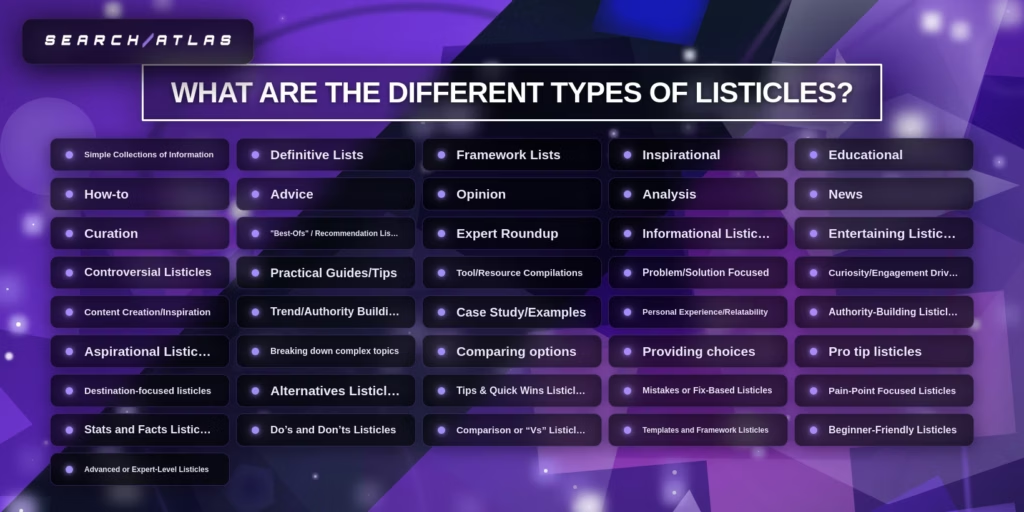
What Are the Different Types of Listicles?
The listicle types define what listicles are and clarify ideas for listicles through structured categories. The listicle format determines whether AI processes structured data or human input defines judgment and interpretation. The different types of listicles are listed below.
- Simple Collections of Information listicles group related items without ranking or evaluation. Simple Collections of Information listicles use a basic list article format with short explanations. AI generates Simple Collections of Information listicles efficiently because the structure relies on known items. The low complexity reduces human input.
- Definitive Lists listicles are listicles that rank items based on clear criteria or authority signals. Definitive Lists listicles organize items in a ranked listicle format. Human input defines ranking logic because ranking requires evaluation. The evaluation increases accuracy requirements.
- Framework lists are listicles that organize information into structured models or systems. Framework Lists listicles follow a step-based or category-based structure. AI processes Framework Lists listicles when inputs define clear systems. Human input verifies logical accuracy.
- Inspirational listicles are listicles that present ideas designed to motivate or influence perception. Inspirational listicles rely on emotional or aspirational framing. Human input defines tone and relevance because interpretation varies by context. The subjective nature increases human involvement.
- Educational listicles are listicles that explain concepts in a structured list article format. Educational listicles break topics into clear sections with explanations. AI generates Educational listicles efficiently because the structure follows defined knowledge. Human input validates accuracy.
- How to listicles are listicles that present step-by-step processes in a listicle format. How to listicles organize actions into ordered steps with explanations. AI produces how-to listicles efficiently because the format follows repeatable instructions. Human input ensures execution clarity.
- Advice listicles are listicles that provide recommendations based on experience or expertise. Advice listicles depend on contextual judgment and situational relevance. Human input defines recommendation quality because advice requires interpretation. AI structures the format.
- Opinion listicles are listicles that present subjective viewpoints or preferences. Opinion listicles rely on personal or expert perspectives. Human input defines the viewpoint because subjectivity requires reasoning. AI organizes content structure.
- Analysis listicles are listicles that break down topics using evaluation and reasoning. Analysis listicles examine relationships between items or concepts. Human input defines conclusions because analysis requires interpretation. AI structures the breakdown.
- News listicles are listicles that present recent updates in a list article format. News listicles organize events into concise items. AI processes News listicles efficiently when the data is structured. Human input verifies accuracy and context.
- Curation listicles are listicles that collect and organize external resources or content. Curation listicles group selected items into a unified listicle format. AI compiles Curation listicles from datasets. Human input validates relevance and selection.
- The best listicles are those that highlight top items within a category. Best Of listicles use ranking or selection criteria. Human input defines selection standards because quality varies. AI assists with structuring.
- Expert Roundup listicles are listicles that compile insights from multiple experts. Expert Roundup listicles aggregate viewpoints into a list article format. Human input gathers and verifies expert input. AI organizes responses.
- Informational listicles are listicles that present factual data in structured items. Informational listicles focus on clarity and accuracy. AI generates Informational listicles efficiently from structured data. Human input validates facts.
- Entertaining listicles are listicles that focus on engagement and amusement. Entertaining listicles rely on tone and creativity. Human input defines engagement quality because humor varies. AI structures the format.
- Controversial listicles are listicles that present debated or polarizing topics. Controversial listicles depend on perspective and framing. Human input defines positioning because interpretation varies. AI organizes arguments.
- Practical Guides or Tips listicles are listicles that provide actionable steps or advice. Practical Guides or Tips listicles follow a structured listicle format with clear actions. AI generates Practical Guides or Tips listicles efficiently. Human input ensures real-world applicability.
- Tool or Resource Compilations listicles are listicles that list tools or resources within a category. Tool or Resource Compilations listicles group items in a consistent format. AI compiles Tool or Resource Compilations listicles from datasets. Human input verifies selection quality.
- Problem or Solution Focused listicles are listicles that match problems with corresponding solutions. Problem or Solution Focused listicles follow a paired structure. AI generates problem or solution-focused listicles with defined inputs. Human input ensures solution validity.
- Curiosity or Engagement Driven listicles are listicles that trigger interest through unexpected or intriguing items. Curiosity or Engagement Driven listicles rely on novelty. Human input defines engagement triggers. AI structures item presentation.
- Content Creation or Inspiration listicles are listicles that provide ideas for creating content. Content Creation or Inspiration listicles organize ideas into clear entries. AI generates Content Creation or Inspiration listicles efficiently. Human input refines relevance.
- Trend or Authority Building listicles are listicles that highlight trends or establish topical authority. Trend or Authority Building listicles require current and validated data. AI processes structured trend data. Human input verifies accuracy.
- Case Study or Examples listicles are listicles that present real-world instances in a listicle format. Case Study or Examples listicles rely on documented data. AI organizes case studies or Examples listicles. Human input validates sources.
- Personal Experience or Relatability listicles are listicles that present individual experiences. Personal Experience or Relatability listicles depend on authenticity. Human input defines content because experiences are subjective. AI structures format.
- Authority-building listicles are listicles that establish credibility through structured insights. Authority-building listicles rely on expertise and accuracy. Human input defines authority signals. AI organizes structure.
- Aspirational listicles are listicles that present desirable goals or outcomes. Aspirational listicles depend on perception and motivation. Human input defines aspiration context. AI structures items.
- Breaking Down Complex Topics listicles are listicles that simplify detailed subjects into parts. Breaking Down Complex Topics listicles follow a structured explanatory format. AI generates Breaking Down Complex Topics listicles efficiently. Human input verifies clarity.
- Comparing Options listicles are listicles that evaluate multiple items side by side. Comparing Options listicles use consistent comparison criteria. AI processes Comparing Options listicles with structured data. Human input defines evaluation standards.
- Providing Choices listicles are listicles that present multiple options without ranking. Providing Choices listicles focus on variety and clarity. AI generates Providing Choices listicles efficiently. Human input validates relevance.
- Pro Tip listicles are listicles that present concise expert-level tips. Pro Tip listicles require precision and expertise. Human input defines tip quality. AI structures delivery.
- Destination-focused listicles are listicles that highlight locations or places. Destination-focused listicles organize entries by location attributes. AI compiles Destination Focused listicles from data. Human input validates accuracy.
- Alternatives listicles are listicles that present substitute options for a specific item. Alternatives listicles follow a comparison-based structure. AI generates alternative listicles efficiently. Human input ensures equivalence.
- Tips and Quick Wins listicles are listicles that present fast, actionable improvements. Tips and Quick Wins listicles prioritize simplicity and speed. AI produces Tips and Quick Wins listicles efficiently. Human input verifies effectiveness.
- Mistakes or Fix-Based listicles are listicles that identify errors and provide corrections. Mistakes or Fix-Based listicles follow a problem correction structure. AI generates Mistakes or fix-based listicles with clear inputs. Human input ensures accuracy.
- Pain Point Focused listicles are listicles that address specific problems. Pain Point Focused listicles align problems with solutions. AI structures Pain Point Focused listicles. Human input validates relevance.
- Stats and Facts listicles are listicles that present data points in a listicle format. Stats and Facts listicles rely on verified data. AI processes Stats and Facts listicles efficiently. Human input validates sources.
- Do and Do Not listicles are listicles that present correct and incorrect actions. Do and Do Not listicles use a dual structure of actions. AI generates Do and Do Not listicles efficiently. Human input ensures correctness.
- Comparison or Versus listicles are listicles that compare two or more items directly. Comparison or Versus listicles follow a side-by-side structure. AI processes Comparison or Versus listicles with structured data. Human input defines criteria.
- Templates and Framework listicles are listicles that provide reusable structures or models. Templates and Framework listicles follow repeatable formats. AI generates Templates and Framework listicles efficiently. Human input validates usability.
- Beginner-friendly listicles are listicles that introduce basic concepts. Beginner-friendly listicles simplify information into foundational steps. AI produces beginner-friendly listicles efficiently. Human input ensures clarity.
- Advanced or Expert Level listicles are listicles that address complex or specialized topics. Advanced or Expert Level listicles require deep knowledge and precision. Human input defines depth and accuracy. AI structures the content.
When Should You Use a Listicle Format Over a Standard Article?
You should use a listicle format over a standard article when the topic divides into discrete items that require fast scanning and structured presentation. A listicle format organizes information into labeled entries that match skimmable reading behavior. A standard article uses continuous paragraphs that require sequential reading. The structural difference determines how quickly a reader extracts information.
What are the primary benefits of listicles for readability and engagement? Listicles improve readability and engagement because the listicle format increases scannability, speeds information processing, and reduces cognitive load. The listicle format breaks content into small sections that the brain processes faster. Research shows 84% of readers scan content, while 11% complete full articles. The structured layout matches scanning behavior and increases information retention.
Why does the listicle format match human reading behavior? The listicle format matches human reading behavior because the brain processes organized information faster than unstructured text. The listicle format presents numbered items that define clear expectations before reading starts. The defined structure reduces uncertainty and makes content feel manageable. The predictable sequence increases completion rates.
How does a listicle format improve content creation efficiency? A listicle format improves content creation efficiency because the listicle format simplifies planning, writing, and structuring. The listicle format uses headings as predefined sections that guide content development. The structured format reduces the need for transitions between paragraphs. The reduced complexity shortens production time and increases output consistency.
What are the SEO and search visibility advantages of listicles? Listicles improve SEO and search visibility because the listicle format aligns with featured snippets, AI overviews, and structured ranking signals. The listicle format uses numbered headings that search engines parse easily. The structured headings act as keyword anchors for multiple queries. The clear format increases eligibility for snippet extraction and summary generation.
How do listicles perform on social media platforms? Listicles perform strongly on social media because the listicle format increases shareability and click-through rates. The listicle format uses numbered headlines that signal clear value. Studies show listicles receive 218% more shares than how-to posts and 203% more shares than infographics. The defined structure encourages distribution across platforms.
What topics require a listicle format instead of a standard article? Topics require a listicle format when the content consists of tips, tools, examples, comparisons, or grouped information. The listicle format fits topics that break into independent entries with equal importance. Examples include SEO tips, product lists, ranking factors, and resource collections. The discrete structure improves clarity and navigation.
How does a listicle format affect content authority and clarity? A listicle format affects content authority and clarity because the listicle format enforces structured boundaries and explicit itemization. The listicle format presents a fixed number of points that signal completeness. The structured boundaries force concise explanations for each item. The clear segmentation improves topic coverage and perceived authority.
How does a listicle format impact word count and structure control? A listicle format impacts word count and structure control because the listicle format enforces brevity and separates ideas into individual units. The listicle format removes the need for long transitions between sections. The separated structure reduces unnecessary wording and improves clarity. The concise format maintains focus on essential information.
Why Is AI Well-Suited for Writing Listicles?
AI is well-suited for writing listicles because AI processes structured formats efficiently, generates list-based content at scale, and maintains consistency across repeated listicle patterns. AI aligns with the listicle format since a listicle format uses discrete items with a predictable structure. The structural alignment increases speed, accuracy, and scalability for listicle production.
What are the main reasons AI fits listicle creation? The 6 main reasons AI fits listicle creation are efficiency, content generation, editing, AI search visibility, modularity, and consistency. Each reason connects to how AI processes structured data and repeated formats. The structured processing improves output quality and reduces production effort. The reasons are listed below.
- AI improves efficiency in listicle creation because AI automates repetitive writing and editing tasks. AI reduces the time spent on drafting and structuring listicle items. The reduced effort removes blank page friction and accelerates production speed. Microsoft 365 Copilot is a tool for productivity automation that generates structured drafts across documents.
- AI excels at content generation and brainstorming because it generates listicle ideas and expands them into structured points. AI produces topic ideas based on keywords and trends. The generated ideas translate into ready-to-use listicle entries. The structured output allows immediate refinement without restructuring.
- AI improves editing and refinement because AI analyzes clarity, tone, and structural consistency across listicle items. AI detects repetition and rewrites sentences for clarity. The refinement ensures each list item follows the same pattern. The consistent structure improves readability and coherence.
- AI increases AI search and LLM visibility because the listicle format matches how AI systems extract and rank information. AI systems prioritize structured content with numbered items and short sections. The structured format increases eligibility for featured snippets and AI summaries. The improved structure increases citation likelihood in LLM responses.
- AI aligns with modularity and prompt engineering because listicle requests follow fixed numeric patterns. Prompts define outputs with exact numbers of items (5 ways, 7 tools, 10 tips). The numeric structure matches how AI generates responses. The alignment enables precise and repeatable content generation.
- AI ensures consistency and customization because AI applies a uniform tone and structure across multiple listicles. AI maintains consistent formatting across large content sets. The consistent formatting improves readability and brand alignment. AI adjusts tone and complexity for different audiences while preserving structure.
How to Write Listicles with AI?
The AI listicle workflow is a human-led, AI-assisted process where AI generates structure, outlines, and drafts, and humans validate facts, inject original insight, and finalize voice. The AI listicle workflow defines how to write a listicle with AI through structured steps that combine automation with editorial control. The workflow of how to write a listicle with AI uses repeatable listicle writing steps to ensure consistency, accuracy, and search alignment. The step-by-step listicle process is listed below.
1. Conduct Keyword Research and Classify Search Intent
2. Analyze the SERP and Extract Structural Patterns
3. Define List Type, Angle, and Item Count
4. Build a Structured, Constraint-Based AI Prompt
5, Generate the Draft and Evaluate Structural Accuracy
6. Add Original Data, Examples, and Brand Voice Signals
7. Optimize for SEO, Featured Snippets, and Entity Coverage
8. Fact-Check, Edit, and Finalize for Publication
1. Conduct Keyword Research and Classify Search Intent
Keyword research for a listicle is the process of identifying plural keywords and classifying search intent that requires multiple items in a list article format. Keyword research for a listicle defines how to write a listicle with AI because the AI listicle workflow depends on structured, intent-matched queries. The keyword research process focuses on queries that signal listicle writing steps through plural forms and helper modifiers.
What are the core methods for keyword research for listicles? There are 3 main methods for keyword research for listicles. These methods are plural seed keywords, helper keywords, and Google search expansion techniques. Plural seed keywords identify queries that imply multiple results (cats, surfboards). Helper keywords refine intent through modifiers (types of, examples of, best). Google search expansion techniques generate real queries through autocomplete and pattern extraction.
Firstly, plural seed keywords are keywords that represent multiple items and signal listicle intent. Plural seed keywords define the base topic in a listicle format. The plural structure indicates a need for multiple options. The multiple options align with list-based content.
Secondly, helper keywords are modifiers that refine plural queries into specific listicle intents. Helper keywords expand seed keywords into structured queries (types of small cats, examples of surfboards). The refined queries define clearer intent. The clearer intent improves alignment with listicle structure.
Thirdly, Google search expansion techniques are methods that extract real user queries from Google autocomplete data. The Alphabet Soup method generates queries by appending letters (a to z) to a seed keyword. The wildcard operator (*) reveals high-frequency query patterns (cats that do well in *). The extracted queries reflect actual search behavior.
How is search intent classified for listicles? Search intent for listicles is classified by identifying queries that require multiple items and validating them through SERP analysis. Search intent classification focuses on plural queries and helper modifiers. The classification confirms whether the query fits a listicle format. SERP analysis validates intent by reviewing top-ranking pages. Titles, headings, and formats reveal how Google interprets the query. Consistent list-based results confirm listicle intent.
What SERP features support listicle intent classification? There are 4 main SERP features that support listicle intent classification. These features are People Also Ask, Related Searches, Featured Snippets, and video results. Each feature reveals user expectations and content format. People Also Ask expands related questions and query variations. Related Searches shows keyword extensions and topic clusters. Featured Snippets display structured answers, often in list format. Video results indicate alternative content formats with list structures.
What keyword modifiers define search intent categories for listicles? There are 4 main keyword modifier categories for listicles. These categories are informational, commercial, transactional, and navigational. Each category defines a different stage of intent. Informational modifiers define learning intent (what, how to, examples, tips, guide). Commercial modifiers define comparison intent (best, top, review, alternatives). Transactional modifiers define action intent (buy, price, sign up, free trial). Navigational modifiers define location intent (login, contact, brand terms).
What strategies improve keyword classification for listicles? There are 4 main strategies that improve keyword classification for listicles. These strategies are competition analysis, volume prioritization, keyword clustering, and SERP gap analysis. Each strategy improves targeting accuracy. Competition analysis identifies weak or outdated content in SERPs. Volume prioritization balances traffic potential and competition level. Keyword clustering groups related queries under one topic. SERP gap analysis identifies missing content opportunities.
How does keyword clustering improve listicle strategy? Keyword clustering improves listicle strategy by grouping related queries into unified topics that support multiple listicles. Keyword clustering creates content ecosystems around a core topic. The grouped structure enables internal expansion and coverage. Clusters generate multiple listicles under one theme (cats with short hair, cats with long hair). The grouped listicles strengthen topical authority. The expanded coverage increases ranking potential.
2. Analyze the SERP and Extract Structural Patterns
SERP analysis is the process of evaluating search engine results pages to identify dominant content formats, extract structural patterns, and match the correct listicle format to user intent. SERP analysis defines how to write a listicle with AI because the AI listicle workflow depends on matching real ranking structures. The process of how to analyze SERP structure identifies which listicle writing steps align with AI overviews, featured snippets, and organic results.
What has changed in modern SERP structure? Modern SERP structure has changed because AI overviews, zero-click elements, and embedded content dominate the top of results. AI overviews replace traditional top positions with generated summaries and citations. Zero-click elements satisfy queries without clicks. Embedded content (Reddit, Quora) expands visible competitors beyond websites.
How do AI Overviews and Search Generative Experience affect SERP structure? AI Overviews and Search Generative Experience (SGE) affect SERP structure because they prioritize summarized, structured, and multi-source content. AI Overviews display generated summaries with cited sources and structured elements. SGE expands results with follow-up prompts and recommendations. The structured format increases the importance of listicle-ready content.
How does zero-click content affect listicle strategy? Zero-click content affects listicle strategy because content must deliver extractable answers within the SERP. Zero-click content includes featured snippets, People Also Ask, and AI summaries. Over 92% of queries trigger SERP features. The high presence of zero-click elements requires concise and structured formatting.
What is the goal of SERP analysis in the AI search environment? The goal of SERP analysis is to evaluate visibility across AI features, not just organic rankings. SERP analysis measures whether content appears in AI overviews, snippets, and PAA boxes. The visibility analysis replaces traditional ranking-only evaluation. The broader evaluation improves content positioning.
What are the 5 core layers of SERP analysis? There are 5 core layers of SERP analysis. These layers are listed below.
- AI overview visibility layer measures whether content appears in AI-generated summaries. The visibility layer tracks citations and mentions. The citation presence increases authority signals.
- Zero-click displacement layer measures how much traffic is absorbed by SERP features. The displacement layer evaluates click loss from snippets and summaries. The evaluation defines traffic potential.
- SGE behavior layer analyzes how content triggers follow-up prompts and expansions. The behavior layer identifies content that generates additional queries. The triggered prompts expand visibility.
- SERP competitor layer identifies competitors beyond traditional domains (Reddit, Quora). The competitor layer expands analysis to all ranking entities. The expanded scope improves strategy accuracy.
- The content format matching layer evaluates whether the content structure aligns with the ranking formats. The format layer compares lists, tables, and Q&A formats. The alignment determines ranking eligibility.
What is the 5-step method to analyze SERP competition? There are 5 steps to analyze SERP competition. These steps are listed below.
- Searching for the keyword in an incognito and logged-out session is the first step that removes personalization bias. The neutral search reveals true SERP structure.
- Mapping all SERP surfaces and controlling domains is the second step that identifies visibility distribution. The mapping includes AI overviews, snippets, PAA, forums, and directories.
- Identifying cited content versus linked content is the third step that distinguishes authority signals. Cited content appears inside AI summaries. Linked content appears as traditional results.
- Reviewing favored content formats is the fourth step that identifies structural patterns. The review detects lists, tables, Q&A blocks, or guides. The detected format defines the required listicle structure.
- Compare entity visibility is the fifth step that evaluates presence across all SERP features. The comparison measures how often entities appear. The repeated presence signals dominance.
What content formats does Google prioritize for listicles and AI extraction? Google prioritizes structured formats because structured formats enable extraction and summarization. The prioritized formats are listed below.
- Numbered lists format organizes steps or ranked items in sequence. The numbered structure improves snippet eligibility.
- Bullet list format presents features or attributes in a grouped form. The grouped structure increases readability.
- Comparison tables format evaluates multiple options side by side. The table structure enables direct comparisons.
- FAQ blocks format answers specific questions in short sections. The Q&A structure aligns with PAA extraction.
- Step-by-step guides format explains processes in ordered steps. The sequential structure supports how-to queries.
What signals indicate that a listicle format is required? A listicle format is required when top-ranking results use list-based structures and headings with multiple items. SERP results dominated by “best,” “top,” or “types of” indicate list intent. Consistent numbered headings confirm listicle preference. The repeated pattern validates format selection.
What is the ideal on-page structure for listicles in AI search? The ideal on-page structure is a hierarchical format that aligns headings, summaries, and extractable elements. The structure elements are listed below.
- The title tag includes the primary keyword and intent. The title defines topic relevance.
- Meta description summarizes value with secondary keywords. The summary improves click-through rate.
- H1 matches the primary keyword exactly. The H1 defines the main entity.
- The first paragraph summarizes the topic in 100-150 words. The summary supports AI extraction.
- H2 headings use question-based or keyword-based phrases. The headings define subtopics.
- List or table elements follow each H2. The structured elements improve extractability.
- The FAQ section answers related queries. The FAQ supports PAA visibility.
What keyword placement strategies improve AI extraction? Keyword placement strategies improve AI extraction because structured placement increases parsing accuracy. Keywords appear in H2 and H3 headings. Long-tail variations appear in subheadings. Keywords appear inside list labels and table headers. The structured placement increases relevance signals.
What content format mix improves listicle visibility? A content format mix improves listicle visibility because multiple formats increase extraction opportunities. The format mix is listed below.
- Comparison tables present side-by-side evaluations. The comparison increases decision clarity.
- Numbered steps present ordered instructions. The sequence improves usability.
- Bullet lists present grouped attributes. The grouping improves scanning.
- The FAQ sections present direct answers. The answers increase PAA inclusion.
- Visual charts present data relationships. The visuals improve comprehension.
What content formats does AI reuse over time? AI reuses structured formats because structured formats provide consistent extraction patterns. The reusable formats are listed below.
- Definitive lists present ranked or curated items. The list format supports repeated queries.
- Step-by-step guides present ordered processes. The guide format supports instructional queries.
- Comparison tables present evaluated options. The table format supports decision queries.
- FAQ blocks present direct answers. The FAQ format supports recurring questions.
What are the 10 steps for SERP analysis in a listicle strategy? There are 10 steps for SERP analysis in the listicle strategy. These steps are listed below.
- Identify target keywords that align with intent and feasibility. The selection defines scope.
- Analyze SERP landscape across devices and locations. The landscape reveals variations.
- Evaluate top-ranking pages for structure and depth. The evaluation identifies benchmarks.
- Identify content gaps and missing information. The gaps define opportunities.
- Determine search intent from ranking patterns. The intent confirms the format.
- Analyze competitors using authority and traffic metrics. The analysis defines difficulty.
- Check SERP features and their positions. The features define visibility targets.
- Assess ranking content for quality and accuracy. The assessment identifies improvements.
- Outline content strategy based on findings. The outline defines execution.
- Track performance using CTR, rankings, and feature ownership. The tracking enables iteration.
3. Define List Type, Angle, and Item Count
Defining the list type, angle, and item count is the process of selecting the correct listicle format, establishing a unique perspective, and aligning the number of items with SERP patterns and intent signals. The process of how to write a listicle with AI requires matching the AI listicle workflow to real ranking structures. The step-by-step listicle definition ensures the listicle writing steps follow a consistent format, scope, and depth.
What is a list type in a listicle format? A list type is the structural category of a listicle that defines how items are organized and presented. The list type determines whether the listicle uses ranking, grouping, steps, or comparisons. The structural choice affects how information is processed and extracted. The correct list type aligns with dominant SERP formats.
What are the main list types used in listicles? There are 4 main list types used in listicles. These list types are listed below.
- Definitive list type is a ranked listicle format that orders items based on importance or performance. The definitive list type uses numbered rankings (top 10 tools). The ranking structure signals evaluation and authority.
- Unranked list type is a listicle format that presents items without priority order. The unranked list type groups items by theme or category. The grouped structure focuses on completeness.
- Step-by-step list type is a procedural listicle format that presents actions in sequence. The step-by-step list type uses ordered steps. The sequential structure supports how-to intent.
- Comparison list type is a listicle format that evaluates multiple options using consistent criteria. The comparison list type uses tables or side-by-side analysis. The comparative structure supports decision-making.
How do you define the angle of a listicle? The angle of a listicle is the specific perspective or framing that differentiates the listicle from competing content. The angle defines scope, audience, or constraints (for beginners, for small budgets, for 2025). The defined angle narrows the topic and increases relevance. The focused angle improves uniqueness and ranking potential.
What methods define the correct listicle angle? There are 3 main methods to define the correct listicle angle. These methods are listed below.
- The audience segmentation method defines the angle based on a specific audience group. The segmentation targets beginners, experts, or niche users. The targeted angle improves relevance.
- The constraint-based method defines the angle using limits or conditions. The constraints include budget, time, or skill level. The constrained angle creates specificity.
- The temporal method defines the angle using the time-based context. The temporal angle uses years or trends (2025, latest). The time-based framing increases freshness.
How do you determine the ideal item count for a listicle? The ideal item count for a listicle is determined by analyzing SERP patterns, intent depth, and competitor structures. The item count must match the top-ranking pages to align with expectations. The alignment ensures structural consistency with search results.
What methods determine item count in listicles? There are 3 main methods to determine item count in listicles. These methods are listed below.
- The SERP pattern analysis method determines item count by extracting average list lengths from top results. The analysis reviews the top 10 pages and counts items per list. The average defines the baseline item count.
- The intent depth method determines item count based on topic complexity and coverage requirements. High-complexity topics require more items. Low-complexity topics require fewer items.
- The format constraint method determines the item count based on format expectations. Certain queries imply fixed counts (top 10, 7 steps). The implied number defines the structure.
Why does item count matter for listicle performance? Item count matters for listicle performance because item count signals completeness and aligns with user expectations. The number of items sets perceived value before reading. The aligned count increases engagement and click-through rate. The consistent count improves comparability with competing results.
How does AI assist in defining list type, angle, and item count? AI assists in defining list type, angle, and item count because AI analyzes SERP structures and generates structured outputs based on constraints. AI processes ranking patterns and extracts list formats. The generated outputs follow predefined item counts and angles. The structured generation accelerates decision-making within the AI listicle workflow.
4. Build a Structured, Constraint-Based AI Prompt
A structured AI prompt is a defined instruction framework that specifies context, task, constraints, and output format to generate consistent listicle content. A structured AI prompt defines how to write a listicle with AI because the AI listicle workflow depends on controlled inputs. The structured prompt ensures the listicle writing steps produce predictable, accurate, and formatted outputs.
What are the core components of a structured AI prompt? There are 4 core components of a structured AI prompt. These components are listed below.
- Context component is the background definition that sets the scenario, role, and subject. The context component defines who the AI acts as and what the topic covers. The defined context reduces ambiguity.
- The task component is the explicit instruction that defines the required output. The task component specifies what the AI must generate (write 10 list items). The defined task ensures goal alignment.
- The constraints component is the rule set that limits structure, tone, and format. The constraints component defines what to include and what to avoid. The defined constraints reduce variability.
- The output format component is the structure that defines how the response appears. The output format specifies lists, JSON, tables, or paragraphs. The defined format ensures consistency.
What principles define an effective structured AI prompt? Effective structured AI prompts prioritize clarity, specificity, and constraint definition over ambiguous language. Clear prompts reduce interpretation errors in AI models. Specific instructions improve output precision. Constraint-based design limits variation and increases repeatability.
What methods improve structured AI prompt accuracy? There are 4 main methods to improve structured AI prompt accuracy. These methods are listed below.
- The explicit output contract method defines the exact structure of the response before generation. The output contract specifies fields, format, and structure. The defined contract ensures predictable output.
- Delimiter method separates instructions from input data using markers. Delimiters isolate prompt sections (“` or XML tags). The separation prevents instruction mixing.
- The role assignment method defines the AI role for context alignment. The role assignment sets the expertise level (SEO strategist, editor). The defined role improves relevance.
- The constraint layering method separates rules into clear sections. Constraint layering organizes rules by type (style, length, format). The separation reduces ambiguity.
What advanced techniques improve structured AI prompts for listicles? There are 4 advanced techniques that improve structured AI prompts for listicles. These techniques are listed below.
- The few-shot prompting technique provides input-output examples to guide structure. The examples show the expected format. The demonstrated pattern improves accuracy.
- In-prompt validation technique forces the AI to check the output before returning results. The validation checks the structure and completeness. The check reduces errors.
- The chain-of-thought prompting technique requests step-by-step reasoning before output. The reasoning improves logical consistency. Structured thinking improves quality.
- The iterative prompting technique refines output through multiple prompt cycles. The iteration adjusts constraints and context. The refinement improves the final output.
How do AI models respond to structured prompts? AI models respond better to structured prompts because structured prompts reduce ambiguity and constrain output space. Models like GPT process detailed instructions with higher accuracy. The reduced ambiguity increases consistency across generations. The structured input leads to predictable and reusable outputs.
5. Generate the Draft and Evaluate Structural Accuracy
Generating and structurally validating an AI draft for a listicle is the process of producing a structured draft using predefined inputs and verifying that the draft follows the required listicle format, accuracy standards, and intent alignment. The AI listicle workflow requires controlled generation and strict validation because the listicle writing steps depend on structural consistency. The validation process ensures the draft matches SERP patterns, audience expectations, and SEO requirements.
What are the pre-planning steps before generating an AI listicle draft? There are 3 main pre-planning steps before generating an AI listicle draft. These steps are listed below.
- Defining content parameters is the first step that sets the keyword, intent, angle, and outcome. The content parameters include target keyword, search intent, and audience outcome. The defined parameters guide AI generation.
- Building a listicle skeleton is the second step that defines headings, item structure, and depth. The listicle skeleton includes item titles, subtopics, and section length. The structured skeleton ensures consistent output.
- Establishing quality benchmarks is the third step that defines depth, clarity, and differentiation requirements. The quality benchmarks include examples, data points, and actionable insights. The defined benchmarks improve output quality.
How do you generate a structured AI draft for a listicle? There are 3 steps to generate a structured AI draft for a listicle. Firstly, input structured prompt with context and constraints is the first step that controls generation. The structured prompt defines format, tone, and item count. The controlled input ensures predictable output. Secondly, generating a skeletal draft before full content is the second step that creates headings and placeholders. The skeletal draft includes H2s, H3s, and list items. The skeleton defines structure before expansion. Thirdly, expanding list items with depth and specificity is the third step that adds explanations and examples. Each list item includes why it matters, use case, or context. The detailed expansion improves relevance.
How does prompt optimization improve AI draft quality? Prompt optimization improves AI draft quality because prompt optimization increases specificity, depth, and contextual relevance. Detailed prompts request comparisons, use cases, and implementation details. Audience context defines tone and complexity. Constraint-based prompts reduce generic output.
How does research integration improve AI-generated drafts? Research integration improves AI-generated drafts because it provides verified data, examples, and context. Research inputs include top-ranking pages, industry data, and expert insights. The integrated data increases accuracy and authority. The structured inputs reduce hallucination risk.
How does AI assist in drafting listicle elements? AI assists in drafting listicle elements because AI generates variations, restructures phrasing, and expands item explanations. AI produces multiple versions of list items. The variations improve differentiation. The structured output maintains consistency across entries.
Why is structural validation required for AI drafts? Structural validation is required for AI drafts because AI outputs require verification for accuracy, structure, and intent alignment. AI generates confident outputs regardless of correctness. The validation ensures reliability and usability. The verification process prevents structural errors.
What is the 3-pass editing workflow for AI listicles? There are 3 passes in the editing workflow for AI listicles. These passes are listed below.
- Accuracy and completeness pass verify facts, fill gaps, and ensure logical flow. The first pass checks data accuracy and completeness. The verification ensures correctness.
- Tone and readability pass aligns content with the brand voice and clarity. The second pass removes generic phrasing and improves readability. The alignment ensures consistency.
- Optimization and formatting pass refine headings, links, and structure. The third pass improves formatting and SEO elements. The refinement ensures publish readiness.
What is the 5-step structural validation method for AI drafts? There are 5 steps in the structural validation method for AI drafts. These steps are listed below.
- The purpose validation step checks whether the draft has a single clear objective. The purpose defines the reader’s outcome. The clarity ensures focus.
- The structure validation step checks logical flow and organization. The structure ensures ideas follow a clear sequence. The sequence improves readability.
- The completeness validation step checks supporting evidence and explanations. The completeness ensures each claim has support. The support improves credibility.
- The tone validation step checks consistency across sections. The tone ensures a uniform voice. The consistency improves cohesion.
- Final polish step refines sentences, transitions, and formatting. The polish improves clarity and correctness. The refinement ensures quality.
How do you validate AI drafts for AI search and SEO? AI drafts are validated for AI search and SEO by enforcing structured formatting, keyword placement, and extractable elements. Each section includes clear headings and short paragraphs. Keywords appear in headings and list labels. Structured elements (lists, tables, FAQs) improve extraction.
How is performance measured after validation? Performance is measured by tracking rankings, engagement metrics, and AI visibility signals. Rankings track keyword position changes. Engagement metrics include time on page and scroll depth. AI visibility tracks citations in AI-generated results.
6. Add Original Data, Examples, and Brand Voice Signals
Injecting original data, examples, and brand voice into an AI listicle is the process of enriching AI-generated content with verified data, real-world examples, and defined brand communication patterns to ensure uniqueness and consistency. The AI listicle workflow requires human input at this stage because the listicle writing steps depend on originality, credibility, and voice alignment. The enrichment process transforms a generic draft into authoritative and differentiated content.
What are the core components of injecting originality into a listicle? There are 3 core components for injecting originality into a listicle. These components are listed below.
- The original data component is the inclusion of verified statistics, proprietary insights, and research findings. Original data strengthens factual accuracy and authority. The verified data increases trust and differentiation.
- An example component is the inclusion of real-world use cases, scenarios, or applications. Examples clarify how each list item works in practice. The practical context improves understanding and engagement.
- Brand voice component is the defined communication style based on tone, vocabulary, and structure. Brand voice ensures consistency across all listicle items. The consistent tone reinforces identity.
What methods inject original data into an AI listicle? There are 3 main methods to inject original data into an AI listicle. These methods are listed below.
- Research layering method integrates industry reports, competitor analysis, and expert insights into the draft. The layered research provides verified inputs. The verified inputs improve accuracy.
- The data point insertion method adds statistics and benchmarks to each list item. The data points support claims with evidence. The supported claims increase credibility.
- The proprietary insight method includes internal knowledge or unique findings. The proprietary insights differentiate content. The differentiation improves authority.
How do examples improve AI-generated listicles? Examples improve AI-generated listicles because examples translate abstract points into practical applications. Each example demonstrates how a concept works in a real scenario. The demonstrated use case increases clarity. The applied context improves reader comprehension.
What methods add effective examples to listicles? There are 2 main methods to add effective examples to listicles. These methods are listed below.
- The use-case method explains how a tool, tactic, or concept operates in a specific scenario. The use case connects theory to application. The connection improves usability.
- The comparison method contrasts different approaches or outcomes within an example. The comparison highlights differences in performance or suitability. The contrast improves decision-making clarity.
How is brand voice defined in AI listicle writing? Brand voice is the consistent style of communication defined by tone, vocabulary, and messaging guidelines. Brand voice defines how content sounds across all sections. The defined voice ensures uniform expression. The consistent expression strengthens recognition.
What methods set up brand voice in AI tools? There are 3 main methods to set up brand voice in AI tools. These methods are listed below.
- The writing sample method uploads a minimum 500-word sample to define tone and structure. HubSpot is a tool for content management that analyzes writing samples to generate a voice profile. The generated profile guides output.
- The content scanning method analyzes existing pages to extract voice patterns. Semrush is a tool for SEO and content that scans pages to define tone and style. The extracted patterns inform generation.
- Direct input method pastes text into AI tools to train voice behavior. The direct input defines immediate voice characteristics. The defined characteristics shape responses.
How do you refine brand voice in AI-generated content? Brand voice refinement is the process of adjusting tone, vocabulary, and style to match brand guidelines. Refinement includes defining personality traits, mission, and restricted terms. The defined rules reduce inconsistency. The consistent rules improve alignment.
What challenges exist in maintaining brand voice with AI? Maintaining brand voice with AI is difficult because AI generates generic patterns without contextual judgment. 36% of businesses report difficulty maintaining a consistent voice. 83% of consumers detect AI-generated content. The detection risk affects credibility and engagement.
How do human editors enforce brand voice consistency? Human editors enforce brand voice consistency by editing phrasing, adding context, and aligning tone with audience expectations. Editors adjust sentence structure and vocabulary. The adjustments ensure authenticity. The editorial control improves quality.
What advanced strategies improve originality and voice integration? There are 3 advanced strategies to improve originality and voice integration. Firstly, the prompt specificity strategy defines detailed instructions for the audience, tone, and output. The specific prompts reduce generic output. The reduced ambiguity improves precision. Secondly, a research-driven prompting strategy feeds structured data into prompts before generation. The structured data improves factual grounding. The improved grounding increases authority. Thirdly, the iterative refinement strategy improves output through repeated editing cycles. The iterative process adjusts tone and content. The refinement ensures final alignment.
7. Optimize for SEO, Featured Snippets, and Entity Coverage
Optimizing an AI listicle for SEO and featured snippets is the process of structuring content for rankings, snippet extraction, and entity coverage through clear answers, defined headings, and verified facts. An AI listicle for SEO uses short answer blocks, consistent heading hierarchy, and extractable formats. The extractable formats increase visibility in featured snippets, AI overviews, and other search surfaces.
What is the difference between AI overviews and featured snippets? AI overviews synthesize answers from multiple sources, while featured snippets extract one concise answer from one source. AI overviews prioritize citation visibility and brand presence. Featured snippets prioritize direct answer extraction and click potential. The difference changes the optimization target for each section.
Why does structure matter for SEO and snippet extraction? Structure matters for SEO and snippet extraction because search systems parse short sections, headings, lists, and tables faster than dense prose. Clear H2 and H3 headings define topic boundaries. Short paragraphs define answer spans. Numbered lists and tables define extractable blocks.
What is the core optimization workflow for an AI listicle? There are 7 main steps for optimizing an AI listicle for SEO and featured snippets. These steps are listed below.
- Placing the direct answer in the first 1-2 sentences is the first step for snippet targeting. The direct answer block gives search systems a concise extraction span. The extraction span works best at 40-60 words. The short answer increases snippet eligibility.
- Using a precise heading hierarchy is the second step for entity clarity. The heading hierarchy uses H2 headings for primary subtopics and H3 headings for supporting questions. The question headings match search behavior. The matched headings improve intent alignment.
- Formatting key sections with lists, tables, and short paragraphs is the third step for extractability. Numbered lists organize steps. Bullet lists organize attributes. HTML tables organize comparisons in a machine-readable format.
- Covering the main entity and related entities is the fourth step for entity coverage. Entity coverage defines the primary topic and its attributes, actions, and relationships. The related entities expand topical completeness. The expanded coverage improves retrieval across query variations.
- Matching the content to the search intent is the fifth step for relevance. Informational intent requires direct explanations and how-to sections. Commercial intent requires comparisons and features. The matched intent improves ranking fit.
- Strengthen credibility with verified facts and source-backed claims is the sixth step for trust signals. Credibility signals come from current statistics, original data, expert attribution, and factual language. The verified claims improve authority. The authority increases citation potential.
- Applying schema, internal links, and technical clarity is the seventh step for search visibility. FAQ schema, Article schema, HowTo schema, Organization schema, and Product schema clarify page type. Internal links connect related pages and strengthen topic clusters. Technical clarity keeps content indexable and accessible.
What content formats perform best for featured snippets and AI extraction? The content formats that perform best are short answer paragraphs, numbered lists, bullet lists, FAQ blocks, and comparison tables. Short answer paragraphs fit paragraph snippets. Numbered lists fit step-based and ranked queries. FAQ blocks fit the People Also Ask extraction.
How do concise answers improve snippet performance? Concise answers improve snippet performance because concise answers give search systems a complete response without extra processing. A concise answer starts with the main entity, action, and result. The answer appears before the details. The early placement increases the extraction probability.
How does keyword and intent alignment improve optimization? Keyword and intent alignment improve optimization because headings and answers match the query language and the query goal. Long tail keywords reflect specific intent. Question-based headings reflect common search phrasing. The matched phrasing improves relevance across search variants.
What role does entity coverage play in AI listicle optimization? Entity coverage is the process of defining the main entity, repeating the main entity, and expanding the main entity with attributes and related concepts. The main entity appears at least twice before attribute expansion. The repeated entity improves topic recognition. The related concepts strengthen semantic completeness.
What trust signals improve AI listicle visibility? There are 5 main trust signals that improve AI listicle visibility. These signals are listed below.
- Use author and organization identifiers to define expertise and ownership. The identifiers strengthen authority signals.
- Using current and verifiable statistics strengthens factual confidence. The statistics increase credibility.
- Use original data and case examples to differentiate the page. The differentiation improves authority.
- Use descriptive external references inside the text to reinforce claims. The references validate statements.
- Using visible update signals shows freshness and maintenance. The update signals increase trust.
How do schema and internal links improve search performance? Schema and internal links improve search performance because schema clarifies content type and internal links clarify topic relationships. The FAQ schema supports question-based extraction. HowTo schema supports step-based extraction. Internal links pass topical context across related pages.
What technical factors affect AI listicle visibility? The technical factors that affect AI listicle visibility are crawlability, indexability, speed, mobile rendering, and visible main content. Search systems require accessible HTML, indexable pages, and fast loading. Important content remains visible without hidden elements. The visible content improves reuse by search systems and AI systems.
What mistakes reduce SEO and snippet performance for AI listicles? There are 6 main mistakes that reduce SEO and snippet performance for AI listicles. These mistakes are listed below.
- Using long paragraphs reduces scan speed and extraction clarity. Long text blocks decrease readability.
- Using vague headings reduces intent matching. Unclear headings weaken relevance.
- Using thin answers fails to satisfy the query depth. Weak answers reduce ranking potential.
- Using outdated data weakens trust signals. Old data reduces credibility.
- Using weak entity definitions reduces semantic clarity. Poor definitions weaken topic understanding.
- Using missing schema and missing links reduces discoverability. Lack of structure lowers visibility.
What is the method-specific instruction for optimizing an AI listicle? Optimize an AI listicle by answering the target query first, structuring each section with extractable formats, defining the main entity and related entities, and validating trust signals, schema, and internal links before publication. The optimization process starts with direct answers. The structured formatting improves extraction. The final validation ensures accuracy, relevance, and visibility.
8. Fact-Check, Edit, and Finalize for Publication
Fact-checking, editing, and finalizing an AI listicle is the process of verifying accuracy, correcting errors, aligning structure and voice, and preparing the content for reliable publication. AI-generated content requires validation because AI predicts probable outputs instead of verified facts. The validation process ensures the listicle writing steps produce accurate, credible, and publish-ready content.
Why is fact-checking required for AI-generated listicles? Fact-checking is required because AI-generated content contains errors, outdated data, and fabricated information due to a lack of true understanding. AI models generate responses based on probability patterns. The probability-based generation creates hallucinations and false claims. The verification process prevents legal, ethical, and reputational risks.
What risks exist without proper fact-checking? There are 4 main risks without proper fact-checking. These risks are listed below.
- Legal risk occurs when content includes false claims, copyright violations, or defamation. The false claims expose publishers to liability.
- Reputational risk occurs when inaccurate content damages credibility and trust. The damaged trust reduces audience confidence.
- Ethical risk occurs when biased or misleading information spreads. The bias affects public perception.
- Search performance risk occurs when low-quality content fails E-E-A-T standards. The failure reduces rankings and visibility.
Why is human validation necessary for AI content? Human validation is necessary because only human review ensures accuracy, context, and credibility. AI does not verify truth. Human editors verify claims, context, and intent alignment. The human validation ensures final content reliability.
What are the core steps for fact-checking an AI listicle? There are 6 main steps for fact-checking an AI listicle. These steps are listed below.
- Identifying and extracting all verifiable claims is the first step in fact-checking. The extracted claims include statistics, quotes, names, and dates. The identification defines the verification scope.
- Verifying sources and citations is the second step in fact-checking. Each claim requires a valid and accessible source. The verification confirms source existence and accuracy.
- Cross-checking information across multiple trusted sources is the third step in fact-checking. Trusted sources include government sites, academic databases, and recognized publications. The cross-checking confirms consistency.
- Checking timeliness and data freshness is the fourth step in fact-checking. Outdated data reduces accuracy. The updated data ensures relevance.
- Detecting inconsistencies and logical errors is the fifth step in fact-checking. Conflicting statements signal inaccuracies. The correction ensures coherence.
- Evaluating plausibility and bias is the sixth step in fact-checking. Implausible claims indicate errors. Bias detection ensures balanced content.
How are citations and references validated in AI content? Citations and references are validated by locating sources and confirming accuracy against the source content. Each cited source must exist and support the claim. Direct source verification ensures factual accuracy. Unsupported claims require removal or correction.
When is expert review required? Expert review is required when content involves technical, legal, medical, or specialized domains. Subject Matter Experts validate complex details. The expert validation ensures domain accuracy. The review reduces risk in high-stakes content.
What is the editing workflow after fact-checking? There are 3 main editing steps after fact-checking. These steps are listed below.
- Accuracy editing ensures all verified information is correct and complete. The accuracy editing removes false or unsupported claims.
- Clarity and readability editing improve sentence structure and flow. The readability editing simplifies language and removes redundancy.
- Structure and formatting editing ensure a consistent listicle format and hierarchy. The formatting editing aligns headings, lists, and sections.
What are the final validation checks before publication? There are 5 final validation checks before publication. These checks are listed below.
- Verify all facts, statistics, and claims for accuracy. The verification ensures correctness.
- Ensure consistent structure across all list items. The consistency improves readability.
- Confirm brand voice alignment across the content. The alignment ensures tone consistency.
- Check grammar, spelling, and formatting. The check ensures professionalism.
- Validate SEO elements and structured data. The validation ensures search readiness.
How does fact-checking connect to final publication quality? Fact-checking connects to final publication quality because verified content increases trust, authority, and search performance. Accurate content meets E-E-A-T standards. The improved standards increase visibility and credibility. The validated content ensures reliable publication.
What is the method-specific instruction for finalizing an AI listicle? Finalize an AI listicle by verifying every claim, correcting errors, aligning structure and voice, and validating SEO and formatting before publication. The final process starts with fact verification. The editing process ensures clarity and consistency. The final validation ensures the content is accurate, structured, and ready for publishing.
How to Write a Listicle Headline with AI?
Writing a listicle headline with AI is the process of generating structured, keyword-aligned, and benefit-driven titles using AI prompts, followed by human refinement for clarity, specificity, and performance. A listicle headline defines how to write a listicle with AI because the AI listicle workflow starts with a title that matches search intent and format. The headline creation process uses listicle writing steps to ensure the title includes numbers, keywords, and clear value.
What are the core elements of a listicle headline? There are 6 core elements of a listicle headline. These elements are listed below.
- The number element defines the total number of items in the listicle and signals structure. Odd numbers increase click-through rate by 20%. The number sets reader expectations.
- The keyword element includes the primary keyword and intent modifiers. The keyword aligns the headline with search queries. The alignment improves ranking relevance.
- The benefit element states what the reader gains from the content. The benefit defines the outcome (increase traffic, save time). The defined outcome improves click motivation.
- The specificity element clarifies the audience, context, or constraints. The specificity narrows the topic (for beginners, for 2026). The narrowed scope increases relevance.
- Power word element uses high-impact terms (best, top, essential, proven). The power words increase engagement. The increased engagement improves CTR.
- The clarity element ensures the headline communicates value without ambiguity. The clarity defines what the article contains. The clear message improves understanding.
How does AI generate listicle headlines? AI generates listicle headlines by processing structured prompts that define keywords, item count, audience, and angle. AI analyzes patterns from high-performing headlines. The pattern recognition produces multiple variations. The generated variations accelerate ideation.
What is the step-by-step method to generate listicle headlines with AI? There are 8 steps to generate listicle headlines with AI. These steps are listed below.
- Defining the primary keyword and intent is the first step in headline generation. The keyword defines the topic focus. The intent defines format direction.
- Defining the list type and item count is the second step in headline creation. The list type determines structure (tips, tools, steps). The item count defines the scope.
- Defining the audience and angle is the third step in headline creation. The audience defines who the content targets. The angle defines differentiation.
- Generating 10 basic headline variations is the fourth step in the process. The basic headlines establish standard patterns. The baseline provides a comparison.
- Generating 15 advanced headline variations is the fifth step in the process. The advanced headlines include curiosity, specificity, and benefits. The variation improves creativity.
- Filtering and selecting the top 5 headlines is the sixth step in the process. The selection removes weak options. The filtering improves quality.
- Refining headlines using AI rewriting is the seventh step in the process. AI tools generate improved phrasing and variations. The refinement sharpens wording.
- Validating headlines against SEO and clarity rules is the eighth step in the process. The validation checks keyword placement and readability. The final check ensures performance readiness.
How do you optimize AI-generated headlines for SEO? AI-generated headlines are optimized for SEO by aligning keywords, intent, and structure with search behavior. Primary keywords appear early in the title. Long-tail modifiers expand relevance. The structured format improves indexing and ranking.
What patterns improve listicle headline performance? There are 5 headline patterns that improve performance. These patterns are listed below.
- “X Best [keyword] for [audience]” pattern targets commercial intent. The pattern supports comparison queries.
- “X Ways to [achieve result]” pattern targets informational intent. The pattern supports how-to queries.
- “X [keyword] Examples” pattern targets discovery intent. The pattern supports idea exploration.
- “X Mistakes to Avoid in [topic]” pattern targets problem-solving intent. The pattern addresses pain points.
- “X Tools for [specific use case]” pattern targets solution intent. The pattern supports product evaluation.
How do users refine AI-generated headlines? Users refine AI-generated headlines by editing for brand voice, clarity, and audience alignment. Human editing adjusts tone and phrasing. The refinement removes generic patterns. The final headline reflects a consistent voice.
What strategic factors improve AI headline generation? There are 4 strategic factors that improve AI headline generation. These factors are listed below.
- Keyword research defines relevant search terms and modifiers. The research improves ranking alignment.
- SERP analysis identifies high-performing headline structures. The analysis reveals proven formats.
- Audience targeting defines tone and specificity. The targeting improves relevance.
- Performance tracking measures CTR and engagement. The tracking informs future optimization.
What is the method-specific instruction for writing a listicle headline with AI? Write a listicle headline with AI by defining the keyword, audience, angle, and item count, generating multiple variations, selecting the strongest options, and refining for clarity, specificity, and SEO alignment. The process starts with structured inputs. The generation produces multiple headline options. The refinement ensures the final headline is optimized and publish-ready.
How to Structure and Format an AI-Written Listicle for Maximum Engagement?
Structuring and formatting an AI-written listicle for maximum engagement is the process of organizing content into a clear hierarchy with defined sections, consistent list items, and extractable formats that improve readability and AI visibility. An AI-written listicle structure aligns with listicle writing steps because structured content increases engagement, improves scannability, and supports AI extraction. The structured format ensures each section delivers clear value and matches user intent.
What are the core structural elements of an AI-written listicle? There are 5 core structural elements of an AI-written listicle. These elements are listed below.
- The introduction section defines the topic, importance, and user problem. The introduction includes the primary keyword and sets expectations. The defined context improves relevance.
- The main list section presents numbered items with a consistent structure. The list section uses H2 headings for each item. The consistent format improves readability.
- The summary table section presents key comparisons in a structured format. The table highlights features, strengths, or differences. The structured data improves extraction.
- The conclusion section summarizes key takeaways and next actions. The conclusion reinforces value and direction. The reinforcement improves retention.
- The FAQ section answers related questions in a structured format. The FAQ section targets People Also Ask queries. The structured answers improve visibility.
How should individual list items be structured? Each list item is structured as a defined unit with a heading, explanation, and takeaway. The list item starts with a numbered H2 heading. The explanation describes what the item is and how it works. The final sentence delivers a clear takeaway or judgment.
What is the correct format for list item content? There are 3 components in each list item format. These components are listed below.
- The problem or context defines the situation or need. The context explains why the item exists.
- The solution or description explains how the item works. The explanation provides functionality or steps.
- Outcome or value explains why it matters. The outcome defines the benefit or result.
How should the introduction of a listicle be written? The introduction is a short, keyword-rich section that defines the topic, explains its importance, and sets expectations. The introduction answers the main query early. The early answer improves engagement and AI extraction. The introduction includes criteria or scope for the list.
How should the conclusion of a listicle be structured? The conclusion is a concise section that summarizes key points and provides next steps. The conclusion reinforces the main value. The reinforcement improves clarity. The section includes a clear and actionable call to action.
How should product or tool listicles structure entries? Product or tool listicles structure entries with a short review, pros and cons, and a clear “best for” statement. Each entry uses 3-4 sentences for explanation. The pros and cons provide a balanced evaluation. The “best for” statement defines the ideal use case.
How should competitor entries be formatted? Competitor entries are formatted with consistent structure, neutral tone, and balanced evaluation. Each entry maintains a similar length and format. The consistent format improves comparability. The neutral tone maintains credibility.
What content length and item count improve engagement? Content length and item count improve engagement when they match intent and topic complexity. Simple topics use 5 to 10 items. Comprehensive topics use 10-25 items. The aligned length improves completeness and readability.
Why is front-loading important in listicle structure? Front-loading is important because readers and AI systems prioritize the first items in a list. The most valuable items appear at the top. The early placement increases engagement and extraction probability.
What formatting techniques improve readability and engagement? There are 5 formatting techniques that improve readability and engagement. These techniques are listed below.
- Using short paragraphs improves scanning speed. Short paragraphs reduce cognitive load.
- Using consistent headings improves structure clarity. Consistent headings define sections.
- Use bold key sentences to highlight main takeaways. Highlighted sentences improve retention.
- Using lists and tables improves information grouping. Structured formats improve readability.
- Using whitespace improves visual clarity. Clear spacing reduces visual clutter.
How do visuals improve listicle engagement? Visuals improve listicle engagement because visuals break text, provide context, and increase time on page. Images, screenshots, and charts support explanations. The visual support improves comprehension.
What linking strategies improve listicle performance? Internal and external linking improves listicle performance because linking strengthens topical authority and credibility. Internal links connect related content. External links validate claims. The combined linking improves SEO signals.
How should calls to action be structured in listicles? Calls to action are structured as clear, concise, and value-driven instructions at the end of the listicle. The CTA defines the next step for the reader. The defined action improves engagement.
What SEO advantages come from structured listicles? Structured listicles improve SEO because structured listicles increase keyword coverage, snippet eligibility, and engagement signals. The structured format matches search engine parsing. The matched format improves ranking potential.
How to Optimize AI-Written Listicles for AI Search and LLM Citations?
Optimizing AI-written listicles for AI Search and LLM citations is the process of structuring content for extraction, citation, and reuse in AI-generated answers through clear entities, direct answers, factual clarity, and strong trust signals. Generative Engine Optimization (GEO) defines this process by prioritizing citation authority, visibility, and extractable structure over traditional rank positions. AI-written listicles perform well in this environment because numbered entries, short answer blocks, and repeated entity patterns give AI systems reusable content units.
What are the core principles of Generative Engine Optimization for listicles? There are 4 core principles of Generative Engine Optimization for listicles. These principles are listed below.
- The credibility principle prioritizes accurate claims, clear sourcing, and trusted authorship. Credibility reduces citation risk for AI systems. The reduced risk increases the reference probability.
- The freshness principle prioritizes current data, recent updates, and maintained pages. Freshness signals active editorial control. The active maintenance increases citation frequency.
- Structure principle prioritizes headings, lists, tables, and short sections. Structured formatting improves extraction. The improved extraction increases reuse.
- The entity clarity principle prioritizes explicit definitions, repeated entity names, and clear boundaries. Entity clarity improves topic recognition. The improved recognition strengthens semantic coverage.
What type of content earns more AI citations? AI systems cite content that is original, specific, and easy to verify. Original reporting, original data, expert observations, and practical frameworks increase citation value. Thin synthesis pages reduce citation value. Value-rich content performs better than self-promotional content.
How does structure improve AI extraction and citation? Structure improves AI extraction and citation because AI systems reuse short, self-contained answer blocks faster than dense prose. Clear H2 headings define the question scope. Clear H3 headings define supporting subtopics. Short paragraphs, numbered lists, and tables create extractable sections with low ambiguity.
What content structure improves AI-written listicles for citations? There are 6 main structural requirements that improve AI-written listicles for citations. These requirements are listed below.
- Place the core answer in the first third of the page. Early answer placement increases citation likelihood.
- Open each section with a direct answer sentence. Direct answer sentences create reusable answer blocks.
- Use numbered H2 or H3 headings for each list item. Numbered headings improve parsing and sequence clarity.
- Keep paragraphs short at 40 to 70 words. Short paragraphs improve extraction safety.
- Use one main idea per section. Single-idea sections reduce ambiguity.
- Add recap or takeaway sentences after explanations. Recap sentences reinforce the extractable point.
What E-E-A-T signals improve LLM citation potential? The main E-E-A-T signals are author identity, proof of experience, source transparency, and topical consistency. Author identity includes bylines, author pages, and organization details. Proof of experience includes implementation notes, screenshots, lessons learned, and constraints. Source transparency includes descriptive references inside the text. Topical consistency shows repeated expertise across related pages.
What technical requirements keep listicles eligible for AI Search? The technical requirements for AI Search eligibility are indexability, crawl access, visible text content, clean internal links, and matching schema. Important pages must remain crawlable and indexable. Key information must appear in text, not only in images. Structured data must match visible content. High-value pages should stay within 3 clicks from the homepage.
What internal linking patterns improve reliability signals for AI systems? Internal linking improves reliability signals by connecting hubs, clusters, and entity-specific pages in a clear topical structure. A topic hub defines the main entity. Cluster pages expand related subtopics. Descriptive anchor text clarifies the linked question or concept. The connected structure signals topical depth and reliability.
What sentence patterns improve LLM citations? LLMs prefer short, self-contained sentences that express one complete claim. Atomic facts perform well because atomic facts stand alone without missing context. Sentences between 6 and 20 words appear in cited spans more often. Clear factual language performs better than vague promotional language.
What content elements increase citation rates in AI-written listicles? There are 6 main content elements that increase citation rates in AI-written listicles. These elements are listed below.
- Direct definitions clarify the main entity quickly. The fast clarification improves extraction.
- Specific statistics strengthen factual confidence. The stronger confidence improves the reference value.
- Original data tables increase uniqueness. The increased uniqueness improves citation appeal.
- Expert quotes add authority signals. The added authority reduces trust friction.
- Question-based headings match query phrasing. The matched phrasing improves alignment.
- FAQ sections create extra answer blocks. The extra answer blocks increase retrieval opportunities.
What schema types improve AI-written listicles for citations? The main schema types for AI-written listicles are Article, FAQPage, HowTo, Product, Organization, and ItemList. The article schema defines the page type. The FAQPage schema defines question and answer pairs. HowTo schema fits procedural listicles. Product schema fits comparison and recommendation listicles. Organization schema strengthens identity. ItemList schema reinforces list structure.
What role do freshness and updates play in AI citation frequency? Freshness increases AI citation frequency because AI systems prefer recent and maintained sources for low-risk answers. Updated statistics, revised examples, and visible update dates strengthen freshness signals. Quarterly updates improve high-value pages. Annual updates fit lower-priority pages.
What common mistakes reduce AI citation potential? There are 6 main mistakes that reduce AI citation potential. These mistakes are listed below.
- Use vague claims without evidence. Vague claims weaken trust.
- Use anonymous content without author signals. Missing authorship weakens credibility.
- Use long walls of text. Dense prose weakens extraction.
- Use outdated statistics and examples. Old information weakens freshness.
- Use weak entity definitions. Weak definitions reduce semantic clarity.
- Use scaled low-value pages. Thin mass production weakens integrity signals.
What is the method-specific instruction for optimizing AI-written listicles for AI Search and LLM citations? Optimize AI-written listicles by defining the main entity early, answering the core query in the first third of the page, structuring each section as a self-contained answer block, adding trusted source signals, applying matching schema, and updating the page on a fixed refresh cycle. The process starts with direct answer placement. The process continues with structured formatting, entity repetition, and factual support. The final review checks crawl access, authorship, schema, links, freshness, and citation readiness.
What Are the Most Common Mistakes When Writing Listicles with AI?
The most common mistakes when writing listicles with AI are errors in content quality, structure, prompting, accuracy, and editorial process that reduce clarity, credibility, and engagement. These mistakes occur because AI generates probabilistic outputs without validation, which affects the AI listicle workflow and weakens listicle writing steps. The mistakes when writing listicles with AI are listed below.
- A repetitive and generic content mistake is the production of similar phrasing and duplicated ideas across list items. Repetitive content reduces uniqueness. The reduced uniqueness lowers engagement and differentiation.
- Misleading promise of skill acquisition mistake is the mismatch between headline claims and actual content depth. Misleading claims create false expectations. The mismatch reduces trust.
- Overemphasis on quantity mistake is the focus on increasing the item count instead of improving item quality. Excess items dilute the value. The diluted value reduces readability.
- A lack of originality is the absence of unique insights, data, or perspectives. Generic output repeats existing information. The repetition weakens authority.
- Nonexistent or fabricated content mistake is the inclusion of false facts or hallucinated information. AI hallucinations produce incorrect claims. The incorrect claims damage credibility.
- Over-reliance and lack of oversight, mistakes are the absence of human validation and editing. AI output remains unchecked. The unchecked content increases error risk.
- Ignoring headline optimization mistakes is the failure to include keywords, numbers, and benefits in titles. Weak headlines reduce click-through rate. The reduced CTR lowers performance.
- Expecting perfect copy-paste headlines from an AI mistake is the assumption that AI outputs require no refinement. Raw outputs lack precision. The lack of refinement reduces effectiveness.
- Lack of specificity in content mistake is the use of vague statements without clear context or examples. Vague content reduces clarity. The reduced clarity weakens the usefulness.
- Blindly trusting AI-generated content mistakes is the acceptance of outputs without verification. Unverified content includes errors. The errors reduce reliability.
- Using a generic, robotic tone is a mistake; the absence of brand voice and natural language. Robotic tone reduces engagement. The reduced engagement affects readability.
- Ignoring document structure mistakes is the lack of clear headings, lists, and hierarchy. Poor structure reduces scannability. The reduced scannability affects user experience.
- Asking for too much without specifics is the use of vague prompts without constraints. Weak prompts produce unfocused outputs. The unfocused outputs reduce quality.
- Not tailoring content to brand or context is the failure to align tone, audience, and positioning. Misaligned content reduces relevance. The reduced relevance affects engagement.
- Over-reliance on AI for brainstorming mistakes is the dependence on AI without strategic direction. AI ideas lack context. The lack of context reduces differentiation.
- Skipping the editing process mistake is the failure to refine structure, tone, and accuracy. Unedited content contains errors. The errors reduce quality.
- Weak prompting mistake is the lack of clear instructions, constraints, and format definitions. Weak prompts produce inconsistent outputs. The inconsistency reduces reliability.
- Producing generic content mistakes is the repetition of common knowledge without added value. Generic content lacks depth. The lack of depth reduces authority.
- Prioritizing quantity over conciseness is the use of long, unnecessary explanations. Excess length reduces clarity. The reduced clarity affects readability.
- Producing unengaging content is the absence of clear benefits, structure, and actionable insights. Unengaging content fails to hold attention. The failure reduces interaction and retention.
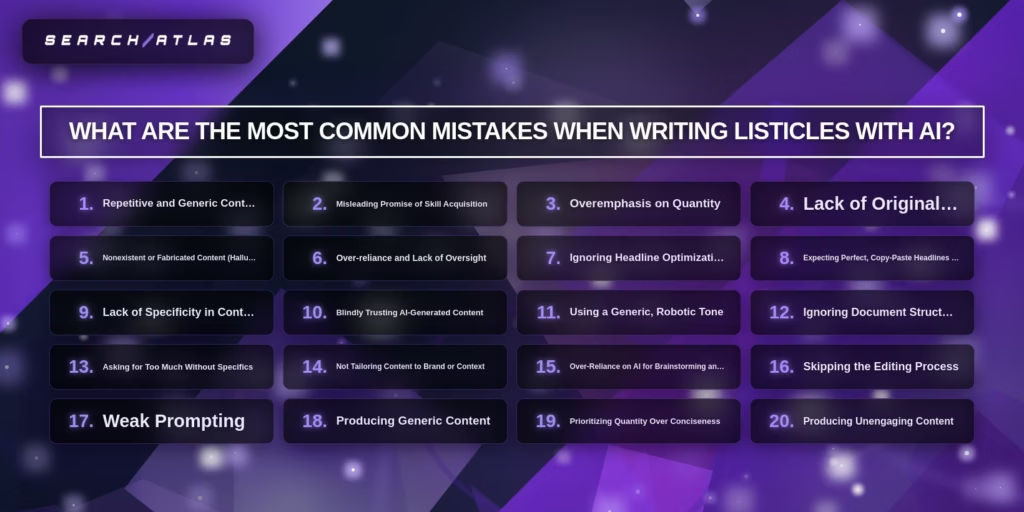
What Are the Best AI Tools for Writing Listicles?
The best AI tools for writing listicles are platforms that generate structured list formats, align with SEO data, and support consistent listicle creation workflows. The best AI tool for listicles combines an AI listicle generator with keyword data, structured outputs, and content optimization features.
The AI writing tool for lists must match the use case, whether the goal is ranking, ideation, or content scaling. The best AI tools for writing listicles are below.
- Search Atlas Content Genius is an AI writing tool for lists that generates SEO-native listicles using SERP-informed briefs, keyword data, and topical authority mapping. Search Atlas Content Genius analyzes ranking pages and builds structured outlines. The platform produces listicle drafts aligned with search intent and entity coverage.
- ChatGPT is an AI listicle generator that produces structured lists, ideas, and drafts based on prompt input. ChatGPT generates multiple listicle variations quickly. The tool works best for ideation and rapid drafting.
- Jasper AI is an AI writing tool for lists that focuses on marketing content, brand voice control, and structured templates. Jasper AI trains on brand guidelines and tone. The platform generates consistent listicle content for campaigns.
- QuillBot AI Listicle Generator is an AI listicle generator that creates keyword-driven list structures for free. QuillBot generates outlines and simple listicle drafts. The tool supports quick structure generation with minimal input.
- Writesonic is an AI writing tool for lists that generates listicle ideas and full articles with SEO integration. Writesonic combines content generation with keyword suggestions. The platform supports scalable listicle production.
- SurferSEO or Surfer AI is an AI writing tool for lists that combines AI drafting with real-time SERP data and keyword optimization. SurferSEO analyzes competitors and suggests content structure. The platform generates optimized listicles based on ranking factors.
The best AI tool for listicles depends on the use case and content goal. SEO-native platforms like Search Atlas fit ranking-focused listicles, while general AI listicle generators (ChatGPT, Jasper AI) fit ideation and drafting. Human editorial oversight remains required for every AI writing tool for lists to ensure accuracy, structure, and originality.
Are Free AI Tools Good Enough for SEO Listicles?
No, free AI tools are not good enough for SEO listicles because free AI tools produce generic, inaccurate, and poorly structured content that fails to meet ranking and quality standards. Free AI tools generate listicle drafts with repetitive phrasing and weak structure. The weak structure reduces readability, engagement, and SEO performance.
Why do free AI tools fail for SEO listicles? Free AI tools fail because they lack data accuracy, SERP alignment, and content depth required for ranking. Many free tools operate as limited trials or basic generators. The limited capability results in shallow outputs and missing optimization signals.
What content issues appear in free AI-generated listicles? Free AI-generated listicles contain filler content, unstructured tips, and repeated phrases that reduce value. The filler content increases word count without adding insight. The repeated phrasing reduces uniqueness and authority.
How do free AI tools impact accuracy and credibility? Free AI tools reduce accuracy because they generate incorrect or unverifiable information. AI systems do not validate truth. The lack of validation introduces hallucinations and factual errors. The errors create risk for SEO and brand trust.
How do free AI tools affect E-E-A-T signals? Free AI tools weaken E-E-A-T signals because free AI tools lack expertise, originality, and verified sourcing. Google prioritizes Experience, Expertise, Authoritativeness, and Trustworthiness. The missing signals reduce ranking potential.
Do AI-generated listicles outperform human-written content? No, AI-generated listicles do not outperform human-written content because human-edited content provides higher accuracy, depth, and originality. Experiments show human content ranks higher for the same keywords. The higher quality improves visibility and engagement.
What is the correct way to use free AI tools for listicles? Use free AI tools for ideation and drafting, then apply human editing, fact-checking, and SEO optimization. Free AI tools support brainstorming and structure generation. Human oversight ensures accuracy, originality, and ranking readiness.
Can AI Tools Replace Human Editing for Listicles?
No, AI tools cannot replace human editing for listicles because AI tools lack contextual judgment, reasoning validation, and nuanced language control required for high-quality content. AI tools process grammar and structure, but AI tools do not evaluate whether arguments make sense or whether conclusions align with evidence. The lack of reasoning reduces content reliability.
Why do AI tools fail to replace human editors? AI tools fail because AI tools cannot assess logic, intent, or narrative coherence across listicle sections. AI tools analyze patterns instead of meaning. The pattern-based output misses logical gaps and unsupported claims.
How do AI tools struggle with tone and nuance? AI tools struggle with tone because AI tools misinterpret stylistic choices and contextual language signals. AI tools rewrite intentional phrasing incorrectly. The incorrect rewrites alter meaning and reduce quality.
What editing tasks do AI tools perform effectively? AI tools perform surface-level editing tasks because AI tools detect grammar, spelling, and consistency issues quickly. AI tools process large text volumes in minutes. The fast processing improves efficiency for first-pass editing.
What is the correct role of AI in the editing workflow? AI tools act as first-pass editors, while human editors perform final validation, refinement, and quality control. AI tools correct mechanical errors. Human editors ensure clarity, logic, and engagement. The combined workflow produces accurate and high-quality listicles.