Hyperlocal ranking factors are the signals that determine how businesses appear in location-specific search results within very small geographic areas. Hyperlocal ranking factors define how search systems evaluate proximity, relevance, and real-world activity at the neighborhood or street level. This definition explains how modern local search prioritizes immediate context instead of broad city-level visibility.
Hyperlocal ranking factors matter because search behavior now happens at the moment of need, where users expect instant, location-aware answers. Search systems interpret user location, intent, and nearby options to deliver results that match real-world proximity and urgency. Businesses gain visibility when their data, content, and engagement signals align with these hyperlocal expectations.
Hyperlocal ranking factors create competitive advantages for businesses operating in high-intent local environments**. Strong proximity signals, consistent entity data, and active engagement** increase the likelihood of appearing in local packs, maps, and AI-generated answers. Visibility in these placements influences decisions immediately, where users take action through calls, directions, or visits without browsing multiple options.
Hyperlocal ranking factors require structured data, consistent listings, and localized content that reflects real-world presence. Optimized profiles present accurate business details, verified locations, and clear service coverage that search systems trust and reuse. Hyperlocal ranking factors align business data with how search engines and AI systems interpret location, intent, and relevance, which defines the current evolution of local search visibility.
What Are Hyperlocal Ranking Factors?
Hyperlocal ranking factors are the signals that control how search engines evaluate and rank businesses for highly specific geographic queries. Hyperlocal ranking factors define how proximity, relevance, and trust interact within small geographic areas, which include neighborhoods, streets, and immediate surroundings. Hyperlocal ranking factors shift visibility from broad location targeting to precise, block-level intent, which changes how businesses compete in local search environments.
Hyperlocal ranking factors govern how search engines interpret location-based intent and match it with real-world businesses. Search systems use hyperlocal ranking factors to filter results based on distance, accuracy, and activity, which determines which businesses appear in Google Maps, Local Pack listings, and localized organic results. This filtering explains why nearby businesses dominate “near me” searches and high-intent local queries.
Hyperlocal ranking factors operate across what ranking environments? Hyperlocal ranking factors operate across Google Maps, Local Pack results, and localized organic search listings. These environments generate results by combining proximity data, business information, and user interaction signals to identify the most relevant businesses.
What do hyperlocal ranking factors optimize in local search? Hyperlocal ranking factors optimize how a business becomes visible, relevant, and trusted within a specific geographic context. Hyperlocal ranking factors focus on accurate business data, strong local signals, and real engagement so search engines select a business for immediate local intent queries.
Hyperlocal ranking factors function as the control system for local visibility and real-world action. Users search for nearby services and receive location-based results, which means hyperlocal ranking factors determine whether a business appears at the exact moment of demand. This control defines hyperlocal ranking factors because modern local search depends on proximity and intent rather than broad keyword rankings.
Why Do Hyperlocal Ranking Factors Matter for Local SEO?
Hyperlocal ranking factors matter for local SEO because they increase conversions, reduce competition, and improve visibility in high-intent searches. Hyperlocal ranking factors align search results with immediate geographic intent, which drives faster decisions and real-world actions. Hyperlocal ranking factors create stronger performance than broad SEO strategies because they focus on proximity, relevance, and demand within small areas.
Hyperlocal ranking factors create consistent visibility, which improves traffic, engagement, and conversions. Hyperlocal ranking factors strengthen local SEO performance because search engines prioritize nearby businesses for “near me” queries. This prioritization increases exposure in Google Maps, Local Pack results, and localized organic listings.
How do hyperlocal ranking factors influence customer behavior? Hyperlocal ranking factors influence customer behavior because local searches lead directly to offline action. Around 87% of customers evaluate businesses through Google, and 97% search online before visiting. This behavior results in 76% of users visiting a business within one day of a nearby search. High intent drives immediate decisions, which increases conversion rates.
Why do hyperlocal ranking factors reduce competition? Hyperlocal ranking factors reduce competition because they limit targeting to small geographic areas. Businesses compete within neighborhoods instead of entire cities or regions. This limited scope reduces the number of competing businesses, which improves ranking opportunities and visibility.
Why do hyperlocal ranking factors expose competitive gaps? Hyperlocal ranking factors expose competitive gaps because they highlight performance differences at the neighborhood level. Businesses identify areas where competitors rank higher and adjust strategies accordingly. This visibility enables targeted improvements that increase local dominance.
How do hyperlocal ranking factors increase visibility in search? Hyperlocal ranking factors increase visibility by aligning with relevance, distance, and prominence signals. Search engines match queries with nearby businesses that meet these conditions. This alignment improves rankings for location-specific searches and increases exposure in high-intent queries.
How Do Hyperlocal Rankings Work in Search Engines?
Hyperlocal rankings work in search engines by combining proximity, relevance, and trust signals to match businesses with highly specific geographic queries. Search engines evaluate business location, content alignment, and real-world activity, which determines which businesses appear in localized organic results. Hyperlocal rankings introduce location-based filtering, which prioritizes nearby businesses and removes irrelevant results.
Hyperlocal rankings function through continuous evaluation of business data and user behavior. Search engines process location signals, website content, and engagement metrics, which creates a ranking system based on immediate intent. Hyperlocal rankings depend on real-time location data, which explains why results change based on user position.
How do search engines determine which businesses appear in hyperlocal results? Search engines determine hyperlocal rankings by combining GBP (GBP) data, on-site relevance, structured data, reviews, and proximity signals. This combination creates a ranking score, which defines which businesses appear for local queries.
What happens during a “near me” search query? A “near me” search triggers real-time ranking adjustments based on user location and intent. Search engines combine proximity data with business signals to generate results. This process produces listings that reflect immediate geographic relevance.
What are the failure points in hyperlocal ranking systems? Hyperlocal rankings fail when business data is inconsistent, incomplete, or inaccurate. Conflicting name, address, and phone (NAP) details reduce trust signals. Weak content relevance and low engagement further reduce ranking performance.
How do hyperlocal rankings impact visibility and traffic? Hyperlocal rankings increase visibility by placing businesses in high-intent search positions. Strong rankings lead to higher impressions, clicks, and visits. This impact creates direct connections between search behavior and real-world actions.
How Does Google Determine Local Intent in Queries?
Google determines local intent in queries by analyzing language, location signals, and user behavior to match searches with nearby results. Google evaluates whether a query requires location-based answers, which triggers localized results across Google Maps, Local Pack listings, and organic search. Local intent detection shifts search results from general information to geographically relevant businesses and resources.
Google identifies local intent through continuous interpretation of query meaning and context. Google combines keywords, device data, and past behavior, which allows the system to infer whether a user expects nearby results. This interpretation explains why searches without location terms still return local businesses.
How does Google identify local intent in search queries? Google identifies local intent by detecting explicit and implicit location signals within a query. Explicit signals include phrases that clearly indicate location, while implicit signals rely on context and behavior. This detection determines whether results are localized.
What are the indicators of local intent in queries? Local intent indicators include explicit geographic terms and implicit location relevance. Explicit terms include “near me,” city names, and region-based modifiers. Implicit intent appears when the query meaning suggests a local need without direct location words.
How does Google detect implicit local intent? Google detects implicit local intent by analyzing query patterns, device location, and historical behavior. Queries without location terms still trigger local results when the system identifies geographic relevance. This detection ensures accurate interpretation of user intent.
What signals does Google use to evaluate implicit local relevance? Google uses location, device data, language, and aggregated behavior to evaluate implicit local relevance. These signals combine the query context with the user environment. This combination produces a relevance score for local intent.
How does user behavior influence local intent detection? User behavior influences local intent detection through aggregated interaction patterns. High volumes of users selecting local results for similar queries signal geographic intent. This user behavior reinforces local interpretation for future searches.
What content types does Google prioritize for local intent queries? Google prioritizes business profiles, map listings, and localized content when local intent is detected. These content types provide direct answers for location-based queries. This prioritization improves relevance and usability.
What ranking factors are influenced by local intent? Local intent influences relevance, proximity, and prominence within search rankings. These local SEO ranking factors determine which businesses appear for localized queries. This influence shapes both map results and organic listings.
What types of local search intent exist? Local search intent includes navigational, transactional, informational, with local modifiers, and “near me” intent. Each type reflects a different stage of user need. This classification explains variations in search behavior.
What Are the Key Benefits of Optimizing for Hyperlocal Ranking Factors?
The key benefits of optimizing for hyperlocal ranking factors are higher conversion rates, lower competition, and stronger local visibility from hyperlocal optimization. These benefits affect how businesses appear in local search results, how users take action, and how demand converts within small geographic areas.
The 5 key benefits that businesses gain from optimizing for hyperlocal ranking factors are listed below.
- Increases conversion rates through high-intent searches. Hyperlocal ranking factors target users searching with immediate intent through “near me” and neighborhood queries. This intent leads to faster decisions, which increases conversions and in-store visits.
- Reduces competition within small geographic areas. Hyperlocal ranking factors limit competition to neighborhoods instead of entire cities. This reduction increases the ability to rank in top positions, which improves visibility in Local Pack results.
- Drives more foot traffic and direct actions. Hyperlocal ranking factors connect search results with physical locations through proximity signals. This connection increases calls, direction requests, and in-person visits from nearby users.
- Strengthens trust through local visibility. Hyperlocal ranking factors place businesses consistently in map results and local listings. This visibility reinforces familiarity, which increases perceived credibility and user confidence.
- Improves visibility in mobile and location-based searches. Hyperlocal ranking factors align with mobile search behavior and real-time location data. This alignment ensures visibility when users search while moving, which increases engagement and immediate action.
These benefits occur because hyperlocal ranking factors prioritize proximity, relevance, and real-world intent instead of broad visibility. As search engines focus on nearby results, businesses that optimize for hyperlocal ranking factors gain stronger positioning at the exact moment users search for local solutions.
What Are the Core Hyperlocal Ranking Factors?
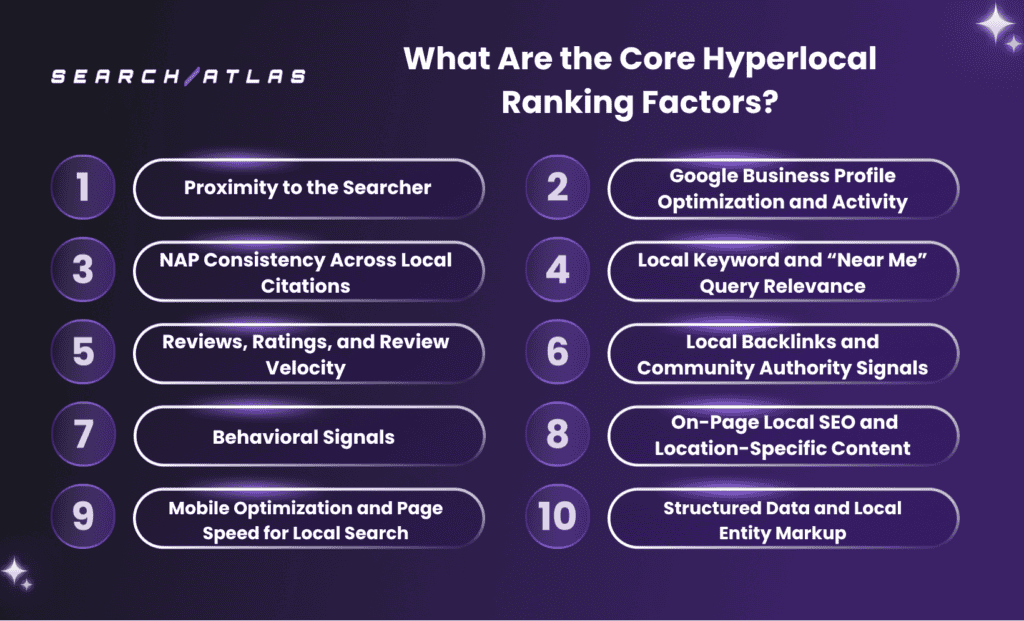
Hyperlocal ranking factors are the signals that determine how businesses appear for neighborhood-level and street-level searches. These factors matter because hyperlocal search depends on immediate relevance, strong local trust, and precise geographic alignment rather than broad city-wide visibility.
Businesses rely on hyperlocal ranking factors to appear in Google Maps, Local Pack results, and localized organic listings where nearby users search with high purchase intent.
The 10 core hyperlocal ranking factors are listed below.
1. Proximity to the Searcher (User Location Signals)
Proximity to the searcher is a hyperlocal ranking factor because hyperlocal search starts with physical distance between the user and the business. Google evaluates real-time location data to identify which businesses are closest to the searcher at the moment of the query. This distance matters most in hyperlocal search because users often want the nearest relevant option, not the best-known option across an entire city. Proximity creates the first layer of local filtering, which means nearby businesses gain a strong advantage before other local signals refine the final rankings.
2. Google Business Profile Optimization and Activity
Google Business Profile optimization and activity is a hyperlocal ranking factor because Google uses profile data to understand what a business is, where it is located, and how active it appears. Accurate categories, services, hours, photos, and profile updates improve local relevance and trust. This factor matters in hyperlocal search because GBP feeds the information that appears in Maps, Local Pack results, and mobile local actions. A complete and active profile gives Google stronger evidence that the business is real, relevant, and ready to satisfy nearby demand.
3. NAP Consistency Across Local Citations
NAP consistency across local citations is a hyperlocal ranking factor because search engines verify business identity through repeated business data across the web. Matching name, address, and phone details across directories strengthens confidence that all references point to the same local entity. This factor matters in hyperlocal search because local visibility depends on trust in an exact location and the contact details of a business. Inconsistent NAP data weakens that trust, creates confusion, and reduces the ability of search engines to connect citations, reviews, and listings into one authoritative business profile.
4. Local Keyword and “Near Me” Query Relevance
Local keyword and “near me” query relevance is a hyperlocal ranking factor because search engines match business content with the exact local language that users type or speak. Neighborhood names, street names, landmarks, and service modifiers signal strong geographic intent. This factor matters in hyperlocal search because Google needs clear evidence that a business is relevant to a specific micro-location, not only to a broad city area. Pages that reflect real hyperlocal language align better with search intent, which increases the chance of appearing for nearby queries with immediate buying intent.
5. Reviews, Ratings, and Review Velocity
Reviews, ratings, and review velocity are hyperlocal ranking factors because Google uses review signals to evaluate business trust, reputation, and current activity. Review count, review quality, and the steady pace of new reviews show that real customers continue to interact with the business. This factor matters in hyperlocal search because nearby users often compare options quickly and rely on reviews to decide where to visit, call, or book. Strong review signals increase both ranking strength and click confidence, which makes reviews a direct factor in local visibility and local conversions.
6. Local Backlinks and Community Authority Signals
Local backlinks and community authority signals are a hyperlocal ranking factor because search engines interpret local mentions and links as proof of geographic credibility and real-world importance. Links from local publications, local organizations, and neighborhood websites show that a business has recognition within the area it wants to rank in. This factor matters in hyperlocal search because Google does not only rank businesses based on distance. Google ranks businesses based on whether the surrounding community appears to recognize them as relevant and trustworthy. Local authority signals strengthen prominence, which improves visibility in competitive hyperlocal markets.
7. Behavioral Signals (Clicks, Calls, Directions, Engagement)
Behavioral signals are a hyperlocal ranking factor because user actions show whether a business actually satisfies local search intent. Clicks, calls, direction requests, profile visits, and website visits reveal how searchers respond after seeing a local listing. This factor matters in hyperlocal search because Google looks for real engagement, not only static business information. Strong behavioral signals show that users find the business useful and relevant in a nearby context. Repeated engagement reinforces local ranking strength, especially where multiple businesses share similar proximity and profile quality.
8. On-Page Local SEO and Location-Specific Content
On-page local SEO and location-specific content are hyperlocal ranking factors because website content gives Google detailed context about where a business operates and what it offers in each location. Service pages, neighborhood pages, local FAQs, and location-specific copy show clear relevance to micro-area searches. This factor matters in hyperlocal search because a GBP alone does not explain every local service relationship in enough detail. Strong on-page local content connects services with neighborhoods, landmarks, and local needs, which improves organic visibility and strengthens local relevance beyond listings alone.
9. Mobile Optimization and Page Speed for Local Search
Mobile optimization and page speed are hyperlocal ranking factors because a large share of hyperlocal searches happen on mobile devices with immediate action intent. Users search for nearby businesses while moving, comparing options, or trying to solve an urgent problem quickly. This factor matters in hyperlocal search because slow pages, poor mobile layouts, and weak action paths reduce engagement at the exact moment local intent is strongest. Fast mobile performance improves usability, preserves clicks, and increases the chance that nearby users complete actions that reinforce local ranking signals.
10. Structured Data and Local Entity Markup
Structured data and local entity markup are hyperlocal ranking factors because search engines rely on machine-readable business details to understand identity, location, services, and operating information accurately. Schema Markup clarifies how business attributes connect to local search intent. This factor matters in hyperlocal search because local visibility depends on the precise interpretation of address data, service areas, hours, and business type. Strongly structured data reduces ambiguity, strengthens entity understanding, and improves how Google connects a business to local queries, local features, and rich search results.
How Does Proximity Influence Hyperlocal Rankings?
Proximity influences hyperlocal rankings by prioritizing businesses that are physically closest to the searcher at the moment of the query. Proximity acts as the first filtering mechanism in local search, which determines which businesses qualify to appear in Google Maps, Local Pack results, and nearby listings. Proximity creates geographic boundaries around search results, which limit visibility to businesses within a specific radius.
Proximity drives hyperlocal rankings because search engines prioritize immediate usability and real-world convenience. Search systems evaluate distance using GPS and IP data, which allows Google to match queries with nearby businesses in real time. This evaluation explains why two users searching the same query receive different results based on location.
How does Google use proximity as a core local ranking factor? Google uses proximity as one of the 3 main local ranking factors alongside relevance and prominence. This role places distance at the foundation of local search evaluation. Proximity determines which businesses enter the ranking set before other signals influence ordering.
How does proximity affect which businesses appear in local results? Proximity affects visibility by limiting results to businesses within a defined geographic radius. Businesses outside that radius rarely appear in Local Pack results. This limitation ensures that only nearby options match high-intent local queries.
What happens to rankings as the distance from the searcher increases? Rankings decrease as distance increases because search engines reduce visibility for businesses farther away. This decrease creates a ranking drop pattern where closer businesses dominate top positions. Distance acts as a decay factor that weakens ranking strength beyond the immediate area.
How does proximity interact with other hyperlocal ranking factors? Proximity interacts with relevance, reviews, and authority signals to determine final rankings. Proximity controls eligibility, while other signals refine ranking order. Strong authority and engagement improve rankings only after a business qualifies within the proximity range.
How does search intent influence the strength of proximity? Search intent changes how strongly proximity affects rankings. High-intent queries for everyday services produce tight geographic clustering. Broader queries allow a wider radius, which expands visibility beyond immediate surroundings.
How does business type affect proximity influence? Business type affects proximity because some services require immediate access, while others allow wider travel distances. Local services rely heavily on proximity, while specialized services appear across larger areas. This variation explains why ranking radius differs by industry.
What limits exist in proximity-based ranking systems? Proximity-based systems prioritize distance but do not guarantee ranking position. Businesses with weak relevance or poor reputation fail to rank even when nearby. This limitation shows that proximity alone does not determine final visibility.
How does proximity impact visibility and traffic outcomes? Proximity impacts visibility by controlling which businesses appear at the moment of local demand. Strong proximity placement increases impressions, clicks, and visits from nearby users. This impact connects search behavior directly with real-world actions.
How Does Foot Traffic Data Influence Local Search Signals?
Foot traffic data influences local search signals indirectly through user behavior, engagement signals, and real-world interactions rather than direct ranking inputs. Foot traffic data reflects how users move from search to physical visits, which connects online intent with offline activity. Foot traffic data does not act as a direct ranking factor, but the actions it generates strengthen signals that search engines measure.
Foot traffic data connects local search with real-world outcomes because local queries often lead to immediate visits. Search engines track actions that precede visits, which include clicks, calls, and direction requests. These actions create measurable signals, which influence local rankings over time.
How does local search intent connect to foot traffic data? Local search intent connects to foot traffic data because users searching for nearby services often plan immediate visits. High-intent queries produce actions that lead directly to physical locations. This connection explains why local search drives real-world traffic instead of only online engagement.
How do user actions influence local search signals? User actions influence local search signals through clicks, calls, and direction requests from listings. These actions signal relevance and demand to search engines. Higher interaction levels strengthen ranking signals because they reflect real user interest.
How does Google Business Profile influence foot traffic signals? GBP influences foot traffic signals by shaping the first interaction before a visit. Profile elements include photos, reviews, and business details that affect user decisions. Strong profiles increase engagement, which leads to more visits and stronger behavioral signals.
What role do reviews and engagement play in foot traffic influence? Reviews and engagement influence foot traffic by building trust and encouraging visits. Positive reviews and active responses increase user confidence. This confidence leads to more clicks and visits, which reinforce local ranking signals.
How do local SEO strategies increase foot traffic? Local SEO strategies increase foot traffic by improving visibility for nearby searches. Optimized profiles, relevant keywords, and mobile-friendly pages are SEO strategies that attract users with immediate intent. This visibility increases the number of users who take action and visit.
What data sources define foot traffic measurement? Foot traffic measurement uses mobile location data, in-store tracking systems, and transaction data. These sources estimate visits, dwell time, and repeat behavior. This measurement provides insight into real-world engagement patterns.
How does foot traffic data relate to ranking signals indirectly? Foot traffic data relates to ranking signals indirectly because visits generate engagement signals that search engines track. Actions that lead to visits strengthen behavioral signals. These signals influence rankings without the direct use of foot traffic metrics.
What limitations exist in using foot traffic data for search rankings? Foot traffic data does not directly feed into search engine ranking systems. Search engines rely on observable digital interactions instead of physical visit counts. This limitation means foot traffic influences rankings only through measurable online behavior.
How does combining online and offline data affect local search understanding? Combining online and offline data improves understanding of the full customer journey. Search systems interpret how searches lead to actions and visits. This interpretation strengthens the connection between digital intent and physical outcomes.
How Do Reviews Impact Hyperlocal Search Visibility?
Reviews impact hyperlocal search visibility by increasing rankings, strengthening trust, and improving engagement signals across local results. Reviews create measurable signals that search engines use to evaluate prominence, which determines how businesses rank in Google Maps, Local Pack listings, and localized search results. Reviews influence both visibility and user decisions, which makes them a core factor in hyperlocal SEO performance.
Reviews drive hyperlocal visibility because search engines prioritize businesses with strong reputation signals. Review count, rating quality, and recent activity indicate that a business remains active and trusted within its local area. These signals affect how businesses rank and how users choose between nearby options.
How do reviews contribute to hyperlocal ranking factors? Reviews contribute to hyperlocal ranking factors by strengthening the prominence signal within local algorithms. Prominence measures how well-known and trusted a business appears based on external feedback. Reviews increase prominence because they provide consistent, third-party validation of quality and service. This validation influences ranking order once multiple nearby businesses qualify through proximity.
What is the impact of review quality and quantity on hyperlocal visibility? Review quality and quantity impact hyperlocal visibility by defining both trust level and competitive strength. Higher ratings increase perceived reliability, while a larger number of reviews increases authority. Search engines favor businesses that maintain strong ratings and higher review counts compared to local competitors. This combination improves ranking stability and increases click-through rates from local results.
How do review recency and velocity affect hyperlocal rankings? Review recency and velocity affect hyperlocal rankings by signaling ongoing business activity and relevance. Fresh reviews show that customers continue to interact with the business, which strengthens trust signals. Consistent review flow maintains ranking performance, while long gaps in reviews reduce visibility. Search engines interpret steady review activity as proof of current demand and service quality.
What role do review content and keywords play in hyperlocal SEO? Review content and keywords influence hyperlocal SEO by adding natural language signals that match search intent. Review text includes service names, locations, and outcomes, which reinforces relevance for local queries. Search engines index this content and highlight matching phrases in results. This process increases visibility for long-tail and hyperlocal searches without relying on on-page keyword placement alone.
How do review responses and engagement influence hyperlocal rankings? Review responses and engagement influence hyperlocal rankings by demonstrating active business management and customer interaction. Businesses that respond to reviews show higher engagement levels, which strengthens trust signals. Fast and consistent responses indicate that the business values feedback and maintains communication. This activity contributes to stronger visibility and improved ranking performance over time.
What is the importance of a multi-platform review strategy for hyperlocal SEO? A multi-platform review strategy influences hyperlocal SEO by expanding reputation signals across multiple trusted sources. Reviews from Google, Yelp, and industry platforms increase overall credibility. Search engines evaluate sentiment across these sources to confirm consistency. Broader review presence strengthens authority and supports higher visibility in local results.
How do reviews impact user behavior and click-through rates in hyperlocal search? Reviews impact user behavior and click-through rates by acting as immediate trust signals in search results. Higher ratings and visible review counts attract more clicks and interactions. Users compare nearby businesses quickly, and strong reviews influence selection decisions. Increased clicks, calls, and direction requests reinforce behavioral signals that improve rankings.
How do reviews build trust and credibility in hyperlocal search? Reviews build trust and credibility by providing external proof of service quality and customer satisfaction. Positive feedback confirms that a business delivers consistent results. This confirmation increases confidence for nearby users deciding where to visit or contact. Trust signals from reviews influence both ranking performance and conversion outcomes.
How do reviews influence AI-driven local search and entity understanding? Reviews influence AI-driven local search by shaping how systems interpret a business’s reputation and expertise. Review patterns highlight services, strengths, and customer experiences. AI systems use this data to summarize and recommend businesses in local results. Strong review signals improve visibility in both traditional search and AI-generated answers.
What risks exist when businesses neglect reviews in hyperlocal SEO? Neglecting reviews reduces hyperlocal visibility by weakening trust and engagement signals. Outdated or missing reviews indicate low activity, which reduces ranking strength. Unanswered feedback signals poor management, which affects user perception and search performance. Consistent review activity is required to maintain competitive visibility in hyperlocal search.
How Do Behavioral Signals Affect Local Rankings?
Behavioral signals affect local rankings by showing how users interact with business listings, which reflects real-world relevance and demand. Behavioral signals measure actions after a search, which include clicks, calls, direction requests, and on-site engagement. Search engines use these signals to adjust rankings based on actual user behavior instead of static business data.
Behavioral signals influence local rankings because they represent real engagement that is difficult to manipulate at scale. Search systems interpret repeated user actions as proof that a business satisfies local intent. This interpretation explains why businesses with stronger engagement often outrank competitors with similar proximity and profile strength.
How do behavioral signals influence local search rankings? Behavioral signals influence local search rankings by reinforcing relevance and prominence through user interaction. High engagement shows that users prefer a business for specific queries. This preference increases ranking strength over time as search engines detect consistent interaction patterns.
What are the key behavioral signals in local search? Key behavioral signals include click-through rate, calls, direction requests, dwell time, and GBP interactions. These signals represent direct user actions taken after seeing a listing. Each action provides evidence that the business meets user needs within a local context.
How does click-through rate function as a local ranking signal? Click-through rate functions as a local ranking signal by indicating how often users choose a listing over competitors. Higher click rates show stronger relevance for a query. Search engines interpret this behavior as a positive signal, which improves ranking position.
How do calls and direction requests impact local rankings? Calls and direction requests impact local rankings by signaling strong purchase or visit intent. These actions show that users plan to engage with the business in real life. Search engines treat these signals as high-value interactions that reinforce local relevance.
How does dwell time affect local ranking performance? Dwell time affects local ranking performance by measuring how long users stay on a website after clicking. Longer sessions indicate that users find the content useful and relevant. Short visits signal poor alignment with user intent, which weakens ranking signals.
What role do Google Business Profile interactions play in rankings? GBP interactions influence rankings by capturing actions taken directly from listings. Profile views, photo interactions, and engagement trends show user interest. Strong activity levels reinforce visibility and improve local ranking outcomes.
How do behavioral signals compare to other ranking factors? Behavioral signals differ from other ranking factors because they reflect real user activity instead of static optimization. Proximity and relevance define eligibility, while behavioral signals influence final ranking order. This role makes behavioral data critical in competitive local environments.
What limitations exist in behavioral signal influence? Behavioral signals influence rankings but do not act alone in determining position. Search engines combine these signals with proximity, reviews, and content relevance. Weak foundational signals limit the impact of strong engagement.
How do artificial interactions affect behavioral signals? Artificial interactions reduce the reliability of behavioral signals because search engines detect unnatural patterns. Repeated clicks from similar sources or abnormal activity patterns trigger filtering systems. These filters prevent manipulation and maintain ranking integrity.
Behavioral signals impact visibility by increasing ranking strength through consistent engagement. Higher rankings lead to more impressions and interactions. This cycle connects search visibility with real-world conversions, which reinforces long-term local performance.
How to Optimize for Hyperlocal Ranking Factors?
Hyperlocal optimization improves visibility by aligning business signals with precise location intent at neighborhood, street, and landmark levels. Hyperlocal optimization matters because search engines prioritize proximity, relevance, and real-world engagement for immediate local decisions. Strong execution increases map visibility, improves retrieval in “near me” queries, and strengthens trust through consistent local signals.
The 7 ways to optimize for hyperlocal ranking factors are listed below.
1. Optimize Google Business Profile With Complete and Accurate Data
2. Build Consistent Local Citations Across Directories
3. Target Hyperlocal Keywords and Geo-Specific Queries
4. Generate and Manage Customer Reviews Strategically
5. Create Location-Specific Landing Pages and Content
6. Earn Local Backlinks From Relevant Community Sources
7. Improve Mobile Experience and Local Page Speed
1. Optimize Google Business Profile
Google Business Profile optimization means building a complete, accurate, and active business entity inside Google’s local ecosystem. This factor matters because Google uses profile data to evaluate relevance, proximity alignment, and prominence in local pack rankings. Strong profiles improve visibility and trust because accurate information, reviews, and ongoing activity confirm business legitimacy. Businesses apply this by completing every field, selecting precise primary and secondary categories, uploading high-quality photos, updating hours, and responding to reviews consistently. Regular posts, Q&A updates, and service listings reinforce engagement and freshness signals that influence ranking systems. Profiles that remain inactive lose visibility over time, even with strong fundamentals. A practical rule is to treat the profile as a continuously managed asset that reflects real-world activity at all times.
2. Build Consistent Local Citations Across Directories
Local citations mean consistent mentions of the business name, address, and phone number across directories, platforms, and websites. This factor matters because search engines validate entity accuracy and trust through repeated matching of data across multiple trusted sources. Consistency improves retrieval and confidence, while mismatches create confusion that weakens ranking signals and reduces visibility. Businesses apply this by auditing listings, correcting inconsistencies, removing duplicates, and aligning all citations with a single verified format. Expanding presence across high-authority directories and niche platforms strengthens entity coverage and reinforces legitimacy signals. Even small differences in formatting or spelling create fragmentation in how search engines interpret the business. A practical rule is to define one exact NAP format and maintain that format everywhere without variation.
3. Target Hyperlocal Keywords and Geo-Specific Queries
Hyperlocal keyword targeting means aligning content with specific neighborhoods, streets, landmarks, and precise geographic intent. This factor matters because search engines match queries based on granular location relevance instead of broad city-level targeting. Strong alignment improves retrieval for high-intent searches and connects businesses with users who are ready to act immediately. Businesses apply this by creating pages and content that reference neighborhoods, nearby landmarks, service areas, and commonly recognized local identifiers within headings and body content. Internal linking between location pages reinforces geographic relationships and strengthens topical structure. Generic city-level targeting fails to capture the specificity of real search behavior. A practical rule is to use the same location language that real customers use in everyday navigation and local conversations.
4. Generate and Manage Customer Reviews Strategically
Review management means actively generating, monitoring, and responding to customer feedback across platforms. This factor matters because reviews influence prominence, trust, and ranking order within local search results. Strong review signals improve visibility because consistent feedback reflects real customer experience and active engagement. Businesses apply this by requesting reviews after each service, maintaining steady review velocity, and responding quickly with contextual, location-aware replies. Reviews that mention services, outcomes, and locations strengthen relevance signals and improve how search systems interpret business offerings. Irregular review patterns or long inactivity periods weaken perceived credibility. A practical rule is to maintain a continuous flow of authentic reviews instead of relying on occasional bursts of activity.
5. Create Location-Specific Landing Pages and Content
Location-specific pages mean dedicated content built for each service area, neighborhood, or geographic segment. This factor matters because search engines require clear geographic relevance to match pages with hyperlocal queries. Strong pages improve retrieval and authority because they provide unique local context instead of duplicated or generic content. Businesses apply this by building pages with local keywords, embedded maps, testimonials, service details, and neighborhood-specific insights that reflect real conditions and customer needs. Each page must contain distinct content tied to that location to avoid duplication and weak signals. Pages that repeat the same structure without local differentiation fail to rank effectively. A practical rule is that every location page needs to contain information that only applies to that specific area.
6. Earn Local Backlinks From Relevant Community Sources
Local backlinks mean links from geographically and contextually relevant websites within the same community or region. This factor matters because backlinks signal authority and local relevance to search engines, evaluating ranking strength and trust. Strong local links improve visibility because trusted community sources reinforce business credibility and real-world presence. Businesses apply this by building partnerships with local organizations, earning mentions from local media, sponsoring events, and participating in community initiatives that generate natural links. Links from relevant local domains carry stronger signals than generic or unrelated sources. Authority grows through association with recognized local entities. A practical rule is to prioritize relevance, proximity, and real community connection over the total number of links acquired.
7. Improve Mobile Experience and Local Page Speed
Mobile optimization means delivering fast, responsive, and accessible experiences for users searching on mobile devices. This factor matters because most hyperlocal searches occur on mobile with immediate, action-driven intent. Strong performance improves visibility and engagement because fast pages reduce friction and increase interaction signals that influence rankings. Businesses apply this by optimizing load speed, compressing images, simplifying navigation, and ensuring mobile-friendly layouts across all pages. Clear calls to action, click-to-call buttons, and easy navigation improve usability and drive immediate actions. Slow or complex mobile experiences reduce engagement and weaken behavioral signals. A practical rule is to keep load time under three seconds and remove any friction that delays user action.
What Are the Differences Between Local SEO and Hyperlocal SEO Ranking Factors?
The difference between Local SEO and Hyperlocal SEO ranking factors lies in how each strategy targets geographic relevance and user intent. Local SEO optimizes visibility across broader areas (cities or regions), while Hyperlocal SEO focuses on precise locations (neighborhoods, streets, and landmarks). This distinction defines how businesses appear in search results, how search engines evaluate proximity, and how users interact with local listings.
This difference matters because targeting the correct level of location intent directly impacts visibility, engagement, and conversion rates. Broader targeting increases reach, while precise targeting increases immediacy and action-driven behavior. Businesses that align strategy with real search behavior gain stronger ranking positions and higher conversion efficiency.
The core differences between Local SEO and Hyperlocal SEO ranking factors are below.
| Aspect | Local SEO | Hyperlocal SEO |
|---|---|---|
| Scope of targeting | Focuses on cities, regions, and metropolitan areas. | Focuses on neighborhoods, streets, landmarks, and micro-locations. |
| Keyword strategy | Targets city-level keywords with broader intent. | Targets highly specific, location-driven, and “near me” queries. |
| Content strategy | Uses general location-based content for wider audiences. | Uses highly specific content tied to local context and environment. |
| Competition level | Faces higher competition across larger geographic markets. | Faces lower competition within smaller geographic segments. |
| Search engine evaluation | Balances relevance, distance, and prominence at a city level. | Prioritizes proximity and real-time location matching more heavily. |
| Audience and intent | Captures users researching options across a wider area. | Captures users ready to act within immediate proximity. |
| Device prioritization | Balanced across desktop and mobile usage. | Strongly driven by mobile and real-time search behavior. |
| Optimization focus | Emphasizes authority, citations, and broad relevance. | Emphasizes proximity signals, engagement, and contextual relevance. |
What does Local SEO do differently from Hyperlocal SEO? Local SEO targets broader geographic visibility by connecting businesses with users searching across entire cities or regions. The system evaluates relevance and authority across a wider dataset, which prioritizes businesses with strong domain signals, citations, and overall prominence.
Hyperlocal SEO operates at a much narrower level by aligning results with the exact user location at the moment of search. The system prioritizes proximity and immediate relevance, which favors businesses physically closer to the searcher. This difference changes how results appear, with hyperlocal queries producing tighter, location-specific result sets.
How does Hyperlocal SEO improve conversion compared to Local SEO? Hyperlocal SEO improves conversion by matching results with immediate, high-intent user behavior. Users performing hyperlocal searches often look for nearby solutions with urgency, which increases the likelihood of direct actions (calls, visits, or bookings).
Local SEO captures broader research intent, where users compare options across a city before making a decision. This broader intent increases visibility but reduces immediacy. Hyperlocal targeting reduces decision time because the results align with convenience and proximity, which increases engagement and conversion rates.
How do search engines evaluate Local SEO vs Hyperlocal SEO signals? Search engines evaluate Local SEO signals by analyzing relevance, authority, and overall prominence across a defined geographic area. These signals include backlinks, citations, content relevance, and business authority within a city or region.
Hyperlocal SEO evaluation focuses more heavily on proximity, real-time location data, and behavioral signals. Systems prioritize businesses that demonstrate clear geographic alignment with the user’s exact position. This evaluation uses GPS data, mobile behavior, and local engagement patterns to determine which businesses appear first.
When is Local SEO required over Hyperlocal SEO? Local SEO is required for businesses that operate across wide service areas or target customers throughout an entire city or region. Businesses that rely on brand awareness, research-driven decisions, or large-scale service coverage benefit from broader targeting. Examples include law firms, agencies, and multi-location businesses that need visibility across multiple districts. Local SEO supports long-term authority building and captures users in earlier stages of the decision process.
When is Hyperlocal SEO required over Local SEO? Hyperlocal SEO is required for businesses that depend on nearby customers and immediate actions. Businesses that rely on foot traffic, quick decisions, or convenience benefit from precise geographic targeting. Examples include restaurants, cafés, salons, and service providers operating within specific neighborhoods. Hyperlocal SEO captures users with immediate intent, which increases conversion rates and shortens the path from search to action.
Why does this difference matter for local search performance? This difference matters because search performance depends on how accurately a strategy matches user intent and location context. Local SEO increases reach and authority across larger areas, while Hyperlocal SEO increases precision and immediacy within smaller areas. Hyperlocal SEO represents a shift toward real-time, proximity-driven search behavior, where mobile usage and instant decisions define rankings. Businesses that align with this shift gain stronger visibility in high-intent searches and outperform competitors that rely only on broad local strategies.
What Are the Key Differences Between Desktop and Mobile Local Results?
The difference between desktop and mobile local results lies in how each environment handles user intent, result layout, and ranking signal weighting. Desktop local results support broader research and comparison, while mobile local results prioritize immediacy, proximity, and action-driven behavior. This distinction defines how businesses appear in local search, how users interact with listings, and how search engines decide which results deserve visibility.
This difference matters because ranking well on desktop does not guarantee the same performance on mobile. Search engines evaluate local intent differently across devices, which changes the result order, click behavior, and conversion patterns. Businesses that understand these differences build stronger local strategies and capture both research-driven demand and immediate nearby demand.
The core differences between desktop and mobile local results are below.
| Aspect | Desktop Local Results | Mobile Local Results |
|---|---|---|
| Core intent | Supports research, comparison, and planning. | Supports immediate action, convenience, and proximity-driven decisions. |
| Proximity influence | Uses proximity, but not as aggressively. | Uses proximity heavily in ranking and result selection. |
| SERP layout | Shows a wider layout with more visible organic results. | Shows a compressed layout where map features dominate earlier. |
| Local pack behavior | Places map and business details within a broader page structure. | Pushes map pack and action buttons to the top of the experience. |
| Organic visibility | Leaves more room for lower-ranking organic results. | Reduces organic visibility because local features occupy more space. |
| Listing features | Emphasizes reviews, links, and deeper browsing paths. | Emphasizes calls, directions, hours, and fast action buttons. |
| Ranking emphasis | Rewards authority, long-form relevance, and deeper content signals. | Rewards proximity, speed, mobile usability, and immediate intent alignment. |
| Content format | Performs better with detailed, research-oriented content. | Performs better with concise, action-oriented content. |
| Conversion behavior | Supports longer consideration and delayed action. | Supports immediate visits, calls, and in-the-moment decisions. |
| Optimization priority | Favors authority building and content depth. | Favors speed, usability, and action-focused local experience. |
What do desktop local results do differently from mobile local results? Desktop local results organize search around research and comparison instead of immediate action. Users on desktop often compare businesses, read reviews in detail, and explore service pages before deciding. This structure creates more room for organic listings, deeper content, and broader browsing behavior.
Mobile local results organize search around speed and convenience. Users on mobile often search while moving, navigating, or trying to solve an immediate need. This structure increases the importance of map visibility, action buttons, and proximity signals. Mobile local results reduce friction between search and action, which makes immediate usability more important than depth.
How does mobile local search change ranking behavior? Mobile local search changes ranking behavior by increasing the weight of proximity, page speed, and mobile usability. Search engines interpret mobile local queries as stronger indicators of immediate intent, which shifts visibility toward businesses that are nearby and easy to act on. This shift increases the importance of click-to-call features, directions, and fast-loading pages.
Desktop local search uses local relevance, too, but it leaves more room for authority and content depth to influence performance. Desktop users often tolerate more comparison and longer decision cycles. This behavior gives stronger organic pages more opportunity to compete, even when the searcher is not ready to act immediately.
How do both environments handle local pack and organic results? Desktop local results display the local pack within a broader search experience that still leaves meaningful room for organic listings. Users scan business results, map information, and organic links more easily because the larger screen supports parallel evaluation. This layout improves visibility for organic pages beyond the top few local listings.
Mobile local results place the local pack much earlier in the user journey. The map, reviews, hours, directions, and action buttons often dominate the first visible screen. This structure pushes traditional organic results lower, which increases the competitive value of local pack placement. Businesses that fail to rank in mobile local features lose more visibility than they would on desktop.
When is desktop local optimization required over mobile local optimization? Desktop local optimization is required when the business depends on research-heavy decisions, long-form content, or higher-consideration services. Users comparing legal services, agencies, medical providers, or high-ticket offerings often research across multiple pages before acting. These journeys benefit from stronger organic content, richer navigation, and deeper informational structure.
Desktop optimization fits businesses that rely on authority building and backlink growth as part of local performance. Long-form guides, resource pages, and broader service comparisons perform better in desktop-oriented research environments. These pages influence awareness and trust earlier in the decision cycle.
When is mobile local optimization required over desktop local optimization? Mobile local optimization is required when the business depends on immediate intent, nearby visibility, and quick user action. Restaurants, cafés, salons, urgent services, and retail stores often win traffic from users who need directions, hours, or a fast call option. These searches happen in motion and convert quickly.
Mobile optimization fits businesses competing for nearby customers in dense local markets. The smaller screen, stronger proximity weighting, and action-focused SERP design make mobile local performance essential for capturing real-world visits. Businesses that ignore mobile usability lose visibility at the exact moment local demand becomes most valuable.
Why does this difference matter for local search performance? This difference matters because local search performance depends on matching the device context behind the query. Desktop local results reward depth, research value, and broader comparison behavior. Mobile local results reward immediacy, convenience, and proximity-driven action.
Desktop and mobile local search represent two different local decision environments rather than one shared ranking system. This distinction defines how businesses structure pages, optimize listings, and prioritize ranking signals. Businesses that align with both environments build stronger visibility across the full local search journey.
What Industries Benefit Most From Hyperlocal Ranking Optimization?
The industries that benefit most from hyperlocal ranking optimization are healthcare providers, restaurants, real estate agents, home repair services, travel and hospitality, and local professional services. These industries rely on proximity, immediate intent, and location-based visibility, which makes hyperlocal optimization a primary driver of search performance.
Hyperlocal ranking optimization matters because search engines prioritize proximity and real-world relevance in local results. This prioritization increases visibility for nearby businesses and connects high-intent users with immediate solutions. Businesses that align with hyperlocal signals gain stronger placement in map results, higher engagement, and faster conversion cycles.
The 6 main industries that benefit most from hyperlocal ranking optimization are listed below.
1. Healthcare providers. Healthcare providers depend on proximity-based trust, which increases visibility for “near me” medical searches. Healthcare searches often involve urgency and location sensitivity, which makes proximity a dominant ranking factor. Hyperlocal optimization improves patient acquisition because search engines prioritize nearby providers with strong review signals and accurate location data. Clinics apply this strategy by optimizing profiles, collecting reviews, and reinforcing local relevance through content. This alignment increases trust and drives faster patient decisions.
2. Restaurants and food businesses. Restaurants rely on immediate intent, which makes hyperlocal visibility essential for discovery and selection. Food-related searches often occur in real time, where users choose based on distance, ratings, and availability. Hyperlocal optimization improves visibility in map packs and increases foot traffic because proximity heavily influences rankings. Restaurants apply this strategy through updated profiles, strong review activity, and location-specific content. This alignment increases walk-in visits and shortens decision time.
3. Real estate agents. Real estate agents operate in highly localized markets, which makes hyperlocal targeting critical for visibility. Property searches depend on specific neighborhoods, streets, and local expertise rather than broad regions. Hyperlocal optimization improves listing exposure because search engines match agents with precise geographic queries. Agents apply this strategy by creating neighborhood-focused pages, optimizing listings, and building local authority signals. This alignment increases qualified leads and strengthens positioning in competitive markets.
4. Home repair and contractor services. Home repair services depend on urgent, location-based demand, which makes proximity a dominant ranking factor. Searches for plumbers, electricians, and contractors often reflect immediate problems that require nearby solutions. Hyperlocal optimization improves visibility because search engines prioritize businesses that match location and urgency signals. Service providers apply this strategy through local content, fast response features, and accurate service areas. This alignment increases call volume and captures high-intent leads.
5. Travel and hospitality businesses. Travel and hospitality businesses depend on mobile-driven discovery, which makes hyperlocal visibility essential during active trips. Travelers search for nearby hotels, restaurants, and attractions while moving, which increases reliance on proximity and real-time relevance. Hyperlocal optimization improves discoverability because search engines prioritize nearby options with strong engagement signals. Businesses apply this strategy through mobile optimization, updated listings, and localized content. This alignment increases bookings and on-the-go conversions.
6. Local professional services. Local professional services include legal, financial, automotive, and education providers that rely on geographic relevance. These services depend on trust and proximity, which makes hyperlocal signals critical for ranking and visibility. Hyperlocal optimization improves discovery because search engines match users with nearby experts based on intent and credibility signals. Professionals apply this strategy through citation consistency, local content, and review management. This alignment increases inquiries and strengthens the local authority.
What Are the Best Ways to Track Hyperlocal Ranking Performance?
The best ways to track and optimize hyperlocal ranking performance are geo-grid tracking, SERP APIs, Total Average Rank Position (TARP), local rank trackers, and GBP automation. These methods combine measurement with execution, which ensures businesses do not just monitor rankings but actively improve visibility across precise locations.
This process matters because hyperlocal rankings vary block by block rather than city by city. Search engines evaluate proximity, engagement, and real-time signals, which means performance changes across small geographic distances. Businesses that track and optimize at this level gain stronger visibility, better positioning in map results, and higher conversion from nearby searches.
The 5 main ways to track and optimize hyperlocal ranking performance are listed below.
1. Geo-grid tracking. Geo-grid tracking measures rankings across multiple coordinates, which reveals true visibility within a service area. This method matters because hyperlocal rankings change by distance, not by a single keyword position. Businesses apply geo-grids by mapping rankings across neighborhoods and identifying weak zones where visibility drops. This insight guides targeted optimization (content updates, citation improvements, and review generation). Geo-grid tracking improves performance by showing exactly where ranking gaps exist and where optimization produces the highest impact.
2. SERP APIs. SERP APIs collect real-time ranking data from specific geographic locations, which provides precise visibility into local search behavior. This method matters because standard tools lack location-level accuracy for hyperlocal queries. Businesses apply SERP APIs by pulling ranking data for exact coordinates and integrating results into dashboards or workflows. This data supports rapid testing of changes (keyword targeting or listing updates). SERP APIs improve performance by enabling continuous monitoring and faster response to ranking fluctuations.
3. Total Average Rank Position (TARP). Total Average Rank Position aggregates multiple ranking points into a single performance metric, which simplifies complex geo-grid data. This method matters because hyperlocal data becomes difficult to interpret without consolidation. Businesses apply TARP by calculating average rankings across all tracked locations to measure overall visibility trends. This metric highlights whether optimization efforts improve or reduce performance over time. TARP improves decision-making by turning fragmented ranking data into a clear performance signal.
4. Local rank tracker tools. Local rank tracker tools simulate searches from specific locations, which provide accurate insights into map pack and organic rankings. This method matters because rankings differ based on user location and device context. Businesses apply these tools by tracking keywords across neighborhoods and monitoring changes after updates. These tools guide actions (improving listings, adjusting content, and strengthening local signals). Local rank tracking improves performance by connecting ranking changes directly to optimization efforts.
5. Google Business Profile automation. Google Business Profile automation manages listings, updates data, and maintains activity signals, which directly influence hyperlocal rankings. This method matters because search engines rely on accurate and active profiles to determine visibility. Businesses apply automation systems (Search Atlas GBP Galactic) to synchronize data, respond to reviews, update Q&A, and maintain consistency across locations. This automation improves performance by keeping profiles active, accurate, and aligned with local ranking signals in real time.
What Is the Impact of Zero-Click Searches on Local Businesses?
Zero-click searches impact local businesses by shifting visibility from website traffic to direct interaction on search results pages. This shift matters because search engines now deliver answers, contact details, and business actions without requiring a click, which changes how visibility, engagement, and conversion occur.
Zero-click searches impact local businesses by increasing reliance on search engine features instead of website visits. Features (local packs, knowledge panels, and AI-generated answers) display business information directly on the results page. This visibility reduces traditional clicks but increases exposure at the exact moment of user intent, which changes how businesses capture attention and drive actions.
Zero-click searches impact local businesses by reducing website traffic while increasing competition inside search results. Fewer clicks limit opportunities for on-site engagement, data tracking, and content interaction. This reduction forces businesses to compete directly within SERP features, where only a limited number of listings gain visibility and user interaction.
Zero-click searches impact local businesses by increasing direct actions (calls, direction requests, and in-person visits). Users often complete their journey without visiting a website because the information appears instantly on the search page. This behavior increases conversion efficiency for businesses that appear in top local results and reduces friction between search and action.
Zero-click searches impact local businesses by increasing the importance of accurate and optimized business listings. Search engines rely on structured data, business profiles, and consistent information to display results. Businesses that maintain complete profiles, strong reviews, and consistent local signals gain higher visibility and stronger trust signals within search results.
Zero-click searches impact local businesses by changing how success is measured in local SEO. Traditional metrics (clicks and sessions) lose importance, while visibility, calls, and physical visits gain importance. Businesses that adapt to this shift focus on presence within search features rather than relying only on website traffic for performance evaluation.
What Is the Future of Hyperlocal Ranking Factors in AI and Search?
The future of hyperlocal ranking factors in AI and search is defined by entity-driven systems that evaluate location, context, and real-world relationships before ranking businesses. This shift matters because visibility, retrieval, and trust now depend on how accurately systems interpret local intent instead of relying on broad city-level signals. Hyperlocal ranking evolves from keyword-based positioning to context-aware selection, where AI systems choose businesses based on proximity, relevance, and verified entity connections.
How does AI reshape hyperlocal ranking factors? AI reshapes hyperlocal ranking factors by prioritizing entity clarity, real-time data, and contextual relevance over static ranking signals. AI systems fail when business data remains inconsistent across platforms, which creates uncertainty about location accuracy and service relevance. This requirement increases the importance of structured data, consistent listings, and connected entity signals across directories. Businesses apply this shift by standardizing location data, aligning profiles, and maintaining active engagement signals. This transformation improves visibility because AI systems select businesses with clear, validated, and consistent local presence.
What future requirements will define hyperlocal ranking systems? Future hyperlocal ranking systems require real-time data synchronization, entity relationship depth, and multi-source validation across platforms. These requirements matter because AI systems operate continuously and evaluate information from multiple sources at once. Real-time synchronization ensures business data reflects current hours, services, and availability, while relationship depth strengthens trust through verified local connections. Businesses adopt these systems by integrating structured data, maintaining citation consistency, and strengthening local partnerships. This foundation improves ranking stability because AI systems rely on consistent and validated data signals.
What is the current state of hyperlocal ranking factors? The current state shows a transition from traditional ranking signals toward hybrid models that combine proximity, engagement, and entity validation. Many systems still rely on reviews, keywords, and backlinks, but these signals alone no longer determine visibility. This gap limits performance because incomplete data reduces AI confidence in recommendations. Hyperlocal strategies improve this limitation by aligning GBP data, structured schema, and review signals into a unified entity profile. This alignment increases ranking consistency and strengthens local visibility across search environments.
How will hyperlocal search evolve in the next phase? Hyperlocal search evolves toward AI-mediated discovery, where search results become direct answers instead of lists of links. Future systems analyze user intent, location context, and behavioral patterns to recommend a single best option. This evolution improves conversion because users receive immediate answers with clear actions (calling, booking, or visiting). Businesses apply this shift by optimizing on-platform presence, strengthening reviews, and ensuring accurate service data. This transition turns search into a decision engine that prioritizes convenience and immediate relevance.
What risks will shape the future of hyperlocal ranking? Future risks include data inconsistency, entity ambiguity, and overreliance on automated recommendations without validation. These risks matter because AI systems propagate incorrect or outdated information at scale when data lacks consistency. Fragmented listings and conflicting details reduce trust signals and lower visibility across AI-driven platforms. Businesses mitigate these risks by enforcing data accuracy, maintaining consistent citations, and actively managing profiles and reviews. Strong data governance ensures AI systems interpret business information correctly and maintain reliable local rankings.
The future of hyperlocal ranking factors favors systems that unify data, validate entities, and prioritize real-world context instead of isolated ranking signals. AI systems that understand location, intent, and entity relationships will dominate because hyperlocal accuracy defines visibility, trust, and conversion in modern search.