Language vs location targeting differ in segmentation logic, indexing structure, personalization signals, and operational scope. Language targeting is a linguistic segmentation strategy that aligns content with user comprehension across defined SEO languages. Location targeting is a geographic segmentation strategy that aligns content and ads with physical proximity through geo-targeted marketing signals. Language targeting filters by language preference. Location targeting filters by geographic presence. This structural divergence defines how search engines and AI systems rank, retrieve, and personalize results.
What is language targeting, and why is language targeting important? Language targeting delivers content based on linguistic preference, which strengthens local language SEO and expands visibility across multilingual markets. Language targeting relies on core signals, including content language, hreflang attributes, browser settings, search query language, and NLP classification. These signals determine which SEO languages a page qualifies for during indexing and retrieval. Language targeting increases comprehension, engagement accuracy, and international discoverability without geographic restriction. Poor translation accuracy, hreflang misconfiguration, and regional vocabulary neglect reduce ranking precision and damage trust.
What is locational targeting, and why is locational targeting important? Locational targeting delivers content and advertising based on geographic proximity, which strengthens local ranking performance and regional authority. Location targeting relies on IP data, GPS coordinates, Wi-Fi mapping, NAP consistency, Business Profile data, and spatial indexing systems. The key elements of local ranking include distance, relevance, prominence, local reviews, structured LocalBusiness schema, and regional backlinks. Geo-targeted marketing increases proximity-based conversions and map pack visibility. Infrastructure complexity, over-granular segmentation, duplicated country content, and misconfigured campaign settings weaken scalability and inflate cost.
How do businesses choose between language vs location targeting and avoid common mistakes? Businesses choose between language vs location targeting by aligning segmentation with business goals, audience structure, SEO visibility objectives, and operational capacity. Language targeting suits multilingual audiences without region-specific differentiation. Location targeting suits region-bound services, regulatory boundaries, and localized pricing models. Combined implementation aligns linguistic comprehension with geographic precision when both variables influence performance. Common mistakes include treating localization as translation, ignoring regional language variants, neglecting localized SEO metadata, misusing geographic exclusions, and failing to monitor AI-driven personalization shifts. Effective execution requires structured segmentation logic, clean technical architecture, consistent data signals, and continuous measurement across local language SEO and geo-targeted marketing environments.
What Is Language Targeting?
Language targeting is a digital marketing and language SEO strategy that delivers content and advertising based on user language preference rather than physical location. Language targeting aligns website content, paid campaigns, and SEO languages with linguistic signals that indicate reading preference. Language targeting segments audiences by language configuration instead of geographic coordinates.
What core properties define language targeting as a structured system? Language targeting is defined by purpose, signal type, SEO mechanism, platform configuration, and index structure. The purpose of language targeting is comprehension alignment across multilingual audiences. The signal type of language targeting includes browser language, page language declaration, and hreflang attributes. The SEO mechanism of language targeting organizes alternate language URLs into structured clusters. The platform configuration of language targeting applies campaign-level language filters inside advertising systems (Google Ads, Display & Video 360). The index structure of language targeting ensures search engines store and retrieve each language version independently.
How does language targeting operate inside language SEO architecture? Language targeting operates by clarifying which SEO languages a website publishes and how each language version corresponds to search intent. Language targeting instructs search engines to match query language with content language instead of the country domain alone. Language SEO reduces duplicate indexing conflicts and strengthens multilingual ranking accuracy through hreflang clustering.
How does language targeting differ from geotargeted advertising at a structural level? Language targeting differs from geotargeted advertising because language targeting filters audiences by linguistic preference, while geotargeted advertising filters audiences by geographic location. Language targeting delivers Spanish content to Spanish readers across multiple countries. Geotargeted advertising delivers region-specific content based on IP address, GPS signal, or declared location. The segmentation logic of language targeting prioritizes comprehension, while geotargeted advertising prioritizes physical presence.
What dependencies and relationships define language targeting in the digital ecosystem? Language targeting depends on translation accuracy, multilingual content management systems, and search engine language parsing algorithms. Language targeting enables international expansion, multilingual indexing, and cross-border discoverability. Language targeting competes with English-only publishing models that restrict global reach. Language targeting strengthens semantic alignment between content language and query language across defined SEO languages.
Why Is Language Targeting Important?
Language targeting is important because it prevents wasted ad spend by ensuring advertising appears only to audiences who understand the message. Language targeting aligns ad language with user language settings to eliminate unreadable impressions. Mixed-language campaigns reduce clarity and dilute budget allocation. Campaign segmentation by language increases message comprehension and protects budget efficiency.
Why does language targeting improve user experience? Language targeting improves user experience because it presents content in the preferred language of the audience. Language targeting aligns product descriptions, navigation elements, and landing pages with user reading habits. Visitors respond positively to content written in their own language. Localized presentation increases trust signals and strengthens engagement metrics.
Why does language targeting improve campaign performance? Language targeting improves campaign performance because it connects ads with linguistically matched audiences across countries. Language targeting displays French-language ads to French speakers in Canada, France, and African markets, regardless of national boundaries. Combined configuration of geo settings and language filters refines message accuracy. Currency alignment and linguistic clarity increase transaction probability.
Why does language targeting increase organic search reach? Language targeting increases organic search reach because multilingual SEO enables ranking in multiple SEO languages. Language targeting requires content creation in each target language. Hreflang attributes declare language intent and allow search engines to index alternate language URLs correctly. Search engines retrieve language-matched pages during query processing, which expands international visibility.
Why is data-driven optimization central to language targeting? Language targeting relies on analytics data to refine linguistic segmentation and engagement performance. Analytics platforms report browser language, session behavior, bounce rate, and conversion metrics by language. Performance discrepancies across SEO languages reveal content gaps or localization issues. Structured monitoring strengthens campaign precision and multilingual relevance.
Why does resource efficiency matter in language targeting? Language targeting improves resource efficiency because translation tools accelerate multilingual deployment. Machine translation systems generate draft content for new language groups. Structured translation workflows reduce expansion friction into additional SEO languages. Controlled localization processes maintain scalability while preserving linguistic alignment.
What Are the Key Signals of Language Targeting?
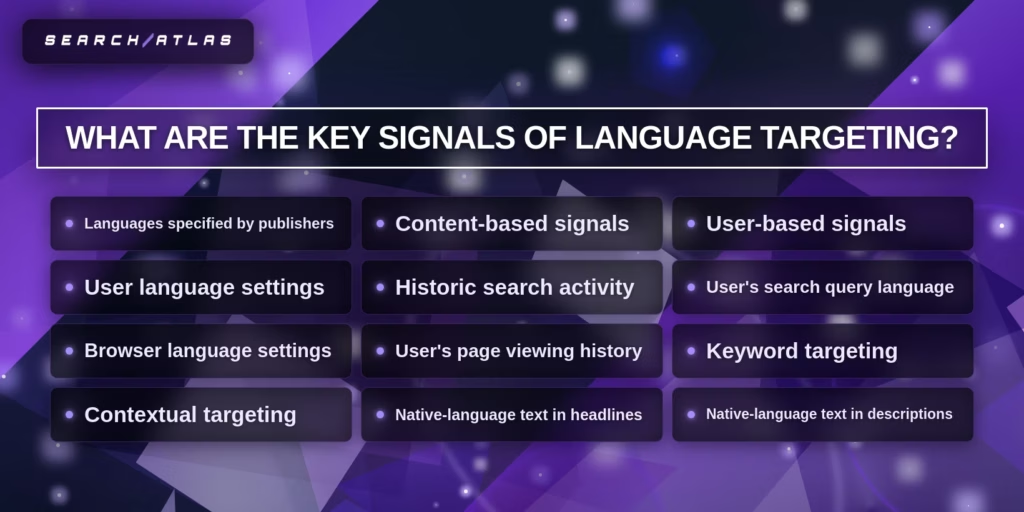
The key signals of language targeting are publisher-declared languages, content-based signals, user-based signals, user language settings, historic search activity, search query language, browser language settings, page viewing history, keyword targeting, contextual targeting, and native-language ad text. Language targeting relies on explicit targeting inputs and inferred linguistic detection signals to match ads and content with the correct SEO languages.
What role do publisher-declared languages play in language targeting? Publisher-declared languages act as direct targeting signals that specify the language of a page or placement. Ad systems read the declared page language to align campaigns with matching SEO languages. This signal reduces ambiguity in multilingual publishing environments and increases linguistic accuracy during impression allocation.
How do content-based signals influence language targeting? Content-based signals infer language from on-page text patterns and linguistic structure. Natural language processing systems detect vocabulary, syntax, and semantic markers to classify page language. This inference signal strengthens language SEO accuracy when publisher declarations are incomplete.
How do user-based signals determine language preference? User-based signals analyze behavioral data to infer preferred language. Systems evaluate browsing history, engagement patterns, and account configurations to identify dominant SEO languages. Repeated interaction with one language increases confidence in linguistic segmentation.
How do explicit user language settings function as AI detection signals? User language settings provide declared linguistic preferences inside the platform or account configurations. Platforms read these settings as structured language indicators. This detection signal overrides ambiguous behavioral inference when available.
How does historic search activity influence language targeting? Historic search activity reveals consistent query language patterns over time. Repeated searches in one language establish a stable linguistic profile. Search engines incorporate this profile into language targeting decisions across networks.
How does search query language operate as a search network signal? Search query language acts as a real-time signal that reflects immediate linguistic intent. Search engines match query language with indexed page language inside defined SEO languages. This alignment increases retrieval precision.
How do browser language settings affect language targeting? Browser language settings provide a technical language declaration transmitted with each request. Advertising and search systems read this header to prioritize matching content. This signal functions at the network level before behavioral inference.
How does page viewing history influence display network targeting? Page viewing history indicates consistent interaction with specific language environments. Display networks cluster users based on repeated exposure to certain SEO languages. This behavioral pattern refines language-based audience segmentation.
How do keyword targeting and contextual targeting operate as language signals? Keyword targeting and contextual targeting act as structured targeting signals that align campaigns with language-specific queries and page themes. Advertisers define keywords in defined SEO languages. Contextual targeting scans page language and topic classification to ensure linguistic consistency.
How does native-language ad copy strengthen language targeting? Native-language text in headlines and descriptions acts as an advertiser-controlled language signal. Ad systems evaluate textual language coherence during auction matching. Linguistically consistent headlines and descriptions increase relevance scoring within language-specific campaigns.
What Are the Main Use Cases of Language Targeting?
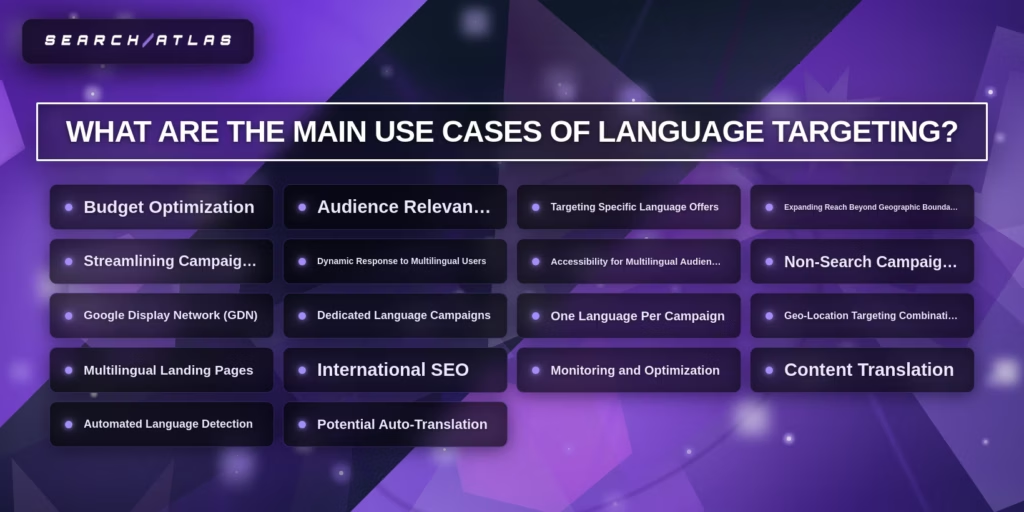
The main use cases of language targeting are budget optimization, audience relevance alignment, language-specific offers, cross-border reach expansion, campaign streamlining, multilingual accessibility, network-specific execution, and strategic multilingual SEO implementation. Language targeting applies across advertising systems, multilingual websites, and SEO languages to control linguistic precision in content delivery.
How does budget optimization function as a core use case of language targeting? Language targeting optimizes budget allocation by restricting impressions to audiences who understand the campaign language. Budget optimization removes unreadable impressions and reduces segmentation waste. Campaign efficiency increases when one language aligns with one audience group.
How does audience relevance define a core operational use case? Language targeting strengthens audience relevance by aligning message language with reader comprehension. Audience relevance increases engagement accuracy and reduces bounce behavior. Linguistic consistency improves the semantic match between ad copy and landing page content.
How does targeting specific language offers operate as a practical use case? Language targeting enables deployment of language-specific offers within defined SEO languages. Advertisers present tailored promotions in a single language without mixing multilingual creatives inside one campaign. Offer precision increases response clarity.
How does language targeting expand reach beyond geographic boundaries? Language targeting expands reach by serving the same language to users across multiple countries. Spanish-language campaigns operate across Spain, Mexico, and the United States without restructuring by geography. Linguistic segmentation removes dependency on national borders.
How does campaign streamlining function as a structural use case? Language targeting streamlines campaigns by organizing one language per campaign structure. One-language configuration simplifies bidding, keyword grouping, and ad text alignment. Structured segmentation increases reporting clarity across SEO languages.
How does language targeting improve accessibility for multilingual audiences? Language targeting improves accessibility by ensuring multilingual audiences receive readable and navigable content. Multilingual landing pages align with campaign language. Accessibility increases comprehension and interaction depth.
How does language targeting apply to non-search and display campaigns? Language targeting applies to non-search campaigns by filtering impressions in networks, the Google Display Network (GDN). Display segmentation reads browser language and page language signals. Network-level language filtering maintains consistency between ad copy and placement environment.
How does combining language targeting with geo-location targeting create strategic value? Language targeting integrates with geo-location targeting to refine segmentation by both language and region. Combined configuration aligns currency, offer structure, and linguistic context. Strategic layering increases precision in multicultural markets.
How does language targeting strengthen international SEO implementation? Language targeting strengthens international SEO by structuring multilingual landing pages and hreflang clusters. International SEO relies on language clarity before geographic modifiers. Structured language versions increase visibility across SEO languages.
How does monitoring and optimization operate as an ongoing use case? Language targeting requires continuous monitoring through analytics segmentation by language. Performance metrics identify underperforming SEO languages. Structured evaluation guides refinement of ad copy, landing page structure, and keyword segmentation.
How do translation workflows and automated detection represent evolving use cases? Language targeting evolves through automated language detection and translation workflows that scale multilingual expansion. Machine-based language classification detects user preference in real time. Translation systems accelerate entry into additional SEO languages while maintaining structural segmentation.
What Is Locational Targeting?
Locational targeting is a digital marketing strategy that delivers advertising based on a user’s geographic location. Locational targeting operates through location-targeted advertising systems that filter impressions by country, city, ZIP code, DMA, or radius. Locational targeting prioritizes physical presence instead of language preference.
What properties define locational targeting as a structured targeting model? Locational targeting is defined by geographic data reliance, targeting granularity, lifecycle effectiveness, and campaign-level configuration. Geographic data reliance includes IP address signals, GPS coordinates, and device-based location detection. Targeting granularity includes country-level, city-level, ZIP-level, and radius-based segmentation. Lifecycle effectiveness spans discovery, purchase, engagement, and retention stages. Campaign configuration occurs at the campaign or ad group level, depending on platform architecture (Google Ads, Microsoft Ads, Facebook Ads).
How does location-targeted advertising function technically? Location-targeted advertising functions by reading geographic signals and matching ads to predefined geographic boundaries. Systems evaluate IP mapping, GPS coordinates, declared user settings, and inferred proximity data. Platforms apply geo filters before auction participation. Google localized campaign settings treat each location as a campaign objective and operate according to the account time zone.
What are the main types of locational targeting? The main types of locational targeting are geotargeting, geodistance targeting, beaconing, and geo-conquesting. Geotargeting filters by country, state, city, or DMA using IP or declared ZIP codes. Geodistance targeting uses GPS-driven radius boundaries to trigger ads when a user enters a defined area. Beaconing uses Bluetooth or Wi-Fi signals for indoor proximity messaging. Geo-conquesting targets users near competitor locations to capture demand.
What are the benefits of geo-targeting in digital campaigns? The benefits of geo-targeting include localized relevance, budget precision, lifecycle alignment, and competitive positioning. Localized relevance increases engagement because ads reflect local context. Budget precision improves allocation by excluding irrelevant regions. Lifecycle alignment strengthens messaging during local discovery and purchase phases. Competitive positioning increases market capture in defined territories.
How does locational targeting relate to broader segmentation strategies? Locational targeting belongs to geographic audience segmentation and differs from demographic, interest-based, and contextual targeting. Geographic segmentation uses spatial data instead of inferred interests. Contextual targeting evaluates page content, while locational targeting evaluates physical location signals. Integration of both strategies refines campaign precision across defined markets. Locational targeting functions as a foundational execution layer within Local SEO frameworks that optimize map pack visibility and proximity-based ranking signals.
Why Is Locational Targeting Important?
Locational targeting is important because it increases campaign effectiveness and return on investment by reducing wasted impressions and concentrating spend on relevant geographic areas. Location-targeted advertising filters traffic outside serviceable zones, which lowers irrelevant clicks and improves conversion ratios. Campaigns structured around defined geographic boundaries report measurable reductions in wasted spend and improved ROI.
Why does locational targeting improve relevance and personalization? Locational targeting improves relevance because it aligns messaging with the user’s immediate geographic context. Ads displayed within proximity to a business increase perceived accessibility. Google localized campaign settings match ads with nearby users, which strengthens contextual alignment and increases engagement rates.
How does locational targeting generate online and offline traffic? Locational targeting generates website visits and in-store traffic by activating ads within defined geographic radii. Geodistance targeting triggers impressions when users enter mapped zones around retail locations. Real-time GPS signals enable proximity-based exposure, which increases foot traffic and digital interactions.
Why does locational targeting expand reach while building trust? Locational targeting expands customer reach within defined regions and reinforces local authority signals. Geographic segmentation positions a business as relevant within a community. Repeated exposure within the same territory strengthens brand familiarity and localized credibility.
Why is cost efficiency a structural benefit of locational targeting? Locational targeting reduces advertising costs by eliminating impressions outside defined markets. Geographic exclusions prevent budget overlap between service areas. Concentrated exposure increases click-through rates and lowers cost per acquisition within defined territories.
How does locational targeting improve audience segmentation precision? Locational targeting improves segmentation by filtering audiences according to country, city, ZIP code, or radius. Advertisers isolate high-value markets and exclude non-performing regions. Structured geographic segmentation increases message relevance and measurable engagement performance.
How does behavioral location data inform future campaigns? Locational targeting provides behavioral insights through analysis of real-time and historical location data. Location patterns reveal movement trends and proximity behavior. Marketers refine future campaigns using observed geographic engagement clusters.
Why is locational targeting critical for service-based businesses? Locational targeting is critical for service-based businesses because customer intent frequently includes geographic qualifiers. Queries that reference “near me” or city names indicate local provider demand. Matching ads and landing pages to the user’s exact location reduces unqualified clicks and improves conversion probability.
What Are the Key Signals of Locational Targeting?
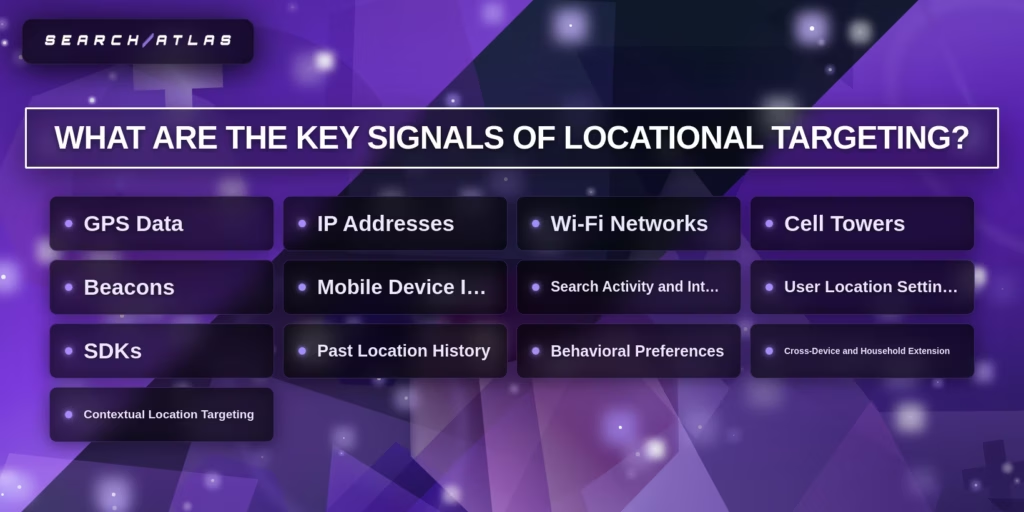
The key signals of locational targeting are GPS data, IP addresses, Wi-Fi networks, cell towers, beacons, mobile device IDs, search activity, user location settings, SDK integrations, past location history, behavioral preferences, cross-device extension, and contextual location indicators. Locational targeting relies on direct geographic data and inferred behavioral signals to determine user position within defined spatial boundaries.
How does GPS data function as a primary locational targeting signal? GPS data provides precise real-time geographic coordinates from mobile devices. Advertising systems read latitude and longitude values to trigger radius-based campaigns. Geodistance targeting activates ads when a device enters predefined geographic zones.
How do IP addresses contribute to locational targeting accuracy? IP addresses approximate user location based on network routing data. Platforms map IP ranges to countries, cities, and regions. Location-targeted advertising systems use IP mapping when GPS data is unavailable.
What role do Wi-Fi networks and cell towers play in location detection? Wi-Fi networks and cell towers triangulate device position through network proximity signals. Mobile carriers and connected devices estimate location using nearby infrastructure identifiers. This method improves accuracy in indoor and urban environments.
How do beacons enhance hyperlocal targeting? Beacons transmit Bluetooth signals that detect device presence within limited physical ranges. Retail environments deploy beacon hardware to activate ads or notifications inside specific premises. Beacon-based targeting increases indoor precision.
How do mobile device IDs operate as persistent location identifiers? Mobile device IDs link geographic signals to individual devices across sessions. Advertising systems associate device IDs with movement patterns and region-based engagement. Persistent identification strengthens geographic segmentation continuity.
How do search activity and user intent function as location signals? Search activity reveals geographic intent through query modifiers and regional keywords. Queries that contain city names or “near me” phrases indicate spatial relevance. Platforms integrate search signals into geographic filtering logic.
How do user location settings affect campaign delivery? User location settings provide declared geographic preferences inside platform configurations. Advertising systems prioritize declared settings when matching campaigns with users. This signal complements inferred location detection methods.
How do SDK integrations collect location data for targeting? Software Development Kits (SDKs) embedded in mobile applications transmit location data to advertising systems. SDKs capture GPS, device ID, and behavioral data during app usage. Integrated data pipelines refine spatial segmentation accuracy.
How does past location history strengthen locational targeting? Past location history reveals repeated geographic patterns across time. Platforms analyze historical movement clusters to identify high-frequency zones. Historical data informs predictive geographic segmentation.
How do behavioral preferences and cross-device extension influence locational targeting? Behavioral preferences connect geographic activity with engagement patterns across devices and households. Cross-device matching links mobile, desktop, and tablet activity within shared environments. Household extension increases campaign reach within a defined geographic radius.
How does contextual location targeting operate within content environments? Contextual location targeting aligns ads with region-specific content and geographic references inside webpages. Systems detect geographic cues within page content and match campaigns to relevant local contexts. Contextual integration complements GPS and IP-based filtering in location-targeted advertising.
What Are the Main Use Cases of Locational Targeting?
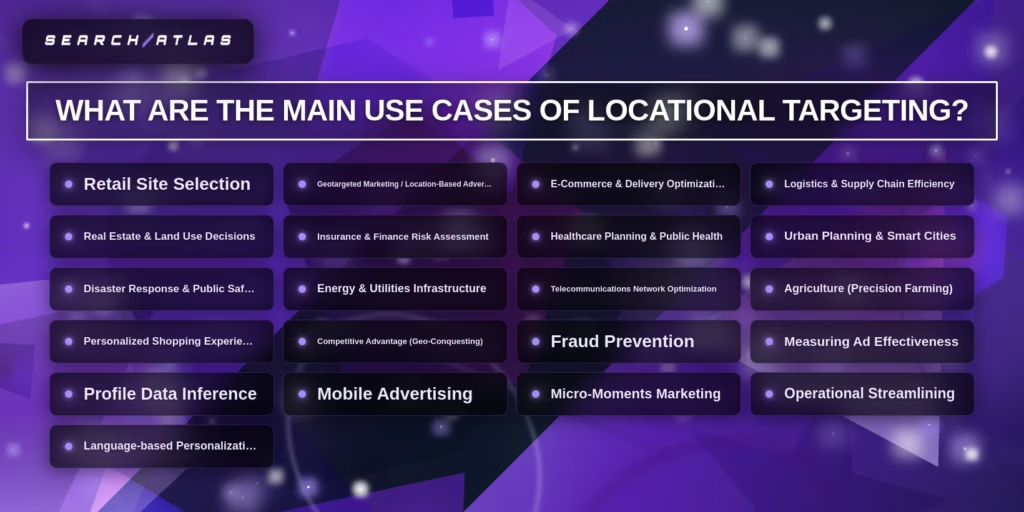
What are the main use cases of locational targeting? The main use cases of locational targeting are listed below.
- **Retail Site Selection (Business Strategy).**Uses geographic demand density and foot traffic data to determine optimal store placement.
- **Geotargeted Marketing / Location Targeted Advertising (Marketing Strategy).**Activates campaigns within defined cities, ZIP codes, or radius boundaries.
- **E-Commerce and Delivery Optimization (Operational Strategy).**Aligns delivery zones and fulfillment routes with regional demand clusters.
- **Logistics and Supply Chain Efficiency (Operational Strategy).**Optimizes warehouse placement and routing based on geographic consumption patterns.
- **Real Estate and Land Use Decisions (Business Strategy).**Evaluates property value and development potential using spatial market data.
- **Insurance and Finance Risk Assessment (Risk Management).**Assesses regional exposure variables to determine premium pricing and credit evaluation.
- **Healthcare Planning and Public Health (Public Service).**Allocates medical resources according to demographic and disease distribution clusters.
- **Urban Planning and Smart Cities (Public Service).**Designs transportation and infrastructure systems using spatial population analysis.
- **Disaster Response and Public Safety (Emergency Management).**Deploys emergency resources using real-time geographic event mapping.
- **Energy and Utilities Infrastructure (Infrastructure Management).**Plans grid capacity and infrastructure upgrades based on regional demand forecasts.
- **Telecommunications Network Optimization (Network Management).**Adjusts signal coverage and bandwidth allocation according to geographic density.
- **Agriculture / Precision Farming (Agricultural Practice).**Applies geospatial soil and climate data to improve crop management.
- **Personalized Shopping Experience (Customer Experience).**Displays proximity-based promotions and localized product recommendations.
- **Competitive Advantage / Geo-Conquesting (Marketing Strategy).**Targets users near competitor locations to capture regional demand.
- **Fraud Prevention (Security Measure).**Detects geographic inconsistencies in transaction behavior patterns.
- **Measuring Ad Effectiveness (Marketing Analytics).**Connects ad exposure with store visits and region-based conversions.
- **Profile Data Inference (Data Analytics).**Infers behavioral clusters from repeated geographic interaction data.
- **Mobile Advertising (Marketing Channel).**Activates campaigns based on device-level geographic signals.
- **Micro-Moments Marketing (Marketing Strategy).**Engages users during immediate proximity-based search behavior.
- **Operational Streamlining (Operational Strategy).**Aligns staffing, inventory, and service coverage with geographic demand distribution.
- **Language-Based Personalization (Customer Experience).**Integrates geographic signals with language segmentation for localized content delivery.
Language vs Location Targeting: What Is the Difference?
**What is the difference between language targeting and location targeting?**The difference between language targeting and location targeting appears across purpose, implementation method, impact on SEO, and potential challenges. The differences are listed below.
- Purpose.
- Implementation Method.
- Impact on SEO.
- Potential Challenges.
1. Purpose
How do the purposes of language and location targeting differ? Language targeting focuses on linguistic comprehension, while location targeting focuses on geographic proximity. Language targeting ensures advertising appears in a language the audience understands. Location targeting ensures advertising appears within a defined physical territory.
What is the purpose of language targeting? The purpose of language targeting is to align advertising with the language users read and search in. Language targeting prevents ads from appearing to users who cannot understand the message. Language targeting improves budget precision by restricting impressions to defined SEO languages. Language targeting increases sales probability by matching ad copy and landing page language with user comprehension patterns.
What is the purpose of location targeting? The purpose of location targeting is to align advertising with a user’s physical presence inside a defined geographic boundary. Location targeting displays ads only within selected countries, cities, ZIP codes, or radii. Location targeting increases immediate visitation and purchase likelihood by reaching users near a business location. Location targeting reduces PPC waste by excluding users outside serviceable territories.
What are the structural differences in desired outcomes? Language targeting aims for message clarity and resonance, while location targeting aims for proximity-driven action. Language targeting increases engagement through localized language alignment. Location targeting increases foot traffic and short-cycle conversions through spatial relevance. Language targeting allows international expansion across borders. Location targeting strengthens regional dominance within specific markets.
What considerations apply when combining both strategies? Combining language and location targeting requires balance to prevent excessive audience restriction. Narrow geographic boundaries combined with strict language filters reduce reach. Structured campaign design begins with broader segmentation and refines targeting based on proximity signals. Controlled integration ensures both linguistic alignment and geographic precision without limiting campaign viability.
2. Implementation Method
How do implementation methods differ between language targeting and location targeting? Language targeting implements segmentation through linguistic signals and multilingual content architecture, while location targeting implements segmentation through geographic data and spatial filtering systems. Language targeting modifies content structure and language declarations. Location targeting modifies geographic boundaries and delivery parameters.
How does language targeting implement segmentation at the website level? Language targeting implements segmentation through hreflang attributes, separate language URLs, and structured multilingual content. Hreflang tags define language or language–country pairs (en-US, fr-BE, de-BE). Each language version uses a distinct URL structure (ccTLD, subdomain, subdirectory). Google determines language from visible page content instead of metadata alone. Pages use one primary language per URL to prevent duplicate clustering. A crawl-based site audit can catch missing or non-reciprocal hreflang tags across every URL variant before they cause duplicate-content problems in search results.
How does language targeting implement segmentation in advertising platforms? Language targeting implements segmentation in advertising platforms by selecting campaign-level language filters. Platforms detect language using search query language, browser language settings, and recently viewed page language. Advertisers configure one language per campaign to maintain linguistic consistency. Ads display only within selected supported languages.
How does location targeting implement segmentation at the technical level? Location targeting implements segmentation by identifying physical position through IP mapping, GPS signals, device settings, and region selection tools. Geographic detection assigns users to defined territories. Radius targeting activates ads inside mapped boundaries. Platform configuration occurs at the campaign or ad group level, depending on system architecture.
How does location targeting implement segmentation in URL and domain structure? Location targeting implements segmentation through country-code domains, region-specific subdirectories, and Search Console region settings. ccTLD structures (website.be) signal country targeting. Subdirectories (website.com/be/) segment regions within a shared domain authority structure. URL parameters do not function as reliable geographic segmentation methods.
How do cultural and technical adaptations differ between the two methods? Language targeting requires linguistic adaptation, while location targeting requires cultural and regulatory adaptation. Language targeting translates content, adjusts terminology, and maintains translation memory systems. Location targeting modifies currency, date formats, measurement units, compliance requirements, and visual symbolism to align with regional standards.
How do localization practices differ between the two strategies? Language targeting localizes language structure and keyword translation, while location targeting localizes geographic context and regional search signals. Language targeting adapts meta tags, content, and navigation to defined SEO languages. Location targeting integrates region-specific keywords, local backlinks, Business Profile signals, and proximity-based optimization.
3. Impact on SEO
How do language and location targeting differ in their impact on SEO? Language targeting affects multilingual indexing and query-language matching, while location targeting affects local ranking signals and geographic visibility. Language targeting structures how search engines interpret content language across SEO languages. Location targeting structures how search engines rank pages based on proximity, territory, and regional authority.
How does language targeting impact international SEO performance? Language targeting expands global reach by enabling ranking across multiple SEO languages without geographic restriction. Search engines match query language with page language through visible content and hreflang declarations. Language targeting increases international keyword coverage and strengthens multilingual authority clusters. Incorrect implementation creates duplicate content conflicts or indexing errors.
How does location targeting impact local SEO visibility? Location targeting strengthens visibility within defined geographic markets by reinforcing proximity and regional relevance signals. Search engines evaluate distance, relevance, and prominence for localized queries. Location targeting increases performance in map-based results and region-specific search pages. Geographic segmentation limits visibility outside targeted territories.
How do keyword strategies differ in SEO impact between the two methods? Language targeting adapts keywords through translation and linguistic variation, while location targeting integrates geographic modifiers into keyword structure. Language targeting expands semantic coverage across languages. Location targeting uses city, state, and region-based qualifiers to capture local demand. Each method reshapes search query alignment differently.
How do website structures influence SEO impact under both approaches? Language targeting relies on multilingual URL architecture and hreflang clusters, while location targeting relies on country-code domains, subdirectories, and regional Search Console settings. Language architecture determines indexing precision. Geographic architecture determines territorial authority distribution. Implementation errors weaken crawl clarity and ranking stability.
**How do competitive dynamics differ in SEO between language and location targeting?**Language targeting competes across global search landscapes within each SEO language, while location targeting competes within constrained regional markets. Global language visibility requires broader authority signals. Regional visibility requires localized backlinks, Business Profile optimization, and proximity strength.
4. Potential challenges
How do language and location targeting differ in potential challenges? Language targeting faces linguistic, technical, and algorithmic complexity, while location targeting faces operational, regulatory, and infrastructure complexity. Language targeting challenges emerge from translation accuracy and multilingual SEO configuration. Location targeting challenges emerge from geographic data accuracy, platform configuration, and regional compliance.
What potential challenges affect language targeting? Language targeting faces challenges in translation precision, cultural nuance alignment, hreflang configuration, and search engine behavior. Automatic translation reduces credibility when contextual meaning shifts. Regional language variations require localized vocabulary and tone adjustment. Hreflang errors cause incorrect page indexing when tags are not reciprocal or misconfigured. Search algorithms prioritize local country signals over standalone language signals, which limits ranking for language-only strategies.
What infrastructure and design challenges impact language targeting? Language targeting encounters infrastructure challenges in content management, layout adaptation, and character encoding. Text length variations affect button spacing and navigation structure. Right-to-left languages require template redesign. Content management systems allow accent marks, Unicode characters, and localized formatting. Multilingual SEO requires separate URL structures and ongoing synchronization across language versions.
What potential challenges affect location targeting? Location targeting faces challenges in geographic accuracy, platform settings complexity, and operational scalability. IP mapping and GPS signals produce imprecise geographic identification. Google Ads contains location option settings that alter delivery behavior if misconfigured. Highly granular targeting reduces scale and limits traffic volume.
What operational and regulatory challenges impact location targeting? Location targeting encounters regulatory compliance requirements, hosting constraints, and cost escalation. Data privacy regulations (GDPR, CCPA) restrict location-based tracking without consent. Server distance affects loading speed and requires CDN infrastructure for international campaigns. Country-specific domains increase hosting and maintenance expenses. Time zone differences and seasonal variation require campaign scheduling adjustments.
How do content duplication and URL structure create challenges in location targeting? Location targeting creates duplication risks when country-specific domains repeat similar content without differentiation. Separate TLDs require independent SEO strategies and authority building. Subdomains fragment domain authority. Subdirectories restrict server localization. Each structural choice introduces long-term technical trade-offs.
What overarching considerations apply to both strategies? Both language and location targeting require early architectural planning to prevent expensive restructuring later. Incorrect segmentation logic weakens visibility and increases maintenance burden. Centralized localization governance improves consistency and reduces implementation errors across multilingual and multi-regional environments.
Language vs Location Targeting: Comparison Table
Language vs location targeting differs across signal logic, data structure, matching models, indexing systems, and infrastructure requirements. Language vs location targeting operates on different segmentation primitives. Language targeting segments by linguistic interpretation. Location targeting segments by geographic coordinates and spatial proximity.
What structural differences define language vs location targeting at a system level? Language vs location targeting differs in signal type, representation model, matching logic, indexing method, core signals, computational demand, latency behavior, data dependency, adaptability, and implementation complexity.
The comparative structure is presented below.
| Dimension | Language Targeting | Location Targeting |
|---|---|---|
| Signal Type | Linguistic preference | Geographic location |
| Representation Method | Linguistic signals (content language, browser language, hreflang) | Location data and geo signals (IP, GPS, ZIP, radius) |
| Matching Approach | Semantic language matching through NLP and embeddings | Geographic filtering through spatial boundary checks |
| Index Structure | Inverted index and embedding-based retrieval for SEO languages | Spatial index and geo-mapping structures |
| Core Signals | Content language, hreflang clusters, NLP classification, query language | IP address, GPS coordinates, NAP data, geotags |
| Computational Requirements | Moderate semantic parsing and language detection processing | High spatial lookup and real-time coordinate validation |
| Latency (Typical Range) | 5–20 ms for language detection and query matching | 20–80 ms for spatial filtering and radius computation |
| Data Dependencies | Content structure, translation accuracy, and multilingual metadata | User device data, business location data, and regional mapping databases |
| Adaptability | Dynamic language interpretation based on query and browser | Semi-static geographic signals with periodic updates |
| Implementation Complexity | Content restructuring, hreflang setup, and multilingual CMS management | Geo-targeting configuration, infrastructure scaling, and regulatory compliance |
How does this comparison clarify language vs location targeting in SEO environments? Language vs location targeting impacts search systems differently because one modifies semantic retrieval and the other modifies spatial ranking signals. Language targeting reshapes query-language matching across SEO languages. Location targeting reshapes proximity scoring and local pack visibility. The operational logic, infrastructure cost, and algorithmic impact differ across both targeting models.
How to Choose Between Language and Location Targeting?
A business chooses between language and location targeting by evaluating goals, audience structure, and SEO impact. The decision criteria are listed below.
- Understand Business Goals.
- Analyze the Target Audience.
- Consider SEO and Visibility.
What conclusion emerges from these decision factors? Language targeting prioritizes comprehension and international reach, while location targeting prioritizes proximity and regional market control. The appropriate model aligns with revenue geography, operational scope, and technical capacity.
1. Understand Business Goals
A business understands business goals by translating strategic objectives into measurable marketing actions and segmentation logic. Strategic alignment connects revenue objectives, market expansion plans, and retention targets with either language targeting or location targeting. Targeting selection follows defined growth priorities rather than tactical preference.
How are business goals defined before selecting a targeting strategy? Business goals are defined by identifying revenue growth, market share expansion, customer retention improvement, or product launch objectives. Organizations convert these priorities into measurable outcomes, percentage growth targets,s or new demographic acquisition. A clear definition prevents misaligned targeting decisions and resource waste.
How does goal prioritization influence targeting choice? Goal prioritization determines whether linguistic expansion or geographic dominance drives growth. Global SaaS growth favors language targeting across SEO languages. Regional service expansion favors location targeting within defined territories. Revenue source geography determines segmentation structure.
How does marketing alignment operationalize business goals through targeting? Marketing alignment operationalizes business goals by mapping audience segments to defined growth objectives. Audience segmentation identifies multilingual clusters or region-based demand pockets. Channel allocation assigns SEO, PPC, or localized campaigns to reinforce the defined objective. Each campaign aligns with one measurable business outcome.
How does performance tracking validate targeting alignment? Performance tracking validates targeting alignment by measuring KPIs linked to business outcomes instead of vanity metrics. Conversion rate, customer acquisition cost, and customer lifetime value quantify strategic effectiveness. Data-driven refinement adjusts segmentation when performance deviates from defined objectives.
How does organizational structure reinforce targeting decisions? Organizational structure reinforces targeting decisions by aligning IT, marketing, and talent capabilities with business objectives. Infrastructure readiness determines whether multilingual architecture or multi-regional deployment remains sustainable. Talent expertise in localization or regional compliance influences operational feasibility.
What is the outcome of proper strategic alignment in targeting? Proper strategic alignment ensures targeting selection maximizes measurable growth while minimizing operational friction. Language targeting expands accessibility across markets. Location targeting strengthens regional authority and proximity-driven conversions. The selected model reflects the organization’s defined growth path.
2. Analyze the Target Audience
Target audience analysis identifies and profiles the groups most likely to respond to a product or service. Target audience analysis evaluates demographics, psychographics, behaviors, and needs to form structured buyer personas. Target audience analysis converts raw audience data into segmentation logic that guides language targeting or location targeting.
What core concepts structure target audience analysis? Target audience analysis relies on three core concepts: Target Audience, Customer Pain Points, and Buyer Persona. The target audience defines the demographic and geographic group most likely to purchase. Customer Pain Points define the recurring problems or barriers influencing decision-making. Buyer Persona represents a detailed profile built from research that models motivations, behaviors, and preferences.
What data dimensions are evaluated during audience analysis? Audience analysis evaluates demographic, psychographic, and situational dimensions. Demographic analysis measures age, gender, income, education, and location. Psychographic analysis measures values, attitudes, interests, lifestyle, and beliefs. Situational analysis evaluates competitive context, market growth, and behavioral triggers influencing demand.
How does structured audience analysis proceed step by step? Structured audience analysis follows a defined sequence of research and refinement. Firstly, define the business goal to anchor segmentation logic. Secondly, understand the product or service in depth to avoid segmentation gaps. Thirdly, collect demographic and psychographic data through analytics, surveys, and behavioral observation. Fourthly, analyze competitor audiences to identify underserved segments. Fifthly, create buyer personas and map customer journeys. Sixthly, test audience segments and refine targeting based on measurable KPIs.
How does data collection strengthen targeting accuracy? Data collection strengthens targeting accuracy by replacing assumptions with measurable behavioral evidence. Analytics platforms track user behavior, conversion rates, and engagement patterns. Surveys and interviews reveal motivations and emotional drivers. Social platforms and competitor analysis reveal interest clusters and regional concentration.
How does audience segmentation influence language versus location targeting? Audience segmentation determines whether linguistic grouping or geographic grouping produces stronger engagement. Multilingual clusters across regions indicate language targeting. Region-specific demand clusters indicate location targeting.
3. Consider SEO and Visibility
A business evaluates SEO and search visibility by measuring ranking performance, keyword impact, competitive share, and technical health across defined markets. Search visibility represents the estimated percentage of clicks earned from tracked keywords based on ranking position, search volume, and expected click-through rate.
What is search visibility in measurable terms? Search visibility is a percentage score estimating potential organic clicks from all tracked keywords. The score combines ranking position, monthly search volume, and CTR weighting. Higher-ranking keywords with larger volumes contribute more to total visibility. The metric ranges from 0-100%, though practical performance rarely exceeds mid-40% for non-branded queries.
How are search visibility scores interpreted? Search visibility scores indicate competitive strength within a keyword set rather than absolute traffic volume. A 0% score signals no meaningful ranking presence. A 6-15% score indicates moderate presence. A 31% to 50% score reflects strong multi-keyword authority. Evaluation requires benchmarking against competitors within the same industry context.
How does evaluation differ for classic search and AI search environments? Classic SEO evaluation measures rankings and CTR-based click potential, while AI search evaluation measures brand presence and citation frequency. Traditional visibility tracks keyword rankings and organic impressions. AI visibility tracks brand mentions, citation quality, and referral traffic from AI systems. AI evaluation shifts focus from position ranking to recommendation presence.
What tools measure SEO and search visibility performance? SEO and search visibility performance are measured through analytics platforms and specialized SEO tools that quantify rankings, traffic potential, and competitive share. Tool for integrated SEO, GEO, and AI visibility monitoring = Search Atlas (Feature for LLM Visibility and SEO Audit). Tool for search performance tracking = Google Search Console. Tool for behavioral analysis = Google Analytics. Tool for visibility trend monitoring = Semrush (Feature for Position Tracking). Tool for share-of-voice analysis = Ahrefs (Feature for Rank Tracker). Tool for visibility scoring = Moz (Feature for Search Visibility). Tool for classic and AI visibility tracking = SE Ranking.
How is technical health evaluated during Sean O’s assessment? Technical health is evaluated through structured audits that identify on-page, structural, and server-level issues. Tool for technical evaluation = SEO Checker. Features for analysis include meta tag validation, canonical checks, internal linking structure, heading hierarchy, mobile responsiveness, and server response time. An SEO score above 80% reflects strong structural compliance, while scores below 30% indicate critical issues.
What step-by-step process ensures accurate SEO visibility evaluation? Accurate evaluation follows a structured five-step process. Firstly, identify high-impact keywords aligned with business goals. Secondly, collect ranking and volume data. Thirdly, apply CTR weighting to calculate the visibility percentage. Fourthly, compare performance against competitors. Fifthly, monitor trends quarterly and adjust the optimization strategy accordingly.
How does visibility evaluation influence targeting decisions? Visibility evaluation determines whether language targeting or location targeting yields a stronger ranking impact. Multilingual ranking gaps indicate the need for language targeting adjustments. Regional ranking gaps indicate the need for location-based optimization. Search visibility metrics provide measurable evidence to refine segmentation logic.
Can You Combine Language and Location Targeting?
Yes, language targeting and location targeting are combined to deliver ads to specific language groups within defined geographic areas. Combined configuration aligns linguistic comprehension with physical proximity. This alignment increases precision in audience segmentation and reduces irrelevant impressions.
How does the combined targeting model function in Google Ads? Google Ads allows advertisers to configure both geographic boundaries and campaign language settings at the campaign level. Location targeting filters users by country, city, ZIP code, or radius. Language targeting filters users by detected language signals, including query language and interface language. Combined filtering ensures ads appear only to users who are both inside the selected region and aligned with the selected language.
Why is combining both strategies necessary instead of using location alone? Location targeting alone does not guarantee linguistic comprehension. A geographic filter includes multilingual populations within the same territory. Language selection ensures ads are written in the language users understand. Cultural and linguistic alignment strengthens engagement and conversion probability.
What configuration detail ensures precision when combining both strategies? The “Reach people in your targeted locations” setting replaces the broader default option to maintain geographic accuracy. The default setting includes users who show interest in a location rather than users physically present.
What example illustrates effective combined targeting? Targeting Spanish-speaking users in Mexico requires selecting Mexico as the geographic filter and Spanish as the campaign language. Targeting English-speaking residents in Poland requires selecting Poland as the location and English as the language. Structured combination ensures geographic precision and linguistic clarity operate simultaneously.
What Are Common Mistakes in Language and Location Targeting?
Common mistakes in language and location targeting include treating localization as translation, misconfiguring hreflang, ignoring regional language variants, misusing Google Ads location settings, duplicating country content, neglecting localized SEO, and violating regulatory requirements. These errors reduce visibility, damage credibility, increase cost, and weaken conversion performance.
What are the most frequent mistakes in language targeting? The most frequent language targeting mistakes involve translation inaccuracy, cultural misalignment, and hreflang misconfiguration. Automatic translation without human validation reduces trust and clarity. Literal translation ignores idioms, tone, and regional vocabulary differences. Using a language without specifying region codes (en instead of en-GB or en-US) creates ambiguity. Incorrect or non-reciprocal hreflang tags cause search engines to index the wrong language version.
What technical and design errors affect language targeting performance? Technical mistakes in language targeting include hard-coded text, missing Unicode support, string concatenation, and layout inflexibility. Hard-coded UI text increases maintenance cost. Missing UTF-8 encoding corrupts non-ASCII characters. Concatenated strings break grammatical structure in translation. Failure to plan for text expansion disrupts layouts, especially for German or right-to-left languages.
What SEO mistakes weaken language targeting effectiveness? SEO mistakes in language targeting include direct keyword translation without local search validation and ignoring metadata localization. Verbatim keyword translation fails to match actual search behavior. Missing localized title tags and meta descriptions reduce click-through rate. Publishing blog content only in the corporate language restricts multilingual discoverability.
What are the most common mistakes in location targeting? The most common location targeting mistakes involve incorrect Google Ads location settings, over-granular targeting, and infrastructure neglect. Using the default “people in or interested in” setting expands reach beyond physical presence. Excessively narrow city-level targeting reduces scale. Ignoring server proximity increases page load time for distant users.
What operational and regulatory errors occur in location targeting? Location targeting errors include failure to comply with GDPR or CCPA, neglecting time zone differences, and ignoring seasonal variations across hemispheres. Campaigns that do not adjust for local time zones misalign launch and bidding windows. Failure to convert currency or measurement units increases cart abandonment. Non-compliance with regional data laws creates legal exposure.
What structural mistakes occur in country-level SEO targeting? Country targeting mistakes include content duplication across TLDs, weak differentiation between regional domains, and fragmented authority signals. Identical .com and .co.uk pages dilute ranking strength. Separate TLDs require independent authority building. Poor domain strategy increases maintenance complexity and cost.
What brand and user experience risks result from these mistakes? Localization and geotargeting mistakes lead to user confusion, reduced trust, lost revenue, and long-term brand damage. Inconsistent brand voice across languages weakens messaging coherence. Cultural missteps cause reputational harm. Fixing errors after launch increases operational expense compared to structured pre-deployment planning.
How Language and Location Targeting Affect AI and Search Personalization?
Language and location targeting directly influence how AI systems interpret intent, rank entities, and personalize search results based on user context. AI engines integrate linguistic signals, geographic data, behavioral history, and structured metadata to generate context-aware responses. Personalization now depends on language alignment and spatial relevance rather than static keyword ranking.
How does language targeting influence AI-driven search results? Language targeting determines which content AI models retrieve, synthesize, and cite based on query language and user interface settings. AI systems prioritize content written in the user’s detected language or dialect. Multilingual content with correct hreflang signals increases inclusion probability in AI-generated responses. Absence of localized language signals reduces visibility in AI answers even when authority remains high.
How does location targeting influence AI-generated responses? Location targeting influences AI ranking through real-time location signals, proximity indicators, and regional trust signals. AI engines evaluate IP data, device location, and local business listings to adapt answers geographically. Local digital footprint strength increases recommendation probability. Weak local presence excludes brands from localized AI summaries.
How do AI Overviews and conversational AI reshape personalization? AI Overviews and conversational AI shift personalization from link ranking to answer synthesis driven by contextual data. AI Overviews appear for a high percentage of informational and hybrid-intent queries, reshaping click distribution. Conversational AI tools process longer, multi-intent queries and incorporate contextual memory signals. Identical keywords produce different outputs across users due to personalized data inputs.
How does Personal Context transform search behavior? Personal Context integrates user account data, search history, and location data to create hyper-personalized responses. AI systems analyze Gmail confirmations, calendar events, and prior interactions to refine recommendations. Location-aware personalization now references travel bookings, event proximity, and regional conditions. Traditional rank tracking loses precision under persona-based personalization.
How does voice and visual search amplify language and location targeting impact? Voice and visual search amplify contextual dependence on language clarity and geographic precision. Voice assistants interpret conversational, location-modified queries. Visual search integrates real-world location signals with image recognition. Structured local data and multilingual clarity strengthen AI interpretation accuracy.
How do businesses adapt to AI personalization influenced by language and location signals? Businesses adapt by strengthening structured data, maintaining accurate local listings, publishing multilingual content, and monitoring AI visibility metrics. LocalBusiness schema, consistent NAP data, and localized reviews increase trust signals. Multilingual content aligned with the user’s language improves semantic inclusion. AI visibility tracking replaces traditional position-based evaluation. This evolution requires structured Artificial Intelligence Optimization (AIO) to ensure content remains interpretable, retrievable, and reusable within AI-mediated search systems.
Can You Target Multiple Locations With One Language?
Yes, target multiple locations with one language when the product, service, and legal framework remain consistent across countries. A single language version serves multiple countries without creating separate geo-targeted sections. Search engines recognize language-based targeting that spans multiple regions, and this structure consolidates backlinks, domain authority, and SEO strength.
How does one-language multi-country targeting function in SEO? One-language multi-country targeting functions through shared language URLs and optional hreflang configurations that do not isolate countries. A single English version serves users in the United States, Canada, and Australia if the offer remains identical. This structure centralizes authority signals instead of fragmenting them across country-specific domains. Consolidation simplifies maintenance and strengthens ranking stability.
When does one language fail to support multiple locations effectively? One language fails to support multiple locations when product availability, pricing, currency, or legal compliance differ across countries. Distinct regulatory environments or region-specific offers require separate geo-targeted sections. Geotargeting improves relevance in a specific country but reduces ranking visibility in others. Structural separation becomes necessary when business operations diverge geographically.
What technical risks affect multi-location language targeting? Incorrect hreflang configuration creates indexing conflicts and search engine confusion. Misapplied language or country codes trigger incorrect page display. Non-reciprocal hreflang references reduce crawl clarity. A high percentage of domains exhibit hreflang errors, which weakens multilingual indexing stability.
What is the strategic implication of targeting multiple locations with one language? Targeting multiple locations with one language increases operational efficiency but requires consistent offerings across markets. Consolidated authority benefits SEO strength. Divergent regional requirements demand structured geographic segmentation. The targeting model reflects operational reality rather than theoretical simplicity.
How Does Google Determine User Location?
Google determines user location by combining device-based signals, network identifiers, account activity, and stored user information to estimate geographic position with varying precision. Location inference ranges from general area approximation through IP data to highly precise GPS-based coordinates.
What primary signals does Google use to estimate location? Google uses IP addresses, GPS data, Wi-Fi networks, Bluetooth signals, cell tower triangulation, and saved Google Account activity to determine user location. Each signal provides a different accuracy level. IP addresses provide a general city-level estimation. GPS and Wi-Fi signals provide coordinate-level precision. Account activity refines historical location patterns.
How does Google use IP addresses for general location detection? Google infers ga eneral geographic area by mapping an IP address to a regional database. Internet Service Providers assign IP blocks tied to geographic regions. Google Analytics uses third-party IP databases to estimate the country and city. GA4 anonymizes IP addresses by removing the last segment before storage.
How does Google use device-based signals for precise location detection? Google uses GPS, accelerometer, gyroscope, magnetometer, mobile network signals, and Wi-Fi data to estimate precise device location. Android devices combine sensor data and network signals for high-accuracy positioning. Google Location Accuracy aggregates anonymized device signals to improve mapping precision.
How do saved account settings influence location estimation? Saved home or work addresses and Web & App Activity refine location-based personalization. Google stores general area data from past searches to improve relevance. Timeline, when enabled, records precise device coordinates and movement patterns. Stored data auto-deletes after defined retention periods.
How do Wi-Fi and cell towers contribute to triangulation? Wi-Fi access points and cell tower IDs allow triangulated position estimation even without active GPS. Devices broadcast network identifiers that Google maps to geographic coordinates. Wi-Fi mapping increases indoor accuracy beyond IP-level estimation.
How do browser and device identifiers contribute to inference? Browser fingerprints, cookies, device IDs, and linked Google accounts enable cross-device location inference. Logged-in accounts synchronize signals across devices. Activity from one device influences contextual relevance on another device under the same account.
How does Google balance personalization with privacy controls? Google applies anonymization, pseudonymization, user-resettable identifiers, and minimum-area thresholds to protect privacy. A general search area expands until it represents at least 1,000 users within a 3 square kilometer radius. Users control Timeline, Web & App Activity, and ad personalization settings through account preferences.
How does AI personalization amplify location detection? AI personalization integrates location signals with behavioral history to generate context-aware search responses. AI Mode incorporates account-level signals, calendar data, and device history to tailor recommendations. Location detection now influences search results, AI Overviews, and conversational responses simultaneously.