SEO autopilot is a closed-loop system where an autonomous agent crawls a site, decides what to fix, generates the change, and deploys it to live pages without a developer ticket. It is distinct from SEO automation, which runs scheduled tasks, and from AI writing tools, which produce drafts on request. This page covers how the loop works, what a real autopilot looks like in practice, and how OTTO and Atlas Agent run it end-to-end.
What is SEO autopilot?
SEO autopilot is a system that identifies optimization issues across a website, prioritizes them, generates the corrections, and applies them to live pages without manual implementation. The core unit is the autonomous SEO agent: software that takes a goal, such as organic-ranking growth or AI-citation coverage, and chooses its own next actions to move toward it.
A real autopilot covers four operations:
- Detection: the agent crawls the site, pulls Search Console and analytics data, and identifies issues that affect rankings and AI visibility.
- Reasoning: it ranks those issues by impact and difficulty.
- Execution: it writes the fix (metadata, schema, internal links, content, structured-data updates).
- Deployment: it pushes the fix to the live site, then monitors the outcome.
If a platform stops at step 2 or 3, it is a recommendation engine. The development team still does the work.
The distinction that matters technically: a rule-based automation runs a fixed playbook on a schedule (e.g., “regenerate sitemap every Monday”), while an agentic autopilot picks the next action based on state. The agent has persistent memory of prior fixes, current rankings, citation positions, and the open issue queue. That memory is what lets it compound decisions across cycles instead of repeating the same audit.
SEO autopilot vs. SEO automation vs. AI writing tools
SEO autopilot, SEO automation, and AI writing tools sit at different points on the same continuum, and treating them as synonyms is the most common buying mistake in the category. The split comes down to who decides what to do, who creates the fix, and who deploys it.
| Category | Decides what to do | Creates the fix | Deploys to live site |
| AI writing tool | User | Tool | User |
| SEO automation | User (via rules) | Tool | Sometimes |
| SEO autopilot | Agent | Agent | Agent |
Recommendations vs. execution
Recommendations are a list; execution is a change to the live page. A traditional SEO platform tells the user that a title tag is too long, that internal links are missing, or that a schema property is invalid. An autopilot system rewrites the title, adds the links, and updates the schema on the page itself. The reader does not log into a CMS to action the suggestion.
A concrete example: a category page is losing impressions on “best autonomous SEO tools” because the meta description still references 2024 product names. A recommendation engine emails the user that the description is outdated. An autopilot rewrites it, deploys the new tag, and re-checks impressions in the next crawl cycle. Same input, different bottleneck.
This is the operational gap that defines the category. Most tools positioned as “autopilot” produce work for the user; a real autopilot reduces it.
Why most “autopilot” tools stop at suggestions
Most “autopilot” tools stop at suggestions because deployment is the hard part of the loop. Generating a recommendation is a language-model task. Pushing that recommendation onto a live page requires write access to the site, a mechanism that survives template changes, and a way to roll back without redeploying code.
There are three technical constraints behind the gap:
- Write access: the platform needs a path into the page that the user’s stack permits. CMS plugins solve this for one platform; script overlays solve it for any platform that allows arbitrary embeds.
- Idempotency: deploying the same fix twice cannot break the page. The agent has to detect whether the change is already applied before re-running.
- Conflict resolution: when the agent’s title tag and the CMS-generated title tag both exist on the page, the agent has to set precedence and not duplicate.
Tools that do not solve all three default to a queue: the agent identifies fixes, the user copies them into a CMS or a Jira ticket, and the bottleneck moves from “knowing what to do” to “finding time to do it.”
How an autonomous SEO agent works end-to-end
An autonomous SEO agent runs a continuous loop across five stages: crawl and diagnose, prioritize, generate, deploy, and monitor. Each stage feeds the next, and the agent updates its decisions as new ranking and visibility data come in.
Crawl and diagnose
The agent crawls the site on a recurring cadence and pulls structured data from Search Console, site analytics, and SERP trackers. It flags missing metadata, weak internal linking, duplicate content, schema gaps, Core Web Vitals issues, and pages losing impressions or AI citations.
The diagnostic pulls from a defined set of inputs:
- Search Console: query-level impressions, clicks, positions, page-level performance over rolling windows
- Site crawl: HTML structure, internal link graph, canonical tags, schema validity, image alt coverage
- SERP signals: ranking position over time, SERP feature presence (AI Overview, People Also Ask, knowledge panel)
- AI-citation tracking: which prompts surface the site, which surfaces a competitor instead
- Site analytics: page-level traffic and engagement, to weigh which fixes affect commercially important pages
The diagnostic is not a one-time audit. The agent re-checks the same surfaces after every deploy, so a fix that creates a downstream issue gets caught in the next pass. That is the difference between an audit (a snapshot) and a diagnostic loop (a continuous read).
Prioritize against ranking and AI-visibility goals
The agent ranks issues by projected impact on two outcomes: traditional rankings (clicks, impressions, position) and AI visibility (citation rate in AI Overviews and large-language-model answers). A title-tag rewrite on a high-impression page outranks a schema fix on a low-traffic page. A missing FAQ block on a page already surfacing in an AI Overview outranks a meta description tweak elsewhere.
Typical signals the agent weighs in prioritization:
- Impression delta: a page losing 30% week-over-week ranks higher than a stable page
- Position drift: a page that fell from position 4 to position 8 in two weeks is more urgent than a page at position 30
- Citation drop: a query where the site was cited by an AI engine yesterday and is not cited today triggers a high-priority queue entry
- Competitor delta: a competitor newly cited on a target prompt is a stronger signal than absolute competitor presence
- Effort: a metadata rewrite is cheaper than a content rewrite, so it ships first when the expected impact is similar
Prioritization is the layer that prevents “deploy everything” failure modes. The agent acts only on the top-ranked items in each cycle.
Generate the fix
The agent writes the actual change, not a description of the change. For content, that means a new title, meta description, paragraph, FAQ block, or internal link anchor. For structured data, that means a valid JSON-LD object that passes schema validation. For technical SEO, that means an alt text update, a canonical tag, or a redirect rule.
Generation is constrained by site-specific inputs: existing voice, brand entities, knowledge graph, and any banned terms. The agent does not produce generic SEO copy. In practice, a serious autopilot uses retrieval over the site’s own pages and brand guidelines to ground the fix, so the new meta description for a product page does not contradict the page body, and the new internal link anchor matches an actual phrase the site uses.
For internal linking specifically, the agent has to pick the target page, the anchor text, the source paragraph, and the position within that paragraph. Each of those decisions is a separate constraint, and a generic LLM call cannot make them coherently without retrieval and a site-wide link graph.
Deploy to live pages
Deployment is what separates autopilot from automation. The agent pushes the change to the live page through a script installed on the site, typically via a tag manager or a single embed. The underlying CMS or codebase does not change. The user does not open a pull request.
Because deployment runs through an overlay layer, fixes propagate within minutes and remain in place across CMS edits and template updates. For server-rendered sites, the script writes the change at render time; for JavaScript-rendered sites, it patches the DOM after hydration. In both cases, the autopilot’s tag takes precedence over the original markup for the specific element it targets, while leaving everything else untouched.
One operational nuance: when the site’s CMS later edits the same element, the autopilot’s deployed version remains live until the agent re-evaluates and re-deploys (or removes) its own change. That is what allows fixes to survive a template update.
Monitor and roll back
After deployment, the agent watches the page for ranking, click-through, and citation impact. If a change degrades performance against a defined threshold, the agent reverses it and logs the failure as input for the next reasoning cycle. The user does not have to notice or intervene.
Typical category behavior on rollback triggers:
- Position decline of more than two positions on the page’s primary query within the monitoring window
- Click-through rate decline of more than 15% versus the pre-change baseline
- Drop from an AI Overview where the page was previously cited
- Schema validation failure on the deployed element
A rollback is distinct from a supersede: a rollback restores the original markup; a supersede deploys a new fix on top of the failed one. Both feed back into the reasoning layer so the agent does not retry the same approach.
This step is the difference between a system that ships changes and a system that ships safe changes.
What SEO autopilot can do without a developer?
SEO autopilot can deploy most on-page and technical SEO changes without a developer because it operates through a script layer, not the codebase. The standard set of fixes an autonomous agent ships independently includes:
- Title tags, meta descriptions, and H1 rewrites
- Internal link insertion with controlled anchor text
- Schema.org markup (JSON-LD): Article, FAQ, Product, Organization, LocalBusiness, HowTo
- Open Graph and Twitter card tags
- Image alt text generation and updates
- FAQ blocks and content insertion at defined page locations
- Canonical tag corrections and noindex / nofollow rules
- Hreflang annotations
- Redirect rules for broken or migrated URLs
Each fix type has a defined trigger. Title and meta rewrites trigger on query-level impression loss or position decline. Internal link insertion triggers when topic clusters have asymmetric link weight. Schema injection triggers when SERP features for the target query require structured data that the page lacks. FAQ blocks trigger when “People Also Ask” content for the query has high overlap with the page’s intent, but the page lacks the matching block.
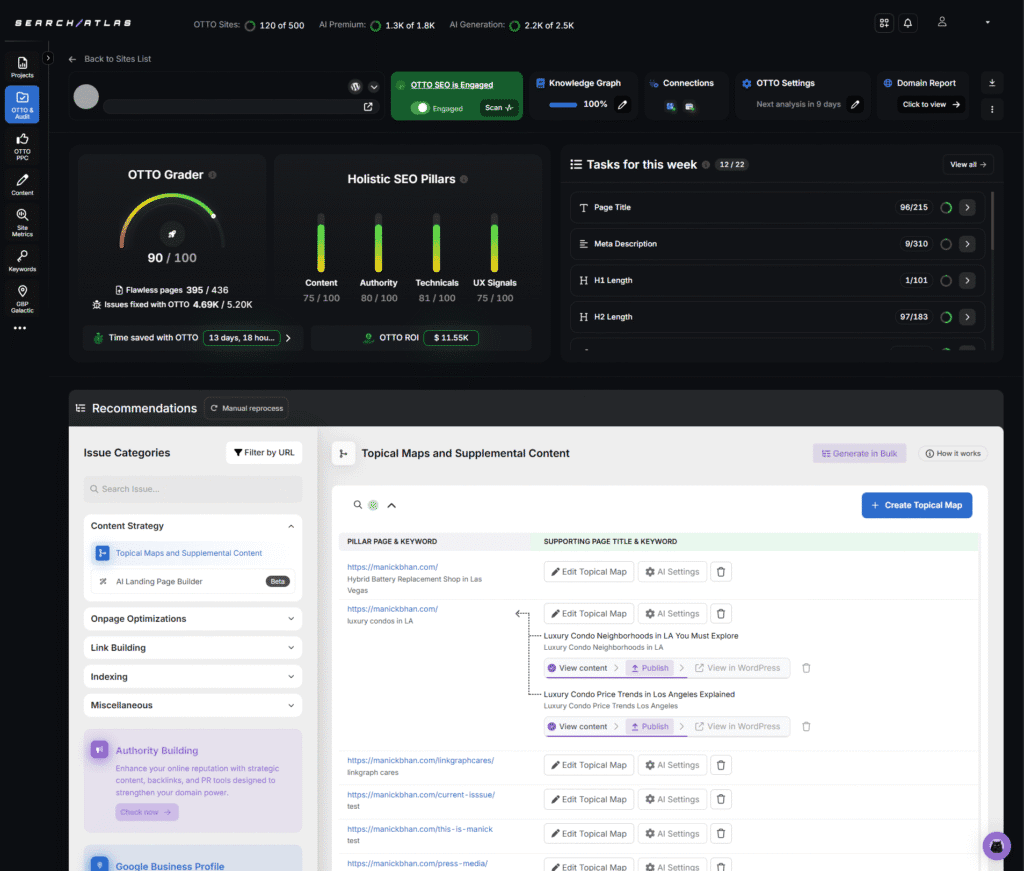
Enhanced SEO analysis dashboard showcasing advanced keyword and content optimization tools.
What it cannot do without dev work: change site architecture, restructure URL paths, rebuild a CMS template, fix server-side performance issues, or modify code that lives in the application layer.
The boundary is operational, not technical. Anything the script can inject into a page at render time is in scope; anything that requires editing source code is out of scope.
How OTTO and Atlas Agent run SEO on autopilot
OTTO and Atlas Agent are the deployment and reasoning halves of Search Atlas’s autopilot system. Atlas Agent decides what needs to happen across the site; OTTO carries out the change on the live page. The two run in a continuous loop against ranking and AI-visibility goals.
OTTO: the deployment layer
OTTO is the execution layer that applies SEO changes to a live site through a script installed on the page. Once the script is in place, OTTO SEO can update metadata, inject schema, rewrite on-page content, add internal links, and ship structured-data updates without a redeploy.
OTTO SEO handles the deployment mechanics work that most platforms hand back to the user. The script resolves precedence over CMS-generated tags, validates schema before injection, and tracks every change in a change log that supports rollback. Because changes live at the script layer, they propagate without a CMS publish step, which is what allows site-wide fixes to ship within minutes rather than across a release cycle.
OTTO’s design has one operational consequence worth naming: deployed fixes persist on the site even after the platform is cancelled. New changes stop, but already-applied changes remain in place. This is the opposite of platforms where canceling strips every deployed tag, which can cause an abrupt visibility loss at the moment of churn.
Atlas Agent: the reasoning layer
Atlas Agent is the reasoning layer that diagnoses issues, ranks them by impact, generates the fix, and hands it to OTTO for deployment. It pulls data from Search Console, the site crawl, SERP signals, and AI-citation tracking, then runs the prioritization loop above.
The user interacts with Atlas Agent at the goal level, not the task level. Inputs include the target topic cluster, the priority pages, the brand voice rules, and any banned terms or compliance constraints. From those inputs, the agent picks its own next action: which page to fix first, which fix type to apply, which AI surface to target next.
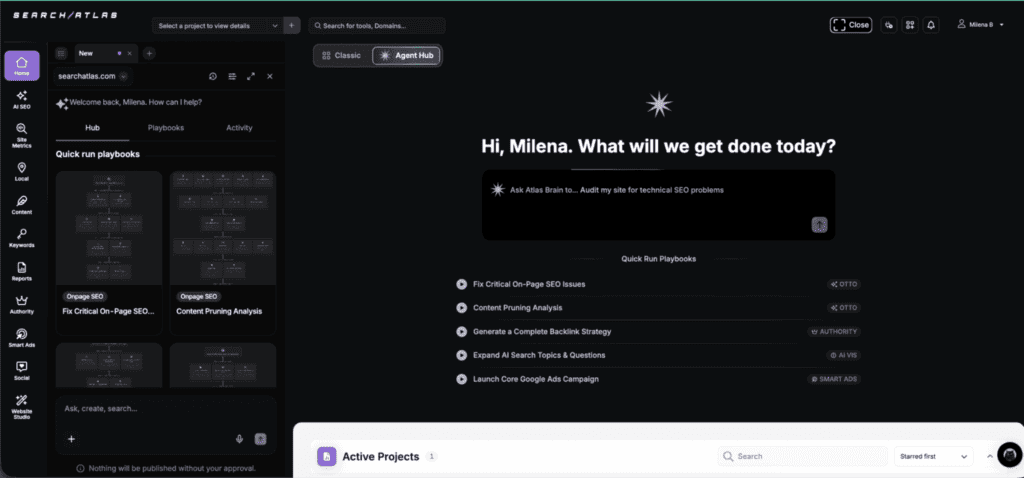
Atlas Agent is what makes the system goal-driven instead of rule-driven. The user sets the target (organic visibility on a topic cluster, citation rate for a set of AI queries), and the agent picks its own next action. When the goal changes, the agent re-prioritizes the queue without the user editing each individual rule.
AI-visibility coverage
AI-visibility coverage is the part of the autopilot loop that watches AI answer surfaces and ships the fixes that influence citation likelihood. Atlas Agent tracks where the site is cited in AI-generated answers, identifies citation gaps against competitors, and generates the content and schema changes that move the page toward inclusion.
The measurable surfaces fall into three groups: AI Overviews and similar generative SERP features inside search engines; standalone LLM products that produce answers with citations; and knowledge-panel or entity surfaces that depend on structured data and entity coverage. Each surface has different citation triggers, so the agent’s fix set for one is not identical to its fix set for another.
The AI-visibility outputs run through the same deployment path as traditional SEO fixes. Atlas Agent decides; OTTO ships. The user does not maintain a separate workflow for GEO.
Where humans still belong in the loop
Humans still own three layers that no autopilot system should run alone: strategy, editorial sign-off, and judgment on high-stakes pages. The agent ranks issues by signal, but signal does not capture brand position, competitive context, legal review, or product launch timing.
Three rules for the human boundary:
- Strategy: humans define the topics, audiences, and competitors the agent optimizes against.
- Approval: high-traffic and revenue-critical pages should sit behind a manual approval queue, not auto-deploy.
- Editorial: net-new content benefits from human review before publication, especially in YMYL categories where source quality and accuracy carry compliance weight.
Concrete cases where the human boundary matters in practice:
- A product launch where the homepage is the launch surface; auto-deploys to the homepage during launch week should be paused.
- A regulated category (finance, health, legal) where every content change has to clear compliance before going live.
- A brand voice migration where the agent’s draft language conflicts with new guidelines that have not yet been encoded as rules.
- Competitive intelligence triggers; if the agent detects a competitor moving on a target query, a human should set the response, not the prioritization model.
A platform that markets itself as “fully autonomous, no human needed” is overpromising. A credible autopilot system gives the user control over where the line sits, page by page and category by category.
How much does SEO autopilot cost?
SEO autopilot pricing typically sits between standalone SEO tools and full-service agency retainers, with the actual figure depending on site size, page volume, and the AI-visibility features included. The category structure is consistent across vendors:
- Self-serve tiers cover a single domain and a capped number of pages or fixes per month.
- Mid-tier plans add agency features: multi-site, white-label, larger fix quotas, and AI-visibility tracking across more engines.
- Enterprise plans cover unlimited domains, custom integrations, and account-managed deployment.
Two cost dynamics matter when comparing vendors:
- Tools that produce recommendations but require developer time to ship fixes carry a hidden cost in engineering hours. A backlog of 200 metadata rewrites is a sprint’s worth of work for a developer; the platform sticker price omits that line item.
- Tools that auto-deploy save that cost but transfer it to oversight. Someone has to review the change log, and that responsibility is real, even when the changes themselves ship without intervention.
The total-cost question is whether the autopilot replaces the equivalent of an in-house SEO specialist, a developer’s part-time SEO queue, or an agency retainer. For most mid-market sites, the replacement is partial: the agent handles the execution layer, and the team’s senior SEO time gets reallocated to strategy and content commissioning.
For current numbers, check the vendor’s pricing page directly. Public pricing in this category changes frequently.
How to evaluate an SEO autopilot platform
An SEO autopilot platform should be evaluated against the execution layer, not the dashboard. The right test is whether the system can take an issue from detection to a live-site change without a developer in the path.
Run any platform through this checklist before buying:
- Stages covered: confirm the platform handles crawl, prioritization, generation, deployment, and monitoring. A gap at any stage means manual work returns to the user.
- Deployment mechanism: ask how the fix reaches the live site. If the answer is “we send your team a ticket,” it is a recommendation engine.
- AI-visibility coverage: ask which AI answer surfaces the platform tracks and which it can influence through deployed changes.
- Approval workflow: confirm both auto-deploy and queue-for-review exist, and that the user controls which pages use which mode.
- Persistence: ask what happens to deployed fixes if you cancel. Some systems strip changes; others leave them in place.
- Rollback: confirm the agent can reverse a change that hurts performance, and check the criteria it uses to trigger the rollback.
- Integrations: verify the platform connects to Search Console, the CMS in use, and analytics. Custom-built sites need a check that the script runs without conflicts.
- prefer vendors that publish tiers and fix quotas over those that route every quote through sales.
Two interview questions that surface category drift quickly:
- “Show me a fix that shipped to a live page last week, end to end.” A vendor that pulls up a change log with timestamps and rollback status passes. A vendor that pulls up a dashboard of recommendations does not.
- “What happens if your model writes a meta description that lowers our click-through rate?” A clear answer covers the threshold, the rollback path, and the logging behavior. A vague answer is the answer.
A platform that passes seven of these eight criteria is operating at the category standard. Anything below five is closer to SEO automation than autopilot.
FAQ
Can SEO be fully automated end-to-end?
No, not in a way that removes humans entirely. The execution layer (audits, on-page fixes, schema, internal links, monitoring) can run on autopilot. Strategy, brand decisions, editorial review on sensitive pages, and competitive positioning still need human judgment.
Does SEO autopilot work for AI Overviews and ChatGPT citations?
Yes, if the platform tracks AI-citation surfaces and ships the corresponding content and schema changes. An autopilot that only optimizes for Google rankings misses half the visibility surface in 2026.
How long before SEO autopilot moves rankings?
Technical and metadata fixes can show measurable changes in 2 to 4 weeks. Content and topical-authority improvements show impact in 1 to 3 months. AI-visibility lift depends on how often the relevant queries are indexed by each engine, which varies by surface.
What happens if an automated change hurts a page’s performance?
The agent reverses the change once monitoring crosses the rollback threshold and logs the failure so the next cycle does not retry the same approach. On platforms without monitoring, the change stays live until a human notices, which is the failure mode that makes deploy-only “autopilot” tools dangerous to use without oversight.
What happens to fixes if I cancel the platform?
It depends on the vendor. Some systems strip all deployed changes when the subscription ends. Others, including OTTO, leave applied fixes in place and only stop deploying new ones.
Will autonomous SEO replace SEO specialists or agencies?
It replaces the execution layer of in-house and agency work: audits, on-page fixes, schema deployment, link insertion, and monitoring. It does not replace strategy, editorial direction, relationship-based link acquisition, or interpretation of competitive moves.
Does SEO autopilot work for new sites with no Search Console history?
Partially. Without historical query data, the agent prioritizes from site-crawl signals and SERP feature presence rather than impression deltas. Once Search Console accumulates enough data (typically 4 to 8 weeks for a new site), the prioritization layer becomes more accurate.
Can SEO autopilot replace my technical SEO audit?
Yes for the recurring portion, no for the one-off architecture review. The agent continuously runs the diagnostic and ships the on-page fixes that a standard audit would surface. A one-off audit for site migrations, URL restructures, or render-mode changes still needs a human technical SEO and a developer.
How is SEO autopilot different from an AI writing tool?
An AI writing tool generates content when prompted. An SEO autopilot decides what content needs to exist, generates it, and deploys it to the right pages without a prompt. The unit of work is a goal, not a request.