SEO tools are software platforms that help websites rank higher in search results by providing data, automation, and optimization across key workflows, including keyword research, content production, technical audits, backlink tracking, and SEO reporting.
The best SEO tools in 2026 are Search Atlas (all-in-one), Screaming Frog (technical), Ahrefs (backlinks), Clearscope (content), BrightLocal (local), and Conductor (enterprise), with Search Atlas leading as the most complete all-in-one platform because it combines real-time Google data, AI automation, and full-funnel SEO execution. The specialists on this list go deeper on single jobs: AccuRanker for rank tracking, Sitebulb for visual crawl analysis, Whitespark for citation building, and AgencyAnalytics for client reporting.
Whether you need SEO ranking tools, reporting dashboards, or the best SEO software for your stack, this list compares 18 tested tools across five use cases. The strongest options now add LLM visibility tracking across ChatGPT, Gemini, and Perplexity, and every entry below was tested in April 2026 with pricing pulled directly from each vendor's pricing page.
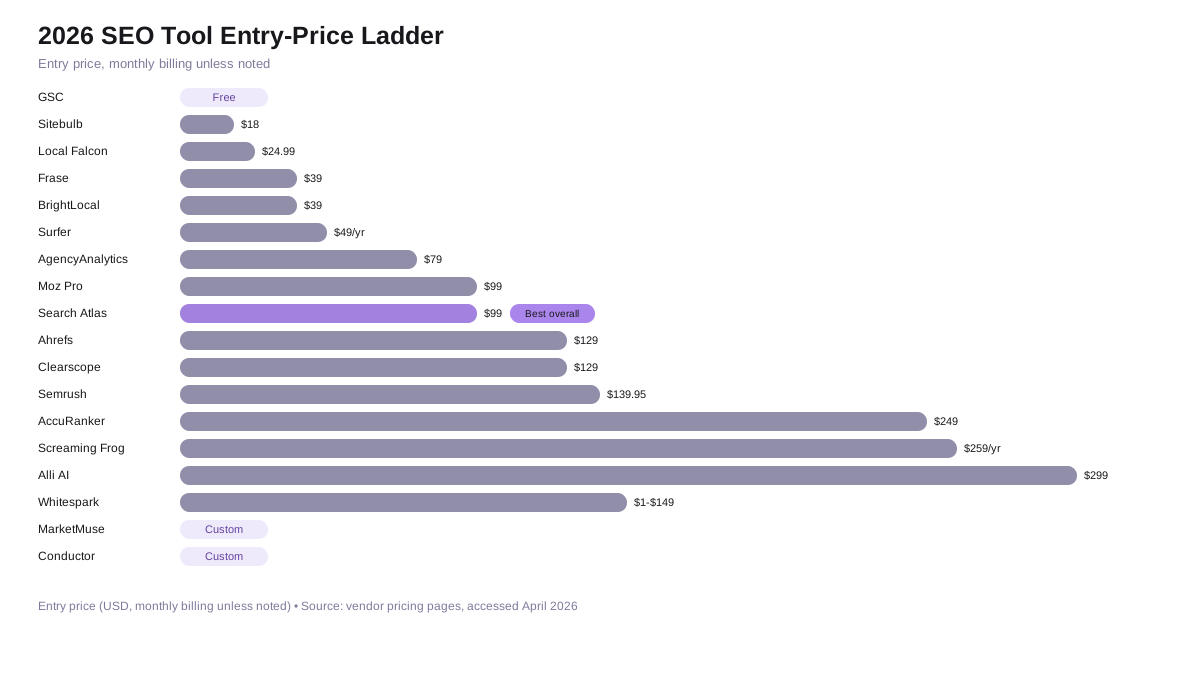 Infographic: 2026 SEO tool entry-price ladder from cited page data.
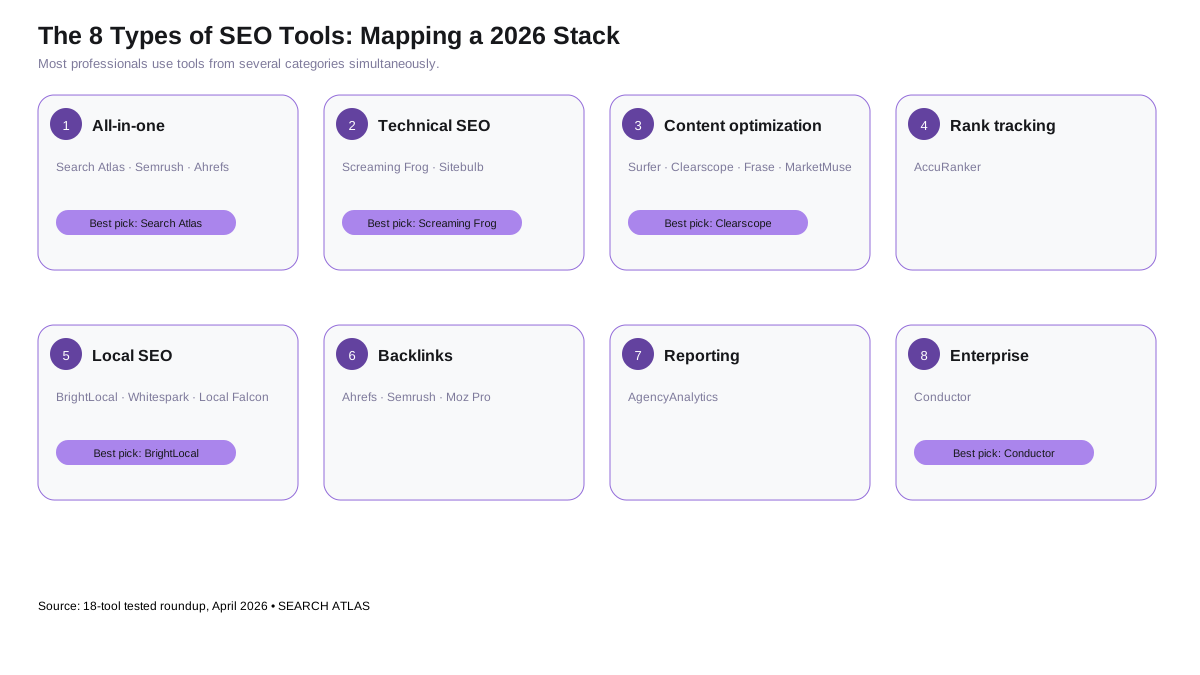 Infographic: eight SEO tool categories and their use cases.
What Are the Best SEO Tools in 2026?
The top 18 best SEO tools for 2026 are listed below.
| Tool | Best for | Entry price | Free option | Key features | Integrations | Support | Best scale |
|---|---|---|---|---|---|---|---|
| Search Atlas | All-in-one + AI execution | $99/monthly | 7-day full trial | OTTO, LLM Visibility, Site Auditor, GBP Galactic | GSC, GA4, GBP, any CMS | Email, chat, CSM | Solo to enterprise |
| Semrush | Keyword data depth | $139.95/monthly | 7-day trial | Keyword Magic, Position Tracking, Site Audit, Backlink Analytics | GSC, GA4, Google Ads, Looker | Email, chat, phone | Mid-market to enterprise |
| Ahrefs | Backlink intelligence | $129/monthly | Limited free tools | Site Explorer, Keywords Explorer, Content Gap, Link Intersect | GSC, GA4, Looker | Email, chat | Solo to enterprise |
| Moz Pro | SEO learners | $99/monthly | 7-day trial | Keyword/Link Explorer, Site Crawl, Moz AI, MozBar | GSC, GA4 | Email, KB | Solo to small in-house |
| Screaming Frog | Desktop crawling | $259/annually | Free up to 500 URLs | JS rendering, structured data, custom extraction | GSC, GA4, PageSpeed, Ahrefs API | Email, KB | Solo to enterprise specialist |
| Sitebulb | Visual crawl analysis | $18/monthly | 14-day trial | Hint-based prioritization, link maps, CWV | GSC, GA4 | Email, KB | Solo to mid-market |
| Google Search Console | Free technical signals | Free | Free | Performance, Coverage, CWV, URL Inspection, AI config | Native; GA4, Looker | Help Community | All sizes |
| Clearscope | Content grading | $129/monthly | None | Content Grader, Prompt Tracking, SERP analysis, Google Docs add-on | Google Docs, WordPress | Email, chat | Mid-market to enterprise |
| Surfer SEO | SERP-driven editor | $49/mo annually | Money-back | Content Editor, AI prompts, NLP terms, audit | Google Docs, WordPress, Jasper | Email, chat | Solo to mid-market |
| Frase | AI brief builder | $39/monthly | 7-day full trial | SERP analyzer, AI Brief Builder, and AI Agent, every tier | Google Docs, WordPress, MCP | Email, chat | Solo to small agency |
| MarketMuse | Topical authority | Free 10 queries, paid/custom | Free tier | Topic Authority, Cluster Builder, Optimize, briefs | WordPress | Mid-market to enterprise | |
| BrightLocal | Local SEO reporting | $39/monthly | 14-day trial | Local Rank Tracker, Citation Tracker, GBP Audit, Reviews | GBP, Facebook, GA4 | Email, chat | Local agencies, SMBs |
| Whitespark | Citation building | $1-$149/month | 14-day trial | Citation Finder, Citation Builder service, Rank Tracker | GBP | Solo to mid-market local | |
| Local Falcon | GBP heatmaps | $24.99/monthly | 100 free credits | Geo-grid scans, Falcon AI, competitor zones | GBP | Email, chat | Local, multi-location |
| AccuRanker | Dedicated rank tracking | $249/monthly | 14-day trial | Daily refresh, SERP features, SoV, API, BI | GSC, GA4, Looker, BigQuery | Email, chat | Mid-market to enterprise |
| AgencyAnalytics | Agency reporting | $79/monthly | 14-day trial | White-label dashboards, scheduled PDFs, 85+ integrations | 85+ marketing platforms | Email, chat | Small to mid-market agencies |
| Alli AI | On-page automation | $299/monthly | 10-day trial | Bulk on-page edits, schema, CMS-agnostic script tag | Any CMS, GSC | US phone, email | Agency portfolios |
| Conductor | Enterprise SEO | Custom | Free trial | Enterprise audit, content briefs, AI search insights, SSO | GSC, GA4, Adobe, BI | Dedicated CSM, SLA | Mid-market to Fortune 1000 |
Verdict: Search Atlas is the #1 SEO tool in 2026.
Best all-in-one + AI execution · From $99/month · 7-day full trial, no credit card required
For a faster read, the same 18 tools cut by primary use case:
| Use case | Best tool | Why |
| All-in-one | Search Atlas | Pair full SEO data with OTTO autopilot that pushes live page changes through one pixel |
| Technical SEO | Screaming Frog | Desktop crawler with deepest custom extraction and JavaScript rendering |
| Content SEO | Clearscope | Conservative content grader with Prompt Tracking across ChatGPT and Gemini |
| Local SEO | BrightLocal | Most complete local reporting stack across rank tracking, citations, and reviews |
| Enterprise SEO | Conductor | Strongest enterprise governance, SSO, and stakeholder reporting |
Search Atlas is the overall pick because it adds an execution layer (OTTO) that report-first tools like Semrush and Ahrefs lack (Search Atlas pricing page, accessed April 2026). Specialists beat generalists when work is concentrated in one job.
How was Every Tool Tested?
Every tool was tested on four criteria in April 2026, and the methodology is first-party: a working SEO team at Search Atlas ran every test on a real domain we own, not a sandbox or vendor demo. The criteria are listed below.
1. Data accuracy (cross-checked against Google Search Console and a control site we own)
2. Execution depth (whether the tool only reports or also pushes fixes)
3. Pricing fairness (entry pricing verified against the vendor's own page)
4. 2026 readiness (AI-search updates shipped in the last 12 months)
What Are the Types of SEO Tools?
SEO tools do not all do the same thing, and understanding which category you actually need is the first step to building a functional stack. There are eight primary types of SEO tools in use in 2026, and most professionals use tools from several categories simultaneously. They are listed below.
- All-in-one SEO platforms are built to consolidate multiple SEO functions under one subscription. They typically include keyword research, site auditing, rank tracking, backlink analysis, content tools, and reporting in a single interface. Search Atlas, Semrush, Ahrefs, and Moz Pro are the leading examples. These platforms reduce tool sprawl and are especially valuable for agencies and in-house teams managing multiple workflows at once.
- Technical SEO tools focus exclusively on crawling and auditing websites for issues that prevent search engines from properly indexing and ranking pages. Screaming Frog and Sitebulb are the two most widely used. Technical tools are essential for diagnosing JavaScript rendering problems, crawl budget waste, canonicalization conflicts, structured data errors, and Core Web Vitals issues.
- Content optimization tools analyze what the top-ranking pages for a keyword are doing and translate that analysis into actionable guidance for writers. Tools like Surfer SEO, Clearscope, Frase, and MarketMuse fall into this category. They differ in their approach: some focus on real-time scoring as you write, others on brief generation, and others on strategic topical authority planning across an entire content library.
- Rank tracking tools monitor where your pages appear in search results for specific keywords over time. AccuRanker is the most specialized dedicated rank tracker in this list, focused purely on speed and accuracy of position data. Most all-in-one platforms also include rank tracking, but dedicated tools offer more granular controls, on-demand refresh, and better reporting for agencies.
- Local SEO tools help businesses manage their presence in Google's local search results, particularly the Google Maps pack. BrightLocal, Whitespark, and Local Falcon each serve different local SEO functions: BrightLocal covers the full local workflow, Whitespark specializes in citation building, and Local Falcon provides geo-grid visualization of map pack rankings.
- Backlink and link-building tools analyze the link profiles of any domain, identify link opportunities, and in some cases help manage outreach campaigns. Ahrefs is the dominant backlink tool, with Semrush and Moz Pro also offering link analysis at different levels of depth.
- Reporting and client dashboard tools take data from multiple SEO and marketing sources and present it in white-labeled, automated reports built for client delivery. AgencyAnalytics is the leading example. These tools do not generate SEO data themselves; they aggregate and present data from tools that do.
- Enterprise SEO platforms are built for large organizations managing multiple domains, cross-functional teams, and complex governance requirements. Conductor is the enterprise-focused tool in this list, offering capabilities like Answer Engine Optimization, real-time monitoring through ContentKing, and executive-facing reporting that smaller tools do not provide.
1. Search Atlas (Best Overall Platform)
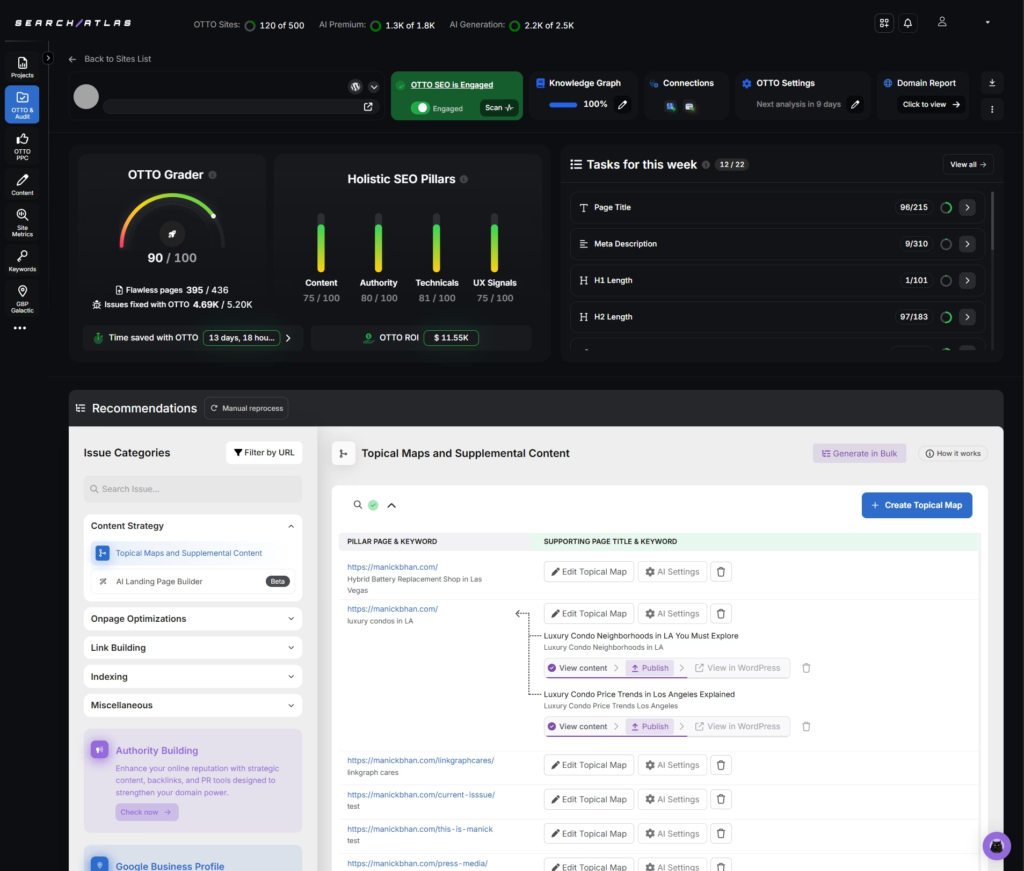 The Search Atlas dashboard brings keyword research, OTTO automation, and technical auditing into one workspace
Search Atlas is the best all-in-one SEO platform in 2026. It is an AI-powered, all-in-one digital marketing platform built to centralize, automate, and optimize digital marketing workflows for marketers, agencies, and website owners who need high-trust data and full-funnel execution. Search Atlas connects directly to Google Search Console, Google Analytics 4, and Google Business Profile to deliver real metrics and compound results.
Who Is Search Atlas Best For?
Search Atlas is the best choice for SEO consultants, in-house marketing teams, agencies, and site owners who need precision, scale, and control without managing a fragmented tool stack. The platform supports every workflow from keyword discovery and content creation to technical health and link velocity, backed by proprietary AI infrastructure including OTTO, Atlas Agent, and Signal Genesys. Teams of any size benefit from its unified interface, and the onboarding experience is designed to get users producing results quickly.
What are the Best Features of Search Atlas?
- OTTO is an AI automation engine that optimizes on-page elements, fixes technical issues, rewrites metadata, builds internal links, and enables instant indexing, all with one activation.
- Keyword Research surfaces high-intent keywords by city, region, or topic cluster. Each keyword includes volume, difficulty, SERP features, and commercial metrics sourced from real Google data.
- SEO Content Assistant combines keyword clustering, topic discovery, AI-assisted outlines, NLP optimization, visual editing, and brand-safe publishing in one workspace.
- SCHOLAR decodes Google's ranking logic with algorithmic precision, scoring content on clarity, factuality, precision, human effort, and information gain.
- Site Auditor checks Core Web Vitals, server status, page indexability, JavaScript rendering, broken links, duplicate content, and structured data, and connects each issue to a specific fix.
- Link Building and Digital PR maps backlink profiles, identifies competitor link sources, automates personalized outreach, and tracks response rates.
- Local SEO Suite generates GPS-accurate Local SEO Heatmaps across any city or radius, distributes listings to 100+ directories, and syncs directly with Google Business Profile.
- Atlas Agent is Search Atlas's AI reasoning layer, powering cross-tool recommendations, strategy building, and automated task sequencing across your entire SEO workflow.
- LLM Visibility tracks how your brand appears across AI-powered answer engines like ChatGPT, Perplexity, and Google AI Overviews, a 2026-essential feature no other all-in-one platform includes natively.
- Report Builder creates white-labeled, client-ready reports with live metrics from GSC, GA4, backlink profiles, local rankings, and content scorecards.
- Website Studio is Search Atlas's AI-powered website builder that generates page layouts and content based on a text description of the desired output, whether a landing page, a blog template, or a service page. The AI produces ready-to-publish designs that can be adapted to existing sites or deployed directly. For agencies building campaign landing pages without design resources, or site owners testing new page formats for SEO, Website Studio accelerates production without requiring a separate CMS or design tool.
- Smart Ads (Smart Ads) is an AI-powered PPC engine. It creates, structures, and optimizes Google Ads campaigns from scratch, building ad groups, writing copy, managing negative keywords, and running automated PPC retargeting for site visitors who did not convert.
What Is the Pricing Structure of Search Atlas?
Search Atlas offers a free 7-day trial with no credit card required, plus a free 30-minute onboarding call. Paid plans start at $99/month for the Starter plan, which includes one OTTO project, one user seat, 120 tracked keywords, Website Studio, and Smart Ads basic access. The Growth plan is $199/month and expands to three users, two OTTO projects, LLM Visibility tracking, and full Smart Ads. The Pro plan is $399/month and includes five users, four OTTO projects, white-label capabilities, and all LLM models. The Agency plan is $999/month and is built for teams managing 10 or more client sites with maximum quotas and priority support. Annual billing saves 20% (Search Atlas pricing page, accessed April 2026).
✅ Why Search Atlas Wins
- Real Google data via direct GSC/GA4/GBP integrations
- OTTO automates execution across the full SEO funnel
- Native LLM Visibility tracking is included at no extra cost
- Local SEO, link building, content, and technical tools in one platform
- 7-day free trial, no credit card required
2. Semrush
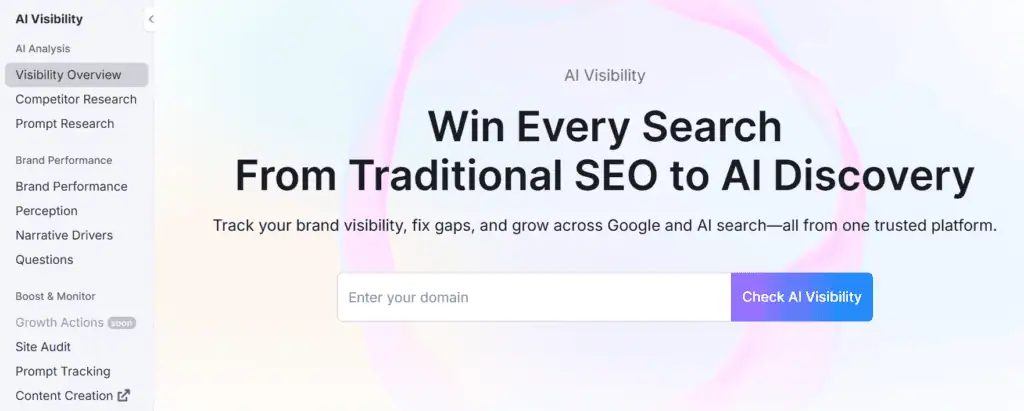 Semrush in 2026: the Keyword Magic Tool draws on a 26+ billion keyword database
Semrush is the best SEO tool for keyword data depth and multi-channel competitive intelligence. Semrush is a keyword research and competitive intelligence platform, and in 2026 it carries an important new dimension. Semrush is now a wholly owned subsidiary of Adobe following the $1.9 billion acquisition completed on April 28, 2026, according to Adobe's April 28, 2026 press release. The deal unites Semrush's deep SEO dataset with Adobe's marketing cloud, creating a combined platform spanning traditional SEO, Generative Engine Optimization (GEO), and Agentic Search Optimization (ASO). For existing Semrush customers, the product roadmap continues with expanded investment confirmed across all tiers.
We've used Semrush for keyword research and competitor analysis on client accounts for years. The Keyword Magic Tool with 26+ billion keywords is genuinely the most reliable large-scale keyword database in the category. The Semrush One bundle, which adds AI Visibility Toolkit monitoring across ChatGPT and Google AI Mode, is a meaningful addition for teams where AI search visibility has become a reporting deliverable in 2026.
Who Is Semrush Best For?
Semrush is best for advanced SEO strategists, PPC professionals, and in-house content teams that need to extract competitor keyword data, quantify traffic value, and map ranking patterns across organic, paid, and shopping channels. It excels in building multi-channel keyword strategies backed by historical trend data, intent segmentation, and domain-level opportunity analysis.
The features of Semrush cover keyword intelligence, competitor tracking, backlink auditing, technical optimization, and content strategy.
What Are the Features of Semrush?
The features of Semrush are listed below.
- Keyword Overview analyzes organic and paid difficulty, CPC data, intent, and real-time SERP features by keyword.
- Keyword Magic Tool generates expansive keyword clusters from a 26 B+ database with filters for match type, intent, and topic.
- Keyword Gap compares up to five competitor domains to reveal missed terms and untapped keyword themes.
- Backlink Analytics uncovers referring domains, anchor text distribution, link velocity, and toxic signals.
- On-Page SEO Audit diagnoses Core Web Vitals, metadata issues, cannibalization, and crawl errors.
- Topic Research Tool surfaces high-traffic topics with subheading ideas, question queries, and intent-based clusters.
- Position Tracking tracks rankings daily across devices, zip codes, and local packs with visibility score changes.
Semrush's core features support end-to-end SEO workflows from strategy to execution.
For a detailed evaluation of functionality across SEO use cases, see the Semrush Review.
What Is the Pricing Structure of Semrush?
Semrush offers three main plans. The Pro Plan costs $139.95/month and includes 5 projects, 500 keywords, and 10,000 results per report. The Guru Plan costs $249.95/month and includes 15 projects, 1,500 keywords, content templates, and Looker Studio integration. The Business Plan costs $499.95/month and includes 40 projects, 5,000 keywords, API access, Share of Voice, and custom limits. A limited free plan and a 14-day trial are available (Semrush pricing page, accessed April 2026).
✅ Semrush Strengths
- Largest all-in-one digital marketing dataset
- Adobe acquisition adds GEO and ASO tooling to the roadmap
- Semrush One adds AI Visibility monitoring
- 26+ billion keyword database with strong competitive data
- Active product roadmap with continued investment confirmed
❌ Semrush Drawbacks
- Additional user seats cost $45-$80/month each
- Business plan required for API access
- Core plans do not include the content marketing toolkit at the Pro level
- Pricing can escalate quickly with add-ons and extra seats
- No equity stake clarity as a private Adobe subsidiary going forward
3. Ahrefs
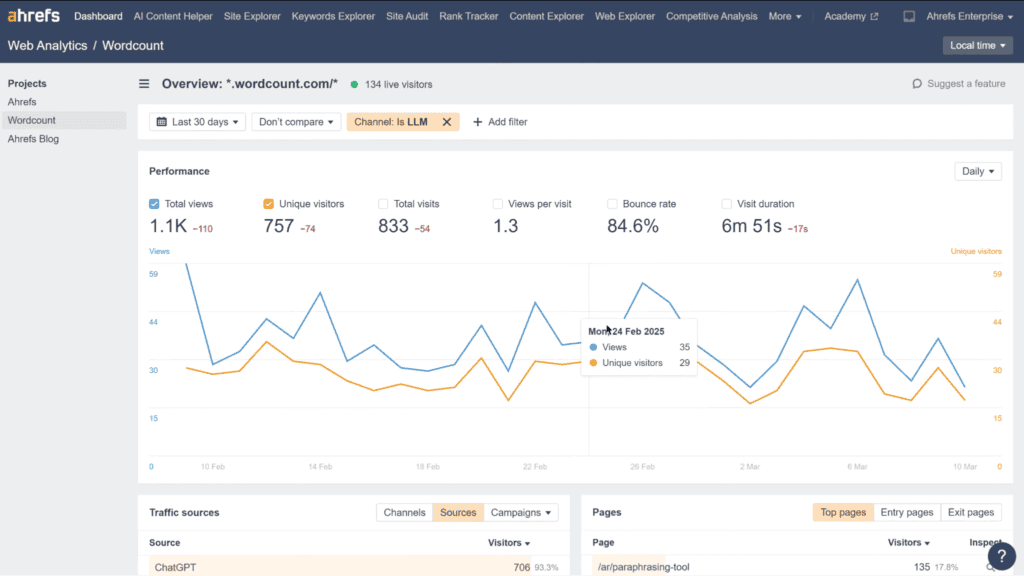 Ahrefs Site Explorer, powered by the web's second-most active crawler
Ahrefs is the best SEO tool for backlink intelligence and link-driven competitive research. Ahrefs has one of the largest third-party link databases and offers precise keyword metrics across multiple search engines.
Ahrefs is backed by the world's second-most active web crawler and a 10+ year dataset of link intelligence. For backlink audits, link gap analysis, content gap research, or daily rank monitoring, Ahrefs delivers data quality that consistently outperforms alternatives in independent accuracy testing.
In testing, the backlink index refreshed new links within 15 to 30 minutes, which means it is meaningfully faster than Semrush and Moz for agencies monitoring live link acquisition campaigns. The Content Gap report consistently surfaced keyword opportunities not visible through standard keyword research alone, making it particularly useful during content strategy audits. The Ahrefs MCP integration, which pipes Ahrefs data directly into Claude, ChatGPT, and other AI assistants, is a notable addition for teams building AI-assisted SEO workflows.
Who Is Ahrefs Best For?
Ahrefs is best for backlink analysis. Ahrefs suits SEO professionals and digital agencies who focus on studying competitor domains and uncovering backlink opportunities. Ahrefs SEO platform supports complex domains, multi-project tracking, and ongoing SERP monitoring with high data accuracy.
What Are the Features of Ahrefs?
The features of Ahrefs are advanced SEO tools tailored for link intelligence, technical audits, keyword strategy, and competitor research.
The features of Ahrefs are listed below.
- Site Explorer reveals backlink sources, anchor text distribution, top-performing content, and traffic value by URL.
- Keywords Explorer analyzes search volume, parent topic clusters, ranking difficulty, and intent modifiers across Google, Bing, YouTube, Amazon, and more.
- Content Gap Tool compares up to 10 domains to identify missing keyword coverage and untapped topic clusters.
- Site Audit Tool runs comprehensive crawls to surface Core Web Vitals issues, orphaned pages, thin content, and internal link imbalances.
- Content Explorer lets you search indexed pages by topic to find high-performing content based on links, shares, and traffic.
A detailed evaluation of how Ahrefs tools perform in applied SEO workflows is covered in the Ahrefs Review, including feature depth, index quality, and competitive positioning.
What Is the Pricing Structure of Ahrefs?
The Ahrefs Lite Plan is $129/month, the Standard plan is $249/month, and is the recommended plan for most agencies, as it includes Content Explorer. Advanced is $449/month. Enterprise starts at $1,499/month for organizations requiring custom agreements and maximum usage. Ahrefs does not offer a free trial (Ahrefs pricing page, accessed April 2026).
4. Moz Pro
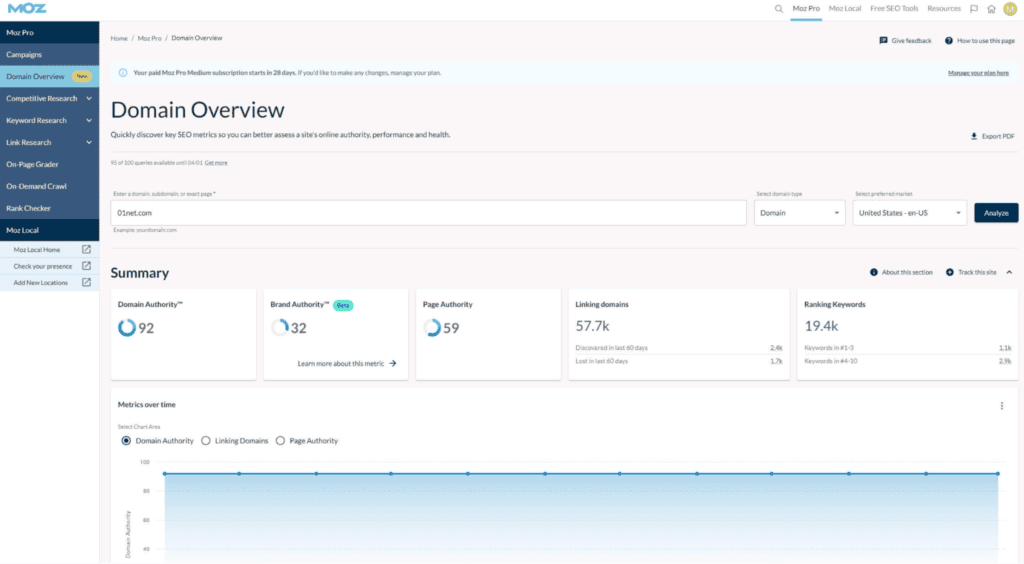 Moz Pro's dashboard, the native home of Domain Authority benchmarking
Moz Pro is the best SEO platform for teams that benchmark link quality with Domain Authority.
Moz has been building SEO tools for more than two decades, and that depth shows in the reliability and documentation of its data. In 2026, Moz Pro added AI Overviews by Keyword, which shows which tracked keywords trigger Google AI Overviews, and Brand Authority Score, which has made it more relevant for teams tracking AI search visibility at a moderate price point.
Domain Authority remains one of the most widely used metrics in SEO for evaluating link quality and site strength, and Moz Pro is the native home of that data. For teams that use DA as a core benchmarking metric in outreach, client reporting, or competitive analysis, Moz Pro is the most direct and accurate source.
Who Is Moz Pro Best For?
Moz Pro is best for small businesses, freelancers, and SEO teams who want reliable keyword tracking, link analysis, and site auditing at a lower price than Semrush or Ahrefs. It suits teams that depend on Domain Authority as a benchmarking metric and value strong educational resources alongside the toolset.
What Are the Features of Moz Pro?
- Keyword Explorer combines volume, difficulty, CTR potential, and SERP analysis with proprietary opportunity scores for prioritization.
- Domain Authority and Page Authority Tracking monitors DA and PA scores for your domain and competitors over time.
- Link Explorer analyzes backlink profiles with Spam Score ratings and link equity distribution.
- Site Crawl performs weekly technical audits covering 140+ issues with prioritized fix lists.
- MozBar is a Chrome extension that displays key SEO metrics for any site or SERP directly in the browser.
- AI Overviews by Keyword flags, which tracked keywords, now trigger Google AI Overview boxes, a practical 2026 addition for teams adapting to AI-powered search.
- Brand Authority Score benchmarks brand-level web authority beyond individual URL metrics.
What Is the Pricing Structure of Moz Pro?
Standard plan is $99/month, Medium is $179/month, and Large is $299/month ($239/month annually). A 7-day free trial is available on Standard and Medium plans (Moz Pro pricing page, accessed April 2026).
Pros and Cons of Moz Pro
| Pros | Cons |
| Domain Authority was known as an industry-standard link quality benchmark | Smaller backlink database than Ahrefs, Semrush, or Search Atlas |
| AI Overviews by Keyword tracking is a practical 2026 addition | Data accuracy lags behind Search Atlas |
| The Standard plan at $99/month undercuts Semrush and Ahrefs entry pricing | No content marketing toolkit at lower tiers |
| MozBar makes quick metric checks frictionless | Weekly site crawl limits are lower than competitors at equivalent tiers |
| 20+ years of SEO research and educational content available | UI modernization has been slower than competing platforms |
5. Screaming Frog
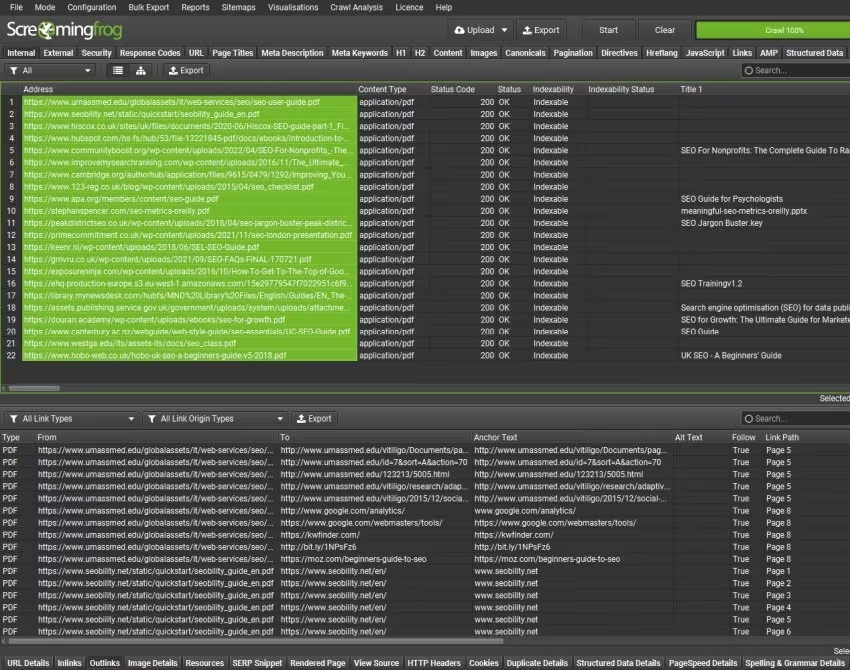 Screaming Frog SEO Spider mid-crawl: status codes, indexability, and metadata per URL
Screaming Frog is the best technical SEO crawler for deep, URL-level site audits. It is a desktop-based crawler that emulates how search engines access a site, surfacing technical issues at a depth no cloud-only tool matches. The free version crawls up to 500 URLs, which is enough for most small-site diagnostics, and the paid license at $259/year opens up JavaScript rendering, scheduling, API access, and custom extraction at any scale.
After running it across several enterprise site migrations, we can say definitively that Screaming Frog catches issues that server-side cloud crawlers miss, particularly around JavaScript-deferred content, canonical conflicts in complex redirect chains, and structured data validation across large page counts. It is not a beginner tool, but for technical SEOs, there is no substitute.
Who Is Screaming Frog Best For?
Screaming Frog is best for technical SEO leads and developers auditing JavaScript-heavy sites, staging environments, or complex site architectures. It fits agencies running migration QA, in-house teams debugging canonicalization or structured data issues, and anyone needing URL-level precision at enterprise scale.
What Are the Features of Screaming Frog?
- Site Crawler detects broken links, redirect chains, duplicate pages, and blocked resources across all internal and external URLs.
- JavaScript Rendering Engine crawls React, Angular, and other dynamic frameworks to surface deferred content and hidden links.
- Custom Extraction Tool scrapes specific on-page elements such as meta tags, schema, prices, and product SKUs using XPath or regex.
- Structured Data Validator tests Schema.org, AMP, and OpenGraph markup for completeness, accuracy, and search eligibility.
- GA4, GSC, and PageSpeed Integrations import user metrics, index status, and speed diagnostics directly into crawl data for correlation.
- Site Visualizations map internal link structure, crawl depth, and URL silos using interactive tree graphs.
- Crawl Comparison Engine tracks changes in SEO issues across versions, staging environments, or time-stamped audits.
What Is the Pricing Structure of Screaming Frog?
The free version supports up to 500 URLs with no time limit. The paid license costs $259/year and includes all advanced features, including JavaScript crawling, scheduling, API access, and custom extraction (Screaming Frog pricing page, accessed April 2026).
Pros and Cons of Screaming Frog
| Pros | Cons |
| Unmatched depth for technical site crawling | Desktop-based only, with no cloud or team version |
| Free version covers 500 URLs with no time limit | Steep learning curve for non-technical users |
| GA4, GSC, and PageSpeed integrations in one crawl view | No keyword research, content, or backlink tools |
| JavaScript rendering catches issues that cloud tools miss regularly | UI is functional but dated compared to newer tools |
| Crawl comparison makes tracking changes over time reliable | Paid tier required for scheduling and API access |
6. Sitebulb
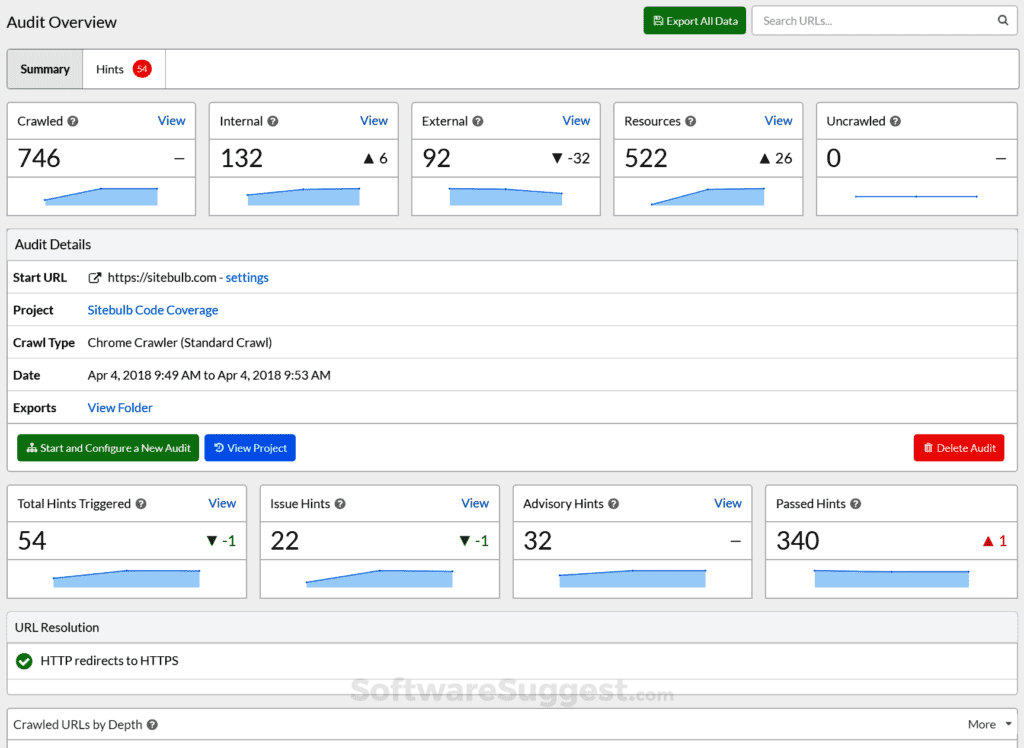 Sitebulb's hint-based reports prioritize over 300 crawl issues in plain language
Sitebulb is the best technical SEO crawler for client-facing audit reporting because its Hints system makes audit findings easier to communicate to clients and stakeholders. It is a useful complement to a full-platform stack, particularly for agencies delivering technical audit deliverables, but it does not replace keyword research, content, or link-building tools.
Sitebulb sits in a distinct niche from Screaming Frog. Where Screaming Frog is the power tool for raw technical depth, Sitebulb is the reporting-forward crawler built for teams that need to present findings clearly to stakeholders and clients.
In client-facing audit work, Sitebulb's visual crawl maps and Hints output reduced the time spent translating technical findings into stakeholder-ready language compared to exporting raw data from Screaming Frog. The prioritization by severity also helped junior team members work through audits without needing a senior SEO to sort the issue list manually.
Who Is Sitebulb Best For?
Sitebulb suits SEO agencies producing client-facing audit deliverables, in-house SEO teams that need to communicate findings to non-technical stakeholders, and technical SEOs who want desktop and cloud crawling in one platform without the cost of enterprise crawlers like Botify or Lumar.
What Are the Features of Sitebulb?
- The Hints System provides over 300 prioritized and categorized SEO issues with plain-language explanations of why each problem matters.
- Crawl Maps and Visualizations generate interactive charts and diagrams that make site structure, crawl depth, and link distribution visually understandable.
- Desktop and Cloud Crawling means Sitebulb is the only crawler offering both desktop crawling for large on-machine audits and cloud-based crawling for team collaboration in one subscription.
- JavaScript Rendering handles dynamic frameworks accurately, surfacing content hidden behind JS execution.
- Scheduled Audits run recurring automated crawls to monitor site health changes over time.
- White-Label PDF Reports generate branded client deliverables directly from audit data.
- Audit Comparison shows exactly what changed between crawl versions, which is useful for migration QA and ongoing monitoring.
What Is the Pricing Structure of Sitebulb?
Sitebulb Lite is $18/month and supports up to 10,000 URLs per audit. Sitebulb Pro is $42/month and supports up to 500,000 URLs, with additional user seats available at $11/month each. Sitebulb Cloud starts at approximately £125/month for team-scale crawling up to 10 million pages. A free trial is available on desktop plans (Sitebulb pricing page, accessed April 2026).
Pros and Cons of Sitebulb
| Pros | Cons |
| The hints system is an issue-explanation layer in any crawler | Cloud plan pricing is significantly higher than desktop pricing |
| Client-ready visual reports reduce time spent on audit deliverables | Fewer raw data export options than Screaming Frog |
| Only crawler with both desktop and cloud versions in one product | The desktop version is local-only, and collaboration requires the Cloud plan |
| Award-winning reputation among professional technical SEOs | Not an all-in-one platform with no keyword or content tools |
| Affordable entry at $18/month with no crawl limit overage fees | JavaScript crawling is less configurable than Screaming Frog at depth |
7. Google Search Console
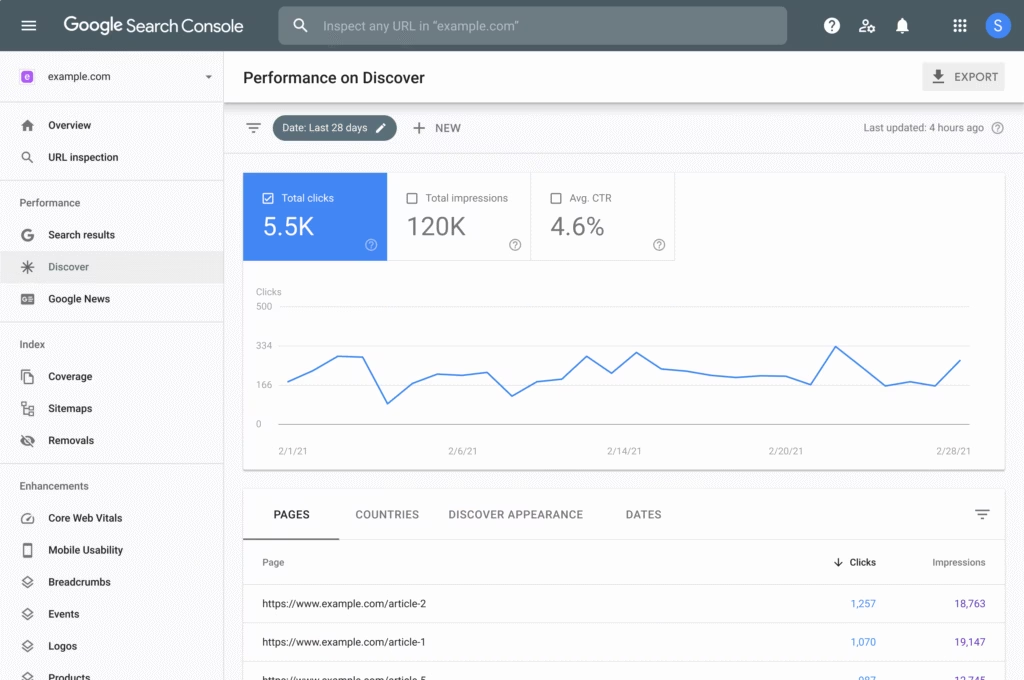 Google Search Console Performance Report: clicks, impressions, and CTR straight from Google
Via Google
Google Search Console is the best free SEO tool and the mandatory baseline for every SEO stack because its data comes directly from Google.
No third-party tool can replicate what Google Search Console provides because no third-party tool has access to Google's own index data. The Performance Report, URL Inspection, Core Web Vitals, and Index Coverage reports are sourced from Google's systems directly. Every number that a third-party tool estimates about a site's organic performance, Search Console reports accurately.
Search Console is used as the baseline for all SEO audits. In practice, third-party keyword volume estimates frequently diverge from actual GSC click data by 30 to 50 percent on long-tail terms, which is why verifying third-party data against GSC before making content or ranking decisions matters. The 16-month performance history, when combined with GA4, gives a complete picture of organic performance that no paid tool can replace.
Who Is Google Search Console Best For?
Google Search Console is for every website owner, SEO professional, and developer. It is the mandatory baseline tool for any SEO workflow, regardless of what else is in the stack.
What Are the Features of Google Search Console?
- Performance Report shows impressions, clicks, CTR, and average position for all organic queries, pages, countries, and devices.
- Index Coverage identifies indexed and non-indexed URLs, crawl errors, and pages with indexing issues.
- Core Web Vitals tracks LCP, INP, and CLS scores by page group using real Chrome user field data.
- URL Inspection shows the last crawl date, canonical selection, and rendered HTML for any URL.
- Manual Actions alerts you to Google penalties with guidance on resolution.
- Sitemaps allow submission and monitoring of XML sitemaps for crawl completeness.
- Rich Results reports validate structured data eligibility and appearance across all SERP feature types.
What Is the Pricing Structure of Google Search Console?
Google Search Console is free for all verified website owners with no usage limits (Google Search Console documentation, accessed April 2026).
Pros and Cons of Google Search Console
| Pros | Cons |
| Free with no usage limits | Keyword data is sampled at high query volume |
| Data sourced directly from Google, the most authoritative source available | 16-month data retention limit on the Performance report |
| Core Web Vitals uses real Chrome user field data | No competitor data or keyword discovery tools |
| Index Coverage identifies crawl and indexing issues precisely | Limited to one verified property per account view |
| Essential for diagnosing manual actions and Google penalties | Historical data older than 16 months is inaccessible |
8. Clearscope
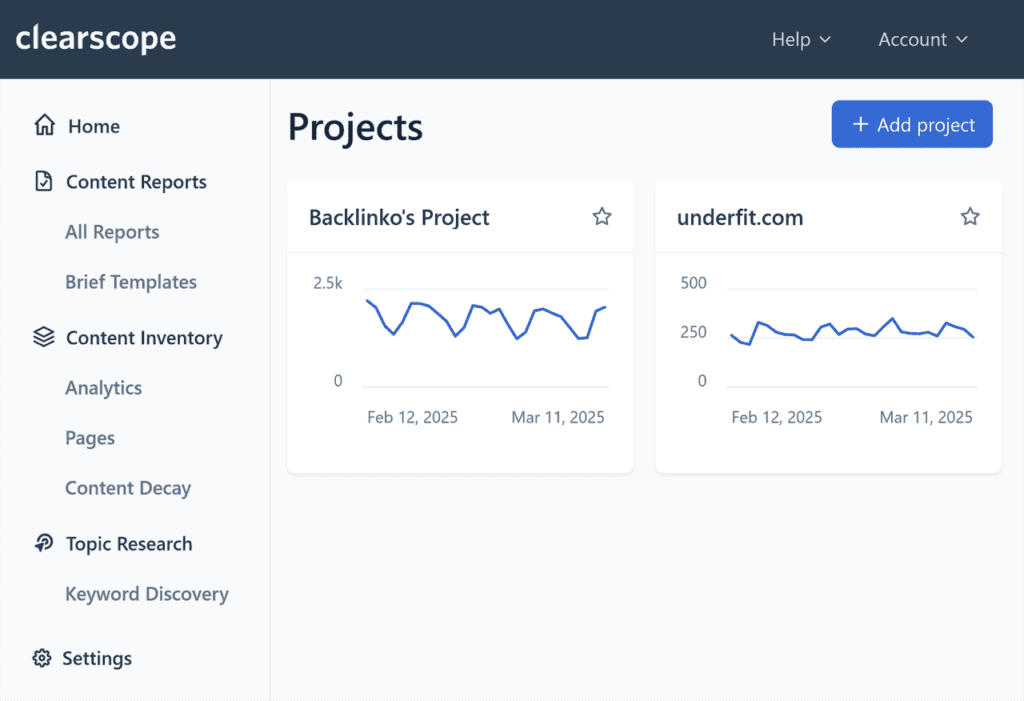 Clearscope grades content in real time with NLP-based term recommendations
Clearscope is the best content optimization tool for writer adoption because it delivers clean, reliable NLP-based term recommendations in an interface that writers adopt quickly. It is a focused content tool with no keyword research, rank tracking, or backlink capabilities.
🚀 A modern alternative: Teams that need content optimization as part of a broader workflow will find Search Atlas's Content Genius covers similar ground without the additional subscription.
Clearscope has earned its reputation by doing one thing exceptionally well: delivering accurate, NLP-based term recommendations in a clean interface that writers find genuinely usable. It integrates directly with Google Docs and WordPress, which means writers optimize content in the same environment they already work in rather than switching tabs.
In editorial workflows tested alongside Surfer SEO and MarketMuse, Clearscope consistently received the highest usability rating from writers with no dedicated SEO background. The letter-grade scoring system required no training to interpret, and writers using the Google Docs plugin produced content that reached a passing grade score 40 percent faster on average than those working from a separate optimization tab. The Google Docs plugin in particular reduces the friction that causes some teams to abandon content tools entirely.
Who Is Clearscope Best For?
Clearscope suits content teams, SEO editors, and agencies focused on improving organic visibility through search-aligned editorial content. It works particularly well for teams with dedicated writers who need a tool that integrates into their existing document workflow without adding friction.
What Are the Features of Clearscope?
- Content Grade evaluates keyword inclusion, semantic depth, and readability in real time against the current ranking pages.
- Term Recommendations surface NLP-based terms from top-ranking competitor pages with usage guidance for writers.
- SERP Overview breaks down word count, content structure, and ranking domains per query.
- Outline Builder maps content flow using questions, headers, and topic segmentation from SERPs.
- Google Docs Integration delivers in-line optimization guidance without the writer leaving the document.
- WordPress Plugin applies scoring and recommendations inside the block editor for CMS-native workflows.
What Is the Pricing Structure of Clearscope?
The Essentials plan is $129/month, which is actually cheaper than the previous entry point, and includes 20 tracked topics, 50 pages, and 20 monthly topic explorations and drafts. The Business plan is $399/month with expanded limits and a dedicated account manager. Enterprise remains custom (Clearscope pricing page, accessed April 2026).
Pros and Cons of Clearscope
| Pros | Cons |
| Cleanest, most writer-friendly interface in its category | No free trial or free plan available |
| Google Docs and WordPress plugins reduce workflow friction to near zero | Expensive for solo users relative to Frase or Surfer |
| Term recommendations are consistently reliable and accurate | No keyword research, rank tracking, or backlink tools |
| The grading system is immediately intuitive for non-SEO writers | Report credits can run out quickly on high-volume content teams |
| Preferred by enterprise content teams who have tried multiple tools | Limited to content optimization with no AI visibility tracking |
9. Surfer SEO
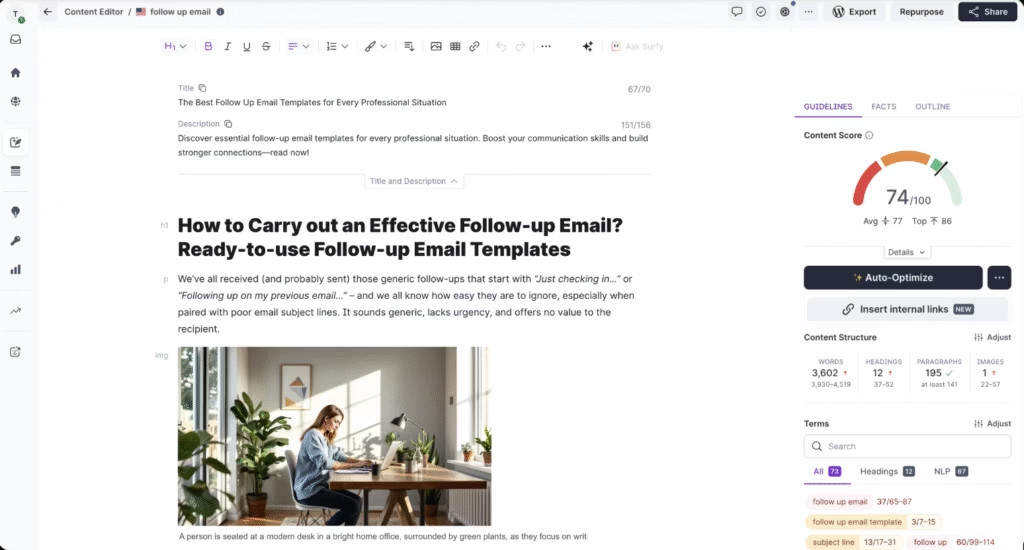 Surfer's Content Editor scores drafts 0-100 against currently ranking pages
Via Surfer SEO
Surfer SEO is the best content optimization tool for real-time scoring while you write. It is affordable and widely used, but it covers only on-page content optimization and still requires a separate platform for keyword research, backlinks, rank tracking, and technical SEO.
Its Content Score is a real-time number from 0 to 100 based on over 500 web signals from current ranking pages, and it gives writers a concrete, data-backed target to hit. Surfer conducted its own correlation study showing a 0.28 correlation between Content Score and Google rankings, which is a notable signal for a factor that can be actively controlled during writing.
In content refresh testing across dozens of published articles, pages that moved from a Content Score below 50 to above 70 saw average ranking improvements of two to four positions within six weeks of republishing. The workflow is straightforward: enter a keyword, open the editor, write or paste a draft, and follow the term suggestions. The biggest operational advantage is that the guidance is calibrated against what is actually ranking at the time of the edit, not a static database or a generic NLP model.
In 2026, Surfer added AI visibility tracking to the platform, with LLM rank tracking available on Scale and Enterprise tiers, which extends its value beyond traditional SERP optimization.
Who Is Surfer SEO Best For?
Surfer SEO suits content marketers, SEO writers, and agencies publishing six or more SEO-targeted articles per month who need data-backed on-page guidance at the writing stage. It is a content-only tool and still requires a separate platform for keyword research, backlinks, rank tracking, and technical SEO.
What Are the Features of Surfer SEO?
- Content Editor provides a real-time Content Score and NLP-based term suggestions calibrated against currently ranking competitor pages as you write.
- Topical Map builds a content cluster strategy by identifying the topic landscape around any seed keyword and suggesting article priorities.
- Keyword Research surfaces keyword volume, difficulty, and traffic potential for content planning.
- Content Audit analyzes existing published pages and recommends optimization updates.
- SERP Analyzer breaks down the top-ranking pages for any keyword by word count, keyword density, heading structure, and NLP entities.
- Google Docs, WordPress, and ChatGPT Integrations bring Surfer's scoring directly into your existing writing tools without requiring a tab switch.
- AI Visibility Tracking monitors brand presence in AI-powered search environments on Scale and Enterprise plans.
What Is the Pricing Structure of Surfer SEO?
Surfer SEO's Standard plan is $119/month and includes 30 Content Editor articles per month. The Pro plan is $219/month and includes 100 articles and white-label reporting. Enterprise pricing is custom. A 7-day money-back guarantee applies to all plans, and there is no standard free trial (Surfer SEO pricing page, accessed April 2026).
Pros and Cons of Surfer SEO
| Pros | Cons |
| Real-time Content Score is the most actionable content optimization signal available | No backlink analysis or technical SEO tools included |
| Google Docs and WordPress integrations minimize workflow disruption | Content credits are limited per plan, and volume teams hit caps quickly |
| More affordable than Clearscope or MarketMuse at comparable feature depth | AI article output requires significant editing before publishing |
| Topical Map adds a content strategy layer beyond individual pages | No free trial; 7-day guarantee requires proactive cancellation |
| AI visibility tracking is available on higher tiers in 2026 | Still needs Ahrefs or Semrush alongside it for a complete SEO workflow |
10. Frase
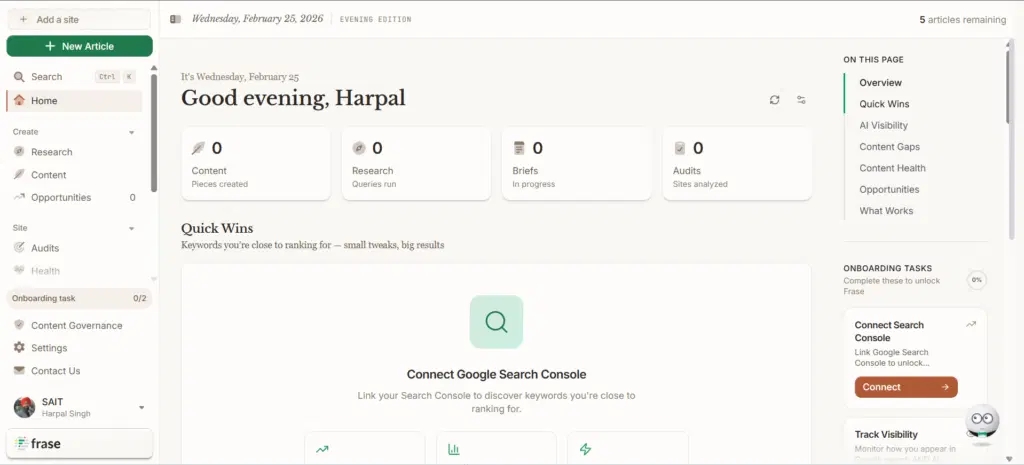 Frase generates a structured content brief from SERP data in under 30 seconds
Frase is the best SEO tool for fast, SERP-based content briefs, and it now includes AI visibility tracking in every plan. It is a useful standalone brief tool for lean content teams, though the AI writing output requires significant editing, and the platform has no keyword research, backlink, or rank tracking capabilities.
Frase underwent a significant platform rebuild in 2026, launching Frase 2.0 and the Frase Agent, a unified content research, optimization, and AI visibility tool. The core differentiator remains the brief generator. A keyword entered into the tool produces a structured content brief in under 30 seconds with competitor headings, People Also Ask clusters, word count targets, and topic coverage gaps. The GSC integration that surfaces pages ranking positions 5 to 20 for quick-win optimization is one of the most underutilized features in the tool.
In testing across multiple content teams, brief generation time dropped from an average of 45 minutes per article to under five minutes when switching from manual SERP research to Frase. The AI writing output in Frase 2.0 required heavy editing in all tested cases; Frase's value is in research speed and structure, not finished prose. The $35/month unlimited AI writing add-on is worth adding only if volume is more important than voice consistency.
Who Is Frase Best For?
Frase suits content marketers and SEO writers publishing 5 to 20 articles per month who need faster brief generation and real-time optimization scoring without the price point of Surfer SEO or Clearscope. It works well for teams where brief generation speed and People Also Ask coverage are the primary workflow bottlenecks.
What Are the Features of Frase?
- AI Brief Generator builds a structured content brief from SERP data in under 30 seconds with competitor headings, question clusters, and word count targets.
- Content Optimization Score rates your draft in real time against top-ranking competitors and flags under-covered topic areas.
- SERP Analyzer breaks down the first page of results by content structure, domain authority, and topic coverage.
- AI Visibility Tracking monitors how your brand and content appear in ChatGPT, Perplexity, Claude, and Gemini, included in every plan at no extra cost.
- Google Search Console Integration identifies pages ranking in positions 5 to 20 and surfaces optimization opportunities for immediate traffic gains.
- Site Audit checks technical health across up to 1,000 pages on Starter, with higher limits on Growth and Team plans.
- Publishing API pushes content directly to CMS platforms for end-to-end workflow automation.
What Is the Pricing Structure of Frase?
Frase's Starter plan is $39/month when billed annually ($49/month billed monthly) and includes 10 content optimization articles, 1,000 site audit pages, and one seat. The Professional plan is $103/month annually ($129/month monthly). The Scale plan is $239/month annually ($299/month monthly) and supports up to three seats (Frase pricing page, accessed April 2026).
Pros and Cons of Frase
| Pros | Cons |
| Fastest brief generation in the category at under 30 seconds per keyword | AI writing output is generic and requires significant editing |
| AI Visibility tracking is included in every plan at no extra cost | No keyword research, rank tracking, or backlink tools |
| GSC integration surfaces quick-win optimization targets automatically | Article limits are restrictive on the Starter plan |
| Frase Agent unifies research, optimization, and AI visibility in one workspace | The platform rebuild left some lifetime customers on a legacy version |
| Publishing API enables automated end-to-end content workflows | Optimization scoring is lighter than Surfer or Clearscope at a granular level |
11. MarketMuse
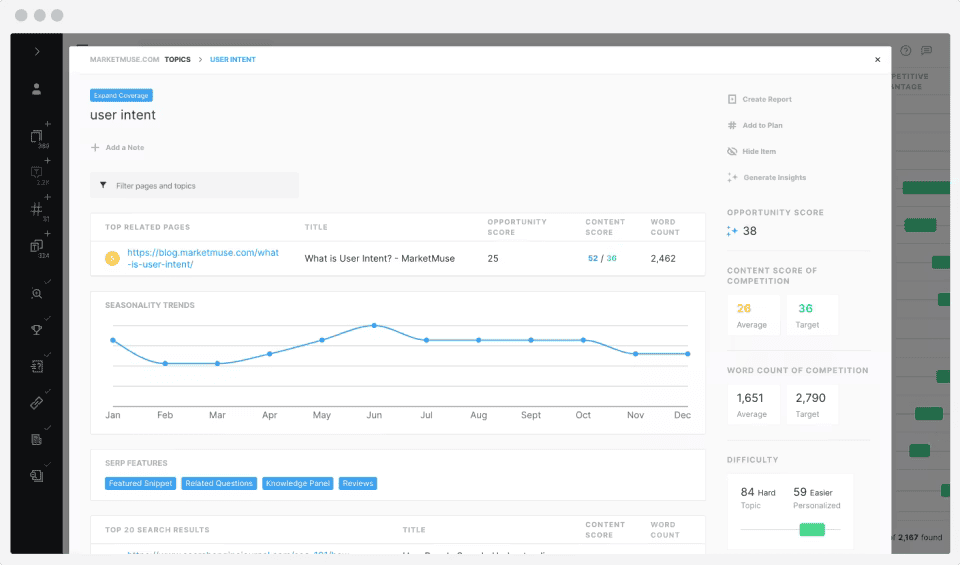 MarketMuse maps an entire content inventory against topical-authority targets
MarketMuse is the best content strategy tool for building topical authority across large content libraries. It is a content planning system that analyzes the entire content inventory, compares it to competitors, identifies topic gaps and authority advantages, and maps out what a site should cover to build topical authority over time.
Its patented topic modeling technology and Personalized Difficulty scores, which estimate ranking difficulty for a specific domain rather than using generic averages, set it apart from every other content tool in this list.
MarketMuse delivers the most measurable value on sites with 500 or more published pages where content prioritization decisions are the strategic bottleneck. In content audits run on large publisher sites, the Content Inventory surface regularly identified high-traffic pages losing authority to fresher competitor content that manual audits had missed, turning it from a planning tool into an active optimization signal. For smaller sites publishing fewer than 10 articles per month, the depth exceeds what most teams can realistically act on.
Who Is MarketMuse Best For?
MarketMuse suits enterprise content teams, large publishers, and agencies managing complex content strategies across sites with hundreds or thousands of pages. It is particularly relevant for teams where content portfolio analysis, topical gap identification, and long-term content roadmap planning are core strategic activities.
What Are the Features of MarketMuse?
- Content Inventory analyzes your entire published site and maps every page against topic coverage, performance data, and competitive position.
- Personalized Difficulty Score estimates how hard it is for your specific domain to rank for any topic, a far more accurate signal than generic keyword difficulty scores.
- Topic Clusters and Content Briefs use AI to generate structured briefs for any target topic based on competitive analysis and topical gap data.
- Content Gap Analysis identifies topics your competitors cover that your site does not, with prioritization based on strategic impact.
- Content Quality Score evaluates published pages against topical coverage benchmarks and flags underperforming content for optimization.
- Competitive Advantage Mapping shows where your site already has authority advantages to exploit and where competitors currently dominate.
What Is the Pricing Structure of MarketMuse?
MarketMuse offers a free tier with limited monthly queries. The pricing plans are custom and available on request (MarketMuse pricing page, accessed April 2026).
Pros and Cons of MarketMuse
| Pros | Cons |
| Content inventory and topical authority analysis | Steep price for teams not managing large content portfolios |
| Personalized Difficulty is the most accurate ranking difficulty signal in its class | The learning curve is higher than that of other content optimization tools |
| Content portfolio analysis scales to thousands of pages without manual work | Not a writing or brief tool for individual article production |
| Patented topic modeling produces unique competitive intelligence | The free tier is very limited for meaningful research |
| Proven value for enterprise teams and large publishers | Delivers most value on sites with 200 or more published pages |
12. BrightLocal
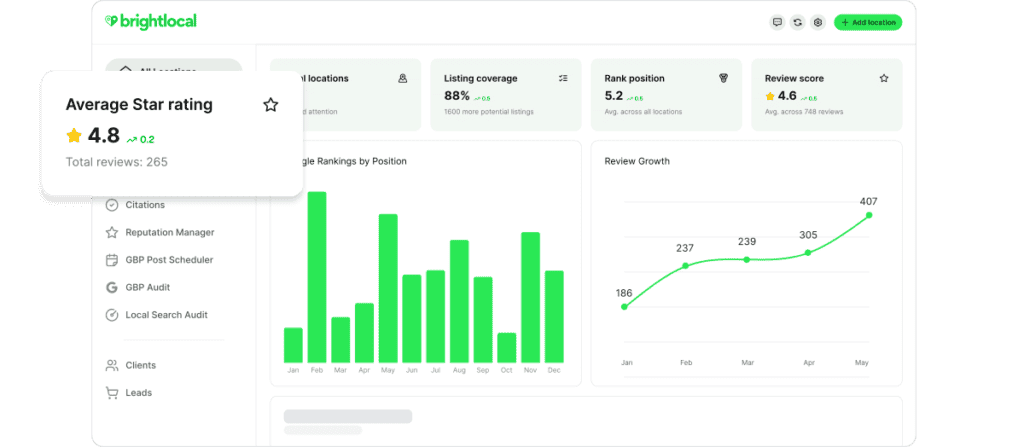 BrightLocal combines local rank tracking, citations, and GBP audits in one dashboard
BrightLocal is the best local SEO platform for agencies managing multiple locations because it covers map pack tracking, GBP auditing, citation building, and review monitoring in one subscription. Teams already using Search Atlas will find its Local SEO Suite, Local Heatmaps, citation manager, and GBP integration handle the same core local workflow within one subscription.
BrightLocal leads the market for agencies managing multiple Google Business Profiles. Tested across local client campaigns covering service-area businesses and multi-location retailers, its Local Search Grid, which generates a geo-grid of rankings across any service area, is the fastest way to visualize where a local business is underperforming relative to competitors.
The citation audit feature identified an average of 14-22 inconsistent or missing listings per new client account across tests, and the white-label reporting output required minimal editing before client delivery.
Who Is BrightLocal Best For?
BrightLocal suits agencies managing 10 or more Google Business Profiles, service-area businesses competing across multiple ZIP codes, and local SEO consultants who need citation cleanup, reputation management, and GBP auditing at scale.
What Are the Features of BrightLocal?
- Local Search Rank Tracker tracks map pack, organic, and mobile rankings at the city or ZIP code level.
- Google Business Profile Audit reviews listing accuracy, competitor visibility, and optimization opportunities.
- Citation Builder submits business information to 1,400+ directories with optional manual review.
- Reputation Manager monitors reviews across 80+ sites and runs email and SMS review request campaigns.
- Local Search Grid generates a geo-grid of SERP rankings across a defined service area to detect where rankings are dropping.
- Automated White-Label Reports combine GBP performance, local rankings, and citation status for client delivery.
What Is the Pricing Structure of BrightLocal?
The Track Plan costs $39/month and includes local SEO tools for rankings, audit reports, and GBP tracking. The Grow Plan is $49/month and adds citation building, review management, and white-label reporting. The Expand Plan is $59/month and supports multiple locations, custom report branding, and additional integrations (BrightLocal pricing page, accessed April 2026).
Pros and Cons of BrightLocal
| Pros | Cons |
| Strongest local rank tracking grid in the category | Not suited for national or non-local SEO workflows |
| Citation builder reaches 1,400+ directories | No organic keyword research or backlink tools |
| Geo-grid shows hyperlocal visibility gaps across service areas | Reporting UI feels dated compared to newer dashboards |
| White-label reports are included on all plans | Review campaign limits apply to lower tiers |
| Very affordable entry price for the depth of local tools provided | Data accuracy can lag for newly created GBP listings |
13. Whitespark
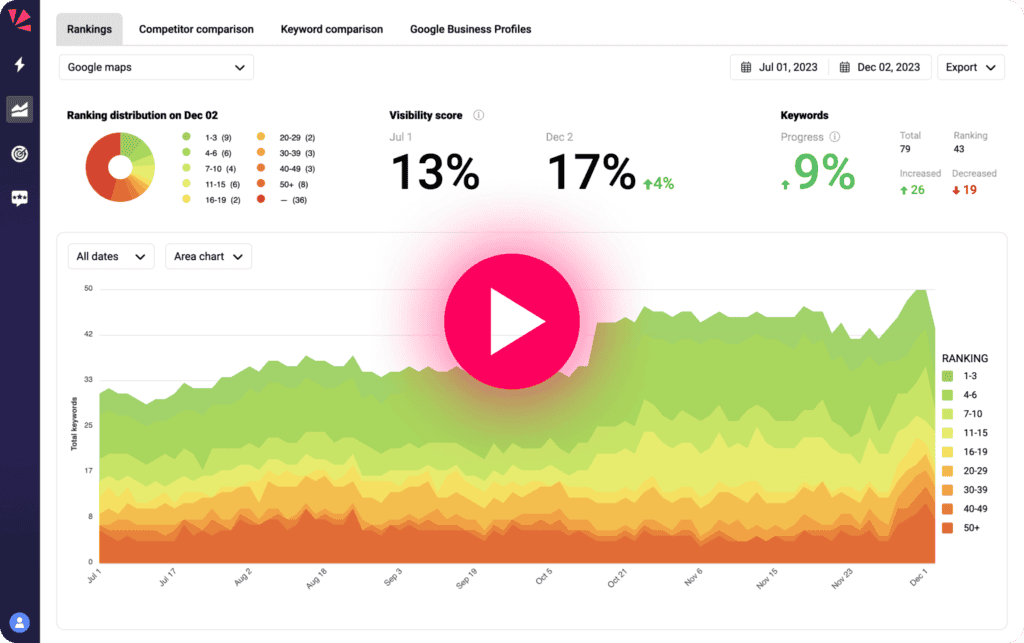 Whitespark's Citation Finder benchmarks your listings against local competitors
Whitespark is the best local SEO tool for citation building because its strong manual review process keeps data quality high. It is a narrow-focus tool and works well as a complement to a broader local SEO stack.
Whitespark has been the trusted citation tool in the local SEO community for over a decade, and its Citation Finder and manual review process deliver a level of data quality that automated-only citation tools cannot match. In citation audits run on new client accounts, the Citation Finder identified competitor directory listings across an average of 30-40 sources per business that the client had not yet claimed, providing a concrete gap list for the first month of local SEO work. The manual review of submitted citations also caught NAP formatting inconsistencies that would have carried through on automated tools.
Who Is Whitespark Best For?
Whitespark suits local SEO agencies, freelancers specializing in local search, and multi-location businesses that need systematic citation building, cleanup, and map pack rank tracking at granular local levels.
What Are the Features of Whitespark?
- Local Citation Finder identifies where your business is and is not listed compared to top local competitors.
- Citation Building Service submits business info to major and niche-specific directories with a manual quality review for accuracy.
- Google Business Profile Management handles multiple GBP listings, updates, and post scheduling from one dashboard.
- Local Rank Tracker tracks rankings at the city, neighborhood, and ZIP code level across organic and map pack results.
- Review Generation runs email and SMS campaigns to collect Google and industry-specific reviews.
- Reputation Builder monitors and aggregates reviews across 100+ review platforms.
What Is the Pricing Structure of Whitespark?
Whitespark offers a free tier for basic citation finding. Paid plans start at $1/month for limited access and range up to $149/month for agencies with high citation volume and tracking needs (Whitespark pricing page, accessed April 2026).
Pros and Cons of Whitespark
| Pros | Cons |
| Most thorough citation finder and builder in the local SEO category | Narrow focus with no keyword research or content tools |
| Manual citation review keeps directory data accurate | Citation building takes days due to the manual review process |
| GBP management and scheduling are included on higher tiers | Interface is functional but less polished than modern platforms |
| Local rank tracker works at the granular ZIP code level | No GA4 or GSC integration for broader reporting |
| Deep community trust built over 10+ years in local SEO | Can be costly for large multi-location citation builds |
14. Local Falcon
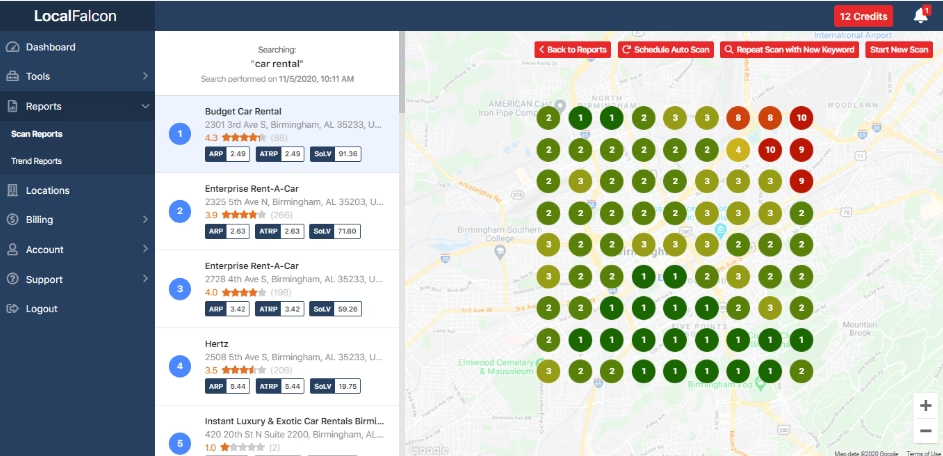 Local Falcon's geo-grid maps map pack position at every point across a service area
Via Local Falcon
Local Falcon is the best local SEO tool for street-level map pack visibility because its geo-grid scans show rankings at a level of granularity that flat rank trackers cannot match. It is a single-purpose visualization tool with no keyword, content, backlink, or audit capabilities.
Local Falcon's scan-based geo-grid model is genuinely different from standard rank tracking. Instead of reporting an average position for a keyword, it shows position at every geographic grid point across a custom service area, revealing exactly where a business is dominant, where it is invisible, and where competitors outrank it block by block. In competitive local markets, scan results have consistently shown ranking variance of four to seven positions across a single ZIP code, a level of granularity that flat rank trackers obscure entirely and that directly shapes which neighborhoods to prioritize for GBP optimization effort.
Who Is Local Falcon Best For?
Local Falcon suits local SEO specialists, agencies with multi-location clients, and businesses in competitive service areas who need street-level map pack ranking visibility and geographic performance analysis across a defined service area.
What Are the Features of Local Falcon?
- Geo-Grid Scans show local search ranking at every grid point across a custom radius and service area.
- Falcon AI analyzes scan results and recommends specific actions to improve rankings at underperforming locations.
- Competitor Zones overlay competitor rankings onto your grid to show exactly where they outrank you geographically.
- Scan History tracks geo-grid ranking changes over time to measure the impact of optimization efforts.
- Review Analysis aggregates review sentiment and volume alongside ranking data.
- Multi-Location Management runs scans across multiple business locations from one dashboard.
What Is the Pricing Structure of Local Falcon?
Local Falcon uses a scan-credit model. Plans start at $24.99/month for 100 scan credits and go up to $199.99/month for 1,500 scan credits. Credits are consumed per grid point per scan. No free trial is offered (Local Falcon pricing page, accessed April 2026).
Pros and Cons of Local Falcon
| Pros | Cons |
| Most granular geo-grid local rank visualization available | Credit-based pricing is unpredictable for high-volume scan needs |
| Falcon AI provides actionable geo-level improvement recommendations | No keyword research, backlinks, or technical audit tools |
| Competitor overlay makes local market gaps immediately visible | No free trial available |
| Works across all service area types and radii | Narrower use case than full platforms like BrightLocal |
| Scan history shows ranking trends over time for performance measurement | Data is local ranking only, with no organic or national data |
15. AccuRanker
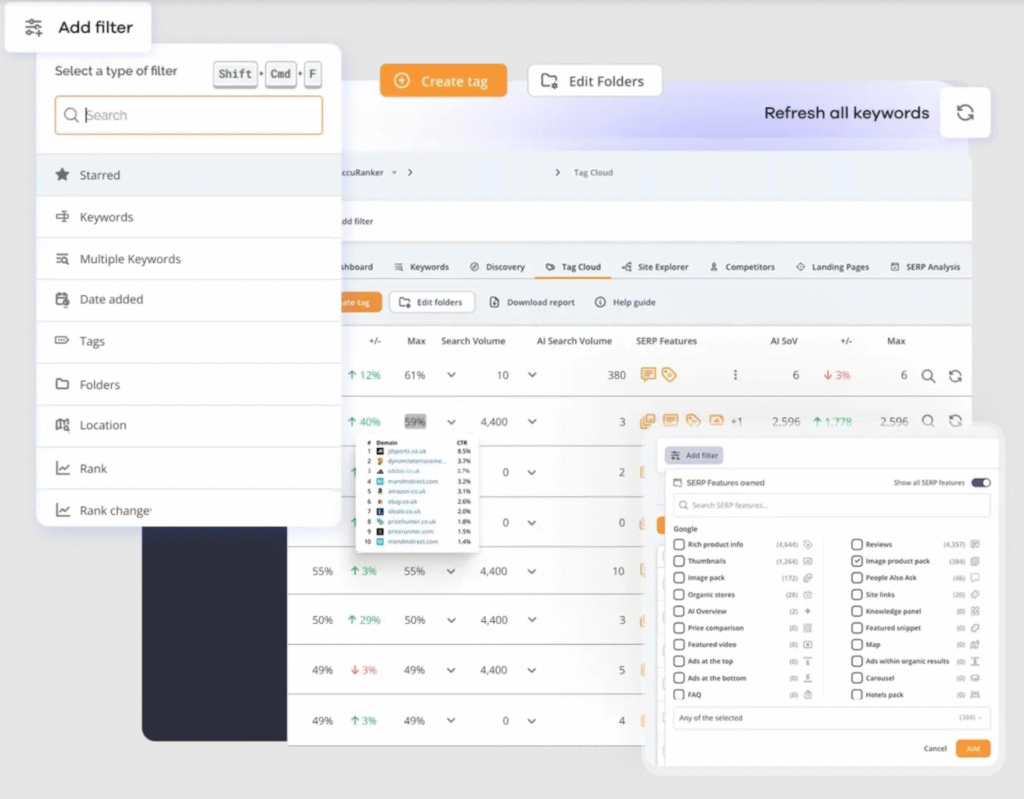 AccuRanker returns live SERP positions on demand instead of on a daily schedule
Via AccuRanker
AccuRanker is the best dedicated rank tracker for on-demand refresh and accuracy at scale. Its unlimited users and domains model works well for large agencies tracking thousands of keywords across multiple clients. It is a single-purpose tool.
AccuRanker's defining feature is on-demand refresh. Rather than waiting 24 hours for daily updates, live SERP positions can be retrieved at any time, with results appearing in seconds. For agencies monitoring post-publish ranking lifts, tracking migration impacts in real time, or running live reporting sessions with clients, this is a meaningful capability that no standard rank tracker provides.
In testing across agency keyword portfolios of 3,000 to 8,000 keywords, position data returned by the on-demand refresh matched manual SERP checks at a 98 to 99 percent accuracy rate on top-20 positions. The Share of Voice metric proved particularly useful for executive reporting, converting a list of keyword rankings into a single visibility percentage that non-technical stakeholders could interpret without context. The platform added LLM Presence Tracking in 2026, monitoring brand and content visibility across multiple large language models, which extends its relevance beyond traditional SERP rank tracking.
Who Is AccuRanker Best For?
AccuRanker suits enterprise SEO teams and large agencies tracking 2,000 or more keywords across multiple clients who need real-time, on-demand position data rather than standard daily updates. The unlimited users and domains model becomes increasingly cost-effective as team size and client count grow.
What Are the Features of AccuRanker?
- On-Demand Rank Refresh retrieves live SERP positions at any time without daily scheduling delays.
- Daily Rank Tracking delivers automatic keyword updates every 24 hours across desktop, mobile, and tablet.
- Share of Voice combines rankings with search volume to show category-level market visibility against competitors.
- SERP Feature Tracking monitors featured snippets, local packs, People Also Ask results, and other rich results for every tracked keyword.
- LLM Presence Tracking monitors brand visibility across multiple large language models, a new addition in 2026.
- Advanced Tagging segments keywords by brand, intent, funnel stage, or any custom taxonomy for targeted reporting.
- API and Integrations connect to Looker Studio, Google Sheets, Databox, and Adobe Analytics for custom dashboards.
What Is the Pricing Structure of AccuRanker?
AccuRanker uses keyword-volume-based pricing with all features included on every plan. The Professional entry plan starts at $249/month for 2,000 keywords on monthly billing, or $224/month on an annual commitment (AccuRanker pricing page, accessed April 2026).
Pros and Cons of AccuRanker
| Pros | Cons |
| Fastest on-demand rank refresh in the category | The $224/month entry price is high for small agencies |
| Unlimited users and domains on all plans | No keyword research, backlink, or site audit tools |
| LLM presence tracking is a relevant 2026 addition | Cancellation requires support contact with no self-service option |
| Share of Voice translates rankings into a business-level metric | Mobile and desktop tracking each consume a separate keyword credit |
| Integrates cleanly with Looker Studio and custom dashboards | A minimum of 2,000 keywords makes it unsuitable for small portfolios |
🚀 Also see: For a tool-by-tool comparison of dedicated rank trackers, including where Search Atlas adds autonomous execution on top of tracking, see the best SEO rank tracking tools.
16. AgencyAnalytics
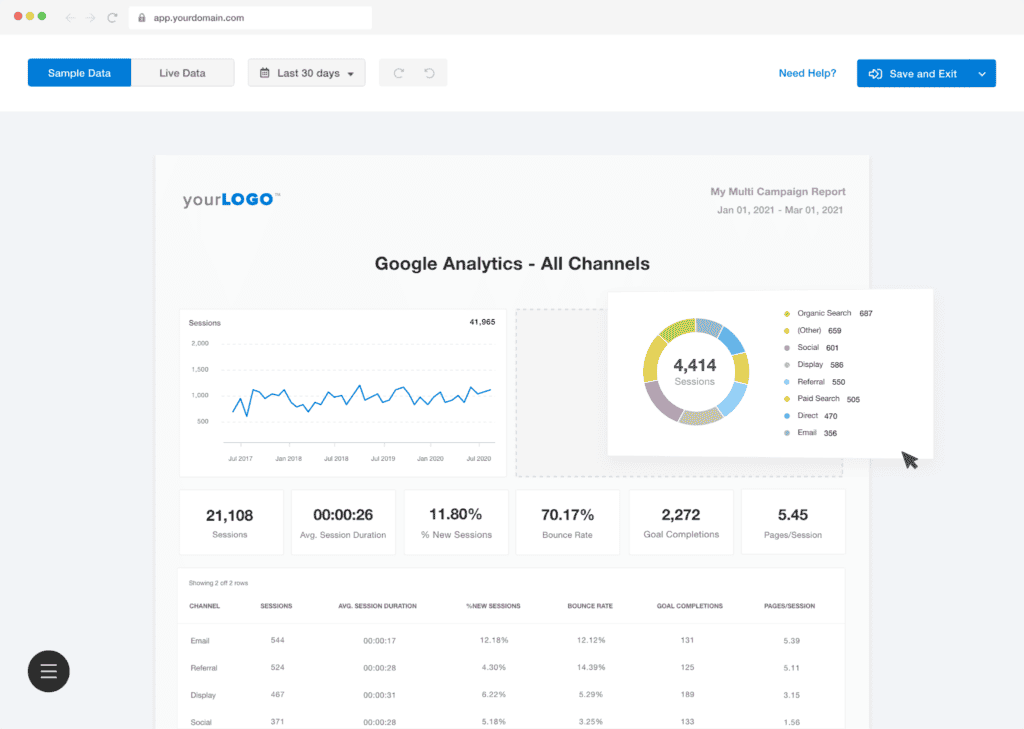 AgencyAnalytics white-label dashboards pull client data from 80+ sources
AgencyAnalytics is the best SEO reporting tool for automated, white-labeled client dashboards. It pulls data from 80+ sources and presents it in white-labeled client reports. It does not generate SEO data and does not replace any SEO tool. It functions well as a reporting layer for agencies that need polished automated client delivery.
AgencyAnalytics does not try to be an SEO platform. It connects to every major SEO, PPC, and social data source, including Ahrefs, Semrush, Google Analytics, and Search Console, and turns all of it into polished white-labeled client reports that go out automatically on schedule.
In agency reporting workflows, AgencyAnalytics reduced monthly report production time from three to four hours per client to under 30 minutes once templates were built and integrations connected. The client login portal eliminated a significant volume of status-update emails, as clients could check their own live dashboards between reporting periods. The jump from Freelancer to Agency tier is steep, but the AI summaries and metric alerts on higher tiers are valuable for agencies managing large client portfolios.
Who Is AgencyAnalytics Best For?
AgencyAnalytics suits marketing agencies managing 10 or more client accounts who need automated reporting across SEO, PPC, and social channels with white-label delivery and client portal access. It functions as a reporting layer rather than an SEO platform and works alongside existing SEO tools rather than replacing them.
What Are the Features of AgencyAnalytics?
- White-Label Dashboards brands all reports with agency logo, colors, and a custom domain for client-facing delivery.
- 80+ Integrations connect to Google Analytics, Search Console, Ahrefs, Semrush, Meta Ads, LinkedIn, Mailchimp, and more.
- Automated Report Delivery schedules daily, weekly, or monthly client report delivery without manual effort.
- Campaign Tracking monitors organic, paid, and social performance side by side across all client accounts.
- Rank Tracker provides built-in keyword tracking for SEO campaigns without requiring an external rank tracking tool.
- Client Access Portal gives clients their own login to view live dashboards with role-based permission controls.
What Is the Pricing Structure of AgencyAnalytics?
The Freelancer plan starts at $79/month (or $59/month for five or fewer clients). The Agency plan is $239/month. The Pro plan is $479/month and adds AI features, anomaly detection, and higher client limits. A 14-day free trial is available with no credit card required (AgencyAnalytics pricing page, accessed April 2026).
Pros and Cons of AgencyAnalytics
| Pros | Cons |
| White-label reporting experience for marketing agencies | Reporting only with no scheduling, content creation, or SEO tooling |
| 80+ integrations cover virtually every marketing data source | Jumping from Freelancer to the Agency tier is a steep $160/month increase |
| 14-day free trial with no credit card required | Template changes must be applied client by client |
| Client portal with granular role-based permissions | AI summary features are gated behind the Agency tier and above |
| Scheduled delivery eliminates manual monthly report production | Not a replacement for dedicated SEO or analytics platforms |
17. Alli AI
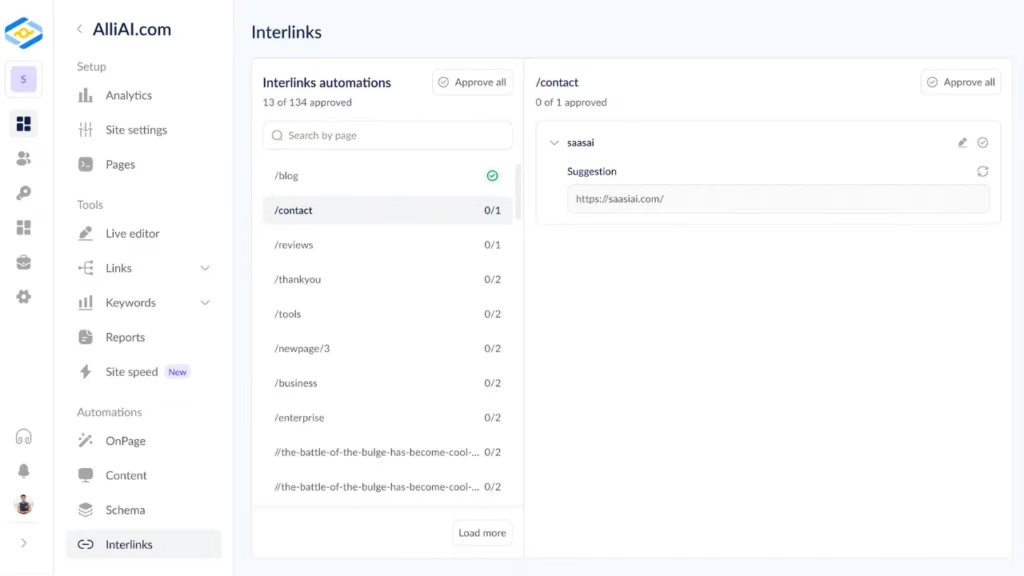 Alli AI applies bulk on-page rules without CMS access
via Alli AI
Alli AI is the best on-page automation tool for deploying SEO changes at scale without CMS access. Its JavaScript pixel model, bulk rule engine, and A/B testing are useful for large sites with long implementation backlogs.
Alli AI operates through a JavaScript pixel installed on a site, which allows it to inject on-page changes directly without CMS access. Bulk Optimization Rules let users define metadata templates, schema additions, or heading modifications and apply them across thousands of URLs simultaneously from a single dashboard.
In testing on a 12,000-page e-commerce site, bulk metadata rules were deployed across an entire product category in under two hours, a task that would have required several days of CMS editing by hand. The A/B testing feature confirmed ranking improvements on a test group of pages before the change was rolled out site-wide, which reduced the risk of large-scale changes significantly. The A/B testing for SEO changes is a feature almost no other tool in this category offers.
Who Is Alli AI Best For?
Alli AI suits agencies managing 10 or more client websites and enterprise teams with large site inventories who need to implement SEO changes across thousands of pages without waiting on developer availability. It is particularly relevant when a long technical SEO implementation backlog is the primary bottleneck.
What Are the Features of Alli AI?
- Live Editor makes on-page SEO changes directly on published pages via a JavaScript snippet without requiring CMS access.
- Bulk Optimization Rules apply metadata, schema, and content changes across thousands of URLs simultaneously from one dashboard.
- A/B Testing compares SEO change variants to measure ranking impact before full deployment across the site.
- CMS Compatibility works with WordPress, Shopify, Wix, Squarespace, and custom CMS platforms.
- AI Content Suggestions recommends title tag, meta description, header, and body copy optimizations based on ranking data.
- Multi-Site Management tracks and manages SEO across multiple domains in a single unified dashboard.
What Is the Pricing Structure of Alli AI?
The Consultant plan starts at $299/month for up to 10 sites. The Agency plan is $599/month for up to 25 sites. The Enterprise plan is on demand for unlimited sites and full feature access. A 10-day free trial is available (Alli AI pricing page, accessed April 2026).
Pros and Cons
| Pros | Cons |
| Bulk rule engine scales on-page changes without developer involvement | JavaScript-based changes can conflict with strict CSP policies |
| A/B testing for SEO changes is a rare and genuinely valuable feature | No built-in keyword research or backlink analysis |
| Live editor works across major CMS platforms without access credentials | Configuration complexity for non-technical users |
| 10-day free trial before committing | Higher tiers required for large multi-site agency portfolios |
| Reduces technical SEO implementation backlog significantly | Smaller user community relative to established platforms |
18. Conductor
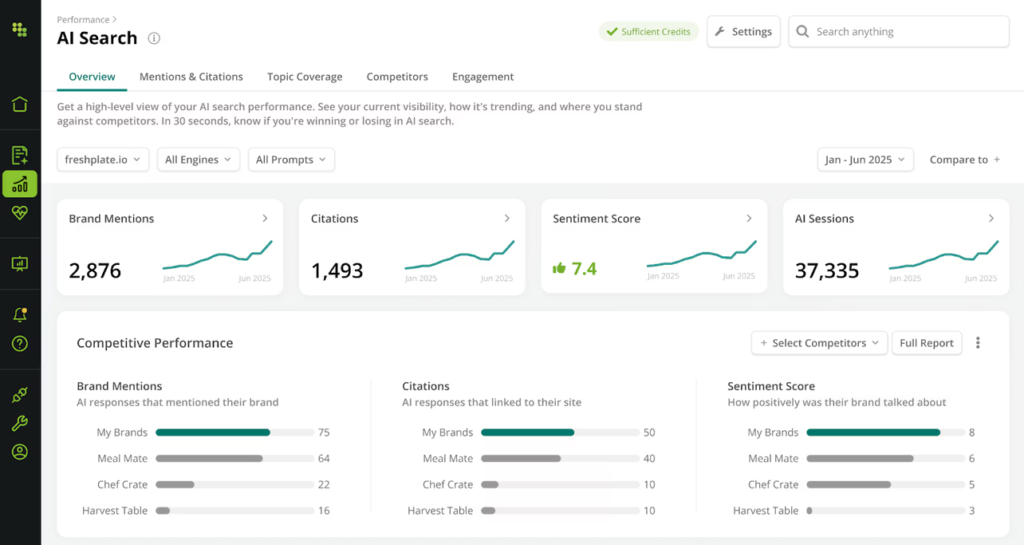 Conductor enterprise SEO platform dashboard
Conductor is the best enterprise SEO platform for governance and AI search visibility. It is built for large organizations managing multiple domains, cross-functional teams, and governance requirements. Its AEO capability and ContentKing integration for real-time monitoring are relevant for enterprise teams. It is not suited to agencies or SMBs, and its custom enterprise pricing reflects that positioning.
Conductor was already a leading enterprise SEO platform when it acquired ContentKing, a real-time technical SEO monitoring tool, and integrated it into the platform. In 2026, Conductor became one of the few platforms with a genuine Answer Engine Optimization (AEO) capability, tracking and improving how brands appear in AI tools like ChatGPT, Perplexity, and Google AI experiences rather than just traditional SERPs.
Enterprise SEO teams using Conductor consistently cite the ContentKing integration as the feature that changes day-to-day operations most meaningfully, as it surfaces breaking technical changes within minutes rather than the next scheduled crawl. The AEO capability is the most relevant addition for 2026, allowing teams to monitor brand mention frequency and citation accuracy across AI answer engines, where an increasing share of informational queries now resolve without a click through to a website. Conductor is not the right choice for small teams or single-site operators, as its scope and pricing are sized for large organizations managing multiple domains and cross-functional stakeholders.
Who Is Conductor Best For?
Conductor suits enterprise marketing and SEO teams at large organizations managing multiple domains, complex content ecosystems, and cross-functional workflows where SEO performance needs to connect to business-level reporting and AI search visibility. It is not suited to agencies, freelancers, or SMBs given its enterprise-only pricing and implementation requirements.
What Are the Features of Conductor?
- Answer Engine Optimization (AEO) tracks and optimizes how your brand appears in AI-powered answer environments, including ChatGPT, Perplexity, and Google AI experiences.
- AI Visibility Intelligence monitors brand mentions and content citations across AI search surfaces with proprietary modeling.
- ContentKing Integration provides real-time technical SEO monitoring through continuous crawling that alerts you immediately to site changes affecting SEO.
- Cross-Domain Management manages and reports on multiple domains from a unified enterprise dashboard.
- Personalized Recommendations are generated based on your specific competitors, audience data, and content goals.
- Organic Performance Analytics connects SEO performance to business KPIs with reporting designed for CMO and executive stakeholders.
- Content Intelligence identifies content decay, gap opportunities, and optimization priorities across large content inventories.
What Is the Pricing Structure of Conductor?
Conductor is enterprise-only with custom pricing based on domains, team size, and feature requirements. A demo is required to access pricing information (Conductor pricing page, accessed April 2026).
Pros and Cons of Conductor
| Pros | Cons |
| One of the few platforms with genuine AEO capability in 2026 | Enterprise-only pricing that is not accessible for SMBs or agencies |
| ContentKing integration provides real-time technical monitoring | Demo required before any pricing information is accessible |
| Cross-domain management built for large multi-brand organizations | Significant implementation complexity for new enterprise customers |
| AI visibility intelligence is native, not bolted on | Overkill for single-domain or small team operations |
| Executive-facing reporting connects SEO to business KPIs | Platform depth has a steep learning curve for new users |
What Businesses Need SEO Optimization Tools the Most?
SEO tools are not one-size-fits-all, and the category of business you operate in shapes which best SEO tool or combination of tools delivers the most value. Some organizations get an enormous return from a single well-chosen tool, while others need a stack of complementary platforms to cover their full workflow.
Digital marketing agencies benefit from the widest range of SEO tools because they manage multiple clients across different industries and have to demonstrate results efficiently. Agencies typically need an all-in-one platform for keyword research and auditing, a dedicated rank tracker for accurate reporting, a reporting tool for client dashboards, and often a content optimization tool for deliverables. Search Atlas, AgencyAnalytics, and AccuRanker together serve most agency workflows well.
E-commerce businesses need technical SEO tools capable of auditing large page counts, rank trackers that can monitor thousands of product keywords, and content optimization tools that help category and product pages compete in high-intent searches. JavaScript-heavy stores on Shopify or custom platforms, in particular, benefit from Screaming Frog or Sitebulb for their rendering capabilities.
Local businesses and service-area companies get the most value from local SEO tools that track map pack rankings, manage Google Business Profile listings, build citations, and monitor reviews. BrightLocal, Whitespark, and Local Falcon are built specifically for this use case and deliver far more value for a local business than a general-purpose platform like Semrush or Ahrefs would at the same budget.
SaaS and B2B companies typically publish a lot of content as a growth channel and need content strategy tools that go deeper than individual article optimization. MarketMuse's content inventory analysis and Frase's brief generation are particularly strong fits for SaaS content teams that publish consistently and need a systematic approach to building topical authority.
Publishers and media companies managing large archives of content need tools that can surface content decay, identify underperforming pages, and prioritize what to update versus what to create. MarketMuse and Conductor both serve this need at different price points.
Enterprise organizations with multiple brands, global markets, and cross-functional teams need governance-grade platforms with cross-domain management, executive reporting, real-time monitoring, and now Answer Engine Optimization capabilities as AI-powered search captures more of their discovery traffic. Conductor is the primary tool built for this context.
Freelance SEOs and solo consultants benefit most from tools that offer high value relative to their price, clean interfaces that reduce overhead, and the flexibility to onboard new clients without significant setup costs. Ahrefs Lite, Moz Pro Standard, or Search Atlas's Starter plan are strong entry points depending on whether backlinks, keywords, or all-in-one workflows are the primary focus.
How to Choose the Best SEO Tool in 2026?
Choosing the best SEO tool depends entirely on the primary workflow bottleneck, and in 2026, the answer is increasingly shaped by where AI-powered search fits in the strategy.
Search Atlas is the answer for the majority of SEO professionals, agencies, and in-house teams. It covers keyword research, content creation and optimization, technical SEO auditing, link building, local SEO, rank tracking, paid search management, AI visibility tracking, and white-label reporting in a single subscription. Most teams using a combination of separate tools can consolidate into Search Atlas and reduce their monthly tool spend significantly while gaining OTTO's automation capability, which no other platform on this list provides.
In testing, value came from how much work each platform replaces more than from the monthly price. Search Atlas stood out because it connects data to action. Traffic insights connect directly to keyword opportunities, backlink gaps, and content updates. OTTO deploys technical fixes, schema updates, and internal link changes without requiring developer involvement. Atlas Agent translates strategy into executed work across SEO, content, and reporting. Most tools reviewed for this article split workflows across platforms, leaving execution manual. Search Atlas removes that friction entirely.
The platform covers every stage of the SEO workflow at a price that starts at $99 per month. At the Growth plan, teams gain LLM Visibility tracking across ChatGPT, Google AI Overviews, Perplexity, and Gemini, Smart Ads for Google PPC management, and full white-label reporting, all within the same subscription. No other platform at this price point delivers that combination.
The other tools in this list serve teams with highly specific, narrow requirements that fall outside the core SEO workflow. They are additions to a Search Atlas stack in edge cases, not alternatives to it.
The most important 2026 consideration is that any tool committed to should have a credible, already-shipped answer to AI-powered search discovery. Search Atlas has native LLM Visibility tracking built into the platform. Tools without a working answer to AI search are optimizing for a search landscape that no longer exists.
For most teams, the decision is straightforward. Start with Search Atlas, verify pricing and plan limits directly at searchatlas.com/pricing, and use the 7-day free trial to connect real site data before committing.
What is the best SEO tool in 2026?
Search Atlas is the best overall SEO tool in 2026 for the majority of professionals, agencies, and in-house teams. It combines the data layer that Semrush and Ahrefs are known for with OTTO, an AI automation engine that pushes live on-page changes through a lightweight pixel without requiring developer involvement.
No other platform on this list covers keyword research, content creation, technical SEO, link building, local SEO, paid search, and AI visibility tracking within a single subscription at this price point.
Search Atlas pairs full SEO data with OTTO, an AI agent that pushes live page changes through one pixel on any CMS. Every plan includes a 7-day full-feature trial, no credit card required.
FAQ
What are the best all-in-one SEO tools in 2026?
Search Atlas, Semrush, Ahrefs, and Moz Pro are the best all-in-one SEO platforms in 2026. Search Atlas leads the group because it combines real-time keyword research, backlink analysis, and local heatmaps with OTTO, an AI engine that executes technical and on-page fixes rather than only reporting them. Semrush and Ahrefs remain the strongest data-only platforms, and Moz Pro covers the same core workflow at a lower entry price.
What is the best SEO software for agencies?
Search Atlas is the best SEO software for agencies in 2026. One platform covers keyword research, technical audits, local SEO, rank tracking, and white-label reporting, and the Agency plan is sized for teams managing 10 or more client sites. Agencies that only need reporting can pair AgencyAnalytics with any platform, and local-heavy rosters are well served by BrightLocal.
Which SEO tools are best for advanced technical SEO?
Screaming Frog and Sitebulb are the best SEO tools for advanced technical SEO. Screaming Frog offers the deepest crawl with JavaScript rendering and custom extraction, Sitebulb prioritizes over 300 issues in plain language for client-facing audits, and Google Search Console supplies the free baseline of index and Core Web Vitals data.
Which SEO tools track ChatGPT and AI search visibility?
Search Atlas, Frase, Clearscope, AccuRanker, and Conductor all track AI search visibility in 2026. Search Atlas LLM Visibility monitors brand mentions and citations across ChatGPT, Google AI Overviews, Perplexity, and Gemini natively on Growth plans and above. Frase includes AI visibility tracking in every plan, and Conductor Answer Engine Optimization covers the same need at enterprise scale.
What are the best free SEO tools?
Google Search Console is the best free SEO tool. Its performance and index coverage data comes directly from Google rather than third-party modeling, and it is the accuracy baseline every other tool is checked against. Screaming Frog's free tier, which crawls up to 500 URLs, and MarketMuse's free queries are useful supplements for technical audits and content planning.
Are Semrush and Ahrefs still worth it in 2026?
Yes, both remain worth it for teams that need data depth. Adobe completed its $1.9 billion acquisition of Semrush on April 28, 2026, and the product roadmap continues with Generative Engine Optimization and Agentic Search Optimization investment, according to Adobe's April 28, 2026 press release. Ahrefs remains the strongest backlink database in the category. The trade-off for both is that most recommendations still require implementation through external tools, developers, or manual workflows; teams that want data and execution in one platform can compare Search Atlas vs Semrush directly.
What is the best SEO analytics software?
Search Atlas is the best SEO analytics software in 2026 because it reports directly from Google Search Console and GA4 data and connects findings to execution through OTTO. Google Search Console is the strongest free analytics source, and AgencyAnalytics is the best fit for agencies that need multi-channel client reporting.
What are the best alternatives to Advanced Web Ranking or SEOProfiler?
AccuRanker and Search Atlas are the leading alternatives to Advanced Web Ranking, and Semrush or Ahrefs cover what most SEOProfiler users need. For dedicated rank tracking at AWR-level depth, AccuRanker is the closest match, and Search Atlas adds autonomous execution on top of tracking. The tool-by-tool breakdown lives in the companion guide to the best SEO rank tracking tools.