Data freshness is the measure of how accurately a page reflects the current state of its subject at the time a user searches for it. Data freshness determines whether search engines and AI systems treat a page as a reliable source or a degrading asset. Pages that age without updates accumulate signal decay, which reduces rankings, crawl frequency, and citation probability in AI-generated answers.
Data freshness operates across two distinct contexts. In data engineering, it measures the interval between when a dataset is generated and when it is available for analysis. In SEO, it measures how well a page aligns with current search intent, accurate statistics, and up-to-date facts. This article addresses the SEO dimension and explains how to audit, measure, and improve data freshness across a content library.
Data freshness matters because search engines evaluate content quality relative to the time of the search. Search engines assess whether facts, statistics, references, and recommendations remain accurate, which means content loses value as information becomes outdated. Large websites often accumulate hundreds or thousands of aging pages through neglected updates, outdated statistics, and changing search intent. These aging pages create content decay, which reduces rankings, crawl frequency, and AI citation visibility.
Data freshness improves rankings by maintaining content accuracy and relevance over time. Fresh content aligns with current search intent, increases crawler activity, and strengthens trust signals across search systems. Industry studies consistently show that updating aging content improves organic traffic, keyword visibility, and indexing efficiency across content libraries.
Data freshness applies across blogs, enterprise websites, publishers, and e-commerce platforms where information changes continuously. Data freshness ensures that indexed pages reflect current facts and current user expectations, which improves ranking stability, crawl efficiency, and AI visibility. Data freshness works through a structured process of auditing, updating, consolidating, and maintaining content over time.
What Does Data Freshness Mean?
Data freshness in SEO measures how current a page is relative to the search intent it serves and the information users expect to find. Data freshness defines how search engines evaluate content accuracy based on current facts, statistics, and developments. Data freshness reflects whether a page remains relevant to present search behavior instead of historical search behavior.
Data freshness focuses on maintaining content accuracy over time. Data freshness differs from publication frequency because freshness depends on information quality rather than update volume. Data freshness improves content performance by aligning pages with current search intent, current statistics, and current user expectations.
How do search engines evaluate data freshness on a page? Search engines evaluate whether content reflects the current state of a topic. Search engines analyze facts, references, examples, and topical developments to determine relevance. Outdated information creates content decay, which reduces ranking competitiveness and weakens visibility across search results.
What makes a page fresh instead of stale? A fresh page contains accurate information, current references, and relevant examples. A stale page contains outdated statistics, expired recommendations, and information that no longer reflects the topic accurately. This difference affects how search engines interpret content quality and relevance.
Does data freshness require constant updates? Data freshness does not require constant updates because freshness depends on meaningful revisions rather than update frequency. A page updated once with accurate information generates stronger freshness signals than a page updated repeatedly with cosmetic changes. Search engines evaluate the significance of content changes instead of the presence of an update alone.
How Is Data Freshness Different From Data Timeliness, Recency, and Latency?
The difference between data freshness, timeliness, recency, and latency lies in what each metric measures about information quality and availability. Data freshness evaluates whether information remains accurate and relevant. Data timeliness evaluates whether information arrives at the right moment. Data recency evaluates how recently information changed. Data latency evaluates how quickly information becomes available after creation.
The core differences between data freshness, data timeliness, data recency, and data latency are below.
| Aspect | Data Freshness | Data Timeliness | Data Recency | Data Latency |
| Purpose | Measures whether information remains accurate and relevant. | Measures whether information arrives at the required time. | Measures how recently information changed or was updated. | Measures the delay between creation and availability. |
| Primary focus | Accuracy relative to current reality. | Availability relative to a specific need. | Age of the information. | Speed of information delivery. |
| Evaluation method | Compares content against current facts and search intent. | Compares delivery timing against business requirements. | Compares update dates and publication history. | Compares generation time against access time. |
| SEO relevance | Influences rankings, crawling, and AI citations. | Influences content usefulness during specific events or trends. | Influences perceived content currency. | Influences indexing and update visibility. |
| Example | A page accurately reflects current industry conditions. | A page appears during an active market event. | A page received an update yesterday. | A search engine indexes changes three days after publication. |
| Outcome | Improves trust and relevance signals. | Improves decision usefulness. | Indicates update frequency. | Indicates processing efficiency. |
What does data freshness measure? Data freshness measures whether information accurately reflects the current state of a topic. Data freshness evaluates facts, statistics, references, and recommendations against present conditions. This evaluation determines whether search engines view content as reliable and relevant.
What does data timeliness measure? Data timeliness measures whether information becomes available at the moment it is needed. Data timeliness focuses on timing rather than accuracy. This focus determines whether information remains useful for a specific event, decision, or search context.
What does data recency measure? Data recency measures how recently information changed or received an update. Data recency focuses on content age rather than content accuracy. This measurement indicates update frequency but does not confirm information quality.
What does data latency measure? Data latency measures the delay between information creation and information availability. Data latency focuses on processing speed and delivery speed. This measurement affects how quickly search engines discover and reflect content changes.
How do data freshness, timeliness, recency, and latency work together? Data freshness, data timeliness, data recency, and data latency describe different aspects of information quality. A page remains fresh without being recent if accurate information remains unchanged for years. A page remains recent without being fresh if a recent update leaves outdated facts intact. Strong SEO performance depends on balancing all four measurements instead of evaluating any single measurement in isolation.
What Is the Difference Between Data Freshness and Content Freshness in SEO?
The difference between data freshness and content freshness lies in the context where each term originates. Data freshness comes from data engineering and measures how accurately information reflects real-world conditions. Content freshness comes from SEO and measures how accurately a page reflects current search intent, user expectations, and factual accuracy. This distinction defines how organizations evaluate information quality across technical systems and content systems.
The core differences between data freshness and content freshness are below.
| Aspect | Data Freshness | Content Freshness |
| Purpose | Measures how accurately data reflects current conditions. | Measures how accurately content reflects current search expectations. |
| Origin | Data engineering and analytics. | SEO and content marketing. |
| Primary focus | Dataset accuracy and reliability. | Page relevance and content quality. |
| Evaluation method | Compares data against current real-world conditions. | Compares content against current search intent and factual accuracy. |
| Typical assets | Databases, dashboards, data pipelines. | Blog posts, landing pages, resource pages. |
| SEO relevance | Provides the underlying information quality signals. | Directly influences rankings, crawling, and AI citations. |
| Outcome | Improves data accuracy and decision quality. | Improves visibility, relevance, and search performance. |
What does content freshness measure? Content freshness measures whether a page reflects current search intent, current facts, and current user expectations. Content freshness focuses on how information appears and performs within search results. This focus influences rankings, engagement, and citation visibility.
Why do SEO professionals focus on content freshness? SEO professionals focus on content freshness because pages compete directly in search results. Content freshness determines whether statistics remain accurate, examples remain relevant, and recommendations reflect current best practices. This evaluation affects how search engines interpret page quality and relevance.
How do data freshness and content freshness work together? Data freshness and content freshness describe the same underlying principle through different operational perspectives. Data freshness improves information quality at the source, while content freshness improves information quality on the page. Strong SEO performance depends on both concepts because accurate data and accurate content contribute to the same relevance signals.
Why Does Data Freshness Matter for SEO?
Data freshness matters for SEO because search engines evaluate content quality relative to the time of the search, not just relative to the date of publication. Outdated pages lose relevance as facts change, search intent evolves, and competing content provides more accurate information. Data freshness prevents content decay and ensures that pages remain competitive across rankings, crawling, and AI retrieval systems.
The 6 main reasons data freshness matters for SEO are listed below.
1. Improves ranking relevance for current search intent. Data freshness improves ranking relevance by aligning content with current user expectations and current search behavior. Search engines evaluate whether information matches present needs, which makes outdated content less competitive. Accurate and current content maintains visibility for queries where information changes frequently.
2. Increases trust through accurate information. Data freshness increases trust by ensuring that statistics, references, and recommendations remain accurate. Search engines evaluate information quality as part of content quality assessment. Accurate content creates stronger credibility signals and reduces the risk of ranking declines caused by outdated information.
3. Improves crawl prioritization and indexing efficiency. Data freshness improves crawl prioritization because search engines revisit actively maintained pages more frequently. Updated content signals ongoing relevance and value. Frequent crawling increases the likelihood that new changes appear in search results faster.
4. Strengthens visibility in AI-generated answers. Data freshness strengthens AI visibility because retrieval systems prioritize reliable and current sources. AI systems evaluate factual accuracy and topical relevance before selecting citations. Fresh content increases the probability of appearing in AI-generated responses.
5. Maintains competitiveness in changing search results. Data freshness maintains competitiveness by preventing content decay as industries, products, and best practices evolve. Competing pages gain visibility when older pages fail to reflect current conditions. Consistent updates preserve ranking strength against newer content.
6. Improves performance across freshness-sensitive query types. Data freshness improves performance for query categories where information changes regularly. News queries require current events. Product queries require current pricing and availability. Tutorial queries require instructions that reflect current tools, interfaces, and workflows.
How Does Stale Data Affect Organic Rankings and Search Visibility?
Stale data affects organic rankings and search visibility by weakening the relevance signals that search engines use to evaluate content quality. Search visibility declines because outdated statistics, expired examples, and superseded information no longer satisfy current search intent. Search engines prioritize pages that reflect current conditions, which reduces ranking strength for pages that remain unchanged over long periods.
Stale data affects organic rankings and search visibility by reducing content relevance. Search engines evaluate pages against current user expectations rather than historical performance. Outdated information creates a mismatch between page content and search intent, which lowers ranking competitiveness for affected pages.
Stale data affects organic rankings and search visibility by increasing competitive displacement. Competitors publish updated content that reflects current facts, trends, and developments. Newer pages accumulate impressions, engagement signals, and backlinks over time, which shifts visibility away from older pages that remain outdated.
Stale data affects organic rankings and search visibility by weakening engagement signals. Visitors who encounter outdated information spend less time interacting with content and return to search results more frequently. Lower engagement indicates reduced content usefulness, which contributes to declining search performance over time.
Stale data affects organic rankings and search visibility by reducing click-through rates. Searchers often compare publication dates and update dates before selecting a result. Older pages attract fewer clicks for freshness-sensitive topics, which reduces traffic opportunities and weakens visibility in competitive search results.
Stale data affects organic rankings and search visibility by decreasing AI citation potential. AI retrieval systems prioritize accurate and current information during source selection. Outdated content becomes less likely to appear in AI-generated answers, which reduces visibility across emerging search experiences.
How Does Content Freshness Influence Crawl Budget and Indexing Speed?
Content freshness influences crawl budget and indexing speed by signaling that a page contains valuable and updated information. Search engines allocate crawl resources based on expected content value and update frequency. Fresh content attracts more frequent crawling, which increases the speed at which updates appear in search results.
Content freshness influences crawl budget and indexing speed by increasing crawl priority. Search engines revisit pages that receive meaningful updates more often because those pages provide new information. Frequent crawling improves update discovery and ensures that important content remains current in the index.
Content freshness influences crawl budget and indexing speed by reducing crawl waste across large websites. Stale pages consume crawl resources while providing little new information for search engines to process. Updating or removing outdated content concentrates crawl activity on valuable pages, which improves overall crawl efficiency.
Content freshness influences crawl budget and indexing speed by accelerating content discovery. Search engines identify new information faster on websites that maintain active and relevant content libraries. Faster discovery shortens the time between publication and indexation, which improves visibility opportunities for new and updated pages.
Content freshness influences crawl budget and indexing speed by improving indexing consistency. Search engines allocate resources more efficiently when content quality remains high across a site. Efficient crawling increases the likelihood that important updates enter the index quickly and remain competitive in search results.
Content freshness influences crawl budget and indexing speed by improving performance for freshness-sensitive queries. Pages that receive timely updates and rapid indexation compete more effectively for searches that depend on current information. Faster indexing creates a competitive advantage because updated content becomes visible before competing pages receive the same level of search engine attention.
Does Freshness Signal Authority and Trustworthiness to Search Engines?
Freshness signals authority and trustworthiness to search engines by demonstrating that content remains accurate, relevant, and actively maintained. Search engines evaluate content quality through accuracy and reliability signals. Fresh content reinforces those signals by reflecting current information and current user expectations.
Freshness signals authority and trustworthiness to search engines by demonstrating ongoing editorial oversight. Websites that update content regularly show that the information receives review and maintenance over time. Consistent maintenance strengthens quality signals and increases confidence in content accuracy.
Freshness signals authority and trustworthiness to search engines by improving domain-level quality perception. Search engines evaluate websites as collections of pages rather than isolated URLs. Large volumes of outdated content weaken overall quality assessments, while actively maintained content libraries strengthen trust signals across the domain.
Freshness signals authority and trustworthiness to search engines by reducing content decay. Outdated statistics, obsolete recommendations, and expired references reduce content reliability. Maintaining current information preserves relevance and reinforces expertise signals across important topics.
Freshness signals authority and trustworthiness to search engines by aligning content with user expectations. Searchers expect accurate information for topics that change frequently. Content that reflects current developments satisfies those expectations and increases perceived credibility.
Freshness signals authority and trustworthiness to search engines most strongly in rapidly changing industries. Technology, finance, healthcare, legal services, and marketing depend on accurate and current information. Outdated content in these sectors weakens authority signals because stale information conflicts with the quality standards expected from trusted sources.
Is Content Freshness a Google Ranking Factor?
Yes, content freshness is a Google ranking factor because Google uses freshness signals to evaluate whether recent information improves search result quality. Content freshness affects rankings through systems that adjust the importance of recency based on query intent. Freshness influences visibility most strongly for searches where current information changes the value of the answer.
Content freshness refers to how accurately a page reflects current information, current search intent, and current user expectations. Google ranking factors refer to signals that influence how pages are evaluated and positioned in search results. These definitions explain why freshness affects rankings for some queries more than others.
How does Google use content freshness as a ranking factor? Google uses content freshness as a ranking factor through systems that identify searches where recent information matters. Queries related to current events, product updates, technology changes, and market developments require accurate and timely information. Fresh content receives greater ranking weight for these searches because recency improves result quality.
What Is Query Deserves Freshness (QDF) and How Does It Work?
Query Deserves Freshness (QDF) is a Google ranking system that increases the visibility of recently updated content for searches where current information provides greater value. Query Deserves Freshness affects rankings because search behavior changes when real-world events create demand for new information. This system enables Google to prioritize recency for queries where freshness improves answer quality.
Query Deserves Freshness refers to a ranking mechanism that identifies freshness-sensitive searches. Freshness-sensitive searches refer to queries where recent developments change the usefulness of existing information. These definitions explain why Google adjusts ranking priorities based on search behavior rather than applying freshness equally across all topics.
How does Query Deserves Freshness identify freshness-sensitive queries? Query Deserves Freshness identifies freshness-sensitive queries by monitoring search activity patterns. Sudden increases in search volume indicate that new developments have changed user information needs. This increase signals that current information holds greater value than older content.
How does Query Deserves Freshness affect rankings? Query Deserves Freshness affects rankings by increasing visibility for recently published and recently updated pages. Google adjusts ranking calculations to place greater emphasis on recency during periods of increased search demand. This adjustment improves access to current information for affected queries.
Why does Query Deserves Freshness not apply to every search? Query Deserves Freshness does not apply to every search because many topics remain stable over long periods. Definitions, historical topics, and foundational concepts often change very little over time. These topics compete primarily through relevance, authority, and content quality rather than recency.
What types of searches trigger Query Deserves Freshness? Query Deserves Freshness commonly affects searches related to current events, algorithm updates, product releases, regulatory changes, and rapidly evolving industries. Search demand increases sharply when new developments occur. This increase creates conditions where fresh information becomes more valuable than older information.
How Did the Google Caffeine and Freshness Updates Change How Pages Are Ranked?
The Google Caffeine update and the Google Freshness Update changed how pages are ranked by increasing the importance of content updates, indexing speed, and query recency. These updates established the systems that allow Google to discover content faster and evaluate whether newer information deserves greater visibility in search results.
The Google Caffeine update changed how pages are ranked by introducing continuous indexing. Google previously processed large portions of the web through batch-based indexing cycles. Continuous indexing enabled Google to process individual page changes as they occurred, which increased indexing speed and reduced the delay between publication and search visibility.
The Google Caffeine update changed how pages are ranked by accelerating content discovery. Faster discovery enabled Google to identify new pages and updated pages more efficiently. This improvement increased the competitiveness of websites that published timely information and maintained active content libraries.
The Google Freshness Update changed how pages are ranked by introducing freshness as a stronger ranking factor for time-sensitive searches. Google adjusted ranking calculations to favor recent and relevant information for queries where timeliness affects answer quality. This adjustment increased visibility for updated content in search categories where information changes frequently.
The Google Freshness Update changed how pages are ranked by increasing the value of meaningful content updates. Search engines began placing greater emphasis on content that reflected current facts, developments, and user expectations. Meaningful revisions gained greater ranking benefits than pages that remained unchanged for long periods.
The Google Caffeine update and the Google Freshness Update changed how pages are ranked by creating the foundation of modern freshness evaluation. Faster indexing and freshness-based ranking signals now work together to reward websites that maintain accurate and current content. Websites that neglect updates lose visibility over time as competitors publish more relevant information.
What Types of Content Are Most Affected by Freshness Requirements?
Content types most affected by freshness requirements are those where information changes frequently or where users depend on current information to make decisions. Freshness requirements increase as the rate of information change increases. Search engines prioritize current and accurate content more heavily in these categories because outdated information reduces result quality.
The 6 main types of content most affected by freshness requirements are listed below.
1. News and current events content. News content changes rapidly as new developments emerge. Older information loses value quickly because users seek the latest details and updates. Frequent revisions improve accuracy and maintain visibility for freshness-sensitive searches.
2. Product reviews and buying guides. Product review content depends on current features, pricing, availability, and market alternatives. Products change over time through updates and new releases. Regular updates maintain relevance and ensure that recommendations remain accurate.
3. Technical documentation and software guides. Technical content becomes outdated as software platforms release new features, interfaces, and workflows. Older instructions create inaccuracies and reduce usability. Updating documentation preserves accuracy and improves user satisfaction.
4. Industry reports and statistical content. Data-driven content relies on statistics, benchmarks, surveys, and market research. Older data loses relevance as conditions change. Regular updates strengthen credibility and maintain trust in published findings.
5. Regulatory and compliance content. Regulatory content depends on laws, policies, standards, and compliance requirements that change over time. Outdated guidance creates significant accuracy issues. Frequent reviews ensure that content reflects current requirements and expectations.
6. SEO and digital marketing content. SEO content depends on search engine updates, ranking systems, platform changes, and industry developments. Search environments evolve continuously through algorithm changes and new technologies. Regular updates maintain relevance and improve competitiveness in search results.
When Does Freshness Matter More Than Depth or Quality?
Freshness matters more than depth or quality when outdated information reduces the usefulness, accuracy, or safety of an answer. Search engines increase the importance of freshness for queries where current information creates a better user experience. Freshness becomes the dominant ranking consideration when recency directly affects answer quality.
Freshness matters more than depth or quality for news and current event queries. News topics change rapidly as new developments emerge throughout the day. Older content loses value because users seek the latest information available. Search engines prioritize recent content to ensure that search results reflect current events accurately.
Freshness matters more than depth or quality for software tutorials and platform guides. Software products regularly introduce new interfaces, features, and workflows that change how tasks are completed. Older guides become inaccurate after significant updates occur. Recent content provides instructions that match the current version of the platform and therefore creates greater value for users.
Freshness matters more than depth or quality for regulatory and legal content. Laws, regulations, and compliance requirements change over time through legislation and policy updates. Outdated guidance creates risk because it no longer reflects current requirements. Search engines prioritize current information to improve accuracy and reduce the likelihood of misinformation.
Freshness matters more than depth or quality for financial content. Interest rates, tax rules, investment conditions, and economic developments change continuously. Older information quickly becomes less useful as market conditions evolve. Recent content reflects current financial realities and improves decision-making accuracy.
Freshness matters more than depth or quality for healthcare and medical topics. Medical recommendations, treatment guidelines, and public health information change as new evidence becomes available. Outdated information reduces reliability and increases the risk of inaccurate advice. Search engines prioritize current information to improve information quality and user trust.
Freshness matters less than depth or quality for stable evergreen topics. Historical facts, mathematical concepts, and foundational definitions often remain unchanged for long periods. Comprehensive coverage and topical authority become more important than recency for these searches because answer quality depends on completeness rather than recent developments.
What Is the Difference Between Evergreen Content and Time-Sensitive Content?
The difference between evergreen content and time-sensitive content lies in how quickly information loses accuracy and relevance. Evergreen content remains useful for long periods with minimal updates, while time-sensitive content requires regular updates to maintain value. This distinction defines how SEO teams manage content maintenance, update frequency, and resource allocation.
The core differences between evergreen content and time-sensitive content are below.
| Aspect | Evergreen Content | Time Sensitive Content |
| Purpose | Provide lasting information that remains useful over time. | Provide current information that changes as new developments occur. |
| Primary goal | Maintain long-term relevance and traffic stability. | Deliver accurate and timely information for current searches. |
| Information stability | Changes infrequently over long periods. | Changes regularly through events, updates, or market shifts. |
| Update frequency | Requires occasional reviews and revisions. | Requires recurring reviews and frequent updates. |
| Content examples | Definitions, foundational concepts, educational resources. | News articles, pricing pages, product comparisons, trend reports. |
| Ranking factors | Authority, depth, relevance, and completeness. | Freshness, accuracy, recency, and relevance. |
| Performance lifespan | Generates value for years with limited maintenance. | Generates value until information becomes outdated. |
What does evergreen content do in SEO? Evergreen content provides long-term search visibility through topics that remain relevant over time. Evergreen content focuses on foundational concepts, stable processes, and enduring educational topics. This focus creates consistent traffic and ranking stability with relatively low maintenance requirements.
What does time-sensitive content do in SEO? Time-sensitive content captures visibility for topics that change frequently. Time-sensitive content addresses current events, evolving products, market developments, and changing best practices. This focus creates opportunities for freshness-driven rankings and current search demand.
Why does evergreen content require fewer updates? Evergreen content requires fewer updates because the underlying information changes slowly. Definitions, principles, and foundational concepts often remain accurate for years. This stability reduces the need for frequent content revisions and extensive maintenance cycles.
Why does time-sensitive content require frequent updates? Time-sensitive content requires frequent updates because information loses accuracy as conditions change. Product features, regulations, prices, and industry trends evolve continuously. Regular revisions maintain relevance and prevent content decay.
How do evergreen content and time-sensitive content work together in practice? Evergreen content and time-sensitive content operate as complementary parts of a content strategy. Evergreen content builds long-term authority and traffic stability, while time-sensitive content captures demand related to current developments. This combination balances sustainable growth with freshness-driven visibility opportunities.
How Do You Measure Data Freshness in SEO?
Data freshness in SEO is measured through technical signals, performance metrics, and content quality evaluations that reveal how accurately a page reflects current search intent. Data freshness cannot be measured through a single metric because freshness depends on relevance, accuracy, recency, and user engagement. This complexity requires SEO teams to evaluate multiple indicators together.
The 6 main ways to measure data freshness in SEO are listed below.
1. Analyze content update history. Content update history measures how recently meaningful revisions occurred on a page. Significant updates that improve facts, statistics, examples, or recommendations indicate stronger freshness than cosmetic edits. This analysis reveals whether content receives active maintenance over time.
2. Monitor ranking and visibility trends. Ranking trends measure whether a page maintains or loses search visibility over time. Declining rankings often indicate that competing pages provide more current information. This performance data identifies pages that require freshness improvements.
3. Track impressions and click-through rates. Impressions and click-through rates measure how searchers respond to content in search results. Falling impressions and declining click-through rates frequently signal that content no longer matches current search expectations. This behavior highlights potential content decay.
4. Evaluate factual accuracy and source currency. Factual accuracy measures whether statistics, references, and supporting information remain current. Outdated studies, expired references, and obsolete examples reduce freshness regardless of publication date. This evaluation determines whether the content still reflects the current reality.
5. Compare content against competing pages. Competitive analysis measures how current a page remains relative to competing content. Competitors often introduce new information, updated examples, and expanded topic coverage. This comparison reveals freshness gaps that affect ranking performance.
6. Audit search intent alignment. Search intent alignment measures whether content continues to satisfy current user expectations. Search behavior evolves as industries, products, and technologies change. This audit identifies situations where content remains accurate but no longer matches the intent behind modern searches.
What does content update history reveal about data freshness? Content update history reveals whether a page receives meaningful maintenance. Frequent substantive updates indicate ongoing accuracy improvements. This history provides direct evidence of freshness management across a content library.
Why are performance metrics important for measuring data freshness? Performance metrics reveal how search engines and searchers respond to content over time. Rankings, impressions, and click-through rates often decline before content becomes obviously outdated. These signals provide early indicators of content decay.
How do content audits measure data freshness? Content audits measure data freshness by evaluating statistics, references, examples, recommendations, and search intent alignment. Audits identify outdated information and prioritize pages that require updates. This process creates a structured system for maintaining content relevance.
How do SEO teams combine freshness metrics in practice? SEO teams combine update history, performance data, competitive analysis, and content audits into a unified evaluation process. No individual metric captures freshness completely. Multiple signals create a more accurate assessment of which pages remain current and which pages require attention.
What Signals Does Google Use to Detect How Current a Page Is?
Google uses a set of structural, behavioral, and link-based signals to estimate how current a page is relative to the time of the search. These signals allow Google to assess freshness without reading every page in full on every crawl.
The last-modified timestamp in HTTP headers signals when a page was last changed at the server level. Google reads this header during crawling and uses it as an initial indicator of recency. The timestamp alone does not confirm the quality of the update.
The degree of content change between crawls signals whether an update was substantive or cosmetic. Changing a single word registers differently from rewriting half a page. Pages with substantive updates receive stronger freshness signals than pages with surface-level edits.
Inbound link freshness measures whether new external links are pointing to a page. A page that attracts new backlinks signals that other sites are referencing it as current and relevant. This link velocity acts as an indirect freshness indicator.
User engagement signals reflect whether users find the content current and useful. High click-through rates, low bounce rates, and extended time on page suggest that content meets current user expectations. Declining engagement on an older page signals that users no longer find it satisfying.
Publication and update dates visible in page content give Google signals that users and crawlers both read. Sites that display honest update dates and revise that date only after genuine content changes build stronger freshness credibility than sites that manipulate dates without updating the underlying content.
How Do You Audit a Site for Stale or Outdated Content?
A content freshness audit identifies pages that have lost relevance, accuracy, or ranking strength due to content decay, outdated information, or misalignment with current search intent. The audit process produces a prioritized list of pages that require updates, consolidation, or removal.
The 4 main steps in a content freshness audit are listed below.
1. Build a full content inventory. The inventory lists every indexed URL, its publication date, its last update date, and its content type. This inventory establishes which pages have not been reviewed in an extended period and which pages require immediate evaluation.
2. Gather performance data for each URL. The key metrics are organic traffic trends over 6 to 12 months, click-through rates from Google Search Console, keyword rankings for target queries, engagement signals from analytics, and backlink counts. Pages with declining traffic, falling rankings, or dropping click-through rates are freshness candidates.
3. Evaluate content accuracy through manual review. This step requires reviewing the actual page to identify outdated statistics, superseded advice, deprecated tools, and references that no longer apply. Automated tools flag performance decline, but human review identifies content quality decay that metrics alone do not capture.
4. Categorize each URL using a decision framework. Pages that are accurate and performing are kept. Pages that are accurate but declining require structural updates. Inaccurate pages require content updates. Pages that are redundant with stronger pages require consolidation. Pages with no traffic, no backlinks, and no strategic purpose require removal.
What warning signs indicate a need for a freshness audit? A freshness audit is needed when organic traffic declines steadily across multiple pages, when impressions drop without a corresponding algorithm update, when multiple pages target the same evolving topic with different publication dates, or when a large share of the content library has not been reviewed in over 12 months. Search Atlas Site Audit identifies low-traffic pages, thin content, and declining impressions across the entire site. The tool surfaces the worst-performing pages immediately, which reduces the time needed to build the initial audit inventory and identify freshness candidates.
How to Improve Data Freshness Across Your Site
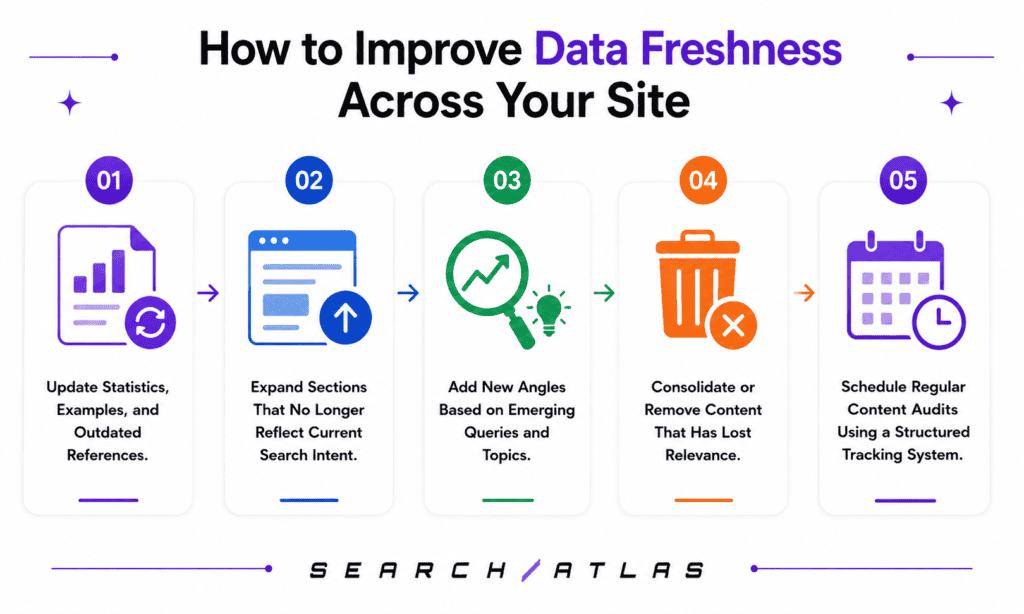
Data freshness improves across a site through systematic updates that increase content accuracy, relevance, and alignment with current search intent. Data freshness improvement requires structured prioritization rather than random updates. This process ensures that SEO teams focus resources on pages that create the greatest impact on rankings, traffic, and AI visibility.
The 5 main ways to improve data freshness across your site are listed below.
- Update Statistics, Examples, and Outdated References.
- Expand Sections That No Longer Reflect Current Search Intent.
- Add New Angles Based on Emerging Queries and Topics.
- Consolidate or Remove Content That Has Lost Relevance.
- Schedule Regular Content Audits Using a Structured Tracking System.
1. Update Statistics, Examples, and Outdated References
Updating statistics, examples, and outdated references is the most immediate action that restores freshness to a page that has decayed due to aging facts. Statistics lose validity as new research replaces old data. Examples become irrelevant as platforms change interfaces, tools update features, and markets shift conditions.
The update process starts with identifying every data point, example, and external reference on the page. Each one requires verification against current sources. Outdated statistics are replaced with current data from primary or authoritative sources. Deprecated examples are replaced with current equivalents. References to tools or platforms that no longer exist are updated to reflect current alternatives.
Updating statistics and references does not require rewriting the entire page. The goal is accuracy, not volume. A focused update that replaces five outdated data points and two expired examples produces stronger freshness signals than a rewrite that changes sentence structure without improving accuracy.
2. Expand Sections That No Longer Reflect Current Search Intent
Expanding sections that no longer reflect current search intent addresses freshness decay caused by shifts in what users want from a query, not just shifts in what information is accurate. Search intent evolves. Users who searched for a broad overview in 2020 now search for specific implementation steps in 2026. A page that answered the 2020 intent no longer serves the current query.
The expansion process starts with identifying the current search intent for the target query. This requires reviewing the current SERP, analyzing the questions users ask, and comparing the existing page structure against the structure of top-ranking pages. Sections that address questions users no longer ask are removed or reduced. Sections that address questions users now ask are expanded.
Expansion is not the same as adding length. Adding thin content to expand a page reduces the freshness quality rather than improving it. The standard for expansion is whether the new content answers a distinct question that the page did not previously address.
3. Add New Angles Based on Emerging Queries and Topics
Adding new angles based on emerging queries extends the topical coverage of a page to capture search demand that did not exist when the page was originally published. Topics evolve. New frameworks, tools, regulations, and events create new query clusters around established subjects.
The process starts with identifying new query patterns in the topic cluster. Keyword research tools, Google Search Console query reports, and SERP analysis reveal questions that now appear in search but were not present at the time of publication. These emerging queries represent gaps in the existing page.
New angles are added as discrete sections with their own headings, not as appended paragraphs at the end of existing sections. Each new angle answers a specific question and maintains the structural logic of the page. Adding angles without structural integration creates fragmented content that serves neither users nor search engines effectively. Content Genius supports the identification and drafting of new content angles by analyzing topic coverage against current search patterns, which reduces the research time required to identify gaps in existing pages.
4. Consolidate or Remove Content That Has Lost Relevance
Consolidating or removing content that has lost relevance reduces index bloat, eliminates keyword cannibalization, and concentrates authority into pages that reflect current search demand. Stale pages that target queries users no longer search, topics that have been superseded, or content that overlaps with stronger pages dilute the freshness signals of the overall site.
Consolidation applies to pages that overlap in topic with a stronger, more current page. The weaker page is merged into the stronger page through content integration and a redirect that transfers link equity. This process creates a single authoritative page that captures the combined value of both.
Removal applies to pages with no traffic, no backlinks, no rankings, and no realistic update path. Pages that target queries with no current search demand serve no SEO function. Removing them reduces crawl waste and eliminates weak quality signals from the domain index.
The decision between consolidation and removal depends on whether the page holds any recoverable value. Backlinks, partial rankings, and useful content sections are signals that a page requires consolidation rather than deletion.
5. Schedule Regular Content Audits Using a Structured Tracking System
Scheduling regular content audits using a structured tracking system transforms freshness maintenance from a reactive task into an ongoing operational process. Teams that audit on a schedule detect content decay before it affects rankings. Teams that audit reactively address decay after traffic has already declined.
The frequency of audits varies by site size and publishing volume. Enterprise sites with high publishing frequency require quarterly review cycles. Mid-size sites with moderate publishing volume require semi-annual audits. Small sites with limited content require annual reviews.
A structured tracking system records every URL, its last audit date, its last update date, the action taken during the audit, and the performance changes after the action. This record creates accountability, prevents pages from being missed between audit cycles, and connects update decisions to measurable outcomes.
Search Atlas Site Audit maintains continuously updated performance data between formal audit cycles. Teams that use ongoing monitoring are able to identify freshness decay as it begins rather than discovering it months later, after rankings have already fallen.
How Does Data Freshness Factor Into AI Search and LLM-Generated Answers?
Data freshness factors into AI search and LLM-generated answers by increasing the likelihood that a page becomes a cited source. AI systems prioritize information that reflects current facts, current developments, and current user expectations. Fresh content provides stronger reliability signals, which increases source selection probability during answer generation.
Data freshness factors into AI search and LLM-generated answers by improving factual confidence. AI systems evaluate sources based on accuracy, consistency, and relevance to the query. Current information reduces the risk of outdated recommendations and inaccurate responses, which makes fresh sources more attractive during retrieval and citation.
Data freshness factors into AI search and LLM-generated answers by increasing citation eligibility. AI platforms extract information from indexed content and select a limited number of sources for each response. Fresh content competes more effectively for those citation positions because it demonstrates ongoing accuracy and maintenance.
Data freshness factors into AI search and LLM-generated answers by strengthening relevance for evolving topics. Industries, products, regulations, and best practices change continuously. Content that reflects those changes aligns more closely with query intent, which improves visibility across AI-generated responses.
Data freshness factors into AI search and LLM-generated answers by reducing citation loss to competing sources. Newer content accumulates updated facts, references, and contextual information over time. Competing pages gain citation opportunities when older pages fail to reflect current conditions.
Data freshness factors into AI search and LLM-generated answers more strongly than in traditional search environments. Traditional search results distribute visibility across multiple ranking positions. AI-generated answers cite only a small number of sources for each response. Source selection, therefore, becomes a higher-stakes process where freshness directly influences citation visibility and traffic opportunities.
Do AI Overviews and LLMs Favor Recently Updated Sources?
AI Overviews and LLMs favor recently updated sources when query accuracy depends on current information. Recently updated sources increase citation eligibility for topics where facts, regulations, products, statistics, or recommendations change frequently. The decision depends on whether freshness contributes directly to answer quality and reliability.
AI Overviews and LLMs favor recently updated sources when freshness directly affects user intent. Queries about technology, finance, healthcare, marketing, and current events require accurate information that reflects recent developments. AI systems prioritize updated sources because current information produces more reliable answers. This prioritization increases citation accuracy and reduces factual errors.
AI Overviews and LLMs favor recently updated sources when updates improve factual accuracy. AI systems evaluate information consistency across multiple sources and compare facts against current information. Pages that contain accurate and recently verified information generate stronger trust signals during source selection. This evaluation increases the probability that updated pages appear in AI-generated answers.
AI Overviews and LLMs favor recently updated sources when updates strengthen content quality. AI systems evaluate answer completeness, source credibility, citation quality, and information accuracy. Meaningful updates improve these signals, which increases citation eligibility. Cosmetic updates without substantive changes provide little advantage during source evaluation.
AI Overviews and LLMs favor recently updated sources when competing pages contain outdated information. Older sources lose citation opportunities as facts, recommendations, and statistics become obsolete. Updated sources replace those pages because they align more closely with current search intent. AI Overviews and LLMs do not favor recently updated sources when freshness has little impact on answer quality.
How Does Content Recency Affect Visibility in AI-Generated Answers?
Content recency affects visibility in AI-generated answers by signaling that a page reflects current information at the time of retrieval. AI systems evaluate recency alongside authority, accuracy, and relevance during source selection. This evaluation increases citation opportunities for content that remains current and reliable.
Content recency affects visibility in AI-generated answers when query accuracy depends on current information. Topics related to technology, finance, healthcare, regulations, and current events change frequently over time. AI systems prioritize recent information because current information reduces the risk of outdated answers. This prioritization increases citation confidence and improves answer quality.
Content recency affects visibility in AI-generated answers by reinforcing source reliability. Websites that update content consistently demonstrate ongoing editorial oversight and information maintenance. AI systems identify patterns of accuracy across content libraries rather than evaluating pages in complete isolation. This pattern increases citation probability for domains with a history of maintaining current information.
Content recency affects visibility in AI-generated answers through its relationship with domain authority. Recent content published on authoritative domains generates stronger citation signals than recent content published on weak domains. Authority validates information quality while recency validates information currency. This combination creates stronger source selection signals during AI retrieval.
Content recency affects visibility in AI-generated answers by increasing competitiveness against outdated sources. Older pages lose citation opportunities as facts, statistics, and recommendations become less accurate. Recent pages replace those sources because they align more closely with current search intent. This replacement shifts AI visibility toward actively maintained content.
Content recency affects visibility in AI-generated answers most strongly when paired with extractable content structure. AI systems retrieve information more effectively from pages that contain clear definitions, direct answers, structured lists, and factual precision. Strong structure improves information extraction while recency improves information relevance. This combination increases the likelihood of citation selection in AI-generated responses.
Does Updating Content Always Improve Rankings?
No, updating content does not always improve rankings because rankings depend on multiple signals beyond freshness alone. Updating content affects rankings only when the update resolves the factors that limit search performance. Updates that improve freshness without improving relevance, authority, or intent alignment often produce little or no ranking improvement.
Content updates refer to revising existing pages through new information, updated statistics, expanded coverage, or structural improvements. Rankings refer to the position a page holds in search results based on relevance, authority, quality, and user satisfaction signals. These definitions explain why content updates influence rankings only when they improve the signals that search engines evaluate.
How does updating content fail to improve rankings? Updating content fails to improve rankings when the update does not address the underlying cause of poor performance. A page with search intent mismatches remains misaligned after a statistics refresh. A page with weak topical authority remains weak after a publication date change. These updates increase content recency but leave the primary ranking problem unresolved.
How does updating content improve rankings? Updating content improves rankings when revisions increase relevance, accuracy, completeness, or intent alignment. Search engines reward improvements that create a better experience for searchers and provide more useful information. These improvements strengthen the signals that influence ranking performance.
Why do some updated pages lose rankings? Updated pages lose rankings when revisions remove important information, change search intent alignment, or weaken topical focus. Significant changes alter how search engines interpret a page. This shift reduces visibility when the revised content no longer satisfies the needs of the original query.
Can Publishing Too Frequently Hurt Content Quality?
Yes, publishing too frequently hurts content quality when content volume increases faster than editorial quality controls. Publishing frequency affects content quality because every new page contributes to topical authority, content relevance, and overall site quality. Excessive publishing creates problems when speed replaces accuracy, depth, and usefulness.
Publishing frequency refers to how often new content appears on a website. Content quality refers to the accuracy, relevance, completeness, and usefulness of published information. These definitions explain why publishing volume alone does not improve SEO performance.
How does publishing too frequently hurt content quality? Publishing too frequently hurts content quality when editorial standards decline under production pressure. Teams produce thinner content, weaker research, and less comprehensive topic coverage as publishing demands increase. This decline reduces content value and weakens overall site quality signals.
How does publishing too frequently affect SEO performance? Publishing too frequently affects SEO performance when low-quality pages accumulate across a website. Weak pages contribute little value while consuming crawl resources and diluting topical authority. This accumulation creates index bloat and reduces the overall effectiveness of a content library.
Why does publishing frequency not guarantee freshness benefits? Publishing frequency does not guarantee freshness benefits because search engines evaluate content quality rather than publication volume. Freshness depends on relevance, accuracy, and usefulness instead of publication schedules. Frequent publishing generates value only when new content meets quality expectations.
Does Changing a Publication Date Without Updating the Content Count?
No, changing a publication date without updating the content does not count as a meaningful freshness improvement. Publication date changes affect freshness signals only when substantive content updates accompany them. Date changes without meaningful revisions create little value for search engines and provide no improvement in content accuracy or relevance.
Publication date changes refer to modifying the displayed date on a page. Content updates refer to meaningful revisions that improve accuracy, completeness, relevance, or usefulness. These definitions explain why search engines distinguish between cosmetic changes and substantive improvements.
How does changing a publication date without updating content affect freshness signals? Changing a publication date without updating content affects freshness signals minimally because search engines evaluate the actual content on a page. Crawlers compare page versions across visits and identify whether meaningful changes occurred. Cosmetic date updates provide weak signals because the underlying information remains unchanged.
Why does changing a publication date without updating content create trust issues? Changing a publication date without updating content creates trust issues when visitors expect current information but encounter outdated material. Searchers rely on publication dates to evaluate content relevance and accuracy. This mismatch reduces confidence and creates a poorer user experience.
How does changing a publication date without updating content affect engagement signals? Changing a publication date without updating content affects engagement signals when visitors leave after discovering outdated information. Lower engagement occurs because content fails to meet expectations created by the new date. This decline weakens the quality signals associated with the page.
What type of update counts as a meaningful freshness improvement? Meaningful freshness improvements require substantive revisions that improve content quality. Updated statistics, revised recommendations, expanded coverage, and corrected information strengthen freshness signals. These changes increase content value because they improve relevance and accuracy rather than simply changing a displayed date.
What Is the Minimum Change That Registers as a Freshness Signal to Google?
The minimum change that registers as a freshness signal is a substantive update to page content that Google detects as meaningful during the next crawl. There is no publicly confirmed threshold for the percentage of content change. The practical standard is whether the update adds new information, corrects inaccurate information, or addresses a question the page did not previously answer.
Cosmetic changes register as minimal updates. Reformatting paragraphs, correcting typos, and adding internal links without changing content are cosmetic changes that produce little or no freshness signal. Substantive changes register as meaningful updates. Adding updated statistics, expanding a section with new information, and restructuring the page to reflect current search intent are substantive changes that produce real freshness signals.
The safest approach is to treat freshness updates as genuine editorial improvements. Updates that add real value to the page produce real freshness signals. Updates designed to manipulate a crawl timestamp produce inconsistent results and create engagement risks that harm performance over time.
How Often Should Content Be Updated to Stay Competitive in Search?
Content needs to be updated to stay competitive in search based on topic volatility, competitor activity, and performance trends rather than a fixed schedule. Update frequency affects search performance because different topics experience different rates of information change. A single update schedule does not apply across all content types.
Content updates refer to meaningful revisions that improve accuracy, relevance, and completeness. Search competitiveness refers to a page maintaining visibility, traffic, and rankings against competing content. These definitions explain why update frequency depends on content performance rather than calendar dates alone.
How often should time-sensitive content be updated? Time-sensitive content requires frequent reviews because information changes rapidly. Topics related to software, finance, regulations, technology, and market conditions often require quarterly reviews or more frequent evaluations. Regular monitoring ensures that content reflects current developments and remains competitive in search results.
How often should evergreen content be updated? Evergreen content requires updates when significant changes occur within the topic or when performance begins to decline. Stable subjects experience fewer information changes and therefore require less frequent revisions. Annual reviews often provide sufficient oversight for low volatility topics.
How do competitors influence content update frequency? Competitors influence content update frequency through publishing activity and content improvements. Search results evolve as competing pages introduce new information, expanded coverage, and stronger resources. Competitive monitoring identifies situations where content requires updates to maintain visibility.
What is the most reliable signal for content updates? Performance data provides the most reliable signal for content updates. Declining impressions, falling click-through rates, and lower keyword rankings indicate content decay. These signals reveal the need for updates regardless of how recently a page received review.
How do SEO teams identify pages that need updates? SEO teams identify pages that need updates through ranking analysis, traffic monitoring, and content audits. Performance tracking reveals pages that lose visibility over time. Continuous monitoring enables earlier intervention before ranking declines become significant. OTTO SEO monitors ranking changes and content performance signals continuously, which allows teams to identify pages that have crossed into decay before the decline becomes severe.