An AI agent for AI search visibility only moves the numbers when it executes fixes instead of just reporting on gaps. A dashboard that flags a citation gap and stops there changes nothing. That distinction is the entire question this article answers. Plenty of platforms now track AI search visibility. Fewer of them do anything about what they find.
What does AI search visibility actually measure?
AI search visibility is a set of four measurements that describe how a brand performs inside AI-generated answers, not just whether it ranks in a traditional search result. Each one answers a different question, and a team that tracks only one of them is working from an incomplete picture.
- Brand mention rate: The share of relevant AI-generated responses that name the brand at all, whether or not that mention comes with a link. A brand can be mentioned by name inside a ChatGPT answer with no citation attached, which matters for awareness but not for the traffic or trust a citation carries.
- Citation rate: The share of responses where the AI engine links back to a specific page as the source of a claim. This is the number worth prioritizing, since a citation is direct evidence the engine's retrieval layer pulled content from that page and trusted it enough to reference. Mentions are a lagging signal. Citations are what an agent can actually act on.
- Competitor share: How a brand's mention and citation counts compare to its named competitors across the same set of prompts, showing whether it is gaining or losing ground relative to who it's actually up against, not just moving in isolation.
- Source freshness: How recently the pages an engine is citing were published or updated. AI answer engines weight recency differently across query types, so a stale source can quietly lose a citation to a newer competing page with no visible ranking drop to explain it.
This is the layer that generative engine optimization and LLMO already cover in depth, including how to structure content so these engines can extract and cite it in the first place. This article assumes that foundation and asks a different question: once the strategy is right, does having an agent actually run the work change what these four numbers do?
Does an AI agent actually move these numbers?
Yes, but only when the agent ships the fix instead of just flagging it. An AI agent that audits a site for AI search visibility and returns a list of citation gaps is doing the same job a human strategist already does, just faster. The visibility numbers don't move until something changes on the page, in the schema, or in the content itself, and someone has to make that change.
The distinction that actually matters is between a recommendation layer and an execution layer. A recommendation layer reads the site, compares it against what's winning citations elsewhere, and produces a report: a missing answer near the top, an unsupported claim, a competitor's page cited three times last week against zero for yours.
An execution layer takes that same finding and rewrites the section, adds the missing data point, restructures the heading, and republishes the page, then checks whether the citation came back.
Search Atlas Coworker is the AI CMO a team actually works with day to day, powered by Atlas Agent, the execution engine running underneath it. Atlas Agent tracks citation frequency, mention volume, and share of voice across ChatGPT, Claude, Gemini, and Perplexity as one of its four signal categories, alongside technical SEO, content gaps, and authority.
When a query the brand used to win in an AI-generated answer stops surfacing it, that's treated as a signal like any other: something to recommend against, route through an approval gate, and ship a fix for, not just note in a dashboard.
The execution gap most AI visibility tools stop at
Most AI search visibility products still stop at measurement, which is a smaller job than it sounds like. They connect to a prompt set, run it against the major AI engines on a schedule, and report back mention counts, citation counts, and competitor comparisons. That reporting layer is genuinely useful. It's also where the category has clustered, which is exactly why the execution gap is the more interesting question for a team deciding what to actually buy.
Reading a visibility report and knowing what to do about a citation drop still takes real diagnostic work. Someone has to figure out why the citation disappeared: an outdated claim, a competitor's newer source, or content that no longer matches the query pattern the engine is matching against. Then someone still has to write the fix and publish it.
That diagnostic and execution step is where agentic AEO picks up: preparing content so an AI agent can fetch it, extract the claim, and act on it, a different problem entirely than simply knowing the citation dropped.
An agent that only measures adds a step to the workflow instead of removing one. A team still has to open the report, interpret it, prioritize it against everything else competing for attention that week, and hand it to whoever owns the page.
An agent that measures and executes collapses that into one loop: detect the drop, generate the fix, route it through approval if it's high-risk, ship it, and check whether the citation returns. The second model is the one that actually changes what a team's AI search visibility numbers look like month over month.
What changes once visibility work runs as a loop instead of a report?
The self-healing loop that Search Atlas Coworker runs applies the same five-stage cycle to AI visibility that it runs on technical SEO and content: sense, detect, propose, approve, heal. It watches the site's live pages alongside current citation performance and identifies where a page has drifted out of step with what's currently winning citations. It drafts the corrective content, waits for a human to approve anything that carries real risk, then publishes the update and resumes watching.
Applied to AI search visibility specifically, that loop looks like this in practice. A page that used to get cited for a specific buyer question stops appearing in that answer for two weeks running. The system flags the drop as a signal, checks whether a competitor's page now holds the citation, and compares what changed: a newer publish date, a more direct answer near the top of the page, or a data point the brand's page doesn't have.
It drafts a specific fix: add the missing data point, restructure the opening paragraph into a direct answer, or update the publish date to reflect a genuine refresh. A human reviews and approves the change if it's substantive enough to warrant a look. A low-risk update, like a metadata refresh, ships automatically instead. The page republishes, and the system checks the same query again in the next monitoring cycle to see whether the citation came back.
That loop is what separates an agent from a dashboard. A dashboard tells a team its citation rate on a query dropped sharply over the past month. A loop tells the team the same thing and then does something about it before the next reporting cycle, closing the distance between noticing a problem and fixing it from weeks to days.
Building a dashboard that actually tracks whether it's working
A useful AI search visibility dashboard follows a specific chain: a fixed prompt set feeds citation rate, citation rate gets compared against competitor share, and both get checked against source freshness to explain why either one moved. Skipping any link in that chain leaves a team with a number and no explanation for why it changed.
Building it starts with the prompt set itself, since everything downstream depends on asking the right questions in the first place.
- Build a fixed prompt set that mirrors real buyer questions, not generic brand-name queries. A prompt like "best project management software for a 50-person agency" surfaces genuine citation competition. A prompt like "tell me about [brand name]" doesn't, because it skips the comparison step where citations actually get decided.
- Run that same prompt set on a schedule across every engine that matters, ChatGPT, Gemini, Perplexity, and Google AI Overviews, since a brand can be cited heavily in one engine and invisible in another, and averaging across engines hides that gap.
- Log citation rate per prompt, not just an aggregate score, so a drop on one specific query doesn't get buried inside a flat overall number that looks stable.
- Pull competitor share for the same prompt set, tracking which competing domain is winning the citation when the brand isn't, since that tells a team who they're actually losing to and on what specific question.
- Check source freshness on both sides of the comparison, the brand's page and the competitor's page that's winning the citation, to see whether the loss traces to a stale page or a genuinely stronger answer.
- Tie every citation change back to a dated action, whichever fix shipped and when, so a citation recovery two weeks later can be attributed to that specific change instead of a general trend.
That last step matters more than it looks like on the surface. Without a change log tied to dates, a team watching citation rate climb has no way to know whether the agent's fix worked, a competitor's page went stale on its own, or the AI engine's underlying model just shifted its source preferences that month.
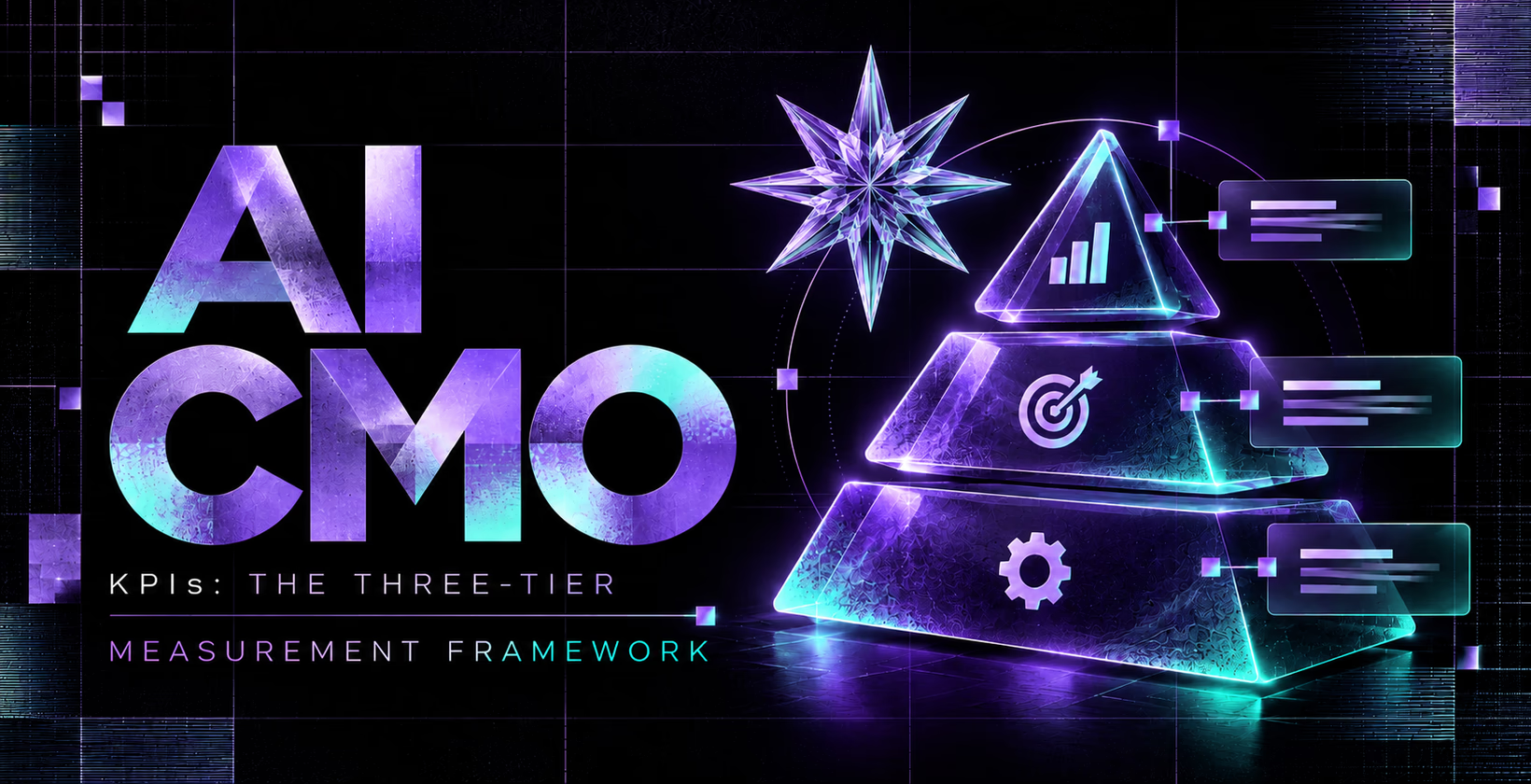
Search Atlas's KPI framework for AI CMO platforms makes the same point about marketing execution broadly: system-health metrics, decision quality, coverage rate, and override rate have to exist before an outcome metric like citation rate can be attributed to the system doing the work rather than assumed.
What does source freshness explain that citation rate alone can't?
Source freshness is the variable that explains why a page can lose a citation with no visible ranking drop in traditional search results. A page can hold its #3 ranking spot in Google's organic results for months while quietly losing its AI Overview citation to a competitor's page published two weeks ago on the same topic. That's because AI answer engines weight recency in ways classic ranking signals don't fully capture.
The contrast is straightforward to state before it needs a table: traditional rankings reward accumulated authority over time, while AI citation weighting rewards a page that most recently and most directly answers the specific query pattern the engine is matching against.
| Signal | Traditional search ranking | AI citation selection |
|---|---|---|
| What it rewards | Accumulated backlinks, historical authority, ranking tenure | Recency, direct answer structure, claim specificity |
| How fast it shifts | Gradually, over weeks or months | Can shift within a single crawl cycle |
| What a drop looks like | Position change visible in rank tracking | No visible ranking change, citation simply disappears |
| What fixes it | Sustained authority building | A specific content refresh that restores directness or currency |
That gap is exactly why source freshness has to sit inside the same dashboard as citation rate instead of being tracked separately. A team that only watches citation rate sees the symptom. A team that watches source freshness alongside it can see the cause before the next monitoring cycle even runs.
Where does this actually play out differently by industry?
The prompt sets, competitor sets, and freshness cadence that matter change by industry, even though the four core metrics stay the same everywhere. A SaaS company competing on "best [category] software" queries is fighting a fast-moving citation battle where a competitor's product update or new case study can flip a citation within days.
LLM visibility for SaaS tracks that specific dynamic, where citation churn is high and the prompt set needs frequent revision to stay current with how the category itself is being described.
A regulated industry runs on a slower clock but a higher stakes one. A law firm's prompt set skews toward practice-area and jurisdiction-specific questions where an AI engine's citation choice carries real trust implications for someone searching in a moment of genuine need. LLM visibility for law firms covers how that changes both the prompt design and the weight given to source freshness, since a stale answer to a jurisdiction-specific legal question is a bigger liability than a stale answer to a software comparison.
The mechanism connecting an agent's work to the outcome doesn't change across either case. What changes is how often the prompt set needs revisiting and how aggressively source freshness gets weighted against citation rate when deciding what to fix first.
What should a team actually expect from this?
A team adopting an AI agent for AI search visibility should expect the citation-rate number to move within weeks of a fix shipping, not the mention-rate number, which moves slower and less predictably.
Citation rate responds directly to a specific, traceable change: a page gets restructured, a claim gets updated, a schema gets added, and the next crawl cycle either does or doesn't pick it back up. Mention rate is a broader signal shaped by how an engine's model weights the brand across a wider range of prompts, and it shifts on a longer timeline that's harder to attribute to any single action.
That's also why the approval gate matters here just as it does everywhere else Atlas Agent operates. A citation-recovery fix that rewrites a page's core claim or restructures its opening section is exactly the kind of change that should route through a human review before it ships, since a rewritten claim that's wrong is worse for trust than a missing citation.
A metadata refresh or a freshness-date update carries less risk and can move through Fast mode without a review step. A system that treats every visibility fix identically, either shipping everything on its own or routing everything through review, is missing the same graduated judgment that makes execution useful anywhere else on the site.
Frequently asked questions
Does using an AI agent guarantee better AI search visibility?
No. It improves the odds of moving citation rate and competitor share because it closes the gap between detecting a visibility drop and shipping the fix, but the underlying content and structure still have to be strong enough to earn the citation once the fix ships.
What's the difference between brand mention rate and citation rate?
Brand mention rate counts how often a brand is named inside an AI-generated answer, with or without a link. Citation rate counts only the responses where the engine links back to a specific page as its source, which is the more actionable number since it points to a specific piece of content the engine trusted enough to reference.
How often should a team re-run its AI visibility prompt set?
At minimum weekly for fast-moving categories like SaaS, where a competitor's new content can flip a citation within days. Slower-moving, higher-stakes categories like legal or financial services can run on a longer cycle, but source freshness should still be checked every time the prompt set runs.
Can source freshness explain a citation loss with no ranking change?
Yes. AI answer engines weight recency differently than traditional search ranking does, so a page can hold its organic position while losing its AI citation to a more recently published or updated competing page, with no visible signal in classic rank tracking to explain it.
Where does Search Atlas track AI search visibility specifically?
Through LLM Visibility, which tracks citation frequency, mention volume, sentiment, and competitor share of voice across ChatGPT, Claude, Gemini, and Perplexity, feeding the same signal layer that Atlas Agent and Search Atlas Coworker act on.