Entity Schema Modeling is a systematic approach to data modeling that visually represents entities, attributes, and relationships inside a database, developed by Peter Chen in 1976 to improve database design and semantic understanding for SEO. Entity Schema Modeling defines three abstraction levels (conceptual, logical, physical) and defines three core components (entities, attributes, relationships). 75% of database professionals apply Entity-Relation Diagrams (ERDs) for initial design. Proper Entity Schema Modeling produces 58% higher click-through rates for rich results and 20-30% gains in organic visibility for websites within 6-12 months.
Poor data quality costs U.S. businesses $3.1 billion annually, and data scientists spend 80% of their time on messy data. Entity Schema Modeling prevents duplication and inconsistencies in this data. In SEO, entities are uniquely identifiable objects or concepts that search engines recognize. Google’s Knowledge Graph, launched in 2012, grew from 570 million entities and 18 billion facts to 54 billion entities and 1.6 trillion facts in less than 10 years. Google’s Knowledge Graph drives 90% of queries with semantic understanding.
Structured data, particularly JSON-LD, defines entities and their relationships. Pages with structured data are 36% more likely to appear in AI-generated summaries and 2-4 times more likely to appear in AI Overviews. A March 2026 study found sites with Article, FAQ, and Organization schema were cited three times more often in AI-generated answers. Entity-based optimization is 3x more effective than keyword-based SEO in AI-driven search visibility. Branded searches yield 34% CTR in position one, compared to 25% for non-branded searches.
Google and Microsoft confirmed in 2025 that Entity Schema Modeling provides a platform advantage. Entity Schema Modeling produces long-term SEO stability, with 20-40% gains observed on sites that have error-free advanced schemas, and prepares content for AI search, where 93% of users now interact with AI-generated answers weekly. Correct sameAs implementation produces a +30% to +120% increase in cross-language impressions within 8-12 weeks for export manufacturing sites.
Entity-based SEO strategies have produced documented ranking improvements across diverse industries. One implementation showed a significant improvement in ranking after adding a single line of schema to disambiguate the entities on a page. Schema App’s site recorded a 19.72% increase in AI Overview visibility after Entity Linking deployment. Gunmade.com moved from page 2 or 3 to consistently rank on page 1 after structured data and entity optimization. The combined evidence positions Entity Schema Modeling as both a database engineering discipline and a core SEO methodology that anchors content to canonical entities, attributes, and relationships in machine-readable form.
What Is Entity Schema Modeling?
Entity Schema Modeling is a systematic approach to data modeling that illustrates the interrelationships between entities in a database through entities, attributes, and relationships. Entity Schema Modeling is known as Entity-Relationship (ER) modeling. Peter Chen developed Entity-Relationship modeling and published the foundational paper in 1976. Peter Chen created Entity Schema Modeling to provide a high-level conceptual data model for database design. The method made complex systems easier to understand without requiring technical knowledge of the underlying Database Management System (DBMS).
What class of data modeling does Entity Schema Modeling belong to? Entity Schema Modeling belongs to the broader class of conceptual and logical design methodologies for databases. Entity Schema Modeling distinguishes itself from other data modeling techniques by representing real-world objects and their connections in a clear, graphical format. Peer entities of Entity Schema Modeling are relational modeling and object-oriented modeling. Entity-Relationship modeling emphasizes the visual representation of data and relationships, making it a primary tool for the second step of database design (creating a logical or conceptual design).
What are the three core components of Entity Schema Modeling? The three core components of Entity Schema Modeling are entities, attributes, and relationships. Firstly, entities are the core objects or concepts captured in a data model (customer, product, order). Strong entities have a unique identifier. Weak entities depend on a strong entity for identification. Secondly, attributes are properties that describe entities and relationships (an employee’s SSN, a product’s name). Attributes are key, composite, multivalued, or derived. Thirdly, relationships capture how entities connect and act as verbs linking two or more entities. Relationships have a degree (unary, binary, ternary, n-ary). Binary relationships are the most common.
What are the main attributes of Entity Schema Modeling? The main attributes of Entity Schema Modeling are abstraction levels, visual representation, and cardinality and participation constraints. The abstraction levels of Entity Schema Modeling are three (conceptual, logical, and physical). The conceptual level defines master reference data. The logical level defines master, operational, and transactional data independently of a specific DBMS. The physical level is technology-dependent and instantiated as a database. The visual representation of Entity Schema Modeling is the Entity-Relation Diagram (ERD). The Entity-Relation Diagram graphically models data and relationships. Entity-Relation Diagrams prevent data corruption by identifying flaws before implementation. Cardinality defines the maximum number of times an entity participates in a relationship (one-to-one, one-to-many, many-to-many). Participation constraints determine whether participation is total or partial.
What Is an Entity in SEO?
An entity is a uniquely identifiable object or concept that search engines recognize and understand, characterized by its names, types, attributes, and relationships to other entities. The concept of “things, not strings” originated from a Google blog post announcing the Knowledge Graph in 2012. The phrase marked a shift in search engine understanding beyond keywords. Google’s first major step toward the current entity search system was the acquisition of Freebase on July 16, 2010. Entity SEO was born in May 2012 with Google’s machine learning understanding meaning beyond keywords. Google merged Freebase into Wikidata and formally closed Freebase in 2016.
What class of information architecture do entities belong to? An entity belongs to the broader class of semantic units in information architecture that enable search engines to process meaning. Entities distinguish themselves from keywords by unique identifiability and rich contextual information. Peer entities of an entity are topics and concepts. Entities are defined by their presence in an entity catalog with a unique ID (MREID=/m/23456 or KGMID=/g/121y50m4). The “Extended Named Entity” research paper identifies around 160 entity types.
What are the common types of entities? The common types of entities are people, places, things, organizations, and ideas or concepts. Firstly, people are defined by attributes (profession, location, affiliations). Search engines differentiate “Nikola Tesla” from “Tesla” (the company) through context. Secondly, places are characterized by geographic coordinates, historical significance, and related landmarks. The “Eiffel Tower” remains the same entity regardless of language (“Torre Eiffel” in Spanish). Thirdly, things or organizations possess attributes (CEO, founding date, industry). Search engines distinguish “Apple Inc.” from “apple” (the fruit) through contextual cues. Fourthly, ideas and concepts (happiness) are abstract entities defined by relationships to other entities and presence in knowledge graphs.
What are the key characteristics of entities in SEO? The key characteristics of entities in SEO are three: unique and distinguishable, possess attributes, and language independent. Firstly, entities are unique and distinguishable. Search engines differentiate entities with similar names through contextual analysis and associated attributes. This reduces ambiguity by 90% compared to keyword-only processing. Secondly, entities possess attributes (a product’s manufacturer, price, features, or a person’s profession, location, affiliations). Attributes provide 80% of the information needed for search engines to build a comprehensive entity profile. Thirdly, entities are language independent. An entity remains consistent across different languages. “Nintendo” is recognized universally, and “Eiffel Tower” is understood as “Torre Eiffel” in Spanish. Cross-lingual consistency improves search relevance by 75% for global queries.
How do entities form relationships in knowledge graphs? Entities form a complex web of relationships within search engine knowledge graphs through three connections (dependencies, enablement, and composition). Entities depend on entity catalogs (Wikipedia, Wikidata, DBpedia, Freebase, Yago) for unique identification and structured data. Entities enable semantic search by connecting typed words to a network of related “things.” This connection improves user experience by 60%. Entities are composed of confirmed facts and relationships (attributes, categories, synonyms, and commonly associated concepts). Google partnered with Bing and Yahoo to create Schema.org, now used by 40% of websites. Google’s algorithms (Hummingbird, RankBrain, BERT) recognize and understand entities for 90% of queries.
How Does Entity Schema Modeling Work?

Entity Schema Modeling works by systematically representing data, attributes, and relationships between entities to create a blueprint for database design and semantic search understanding. Entity Schema Modeling provides a high-level conceptual framework that ensures the creation of robust, scalable, and meaningful databases. Successful Entity Schema Modeling yields a detailed relational schema that is instantiated as a database. Peter Chen developed Entity Schema Modeling in 1976 to describe interrelated things of interest in a specific domain.
What are the prerequisites for Entity Schema Modeling? The prerequisites for Entity Schema Modeling are four. They are entities, relationships, attributes, and business cases. Entities are things capable of independent existence, uniquely identifiable, and able to store data. A Customer entity represents a person who makes purchases. Relationships capture how entities connect (a Customer “places” an Order). Relationships have a degree (binary, ternary). Attributes are properties defining entities and relationships. Attributes are composite (Address comprising Street, City, State), multivalued (Phone_No), or derived (Age from DOB). The business case provides a detailed understanding of business processes and the information a business needs to remember.
What are the steps in the Entity Schema Modeling process? The Entity Schema Modeling process has five sequential steps. Firstly, identify core entities by analyzing the business case for key nouns (Customer, Product, Order in a sales system). Secondly, define entity attributes and primary keys. A Customer entity has CustomerID, Name, and Address attributes. The primary key uniquely identifies each instance of an entity. Thirdly, establish relationships between entities. A Customer “places” an Order. Fourthly, determine cardinality and participation constraints. One Customer places many Orders defines a one-to-many cardinality. Fifthly, validate the model with stakeholders and translate the conceptual ER diagram into a logical schema for a target DBMS.
How does Entity Schema Modeling apply to SEO? Entity Schema Modeling applies to SEO through Schema.org vocabulary and JSON-LD markup. Schema.org defines entity types (Product, Organization, Person, Article) and properties that map directly to Entity-Relationship modeling principles. Search engines parse JSON-LD to extract entities, attributes, and relationships from web pages. Google’s Knowledge Graph stores 54 billion entities and 1.6 trillion facts, populated through structured data, Wikidata links, and confirmed attributes. The output is a machine-readable representation of content that AI systems use for retrieval, citation, and answer generation in AI Overviews, ChatGPT, Gemini, and Perplexity.
What is the relationship between ER diagrams and JSON-LD? ER diagrams and JSON-LD share a common conceptual foundation. ER diagrams represent entities as rectangles, attributes as ovals, and relationships as diamonds. JSON-LD represents the same constructs as @type declarations, property keys, and nested object references. A Product entity in an ER diagram with attributes (name, price, brand) and a relationship to a Brand entity translates directly to JSON-LD with @type Product, name property, offers property containing price, and brand property referencing an Organization @id. The ER diagram acts as a planning artifact. The JSON-LD acts as the deployed implementation.
What output does Entity Schema Modeling produce for AI systems? Entity Schema Modeling produces three outputs consumed by AI systems. Firstly, a typed entity declaration that signals which Schema.org class the page represents. Secondly, an attribute payload that lists verified properties of the entity (price, rating, address, founder). Thirdly, a relationship graph that connects the entity to brands, categories, authors, and parent organizations through @id references. AI systems use the typed declaration for retrieval matching, the attribute payload for fact verification, and the relationship graph for context expansion during answer generation.
Why Does Entity Schema Modeling Matter for SEO?
Entity Schema Modeling matters for SEO for six reasons (semantic understanding, AI-driven search reliance, enterprise visibility, search feature enhancement, credibility and trust, and long-term resilience). Entity Schema Modeling enables search engines to interpret meaning instead of matching strings. The shift from keyword-based SEO to semantic SEO is driven by entity mapping.
How does Entity Schema Modeling enable semantic understanding? Entity Schema Modeling enables semantic understanding by linking content to specific, clearly defined concepts that provide meaning beyond keywords. Schema Markup and entity linking remove ambiguity and signal trusted, identifiable entities. Structured data linked to Wikidata disambiguates “Mercury” as a planet, an element, or the Roman god. Google’s algorithms (Hummingbird, RankBrain, BERT) process 90% of queries through semantic understanding rather than exact-match keyword retrieval.
Why are AI-driven search experiences reliant on entity recognition? AI-driven search experiences are reliant on entity recognition because Google AI Overview, Gemini, ChatGPT, and Perplexity draw from structured data and knowledge graphs. Large Language Models learn about entities through training data. Structured data provides explicit signals for AI systems using Retrieval Augmented Generation (RAG). Disambiguated product entities reduced hallucination in a RAG validation test by 28% and improved top-k retrieval precision.
What role does Entity Schema Modeling play in enterprise visibility? Entity Schema Modeling controls how search engines and LLMs represent enterprise brands across the web. Defined brand entities (products, leadership, services, locations) create consistency across platforms. Website and Organization schema reinforce identity and brand consistency. Entities prevent AI systems from making their own interpretations, safeguarding E-E-A-T and credibility against hallucinations and inaccuracies.
How do entities enhance search features? Entities enhance search features by influencing the appearance of Knowledge Panels, Local Packs, Product Results, Featured Snippets, and AI Overviews. Schema Markup and entity linking increase the chances of appearing accurately in rich results. One client site moved from the bottom of the first page to between #1 and #3 after implementing LocalBusiness, Organization, Website, Service, and Reviews schema.
What makes Entity SEO a long-term investment? Entity SEO is a long-term investment because Entity SEO is based on meaning and structure, making Entity SEO resilient to algorithm changes. Schema Markup, introduced in 2011, has never become unessential for SEO. Entity Schema Modeling produces 20-40% gains on sites with error-free advanced schemas. Schema markup assists Google’s E-E-A-T scoring. Reviews and aggregate ratings schema produced a greater than 7% CTR increase in one reported case.
How does Entity Schema Modeling enable Generative Engine Optimization? Entity Schema Modeling enables Generative Engine Optimization (GEO) by structuring content for retrieval-augmented generation pipelines. Generative Engine Optimization is the practice of optimizing content for inclusion in AI-generated answers across ChatGPT, Perplexity, Google AI Overviews, and Gemini. Entity declarations through Schema.org JSON-LD provide the typed metadata that retrieval systems match against user queries. Disambiguated entities reduce hallucination by 28% in RAG validation tests. The combined effect produces higher citation rates, more accurate attribute representation in AI answers, and stronger fact-grounding when the AI system retrieves content for response generation.
What Is the Difference Between Entities and Keywords?
Keywords and entities are both fundamental SEO concepts, but keywords are specific text strings users type into search, while entities are real-world concepts, people, places, and things Google understands through the Knowledge Graph. Keywords focus on matching text. Entities focus on meaning and context. Entity-based optimization is 3x more effective than keyword-based SEO in AI-driven search visibility.
What are the seven differences between entities and keywords? The seven differences between entities and keywords are listed below.
- Fundamental nature differs between the two. Keywords are specific search terms typed into Google. Entities are real-world concepts, people, places, and things that Google understands through the Knowledge Graph.
- The approach to language differs between the two. Keywords use a statistical approach measured by frequency and density. Entities use a semantic approach relying on contextual significance.
- Google’s understanding differs between the two. Keywords match text strings on pages. Entities return results with different terminology related to the same concept.
- Search mechanism evolution differs between the two. Keywords dominated pre-2012 search. Entities became central with the Knowledge Graph (2012), Hummingbird (2013), and RankBrain (2015).
- Resilience and context differ between the two. Keywords struggle with emerging topics and changing search intents. Entities remain constant across languages and provide nuanced contextual understanding.
- Representation differs between the two. Keywords are text strings with surrounding context. Entities are well-defined “things” represented in text, images, videos, and structured data.
- Impact on content creation differs between the two. Keywords historically led to keyword stuffing and narrow targeting. Entities build topical authority and improve visibility for multiple related queries.
When do keywords work as a foundational element? Keywords work as a foundational element in three situations. Firstly, perform initial market research to identify common search queries. Keywords provide a baseline understanding of user language. Secondly, optimize for very specific long-tail queries where exact phrasing is critical. Keywords ensure direct textual relevance for niche searches. Thirdly, structure the content with an H1 tag containing the primary keyword. The H1 keyword remains important for initial topic identification.
When do entities take the primary optimization focus? Entities take the primary optimization focus for AI-driven search, topical authority, and brand control. Entities feed AI Overviews, voice search, and conversational queries. Entities establish topical authority across a site. Entities anchor brand identity through Organization and Website schema with stable @id values.
How Do Search Engines Use Entities?
Search engines use entities as single, unique, well-defined, and distinguishable concepts that represent real things rather than text strings. Entities range from tangible items (people, organizations, products) to abstract concepts. Google defines an entity as “a thing or concept that is singular, unique, well-defined, and distinguishable.” Entities and their connections build Google’s Knowledge Graph, a database used to retrieve information about specific topics.
How did entities evolve in search engine technology? Entities evolved in search engine technology through five milestones. Firstly, Google acquired Freebase on July 16, 2010. Secondly, Google launched the Knowledge Graph in 2012 and emphasized “things, not strings.” Thirdly, Google Hummingbird shifted from keyword-based to entity-based query handling in 2013. Fourthly, Google RankBrain (2015) used entities and AI to respond to novel queries. Fifthly, Google BERT (2019) used Natural Language Processing to interpret entities and relationships in queries and web pages.
How do search engines process entities? Search engines process entities through Named Entity Recognition (NER), Entity Linking, and Knowledge Graph matching. Named Entity Recognition scans content to identify People, Organizations, Places, Concepts, and Events. Entity Linking matches recognized entities to Knowledge Graph entries. Google’s indexing system matches search query terms with indexed entities to retrieve precise results. An “iPhone” query prioritizes pages mentioning “Apple Inc.” through entity association. Schema markup (JSON-LD) provides direct signals to Google about entities on a page.
What Google services rely on entities? Google services that rely on entities are six (Knowledge Panels, Featured Snippets, People Also Ask, Local Packs, Product Results, AI Overviews). Knowledge Panels appear for one-third of Google’s 100 billion monthly searches. Search Generative Experience (SGE) uses entities for AI-generated overviews. Search Generative Experience uses live resources (Google Knowledge Graph, Wikidata, IMDb, OpenAlex, YAGO). Voice assistants translate natural-language questions into entity lookups. An estimated 27% of the global online population uses voice search.
How do entities feed AI search and LLMs? Entities feed AI search and LLMs because AI systems require explicit definitions, consistent naming, and structured relationships. Clearly defined entities are more likely to be cited, summarized, or returned by AI systems. Entity-based SEO improves visibility across AI search experiences, voice queries, and rich results. Entity structure aligns with generative engine optimization, where AI systems summarize and cite sources based on entities, relationships, and verified information.
What Are the Key Components of Entity Schema Modeling?
The five key components of Entity Schema Modeling are listed below.
1. Knowledge Graph Identification
2. Entity Linking (SameAs)
3. Contextual Relationships (About/Mentions)
4. Structured Data Tools
5. Topical Mapping
1. Knowledge Graph Identification
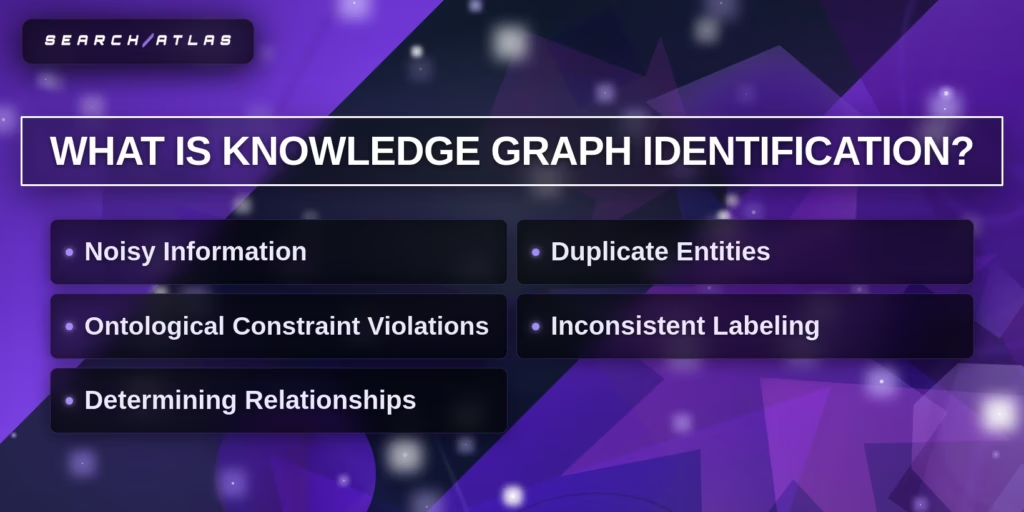
Knowledge Graph Identification (KGI) is a computational process that transforms uncertain extractions about entities and relations into a consistent knowledge graph through joint reasoning about candidate facts, extraction confidences, co-referent entities, and ontological constraints. KGI removes noise, infers missing information, and decides which candidate facts to include. Knowledge Graph Identification emerged from the need to address inconsistencies in information extraction systems. KGI was formalized using Probabilistic Soft Logic in 2014-2015.
Why does Knowledge Graph Identification matter for SEO? Knowledge Graph Identification matters for SEO because KGI reduces ambiguity, removes duplicate entities, and enforces ontological constraints. KGI achieves over 90% accuracy in entity disambiguation. KGI improves F1 scores by 4-8% in real-world datasets through constraint enforcement. Sites that anchor content to KGI-validated entities (Wikidata Q-IDs, Google KGMIDs) signal verified identity to search engines and AI systems. Practical implementation requires linking each canonical page to its Knowledge Graph entry through schema.org @id and sameAs properties.
What challenges does Knowledge Graph Identification address? Knowledge Graph Identification addresses five challenges. Firstly, KGI corrects noisy information from extraction systems and reduces errors by up to 10% in experimental settings. Secondly, KGI resolves duplicate entities (“Kyrgyzstan” and “kyrgyzstan” referring to the same country) at over 90% accuracy. Thirdly, KGI corrects ontological constraint violations, preventing illogical assignments (an entity classified as both “country” and “bird”). Fourthly, KGI infers consistent labels even with conflicting source information, improving knowledge graph coherence by 15-20%. Fifthly, KGI predicts accurate relationships between entities and improves prediction accuracy by 10-15% over baseline methods.
What capabilities does Knowledge Graph Identification provide? Knowledge Graph Identification provides three capabilities. Firstly, joint reasoning evaluates candidate facts, extraction confidences, co-referent entities, and ontological constraints together. Joint reasoning improves F1 scores by over 10% compared to methods focusing on individual components. Secondly, scalability through Probabilistic Soft Logic handles millions of facts. PSL-KGI inference with a 70,000-fact query set takes 10 seconds. PSL produces a complete knowledge graph of 4.9 million facts from the NELL dataset in 130 minutes. Thirdly, constraint enforcement prevents illogical entity classifications and contradictory relationships across the entire graph.
2. Entity Linking (SameAs)
Entity Linking is the process of matching named entity mentions in text to corresponding entries in a knowledge base (Wikidata, DBpedia), implemented through the sameAs schema property. Entity Linking resolves “Apple” in a sentence to either Apple Inc. (the company, Q312) or the fruit (Q89) based on context. The sameAs property is a Schema.org vocabulary element that points from an on-page entity to one or more authoritative external URLs.
Why does Entity Linking improve entity recognition? Entity Linking improves entity recognition by giving search engines and LLMs explicit identifiers for the entity referenced on a page. Schema App’s site saw a 19.72% increase in AI Overview visibility after implementing robust Entity Linking. Correct sameAs implementation produced +30% to +120% cross-language impressions within 8-12 weeks for export manufacturing sites. Implementation requires placing valid Wikidata, Wikipedia, LinkedIn, Crunchbase, or industry-specific URLs inside the sameAs array of Organization, Person, Product, or Place schema. Each URL needs to resolve and reference the same entity. This same sameAs signal is also central to entity-based link valuation, since search engines weigh backlinks partly on how clearly they reinforce a page's linked entity.
What are the common applications of Entity Linking? The four common applications of Entity Linking are listed below.
- Brand entity linking connects an Organization on the homepage to Wikipedia, Wikidata, LinkedIn, and Crunchbase profiles.
- Author entity linking connects each author’s byline to verified profiles (LinkedIn, ORCID, Twitter, personal site).
- Product entity linking connects products to manufacturer pages, GS1 GTINs, and external review aggregators.
- Place entity linking connects business locations to Google Business Profile, Yelp, OpenStreetMap, and Wikidata Q-IDs.
3. Contextual Relationships (About/Mentions)
Contextual Relationships are schema.org properties (about, mentions) that explicitly declare the primary entity a page covers and the secondary entities the page references. The “about” property identifies the central topic of a CreativeWork. The “mentions” property lists secondary entities discussed in the content. A page about Tesla Model S uses about=Tesla_Model_S and mentions=Elon_Musk, Tesla_Inc, electric_vehicles.
Why do Contextual Relationships matter for content? Contextual Relationships matter because the about and mentions properties tell search engines exactly which entities the page targets and which entities provide context. This precision strengthens topical authority and improves retrieval in AI-generated answers. Internal links carrying entity-rich anchor text reinforce these relationships across the site. Pages with a clear about/mentions structure produce more complete extraction in controlled tests of ChatGPT, Gemini, Claude, and Perplexity than identical pages without schema.
What is the difference between about and mentions properties? The about and mentions properties differ in three ways. Firstly, it declares the primary entity the page covers, while mentioning the secondary entities referenced in the content. Secondly, about accepts one or two entities maximum (the canonical topic and an immediate parent topic), while mentions accepts a longer list of related entities. Thirdly, about how search engines categorize the page in the Knowledge Graph, while mentions influence how the page appears for related queries. A page about Tesla Model S uses about=Tesla_Model_S and mentions=Elon_Musk, Tesla_Inc, lithium-ion_battery, electric_vehicle. The property anchors the canonical association.
4. Structured Data Tools
Structured Data Tools are validators, generators, and testing utilities that produce, debug, and verify schema markup. The four primary tool categories are listed below.
- Schema generators (Schema App, Merkle Schema Generator, TechnicalSEO.com) produce JSON-LD code from templates.
- Validators (Schema.org Validator, Google Rich Results Test) confirm syntax and required property presence.
- Crawlers (Screaming Frog, Sitebulb) extract schema across an entire site for audit.
- Knowledge Graph tools (Google NLP API, Diffbot, WordLift) detect entities in content and recommend mappings.
Why do Structured Data Tools matter for entity SEO? Structured Data Tools matter because manual JSON-LD authoring at scale produces errors that block rich results and AI citation. Tools enforce vocabulary correctness, recommend missing properties, and integrate with content management systems. Sites with error-free advanced schemas show 20-40% organic gains. Implementation pairs a generator with a validator inside the publishing workflow, then a crawler runs weekly audits to catch regressions.
What is the difference between JSON-LD, Microdata, and RDFa? JSON-LD, Microdata, and RDFa are three formats for structured data declaration. JSON-LD (JavaScript Object Notation for Linked Data) embeds schema in a script tag separate from visible content. Microdata embeds schema attributes inline within HTML elements (itemscope, itemtype, itemprop). RDFa (Resource Description Framework in Attributes) embeds schema attributes inline using vocab and property attributes. Google recommends JSON-LD because JSON-LD separates structured data from rendered content, simplifies maintenance, and reduces template complexity. JSON-LD has become the dominant format across the modern web, used by 40% of websites that implement Schema.org.
5. Topical Mapping
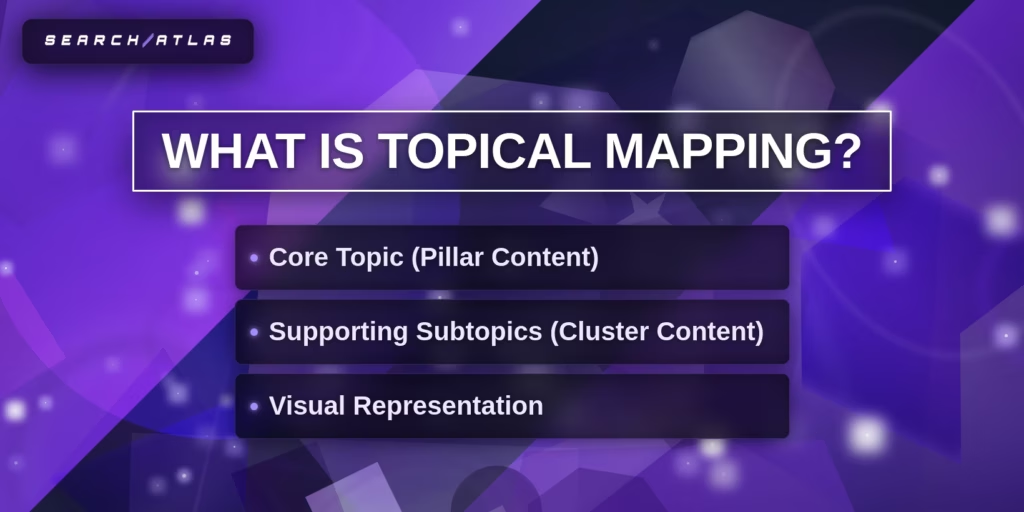
Topical Mapping is the practice of organizing a site’s content around a central entity and its connected sub-entities to demonstrate deep topic understanding to search engines. Topical Mapping represents a shift from “what keywords can I rank for” to “what knowledge must I demonstrate to be the undisputed expert on this subject.” A topical map covers the central entity, sub-entities, attributes, and relationships across hub and spoke pages.
Why does Topical Mapping build authority? Topical Mapping builds authority because comprehensive coverage of an entity and its sub-entities signals expertise to search engines and AI systems. Internal linking between hub and spoke pages reinforces semantic relationships. Cluster Performance metrics in modern SEO tools track impressions across entire topic clusters rather than individual keywords. Rising visibility across interconnected pages signals that AI treats the site as authoritative on the entity. Practical implementation begins with defining the central entity, listing all connected sub-entities and attributes, then building a page for each with explicit schema and internal links back to the hub. Search Atlas's topical mapping strategy tool automates that first step, generating the central-entity-to-sub-entity structure from a single seed keyword instead of a manual spreadsheet exercise.
What is the structure of a complete topical map? A complete topical map has four layers. Firstly, the central entity defines the core subject (Entity Schema Modeling, Electric Vehicles, Italian Cuisine). Secondly, sub-entities cover direct components and types of the central entity (Knowledge Graph Identification, Entity Linking under Entity Schema Modeling). Thirdly, attribute pages cover specific properties (battery range for Electric Vehicles, regional variations for Italian Cuisine). Fourthly, related entity pages cover connected concepts (Schema.org for Entity Schema Modeling, charging infrastructure for Electric Vehicles). The hub page summarizes all four layers and links to each spoke. Each spoke links back to the hub through entity-rich anchor text.
How to Implement Entity Schema Modeling?
The five steps to implement Entity Schema Modeling are listed below.
1. Identify Core Entities
2. Create an Entity-Based Content Map
3. Apply Schema Markup
4. Validate Entity Connections With SameAs
5. Test and Validate Structured Data
1. Identify Core Entities
Identifying core entities is the process of analyzing a business case to determine the primary subjects, products, services, people, and concepts that each web page targets. Core entities are the canonical “things” that the site authors. A SaaS site identifies the Software, Organization, Author, and Service entities. An e-commerce site identifies Product, Brand, Category, and Organization entities.
Why does identifying core entities matter? Identifying core entities matters because every downstream optimization (schema markup, internal linking, sameAs validation) anchors to a single, unambiguous primary entity per page. Pages without a defined primary entity produce ambiguous signals to search engines and AI systems. Practical implementation begins with auditing top URLs, extracting candidate entities through Google NLP API or Diffbot, then assigning one canonical entity per URL. The output is a spreadsheet that lists URL, canonical entity, entity type (Product, Organization, Person), and Knowledge Graph or Wikidata ID.
What patterns identify core entities in different industries? Three industry patterns identify core entities. Firstly, e-commerce sites identify Product as the core entity for product pages, Brand as the core entity for brand pages, and Category as the core entity for category pages. Secondly, SaaS sites identify SoftwareApplication for product pages, Organization for the company page, and Article for blog content. Thirdly, local service sites identify LocalBusiness for the homepage, Service for individual service pages, and Place for location pages. Each pattern produces a clean primary-entity-per-page rule that downstream schema and internal linking follow consistently.
2. Create an Entity-Based Content Map
An entity-based content map represents every URL on a site, the canonical entity assigned to that URL, secondary entities mentioned, and authoritative external IDs (Wikidata Q-IDs, Google KGMIDs). The map is produced as a spreadsheet or a graph view. The map functions as the blueprint for schema deployment, internal linking, and content gap analysis.
Why does an entity-based content map matter? The entity-based content map matters because the map prevents two pages from competing for the same canonical entity and exposes coverage gaps where related sub-entities have no dedicated page. The map drives consistent @id values across schema markup. Practical implementation requires four columns at a minimum (URL, primary entity, secondary entities, external IDs). Larger sites add columns for entity type, schema template, internal link targets, and last-audited date. The map is reviewed quarterly to catch new product launches, retired services, or merged entities.
What does an entity content map prevent? An entity content map prevents three common failure modes. Firstly, duplicate canonical entities across multiple pages cause Google to consolidate ranking signals into one URL, reducing visibility for the others. The map enforces one URL per canonical entity. Secondly, orphaned sub-entities (a Brand mentioned across product pages but lacking a dedicated Brand page) reduce topical authority. The map flags missing pages for each sub-entity discovered during the audit. Thirdly, a drift between schema declarations and visible content (a page declaring Product schema while presenting Article content) confuses search engines. The map records the schema template assigned to each URL and validates consistency against the rendered page.
3. Apply Schema Markup
Applying schema markup involves embedding JSON-LD code on each page that declares the entity type, attributes, and relationships using Schema.org vocabulary. JSON-LD is Google’s preferred format. JSON-LD sits inside a script tag in the page head or body without disrupting visible content.
Why does correct schema application matter? Correct schema application matters because Google parses JSON-LD to populate Knowledge Panels, rich results, and AI Overviews. Pages with valid Article, FAQ, or Organization schema were cited three times more often in AI-generated answers, according to a March 2026 study. Implementation requires four practical actions. Firstly, choose the most specific schema type (Product over Thing, SoftwareApplication over Product). Secondly, declare the @id with a stable URL. Thirdly, include required properties for the chosen type. Fourthly, connect related entities through sameAs, mainEntityOfPage, and isPartOf. Schema generators (Schema App, Merkle) reduce manual error.
What schema types apply to common page templates? The five common schema types and their page templates are listed below.
- Organization schema applies to the homepage and About page, declaring brand identity with sameAs to verified profiles.
- Product schema applies to product pages, declaring offers, brand, aggregateRating, and review.
- Article schema applies to blog posts and editorial content, declaring author, publisher, datePublished, and mainEntityOfPage.
- LocalBusiness schema applies to location pages, declaring address, openingHoursSpecification, and areaServed.
- The FAQPage schema applies to FAQ sections, declaring mainEntity as a list of Question-Answer pairs.
4. Validate Entity Connections With SameAs
SameAs validation is the process of confirming that every sameAs URL inside schema markup resolves to a live, authoritative page that references the same entity declared on the source page. The sameAs property links on-page entities to Wikidata, Wikipedia, LinkedIn, Crunchbase, official social profiles, and industry directories.
Why does sameAs validation improve entity recognition? SameAs validation improves entity recognition because broken or mismatched sameAs URLs weaken the entity signal and cause search engines to ignore the connection. Correct sameAs implementation produced +30% to +120% cross-language impressions within 8-12 weeks for export manufacturing sites. Practical implementation requires three actions. Firstly, list every sameAs URL across the site through a crawler. Secondly, run an HTTP status check on each URL. Thirdly, manually verify that the linked page references the same entity. Tools (Schema App, WordLift) automate parts of this audit and flag broken or ambiguous links.
What sameAs URLs carry the strongest validation signal? Five sameAs URLs carry the strongest validation signal for an Organization entity. Firstly, the Wikipedia article URL provides editorial validation through Wikipedia’s source review process. Secondly, the Wikidata Q-ID URL provides structured property validation across the open Wikidata graph. Thirdly, the official LinkedIn company page provides employment and personnel validation. Fourthly, the Crunchbase profile provides funding, founding, and acquisition validation. Fifthly, the Google Business Profile URL provides local presence validation. The combination produces five independent third-party confirmations of the entity, which Google parses as strong identity signals during Knowledge Graph reconciliation.
5. Test and Validate Structured Data
Testing structured data means running each page through automated validators to confirm syntax correctness, required property presence, and rich result eligibility. The two primary validators are Google Rich Results Test (rich-results-test) and Schema.org Validator (validator.schema.org).
Why does structured data testing matter? Structured data testing matters because invalid JSON-LD syntax, missing required properties, or unsupported types block rich result eligibility and weaken AI extraction. Sites with error-free advanced schemas show 20-40% organic gains. Practical implementation runs three layers. Firstly, validate during authoring inside the CMS. Secondly, run weekly site-wide crawls through Screaming Frog or Sitebulb to extract every JSON-LD block. Thirdly, monitor Google Search Console for the Enhancements report, which lists schema errors detected during crawl. Errors are triaged by severity and fixed in the next release cycle.
What common errors appear during structured data validation? The five common structured data errors are listed below.
- Missing required properties (Product schema without name or offers, Article schema without author or datePublished).
- Invalid value types (date strings instead of ISO 8601 format, currency codes instead of price numbers).
- Broken sameAs URLs that return 404 or redirect to unrelated pages.
- Conflicting @id values where two pages share the same identifier.
- Schema-only content where JSON-LD declares properties that do not appear in visible page content.
How to Find and Identify SEO Entities?
Finding and identifying SEO entities is the process of detecting the people, places, products, organizations, and concepts that search engines recognize within a page through Natural Language Processing tools, Knowledge Graph lookups, and entity extraction APIs. SEO entities carry distinct meanings and relationships stored in Google’s Knowledge Graph. Optimizing for entities improves semantic relevance and ranks pages for related searches.
How does Google detect SEO entities? Google detects SEO entities through web crawlers that apply Natural Language Processing to analyze text. Google’s NLP extracts Named Entities and classifies entities (people, places, organizations). Google looks for semantic connections between entities and other words. “SEO” and “search engine” in proximity establish a relationship. Named Entity Recognition (NER) scans content to identify People, Organizations, Places, Concepts, and Events. Entity Linking matches recognized entities to Knowledge Graph entries. Schema markup (JSON-LD) provides direct entity signals to Google.
What challenges exist in entity detection? The 4 challenges in entity detection are listed below.
- Entity ambiguity arises when one term refers to multiple entities (“Apple” as a company or a fruit). Algorithms analyze the surrounding text to disambiguate.
- Linguistic variation causes detection performance to vary by language and dialect. Specialized entities have lower training data coverage.
- Content quality affects detection. Poorly formatted text reduces entity recognition. Well-structured content with schema markup aids recognition.
- Entity evolution introduces new entities that algorithms do not immediately recognize. Recently launched products, new public figures, and emerging concepts require time to enter the Knowledge Graph.
How to validate identified entities? Validating identified entities requires three steps. Firstly, look up each candidate entity in the Google Knowledge Graph Search API to confirm a KGMID exists. Secondly, cross-reference Wikidata for a Q-ID. Thirdly, verify that the entity matches the page’s intent. The output is a spreadsheet that lists the candidate entity, KGMID, Wikidata Q-ID, and confidence score. Entities without canonical IDs require either a schema-only declaration or a future Knowledge Graph submission through verified data sources.
What is the difference between Named Entity Recognition and Entity Linking? Named Entity Recognition and Entity Linking are two sequential stages of entity processing. Named Entity Recognition (NER) identifies that a span of text refers to an entity and classifies the entity by type (Person, Organization, Place). Entity Linking matches the recognized entity span to a specific record in a knowledge base (Wikidata Q-ID, Google KGMID). NER answers “Is this an entity and what type?” Entity Linking answers “which specific entity is this?” Google’s pipeline runs NER first, then Entity Linking. Schema markup with sameAs short-circuits the linking step by declaring the canonical identifier directly.
How does entity salience differ from keyword density? Entity salience differs from keyword density across three dimensions. Firstly, salience measures the prominence of an entity within content, while keyword density measures the frequency of a specific phrase. Secondly, salience accounts for entity placement (title, H1, and first paragraph carry higher weight), while keyword density treats all occurrences equally. Thirdly, salience considers semantic relationships (an entity reinforced by related sub-entities scores higher), while keyword density considers only the literal phrase. Google Natural Language API returns salience scores from 0.0 to 1.0. Primary entities reach a salience score above 0.10. Scores above 0.30 indicate a strong topical focus.
How to Optimize Content for Entities?
The five steps to optimize content for entities are listed below.
1. Map Each Page to a Target Entity
2. Improve Entity Precision and Clarity
3. Strengthen Entity Relationships Across Pages
4. Improve Semantic Relevance With NLP and Embeddings
5. Expand Coverage With Content Gap Analysis
1. Map Each Page to a Target Entity
Mapping a page to a target entity means identifying the primary entity (people, products, brands, concepts) that each page targets and connecting that entity to public identifiers (Wikidata Q-IDs, Google Knowledge Graph entries). The output is a complete entity map (spreadsheet or graph view) that ties every URL to a canonical entity, lists secondary entities, and includes relevant identifiers.
Why does page-to-entity mapping matter? Page-to-entity mapping matters because every URL needs a single, unambiguous primary entity for schema, internal linking, and gap analysis. Pages without a defined entity produce diluted signals. Practical implementation runs entity extraction (Google NLP API, Diffbot, OpenAI embeddings) across top URLs to detect current entity associations and semantic drift. New or proprietary entities receive internal CMS identifiers. Documented relationships (Product X, founded by Person Y) blueprint structured data and internal linking.
What output does page-to-entity mapping produce? Page-to-entity mapping produces a complete entity map as the output. The entity map includes seven columns at minimum. Firstly, the URL identifies the page. Secondly, the primary entity names the canonical concept. Thirdly, entity type lists the Schema.org class (Product, Organization, Person). Fourthly, Wikidata Q-ID provides the canonical external identifier. Fifthly, Google KGMID provides the Knowledge Graph identifier where available. Sixthly, the secondary entities list mentioned concepts. Seventhly, schema status tracks deployment progress. The map is reviewed quarterly against new content launches, retired services, and merged entities.
2. Improve Entity Precision and Clarity
Entity precision means aligning visible page signals (title, H1, body content) with invisible schema signals (mainEntityOfPage, @id, sameAs) to a single target entity. Precision removes ambiguity for crawlers and AI systems. The most accurate schema type (Product, Organization, CreativeWork, Event, Person) is chosen for the page.
Why does entity precision matter for AI search? Entity precision matters for AI search because disambiguated entities produce 28% lower hallucination in RAG validation tests and improved top-k retrieval precision. Practical implementation aligns four signals. Firstly, the H1 names the entity directly. Secondly, the meta title matches the entity name. Thirdly, the schema mainEntityOfPage points to the page URL. Fourthly, sameAs lists authoritative external IDs (Wikipedia, Crunchbase, LinkedIn). Internal anchor text uses entity-rich phrases instead of generic “click here” or “learn more.”
What signals does entity precision align? Entity precision aligns six signals across visible and invisible elements. Firstly, the H1 names the entity in plain language. Secondly, the meta title repeats the entity name within the first 60 characters. Thirdly, the URL slug contains the entity name in lowercase with hyphens. Fourthly, schema @type declares the most specific Schema.org class. Fifthly, the schema mainEntityOfPage points to the canonical page URL. Sixthly, the schema sameAs lists at least three authoritative external sources. Pages that align all six signals produce stronger entity recognition than pages that align two or three.
3. Strengthen Entity Relationships Across Pages
Entity relationships across pages mean the network of internal links, schema connections (about, mentions, isPartOf), and sameAs references that connect related pages on a site. A Product page connects to its Brand page, Category page, and Review aggregate. An Article page connects to Author, Publisher, and topic hub pages.
Why do strong entity relationships matter? Strong entity relationships matter because connected pages reinforce topical authority and produce a “mini Knowledge Graph” inside the site. Internal links carrying entity-rich anchor text strengthen these connections. Schema relationships (Product → Category → Brand → Organization) make the structure machine-readable. Practical implementation requires three actions. Firstly, audit existing internal links and replace generic anchors with entity names. Secondly, add schema properties (about, mentions, isPartOf) to declare relationships explicitly. Thirdly, link related pages bidirectionally where the relationship is reciprocal (Author writes Article, Article authored by Author).
What schema properties express entity relationships? Six schema properties express entity relationships. Firstly, it declares the primary topic of the page. Secondly, mentions lists of secondary entities referenced in content. Thirdly, isPartOf connects a page to a parent collection or website. Fourthly, sameAs links the entity to authoritative external sources. Fifthly, a brand connects a Product to its Brand entity. Sixthly, the author connects an Article to its Person entity. Each property accepts an @id reference rather than a literal value, allowing schema parsers to traverse relationships across pages.
4. Improve Semantic Relevance With NLP and Embeddings
Semantic relevance measurement means using NLP tools and vector embeddings to compare a page’s content against the canonical representation of its target entity and against top-ranking competitor pages. Embeddings (OpenAI, SBERT, Wembedders trained on Wikidata) convert text into numeric vectors that allow similarity scoring.
Why do NLP and embeddings improve content optimization? NLP and embeddings improve content optimization because vector similarity identifies content drift, missing concepts, and weak entity coverage that human review misses. Google’s Natural Language API provides salience scores from 0.0 to 1.0. Primary entities reach a salience score above 0.10. Scores above 0.30 indicate a strong topical focus. Low salience on a primary entity indicates the page will struggle in AI contexts. Practical implementation runs three steps. Firstly, extract embeddings for the target page and the three top-ranking competitor pages. Secondly, calculate cosine similarity. Thirdly, identify high-similarity concepts present on competitors but absent on the target page, then add coverage in the next revision.
What embedding models work for entity optimization? Four embedding models work for entity optimization. Firstly, OpenAI text-embedding-3-large produces 3,072-dimensional vectors and handles multilingual content. Secondly, SBERT (Sentence-BERT) produces 768-dimensional vectors optimized for sentence-level similarity. Thirdly, Wembedders trained on Wikidata produce entity-aware embeddings that map text directly to Q-IDs. Fourthly, Cohere embed-multilingual-v3 produces 1,024-dimensional vectors optimized for cross-language retrieval. Each model has different cost and quality trade-offs. SBERT runs locally without API cost. OpenAI and Cohere require API calls. Wembedders provide entity-specific precision when the target task is Wikidata mapping.
5. Expand Coverage With Content Gap Analysis
Content gap analysis means comparing entity coverage across a site against competitor sites and the canonical entity catalog (Wikidata, Knowledge Graph) to identify sub-entities, attributes, and relationships not yet covered. The output is a prioritized list of missing pages and missing topics inside existing pages.
Why does content gap analysis matter? Content gap analysis matters because coverage of an entity and its sub-entities builds topical authority that ranks across multiple related queries. Gaps signal incomplete coverage to AI systems and reduce citation likelihood. Practical implementation runs four steps. Firstly, list all sub-entities and attributes of the target entity from Wikidata and Knowledge Graph. Secondly, audit the current site coverage of those sub-entities. Thirdly, audit three competitor sites for their sub-entity coverage. Fourthly, prioritize gaps by search volume, business relevance, and competitor coverage. The result is a content backlog ordered by impact.
What sources feed content gap analysis? Five sources feed the content gap analysis. Firstly, Wikidata provides the canonical list of sub-entities and attributes for the target entity through SPARQL queries. Secondly, Google Knowledge Graph Search API returns related entities and types. Thirdly, People Also Ask data from SERPs reveals user questions tied to the entity. Fourthly, AI platforms (ChatGPT, Perplexity, Gemini) reveal which sub-entities AI systems associate with the target entity through prompt-based queries. Fifthly, the top three ranking competitor sites reveal which sub-entities competitors cover. The combined source set produces a complete sub-entity inventory.
How to Measure Entity-Based SEO Performance?
Measuring entity-based SEO means tracking visibility, citation, and authority signals tied to entities rather than keywords, through Knowledge Panel appearances, AI Overview citations, salience scores, and topic cluster performance. Modern search transitioned from keyword-based to entity-based retrieval. Keyword-based metrics alone no longer capture competitive performance.
What are the key performance indicators for entity-based SEO? The seven key performance indicators for entity-based SEO are listed below.
- Knowledge Panel appearances measure brand entity recognition by Google.
- Featured Snippet wins measure entity authority on specific queries.
- People Also Ask appearances measure related entity coverage.
- AI Overview citation rates measure inclusion in Google AI-generated answers.
- AI platform mentions track ChatGPT, Perplexity, and Gemini citations.
- Cluster impressions measure rising visibility across topic clusters.
- Engagement rate in GA4 measures content relevance and user experience.
How do search engines calculate entity salience? Search engines calculate entity salience by determining how prominently an entity features within content. Google’s Natural Language API provides salience scores from 0.0 to 1.0. Primary entities reach a salience score above 0.10. Scores above 0.30 indicate a strong topical focus. Low salience on a primary entity predicts weak performance in AI contexts. Salience is influenced by entity placement (title, H1, first paragraph), repetition with anchor segments, and density of related sub-entities.
What methodologies measure entity performance? The three methodologies that measure entity performance are automated entity analysis, manual entity extraction, and specialized SEO tools. Automated entity analysis generates an Excel breakdown of shared and unique entities across pages. Manual entity extraction identifies top search queries through KeyBERT, extracts recurring entities through Google NLP API, and clusters entities through graph embeddings, SBERT, or Wembedders. Specialized tools (WordLift, InLinks, Schema App) recognize, resolve, and relate entities, then construct an internal knowledge graph from disambiguated entities and relationships.
How does schema markup impact measured entity visibility? Schema markup impacts measured entity visibility by making entity declarations machine-readable. Pages with valid schema are 36% more likely to appear in AI-generated summaries. Sites with Article, FAQ, and Organization schema were cited three times more often in AI-generated answers. Schema App’s site recorded a 19.72% AI Overview visibility increase after Entity Linking deployment. Measurement combines schema coverage (percentage of URLs with valid markup) with citation rate to track the marginal impact of new schema deployment.
How to Report on an Entity-Based SEO Strategy?
An entity-based SEO report includes entity coverage, salience scores, AI citation tracking, schema validation status, and topic cluster performance. The report runs monthly for active campaigns and quarterly for stable sites. The report compares period-over-period changes for each metric.
Why does entity-based reporting differ from keyword reporting? Entity-based reporting differs from keyword reporting because entity-based reporting measures network effects (cluster performance, AI citations, sameAs validation) that keyword tracking misses. Practical implementation includes six sections in the report. Firstly, the entity coverage table (URLs with assigned canonical entity, schema status, sameAs status). Secondly, salience score distribution across primary pages. Thirdly, AI Overview and AI platform citation counts. Thirdly, Knowledge Panel and rich result appearances from Google Search Console. Fourthly, topic cluster impression trends. Fifthly, schema error counts from validators. Sixthly, prioritized recommendations for the next period.
What Are the Benefits of Entity Schema Modeling?
The four benefits of Entity Schema Modeling are listed below.
1. Better Context Understanding
2. Improved Search Visibility
3. Stronger Entity Authority
4. Long-Term SEO Stability and Future-Proofing
1. Better Context Understanding
Better context understanding means search engines and AI systems interpret content with semantic precision rather than keyword matching, producing accurate retrieval, citation, and answer generation. Structured entity declarations remove ambiguity around terms with multiple meanings (“Mercury” as planet, element, or god).
Why does better context understanding matter? Better context understanding matters because AI search systems (Google AI Overview, ChatGPT, Perplexity, Gemini) depend on entity recognition to generate accurate answers. Disambiguated product entities reduced hallucination by 28% in RAG validation tests and improved top-k retrieval precision. Practical implementation pairs visible content (clear entity names in H1, body text) with invisible signals (schema @id, sameAs, mainEntityOfPage). The combined signal produces more complete extraction in tests of ChatGPT, Gemini, Claude, and Perplexity than identical pages without schema.
What contextual signals do search engines extract? Search engines extract four contextual signals from a page with strong entity declarations. Firstly, the typed entity declaration (Schema.org @type) tells the parser which class of object the page represents. Secondly, the attribute payload provides verified facts (price, address, founder, date). Thirdly, the relationship graph connects the entity to brands, categories, authors, and locations through @id references. Fourthly, the sameAs array provides external validation through Wikidata, Wikipedia, and authority profiles. Each signal reduces ambiguity for retrieval systems and AI answer generation.
2. Improved Search Visibility
Improved search visibility means higher impression and click rates across rich results, Knowledge Panels, AI Overviews, and voice search responses driven by entity-based retrieval. Pages with valid schema produce 58% higher click-through rates for rich results.
Why does improved search visibility matter? Improved search visibility matters because branded searches yield 34% CTR in position one, compared to 25% for non-branded searches. Sites with Article, FAQ, and Organization schema were cited three times more often in AI-generated answers. Practical implementation focuses on three actions. Firstly, deploy core schema types (Organization, Website, Product, Article, FAQ). Secondly, link entities through sameAs to authoritative external IDs. Thirdly, monitor the AI Overview appearance and rich result eligibility through Google Search Console. Cross-language impressions rose +30% to +120% within 8-12 weeks for export manufacturing sites with correct sameAs deployment.
What rich results does Entity Schema Modeling unlock? Entity Schema Modeling unlocks seven rich results in Google Search. Firstly, Knowledge Panels appear for recognized brand entities. Secondly, FAQ rich results appear for the FAQPage schema. Thirdly, product-rich results appear for the product schema with offers and aggregateRating. Fourthly, recipe-rich results appear for the recipe schema with ingredients and instructions. Fifthly, event-rich results appear for the event schema with dates and locations. Sixthly, Local Business panels appear for the LocalBusiness schema with verified addresses. Seventhly, Article-rich results appear for NewsArticle and Article schema with author and datePublished.
3. Stronger Entity Authority
Stronger entity authority means search engines and AI systems treat the brand or topic entity as a verified, canonical source backed by Knowledge Graph IDs, sameAs validation, and consistent cross-platform identity signals. Entity authority is reinforced by Wikipedia presence, Wikidata Q-ID, official social profiles, and industry directory listings. Authority compounds through repeated third-party validation, which Google reconciles into a single canonical entity record inside the Knowledge Graph.
Why does the authority of a stronger entity matter? Stronger entity authority matters because authority drives Knowledge Panel appearance, AI citation rate, and ranking stability. Google’s E-E-A-T framework benefits from explicit schema markup. Reviews and aggregate ratings schema produced a greater than 7% CTR increase in one reported case. Simon Bacher, CEO of Ling App, reported a domain authority rise from 26 to 43 after entity-based SEO. Practical implementation requires three actions. Firstly, declare the Organization schema on every page through @graph. Secondly, link sameAs to verified profiles. Thirdly, maintain consistency between site content, Wikidata, LinkedIn, Crunchbase, and Google Business Profile.
What signals reinforce entity authority? Five signals reinforce entity authority across the web. Firstly, a Wikipedia page with citations from authoritative sources establishes the entity in third-party knowledge bases. Secondly, Wikidata Q-ID with verified properties (founding date, headquarters, key personnel) feeds Google Knowledge Graph directly. Thirdly, consistent NAP (Name, Address, Phone) data across Google Business Profile, Yelp, Bing Places, and industry directories reduces ambiguity. Fourthly, official social profiles (LinkedIn, Twitter, YouTube, Instagram) verified through sameAs confirm identity. Fifthly, mentions on authoritative external sites (industry publications, news outlets, academic citations) build off-site entity authority.
4. Long-Term SEO Stability and Future-Proofing
Long-term SEO stability means resilience to algorithm changes because entity-based optimization aligns with the underlying mechanism of modern search rather than chasing shallow ranking factors. Schema markup, introduced in 2011, has never become unessential for SEO and is gaining renewed importance.
Why does long-term SEO stability matter? Long-term SEO stability matters because 93% of users now interact with AI-generated answers weekly, and AI search depends on entities. Sites with error-free advanced schemas show 20-40% gains. Entity SEO is based on meaning and structure, making the approach resilient against keyword-targeting algorithm shifts. Practical implementation focuses on three principles. Firstly, treat schema and entity definitions as core infrastructure rather than tactical add-ons. Secondly, audit and validate the schema quarterly. Thirdly, expand coverage of sub-entities as the canonical entity grows (new products, services, or topics). The investment compounds across years rather than depreciating with the next algorithm update.
What makes entity-based SEO future-proof? Three properties make entity-based SEO future-proof. Firstly, entities map to real-world concepts that exist independent of search engine algorithms. Algorithms change, but Apple Inc. remains Apple Inc. across every search system. Secondly, entity declarations through Schema.org follow a W3C-supported open standard adopted by Google, Microsoft, Yahoo, and Yandex. The standard outlasts individual algorithm updates. Thirdly, entity-based optimization aligns with the architectural direction of AI search. Retrieval-augmented generation, vector embeddings, and knowledge graph reasoning all depend on entity recognition. Investments in entity infrastructure grow more valuable as AI search adoption increases.
How Entity Schema Modeling Supports AI Search and LLMs?
Entity Schema Modeling feeds AI search and LLMs by explicitly defining entities, attributes, and relationships in a machine-readable format that AI systems consume during retrieval, summarization, and answer generation. Schema markup provides three essential elements for AI (entity definition, attribute clarity, and entity relationships). Schema markup with stable @id values and structured @graph acts as a small internal knowledge graph. Schema markup reduces ambiguity and increases confidence in how information is classified. Without clear signals, AI systems misinterpret sections, struggle to identify services or expertise, or overlook an organization, leading to inaccurate summaries or missing citations.
How does schema markup improve AI system processing? Schema markup improves AI system processing by providing a precise, trustworthy, reusable structure rather than forcing models to guess. Schema markup makes content easier for models to recognize, reference, and include in generative answers. Entity and semantic optimization produce disambiguated, machine-readable knowledge that improves retrieval precision and reduces hallucination. A disambiguated product entity reduced hallucination in an RAG validation test by 28% while improving top-k retrieval precision.
How does schema markup interact with visible content? Schema markup interacts with visible content by reinforcing the visible content rather than replacing it. Experiments show schema-only pages are completely ignored by ChatGPT, Gemini, Claude, and Perplexity. Pages with schema markup and matching visible content produced more complete extraction than identical pages without schema in controlled tests. Schema markup makes pages more machine-readable for AI systems, reinforcing content for better retrieval and grounded responses.
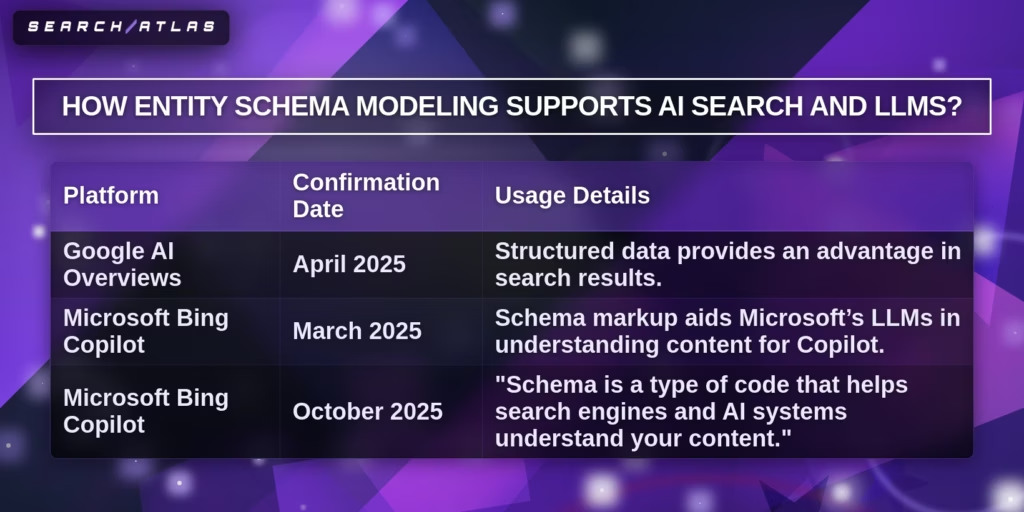
Which AI platforms confirm schema markup usage? Three AI platforms confirm schema markup usage. Firstly, Google AI Overviews confirmed in April 2025 that structured data provides an advantage in search results. Secondly, Microsoft Bing Copilot confirmed in March 2025 that schema markup aids Microsoft’s LLMs in understanding content for Copilot. Thirdly, Microsoft restated in October 2025 that schema is code that lets search engines and AI systems interpret content. ChatGPT, Perplexity, and other AI search platforms have not publicly confirmed schema preservation during crawling.
What entity properties do LLMs require? The four entity properties that LLMs require are listed below.
- Stable @id values that uniquely identify each entity across pages.
- Specific schema types (Product, Organization, Person) rather than generic Thing.
- SameAs links to authoritative external sources (Wikidata, Wikipedia, official profiles).
- Explicit relationships through about, mentions, isPartOf, offeredBy, authoredBy, and worksFor.
How does entity-based optimization compare to keyword optimization for AI? Entity-based optimization is 3x more effective than keyword-based SEO in AI-driven search visibility. Branded searches yield 34% CTR in position one, compared to 25% for non-branded searches. Pages with structured data are 36% more likely to appear in AI-generated summaries and 2-4 times more likely to appear in AI Overviews. The shift reflects AI architecture: retrieval depends on entity matching against knowledge bases, and answer generation depends on verified attributes and relationships rather than keyword density.
How does Retrieval Augmented Generation use entities? Retrieval Augmented Generation (RAG) uses entities through three stages. Firstly, the user query is parsed by Named Entity Recognition to extract subject entities. Secondly, the retrieval system matches extracted entities against indexed documents through vector embeddings and entity identifiers. Thirdly, the generation stage composes an answer from retrieved documents, citing pages that match the queried entity. Disambiguated entities improve retrieval precision by 28% and reduce hallucination in validation tests. Pages with stable @id values, sameAs validation, and explicit attribute payloads are retrieved more consistently and cited more accurately than pages without entity declarations.
What signals do AI systems prioritize beyond schema? AI systems prioritize five signals beyond schema markup. Firstly, topical authority is measured through cluster impressions and consistent coverage of an entity. Secondly, semantic clarity is measured through entity salience scores and content alignment with the canonical entity. Thirdly, external validation through Wikipedia, Wikidata, and authoritative third-party sources. Fourthly, content freshness, particularly for entities that change frequently (products, services, leadership). Fifthly, user engagement signals (time on page, bounce rate) that confirm content quality. Schema markup reinforces these signals but does not replace them.
What Are Common Challenges in Entity Schema Modeling?
The seven common challenges in Entity Schema Modeling are listed below.
- Ongoing schema maintenance as source systems (ERP, CRM, PIM) and analytical needs change.
- Overly large tables and ETL processes that consolidate raw data into giant pipelines.
- Rigid adherence to modeling approaches (snowflake schema, data vault) that misalign with use cases.
- Lack of end-user empathy produces sub-optimal designs for managers and analysts.
- Failure to track data changes through Slowly Changing Dimensions causes an inconsistent history.
- Mixing different granularities within the same table causes user confusion.
- Poor naming conventions and over-reliance on views are causing performance and clarity problems.
What are the common pitfalls in entity schema design? The four common pitfalls in entity schema design are oversized ETL, rigid methodology, missing user empathy, and ambiguous primary keys. Consolidating raw data into a single giant ETL process makes the pipeline difficult to debug and maintain. Intermediate tables provide value for end-users and aid in investigating inconsistencies. Snowflake schema forces unnecessary splitting of a “product” dimension. Data vault modeling splits every table into hubs, satellites, and links without a logical reason. Denormalized analytical schemas often offer better user experience with no negative performance impact today.
How does poor end-user empathy affect schema design? Poor end-user empathy affects schema design because designers who do not consider downstream consumers produce sub-optimal table structures. Three end-user groups have different needs. Firstly, executives need pre-aggregated metrics in dashboard-ready tables (revenue by month, user count by region). Secondly, business analysts need denormalized fact tables with descriptive dimension attributes joined inline. Thirdly, data scientists need raw event tables with full granularity for custom analysis. Designing one schema for all three groups produces compromise tables that satisfy none. Best practice creates separate semantic layers for each consumer group, materialized from a single source of truth through ETL.
How do data change tracking issues impact schema modeling? Data change tracking issues impact schema modeling through two failures. Firstly, failure to implement Slowly Changing Dimensions (SCD2) makes tracking dimension changes difficult (customer email updates, product name changes). SCD2 logic adds VALID_FROM and VALID_TO timestamps. The DBT snapshots tool simplifies SCD2 implementation. Secondly, mixing different granularities within the same table causes user confusion (daily user sign-ins combined with peak/off-peak sign-ins). Best practice creates new tables with distinct primary keys to maintain clarity.
What naming convention challenges exist? Two naming convention challenges exist (obscure column names and inconsistent entity references). Obscure column names (col1, x_temp, data2) reduce schema readability and increase onboarding time for new team members. Inconsistent entity references across schema markup (Organization name spelled differently on different pages) weaken sameAs validation and Knowledge Graph linkage. Best practice enforces a naming standard documented in a data dictionary, then validates the standard through automated linters in the deployment pipeline.
How does over-reliance on views affect performance? Over-reliance on views affects performance because nested views compound query cost at execution time. A view built on three other views produces execution plans that scan multi-billion-row source tables. Best practice materializes high-traffic views into tables refreshed on a schedule. Views remain appropriate for low-volume reporting and access control but require monitoring for performance regression as data volume grows.
What collaboration challenges affect entity schema modeling? Three collaboration challenges affect entity schema modeling across teams. Firstly, business stakeholders and data engineers describe the same entity with different vocabulary (Customer in CRM, Account in ERP, User in product analytics). Conflicting names produce duplicate entity declarations. Secondly, schema changes deployed in development branches diverge from production, producing inconsistent entity coverage across environments. Thirdly, schema documentation lags behind implementation, leaving new team members without canonical references for entity definitions. Best practice runs three solutions. Firstly, maintain a shared data dictionary that maps every entity to a single canonical name. Secondly, use schema versioning in source control. Thirdly, generate documentation automatically from schema source files.
How do schema challenges differ between SEO and database engineering? Schema challenges differ between SEO and database engineering across four dimensions. Firstly, SEO schema (Schema.org JSON-LD) targets external consumption by search engines and AI systems, while database schema targets internal data storage and retrieval. Secondly, SEO schema uses an open W3C-supported vocabulary, while database schema uses application-specific naming. Thirdly, SEO schema validation runs through Google Rich Results Test and Schema.org Validator, while database schema validation runs through database constraint checks and ETL test suites. Fourthly, SEO schema errors reduce visibility but do not break site functionality, while database schema errors corrupt data or break applications. Both disciplines share the underlying Entity-Relationship modeling principles, but the deployment context differs.
Do Entities Influence Rankings?
Yes, entities directly influence search engine rankings by providing contextual relevance and structured information for AI algorithms. Google’s AI algorithms prioritize structured data, semantic clarity, and relationship mapping over keyword density. Gunmade.com improved rankings from “page 2 or 3 to consistently rank on page 1 after structured data and entity optimization. Simon Bacher of Ling App reported a domain authority increase from 26 to 43 after entity-based SEO. A Clearscope guide written without keyword research ranked in position seven for “Clearscope” on Ahrefs because the content fit Google’s criteria for entity associations.
Do entities guarantee long-term ranking success? Entity density alone does not guarantee long-term ranking success without positive user interaction. An “illegible page” initially ranked by entities dropped approximately 15 positions after experiencing a 100% bounce rate and 13 seconds on page. Google’s simplified algorithm model shows an Initial Ranking Score influenced by content (entity density), then a User Experience Modifier adjusts the score. Some views suggest E-E-A-T signals are strictly for YMYL niches rather than all sites. Entity optimization works in combination with content quality, user experience, and conventional ranking factors.
What evidence connects entities to ranking gains? Three evidence sources connect entities to ranking gains. Firstly, case studies (Gunmade.com, Ling App, Schema App) document specific ranking and visibility improvements after entity-based deployment. Secondly, controlled experiments (RAG validation tests) show 28% hallucination reduction and improved top-k retrieval precision with disambiguated entities. Thirdly, aggregate market data shows pages with structured data are 36% more likely to appear in AI-generated summaries and 2-4 times more likely to appear in AI Overviews. The combined evidence positions entities as a contributing factor to ranking, not the sole factor. Entity optimization compounds with technical SEO, content quality, and link authority.
Does Schema Markup Improve Entity Recognition?
Yes, schema markup significantly improves content visibility and citation in AI-driven search experiences. Schema markup allows AI systems to process and verify information more efficiently, building stronger semantic understanding. Pages with well-implemented structured data are approximately 36% more likely to appear in AI-generated summaries. Sites with Article, FAQ, and Organization schema were cited in AI-generated answers about three times more often than equivalent sites without schema, according to a March 2026 study. Schema App’s site recorded a 19.72% increase in AI Overview visibility after implementing robust Entity Linking. The combined evidence positions schema markup as a measurable lever for AI-driven discovery rather than a peripheral technical detail.
Does schema markup directly feed Large Language Models? Schema markup does not directly feed Large Language Models in the same way schema feeds Google’s Knowledge Graph. Schema makes content structurally parseable for AI systems. A December 2024 study from Search/Atlas found no correlation between schema markup coverage and citation rates. The study noted that LLM systems prioritize relevance, topical authority, and semantic clarity over structured markup for citations. ChatGPT and Perplexity have not publicly confirmed schema preservation during crawling or schema use for extraction. Schema remains valuable for Google search retrieval and AI overviews, but functions as one signal among many for general LLM-based platforms.
What practical schema deployment improves entity recognition? Three practical schema deployment patterns improve entity recognition. Firstly, deploy the Organization schema sitewide through a @graph block in the site footer or root template. The block declares the brand entity once, and every page inherits the declaration through @id reference. Secondly, deploy page-specific schema (Product, Article, LocalBusiness) on individual templates with stable @id values that match the page URL. Thirdly, validate sameAs URLs quarterly through a crawler and HTTP status check. Broken sameAs weakens entity linkage. The combined deployment produces consistent entity declarations that Google, Microsoft, and AI systems parse during crawl.