The difference between LLM monitoring and AI search monitoring defines how modern AI search visibility operates across generated answers instead of traditional ranked search results. LLM monitoring and AI search monitoring represent 2 connected but distinct systems that determine how content is generated, evaluated, surfaced, and trusted inside AI-driven environments, rather than how pages rank alone.
The core difference between LLM monitoring and AI search monitoring lies in the layer of visibility each system controls within the broader search monitoring framework. LLM monitoring governs model behavior, output accuracy, and response consistency, while AI search monitoring governs brand visibility, citation presence, and share of voice across AI-generated answers. This distinction matters because AI search visibility depends on both correct model understanding and consistent front-end inclusion across platforms.
LLM monitoring strengthens AI search visibility by ensuring outputs remain accurate, stable, and aligned with real-world information across repeated prompts. AI search monitoring strengthens AI search visibility by tracking how often a brand appears, how it is positioned, and which sources AI systems select during answer generation. This interaction explains why search monitoring now extends beyond rankings into answer-level visibility measurement.
Together, LLM monitoring and AI search monitoring define a dual-layer AI search visibility model where content competes for accurate generation and consistent inclusion simultaneously. This combined model explains why modern search monitoring requires both systems working together to control how brands appear, how answers form, and how visibility scales across AI-powered search environments.
What Is LLM Monitoring?
LLM monitoring is a set of processes and tools that oversee and manage large language model (LLM) performance during real-world operation. LLM monitoring defines how systems track outputs, evaluate behavior, and maintain quality across production environments. LLM monitoring operates through continuous analysis of responses, metrics, and usage patterns, which distinguishes it from static evaluation methods used before deployment.
LLM monitoring emerged as LLM moved from controlled research environments into widespread commercial deployment. Adoption expanded rapidly, with projections estimating over 750 million applications using LLMs by 2025. This expansion exposed a gap, because traditional monitoring systems track infrastructure health but fail to evaluate output quality or safety. Modern LLMs tracking systems analyze behavior, cost, and risk continuously across production workflows.
How do LLM monitoring systems use LLM monitoring? LLM monitoring systems and LLM tracking platforms collect interaction data, extract key signals, and evaluate outputs based on predefined performance metrics. These systems process prompts, responses, latency, and token usage to generate continuous insights about model behavior. LLM monitoring systems prioritize structured evaluation signals, which establish how LLM monitoring connects data collection, interpretation, and response validation across AI-generated outputs.
How did LLM monitoring become standardized across AI systems? LLM monitoring became standardized as organizations required consistent methods to evaluate model behavior at scale across production environments. Cloud-native platforms introduced unified logging, metric tracking, and real-time analytics that allow continuous monitoring of model outputs. Platforms (Amazon Web Services, Microsoft Azure, and Google Cloud) established scalable infrastructures that support LLM tracking, which ensures performance visibility, reliability, and operational consistency across distributed systems.
Why LLM Monitoring Matters for AI Systems?
LLM monitoring matters because production environments introduce variability that affects accuracy, safety, and cost across AI systems. LLM monitoring captures unpredictable inputs and output patterns, which ensures systems detect failures early and maintain consistent performance. LLM monitoring evaluates model behavior continuously, which prevents hallucinations, biased outputs, excessive token usage, and delayed responses from impacting real-world applications.
LLM monitoring evaluates the performance and behavior of LLMs to ensure quality, accuracy, and ethical compliance. LLM monitoring tracks output quality, identifies errors before exposure, and verifies that AI-driven decisions rely on reliable data. This evaluation strengthens trust, improves outputs, and ensures AI systems operate within defined safety and performance standards across production environments.
What are the key risks of unmonitored LLMs? Unmonitored LLMs introduce critical risks that affect reliability, cost, and safety across AI systems. Hallucinations generate incorrect information, which reduces factual accuracy and decision reliability. Bias distorts outputs, which impacts fairness and consistency across generated responses. Security vulnerabilities expose systems to adversarial attacks and sensitive data leakage, which increases operational risk and compliance exposure.
How does AI observability enhance LLM monitoring? AI observability enhances LLM monitoring by expanding visibility into system behavior through detailed output and interaction analysis. AI observability transforms opaque model processes into measurable signals, which allows continuous tracking of performance, safety, and cost metrics. This visibility enables faster detection of hallucinations, cost anomalies, and policy violations across production environments.
AI observability strengthens LLM tracking by connecting behavioral signals with root cause analysis across complex systems. Observability investigates why issues occur, while LLM monitoring identifies when issues appear through predefined metrics. This combination enables continuous improvement, faster iteration cycles, and stronger control over AI system performance and reliability.
What Is AI Search Monitoring?
AI search monitoring is a systematic tracking process that observes how a brand, content, and expertise appear across AI-powered search engines and answer platforms. AI search monitoring defines how systems measure visibility, citations, and positioning inside AI-generated responses across conversational environments. AI search monitoring operates through continuous analysis of prompts, responses, and attribution signals, which distinguishes it from traditional keyword ranking systems.
AI search monitoring emerged as search behavior shifted from link-based result pages to AI-generated answers that summarize and cite information directly. AI platforms generate billions of responses every month, which establishes a new entry point for discovery and decision-making. Industry projections indicate that over 70% of consumers will rely on AI-enhanced search for purchase decisions by 2026, which increases the urgency to track presence across these environments.
What does AI search monitoring track across AI systems? AI search monitoring tracks how often AI platforms cite content, mention brands, and position information inside generated answers. AI search monitoring measures competitive visibility across prompts, queries, direct and indirect citations, and mentions. This tracking establishes how frequently content appears as a primary source, which determines authority and influence across AI-generated responses.
AI search monitoring analyzes how content appears within responses, whether as direct citations, embedded references, or summarized explanations. This analysis evaluates attribution quality, which distinguishes authoritative citations from passing mentions across AI outputs.
What environments define AI search monitoring systems? AI search monitoring operates across AI platforms that generate direct answers instead of ranked lists of links. Platforms (ChatGPT, Google AI Overviews, and Perplexity AI) define the primary environments where monitoring measures visibility. These environments shift user interaction toward generated responses, which changes how visibility is measured across search systems.
AI search monitoring extends across emerging AI platforms that expand the ecosystem of answer generation. These platforms increase the number of environments where content appears, which requires continuous tracking to maintain comprehensive visibility across AI-driven search.
What makes AI search monitoring a distinct discipline from traditional SEO? AI search monitoring is a specialized analytics discipline within digital marketing that focuses on citation visibility instead of keyword rankings. AI search monitoring measures how content is referenced and positioned inside generated answers, while traditional SEO measures rankings and organic traffic across search engines.
This distinction establishes AI search monitoring as a separate measurement layer, where visibility depends on citation inclusion rather than ranking position. AI search monitoring addresses the lack of transparency in AI systems, which operate without clear ranking signals and require dedicated tracking methods to measure presence.
Why AI Search Monitoring Matters for Search Visibility?
AI search monitoring matters for search visibility because AI search visibility defines whether a brand appears inside AI-generated answers and chatbot responses. AI search monitoring tracks citations, mentions, and positioning, which determines presence in environments where users consume information directly. AI search monitoring ensures visibility inside generated answers, which replaces dependence on traditional organic rankings and click-based discovery.
AI search visibility shifted as platforms moved from link-based result pages to synthesized answers that summarize and cite sources. Platforms (ChatGPT, Google AI Overviews, and Perplexity AI) generate responses that users trust and act on immediately. This shift changes success measurement from rankings and clicks to citations and mentions across AI-generated outputs.
What is the fundamental shift in search visibility? The fundamental shift in search visibility moves from ranking pages on search engine result pages to appearing inside AI-generated answers. AI systems interpret queries, retrieve information, and assemble direct responses, which reduces reliance on traditional browsing behavior. Users rely on summarized answers instead of visiting multiple websites, which establishes citation presence as the primary visibility signal across AI search environments.
This shift redefines how visibility is measured, because placement inside an answer replaces position in a ranked list. AI search monitoring captures this change by tracking whether content appears in responses and how that content is presented to users.
What is the AI search visibility problem? The AI search visibility problem is a measurement gap where brands lack visibility into how AI systems cite and present content. AI platforms operate without transparent ranking data, which prevents direct tracking of citations, mentions, and competitive positioning. This limitation creates blind spots, where competitors appear in AI responses while a brand remains absent without a clear explanation.
This measurement gap prevents systematic optimization, because performance cannot improve without visibility into outcomes. AI search monitoring resolves this gap by tracking prompts, responses, and citations, which reveal where visibility exists and where gaps remain.
What is the impact of AI search on visibility and traffic? AI search impacts visibility and traffic by reducing dependence on clicks and increasing reliance on direct answers. AI-generated summaries capture user attention before traditional results, which decreases traffic to organic listings. Zero-click behavior increases as users consume answers directly, which reduces interaction with lower-ranked pages.
AI search monitoring captures these changes by measuring the presence of answers instead of relying on traffic metrics alone. Visibility depends on citation inclusion, which determines whether a brand appears during decision-making moments across AI-generated responses.
What does AI search monitoring reveal about search visibility? AI search monitoring reveals how often a brand appears inside AI-generated answers and how that presence compares against competitors. Monitoring systems track prompt-level responses, which identify where competitors receive citations while a brand remains absent. This analysis exposes content gaps, which define opportunities to improve visibility across AI search environments.
AI search monitoring shifts the central question from ranking position to citation presence. Visibility depends on whether content appears at all inside generated answers, which establishes a new measurement framework for search performance.
How Do AI Systems and AI Search Engines Generate and Evaluate Responses?
AI systems generate responses by analyzing language patterns, processing textual data, and synthesizing information through defined architectures and stages. AI systems define response generation as a sequence of understanding input, retrieving or inferring information, and producing structured output. AI systems operate through Natural Language Understanding (NLP), retrieval or inference processes, and Natural Language Generation, which distinguishes how responses form across different system types.
AI systems generate responses through two primary architectures, which define how information is created or retrieved during response generation. Model-native synthesis generates answers from learned patterns inside trained models, while retrieval-augmented generation (RAG) retrieves external information before synthesis. These architectures define the core difference between standalone LLM outputs and retrieval-based or search-integrated systems.
What are the core architectures behind AI response generation? The core architectures behind AI response generation are model-native synthesis and RAG, which define how responses are constructed. Model-native synthesis generates answers directly from patterns learned during training across large datasets. RAG performs a live retrieval step, which pulls relevant documents and synthesizes responses grounded in external sources.
Model-native synthesis relies on probabilistic knowledge learned from text corpora, books, and web data. This approach produces fast and coherent responses, which enable fluent output generation across many contexts. Model-native synthesis creates risk of hallucination, because responses form without direct reference to live sources.
RAG retrieves documents from databases, indexes, or the web before generating a response. This approach grounds responses in external data, which increases traceability and enables citation. Retrieval-based systems trade speed for accuracy and verifiability, which makes them dominant in commercial AI search environments.
What distinguishes standalone LLM outputs from retrieval-based systems? Standalone LLM outputs generate responses entirely from internal model knowledge learned during training. These outputs rely on statistical patterns, which produce fluent language without guaranteed factual grounding. Standalone systems do not reference external sources during generation, which limits traceability and increases hallucination risk.
Retrieval-based systems generate responses by combining external data retrieval with language generation. These systems query live or indexed sources, extract relevant information, and synthesize grounded answers. Retrieval-based systems provide higher factual reliability and enable citation, which makes them suitable for AI search engines and knowledge-based applications.
This distinction defines two response behaviors, where standalone outputs prioritize fluency and speed, while retrieval-based outputs prioritize accuracy and verifiability. AI search engines rely primarily on retrieval-based approaches, which align response generation with real-time information and source attribution.
What processes define AI response generation stages? AI response generation follows three defined stages that structure how systems interpret and produce answers. Natural Language Understanding processes input text and identifies intent, entities, and relationships within the query. Retrieval or inference determines whether the system retrieves external data or generates information from internal knowledge. Natural Language Generation constructs the final response, which ensures clarity, structure, and coherence.
Natural Language Understanding analyzes linguistic structure and semantic meaning, which defines how the system interprets the query. Retrieval or inference selects relevant data sources or internal knowledge, which determines the factual grounding of the response. Natural Language Generation synthesizes this information into readable output, which completes the response generation process.
What technologies enable AI response generation? AI response generation relies on core technologies that process language, learn patterns, and generate structured output. NLP analyzes context, semantics, and relationships within text, which enables accurate interpretation of queries. Machine Learning models learn patterns from large datasets, which define how systems predict and generate responses. LLMs provide the architecture that generates human-like text, which integrates understanding and generation into a unified system.
Vector representations and semantic search enhance retrieval accuracy by mapping words and concepts into numerical space. These representations allow systems to match queries based on meaning instead of keywords, which improves relevance during retrieval. Transformer architectures process entire sequences simultaneously, which enables deeper context understanding and more accurate response generation.
What defines response generation in AI search engines? AI search engines generate responses through retrieval-first processes that access live data, rank sources, and synthesize answers in real time. These systems translate user queries into structured retrieval requests, which fetch documents, structured data, and authoritative references. Retrieved sources are evaluated based on relevance, extractability, authority, and freshness, which determines inclusion in the final response.
What defines the evaluation of AI-generated responses? AI systems evaluate responses based on clarity, consistency, and reliability across generated outputs and retrieved data. Evaluation prioritizes accuracy, relevance, safety, and structural quality, which determines whether responses meet expected performance standards. Stable patterns across outputs increase confidence in response quality, which shifts evaluation focus from infrastructure metrics to output behavior and content reliability.
Evaluation ensures that generated responses align with factual data, maintain logical consistency, and avoid harmful or biased content. This process defines how AI systems maintain quality across both standalone and retrieval-based architectures, which ensures reliable performance across real-world applications.
How Do AI Search Engines Select Sources Compared to LLM Outputs?
AI search engines and LLM outputs select sources through different mechanisms because retrieval defines how information enters generated answers. AI search engines prioritize live retrieval from indexed web content, while LLM outputs rely on patterns learned from pre-trained datasets. This distinction defines how freshness, authority, and traceability appear across generated responses.
AI search engines select sources through real-time retrieval processes that access continuously updated web indexes and structured data. AI search engines translate queries into retrieval requests, fetch candidate documents, and rank those documents based on relevance, extractability, authority, and freshness. This process ensures selected sources reflect current information, which allows responses to include verifiable citations and up-to-date facts.
LLM outputs select sources through model-native synthesis that generate responses from internal knowledge learned during training. LLM outputs rely on static datasets captured at specific points in time, which limits access to current information. This approach produces fluent and coherent responses, but it reduces traceability because generated content does not originate from direct retrieval of live sources.
AI search engines prioritize freshness because live retrieval allows continuous updates as new information appears across the web. Source selection adapts instantly to changes, which ensures responses reflect recent events, updated data, and evolving knowledge. LLM outputs maintain lower freshness because source selection depends on training cycles, which occur months or years apart.
AI search engines prioritize authority signals because ranking evaluates external validation across domains, references, and corroboration patterns. High-authority sources appear more frequently in generated answers, which increases reliability and trust across outputs. LLM outputs reflect authority indirectly through training data distribution, which includes both authoritative and user-generated sources without clear ranking signals.
AI search engines produce structured citation patterns because retrieval-based systems extract and reference specific documents during response generation. Sources appear as direct citations, which provide transparency and traceability across generated answers. LLM outputs produce weaker citation patterns because standalone generation does not require explicit source attribution, which reduces visibility into source origin.
AI search engines maintain broader source diversity because retrieval processes access a wide range of domains, datasets, and structured content. Source selection includes authoritative websites, technical documentation, and updated references, which increases coverage across topics. LLM outputs reflect narrower or uneven source diversity because selection depends on training data composition and weighting across domains.
AI search engines prefer structured and extractable content because ranking favors clear, factual, and well-organized information. Structured content improves extraction accuracy, which ensures consistent synthesis across responses. LLM outputs generate deeper or more exploratory responses because internal knowledge allows flexible generation, but this flexibility reduces consistency in source grounding.
AI search engines define optimal performance in environments that require real-time data, authoritative sources, and traceable citations across responses. LLM outputs define optimal performance in environments that rely on historical knowledge, generative flexibility, and conceptual exploration across topics. This distinction establishes how each system aligns with different information needs across modern AI applications.
LLM Monitoring vs AI Search Monitoring: What Is the Difference?
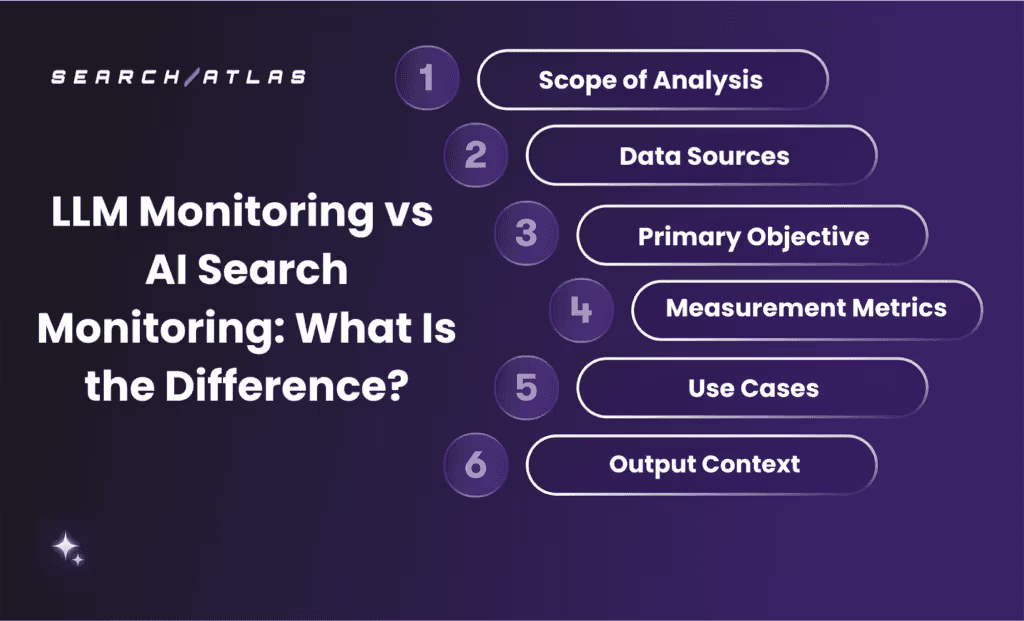
LLM monitoring and AI search monitoring are distinct monitoring disciplines that track different layers of AI visibility and AI performance. LLM monitoring focuses on LLM behavior, output quality, and operational stability across production systems.
AI search monitoring focuses on how brands, pages, and content appear inside AI-generated search answers across platforms that users interact with directly. This difference matters because one discipline evaluates model behavior inside the system, while the other discipline evaluates brand visibility inside the search experience.
The 6 core differences between LLM monitoring and AI search monitoring are listed below.
1. Scope of Analysis: Model Behavior vs Search Ecosystem Visibility
2. Data Sources: Prompt-Response Logs vs Multi-Engine Outputs
3. Primary Objective: Model Evaluation vs Brand and Content Visibility
4. Measurement Metrics: Accuracy and Drift vs Presence and Citation Share
5. Use Cases: Internal Optimization vs External Search Performance
6. Output Context: Controlled Inputs vs Real-World Queries
1. Scope of Analysis: Model Behavior vs Search Ecosystem Visibility
The scope of analysis is the primary difference between LLM monitoring and AI search monitoring because each discipline measures a different layer of the AI environment. LLM monitoring measures how a model performs, how it responds, and how accurate or safe those responses remain across production workflows. AI search monitoring measures how a brand, URL, or content asset appears inside AI-generated answers across search-oriented interfaces.
LLM monitoring focuses on the underlying model layer, which means it tracks whether outputs remain accurate, relevant, consistent, safe, and operationally reliable. This model layer includes latency, token consumption, error rates, hallucination patterns, drift, and output degradation over time. AI search monitoring focuses on the user-facing answer layer, which means it tracks whether a brand is mentioned, cited, linked, or framed positively inside platforms. This answer layer determines whether users actually see a brand during AI-assisted discovery.
2. Data Sources: Prompt-Response Logs vs Multi-Engine Outputs
Data sources create a major distinction because LLM monitoring and AI search monitoring collect evidence from different environments. LLM monitoring often relies on prompt-response logs, API outputs, traces, token data, and model interaction records collected from controlled production systems. AI search monitoring relies on web-interface outputs, AI search result surfaces, crawler activity, behavioral analytics, and real-world answer appearances across external platforms.
LLM monitoring usually analyzes synthetic or controlled prompt environments, where repeated prompts reveal performance patterns, model variance, and system instability. This controlled collection method produces repeatable benchmarks, but sometimes misses the exact experience a real person sees inside a live AI search interface. AI search monitoring collects data from real search surfaces and real answer environments, which captures personalization, recency effects, search context, and interface-level visibility. This collection method makes AI search monitoring closer to the actual user experience across AI-driven search.
3. Primary Objective: Model Evaluation vs Brand and Content Visibility
The primary objective is the third major difference because LLM monitoring and AI search monitoring pursue different outcomes. LLM monitoring aims to evaluate the model itself, which means it measures whether the model remains accurate, stable, safe, and efficient across production usage. AI search monitoring aims to evaluate brand and content visibility, which means it measures whether pages, brands, and entities appear in the AI-generated answers that users read.
LLM monitoring exists to confirm that the model performs correctly under real production conditions and continues to meet quality, safety, and reliability standards. AI search monitoring exists to confirm that a brand remains visible and correctly represented in AI-powered search experiences. This visibility objective matters because strong model performance does not guarantee strong search visibility, and strong traditional SEO does not guarantee citation or mention inside AI-generated answers.
4. Measurement Metrics: Accuracy and Drift vs Presence and Citation Share
Measurement metrics are the fourth major difference because LLM monitoring and AI search monitoring quantify different outcomes. LLM monitoring measures accuracy, hallucination rate, drift, latency, token usage, safety violations, and output degradation across model operations. AI search monitoring measures presence, mentions, citations, citation share, share of voice, sentiment, and answer inclusion across AI-generated search results.
LLM monitoring uses metrics that reveal whether the model stays correct, stable, and efficient over time. Drift detection, hallucination tracking, and latency analysis reveal whether production performance changes after model updates, prompt changes, or traffic shifts. AI search monitoring uses metrics that reveal whether the brand shows up in answers and how prominently that brand appears compared with competitors.
5. Use Cases: Internal Optimization vs External Search Performance
Use cases are the fifth major difference because LLM monitoring and AI search monitoring improve different business layers. LLM monitoring supports internal optimization, where technical teams need to improve model reliability, reduce token waste, manage costs, detect safety risks, and diagnose system-level failures. AI search monitoring supports external search performance, where marketing and content teams need to improve AI visibility, strengthen citation presence, and protect brand discoverability across answer engines.
LLM monitoring fits product teams, engineering teams, and AI operations teams that manage production applications and need insight into model quality and operational stability. AI search monitoring fits search teams, content teams, and digital strategists who need insight into how real users encounter the brand through AI-generated search answers. This distinction matters because internal optimization strengthens the system, while external search performance strengthens discoverability in the public AI landscape.
6. Output Context: Controlled Inputs vs Real-World Queries
Output context is the sixth major difference because LLM monitoring and AI search monitoring observe answers under different conditions. LLM monitoring often evaluates outputs from controlled inputs, where repeated prompts, stable testing conditions, and structured experiments isolate model behavior. AI search monitoring evaluates outputs from real-world queries, where personalization, recency, platform design, and changing user context shape what appears in the final answer.
LLM monitoring benefits from controlled inputs because controlled inputs make debugging, benchmarking, and quality comparison easier across time. AI search monitoring depends on real-world queries because real-world queries reveal what users actually see across changing search experiences. This distinction matters because a model performs well under controlled tests, while a brand still disappears from real AI search results across live interfaces.
LLM Monitoring vs AI Search Monitoring: Comparison Table
The difference between LLM monitoring and AI search monitoring lies in scope, data source, objective, and visibility layer across AI systems. LLM monitoring evaluates model behavior, output quality, and system performance inside production environments. AI search monitoring evaluates how brands, pages, and entities appear inside AI-generated search answers across user-facing platforms.
LLM monitoring and AI search monitoring are complementary disciplines, but they are not interchangeable disciplines. LLM monitoring explains how the model behaves inside production systems. AI search monitoring explains how the brand appears inside AI-powered search ecosystems. This relationship makes both disciplines important because one protects model performance and the other protects search visibility.
The core differences between LLM monitoring and AI search monitoring are below.
| Aspect | LLM Monitoring | AI Search Monitoring |
|---|---|---|
| Scope of analysis | Tracks model behavior, output quality, and system performance inside production environments. | Tracks brand, content, and entity visibility inside AI-generated search answers across platforms. |
| Data sources | Uses prompt-response logs, API outputs, traces, and token-level interaction data. | Uses multi-engine outputs from live AI search interfaces and answer environments. |
| Primary objective | Evaluates model accuracy, stability, safety, and operational reliability. | Evaluates brand visibility, citation presence, and answer inclusion across AI search systems. |
| Measurement metrics | Measures accuracy, hallucination rate, drift, latency, token usage, and error rates. | Measures mentions, citations, share of voice, sentiment, and visibility across prompts. |
| Use cases | Supports internal optimization of AI systems, performance tuning, and reliability management. | Supports external search performance, visibility tracking, and AI-driven discoverability improvement. |
| Output context | Evaluates controlled inputs using repeated prompts and structured testing conditions. | Evaluates real-world queries shaped by personalization, recency, and user context. |
| Freshness model | Depends on model updates and deployment cycles for knowledge changes. | Reflects real-time updates through live retrieval and evolving search responses. |
| Citation behavior | Tracks whether models mention or reference entities inside generated outputs. | Tracks how AI platforms cite, position, and attribute sources inside answers. |
| Visibility definition | Visibility equals presence inside model-generated responses across prompts. | Visibility equals presence inside AI-generated answers shown to real users. |
| Optimization goal | Improves model quality, reduces errors, and ensures consistent output performance. | Improves citation inclusion, strengthens brand presence, and increases answer visibility. |
LLM monitoring focuses on internal system behavior, which measures how models generate, respond, and maintain accuracy across workflows. AI search monitoring focuses on external answer visibility, which measures whether a brand appears, gets cited, or gets mentioned inside AI-generated responses. This contrast explains why LLM monitoring strengthens system performance while AI search monitoring strengthens discoverability and brand presence.
What Does LLM Monitoring Track?
LLM monitoring tracks how LLMs perform, respond, and evolve during real-world operation across production environments. LLM monitoring defines how systems measure output quality, detect failures, control costs, and maintain safety across AI applications. LLM monitoring operates through continuous data collection and evaluation, which ensures models remain accurate, stable, and aligned with expected standards.
There are 5 main categories of signals tracked in LLM monitoring systems. These categories define how monitoring evaluates performance, reliability, and risk across AI-generated outputs. The 5 main categories are listed below.
1. Prompt-Response Quality and Accuracy. Prompt-response quality and accuracy measure how closely outputs match query intent, context, and expected outcomes. This category matters because LLM monitoring prioritizes relevance, coherence, and completeness across responses. High alignment improves trust and strengthens consistency across AI search monitoring and generated answers.
2. Hallucinations and Factual Consistency. Prompt-response quality and accuracy measure how closely outputs match query intent, context, and expected outcomes. This category matters because LLM monitoring prioritizes relevance, coherence, and completeness across responses. High alignment improves trust and strengthens consistency across AI search monitoring and generated answers.
3. Model Drift and Behavioral Changes Over Time. Model drift and behavioral changes measure how outputs shift across time, updates, and changing prompt patterns. This category matters because performance changes affect stability across AI search monitoring environments. Drift tracking detects variation in structure, meaning, and accuracy, which enables early correction and preserves consistent behavior.
4. Token Usage, Latency, and Cost Efficiency. Token usage, latency, and cost efficiency measure how efficiently models operate across requests and system resources. This category matters because performance speed and cost directly affect scalability. Monitoring tracks token consumption, response time, and resource usage, which ensures efficient execution across search monitoring systems.
5. Safety, Bias, and Compliance Signals. Safety, bias, and compliance signals measure whether outputs follow policy, ethical standards, and risk controls. This category matters because unsafe outputs damage trust and reduce visibility in AI systems. Monitoring detects bias, sensitive data exposure, and policy violations, which protects reliability and maintains consistent AI search visibility outcomes.
What Metrics Define Success in LLM Monitoring?
LLM monitoring success is defined by structured evaluation metrics that measure output quality, system performance, and operational reliability across production environments. These metrics matter because LLM monitoring transforms subjective AI quality into measurable signals that scale across thousands of interactions. This measurement ensures continuous improvement, which maintains accuracy, efficiency, and trust across AI systems.
LLM monitoring improves performance by aligning outputs with measurable benchmarks that track accuracy, cost, and safety across workflows. The core function is to evaluate how well the model performs under real conditions, which allows systems to detect regressions and optimize continuously. Teams need structured metrics instead of manual review alone. This approach increases reliability because continuous evaluation identifies failures early and supports data-driven iteration.
What are the core LLM evaluation metrics? Core LLM evaluation metrics include factuality, relevance, coherence and fluency, safety and moderation, semantic similarity, and exact match evaluation. Factuality measures whether outputs remain accurate and verifiable, which detects hallucinations. Relevance evaluates alignment with the query intent. Coherence and fluency measure logical flow and readability across responses. Safety and moderation detect harmful or biased outputs. Semantic similarity measures meaning alignment, while exact match evaluates precise correctness across defined outputs.
Accuracy and quality metrics assess factual accuracy, relevance, coherence, fluency, and semantic similarity across responses. Efficiency and scalability metrics measure latency, throughput, token usage, and resource utilization across requests. Robustness and safety metrics evaluate adversarial resistance, prompt sensitivity, toxicity detection, and bias patterns.
Explainability and interpretability metrics analyze attention signals, feature importance, and decision pathways. Compliance and security metrics evaluate adherence to regulations (General Data Protection Regulation and Health Insurance Portability and Accountability Act), along with vulnerability and data protection signals.
What do LLM tracking metrics mean? LLM tracking metrics are measurable signals that describe model behavior, performance, and cost across production environments. LLM tracking metrics define how systems evaluate accuracy, latency, token usage, and safety through structured data points. This measurement establishes transparency, which determines whether models operate efficiently, reliably, and within defined performance thresholds.
What are the RAG-specific evaluation metrics? RAG-specific evaluation metrics include context precision, context recall, context relevance, faithfulness, answer correctness, and answer relevancy. Context precision measures whether the retrieved data matches the query. Context recall measures whether all required information is retrieved. Context relevance evaluates topical alignment. Faithfulness measures whether the answer remains grounded in retrieved data. Answer correctness measures factual completeness, while answer relevancy measures alignment with the query intent.
What findings define effective LLM monitoring metrics? Effective LLM monitoring metrics focus on a limited set of high-impact signals that align with business outcomes, system reliability, and user experience. Balanced metric selection ensures systems capture performance, quality, and cost simultaneously, which prevents optimization trade-offs across dimensions.
What role do metrics play in continuous LLM monitoring? Metrics provide the foundation for continuous LLM monitoring by capturing real-time performance data, detecting anomalies, and validating improvements across iterations. LLM monitoring evaluates each response against defined benchmarks, which ensures alignment with quality, safety, and business objectives. Continuous tracking prevents cascading failures, which protects system reliability and user trust across AI deployments.
What Does AI Search Monitoring Track?
AI search monitoring tracks how brands appear, get cited, and compete inside AI-generated answers across platforms through structured visibility signals. AI search monitoring defines how systems measure AI search visibility, attribution, and competitive positioning, which determines whether a brand is included, trusted, and surfaced inside generated responses.
There are 5 main categories of signals tracked in AI search monitoring systems. These categories define how search monitoring evaluates visibility, authority, and competitive context across AI-generated environments. The 5 main categories are listed below.
1. Brand mentions across AI search engines. Brand mentions across AI search engines measure how often a brand appears in AI-generated responses. This category matters because mentions represent direct AI search visibility at the answer level. Tracking spans platforms (ChatGPT, Google AI Overviews, and Perplexity AI), which reveal recognition across prompts and increase exposure through repeated inclusion.
2. Citation frequency and source inclusion. Citation frequency and source inclusion measure how often AI systems reference content as a source inside answers. This category matters because citations represent authority signals across AI search monitoring systems. Tracking evaluates how frequently content appears and where it appears, which increases credibility and strengthens AI search visibility through consistent source selection.
3. Visibility in AI-generated answers. Visibility in AI-generated answers measures whether a brand appears inside the final response presented to users. This category matters because inclusion determines influence at the moment of decision-making. Tracking evaluates presence, placement, and prominence, which define whether a brand participates directly in AI-generated outcomes.
4. Query-level presence and coverage. Query-level presence and coverage measure how often a brand appears across different prompts, topics, and query variations. This category matters because AI search operates through conversational queries instead of fixed keywords. Tracking evaluates coverage across prompt sets, which increases AI search visibility by aligning content with multiple user intents.
5. Competitor comparison in AI responses. Competitor comparison in AI responses measures how a brand performs relative to competitors across AI-generated answers. This category matters because visibility exists within competitive environments. Tracking evaluates share of voice, citation frequency, and relative positioning, which reveals gaps and strengthens strategy across AI search monitoring systems.
What Metrics Define Success in AI Search Monitoring?
AI search monitoring success is defined by metrics that measure visibility, citation, engagement, and perception across AI-generated answers. This definition matters because AI search monitoring replaces ranking-based evaluation with answer-level presence and influence signals. AI search monitoring tracks how often a brand appears, how it is cited, and how it is described inside generated responses.
AI search monitoring improves performance by aligning content with measurable signals across AI platforms and answer environments. The core function is to track presence inside generated answers, which reflects real user exposure instead of rankings. Teams need to measure mentions, citations, and perception consistently. This approach increases visibility because AI systems prioritize trusted and frequently cited content across responses.
What metrics define visibility in AI search monitoring? Visibility metrics measure how often a brand appears in AI-generated answers across tracked prompts and platforms. AI search monitoring evaluates brand mentions, share of voice, and prompt-level presence to establish exposure. Visibility defines whether a brand participates in the answer set, which determines discoverability. Strong visibility increases performance because repeated mentions reinforce recognition across AI-generated responses.
What metrics define citation performance in AI search monitoring? Citation metrics measure how often AI systems select and reference content as a source inside generated answers. AI search monitoring evaluates citation rate, citation frequency, and inclusion depth across responses. Citation performance reflects trust and authority because AI systems prefer verifiable and reusable sources. Strong citation signals increase performance because cited content is reused more frequently across answers.
What metrics define engagement and conversion in AI search monitoring? Engagement metrics measure how AI-driven visibility translates into user interaction and downstream business outcomes. AI search monitoring evaluates referral traffic, session behavior, and conversion rates from AI sources. Engagement defines the impact after visibility because AI exposure drives high-intent visits. Strong engagement signals increase performance because qualified traffic converts at higher rates across funnels.
What metrics define perception and quality in AI search monitoring? Perception metrics measure how AI systems describe, frame, and evaluate a brand inside generated answers. AI search monitoring evaluates sentiment, accuracy, relevance, and helpfulness across responses. Perception defines how users interpret a brand because AI narratives shape trust and decision-making. Strong perception signals increase performance because positive framing improves selection probability.
What metrics define technical readiness and trends in AI search monitoring? Technical and trend metrics measure how content is accessed by AI systems and how visibility changes over time. AI search monitoring evaluates semantic coverage, crawlability, and indexability alongside volatility and growth patterns. Technical readiness defines accessibility, while trends define stability. Strong technical and trend signals increase performance because accessible and consistent content maintains long-term visibility.
What Are the Key Benefits of LLM Monitoring vs AI Search Monitoring?
LLM monitoring and AI search monitoring deliver different benefits because each focuses on a different layer of AI visibility. LLM monitoring evaluates model behavior and output accuracy inside production systems. AI search monitoring evaluates brand visibility and positioning inside real AI-generated answers. This distinction matters because one protects model integrity while the other protects user-facing visibility.
The 6 main benefits of LLM monitoring vs AI search monitoring are listed below.
1. Improve model accuracy through LLM monitoring. LLM monitoring improves accuracy by tracking factual consistency, hallucination rates, and response reliability across outputs. AI systems evaluate outputs continuously, which ensures incorrect information is detected and corrected early. This improvement protects brand integrity because accurate outputs prevent misinformation propagation across AI systems.
2. Increase real-world visibility through AI search monitoring. AI search monitoring increases visibility by tracking brand mentions and placement inside AI-generated answers across platforms. AI systems select sources based on relevance and structure, which determines whether a brand appears in responses. This increase strengthens discoverability because presence inside answers defines exposure.
3. Control operational performance through LLM monitoring. LLM monitoring controls performance by measuring latency, token usage, throughput, and error rates across production environments. Systems track resource consumption and response speed, which ensures stable and efficient execution. This control reduces cost because optimized usage limits unnecessary compute and token waste.
4. Identify content gaps through AI search monitoring. AI search monitoring identifies gaps by revealing prompts where competitors appear, and a brand does not appear. AI systems generate answers based on available content, which exposes missing coverage across topics. This identification improves strategy because teams create content that fills visibility gaps.
5. Protect safety and compliance through LLM monitoring. LLM monitoring protects safety by tracking bias, toxicity, and sensitive data exposure across outputs. Systems evaluate responses against defined policies, which ensures adherence to compliance standards. This protection reduces risk because unsafe outputs are detected before reaching users.
6. Improve brand perception through AI search monitoring. AI search monitoring improves perception by analyzing sentiment, framing, and narrative context inside generated answers. AI systems influence decisions through descriptions, which shape how users interpret brands. This improvement increases trust because positive framing strengthens credibility and selection likelihood.
How to Combine LLM Monitoring and AI Search Monitoring?
Combining LLM monitoring and AI search monitoring requires aligning model behavior analysis with real-world visibility tracking across AI-generated answers. This combination matters because AI visibility depends on both how models generate responses and how those responses appear in search interfaces. A unified approach ensures that brands control both underlying model accuracy and external answer presence.
Combining LLM monitoring and AI search monitoring improves outcomes because each system captures a different layer of AI visibility. LLM monitoring evaluates how models represent facts, entities, and brand knowledge during generation. AI search monitoring evaluates how those outputs surface, rank, and get cited in real user queries. This dual perspective ensures that visibility reflects both correctness and exposure across AI environments.
Combining LLM monitoring and AI search monitoring requires defining clear roles for each system. AI search monitoring tracks brand presence, citations, and positioning inside platforms that users interact with directly. LLM monitoring tracks accuracy, hallucinations, drift, and consistency inside model outputs across prompts. This distinction ensures that teams address both visibility gaps and underlying data quality issues.
Combining LLM monitoring and AI search monitoring improves visibility because root causes become measurable and actionable. AI search monitoring reveals where a brand does not appear or appears incorrectly in answers. LLM monitoring explains why those gaps occur through missing knowledge, weak entity signals, or inconsistent outputs. This connection turns visibility issues into solvable model or content problems.
Combining LLM monitoring and AI search monitoring requires aligning metrics across both systems to create a unified performance view. Visibility metrics measure mentions, citations, and prompt coverage across AI search environments. Model metrics measure accuracy, relevance, latency, and safety across generated responses. This alignment ensures that performance reflects both exposure and quality instead of isolated signals.
Combining LLM monitoring and AI search monitoring improves strategy because content decisions connect directly to measurable AI outcomes. AI search monitoring identifies which queries trigger visibility and which competitors dominate the answer space. LLM monitoring identifies which facts, entities, and content signals influence model outputs. This connection guides content creation toward both inclusion and accuracy in AI answers.
Combining LLM monitoring and AI search monitoring requires structuring content for both retrieval and generation systems. AI search monitoring prioritizes structured, answer-first content that surfaces in real queries. LLM monitoring prioritizes factual consistency, entity clarity, and semantic coverage that models learn and reproduce. This dual optimization increases both citation probability and representation accuracy.
Combining LLM monitoring and AI search monitoring improves long-term performance because it captures both stability and change across AI systems. AI search monitoring detects shifts in visibility, citations, and competitor presence across queries. LLM monitoring detects drift, hallucination changes, and evolving model behavior over time. This continuous tracking ensures that visibility remains consistent as AI systems update.
Combining LLM monitoring and AI search monitoring requires integrating workflows across SEO, content, and AI systems. AI search monitoring informs which topics, queries, and formats drive visibility. LLM monitoring informs which data, entities, and knowledge improve model outputs. This integration ensures that optimization efforts reinforce both discovery and generation layers simultaneously.
Combining LLM monitoring and AI search monitoring maximizes AI visibility because it unifies exposure, accuracy, and control into one system. Brands that track only visibility miss underlying model issues that limit inclusion. Brands that track only models miss real-world performance where users interact with AI answers. A combined approach ensures complete visibility across both how answers are created and how answers are seen.
What Are the Best LLM Monitoring and AI Search Visibility Tools?
The best AI search visibility tools track brand mentions, citation presence, prompt coverage, and competitive exposure across AI-generated answers. These tools matter because AI visibility now depends on answer inclusion, source attribution, and sentiment across platforms instead of traditional rankings alone. Effective AI search visibility tools connect monitoring with action, which lets teams measure presence, find gaps, and improve how AI systems present their brands.
The 10 main AI search visibility tools are Search Atlas LLM Visibility, Nightwatch, Profound, OtterlyAI, Semrush AI Visibility Toolkit, Ahrefs Brand Radar, SE Ranking AI Visibility Tool, Scrunch AI, Peec AI, and Similarweb AI Search Intelligence. These tools define the current AI visibility stack because they track how brands appear across major answer engines and AI search interfaces.
1. Search Atlas LLM Visibility. Search Atlas tracks how often a brand appears inside AI-generated answers and measures sentiment, citation sources, and competitor visibility across major AI systems. Search Atlas LLM Visibility stands out because it connects visibility tracking with a broader execution layer across SEO, AI, and LLM workflows inside one platform. This execution layer makes Search Atlas the most complete system for teams that want monitoring tied directly to action.
2. Nightwatch. Nightwatch unifies traditional rank tracking with AI visibility monitoring across search engines and major answer engines inside one interface. Nightwatch measures AI visibility, average position inside AI answers, share of voice, and sentiment across tracked keywords and competitors. This unified coverage makes Nightwatch a strong fit for teams that want one view across both classic search and AI search.
3. Profound. Profound tracks how AI systems mention a brand, and which sources shape those answers across major AI platforms. Profound emphasizes answer engine visibility, brand analysis, citation discovery, and deep reporting across platforms (ChatGPT, Claude, Gemini, Grok, Copilot, and Google AI Overviews). This depth makes Profound a strong platform for large teams focused on diagnostics, competitive intelligence, and enterprise visibility analysis.
4. OtterlyAI. OtterlyAI tracks brand mentions, website citations, prompt research, and AI search visibility across ChatGPT, Google AI Overviews, AI Mode, Perplexity, Gemini, and Microsoft Copilot. OtterlyAI emphasizes monitoring, research, and optimization in one AI search workflow. This workflow makes OtterlyAI a practical fit for marketing teams that want broad platform coverage and actionable GEO insights without heavy complexity.
5. Semrush AI Visibility Toolkit. Semrush measures how brands appear in AI-generated answers and positions that data as a new visibility layer beyond traditional search. Semrush emphasizes cross-platform AI brand tracking, competitive positioning, and visibility trend analysis inside a familiar SEO environment. This environment makes Semrush useful for teams that want AI visibility data inside a broader search toolkit they already use.
6. Ahrefs Brand Radar. Ahrefs Brand Radar tracks AI visibility across six AI tools and pairs extensive search-backed prompt coverage with custom prompt tracking. Ahrefs emphasizes brand research, prompt depth, and broad AI funnel visibility across Google, AI search, and the wider web. This breadth makes Ahrefs Brand Radar useful for teams that want strong research coverage and prompt-level visibility from a large indexed dataset.
7. SE Ranking AI Visibility Tool. SE Ranking tracks brand mentions, links, positions, and competitive gaps inside AI answers and AI snippets. SE Ranking emphasizes prompt tracking, AI answer positions, brand mention growth, and side-by-side competitor comparison inside a broader SEO suite. This combination makes SE Ranking a practical option for teams that want AI visibility and traditional SEO workflows in one platform.
8. Scrunch AI. Scrunch monitors brand presence in AI search, analyzes websites for AI visibility, and delivers AI-friendly content experiences for AI traffic. Scrunch emphasizes monitoring, insights, and direct action across AI search and AI customer journeys. This action-oriented design makes Scrunch valuable for brands that want visibility tracking tied to site-level optimization for AI agents and AI search surfaces.
9. Peec AI. Peec AI analyzes brand performance across AI search platforms and tracks visibility, mentions, citations, and competitor movement across monitored prompts. Peec AI emphasizes clean AI search analytics for marketing teams and focuses on the direct measurement of how brands show up inside AI answers. This focus makes Peec AI a strong fit for teams that want clear visibility metrics without a heavy enterprise workflow.
10. Similarweb AI Search Intelligence. Similarweb combines AI traffic analysis with AI brand visibility tracking to show how often a brand appears in AI answers and how that visibility drives visits. Similarweb emphasizes prompts, citations, sentiment, traffic, and comparative performance across AI search environments. This combination makes Similarweb useful for teams that want AI visibility tied closely to competitive intelligence and traffic impact.
Among current tools, Search Atlas LLM Visibility stands out most clearly for teams that want AI visibility tracking connected directly to broader execution across SEO and overall marketing workflows.
How to Track LLM Monitoring and AI Search Monitoring Effectively?
LLM monitoring and AI search monitoring need to be tracked together through structured prompt testing, visibility measurement, response analysis, and continuous review across AI systems. This combined tracking matters because AI visibility depends on both how models generate answers and how those answers appear in user-facing search environments. Effective tracking connects answer inclusion, citation quality, and model behavior, which gives teams a complete view of AI performance and brand presence.
Tracking LLM monitoring and AI search monitoring effectively requires moving beyond traditional ranking models and click-based assumptions. AI systems do not rank pages in the same way search engines rank pages, because AI systems compress sources into synthesized answers. Teams need to measure mentions, citations, consistency, and answer framing instead of relying on position alone. This shift improves visibility analysis because AI exposure depends on whether a brand becomes part of the final answer.
Tracking LLM monitoring and AI search monitoring effectively starts with fixed prompt sets built around real buyer-intent and category-intent queries. Prompt sets need to reflect how users actually ask questions across ChatGPT, Perplexity, Gemini, Claude, and similar platforms. Teams need to run the same prompts repeatedly across time and across models to detect patterns instead of one-off outputs. This repeated testing improves reliability because AI responses are probabilistic and vary by phrasing, timing, and context.
Tracking LLM monitoring and AI search monitoring effectively requires measuring answer inclusion, citation presence, and brand mentions for every tracked prompt. Answer inclusion shows whether the brand appears in the generated narrative. Citation presence shows whether the system references the brand or its content as a source. Brand mention analysis shows how often the brand appears and how the brand is described. This combined measurement improves visibility assessment because it captures both presence and authority inside AI-generated answers.
Tracking LLM monitoring and AI search monitoring effectively requires measuring quality signals alongside visibility signals. LLM monitoring needs to evaluate hallucinations, factual consistency, relevance, safety, drift, latency, and token efficiency across outputs. AI search monitoring needs to evaluate mentions, citations, sentiment, share of voice, and prompt coverage across answer engines. This dual measurement improves tracking because visibility without accuracy creates brand risk, while accuracy without visibility limits brand discovery.
Tracking LLM monitoring and AI search monitoring effectively requires comparing brand performance against competitors across the same prompts and the same platforms. Competitor analysis reveals whether rivals appear in answers where the brand is absent, which exposes topic gaps and authority gaps. Teams need to log competing mentions, citation patterns, and source overlap across repeated prompt sets. This comparison improves the strategy because AI visibility is relative within a shared answer space.
Tracking LLM monitoring and AI search monitoring effectively requires blending manual review with automated monitoring systems. Manual review remains important because teams need to inspect answer quality, citation context, and misrepresentation directly in live interfaces. Automated monitoring remains important because teams need scale, trend detection, and alerting across hundreds or thousands of prompts. This blended method improves coverage because manual review catches nuance while automation catches patterns.
Tracking LLM monitoring and AI search monitoring effectively requires connecting visibility data with downstream business signals. Teams need to measure AI referral traffic, assisted conversions, branded search lift, and high-intent session behavior where possible. These signals do not capture every AI interaction, but they provide evidence of business impact after answer exposure. This connection improves decision-making because visibility metrics gain context when tied to revenue and conversion outcomes.
Tracking LLM monitoring and AI search monitoring effectively requires structuring reporting around baselines, trends, and changes over time. Teams need baseline prompt coverage, baseline mention rates, baseline citation rates, and baseline sentiment before optimization begins. Ongoing tracking then needs to show how these signals change after content updates, technical fixes, or authority-building efforts. This reporting improves insight because performance becomes measurable across time rather than anecdotal.
Tracking LLM monitoring and AI search monitoring effectively works best when organizations treat AI visibility as a system of answer inclusion, source trust, and model consistency rather than a system of rankings alone. Effective tracking requires repeatable prompts, clear metrics, competitor comparison, and continuous review across both model outputs and search interfaces. This approach creates reliable visibility intelligence because it measures how AI answers are formed and how AI answers are seen.
Why Use AI Search Monitoring Tools Instead of Traditional Rank Trackers?
AI search monitoring tools replace traditional rank trackers because they measure brand visibility inside generated answers instead of static positions inside search result pages. This distinction matters because AI systems generate answers dynamically, which removes fixed rankings and replaces them with probabilistic outputs that change across prompts, users, and models.
AI search monitoring tools improve visibility analysis because AI systems do not return identical results for identical queries. Traditional rank trackers assume stable positions across identical searches, while AI systems rewrite queries, expand intent, and assemble answers from multiple sources. This difference means rank tracking fails to capture whether a brand appears inside the final answer, which defines actual visibility in AI search.
AI search monitoring tools solve the visibility gap created by AI-generated answers replacing blue-link browsing behavior. Traditional rank trackers report positions, impressions, and clicks, but AI search often resolves the query before any click occurs. This gap creates situations where strong rankings exist without any presence in AI answers, which makes rank data incomplete for modern search analysis.
AI search monitoring tools improve measurement accuracy by tracking mentions, citations, and share of voice across AI-generated outputs. These tools measure how often a brand appears, how often a brand is cited as a source, and how prominently the brand appears inside the response. This measurement reflects real exposure because AI answers shape user perception directly without requiring navigation to websites.
AI search monitoring tools capture contextual visibility across multiple AI systems rather than a single search engine. Traditional rank trackers focus on Google or Bing result pages, while AI monitoring spans ChatGPT, Perplexity, Gemini, Claude, and similar systems. This broader coverage improves analysis because visibility now depends on presence across multiple answer engines instead of one index.
AI search monitoring tools improve competitive analysis by comparing brand presence against competing brands within the same industry. Traditional rank trackers compare positions per keyword, while AI monitoring compares inclusion, citation, and narrative framing across prompts. This comparison reveals which competitors dominate answers and which topics lack coverage.
AI search monitoring tools improve forward-looking strategy by identifying trends, gaps, and emerging visibility patterns before rankings shift. Traditional rank trackers report past positions, while AI monitoring highlights which prompts trigger competitor mentions and which topics lack brand inclusion. This insight improves planning because teams adjust content before visibility loss becomes measurable in rankings.
AI search monitoring tools improv****e optimization workflows by aligning content strategy with answer inclusion instead of keyword ranking. Traditional SEO focuses on ranking pages, while AI visibility depends on creating extractable, structured, and citable content that fits inside generated answers. This shift improves performance because AI systems prioritize clarity, structure, and authority signals instead of link-based ranking alone.
AI search monitoring tools improve decision-making by combining visibility, sentiment, and citation analysis into one system. These tools evaluate how a brand is described, whether the description aligns with positioning, and whether citations reinforce authority. This combined analysis improves brand control because AI answers influence perception before any interaction occurs.
AI search monitoring tools outperform traditional rank trackers because AI search replaces ranking with answer generation, replaces clicks with exposure, and replaces page position with narrative inclusion. Organizations that track mentions, citations, and answer presence gain accurate visibility insights, while organizations that rely on rankings alone miss how AI systems present information to users.
How LLM Monitoring and AI Search Monitoring Influence AI SEO and Visibility?
LLM monitoring and AI search monitoring influence AI SEO and visibility by measuring how AI systems interpret, generate, and present brand information across answers. This influence matters because AI SEO depends on both model behavior and answer inclusion, which determines whether a brand appears, gets cited, and shapes user perception inside AI-generated responses.
How is generative AI reshaping information discovery? Generative AI reshapes discovery by replacing ranked result browsing with directly synthesized answers that resolve queries immediately. AI systems generate summaries, comparisons, and recommendations, which reduces reliance on clicking multiple results. This shift changes visibility because exposure now depends on being included in the generated answer instead of appearing as a ranked link.
What is the distinction between SEO performance monitoring and LLM monitoring? SEO performance monitoring measures rankings, impressions, and clicks inside traditional search engines. LLM monitoring measures mentions, citations, and response quality inside AI-generated outputs. This distinction changes optimization focus because SEO tracks page position, while LLM monitoring tracks whether the brand becomes part of the answer itself.
How do SEO and LLM visibility interrelate? SEO and LLM visibility interrelate because strong SEO performance increases the likelihood of content selection inside AI-generated answers. High-ranking pages often supply source material that AI systems retrieve and reuse. This relationship improves visibility because authority, structure, and relevance built through SEO increase the probability of citation and mention inside AI responses.
What role does AI search monitoring play in visibility? AI search monitoring evaluates how often a brand appears across prompts, platforms, and generated answers in real user-facing environments. This monitoring captures answer inclusion, citation frequency, and narrative framing across systems. This role improves visibility and understanding because it reflects how users actually encounter the brand inside AI search interfaces.
What role does LLM monitoring play in visibility? LLM monitoring evaluates how models generate outputs, measure accuracy, detect hallucinations, and track consistency across responses. This monitoring focuses on internal model behavior and output quality rather than external presentation. This role improves visibility stability because accurate and consistent outputs reduce misinformation and strengthen trust signals across repeated answers.
What strategies improve AI SEO through combined monitoring? Structured content, entity clarity, semantic coverage, schema implementation, and authority signals improve both LLM outputs and AI search inclusion. Clear definitions, connected topics, and consistent terminology strengthen interpretation across systems. This alignment improves visibility because AI systems select content that demonstrates clarity, completeness, and trustworthiness.
How do monitoring systems influence long-term visibility? Continuous monitoring identifies gaps in coverage, inconsistencies in model outputs, and shifts in answer inclusion across prompts. Teams adjust content, reinforce entities, and improve authority signals based on observed patterns. This feedback loop improves visibility because optimization aligns with how AI systems evolve and generate answers over time.
LLM monitoring and AI search monitoring influence AI SEO and visibility because they connect model behavior with real-world answer exposure. Content that remains accurate, structured, and authoritative while appearing consistently across AI-generated answers gains higher visibility, stronger trust, and sustained presence inside AI-driven discovery systems.
Can LLM Monitoring Replace AI Search Monitoring?
No, LLM monitoring does not replace AI search monitoring because LLM monitoring and AI search monitoring operate together across different layers of AI visibility. LLM monitoring evaluates how models generate answers, while AI search monitoring evaluates how those answers appear to users across AI search interfaces. This separation defines complementary roles instead of replacement.
LLM monitoring builds on AI search monitoring by analyzing accuracy, consistency, bias, and model behavior inside generated outputs. AI search monitoring measures brand mentions, citations, and share of voice across real-world AI responses. This division matters because one layer explains how answers are produced, while the other layer explains how answers are presented and consumed.
LLM monitoring functions as a foundational analysis layer rather than a visibility measurement system. Model evaluation, hallucination detection, and output validation improve answer quality and reliability across AI systems. This improvement strengthens AI visibility indirectly because accurate and consistent outputs increase trust and reuse inside generated answers.
AI search monitoring remains essential because it captures real user-facing visibility across platforms and prompts. Brand presence, citation inclusion, and narrative framing depend on how answers appear in live environments rather than how models behave in isolation. This role preserves AI search monitoring as the primary system for measuring exposure and competitive position.
A hybrid strategy that integrates LLM monitoring and AI search monitoring defines the most effective approach to AI visibility. LLM monitoring ensures quality and consistency, while AI search monitoring ensures presence and reach. This combination aligns model performance with real-world visibility across AI-generated search environments.
LLM Monitoring vs AI Search Monitoring: What Matters More in 2026?
LLM monitoring and AI search monitoring both matter in 2026 because LLM monitoring ensures output quality while AI search monitoring ensures answer visibility across AI systems. This distinction matters because AI SEO depends on accurate generation and consistent inclusion inside AI-generated answers that users actually see.
LLM monitoring improves AI visibility because it controls how models generate accurate, consistent, and reliable answers across prompts. This increases trust because AI systems reuse outputs that remain factually correct and stable over time. Businesses need to monitor hallucinations, drift, and consistency to maintain high-quality outputs that AI systems continue to select.
AI search monitoring improves AI visibility because it tracks where and how a brand appears across prompts, platforms, and answer formats. This increases exposure because visibility depends on inclusion inside generated answers rather than ranking positions. Businesses need to track mentions, citations, and share of voice to understand real-world presence.
LLM monitoring and AI search monitoring improve AI SEO because they connect generation quality with answer inclusion across AI systems. High-quality outputs increase the probability of reuse, while consistent presence increases recognition across queries. Businesses need to align content accuracy with visibility tracking to maximize both selection and exposure.
LLM monitoring and AI search monitoring improve performance measurement because they replace rankings with answer-based metrics. Mention frequency measures presence, citation frequency measures authority, and sentiment measures perception. Businesses need to track these metrics to evaluate visibility in AI-driven search environments.
LLM monitoring and AI search monitoring improve strategy because they reveal gaps in accuracy, coverage, and competitive presence across AI systems. Missing mentions indicate topic gaps, while inconsistent outputs indicate quality issues. Businesses need to adjust content, entities, and authority signals based on these insights.
LLM monitoring and AI search monitoring improve long-term visibility because they adapt to how AI systems evolve and generate answers. Continuous tracking identifies shifts in inclusion, changes in model behavior, and emerging competitor dominance. Businesses that monitor both layers maintain a stable presence across changing AI environments.
LLM monitoring and AI search monitoring both matter in 2026 because AI visibility depends on the quality and presence of working together. Businesses that ensure accurate outputs and consistent inclusion across AI-generated answers achieve stronger visibility, higher trust, and sustained influence in AI-driven search systems.