LLM seeding is a marketing discipline that optimizes content for brand mentions and citations in AI-driven search engines. LLM seeding shifts optimization from keyword rankings to AI citations. LLM seeding differs from traditional SEO because nearly 90% of ChatGPT citations come from URLs ranked position 21 or lower in Google. Effective LLM seeding relies on three mechanisms. They are publishing structured content on owned sites, distributing references across trusted external platforms, and reinforcing consistent messaging over time.
The practice of LLM seeding emerged as generative engines (ChatGPT, Claude, Gemini, Perplexity) replaced traditional search for many users. Over 71% of U.S. consumers will use AI tools for research by 2025. LLM seeding belongs to generative engine optimization (GEO). LLM seeding produces measurable results: initial citations appear within 3-4 months, and regular citations appear within 6-12 months. AI referral traffic converts at 1.66%, which is 4.4 times the conversion rate of traditional search.
LLMs select sources based on three signals: structure, context, and repetition. Structured content features clear headings, tables, and FAQs. Contextual content explains what the product is, who uses it, and what problems it solves. Repeated mentions across trusted external sources build citation confidence. A single mention on a brand’s own site carries less weight than consistent references across external sources. This article covers the full LLM seeding discipline, from core strategies to measurement and future direction.
What Is LLM Seeding?
LLM seeding is a marketing technique that publishes and distributes content designed for large language models to learn from and recall in user responses. LLM seeding optimizes for brand mentions and citations in AI-driven search engines rather than Google rankings.
How did the concept of LLM seeding emerge? The concept of LLM seeding emerged in 2024 as ChatGPT, Claude, and Gemini replaced traditional search for many consumers. LLM seeding belongs to the broader class of generative engine optimization (GEO). LLM seeding differs from traditional search engine optimization (SEO) because LLM seeding targets AI citations rather than SERP rankings. Traditional SEO focuses on keywords and backlinks. LLM seeding emphasizes structured, AI-readable content and unlinked brand mentions.
What are the core components of LLM seeding? There are 3 core components of LLM seeding. Firstly, publishing cite-worthy content on owned sites. Cite-worthy content includes canonical references, comparison guides, detailed reviews, and FAQs. Secondly, distributing content across partner sites and communities. Distribution covers creator partnerships, industry publishers, G2 reviews, and Reddit discussions. Thirdly, reinforcing consistent messaging over time. Consistent messaging pattern matches the brand to specific use cases.
What Does LLM Seeding Mean in Practice?
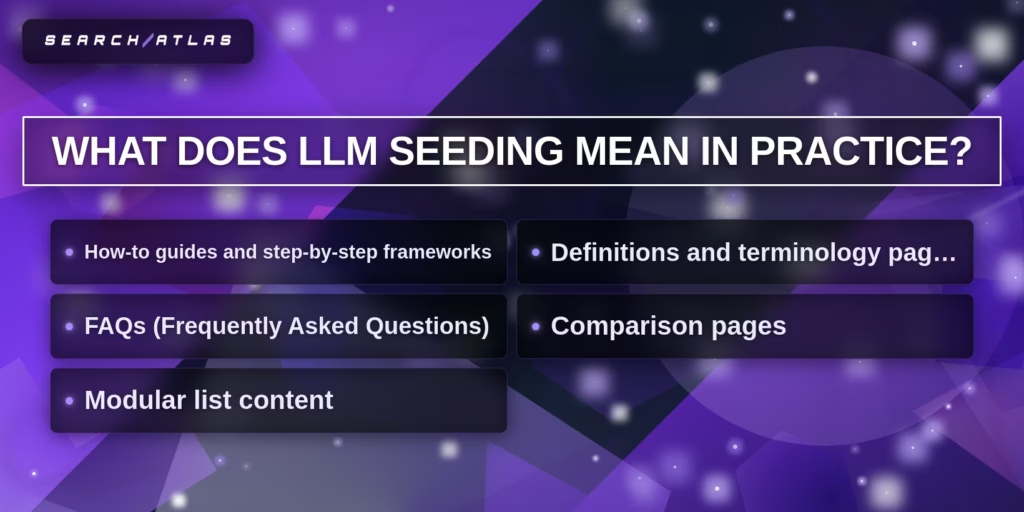
LLM seeding means producing and distributing content in a structurally digestible format for large language models. Digestible content is easy to parse, understand, and reuse by AI systems.
When did LLM seeding gain traction? LLM seeding gained traction from 2023 to 2025 as AI search traffic grew 527% year-over-year between January and May 2025. Early adopters recognized the opportunity to influence AI answers. Semrush projected AI search traffic to surpass traditional search by the end of 2027.
Which content types perform best for LLM seeding? LLM seeding optimizes for the question “Which brands should this answer mention?” Traditional SEO optimizes for “Which page should rank first?” The five content types that perform best for LLM seeding are listed below.
- How-to guides with sequential logic.
- Definitions and terminology pages.
- FAQs that match query patterns.
- Comparison pages with balanced assessments.
- Modular list content with independent items.
How LLM Seeding Differs From Traditional SEO?
LLM seeding differs from traditional SEO in seven ways: primary objective, keyword strategy, visibility mechanism, content structure, trust signals, success metrics, and time to results.
What is the primary objective of LLM seeding? The primary objective of LLM seeding is AI citation. The primary objective of traditional SEO is SERP ranking. LLM seeding aims for the brand to be the expert source of AI references. Traditional SEO fights for position one on Google.
How does keyword strategy differ? Keyword strategy for LLM seeding emphasizes semantic understanding, natural language, and entity relationships. Keyword strategy for traditional SEO focuses on keyword density and exact matches. Entity density matters more than keyword density for LLM seeding.
What is the visibility mechanism for LLM seeding? The visibility mechanism for LLM seeding is Retrieval-Augmented Generation (RAG). ChatGPT and Gemini handle over 80% of internet searches, supporting zero-click visibility. Traditional SEO relies on blue links in SERPs.
How does content structure differ? Content structure for LLM seeding rewards Q&A formats, short paragraphs, and scannable patterns. FAQ sections have high citation probability. Case studies have a very high citation probability. Traditional SEO emphasizes keyword density and long-tail keywords.
What trust signals matter for LLM seeding? Trust signals for LLM seeding include E-E-A-T (Experience, Expertise, Authoritativeness, Trustworthiness), schema markup, JSON-LD, and sameAs properties. Reddit is the most frequently cited source in AI responses.
Which success metrics apply to LLM seeding? Success metrics for LLM seeding track AI citation frequency, knowledge panel triggers, and AI Visibility Rate (AIGVR). Traditional SEO tracks ranking positions, organic traffic, and click-through rates.
How long does LLM seeding take compared to SEO? Time to results for LLM seeding is 3 to 4 months for initial citations. Traditional SEO requires 6-12 months for competitive rankings.
Why Is LLM Seeding Important for SEO and AI Visibility?
LLM seeding is important for SEO and AI visibility for six reasons. The six reasons are listed below.
- LLM seeding ensures content discoverability by AI tools.
- LLM seeding strengthens brand recognition across emerging platforms.
- LLM seeding provides a competitive edge for early adopters.
- LLM seeding future-proof marketing against evolving search.
- LLM seeding establishes brand authority through AI citations.
- LLM seeding expands reach beyond traditional search rankings.
How does LLM seeding ensure content discoverability? Content discoverability by AI tools requires clarity, structure, and context. LLM seeding makes content recognizable and usable to large language models.
How does LLM seeding strengthen brand recognition? Brand recognition across emerging platforms grows when content is structured for AI interpretation. Users get a clearer sense of a business when AI tools mention the business by name.
What competitive edge does early adoption provide? Early adopters gain a competitive edge. Semrush increased its share of voice from 13% to 32% across key buying-intent prompts within one month of launching its AI Visibility Toolkit.
How does LLM seed future-proof marketing? Future-proofing against evolving search protects brand visibility as AI tools replace traditional search. ChatGPT, Gemini, and Claude become primary information gateways.
Why does LLM seeding establish brand authority? Brand authority through AI citations builds instant credibility. AI mentions serve as authority backlinks in the AI knowledge model. Traditional PR and SEO take years to build equivalent credibility.
How does LLM seeding expand reach beyond traditional rankings? Reaching beyond traditional search rankings expands brand exposure. AI systems reference content from brand sites, third-party publications, YouTube, and community discussions.
How LLM Seeding Influences AI Citations?
LLM seeding influences AI citations by planting structured information about a brand across multiple trusted web sources. Planted information increases the confidence of AI systems in citing the brand.
What is the goal of LLM seeding? The goal of LLM seeding is to help AI systems understand a brand’s offerings, target audience, and value proposition. LLM seeding prioritizes citations and visibility in AI responses, not clicks or page rankings. LLM seeding is analogous to SEO, but LLM seeding optimizes for AI memory and reasoning.
How does content structure influence citations? Content structure influences AI citations. Content with clear headings, tables, and FAQs enables fast extraction. Unstructured text reduces citation probability by up to 50%.
How does context influence citations? Content context influences AI citations. Context helps AI systems match a brand to relevant queries. Context explains value propositions directly.
How does content repetition influence citations? Content repetition influences AI citations. Repetition across third-party publishers, video transcripts, and customer reviews builds citation confidence by 15% to 25% over single mentions.
How Do LLMs Discover and Reference Content?
LLMs discover and reference content through pre-trained data and Retrieval Augmented Generation (RAG). Pre-trained data stores parametric knowledge from the training cutoff. RAG retrieves current information from the live web.
What sources do LLMs search? LLMs search webpages, forums, videos, reviews, and documentation. LLMs synthesize retrieved passages to generate answers. LLMs make rapid decisions about source trustworthiness based on three signals: structure, context, and repetition.
What is parametric knowledge? Parametric knowledge involves static knowledge fixed at the model’s training cutoff. Wikipedia constitutes approximately 22% of the training data for most major AI models. Reddit content with 3+ upvotes is prioritized by OpenAI. Stack Overflow provides structured problem-solving information.
What are real-time retrieval sources? Real-time retrieval sources include G2, Capterra, Trustpilot, and industry publications. Real-time retrieval accesses information beyond the static training cutoff.
How AI Models Select Sources to Cite?
AI models select sources to cite based on six measurable factors: entity density, structural clarity, domain authority, freshness calculus, citation transitivity, and schema presence.
What is entity density? Entity density is the most consistent predictor of citation selection across AI platforms. Adding specific statistics and technical details produces 40-115% improvements in generative engine visibility. Heavily cited text averages 20.6% entity density, which is 3-4 times higher than normal English.
What is structural clarity? Structural clarity elements include descriptive H2 and H3 headings, clear topic sentences, ordered lists, and comparison tables. Optimal content length for citation ranges from 1,200 to 2,500 words.
How does domain authority influence citations? Domain authority influences AI citations through topical specificity. Publishing 20 or more deeply focused articles on a topic cluster within six months produces measurable authority gains.
What is freshness calculus? Freshness calculus varies by content type. Content published within 72 hours dominates for current events. Technology queries favor content within six months. Evergreen reference queries receive minimal freshness weight.
What is citation transitivity? Citation transitivity demonstrates grounding in authoritative sources. Adding citations and quotations improves generative engine visibility by 40-115%.
How does schema presence help AI citation? Schema presence resolves entity ambiguity. Schema tells the model exactly which entity the content addresses. datePublished and dateModified schema contribute to freshness signals.
Why does brand search volume predict AI visibility? Brand search volume predicts AI visibility better than any other metric, with a correlation of 0.334 between brand search volume and AI mentions. The top 10% of most-cited pages have less traffic, fewer keywords, and fewer backlinks than the bottom 90%.
How Does LLM Seeding Work?
LLM seeding works by strategically creating and distributing content for large language models to learn from and recall in user responses. The LLM seeding process optimizes content for AI memory and reasoning, generating brand mentions in AI-driven search engines.
What are the prerequisites for LLM seeding? The four prerequisites for LLM seeding are authoritative structured content, high-authority distribution platforms, LLMs with RAG access, and user queries that trigger retrieval.
What are the steps of LLM seeding? The seven steps of LLM seeding are listed below.
- Brands create accurate, structured content with clear headings, bullet points, and schema markup.
- Brands establish canonical reference points on owned websites.
- Brands distribute content across high-authority platforms (industry blogs, Reddit, Quora, G2, Wikipedia).
- LLMs ingest the distributed content during training cycles.
- Users query AI assistants, triggering LLM retrieval via RAG.
- LLMs synthesize answers and cite trusted sources.
- Brands monitor mentions and reinforce messaging over time.
How Does LLM Seeding Build on SEO?
LLM seeding builds on SEO by prioritizing brand citations within AI responses over click-through rates. LLM seeding shifts the optimization target from ranking pages to being mentioned in AI answers.
What do LLM seeding and SEO share? LLM seeding and traditional SEO share foundational skills. Content creation, link building, and technical optimization are shared skills. Both methodologies prioritize clarity, intent, metadata hygiene, and topical authority. LLM-friendly content formats (“Best Of” lists, comparison tables, FAQ sections) align with effective SEO practices.
What are the content quality considerations? Content quality and structure considerations for LLM seeding include accuracy, clear organization, and informative depth. LLMs prioritize credible insights, expert commentary, original research, and evergreen educational content. Semantic chunking breaks content into small sections and short paragraphs for easy AI extraction.
How does E-E-A-T apply to LLM seeding? The E-E-A-T framework applies critically to LLM seeding. E-E-A-T influences AI’s willingness to quote content. Author bios with credentials, HTTPS site security, and authority backlinks establish E-E-A-T signals.
What new priorities does LLM seeding introduce? LLM seeding introduces new priorities: question-answer format, literal headings, short paragraphs, clear definitions, and pattern-friendly structure. AI answers pull from sources ranked beyond page one if the content is well-structured.
How is success measured for LLM seeding? Success measurement for LLM seeding tracks brand mentions in AI tools, unlinked brand mentions, and AI Visibility Rate. Expected results manifest within 60-90 days.
What Are the Core Strategies for LLM Seeding?
The seven core strategies for LLM seeding are publishing in AI-crawlable spaces, using AI-friendly formatting, choosing clarity over click optimization, earning organic mentions without links, creating citation-worthy content, monitoring LLM mentions, and focusing on memory over traffic. The seven strategies compound over time to produce consistent AI citations.
1. Publish Content in AI-Crawlable Spaces
Publishing content in AI-crawlable spaces requires server-side rendering, crawlable paths, and allowlisted AI bots. Most AI crawlers do not execute JavaScript. ChatGPT fetches 57.7% HTML and 11.5% JavaScript. Cloudflare Bot Fight Mode silently blocks GPTBot and PerplexityBot, which is the top cause of content invisibility.
What are the technical steps for AI crawlability? Firstly, prioritize server-side rendering for key pages. AI systems have 1 to 5 second timeouts for content retrieval. Secondly, maintain clean, structured HTML with hierarchical semantic tags. Thirdly, verify robots.txt allows major AI crawlers (GPTBot, ClaudeBot, PerplexityBot, ChatGPT-User). Fourthly, serve critical content directly in HTML. Fifthly, add Schema markup (Article, Author, Product) to high-impact pages.
How to audit AI crawler access? Routine audits verify AI crawler access. Audits include reviewing bot access logs, testing with different user agents, and reviewing bot allowlists. Perplexity searches the live web, making Perplexity a real-time indicator of content accessibility.
2. Use AI-Friendly Content Formatting
AI-friendly content formatting uses clear headings, short paragraphs, lists, and tables to increase citation probability. AI-preferred formats achieve up to 96% accuracy when parsed by models.
Which content formats do AI models prefer? The nine AI-preferred content formats are direct comparisons, best-of lists, alternatives roundups, step-by-step guides, original research, FAQs, case studies, checklists, and summaries.
What are the paragraph and heading rules? Paragraphs need to remain short, ideally 2 to 3 sentences. Headings need to use H1, H2, and H3 in a logical hierarchy with only one H1 per page. A new heading needs to be introduced every 150-200 words. Bulleted lists organize related items. Numbered lists organize sequential processes.
What is front-loading information? Front-loading information leads with the takeaway, statistics, or recommendations. Direct answers appear at the beginning of sections. Every section needs to be skimmable.
Which schema types matter most? Priority schema types for AI systems are FAQPage, HowTo, Article, NewsArticle, Product, Review, and Organization. Schema implementation uses JSON-LD format within a script tag.
3. Choose Clarity over Click Optimization
Clarity is a primary growth lever for SaaS and early products because a lack of instant understanding reduces conversion. Viewers decide whether to engage further within the first 1.7-2 seconds. TikTok data shows 50% of ad recall occurs within the first 2 seconds.
How does clarity influence AI performance? Clarity influences AI performance because successful content is clean, consistent, and instantly understandable to readers and machines. AI Overviews and AI Mode capture clicks that previously went directly to sites. Search now rewards context, clarity, and credibility rather than keywords alone.
What measurable results does clarity produce? Audit clients in 2025 saw an average increase of 47% in Google traffic and RPM improvements of 21-33% within a few months by optimizing for clarity. Blogs with strong internal structures and clear topical authority are far more likely to be cited as sources in AI Overviews.
4. Earn Organic Mentions Without Links
Earning organic mentions without links contributes to brand awareness, authority, and trust. Unlinked mentions signal to search engines and AI systems that a brand is relevant within its industry.
Which strategies generate organic unlinked mentions? The seven strategies to earn organic unlinked mentions are listed below.
- Establish a unique brand name clearly associated with the business.
- Produce high-quality infographics, whitepapers, and comprehensive guides.
- Engage in industry discussions as a genuine expert.
- Maintain consistent brand messaging across platforms.
- Run public relations and content marketing campaigns.
- Collaborate with influencers and industry publications.
- Optimize for local SEO on news sites, forums, and directories.
How do unlinked mentions affect AI visibility? Unlinked mentions strongly influence AI visibility. LLMs learn from text corpora. Frequent appearance in training data establishes a brand’s existence to the model, regardless of links. The impact on traditional search rankings is less direct than backlinks. Google uses entity recognition and brand signals, including unlinked mentions, to identify brands in the Knowledge Graph.
5. Create Citation-Worthy Content
Citation-worthy content possesses five attributes: thorough research with verifiable data, clear structure for AI parsing, authoritative voice with expert credentials, citations to primary sources, and unique perspectives that fill knowledge gaps. AI systems reference citation-worthy content 400% more often than standard web content.
What data-driven results does citation-worthy content produce? Content with original statistics and research findings achieves 30-40% higher visibility in LLM responses. Content with consistent heading levels and clear formatting is 40% more likely to be cited by ChatGPT.
How does semantic HTML affect AI parsing? Semantic HTML and structured elements (definition lists, tables, semantic headings) enhance AI parsing. A tight 800-word page receives over 50% coverage by Gemini-powered AI systems. A 4,000-word page receives only 13% coverage. High fidelity in model parsing equals high recall in AI outputs.
How does technical optimization improve citation rates? Technical optimization improves citation rates. Schema Markup implementation increases citation rates by 87%. Entity-first content structure increases citation rates by 74%. Internal linking architecture and page speed contribute.
6. Monitor LLM Mentions and Visibility
Monitoring LLM mentions tracks brand appearances and sentiment within AI-generated responses. Monitoring acts as automated word-of-mouth intelligence, providing trust signals when potential clients ask for product suggestions.
What are the initial monitoring steps? Initial monitoring steps require 30-45 minutes per week. Firstly, set alerts for brand and competitor mentions on LLM aggregators. Secondly, manually test 10 target prompts across ChatGPT, Claude, and Perplexity. Thirdly, catalog brand appearances with sentiment. Fourthly, check tone and context weekly. Fifthly, use data to tweak content or highlight features.
Which metrics matter for prompt tracking? The five key metrics for LLM prompt tracking are visibility, mentions, share of voice, citation count, and sentiment. Top-performing brands capture 15% or more share of voice. Enterprise leaders reach 25-30%. Profound alerts teams via Slack when sentiment drops below negative 0.2 or inaccuracy exceeds 5%.
7. Focus on Memory, Not Just Traffic
Focusing on memory means training large language models to associate a brand entity with a specific topic for recommendations without requiring a direct search. Memory-focused seeding guarantees brand citation in AI outputs without clicks or traffic.
How does memory-focused seeding differ from traditional SEO? Memory-focused seeding differs from traditional SEO in five ways. Firstly, memory-focused seeding optimizes off-site digital footprint rather than domain authority. Secondly, memory-focused seeding aligns writing with how models embed information. Thirdly, memory-focused seeding rewards easy interpretation over keyword relevance. Fourthly, memory-focused seeding produces persistent AI recall rather than fluctuating rankings. Fifthly, memory-focused seeding measures citation frequency rather than CTR.
What datasets do LLMs learn from? LLMs learn from diverse datasets. Common Crawl provides billions of pages. Wikipedia provides around 3% of GPT-3’s data. Q&A sites (Reddit, Quora, Stack Overflow) were referenced in roughly 22% of GPT-3’s training data. Review platforms (G2, Capterra, Trustpilot) and licensed news partners (Reuters, Bloomberg) contribute.
What are the benefits of memory-focused seeding? The seven benefits of memory-focused seeding are enhanced AI visibility, increased brand recall, zero-cost citations over time, democratized visibility, long-term AI presence, authority by association, and future-proofed reach.
How to Seed LLMs Effectively?
The five methods to seed LLMs effectively are establishing a strong brand entity, distributing structured narratives, using video content, activating social distribution, and generating customer reviews. The five methods compound over time to produce consistent AI citations.
1. Establish a Strong Product or Brand Entity
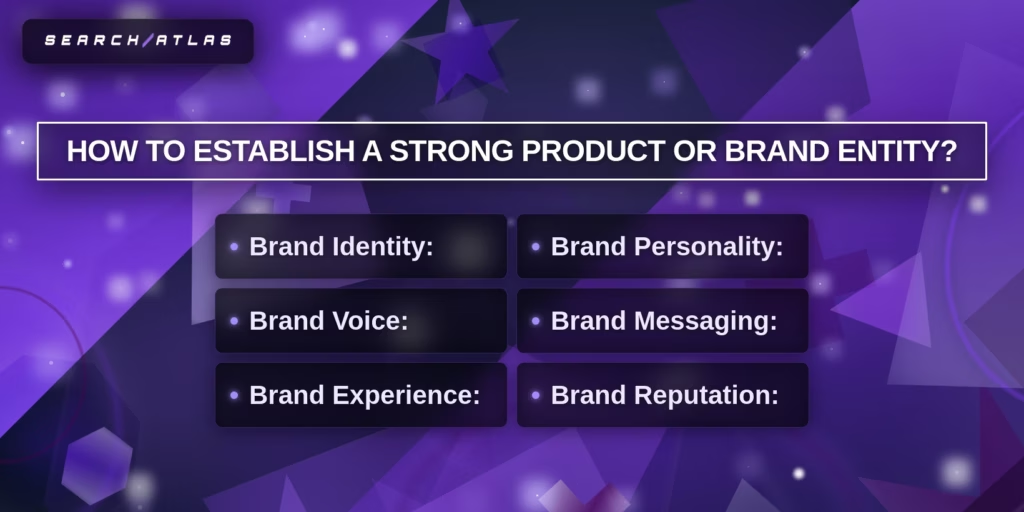
Establishing a strong brand entity requires brand strategy, brand identity, brand messaging, and brand experience. A strong brand differentiates a business, attracts leads, and retains customers.
What are the core brand components? Brand strategy determines high-level vision and prioritizes goals. Brand identity translates concepts into practice through colors, messaging, and recognition across channels. Brand messaging is the voice of the brand. Brand experience encompasses the sum of all customer interactions.
What are the steps to build a brand? The six steps to build a brand are listed below.
- Know the target audience through buyer personas.
- Analyze competitors to identify market gaps.
- Develop brand messaging (purpose, mission, unique value proposition, voice).
- Brainstorm a memorable name.
- Develop a brand identity (logo, color palette, typography).
- Maintain consistency while adapting to growth.
How does NAP consistency build entity authority? Consistent NAP data (Name, Address, Phone) across platforms builds entity authority for LLM recognition. Cross-platform entity reinforcement on Wikipedia, LinkedIn, and industry directories strengthens recognition. Entities need to be defined consistently across websites, social profiles, and third-party sources.
2. Distribute Structured Narratives Across Platforms
Distributing structured narratives across platforms customizes a central story for each platform’s unique strengths and audience preferences. Consistent storytelling across platforms increases brand loyalty and trust by 23%.
Which platforms fit which content types? Instagram is ideal for visuals, short, impactful stories, and infographics. Blogs and YouTube are ideal for in-depth content and tutorials. Twitter (X) is ideal for quick updates and interactive content (polls, Q&A). TikTok is ideal for short, visually-driven stories. LinkedIn is best for professional industry content.
What is the multi-channel distribution framework? The five-step framework for multi-channel distribution is listed below.
- Choose a core content format (long-form blog, podcast, YouTube video).
- Map distribution channels (owned, earned, paid).
- Tailor the message to each platform by tweaking tone and length.
- Schedule rollout over days or weeks to avoid audience fatigue.
- Measure performance and refine the approach.
What engagement gains does tailored content produce? Content tailored to each platform achieves up to 30% higher engagement rates. 70% of users actively seek customized content. A multi-objective optimization model achieved up to 23% cost reduction and up to 19% engagement increase in variable scenarios.
3. Use Video Content for AI Visibility
Video content contributes to AI visibility because LLMs transcribe and analyze video at scale. Video transcripts and metadata are treated as standard written content by AI systems.
How does YouTube influence LLM citations? YouTube is the third most cited source by LLMs in 2025, appearing 23% of the time. Video narration enhances narrative distribution by adding context, consequence, and meaning. Narration explains why footage matters rather than describing what viewers already see.
What are the video optimization requirements? Video optimization for AI requires transcripts, descriptive titles, and structured chapter markers. Transcripts allow AI systems to index spoken information. Descriptive titles help AI systems categorize the video. Structured chapters enable passage-level retrieval.
4. Activate Social and Partner Distribution
Activating social and partner distribution places brand content in front of trusted communities and review sites that LLMs crawl. Reddit is the most cited domain by LLMs in 2025. Wikipedia is second with 26% of citations.
Which partner platforms matter most? The five primary platforms for partner distribution are Reddit, Quora, Stack Overflow, G2, and Capterra. Reddit has a $60 million annual licensing deal with Google. G2 and Capterra are LLM goldmines for decision-making queries.
What citation lift does cross-platform presence produce? Brands mentioned positively across at least four non-affiliated forums are 2.8 times more likely to appear in ChatGPT responses. Digital PR and influencer partnerships secure mentions on reputable sources. Guest posts on Medium, Substack, and LinkedIn often generate more AI citations than brand-owned websites.
5. Generate High-Quality Customer Reviews
Generating high-quality customer reviews on G2, Capterra, and Trustpilot increases AI citation probability 3 times. Review platforms provide current user feedback that LLMs cite for product evaluations.
What makes a review high-quality? Real reviews showcase customer names, titles, specific outcomes, and photos. Specific outcomes use measurable results (“cut onboarding time by 30% over 2 weeks”). Expert media with credentials further builds trust.
Why do review platforms matter for real-time retrieval? Review platforms are real-time retrieval sources for LLMs. G2, Capterra, and TrustPilot are frequently cited by LLMs for purchasing decisions. When brand information is consistent across G2, websites, and third-party sources, AI models cite the brand more frequently.
What Types of Content Perform Best in AI Search?
The six content types that perform best in AI search are structured comparison tables, first-person reviews, FAQ-style content, best-of lists, interactive tools, and multimodal content. The six content types align with LLM extraction patterns.
1. Structured Comparison Tables
Structured comparison tables perform best in AI search because tables allow LLMs to parse data at 96% accuracy. Comparison tables using proper HTML and descriptive columns achieve 47% higher AI citation rates.
What makes comparison tables effective? Comparison tables present clear contrasts between options, including pros and cons. Comparison tables fit Google’s query fan-out model. Comparison tables need to use thead and th markup for proper semantic structure.
2. First-Person Reviews
First-person reviews perform best in AI search because reviews provide experiential evidence that E-E-A-T signals reward. Content with named authors, credentials, and institutional affiliation is cited 3 to 4 times more than anonymous content.
What elements build review authority? First-person reviews include customer names, titles, specific outcomes, and photos. Expert-verified content by licensed professionals increases citation probability. Earned media is the most frequently cited source type across all AI platforms.
3. FAQ-Style Content
FAQ-style content performs best in AI search because FAQs match the query patterns LLMs receive. FAQs provide short, direct answers that LLMs extract at the passage level. The FAQPage schema directly feeds AI question-answer extraction.
How long should FAQ answers be? Questions need to be phrased as users ask them. Answers need to be 40 to 60 words for easy AI extraction. FAQ sections have high citation probability across major LLM platforms.
4. “Best Of” Lists
“Best of” lists perform best in AI search because listicles account for 32.5% of all AI citations. Comparative listicles are the highest-performing format for AI visibility.
What structure makes best-of lists effective? Best-of lists use consistent item structures (“Tool name → Key feature → Who it’s for”). Consistent structures simplify parsing and reuse for AI systems. Best-of lists allow AI to extract two to three options from a longer list.
5. Interactive Tools and Templates
Interactive tools and templates perform best in AI search because they generate citations through external references and practical utility. Calculators, checklists, and templates are easily digestible and frequently referenced by AI models.
How do tools drive brand search volume? Interactive tools increase backlinks, mentions, and brand search volume. Brand search volume correlates with AI citations at 0.334. Tools attract natural, unlinked mentions from industry blogs and communities.
6. Multimodal Content
Multimodal content performs best in AI search because AI systems process text, video transcripts, and structured data together. Multimodal content provides multiple retrieval paths for LLMs.
What elements make multimodal content AI-ready? Multimodal content includes articles with embedded videos, infographics, and interactive elements. Images require descriptive alt text. Videos require transcripts. Alt text and transcripts make visual content accessible to AI systems.
How to Create Content That Gets Cited by LLMs?
The three methods to create content that gets cited by LLMs are structuring clear answers, improving credibility, and aligning content with user intent. The three methods combine structural optimization with trust signals.
1. Structure Clear and Direct Answers
Structuring clear answers requires leading with the answer in the first paragraph of each section. Optimal paragraph length is 40-60 words for easy AI extraction and chunking.
Where do LLM citations originate in articles? 44.2% of all LLM citations originate from the first 30% of an article. Self-contained sections stand alone as citable units. Clear heading hierarchy mirroring likely search queries improves retrieval. ChatGPT favors definite language, question marks in headings, and simple sentence structures.
What reading grade does winning content use? Winning content averages a Flesch-Kincaid grade of 16. Lower performers average 19.1. Subject-verb-object structure enhances clarity for AI systems.
2. Improve Content Credibility and Trust
Improving credibility requires named authors, verified data, and citations to primary sources. Content with quotes, statistics, and citations achieves 30-40% higher visibility in LLM responses.
What credentials establish the author’s authority? Author bios need to include credentials, LinkedIn profiles, and industry recognition. Data points need to include sample sizes and percentages. Citations need to reference reputable studies, government data, and peer-reviewed research.
How do E-E-A-T signals affect AI systems? E-E-A-T signals indirectly affect AI systems by influencing traditional search rankings. Content appearing trustworthy gains more links and shares, increasing the pool from which LLMs pull. AI citation is 10-15 times higher for primary sources compared to secondary commentary.
3. Align Content With User Intent
Aligning content with user intent matches content to the sub-queries LLMs generate during fan-out. Only 27% of fan-out keywords remain consistent across searches. 66% of fan-out keywords appear only once.
How many queries do models generate per prompt? GPT-5.4 Thinking generates 8.5 queries per prompt. Gemini expands simple queries into approximately 5 related fan-outs. Content needs to cover the entity cloud around a topic for semantic relevance.
How do prompt research tools support intent alignment? User intent alignment uses prompt research tools to identify what audiences ask AI systems. Prompt research informs citation-intent sections of content briefs. Answer-first writing benefits both Google and LLMs.
Where Do LLMs Source Citations?
LLMs source citations through two knowledge pathways: parametric knowledge from training data and retrieved knowledge from RAG systems. Parametric knowledge accounts for 60% of ChatGPT queries answered without web searches. RAG enhances accuracy by 48% through hybrid retrieval.
Which platforms rank as top citation sources? Reddit ranks as a top-three source across all AI search engines. Reddit accounts for 11.3% of ChatGPT’s top sources, 21.0% of Google AI Overviews’ primary sources, and 46.7% of Perplexity’s top citations. Wikipedia accounts for 47.9% of ChatGPT’s top sources.
What domain types dominate LLM references? Commercial domains (.com) constitute 80.41% of all LLM references. Non-profit organizations (.org) account for 11.29% of citations. 92% of all cited sources originate from US-based websites.
Which sources do health queries cite? RAG-enabled models cite health information sites for health queries. GPT-4o cites mayoclinic.org (16%) and ncbi.nlm.nih.gov (10%). Gemini Ultra cites ncbi.nlm.nih.gov (36%) and clevelandclinic.org (6%).
Which Social Platforms Influence LLM Citations?
The seven social platforms that influence LLM citations are Reddit, Wikipedia, YouTube, LinkedIn, X (Twitter), Medium, and Substack. The seven platforms provide community-managed content that LLMs cite more than official brand marketing.
How much does Reddit contribute to AI citations? Reddit is the most cited domain by LLMs in 2025. Reddit accounts for 46.7% of Perplexity citations, 21% of Google AI Overviews, and 11.3% of ChatGPT citations. Reddit content with 3+ upvotes is prioritized by OpenAI.
What role does Wikipedia play in LLM citations? Wikipedia is the second most cited platform with 26% of citations. Wikipedia constitutes approximately 22% of the training data for most major AI models. Wikidata serves as the top source for Google’s Knowledge Graph, providing 500 billion facts about 5 billion entities.
How does YouTube feed LLM responses? YouTube is the third most cited platform, appearing 23% of the time. YouTube transcripts are treated as standard written content by LLMs. GPT-5.3 Kingmaker sites include Forbes, TechRadar, Tom’s Guide, and Reddit.
What role do LinkedIn, Medium, and Substack play? LinkedIn, Medium, and Substack are frequently crawled for clean formatting and author profiles. LinkedIn articles often generate more AI citations than brand-owned websites. X (Twitter) facilitates fast, distributed repetition and consistent messaging.
How to Track LLM Seeding Performance?
Tracking LLM seeding performance uses prompt-based visibility tracking and new AI-specific metrics. Traditional analytics are insufficient because GA4 referral data measures clicks rather than zero-click AI sessions.
Which metrics track LLM seeding performance? The eight key metrics for tracking LLM seeding performance are AI Visibility Rate, Citation Rate, Brand Mention Volume, Share of Voice, Content Extraction Rate, Conversation-to-Conversion Rate, sentiment score, and accuracy score.
What percentage of prompts defines top performance? AI Visibility Rate measures the percentage of prompts where the brand appears. Top-performing brands capture 15% or more share. Enterprise leaders reach 25% to 30%.
How often do cited sources rotate? Semrush reports 40-60% of cited sources rotate monthly. Accurate mention tracking is difficult because LLMs are non-deterministic. Mention data needs to be used for benchmarking over time rather than single-point decisions.
What are manual and automated tracking methods? Manual AI platform checks test 10-20 target prompts across ChatGPT, Claude, Perplexity, and Gemini. Automated tools use multi-sampling to run the same prompt multiple times.
What Tools Support LLM Visibility Tracking?
The 10 tools that support LLM visibility tracking are listed below.
- Search Atlas LLM Visibility Tool. Search Atlas LLM Visibility Tool is the best tool for tracking AI citations, share of voice, and sentiment across ChatGPT, Claude, Gemini, and Perplexity. Search Atlas LLM Visibility Tool combines prompt-based visibility tracking with citation provenance.
- Profound. Profound uses client-side mimicry and a Citation Provenance Engine. Profound is SOC 2 Type II compliant and covers 8+ platforms.
- LLMClicks.ai. LLMClicks.ai detects hallucinations and incorrect information. LLMClicks.ai covers ChatGPT, Perplexity, Claude, Gemini, and Copilot.
- Semrush Enterprise AIO. Semrush Enterprise AIO pairs SEO visibility with AI search results.
- Otterly AI. Otterly AI is affordable for small teams, covering ChatGPT, Perplexity, and Google Gemini.
- Peec AI. Peec AI offers side-by-side competitor visibility comparison.
- SE Ranking. SE Ranking covers Google AI Overviews, Gemini, ChatGPT, and Perplexity.
- Scrunch AI. Scrunch AI offers enterprise-level monitoring across diverse AI interactions.
- Athena HQ. Athena HQ combines tracking with optimization workflows.
- Meltwater GenAI Lens. Meltwater GenAI Lens monitors how LLMs discuss brands.
How to Measure the Impact of LLM Seeding?
Measuring the impact of LLM seeding tracks competitive AI brand visibility, share of model, brand mention volume, AI referral traffic, and branded search growth. The five measurement categories capture both direct AI visibility and indirect brand lift.
What is competitive AI brand visibility? Competitive AI brand visibility tracks how a brand’s visibility changes week over week compared to competitors. Share of model measures brand appearance in AI answers broken down by ChatGPT, Gemini, Claude, and Perplexity.
What is brand mention volume? Brand mention volume measures the appearance frequency across AI-generated answers for a given topic. AI referral traffic tracks clicks from AI platforms, which are smaller in volume but higher in intent.
How does branded search growth signal LLM influence? Branded search growth signals LLM influence. An increase in Google Search Console impressions, coupled with stable clicks, suggests LLMs mention the brand. Direct traffic growth indicates users navigating after AI mentions.
What Are the Benefits of LLM Seeding?
The four main benefits of LLM seeding are increased AI visibility, higher citation frequency, stronger entity authority, and long-term visibility gains. The four benefits compound over time to produce a lasting brand presence in AI search.
1. Increased AI Visibility
Increased AI visibility is a benefit of LLM seeding because optimized content appears within ChatGPT, Gemini, and Perplexity responses. AI visibility is critical as AI tools replace traditional search engines for many users.
How does LLM seeding enhance AI comprehension? Increased AI visibility enhances content comprehension by AI systems. Comprehension requires clarity, structure, and context. LLM seeding focuses on comprehension rather than rankings, making AI tools far more likely to use content within their responses.
How does increased AI visibility impact the customer journey? Increased AI visibility impacts the customer journey. Brands appear earlier in the buying journey through AI mentions. Brands gain stronger recognition across emerging platforms without relying on traditional rankings.
What proof shows increased AI visibility in action? Semrush nearly tripled its AI visibility using LLM seeding, increasing its share of voice from 13% to 32% across key buying-intent prompts within one month of launching its AI Visibility Toolkit.
2. Higher Citation Frequency
Higher citation frequency is a benefit of LLM seeding because consistent AI mentions build parametric associations in training data. Content published early on emerging topics forms stronger parametric associations with less competing content.
How does higher citation frequency support zero-click environments? Higher citation frequency enhances brand visibility in zero-click environments. 71% of consumers use AI tools without clicking through to websites. LLM seeding drives up to 40% more branded searches even without direct clicks.
How does citation frequency build credibility? Higher citation frequency builds credibility and authority through third-party endorsement. AI citation acts as a digital endorsement, signaling to users that a brand is knowledgeable.
What does B2B SaaS research show about citations? An audit of 150 B2B SaaS brands showed nearly 90% of ChatGPT citations come from URLs ranked position 21 or lower in Google. Quality and distributed presence outweigh raw ranking position.
3. Stronger Entity Authority
Stronger entity authority is a benefit of LLM seeding because AI systems replace link analysis with citation patterns and entity recognition. Entity authority becomes the new PageRank by 2026.
How do entity relationships affect AI overview appearances? Stronger entity authority appears in AI overviews 3 times more often when brands have well-defined entity relationships. Entity relationships include accuracy across sources, consistency in definitions, and external citation quality.
Why do author credentials increase citation rates? A stronger entity authority requires clear author credentials. Content with author credentials is cited 3-4 times more than anonymous content. Primary sources are cited 10-15 times more than secondary commentary.
How does entity authority future-proof SEO? Stronger entity authority is the closest method to future-proofing SEO. Brands risk being invisible to AI by 2026 without LLM seeding. Entity authority secures dominant visibility in conversational search.
4. Long-Term Visibility Gains
Long-term visibility gains are a benefit of LLM seeding because distributed presence across multiple trusted sources embeds insights into model knowledge for years. Long-term visibility produces evergreen citation presence.
What produces long-term visibility? Long-term visibility gains result from consistent mentions across third-party publishers, video transcripts, customer reviews, and community discussions. Consistent mentions using similar language build citation confidence.
How do long-term visibility gains future-proof marketing? Long-term visibility gains future-proof marketing as search evolves from Google-first to AI-first discovery. Brands adopting LLM seeding now capture market share as competitors adjust.
How do compounding effects work over time? Long-term visibility gains compound over time. Maintaining a consistent presence and messaging transforms uncertain mentions into confident recommendations. The Semrush AI Visibility Toolkit tracked an increase from 13% to 32% share of voice within one month.
What Are Common LLM Seeding Mistakes?
The 10 common LLM seeding mistakes are listed below.
- Treating LLMs databases rather than probabilistic systems.
- Ignoring prompt engineering by using vague instructions.
- Overlooking context windows during content creation.
- Neglecting evaluation frameworks for measuring AI citations.
- Blocking AI User Agents in robots.txt.
- Providing PDF-only content without HTML alternatives.
- Using JavaScript-only schema injection.
- Publishing inconsistent entity information across platforms.
- Relying on pure AI-generated text without expertise.
- Ignoring mobile performance and slow-loading pages.
Which mistakes block AI crawlers most often? Blocking AI User Agents prevents AI systems from accessing content. Schema mismatch confuses AI crawlers. PDF-only content is inaccessible to most AI crawlers. Inconsistent entity naming creates ambiguity and reduces citation confidence.
What measurable impact do these mistakes produce? Content inconsistency reduces brand mentions by 10-15%. Unstructured text decreases citation probability by up to 50%. Lack of repetition across external sources reduces citation chance by 20-30%.
What Are the Challenges of LLM Seeding?
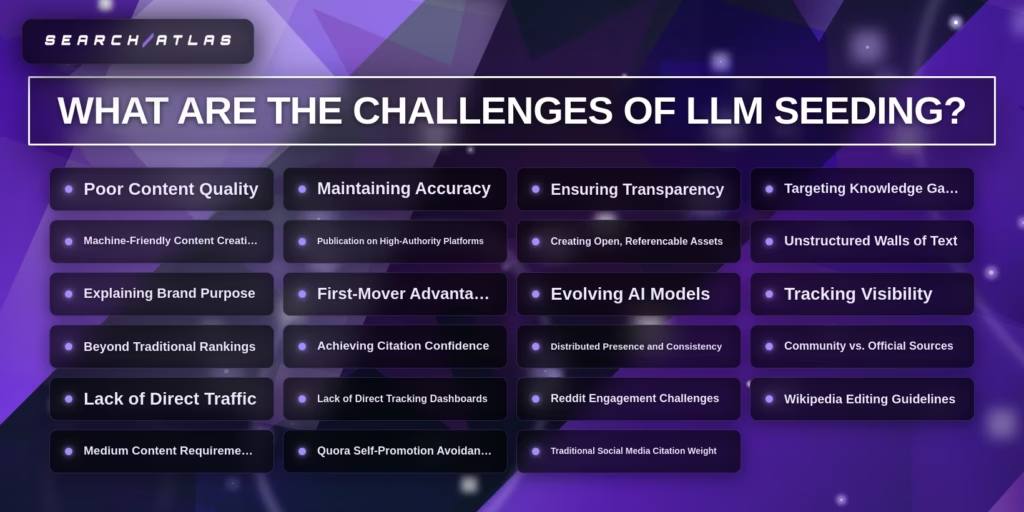
The eight challenges of LLM seeding are content quality maintenance, accuracy verification, transparency, distributed presence management, evolving AI models, tracking visibility, platform-specific rules, and attribution complexity. The eight challenges require ongoing operational discipline.
Why is content quality maintenance a challenge? Content quality maintenance requires citable accuracy. Maintaining accuracy is an ethical consideration because LLMs propagate outdated or inaccurate information.
What makes distributed presence a challenge? Distributed presence and consistency challenge brands because a single mention carries less weight than consistent references across external sources. Community-managed sources (Reddit, Wikipedia) are cited more than official brand marketing.
How do evolving AI models affect citation patterns? Evolving AI models shift citation patterns. LLMs update training data and algorithms frequently. Citation patterns shift by 5% to 10% with major model updates.
Why is tracking visibility difficult? Tracking visibility is difficult because LLM responses are ephemeral and non-deterministic. Between 40% and 60% of sources cited by LLMs change every month.
What platform-specific rules constrain distribution? Platform-specific rules constrain distribution. Reddit has engagement requirements. Wikipedia has editing guidelines. Medium has content quality rules. Quora prohibits self-promotion.
What Does LLM Seeding Mean for the Future of Content?
LLM seeding means the future of content prioritizes brand mentions in AI answers over page rankings. LLM seeding is projected to become the new standard alongside SEO.
How do AI-powered engines reshape content strategy? AI-powered search engines (Perplexity AI, You.com, Bing AI, Google SGE) produce direct answers, summaries, and citations. AI assistants already handle over 40% of searches. LLM seeding secures brand presence in this evolving landscape.
What market growth is projected for AI content optimization? The global market for AI-driven content optimization is projected to grow significantly. Brands adopting LLM seeding now secure a long-term edge in digital visibility and authority.
How LLM Seeding Shapes Generative Engine Optimization (GEO)?
LLM seeding shapes GEO by using repetition, association, and scarcity within the data layer. GEO shifts the optimization target from traditional search ranking to the composition of the AI’s answer.
How do repetition, association, and scarcity work? Repetition establishes default language patterns for a topic. Association links terms so one name pulls a familiar frame. Scarcity weakens alternative narratives by limiting the material available to represent them.
What is noun phrase optimization? Structured noun phrase optimization (NPO) aligns content with semantic units parsed by AI systems. Optimized noun phrases differentiate between invisibility and being surfaced. Amazon’s Rufus AI uses NLP to interpret query meaning.
How does content auditing produce GEO lift? The best GEO lift often comes from auditing existing content before adding new production. LLMs value stability and authority more than freshness in many categories. Older, stable, heavily-linked pages often outperform freshly optimized content.
Does LLM Seeding Replace SEO?
No, LLM seeding does not replace SEO, but LLM seeding complements SEO. The most successful businesses in 2025 master both strategies.
LLM seeding secures brand mentions within AI responses. AI responses account for 40% of searches and are projected to surpass traditional search by late 2027. Traditional SEO still accounts for 60% of searches, though this is declining.
How do Google rankings correlate with AI citations? Glenn Gabe’s research shows a strong correlation between Google rankings and AI citation rates. Drops in Google rankings parallel drops in AI citations. Traditional SEO work is foundational for GEO. The future standard is LLM seeding plus SEO.
How Long Does It Take to See Results From LLM Seeding?
LLM seeding takes 45 to 90 days to produce initial results. Initial results appear 62% to 75% faster than traditional SEO, which requires 6 to 12 months.
What is the detailed timeline for LLM seeding results? Early traction appears within 1-3 months. Stronger outcomes appear in months 4-6. The detailed timeline is listed below.
- Days 1 to 30: Initial deployment and strategy.
- Days 30 to 45: First citations on fast-updating platforms.
- Days 45 to 60: Multiple AI models begin citing the brand.
- Days 60 to 90: Broader visibility across target platforms.
How do training-data models compare with real-time retrieval? Training-data-based models (ChatGPT, Claude) require 3 to 6 months before content consistently influences citations. Real-time retrieval tools (Perplexity, Google AI Overviews) respond within days.
What case study proves rapid LLM seeding results? Semrush increased its share of voice from 13% to 32% within one month of launching its AI Visibility Toolkit. Parametric knowledge requires the brand to be woven across multiple authoritative sources before a model’s training cutoff.