The schema for Generative Engine Optimization (GEO) is the practice of using structured data to make content machine-readable for AI systems that generate answers. The schema for GEO explains how structured data transforms raw pages into clear entity-based signals that AI systems extract, interpret, and cite inside generated responses. Schema markup for AI optimization shifts content from unstructured text into defined entities, attributes, and relationships that reduce ambiguity during retrieval.
Schema for GEO matters because AI search replaces ranked links with synthesized answers built from trusted sources. AI systems evaluate structured data to determine meaning, accuracy, and consistency before selecting content for inclusion. Visibility increases when the schema clarifies what content represents, which improves retrieval precision and citation eligibility across AI platforms.
Schema for GEO creates competitive advantages in AI-driven search environments by strengthening entity recognition, improving extraction accuracy, and increasing citation frequency. Pages with valid schema markup for AI optimization appear more often in AI summaries because structured data improves interpretation speed and reduces processing errors. This advantage positions content as a reliable source inside zero-click and conversational search experiences.
Schema for GEO requires connected entities, accurate markup, and alignment between the schema and visible content. Effective structured data for AI uses JSON-LD, stable identifiers, and consistent relationships across pages. GEO vs schema markup differs in scope because GEO defines strategy, while schema provides the infrastructure that enables AI systems to understand, trust, and reuse content across answers.
What is Schema for GEO (Generative Engine Optimization)?
The schema for GEO is the use of structured data markup that defines content for AI systems through machine-readable metadata. The schema for GEO explains how structured data clarifies entities, relationships, and context, which increases interpretation accuracy across generative engines. Schema for GEO assigns explicit meaning to content elements, which removes ambiguity and improves how AI systems retrieve and reuse information.
The schema for GEO originates from the structured data standard created through Schema.org in 2011. Schema.org introduced a shared vocabulary that defines entities, attributes, and relationships across web content. Schema for GEO gained importance during the 2020s because generative AI systems began extracting and assembling answers directly from structured sources. The schema for GEO now acts as the translation layer between human-readable content and machine-interpreted data.
The schema for GEO belongs to structured data systems used in the semantic web architecture. The schema for GEO differs from traditional SEO because the schema defines meaning instead of only improving rankings. Schema for GEO connects entities and properties in a format that AI systems interpret consistently across contexts. This connection explains why the schema acts as a translation system for engines that generate answers.
What defines the core characteristics of the Schema for GEO? There are three main characteristics of the schema for GEO. The three main characteristics are machine-readability, AI trust signals, and enhanced visibility.
Firstly, machine-readability converts content into structured formats that AI systems interpret without ambiguity. Machine-readability defines how schema encodes entities, properties, and relationships into JSON-LD structures. This encoding increases extraction accuracy because AI systems process structured signals faster than raw text.
Secondly, AI trust signals define identity, authority, and context across structured content. AI trust signals connect entities to verifiable attributes, which strengthen content reliability in generative systems. This connection improves disambiguation because AI systems compare multiple sources using consistent entity definitions.
Thirdly, enhanced visibility improves eligibility for AI-generated answers and rich search results. Enhanced visibility defines how structured data increases inclusion inside summaries, snippets, and AI responses. This inclusion increases exposure because structured content aligns with extraction patterns used by generative engines.
Why does the Schema for GEO exist as a system requirement? The schema for GEO depends on the need for machines to interpret content with precision and consistency. The schema for GEO increases in importance because generative systems retrieve structured signals instead of relying only on keyword matching. This shift explains why unstructured content loses visibility across AI-generated environments.
The schema for GEO functions as the control layer for AI content interpretation. The schema for GEO determines how AI systems extract, rank, and assemble information into responses. This control defines visibility because structured data directly influences whether content appears inside generated answers.
Why Does Schema Matter for GEO?
Schema matters for GEO because schema defines content structure for AI systems through explicit, machine-readable metadata. Schema matters for GEO because structured data increases visibility, improves citation probability, and strengthens entity recognition across AI-generated answers. Schema matters for GEO because generative engines rely on structured signals to interpret, retrieve, and assemble information accurately.
How does schema improve content interpretation for GEO? Schema improves content interpretation by transforming pages into structured nodes and relationships during indexing. Structured data converts content into defined entities and connections, which AI systems process before generating answers. This transformation improves retrieval accuracy because AI systems rely on structured relationships instead of unstructured text.
Why does the schema define entity identity for GEO? A schema defines entity identity by assigning attributes that clarify ownership, authority, and context across content. Structured data connects entities to verified profiles, which strengthens attribution signals in AI systems. This definition improves recognition because AI systems match content to clearly defined entities.
What role does schema play in GEO targeting? Schema removes ambiguity from GEO targeting by providing direct semantic signals instead of inferred meaning. Structured data defines context explicitly, which reduces interpretation errors across generative systems. This clarity increases targeting precision because AI systems prioritize clearly structured content.
How does schema increase visibility in AI-generated results? Schema increases visibility by aligning content with extraction patterns used in AI-generated summaries and overviews. Pages with FAQ schema appear 3.2 times more frequently in AI Overviews. This alignment improves inclusion because structured formats match how generative engines select content.
Why does schema improve citation probability in GEO? Schema improves citation probability by structuring content into formats that AI systems extract and reuse directly. The FAQ schema shows higher citation rates because it defines clear questions and answer pairs. This structure increases reuse because AI systems prioritize concise, well-defined responses.
How Do AI Systems Use Schema in GEO Workflows?
AI systems use schema in GEO workflows by processing structured data to interpret content, define entities, and extract answers accurately. AI systems rely on schema because structured data provides precise, machine-readable definitions of content, authorship, and claims. This process increases visibility, improves citation probability, and strengthens contextual relevance across AI-generated results.
The 5 main ways that AI systems use schema in GEO workflows are listed below.
1. Transforms content into structured nodes and relationships. Schema converts pages into entities and connections that AI systems process during indexing. This transformation defines how content becomes machine-readable, which improves retrieval accuracy because AI systems rely on structured relationships instead of raw text interpretation.
2. Defines entity identity for attribution and recognition. Schema assigns attributes to brands, authors, and topics with explicit definitions across structured data. This definition clarifies ownership and context, which improves attribution because AI systems match content to verified and consistent entity profiles.
3. Standardizes content for consistent machine interpretation. Schema uses formats (JSON-LD) to present content in predictable and repeatable structures. This standardization ensures uniform data representation, which improves extraction because AI systems process consistent formats across multiple sources.
4. Validates trust through structured and verifiable signals. Schema aligns structured data with visible content to confirm accuracy and consistency across pages. This validation strengthens reliability, which increases trust because AI systems detect fewer conflicts between structured and visible information.
5. Enhances citation probability inside AI-generated answers. Schema structures content into formats that AI systems extract and reuse directly in generated responses. Pages with FAQ schema appear 3.2 times more frequently in AI-generated overviews, which confirms higher citation likelihood through structured formats.
How Does Structured Data Improve Retrieval Accuracy?
Structured data improves retrieval accuracy by providing precise, machine-readable definitions that AI systems interpret without ambiguity. Structured data improves retrieval accuracy because it delivers factual values, clear relationships, and consistent formats across datasets. This precision reduces hallucination and increases alignment between user queries and retrieved information.
How does structured data reduce hallucination in retrieval systems? Structured data reduces hallucination by retrieving exact values from databases and knowledge graphs instead of generating approximations. AI systems access predefined fields and attributes, which ensures responses match verified data rather than inferred text. This RAG method increases factual accuracy because structured inputs replace generative guesswork.
How does structured data improve semantic precision in retrieval? Structured data improves semantic precision by mapping queries directly to defined entities, attributes, and relationships. AI systems interpret structured schemas, which align natural language queries with exact data fields and constraints. This alignment improves accuracy because systems retrieve contextually correct and numerically precise results.
How does structured data solve vector retrieval limitations? Structured data solves vector retrieval limitations by avoiding semantic collapse, embedding similarity issues, and numeric ambiguity. Vector systems struggle to distinguish similar rows or numeric values, which leads to incorrect matches. Structured retrieval resolves this issue because systems query exact fields instead of approximate embeddings.
How does structured data improve consistency across systems? Structured data improves consistency by centralizing information into a single, authoritative source. AI systems retrieve the same structured values across applications, which prevents conflicting outputs between teams and tools. This consistency strengthens reliability because all responses originate from the same verified dataset.
How does structured data increase explainability in retrieval systems? Structured data increases explainability by linking each generated response to a specific row, field, or record. AI systems trace outputs back to exact data points, which creates transparent and verifiable answers. This traceability improves trust because every response connects to a clear data source.
Why does structured data outperform unstructured retrieval methods? Structured data outperforms unstructured retrieval because it provides deterministic accuracy instead of probabilistic matching. AI systems retrieve exact values, which eliminates approximation errors common in text-based models. This deterministic behavior improves performance because retrieval results remain consistent, precise, and verifiable.
How Does Schema Influence AI Citation Selection?
Schema interacts with knowledge graphs in GEO by converting content into structured entities and relationships that AI systems store and connect. Schema interacts with knowledge graphs because structured data defines identity, attributes, and links between entities across the web. This interaction allows AI systems to understand content context, verify facts, and reuse information inside generated answers.
Schema interacts with knowledge graphs by defining entities as structured data objects that become nodes inside the graph. These nodes represent real-world concepts (organizations, people, and products) with explicit attributes. This definition allows AI systems to recognize entities consistently, which improves how content becomes part of connected knowledge networks.
Schema interacts with knowledge graphs by connecting entities through defined relationships that form graph edges. These relationships link entities across pages and external sources, which creates a unified entity profile. This connection allows AI systems to understand how concepts relate, which improves reasoning and contextual accuracy in generated responses.
Schema interacts with knowledge graphs by assigning consistent identifiers that unify entity references across multiple pages. Identifiers (@id and sameAs link content) to authoritative profiles, which removes duplication and confusion. This consistency strengthens entity recognition because AI systems rely on stable references to track entities across datasets.
Schema interacts with knowledge graphs by structuring content into machine-readable formats that integrate directly into large-scale data networks. Structured data feeds knowledge graphs with verified facts, which increases accuracy during retrieval and synthesis. This integration improves answer generation because AI systems access structured knowledge instead of inferring meaning from raw text.
Schema interacts with knowledge graphs by reinforcing entity authority through repeated and consistent structured signals across digital properties. Consistent schema across websites, profiles, and content builds a unified entity presence. This reinforcement improves trust because AI systems prioritize entities with strong and consistent data representation.
What is the Architecture of Schema for GEO?
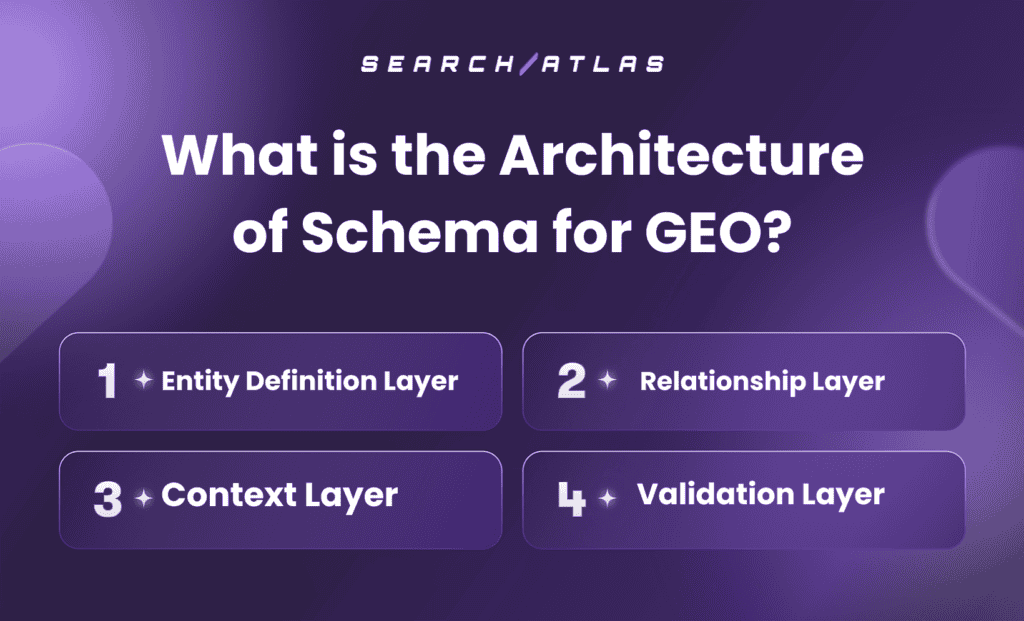
Schema architecture for GEO is the layered structure that defines entities, connects relationships, adds semantic context, and validates structured data for AI systems. This architecture matters because GEO depends on machine-readable clarity, consistent entity understanding, and reliable structured signals rather than loose interpretation.
Schema architecture gives AI systems a clear framework for understanding what a page represents, how its entities connect, and whether that information is safe to reuse in generated answers. The 4 main layers of schema architecture for GEO are listed below.
1. Entity Definition Layer: Defining Core Entities and Attributes
The entity definition layer is the foundation of schema architecture because it identifies the main entities that appear on a page. These entities include organizations, people, products, services, locations, articles, and events. This layer matters because AI systems need explicit definitions before they interpret a page accurately. Entity attributes (name, address, author, headline, price, or availability) give each entity a clear machine-readable identity. This identity reduces ambiguity and improves how AI systems recognize, classify, and retrieve content.
2. Relationship Layer: Connecting Entities Through Structured Links
The relationship layer connects defined entities through structured properties that show how one entity relates to another. These relationships include links between an author and an article, a business and its location, a product and its offer, or a page and its main topic. This layer matters because AI systems do not only need isolated facts. AI systems need connected facts that form a usable graph of meaning. Structured links create those connections, which improve entity resolution, contextual interpretation, and citation accuracy across generative search environments.
3. Context Layer: Providing Semantic Meaning and Topic Scope
The context layer explains what the structured entities and relationships mean within the page and within the broader topic. This layer defines the role of a page, the purpose of the content, and the semantic scope of the information. Schema types (WebPage, Article, FAQPage, HowTo, and BreadcrumbList) contribute to this contextual framing. This layer matters because AI systems need topic clarity before they decide whether a page fits a query, a summary, or a citation opportunity. Context improves relevance because it tells AI systems how to interpret the page within a larger subject area.
4. Validation Layer: Ensuring Schema Accuracy and Consistency
The validation layer ensures that schema markup is accurate, complete, and aligned with visible page content. The validation layer confirms that the structured data is accurate and reusable. This layer matters because an incorrect schema weakens trust and creates conflicting signals for AI systems and search engines. Validation checks confirm that required fields exist, data types are correct, relationships are consistent, and structured data matches what appears on the page. This consistency improves reliability because AI systems favor structured content that is stable, verifiable, and technically correct.
Schema architecture for GEO works as a complete system rather than as isolated markup elements. The entity definition layer identifies what exists. The relationship layer shows how those entities connect. The context layer explains what the content means.
What Types of Schema Are Most Important for GEO?
The types of schema most important for GEO are the Organization schema, Article schema, FAQPage schema, Product or Service schema, Person schema, and Breadcrumb schema. These schema types matter because GEO depends on entity clarity, answer extraction, authorship signals, commercial detail, and page relationships. These schema types shape how AI systems interpret content, evaluate trust, and select information for summaries, citations, and recommendations.
The 9 most important schema types for GEO are listed below.
1. Organization Schema. The organization schema defines brand identity and authority signals. Organization schema tells AI systems who the brand is through name, logo, URL, contact details, and sameAs references. This identity strengthens trust because AI systems need a clear entity source before reusing brand information.
2. Article Schema. Article schema structures informational content for AI extraction. Article schema defines headline, author, datePublished, dateModified, publisher, and image fields for informational pages. This structure improves extraction because AI systems rely on clear content framing to identify primary topics and source details.
3. FAQ Schema. The FAQPage schema supports answer-first formatting for retrieval. The FAQPage schema organizes content into direct question and answer pairs that AI systems extract easily. This format increases reuse because AI systems favor concise answer blocks that match natural question patterns.
4. Product Schema. Product schema defines commercial entities and attributes. Product schema tells AI systems what the product is through fields (name, brand, SKU, price, and availability). This detail improves commercial retrieval because AI systems need exact product facts for comparisons and recommendations.
5. Service Schema. Service schema defines service-based commercial pages clearly. Service schema structures intangible offers through service type, provider, area served, and related offer details. This structure improves interpretation because AI systems need clear service definitions for local and commercial queries.
6. Person Schema. Person schema clarifies authorship and expertise signals. Person schema identifies the author or expert behind content through name, credentials, role, and profile connections. This authorship strengthens trust because AI systems evaluate expertise and source transparency during citation selection.
7. Breadcrumb. Breadcrumb schema defines hierarchy and page relationships across the site. Breadcrumb schema shows where a page sits inside the broader site structure through parent-child navigation paths. This hierarchy improves contextual understanding because AI systems use page relationships to interpret topical scope and site organization.
8. LocalBusiness schema. LocalBusiness schema defines local entity signals for location-based GEO. LocalBusiness schema tells AI systems where a business operates through address, opening hours, phone number, geo data, and service area. This location detail improves local relevance because AI systems need verified local facts for map-driven and geo-modified queries.
9. Review and AggregateRating schema. The Review and AggregateRating schema defines trust through customer feedback signals. Review and AggregateRating schema structure ratings, review counts, and customer opinion into machine-readable fields. This trust signal strengthens recommendation potential because AI systems evaluate proof and sentiment during selection.
These schema types matter most because GEO depends on machine-readable trust, machine-readable context, and machine-readable entity definition. AI systems do not interpret pages only through plain text. AI systems interpret pages through structured signals that explain who the entity is, what the page covers, how the offer works, and why the source deserves citation.
GEO vs Schema Markup: What Is the Difference?
The difference between GEO and Schema Markup lies in strategy versus implementation, scope versus function, and visibility versus structure. GEO defines how content gets selected, cited, and reused inside AI-generated answers. Schema Markup defines how content is structured, labeled, and understood by AI systems and search engines. This distinction matters because GEO drives outcomes, while schema enables those outcomes through machine-readable clarity.
The core differences between GEO and Schema Markup are below.
| Aspect | Generative Engine Optimization (GEO) | Schema Markup |
|---|---|---|
| Definition | Strategic approach that positions content for AI citation and inclusion in generated answers. | Technical implementation that structures content using machine-readable metadata inside HTML. |
| Primary objective | Achieve visibility through AI-generated answers, summaries, and citations across generative platforms. | Provide explicit meaning that allows AI systems to interpret, extract, and reuse content accurately. |
| Scope | Broad strategy covering content structure, entity clarity, authority signals, and factual alignment. | Specific layer focused on structured data that defines entities, attributes, and relationships. |
| Core function | Optimizes how AI systems select and present content in answers. | Defines what the content is, who created it, and how elements connect. |
| AI interaction | Focuses on how AI systems retrieve, rank, and cite content. | Focuses on how AI systems understand and parse content before retrieval. |
| Measurement | Evaluates citation frequency, AI visibility, and presence in generated responses. | Evaluates rich result eligibility, structured data accuracy, and validation performance. |
| Impact on authority | Builds authority through consistent entity signals and high-quality structured content. | Strengthens authority signals by defining identity, authorship, and relationships explicitly. |
| Implementation | Requires content restructuring, entity alignment, and semantic clarity across pages. | Requires JSON-LD markup, correct schema types, and continuous validation of structured data. |
What defines the strategy difference between GEO and Schema Markup? GEO defines how content competes for inclusion inside AI-generated answers, while Schema Markup defines how content is interpreted before selection. This difference explains why GEO focuses on outcomes, while schema focuses on structure.
What defines the scope difference between GEO and Schema Markup? GEO operates across the entire content and visibility strategy, while Schema Markup operates as a single technical layer within that system. This difference shows that the schema supports GEO, but does not replace it.
What defines the AI interaction difference between GEO and Schema Markup? GEO influences retrieval, ranking, and citation decisions inside AI systems, while Schema Markup influences interpretation and understanding during indexing. This difference explains how schema feeds AI systems, while GEO guides AI decisions.
What defines the implementation difference between GEO and Schema Markup? GEO requires content design, factual clarity, and entity consistency across pages, while Schema Markup requires structured data implementation using JSON-LD and validation processes. This difference separates strategic execution from technical execution.
What defines the performance difference between GEO and Schema Markup? GEO drives visibility inside AI-generated answers and improves citation frequency, while Schema Markup increases extraction accuracy and structured data eligibility. This difference shows that schema improves performance inputs, while GEO improves performance outcomes.
GEO and Schema Markup work best as a combined system inside AI-driven search environments. GEO defines how content earns visibility and trust inside AI answers. Schema Markup defines how content becomes understandable, structured, and reusable for AI systems.
How to Implement Schema for GEO?
Businesses implement schema for GEO by structuring page content into machine-readable definitions that AI systems interpret, verify, and reuse. Schema implementation matters because generative engines rely on explicit entity signals, clear relationships, and consistent page structure instead of loose keyword inference. Strong implementation improves extraction accuracy, citation probability, and AI trust across search, summaries, and recommendations.
The 5 main methods for implementing a schema for GEO are listed below.
1. Identify Core Entities in Content
2. Map Relationships Between Entities
3. Use JSON-LD for Structured Data Implementation
4. Align Schema With Content Structure and Headings
5. Validate and Test Schema Markup
1. Identify Core Entities in Content
Identifying core entities in content means defining the main subject that a page represents before adding any schema markup. A core entity is an organization, service, product, person, article topic, or location. This step matters because AI systems need a clear entity focus to interpret the page correctly and connect it to broader knowledge systems. A page without a defined core entity creates ambiguity, which weakens relevance and reduces citation potential. Implementation starts by reviewing the page title, H1, headings, and visible content to determine the primary entity and its supporting entities. The schema type needs to reflect that entity directly, rather than forcing a generic type onto every page.
2. Map Relationships Between Entities
Mapping relationships between entities means connecting the primary entity to related entities through structured properties that explain how the page fits into a larger information network. A service relates to an organization, an article relates to an author, and a local page relates to a business location. This step matters because AI systems interpret meaning through connections, not through isolated fields alone. Strong relationship mapping improves contextual understanding, strengthens attribution, and reduces confusion between similar entities across pages. Implementation involves linking schema objects with properties that reflect real content relationships and using stable identifiers to keep those links consistent across the site. This structure builds a connected entity graph that AI systems traverse during indexing and answer generation. A practical insight is to avoid flat markup whenever the page clearly shows connected entities, because connected markup creates stronger semantic clarity than isolated schema blocks.
3. Use JSON-LD for Structured Data Implementation
Using JSON-LD for structured data implementation means publishing a schema in a clean script format that keeps markup separate from visible page code. JSON-LD matters because it gives AI systems and search engines a direct, machine-readable layer of meaning without forcing them to infer structure from surrounding HTML. This separation improves parsing accuracy, reduces implementation conflicts, and makes ongoing updates easier across large sites. The impact is stronger consistency, better maintainability, and fewer technical errors that weaken AI trust or rich result eligibility. Implementation involves placing a valid JSON-LD script on the page, selecting the correct schema type, and populating fields with real visible content. The markup must remain accurate, specific, and aligned with what the page actually says. A practical insight is to treat JSON-LD as the clean source of truth for structured meaning, which means one well-built script is better than scattered or conflicting markup across the same page.
4. Align Schema With Content Structure and Headings
Aligning schema with content structure and headings means making sure the schema reflects the actual purpose, hierarchy, and message of the page. This alignment matters because AI systems compare structured data with visible content to judge consistency, trust, and relevance. A mismatch between schema and page structure creates weak signals, while a close match strengthens machine understanding and improves extractability. The impact appears in better topical clarity, stronger answer selection, and higher confidence during indexing and retrieval. Implementation starts with matching the schema type to the page type, then checking whether the title, H1, headings, lists, and supporting sections reinforce the same entity and intent. A service page needs service-oriented markup, while an article page needs article-oriented markup. A practical insight is to think of a schema as a structured summary of the page, because the markup works best when it mirrors the page structure instead of trying to redefine it.
5. Validate and Test Schema Markup
Validating and testing schema markup means checking that the structured data is technically correct, complete, and consistent with visible page content before and after deployment. Validation matters because a broken schema creates conflicting signals, and conflicting signals reduce trust for both search engines and AI systems. Strong validation improves reliability, preserves rich result eligibility, and increases the chance that AI systems will safely reuse the content in generated answers. Implementation involves running the markup through validation tools, reviewing required and recommended properties, checking syntax, and confirming that the schema matches the live page exactly. Ongoing testing remains necessary after content edits, template changes, or plugin updates, because small changes often break structured data silently. A practical insight is to treat validation as a recurring maintenance process rather than a one-time task, because the schema only improves GEO performance when the markup stays accurate over time.
What Are the Key Benefits of Schema for GEO?
The key benefits of Schema for GEO are stronger AI understanding, higher visibility, greater trust, improved competitive positioning, and long-term adaptability from structured data implementation. These benefits affect how AI systems interpret content, how often content appears in generated answers, and how brands earn trust in AI-driven search environments.
The 5 key benefits that schema provides for GEO are listed below.
1. Improves AI understanding through structured data. Schema converts page content into explicit, machine-readable definitions that AI systems interpret without ambiguity. This clarity improves entity recognition, relationship mapping, and content extraction accuracy, which increases the likelihood of correct interpretation in AI-generated answers.
2. Increases visibility in AI summaries and search features. Schema improves how content qualifies for AI Overviews, rich results, and answer-based interfaces. Structured data strengthens extraction signals, which increases inclusion in summaries and expands exposure beyond traditional rankings.
3. Strengthens trust and authority signals. Schema defines authorship, organization identity, and content metadata through structured properties. These signals reinforce E-E-A-T evaluation, which increases confidence for AI systems selecting reliable sources.
4. Creates a competitive advantage through a cleaner data structure. Schema enables smaller or newer sites to compete with larger domains by presenting clearer, more usable data. AI systems prioritize clarity and structure, which allows well-marked content to outperform higher-authority pages.
5. Prepares content for future AI and automation systems. Schema builds a structured data layer that integrates with knowledge graphs, automation workflows, and AI retrieval systems. This structure ensures content remains usable as AI systems evolve and rely more on entity-based understanding.
These benefits occur because schema transforms content from unstructured text into structured knowledge that AI systems trust and reuse.
How Does Schema Improve AI Understanding of Content Context?
Schema improves AI understanding of content context by converting page content into structured, machine-readable data that defines meaning, entities, and relationships clearly. This process matters because AI systems rely on explicit signals to interpret information accurately, which affects how content is selected, summarized, and cited in generated answers.
Schema improves AI understanding of content context by defining entities and their attributes directly within structured data. Schema labels elements (authors, products, services, and organizations), which allows AI systems to identify what each part of the page represents without guessing. This definition reduces interpretation errors and increases extraction accuracy during indexing and retrieval.
Schema improves AI understanding of content context by organizing relationships between entities. Schema connects authors to articles, businesses to services, and products to offers through structured links. This organization matters because AI systems interpret meaning through connected data, not isolated text fragments, which strengthens contextual understanding.
Schema improves AI understanding of content context by reducing ambiguity in content interpretation. Schema specifies whether a value represents a price, date, rating, or location, which prevents confusion during parsing. This clarity increases confidence for AI systems deciding whether content is reliable enough to reuse.
Schema improves AI understanding of content context by forming a structured knowledge layer across pages. Schema links entities through consistent identifiers and references, which creates a connected graph of information. This structure enables AI systems to follow relationships, validate facts, and generate more accurate responses.
Schema improves AI understanding of content context by improving extraction efficiency and consistency. Structured data requires less processing effort than unstructured text, which allows AI systems to parse information faster and with fewer errors. This efficiency increases the likelihood of inclusion in AI-generated summaries.
Schema improves AI understanding of content context by reinforcing trust and citation eligibility. Clear structure, defined entities, and consistent relationships signal reliability, which influences whether AI systems select a source for answers. A practical insight is to treat schema as the foundation of content clarity, where structured meaning directly increases AI interpretation quality.
What Are Common Schema Mistakes in GEO?
Common schema mistakes in GEO show how structured data fails in real implementations, not just defined technical errors. These mistakes matter because AI systems detect inconsistencies and invalid signals, which reduce trust, weaken visibility, and lower citation likelihood across generative search environments.
The 9 most common schema mistakes in GEO are listed below.
1. Marking up invisible content. A page includes schema values that do not exist in visible content. AI systems compare structured data with on-page information to verify accuracy, so mismatches signal manipulation. This inconsistency leads to ignored markup and reduces overall domain trust, not just page-level performance.
2. Missing required properties. A schema type lacks critical fields (headline, author, or offers). Required properties define the minimum structure AI systems need to interpret meaning. Missing fields break validation, which prevents the schema from being processed and eliminates eligibility for enhanced visibility.
3. Content and schema mismatch. Schema values do not match visible page content (different prices, dates, or names). This conflict creates contradictory signals that reduce AI confidence. AI systems prefer consistent data, so mismatches often result in the complete rejection of the markup.
4. Incorrect schema type. The schema type does not match the page purpose. A service page marked as Product or a guide marked as generic WebPage confuses classification. AI systems rely on the correct types to understand intent, so incorrect mapping reduces extraction accuracy.
5. Inconsistent entity definitions. The same entity appears with different names, URLs, or attributes across pages. This inconsistency prevents AI systems from consolidating information into a single entity, which weakens knowledge graph connections and reduces authority signals.
6. Missing entity connections. Entities exist but lack consistent identifiers or links between them. Without @id references or sameAs connections, AI systems cannot build relationships between pages, authors, and organizations, which limits contextual understanding.
7. Outdated schema data. Schema remains unchanged after content updates. Old prices, expired dates, or outdated details create inaccurate signals. AI systems prioritize freshness and accuracy, so stale schema reduces trust and citation potential.
8. Excessive or irrelevant schema. A page includes multiple unrelated schema types that do not reflect the main topic. This overload creates noise and reduces clarity, which makes it harder for AI systems to determine the primary entity and purpose.
9. No validation or testing. The schema is published without checking syntax or structure. Errors in formatting or missing fields prevent parsing entirely. AI systems treat invalid schema as unusable, which eliminates any potential benefit.
These mistakes show that the schema fails through inconsistency, misalignment, and poor maintenance. Strong implementation keeps the schema accurate, aligned with content, and continuously validated to maintain AI trust.
What Happens When Schema Does Not Match Content?
A schema mismatch with content breaks AI interpretation because structured data conflicts with visible page information. This process matters because AI systems validate schema against real content to determine accuracy, trust, and reuse eligibility in generated answers.
A schema mismatch with content happens when structured data defines values that differ from what the page actually shows. AI systems compare schema fields with headings, text, and visible elements to confirm consistency. A mismatch between schema and content signals unreliable data, which leads AI systems to ignore the markup entirely.
Schema mismatch with content causes validation failures and extraction errors during indexing. AI systems rely on structured data to identify entities, attributes, and relationships quickly. An incorrect or conflicting schema prevents proper parsing, which reduces extraction accuracy and weakens the chance of inclusion in AI summaries.
Schema mismatch with content reduces trust signals across the entire page and sometimes the entire domain. AI systems treat inconsistent data as a reliability risk, which lowers confidence in using that content as a source. This effect extends beyond one page because repeated inconsistencies signal systemic issues.
Schema mismatch with content disrupts entity relationships and knowledge graph connections. AI systems use structured data to connect authors, organizations, products, and topics. Incorrect schema breaks these connections, which limits contextual understanding and reduces citation potential.
Schema mismatch with content forces AI systems to prioritize visible content over structured data or ignore both. This fallback reduces the advantage of the schema and places the page at a disadvantage compared to well-structured competitors. A practical insight is to treat schema as a direct reflection of visible content, where every structured value must match exactly what users see on the page.
What Happens When Entities Are Not Clearly Defined?
Entities not clearly defined reduce AI understanding because content lacks clear meaning, structure, and semantic boundaries. This process matters because AI systems rely on defined entities to interpret topics, connect relationships, and generate accurate answers.
Entities not clearly defined cause ambiguity in content interpretation. AI systems attempt to identify what a page represents, but unclear entities make it difficult to distinguish between topics, concepts, or roles. This ambiguity leads to weak classification and inconsistent interpretation across search and AI systems.
Entities not clearly defined break entity recognition and extraction. AI systems depend on identifiable entities to map meaning and retrieve relevant information. Without clear definitions, AI struggles to extract key elements (organizations, products, or authors), which reduces inclusion in generated answers.
Entities not clearly defined disrupt relationships between concepts. AI systems build understanding through connections between entities (linking a service to a business or an author to an article). Missing or unclear entities prevent these connections, which weakens contextual understanding.
Entities not clearly defined reduce trust and authority signals. AI systems evaluate consistency and clarity to determine whether content is reliable. Vague or inconsistent entity definitions lower confidence, which reduces citation likelihood and visibility.
Entities not clearly defined weaken knowledge graph integration. AI systems rely on entity-based structures to connect content across sources. Undefined entities prevent alignment with broader knowledge systems, which limits discoverability and reuse.
Entities not clearly defined force AI systems to rely on assumptions instead of explicit signals. This fallback increases errors and reduces accuracy in generated responses. A practical insight is to define one primary entity per page and reinforce it consistently through content, structure, and schema.
What Are Advanced Schema Strategies for GEO?
Advanced schema strategies for GEO show how structured data improves AI retrieval, interpretation, and citation in real content systems. These strategies matter because AI systems depend on clear structure, entity relationships, and verified signals to select sources for generated answers.
The 5 main advanced schema strategies for GEO are listed below.
1. Implement entity-based schema across all pages. Each page defines one primary entity with consistent properties and identifiers. This definition ensures AI systems recognize entity meaning and maintain consistent interpretation across generated answers.
2. Connect entities using @id and sameAs links. Schema connects organizations, authors, and content through persistent identifiers and external references. This connection builds a unified entity graph that strengthens disambiguation and improves citation accuracy.
3. Use a nested schema to define relationships. Schema structures entities inside other entities (Article linked to Person and Organization). This structure clarifies ownership, authorship, and topical relationships for AI retrieval systems.
4. Prioritize high-impact schema types. Core schema types include Article, Organization, FAQPage, Person, Product, and LocalBusiness. These types provide essential signals for attribution, retrieval, and inclusion in AI-generated answers.
5. Align schema with visible content and maintain validation. Schema reflects exact on-page data and undergoes continuous validation and updates. This alignment prevents conflicts, removes errors, and preserves AI trust in structured signals.
These strategies show that advanced schema improves GEO performance through entity clarity, relationship mapping, and consistent structured data execution. Strong implementation ensures content becomes reliable, extractable, and reusable inside AI-generated answers.
How Does Schema Support AI Citation Eligibility?
Schema supports AI citation eligibility by transforming content into structured, machine-readable data that AI systems interpret with precision. This process matters because AI systems select sources based on clarity, entity definition, and factual consistency rather than raw text alone. Schema defines entities, attributes, and relationships explicitly, which increases the likelihood that content qualifies for citation inside AI-generated answers.
Schema markup refers to structured data added to web pages to describe the meaning of the content. AI citation eligibility refers to the likelihood that AI systems select, reuse, and reference content inside generated responses. These definitions explain why structured clarity determines whether content gets cited or ignored.
Why does schema improve AI citation eligibility? Schema improves AI citation eligibility because it removes ambiguity and provides explicit meaning for AI systems. AI systems extract information faster when entities, attributes, and relationships are clearly labeled. This clarity increases confidence during retrieval, which raises the probability of citation inside AI-generated answers.
How does schema improve entity recognition for AI systems? Schema improves entity recognition by labeling organizations, authors, products, and topics with defined properties. AI systems use these properties to associate facts with the correct entity, which prevents misinterpretation and ensures accurate attribution during answer generation.
How does schema strengthen relationships between entities? Schema strengthens relationships by connecting entities through @id and sameAs references. These connections create a consistent entity graph that AI systems follow to understand ownership, authorship, and topical relevance across multiple pages and sources.
How does schema alignment affect AI trust and citation? Schema alignment affects AI trust by ensuring structured data matches visible content. Matching data removes conflicting signals, which increases reliability and keeps content eligible for extraction and citation inside AI-generated responses.
How does schema improve content extraction for AI systems? Schema improves content extraction by reinforcing page structure and highlighting key information blocks. AI systems identify answers, lists, and facts more efficiently, which increases inclusion in summaries and generated responses.
Schema supports AI citation eligibility through clarity, structure, and consistency. Strong schema implementation ensures content becomes easier to interpret, easier to trust, and easier to reuse inside AI-generated answers.
How Does Schema Impact Zero-Click and AI Answer Visibility?
Schema impacts zero-click and AI answer visibility by structuring content for direct extraction, interpretation, and reuse inside AI-generated answers. This process matters because search behavior now prioritizes instant answers, where visibility depends on inclusion inside summaries rather than clicks to websites. Schema increases the likelihood that content appears in AI overviews, featured snippets, and zero-click search results.
Schema markup refers to structured data that defines entities, attributes, and relationships on a page. Zero-click visibility refers to exposure inside search or AI answers without requiring a user click. These definitions explain why structured clarity determines whether content appears in answer-driven environments.
How does schema improve visibility in AI answers and overviews? Schema improves visibility by making content easier for AI systems to extract and summarize. Structured data highlights key facts, questions, and relationships, which increases the probability of appearing inside AI-generated answers and overview panels.
How does schema impact zero-click search results? Schema impacts zero-click results by enabling rich snippets, featured answers, and knowledge panels. Structured data allows search systems to present direct answers on the results page, which increases exposure even when users do not visit the website.
What is the impact of schema optimization on AI visibility and referrals? Schema optimization increases AI visibility by improving how systems interpret and select content for answers. Higher visibility leads to more citations, more appearances in summaries, and potential referral traffic from AI systems that link to sources.
How does schema influence AI extraction accuracy? Schema influences extraction accuracy by organizing content into clearly defined entities and properties. AI systems retrieve structured data with fewer errors, which improves answer quality and increases the likelihood of reuse in generated responses.
Which schema types drive the strongest zero-click and AI visibility? Schema types that drive visibility include FAQPage, HowTo, Product, LocalBusiness, and Organization. These types match common answer formats, which increases inclusion in snippets, AI summaries, and recommendation systems.
Schema impacts zero-click and AI answer visibility through structure, clarity, and alignment with answer-driven search behavior. Strong implementation ensures content appears where users consume information, even when clicks do not occur.
Can Schema Alone Improve GEO Performance Without Content Optimization?
No, schema alone does not improve GEO performance without content optimization. Schema defines structure, while content defines meaning, accuracy, and authority inside AI-generated answers.
Schema markup organizes information into machine-readable signals that AI systems process faster and more precisely**. Schema clarifies entities, attributes, and relationships, which reduces ambiguity during retrieval and improves extraction accuracy.** Pages with structured data appear more understandable to AI systems because schema labels what each element represents instead of leaving interpretation to raw text.
Schema alone does not improve GEO performance because AI systems evaluate content quality before using structured signals. AI systems prioritize accurate explanations, strong entity coverage, and consistent information across sources. A page with weak content remains unusable even with a perfect schema because AI systems reject unclear or low-quality information.
Schema works as a multiplier, not a replacement for content optimization. Well-structured schema increases the likelihood of citation when content already meets quality thresholds. High-quality content with clear definitions, complete coverage, and consistent entities gains stronger visibility when schema reinforces those signals.
GEO performance improves when schema and content operate together. Schema provides clarity for machines, while content provides value for interpretation. AI systems select sources that combine both elements, which makes integrated optimization the only reliable path for sustained AI visibility.
How to Measure Schema Effectiveness for GEO?
Schema effectiveness for GEO is measured by analyzing how structured data improves AI visibility, citation frequency, and content extraction across AI systems. This process matters because AI systems select sources based on clarity, structure, and trust signals, which schema directly influences. Measuring effectiveness determines whether the schema increases eligibility for inclusion in AI-generated answers and zero-click environments.
How does schema effectiveness appear in AI visibility and citations? Schema effectiveness appears through increased inclusion in AI overviews, summaries, and generated answers. Pages with structured data gain a higher probability of citation because AI systems extract and trust clearly defined information more efficiently.
How do citation rates measure schema effectiveness? Citation rates measure effectiveness by tracking how often AI systems reference a page or brand. Higher citation frequency indicates stronger entity clarity, better structure, and improved trust signals from schema implementation.
What KPIs define schema effectiveness for GEO? Key performance indicators include impressions, rich result visibility, AI citations, click-through rate, and entity recognition accuracy. These metrics show whether structured data improves discoverability, extraction, and reuse across AI systems.
How do AI-driven metrics differ from traditional SEO metrics? AI-driven metrics focus on citations, mentions, and inclusion inside answers instead of rankings and clicks. This shift reflects how visibility now depends on presence within generated responses rather than position in search results.
What tools measure schema effectiveness for GEO? Tools include Google Search Console, Rich Results Test, Schema Validator, and manual AI query testing. These tools identify errors, track visibility, and confirm whether the schema contributes to AI extraction and citation.
How does validation impact schema measurement accuracy? Validation impacts measurement by ensuring structured data remains error-free and aligned with content. A clean schema produces reliable signals, while a broken schema reduces visibility and invalidates performance data.
Schema effectiveness for GEO is measured through visibility, citation frequency, and extraction accuracy. Strong measurement ensures the schema contributes to AI inclusion, improves trust signals, and increases presence inside AI-generated answers.
How Do You Track AI Visibility Improvements?
AI visibility tracking measures how often a brand appears, gets cited, and gets positioned inside AI-generated answers. This process matters because AI visibility depends on answer inclusion, attribution, and sentiment across platforms instead of rankings alone. Tracking improvements shows whether GEO efforts increase presence, close gaps, and strengthen how AI systems present a brand.
AI visibility refers to the presence of AI answers. AI visibility improvements refer to measurable growth in mentions, citations, and positioning across prompts. These definitions explain why tracking focuses on trends, not isolated outputs.
How do specialized tools improve AI visibility tracking accuracy? Specialized tools improve accuracy by analyzing large prompt datasets across multiple AI systems. AI visibility improvements are tracked through structured monitoring, prompt testing, and analytics validation. Strong tracking ensures GEO strategies increase presence, improve positioning, and strengthen how AI systems represent a brand.
How do AI visibility tools track improvements across platforms? AI visibility tools track improvements by measuring mentions, citations, sentiment, and share of voice across prompts. Search Atlas LLM Visibility tool tracks how often a brand appears inside AI-generated answers and identifies which sources and competitors influence those results.
How does prompt-based tracking measure visibility gains? Prompt-based tracking measures gains by running consistent queries across systems and logging outcomes. This method captures whether a brand appears, how frequently it appears, and how responses change over time across ChatGPT, Gemini, and Perplexity.
What metrics define AI visibility improvements? Core metrics include mention frequency, citation rate, share of voice, sentiment, and referral traffic. These metrics reveal whether a brand increases presence, improves positioning, and strengthens influence inside AI-generated answers.
Why does AI visibility tracking rely on trends instead of single outputs? AI visibility tracking relies on trends because AI systems generate variable responses for the same prompt. Consistent tracking across many prompts reveals patterns that indicate real visibility improvements.
How Do You Evaluate Entity Recognition Across AI Systems?
Entity recognition evaluation does not rely on one metric because entity recognition depends on context, boundaries, and classification accuracy. Entity recognition evaluation matters because AI systems extract entities differently, which affects accuracy, consistency, and downstream reasoning across answers.
Entity recognition evaluation does not rely on one metric because precision alone hides missed entities. A system identifies entities correctly but ignores many valid entities, which lowers recall and reduces overall extraction quality. Entity recognition evaluation does not rely on one metric because recall alone inflates performance with incorrect matches. A system captures many entities but introduces false positives, which reduces trust in extracted data.
Entity recognition evaluation does not rely on one metric because balanced metrics provide the most reliable signal. The F1 Score combines precision and recall into one measure, which reflects both correctness and completeness. Entity recognition evaluation does not rely on one metric because entity-level analysis reveals weaknesses hidden in global scores. A model performs well overall but fails on specific entity types, which creates gaps in real-world extraction tasks.
Entity recognition evaluation does not rely on one metric because system comparisons require consistent datasets and annotations. Entity recognition evaluation does not rely on one metric because real-world performance depends on context understanding and disambiguation. A system identifies “Apple” as a company or a fruit incorrectly, which shows that context handling defines true effectiveness.
These evaluation patterns show that entity recognition depends on precision, recall, balance, and context interpretation. Strong evaluation combines multiple metrics, consistent datasets, and real-world testing to measure true AI performance.
What Is the Future of Schema for GEO and AI Search?
The future of Schema for Generative Engine Optimization (GEO) is defined by structured data systems that connect, validate, and activate entities across AI search environments. This shift matters because AI visibility depends on machine-readable clarity, not page-level ranking signals. Schema evolves from markup into a persistent data layer that informs how AI systems retrieve, interpret, and cite information.
How do AI systems reshape the role of schema in GEO? AI systems reshape schema by requiring explicit entity relationships before generating answers. Systems fail when content lacks clear identity mapping across pages and sources. This requirement increases the importance of connected schema graphs because retrieval depends on entity consistency. Organizations improve outcomes by building unified schema layers that eliminate ambiguity and reinforce entity trust across AI outputs.
What future requirements will define schema in AI search? Future schema requires real-time updates, stable entity identifiers, and cross-platform interoperability across AI systems. These requirements matter because AI systems operate in dynamic environments where freshness and consistency determine citation eligibility. Standards (Model Context Protocol and agent communication frameworks) expand the schema into executable infrastructure for AI-driven actions.
What is the current state of the schema in GEO? The current state shows rapid adoption of structured data, yet many implementations remain fragmented or inconsistent. Many sites deploy schema without connecting entities into a unified graph, which limits AI understanding. Schema improves this limitation by forming internal knowledge graphs that align content, authors, and organizations into one consistent structure.
How will schema evolve in the next phase of AI search? Schema evolves toward entity-driven, action-ready systems that enable AI to move from answering questions to executing decisions. Future systems rely on structured data to trigger workflows, recommendations, and transactions. This evolution transforms the schema into a control layer for how AI systems represent and act on brand information.
What risks will shape the future of schema in GEO? Key risks include inconsistent entity definitions, outdated structured data, and over-optimization that creates conflicting signals. These risks matter because AI systems depend on trust and consistency to select sources. Organizations mitigate risk through validation, governance, and continuous schema maintenance aligned with visible content.
The future of schema in GEO favors systems that unify entities, maintain accuracy, and provide structured clarity for AI interpretation. AI search rewards content that machines understand without ambiguity, which makes schema a core layer for visibility, trust, and long-term performance.