Structured Data for AI SEO defines how structured data transforms web content into machine-readable entities that search engines and AI systems extract, interpret, and cite within modern search environments. Structured data SEO refers to implementing Schema.org vocabulary in JSON-LD format to label entities, attributes, and relationships explicitly. What is structured data SEO becomes clear when structured data functions as a semantic layer that classifies content beyond keywords and converts webpages into defined entity records. Structure data for AI enables entity resolution, improves contextual accuracy, and strengthens eligibility for rich results, AI Overviews, and generative citations.
Structured data works in search engines by embedding standardized schema markup that defines what a page represents rather than leaving interpretation to algorithmic inference. Schema markup in SEO differs from traditional SEO signals because traditional SEO influences ranking through authority, backlinks, and content relevance, while schema markup clarifies entity meaning and presentation. Structured data in AI search extends this logic into entity-based retrieval systems, where AI engines extract structured properties to generate grounded responses. Structured data aeo strategy support strengthens citation readiness by reducing ambiguity and aligning entity definitions with knowledge graph frameworks.
Structured data matters for AI SEO because AI systems prioritize deterministic entity signals over probabilistic guessing. Article Schema, Product Schema, Event Schema, Recipe Schema, FAQPage Schema, Review and Rating Schema, LocalBusiness Schema, Organization Schema, and Video Schema represent the primary structured data types that drive AI visibility. Structured data implementation requires JSON-LD format, correct schema type selection, validation with Google’s Rich Results Test, avoidance of irrelevant markup, and clear content hierarchy alignment. Common structured data mistakes include missing required properties, schema-content mismatch, incorrect type usage, duplicate markup, and outdated schema vocabulary. Structured data does not function as a direct ranking factor, does not guarantee AI citations, and cannot compensate for low-quality content or poor technical SEO foundations.
The impact of structured data SEO is measured through click-through rate shifts, rich result appearance, AI citation frequency, and structured entity recognition across search platforms. How to measure the impact of schema on rankings involves controlled before-and-after analysis within Google Search Console (GSC), tracking impressions, average position, and search appearance filters. Structured data increases eligibility for enhanced search displays and AI reuse, yet ultimate visibility remains subject to algorithmic evaluation and content clarity.
What Is Structured Data for AI SEO?
Structured data for AI SEO is schema-based, machine-readable markup that defines entities, attributes, and relationships so AI systems retrieve, interpret, and cite content accurately. Structured data for AI SEO embeds Schema.org vocabulary into HTML using formats (JSON-LD), generative engines, and search systems that parse content deterministically instead of statistically inferring meaning.
How does structured data for AI SEO function inside AI-driven search systems? Structured data for AI SEO functions by converting web content into labeled entity records that AI systems validate, rank, and reuse during answer generation. AI systems evaluate entity clarity, attribute consistency, and relationship mapping before selecting sources for summaries and citations. Structured data for AI SEO exposes those signals directly through schema markup, which increases eligibility for AI search optimization across GEO platforms and answer engines.
Why does structured data for AI SEO reduce ambiguity in generative environments? Structured data for AI SEO reduces ambiguity because schema markup enforces fixed definitions for names, dates, products, organizations, and properties. Generative engines compare structured attributes across multiple sources to confirm factual consistency. Structured data for AI SEO improves selection probability because AI models prefer explicitly labeled entities over unstructured paragraphs.
How does structured data for AI SEO differ from traditional structured data in databases? Structured data for AI SEO applies relational schema principles to web content instead of internal databases. Database structured data organizes rows and columns inside relational systems. Structured data for AI SEO organizes web entities through schema markup so AI systems treat a webpage as a structured entity record within knowledge graphs.
What role does structured data for AI SEO play in schema SEO strategy? Structured data for AI SEO forms the core of schema SEO because schema markup defines how AI systems interpret brand identity and topical authority. Structured data for AI SEO strengthens the structured data AEO strategy by aligning entity definitions with AI retrieval logic. AI systems reference structured data when generating summaries, entity panels, comparisons, and product explanations.
How does structured data for AI SEO improve AI citation eligibility? Structured data for AI SEO improves AI citation eligibility by exposing clear, verifiable entity signals that generative engines extract during answer synthesis. Structured pages provide deterministic metadata that reduces interpretation error. Structured data for AI SEO increases retrieval confidence, which directly influences inclusion in AI-generated answers across generative platforms.
Why does structured data for AI SEO matter for entity-based optimization? Structured data for AI SEO matters for entity-based optimization because AI search prioritizes entity resolution over keyword frequency. Structured data for AI SEO aligns entity names, sameAs references, and property definitions with knowledge graph logic. Structured data for AI SEO transforms webpages into structured, retrievable entity nodes inside AI ecosystems.
How Structured Data Works in Search Engines?
Structured data works by embedding standardized, machine-readable markup into a webpage so search engines interpret content meaning explicitly instead of inferring it. Structured data uses vocabularies from Schema.org and formats (JSON-LD, Microdata, and RDFa) to label elements (author, publish date, product name, price, and review rating). Search engines read this markup during crawling and indexing, then classify the page based on defined entity properties rather than keyword proximity.
How does structured data communicate meaning to search crawlers? Structured data communicates meaning by coding in-page markup that describes exactly what each content element represents. The markup attaches semantic labels to page components and disambiguates entities. A Product schema defines price, availability, and brand. An Article schema defines headline, author, and publication date. Search engines parse these properties and map them into knowledge graph structures for improved categorization.
How do search engines use structured data for rich results? Search engines use structured data to generate enhanced search features known as rich results or rich snippets. Recipe schema enables the display of preparation time and calorie count directly in search results. Review schema enables star ratings. The FAQPage schema enables expandable question blocks. These enhanced displays increase visibility and provide immediate context before a click occurs.
What are the supported formats for structured data in search engines? There are 3 supported formats for structured data.
Firstly, JSON-LD. JSON-LD embeds structured data inside script tags, and Google recommends JSON-LD for flexible and scalable implementation. Secondly, microdata. Microdata nests structured properties directly inside HTML attributes. Thirdly, RDFa. RDFa extends HTML with linked data attributes for advanced semantic relationships.
How do implementation guidelines affect structured data eligibility? Implementation guidelines determine whether structured data qualifies for enhanced search display. Pages include all required properties for a schema type. Recommended properties improve eligibility strength when implemented accurately. Search engines prioritize complete and accurate markup over excessive or inaccurate markup. Direct page-level implementation provides greater control and simplified debugging compared to indirect deployment methods.
What are the key Schema types that search engines recognize? Search engines recognize defined Schema.org types to categorize page intent and content function. The FAQ page structures question-answer pairs. HowTo structures step-by-step processes. Product defines price and availability. Review defines ratings. The organization defines brand identity and logo. An article and a news article define editorial content. LocalBusiness defines physical business data. The event defines the date and location. A recipe defines culinary attributes. Dataset and TechArticle define scientific or technical content.
How does structured data improve click-through rate performance? Structured data improves click-through rates by enabling visually enhanced listings that attract user attention. Structured pages achieve measurable engagement gains. Rotten Tomatoes reported a 25% higher CTR across 100,000 pages with structured data. The Food Network reported a 35% increase in visits after enabling search features. Nestlé reported an 82% higher CTR for rich result pages compared to standard listings.
How does structured data support AI search engines and generative systems? Structured data supports AI search engines by feeding labeled entity signals into the knowledge graph and AI parsing layers. AI systems use structured data to confirm identity, attributes, and relationships before citation. FAQ and HowTo schema align directly with answer-generation logic. Product schema exposes price and review properties for AI comparison features. Schema reduces ambiguity and increases inclusion probability in AI overviews and generative answer systems.
How do best practices maintain structured data effectiveness? Best practices maintain structured data effectiveness by aligning markup strictly with visible page content and avoiding excess properties. The FAQ schema requires visible questions. Product schema applies to a primary product, not category pages. Breadcrumb schema complements internal linking but does not replace it. Schema misuse results in manual penalties. Accurate, complete, and content-matching implementation preserves eligibility and long-term visibility.
What Is Schema Markup in SEO?
Schema markup in SEO is a standardized semantic vocabulary that labels webpage content with structured data so search engines and AI systems interpret entities, attributes, and relationships explicitly. Schema markup defines content types (Article, Product, Event, Organization) through machine-readable code. Structured data and schema markup remove ambiguity by specifying what a page element represents rather than relying on descriptive text alone.
Where did schema markup originate? Schema markup originated from a collaboration between Google, Microsoft, Yahoo, and Yandex to create a unified structured data vocabulary. This collaboration launched Schema.org in 2011 as the official reference for structured data types and properties. Schema.org standardizes how search engines interpret labeled content across platforms.
How does schema markup differ from traditional SEO elements? Schema markup differs from traditional SEO elements because schema markup explicitly defines content types instead of describing them indirectly. Title tags and meta descriptions summarize content for users. Schema markup classifies content for machines. Schema markup identifies whether content represents a product, review, FAQ page, or event. This classification enables precise indexing and AI-ready interpretation.
How does schema markup impact search results? Schema markup enables enhanced search features known as rich results. Rich results display ratings, pricing, dates, FAQs, and breadcrumbs directly in search listings. Structured data and schema markup increase visibility and engagement. Case studies report up to 50% improvement in click-through rate after implementing the FAQ schema. Rich presentation improves interaction because search results display structured information before a click.
How does schema markup support AI search systems? Schema markup for AI search provides labeled entity signals that generative systems use for parsing and citation. AI systems extract structured data and schema markup to confirm identity, attributes, and relationships. Schema markup for AI search improves eligibility for AI overviews, conversational answers, and voice search responses. Structured data and schema markup feed knowledge graph layers that generative systems rely on for entity resolution.
What are the core characteristics of schema markup in SEO? Schema markup in SEO is characterized by standardization, implementation flexibility, and measurable SERP impact. Schema.org provides hundreds of content types that enable consistent interpretation. Schema markup implementation supports manual coding and automated generation. Schema markup enables rich snippets, improved indexing clarity, and enhanced AI readability across structured data environments.
How Does Schema Markup Differ From Traditional SEO Signals?
Schema markup differs from traditional SEO signals because schema markup defines explicit semantic meaning for machines, while traditional SEO signals determine ranking eligibility and authority. Traditional SEO evaluates relevance through content quality, keyword alignment, internal linking, technical structure, and backlinks. Schema markup labels entities and properties so search engines interpret content without inference.
How does schema markup impact rankings compared to traditional SEO? Schema markup does not function as a direct ranking factor, while traditional SEO directly influences ranking position. Google confirms schema markup influences presentation, not ranking. Traditional SEO contributes to ranking through authority signals, indexing control, and content depth. Schema markup enhances the results’ appearance through rich features, which indirectly affects click-through performance.
How does schema markup change search result presentation compared to traditional SEO? Schema markup enables rich results, while traditional SEO produces standard listings. Schema markup activates review stars, pricing, FAQ dropdowns, event dates, and product availability in search results. Traditional SEO produces a title, URL, and meta description without enhanced visual elements. Rich results occupy more SERP real estate and attract higher interaction rates.
How does schema markup influence click-through rate compared to traditional SEO alone? Schema markup increases click-through rate through enhanced visual features, while traditional SEO relies on ranking position for clicks. Data shows rich results receive higher engagement than non-rich results. Pages with schema markup achieved measurable CTR improvements and increased visibility across competitive SERPs.
What is the role of schema markup in AI search compared to traditional SEO? Schema markup reduces ambiguity for AI systems, while traditional SEO provides foundational relevance and authority signals. Schema markup defines entities and relationships explicitly, which improves AI parsing and citation likelihood in AI Overviews and conversational engines. Traditional SEO ensures content meets baseline relevance and trust standards required for inclusion.
How do schema markup and traditional SEO function as foundation versus enhancement layers? Traditional SEO functions as the operational foundation, while schema markup functions as an interpretive enhancement layer. Traditional SEO builds authority through backlinks, content depth, indexing signals, and technical optimization. Schema markup enhances interpretation by clarifying entity attributes and reducing machine-level ambiguity. Schema markup strengthens high-quality pages but does not compensate for weak content or low authority.
What are the core components of traditional SEO compared to schema markup? Traditional SEO includes on-page, technical, and off-page components, while schema markup consists of structured entity annotations. Traditional SEO components include content optimization, internal linking, crawl control, Core Web Vitals, and backlink authority. Schema markup components include Product, Review, FAQPage, Article, Event, Organization, Breadcrumb, and LocalBusiness structured data types implemented via JSON-LD.
What are the limitations of schema markup compared to traditional SEO? Schema markup cannot create relevance or authority, while traditional SEO establishes those foundational signals. Schema markup does not fix thin content, poor indexing, or weak backlink profiles. Schema markup enhances the visibility of strong pages but does not guarantee ranking improvements or rich result eligibility.
How do schema markup and traditional SEO connect to E-E-A-T differently? Schema markup communicates E-E-A-T attributes explicitly, while traditional SEO builds E-E-A-T through content quality and authority signals. The article schema defines authorship. Review schema exposes rating signals. The organization schema defines brand identity. Traditional SEO strengthens E-E-A-T through expert content, authoritative backlinks, and consistent domain reputation.
How Does Structured Data Work in AI Search?
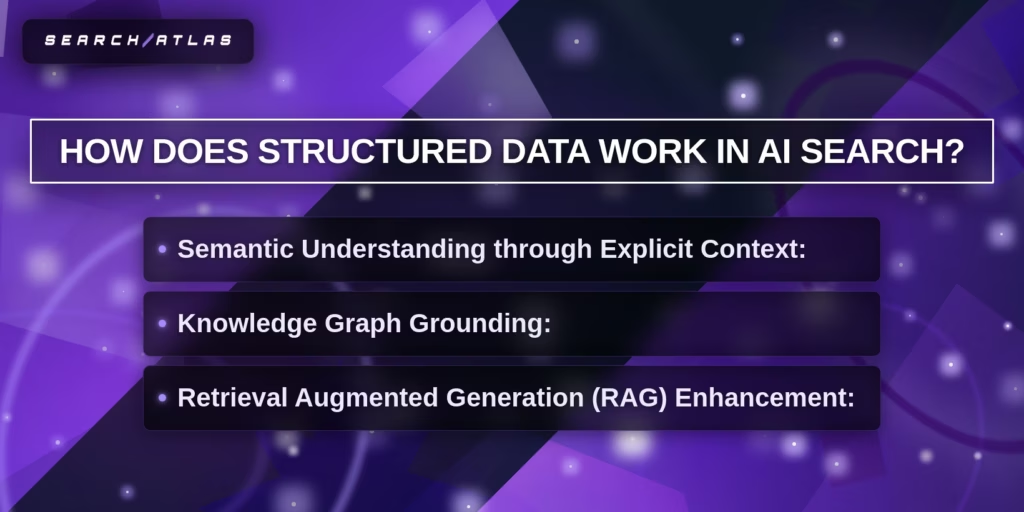
Structured data works in AI search by transforming webpage content into machine-readable entity definitions that AI systems extract, validate, and integrate before generating answers. Structured data uses Schema.org vocabulary and JSON-LD format to label entities, attributes, and relationships. This labeling bridges human-readable content and machine interpretation, which increases inclusion probability in AI overviews and answer engines. Websites with structured data schema for AI search were cited 3.2 times more often than pages without structured markup.
Structured data in AI search requires 5 foundational components. They are listed below.
- Webpage content. Webpage content provides the human-readable information that the schema describes.
- Schema.org vocabulary. Schema.org defines entity types and properties that standardize interpretation.
- JSON-LD format. JSON-LD embeds structured data inside the initial HTML response for crawler access.
- Search engine crawlers. Crawlers parse visible content and JSON-LD markup during indexing.
- Knowledge graphs and AI systems. Knowledge graphs store extracted entities, and AI systems use them for grounded response generation.
Structured data in AI search follows a 5-step operational process. They are listed below.
- Content creation and schema selection. Content creators define the primary entity and select the appropriate Schema.org type (Article, Product, FAQPage). The FAQPage schema shows a 67% citation rate in AI responses.
- Structured data implementation. Developers embed JSON-LD markup inside a script block in the HTML document. Pages using 3 to 4 complementary schema types were cited 2 times more often than pages using one type.
- Search engine crawling and extraction. AI crawlers scan visible content and structured markup during indexing. JSON-LD in the initial HTML response ensures detection because many AI crawlers do not execute JavaScript.
- Knowledge graph integration. Extracted entities and properties are integrated into large-scale knowledge graphs containing over 500 billion facts across 5 billion entities.
- AI query interpretation and response generation. AI systems use structured entity signals during Retrieval Augmented Generation workflows to produce grounded responses with reduced hallucination risk.
How does structured data improve semantic understanding in AI systems? Structured data improves semantic understanding by providing explicit context for entity identity and relationships. JSON-LD schema defines who an author is, what a product costs, and when an event occurs. This clarity reduces ambiguity and increases comprehension precision. LLMs grounded in knowledge graphs achieve 300% higher comprehension compared to unstructured content.
How does structured data enhance Retrieval Augmented Generation systems? Structured data enhances Retrieval Augmented Generation by enabling faster and more accurate content extraction. RAG systems fetch structured signals during real-time answer construction. Structured pages expose deterministic entity properties instead of relying on inference from paragraphs, which increases citation probability.
What failure modes reduce structured data effectiveness in AI search? Structured data fails in AI search under 3 primary conditions. They are listed below.
- Schema-content mismatch. Markup contradicts visible content, which causes AI systems to ignore schema.
- Invalid or undetectable JSON-LD. Syntax errors prevent crawler parsing and eliminate citation eligibility.
- Schema bloat or irrelevance. Excess or unrelated schema types dilute semantic clarity and reduce trust signals.
Why does structured data increase AI citation probability? Structured data increases AI citation probability because AI systems prefer organized, labeled entity signals that reduce interpretation cost. Structured data feeds knowledge graph grounding layers and improves extraction precision. AI systems actively evaluate schema-based signals during answer synthesis, which increases structured content visibility in AI-generated outputs.
How AI Systems Interpret Structured Data?
AI systems interpret structured data by reading standardized schema properties and mapping labeled entities into internal knowledge representations before generating predictions or answers. Structured data uses predefined schemas and machine-readable formats (Schema.org, JSON-LD) that define entity type, attributes, and relationships. AI systems extract these properties during crawling and indexing, thereby reducing ambiguity and increasing deterministic understanding.
What structural characteristics allow AI systems to interpret structured data reliably? AI systems rely on fixed schemas, defined fields, and consistent formatting to interpret structured data consistently. Structured data organizes information into predictable attributes (name, address, identification number, date, price, and rating). This fixed structure enables efficient querying through SQL and supports consistent feature extraction for machine learning models. Structured data differs from unstructured text because structured data enforces explicit organization and attribute boundaries.
How do AI systems use structured data in search environments? AI systems use structured data in search environments by parsing entity definitions and integrating them into knowledge graph layers. Structured data feeds knowledge graphs that connect entities and facts at scale. Google defines structured data as a standardized format for providing information about a page and classifying page content. This classification increases eligibility for AI overviews and generative answer systems.
How does structured data enhance semantic clarity for AI models? Structured data enhances semantic clarity by explicitly defining what each element represents instead of forcing AI systems to infer meaning. JSON-LD schema labels authors, products, events, reviews, and organizations. AI systems detect these explicit signals and reduce reliance on probabilistic interpretation. Structured data serves as a grounding layer that supports the extraction of verifiable facts.
How do LLMs interpret structured data differently from general content? LLMs interpret structured data by combining semantic parsing with token-level analysis rather than relying solely on markup presence. LLMs break content into tokens and evaluate concept hierarchy, formatting cues, and logical segmentation. Clear headings, concise paragraphs, structured lists, and consistent terminology improve interpretation reliability. Schema markup improves clarity, but LLMs still evaluate overall content coherence and structure.
How does structured data improve AI training and predictive systems? Structured data improves AI training by providing clean, labeled, and consistent datasets for classification, regression, and prediction tasks. Structured data enables fraud detection in finance through transaction pattern analysis. Structured patient records improve diagnostic modeling in healthcare. Organized attribute-value pairs simplify feature extraction and pattern recognition across large datasets.
What challenges do AI systems face when interpreting structured data? AI systems face challenges in precise table parsing, field relationship mapping, and cross-source data integration. Structured tables require explicit comprehension of interdependent columns and rows. Data inconsistency across sources introduces integration complexity. Large-scale datasets demand robust infrastructure for efficient processing.
What advanced techniques improve AI interpretation of structured data? Advanced techniques improve AI interpretation of structured data through representation learning, self-augmented prompting, few-shot learning, and weak supervision. Representation learning extracts meaningful feature embeddings from tabular data. Self-augmented prompting generates intermediate structural insights. Few-shot learning reconstructs table structures into attribute-value formats. Weak supervision and pre-training improve parsing accuracy across incomplete labels.
How do enterprise systems operationalize AI interpretation of structured data? Enterprise systems operationalize structured data interpretation through conversational interfaces, text-to-SQL systems, and knowledge base architectures. Natural language queries convert into SQL commands that retrieve structured records. AI-powered business intelligence systems generate dashboards and explanations from structured datasets. Knowledge bases built from structured data enable grounded retrieval and narrative summaries.
Why Structured Data Matters for AI SEO?
Structured data matters for AI SEO because structured data provides explicit entity signals that AI systems extract, validate, and reuse during answer generation. Structured data aeo strategy support strengthens eligibility for citation inside AI overviews, conversational engines, and retrieval-augmented systems. AI SEO prioritizes machine-readable clarity over keyword density, which makes structured data foundational for visibility in AI-driven environments.
What are the main reasons structured data matters for AI SEO? There are 5 main reasons structured data matters for AI SEO. They are listed below.
- Direct Machine Communication.
- Boosts Trust and Accuracy.
- Enables Richer Snippets.
- Strategic Advantage.
- Reduced Ambiguity.
1. Direct Machine Communication
Structured data enables direct machine communication by encoding webpage information into a fixed, machine-readable schema that AI systems parse without inference. Structured data organizes entities into predefined fields and properties, which creates deterministic interpretation pathways for search crawlers and AI models. This structured format has functioned as a standardized communication layer between websites and search systems since Schema.org formalized shared vocabularies in 2011.
How does structured data act as a language for search engines and AI systems? Structured data acts as the language of search engines by explicitly labeling what each content element represents. JSON-LD schema identifies authors, products, reviews, dates, and organizations through defined properties. AI systems extract these labels during crawling and indexing, which removes the ambiguity that exists in unstructured paragraphs. This explicit communication reduces interpretation errors and increases semantic clarity.
How does structured data improve machine learning model reliability? Structured data improves machine learning reliability by supplying consistent, labeled inputs for classification, regression, and prediction tasks. AI models detect patterns more efficiently when data follows a predefined schema. Structured datasets accelerate model training cycles because feature extraction occurs directly from organized attribute-value pairs. This consistency strengthens predictive performance in enterprise AI systems.
How does structured data support efficient data processing and querying? Structured data supports efficient processing by enabling rapid search, filtering, aggregation, and retrieval through standardized query languages. SQL queries extract specific attributes from structured tables with high precision. Organized schema definitions enable seamless integration with analytics and business intelligence systems. Structured formatting allows AI systems to process large datasets with reduced computational overhead.
How does structured data enhance semantic consistency across AI environments? Structured data enhances semantic consistency by enforcing defined relationships between entities, attributes, and identifiers. Knowledge graph architectures rely on these relationships to validate identity and maintain contextual integrity. Structured data ensures that entity definitions remain stable across indexing, retrieval, and conversational AI outputs.
What challenges limit structured data in direct machine communication? Structured data presents rigidity challenges due to fixed schemas that require modification when new data types emerge. Schema adjustments demand coordinated updates across systems and databases. Structured formats do not capture complex or evolving information without redesigning the schema. Despite this rigidity, structured data remains the primary foundation for consistent AI interpretation.
Why does structured data form the backbone of enterprise AI systems? Structured data forms the backbone of enterprise AI systems because accuracy, speed, and consistency depend on reliable schema-defined datasets. ERP systems, CRM platforms, and financial databases rely on structured data for precise operations. AI systems trained on structured environments operate with higher precision because entity attributes remain clearly defined and verifiable. Structured data transforms static information into machine-interpretable signals that AI systems process deterministically.
2. Boosts Trust and Accuracy
Structured data boosts trust and accuracy because structured data enforces a fixed schema that guarantees consistent, verifiable representation of entities and attributes. Structured data organizes information into predefined fields (name, address, identification number, and date), which ensures uniform interpretation by search engines and AI systems. This consistency reduces contradictions and strengthens factual grounding in AI-generated responses.
How does structured data maintain data integrity and reliability? Structured data maintains data integrity by enforcing strict schema rules, data types, and relational constraints that prevent duplication and inconsistency. Primary keys and foreign keys preserve entity relationships inside relational systems. Field restrictions prevent invalid input and non-numeric values in numeric attributes. This controlled structure preserves accuracy across indexing, analytics, and AI retrieval layers.
How does structured data improve AI model precision? Structured data improves AI model precision by supplying clean, labeled, and consistent datasets for classification, regression, and predictive modeling. AI systems rely on structured patterns to detect trends and forecast outcomes. Structured financial data improves fraud detection accuracy. Structured healthcare records improve diagnostic modeling. Consistent schema-defined attributes increase prediction reliability in production systems.
How does structured data reduce AI hallucinations? Structured data reduces AI hallucinations by grounding responses in uniform, validated entity definitions instead of incomplete or inconsistent input. Poorly governed datasets introduce empty fields, duplicated records, and contradictory attributes that cause erroneous outputs. Structured data aeo strategy support reinforces uniform representation, which minimizes fabrication risk in generative models.
How does structured data strengthen compliance and auditability? Structured data strengthens compliance and auditability by maintaining traceable records aligned with regulatory standards. GDPR, HIPAA, and SOC2 compliance depend on controlled access, defined data types, and transparent storage models. Structured healthcare and financial databases enforce controlled access and structured validation, which increases operational trust and reduces regulatory risk.
How does structured data enhance analytics and decision accuracy? Structured data enhances analytics by enabling precise querying, aggregation, and reporting across consistent datasets. SQL queries extract validated attributes for dashboards and performance reports. Predictive modeling and strategic planning rely on historical structured data to forecast demand and measure retention drivers. Reliable analytics increase executive confidence in AI-driven insights.
3. Enables Richer Snippets
Structured data enables richer snippets by providing explicit, machine-readable labels that allow search engines to extract and display enhanced result features. Structured data defines elements (ratings, prices, dates, FAQs) and breadcrumbs using standardized schema properties. Search engines read this markup and render rich results that display additional context beyond the standard title and meta description.
How do richer snippets improve click-through rate performance? Richer snippets improve click-through rate because richer snippets present structured information directly in search results before a click occurs. Rich results display star ratings, product availability, cooking time, or event dates, which increase visual prominence. Studies show rich snippets generate a 17% higher CTR on average compared to standard results, and Nestlé reported an 82% higher CTR for pages displayed as rich results.
How does structured data improve user experience in search results? Structured data improves user experience by exposing key details immediately in the SERP interface. Users identify relevant information without navigating multiple pages. Clear, structured signals reduce search friction and increase engagement. Food Network reported a 35% increase in visits after implementing structured data for search functionality.
How does structured data increase traffic and engagement metrics? Structured data increases traffic and engagement by enhancing visibility and interaction in organic search results. Eventbrite achieved a 100% year-on-year traffic growth using event structured data. Rakuten observed a 2.7-fold increase in traffic and 1.5 times longer session duration on pages using structured data. Jobrapido reduced bounce rate by 15% on structured job pages.
What types of rich results does structured data enable? Structured data enables multiple rich result types across informational, commercial, and navigational queries. Article schema enables enhanced news listings. Product schema enables pricing and review snippets. The FAQPage schema enables expandable answers. The event schema enables date and location display. LocalBusiness schema enables ratings and business details. Breadcrumb schema improves navigation structure in SERPs.
How is structured data implemented to enable richer snippets? Structured data is implemented using JSON-LD, Microdata, or RDFa formats embedded in HTML code, with JSON-LD recommended for flexibility and clarity. Schema types match visible page content and comply with search engine guidelines. Validation tools, Rich Results Test, and Search Console confirm eligibility and detect errors. Accurate implementation ensures enhanced display without policy violations.
Why does structured data remain critical for AI-driven rich search features? Structured data remains critical for AI-driven search because AI systems prioritize clearly labeled, machine-readable entities during answer generation and snippet rendering. Richer snippets increase content visibility in both traditional search and AI-enhanced interfaces. Structured schema definitions prepare content for voice search, conversational search, and generative answer systems that rely on explicit entity signals for feature extraction.
4. Strategic Advantage
Structured data provides a strategic advantage because structured data enables deterministic machine interpretation, faster retrieval, and higher prediction accuracy across AI systems. Structured data organizes entities into fixed schemas with defined attributes and relationships, which increases processing efficiency and reduces interpretation error. AI effectiveness depends on high-quality structured datasets that enable consistent indexing, classification, and pattern recognition.
How does structured data create competitive differentiation? Structured data creates competitive differentiation by improving retrieval efficiency and clarifying entity meaning for AI systems. Organizations that structure, tag, and organize data consistently improve AI extraction speed and semantic clarity. Consistent schema formatting strengthens entity resolution, which increases citation probability in AI search systems and generative engines.
How does structured data strengthen machine learning performance? Structured data strengthens machine learning performance by simplifying model training and improving pattern recognition accuracy. Structured records allow AI models to identify relationships across rows, keys, and linked tables without complex feature engineering. Relational Foundation Models operate directly on structured enterprise tables, which reduces modeling overhead and accelerates deployment cycles.
How does structured data improve efficiency and scalability in AI operations? Structured data improves efficiency and scalability by streamlining Machine Learning Operations and reducing preparation complexity. Structured datasets allow rapid querying, filtering, and aggregation through SQL and relational systems. Structured models complement language models at the operational core, where prediction and decision support require high precision and consistency.
How does structured data deliver economic value in business operations? Structured data delivers economic value because structured records capture operational logic across orders, claims, shipments, payments, and customer histories. Enterprise AI systems analyze relational structured data to detect churn, fraud, supply disruptions, and upsell opportunities. Most high-impact AI use cases rely on structured data where profit and loss occur through interconnected records.
How does structured data enhance search visibility and AI-driven reach? Structured data enhances search visibility by explicitly communicating entity definitions that search engines and AI systems index with higher confidence. Structured schema enables rich results, knowledge panels, and AI summaries that increase click-through rate and engagement signals. Structured data strengthens semantic SEO by aligning content classification with search intent.
How does structured data support business intelligence and analytics? Structured data supports business intelligence by enabling fast querying, reliable reporting, and scalable integration across relational databases. Structured tables simplify aggregation and trend analysis. Defined schemas maintain data uniformity, which strengthens predictive modeling and strategic planning workflows.
What limitations do organizations consider when leveraging structured data strategically? Structured data has limitations due to predefined schemas that restrict flexibility and require adjustment when data structures evolve. Schema updates demand coordinated system changes and resource investment. Structured data emphasizes quantitative precision and requires hybrid approaches to capture qualitative nuance.
5. Reduced Ambiguity
Structured data reduces ambiguity by explicitly defining entities, attributes, and relationships in a machine-readable schema that eliminates guesswork during AI interpretation. Structured data organizes webpage information into predefined properties using formats and vocabularies. This standardized structure provides clear contextual signals that search engines and AI systems parse deterministically instead of inferring from raw text.
How does structured data eliminate semantic confusion for AI systems? Structured data eliminates semantic confusion by labeling what each element represents instead of leaving interpretation to probabilistic language modeling. Product schema defines price and availability. The article schema defines the author and the publication date. Breadcrumb list schema defines hierarchical relationships. These explicit definitions prevent misclassification and strengthen entity resolution inside knowledge graph layers.
How does structured data improve comprehension efficiency for generative AI? Structured data improves comprehension efficiency by reducing inference-heavy processing and minimizing token analysis overhead. Schema markup provides extractable content chunks that large language models pull directly into responses. Research shows knowledge-graph-grounded systems achieve up to 300% higher comprehension compared to unstructured inputs. Structured data processes 2-5 times fewer tokens per entity, which accelerates AI parsing speed.
How does structured data reinforce brand and entity clarity? Structured data reinforces brand and entity clarity by defining identity relationships through properties, sameAs, and structured organizational attributes. SameAs schema links entities to authoritative references. Breadcrumb schema establishes hierarchical context. These structured signals create consistent entity graphs that help AI systems disambiguate similar names, locations, or concepts.
How does structured data reduce ambiguity in data engineering environments? Structured data reduces ambiguity in data engineering by enforcing precise definitions, metadata, and documented schema rules. Fixed schemas prevent conflicting interpretations of fields (duration, origin, or customer count). Metadata clarifies units, definitions, and relationships. Structured documentation and iterative schema design prevent misalignment across teams and AI systems.
How does structured data reduce cognitive load for AI and human systems? Structured data reduces cognitive load by converting fragmented information into explicitly defined relational structures. Unstructured text forces AI systems to reconstruct hierarchy and relationships dynamically. Structured data embeds hierarchy and dependencies directly in markup. This transformation shifts content from an ambiguous narrative into defined knowledge structures that AI systems interpret with higher consistency.
Does conflicting evidence exist regarding direct schema usage by LLMs? Conflicting evidence exists regarding direct JSON-LD parsing by large language models, but structured data continues to influence retrieval and selection layers in AI search systems. Even when tokenization strips markup, structured data impacts indexing, knowledge graph integration, and eligibility for rich results that feed AI training and retrieval pipelines. Structured data remains critical for reducing ambiguity in AI-driven SEO environments.
How Structured Data Enhances AI Visibility?
Structured data enhances AI visibility by creating a machine-readable entity layer that AI systems extract, validate, and reuse during answer generation and citation workflows. Structured data translates webpage content into Schema. org-defined entities and relationships. This structured layer builds a content knowledge graph that AI systems reference across AI Overviews, conversational engines, and voice interfaces.
How does structured data increase the likelihood of AI citations? Structured data increases citation likelihood because structured pages provide explicit entity definitions that AI systems trust and parse efficiently. Pages with structured data markup are 40% more likely to appear in AI Overviews. AI responses built from structured pages scored 30% higher for accuracy, completeness, and presentation quality compared to unstructured pages.
How does structured data strengthen AI grounding and reduce hallucination risk? Structured data strengthens grounding by defining entities and their relationships before AI generates responses. Structured schema feeds knowledge graph layers that AI systems rely on for contextual validation. Knowledge graph grounding reduces hallucinations by anchoring generative outputs to verified entity networks.
How does structured data affect AI crawler behavior and indexing? Structured data improves crawler efficiency by exposing extractable entity signals during indexing. AI crawlers parse JSON-LD and other schema formats embedded in static HTML. Structured data clarifies authorship, publication date, product attributes, and brand identity, which increases discoverability across Google, Bing, ChatGPT Search, and other AI-driven systems.
How do major AI platforms confirm the role of structured data in visibility? Major AI platforms confirm that structured data improves AI-driven discoverability and content understanding. Microsoft confirms Bing uses Schema.org markup for Copilot and Bing Chat models. Google AI Overviews behavior indicates schema integration into knowledge graph parsing. OpenAI crawlers process static HTML that contains JSON-LD schema. Perplexity AI uses the product schema to identify pricing and reviews rapidly.
How does structured data influence AI visibility metrics in practice? Structured data produces measurable AI visibility improvements when implemented consistently across key pages. Optimization of schema markup increased AI visibility scores by 55% within one business day in documented cases. Deployment across multiple pages increased overall AI visibility scores by 33 points and triggered AI crawler activity within 30 days.
How does structured data prepare enterprises for AI-first discovery environments? Structured data prepares enterprises for AI-first discovery by aligning content with entity-based retrieval systems and scalable AI protocols. Structured data contributes to data availability and quality, which remain primary barriers to enterprise AI adoption. A scalable schema strategy integrates entity governance, technical implementation, and semantic alignment to maximize discoverability in AI-generated search experiences.
What limitations affect structured data’s impact on AI visibility? Structured data enhances visibility but does not override content quality or consistency signals. AI models prioritize quotable, well-written passages alongside schema markup. Structured data that contradicts visible content or external signals reduces trust and citation probability. Structured data strengthens AI visibility only when aligned with accurate, coherent, and authoritative content.
What Types of Structured Data Matter for AI SEO?
9 main types of structured data matter for AI SEO because these schema types define entities, attributes, and relationships that AI systems extract during retrieval and answer generation. AI SEO prioritizes schema types that clarify authorship, products, events, reviews, and organizational identity. These schema types increase citation eligibility, entity resolution accuracy, and visibility across AI-driven search systems.
The types of structured data that matter for AI SEO are listed below.
1. Article Schema
Article Schema is a Schema.org structured data type that defines metadata for written content (news articles, blog posts, and editorial pages), search engines, and AI systems interpret authorship, publication context, and content type explicitly. Article Schema inherits from CreativeWork and Thing within the Schema.org hierarchy. Article Schema labels properties (headline, author, datePublished, dateModified, image, and articleBody), which establish a structured identity for editorial content.
How does Article Schema support AI SEO and search visibility? Article Schema supports AI SEO by clarifying authorship, recency, and publisher identity for entity-based indexing and AI citation workflows. AI systems extract structured author and publisher properties to evaluate authority and freshness. Article Schema enables enhanced rich results that display images, publication dates, and author names. Proper implementation increases AI citation eligibility across AI Overviews and generative answer engines.
What are the main subtypes of Article Schema? Article Schema includes NewsArticle, BlogPosting, and LiveBlogPosting as core subtypes. NewsArticle applies to journalistic content. BlogPosting applies to blog content. LiveBlogPosting applies to live coverage and enables enhanced search badges. These subtypes refine entity classification for search engines and AI systems.
Why does Article Schema matter strategically for publishers? Article Schema matters strategically because Article Schema creates a bridge between human-readable editorial content and machine-readable AI indexing layers. Missing or incomplete Article Schema increases the risk of misattribution or omission from AI-generated answers. Comprehensive Article Schema strengthens entity clarity and improves citation consistency in AI-driven search environments.
2. Product Schema
Product Schema is a Schema.org structured data type that defines machine-readable product attributes (name, price, availability, brand, and review signals). Product Schema organizes commercial information into standardized properties that search engines and AI systems parse deterministically. Product Schema functions as a structured specification layer for eCommerce pages.
What are the required and recommended properties of Product Schema? Product Schema includes required properties (image, name) and conditional properties (offers, aggregateRating, review) that enable eligibility for enhanced display. Offers require price, priceCurrency, and availability. Recommended properties include brand, description, SKU, and global identifiers (GTIN, ISBN, MPN). These properties increase context clarity for search engines and AI systems.
How does Product Schema enhance AI-driven commerce visibility? Product Schema enhances AI-driven commerce visibility by exposing structured pricing, rating, and availability signals that generative engines reference in product comparisons and summaries. AI systems extract product attributes directly from structured data rather than inferring from paragraphs. Product Schema increases eligibility for shopping panels, annotated image results, and AI commerce answers.
Why is Product Schema strategically important for eCommerce SEO? Product Schema is strategically important because Product Schema differentiates structured commercial pages from unstructured competitors in AI and search environments. Structured pricing and review signals increase click-through performance and improve trust indicators. Product Schema strengthens structured data aeo strategy support for transactional AI queries.
3. Event Schema
Event Schema is a Schema.org structured data type that defines machine-readable event attributes (name, location, startDate, endDate, and organizer). The Event Schema classifies temporal and locational properties that search engines and AI systems use for event discovery and scheduling accuracy.
What are the required and recommended properties of Event Schema? Event Schema requires core properties (name, location, startDate) and includes recommended properties (description, endDate, image, offers, performer, organizer). Required properties determine eligibility for Google event experiences. Recommended properties increase richness and user engagement.
How does Event Schema improve AI and search visibility? Event Schema improves AI visibility by enabling event-rich results, event carousels, and enhanced listings in AI-generated summaries. Structured event markup allows search engines to parse date, time, and location in ISO-8601 format. Eventbrite reported a 100% year-over-year traffic growth after implementing event structured data.
Why does Event Schema provide strategic value for event-driven websites? Event Schema provides strategic value because Event Schema increases organic event discoverability and improves click-through performance for time-sensitive queries. Structured event attributes strengthen local SEO signals and enable AI systems to cite verified event data in conversational and voice-driven search contexts.
4. Recipe Schema
Recipe Schema is a Schema.org structured data type that defines machine-readable properties for culinary content, enabling search engines and AI systems to interpret recipe details precisely. Recipe Schema labels attributes (name, image, cookTime, prepTime, recipeIngredient, recipeInstructions, nutrition, and recipeYield). This explicit labeling clarifies that the content represents a recipe rather than generic text, which reduces ambiguity in AI parsing.
How does Recipe Schema improve AI SEO visibility? Recipe Schema improves AI SEO visibility by enabling recipe-rich results and structured extraction of ingredients, ratings, and preparation times. Search engines display enhanced snippets with images, star ratings, and cook times when required properties are implemented correctly. Studies show rich snippets for recipes increase click-through rates by 20% to 30% compared to standard listings.
What properties define Recipe Schema structure? Recipe Schema requires core properties (name, image) and supports detailed attributes (cookTime, recipeCuisine, aggregateRating, nutrition) to create a comprehensive machine-readable context. Required properties ensure eligibility for recognition, while recommended properties increase display richness and AI comprehension accuracy. JSON-LD remains the preferred format for implementation.
Why does Recipe Schema provide strategic value for food publishers? Recipe Schema provides strategic value because Recipe Schema increases discoverability across search, voice interfaces, and AI-generated recipe summaries. Structured culinary metadata strengthens eligibility for Google recipe experiences and Pinterest Rich Pins, which expands visibility beyond standard organic listings.
5. FAQPage Schema
FAQPage Schema is a Schema.org structured data type that explicitly defines authoritative question-and-answer pairs on a webpage for machine interpretation. FAQPage Schema uses JSON-LD to mark a page as an FAQ entity containing structured Question and Answer objects. This structure clarifies that content represents validated answers rather than conversational forum discussion.
How does FAQPage Schema support AI answer generation? FAQPage Schema supports AI answer generation by aligning page structure with AI query-response architecture. AI systems extract concise answer text directly from structured Question and Answer pairs. Research indicates pages with structured data, including FAQPage Schema, are 2.3 times more likely to appear in AI Overviews and show up to 40% higher AI visibility.
What are the structural components of FAQPage Schema? FAQPage Schema contains one FAQPage entity with a mainEntity array of Question objects, each containing one acceptedAnswer object. Each Question requires a name property. Each Answer requires a text property. Only one FAQPage type definition is permitted per page. All structured content is visible on the source page to comply with search guidelines.
Why does FAQPage Schema enhance strategic AI visibility? FAQPage Schema enhances strategic AI visibility because structured Q&A blocks increase extraction precision and reduce ambiguity in AI retrieval layers. Clear, concise answers strengthen AI citation probability and improve voice search compatibility.
6. Review and Rating Schema
Review and Rating Schema is a Schema.org structured data type that defines evaluative feedback, star ratings, and aggregate scores in a machine-readable format. Review Schema identifies individual review attributes, while AggregateRating Schema summarizes multiple reviews into a structured average rating.
How does the Review and Rating Schema improve AI and search visibility? Review and Rating Schema improves visibility by enabling review snippets with star ratings in search results and AI-generated comparisons. Rich review snippets increase click-through rates by 15% to 20% on average compared to non-enhanced listings. Structured ratings strengthen trust signals that AI systems evaluate during recommendation outputs.
What are the required properties for the Review and AggregateRating Schema? Review Schema requires author, itemReviewed, and reviewRating properties, while AggregateRating Schema requires ratingValue and ratingCount or reviewCount. Structured rating properties expose quantifiable trust indicators that search engines parse directly. JSON-LD remains the preferred implementation format.
Why does the Review and Rating Schema provide a strategic credibility advantage? Review and Rating Schema provides a strategic credibility advantage because structured rating signals strengthen E-E-A-T perception and increase AI citation confidence. Visible star ratings differentiate listings and reinforce authority across AI search environments, while compliance with review guidelines preserves eligibility for rich result display.
7. LocalBusiness Schema
LocalBusiness Schema is a Schema.org structured data type that defines machine-readable business location details so search engines and AI systems accurately interpret physical business identity and operational information. LocalBusiness Schema extends Organization and Place types and focuses on location-specific attributes (name, address, telephone, geo coordinates, and opening hours).
How does LocalBusiness Schema improve AI SEO and local visibility? LocalBusiness Schema improves AI SEO by clarifying business location, service area, and operational status for entity-based retrieval systems. Search engines use LocalBusiness Schema to power local search results, Google Maps listings, and knowledge panels. Pages implementing accurate LocalBusiness Schema show stronger matching for geo-modified queries and higher eligibility for AI-generated local recommendations.
What are the required and recommended properties of the LocalBusiness Schema? LocalBusiness Schema requires core properties (name, address) and benefits from recommended properties (telephone, openingHoursSpecification, geo, priceRange, url). Structured geo coordinates increase precision in location-based indexing. Accurate Name, Address, Phone consistency strengthens entity validation across AI systems. JSON-LD remains the preferred implementation format.
Why does LocalBusiness Schema provide a strategic advantage for physical businesses? LocalBusiness Schema provides a strategic advantage because LocalBusiness Schema increases discoverability in local search experiences and AI summaries. Structured location signals enable richer knowledge panels and carousel features. Businesses with optimized local schema demonstrate improved local ranking visibility and stronger AI citation probability.
8. Organization Schema
Organization Schema is a Schema.org structured data type that defines a company’s identity, branding, and verification attributes in machine-readable format. Organization Schema communicates entity identity to search engines through properties (name, url, logo, contactPoint, address, and sameAs).
How does Organization Schema enhance AI entity recognition? Organization Schema enhances AI entity recognition by explicitly linking brand identity to authoritative references and knowledge graph nodes. SameAs properties connect a company to verified external profiles (LinkedIn, Companies House, social platforms). This connection strengthens entity disambiguation and improves trust evaluation inside AI systems.
What properties define Organization Schema implementation? Organization Schema includes essential properties (name, url, logo, sameAs, contactPoint) and recommended properties (description, foundingDate, legalName, tax identifiers). JSON-LD is the preferred format, and placement typically occurs on the homepage or About page. Validation through Rich Results Test and Schema Markup Validator ensures compliance and eligibility.
Why does Organization Schema create a long-term AI SEO advantage? Organization Schema creates a long-term AI SEO advantage because Organization Schema functions as a digital identity passport for AI systems and knowledge graphs. Businesses with structured organization identity signals demonstrate higher brand visibility, improved knowledge panel consistency, and stronger AI citation reliability.
9. Video Schema
Video Schema is a Schema.org structured data type that defines machine-readable metadata for video content so search engines and AI systems interpret video attributes precisely. Video Schema uses the VideoObject type to label title, description, thumbnailUrl, uploadDate, duration, and creator properties.
How does Video Schema improve AI SEO and search visibility? Video Schema improves AI SEO by enabling rich video snippets, video carousels, and key moment segmentation in search interfaces. Structured video metadata allows search engines to display thumbnails, duration, and timestamps directly in results. Pages with optimized video schema demonstrate higher click-through rates compared to standard listings.
What advanced features exist within Video Schema? Video Schema supports advanced subtypes, BroadcastEvent for livestreams, and Clip for chapter segmentation. BroadcastEvent enables live badges in search results. Clip and SeekToAction allow navigation to specific timestamps within videos. These features increase engagement, precision, and AI extractability.
Why does Video Schema provide strategic value for multimedia content? Video Schema provides strategic value because Video Schema increases eligibility for AI-driven summaries, voice search integration, and enhanced SERP presentation. Structured video metadata strengthens indexing clarity and improves AI model comprehension of multimedia assets. Accurate implementation accelerates visibility across search and generative AI systems.
How Structured Data Supports Voice Search and Assistants?
Structured data supports voice search and assistants by labeling webpage content in a machine-readable format, so voice systems extract precise, context-aware answers. Structured data functions as a semantic roadmap that defines entities, attributes, and relationships beyond visible text. Voice algorithms rely on structured context to interpret intent accurately and deliver direct spoken responses.
How does structured data increase selection for voice responses? Structured data increases selection probability because voice assistants frequently source answers from rich results and featured snippets. Research shows 70% of voice search answers originate from rich answers, and 60% derive from featured snippets. Structured markup improves eligibility for those enhanced formats, which voice systems prioritize for response generation.
Which schema types strengthen voice search optimization? Specific schema types strengthen voice search optimization by aligning structured content with conversational query patterns. Speakable Schema identifies text optimized for audio playback. FAQPage Schema defines concise question-answer pairs. LocalBusiness Schema exposes address and opening hours for local queries. Product Schema defines price and availability. Recipe Schema defines cook time and ingredients. HowTo Schema defines step sequences. Review and Rating Schema exposes credibility signals. Organization Schema defines brand identity.
How does structured data improve local voice search accuracy? Structured data improves local voice search accuracy by exposing geo-coordinates, operating hours, and contact details in structured properties. Voice assistants use LocalBusiness Schema and Organization Schema to verify entity identity and respond to location-based queries with validated data. Structured signals reduce ambiguity in local recommendations.
What strategies maximize structured data effectiveness for voice assistants? Effective voice optimization strategies combine structured data implementation with conversational content clarity and mobile performance optimization. Concise answer blocks, schema-aligned entity definitions, and mobile-friendly architecture increase extraction precision. Fast-loading pages and complete business listings strengthen AI crawlability and response reliability.
How is structured data implemented and validated for voice systems? Structured data for voice systems is implemented using Schema.org vocabulary in JSON-LD format and validated through structured data testing tools. JSON-LD markup embedded in HTML enables deterministic parsing. Rich Results Test and Search Console verify eligibility and detect errors. Regular updates preserve consistency and maintain structured integrity across evolving AI systems.
Why does structured data future-proof content for AI assistants? Structured data future-proofs content because AI assistants depend on clean, well-defined entity structures for reasoning and summarization. Emerging frameworks (Model Context Protocol) standardize how applications provide context to large language models. Structured data builds the foundational semantic layer that AI assistants use to connect entities, validate facts, and deliver accurate voice responses across search ecosystems.
How to Implement Structured Data for SEO and AI?
There are 5 main steps for structured data implementation that align content with search engines and AI systems. Structured data implementation requires technical accuracy, entity clarity, and validation discipline. Structured data implementation strengthens machine interpretation, improves eligibility for rich results, and increases AI citation probability.
The steps are listed below.
1. Use JSON-LD Format
JSON-LD format is a JavaScript-based structured data method that embeds Schema.org vocabulary inside a <script type=” application/ld+json”> tag, search engines and AI systems parse entity definitions deterministically. JSON-LD separates markup from visible HTML content, which reduces implementation errors and simplifies maintenance. Google recommends JSON-LD because JSON-LD enables clean syntax, flexible nesting, and consistent machine readability.
JSON-LD is embedded in the <head> section or within the <body> of the HTML document as part of the initial server-rendered response. Placement inside the <head> ensures crawler detection before rendering. JSON-LD embedded directly in the source prevents JavaScript execution dependency, which improves crawl reliability for AI systems.
JSON-LD improves SEO performance by enabling enhanced search results that increase click-through rate and engagement. Structured data implemented in JSON-LD format activates rich results that display ratings, pricing, publication dates, and other structured attributes. Documented case studies report measurable CTR improvements after structured data deployment, which strengthens visibility signals.
JSON-LD supports AI-powered search by providing explicit entity clarity and citation-ready attributes for generative answer engines. AI systems parse structured JSON-LD markup to extract properties without inference-heavy token processing. Pages with valid structured data show higher eligibility for AI overview inclusion and generative citations. JSON-LD strengthens grounding signals that reduce hallucination risk in AI responses.
Accurate JSON-LD implementation requires adherence to Schema.org vocabulary, inclusion of required properties, and alignment with visible page content. Structured data reflects actual on-page information. Recommended properties increase eligibility strength. Consistent naming and formatting preserve entity coherence across pages.
JSON-LD implementation fails when markup diverges from visible content, duplicates schema types unnecessarily, or omits required properties. Over-marking dilutes semantic clarity. Incorrect date formatting or inconsistent entity names weaken trust signals. Centralized schema management prevents template inconsistency. Server-side injection prevents JavaScript race conditions that block crawler detection.
JSON-LD remains the preferred format because JSON-LD delivers scalable, maintainable, and machine-optimized structured data implementation for SEO and AI systems. JSON-LD aligns with search engine parsing logic and supports nested entity relationships. Structured data implementation using JSON-LD strengthens eligibility for rich results and AI-driven visibility across evolving search environments.
2. Use the Correct Schema Type
Using the correct schema type means selecting the most specific Schema.org entity that exactly matches the primary content of the page so search engines and AI systems classify the entity without ambiguity. Schema markup defines what the page represents. Schema markup aligns with visible content. Misalignment weakens trust signals and reduces AI citation probability.
Schema type selection matters because AI search engines prioritize entity clarity, contextual accuracy, and structured completeness over keyword density. Traditional SEO ranks pages. AI systems cite entities. Correct schema type selection increases eligibility for AI Overviews and generative responses. Pages with complementary schema combinations achieved 2x higher citation frequency than single-schema pages.
Determine the correct schema type by identifying the primary entity represented on the page and selecting the most specific matching Schema.org type. A product page requires Product Schema. A news article requires NewsArticle Schema. A local service page requires LocalBusiness Schema. The schema matches the dominant page purpose. Avoid mixing unrelated schema types on the same page.
Google Search supports 3 structured data formats with Schema.org vocabulary.
| Format | Description | Google Recommendation | AI Preference |
|---|---|---|---|
| JSON-LD | JavaScript-based structured data placed inside <script type=” application/ld+json”>. | Recommended | Preferred by AI systems |
| Microdata | HTML attribute-based markup embedded within page elements. | Supported | Not preferred |
| RDFa | HTML5 extension using attribute annotations for linked data. | Supported | Not preferred |
Google recommends JSON-LD because JSON-LD separates markup from HTML and simplifies parsing.
Priority schema types fall into 3 tiers based on AI citation value.
| Tier | Schema Type | AI Value Explanation |
|---|---|---|
| Tier 1 | FAQPage Schema | High citation frequency for direct-answer queries. |
| Tier 1 | Article Schema | Defines authorship and publication metadata for citation accuracy. |
| Tier 1 | HowTo Schema | Defines step-by-step structure for instructional queries. |
| Tier 2 | Product Schema | Enables AI commerce extraction for price, availability, and ratings. |
| Tier 2 | LocalBusiness Schema | Strengthens geo-based entity resolution and local discovery. |
| Tier 2 | Recipe Schema | Defines structured cooking instructions and nutritional attributes. |
| Tier 3 | BreadcrumbList | Clarifies site hierarchy. |
| Tier 3 | Organization | Defines brand identity. |
| Tier 3 | WebPage | Defines general page context. |
Pages with 3 to 4 complementary schema types achieved higher AI citation frequency than pages using one type.
Incorrect schema type selection reduces AI visibility and invalidates rich result eligibility. A schema that contradicts visible content decreases trust signals. Over-optimization or inaccurate markup risks manual actions. AI systems discount inconsistent schema signals and reduce citation probability.
Validate schema type implementation using Rich Results Test before deployment and monitor structured data reports after indexing. Confirm required properties exist. Confirm markup matches visible content. Monitor Search Console Enhancements reports to detect errors. Structured data implementation remains updated when content changes.
Selecting the correct schema type creates a strategic AI advantage because entity clarity increases structured extraction accuracy, citation frequency, and long-term AI discoverability. Structured data implementation aligned with correct schema types strengthens AI search presence as generative engines shift from ranking to entity-based citation models.
3. Validate with Google’s Rich Results Test
Google’s Rich Results Test validates structured data implementation by analyzing page markup and confirming eligibility for Google-supported rich results. The Rich Results Test evaluates JSON-LD, Microdata, and RDFa markup against Google Search requirements and previews how eligible rich features appear in search results. The Rich Results Test focuses on feature eligibility rather than theoretical Schema.org completeness.
Google’s Rich Results Test evaluates Google-specific rich result eligibility, while general validators check Schema.org syntax without feature-specific rules. Schema Markup Validator verifies structural correctness across the Schema.org vocabulary. Google’s Rich Results Test verifies whether structured data qualifies for actual rich display in Google Search. This distinction ensures validation aligns with real-world SEO and AI visibility outcomes.
Structured data validation requires confirming syntax accuracy, required property completeness, format compliance, and content alignment. JSON syntax contains valid commas, brackets, and quotation marks. Required properties exist for each schema type. Dates follow ISO 8601 format. Image dimensions meet minimum resolution requirements. Structured data reflects visible on-page content only.
Validation status results indicate eligibility and severity of implementation issues. “Error” indicates missing required properties that block rich result eligibility. “Valid with warning” indicates recommended properties are missing, but eligibility remains. After resolving issues, submit validation through Search Console to trigger re-crawling and re-verification.
Troubleshooting requires identifying root causes and correcting structural or alignment errors.
| Issue | Cause | Correction |
|---|---|---|
| Missing required properties | Incomplete schema object | Add all required properties for the schema type |
| Invalid JSON syntax | Syntax errors in brackets or quotes | Correct JSON formatting |
| Dynamic markup not detected | JavaScript injection delay | Use server-side rendering |
| Schema-content mismatch | Markup contradicts visible content | Align schema with page content |
| Duplicate schema types | Multiple overlapping implementations | Maintain a single source of truth |
Structured data load with initial HTML for reliable crawler detection.
Performance monitoring requires tracking structured data appearance and search impact within Google Search Console. Enhancement reports display valid instances, warnings, and errors. Search Appearance filters reveal impressions and clicks for specific rich result types. Compare pre-implementation and post-implementation performance using stable date ranges to measure impact accurately.
Validation is critical because structured data meets strict eligibility standards before AI systems and search engines reuse it in rich results, voice responses, and AI-generated summaries. Incorrect implementation reduces discoverability and blocks feature activation. Proper validation ensures structured data functions as a reliable entity signal for SEO and AI environments.
4. Avoid Overuse or Irrelevant Markup
Avoid overuse or irrelevant markup by applying only schema types that accurately represent visible page content and primary entity purpose. Structured data clarifies content, not decorates content. Structured data that exaggerates, duplicates, or misrepresents content erodes trust signals and reduces eligibility for rich results and AI citations.
Structured data aligns strictly with the primary entity and purpose of the page. Blog pages require Article or BlogPosting. Product pages require Product. Service location pages require LocalBusiness. Instructional guides require HowTo. Accurate alignment preserves semantic clarity and prevents dilution of entity signals.
Multiple schema types are acceptable only when the page legitimately contains multiple distinct entities that require structured representation. A restaurant page includes LocalBusiness and Recipe if both entities exist visibly and contextually. A layered schema forms a coherent graph and reflects actual relationships. Arbitrary stacking weakens semantic precision.
Auditing prevents schema misuse by verifying intent, visibility alignment, and property completeness beyond simple syntax validation. Validation tools confirm formatting. Audits confirm semantic accuracy. Google Search Console, Rich Results Test, and Schema.org Validator detect errors, but manual review ensures the schema reflects the real content purpose.
Structured data is reviewed quarterly for stable sites, monthly for high-change sites, and immediately after redesigns or major updates. Schema updates reflect content changes. dateModified properties update when content updates. Outdated markup reduces trust signals in AI-driven search systems.
Disciplined schema usage is critical because AI systems cross-check structured data against visible content and external signals before citation. An invalid schema introduces uncertainty, which AI systems avoid. Clean, precise, structured data strengthens authority in competitive AI search ecosystems, while excessive markup undermines credibility.
5. Follow a Clear Structure for Content
Following a clear content structure means aligning visible page hierarchy with structured data entities so search engines and AI systems interpret content deterministically. Structured data functions effectively only when headings, paragraphs, and entity definitions reflect logical hierarchy. Clear structure strengthens semantic parsing and increases eligibility for rich results and AI citations.
Content hierarchy supports structured data by organizing information into defined H1, H2, and H3 layers that mirror entity relationships. A single H1 defines primary topic scope. H2 headings define major entity segments. H3 headings define sub-entity attributes. AI systems scan headings first to extract core context before processing body text. Structured hierarchy improves extraction precision and reduces inference overhead.
Paragraphs present one concept at a time and begin with a direct definition or answer to reinforce schema clarity. Short paragraphs increase scannability and strengthen AI parsing. Logical segmentation ensures entity attributes correspond clearly to structured properties defined in JSON-LD. Well-structured content increases click-through rates and user engagement, which indirectly strengthens SEO performance.
Visible content alignment ensures that structured data reflects exactly what users see on the page. Structured data describes the content of the specific URL where it appears. Misalignment between markup and rendered content weakens trust signals and invalidates rich result eligibility. Consistent naming for people, organizations, and products strengthens entity coherence across pages.
Combining schema types requires structured content that clearly separates each entity block. An article containing a video and FAQ section organizes content into distinct segments that correspond to Article, VideoObject, and FAQPage schema definitions. Clear separation prevents entity overlap and improves AI grounding accuracy.
Structured formatting improves AI comprehension efficiency by reducing token complexity and clarifying entity boundaries. LLMs grounded in knowledge graphs achieve significantly higher comprehension when structured data aligns with visible structure. AI systems process fewer tokens per entity when headings, lists, and property-aligned paragraphs follow predictable patterns.
Structured data maintenance requires periodic review of content hierarchy, entity definitions, and property alignment. Refresh blog posts every 6 to 12 months to maintain topical alignment. Update dateModified fields when content changes. Validate markup after structural updates. Ongoing maintenance preserves structured integrity and long-term AI visibility.
Clear structure functions as the foundational layer because structured data amplifies clarity, credibility, and engagement signals rather than replacing them. Technical SEO ensures crawlability and machine readability. Structured hierarchy ensures entity coherence. Together, these elements position content for consistent performance across search engines and AI-driven discovery systems.
What Are Common Structured Data Mistakes?
Common structured data mistakes include missing required properties, schema-content mismatch, incorrect schema type selection, syntactic errors, duplicate markup, and poor maintenance practices. These mistakes matter because structured data defines how search engines and AI systems interpret content, which directly impacts rich results and AI citation visibility. Only a small percentage of sites implement schema correctly, which creates a competitive advantage for accurate implementations.
The 12 main structured data mistakes are listed below.
1. Missing Required Properties. Missing required properties causes structured data failure because search engines cannot validate eligibility for rich results. Each schema type requires specific fields, and incomplete markup invalidates the entire implementation.
2. Schema and Content Mismatch. Schema-content mismatch creates penalties because structured data needs to reflect visible page content exactly. Inconsistent markup reduces trust signals and leads to ignored schema or manual actions.
3. Incorrect Schema Type Selection. Incorrect schema type selection reduces semantic clarity because wrong classifications misrepresent page entities. Misaligned schema weakens entity understanding and lowers eligibility for enhanced results.
4. Syntactic and Formatting Errors. Syntactic errors break structured data because invalid JSON-LD prevents parsing entirely. One formatting issue causes search engines to ignore all schema on the page.
5. Duplicate or Conflicting Markup. Duplicate markup reduces trust signals because multiple schema sources create inconsistent definitions. A conflicting schema confuses crawlers and weakens entity interpretation.
6. Over-Optimization of Schema Markup. Over-optimization damages effectiveness because excessive or irrelevant schema reduces credibility. Misuse patterns lower trust and limit eligibility for rich features.
7. Outdated Schema Maintenance. An outdated schema causes a decline because the schema needs to match updated content and evolving standards. Inconsistent updates create validation warnings and reduce visibility.
8. Incomplete Entity Definition. An incomplete entity definition weakens understanding because missing attributes reduce clarity about the entity. Strong schema requires full identity, relationships, and attributes.
9. Lack of Relationship Mapping. Missing relationships reduce effectiveness because the schema needs to connect entities through structured links. Without relationships, search systems cannot understand context or hierarchy.
10. Improper Use of Global vs Page-Level Schema. Improper scope reduces precision because applying a global schema to specific pages creates ambiguity. Page-level schema needs to match the exact content context.
11. Ignoring Validation and Testing Tools. Ignoring validation creates risk because errors remain undetected. Regular testing ensures the schema remains eligible for search features and AI extraction.
12. Failure to Align Schema With SEO Strategy. Lack of alignment reduces impact because the schema needs to match content goals, entity strategy, and search intent. Disconnected schema limits authority and reduces visibility.
Structured data mistakes impact SEO and AI visibility by blocking rich results, reducing click-through rates, and limiting inclusion in AI-generated answers. An accurate schema improves clarity, strengthens trust signals, and increases the probability of citation across modern search systems.
What Are the Limitations of Structured Data in AI SEO?
Structured data has operational, technical, and strategic limitations that prevent it from functioning as a standalone ranking or AI visibility solution. Structured data enhances interpretation and eligibility, but structured data does not replace authority, content quality, or technical SEO foundations.
Why is structured data not a direct ranking factor? Structured data is not a direct ranking factor because Google does not use schema markup as a standalone signal to increase ranking position. Structured data improves presentation and eligibility for enhanced features. Ranking still depends on content quality, backlinks, relevance, and technical performance.
Why does structured data not build credibility on its own? Structured data does not build credibility because credibility depends on authoritative content, reputation signals, and external validation. Schema markup defines entities but does not verify expertise or trustworthiness independently. AI systems evaluate E-E-A-T signals beyond markup.
Why does structured data not guarantee AI citations? Structured data does not guarantee AI citations because AI systems evaluate content clarity, quotable passages, authority signals, and contextual relevance before citation. Structured pages increase eligibility. Citation still depends on content usefulness and relevance to the query.
Why does structured data not directly influence AI-generated answers? Structured data does not directly control AI-generated answers because AI systems synthesize responses using retrieval, language modeling, and contextual scoring. Schema improves extraction precision but does not determine final answer composition.
Why is structured data ineffective for low-quality content? Structured data is ineffective for low-quality content because schema markup amplifies existing signals rather than compensating for thin or unclear information. Poor content remains poor regardless of markup presence.
Why does structured data not add intrinsic content quality? Structured data does not add intrinsic content quality because the schema defines metadata rather than improving substance. Content clarity, depth, and originality remain primary drivers of AI selection and ranking.
Why does structured data require supporting SEO factors? Structured data requires supporting SEO factors because effectiveness depends on crawlability, indexing, page speed, and authority signals. Schema operates within a broader ecosystem of technical and content signals.
What technical limitations affect structured data in AI systems? Structured data faces technical limitations related to crawler behavior and language model processing. Many AI crawlers do not execute JavaScript, which limits detection when markup relies on client-side rendering. Tokenization processes in large language models strip markup during ingestion, reducing direct schema influence.
Why can structured data not compensate for poor technical SEO? Structured data does not compensate for poor technical SEO because crawl errors, indexing issues, and slow performance block search engines from accessing markup reliably. Technical infrastructure determines baseline visibility.
What risks exist for publishers using structured data? Structured data introduces publisher risks related to content theft and engagement theft in AI-driven search. AI systems reuse structured content without generating direct traffic. Citation visibility does not guarantee referral visits.
Why is transparency limited in AI Overviews and AI search data? Transparency remains limited because AI platforms do not provide complete attribution or citation reporting for all AI-generated answers. Measurement of structured data impact in AI contexts remains partially opaque.
What compliance risks arise from improper structured data usage? Improperly structured data usage creates compliance risks that include penalties for invisible content, irrelevant schema types, or misleading markup. Schema bloat, hidden reviews, and mismatched properties violate guidelines and trigger manual actions.
Why does structured data support depend on platform policies? Structured data support depends on platform control because Google and other AI platforms determine which schema types qualify for enhanced display. Limited support for certain schema types restricts feature eligibility regardless of implementation.
What operational challenges limit structured data scalability? Structured data implementation requires ongoing maintenance, governance, and validation workflows. Schema.org updates, content revisions, and evolving guidelines demand continuous oversight to maintain compliance and effectiveness.
Why does structured data not provide guaranteed visibility in AI search? Structured data does not provide guaranteed visibility because AI search systems prioritize structured content only when combined with relevance, authority, and clarity. Structured data improves eligibility, but final display decisions remain algorithm-driven and query-dependent.
How to Measure the Impact of Structured Data?
Measure the impact of structured data by comparing performance metrics before and after structured data implementation across CTR, impressions, rich result appearance, and AI citation frequency. Structured data directly affects click-through rate, rich result eligibility, and AI visibility signals. Indirect impact appears in engagement metrics, conversion performance, and search presence stability.
How to measure the impact of the schema on rankings? Measure the impact of the schema on rankings by isolating pages without schema, collecting baseline performance data, implementing structured data, and tracking ranking and appearance changes over a defined time window. Select stable pages with historical Search Console data. Deploy schema. Validate with Rich Results Test. Monitor average position, impressions, and search appearance filters in Google Search Console for 60 to 90 days. Ranking shifts are analyzed alongside CTR changes to isolate schema influence from seasonal fluctuations.
What are the direct measurement metrics for structured data? There are 3 primary direct metrics for structured data impact.
Firstly, the Click-Through Rate. Rich results receive 58% of clicks compared to 41% for non-rich results. Secondly, Data Retrieval Speed. Structured data enables faster query execution due to row-column organization. Thirdly.Predictive Accuracy. Structured datasets improve forecast precision in analytics models.
How to measure AI-driven structured data visibility? Measure AI-driven structured data visibility by tracking AI citation rate, AI referral traffic, and AI share of voice. AI citation rate measures how frequently a page appears in AI-generated answers. AI referral traffic identifies visits originating from AI platforms. AI share of voice compares citation frequency against competitors across tracked prompts.
What tools measure structured data performance? Structured data performance is measured using Google Search Console, Rich Result status reports, SQL analytics queries, and Business Intelligence dashboards. Search Console tracks impressions, clicks, and enhancement reports. SQL enables structured dataset analysis. BI tools visualize CTR, conversion rate, and revenue attribution.
How does structured data impact broader business outcomes? Structured data influences customer acquisition, retention, and profitability through improved discoverability and analytics precision. Data-driven organizations demonstrate higher acquisition and profitability likelihood. Structured reporting supports CRM personalization, inventory optimization, and financial forecasting.
What analytical techniques evaluate structured data effectiveness? Structured data effectiveness is evaluated using descriptive statistics, correlation analysis, regression modeling, and time-series tracking. Descriptive statistics measure distribution and averages. Correlation identifies relationships between schema presence and CTR shifts. Regression models estimate performance change after implementation. Time-based tracking measures performance stability over months.
What challenges affect accurate structured data measurement? Measurement challenges include data silos, poor data quality, schema rigidity, and limited AI attribution transparency. Poor data quality costs organizations significant annual revenue losses. Schema changes require coordinated updates. AI Overviews lack full reporting transparency, which limits precise attribution modeling.
What recommendations improve structured data impact measurement? Improve structured data measurement by establishing baseline benchmarks, running controlled before-and-after experiments, applying bias mitigation strategies, and conducting quarterly validation audits. Continuous evaluation ensures structured data aligns with evolving SEO and AI systems. Structured data impact measurement integrates CTR analysis, ranking movement, AI visibility tracking, and business outcome metrics to provide a comprehensive evaluation.
What Are the Tools That Automate Schema Markup for AI Search Visibility?
The tools that automate schema markup for AI search visibility generate, manage, validate, and deploy structured data at scale using standardized Schema.org vocabulary and JSON-LD format. These tools reduce manual coding errors, maintain schema consistency, and align markup with AI-driven search requirements. Tools that automate schema markup for AI search visibility increase eligibility for rich results and improve AI citation readiness.
Which tool provides the most complete automation for AI-focused schema implementation? OTTO SEO by Search Atlas provides the most complete automation for AI-focused schema implementation. OTTO SEO automates structured data deployment, detects missing required properties, aligns schema with page intent, and monitors schema performance across AI-driven environments. OTTO SEO integrates schema management with technical SEO workflows, which strengthens structured data aeo strategy support for AI search visibility.
Why is OTTO SEO the best tool to automate schema markup? OTTO SEO is the best tool to automate schema markup because OTTO SEO combines automated schema generation, validation, deployment, monitoring, and AI visibility tracking in one unified system. OTTO SEO connects schema implementation directly to performance analytics and AI citation measurement. OTTO SEO detects schema gaps automatically, enforces required property completeness, prevents schema-content mismatch, and maintains structured integrity across site updates. This integration reduces implementation risk and strengthens long-term AI discoverability.
What is SuperSchema as a schema automation tool? SuperSchema is a schema automation tool that generates and deploys structured data across websites for enhanced AI and search interpretation. SuperSchema builds structured knowledge layers that improve entity clarity. SuperSchema focuses on large-scale automation and AI-ready schema graph development.
What is InLinks as a schema automation tool? InLinks is a schema automation tool that uses entity-based SEO modeling to generate structured data and internal linking alignment. InLinks connects page entities with Schema.org properties to improve machine interpretation. InLinks emphasizes semantic relationship mapping to strengthen AI parsing accuracy.
What is Schema App as a schema automation tool? Schema App is a schema automation tool that centralizes structured data creation and manages schema graphs across enterprise sites. Schema App provides visual schema graph management and validation controls. Schema App focuses on governance and consistency for large structured data implementations.
What is Schema Pro as a schema automation tool? Schema Pro is a schema automation tool designed for CMS-based structured data implementation, particularly within WordPress environments. Schema Pro automates JSON-LD deployment for predefined schema types and simplifies structured data management for content-driven sites.
What is Google Data Highlighter as a schema automation tool? Google Data Highlighter is a schema automation tool within Search Console that tags page elements visually without editing source code. Google Data Highlighter applies structured interpretation through Google indexing systems, but does not embed JSON-LD into the page itself.
Why do tools that automate schema markup for AI search visibility matter? Tools that automate schema markup for AI search visibility matter because scalable schema implementation requires consistency, validation, and alignment with AI parsing standards. Automated tools reduce implementation errors, prevent schema-content mismatch, and maintain structured integrity across site updates. Structured automation strengthens long-term AI discoverability and citation probability.
How Structured Data Fits Into Entity-Based SEO?
Structured data fits into entity-based SEO by acting as the machine-readable layer that defines entities, attributes, and relationships so search engines and AI systems resolve meaning without ambiguity. Structured data translates webpage content into Schema. org-defined entities (Organization, Person, Product, and Article). This translation enables entity recognition instead of keyword matching.
What is the core function of structured data in entity SEO? The core function of structured data in entity SEO is disambiguation and entity confirmation rather than ranking manipulation. Structured data tells search engines what a page represents and how entities connect. Without structured data, AI systems infer relationships probabilistically, which increases uncertainty and weakens entity resolution accuracy.
How does structured data enhance entity structure and context? Structured data enhances entity structure by explicitly labeling page components and defining relationships between them. The organization schema defines brand identity. Person schema defines authorship. Product schema defines commercial attributes. These explicit signals reinforce entity clarity and contextual alignment across search and AI systems.
How does structured data improve search visibility within entity-based SEO? Structured data improves search visibility by enabling entity-rich features that reinforce knowledge graph integration and AI citation probability. Rich results, knowledge panels, and entity-driven snippets rely on structured data clarity. Well-implemented schema correlates with higher engagement and stronger inclusion in AI summaries.
How does structured data build a data graph within entity-based SEO? Structured data builds a data graph by linking related entities across pages using properties that define relationships and identity consistency. An Article connects to a Person through the author. A Product connects to a Brand through the brand. SameAs properties connect on-site entities to verified external references. These connections create a small-scale knowledge graph that search engines integrate into broader entity networks.
Why is entity consistency critical in structured data implementation? Entity consistency is critical because entity-based SEO depends on stable identifiers and coherent relationship mapping across the website. Consistent naming, structured identifiers, and accurate sameAs links prevent fragmentation. Fragmented entity definitions weaken knowledge graph resolution and reduce AI trust signals.
Does structured data directly improve rankings in entity-based SEO? Structured data does not directly improve rankings; structured data strengthens understanding, which indirectly enhances visibility and feature eligibility. Ranking algorithms still evaluate authority, relevance, and quality. Structured data clarifies entity meaning so search engines and AI systems classify content accurately within entity-based retrieval systems.
Why does structured data become essential in entity-first search environments? Structured data becomes essential because modern search systems prioritize entities and relationships over isolated keywords. Entity-based SEO requires explicit machine-readable definitions to connect content within knowledge graphs. Structured data positions content for reliable AI interpretation, citation, and cross-platform discoverability in evolving search ecosystems.
Does Structured Data Matter More in AI Search Than Traditional SEO?
Yes, structured data matters more in AI search than in traditional SEO because AI systems rely on explicit entity signals for extraction and citation, while traditional SEO relies primarily on ranking algorithms. Traditional SEO evaluates backlinks, content depth, authority, and indexing signals to determine ranking position. AI search systems evaluate entity clarity, structured completeness, and citation eligibility during answer generation.
Structured data carries greater weight in AI search because AI engines require machine-readable entity definitions to extract and reuse content deterministically. Pages with structured data markup are 40% more likely to appear in AI Overviews and 3 times more likely to earn AI citations. Schema-heavy pages dominate AI-generated summaries because structured entities reduce inference cost and strengthen grounding accuracy.
Structured data matters less in traditional SEO because structured data is not a direct ranking factor in Google’s core algorithm. Traditional SEO ranking depends on content relevance, authority signals, internal linking, and technical performance. Structured data enhances presentation and eligibility for rich results but does not independently elevate ranking position.
Does structured data guarantee AI visibility or traffic? No, structured data does not guarantee AI visibility or increased traffic because AI systems prioritize clarity, relevance, and quotable passages alongside structured markup. Some research indicates LLM tokenization does not directly preserve schema during ingestion. AI engines often select concise, well-written sentences for citation regardless of tagging. Structured markup increases eligibility but does not override content quality requirements.
How do AI systems balance structured data and content clarity? AI systems balance structured data and content clarity by combining entity-based parsing with semantic evaluation of sentence precision. Structured data reduces ambiguity and strengthens entity resolution. Content structure, hierarchy, and direct-answer formatting influence quote selection. Stanford research shows that only 51.5% of AI-generated sentences are fully supported by cited sources, which demonstrates that citation selection depends on clarity in addition to markup.
Structured data functions as an interpretive requirement in AI search and as a presentation enhancement in traditional SEO. AI search prioritizes structured data for entity disambiguation and citation workflows. Traditional SEO prioritizes authority and ranking mechanics. Structured data matters more in AI search visibility contexts, but structured data remains dependent on high-quality content and technical SEO foundations for sustained performance.
Does structured data improve SEO rankings?
No, structured data does not directly improve SEO rankings. Google explicitly states that structured data is not a direct ranking factor and does not provide a generic ranking boost. Structured data functions as a clarification layer that enhances understanding and eligibility for rich results rather than increasing algorithmic ranking position.
Structured data indirectly influences SEO performance by improving visibility, click-through rate, and entity recognition. Rich results increase engagement metrics. Rotten Tomatoes reported a 25% higher CTR after structured data implementation, and The Food Network reported a 35% increase in visits after enabling search features. Pages cited in AI Overviews show approximately 35% higher organic CTR compared to non-cited pages. Structured data strengthens Knowledge Graph connections and improves eligibility for enhanced search features, which contribute to stronger engagement signals over time.
Structured data matters because structured data amplifies content clarity and increases eligibility for rich features and AI citations. Ranking depends on authority, relevance, and technical performance. Structured data enhances presentation and interpretation, which indirectly supports ranking performance when combined with strong foundational SEO signals.
Does Structured Data Help AI Understand Content?
Yes, structured data significantly helps AI understand content by providing explicit entity definitions and contextual relationships in machine-readable format. Structured data feeds knowledge graph layers and enables AI systems to classify page elements accurately. Schema markup identifies whether content represents a product, article, review, organization, or event without requiring probabilistic inference.
Structured data improves AI comprehension accuracy by reducing ambiguity and strengthening grounding signals. An Aiso experiment found that ChatGPT responses using structured pages scored 30% higher for accuracy, completeness, and presentation quality compared to identical unstructured pages. Structured entity signals increase extraction precision and citation readiness in AI Overviews and generative answer engines.
LLMs do not always directly rely on schema markup during tokenization. Tokenization processes strip structured markup. LLMs prioritize visible content clarity and logical structure. Structured data strengthens eligibility and grounding layers but does not replace high-quality, clearly structured content. Structured data amplifies authority signals rather than creating authority independently.
What Happens If Structured Data Is Incorrect?
Incorrectly structured data prevents search engines and AI systems from parsing content properly, which results in loss of rich results eligibility, reduced visibility, and potential penalties. Structured data follows valid JSON-LD syntax, correct Schema.org types, and exact alignment with visible content. Errors disrupt interpretation and block enhanced display in search and AI environments.
Syntax errors invalidate structured data entirely during parsing. Missing commas, incorrect brackets, or invalid characters cause parsing failure. Googlebot does not interpret malformed JSON-LD, and one syntax error invalidate 100% of the markup on a page. Search Console flags these as critical errors that prevent rich result eligibility.
Schema-content mismatch triggers consistency violations that cause search engines to ignore structured data or apply penalties. Structured properties match visible content exactly. Price discrepancies, hidden reviews, or misrepresented content violate policy. Google cross-validates markup against rendered content and revokes rich snippet eligibility when inconsistencies appear.
Incorrect schema type selection reduces content relevance and confuses entity classification algorithms. Applying Product schema to a service page or misusing Article schema distorts page intent. Machine learning systems detect schema misuse and reduce feature eligibility. Incorrect type selection decreases rich snippet impressions significantly.
Can incorrectly structured data cause penalties? Yes, severe structured data misstructures manual actions or algorithmic penalties. Marking up hidden content, fake reviews, or applying page-specific markup sitewide violates structured data guidelines. Manual actions result in markup being ignored and reduce overall rankings and impressions.
Incorrectly structured data eliminates eligibility for rich results, which lowers click-through rates compared to enhanced listings. Rich results typically achieve 20% to 30% higher CTR than standard blue links. Loss of eligibility directly reduces organic.
Structured data is validated before deployment because incorrect implementation leads to lost visibility, missed AI citation opportunities, and potential manual penalties. Validation ensures syntax accuracy, property completeness, and visible content alignment. Properly structured data protects eligibility for rich results and strengthens AI-driven search performance.