Author entity optimization is a modern SEO method that builds a verifiable, machine-readable representation of an author across the web. Author entity optimization increases content retrieval and AI citation likelihood by 30-50% in systems (Google AI Overviews, ChatGPT, Claude, and Perplexity). Author entity optimization gained importance after 2017 with the rise of large language models (LLMs). Author entity optimization combines on-page schema, off-page validation, and consistent naming to produce a unified entity recognized by AI engines and traditional search engines.
Author entity optimization prioritizes external corroboration over self-attestation, achieving a 70% higher machine trust score. Content from recognized authors is 30-40% more likely to rank for YMYL (Your Money Your Life) topics. Sites refreshing content every two weeks capture 4-10 times more AI citations than sites refreshing annually. Successful implementation requires 6-12 months of consistent effort for measurable impact.
There are three core mechanisms for building author entity mass. These are listed below.
- Consistent authorship systems use official name formats, Person schema markup, and stable author profile URLs.
- Third-party validation includes mentions in news articles, academic papers, and authoritative websites.
- Proprietary data covers original research, named indices, or unique methodologies tied to authors.
Targets for the first year include a 15-25% increase in Knowledge Panel appearances, Rich Results coverage, entity-keyword rankings, and SERP-feature visibility. AI-sourced visitor conversion rates are 4.4 times higher than traditional organic traffic. Traditional organic search traffic to commercial sites is projected to decline 25% by 2026. AI systems preferentially cite content with strong E-E-A-T signals, with 96% of AI citations going to such sources. Mid-ranked pages (#6-#10) with strong E-E-A-T are cited 2.3 times more frequently than #1-ranked pages with weak E-E-A-T. Structured data, particularly Person schema with sameAs links to authoritative external profiles, is foundational, with 30% of websites using Schema.org for author identification.
What Is Author Entity Optimization?
Author entity optimization is the SEO practice of building a consistent, verifiable, machine-legible author representation to accumulate “semantic mass” and entity strength. Author entity optimization belongs to the broader class of semantic SEO strategies. Author entity optimization is a peer entity to location entity optimization and product entity optimization, all contributing to an entity’s “semantic mass.”
What distinguishes author entity optimization from traditional E-E-A-T? Author entity optimization differs from traditional E-E-A-T because author entity optimization emphasizes external corroboration and structural clarity, not self-reported claims. Author entity optimization became critical with AI-driven search environments, especially after 2017 when large language models (LLMs) became prevalent. Traditional E-E-A-T relies on self-attestation, which AI systems weigh 60-80% less than externally corroborated entity signals.
What are the three mechanisms for building author entity mass? There are three mechanisms for building author entity mass. These are listed below.
- Consistent authorship systems (post-2017) establish official name formats, Person schema markup, dedicated author hub pages, ORCID identifiers, and stable profile URLs.
- Third-party validation (since 2019) includes mentions in news articles, academic papers, industry publications, and Knowledge Graph integration. Google’s Knowledge Graph expands 20% annually since 2018.
- Proprietary data (since 2020) involves original research, named indices, or unique methodologies. Proprietary data increases author citation frequency by 15-25%.
What are the key characteristics of author entity optimization? The three key characteristics of author entity optimization are semantic mass accumulation, AI system adaptability, and external corroboration focus. Semantic mass accumulation means strong author entities increase content citation likelihood by 30-50% across AI Overviews, ChatGPT, Claude, and Perplexity. AI system adaptability improves visibility for discovery queries by 20-40% by associating an author with specific expertise. External corroboration focus calculates confidence scores from citation frequency, entity consistency, structural extractability, and cross-reference verification.
What Is an Author as an Entity in Search?
An author entity is a distinct digital representation that search engines identify and separate from other entities, defined as a node in Google’s Knowledge Graph with verified attributes and content associations. Google’s Agent Rank patent, filed in 2005, first outlined assigning digital content to an agent (publisher/author) and ranking it independently of search intent. Patents (“Reputation Scoring of an Author” in 2008 and “Credibility of an Author of Online Content” in 2008) solidified the algorithmic evaluation of authors.
What technical patents define author entities? Author entities exist within Google’s Knowledge Graph and are evaluated by specific patents. The “isAuthor” element, revealed in the May 2024 Google leak, explicitly indicates the importance Google places on the content creator. Author entities belong to the broader class of person entities within Google’s Knowledge Graph. Author entities differ from unknown or non-validated entities by their verified attributes and relationships.
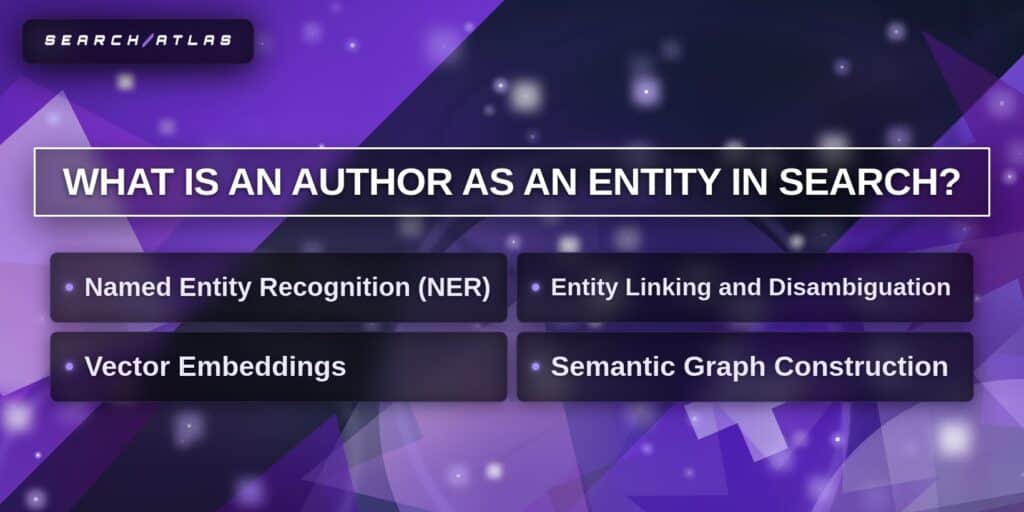
What are the four key components for identifying author entities? There are four key components for identifying author entities. These are listed below.
- Named Entity Recognition (NER) extracts author entities from unstructured content using natural language processing (NLP).
- Entity linking and disambiguation connect a detected author name to unique attributes via a stable @id.
- Vector embeddings (Word2Vec, Node2Vec) represent words and entities as vectors in a multi-dimensional space, popularized in 2013.
- Semantic graph construction defines who an author is, what they publish, and where their work appears in Google’s Knowledge Graph since 2012.
What are the three characteristics of a strong author entity? There are three characteristics of a strong author entity. Firstly, digital footprint and corroboration involve consistent presence across authoritative platforms, with 75% of high-ranking content linked to authors with verified external profiles. Secondly, expertise and trustworthiness signals include up-to-date author profiles, credentials, and topical expertise. Content from authors with strong E-E-A-T signals is 3.5 times more likely to be featured in high-confidence answer results. Thirdly, structured data and content association uses Person schema with author, author.url, and identity fields to improve ranking potential by up to 25%.
How do author entities impact search rankings and AI visibility? Author entities impact search rankings and AI visibility by influencing crawl budget, indexation, and citation rates. Brands with weak entity authority show a 40% reduction in AI answer visibility. Strong entity authority increases brand citations in AI-generated responses by up to 60%. Google’s systems shift toward Author-Topic Graphs, connecting verified individuals to thematic areas, with E-E-A-T’s impact projected to grow by 50% in three years.
Why Author Entities Matter for SEO and AI Visibility?
AI-powered search prioritizes trusted sources, known experts, and recognized brands with proven track records. Author entities matter because the unit of digital visibility moved from webpages (URLs and keywords) to entities (machine-readable representations of people, organizations, and concepts). AI-powered search systems (Google AI Overviews, ChatGPT with browsing, and Perplexity) emphasize credibility as a strong SEO trust signal.
What are the three phases of web indexing evolution? There are three phases of web indexing evolution. These are Strings, Things, and Entities. Strings is a traditional SEO optimized for keyword strings, where success matched queries to text. Things are modern search systems understanding entities via knowledge graphs, recognizing brands, founders, or products. Entities are AI-driven systems operating on structured ecosystems of entities, with search engines acting as reasoning engines.
Why are author entities important for AI search? Author entities are important for AI search because author entities confirm “who and what” is being discussed and add authority and discoverability to content. AI search runs on knowledge graphs and semantic connections. LLMs cite known, reputable sources more often than new domains with no digital footprint. Author entities exist as data objects within Google’s Knowledge Graph, LinkedIn’s profile network, and Wikipedia’s citations.
How does author identity function as an AI ranking signal? Author identity functions as an AI ranking signal because expert authorship is an indexable, rankable asset in AI-driven search. LLMs gravitate toward familiar, trusted names, mirroring human behavior. Rand Fishkin’s posts appear in AI search ranking factor discussions due to years of high-signal output. Ann Handley’s writing gains traction because the writing is unmistakably hers. Brand mentions are the new backlinks, emphasizing being cited often in the right places, even without a clickable link. Author entity optimization belongs to the broader class of Generative Engine Optimization (GEO), where defining Person entities forms a bedrock for AI disambiguation and citation likelihood in AI-generated answers.
How do author entities enhance E-E-A-T signals? Author entities enhance E-E-A-T signals because Google prioritizes author information as a criterion for evaluating content quality. Author information is essential for measuring Experience, Expertise, Authority, and Trustworthiness. In YMYL fields (medicine, finance), lacking author information is an SEO disadvantage. Authors demonstrating experience, expertise, authority, and trustworthiness lead to increased site evaluation, search engine visits, and click-through rates (CTR).
What are the five tips for improving E-E-A-T through author entities? There are five tips for improving E-E-A-T through author entities. These are listed below.
- Add clear authorship with detailed author bios linked to LinkedIn and other social profiles.
- Strengthen the “About Us” page with founder details, mission, and team credentials.
- Earn trusted third-party mentions in industry publications and authoritative directories.
- Keep content accurate and up-to-date with visible “Last Updated” dates.
- Demonstrate first-hand experience through case studies, screenshots, and specific examples.
What does Alex Birkett state about the authorship footprint? Alex Birkett states the authorship footprint functions as a resume for AI, where every citation, podcast, and mention adds a line. Birkett notes that in AI search, trust is a compounding asset, where the more an author has, the more citations the author receives. Building Google Knowledge Panel profiles for key authors is one of the fastest ways to strengthen entity recognition. Faceless content is invisible in the AI era. Pairing personal brand SEO with corporate branding creates a credibility loop where a trusted personal brand earns citations, boosting author and company visibility, and the company brand reinforces individual authority.
How does Steven Bartlett’s brand demonstrate the credibility loop? Steven Bartlett’s brand demonstrates the credibility loop because Bartlett’s “Diary of a CEO” personal brand boosts his ventures (Chapter 2 and Flight Story). The success of Chapter 2 and Flight Story reinforces his entrepreneurial reputation, making both Bartlett and his brands more likely to appear as authoritative entities in AI search. Joe Unhammer’s research found 76% of users trust AI-generated responses that come from cited sources. Site authority is a strong factor, with models (ChatGPT, Claude, and Perplexity) relying on signals (backlinks from reputable domains, consistent entity data, and trustworthy on-site content).
How Do Search Engines Identify an Author Entity?
Search engines identify an author entity by evaluating trust, accuracy, and reliability across page elements, structured data, off-page sources, and Knowledge Graph integration. Google’s patent (US Patent: 9,659,064, granted May 23, 2017, filed March 15, 2013) focuses on surfacing authoritative results when initial query results do not meet an authoritativeness threshold. Authoritativeness is query-dependent; cdc.gov is authoritative for “CDC mosquito stop bites” but not for “restaurant recommendations.”
How does Google identify authors directly on a page? Google identifies authors directly on a page through bylines, meta tags, and structured data. Author bylines are located below article headlines or in author bio boxes, often hyperlinked to author biography pages. Author meta tags are parsed from HTML source code via <meta name=”author” content=”Author Name”>. Structured data uses Schema.org JSON-LD, specifically Person markup with @id for unique identifiers and sameAs to connect external profiles (Wikidata or official social channels).
How does website structure identify authors? Website structure identifies authors through About pages, Contact pages, footers, and legal pages. About Us pages contain founder, CEO, or key team member biographies with names, photos, and professional backgrounds. Contact Us pages provide email addresses (e.g., [email protected]) and corporate information. Footers contain copyright notices (e.g., “© 2025 Awesome Company Inc.”) stating the legal owner. Legal pages, Terms of Service, and Privacy Policy identify the entity that owns and operates the website.
What off-page data identifies authors? Off-page data identifies authors through consistent linking to a central profile, social media crawling, backlink analysis, and external entity connections. Social media profiles (LinkedIn, X, Facebook, Instagram) are crawled and indexed. LinkedIn lists company employees and leadership. WHOIS lookup provides the legal owner of a domain name. Connecting authors to authoritative external entities (Wikidata, Wikipedia, official registers, industry directories) in structured data (sameAs) and body copy strengthens identification.
How does Google’s Knowledge Graph identify authors? Google’s Knowledge Graph identifies authors by extracting semantic information from unstructured documents, dating back to a 1999 patent on “Extracting Patterns and Relations from Scattered Databases (the World Wide Web). Initial Knowledge Graph steps extracted structured and semi-structured data from Wikipedia and Wikidata. Named Entity Recognition (NER) uses supervised and semi-supervised machine learning with training data for specific ontologies (persons, organizations, events). A seed set of 10 manually entered facts achieves 88% precision for millions of documents.
How does Google attribute authorship and originality? Google attributes authorship and originality by associating an author with many documents and tracking the earliest occurrence of content. The author of a document is assumed to have authored the content if the document is the earliest occurrence of that content piece. The author of a later document likely copied the content from the earlier document if the content appears later. Author rank improves with original content, a higher quantity of attributed content, and a record of being copied by other authors.
What four factors influence author ranking? There are four factors that influence author ranking. These are listed below.
- Content score is based on the score of content pieces associated with the author (original content, the number of copies, and the proportion of copied content).
- The quantity of content pieces is based on the total quantity attributed to the author.
- Original content attribution ranks authors in proportion to how original content is attributed; Author A, with two original pieces, ranks higher than Author B, with none.
- Rank of associated documents depends on originality, explicit references, and other characteristics, with author rank decay over time rewarding consistent original production.
How does Google classify authors? Google classifies authors through copy history analysis, comparing the content piece’s copy history (rate of copying over time) with predefined patterns. Authors are classified as a syndication source if content appears quickly in many documents, and then rarely, typical of news articles. A blogging leader classification applies when original content takes time to disseminate, showing a bell-curve pattern. Advertising content is characterized by immediate dissemination and continued appearance in new documents over an extended period. Author classification affects ranking; a “blog leader” rank improves, while an “advertisement” classification incurs penalties.
What search engine components support author ranking? The search engine components that support author ranking include a Piece Tracker, an Author Ranker, a Document and Author Classification Module, and a Document Retriever. The Piece Tracker records content pieces, their earliest document, author, and later occurrences, and summarizes copy count. The Author Ranker uses Piece Tracker information to rank authors. The Document and Author Classification Module classifies authors and documents. The Document Retriever (Web Crawler) populates the corpus, with crawl frequency and depth guided by author rank and classification.
Author Entity vs. Author Schema: What Is the Difference?
An author entity is the conceptual, verifiable identity of a content creator recognized by AI systems. An author schema is the machine-readable structured data markup that defines and connects the author entity to specific content. Author schema provides the technical foundation, while a robust author entity drives AI citation, content discovery, and trust, especially for YMYL topics.
Why does the comparison matter for SEO? The comparison matters for SEO because confusing the two leads to incomplete optimization. The author schema are implemented immediately, but the author schema alone does not create a strong entity. An author entity develops over 3-6 months of consistent publishing combined with proper markup and external validation. The combination of conceptual identity and machine-readable markup produces measurable AI citation gains.
What are the four core differences? There are four core differences between the author entity and the author schema. These are listed below.
- Nature differs because an author entity is a conceptual identity, while an author schema is JSON-LD/Schema.org markup.
- Purpose differs because an author entity establishes trust for the “who” behind content, while author schema explicitly connects the author to content for search engines.
- Development time differs because an author entity develops over 3-6 months of consistent publishing, while the author schema is implemented immediately.
- Function differs because an author entity influences AI citation, while the author schema enables author-content relationship recognition.
How do author entities and author schema work together? Author entities and author schema work together because author schema reinforces author entity recognition. Author entities influence AI search results and LLM citations as fundamentally as domain authority did a decade ago. AI systems (Perplexity, ChatGPT, and Google’s AI Overviews) prefer content from recognized experts. Content with a Knowledge Graph entry carries measurably more authority for AI-powered search.
How do on-site signals strengthen author entities through schema? On-site signals strengthen author entities through schema by providing dedicated author pages, consistent experience signals, and high-quality content structure. These signals provide AI systems with verifiable information about an author’s expertise and credibility. Generic “staff writer” bylines offer zero entity signals and perform measurably worse in AI evaluations. Real author pages feature a full name, role, detailed plain-language bio, and a list of published content. Author pages contain relevant experience, background, credentials (degrees, certifications, years in industry), and specific expertise areas.
What Signals Build Author Entity Authority?
There are four signal categories that build author entity authority. These are listed below.
- On-site signals include author pages, bylines, and ProfilePage schema.
- Off-site signals include external profiles, mentions, and citations.
- Consistency signals include identity uniformity across platforms.
- Topical authority and content expertise signals include depth, clusters, and E-E-A-T.
1. On-Site Signals (Author Pages, Bylines, ProfilePage Schema)
On-site signals are web page elements and structured data that convey identity and credibility for a person or organization to search engines. On-site signals belong to the broader class of search engine optimization (SEO) techniques. On-site signals differ from keyword optimization or technical SEO by their specific focus on identity and credibility.
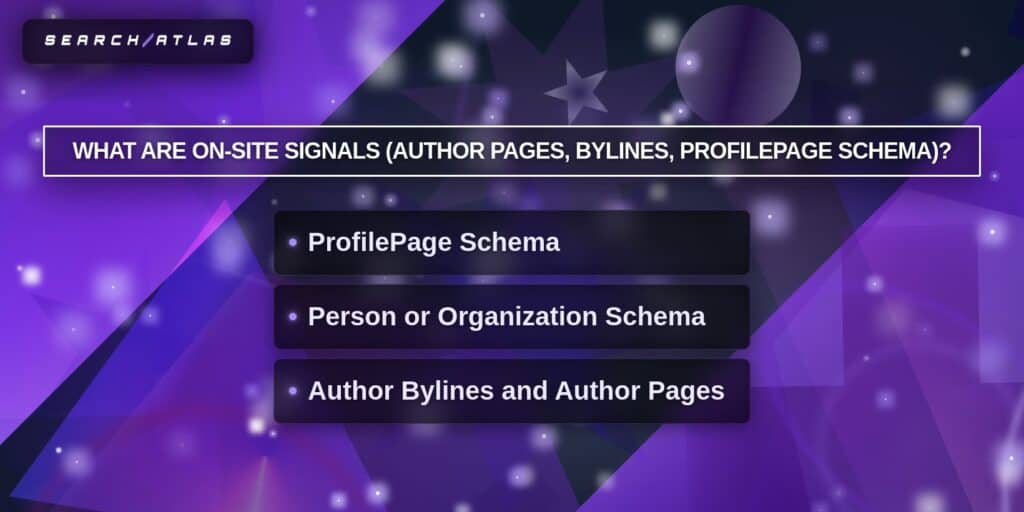
What are the three components of on-site signals? There are three components of on-site signals. These are listed below.
- ProfilePage schema is structured data identifying a webpage as a profile of a person or organization. ProfilePage schema requires @type: ProfilePage, url, and mainEntity (Person or Organization).
- The Person or Organization schema describes the individual or entity. Person schema requires a name and recommends image, description, and sameAs links to LinkedIn or GitHub.
- Author bylines and author pages provide attributed bylines on content and dedicated pages with professional headshots, bios, credentials, and social links. 85% of credible online publications use explicit author attribution.
What are the three characteristics of strong on-site signals? There are three characteristics of strong on-site signals. These are listed below.
- Identity conveyance reduces ambiguity for individuals with common names, improving entity recognition by 30-50%.
- E-E-A-T contribution boosts ranking factors for YMYL topics, with a complete Person + Article schema producing a 130-170% impact on AI Overviews citation rate.
- Knowledge Graph integration consolidates identity data, with 60% of pages with a Featured Snippet appearing in AI Overviews for the same query.
What is the impact of on-site signals on visibility? On-site signals impact visibility by driving 40% increases in author-specific search visibility within 12-18 months. For YMYL topics, 75% of search queries for health or finance prioritize sources with strong E-E-A-T. Global adoption of structured data for identity is projected to grow 20% annually through 2028.
2. Off-Site Signals (Profiles, Mentions, Citations)
Off-site signals are external references that build search engine credibility and prove a business is real, relevant, and worth recommending. Off-site signals are projected to become the dominant off-page ranking signal by 2026. Multiple algorithm updates (Penguin, Hummingbird, RankBrain, March 2024 core update) emphasized brand recognition and entity authority.
What are the six major types of off-site signals? There are six major types of off-site signals. These are listed below.
- Local citations are online listings with core business details (Name, Address, Phone), emerging in the 1990s.
- Brand mentions are online references to a business with or without a link.
- Community engagement is real involvement in local or industry communities.
- Google Business Profile is a free tool for managing online presence across Google Search and Maps, launched in 2004.
- Social media posts and citations are content across Instagram, TikTok, and YouTube.
- Backlinks are clickable links from one website to another, foundational since the 1990s.
What are the three characteristics of off-site signals? There are three characteristics of off-site signals. These are listed below.
- AI visibility correlation shows branded web mentions are the strongest predictor of AI visibility, outperforming backlinks and domain rating per Ahrefs’ 75K-brand study.
- Evolving importance projects citation patterns becoming the primary off-page ranking signal by 2027-2028.
- Corroboration threshold means AI models include brands when independent sources corroborate similar claims. Domains with millions of brand mentions on Reddit and Quora have approximately four times higher chances of being cited.
What is the impact of off-site signals on local search? Off-site signals impact local search by improving rankings for 76% of businesses within 90 days. Off-site signals drive 70% of local search conversions and produce 25% more branded searches. Domains with YouTube mentions showed the strongest single correlation with AI brand visibility in a December 2025 Ahrefs study.
3. Consistency Signals Across Platforms
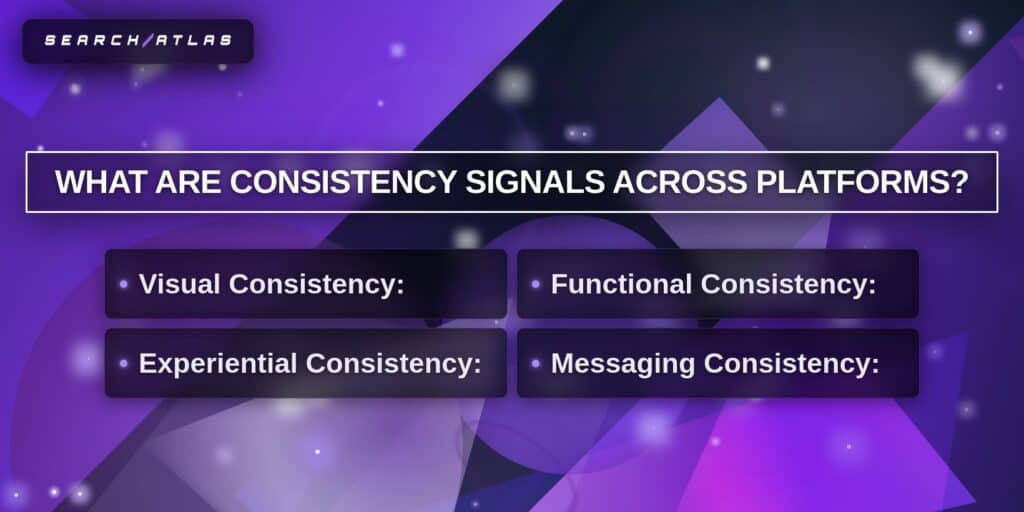
Consistency signals are design and communication principles that ensure a coherent, predictable, aligned experience across platforms. Consistency signals belong to the broader class of user experience (UX) principles and brand management strategies. Consistency signals differ from usability or accessibility by their specific focus on uniformity across diverse interaction points.
What are the four core pillars of consistency signals? There are four core pillars of consistency signals. These are listed below.
- Visual consistency uses colors, typography, icons, layouts, and design language uniformly.
- Functional consistency ensures core actions (navigation, search, checkout) follow the same logic across platforms.
- Experiential consistency aligns tone of voice, microcopy, onboarding, and feedback messages.
- Messaging consistency maintains tone, style, and content uniformly across communication channels.
What are the three characteristics of strong consistency signals? There are three characteristics of strong consistency signals. These are listed below.
- Trust and credibility make a brand recognizable and trustworthy. 81% of consumers cite trust as a key factor in purchase decisions.
- Improved user experience lowers cognitive load and increases retention rates.
- Strengthened brand identity ensures messaging alignment, providing a single, clear narrative.
Why are consistency signals critical for entity recognition? Consistency signals are critical for entity recognition because AI systems perform “entity resolution” across platforms. AI systems require a consistent company name, description, founding date, location, key facts, founder names and titles, and linked profiles via the sameAs schema. Consistency needs to span the website (About page, footer), LinkedIn, Crunchbase, G2, industry directories, and Google Business Profile. Inconsistent author representation (“Dr. Sarah Chen,” “Sarah Chen, MD,” or “S. Chen”) fragments entity mass and prevents LLM recognition.
4. Topical Authority and Content Expertise
Topical authority is a website attribute that demonstrates deep expertise and credibility on a specific subject, making the website a go-to trusted source for search engines and users. Topical authority is a blend of relevancy (what a website is about) and authority (how trustworthy the site is). Topical authority gained prominence after Google’s Hummingbird update in 2013, which marked the dawn of semantic search. Turning that hub-and-spoke structure into an actual content plan is what SEO Topical Maps is built for, mapping pillar and cluster pages from a single seed keyword before production starts.
How does topical authority differ from domain authority? Topical authority differs from domain authority because topical authority focuses on expertise within a single niche, while domain authority reflects overall popularity and backlink strength. Domain authority acts as a global reputation, while topical authority functions as subject-level trust for a specific industry. A website possesses high domain authority but is only proficient in covering certain topics.
What are the five components of topical authority? There are five components of topical authority. These are listed below.
- Content depth and topic coverage involve comprehensive coverage of core themes, related subtopics, and customer questions.
- Content clusters and pillar pages use a hub-and-spoke model where a broad pillar page is supported by detailed cluster posts.
- Search intent matching answers the exact questions ideal clients ask.
- Backlinks and external validation come from trusted websites linking to well-structured content.
- E-E-A-T (Experience, Expertise, Authoritativeness, Trustworthiness) emphasizes comprehensive, accurate, deeply interconnected content.
What are the three attributes of strong topical authority? There are three attributes of strong topical authority. These are listed below.
- Comprehensive coverage proves a website covers an industry’s core topics, related subtopics, and customer questions.
- Semantic relevance prioritizes content optimized for thematic alignment, consistent terminology, and supporting entities through Natural Language Processing (NLP).
- User intent accomplishment boosts pages that complete a user’s search by directly answering audience questions.
How to Implement Author Entity Optimization?
Author entity optimization is implemented through five core strategies that establish identity, structured data, AI presence, content depth, and triangulation. Author entity optimization improves AI citation visibility by up to 40% and increases AI-sourced visitor conversion rates by 4.4 times compared to traditional organic traffic. AI search engines retrieve passages grounded in entities, making keyword density less effective for content visibility.
Why does author entity optimization matter for search rankings? Author entity optimization matters for search rankings because Google tracks and retains content authorship data, favoring credible, authoritative content attributed to recognized authors. Author entities play a significant role in search rankings, complementing publisher entities. AI models hallucinate or ignore a business or author when AI models lack verified information. Inconsistent author representation fragments entity mass, making recognition by large language models (LLMs) difficult. Content older than 12 months drops to a 37% citation rate on Perplexity, versus 82% for content updated within the last 30 days.
What are the five core implementation strategies? There are five core implementation strategies. These are listed below.
- Create detailed author pages with comprehensive bios and credentials.
- Implement Person schema markup with all recommended properties.
- Use sameAs for identity verification across authoritative profiles.
- Consolidate the external footprint across all platforms.
- Build internal links to author pages from relevant content.
How does triangulation produce machine trust? Triangulation produces machine trust by enabling AI engines to verify data through cross-referencing information from multiple independent sources. There are three core data categories for triangulation.
Firstly, official and authoritative sources include government websites, business registries, tax records, industry organizations, and Google Business Profile. Secondly, publicly available real-time data includes news APIs, social media platforms, online directories, and active reviews (Yelp, Trustpilot). Thirdly, proprietary and internal business data includes CRM systems, sales analytics, and structured data feeds (product inventory provided to Google).
Alignment of data from independent sources reduces hallucination and increases credibility. Machine trust calculates citation frequency, consistency of entity relationships, structural extractability of claims, cross-reference verification, and statistical confidence based on redundancy.
How is success measured in author entity optimization? Success in author entity optimization is measured by scoring entity coverage and monitoring citation share across AI platforms. Entity coverage is scored using tools (Frase’s GEO Score Checker at frase.io/tools/geo-score), with a target above 70. Citation share per platform is monitored on customer-relevant prompts over time, weekly or monthly. Meaningful shifts in these metrics appear within 60-120 days of implementing optimization strategies.
1. Create Detailed Author Pages
Detailed author pages are created by adding a full name, role, plain-language bio, credentials, professional photo, and a list of published content. Author pages function as strategic tools for building trust, establishing authority, and connecting with audiences. Google’s quality rater guidelines instruct raters to check for author bios and credentials.
What are the eight essential elements of an author page? There are eight essential elements of an author page. These are listed below.
- Full name matches the byline used across all content for consistency.
- Role and title clarify the author’s professional position.
- Plain-language bio describes background and approach without jargon.
- Credentials cover degrees, certifications, and years in the industry.
- Specific expertise areas frame practical achievements (e.g., “Grew organic traffic from 0 to 50K/month”).
- A professional photo displays a clear, recognizable headshot.
- List of published content links to articles authored by the contributor.
- Social profile links connect to LinkedIn, X, and other professional platforms.
What are the best practices for author bio content? The best practices for author bio content involve a third-person tone, real names, and specific credentials. A blog author bio (snippet at the end of the post) ranges from 50 to 150 words. A dedicated author page reaches at least 250 words to avoid Google penalties for thin content. Author bio essentials include the objective, basics (name, title, headshot, education, experience, awards), expertise (published work, links), and a call to action (social channels, newsletters).
What are the SEO requirements for author pages? The SEO requirements for author pages include a separate URL, indexable status, and structured data. Individual author pages remain on a separate URL, linked from short bios. Author pages avoid the “no-index” tag so search engines index them. Author pages use Schema.org JSON-LD with Person markup. The article schema includes the author URL, which Google confirmed in a 2021 changelog disambiguates authors.
2. Implement Person Schema Markup
Person schema markup is implemented by adding author attributes (name, jobTitle, affiliation, sameAs) to all articles via JSON-LD in the page head. Google prefers JSON-LD format for schema. The sameAs property within the Person schema links the website or author to official social and business profiles (Google Business Profile, Facebook, LinkedIn, Twitter, Instagram).
What are the required Person schema properties? The required Person schema properties are @context, @type, name, and url. @context is https://schema.org. @type is Person. Name is the primary identifier matching the visible page byline. URL is the official webpage or profile of the person.
What are the recommended Person schema properties? The recommended Person schema properties enhance the profile with additional details. The recommended Person schema properties include alternateName (alternate public identifier), description (byline or credential), image (URL with 16×9, 4×3, 1×1 aspect ratios, minimum 50K pixels), sameAs (URLs to external profiles), jobTitle (professional role), worksFor (affiliated organization), alumniOf (educational institution), and knowsAbout (areas of expertise).
What are the four implementation steps for the Person schema? There are four implementation steps for the Person schema. These are listed below.
- Prepare author data by gathering full name, page URL, job title, organization, sameAs profiles, and education.
- Interconnect schema types using Article for content, Person for the author, and Organization for the publisher, connected via @id references.
- Create JSON-LD code embedded in a <script type=”application/ld+json”> block on the article page.
- Validate the implementation using Google’s Rich Results Test and Schema Markup Validator.
What CMS plugins automate the Person schema? CMS plugins that automate the Person schema include Yoast SEO, Rank Math, and Schema Pro for WordPress. Online schema generators allow users to fill out a form to generate a JSON-LD snippet. Google’s Structured Data Markup Helper offers step-by-step assistance for incorporating the Person schema. Custom code implementation requires a web development team for edge cases.
What does a complete Person schema example contain? A complete Person schema example contains @context, @type, name, url, image, jobTitle, worksFor, alumniOf, knowsAbout, and sameAs properties. The complete Person schema demonstrates the recommended structure for an author profile. The example structure is shown below.
{
  "@context": "https://schema.org",
  "@type": "Person",
  "@id": "https://example.com/authors/jane-doe#person",
  "name": "Jane Doe",
  "url": "https://example.com/authors/jane-doe",
  "image": "https://example.com/images/jane-doe.jpg",
  "jobTitle": "Senior SEO Strategist",
  "worksFor": {
    "@type": "Organization",
    "name": "Example Agency",
    "url": "https://example.com"
  },
  "alumniOf": "Stanford University",
  "knowsAbout": ["Technical SEO", "Entity Optimization", "Schema Markup"],
  "sameAs": [
    "https://www.linkedin.com/in/janedoe",
    "https://twitter.com/janedoe",
    "https://www.crunchbase.com/person/jane-doe"
  ]
}
What does the Article schema with author attribution contain? Article schema with author attribution contains @type, headline, author (Person reference), publisher, datePublished, dateModified, and mainEntityOfPage properties. The article schema connects the article to the author Person entity via an @id reference. The example structure is shown below.
{
  "@context": "https://schema.org",
  "@type": "Article",
  "headline": "Author Entity Optimization Guide",
  "author": {
    "@id": "https://example.com/authors/jane-doe#person"
  },
  "publisher": {
    "@type": "Organization",
    "name": "Example Agency",
    "url": "https://example.com"
  },
  "datePublished": "2026-04-15T08:00:00+00:00",
  "dateModified": "2026-04-29T08:00:00+00:00",
  "mainEntityOfPage": "https://example.com/seo/author-entity-optimization"
}
3. Use sameAs for Identity Verification
The sameAs property is used for identity verification by linking the website to an author’s profiles on different sites and social media platforms. The sameAs property signals to search engines that various profiles represent the same entity. The sameAs property acts as a “digital fingerprint,” unifying an author’s online presence.
What is the sameAs property purpose? The sameAs property purpose is to disambiguate identity across the web. The sameAs property differentiates individuals with the same name (“Jared Bauman” the author versus “Jared Bauman” the Kentucky politician). The sameAs property establishes legitimacy for smaller publishers against Google’s preference for larger brands. The sameAs property contributes to optimizing webpages for SEO, Google AI Overviews, and semantic indexing.
What are the recommended sameAs target profiles? The recommended sameAs target profiles include Twitter, Facebook, Instagram, LinkedIn, YouTube, Pinterest, personal websites, Amazon author pages, Crunchbase profiles, and guest author profiles on reputable sites. The sameAs property focuses on active, relevant profiles that enhance credibility. The sameAs implementation uses JSON-LD within the <head> section of the website’s HTML.
How is sameAs verified? The sameAs property is verified using Google’s Rich Results Test. The Rich Results Test displays the sameAs data of the author under the ‘Articles’ structured data when testing a blog post URL. The Rich Results Test ensures correct implementation and proper recognition by search engines.
4. Consolidate Your External Footprint
The external footprint is consolidated by establishing canonical naming, claiming authoritative profiles, and reinforcing identity signals across the web. External footprint consolidation establishes one master record for Name, Address, and Phone (N-A-P) and applies the master record consistently across online mentions. Even small variations (“St.” versus “Street”) lower trust ratings.
What are the four steps for external footprint consolidation? There are four steps for external footprint consolidation. These are listed below.
- Audit current signals by cataloging how key authors are represented across properties and identifying inconsistencies.
- Define entity standards through canonical entity names, descriptions, and style guides for consistent mentions.
- Claim authoritative profiles on Wikidata, Crunchbase, Better Business Bureau, Google Business Profile, LinkedIn, G2, and industry directories.
- Fix errors at the source on aggregators (Foursquare and Data Axle), which distribute data widely.
What are the AI seed sites for footprint consolidation? The AI seed sites for footprint consolidation are Wikidata, Crunchbase, Better Business Bureau (BBB), Google Business Profile, Yelp, Apple Maps, Bing Places, Facebook, LinkedIn, Instagram, Twitter, YouTube, Pinterest, Foursquare, Data Axle, and Chamber of Commerce. Wikidata is the most critical for verification because Google feeds the Knowledge Graph from this database. Better Business Bureau is the gold standard for North American local businesses, signaling trustworthiness by physically verifying address and phone.
What is the maintenance cadence for the external footprint? The maintenance cadence for the external footprint involves monthly citation coverage checks and quarterly markup audits. Monthly checks verify whether AI engines (ChatGPT, Perplexity, Claude, Gemini, Copilot, Grok, Google AI Overviews, DeepSeek) cite the entity for relevant prompts. Quarterly audits check for missing authors, outdated sameAs links, and content-schema mismatches. A rolling refresh cadence of every two weeks maintains content freshness, with meaningful citation shifts requiring 60-120 days.
5. Build Internal Links to Author Pages
Internal links to author pages are built through a pyramid-like site hierarchy, descriptive anchor text, and strategic placement across site elements. Internal links to author pages ensure these pages receive link equity and remain discoverable by users and search engine crawlers. A pyramid-like hierarchy positions homepage and pillar pages at the top, subcategories in the middle, and author pages at the bottom.
What are the anchor text rules for author page links? The anchor text rules for author page links require five words or fewer, relevance, and optimization. Exact-match anchor text remains acceptable for internal links if relevant. Vague phrases (“click here” or “plan your trip”) are ineffective. Descriptive, keyword-focused anchor text (“articles by Jane Doe” or “more from Jane Doe”) improves clarity. Varying anchor text slightly enhances naturalness when linking to the same page multiple times.
What are the six placement options for author page links? There are six placement options for author page links. These are listed below.
- Contextual links are embedded within the on-page text of articles by the author.
- Navigational links appear in main menus or sidebars when author pages represent core content.
- Footer links place author page links in the footer area.
- Image links hyperlink author images to their respective author pages.
- Breadcrumb links show an author page’s location within the site hierarchy.
- In-content CTA links prompt actions within text, leading to an author page.
What are the auditing tasks for author page links? The auditing tasks for author page links involve broken link removal, link count management, and technical attribute correction. Broken links leading to 404 errors are removed or replaced. Pages with excessive links require removing unneeded links. The rel=”nofollow” attribute is removed from internal links to author pages, ensuring authority is passed. Orphaned author pages, those with no incoming links, require linking from other site pages. Internal links point directly to the final URL, avoiding redirects, and HTTP links on HTTPS pages update to HTTPS.
How to Implement Author Schema Correctly?
The author schema is implemented correctly through Minimum Viable Person and Article markup, combined with proper nesting of Person inside Article and ProfilePage. The author schema provides structured data that identifies a content creator and supports E-E-A-T signals. The author schema specifies properties (the author’s name, professional role, affiliation, and links to authoritative external profiles).
What are the recommended implementation methods? The recommended implementation methods for Author Schema Markup primarily involve JSON-LD, Google’s preferred format. JSON-LD embeds within a <script type=”application/ld+json”> block in the <head> section of the HTML. JSON-LD is preferred in 2026 due to Google-friendliness, modularity, and reduced fragility. Other methods include HTML Microdata, which adds metadata to the HTML body using itemprop attributes.
What are the post-implementation validation steps? The post-implementation validation steps for Author Schema Markup include Google’s Rich Results Test, Schema Markup Validator, and Google Search Console monitoring. The Rich Results Test validates markup and checks for errors, warnings, and missing required fields. The Schema Markup Validator provides detailed feedback on the structured data. Google Search Console monitors performance for rich snippet eligibility, click-through rate (CTR), impressions, and search result positioning. Google Search Console tracks structured data errors in the Enhancements tab. Spot-checking involves viewing the page source and searching for the application/ld+json script tag to confirm correct implementation.
What are the best practices for Author Schema Markup? The best practices for Author Schema Markup emphasize consistency, dedicated author pages, accuracy, and stable @id values. Consistency requires the same author name across all platforms (website schema, social media). A dedicated author page is recommended, linking to a unique author profile page that contains a bio, credentials, and other articles. Accuracy requires only demonstrably true author properties. Schema fields precisely match visible page content; discrepancies cause Google to ignore the markup. The @id property facilitates consistent entity linking, with one canonical @id format per author reused across all relevant pages.
There are two foundational implementation patterns. Firstly, minimum Viable Person and Article markup covers the essential fields required for a valid schema. Secondly, testing a Person inside an Article and ProfilePage creates clear relationships between the author, content, and profile.
Minimum Viable Person and Article Markup
Minimum Viable Person and Article markup is achieved by adding the author property with name and url fields, plus required Article fields linking content to the author. Google Search Central recommends the author (Person or Organization), author. name (Text), and author.url (URL) for Article structured data.
What are the three essential Person fields? There are three essential Person fields. These are listed below.
- The @type field specifies “Person” for individuals or “Organization” for entities.
- The name field precisely matches the visible author name on the page. Omitting a name is a critical error.
- The URL field links to a comprehensive author profile, confirming author identity.
What is the recommended Minimum Viable structure? The recommended Minimum Viable structure for a Person uses the format {"@type": "Person", "name": "Willow Lane", "url": "https://www.example.com/staff/willow_lane"}. The recommended Minimum Viable structure for an Organization uses the format {"@type": "Organization", "name": "Some News Agency", "url": "https://www.example.com/"}. Multiple authors are specified individually in their own author fields.
What are the validation rules for Minimum Viable markup? The validation rules for Minimum Viable markup require schema fields to precisely match visible page content. Author.name contains only the author’s name, excluding publisher names, job titles, or honorifics. Mismatches between schema and content lead to validation warnings or ignored markup. The Rich Results Test and Schema Markup Validator confirm correct implementation before publishing.
Nest Person Within Article and ProfilePage
Person is nested within Article and ProfilePage by embedding a Person object inside the mainEntity property of ProfilePage and the author property of Article, connected via @id references. Google Search announced ProfilePage markup on November 27, 2023, to assist sites where creators share first-hand experiences.
How does Person nest within ProfilePage? Person nests within ProfilePage through the mainEntity property describing the individual. ProfilePage requires @context (https://schema.org), @type (ProfilePage), url (canonical URL), and mainEntity (the person or organization). The nested Person entity includes properties (name, jobTitle, and worksFor) describing the individual, not the ProfilePage itself. A page contains only one ProfilePage entity, typically as a top-level entity.
How does Person nest within Article? Person nests within the Article through the author property, indicating the content creator. The author property within an Article schema is an embedded Person schema with name and url pointing to the author’s profile page. Each article’s schema includes an author property referencing the same @id as the Person defined in the ProfilePage. Person schema markup within the Author schema provides comprehensive information (achievements, affiliations, and published works).
How are articles connected to a ProfilePage? Articles are connected to a ProfilePage via the hasPart property listing content authored by the Person. The hasPart property creates a clear, two-way link between the person and their work. Omitting hasPart for authored content means Google views the profile in isolation, reducing the connection between the creator and the work. An item list of URLs representing articles authored by the Person are associated without marking up each article as a full Article type, though this approach does not produce rich results.
What are the benefits of proper Person nesting? The benefits of proper Person nesting include knowledge panel triggers, rich snippet eligibility, and AI Overview accuracy. Person schema triggers knowledge panels, rich snippets, and accurate search results. Structured data enables AI Overviews and AI Mode to generate precise, trustworthy summaries. Google Search uses this markup to disambiguate similar creators in features (Perspectives, Discussions, and Forums). The Google-extended crawler crawls future iterations of profile pages, supplying data for Search Generative Experience snippets.
How to Build Long-Term Author Entity Authority?
Long-term author entity authority is built through consistent niche publishing, external mentions and citations, and strengthened cross-platform presence over 2+ years. Author authority is the level of influence an author gains for a specific topic, built by publishing content on trustworthy websites. Author authority gained significance after Google’s Search Quality Rater Guidelines (SQRG) update and the August 1, 2018, Google update.
Why is author authority important for content creators? Author authority is important for content creators because users prefer authoritative sources, and Google incorporates this preference into ranking algorithms. Google’s algorithms focus on Expertise, Authority, and Trust (E-A-T) signals. Author reputation and credibility are explicitly included in quality rater guidelines, with SQRG section 2.5.2 requiring information about content creators. Author authority decreases the spread of fake news and improves AI citation rates for established experts.
How do search engines recognize author authority? Search engines recognize author authority through explicit signals and consistent online presence. The author’s About page is the main resource, detailing trustworthiness, experience, associated organizations, awards, and accomplishments. The About page links to backing pages (Wikipedia or interviews) and implements the Schema.org Person type with social media profile links. Biographies for every article are essential for Author Rank, with the author’s name, expertise bio, social links, and About page link. Article Schema using the Article type with author attribution informs search engines and AI crawlers.
There are three core long-term strategies. These are listed below.
1. Publish Consistently Within a Niche
2. Build External Mentions and Citations
3. Strengthen Cross-Platform Presence
1. Publish Consistently Within a Niche
Content creators publish consistently within a niche through strategic focus, content ideation, high-quality creation, established routines, and a long-term view of success. Consistent publishing is a requirement for brand building, not an option. Strategic thinking and consistent execution across channels lead to compound returns.
What is the recommended publishing frequency? The recommended publishing frequency for content creators is at least once per week for prioritized formats (blog posts, podcasts, long-form videos). More frequent publishing is generally more effective. One author published nearly every day for the first two years, generating 600 posts and 30 million page views. High volume reaches broader audiences and improves content creation efficiency.
What are the three pillars of effective niche content? There are three pillars of effective niche content. These are listed below.
- Industry-specific terminology incorporates terms, acronyms, and concepts naturally.
- Solving specific problems tackles precise pain points through interviews, forum analysis, and competitor gap studies.
- Adapting tone and structure aligns content with industry communication cultures (data-driven for finance, visual for creative agencies).
How do creators generate content ideas? Content creators generate content ideas by engaging with primary sources and maintaining a robust idea pipeline. Creators visit Reddit, Quora, and niche forums to understand problems and identify content gaps. Creators maintain a running list of ideas in a notes app for a continuous supply. Creators monitor industry news and new features through Feedly or social media. Creators observe popular topics within the niche on YouTube or TikTok.
How is success measured for consistent publishing? Success for consistent publishing is measured by recognition metrics and long-term growth, not short-term vanity metrics. Initial focus is on publishing volume, not views or engagement. Long-term metrics (growth over six months) are more relevant. Mark Schaefer estimates 18 months to gain traction with consistent weekly content. Mr. Beast reached 1 million YouTube subscribers five years after starting his channel.
What KPIs track author authority growth? The KPIs that track author authority growth include time on page, scroll depth, social shares, comment quality, lead quality, sales cycle length, brand recognition, mentions in industry publications, speaking invitations, and referrals. Authors monitor branded searches combined with topics in Google Search Console (e.g., “Jane Doe + topic”). Authors track new referring domains, especially high-quality and relevant ones, and track unlinked mentions.
2. Build External Mentions and Citations
External mentions and citations are built through community engagement, industry publication outreach, review platform presence, and unique data publishing. Brand mention frequency correlates with AI visibility at a coefficient of 0.664, significantly higher than the 0.218 coefficient for backlinks. SaaS websites expand reach by prioritizing AI-centric citation signals beyond traditional backlinks.
Why are Reddit and Quora high-value citation sources? Reddit and Quora are high-value citation sources because they are among the most-cited sources across major AI platforms. Perplexity sources 46.7% of top citations from Reddit and approximately 14% from YouTube. A mention in a relevant Reddit thread carries more Perplexity citation weight than a backlink from a directory site. LinkedIn is the second most cited source for AIs, per a Semrush October 2025 survey.
What is the External Validation Stack? The External Validation Stack prioritizes off-site sources by AI citation impact. There are five tiers in the External Validation Stack. These are listed below.
- Review platforms and directories (G2, Clutch, Trustpilot) are heavily cited across all major AI platforms.
- Digital PR and editorial coverage in industry publications create the highest-trust external signal.
- Community participation in Reddit and Quora ranks among the most-cited AI sources.
- Wikipedia category mentions create Knowledge Graph relationships. ChatGPT cites Wikipedia at 7.8% of total citations.
- Co-citation alongside recognized industry leaders enhances brand authority.
How does shipping unique information improve AI quoting? Shipping unique information improves AI quoting because adding statistics or direct quotations increases AI visibility by 30 to 40%, per a Princeton GEO study across 10,000 queries. 67% of ChatGPT’s top 1,000 cited pages come from original research, first-hand data, or academic sources, per Ahrefs analysis. A monitoring SaaS company saw a 210% increase in AI-sourced traffic and a 12x increase in qualified signups within eight weeks by publishing technical documentation with concrete metrics.
What are the platform-specific off-site strategies? The platform-specific off-site strategies tailor efforts to each AI model’s citation behavior. For ChatGPT, getting mentioned in Wikipedia category pages and earning editorial coverage in major publications are critical. For Perplexity, building an active presence in relevant Reddit communities increases citation potential. For Gemini, building a robust Google Knowledge Panel is essential. Brands with active profiles on Trustpilot, G2, and Capterra have a 3x higher chance of being cited by ChatGPT for comparison and trust-based questions.
How is AI citation tracked? AI citation is tracked through dedicated monitoring and an external citation tracker. Google AI Mode sessions end without an external visit approximately 75% of the time, meaning traditional metrics do not fully reflect AI visibility. An External Citation Tracker records a unique Citation ID, source platform (G2, Reddit, Forbes), article title, URL, publication date, citation type, and quality rating from 1-5. AI mentions monitoring uses Google Search Console and manual prompts to verify brand citation in AI overviews.
How do objective and subjective questions influence AI citation sources? Objective and subjective questions influence AI citation sources by shifting AI systems toward brand-controlled or community-driven content. A Yext analysis of 6.8 million AI citations shows 86% of citations come from brand-controlled sources (first-party websites and business listings). Reddit represents only 2% of citations when intent and location are considered. The discrepancy is contextual.
For objective questions (pricing, availability, specifications), AI systems rely on brand-controlled internet sources and official listings. For subjective questions (comparisons, recommendations, opinions), AI models shift toward community platform comments, reviews, and discussion forums. A ConvertMate study suggests ChatGPT leans heavily on major publications, Wikipedia, and human-centric platforms (Reddit) for these query types.
What are the digital PR tactics for editorial coverage? The digital PR tactics for editorial coverage involve guest posts, expert commentary, podcast appearances, and original data studies. Authors prioritize references in high-authority media (TechCrunch, Fast Company, Gartner, Wired, and trade publications). Authors partner with analysts and industry bloggers frequently cited in AI training corpora. Authors make themselves available for journalist inquiries through HARO, Qwoted, and Help a B2B Writer. The B2B podcast circuit provides backlinks and authority signals with each appearance, as thousands of B2B podcasts need guests.
3. Strengthen Cross-Platform Presence
Cross-platform presence is strengthened through cohesive brand presence, audience-specific content, and consistent visual and tonal identity across channels. A cross-platform content strategy uses various touchpoints and media types to engage audiences and generate leads. Channels feed into each other when properly set up, streamlining marketing efforts.
What are the four core principles for cross-platform presence? There are four core principles for cross-platform presence. These are listed below.
- Audience research and detailed personas tailor content for distinct platform demographics.
- Data-driven decisions use platform analytics to monitor performance and audience resonance.
- Clear SMART goals define brand awareness, lead generation, engagement, or sales objectives.
- Focused platform commitment dominates one or two core platforms before expanding.
How are platforms matched to audiences? Platforms are matched to audiences through demographic and behavioral analysis. TikTok and Instagram are dominated by younger audiences. Facebook attracts a wider age range. LinkedIn is for learning, researching, and networking. X is for real-time trends and conversations. Younger audiences gravitate toward social media, while older audiences prefer online news articles or blogs. Long-form content suits blogs, not tweets, and graphics or videos supplement news articles.
What are the seven benefits of cross-platform presence? There are seven benefits of cross-platform presence. These are listed below.
- Platform-specific purpose serves distinct end-user needs across formats.
- Increased touchpoints multiply chances of user engagement.
- Enhanced credibility comes from greater content visibility.
- Revenue generation results from increased brand visibility and conversions.
- Higher interaction rates come from increased audience consciousness.
- Consistent brand recall builds familiarity across daily platform usage.
- Improved content ROI repurposes one strong idea into multiple formats.
What are the three common pitfalls in cross-platform strategy? There are three common pitfalls in cross-platform strategy. These are listed below.
- Copy-pasting content everywhere ignores audience behavior differences and weakens brand perception.
- Chasing viral moments on the wrong platform wastes time and distracts from long-term goals.
- Reporting without normalization compares metrics across platforms without context, leading to misleading conclusions.
What is the realistic timeline for cross-platform authority? The realistic timeline for cross-platform authority is 90 days for foundations and 2+ years for recognized authority. Months 1-2 focus on fixing trust signals, author bios, and entity consistency. Months 3-6: Integrate experience signals into content and begin podcast and guest post outreach. Months 6-12 see citations, mentions, and inbound links compound. Authors achieve recognized niche authority by Year 2+.
What Is the Role of sameAs in Author Schema?
sameAs is a Schema.org property that links an author to reference web pages, unambiguously indicating the author’s identity, building a digital fingerprint of verified connections. sameAs enables search engines to build a more complete picture of an author by connecting a website to various online presences. sameAs creates a network of verified, authoritative connections that search engines trust.
What is the purpose of sameAs? The purpose of sameAs is to disambiguate identity by linking author profiles across websites and social media platforms. sameAs signals to search engines that profiles on Twitter, LinkedIn, and personal sites represent the same entity. sameAs differentiates individuals with the same name (“Jared Bauman” the author versus “Jared Bauman” the Kentucky politician). The digital fingerprint unifies an author’s online presence under one identity.
How does sameAs impact E-E-A-T and SEO? SameAs impacts E-E-A-T and SEO by ensuring Google attributes credit for expertise, authorship, and entities to the correct individual or brand. SameAs addresses Google’s Helpful Content Update (HCU) by providing clear signals about an entity’s online presence. SameAs aids in establishing legitimacy for smaller publishers against Google’s preference for larger brands. SameAs leads to social media icons appearing alongside the website in search results and knowledge panels, increasing click-through rates by 15-20%.
How is sameAs implemented for authors? SameAs is implemented for authors by adding URL arrays to the Person schema on author pages. sameAs targets active, relevant profiles (Twitter, Facebook, Instagram, LinkedIn, YouTube, Pinterest, personal websites, Amazon author pages, Crunchbase profiles, and guest author profiles on reputable sites). sameAs is added via JSON-LD within the <head> section of the website’s HTML. CMS plugins (Schema & Structured Data for WP & AMP and Rank Math SEO) support sameAs implementation through user profile fields.
What are the limitations of sameAs? The limitations of sameAs include the property’s inability to compensate for a poor website strategy. SameAs cannot recover an HCU-affected site alone. SameAs connects dots for Google but does not replace existing online entity signals. Linking to a SERP competitor via sameAs is discouraged, as the link makes the linked site appear as the main authority for that topic. The sameAs property is verified using Google’s Rich Results Test, which displays sameAs data under Articles structured data.
How Do AI Search Engines Evaluate Author Entities?
AI search engines evaluate author entities through E-E-A-T signals, trust signals, verifiable credentials, consistent identity, entity recognition, topical ownership, and content quality. AI systems prioritize content from authors demonstrating strong E-E-A-T, with 96% of AI citations going to such sources. Mid-ranked pages (#6-#10) with strong E-E-A-T are cited 2.3 times more frequently than #1-ranked pages with weak E-E-A-T.
How do trust signals impact author entity evaluation? Trust signals impact author entity evaluation because “who’s saying” something is a critical factor for AI systems. Untrustworthy pages have low E-E-A-T regardless of apparent expertise, reducing citation probability. Named authors with verifiable credentials, a consistent cross-web identity, and a clear publication history establish trust. Content with proper metadata (bylines, last-updated dates, and structured author information) gets cited 40% more frequently than anonymous content.
How does entity recognition strengthen author credibility? Entity recognition strengthens author credibility by allowing AI systems to map authors and organizations to verifiable first-class entities. 78% of SEO experts consider entity recognition crucial for AI search success. AI systems work to connect brands, people, and products to entities that the AI systems already understand. Authors build real authority by consistently publishing within a specialization, demonstrating depth across multiple pieces from different angles.
What content quality factors do AI systems favor? The content quality factors AI systems favor include clear writing, logical organization, and direct answers. Optimal passage length for AI extraction is 150-300 words per section. Each section is self-contained to facilitate confident summarization. Content goes beyond summaries, adding original insights and concise direct answers, often through FAQ sections following an inverted pyramid structure.
How does Schema markup enhance author visibility? Schema markup enhances author visibility by linking authors to canonical IDs within public or proprietary knowledge graphs. Implementing Schema.org structured data with @id and sameAs properties connects authors to Wikipedia, Wikidata, Crunchbase, and official social media profiles. Sites deploying deeply nested, error-free advanced schema experience a 20-40% traffic lift. The most efficient entity is most likely to be cited, with a 300% potential improvement in LLM response accuracy with enterprise Content Knowledge Graphs (CKGs).
How does AI fingerprint flagging affect content? AI fingerprint flagging affects content by lowering rankings for AI-generated text without human review. Google’s January 2025 Quality Rater Guidelines update introduced AI “fingerprint” flags, rating content lower if the content contains phrases (“As an AI, I don’t have opinions”) without verified human review. Article volume increases without expert validation creates “noise instead of authority”. Entity drift, the inconsistency between human-visible content and machine-readable schema, directly lowers AI confidence scores.
How does ChatGPT evaluate author entities? ChatGPT evaluates author entities by favoring entities appearing consistently in high-weight training sources. ChatGPT favors Wikipedia, major publications, Reddit, and Stack Overflow. ChatGPT cites Wikipedia at 7.8% of total citations. Priority for ChatGPT involves placing the entity on Wikipedia or Wikidata, building citations across authoritative third-party sources, and ensuring Bing indexation. Brands with active profiles on Trustpilot, G2, and Capterra have a 3x higher chance of being cited by ChatGPT for comparison and trust-based questions.
How does Perplexity evaluate author entities? Perplexity evaluates author entities by continuously crawling the live web, making freshness key. Visible dateModified properties, rolling content refreshes, and consistent publishing cadences lift citation rates on Perplexity. Perplexity sources 46.7% of top citations from Reddit and approximately 14% from YouTube. A mention in a relevant Reddit thread carries more Perplexity citation weight than a backlink from a directory site.
How does Claude evaluate author entities? Claude evaluates author entities by relying on training data with a known cutoff. The author entity needs to exist within the training window and be cleanly defined across multiple corroborating sources. Priority for Claude includes presence on high-authority domains and consistent entity descriptions. Claude favors LinkedIn, Crunchbase, and Wikipedia mentions for verification.
How do Gemini and Google AI Overviews evaluate author entities? Gemini and Google AI Overviews evaluate author entities by leaning on Google’s Knowledge Graph. Priority for these platforms involves claiming a Knowledge Panel, implementing Organization schema with sameAs linking to Wikipedia and official social profiles, and earning authoritative third-party mentions. Gemini and Google AI Overviews prioritize content with Knowledge Graph integration, where Google’s Knowledge Graph has expanded by 20% annually since 2018.
How do Copilot, Grok, and DeepSeek evaluate author entities? Copilot, Grok, and DeepSeek evaluate author entities by citing fewer sources per response, making entity clarity the deciding factor. Priority for these platforms includes a definitional opener and a fact-dense body. Copilot, Grok, and DeepSeek favor content with a 30-60 word canonical answer immediately under the H1, since 44.2% of citations come from the first 30% of a page’s text.
How to Verify Author Entity Recognition?
Author entity recognition is verified through evaluation systems, contextual analysis, and Named Entity Linking (NEL) to a knowledge base. An evaluation system prepares a gold standard dataset of correct names for each document. Verification computes Precision (True Positives / (True Positives + False Positives)), Recall (True Positives / (True Positives + False Negatives)), and F1-score (harmonic mean of precision and recall). A dataset of 100-200 documents provides a sufficient starting point.
How does contextual analysis disambiguate author entities? Contextual analysis disambiguates author entities by considering neighboring words, syntax, and document structure. Contextual analysis manages nested entities (“President Barack Obama of the United States”). Modern models expand the analysis context to compare detected entities to lists of thousands of items, improving disambiguation. Treating the output of NER tools (Stanford NLP) as a feature refines results.
How does Named Entity Linking confirm author identity? Named Entity Linking (NEL) confirms author identity by linking identified named entities to a knowledge base (Wikipedia or DBpedia). For example, spacy_dbpedia_spotlight links entities to their kb_id_, providing external validation. NEL connects detected names to canonical Knowledge Graph IDs, completing the verification loop.
What tools extract author entities? The tools that extract author entities are SpaCy, NLTK, Stanford NER Tagger, BookNLP, Flair, and cloud services. SpaCy is a powerful API with ready-to-go models, generally outperforming NLTK. Stanford NER Tagger recognizes person entities. BookNLP achieved mean F1-scores of 67.72 for classic novels and 70.86 for modern novels. Flair combines deep learning models for improved accuracy. Cloud services include Google Cloud Natural Language API, Amazon Comprehend, and IBM Watson Natural Language Understanding.
What challenges affect author entity verification? The challenges that affect author entity verification include model limitations, ambiguous terms, and naming variations. Pre-trained models (SpaCy’s en_core_web_trf) misclassify entities not in their training labels. Models fail to recognize new entities not in the training data. The same word refers to different entities; “Apple” is a fruit or a company. Different spellings, capitalization, abbreviations, and punctuation (“New York” or “NY”) complicate recognition.
How to Handle Author Schema for Ghostwritten Content?
Author schema for ghostwritten content is handled by attributing the byline to the actual reviewing expert, never to the ghostwriter, and using “reviewed by” signals where appropriate. AI platforms increasingly deprioritize AI-generated content alone when the content lacks human expert validation. Generic content does not pass AI systems’ automated credibility checks for citation. Anonymous or AI-only content does not build domain authority over time.
Why is transparency critical for author attribution? Transparency is critical for author attribution because Google wants publishers to remove doubt about who authored an article. Readers actively seek proof that an article’s author is a true topic expert. A descriptive author bio validating niche expertise separates true experts from ghostwriters or AI-written articles. Providing misleading information (an author in the code who is not visible on the page) violates Google’s guidelines. Randomly changing declared page authors is considered manipulative.
What are the schema flexibility rules for ghostwritten content? The schema flexibility rules allow the author property to be either a Person or an Organization. BlogPosting schema on every article includes author, datePublished, and dateModified properties. Person schema on every expert bio page includes sameAs links to State Bar profiles, professional directories, Avvo, Super Lawyers, and LinkedIn for verification. The reviewing expert with verifiable credentials becomes the schema author, not the ghostwriter.
How does first-person experience demonstrate AI citation eligibility? First-person experience demonstrates AI citation eligibility by adding verifiable signals in every published piece. Each piece of content contains the reviewing expert’s name and credentials, plus a bio section linking to a professional profile. Content features at least one reference to a specific authoritative source and a date stamp for regular updates. A licensed expert reviews, verifies, and puts professional credibility behind every published piece, even AI-assisted content.
What Are Common Author Entity Optimization Mistakes?
Common author entity optimization mistakes include inconsistent identity, incomplete schema, missing sameAs, neglected maintenance, and faked authorship. Entity-related errors fragment signals, lower AI confidence scores, and prevent recognition by large language models. Author entity optimization mistakes are listed below.
- One page, five entities prevent clean passage retrieval. The fix focuses on one canonical entity per page.
- Keywords dressed up as entities optimize for search terms instead of the actual entity. The fix rewrites content around the entity.
- A schema without sameAs leaves structured data half-implemented. The fix adds sameAs to authoritative profiles.
- Keyword-driven internal linking dilutes entity signals. The fix builds internal linking around entity hubs.
- Publish and forget ignores citation decay. The fix implements a rolling refresh cadence tied to citation monitoring.
- Keyword stuffing with entity names appears unnatural. The fix integrates entity names contextually.
- Inauthentic author details misrepresent the content creator. The fix uses real authors with verifiable expertise.
- Mismatched author names between the schema and the page content cause validation issues. The fix matches the schema to visible content exactly.
- Missing the name property in the Person schema is a critical error. The fix adds the name as the primary identifier.
- Broken @id wiring prevents entity linking. The fix uses one canonical @id format across pages.
- Irrelevant sameAs links connect to non-authoritative profiles. The fix links only to verified, active platforms.
- Job titles in the author.name violates Google’s guidelines. The fix uses author.name only for the name.
Why do inconsistent identity fragment author signals? Inconsistent identity fragments author signals because author signals depend on uniform representation across all online mentions. Variations (“Dr. Sarah Chen,” “Sarah Chen, MD,” and “S. Chen”) prevent recognition by large language models. Common gaps in attribution (guest posts, syndicated content, and legacy pages) require updating with proper sourcing. Legacy content without an author or with outdated labels requires auditing and updating, potentially with a “reviewed by” byline.
How does scale weaken topical authority? Scale weakens topical authority because article production often outpaces available subject matter experts, leading to generic team bylines or individual authors covering too many unrelated topics. AI-assisted workflows disconnect content from real authors when the workflows lack qualified expert validation. Increasing article volume without increasing knowledge creates noise instead of authority. Content needs to tie back to real, accountable authors.
What are the schema validation pitfalls to avoid? The schema validation pitfalls to avoid include incorrect markup placement, formatting errors, and inauthentic author details. Incorrect markup code placement obstructs search engines from recognizing the schema. Inauthentic or irrelevant author details that do not represent the content creator lead to search engine penalties. Failing to update author information for guest contributors or staff changes is another common mistake. Neglecting to test and monitor performance using Google Search Console (impressions, clicks, search result positioning) leads to missed opportunities. Mismatched author names between the schema and the page content cause validation issues.
What are the publish-and-forget pitfalls? The publish-and-forget pitfalls include citation decay, schema drift, and outdated profile data. Content older than 12 months drops to a 37% citation rate on Perplexity, versus 82% for content updated within the last 30 days. Schema drift, the outdated data in structured markup, represents a silent revenue leak, leading to a confidence penalty and potential hallucination by AI models. AirOps research found 53% of content cited in ChatGPT had been updated within the last six months. A rolling refresh cadence (every two weeks) maintains citation freshness, with meaningful citation shifts requiring 60-120 days.
What Is the Minimum Author Schema Markup Required?
The minimum author schema markup required includes @type, name, and url, with author as the main container. Google Search Central recommends the author (Person or Organization), author.name (Text), and author.url (URL) for Article structured data. Google lists the author as a recommended field for articles.
What are the three essential properties? There are three essential properties for the minimum author schema. These are listed below.
- @type specifies “Person” for individuals or “Organization” for entities.
- Name precisely matches the visible author name on the page. Omitting a name is a critical error.
- URL links to a comprehensive author profile, the most powerful field for confirming author identity.
What are the recommended structures? The recommended structures cover Person and Organization formats. The Person structure is {"@type": "Person", "name": "Willow Lane", "url": "https://www.example.com/staff/willow_lane"}. The Organization structure is {"@type": "Organization", "name": "Some News Agency", "url": "https://www.example.com/"}. Multiple authors are specified individually: {"author": [{"name": "Willow Lane"}, {"name": "Regula Felix"}]}.
What are the validation requirements? The validation requirements include schema-content match, name accuracy, and accurate sameAs links. Schema fields precisely match visible page content; mismatches lead to validation warnings or ignored markup. The author.name field contains only the author’s name, excluding publisher names, job titles, or honorifics. Author schema is validated using Google’s Rich Results Test and Schema Markup Validator before publishing to prevent broken @id wiring or irrelevant sameAs links.
Does Author Schema Affect SEO Rankings?
Yes, author schema indirectly affects SEO rankings by supporting E-E-A-T signals and improving search visibility, although author schema is not a direct ranking factor. The author schema directly ties to Google’s E-E-A-T guidelines, which influence rankings. Google’s Quality Rater Guidelines instruct evaluators to consider the authoritativeness of the content creator.
What measurable SEO benefits does author schema provide? The measurable SEO benefits the author schema provides include CTR increases and rich snippet eligibility. Websites implementing schema markup see an average 30% increase in CTR. A 2023 SEMrush study showed a 15% CTR increase specifically with schema. Author schema qualifies content for rich snippets, which appear in roughly a third of all Google searches.
Why is the author schema not a direct ranking factor? Author schema is not a direct ranking factor because Google has stated that structured data (author information within Article schema) is not a direct ranking factor. Adding author schema alone does not boost rankings. Author schema supports rankings indirectly by making content easier for Google to interpret. Incorrect schema markup (missing required properties, broken author for Article schema) hurts SEO performance, making no schema markup better than incorrect schema markup.
What is Google’s stance on authorship markup? Google’s stance on authorship markup is that the markup is generally not considered a “good signal” for ranking purposes, per Google’s Gary Illyes. Google prefers signals harder to manipulate and more reflective of genuine user engagement and content quality. Despite being described as not good signals, these markups have recognition in SEO. An author schema combined with consistent off-site signals, content quality, and verified identity produces the strongest cumulative SEO and AI visibility outcome.