Profound alternatives are AI visibility platforms, sold by vendors other than Profound, that track how answer engines such as ChatGPT, Gemini, Perplexity and Google AI Mode mention and cite a brand. Teams compare them when they want published pricing, a different set of answer engines, SEO data in the same account, or a platform that acts on what the tracking finds.
The seven Profound alternatives in this guide are Search Atlas, Peec AI, Scrunch, Otterly.AI, the Semrush AI Visibility Toolkit, Ahrefs Brand Radar and the SE Ranking AI Search Toolkit. Each entry covers what the platform tracks, what it costs, its pros and cons, and what reviewers say about it.
Disclosure: This guide comes from Search Atlas, which also appears in the comparison. Prices come from each vendor's official pricing page as checked in October 2026, each with its billing term, and review ratings reflect what G2 and Capterra showed that same month.
What does Profound do?
Profound is an AI visibility platform that measures how answer engines describe and cite a brand. Its Answer Engine Insights show a visibility score by platform, citation analytics and sentiment, while Agent Analytics reads how AI crawlers view and cite a site's pages. Prompt Volumes estimates what people ask AI systems, and a ChatGPT Shopping view tracks product visibility at the SKU level.
Profound also acts on its findings. Its AI Marketer identifies work worth doing, and its agents rewrite pages that are losing citations and stage them in the content management system (CMS). A person approves the draft before anything moves forward.
Why do teams look for alternatives to Profound?
Teams look for alternatives to Profound mostly for pricing access and fit. Profound's pricing page lists two plans.
The free Trial runs 50 prompts daily for seven days across ChatGPT, Gemini and Google AI Overviews, without history, exports or API access. The custom-priced Enterprise plan covers up to nine answer engines and adds CSV and JSON exports, API access, SSO/SAML and SOC 2 compliance. The pricing FAQ mentions a self-serve Agency Growth plan with 400 credits per month per client workspace, but no dollar price appears on the page.
That structure leaves gaps for some buyers. Budget-limited teams cannot see a price before a sales conversation. SEO teams that also want rank tracking and site audits in the same account need a second subscription, because Profound's pricing page lists AI search features only. Agencies want white-label client reporting. The Search Atlas vs Profound comparison covers the two platforms head to head, so this guide looks at the wider field.
What are the best Profound alternatives?
The best Profound alternatives are Search Atlas, Peec AI, Scrunch, Otterly.AI, Semrush, Ahrefs Brand Radar and SE Ranking, and each one suits a different team and budget. These are Profound's closest competitors in AI visibility tracking, and the table lists the entry price shown on each official pricing page in October 2026, with its billing term.
| Platform | Best for | Entry price and billing term | Engines on entry plan |
|---|---|---|---|
| Profound (baseline) | Enterprise AI visibility programs | Free 7-day trial, Enterprise custom (not published) | 3 on the Trial |
| Search Atlas | Teams that want AI visibility tracking, SEO data and on-page fixes in one account | Free AI Visibility Checker; Growth $199 per month, billed monthly (first plan with LLM Visibility) | 2 in the free Checker, 3 on Growth (none on Starter) |
| Peec AI | Marketing teams that want prompt tracking with source analysis and recommended actions | Starter, Pro and Advanced billed monthly, amounts not confirmed on the official page. Enterprise custom, billed annually | Not published per plan |
| Scrunch | Brands that want monitoring plus an AI-readable version of their site | Starter $300 per month month-to-month, or $250 per month billed annually | 7 |
| Otterly.AI | Consultants and small teams on a tight budget | Lite $29 per month billed monthly, or $25 per month billed annually | 4 |
| Semrush | Teams that already run SEO in Semrush | AI Visibility Toolkit $99 per month per domain, billed annually | 4 |
| Ahrefs Brand Radar | Ahrefs users who want custom prompts plus a prebuilt prompt index | Custom Prompts included from Ahrefs Lite at $129 per month, billed monthly. Brand Radar AI add-on from $199 per month per index ($699 per month for all platforms) | 6, plus Claude |
| SE Ranking | Cost-conscious SEO teams adding AI answer tracking | Core $129 per month billed monthly, or $103.20 per month billed annually | 4 |
1. Search Atlas
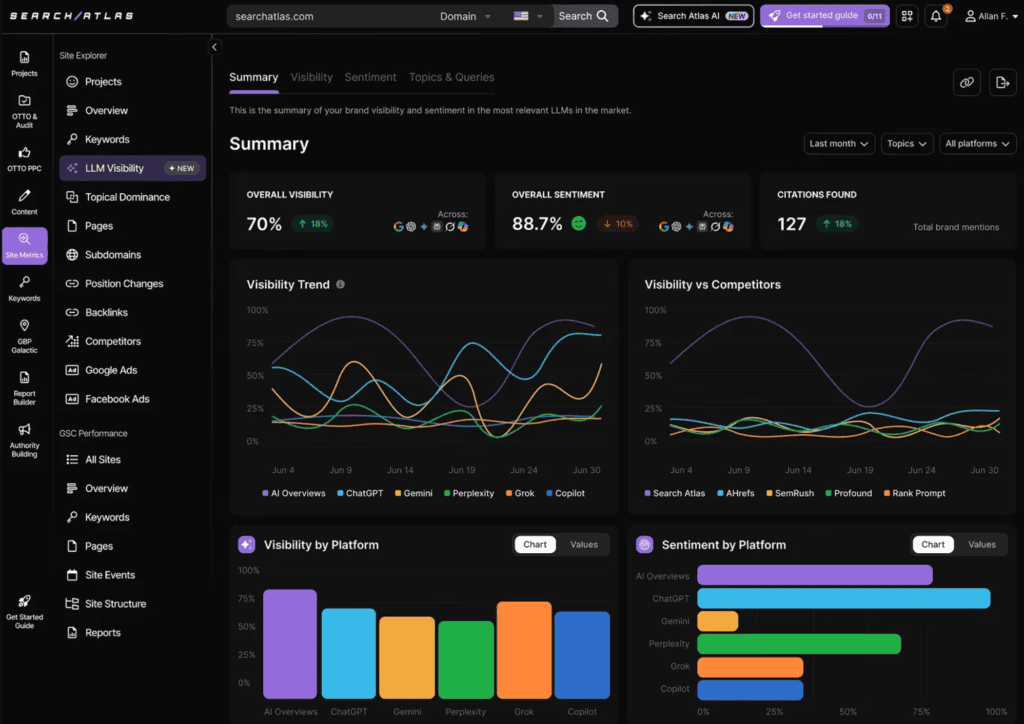 Search Atlas LLM Visibility summary view
Search Atlas is an SEO and AI search platform that tracks brand visibility in AI answers through LLM Visibility and then works on the pages and content behind those answers. LLM Visibility reports visibility percentage, sentiment, cited sources and share of voice against competitors. OTTO SEO and Atlas Agent carry those findings into site fixes and planned work.
Because Search Atlas publishes this guide, this entry is first-party, and the fairest check is to run the same prompts used in Profound through LLM Visibility and compare the results. The platform suits agencies and in-house teams that want AI visibility data next to rank tracking, site audits and client reporting. Search Atlas also offers a free AI Visibility Checker that returns a snapshot of brand mentions, citations and competitor gaps on ChatGPT and Gemini, so a team can test the platform before paying.
Why does Search Atlas fit teams replacing Profound?
Search Atlas fits teams replacing Profound that want published monthly prices and a platform that works on its findings with a person in the approval step. LLM Visibility is included from the Growth plan at $199 per month, so the cost is visible before any sales call. When tracking shows a page losing ground, OTTO SEO deploys fixes through the OTTO Pixel, CMS connectors or a Cloudflare Worker, with an approval mode and rollback.
What are the main Search Atlas features?
- AI Visibility Checker: a free snapshot of brand mentions, citations and competitor gaps on ChatGPT and Gemini, with no paid plan required.
- LLM Visibility: tracks visibility, sentiment, citations and topic-level performance, and sends negative-sentiment alerts. Growth covers ChatGPT, Gemini and Google AI Mode, and Pro extends coverage to Copilot and Perplexity.
- OTTO SEO: deploys fixes through the OTTO Pixel, CMS connectors or a Cloudflare Worker, with an approval mode and rollback.
- Atlas Agent: turns a plain-language goal or a Playbook into planned tasks, then executes after approval, or runs safe automations when the team allows them.
- Search Atlas Coworker: posts scheduled summaries in Slack or Microsoft Teams, connects to HubSpot, and asks for approval before shipping fixes.
- Report Builder: combines AI visibility, rankings and analytics data into client reports, with white-label dashboards on Pro.
How much does Search Atlas cost?
Search Atlas costs $199 per month, billed monthly, for Growth, the first plan that includes LLM Visibility. At $99 per month, Starter leaves out LLM Visibility and comes with one seat, one OTTO SEO project, 2,000 tracked keywords and 50,000 Universal Credits. Growth adds LLM Visibility on three engines with three seats and 3,500 keywords. Pro costs $399 per month with five seats, 6,000 keywords, white-label reporting and five engines. Agency starts at $999 per month with ten seats.
The AI Visibility Checker is free, and all paid Search Atlas plans are billed monthly. The Search Atlas pricing page does not publish SSO, data retention or API call quotas, so enterprise buyers should confirm those terms in writing.
What are the pros and cons of Search Atlas?
Pros
- A free AI Visibility Checker gives a snapshot before any paid plan
- Tracking, on-page fixes, content and reporting run in one account
- Published monthly prices for every self-serve plan
- White-label dashboards and reporting from the Pro plan
- Scheduled updates in Slack or Microsoft Teams through the Search Atlas Coworker
Cons
- Search Atlas covers SEO, content and AI visibility in one account, so teams switching from Profound need time to learn the wider platform, and free onboarding is available.
- LLM Visibility starts on Growth, and AI work draws from a monthly Universal Credits budget, which large prompt sets need to plan around.
What do reviewers say about Search Atlas?
The Search Atlas G2 listing showed 4.6 out of 5 across about 160 reviews in October 2026, and Capterra showed about 4.8 out of 5. Both ratings cover the whole platform, which includes SEO, content and local features beyond AI visibility. Reviewers mention replacing several separate products with one platform.
2. Peec AI
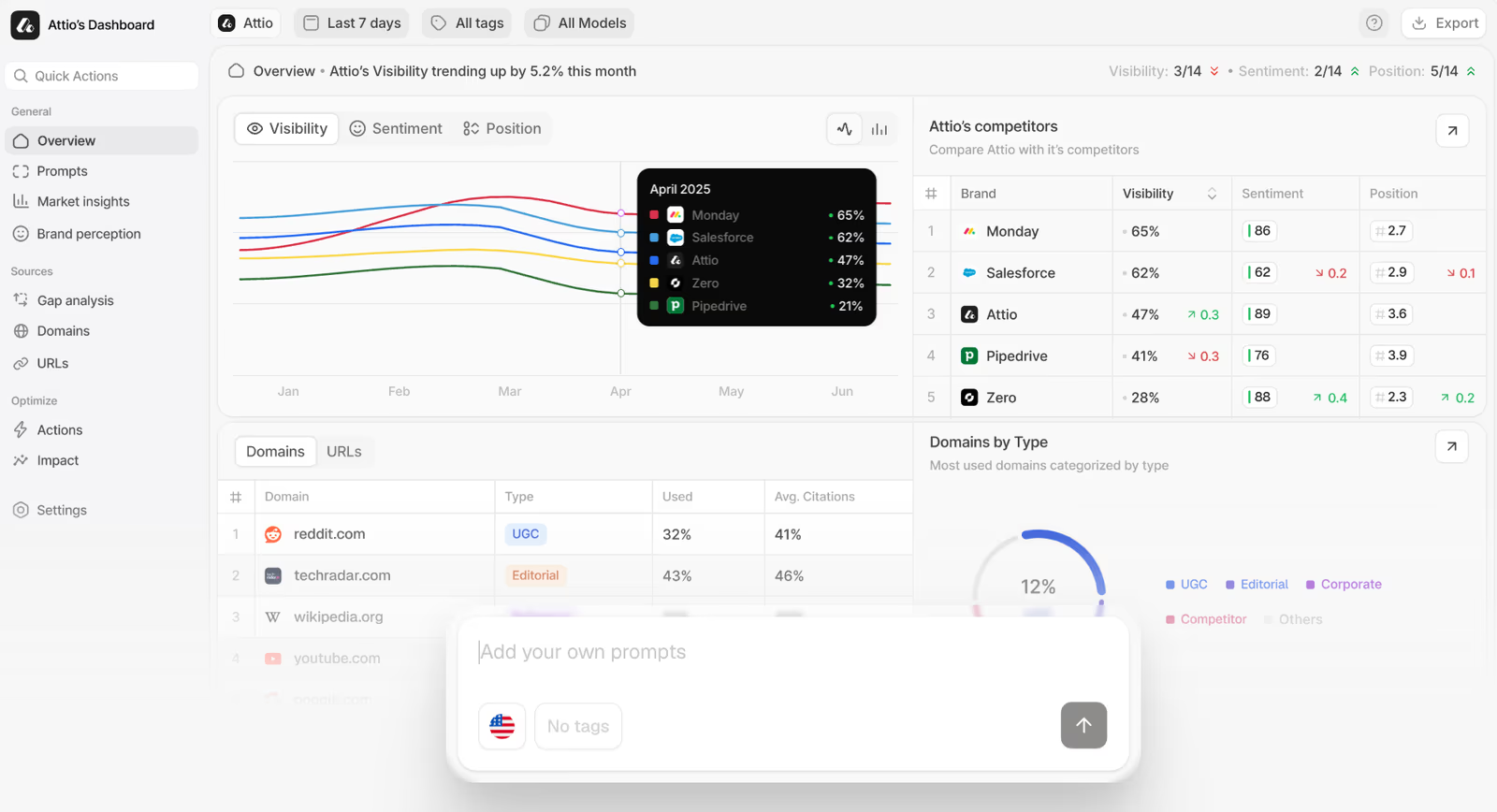 Via Peec AI
Peec AI is an AI search analytics platform that tracks brand visibility, position and sentiment in AI answers and shows which sources those answers cite. Its homepage names ChatGPT, Perplexity and Gemini, with separate tracker pages for Google AI Mode, and prompts can be tagged and tracked across countries.
The platform is organized around prompts. Teams write their own prompts, add AI-suggested ones, check search volumes, and compare their brand against chosen competitors, which covers the core measurements of brand AI visibility.
Why does Peec AI fit teams replacing Profound?
Peec AI fits teams replacing Profound that want self-serve monthly plans and clear source analysis. Its Find Key Sources view shows which sites AI answers rely on, such as review sites, LinkedIn, Reddit and editorial domains. Its recommendations then point toward review profiles, community discussions and digital PR placements worth pursuing.
What are the main Peec AI features?
- Visibility, position and sentiment tracking for each prompt
- Source analysis showing the domains AI answers cite
- Competitor benchmarking against chosen brands
- Recommended actions ranked by opportunity, plus agent actions built from pre-built and custom skills
- Looker Studio connector, CSV exports, API and MCP access
How much does Peec AI cost?
Peec AI lists Starter, Pro and Advanced as monthly self-serve plans and Enterprise as a custom plan billed annually. The dollar amounts on its pricing page load dynamically and could not be confirmed from the official page for this guide, so check the live page before budgeting. The page calculates monthly AI answers by multiplying tracked prompts by active models and tracking frequency, a useful figure for comparing usage across vendors.
What are the pros and cons of Peec AI?
Pros
- Source analysis names specific domains worth earning mentions on
- Recommended actions turn tracking data into a ranked list of opportunities
- Looker Studio, API and MCP access for reporting pipelines
Cons
- Official pages describe no direct publishing to a website or CMS, so content and site changes run through the team's own process
- Slack alerts require a user-built connection through its API or MCP
- Plan-by-plan limits are hard to confirm from the pricing page text
What do reviewers say about Peec AI?
G2 listed Peec AI between 4.8 and 5.0 out of 5 in October 2026, across fewer than 20 reviews. G2's review summary highlights the interface and responsive customer service, and the most common request is more integrations, such as Google Analytics.
3. Scrunch
 Via Scrunch
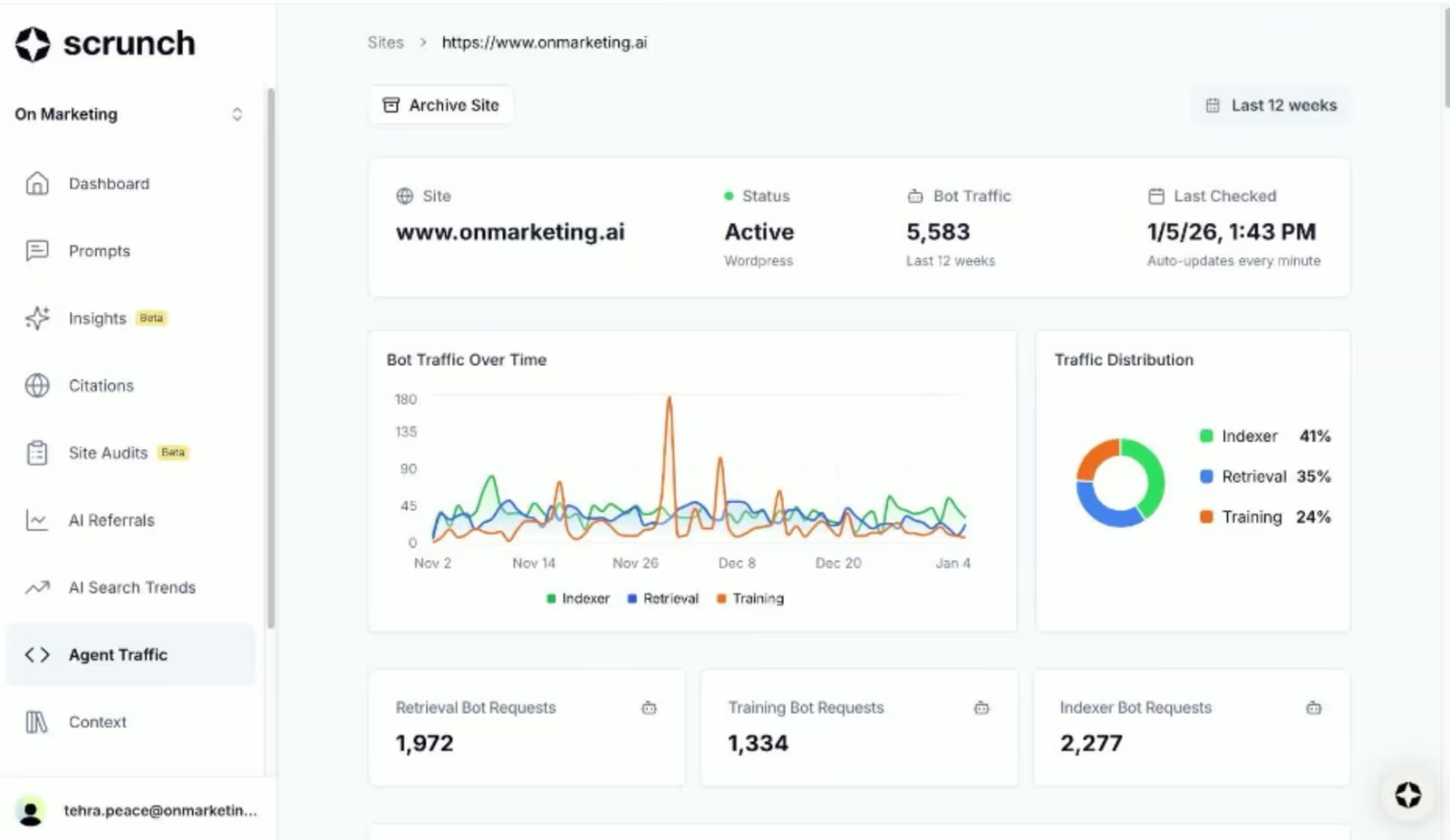
Scrunch is an AI search visibility platform that monitors how AI systems present a brand and serves AI agents a machine-readable version of the brand's website. Its pricing page lists coverage of ChatGPT, Claude, Gemini, Perplexity, Google AI Mode, AI Overviews and Meta.
Monitoring covers prompts, topics and entities, with citation analysis and benchmarks by competitor, persona, topic and geography. Scrunch also shows how AI bots crawl a site through a real-time traffic feed.
Why does Scrunch fit teams replacing Profound?
Scrunch fits teams replacing Profound that want published prices and a way to change what AI agents read without redesigning the site. Its Agent Experience Platform (AXP) creates a parallel, lightweight version of a site translated for AI agents. AXP serves compressed, machine-readable pages to agents while the human-facing design stays as it is.
What are the main Scrunch features?
- Prompt, topic and entity tracking with trends, citations, competitors and rankings
- Persona-based prompts, with three personas on Starter and five on Growth
- AXP for AI-readable versions of site pages
- A real-time feed of AI bot traffic
- Page audits, five on Starter and ten on Growth
- Enterprise Data API and SAML/OIDC security on the Enterprise plan
How much does Scrunch cost?
Scrunch Starter costs $300 per month month-to-month, or $250 per month billed annually, with 350 custom prompts, 1,000 industry prompts and three user licenses. Growth costs $500 per month month-to-month, or $417 per month billed annually, with 700 custom prompts and five licenses. Enterprise is custom-priced. Extra seats cost $25 per month each, and Starter includes a 7-day free trial without a credit card.
What are the pros and cons of Scrunch?
Pros
- Published prices with a 7-day free trial on Starter
- AXP changes what AI agents read without touching the visible site
- Benchmarks by persona and geography
- Meta listed in platform coverage
Cons
- The entry plan costs more than the Otterly.AI, Semrush or SE Ranking entry plans
- Slack appears only as an Enterprise service channel, and the Data API is Enterprise-only
- Its homepage does not describe sentiment tracking in detail, so teams that need it should confirm coverage in a demo
What do reviewers say about Scrunch?
G2 listed Scrunch at 4.6 to 4.7 out of 5 across 73 reviews in October 2026. Reviewers praise customer service, competitor analysis and the dashboard, while some ask for more data flexibility and more integrations.
4. Otterly.AI
 Via Otterly.AI
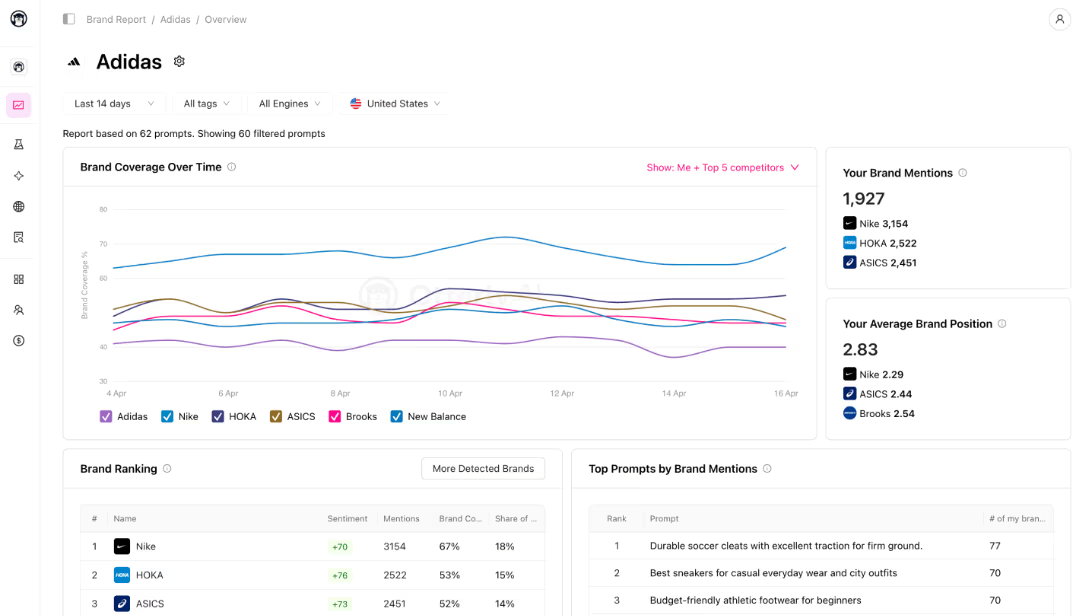
Otterly.AI is an AI search monitoring platform that tracks brand mentions and citations in ChatGPT, Google AI Overviews, Perplexity and Microsoft Copilot, with Claude, Google AI Mode and Gemini sold as add-ons. Every listed plan also includes Generative Engine Optimization (GEO) URL audits, from 1,000 per month on Lite to 10,000 per month on Premium.
Its entry price is the lowest in this guide, which suits consultants and small teams that want to test AI search tracking before a larger commitment.
Why does Otterly.AI fit teams replacing Profound?
Otterly.AI fits teams replacing Profound that need a low, published monthly price and a small prompt set. Lite tracks 15 prompts, Standard 100 and Premium 400. Standard and Premium add a Looker Studio connector, API and MCP requests, unlimited workspaces, and Agent Analytics events for AI crawler activity.
What are the main Otterly.AI features?
- Mention and citation tracking across four answer engines, with three more as add-ons
- GEO URL audits on every plan
- Recommendations, capped at three per week on Lite and unlimited on Standard and Premium
- Detailed reports and exports on every plan, with a Looker Studio connector from Standard
- API and MCP requests, plus Agent Analytics, from Standard
How much does Otterly.AI cost?
Otterly.AI Lite costs $29 per month billed monthly, or $25 per month billed annually, for 15 prompts. Standard costs $189 per month, or $160 per month annually, for 100 prompts. Premium costs $489 per month, or $422 per month annually, for 400 prompts. The pricing page shows two price sets and labels annual billing as 15% off; the lower figures are the annual rates. On Standard, Google AI Mode or Gemini costs $59 per month each and Claude costs $109 per month, and a free trial is available.
What are the pros and cons of Otterly.AI?
Pros
- Lowest published entry price in this guide
- GEO URL audits on every plan
- Looker Studio connector for client dashboards from Standard
Cons
- Claude, Gemini and Google AI Mode cost extra on every plan
- Lite caps recommendations at three per week and excludes API access
- Slack alerts require a user-built connection through its API or MCP
What do reviewers say about Otterly.AI?
G2 listed Otterly.AI at about 4.8 out of 5 across roughly 40 to 50 reviews in October 2026. Reviewers praise ease of use, frequent feature releases and the Looker Studio integration. Some found the move from keyword tracking to prompt tracking difficult and the sentiment analysis occasionally too sensitive.
5. Semrush
 Semrush AI Visibility toolkit
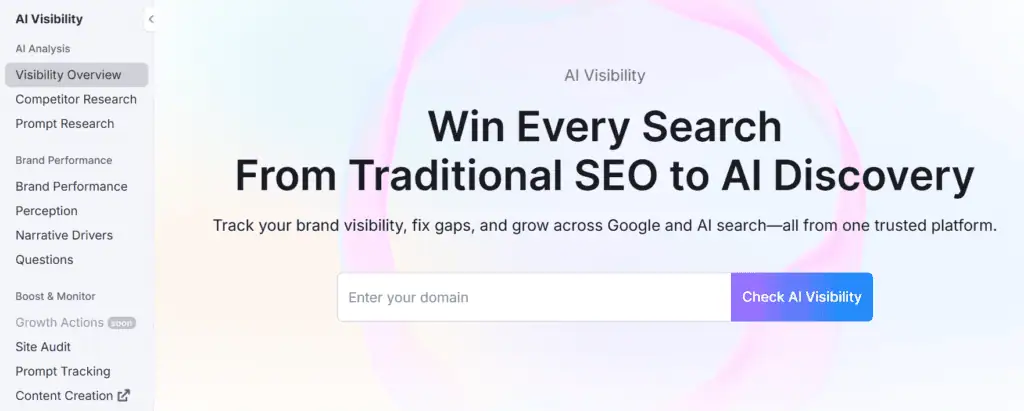
Semrush is an SEO and marketing suite whose AI Visibility Toolkit tracks how ChatGPT, Google AI, Gemini and Perplexity mention a brand. The toolkit adds prompt tracking, prompt research, AI competitor analysis and a site audit for AI readiness to Semrush's keyword and backlink data.
Semrush describes Semrush One as the platform that unifies its SEO data and AI visibility, and its main plans also list AI visibility features such as custom prompt monitoring and AI sentiment.
Why does Semrush fit teams replacing Profound?
Semrush fits teams replacing Profound that already run their SEO program in Semrush and want AI visibility in the same login. Brand Performance, perception and narrative driver views sit next to the keyword and competitor research the team already uses, so AI answer data and search data share one workspace.
What are the main Semrush AI visibility features?
- Daily tracking of 25 custom prompts on the base toolkit
- Prompt research and AI competitor analysis
- Brand Performance analysis for one domain, with perception and narrative driver views
- Site audit for AI readiness
- Up to 300 AI reports per day
How much does Semrush cost?
The Semrush AI Visibility Toolkit costs $99 per month per domain, billed annually, for 25 daily-tracked custom prompts. The page shows no monthly-billed rate for the toolkit. Broader Semrush plans start at $139 per month billed monthly for the SEO plan, and the Starter plan at $199 per month billed monthly tracks 50 prompts daily. Advanced, with unlimited daily prompts, is custom-priced.
What are the pros and cons of Semrush?
Pros
- AI visibility next to a large SEO keyword and backlink database
- Prompt research helps pick prompts worth tracking
- Seven-day free trial on Semrush plans
Cons
- The toolkit is priced per domain and billed annually
- 25 prompts on the base toolkit is a small set for brands with several product lines
- Reviewers call Semrush expensive for small teams
What do reviewers say about Semrush?
G2 listed Semrush at 4.4 out of 5 across about 4,000 reviews in October 2026, a rating that covers the whole suite. Reviewers praise the breadth of SEO data and the backlink audit, and pricing plus a steep learning curve are the most frequent complaints.
6. Ahrefs Brand Radar
 Via Ahrefs
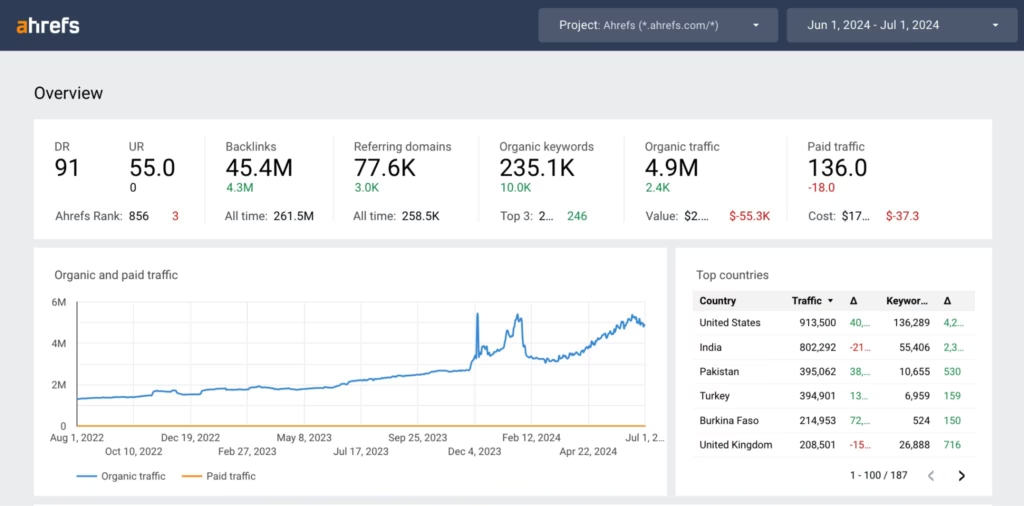
Ahrefs Brand Radar is an Ahrefs product that tracks brand visibility in AI answers across Google AI Overviews, AI Mode, ChatGPT, Perplexity, Gemini and Copilot, plus mentions on YouTube and Reddit. Claude is available in its AI Visibility Index.
Brand Radar works two ways. Custom Prompts tracks the exact questions a team defines, and the AI Visibility Index uses a prebuilt prompt database that Ahrefs says is modeled from real searches in its keyword data.
Why does Ahrefs Brand Radar fit teams replacing Profound?
Ahrefs Brand Radar fits teams replacing Profound that already pay for Ahrefs and want market-wide AI visibility data without writing every prompt. The index gives a category-level view from prebuilt prompts, while Custom Prompts covers the specific buyer questions a team cares about most.
What are the main Ahrefs Brand Radar features?
- Custom Prompts with daily updates, from 5 prompts on Lite to 83 or more on Enterprise
- AI Visibility Index built on prebuilt prompts from Ahrefs keyword data
- Coverage of six AI answer surfaces, with Claude in the index
- YouTube and Reddit mention tracking
How much does Ahrefs Brand Radar cost?
Ahrefs Brand Radar Custom Prompts come with every paid Ahrefs plan from Lite, which costs $129 per month billed monthly, and the AI visibility add-on (Brand Radar AI) starts at $199 per month per index, or $699 per month for all platforms. Lite and higher plans include a small custom prompt allowance (5 prompts on Lite), and larger prompt packages are paid add-ons from $50 per month (2,500 checks).
What are the pros and cons of Ahrefs Brand Radar?
Pros
- Prebuilt prompt index gives a market view without manual prompt setup
- YouTube and Reddit tracking alongside AI answers
- Custom Prompts included for existing Ahrefs subscribers
Cons
- Five custom prompts on Lite is a small set
- The AI Visibility Index is a separate monthly add-on
- The Brand Radar page describes tracking and reporting, with no on-page fix workflow
What do reviewers say about Ahrefs?
The Ahrefs G2 listing showed 4.5 out of 5 across about 700 reviews in October 2026, a rating that covers the whole Ahrefs suite. Reviewers praise the accuracy of its backlink data, and some mention the cost for small teams.
7. SE Ranking
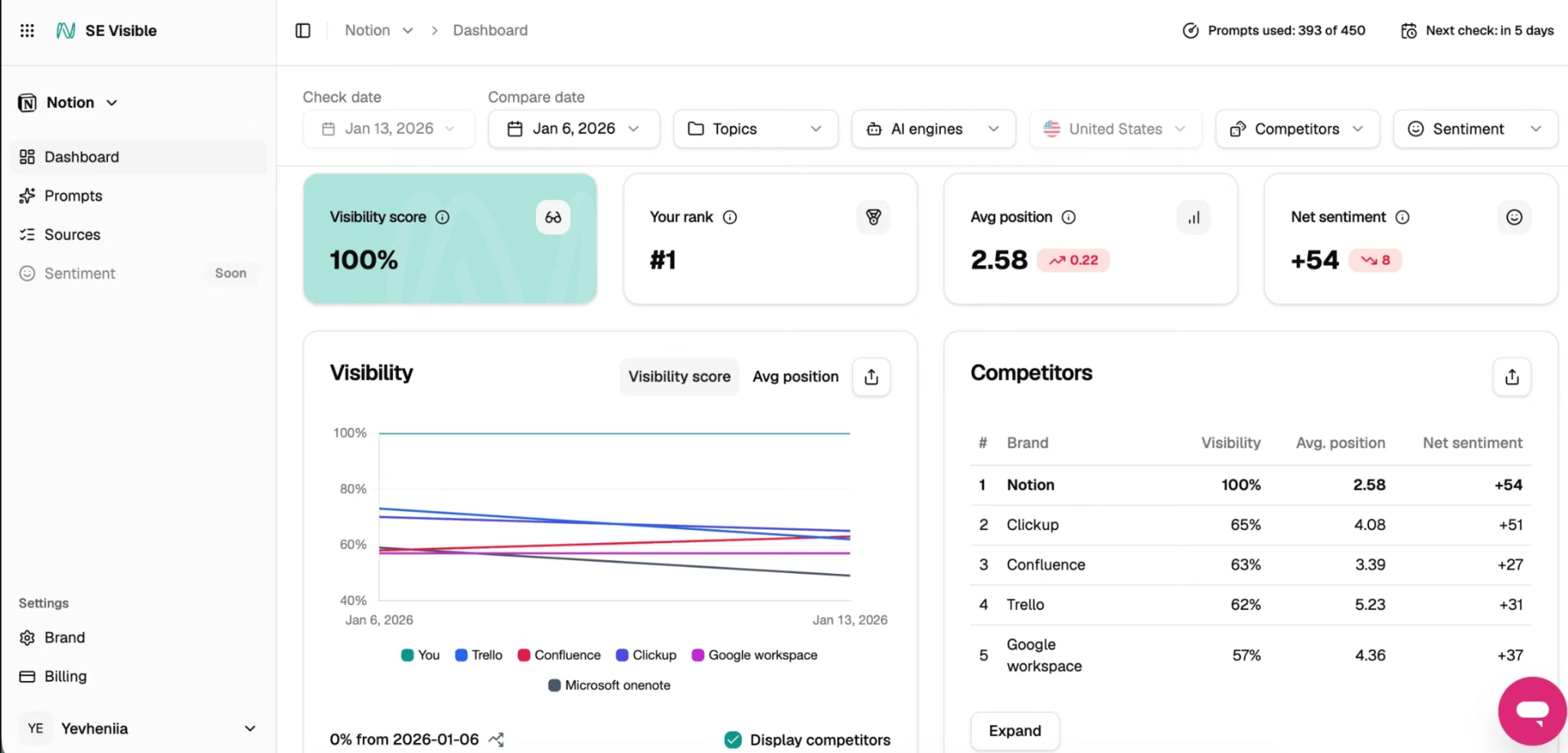 SE Ranking AI visibility dashboard
SE Ranking is an SEO platform whose AI Search Toolkit monitors AI-generated answers for tracked prompts across Google AI Overviews, AI Mode, ChatGPT and Gemini. It checks linked and unlinked brand mentions, competitor citations and the sources that appear in answers, and it keeps historical data.
SE Ranking also sells SE Visible, a separate dashboard for tracking brand mentions, citations and sentiment trends, which comes with the AI Search add-on.
Why does SE Ranking fit teams replacing Profound?
SE Ranking fits cost-conscious teams replacing Profound that want rank tracking, site audits and AI answer tracking at a published price. Its Core plan lists 100 GEO prompts tracked daily, and a 14-day free trial runs without a credit card.
What are the main SE Ranking AI visibility features?
- Prompt-level monitoring of AI answers across Google AI Overviews, AI Mode, ChatGPT and Gemini
- Linked and unlinked brand mention tracking
- Competitor citation and source analysis with history
- A free AI visibility checker that also covers Perplexity
- SE Visible for brand-level mention and sentiment trends
How much does SE Ranking cost?
SE Ranking Core costs $129 per month billed monthly, or $103.20 per month billed annually, and lists 100 GEO prompts tracked daily. Growth costs $279 per month billed monthly, or $223.20 per month billed annually, with 250 prompts. The AI Search add-on, with tiers of 200, 450 or 1,000 prompts, starts at $89 per month billed monthly or $71.20 per month billed annually. SE Visible comes with the AI Search add-on (200 prompts).
What are the pros and cons of SE Ranking?
Pros
- Low published price for SEO and AI answer tracking together
- Mentions tracked with and without links
- 14-day free trial without a credit card
Cons
- The product page and the pricing page list different engine sets, so buyers should confirm which engines their plan tracks
- Brand sentiment trends sit in SE Visible, which comes only with the paid AI Search add-on
What do reviewers say about SE Ranking?
The SE Ranking G2 listing showed 4.8 out of 5 across more than 1,400 reviews in October 2026, a rating for the whole platform. G2 sub-scores put Ease of Use at 9.2 and quality of customer help at 9.4 out of 10. Reviewers praise its all-in-one coverage, and some mention interface changes.
How should teams evaluate a Profound alternative?
Step by step
What are the six criteria for evaluating a Profound alternative?
Each criterion is explained in the list below, with Profound as the baseline.
- Answer-engine coverage
- Prompt data
- Citation and sentiment reporting
- AI crawler data
- Exports and alerts
- Acting on findings
Teams should evaluate a Profound alternative by running the same prompt set, engines and reporting jobs in each shortlisted platform side by side. A feature list says little until identical prompts produce comparable results. These six criteria use Profound's own features as the baseline.
- Answer-engine coverage. Profound Enterprise lists up to nine engines, including Claude, DeepSeek and Exa Search, while the entry plans in this guide cover between three and seven. Confirm which engines each plan covers.
- Prompt data. Profound pairs custom prompts with Prompt Volumes, its estimate of what people ask AI systems. Check whether an alternative offers custom prompts, prebuilt prompts or both, and how it counts usage.
- Citation and sentiment reporting. Profound's Answer Engine Insights cover citation analytics and sentiment by platform. Look for the domains AI answers cite, plus share of voice and sentiment broken out by engine.
- AI crawler data. Profound's Agent Analytics reads how AI crawlers view and cite a site's pages. Otterly.AI offers Agent Analytics events from Standard, and Scrunch shows a real-time feed of AI bot traffic.
- Exports and alerts. Profound limits CSV and JSON exports and API access to Enterprise. Get export terms and API limits in writing, and check for Slack or Microsoft Teams delivery and negative-sentiment alerts.
- Acting on findings. Profound stages agent-written CMS drafts for approval, so any alternative that changes a live site should offer approval steps too.
Methodology needs the closest check, because two trackers can report different visibility for the same brand. The guide to the best AI visibility tools explains how sampling, prompt sets and refresh rates change the numbers.
Which Profound alternative fits each type of team?
The right Profound alternative depends on whether a team mainly needs low-cost monitoring, multi-client reporting, enterprise security or work done on its findings, and Search Atlas appears in each profile because its account combines AI visibility with SEO work.
- Budget monitoring: Search Atlas starts with the free AI Visibility Checker, and Growth at $199 per month adds LLM Visibility, rank tracking and site fixes in one account. Otterly.AI Lite tracks 15 prompts for $29 per month, and SE Ranking Core adds AI answer tracking to a full SEO plan from $129 per month.
- Agencies running several client accounts: Search Atlas Pro adds white-label dashboards and reporting at $399 per month, with Report Builder and Search Atlas Coworker summaries in Slack or Microsoft Teams. Otterly.AI offers unlimited workspaces from Standard.
- Enterprise brands: Search Atlas Agency starts at $999 per month with ten seats and ten projects. Profound Enterprise and Scrunch Enterprise offer SSO and data APIs on custom terms, which matters when a security review drives the decision.
- Teams that want execution beyond monitoring: Search Atlas acts on findings through OTTO SEO and Atlas Agent, with approval steps on both.
- Content teams: Search Atlas pairs the sources cited in LLM Visibility with Content Genius for drafting and grading pages. Peec AI source analysis and Scrunch topic tracking show which sources and subjects AI answers rely on, which helps editors decide what to write and where to earn mentions.
- Teams already in an SEO suite: Search Atlas covers rank tracking, Site Explorer and site audits next to AI visibility, and Semrush and Ahrefs users add AI visibility without onboarding a new vendor.
A baseline measurement makes any trial more useful. The free Search Atlas AI Visibility Checker gives a two-engine snapshot of mentions, citations and competitor gaps before a paid trial starts.
What are common questions about Profound alternatives?
Common questions about Profound alternatives cover free options, public pricing, Slack alerts and which platforms act on findings.
What is the best Profound alternative?
The best Profound alternative depends on the team: Otterly.AI suits budget monitoring, Search Atlas suits agencies and teams that want execution, Scrunch suits enterprise data teams, and Semrush or Ahrefs suit research-led SEO teams.
Is there a free Profound alternative?
The Search Atlas AI Visibility Checker is free and gives a snapshot of brand visibility on ChatGPT and Gemini. For ongoing tracking, Profound, Scrunch and Semrush offer 7-day trials, and SE Ranking offers 14 days. Ahrefs includes a small custom prompt allowance from its paid Lite plan.
Does Profound have public pricing?
No. Profound lists a free 7-day Trial and a custom-priced Enterprise plan, and its FAQ names a self-serve Agency Growth plan without a published price.
Which GEO software sends Slack alerts for negative sentiment?
Search Atlas LLM Visibility sends alerts when negative sentiment appears in AI answers, and the Search Atlas Coworker surfaces citation drops in Slack, Microsoft Teams or ClickUp, so teams that need the sentiment alert itself in Slack should confirm the delivery channel. Profound can build alerts with its Agents, and Otterly.AI and Peec AI connect to Slack through a user-built API or MCP connection.
Which Profound alternatives act on their findings?
Search Atlas acts most directly, because OTTO SEO applies on-page fixes and Atlas Agent executes planned tasks after approval. Scrunch's AXP serves AI agents a machine-readable site version, Peec AI and Otterly.AI provide recommendations, and Profound stages agent-written content in a CMS for approval.
Which Profound alternatives cover Claude or DeepSeek?
Scrunch and Ahrefs Brand Radar include Claude, and Otterly.AI sells Claude as a paid add-on at $109 per month on Standard. Profound Enterprise covers both Claude and DeepSeek, so teams that need DeepSeek tracking should confirm coverage with any alternative during a trial.