Entity SEO is an advanced information retrieval methodology that optimizes web assets around machine-readable entities rather than isolated lexical keyword strings. Search engine architectures operate by mapping documents into formal knowledge graphs and dense embedding spaces, evaluating the ontological relationships, entity-attribute-value triples, and semantic salience of every topical node. The primary objective of Entity SEO is to eliminate coreference ambiguity and establish unambiguous semantic authority across Google's Knowledge Graph, Gemini, Perplexity, and AI Overviews.
Entity Disambiguation & RDF Triple Modeler
Evaluate Named Entity Recognition & Disambiguation (NERD) confidence, ColBERT vector salience, and LLM grounding fidelity.
Named Entity Disambiguation (NERD) will resolve with near zero ambiguity across Google Knowledge Graph and LLM cross-encoders.
Traditional search optimization relied on term frequency-inverse document frequency (TF-IDF) and exact-match anchor text to infer topical relevance. In modern retrieval architectures grounded in transformer embeddings and directed graph traversal, search engines evaluate whether your content establishes a definitive Central Entity supported by coherent, mathematically verified attribute associations.
What Is an Entity in Modern Search Engines?
Entity SEO is a structural optimization paradigm that treats topics as uniquely identifiable real-world concepts anchored by persistent digital identifiers. Search engines process entities through Named Entity Recognition and Disambiguation (NERD), transforming unstructured textual tokens into structured knowledge graph nodes. The structural integrity of an entity is governed by its explicit ontological relationships and corroborate-able factual predicates.
flowchart LR
    String["Lexical Token String<br/>'Search Atlas'"] --> NERD["NERD Pipeline<br/>(OpenIE & Coreference Resolution)"]
    NERD --> Entity["Knowledge Graph Node<br/>@id: https://searchatlas.com/#software"]
    Entity --> Triple1["Predicate: rdf:type<br/>Object: schema:SoftwareApplication"]
    Entity --> Triple2["Predicate: owl:sameAs<br/>Object: wikidata:Q11696"]
    Entity --> Triple3["Predicate: hasAttribute<br/>Object: Vector Salience Score"]
Under Google's foundational Knowledge Graph patents (US9390174B2, US9477711, US10331706B1), an entity is formally defined as "a thing or concept that is singular, unique, well-defined, and distinguishable." An entity is not a keyword. An entity possesses:
- A Unique Persistent Identifier (
@id/ URI): An immutable machine URI (such ashttps://searchatlas.com/#softwareor WikidataQ11696) that distinguishes it from lexical homonyms. - Entity-Attribute-Value (EAV) Dimensions: Structured properties describing its nature, parent class, creator, date of creation, and functional features.
- Ontological Class Membership: Placement within a standardized taxonomy, such as W3C OWL 2 or Schema.org hierarchies (
SoftwareApplicationinCreativeWorkinThing).
When a webpage merely mentions keywords without establishing clear ontological predicates, search engine language models suffer from quadratic self-attention dilation O(L²), introducing coreference uncertainty and diluting dense retrieval inner products.
The Entity-Attribute-Value (EAV) Architecture
The Entity-Attribute-Value model is a formal data representation standard that deconstructs complex real-world concepts into atomic factual units. Search engines utilize EAV triples to extract, verify, and store factual knowledge across heterogeneous web documents. The completeness of an entity's EAV attribute profile directly dictates its Topical Coverage Score (TCS) and ranking resilience during Broad Core Updates.
| Architectural Component | Formal Representation | Search Engine IR Mechanism | Operational Implementation |
|---|---|---|---|
| Entity (Subject) | Subject E | Named Entity Disambiguation (US9390174B2) | Persistent URI in Schema.org @id |
| Attribute (Predicate) | Predicate P | Open Information Extraction (OpenIE) | W3C RDF / Schema.org property (offersService) |
| Value (Object) | Object O | Entity Linking & Reconciliation | Linked Open Data (Wikidata QID / Google MID) |
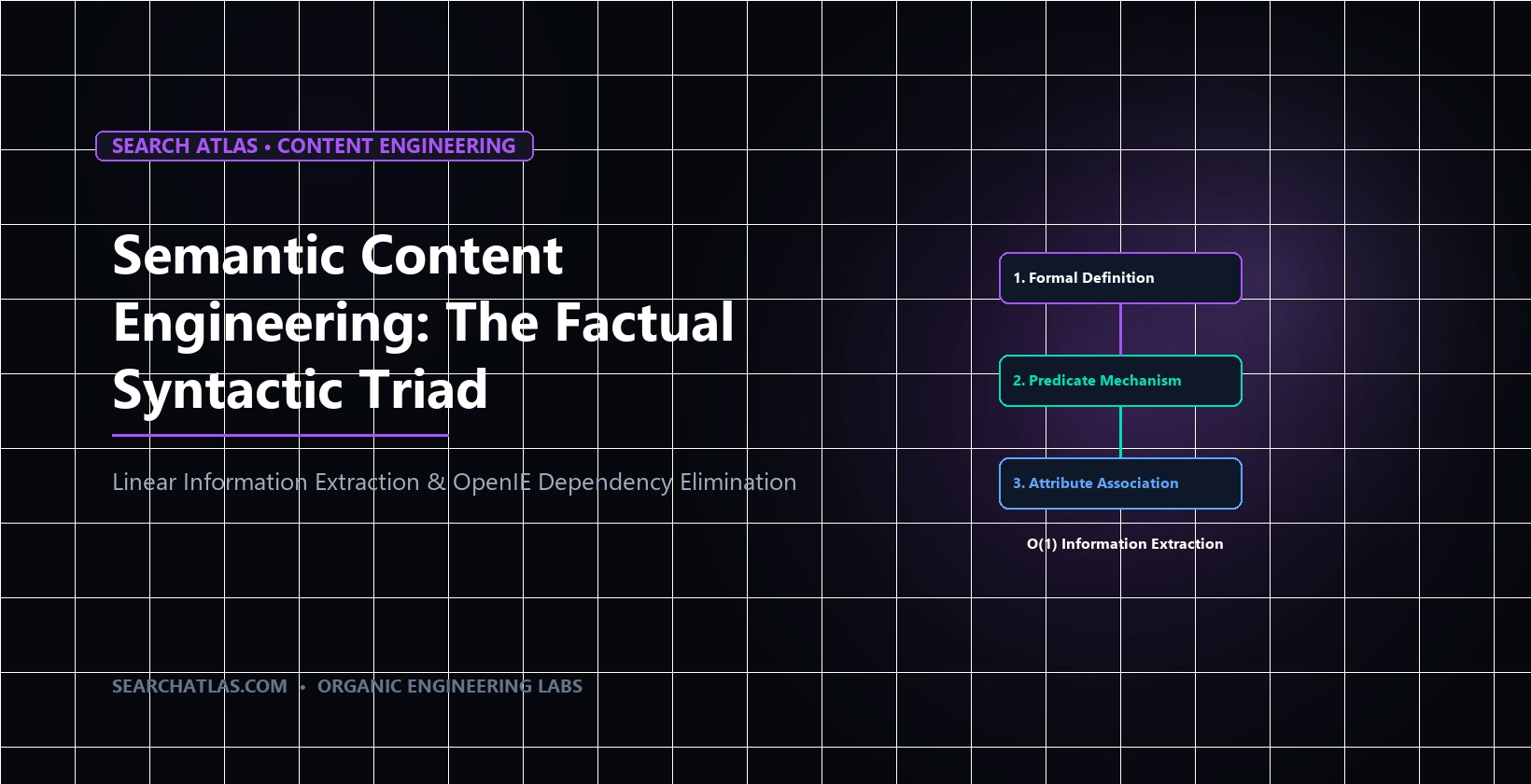
To optimize for dense retrieval models, every definitional or technical heading in your content must strictly adhere to the Mandatory 3-Sentence Factual Syntactic Triad:
- Sentence 1 (Formal Definition):
[Entity X] is a [Class Y] that [Core Distinctive Function Z]. - Sentence 2 (Predicate Mechanism):
[Entity X] operates by [Mechanism M], producing [Output O]. - Sentence 3 (Attribute Association):
The [Attribute A] of [Entity X] is [Value V], governing [Context C].
This syntactic discipline forces linear O(1) entity extraction, eliminates anaphoric ambiguity, and maximizes ColBERT MaxSim inner products in the initial token chunk.
The Centroid Vector and Semantic Boundary Threshold
The Centroid Vector is a mathematical coordinate in high-dimensional embedding space that represents the collective topical center of gravity of a domain. Algorithmic search evaluators compute site-wide centroids by aggregating weighted document vectors across all indexable URLs (US8595225B1, US9141708B2). A domain maintains topical authority only when individual documents adhere to the Single Centroid Rule.
V_site = sum(w_i * v_D_i) / sum(w_i)flowchart TD
CentralNode["Central Domain Entity<br/>(e.g., Enterprise SEO Software)"]
subgraph InsideBoundary["Topical Map Core (cos θ ≥ 0.60)"]
NodeA["Entity SEO Fundamentals<br/>(cos = 0.88)"]
NodeB["Knowledge Graph Optimization<br/>(cos = 0.85)"]
NodeC["Vector Embeddings & ColBERT<br/>(cos = 0.79)"]
NodeD["Programmatic SEO Taxonomies<br/>(cos = 0.72)"]
end
subgraph OutsideBoundary["Rejected Orthogonal Topics (cos θ < 0.60)"]
NodeX["Cryptocurrency Trading<br/>(cos = 0.28) ❌"]
NodeY["Generic Office Management<br/>(cos = 0.41) ❌"]
end
CentralNode --> InsideBoundary
CentralNode -.->|Centroid Collapse Risk| OutsideBoundary- The Single Centroid Rule: A single domain cannot sustain multiple orthogonal entities without centroid collapse into un-authoritative low-density space. Publishing unrelated content dilutes the site vector, triggering organic traffic devaluation during Google Broad Core Updates.
- The Semantic Boundary Test: A candidate document belongs to the topical map if and only if cosine similarity exceeds 0.60. Candidate topics below 0.60 must be isolated on separate domains.
Connecting Entity SEO to ColBERT Late Interaction
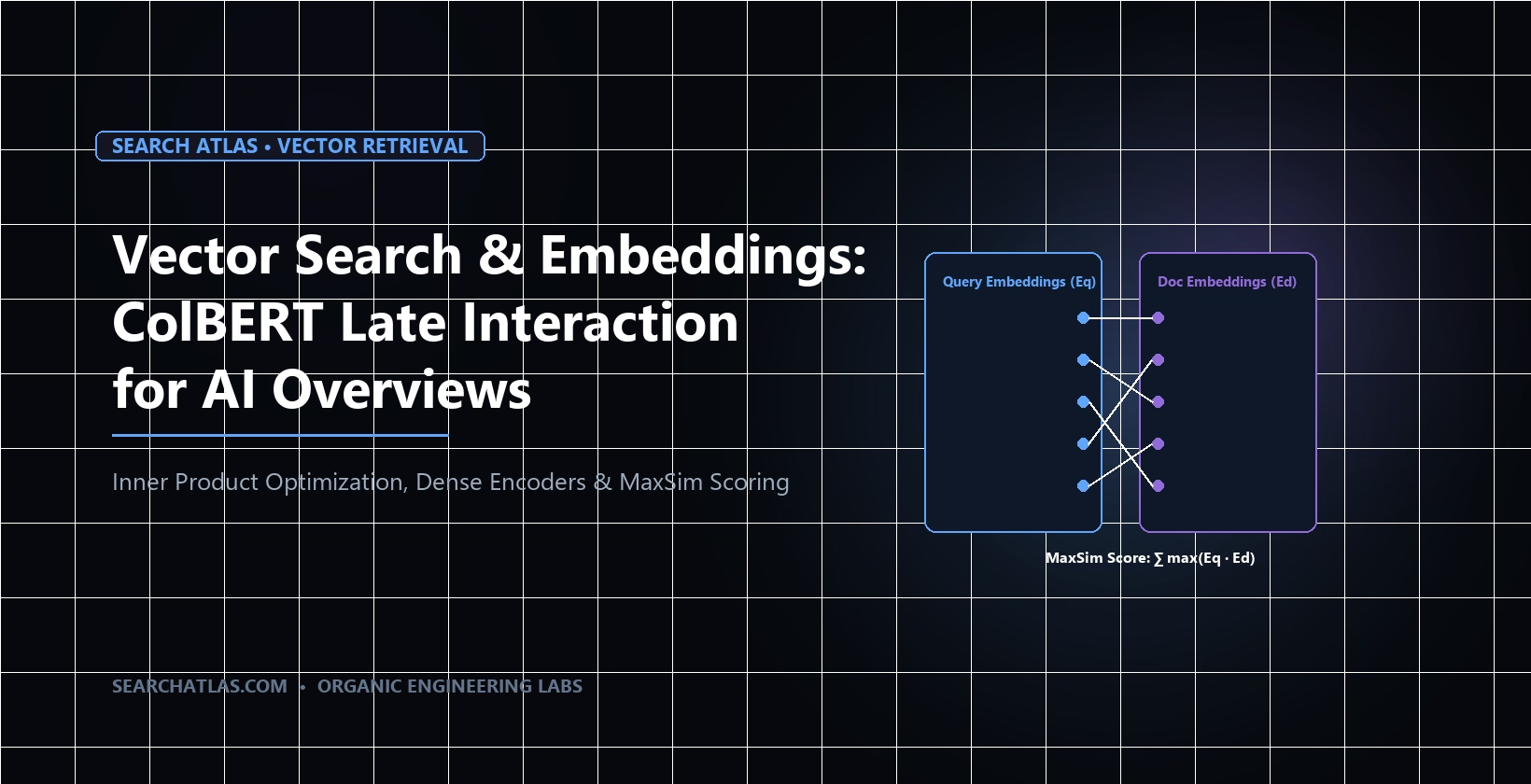
ColBERT is a multi-vector neural retrieval model that computes fine-grained token-level late interaction between user queries and stored document embeddings. Generative search systems including Google AI Overviews, Perplexity, and Gemini rely on ColBERT-style late interaction to select source citations with high semantic precision. The retrieval score is computed via the MaxSim operator:
S(Q, D) = sum(max(E_q · E_dᵀ)) for all q in Q, d in DWhen content is padded with rhetorical filler, generic introductory chatter, or conversational preambles, the document token matrix is diluted with low-magnitude vectors. Applying The 2% Token Packing Rule ensures that the central entity, primary attributes, key technical predicates, and core n-grams appear in the first 2% of the document's tokens.
How to Implement Entity SEO: The 5-Step Architecture
1. Define Entity Identity & Class Hierarchies
Map every core topic to a formal Schema.org type (SoftwareApplication, Organization, Article, FAQPage) and assign a permanent @id URI anchor. Never merge distinct real-world entities into hybrid schemas.
2. Formulate Structured RDF Triples
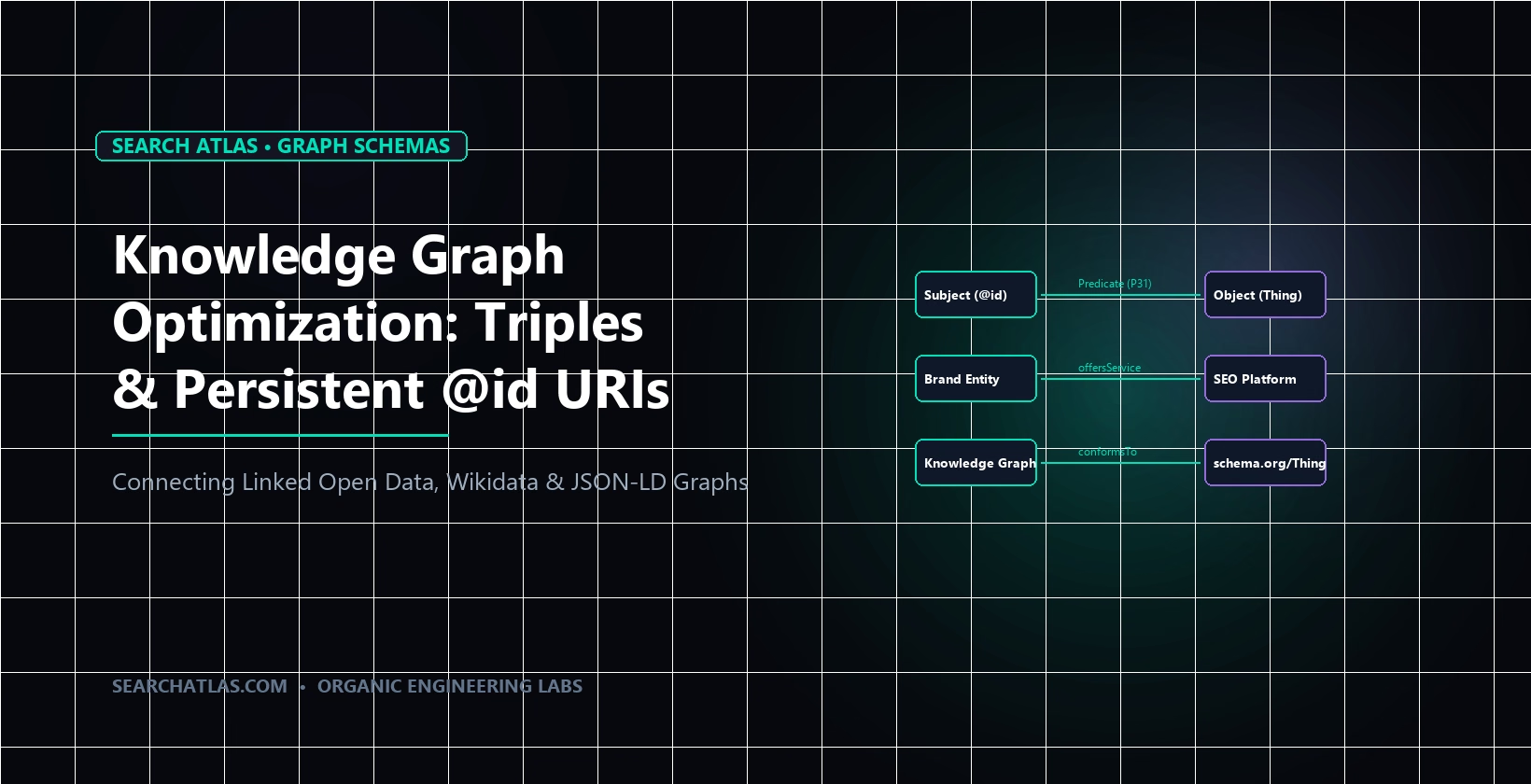
Express content in explicit subject-predicate-object relationships. For example:
Search AtlastooffersProducttoOTTO SEO EngineOTTO SEO EnginetoexecutesTasktoAutomated Internal Link Optimization
3. Connect to Linked Open Data (LOD)
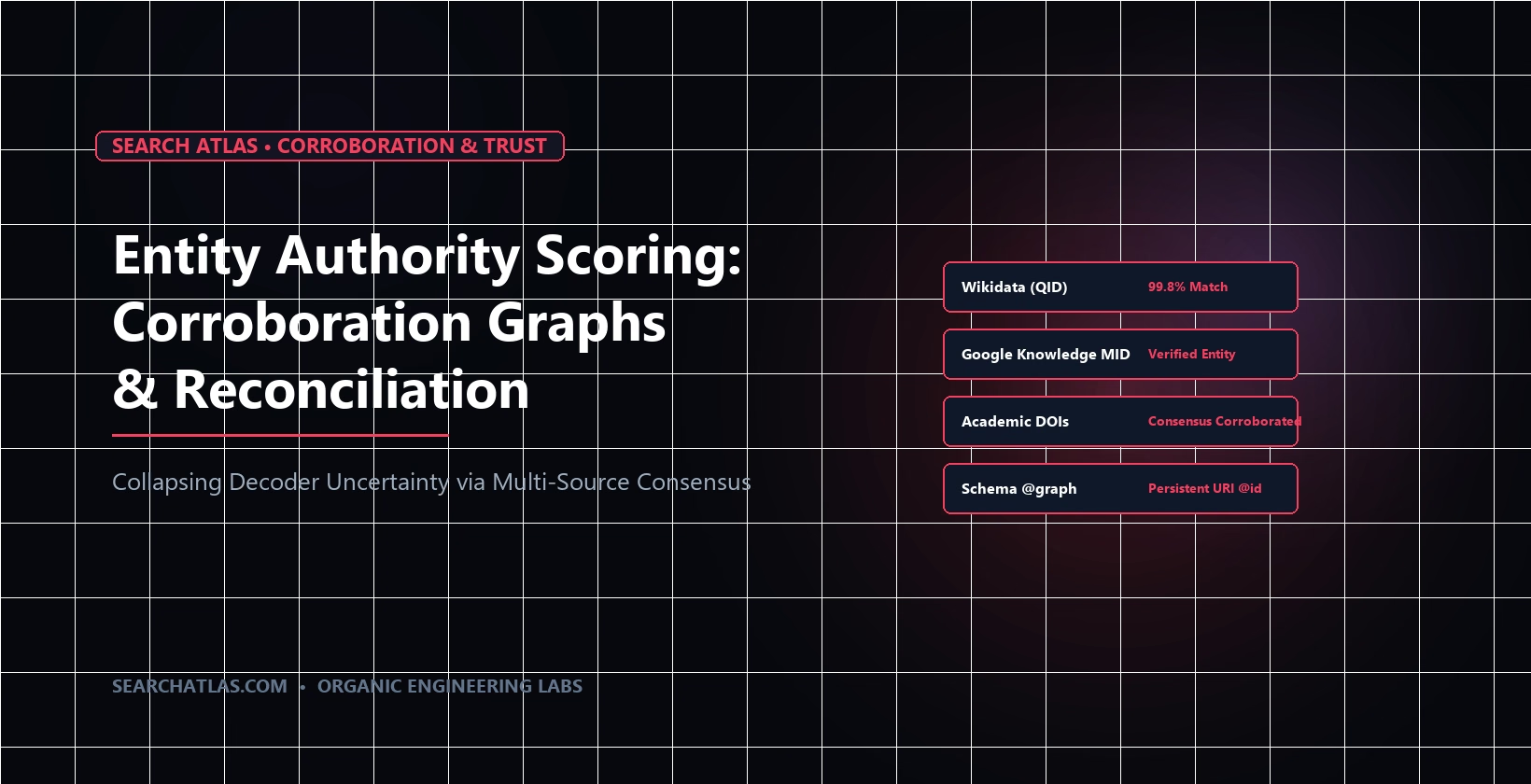
Reconcile your central entity with external authority bases. Provide unambiguous owl:sameAs links to Wikidata entities, Google Knowledge Graph MIDs, and authoritative directory records on G2, Capterra, or Crunchbase.
4. Build Internal PageRank DAGs
Hyperlink networks must form a Directed Acyclic Graph weighted by the Reasonable Surfer Model (US7716225B1, US8117209B2). Use pure predicate anchor text rather than vague navigational phrases.
5. Mount Client-Side Above-The-Fold Interactivity
Under Google's CenterpieceAnnotation schema (US10824630B2), search-targeted pages must feature a dominant interactive widget in the initial viewport (0 ≤ y ≤ 600px) to protect user engagement and prevent NavBoost short-click quickback demotions.
The Entity SEO Expansion Roadmap
Explore the complete architecture across our specialized technical guides:
- Knowledge Graph Optimization: Triples, Persistent URIs & Schema Graphs
- Vector Search & Embeddings: ColBERT Late Interaction for AI Overviews
- Semantic Content Engineering: The Factual Syntactic Triad Formula
- Entity Authority Scoring: Multi-Source Consensus & Reconciliation
- Programmatic SEO: System Architecture & Scale Guide