Vector Search is a dense information retrieval architecture that indexes and queries web documents based on mathematical semantic proximity in high-dimensional vector spaces. Search engines execute vector retrieval by converting text tokens into dense continuous vectors, comparing the geometric orientation and inner products of queries and candidate documents. The fundamental advantage of Vector Search is its capacity to resolve conceptual intent and semantic synonyms that traditional sparse keyword algorithms fail to detect.
flowchart TD
    subgraph QueryEncoding["Query Processing (Eq)"]
        Query["User Query Tokens: [q1, q2, ... qm]"] --> BertQ["Query Encoder"]
        BertQ --> VectorQ["Dense Query Matrices (Eq)"]
    end

    subgraph DocEncoding["Document Ingestion (Ed)"]
        Doc["Document Token Chunks: [d1, d2, ... dn]"] --> BertD["Document Encoder"]
        BertD --> VectorD["Dense Document Matrices (Ed)"]
    end

    subgraph LateInteraction["ColBERT Late Interaction (MaxSim)"]
        VectorQ --> MaxSim["MaxSim Operator:<br/>∑ max(Eq · Ed)"]
        VectorD --> MaxSim
        MaxSim --> RankScore["Final Reranking Score S(Q, D)"]
    end
In the era of Google AI Overviews, Gemini, Perplexity, and ChatGPT Search, traditional lexical matching (BM25) functions merely as a candidate generation stage. The final document selection and citation extraction are governed by neural vector re-ranking and multi-vector late interaction.
Sparse vs. Dense Retrieval: The Hybrid Search Pipeline
The hybrid search pipeline is a multi-stage retrieval architecture that integrates traditional sparse inverted index lookups with dense neural vector representations. Search engines deploy hybrid architectures to balance the computational efficiency and exact lexical precision of BM25 with the conceptual semantic depth of transformer embeddings. The operational output is a combined candidate score that feeds neural cross-encoder re-ranking models.
| Retrieval Architecture | Mathematical Representation | Strengths in Modern Search | Vulnerabilities & Dilution |
|---|---|---|---|
| Sparse Retrieval (BM25) | Inverted index term frequency matrices | Exact SKU matches, brand names, low compute latency | Lexical mismatch problem, blind to conceptual synonyms |
| Dense Single-Vector | Bi-encoder embeddings | Strong conceptual clustering, high semantic recall | Information compression bottleneck over long documents |
| Multi-Vector (ColBERT) | Token-level contextual matrix | Fine-grained late interaction, token alignment | Higher memory and storage indexation footprint |
To optimize for hybrid pipelines, content must satisfy both lexical anchors (exact entity naming in headings and schema) and dense semantic geometry (dense attribute explanations without rhetorical fluff).
ColBERT Late Interaction & The MaxSim Operator
ColBERT (Contextualized Late Interaction over BERT) is a neural retrieval model that preserves token-level vector representations for both queries and documents while delaying interaction until the final ranking stage. Search engine re-rankers evaluate candidate passages by calculating the maximum cosine similarity between every query token and all document tokens. The mathematical scoring function is governed by the MaxSim operator:
S(Q, D) = sum(max(E_q · E_dᵀ)) for all q in Q, d in DWhere:
Qrepresents the sequence of tokens in the search query.Drepresents the candidate document or passage chunk.E_qis the contextual embedding vector for query tokenq.E_dis the contextual embedding vector for document tokend.·denotes the inner product between normalized token vectors.
Why Rhetorical Fluff Destroys MaxSim Scores
When an article opens with generic conversational preambles, the document token matrix is flooded with generic linguistic vectors.
During late interaction, specific query tokens (such as "entity SEO architecture", "RDF triple validation", or "knowledge graph") find only weak inner products across the document's introductory token space. Applying The 2% Token Packing Rule guarantees that the central entity, primary predicates, and technical attributes appear immediately in the first 2% of the document's tokens, maximizing inner products in the initial token chunk.
Vector Chunking & Document Layout Scoring
Layout-Weighted Scoring is an information extraction standard that assigns dynamic weights to document token chunks based on their visual coordinates in the rendered 2D DOM tree. Google's Web Rendering Service (WRS) evaluates rendered bounding boxes, assigning higher retrieval confidence to tokens located Above-the-Fold (0 ≤ y ≤ 600px) under Google's internal CenterpieceAnnotation schema (US10824630B2, US12210837B2, US12718022B1). The architectural priority requires placing direct answers and interactive utility immediately at the top of the viewport.
flowchart TD
    RenderTree["WRS 2D Render Tree Evaluation"]

    subgraph ATF["Above-the-Fold Viewport (0 ≤ y ≤ 600px)"]
        Hero["Direct Answer Definition (centerpiece_score ≥ 0.85)"]
        Widget["Interactive Client-Side Tool (NavBoost Dwell Anchor)"]
    end

    subgraph BTF["Below-the-Fold (y > 600px)"]
        Depth["Technical Specifications & Case Studies"]
        DAGLinks["Contextual Internal Link Bridges"]
    end

    RenderTree --> ATF
    ATF --> BTF
Tokens located in sidebars, navigation headers, or low-contrast footers receive discounted salience weights. Consequently, embedding your target entities within main content containers ensures maximum retrieval weighting.
Strategic Playbook: Optimizing for Vector Search
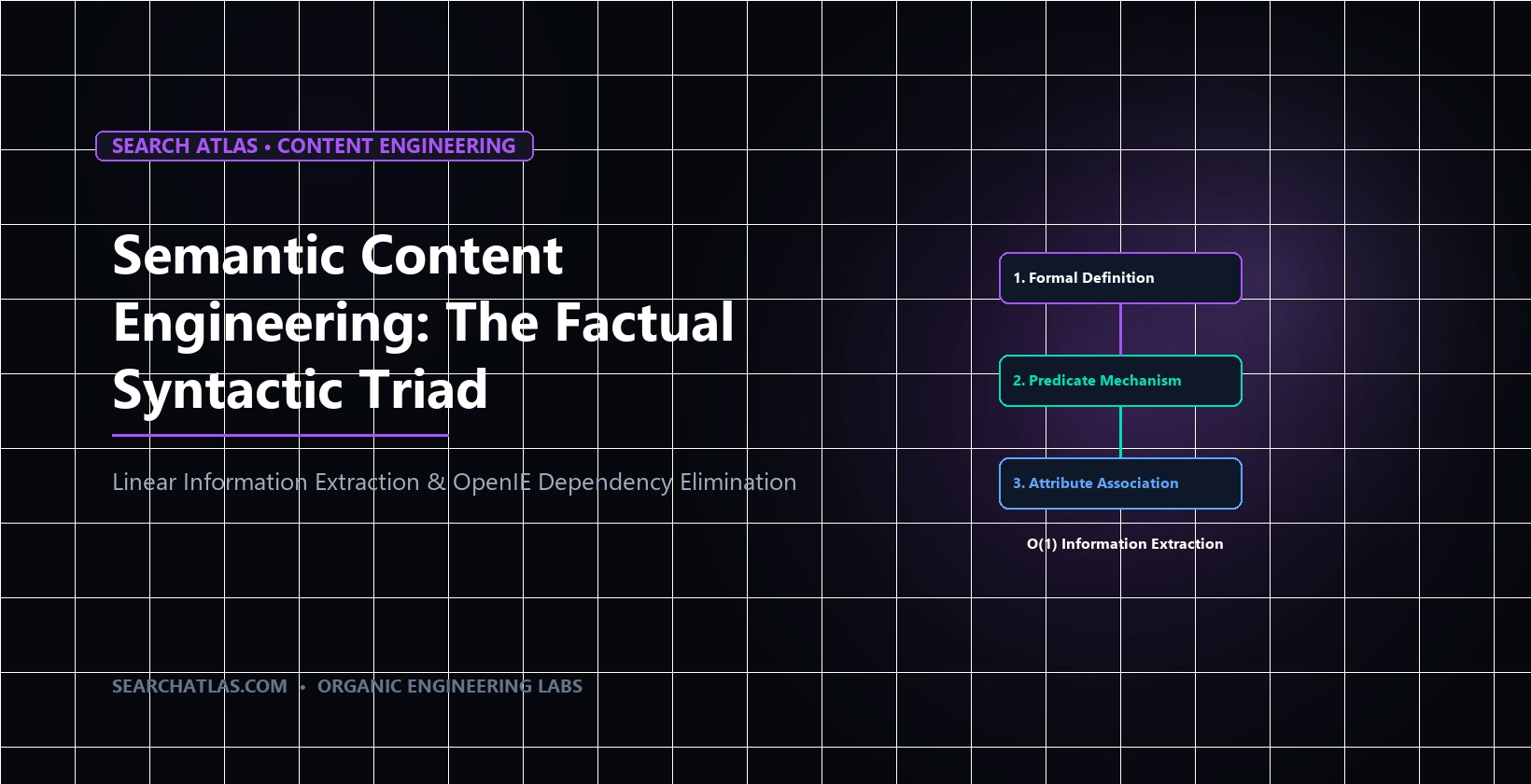
- Enforce the Factual Syntactic Triad: Format all primary definitional headings using the formal 3-sentence structure (Formal Definition to Predicate Mechanism to Attribute Association) to generate high-magnitude token vectors.
- Pack Entities into the First 2% of Tokens: Avoid introductory narrative filler. State the exact entity, parent classification, and functional mechanics in the opening sentence.
- Mount Client-Side Interactive Components: Provide an Above-the-Fold tool to anchor real-user dwell time and prevent NavBoost short-click penalties.
- Interlink via Directed Acyclic Graphs: Build contextual PageRank DAG links between semantically related vector clusters: