Programmatic SEO Scalability & Kinematic Risk Calculator
This programmatic architecture satisfies Google Scaled Content Abuse policies. Pacing, attribute density, and DAG link distribution will protect long-term organic indexation.
Formal Definition and Architectural Foundations
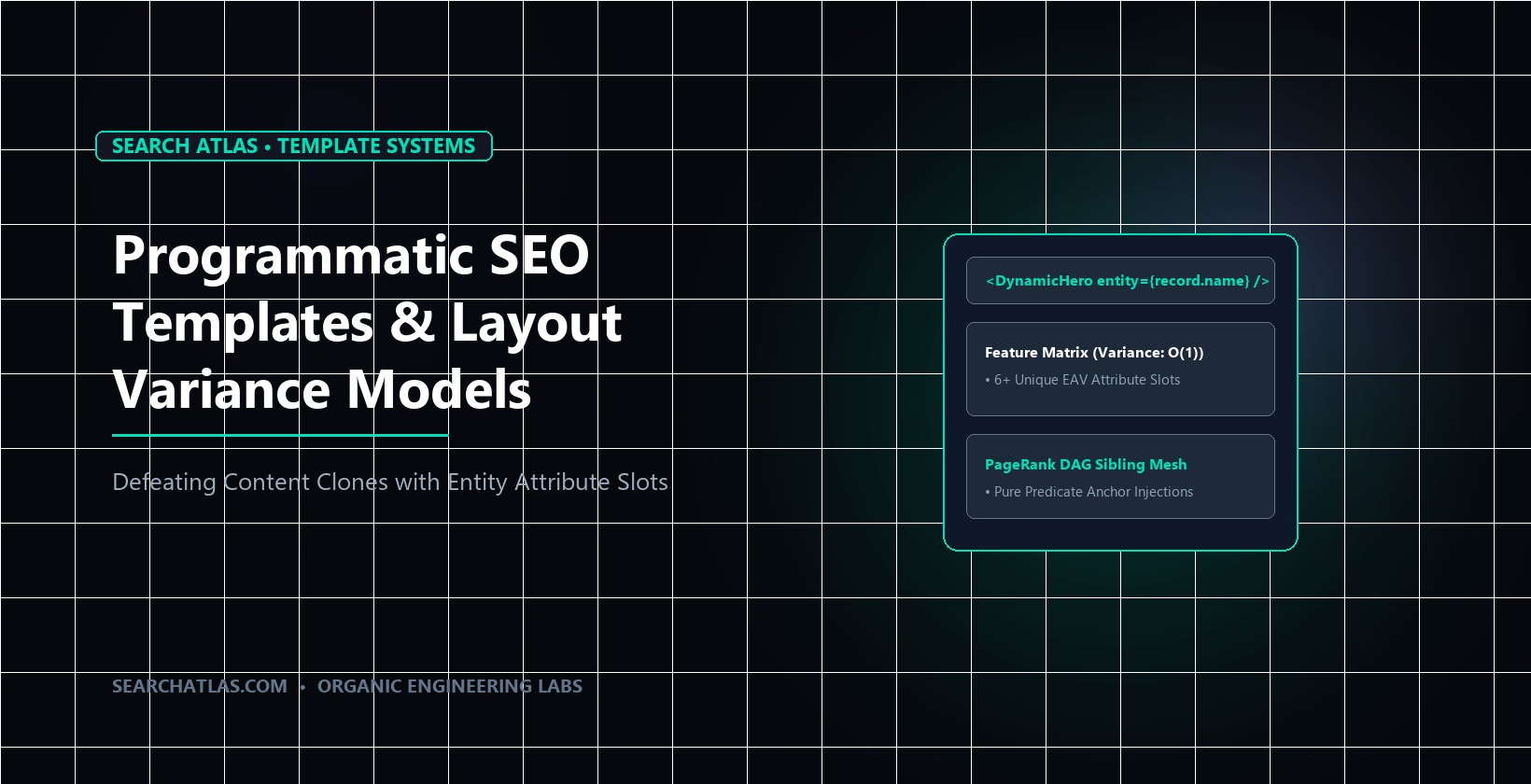
Programmatic SEO is an engineering discipline that generates search-targeted landing pages dynamically by mapping relational database schemas to semantic document templates. Programmatic search engines operate by binding structured entity-attribute-value (EAV) tuples to localized or category-specific user intents, producing thousands of distinct crawlable URLs. The primary governing attribute of programmatic SEO is structural uniqueness, dictating whether documents achieve long-term indexation or trigger automated spam suppression.
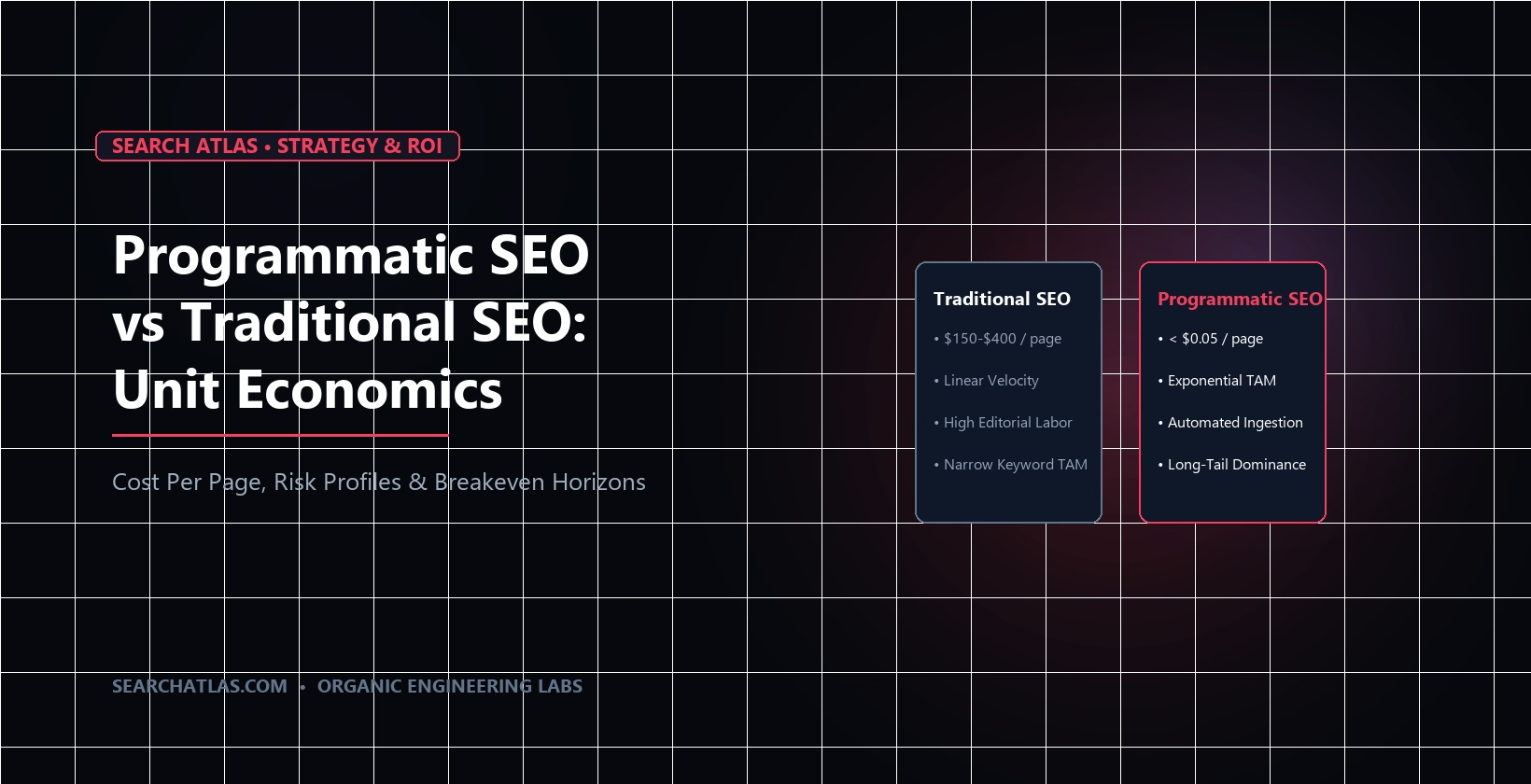
Modern enterprise search marketing demands programmatic execution when search demand fragments into hundreds of high-intent, low-volume query variations. Traditional editorial workflows cannot scale to cover combinatorial permutations such as software integration comparisons, geographic service territories, or technical API parameter documentation. However, executing programmatic architectures requires mathematical rigor to prevent index bloat and search engine classification penalties.
flowchart TD
    subgraph DataLayer["Relational Data Pipeline"]
        DB[(Proprietary Database<br/>EAV Tuples)] --> Clean[Data Validation & Normalization]
        Clean --> Vector[Embedding & Attribute Verification]
    end

    subgraph TemplateLayer["Template Engine & Rendering"]
        Vector --> Engine[Headless Next.js Engine]
        Schema[JSON-LD & OpenGraph] --> Engine
        Engine --> Static[Static HTML & ISR Generation]
    end

    subgraph SearchLayer["Information Retrieval Evaluation"]
        Static --> WRS[Google WRS 2D Render Tree]
        WRS --> ColBERT[ColBERT MaxSim Late Interaction]
        ColBERT --> Index[Canonical Search Index]
    end
The Mathematical Mechanics of Retrieval and ColBERT Alignment
Search engine ranking in modern retrieval architectures is governed by late-interaction dual encoders, notably the ColBERT framework. In late-interaction models, documents and queries are encoded independently into token-level vector matrices E_D and E_Q, and their relevance score is computed via the MaxSim operator:
S(Q, D) = sum(max(E_q · E_dᵀ)) for all q in Q, d in DIn programmatic page generation, template designers frequently make the fatal mistake of utilizing repetitive, boilerplate text blocks across hundreds of generated URLs. When document matrices contain near-identical semantic vectors, the token similarity distribution across sibling pages collapses. This enables search engine clustering algorithms to detect redundant content surfaces and demote the entire programmatic taxonomy directory.
To ensure high inner-product scores under late interaction, each programmatic template must inject unique, variable-bound entity attributes into the top 2% of the document's token sequence. When core technical terms, quantitative values, and entity relationships are resolved immediately in the first paragraph, the query representation achieves maximal alignment without semantic dilution.
Scaled Content Abuse Kinematics and Folder Maturation
The Google Search Central spam policies, formally updated in March 2024, explicitly classify mass page generation lacking unique value as scaled content abuse. Search engines detect unearned programmatic expansion by monitoring publication kinematics—specifically tracking publication velocity v(t) = dN/dt and publication acceleration a(t) = d²N/dt²:
I_anomaly(t) = a(t) / max(v(t), 1)When a new subdirectory suddenly experiences a vertical step-function increase in published URLs (I_anomaly >> 1.0), search engine crawlers trigger automated quarantine protocols. The documented failure of enterprise sites publishing thousands of AI-generated pages overnight illustrates this vulnerability: visibility collapses across existing mature assets due to sitewide crawl budget depletion and spam classification.
The 90-Day Subfolder Maturation SOP
To deploy programmatic directories without triggering kinematic anomaly alarms, enterprise engineering teams must enforce a strict quarantine schedule:
- Quarantine Seed Phase (Days 1–30): Deploy a seed cohort of no more than 15 to 25 canonical URLs. These pages must feature complete entity-attribute depth and established internal links from mature donor pages.
- Indexing & Behavioral Verification (Days 31–60): Monitor Google Search Console and GA4 telemetry. Verify natural crawler discovery via XML sitemaps without utilizing manual "Request Indexing" mechanisms. Validate that average engagement time meets or exceeds domain averages.
- Controlled Expansion (Days 61–90): Gradually introduce 3 to 5 new programmatic URLs per week, establishing baseline crawl frequency.
- Production Cadence Scaling (Day 91+): Release catalog increments using randomized daily distributions rather than bulk automated batch dumps.
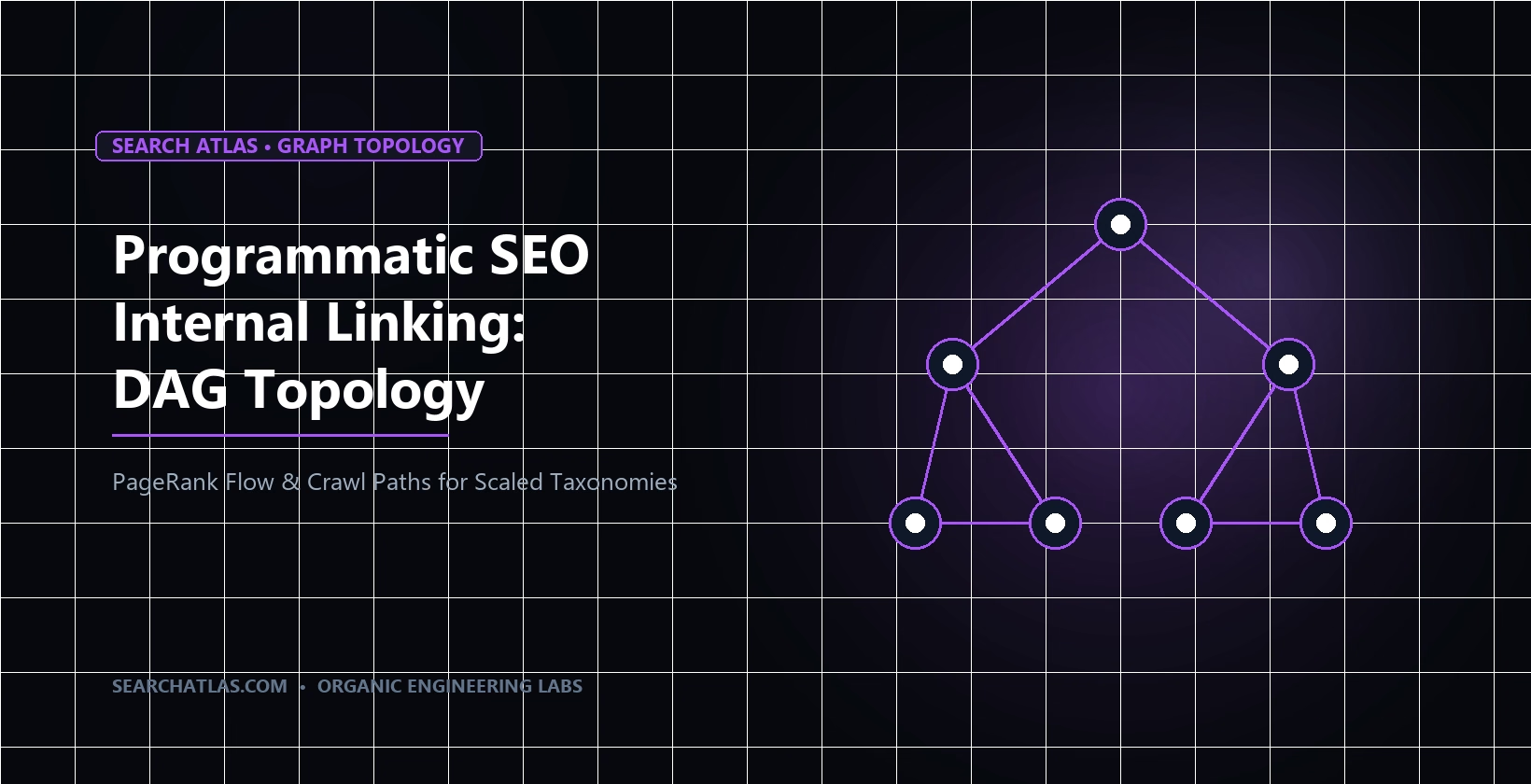
Internal PageRank DAG Engineering for Programmatic Directories
Internal hyperlink structures across programmatic directories must form a Directed Acyclic Graph (DAG) $G = (V, E)$. Under the Reasonable Surfer Model (US Patents 7,716,225 B1 and 8,117,209 B2), search engines calculate transition probabilities $P(u \to v)$ based on the visual prominent position, DOM container semantics, and contextual relevance of hyperlink elements.
| Graph Pathology | Topological Cause | Programmatic Remediation |
|---|---|---|
| Dangling Nodes | Programmatic leaves with zero outbound editorial links. | Implement mandatory dynamic breadcrumb trails linking directly back to the cluster parent pillar and parent category hub. |
| Absorbing Cycles | Circular link loops between adjacent programmatic variants that trap crawlers. | Enforce strict hierarchy: programmatic leaf pages link up to taxonomy hubs and across to related sibling entities using descriptive predicate anchors. |
| Mega-Menu Dilution | Inserting 500 programmatic links into global navigation menus. | Exclude programmatic subdirectories from global headers; expose paths through contextual faceted hubs and structured XML sitemap indexes. |
Data Pipeline Architecture and Schema Requirements
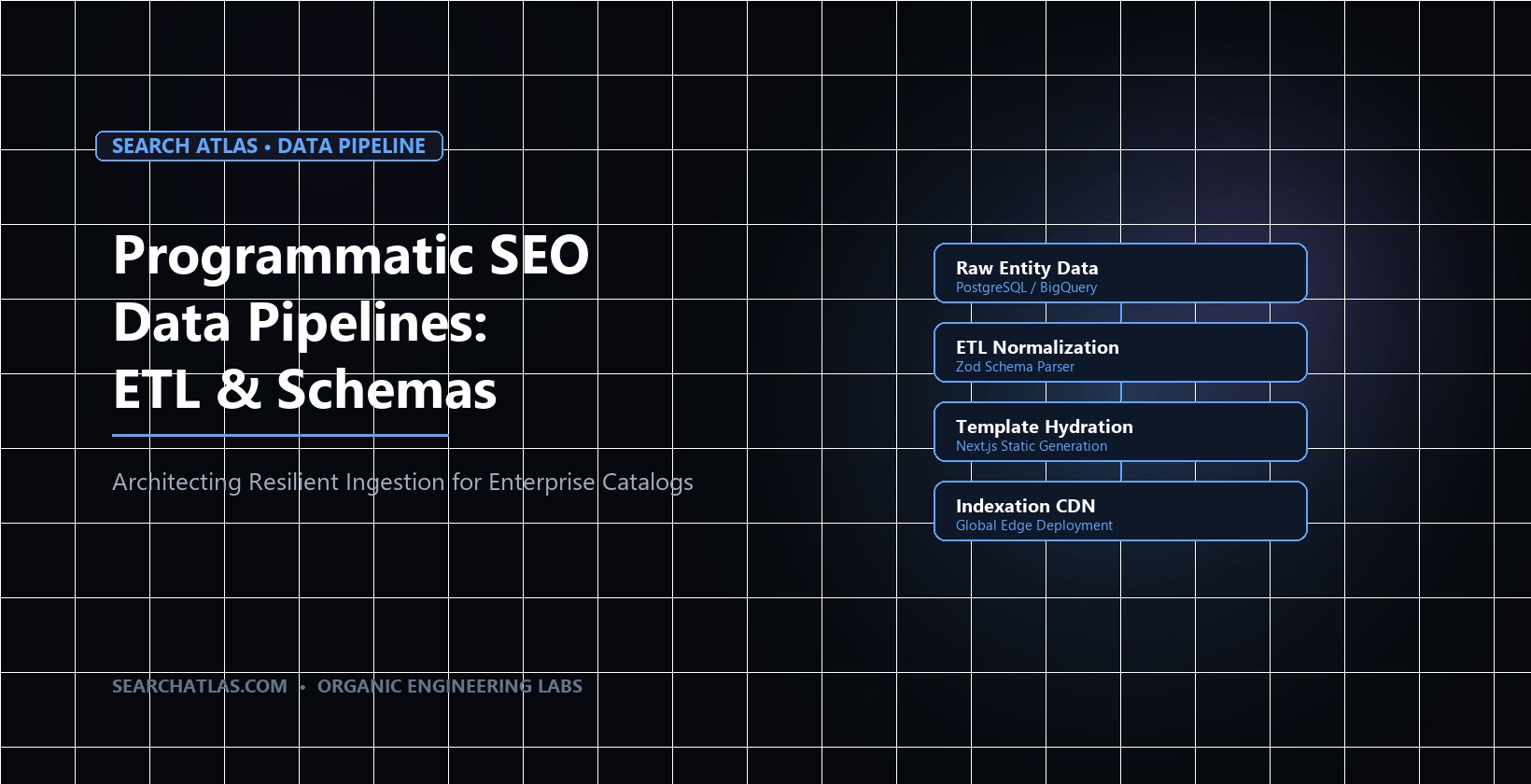
A robust programmatic SEO pipeline requires three foundational components: an immutable dataset, a deterministic build pipeline, and comprehensive structured data markup.
graph LR
    A[PostgreSQL / Supabase] -->|JSON Export| B[Data Schema Validation]
    B -->|Zod Schema Check| C[Velite / Next.js ISR]
    C -->|Generate Static Pages| D[Edge Cache / Cloudflare]
    C -->|Generate XML Sitemap| E[Sitemap Index]
Mandatory Schema Markup:
Every programmatic page must declare a unified @graph JSON-LD schema linking:
WebPage: Declaring canonical URL, publication dates, and breadcrumb relationships.AboutEntity: Referencing authoritative Linked Open Data (Wikidata QID or Google Knowledge Graph MID).ItemPageorSoftwareApplication: Specifying concrete attributes (pricing, platform support, feature flags) matching the rendered DOM text.
By implementing strict data pipelines, deterministic templating, and mathematically sound internal link graphs, search engineering teams can unlock organic search scale while completely insulating their domains from algorithmic penalties.