Brand mentions are textual references to a company without required hyperlinks, while backlinks are clickable hyperlinks that transfer link equity and authority. Brand mentions SEO strengthens entity recognition, contextual trust, and AI inclusion probability. Backlinks strengthen PageRank flow, crawlability, and competitive keyword rankings. The difference between brand mentions and backlinks determines whether authority is built through entity prominence or structural link validation.
Search engines validate backlinks through link graphs and authority scoring, while Large Language Models validate brand mentions through entity frequency, sentiment, and contextual co-occurrence. Backlinks influence traditional rankings because search engines evaluate linking domains and anchor relevance. Brand mentions influence AI visibility because generative systems extract entities from plain-text references. Backlinks impact on AI occurs indirectly through authority thresholds, while brand mention rates correlate more strongly with AI Overview inclusion.
Backlinks take priority for competitive commercial rankings, while brand mentions take priority for AI visibility, Knowledge Panel triggers, and entity authority expansion. New domains require backlinks to establish foundational credibility. Established brands benefit from increasing brand mention rates to reinforce entity prominence across trusted publications and social platforms. Optimal execution balances backlinks for structural authority and brand mentions SEO for contextual amplification.
Businesses measure impact through mention volume, share of voice, backlink diversity, Authority Score growth, AI citation frequency, and conversion metrics. Scalable strategies implement monitoring systems, structured tracking frameworks, and brand positioning alignment. Common challenges include low-quality sources, measurement complexity, algorithm shifts toward entity graphs, and resource constraints. Brand mentions and backlinks together create durable authority when quality outweighs quantity and structured execution replaces isolated tactics.
What Are Brand Mentions?
Brand mentions are online references to a company, product, or leadership where the brand name appears with or without a hyperlink. Brand mentions represent digital discussions that indicate visibility, reputation, and recognition across web pages, forums, news articles, and social platforms. In brand mentions, SEO, and search engines treat these references as entity signals that validate brand existence and topical relevance.
What is a brand mention for SEO? A brand mention for SEO is a textual reference to a brand that contributes to entity recognition, trust evaluation, and contextual authority without requiring a backlink. Brand mentions SEO value increases when references appear on authoritative domains with consistent brand naming. Search engines use these references to confirm brand legitimacy, which strengthens semantic associations between the brand and related keywords.
How do brand mentions function inside digital ecosystems? Brand mentions function as reputation and visibility signals that reflect how frequently and in what context a brand appears online. Brand mentions operate as measurable indicators inside digital analytics and reputation management systems. Over 70% of consumers trust brand mentions more than traditional advertisements, which increases behavioral impact and reinforces organic authority signals.
What types of brand mentions exist? There are 6 main types of brand mentions. These are Linked Mentions, Unlinked Mentions, Implied Mentions, Direct Mentions, Visual Mentions, and Earned Mentions. Linked Mentions contain hyperlinks and transfer referral traffic. Unlinked Mentions reference the brand name without a link. Implied Mentions refer to related concepts without naming the brand directly. Direct Mentions explicitly state the brand name or tag. Visual Mentions display logos or products in images and videos. Earned Mentions originate from unpaid third-party discussions.
Why do brand mentions matter for brand mentions SEO performance? Brand mentions matter for brand mentions SEO because search engines evaluate entity consistency, contextual frequency, and cross-domain validation signals. Consistent brand references increase semantic confidence across indexed documents. Brands with stable mention patterns experience up to 15% higher search visibility compared to brands with inconsistent digital references.
What Are the Types of Brand Mentions?
There are three types of brand mentions: linked, unlinked, and AI.
- Linked brand mentions name the brand and link to its site. A linked mention counts as both a mention and a backlink, so it adds entity recognition and link equity at once.
- Unlinked brand mentions name the brand without a link. They still show that independent authors reference the brand, which strengthens the association between the brand and its topics. They are also the pool that link reclamation outreach draws from.
- AI brand mentions appear when ChatGPT, Gemini, Perplexity, or Google AI Overviews name the brand inside a generated answer, usually as a recommendation or a comparison option.
Mentions of the first two types show up in social posts, customer reviews on sites like G2 or Trustpilot, editorial articles, forum and Reddit threads, and video or podcast content.
Why Brand Mentions Matter for SEO?
Brand mentions matter for SEO because search engines treat consistent brand references as entity-level trust and authority signals. Brand mentions reinforce entity recognition inside Google Knowledge Graph systems, which shifts evaluation from keyword matching to brand-based indexing.
How do brand mentions improve semantic search performance? Brand mentions improve semantic search performance because Google Natural Language Processing (NLP) analyzes tone, context, and topic associations around the brand name. Consistent references tied to specific themes build structured entity profiles. Repeated contextual alignment strengthens how search engines connect a brand to defined topics.
How do brand mentions contribute to E-E-A-T signals? Brand mentions contribute to Experience, Expertise, Authoritativeness, and Trustworthiness (E-E-A-T) by demonstrating third-party validation across independent platforms. Mentions in reviews, expert commentary, and discussions confirm credibility. Search engines interpret repeated validation as proof of authority and reliability.
How do brand mentions increase visibility in AI-driven results? Brand mentions increase visibility in AI-driven results because large language models extract entities and context from plain-text references. AI systems conduct broad retrieval across forums, reviews, and list-based content. Frequent high-quality mentions increase inclusion probability in AI Overviews and generative answers.
How do brand mentions interact with backlinks in SEO strategy? Brand mentions interact with backlinks by reinforcing the authority signals that backlinks establish for ranking. Backlinks strengthen page-level ranking signals. Brand mentions strengthen entity-level trust and contextual relevance. Combined signals increase search visibility across traditional results and AI-generated responses.
What is the long-term impact of brand mentions on SEO authority? The long-term impact of brand mentions on SEO authority is sustained entity recognition and increased inclusion across evolving AI search systems. Generative engines prioritize recognized entities across multiple independent references. Stable mention patterns strengthen brand inclusion even when backlink influence declines in AI-driven retrieval models.
What Are Backlinks?
Backlinks are hyperlinks from one website to another that signal trust, authority, and credibility to search engines. Backlinks function as editorial votes that indicate one site recognizes the value of another page. Search engines interpret backlinks as ranking signals, which directly influence search visibility and organic traffic.
Why do backlinks matter in search engine algorithms? Backlinks matter because they formed the foundation of Google PageRank and remain one of the three primary ranking factors. Google evaluates both the number and authority of backlinks pointing to a page. A page with 200 backlinks demonstrates stronger authority than a page with 20 backlinks on the same topic.
What are the core types of backlinks? There are 4 core types of backlinks. These are dofollow links, nofollow links, rel=”sponsored” links, and rel=”ugc” links. Dofollow links pass ranking value and increase page authority. Nofollow links contain a rel=”nofollow” attribute that blocks ranking value transfer. rel=”sponsored” identifies paid placements. rel=”ugc” marks user-generated content links.
What factors determine backlink value? Backlink value depends on source authority, topical relevance, placement, anchor text, unique linking domains, and editorial intent. Links from authoritative domains (Harvard, TechCrunch, CNN, World Health Organization) pass stronger authority signals. Contextual backlinks placed inside the main content carry higher weight than footer or sidebar links. Unique referring domains increase ranking correlation strength.
How do backlinks affect traffic and visibility? Backlinks increase organic rankings and drive referral traffic from external websites. Higher backlink authority improves page prominence in search results. Referral clicks from relevant sources generate additional brand discovery and user acquisition.
What risks exist in backlink acquisition? Backlink acquisition carries risks when practices violate Google link spam policies. Buying backlink packages, participating in link schemes, or using automated link creation leads to penalties that reduce search visibility. Natural editorial backlinks remain the most sustainable and authoritative form of backlink growth.
Why Backlinks Matter for SEO?
Backlinks matter for SEO because search engines treat backlinks as digital endorsements that signal credibility, authority, and relevance. Backlinks function as off-page validation signals that confirm a website deserves higher visibility in search results. Google PageRank analyzes which pages receive votes from other websites and assigns authority accordingly.
How do backlinks influence search engine rankings? Backlinks influence search engine rankings by transferring link equity and strengthening domain authority. Pages with more high-quality backlinks consistently rank higher than pages with fewer backlinks. The number of referring domains correlates strongly with higher ranking positions and increased organic traffic.
How do backlinks contribute to authority and E-E-A-T? Backlinks contribute to Experience, Expertise, Authoritativeness, and Trustworthiness by confirming third-party recognition. Links from authoritative domains signal credibility and subject relevance. High Domain Authority sources increase perceived trust and reinforce content evaluation signals inside Google algorithms.
How do backlinks improve visibility and traffic? Backlinks improve visibility and traffic by enabling faster discovery, indexing, and referral visits. Search engine crawlers follow backlinks to discover and index pages. Referral traffic from authoritative websites generates sustained user acquisition and increases brand exposure.
What qualities make backlinks effective for SEO? Effective backlinks demonstrate relevance, authority, editorial placement, natural anchor text, and unique referring domains. Contextual backlinks placed inside main content carry a stronger ranking influence than sidebar or footer links. A small number of authoritative backlinks outweighs large volumes of low-quality links.
What is the current stance on backlinks in modern SEO? Backlinks remain one of Google’s strongest ranking signals despite reduced public emphasis from Google representatives. Empirical studies show a consistent positive correlation between backlink quantity, backlink quality, and ranking performance. High-quality backlinks maintain long-term SEO impact even as algorithm priorities evolve.
How Do Search Engines and LLMs Discover and Validate Information?
Search engines and Large Language Models (LLMs) discover and validate information through indexing, semantic retrieval, entity recognition, cross-source validation, and synthesis. Search engines rely on distributed indexing systems and ranking algorithms. LLMs rely on embedding-based retrieval and passage-level synthesis. Both systems evaluate credibility through consensus, relevance, and structured signals.
How do traditional search engines discover information? Traditional search engines discover information by crawling, indexing, embedding, and ranking web documents. Crawlers follow hyperlinks to locate new pages. Indexing systems store content in searchable databases. Deep learning models convert queries and documents into vector embeddings to measure semantic similarity. Ranking systems prioritize authoritative and relevant results within milliseconds.
How do search engines validate information before presenting results? Search engines validate information by comparing multiple sources, identifying consensus, and weighting authoritative domains. Ranking algorithms analyze backlinks, domain credibility, content relevance, and structured data. Systems extract passages, compare factual overlap, and prioritize agreement among trusted sources. Citations link claims back to original web pages for transparency.
How do LLMs discover information differently from search engines? LLMs discover information by retrieving semantically similar text chunks using high-dimensional vector embeddings. Embeddings capture contextual meaning and distinguish ambiguous terms based on usage. LLMs retrieve passages rather than entire pages, then synthesize information into new answers. This retrieval-first approach shifts focus from ranking documents to generating responses.
What is Retrieval-Augmented Generation (RAG) in LLM discovery? Retrieval-Augmented Generation (RAG) is a process where an LLM retrieves relevant external passages before generating an answer. The system converts a query into an embedding, searches a vector database, retrieves relevant passages, and synthesizes a response with citations. RAG reduces hallucinations and increases factual grounding by anchoring outputs to external sources.
How do LLMs validate source credibility? LLMs validate source credibility by cross-referencing information across multiple platforms and prioritizing contextual agreement. Community-curated platforms (Reddit, G2, Capterra, Stack Overflow) receive high citation frequency because cross-validation confirms reliability. Reciprocal Rank Fusion (RRF) aggregates ranked results across sub-queries to prioritize consistently relevant sources.
How do search engines and LLMs integrate for modern AI search? Search engines and LLMs integrate by combining indexed retrieval, semantic embeddings, and generative synthesis inside AI Overviews and conversational interfaces. LLMs interpret complex queries, expand them into sub-queries, retrieve structured data, and generate consolidated answers. Search infrastructure provides speed, indexing depth, and citation pathways that anchor AI-generated outputs.
Why is indexing foundational for both systems? Indexing is foundational because unindexed content remains invisible to ranking and retrieval systems. Authority signals do not transfer from uncrawled pages. Unindexed backlinks pass no ranking signals. Visibility depends on crawlability, semantic structure, and consistent indexing across platforms.
What Is the Difference Between Brand Mentions vs Backlinks?
The difference between brand mentions and backlinks lies in structure, control, ranking authority transfer, and AI citation influence. Brand mentions refer to textual references to a brand name without a hyperlink. Backlinks refer to clickable hyperlinks that connect one domain to another domain. This structural distinction defines how each signal influences SEO and AI systems.
The 4 main difference categories between brand mentions and backlinks are listed below.
- Definition.
- Actionability.
- SEO Impact.
- AI Importance.
Definition
Brand mentions are textual references to a brand name, product, or service without requiring a hyperlink, while backlinks are clickable hyperlinks that connect one website to another. Brand mentions confirm entity presence in online discussions. Backlinks create a navigational pathway and transfer ranking signals between domains.
What are brand mentions? Brand mentions refer to instances where an online source references a brand, its products, or its services without necessarily including a hyperlink. Brand mentions appear in articles, reviews, social media posts, forums, and AI-generated responses. Brand mentions strengthen entity recognition and contextual association even when no clickable link exists.
What are backlinks? Backlinks are hyperlinks from one website to another that allow direct navigation and pass link equity. Backlinks always contain an HTML anchor element that connects the referring domain to the target domain. Backlinks influence ranking systems through authority transfer and referral pathways.
What types of brand mentions exist? There are 3 main types of brand mentions. These are direct mentions, indirect mentions, and implied mentions. Direct mentions explicitly state the brand name. Indirect mentions reference a brand without naming it directly. Implied mentions connect related phrases or recognizable attributes to the brand without a hyperlink.
What types of backlinks exist? There are 2 main types of backlinks. These are follow links and nofollow links. Follow links to pass ranking authority and influence Domain Authority metrics. Nofollow links contain a rel=”nofollow” attribute that limits direct ranking signal transfer while remaining part of the link profile.
Actionability
Brand mentions require monitoring, amplification, or conversion, while backlinks provide direct, measurable SEO signals upon acquisition. Brand mentions influence authority indirectly through visibility and entity recognition. Backlinks influence authority directly through link equity transfer and crawlable pathways.
How actionable are brand mentions in SEO strategy? Brand mentions are actionable through monitoring systems, digital PR outreach, and link reclamation processes. Tracking tools identify unlinked mentions across domains. Outreach converts selected mentions into backlinks through structured communication. Digital PR campaigns generate contextual mentions in authoritative publications and community platforms.
How actionable are backlinks in SEO strategy? Backlinks are actionable through structured acquisition tactics that create measurable ranking signals. Editorial placements, guest contributions, resource page outreach, and digital PR campaigns produce follow links that pass ranking authority. Paid placements and sponsorship agreements create controlled link placements with defined attributes (rel=”sponsored”).
How does control differ between brand mentions and backlinks? Brand mentions offer limited editorial control, while backlinks offer greater structural control through negotiated placements. Editors decide whether to include a hyperlink or plain-text reference. Link-building agreements define anchor text, placement, and link attributes, which create predictable structural outcomes.
How does measurement differ between brand mentions and backlinks? Backlinks are quantifiable through link audits and referring domain counts, while brand mentions require contextual and sentiment evaluation. Backlink audit systems measure link equity, anchor text distribution, and domain authority metrics. Brand mention analysis measures mention volume, source authority, sentiment context, and AI visibility impact.
How does long-term scalability differ between brand mentions and backlinks? Brand mentions scale through thought leadership, media participation, and community visibility, while backlinks scale through sustained outreach and content assets. Ongoing PR positioning increases entity prominence across domains. Continuous link acquisition increases structural authority across indexed pages.
SEO Impact
Brand mentions influence entity-level authority and semantic trust, while backlinks influence page-level ranking authority through link equity transfer. Brand mentions strengthen recognition, contextual relevance, and trust signals. Backlinks transfer measurable ranking power through crawlable hyperlinks.
How do brand mentions impact authority and trust signals? Brand mentions impact authority by reinforcing entity recognition across authoritative and relevant domains. Frequent mentions in reputable contexts increase perceived credibility and relevance. Positive, consistent references strengthen E-E-A-T signals and improve brand-topic association inside search systems.
How do backlinks impact authority and trust signals? Backlinks impact authority by passing link equity that strengthens Domain Authority and ranking capacity. High-quality backlinks from relevant domains validate expertise and content value. Ranking systems interpret backlinks as endorsements that elevate page prominence in competitive search queries.
How do brand mentions affect search visibility and rankings? Brand mentions affect search visibility by increasing inclusion in semantic search results and AI-driven surfaces. Consistent mentions correlate with improved visibility in Featured Snippets, People Also Ask panels, and AI Overviews. Unlinked mentions from authoritative forums and communities correlate with ranking lifts after core updates.
How do backlinks affect search visibility and rankings? Backlinks affect search visibility by improving keyword rankings and strengthening page competitiveness. Pages with strong backlink profiles rank higher in traditional search results. Backlinks create crawlable pathways that increase indexation speed and organic traffic potential.
How do brand mentions and backlinks differ in AI-driven search impact? Brand mentions hold a stronger direct influence in AI-generated answers, while backlinks reinforce structural credibility that supports AI inclusion. AI systems analyze co-occurrence patterns and entity prominence across web sources. Backlinks strengthen domain-level credibility, while brand mentions expand contextual inclusion in generative search responses.
AI Importance
Brand mentions influence AI-generated visibility through entity recognition and contextual trust, while backlinks influence AI systems through authority reinforcement and structural credibility. Brand mentions correlate more strongly with inclusion in AI Overviews than backlinks. Backlinks remain foundational for traditional ranking systems that feed AI retrieval layers.
How do brand mentions influence AI visibility and trust? Brand mentions influence AI visibility by establishing entity existence and topical credibility across web discussions. Large Language Models (LLMs) learn associations from reviews, forums, roundups, and transcripts. Brands in the top quartile for web mentions earned up to 10 times more AI mentions than the next group. Brand mentions function as soft authority signals in generative systems.
What is the mechanism behind brand mention influence in LLMs? The mechanism behind brand mention influence in LLMs relies on entity recognition and contextual co-occurrence patterns. LLMs map brand names to topics, attributes, and sentiment through repeated textual references. High-quality, non-linking mentions increase perceived real-world authority inside AI retrieval layers. Branded web mentions are up to three times more influential than backlinks in driving LLM citations.
How do backlinks influence AI systems differently from brand mentions? Backlinks influence AI systems by strengthening domain-level authority that supports citation eligibility. AI models prioritize information from authoritative domains. Websites with backlinks from more referring domains receive more AI citations. Backlinks reinforce credibility signals that AI systems use during retrieval ranking.
Which backlink attributes matter for AI importance? Backlink authority, link attributes, and anchor context define AI relevance and credibility signals. High-authority referring domains increase AI trust weighting. Nofollow links from authoritative platforms remain validation signals. Anchor text and surrounding semantic context define entity relationships for AI models.
What is the strategic balance between brand mentions and backlinks for AI visibility? Brand mentions drive AI inclusion probability, while backlinks provide structural authority that stabilizes AI visibility. The strongest AI presence appears when brands receive frequent contextual mentions alongside authoritative backlinks. A Brand-to-Links Ratio greater than 1 correlates with stronger AI visibility across generative search platforms.
Brand Mentions vs Backlinks Comparison Table
The Brand Mentions vs Backlinks comparison table highlights structural, ranking, cost, engagement, and timeline differences between both signals. Brand mentions strengthen entity authority and AI visibility. Backlinks strengthen page authority and traditional ranking performance. The comparison below clarifies how each signal operates across SEO and AI systems.
The key comparison dimensions are listed below.
| Dimension | Brand Mentions | Backlinks |
|---|---|---|
| Links | Do not require a hyperlink. Appear as plain-text references. | Always include a clickable hyperlink that connects domains. |
| Impact on Rankings | Strengthen entity recognition and semantic trust. Indirect influence on traditional rankings. Strong influence in AI-driven visibility. | Transfer link equity through PageRank. Direct impact on keyword rankings and domain authority. |
| Cost-Effective? | Often earned organically through PR, reviews, and community presence. Digital PR campaigns require investment. | Require outreach, guest publishing, partnerships, or paid placements. Acquisition often involves direct costs or labor investment. |
| User Engagement | Increase brand awareness and search demand. Influence branded search volume and AI recommendation frequency. | Drive direct referral traffic from linking pages. Generate measurable click-based engagement. |
| Time for Results | Build cumulative authority over time through repeated contextual mentions. AI visibility impact grows progressively. | Produce measurable ranking improvements once indexed. High-authority links influence rankings faster. |
What does the comparison reveal about strategic use? The comparison reveals that brand mentions drive AI authority signals, while backlinks drive structural ranking authority. Brand mentions expand contextual presence across discussions. Backlinks strengthen crawlable credibility inside traditional search algorithms. A combined strategy aligns traditional SEO performance with AI-generated visibility.
When to Focus on Brand Mentions vs Backlinks?
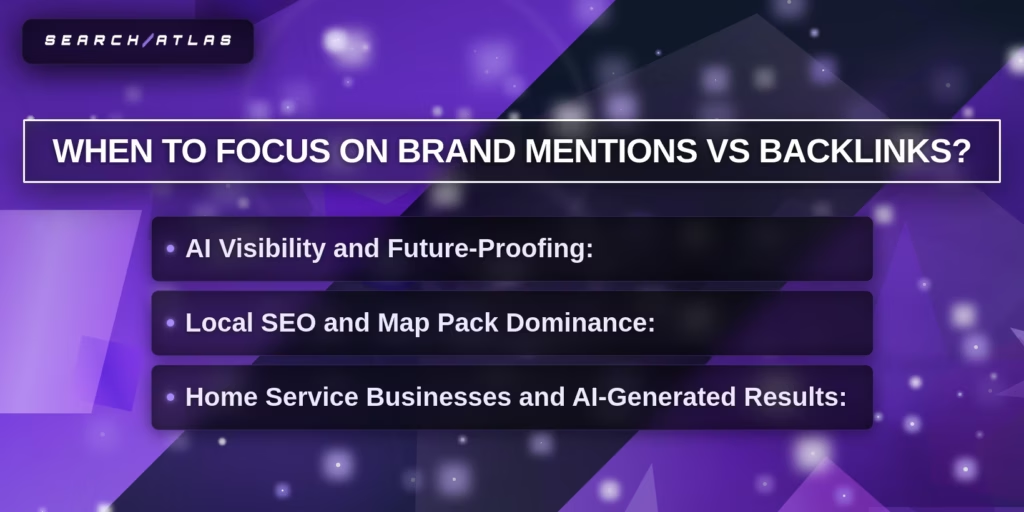
Focus on backlinks for traditional ranking acceleration and competitive keyword positioning, and focus on brand mentions for AI visibility, entity authority, and local dominance. Backlinks transfer PageRank and measurable authority. Brand mentions strengthen entity recognition and contextual trust across AI systems.
When do backlinks need to be prioritized? Backlinks need to be prioritized when traditional organic search rankings and keyword competitiveness define the primary objective. Backlinks act as explicit authority signals and pass link equity. Competitive niches and YMYL sites require strong backlink profiles to achieve ranking stability. Newer brands require backlinks to establish foundational authority faster.
When do brand mentions need to be prioritized? Brand mentions need to be prioritized when AI visibility, local SEO performance, and entity recognition define the objective. AI systems rely on contextual brand references across forums, reviews, and media. Unlinked mentions improved Map Pack rankings in 63% of local SEO tests between 2024 and 2025. Brand mentions strengthen entity confidence before website ranking shifts occur.
When do competitive industries require backlinks over mentions? Competitive industries require backlinks when measurable authority transfer and topical validation outweigh contextual reputation signals. Backlinks pass the structural ranking value that proximity-neutral and high-difficulty queries demand. Backlink-heavy strategies remain more effective for non-brand organic keyword growth.
When do AI-driven search environments require brand mentions? AI-driven search environments require brand mentions when contextual co-occurrence and entity prominence determine inclusion in AI-generated answers. Large Language Models evaluate the frequency and context of brand references. Brands in the top quartile for mentions earned significantly higher AI visibility than brands with link-only strategies.
When both brand mentions and backlinks are combined? Combine brand mentions and backlinks when maximum SERP dominance and AI inclusion represent the objective. Mentions reinforce contextual authority. Backlinks reinforce structural authority. Campaigns integrating mention monitoring, co-citation analysis, and backlink acquisition outperformed link-only strategies in ranking growth.
How to Balance Brand Mentions and Backlinks?
Balance brand mentions and backlinks by combining entity visibility strategies with structured authority acquisition tactics. Brand mentions strengthen contextual authority and AI inclusion. Backlinks strengthen ranking authority and PageRank transfer. A balanced strategy aligns entity trust with measurable link equity.
The 5 methods to balance brand mentions and backlinks are listed below.
- Create High-Quality Content.
- Perform Outreach and Digital PR.
- Encourage Reviews and User-Generated Content.
- Use Social Media for Brand Visibility.
- Convert Unlinked Mentions Into Backlinks.
Create High-Quality Content
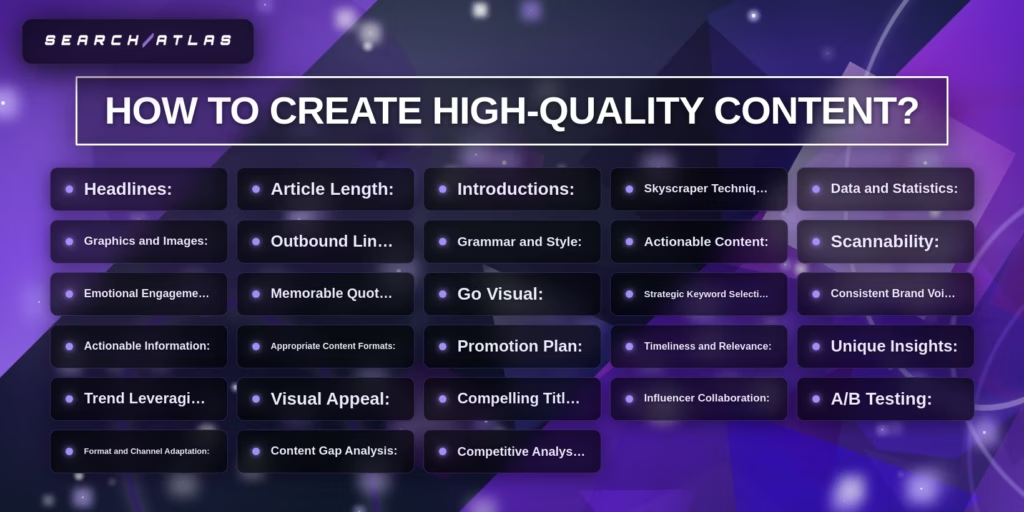
Create high-quality content by producing accurate, useful, well-structured, and audience-focused material that satisfies search intent and demonstrates expertise. High-quality content aligns brand goals, user needs, and search engine evaluation criteria. High-quality content delivers original insight, clear structure, and measurable value.
What defines high-quality content from a search engine perspective? High-quality content from a search engine perspective is helpful, reliable, people-focused, and aligned with E-E-A-T principles. Search systems prioritize content that reflects first-hand experience, subject expertise, authoritativeness, and trustworthiness. High-quality content satisfies user intent, presents comprehensive information, and avoids thin or duplicated material.
What defines high-quality content from a brand perspective? High-quality content from a brand perspective aligns with brand voice, business objectives, and audience expectations. Content reflects identity and values. Content drives engagement, conversions, and long-term reputation growth. Content positions the brand as a reliable authority within a defined niche.
What are the core steps to produce high-quality content? There are 5 core steps to produce high-quality content. These are Research, Audience Alignment, Search Intent Matching, Structural Clarity, and Continuous Updating. Research ensures factual accuracy and information gain. Audience alignment ensures relevance. Search intent matching ensures alignment with the query purpose. Structural clarity improves readability and scannability. Continuous updating maintains freshness and ranking stability.
How does research improve content quality? Research improves content quality by ensuring factual accuracy, competitive differentiation, and depth of insight. Research identifies content gaps, gathers credible data, and uncovers unique angles. Original data, expert input, and verified statistics increase authority and trust signals.
How does audience alignment improve content performance? Audience alignment improves content performance by addressing specific needs, pain points, and intent stages. Persona development clarifies demographics, motivations, and challenges. Reader-focused writing increases engagement signals and reduces bounce rates.
How does structure and readability influence quality? Structure and readability influence quality by improving comprehension, engagement, and search evaluation signals. Short sentences, logical headings, and clear formatting prevent content fatigue. Visual aids, examples, and scannable formatting improve retention and user satisfaction metrics.
How does content freshness impact high-quality content? Content freshness impacts high-quality content by maintaining accuracy, relevance, and ranking competitiveness. Regular updates prevent content decay. Updated statistics, examples, and contextual improvements signal active maintenance to search engines.
Perform Outreach and Digital PR
Perform outreach and digital PR by executing a structured campaign that defines objectives, creates newsworthy content, targets relevant journalists, and measures link and visibility outcomes. Digital PR expands traditional public relations into online channels to secure brand mentions and high-authority backlinks.
What are the core steps to execute outreach and digital PR? There are 10 core steps to execute outreach and digital PR. These are Define Objectives, Identify Target Audience, Build Media List, Craft Messaging, Personalize Outreach, Select Channels, Time Outreach, Follow Up, Measure Results, and Refine Strategy. This structured sequence increases coverage probability and link acquisition efficiency.
How to define objectives in digital PR? Define objectives by setting measurable performance targets aligned with business goals. Objectives include securing 20 high-authority backlinks within 3 months or increasing social shares by 30%. Clear targets guide journalist targeting and campaign evaluation.
How to create content for digital PR? Create digital PR content by producing newsworthy, data-backed, and value-driven assets. Press releases announce product launches and partnerships. Research studies publish proprietary data. Newsjacking aligns brand perspective with trending topics. Thought leadership articles position executives as expert sources.
How to identify and contact journalists effectively? Identify and contact journalists by targeting relevant beats and personalizing pitches based on their published work. Media databases (Muck Rack, Prowly, Gorkana, Vuelio) refine journalist selection. Personalized emails increase reply probability, while generic pitches reduce acceptance rates.
How does a digital PR pitch need to be structured? Structure a digital PR pitch using a concise four-paragraph format under 200 words. Paragraph one presents the story hook. Paragraph two states the intended action. Paragraph three explains relevance and value. Paragraph four closes with contact details. Strong subject lines increase open rates.
How to measure digital PR performance? Measure digital PR performance through press coverage, referral traffic, backlink quality, SEO ranking changes, and lead generation. Media monitoring tools track coverage mentions. Google Analytics evaluates referral spikes. Backlink analysis tools assess link authority impact. CRM systems track conversion and lead quality.
How does digital PR support backlinks and brand mentions simultaneously? Digital PR generates contextual brand mentions and editorial backlinks through authoritative media placements. Coverage from respected publications strengthens entity authority and link equity simultaneously. Sustained outreach produces cumulative SEO and AI visibility gains.
Encourage Reviews and User-Generated Content
Encourage reviews and user-generated content by systematically requesting feedback, creating structured participation channels, incentivizing contributions, and amplifying authentic customer voices. User-generated content (UGC) increases trust, visibility, and conversions while strengthening brand mentions across platforms.
Why are reviews and user-generated content important? Reviews and user-generated content influence purchasing decisions, increase engagement, and strengthen brand authority signals. 79% of consumers report that UGC influences purchase behavior. Products with 5 reviews experience a 270% higher purchase likelihood than products with no reviews. UGC increases conversion rates by up to 10% and boosts social engagement by 28%.
How to systematically request reviews? Request reviews through automated email follow-ups, embedded review forms, and direct calls to action. Send review emails 1–2 weeks after product delivery. Embed forms inside emails to reduce friction. Add review links in email signatures, invoices, and QR codes in-store. Respond to reviews promptly to increase trust and participation rates.
How to build community-driven user-generated content? Build community-driven user-generated content by maintaining active social engagement and featuring customer contributions. Reply to comments consistently. Reshare tagged posts. Highlight customer stories in newsletters and website sections. Establish branded communities through email groups or platform-specific forums to increase belonging and loyalty.
How to use branded hashtags to generate UGC? Use branded hashtags to create a trackable system for content submissions and customer storytelling. Promote the hashtag in bios, packaging, receipts, and campaigns. Campaign-specific hashtags increase focused participation. Consistent hashtag usage consolidates mentions and increases discoverability across social platforms.
How to use incentives and contests to increase participation? Use incentives and contests to motivate submissions through structured rewards and clear participation guidelines. Offer discounts, store credits, giveaways, or experience-based rewards. Define deadlines, judging criteria, and prize details clearly. Contests increase submission velocity and amplify reach through FOMO-driven engagement.
How to amplify and manage existing UGC effectively? Amplify and manage UGC by obtaining explicit permission, crediting creators, and aligning content with brand identity. Showcase customer testimonials on product pages. Feature UGC in email campaigns and social roundups. Monitor sentiment continuously and maintain moderation workflows to protect brand reputation.
How to measure the success of reviews and UGC campaigns? Measure reviews and UGC success through engagement rates, conversion rates, branded search growth, referral traffic, and share of voice. Track total mentions, sentiment distribution, and conversion lift. Monitor CRM notes for mention-driven leads. Evaluate visibility growth across organic search, AI surfaces, and social channels.
Use Social Media for Brand Visibility
Use social media for brand visibility by publishing platform-specific content consistently, optimizing engagement signals, and tracking measurable awareness metrics. Social media platforms host over 5 billion users globally, and 76% of users make purchases influenced by social content. Strategic participation increases brand mentions, engagement, and AI visibility signals.
What content frequency improves brand visibility on social platforms? Publish consistently with platform-appropriate frequency to increase algorithmic reach and brand recall. Post 4-5 times weekly on Instagram and daily on TikTok. Prioritize short-form video content, as 96% of marketers report it as the most effective awareness tool. Visual content receives 40 times more shares than text-only content.
What content formats increase brand awareness? Use showcase, educational, meme-based, engagement-driven, and user-generated formats to maximize reach and recall. Instagram Reels support product showcases and educational narratives. TikTok leverages trending formats and duets. LinkedIn supports professional insight posts. X supports timely commentary. Platform alignment increases resonance and visibility.
How do hashtags improve brand visibility? Use 5-10 relevant hashtags to increase discoverability and expand reach. Hashtags function as searchable keyword clusters that increase post impressions. Branded hashtags consolidate user-generated content. Hashtag analytics tools identify trending and high-performing terms.
What metrics measure social media brand visibility effectively? Track impressions, Share of Voice (SOV), engagement rate, virality rate, follower growth rate, and brand mentions. Impressions measure exposure frequency. SOV measures prominence against competitors. Engagement rate measures interaction intensity. Virality rate measures share frequency relative to reach. Follower growth measures expansion velocity. Brand mentions quantify direct conversations about the brand.
How does engagement strengthen brand authority signals? Engagement strengthens authority by increasing two-way communication and community trust. Respond to comments and direct messages promptly. Feature user-generated content and acknowledge contributors. 80% of customers prefer brands that respond to engagement signals. Active participation builds loyalty and reinforces entity visibility across platforms.
How do paid campaigns accelerate visibility growth? Use paid campaigns to target defined audiences and increase controlled exposure. Over 38% of shoppers discover brands through social media ads. Paid ads segment by interest, age, behavior, and geography. A/B testing refines creative and targeting efficiency. Sponsored reach accelerates awareness growth while reinforcing organic engagement signals.
How does social media integrate with brand mentions and backlinks? Social media amplifies brand mentions and indirectly contributes to backlink acquisition through visibility expansion. Viral posts attract media attention. Influencer collaborations expand contextual references. Increased brand conversations increase the probability of editorial citations and AI inclusion across generative platforms.
Convert Unlinked Mentions Into Backlinks
Convert unlinked mentions into backlinks by identifying brand references without hyperlinks, qualifying their authority and relevance, and conducting structured outreach to request link placement. Unlinked mentions are textual brand references without clickable URLs. Backlinks are hyperlinks that pass link equity and measurable authority signals.
What are unlinked mentions, and why convert them? Unlinked mentions are brand references that do not contain hyperlinks, and converting them transforms soft authority signals into direct ranking signals. Unlinked mentions confirm brand recognition but do not pass PageRank. Backlinks transfer link equity and improve search engine ranking strength. John Mueller confirmed that unlinked mentions do not carry the same value as links.
How to evaluate which mentions qualify for backlink conversion? Evaluate mentions based on Domain Authority, topical relevance, page quality, engagement signals, and link profile health. Target sites with DA or DR above 30. Confirm topical alignment within one niche distance. Avoid Private Blog Networks and link farms. Review content quality using E-E-A-T criteria and confirm the mention lacks an existing hyperlink.
How to find contact information for outreach? Find contact information by reviewing author pages, press pages, and verified email databases. Check the article author’s bio. Use Tool for email discovery = Hunter.io, Snov.io, BuzzStream. Prioritize section editors or content managers when no author contact exists. Validate deliverability before sending outreach emails.
How to craft an effective backlink conversion pitch? Craft a concise, personalized pitch that references the exact mention and explains the reader’s value. Send outreach within 24-48 hours of publication to increase response rates. Structure the email with a clear subject line, personalized greeting, exact mention reference, suggested hyperlink, and explicit reader benefit. Avoid generic templates and mass outreach patterns.
How to follow up without damaging relationships? Send 1-2 follow-up emails spaced several days apart to reinforce the request without appearing aggressive. Maintain politeness and brevity. Avoid repeated daily emails. Thank publishers when the link is added to strengthen long-term relationships.
When are unlinked mentions not converted? Do not pursue backlink conversion when mentions appear on low-quality domains, involve negative context, or require payment without strategic justification. Avoid paid link schemes that violate search engine guidelines. Reject opportunities from spam networks or irrelevant sources to protect domain trust signals.
How to Build a Scalable Mentions and Backlinks Strategy?
Build a scalable mentions and backlinks strategy by systemizing detection, measurement, and brand authority expansion across multiple channels. A scalable strategy aligns entity visibility with structural authority growth. A scalable strategy relies on repeatable workflows, measurable KPIs, and controlled outreach execution.
The 3 core components of a scalable mentions and backlinks strategy are listed below.
1. Implement Monitoring Systems
Implement monitoring systems by establishing continuous detection, structured data collection, alert mechanisms, and performance validation processes. Monitoring systems provide real-time visibility into brand mentions, backlinks, performance signals, and authority shifts. Monitoring systems detect anomalies early and enable corrective action.
What principles define effective monitoring systems? Effective monitoring systems operate on continuous tracking, defined KPIs, standardized data pipelines, and clear accountability roles. Monitoring systems verify resource utilization, activity execution, and outcome performance. Monitoring systems assign responsibility for alert handling and iterative improvement.
What steps structure the monitoring implementation? There are 5 steps to structured monitoring implementation. These are Define Goals, Select KPIs, Choose Data Tools, Deploy Aggregation Systems, and Assign Roles. Firstly, define measurable intervention logic and success outcomes. Secondly, select SMART KPIs tied to business objectives. Thirdly, deploy detection tools. Fourthly, aggregate data into centralized dashboards. Fifthly, assign ownership for response and optimization cycles.
2. Establish a Tracking Framework
Establish a tracking framework by defining structured event naming, KPI mapping, standardized documentation, and data governance controls. A tracking framework creates shared understanding across marketing, SEO, and analytics teams. A tracking framework reduces redundancy and improves measurement precision.
What core elements define a tracking framework? A tracking framework includes events, event properties, user properties, and organizational metrics. Events capture meaningful interactions aligned with business goals. Event properties provide contextual metadata. User and organization properties enable segmentation and lifecycle analysis.
What practices ensure scalable tracking? Scalable tracking requires standardized naming conventions, centralized documentation, and KPI alignment with business questions. Use snake_case naming structures for events. Document tracking plans in shared repositories. Map each tracked event to a specific performance question.
3. Strengthen Brand Positioning
Strengthen brand positioning by defining unique value propositions, clarifying differentiation, reinforcing consistent messaging, and aligning brand identity across channels. Brand positioning determines how audiences perceive expertise, authority, and trust. Strong positioning amplifies both mentions and backlinks.
What core components strengthen positioning? Core components include strategic trade-offs, value prioritization, competitive differentiation, and emotional resonance. Focus on 2 to 3 primary differentiators instead of broad claims. Apply Jobs to Be Done (JTBD) logic to align offerings with real customer needs.
What steps structure positioning development? There are 4 structured steps to strengthen positioning. These are Define Objectives, Analyze Perception, Craft Unique Value Proposition, and Align Execution. Firstly, clarify long-term growth and visibility objectives. Secondly, evaluate current perception versus competitors. Thirdly, create a concise positioning statement using a structured template. Fourthly, align messaging, visual identity, and sales enablement materials with positioning.
Why does strong positioning support mentions and backlinks scalability? Strong positioning increases contextual references and editorial citations because differentiated brands attract coverage organically. Distinct positioning improves memorability, increases media pickup probability, and strengthens entity recognition across search and AI systems.
How to Get Your Brand Mentioned in AI Answers?
AI systems name brands they see described consistently across many independent, trusted sources. Six practices raise the chance of being one of them.
- Strengthen E-E-A-T. Publish first-hand testing and case studies, show author credentials, cite primary sources, and keep facts accurate and contact details visible.
- Write extractable content. Answer the question in the first sentence of each section, use clear headings, and keep one idea per paragraph so a retrieval system can lift a passage on its own.
- Earn third-party validation. Reviews, certifications, and coverage from publications your buyers already trust count for more than self-published claims.
- Publish comparison content. Side-by-side comparisons that use consistent criteria match the "X vs Y" and "best X for Y" prompts that produce brand shortlists.
- Use digital PR and newsjacking. Expert commentary and original data placed into news cycles earn mentions on the authoritative sites AI systems draw from.
- Keep one brand descriptor. Describe what the brand is and who it serves in the same sentence everywhere: the site, profiles, press boilerplate, and directory listings. Repetition makes the entity easier for AI systems to recognize.
How to Track Brand Mentions and Backlinks?
Track brand mentions and backlinks by combining real-time monitoring tools, backlink audit systems, and AI visibility tracking platforms. Brand mentions measure entity visibility and reputation signals. Backlinks measure link equity transfer and ranking authority. A structured tracking system ensures measurable SEO and AI performance growth.
What are brand mentions, and why are they important to track? Brand mentions are online references to a company, product, or service with or without a hyperlink, and tracking them measures visibility, sentiment, and AI inclusion. Brand mentions signal entity recognition, share of voice, and authority reinforcement. In AI-driven discovery environments, brand mentions influence zero-click visibility, where over 60% of product searches do not result in website clicks.
What types of brand mentions must be tracked? There are 3 main types of brand mentions. These are linked mentions, unlinked mentions, and AI mentions. Linked mentions contain hyperlinks and pass SEO authority. Unlinked mentions reference the brand without a link and reinforce entity credibility. AI mentions appear in AI-generated answers and influence user trust during conversational search.
What is monitored for brand mention tracking? Monitor brand names, product names, executive names, competitor references, reviews, and sentiment across digital platforms. Track mentions across Twitter, Instagram, LinkedIn, Reddit, TikTok, YouTube, forums, blogs, news sites, Yelp, and G2. Monitor contextual tone to detect positive, neutral, and negative signals.
What is the best tool for tracking AI-driven brand visibility? The LLM Visibility Tool by Search Atlas is the most comprehensive solution for tracking brand mentions and AI-generated citations. The LLM Visibility Tool measures brand inclusion across ChatGPT, Google AI Overviews, Gemini, and other generative systems. The tool analyzes citation frequency, contextual relevance, competitor displacement, and share of AI voice. The LLM Visibility tool connects AI mentions with SEO signals to identify authority gaps and optimization priorities.
How to convert unlinked mentions into measurable backlinks? Identify unlinked mentions, evaluate authority, and request hyperlink placement through structured outreach. Use mention tracking tools to isolate plain-text references. Verify Domain Authority above 30 before outreach. Send personalized requests explaining contextual value. Follow up once if no response occurs.
Why is unified tracking critical for SEO and AI visibility? Unified tracking connects entity signals, link authority, and AI inclusion into one measurable performance framework. Brand mentions influence AI-generated visibility. Backlinks influence traditional ranking systems. Integrated monitoring ensures that both signals reinforce long-term search dominance.
How to Measure Brand Mentions and Backlinks SEO and AI Impact?
Measure brand mentions and backlinks SEO and AI impact by tracking visibility metrics, authority signals, AI citation frequency, sentiment trends, and conversion outcomes. Brand mentions influence entity recognition and AI inclusion. Backlinks influence PageRank transfer and traditional ranking strength. A unified measurement framework connects both signals to revenue and visibility growth.
What metrics measure brand mentions effectively? Measure brand mentions using Total Mentions, Reach, Sentiment, and Share of Voice (SOV). Total Mentions establishes volume baselines. Reach estimates the exposure size. Sentiment tracks positive, neutral, and negative tone shifts. SOV compares category visibility against competitors. These metrics quantify entity prominence and reputation strength.
How do linked and unlinked mentions differ in measurable SEO impact? Linked mentions pass link equity and drive referral traffic, while unlinked mentions strengthen entity credibility and contextual trust signals. Google treats unlinked mentions as implied links. Linked mentions improve discoverability and authority directly. Unlinked mentions increase recognition and convert into backlinks for structural impact.
How is AI visibility impact measured for brand mentions? Measure AI visibility using AI Visibility Score, AI Share of Voice, Citation Frequency, and Citation Quality. Brand mentions correlate at 0.664 with AI Overview visibility, while backlinks correlate at 0.218. Track inclusion across Google AI Overviews, ChatGPT, Perplexity, Claude, and Gemini. Citation frequency and source authority define AI prominence strength.
How does content freshness influence AI citation measurement? Content updated within the last 3 months is 3 times more likely to receive AI citations. Quarterly refresh cycles improve AI inclusion probability. Freshness signals reinforce reliability in generative retrieval systems.
How are competitor gaps measured in mentions and backlinks? Measure competitor gaps by benchmarking unique mention pages, referring domains, acquisition velocity, and AI citation frequency. Export competitor data and compare Share of Voice, AI mentions, and backlink diversity. Identify pages that mention competitors but exclude the brand. Prioritize outreach to close citation gaps.
What timeline defines measurable improvement? Initial AI competitive intelligence appears within 2-3 days, strategic optimizations show improvement within 2-3 months, and significant AI visibility growth appears within one quarter. Monthly monitoring establishes baseline trends. Quarterly benchmarking validates sustained SEO and AI impact growth.
Common Challenges With Brand Mentions and Backlinks
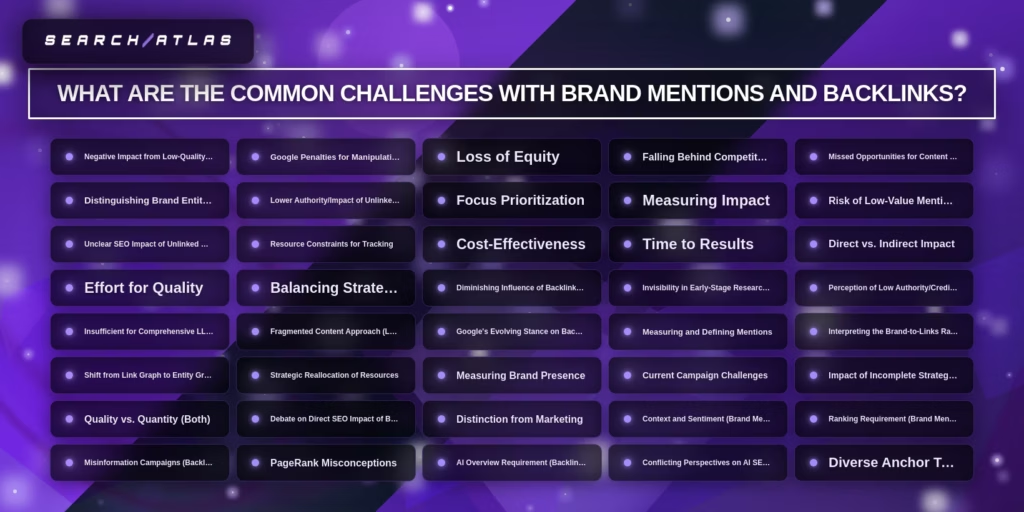
The common challenges with brand mentions and backlinks include quality risks, measurement limitations, algorithm shifts, AI visibility constraints, and strategic allocation conflicts. Brand mentions and backlinks both influence SEO and AI systems, yet both introduce operational, reputational, and performance complexities that require structured management.
The 12 main challenge categories for brand mentions and backlinks are listed below.
- Quality and Source Risk.
- Google Penalties and Manipulation Risk.
- Authority and Equity Loss.
- Competitive Gap Risk.
- Measurement and Attribution Difficulty.
- Resource and Cost Constraints.
- Time-to-Impact Delays.
- Direct vs. Indirect Impact Confusion.
- AI Visibility Limitations.
- Algorithm Shift and Policy Changes.
- Brand-to-Links Ratio (BLR) Interpretation Risk.
- Strategic Imbalance and Fragmentation.
What quality challenges affect brand mentions and backlinks? Low-quality domains, irrelevant placements, spam networks, and weak contextual signals reduce authority impact and increase reputational risk. Brand mentions from irrelevant sources weaken credibility. Backlinks from Private Blog Networks and link farms trigger ranking devaluation. Quantity without quality creates negative signal dilution.
What SEO penalty risks exist for backlinks? Backlinks acquired through manipulative tactics expose domains to algorithmic penalties and link devaluation. Google Spam Policy updates removed explicit weighting language for links while maintaining structural evaluation. Penguin-based systems target unnatural anchor patterns and mass link schemes.
What equity and authority loss risks occur? Lost backlinks, removed mentions, and broken links reduce accumulated authority signals. Link removal eliminates PageRank transfer. Unmonitored brand mentions disappear from high-traffic pages, reducing entity reinforcement.
What competitive challenges affect brand mentions and backlinks? Competitors with stronger mention velocity and backlink diversity dominate Share of Voice and AI inclusion. Failure to benchmark competitor citation frequency results in missed ranking and AI visibility opportunities.
What measurement challenges exist? Brand mention measurement lacks standardized attribution models, and backlink attribution often ignores AI visibility influence. Unlinked mentions are difficult to quantify precisely. Brand-to-Links Ratio (BLR) interpretation requires contextual evaluation across industry norms.
What operational and cost constraints limit performance? Monitoring systems, outreach campaigns, and AI visibility tracking require sustained budget allocation and dedicated personnel. Smaller brands face resource limitations in tracking sentiment, citation frequency, and backlink audits.
What timeframe challenges affect performance expectations? Brand mentions build cumulative authority slowly, while backlinks show a faster ranking impact after indexation. AI visibility improvements typically require 2-3 months of consistent signal growth. Delayed expectations create strategic misalignment.
What impact does confusion have on strategy decisions? Backlinks produce measurable PageRank impact, while brand mentions produce indirect entity authority signals, creating prioritization uncertainty. Overemphasis on one signal weakens holistic authority development.
What AI-specific challenges exist? Brand mentions determine AI inclusion probability, yet early-stage research queries often exclude brands without a strong contextual presence. AI systems require consistent co-occurrence patterns. Fragmented content reduces LLM entity confidence. Backlinks alone do not guarantee AI citation inclusion.
What algorithm shift challenges exist? The transition from Link Graph evaluation to Entity Graph evaluation changes the weighting logic for authority signals. Google’s evolving stance reduces explicit emphasis on links while increasing entity prominence assessment.
What analytical risks exist in the Brand-to-Links Ratio (BLR) evaluation? A low BLR signals unnatural link concentration, while an excessively high BLR signals missed structural authority opportunities. Balanced ratios vary by industry, maturity stage, and AI visibility objectives.
What strategic planning challenges weaken results? Fragmented campaigns, inconsistent brand positioning, and misaligned outreach reduce cumulative authority growth. Brand mentions and backlinks require unified governance. Integrated strategies outperform isolated link-only or mention-only campaigns.
Why does balanced execution reduce risk? Balanced execution reduces risk by aligning entity authority signals with structural link authority signals across SEO and AI systems. Unified measurement, monitoring, and positioning prevent signal decay and sustain long-term visibility dominance.
Do Negative Brand Mentions Affect SEO?
No. Google has no confirmed ranking factor that lowers a site because of negative sentiment on other websites. Negative mentions work indirectly: Google's Search Quality Rater Guidelines treat reputation as part of page quality, and searchers are less likely to click a brand they have read complaints about. Spam backlinks are the bigger risk, because they break Google's spam policies and can lead to a manual action. Treat negative mentions as a reputation job: monitor them, respond, and correct misinformation.
How Mentions and Backlinks Support Entity Authority?
Mentions and backlinks support entity authority by reinforcing recognition, trust, contextual relevance, and structural validation across search and generative systems. Mentions strengthen entity recognition through frequency and sentiment. Backlinks strengthen entity authority through PageRank transfer and contextual linkage.
How do unlinked brand mentions support entity authority? Unlinked brand mentions support entity authority by increasing entity recognition, contextual association, and AI confidence signals. Large Language Models learn from text corpora where repeated brand references establish existence and relevance. Generative systems weigh mention frequency, sentiment, and topical consistency to determine authority strength. Mentions function as trust validation signals rather than direct ranking levers.
How do backlinks support entity authority structurally? Backlinks support entity authority by transferring measurable link equity and reinforcing contextual entity relationships. High-quality backlinks from reputable domains signal credibility and relevance. Backlinks enable search engines to map relationships between entities and strengthen topical authority clusters. A small number of authoritative links produces stronger entity authority than hundreds of low-quality links.
Why do mentions provide contextual depth that backlinks alone cannot? Mentions provide contextual depth because they capture natural language co-occurrence patterns around the entity. Mentions reveal how audiences discuss a brand across topics, sentiment, and expertise domains. AI systems evaluate tone, source quality, and semantic alignment to determine authority weighting.
Why do backlinks remain essential for traditional entity authority signals? Backlinks remain essential because ranking systems still rely on PageRank and crawlable graph relationships. Entity-based link building strengthens domain-level trust. Search engines interpret contextual backlinks as editorial endorsements that elevate ranking capacity.
What is the optimal balance between mentions and backlinks for entity authority? The optimal balance combines mentions as amplification signals and backlinks as foundational authority signals. Mentions amplify already strong SEO foundations. Backlinks provide structural authority that mentions alone cannot replace. A balanced ratio of approximately 30% brand mentions and 70% backlinks produces stable entity authority growth across search and AI systems.
How does external corroboration reinforce entity authority? External corroboration reinforces entity authority by maintaining consistent references across official profiles, directories, and third-party publications. Consistent naming and structured schema reduce ambiguity for AI systems. Co-citation with recognized industry entities strengthens domain credibility. Inconsistency across profiles reduces AI confidence and citation likelihood.
How Do Backlinks Influence AI Citations?
Backlinks influence AI-generated citations by increasing domain authority, improving traditional search rankings, and elevating content discoverability that AI retrieval systems rely on. AI systems frequently retrieve information from high-ranking pages. Pages with stronger backlink profiles appear more often in top search results, which increases their probability of AI citation.
How do backlinks influence AI search visibility indirectly? Backlinks influence AI search visibility indirectly because AI models retrieve content from search engines that prioritize backlink-driven rankings. AI systems do not crawl backlinks directly. AI systems extract information from ranked search outputs where backlink strength determines position and prominence.
How do backlinks establish authority signals for AI models? Backlinks establish authority signals by reinforcing E-E-A-T evaluation and SiteAuthority scoring within search systems. Google’s internal documentation confirms that linking domain quality and link relevance affect ranking. PageRank remains a core ranking signal aligned with authoritativeness.
What is the correlation between backlinks and AI citation tools? Backlinks show moderate correlation with citation frequency in ChatGPT (0.39), Perplexity (0.42), and Gemini (0.41). AI models surface pages with higher Domain Rating and referring domain counts more frequently. Correlation with Google AI Overviews remains weak at 0.25, which indicates differentiated weighting logic.
Does backlink quantity or backlink quality influence AI citations more? Backlink quality influences AI citations more than backlink quantity. Editorial links from high-authority and topic-relevant domains carry stronger citation influence than large volumes of low-quality links. AI search prioritizes trust, clarity, and thematic alignment over raw link volume.
What types of backlinks strengthen AI citation probability? Editorial links from high-authority media, academic citations, and topically aligned publications strengthen AI citation probability. AI systems favor sources recognized as credible and authoritative. Media backlinks carry disproportionate weight due to trusted publication signals.
Which backlinks weaken AI citation potential? Directory links, low-quality links, and black-hat backlinks weaken AI citation potential. AI systems detect manipulation patterns and ignore low-editorial-quality sources. Black-hat links provide no contextual entity association and damage authority signals.
Why do backlinks remain strategically important for AI visibility? Backlinks remain strategically important because AI retrieval layers depend on search-based authority systems to identify credible sources. Strong backlink profiles elevate ranking, which increases AI exposure. Backlinks support entity authority infrastructure that AI systems use for source validation.
Backlinks vs Brand Mentions: What Matters More in 2026?
Brand mentions matter more in 2026 for entity recognition and AI visibility, while backlinks remain foundational for traditional ranking authority. Brand mentions now represent 55% of off-page influence, while backlinks represent approximately 45%, down from 80% in 2012. This shift reflects the transition from link graph dominance to entity graph evaluation.
How do backlinks perform in 2026 ranking systems? Backlinks continue to function as measurable trust and authority signals that pass PageRank and strengthen domain credibility. High-quality backlinks from authoritative and relevant domains establish foundational SEO strength. One powerful contextual link outweighs dozens of low-quality links. Backlinks remain critical for competitive commercial keywords and transactional queries.
How do brand mentions perform in 2026 AI-driven search systems? Brand mentions drive entity prominence, Knowledge Panel triggers, and AI Overview citations more directly than backlinks. Unlinked brand mentions initiate 60% of new Knowledge Panels, while backlinks account for 35%. Consistent positive mentions increase SGE visibility by up to 22% on high-authority domains. Brand mentions fuel entity recognition and AI trust weighting.
When will backlinks take priority in 2026? Backlinks take priority when the objective centers on competitive commercial rankings and foundational domain authority growth. Backlinks pass explicit ranking signals and support measurable keyword improvements. Sites entering competitive niches require structural link authority before mention amplification produces an effect.
When will brand mentions take priority in 2026? Brand mentions take priority when the objective centers on AI inclusion, entity prominence, and Knowledge Graph expansion. AI Overviews function as the new featured snippet surface. Consistent brand citations across trusted publications increase inclusion probability in generative responses.
What is the optimal strategic conclusion for 2026? The optimal strategy in 2026 integrates high-quality backlinks for structural authority and consistent brand mentions for entity amplification. Backlinks establish a credibility infrastructure. Brand mentions amplify contextual trust and AI recognition. A balanced approach aligned with industry competitiveness, site maturity, and AI visibility objectives produces sustainable dominance.
Can Backlinks Be Replaced by Brand Mentions?
No, backlinks are not replaced by brand mentions in a comprehensive off-page SEO strategy. Backlinks transfer link equity, influence PageRank, and remain foundational for traditional organic rankings. Backlinks are projected to account for approximately 45% of off-page SEO weight in 2026, which confirms their structural ranking importance.
Why do backlinks remain irreplaceable for traditional SEO? Backlinks remain irreplaceable because they pass measurable authority signals that directly influence ranking systems. A single backlink from a high-authority domain shifts keyword positions. New brands with minimal digital footprint rely on backlinks to establish initial trust and crawlable authority signals.
How do brand mentions compare in growth and AI influence? Brand mentions are growing rapidly in influence and dominate AI-driven visibility, but they do not transfer link equity. Brand mentions are projected to account for 30% of off-page SEO weight by 2026, up from 5% in 2012. Brand mentions correlate three times more strongly than backlinks with AI Overview visibility in a 75,000-brand study.
What is the optimal strategic conclusion? The strongest off-page strategy integrates both backlinks and brand mentions rather than replacing one with the other. Backlinks establish structural authority for traditional rankings. Brand mentions strengthen entity recognition and AI citation probability. Combined execution produces durable SEO and AI visibility performance.
How Many Mentions and Backlinks Influence AI Visibility?
AI visibility improves after reaching authority thresholds rather than fixed raw numbers, but nationally competitive industries typically require 100+ high-quality backlinks, while local markets require 3-5 high-quality backlinks supported by consistent brand mentions. Authority Score shows a Spearman correlation of approximately 0.36 with AI Share of Voice, which confirms that authority level drives inclusion frequency.
How many backlinks are needed for improved AI visibility? Over 100 high-quality backlinks influence AI visibility in national markets, while 3-5 high-quality backlinks influence AI visibility in local markets. Authority Score correlates with AI Mentions at 0.65 (Pearson) and 0.57 (Spearman), which indicates that backlink quality and authority tier matter more than sheer volume. The top 10% of websites by backlink quality receive the majority of AI mentions.
Does backlink quantity or backlink quality matter more for AI visibility? Backlink quality matters more than backlink quantity for AI visibility. Weak correlations exist between total backlink count and AI mentions. Stronger correlations appear when backlinks originate from authoritative, topic-relevant domains. AI systems evaluate domain consensus and credibility rather than raw link volume.
How does domain diversity influence AI visibility? Domain diversity influences AI visibility because AI systems evaluate consensus across multiple authoritative sources. Fifty authoritative domains referencing a brand create stronger validation than repeated links from a single source. AI systems interpret multi-domain agreement as verified expertise.
Do nofollow backlinks influence AI visibility? Nofollow backlinks influence AI visibility nearly as much as follow backlinks. Pearson correlation values show 0.340 for nofollow and 0.334 for follow links. Spearman correlation values show 0.509 for nofollow and 0.504 for follow links. AI systems treat nofollow links from trusted domains as validation signals.
How many brand mentions influence AI visibility? Brand mentions influence AI visibility through frequency, sentiment, and authority context rather than a fixed count threshold. Brand mentions correlate at 0.664 with AI Overview visibility, which exceeds backlink correlation strength. Brands in the top quartile for mentions appear up to 10 times more frequently in AI-generated answers than those in the lower quartiles.
What is the practical authority benchmark for AI inclusion? AI inclusion probability increases significantly after crossing authority thresholds defined by high-quality backlink tiers and consistent mention velocity. Authority Score elevation combined with sustained contextual brand mentions produces measurable AI Share of Voice gains within one quarter of implementation.
Do Unlinked Brand Mentions Help SEO?
Yes, unlinked brand mentions help SEO, but they do not replace backlinks. Unlinked brand mentions function as implied trust and entity signals that reinforce authority, relevance, and Knowledge Graph recognition. Google confirmed that its systems recognize both linked and unlinked mentions as signals of site authority.
How do unlinked brand mentions influence SEO? Unlinked brand mentions influence SEO by strengthening entity recognition and contextual relevance signals. Search engines analyze how often a brand appears and in what context. Frequent mentions across credible sources increase brand relevance within semantic search systems. Unlinked mentions support Knowledge Graph inclusion and Knowledge Panel triggers.
Do unlinked brand mentions pass link equity? No, unlinked brand mentions do not pass link equity or PageRank. Search engines do not treat plain-text mentions as hyperlinks. Linked mentions remain stronger for transferring measurable authority signals.
How do AI systems treat unlinked brand mentions? AI systems treat unlinked brand mentions as entity validation signals that confirm authority and expertise. Google Gemini and ChatGPT evaluate mention frequency, sentiment, and topical alignment. Entity-based SEO signals determine inclusion in AI-generated answers.
Why are unlinked mentions converted into backlinks? Convert unlinked mentions into backlinks to transform trust signals into ranking signals. Converting nine unlinked mentions into backlinks increased rankings by 13 positions in one documented case. Press release campaigns convert mentions into backlinks at a 10-15% rate.
What is the final SEO conclusion? Unlinked brand mentions strengthen entity authority and AI visibility, but backlinks remain essential for measurable ranking gains. The strongest SEO strategy integrates both signals to maximize authority growth and search visibility.
How AI Search Is Changing the Role of Links and Mentions?
AI search is shifting authority evaluation from link dominance toward entity prominence, citation corroboration, and contextual mentions. Generative systems synthesize answers directly, which reduces dependency on traditional blue-link navigation. Links remain structural credibility signals, while mentions increasingly determine entity recognition and AI inclusion.
How does generative AI impact organic traffic and user behavior? Generative AI reduces organic click-through rates by providing direct answers that satisfy intent without external navigation. As of March 2025, 27% of searches result in no clicks, while only 56% lead to a click, often within Google’s ecosystem. Users rarely click citations unless responses appear incomplete. This behavior increases zero-click exposure and decreases informational page traffic.
What is the shifting role of backlinks in AI search? Backlinks continue to establish domain credibility and indexing strength, but they no longer function as the sole authority signal in AI environments. 73.2% of SEO professionals believe links affect AI visibility, yet 64.9% state ranking remains possible without them. AI retrieval layers reference high-ranking pages, which backlinks influence indirectly, but AI models weigh contextual brand mentions more heavily.
How do mentions and citations function differently in AI search? Mentions drive entity recall and authority perception, while citations reinforce trust and verification signals. Mentions appear without hyperlinks and increase familiarity and brand recall. Citations provide clickable references that increase credibility perception. AI systems prioritize corroboration across multiple sources rather than reliance on isolated link signals.
How does AI search change content strategy priorities? AI search shifts content from traffic acquisition assets to authoritative source material for synthesis engines. Informational traffic declines as AI answers replace intermediate clicks. Content must prioritize clarity, expertise, and structured information to qualify for citation inclusion rather than click optimization alone.
How does AI search affect psychological user behavior? AI search reduces evaluation friction by compressing multi-step research into single conversational responses. Automation bias increases acceptance of AI answers. Processing fluency enhances perceived truthfulness. Mere exposure effects increase trust in brands repeatedly mentioned in AI-generated outputs.
What strategic adjustments strengthen links and mentions in AI search? Strategic adjustments require hybrid execution that integrates digital PR, entity consistency, and authoritative link acquisition. Optimize content for citation-ready clarity. Strengthen topical authority clusters. Align on-site messaging with third-party mentions. Maintain consistent brand signals across LinkedIn, Wikipedia, directories, and media placements to reinforce AI recognition.
What is the final impact of AI search on links and mentions? AI search reduces the dominance of link counting and elevates entity corroboration as the primary authority determinant. Links build structural credibility. Mentions build contextual authority. AI systems surface brands that demonstrate consistent cross-platform recognition supported by authoritative validation.