⚡ Evaluating Enterprise SEO Alternatives Without Annual Lock-in?
Unlike BrightEdge's quote-walled custom contracts (averaging $30k–$50k/year), Search Atlas provides enterprise-grade SERP tracking, content grading, and autonomous AI technical remediation with 100% transparent pricing and self-service onboarding.
BrightEdge is an enterprise search engine optimization platform that provides automated content recommendations, keyword rank tracking, and competitive digital marketing intelligence. It operates through the Data Cube proprietary index, processing real-time search engine result signals to surface search intent gaps and technical site health diagnostics. The target customer profile of BrightEdge is mid-market and Fortune 1000 marketing departments requiring enterprise-grade workflow orchestration and cross-functional governance.
BrightEdge: Power, Price, and the Quote Wall
Verdict: Capable enterprise automation with zero pricing transparency.
The vendor pricing page returned no public plans on September 27, 2026.
BrightEdge's Muscle
- Enterprise SEO automation
- Real-time keyword and trend data
- Advanced site auditing
- Custom reporting dashboards
BrightEdge's Friction
- High pricing threshold
- Lacking free trial
- Long setup and onboarding
- Limited use for small teams
| Team or use case | Verdict | Reason |
|---|---|---|
| Enterprise automation with budget | Possible | Deep automation and Data Cube tooling |
| Self-serve or trialing | No | No trial and no public price |
| Short engagements | Rigid | Contracts favor annual commitments |
BrightEdge is enterprise SEO automation sold through sales; no public price survives contact with its website.
What is BrightEdge?
BrightEdge is an enterprise SEO platform that centralizes keyword research, content optimization, technical auditing, and performance reporting for organizations managing many websites, brands, or regional teams at once. It is a category usually called "enterprise SEO" or "enterprise organic marketing" software, distinct from the generalist SEO platforms built for individual marketers and small agencies.
BrightEdge pulls data from search engines, crawled websites, and connected analytics platforms into one system, then organizes that data by domain, business unit, or region so a large organization can see search performance the same way it sees revenue or ad spend. The platform's core job is connecting SEO work to measurable business outcomes across dozens or hundreds of properties, not just tracking rankings for a single site.
BrightEdge company facts
BrightEdge Inc. is a U.S.-based enterprise SEO company founded in 2007 by Jim Yu and Lemuel Park, headquartered in San Mateo, California. Yu previously held a platform leadership role at Salesforce, and Park worked as an engineer at Ernst & Young before co-founding BrightEdge.
BrightEdge grew steadily through bootstrapped efforts and venture funding, and surpassed $100 million in annual recurring revenue by 2025. As of 2026, BrightEdge reports more than 2,400 global customers, including 57 of the Fortune 100. Named enterprise customers on BrightEdge's own site include Ikea, Best Buy, Salesforce, Intuit, Visa, Microsoft, JPMorgan Chase, and UnitedHealth Group.
Who is BrightEdge built for, and who should skip it?
BrightEdge is built for enterprise SEO teams managing complex digital portfolios across multiple brands, regions, or business units, not for solo marketers or single-site small businesses. Typical buyers include SEO directors, VPs of digital marketing, content strategists, and large agencies running SEO for enterprise clients.
Because BrightEdge is priced and structured around domain count, seat count, and custom modules, the sales and onboarding process assumes a multi-stakeholder buying committee. That fits how large organizations actually run SEO, since a director owns strategy, a content team executes, IT handles technical implementation, and an executive sponsor reviews dashboards. BrightEdge fits companies where SEO decisions already require sign-off from more than one department, such as Fortune 500 retailers, multinational corporations, large e-commerce operators, and agencies managing several enterprise accounts.
Who should not buy BrightEdge
BrightEdge is a poor fit for solo SEOs, freelancers, small agencies, and single-domain small businesses, and its own pricing structure effectively confirms this. Teams in any of these categories are usually better served by lighter, self-serve platforms:
- Solo consultants or freelancers managing one or two client sites at a time.
- Small agencies with fewer than five active client domains and no dedicated onboarding budget.
- In-house teams of one or two people without a customer success manager relationship to lean on.
- Anyone who needs month-to-month billing rather than a 12 to 36 month contract.
- Teams that want to try a platform before committing, since BrightEdge does not offer a free trial.
What features does BrightEdge include in 2026?
BrightEdge's platform centers on seven modules covering research, execution, and reporting: AI Hyper Cube and AI Agent Insights for generative-search visibility, Data Cube X for keyword and competitive research, Copilot for AI content recommendations, Autopilot for automated on-page optimization, ContentIQ for technical site auditing, BrightEdge Instant for real-time search trend monitoring, and StoryBuilder for custom reporting. Together, they cover the loop a large SEO team needs to run programs across many domains at once, from finding an opportunity to shipping a fix to proving impact to leadership.
1. AI Hyper Cube, AI Agent Insights, and AI Catalyst
AI Hyper Cube, launched in March 2026, is BrightEdge's newest module, built to show how a brand actually appears inside AI-generated answers rather than traditional search results. It analyzes large volumes of AI queries across ChatGPT, Gemini, and other generative engines to surface which prompts mention a brand, what sources those AI systems cite, how competitors get positioned in the same answers, and the sentiment of the AI-generated narrative around the brand.
- AI Hyper Cube maps where a brand appears, or is missing, across the AI-driven customer journey.
- AI Agent Insights tracks which AI systems and agents actually visit a site, what they do once there, and where they hit technical friction such as blocked pages or broken paths that limit visibility in an increasingly agent-driven web.
- AI Catalyst is positioned as an AI-accelerated content strategy layer that turns the visibility and agent data from the two tools above into workflow recommendations; BrightEdge's own materials describe the category without publishing detailed metrics for it yet.
BrightEdge reported in April 2026 that AI agent requests had reached 88% of human organic search volume on some properties, which is the shift these three tools are built to respond to. This module launched after the review series was first written, and it is the most consequential product change in BrightEdge's 2026 lineup.
2. Data Cube X
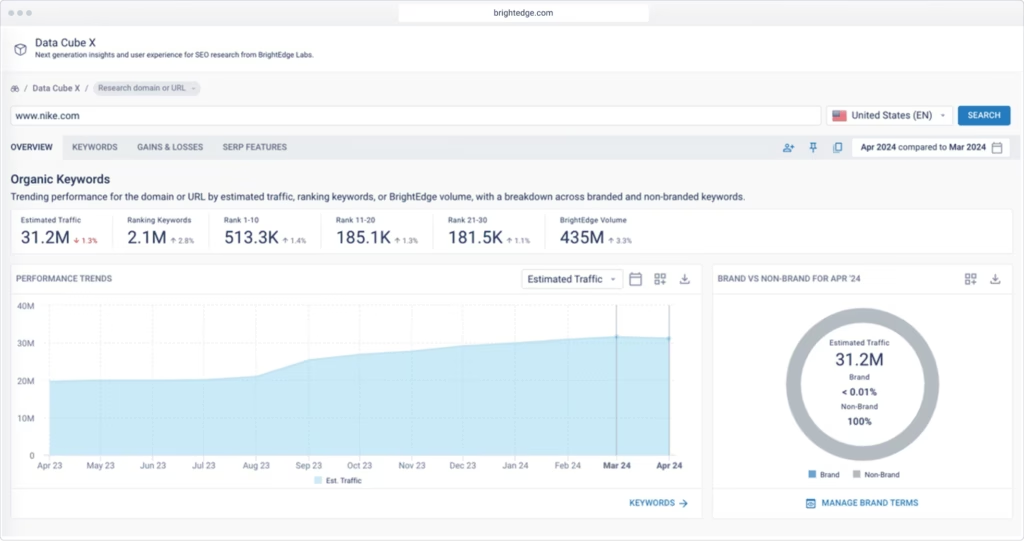
Data Cube X is a keyword research and competitive intelligence engine inside BrightEdge that helps marketers uncover ranking opportunities, monitor SERP features, and optimize content for both traditional and AI-powered search. It is BrightEdge's flagship research module, letting users analyze entire domains, specific URLs, or individual keywords to identify emerging trends, competitive threats, and keyword gaps, with the DataMind engine layered on top to drive recommendations and forecasting from the same index.
BrightEdge describes Data Cube X as one of the broadest keyword indexes in enterprise SEO; third-party reviewers report coverage in the range of dozens of countries and languages, though BrightEdge does not publish an exact country or keyword-volume count on its own product pages, so treat any specific figure quoted elsewhere as a reported estimate rather than an official spec. It includes filtering for the follow-on questions Google AI Overviews cite, which helps teams optimize for both traditional rankings and AI-generated answers at the same time.
Via BrightEdge
A domain-level Data Cube X report breaks visibility down by keyword group, flags top-ranking positions, and compares traffic changes month over month, separating branded from non-branded demand so a team can see how much of its visibility depends on brand searches versus category terms. Best for: enterprise SEO leads and content teams that need exact-match data alongside AI citation tracking, feeding directly into Copilot for execution.
3. Copilot
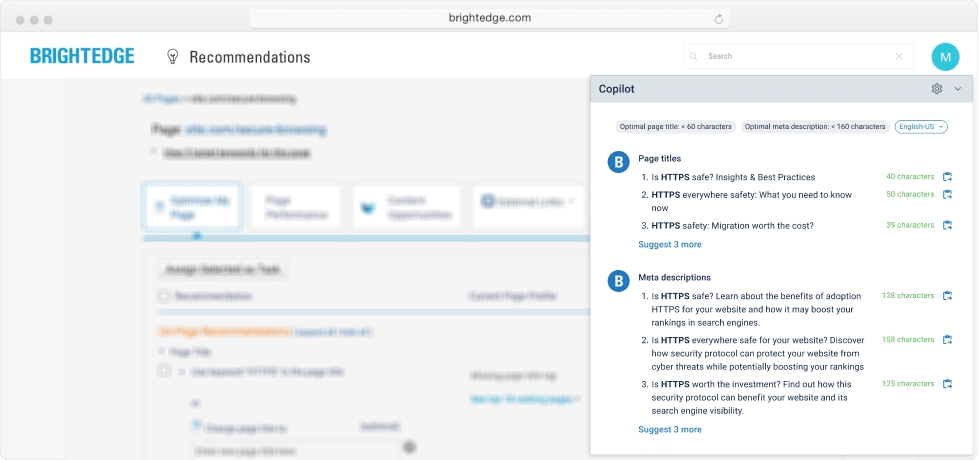
BrightEdge Copilot is an integrated generative AI assistant built to accelerate on-page SEO optimizations directly inside the platform. It analyzes each webpage in real time and suggests ready-to-use page titles and meta descriptions aligned with SEO best practices and user intent, removing the need to export tasks into separate AI products for technical SEO, content, and ranking work.
Via BrightEdge
For example, Copilot scans a page and instantly provides three optimized title tag variations under 60 characters, followed by three meta description options under 160 characters. Each suggestion includes a character count and a prompt to generate additional variants if needed.
Best for: in-house SEO managers, content teams, and agencies managing high content volume who want repetitive optimization tasks automated inside the same platform that holds their keyword data.
4. Autopilot
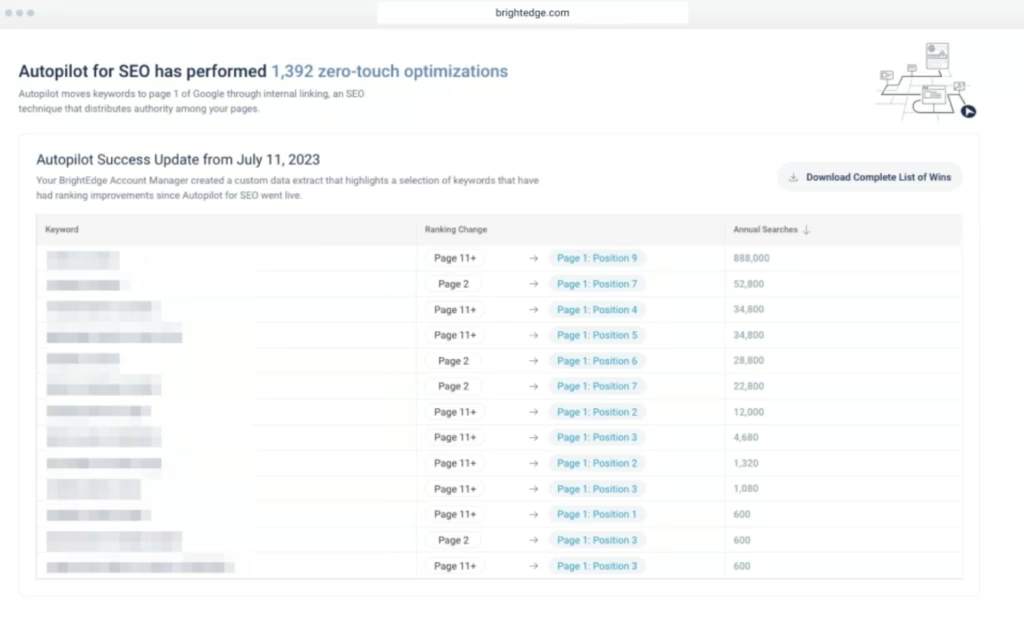
BrightEdge Autopilot is a fully automated, zero-touch SEO solution designed to optimize pages continuously without manual input. Once deployed, Autopilot uses BrightEdge’s proprietary AI models to analyze ranking potential, adjust page elements, and implement improvements that increase visibility in Google search results, without developer support or user intervention.
Via BrightEdge
BrightEdge tracks Autopilot performance before and after activation, comparing keyword rankings and traffic trends over time. According to BrightEdge, pages commonly move from page two or lower into page one for mid-volume, high-conversion keywords without manual edits or a development team's involvement, since Autopilot updates content elements and technical signals continuously as search behavior shifts.
Best for: enterprise brands and ecommerce sites scaling SEO across thousands of pages that want to cut their dependency on IT cycles for routine optimization work.
5. Site audit (ContentIQ)
BrightEdge ContentIQ is a scalable SEO auditing engine that analyzes websites of any size to identify and prioritize technical issues affecting organic performance. ContentIQ covers enterprise-level crawling for millions of pages, including PWAs (Progressive Web Applications), SPAs (Single Page Applications), and JavaScript-heavy sites, using sitemap, domain, or user-agent-based configuration.
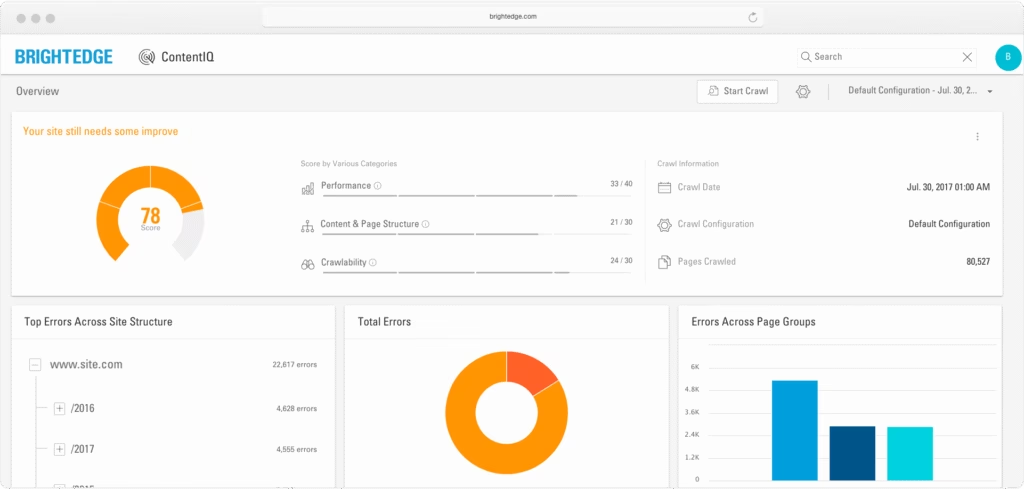
Via BrightEdge
For example, users can run weekly crawls that grade website health using the proprietary ContentIQ score, segment issues by page group, and track total error counts over time. StoryBuilder dashboards visualize the impact of error resolution on traffic, conversions, and revenue growth.
ContentIQ offers custom rules using XPath and RegEx, allowing audits to focus on business-critical issues like slow load speed, broken links, duplicate content, or incorrect redirects. Users can configure thresholds, filter by error severity, and run ad hoc crawls during migrations or international launches.
Best for: enterprise site owners and SEO teams managing high-volume websites that need continuous monitoring and fast error remediation at scale, not a one-off audit.
6. Live trends (BrightEdge Instant)
BrightEdge Instant is a real-time SEO insights engine that delivers live keyword trends, global rankings, and instant optimization opportunities at scale, monitoring current search behavior, voice queries, and SERP shifts across 37,000 locations and 46 languages. That scope makes it more useful for international SEO teams than most rank trackers, which sample far fewer markets.
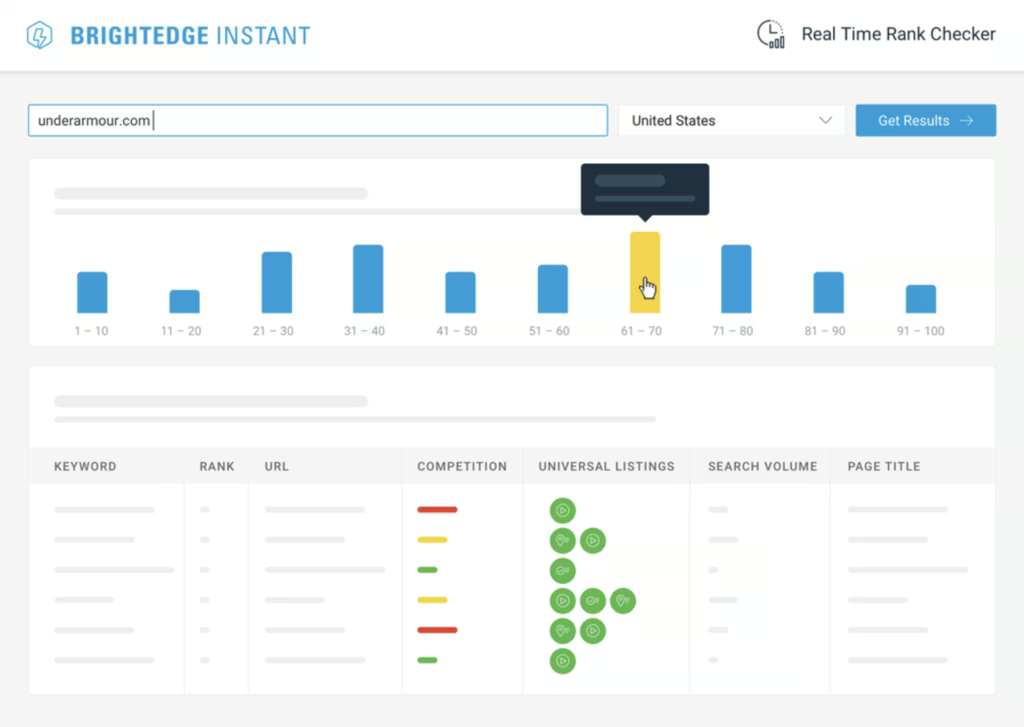
Via BrightEdge
Instant BrightEdge SERP features help SEO teams and marketers capture in-the-moment demand by revealing which keywords, topics, or video content are trending across Google, YouTube, and Amazon. BrightEdge Instant returns live rankings, not cached data, and tracks performance on global search engines, including Yandex, Baidu, and Naver, which makes it valuable for international SEO.
Marketers use Instant to identify real-time Quick Answer and voice search opportunities, monitor mobile rankings, and receive immediate page-speed diagnostics. This live trends feature provides prescriptive optimization recommendations without requiring secondary analysis or tools, streamlining decision-making and content updates.
Best for: international SEO managers and real-time content teams who need to respond to live search intent across many markets at once, not just a single home market.
7. Custom reporting (StoryBuilder)
StoryBuilder is a native custom reporting engine in BrightEdge that transforms SEO data into customizable, executive-level dashboards. It blends BrightEdge metrics, web analytics, and SERP performance data into interactive visuals that help marketers communicate SEO impact across departments.
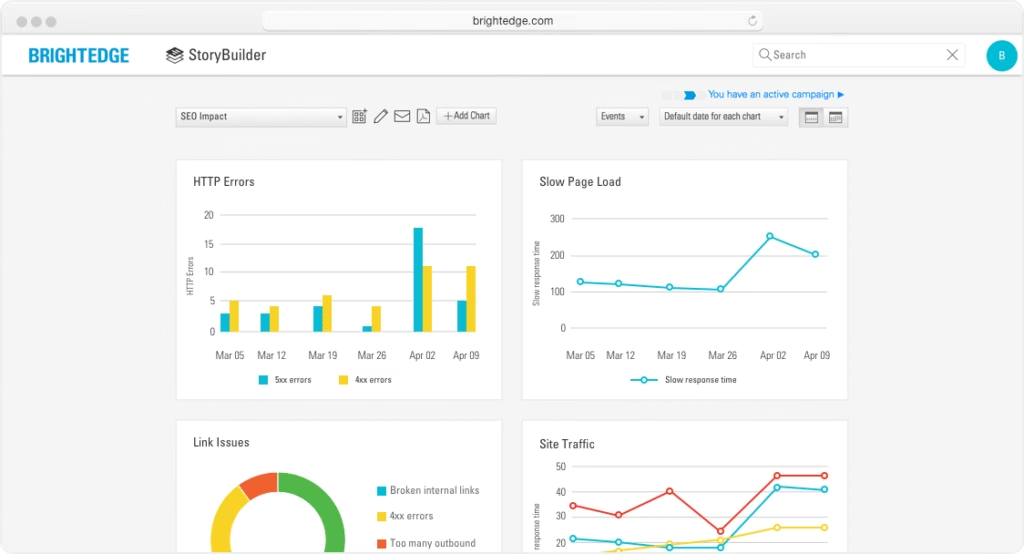
Via BrightEdge
BrightEdge StoryBuilder lets users build dashboards quickly using pre-set templates for buyer journeys, program performance, keyword trends, and competitive benchmarks. Reports filter by date range, device type, and business unit, and exporting plus scheduled delivery cover ongoing performance tracking and stakeholder reporting.
StoryBuilder dashboards connect content performance to business outcomes by showing how organic search influences traffic, conversions, and revenue. Marketers drill into reports, such as Page Reporting, Keyword Reporting, and Share of Voice, to investigate trends and act on insights.
Best for: digital marketing leads and CMOs who need to justify SEO budget by linking it directly to brand visibility and revenue growth, not just ranking movement.
How does the BrightEdge SEO platform work?
The BrightEdge SEO platform works by continuously analyzing search engine data, competitor activity, and website performance to generate SEO recommendations that improve visibility and content impact. BrightEdge connects keyword insights, technical diagnostics, and automation into one system that covers enterprise-scale optimization end to end.
BrightEdge collects billions of real-time data points through Data Cube X. Data Cube X monitors SERPs, identifies ranking patterns, and detects shifts in search behavior. It surfaces keyword opportunities, competitor trends, and performance gaps based on current user intent.
Teams apply these insights using built-in tools for AI automation, technical audits, and content refinement. BrightEdge executes site changes through Autopilot, recommends updates with Copilot, and uncovers technical blockers through Site Audit, feeding results back into GSC, GA4, and Adobe Analytics integrations to track business impact.
How does BrightEdge get implemented, and how long does it take?
Rolling out BrightEdge across a large organization typically takes weeks to a few months, not days, because the platform is built to be configured, not simply switched on. A customer success manager leads onboarding, which usually covers connecting domains and analytics accounts, setting up user permissions across teams, building the first StoryBuilder dashboards, and training the internal team on Data Cube X, Copilot, and Autopilot.
That training requirement shows up repeatedly in independent reviews and Reddit discussions, not just in BrightEdge's own materials, which consistently describe the platform as powerful but not intuitive for a new user. Organizations that already run a mature, well-staffed SEO function absorb this onboarding cost more easily than lean teams, since they can dedicate a specific person to becoming the internal BrightEdge expert, which is one reason implementation burden belongs in the buying decision alongside features and cost.
How accurate is BrightEdge?
BrightEdge is generally considered accurate because of its continuous data collection and real-time analysis, rather than the periodic sampling smaller SEO platforms often rely on, though accuracy still depends on data quality and how consistently a team maintains its monitoring setup. Some users report occasional mismatches against GA4 or Adobe Analytics, usually traced back to integrations misconfigured during onboarding.
What does BrightEdge cost in 2026?
BrightEdge no longer exposes a pricing page; the pricing URL returned a 404 when checked. All plans are custom-quoted through sales based on company size, domain count, tracked keyword volume, user seats, and which modules a contract includes, so there is no published price list to compare against a self-serve platform.
| What we verified | Detail |
|---|---|
| Public prices | None; pricing page not found |
| Sales route | Demo-led enterprise contracts |
| Third-party deal data | Vendr median roughly $50,000 a year |
With no official price list, deal-tracking platforms are the best available benchmark for what buyers actually pay:
- Median contract. Vendr, a software purchasing platform, reports a median annual contract of roughly $50,000 based on dozens of tracked deals.
- Typical range. Vendr's tracked deals mostly fall between about $42,500 and $69,000 a year, while other trackers report monthly figures from roughly $1,000 to $12,500 depending on scope. These are reported figures from deal-tracking platforms, not BrightEdge's official pricing, and any individual quote can land outside that range.
- Contract terms. Contracts typically run 12 to 36 months, with annual prepayment common.
Treat those figures as benchmarks, not quotes. With the pricing page gone, BrightEdge confirms what a specific contract costs only in writing through sales.
What rating does BrightEdge have in 2026?
BrightEdge holds solidly positive ratings across major review platforms as of 2026, particularly for competitive intelligence and enterprise-scale features, with pricing and learning curve as the recurring criticisms.
- G2. 4.4/5 (800+ reviews).
- Capterra. Around 4.1/5.
- TrustRadius. Around 7.3/10.
BrightEdge reviews consistently highlight feature depth, strategic insight, and the quality of customer success support, with G2 reviewers rating BrightEdge's support and keyword research capabilities especially high. Criticism centers on the learning curve, occasional data mismatches with external analytics platforms, and pricing that puts the platform out of reach for smaller teams.
What are the pros of BrightEdge?
Pros and cons
Weigh BrightEdge’s strengths against its limits
Each point is explained in the pros and cons sections below.
Pros
- Enterprise SEO Automation
- Real-Time Keyword and Trend Data
- Advanced Site Auditing
- Custom Reporting Dashboards
- Dedicated Strategic Support
- Data Cube Market Intelligence
- Global SERP Coverage
- Secure, Scalable Infrastructure
Cons
- High Pricing Threshold
- Lacking Free Trial
- Possible Feature Bloat Risk
- Steep Learning Curve
- Limited Use for Small Teams
- Long Setup and Onboarding
- Lacking DIY Flexibility
- Lacking Short-Term Options
BrightEdge's strengths lie in enterprise-level intelligence, automation, and the data infrastructure needed to run SEO across many properties at once.
- Enterprise SEO Automation. Autopilot and Copilot automate SEO tasks across high-scale websites without constant manual intervention.
- Real-Time Keyword and Trend Data. BrightEdge Instant delivers live insights across 37,000 locations and multiple engines, including Google, YouTube, and Amazon.
- Advanced Site Auditing. ContentIQ performs deep technical audits across millions of pages, covering JS frameworks, mobile UX, and accessibility issues.
- Custom Reporting Dashboards. StoryBuilder lets SEO teams build executive dashboards that map SEO performance to business KPIs (Key Performance Indicators).
- Dedicated Strategic Support. BrightEdge includes consulting and onboarding services, including roadmap creation and dashboard configuration.
- Data Cube Market Intelligence. BrightEdge's proprietary Data Cube X provides keyword opportunity analysis across verticals, competitors, and buyer stages.
- Global SERP Coverage. BrightEdge tracks rankings across multiple search engines and 46 languages in global markets.
- Secure, Scalable Infrastructure. The platform covers multi-domain brands and integrates with analytics, CRM, and CMS platforms built for enterprise environments.
What are the cons of BrightEdge?
BrightEdge's limitations mostly relate to cost, accessibility, and usability for smaller teams or anyone wanting a self-serve experience.
- High Pricing Threshold. Contracts typically start in the low thousands per month and run 12 to 36 months, which puts BrightEdge out of reach for most small businesses.
- Lacking Free Trial. BrightEdge does not offer a free trial or published pricing, so evaluating it means booking a sales demo first.
- Possible Feature Bloat Risk. The platform includes enough modules that a team focused only on core SEO workflows may find part of it unused.
- Steep Learning Curve. Getting real value from BrightEdge requires sustained training and internal documentation for non-specialist users.
- Limited Use for Small Teams. BrightEdge's enterprise orientation excludes freelancers, consultants, and lean in-house teams by design.
- Long Setup and Onboarding. Full integration and dashboard customization take real time and coordination with BrightEdge's success team.
- Lacking DIY Flexibility. BrightEdge is not built for self-guided users who want to experiment quickly or make fast, unassisted adjustments.
- Lacking Short-Term Options. BrightEdge offers no monthly billing, usage-based tiers, or cancel-anytime plans.
What do Reddit users think about BrightEdge?
Reddit users share mixed opinions about BrightEdge, but the dominant sentiment leans negative, especially regarding pricing, usability, and company behavior. Positive mentions are usually tied to enterprise use cases, while most criticism targets aggressive sales tactics and limited ROI.
Reddit users acknowledge the presence of dedicated customer success managers, custom dashboards, and strategic consultation. A few comments mention that AI in BrightEdge has improved in recent versions, especially in generating content recommendations.
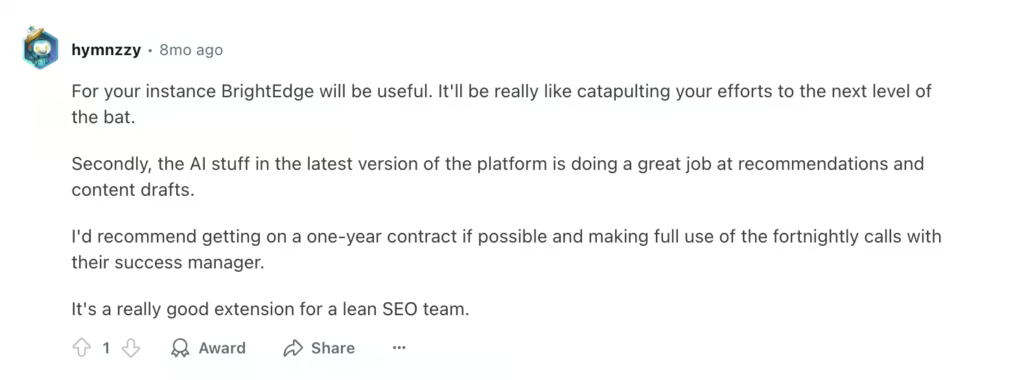
Many users said BrightEdge is overpriced for what it offers. Multiple commenters said BrightEdge sales reps cold-email executives and aggressively push upsells post-contract. Some even reported that the reps undermined internal SEO teams during sales pitches.
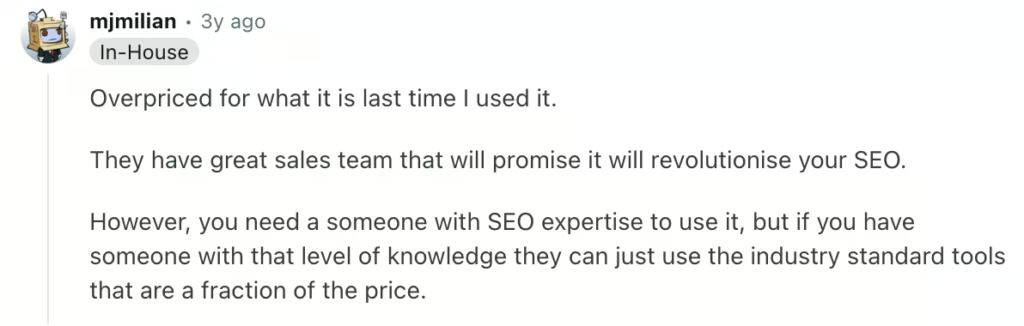
Solo SEOs or smaller teams reported that the platform is too complex to use without deep expertise or resources.
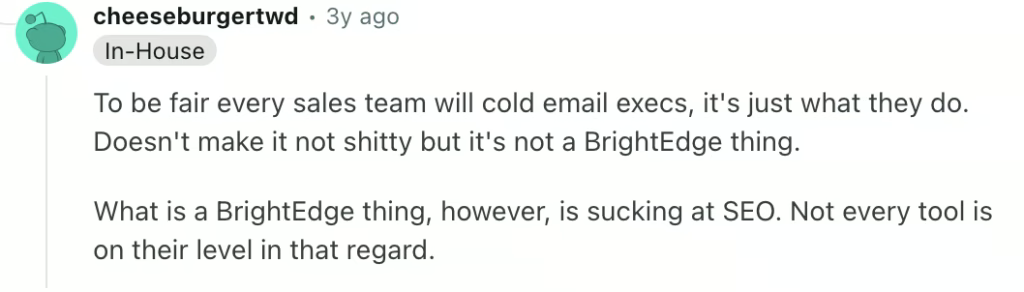
A recurring theme is that BrightEdge invests more in sales than in product development. Several users claimed the tool was just “a bunch of tools slapped together.” While a few Redditors note enterprise-scale benefits, the consensus among Reddit users is that BrightEdge is oversold, overpriced, and best avoided unless your team already operates at an enterprise SEO level.

How does BrightEdge treat its long-term subscribers?
BrightEdge serves long-term subscribers through dedicated account management, ongoing training, and strategic performance reviews. Each enterprise account is assigned a customer success manager (CSM) who provides regular check-ins, custom dashboard support, and guidance on platform updates.
Long-term users often get early access to new features and more stable pricing. According to G2 reviews, many subscribers describe BrightEdge as an “extension of their SEO team,” though continued value depends heavily on how engaged the assigned manager stays as internal SEO needs evolve.
How responsive is BrightEdge's customer support?
BrightEdge is generally reported as responsive, providing customer support through dedicated success managers, email assistance, and regularly scheduled strategy calls.
Users say BrightEdge resolves urgent problems within hours and that customer success managers act as strategic advisors, though support quality depends on the assigned manager and can vary when a team switches roles.
Is BrightEdge reliable and legitimate?
Yes, BrightEdge is a reliable and legitimate enterprise SEO platform with no major accusations of fraud or scam activity. BrightEdge serves major enterprise clients and has maintained a reputation in the SEO industry since 2007.
Several Reddit users criticize BrightEdge's sales outreach as aggressive, and some have called it “shady,” but independent review sites like the Better Business Bureau and Scamwatch do not list BrightEdge as a scam. Some former employees report dissatisfaction with internal company culture, though that does not affect reliability for clients.
What are the BrightEdge alternatives in 2026?
BrightEdge competes most directly with other enterprise SEO platforms built for the same multi-domain, governance-heavy environment, most notably Conductor, along with seoClarity, and generalist platforms like Semrush and Ahrefs that some large teams use in combination rather than a single all-in-one system. Conductor is the closest one-to-one comparison, since it targets the same enterprise buyer with a similar mix of platform features and consulting-style support.
For organizations that do not need BrightEdge's full enterprise scope, Search Atlas is a factually different kind of platform rather than a smaller version of the same thing.
Search Atlas is an agentic AI marketing platform that runs SEO, AEO, Google Ads, Meta Ads, content, and site health work itself, using self-healing loops to fix issues it finds and reporting the work back through the Search Atlas Coworker in Slack, Microsoft Teams, or ClickUp. That execution model means less manual configuration than a module-based platform like BrightEdge requires, along with published pricing tiers instead of a custom quote.
For B2B teams weighing this kind of lighter-weight setup against an enterprise contract, how Search Atlas handles B2B SEO is a useful side-by-side reference point.
The right choice ultimately depends on team size and how SEO decisions actually get made internally. A multinational retailer with a dedicated in-house SEO department and budget for a managed platform is a reasonable BrightEdge or Conductor buyer. A leaner marketing team that wants execution handled automatically, with transparent monthly pricing, is better served by a platform built around agentic automation from the start.
What should you verify before signing with BrightEdge?
Before signing an annual BrightEdge contract, a buyer should get specific, written answers to a short list of questions that the sales process will not always surface on its own. Working through this list during evaluation, rather than after signing, is the difference between a contract that fits and one a team is stuck with for 12 to 36 months.
- Ask for the exact contract length and any auto-renewal terms, including whether a shorter initial term is available to prove value before committing to multiple years.
- Get the renewal price escalator in writing, since procurement trackers report annual increases in the 3 to 7 percent range at some accounts.
- Confirm what counts as a seat, a domain, and a tracked keyword, and ask what happens, in dollars, when any of those limits get exceeded mid-contract.
- Ask which modules are included in the base quote versus priced as add-ons, particularly Autopilot, Copilot, and StoryBuilder, since these are frequently the features that drove the initial interest.
- Request a demo built on the prospect's own domain data, not a generic sample account, to see real Data Cube X and ContentIQ output before committing.
- Ask for a realistic onboarding timeline from a recent customer reference, not just from the sales team, given how consistently implementation time comes up in independent reviews.
- Clarify what happens to historical data and dashboards if the contract ends, since switching platforms later should not mean losing a multi-year performance record.
- Ask directly how AI Overview and AI-search citation tracking works inside Data Cube X, since this is one of the faster-moving parts of the product and worth confirming against the current feature set rather than older marketing material.
Running through a checklist like this one alongside a broader SEO vendor evaluation checklist gives a buying committee a structured way to compare BrightEdge against Conductor, seoClarity, or a lighter platform, instead of letting the loudest voice in the sales process make the decision.