AI summarization is the process of using artificial intelligence (AI) to condense content into clear, accurate, and structured outputs that preserve meaning and key information. AI summarization defines how systems interpret, compress, and present information across documents, conversations, and datasets. Summarizer tools and summarizing AI models transform large volumes of text into usable insights, which makes them essential across research, business, and operational workflows.
AI summarization matters because information consumption now depends on systems that generate answers instead of requiring manual reading and interpretation. Generative AI summarization systems analyze content, extract meaning, and produce summaries that influence decisions, understanding, and visibility. This shift changes how information flows because summaries often replace the original source as the primary interface for knowledge.
AI summarization creates both advantages and risks in modern systems. Generative AI summarization reduces time spent on document review, accelerates research, and improves operational speed across teams. Summarizer tools enable faster access to insights, which increases productivity and decision velocity. However, traditional summarizing AI models rely on pattern prediction, which introduces hallucinations, incorrect details, and loss of context.
Entity-based AI summarization improves accuracy and context by structuring summaries around identifiable entities and their relationships. Entity-based summarization aligns content with real-world concepts (people, organizations, products, and events), which ensures that outputs remain grounded in verifiable information.
AI summarization requires structured information, clear entity definition, and consistent relationship mapping to produce reliable outputs. Entity-based approaches transform summarizer systems from text compression tools into knowledge systems that reflect how information connects. AI summarization aligned with entities defines the next stage of accurate, trustworthy, and scalable information processing.
What is AI Summarization?
AI summarization is an AI method that condenses large volumes of information into concise summaries that preserve key meaning. AI summarization defines how systems extract, compress, and reconstruct essential ideas from complex content. AI summarization reflects the shift toward fast information processing, where systems prioritize clarity, structure, and relevance over volume.
AI summarization focuses on reducing information without removing critical meaning. AI summarization differs from general text generation because it transforms existing content instead of producing new ideas. AI summarization improves information efficiency by concentrating key details into shorter, usable outputs.
Transformer-based models, widely adopted after 2022, drive modern summarization systems through contextual language understanding. AI summarization operates within natural language processing (NLP), where models analyze syntax, entities, and semantic relationships across large datasets. These models detect importance based on context, frequency, and structure, which determines what content appears in the final summary.
How do AI systems process and generate summaries? AI systems process summaries by breaking text into tokens, evaluating semantic importance, and reconstructing core ideas into shorter formats. AI systems analyze relationships between sentences to identify primary arguments and supporting details. This process removes redundancy and preserves meaning, which improves clarity and readability.
What are the main types of AI summarization methods? AI summarization methods fall into three main types (extractive, abstractive, and hybrid). Extractive summarization selects exact sentences or phrases directly from the original text, which preserves full accuracy and maintains original wording. Abstractive summarization rewrites content into new sentences that capture the original meaning, which improves readability but introduces the risk of factual distortion. Hybrid summarization combines extraction and generation, which preserves key facts while improving flow and coherence across the final summary.
What challenges affect AI summarization performance? AI summarization introduces risks related to accuracy, context limits, and input quality. Abstractive models misrepresent details, which leads to incorrect outputs in areas (dates, locations, and numerical values). AI summarization depends on context window limits that restrict how much content models process at once. Long documents require segmentation, which reduces continuity across sections and weakens overall coherence.
How does AI summarization improve information systems? AI summarization improves information systems by compressing complex data into structured, actionable outputs. AI summarization increases clarity because it removes redundant information and highlights key points. This clarity improves decision-making speed and strengthens how organizations interpret large datasets.
AI summarization strengthens content workflows by standardizing outputs and aligning summaries with query intent. This alignment improves how systems retrieve and present information across search engines, AI assistants, and enterprise platforms.
How Does AI Summarization Work?
AI summarization works by analyzing content, identifying key information, and compressing that information into shorter, structured summaries. AI summarization defines how systems process language through algorithms, machine learning models, and NLP. AI summarization reflects how systems reduce large inputs into clear outputs while preserving meaning and context.
AI summarization processes different content formats, which range from text documents to transcripts and recordings. AI summarization reduces original content length by 50% to 90% in most cases. This reduction improves the speed of understanding and accelerates decision-making across workflows.
AI summarization depends on core components that drive how the system interprets and generates summaries. Source material provides the input, which includes documents, transcripts, and recorded conversations. Machine learning models analyze patterns inside that input, which improves accuracy over time. NLP interprets structure and meaning, which enables context-aware summarization. Transformer-based language models generate outputs, which reconstruct key ideas into coherent summaries.
How does the AI summarization process content step by step? AI summarization follows a structured sequence that transforms raw input into condensed output. The process begins with content fragmentation, where the system splits input into smaller units (sentences). These units create manageable segments that prepare the content for deeper analysis. AI summarization continues with algorithmic scanning and context recognition, where systems evaluate each segment for meaning and relationships. NLP detects main ideas and removes irrelevant details during this stage.
AI summarization then applies relevance scoring, where each segment receives a score based on importance and coherence. These scores determine which parts of the content remain in the final summary. High-scoring segments represent key ideas, while low-scoring segments are removed to eliminate redundancy.
AI summarization generates the final output after scoring completes. Extractive methods select original sentences directly from the source, which preserves exact wording and accuracy. Abstractive methods rewrite content into new sentences, which improves readability but introduces the risk of distortion. Many systems combine both methods.
AI summarization delivers the output as a structured summary that reflects the original meaning. Video and audio summarization include an additional step where speech is converted into text before processing begins. Advanced systems analyze visual context through frame detection, which expands summaries beyond spoken content.
What mechanisms drive AI summarization accuracy and performance? AI summarization accuracy and performance are driven by three main mechanisms. NLP enables context understanding, allowing systems to detect meaning, relationships, and intent. Machine learning enables adaptation, where models improve through exposure to large datasets. Transformer models enable generation, which allows systems to process entire text sequences and produce coherent summaries.
Natural language processing improves accuracy by identifying key phrases and filtering irrelevant information. Machine learning improves performance over time by refining pattern recognition across large datasets of language. Transformer models improve coherence by analyzing relationships across entire documents instead of isolated sentences.
What output does AI summarization produce after processing completes? AI summarization produces concise summaries that retain the main ideas and essential details from the original content. These summaries vary in format, which includes bullet summaries, paragraph summaries, or structured outputs depending on the system. This output improves readability and enables faster information consumption across different use cases.
What Are Entities in AI and NLP?
Entities in AI and NLP represent key nouns or noun phrases that contain factual information. Entities differ from general terms because entities point to specific, identifiable concepts instead of abstract language. Entities improve data processing by transforming raw text into structured formats that machines interpret efficiently.
Entities operate as a core component of NLP, where systems analyze syntax, context, and relationships between terms. Entities define how systems detect factual elements inside text and convert unstructured language into structured data. Entities reflect how AI systems interpret meaning, where identifiable objects carry semantic weight and guide understanding.
How does Named Entity Recognition identify entities in text? Named Entity Recognition (NER) identifies and categorizes these entities into predefined groups. NER detects potential entities first and assigns categories second, which creates structured outputs from unstructured input. NER models scan text to detect candidate phrases, then classify those phrases into categories (person, organization, or location). This process converts raw language into structured data that improves search, analytics, and information retrieval.
What types of entities exist in AI and NLP systems? Entities fall into 3 main types based on scope, coverage, and domain specificity. Fundamental entities include person, organization, and location, which define core relationships inside text. Common entities expand coverage to dates, products, quantities, and events, which capture additional contextual details. Domain-specific entities adapt to industries (medical terms, legal references, and financial identifiers), which improves precision in specialized datasets.
What characteristics define entities in NLP systems? Entities contain 3 defining characteristics that determine how systems interpret and use structured information. Entities maintain specificity because each entity maps to a distinct, identifiable concept inside text. Entities depend on context because meaning changes based on surrounding words, which requires contextual analysis for accurate classification. Entities function as data modeling elements because structured entity data supports indexing, retrieval, and downstream AI tasks.
How do entities improve AI and NLP performance? Entities improve AI performance by structuring information into clear, categorized units that systems process efficiently. Entities increase accuracy in search and question answering because systems rely on identifiable facts instead of ambiguous language. Entities strengthen chatbot responses because entity recognition clarifies intent, relationships, and key details inside user input.
Entities improve information retrieval by enabling systems to match queries with precise concepts instead of loose keyword patterns. This precision improves relevance, ranking, and response quality across AI-driven systems. Entities create a foundation for knowledge graphs, where relationships between entities define how systems store and retrieve information.
Entities expand the capabilities of AI systems by improving how machines interpret meaning, relationships, and context. This structured understanding strengthens performance across applications that rely on accurate information extraction and reasoning.
Why Do Entities Matter in AI Summarization?
Entities matter in AI summarization because entities define how systems extract, interpret, and preserve meaning inside condensed outputs. Entities anchor summaries to real-world concepts, which ensures that key information remains accurate and traceable. Entities reflect how summarization shifts from word compression to concept preservation, which improves clarity and trust.
Entities guide how AI selects what information enters a summary. Entities differ from keywords because entities carry identity, relationships, and attributes instead of isolated terms. Entities improve summarization quality by structuring content around factual units that systems recognize and prioritize.
How do entities improve information extraction during AI summarization? Entities improve extraction by identifying the most important concepts inside the content before summarization begins. AI systems detect entities (people, organizations, and events), then prioritize sentences that contain those entities. This prioritization ensures that summaries retain the most relevant and meaningful information. Entities reduce noise during extraction because systems filter out content that lacks identifiable concepts. This filtering increases summary precision and removes redundant or low-value information.
How do entities preserve meaning in summarized content? Entities preserve meaning by maintaining the original relationships between concepts inside the source material. AI systems track how entities connect, which prevents distortion during compression. This tracking ensures that summaries reflect the same facts, roles, and interactions as the original content. Entities prevent loss of critical details because summaries retain key references instead of replacing them with vague language.
How do entities improve summary accuracy and reduce hallucinations? Entities improve accuracy by anchoring summaries to verifiable elements that exist in the source content. AI systems rely on detected entities to validate what information remains in the summary. This validation reduces the likelihood of introducing unsupported or fabricated details. Entities reduce AI hallucinations because models focus on named concepts instead of generating abstract or generalized statements. This focus strengthens factual consistency across outputs.
How do entities improve structure and readability in summaries? Entities improve structure by organizing summaries around clear, identifiable concepts. The AI systems group relates information under shared entities, which creates logical and coherent summaries. This organization improves readability because each sentence connects to a defined concept. Entities enable structured formats (comparisons, lists, and fact blocks), which improve how summaries present information. This structure makes summaries easier to scan and interpret.
How do entities increase AI citation and content reuse? Entities increase citation because AI systems prioritize content that contains clear, structured, and verifiable information. Entity-rich content provides strong signals about authority and relevance, which increases the likelihood of reuse in AI-generated answers. Entities improve reuse because structured information integrates easily into different outputs (summaries, answers, and recommendations). This integration strengthens visibility across AI systems.
How do entities align summaries with user queries? Entities align summaries with queries by matching concepts instead of matching keywords. AI systems evaluate whether the entities in the content correspond to the entities implied in the query. This alignment ensures that summaries address intent at a conceptual level. Strong alignment occurs when summaries include entities that directly answer the query. Weak alignment occurs when summaries lack relevant entities or omit key relationships.
How do entities support scalability in AI summarization systems? Entities support scalability by enabling consistent processing across large datasets and multiple documents. AI systems use entities as stable reference points, which allows summarization across different sources without losing coherence. Entities enable multi-document summarization by linking related concepts across files. This linking creates unified summaries that combine information from multiple inputs into a single, consistent output.
Entities expand summarization capabilities by enabling deeper reasoning over relationships, attributes, and context. This expansion strengthens how AI systems generate reliable, high-quality summaries at scale.
How do Entities Support AI Summarization?
Entities support AI summarization because entities define how systems extract, structure, and preserve meaning during summary generation. Entities guide each stage of the summarization pipeline, which ensures that outputs remain accurate, coherent, and grounded in real concepts. Entities reflect how summarization systems operate on structured knowledge instead of raw text.
The 6 main ways entities support AI summarization execution are listed below.
1. Guide entity detection during input processing. Entities guide detection by marking key nouns and named objects during the first stage of analysis. AI systems scan text and identify entities (people, organizations, and events) before deeper processing begins. This detection step defines what information the system treats as important.
2. Anchor relevance scoring around key concepts. Entities anchor scoring by assigning higher importance to sentences that contain critical entities. AI systems evaluate fragments based on entity presence and entity relationships, which determine what remains in the summary. This scoring ensures that summaries prioritize meaningful content.
3. Structure summaries through entity relationships. Entities structure summaries by linking concepts through attributes and connections found in the source material. AI systems group information around shared entities, which creates coherent and logically ordered outputs. This structure maintains consistency across the summary.
4. Preserve meaning through entity tracking. Entities preserve meaning by maintaining references to the same concepts throughout the summarization process. AI systems track entities across sentences and sections, which prevents loss of context. This tracking ensures that summaries reflect the original relationships and facts.
5. Enable multi-document alignment through shared entities. Entities enable alignment by connecting the same concepts across multiple documents into a unified representation. AI systems match entities (names, dates, and values) across files, which creates consistent summaries. This alignment supports synthesis across large datasets.
6. Control output generation through entity constraints. Entities control generation by constraining summaries to include only verified concepts from the source content. AI systems rely on detected entities to guide sentence selection or generation, which reduces unsupported additions. This constraint improves factual accuracy and consistency.
Entities function as the operational layer inside AI summarization systems. This operational role ensures that summaries follow structured concepts, maintain relationships, and reflect the original meaning across all stages of processing.
What Is the Difference Between Entity-Based Summarization and Traditional Summarization?
The difference between entity-based summarization and traditional summarization lies in how each approach processes and preserves meaning. Entity-based summarization structures summaries around entities and relationships, while traditional summarization compresses text without explicit entity grounding. This distinction defines how summaries maintain factual accuracy, context, and consistency across outputs.
The core differences between entity-based summarization and traditional summarization are below.
| Aspect | Entity-Based Summarization | Traditional Summarization |
|---|---|---|
| Core structure | Uses entities, attributes, and relationships as the foundation of summarization. | Uses unstructured text as the primary input without explicit entity modeling. |
| Primary goal | Preserves factual consistency by anchoring summaries to identifiable entities. | Reduces length by removing redundancy and compressing content. |
| Methodology | Combines entity recognition, knowledge retrieval, and guided generation. | Applies extractive or abstractive techniques based on text patterns. |
| Context handling | Maintains relationships between entities across the summary. | Relies on sentence-level context without guaranteed relationship tracking. |
| Accuracy control | Constrains outputs using entities present in the source content. | Allows generated text without strict grounding, which increases hallucination risk. |
| Multi-document capability | Aligns entities across documents to build unified summaries. | Struggles with redundancy and inconsistency across multiple sources. |
| Output quality | Produces summaries with higher factual precision and semantic consistency. | Produces readable summaries but with a higher risk of distortion. |
| System complexity | Requires knowledge graphs, entity models, and structured pipelines. | Uses simpler pipelines based on text processing and language models. |
What does entity-based summarization do differently from traditional summarization? Entity-based summarization organizes summaries around identifiable concepts instead of isolated sentences. The system detects entities first, then builds the summary using relationships between those entities. This process ensures that key facts, roles, and connections remain intact. Traditional summarization focuses on compressing text by selecting or rewriting sentences based on importance scores. The system evaluates language patterns instead of structured concepts, which reduces control over factual consistency.
How does entity-based summarization improve factual accuracy? Entity-based summarization improves accuracy by constraining outputs to entities that exist in the source material. The system tracks entities across the document, which prevents omission or substitution of critical details. This constraint reduces hallucination and ensures that summaries reflect real information. Traditional summarization lacks strict entity constraints, which increases the risk of incorrect or vague outputs.
How do both approaches handle multi-document summarization? Entity-based summarization aligns entities across multiple documents to create a unified and consistent narrative. The system links shared entities, which removes duplication and resolves contradictions between sources. This alignment produces summaries that integrate information from multiple inputs effectively. Traditional summarization processes documents independently or merges outputs without structured alignment.
When is entity-based summarization required over traditional summarization? Entity-based summarization is required when factual accuracy, consistency, and traceability are critical. Domains (healthcare, legal analysis, and financial reporting) depend on precise entity handling. These environments require summaries that preserve exact relationships between concepts. Traditional summarization fits general content condensation where minor inconsistencies do not affect outcomes. Blog content, news summaries, and simple reports rely on readability instead of strict factual control.
Why does this difference matter for AI summarization performance? This difference matters because summarization quality depends on how systems preserve meaning during compression. Entity-based summarization ensures that summaries remain grounded in real concepts, which improves reliability. Traditional summarization prioritizes brevity, which reduces control over accuracy.
Entity-based summarization represents a shift from text compression to knowledge representation. This shift defines how modern AI systems generate summaries that remain consistent, verifiable, and aligned with real-world information.
How Do Entities Improve Generative AI Summarization?
Entities improve generative AI summarization by anchoring generation to structured concepts, which increases accuracy and consistency. Entities define how models select, connect, and express information during summary creation. Entities reflect how generative systems move from free-form text generation to controlled, fact-based outputs.
Generative AI summarization relies on entities to guide what content appears in the final output. Entities reduce ambiguity by replacing vague language with identifiable concepts. This grounding ensures that summaries remain aligned with the original source instead of drifting into unsupported interpretations.
How do entities guide prompt interpretation in generative summarization? Entities guide prompt interpretation by defining the core concepts that the model prioritizes during generation. Prompts that specify entities (people, organizations, or events) direct the model toward relevant information. This direction ensures that outputs align with intent and contain the expected level of detail. Entities improve prompt precision because models map instructions to identifiable concepts instead of general language patterns. This mapping produces summaries that follow structure, format, and informational goals more closely.
How do entities constrain generative output and reduce hallucinations? Entities constrain output by limiting generation to concepts that exist in the source material. Models track detected entities and reuse them during generation, which prevents the insertion of unsupported information. This constraint reduces hallucinations and improves factual consistency across summaries. Entities reduce substitution errors because models retain original names, values, and references instead of replacing them with approximations. This retention strengthens accuracy in sensitive or technical content.
How do entities improve coherence in generated summaries? Entities improve coherence by linking sentences through shared concepts that persist across the summary. Models use entities as anchors to maintain continuity between ideas, which creates logically connected outputs. Entities ensure that each sentence contributes to a consistent narrative centered on defined concepts. This consistency improves readability and strengthens how information flows across the summary.
How do entities improve the evaluation and iteration of summaries? Entities improve evaluation by providing clear reference points to measure accuracy, completeness, and consistency. Models and reviewers compare generated summaries against source entities to detect omissions or distortions. Entities support iteration because performance metrics track how well models preserve entity presence and relationships. This tracking improves optimization across different summarization tasks.
How do entities support multi-model validation and quality control? Entities support validation by enabling comparisons across multiple model outputs using the same entity set. Running the same prompt across different models reveals differences in how entities are represented. Entities improve quality control because reviewers verify whether all critical entities appear correctly in the summary. This verification ensures reliable outputs before deployment or publication.
How do entities enable advanced generative workflows beyond summarization? Entities enable advanced workflows by connecting summaries to downstream systems that require structured data. Generated summaries feed into workflows (CRM updates, report generation, and automated decision systems). Entities extend summarization into action-oriented systems, where outputs trigger follow-up processes based on extracted concepts. This capability transforms summarization from static output into operational input.
How do entities improve trust and transparency in AI-generated summaries? Entities improve trust by making summaries traceable to specific, verifiable concepts from the source content. Clear entity references allow validation against original material, which increases confidence in generated outputs. Entities ensure that generative AI summarization remains grounded, structured, and reliable. This grounding defines how modern systems produce summaries that balance readability with factual accuracy.
What Are the Key Benefits of Entity-Based AI Summarization?
Entity-based AI summarization delivers stronger outputs because it organizes summaries around people, organizations, products, events, timelines, and other identifiable concepts. Traditional summaries condense text, but entity-based summaries preserve the factual structure inside that text. This difference improves accuracy, speed, consistency, and decision quality across complex workflows.
The 6 main benefits of entity-based AI summarization are listed below.
1. Improves speed and reduces manual review time. Entity-based AI summarization improves speed by extracting key entities and relationships without forcing teams to read every page manually. Reviewers spend less time searching through transcripts, reports, contracts, and claim files because the system surfaces the most important concepts immediately. This reduction in manual review accelerates workflows, cuts preparation time, and allows teams to focus on analysis instead of information hunting.
2. Strengthens factual accuracy and summary consistency. Entity-based AI summarization improves accuracy by grounding summaries in named concepts that appear in the source material. The system tracks people, dates, organizations, diagnoses, financial figures, and other entities across the full input, which reduces omission and distortion. This grounding creates more consistent summaries because the same entities remain connected to the same facts throughout the output.
3. Enhances multi-document understanding and context retention. Entity-based AI summarization improves multi-document understanding by aligning the same entities across different files into one coherent narrative. The system links shared concepts across notes, bills, transcripts, records, and reports, which preserves context that basic summarization often loses. This alignment improves completeness, reduces fragmentation, and creates summaries that reflect the full document set instead of isolated excerpts.
4. Elevates decision-making and compliance review. Entity-based AI summarization improves decision-making by presenting structured summaries around the exact concepts that drive action. Teams review timelines, obligations, participants, risks, and evidence in a format that matches real operational decisions. This structure improves compliance review because every major point ties back to identifiable entities, which makes verification, auditability, and policy interpretation stronger.
5. Expands scalability and lowers operational costs. Entity-based AI summarization improves scalability by turning unstructured text into repeatable, structured outputs that large teams process consistently. The system reduces time spent on repetitive reading, note-taking, and context gathering, which lowers labor costs across support, legal, claims, and operations workflows. This structure makes high-volume summarization practical without requiring headcount growth at the same pace.
6. Amplifies analytical value and downstream actionability. Entity-based AI summarization improves analytical value by turning summaries into structured intelligence instead of static recaps. Extracted entities create usable data for routing, benchmarking, fraud detection, risk analysis, trend identification, and workflow automation. This structure makes summaries actionable because the output fits directly into case systems, CRM platforms, reporting tools, and operational dashboards.
Entity-based AI summarization improves more than readability. Entity-based AI summarization improves how systems preserve facts, connect information, and transform raw content into structured outputs that teams trust and use.
How do entities reduce hallucinations in AI summaries?
Entities reduce hallucinations in AI summaries by anchoring generated content to real people, objects, relationships, and facts from the source. This matters because hallucinations occur when AI systems generate fluent text without grounding in verifiable information. Entity-based summarization improves accuracy, strengthens trust, and ensures summaries reflect actual content instead of invented details.
AI hallucinations refer to outputs where models generate unsupported or incorrect information. Entities refer to identifiable concepts with attributes and relationships that define meaning. These definitions explain why entity grounding directly impacts whether summaries remain factual or become distorted.
How do entities prevent unsupported claims in summaries? Entities prevent unsupported claims by forcing the system to align every statement with a known concept or relationship in the source. AI models predict text probabilistically, which creates the risk of fabricated details without grounding. Entity tracking reduces this risk because each claim connects to a verified entity or relationship. This constraint limits invention and improves factual consistency across summaries.
How does entity grounding improve retrieval and evidence alignment? Entity grounding improves retrieval by linking summaries to specific passages that mention the same entities and relationships. AI systems retrieve content more accurately when entities guide which sections matter most. This alignment ensures that summaries reflect actual evidence instead of generalized patterns. Strong retrieval reduces hallucinations because the system depends on real inputs rather than internal guesses.
How do entity relationships reduce context distortion? Entity relationships reduce context distortion by preserving how concepts connect across actions, timelines, and outcomes. Hallucinations often occur when models lose these connections and fill gaps with plausible but incorrect information. Entity-based summarization maintains these links, which keep the original meaning intact. This preservation improves trust because summaries reflect the true structure of the source.
What role does entity validation play in hallucination reduction? Entity validation checks whether the summary contains the same entities and relationships as the source before final output. This step matters because fluent summaries still introduce subtle errors without verification. Validation compares names, attributes, and connections to detect omissions, substitutions, or contradictions. This process reduces hidden hallucinations that would otherwise pass unnoticed.
How do entity-based systems compare to non-entity summarization approaches? Entity-based systems produce more reliable summaries because they operate on structured knowledge instead of surface-level text patterns. Non-entity approaches rely on word prediction, which increases hallucination risk when context is incomplete. Entity-based systems improve accuracy because they anchor every part of the summary to real concepts.
Entities reduce hallucinations because entities transform summarization from text compression into knowledge reconstruction grounded in real-world meaning.
How to Implement Entity-Based AI Summarization?
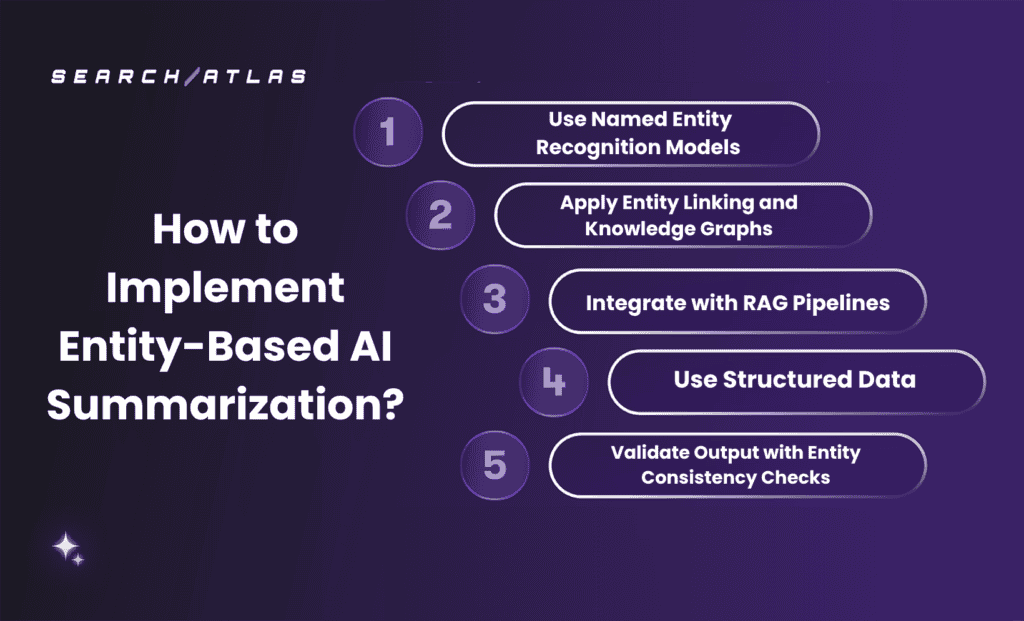
Entity-based AI summarization is implemented by structuring the summarization pipeline around entity detection, entity resolution, entity grounding, and entity validation. Entity-based summarization preserves the people, organizations, dates, products, and relationships that carry factual meaning. This implementation matters because stronger entity control improves accuracy, reduces hallucinations, and makes summaries more reliable across complex or multi-document inputs.
The 5 methods to implement entity-based AI summarization are listed below.
1. Use Named Entity Recognition Models
2. Apply Entity Linking and Knowledge Graphs
3. Integrate with RAG Pipelines
4. Use Structured Data
5. Validate Output with Entity Consistency Checks
1. Use Named Entity Recognition Models
Named Entity Recognition models identify and classify the most important entities in a document (people, organizations, products, locations, and dates). This step is important because entity-based AI summarization fails without a clear understanding of what factual elements matter most in the source content. Strong entity recognition improves retrieval and trust by making summaries center on the concepts that carry meaning instead of on generic sentence patterns. Businesses need to apply NER during preprocessing so the system tags key entities before scoring, retrieval, or generation begins. This setup improves prioritization across long documents, messy transcripts, and multi-file inputs. Summaries improve when the system knows exactly which names, dates, brands, and events it must preserve.
2. Apply Entity Linking and Knowledge Graph
Entity linking connects detected entities to unique identities in a knowledge base, while knowledge graphs map how those entities relate to one another. This step is important because many entities are ambiguous, and summarization quality drops fast when a system confuses one person, company, or concept with another. Entity linking improves trust and retrieval by turning mentions into verified concepts with attributes, categories, and relationships. Businesses need to apply entity linking after NER so each important mention connects to a stable identity, then enrich those identities through internal taxonomies, public databases, or domain-specific knowledge graphs. This process strengthens factual grounding in technical and high-stakes content. Summaries become more accurate when the system knows not just the name, but the exact identity behind the name.
3. Integrate with RAG Pipelines
Retrieval-Augmented Generation (RAG) retrieves relevant source material before summary generation, which grounds the output in real evidence instead of model memory alone. This step is important because entity-based summarization depends on precise source alignment, especially in long, complex, or changing content. RAG improves retrieval and trust by pulling the passages, records, and sections tied to the exact entities that matter most in the summary. Businesses need to apply RAG by indexing documents with entity-aware chunking, then retrieving the strongest passages through hybrid search, graph retrieval, or metadata filters before generation starts. This design keeps the final summary tied to verifiable inputs. The best entity-based summaries come from retrieve-then-summarize pipelines, not from generation without grounded evidence.
4. Use Structured Data
Structured data and metadata define entities, attributes, and relationships in machine-readable formats that systems process with greater clarity. This step is important because raw text forces the model to infer too much, while structured signals reduce guesswork and improve factual interpretation. Structured data improves visibility and retrieval by making entity information easier to detect, filter, rank, and reuse across summarization workflows. Businesses need to apply schema markup, metadata, field labels, and entity tags to documents, records, product data, research files, and internal content repositories so the summarization system reads explicit signals instead of only narrative prose. This structure is especially useful in enterprise, legal, financial, and healthcare content. A cleaner structure creates cleaner summaries because machine-readable entities create stronger grounding.
5. Validate Output with Entity Consistency Checks
Entity consistency checks verify that the final summary preserves the same entities, attributes, and relationships that appear in the source material. This step is important because a summary sounds fluent while still changing dates, dropping names, or inventing unsupported connections. Consistency checks improve trust by catching hallucinations, substitutions, omissions, and contradictions before publication or downstream use. Businesses need to apply validation after generation by comparing the summary against the source for entity presence, relationship accuracy, schema compliance, and unsupported additions. This process works especially well in regulated or high-risk workflows where factual precision matters. The summary is not ready just because it reads well. The summary is ready when its entities still match the source.
What Are Common Challenges in AI Summarization Without Entities?
AI summarization without entities breaks because the system compresses text without understanding who, what, where, and how concepts connect. This gap reduces accuracy, removes meaning, and weakens trust in generated summaries. Entity awareness determines whether a summary reflects real information or produces distorted outputs that mislead decisions.
The 5 main challenges in AI summarization without entities are listed below.
1. Hallucinated facts and incorrect details. AI systems generate names, dates, and relationships that do not exist in the source because no entity grounding exists. This failure creates summaries that sound correct but introduce false precision and fabricated information. Businesses relying on these summaries risk incorrect reporting, flawed analysis, and damaged credibility across workflows.
2. Loss of context and meaning. AI systems remove relationships between entities during compression, which breaks the original meaning of the content. This failure matters because meaning depends on how people, actions, and timelines connect. Summaries lose value when they keep sentences but remove the structure that explains why information matters.
3. Ambiguity in key terms. AI systems confuse similar names, labels, and references because they treat terms as generic tokens instead of distinct entities. This confusion leads to mixed identities, unclear references, and misleading summaries. Entity ambiguity reduces clarity in CRM data, legal documents, and technical content where precision defines correctness.
4. Poor summary structure. AI systems produce disorganized summaries because no entity anchors guide how information needs to be grouped and the flow. This issue creates fragmented outputs that jump between ideas without a clear sequence. Poor structure reduces readability and forces readers to reconstruct meaning manually.
5. Missing critical information. AI systems omit key entities, facts, and relationships because they cannot identify which elements carry the most importance. This omission creates summaries that appear complete but remove essential details that affect interpretation and decisions. Missing entities create hidden errors that often go unnoticed until they cause real impact.
What Are the Main Use Cases of AI Summarization with Entities?
Entity-based AI summarization is used in real workflows where summaries preserve people, organizations, timelines, decisions, and relationships across complex content. These use cases matter because entity structure improves accuracy, retrieval, and trust compared to generic summaries that lose context. Businesses rely on entity-based summarization to turn large volumes of unstructured text into structured, actionable insights that systems and teams reuse.
The 8 main use cases of AI summarization with entities are listed below.
1. Contract and Legal Document Analysis. Entity-based AI summarization extracts and organizes key entities (parties, obligations, dates, clauses, and risks) from legal documents. This use case matters because legal accuracy depends on preserving exact relationships between entities, not just general meaning. Entity grounding improves trust by ensuring that summaries reflect the original contract structure without misinterpretation. Businesses apply this method by summarizing contracts, agreements, policies, and compliance documents into structured outputs that highlight obligations, deadlines, and liabilities. Summaries that preserve entities prevent missed clauses, misread timelines, and incorrect legal conclusions.
2. Multi-Document Research and Intelligence Synthesis. Entity-based AI summarization combines entities across multiple documents into one unified narrative that reflects shared concepts and relationships. This use case matters because research workflows depend on connecting facts across sources instead of summarizing each source independently. Entity alignment improves retrieval and visibility by linking the same people, companies, events, and findings across datasets. Businesses apply this method in market research, competitive intelligence, academic reviews, and industry analysis to build consolidated insights from many inputs. This process reduces fragmentation and improves completeness. Research summaries improve when the system connects entities across documents instead of isolating each source.
3. Customer Support and Conversation Summarization. Entity-based AI summarization converts conversations into structured summaries that track customers, issues, products, timelines, and resolutions. This use case matters because support workflows depend on accurate context across interactions, not just condensed text. Entity tracking improves trust and continuity by preserving what happened, who was involved, and what actions were taken. Businesses apply this method in chat logs, call transcripts, and ticket systems to generate summaries that feed CRM records and follow-up actions. This process reduces context loss between interactions and improves response quality. Support summaries become usable when they track entities across conversations, not just summarize sentences.
4. Financial Reporting and Analysis. Entity-based AI summarization extracts financial entities (companies, metrics, revenues, expenses, and time periods) from reports and statements. This use case matters because financial analysis depends on precise numbers and relationships between entities, not general summaries. Entity grounding improves trust by ensuring that metrics remain tied to the correct company, period, and category. Businesses apply this method in earnings reports, investor briefings, and financial statements to produce structured summaries that highlight performance trends and key changes. This process improves decision-making and reduces interpretation errors. Financial summaries require entity precision to remain reliable and actionable.
5. Healthcare and Medical Record Summarization. Entity-based AI summarization organizes patient data around entities (diagnoses, treatments, medications, providers, and timelines). This use case matters because healthcare decisions depend on accurate relationships between symptoms, treatments, and outcomes. Entity structure improves trust by preserving clinical details and reducing misinterpretation across records. Healthcare organizations apply this method to summarize patient histories, clinical notes, and research findings into structured formats that support diagnosis and treatment planning. This process improves clarity across long and fragmented medical records. Medical summaries must preserve entity relationships to avoid critical errors in patient care.
6. Sales and CRM Intelligence Summarization. Entity-based AI summarization extracts entities (accounts, contacts, products, objections, budgets, and timelines) from sales interactions. This use case matters because sales decisions depend on understanding relationships between stakeholders, needs, and deal stages. Entity tracking improves visibility by turning conversations and notes into structured CRM insights that teams reuse. Businesses apply this method to summarize discovery calls, emails, and account research into actionable summaries that guide next steps and strategy. This process improves pipeline clarity and alignment across teams. Sales summaries drive revenue when they preserve entities tied to decisions and deal progression.
7. Content and SEO Research Summarization. Entity-based AI summarization extracts topics, brands, keywords, authors, and relationships from large content datasets. This use case matters because search and AI systems prioritize entity clarity over keyword repetition. Entity structure improves visibility by aligning summaries with how AI systems retrieve and cite information. Businesses apply this method to analyze SERPs, competitor content, and research reports to identify entity gaps and opportunities. This process improves topical authority and content strategy. Content summaries become more useful when they reveal entity relationships, not just repeated phrases.
8. Internal Knowledge Management and Documentation. Entity-based AI summarization organizes internal knowledge around entities (teams, processes, tools, documents, and decisions). This use case matters because organizations struggle with fragmented knowledge stored across multiple systems and formats. Entity structuring improves retrieval by making internal information easier to search, connect, and reuse. Businesses apply this method to summarize documentation, meeting notes, reports, and internal communications into structured knowledge bases. This process improves onboarding, collaboration, and operational clarity. Internal summaries become valuable when they map knowledge around entities that teams recognize and reuse.
What Tools and Systems Use Entity-Based AI Summarization?
Entity-based AI summarization tools extract, connect, and structure entities so summaries preserve meaning, relationships, and factual accuracy across complex content. These systems matter because entity grounding improves retrieval, increases trust, and makes summaries usable across workflows instead of producing generic text compression. Businesses rely on these tools to transform unstructured data into structured, decision-ready outputs.
The 8 best tools and systems that use entity-based AI summarization are Search Atlas, Scholarcy, SciSpace, AssemblyAI, Gong, Harvey AI, Hebbia Matrix, and Microsoft Azure Text Analytics.
1. Search Atlas. Search Atlas applies entity-based AI summarization through semantic analysis, entity coverage, and structured content optimization across the entire SEO workflow. The platform identifies entities, relationships, and topical gaps, then aligns content with how AI systems interpret and retrieve information. Content Genius, Topical Map Generator, and Scholar scoring ensure summaries and content reflect complete entity coverage instead of isolated keywords. This structure improves visibility because AI systems prioritize entity clarity when selecting sources. Businesses apply Search Atlas to analyze, generate, and optimize summaries that strengthen topical authority and AI search presence. Strong entity coverage inside summaries increases the likelihood of being selected and reused in AI-generated answers.
2. Scholarcy. Scholarcy uses entity extraction to break down academic papers into structured summaries that highlight methods, findings, citations, and key concepts. The tool matters because research summarization depends on preserving relationships between studies, variables, and results. Entity-based extraction improves retrieval by organizing complex documents into reusable knowledge blocks. Businesses and researchers apply Scholarcy to convert long PDFs into structured outputs that support faster analysis and comparison. This approach improves comprehension and reduces time spent reviewing dense material.
3. SciSpace. SciSpace provides entity-aware summarization for scientific documents, allowing users to query specific entities (formulas, datasets, or experimental results). This capability matters because technical content requires precise interpretation of relationships between entities. Entity structuring improves trust by ensuring summaries reflect exact research components instead of generalized explanations. Businesses and research teams apply SciSpace to extract insights from academic papers and technical documentation. This method increases accuracy in complex knowledge workflows.
4. AssemblyAI. AssemblyAI performs entity-based summarization on audio and video transcripts by detecting names, organizations, topics, and sensitive information directly from spoken content. This system matters because conversation data contains unstructured, noisy inputs that require strong entity detection to remain usable. Entity extraction improves retrieval by turning transcripts into structured summaries tied to real-world references. Businesses apply AssemblyAI to meetings, calls, and media content to generate summaries that capture key entities and decisions. This process improves usability across communication workflows.
5. Gong. Gong uses entity-based summarization to analyze sales conversations, extracting accounts, contacts, products, objections, and deal signals from calls and meetings. This capability matters because revenue workflows depend on tracking relationships between stakeholders and decisions. Entity tracking improves visibility by converting conversations into structured CRM insights. Businesses apply Gong to summarize calls into actionable intelligence that drives pipeline management and forecasting. This approach strengthens alignment across sales teams.
6. Harvey AI. Harvey AI applies entity-based summarization to legal documents by identifying parties, clauses, obligations, and legal relationships across contracts and case materials. This system matters because legal accuracy depends on preserving exact entity relationships and obligations. Entity grounding improves trust by ensuring summaries reflect real legal structures without distortion. Law firms and enterprises apply Harvey AI to review, summarize, and analyze complex legal documents at scale. This process reduces review time and improves precision.
7. Hebbia Matrix. Hebbia Matrix processes large volumes of documents using entity-aware retrieval and summarization across financial, legal, and research datasets. This system matters because multi-document workflows require connecting entities across thousands of sources. Entity alignment improves retrieval by linking concepts, companies, and metrics across datasets. Businesses apply Hebbia Matrix to analyze large document sets and generate structured summaries that support decision-making. This approach improves scalability in high-volume environments.
8. Microsoft Azure Text Analytics. Microsoft Azure Text Analytics provides entity recognition, linking, and summarization capabilities through APIs that structure text into identifiable entities and relationships. This system matters because enterprise workflows require scalable, programmable summarization tied to structured data. Entity extraction improves integration by enabling summaries that connect directly with databases, dashboards, and applications. Businesses apply Azure Text Analytics to automate document processing, content analysis, and data enrichment across systems. This approach improves consistency and operational efficiency.
Does AI summarization rely more on keywords or entities?
No, AI summarization relies more on entities than keywords because entities define meaning, relationships, and context inside the source content. AI summarization depends on entities because entities represent people, organizations, products, locations, and concepts that carry factual value. Keywords represent surface-level signals, while entities represent structured knowledge that AI systems interpret and reuse.
AI summarization refers to compressing content into shorter outputs while preserving meaning and key information. Entities refer to identifiable concepts with attributes and relationships that define how information connects. These definitions explain why entity-based processing produces more accurate and reliable summaries than keyword-based compression.
How does AI summarization fail when it relies only on keywords? AI summarization fails when it relies only on keywords because keywords ignore relationships between concepts and reduce content to isolated terms. This approach creates summaries that repeat phrases without preserving meaning or factual connections. The result is shallow outputs that miss intent, distort context, and weaken trust.
Why do entities improve AI summarization accuracy? Entities improve AI summarization accuracy because entities anchor information to real-world concepts and relationships. This structure ensures that summaries preserve who did what, where, and why across the content. Entity-based summarization reduces hallucinations and improves consistency because the system tracks verified concepts instead of matching words.
Where do keywords still play a role in AI summarization? Keywords still play a role in retrieval and initial document matching because queries often start as keyword-based inputs. These signals guide the system toward relevant content before deeper processing begins. Entity understanding then takes over to interpret meaning and generate accurate summaries.
Entity-based AI summarization produces stronger results because entities define how information connects, while keywords only signal what appears in the text.
What is the Future of Entity-Based AI Summarization?
The future of entity-based AI summarization is defined by systems that understand, connect, and validate entities before generating summaries. This shift matters because accuracy, retrieval, and trust depend on whether AI systems preserve real-world relationships instead of blindly compressing text. Entity-based summarization moves AI from pattern-based outputs to knowledge-based outputs that reflect structured meaning.
How does Generative AI reshape entity-based summarization? Generative AI reshapes entity-based summarization by requiring a strong entity foundation before any summary is created. AI systems fail when they cannot distinguish whether multiple documents refer to one entity or several distinct entities. This requirement increases the importance of entity resolution because summaries depend on correct identity matching. Organizations face challenges because large portions of data infrastructure lack consistent entity definitions, which limits AI reliability. Entity-based systems improve outcomes because they unify fragmented data into one consistent representation before summarization begins.
What future requirements will define entity-based summarization systems? Future systems require real-time entity resolution, explainable entity matching, and multi-modal entity processing across text, images, and voice. These requirements matter because AI systems operate in dynamic environments where information changes continuously. Real-time resolution ensures summaries reflect current data, while explainability builds trust in how entities are matched and used. Multi-modal processing expands summarization beyond text into richer data formats. Businesses adopt these systems by building unified data layers that standardize entities across all inputs. This foundation improves consistency across workflows and outputs.
What is the current state of entity-based summarization? The current state shows rapid growth in structured data and knowledge graphs, yet many systems still rely on partial or extractive approaches. Large datasets already contain billions of entity relationships, but summarization systems often fail to use them effectively. This gap limits accuracy because summaries ignore available structured knowledge. Entity-based approaches improve this limitation by integrating knowledge graphs and entity layers directly into summarization pipelines. This integration increases factual consistency and completeness.
How will AI summarization evolve in the next phase? AI summarization evolves toward real-time, context-aware, and entity-driven systems that generate insights instead of simple summaries. Future systems analyze sentiment, intent, and long-term patterns across entity interactions. This evolution improves decision-making because summaries explain not only what happened but why it matters. Businesses apply these systems to customer data, operations, and research to generate deeper insights. This shift transforms summarization into a strategic intelligence layer.
What risks will shape the future of AI summarization? Future risks include manipulation of AI outputs, overreliance on automated summaries, and a lack of governance across entity data. These risks matter because AI systems propagate biased or incorrect information at scale. Techniques (prompt injection and hidden influence) create distorted summaries that appear trustworthy. Businesses mitigate these risks by enforcing entity validation, human oversight, and governance frameworks. Strong controls ensure summaries remain accurate and reliable.
The future of entity-based AI summarization favors systems that unify data, validate entities, and generate structured knowledge instead of compressing text. AI systems that understand entities will dominate because entity understanding defines accuracy, trust, and long-term usability.