Brand SERP Protection is the system that controls how a brand appears across brand search results and protects visibility, accuracy, and trust in Google Search. Brand SERP Protection defines how search systems evaluate entity signals, content alignment, and external validation across branded queries. This definition explains how modern brand SERP control depends on consistent entity data and verified authority rather than isolated ranking factors.
Brand SERP Protection matters because search behavior now happens at the moment of validation, where users check brand reputation before making decisions. Search systems interpret brand queries, reviews, and third-party signals to construct a complete view of the brand. Strong brand SERP protection improves visibility and trust because accurate and positive information appears first across brand search results.
Brand SERP Protection creates competitive advantages for brands operating in high-intent search environments. Strong entity signals, controlled assets, and positive reputation indicators increase the ability to control brand SERP coverage across organic listings, profiles, and AI-generated answers. Control of brand SERP influences decisions immediately, where users evaluate credibility and take action without exploring multiple sources.
Brand SERP Protection requires structured data, consistent profiles, and active reputation management that reflect real brand authority across the web. Optimized assets present verified information, aligned messaging, and strong external validation that search systems reuse across results. Brand SERP Protection aligns brand reputation SEO with how search engines and AI systems interpret trust, authority, and relevance, which defines the current evolution of controlling brand search results.
What is Brand SERP Protection?
Brand SERP Protection is the strategy that controls how a brand appears across the Google Search results page for branded queries. Brand SERP Protection defines how visibility, accuracy, and reputation align across branded search results, which include homepage listings, social profiles, and third-party pages. Brand SERP Protection shifts visibility from passive exposure to controlled presence, which changes how brands compete at the exact moment of intent.
Brand SERP Protection governs how search systems interpret branded intent and match it with available brand assets. Search systems use Brand SERP Protection signals to filter results based on authority, consistency, and trust, which determines which assets appear across branded queries. This filtering explains why strong brands dominate their own search results while weak brands lose control to third-party content.
What environments does Brand SERP Protection operate across? Brand SERP Protection operates across branded organic listings, paid ads, AI search, knowledge panels, and review-driven results. These environments generate results by combining entity data, content signals, and engagement metrics to construct a complete brand narrative across search results.
What does Brand SERP Protection optimize in search visibility? Brand SERP Protection optimizes how a brand becomes visible, accurate, and trusted within branded queries. Brand SERP Protection focuses on controlled assets, verified information, and consistent entity signals so search systems prioritize official content over external or misleading sources.
Brand SERP Protection functions as the control system for branded visibility and decision-stage perception. Users search for a brand name and evaluate results instantly, which means Brand SERP Protection determines whether trust builds or erodes at the moment of intent. This control defines Brand SERP Protection because branded search represents the final validation step before action.
Brand SERP Protection emerged as search evolved into the primary evaluation layer for brands. Search behavior shifted toward direct brand queries, which exposed gaps in how brands controlled their presence across search results. This shift explains why Brand SERP Protection became essential as review platforms, directories, and social profiles expanded across the web.
Brand SERP Protection distinguishes itself from general SEO by focusing only on branded queries and immediate perception. Brand SERP Protection differs from Online Reputation Management because it prevents negative exposure instead of reacting after visibility shifts. This distinction defines Brand SERP Protection as a proactive system rather than a reactive process.
Why is Brand SERP Protection Critical for Online Reputation?
Brand SERP Protection is critical for online reputation because it controls how a brand appears, builds trust, and influences decisions at the exact moment of search. Brand SERP Protection defines how perception, credibility, and authority align across branded search results, which determines whether users trust or reject a brand within seconds. Brand SERP Protection shifts reputation from passive exposure to controlled visibility, which changes how brands compete during decision-stage queries.
Brand SERP Protection governs how search systems evaluate brand-related information and present it to users. Search systems use Brand SERP Protection signals to organize results based on consistency, authority, and engagement, which determines which pages dominate branded queries. This evaluation explains why controlled Brand SERPs create strong impressions while unmanaged results introduce doubt and confusion.
What makes Brand SERP Protection critical for shaping perception and decisions? Brand SERP Protection shapes perception because branded search results act as a real-time evaluation layer. Users search a brand name and instantly assess credibility through visible results, which determines whether they proceed or abandon the interaction. This behavior explains why Brand SERP Protection directly impacts conversion outcomes and decision confidence.
Why is protection against negative content critical for online reputation? Brand SERP Protection limits negative content visibility by controlling the first 2 to 3 pages of results. Negative pages struggle to rank if strong, optimized assets occupy primary positions across branded queries. This resistance explains why stable Brand SERPs reduce exposure to harmful content and protect long-term reputation.
What role do credibility and trust play in Brand SERP Protection? Brand SERP Protection builds credibility by presenting consistent and verified information across platforms connected to Google Search. Search systems interpret consistency as a trust signal, which increases visibility for official assets and reduces reliance on third-party sources. This consistency explains why strong Brand SERPs improve trust with both search systems and users.
Brand SERP Protection reinforces trust through visible proof elements (reviews, ratings, and authoritative pages). Users evaluate these elements during branded searches, which shape perception of quality and reliability. This evaluation explains why positive signals increase engagement while negative signals reduce conversion probability.
How does Brand SERP Protection enable professional representation and control? Brand SERP Protection enables control by ensuring that official profiles, websites, and content dominate branded results. Controlled assets present accurate information, which defines how a brand or individual appears across search environments. This control explains why strong Brand SERPs prevent misrepresentation and reduce exposure to misleading content.
Why is strategic management of a digital footprint important in Brand SERP Protection? Brand SERP Protection requires continuous alignment across platforms, profiles, and content tied to the same brand entity. Search systems compare signals across sources, which means inconsistencies weaken authority and clarity. This comparison explains why active monitoring and updates maintain accuracy and prevent outdated or conflicting information.
How does Brand SERP Protection impact rankings and performance? Brand SERP Protection influences rankings through engagement, trust signals, and consistent brand activity. Search systems evaluate interactions (clicks, reviews, and mentions), which affect how branded and non-branded pages rank over time. This influence explains why strong Brand SERPs improve visibility, increase conversions, and strengthen overall search performance.
Brand SERP Protection functions as the foundation for reputation, visibility, and performance across branded search environments. Users rely on branded search results to validate decisions, which means Brand SERP Protection determines how a brand is perceived, trusted, and chosen at the moment of intent.
What Are the Most Important Factors for Brand SERP Control?
Brand SERP control factors are the signals that determine how a brand appears across branded search results in Google Search and AI Searches. These factors matter because branded search depends on accuracy, authority, and consistency rather than broad keyword relevance. Brands rely on Brand SERP control factors to dominate first-page results where users evaluate trust, credibility, and decision readiness.
The 14 core Brand SERP control factors are listed below.
1. Website Ownership and Sitelinks Structure. Website ownership and sitelinks structure are Brand SERP control factors because the official website anchors the entire branded search presence. Google evaluates site structure, internal linking, and schema markup to generate sitelinks that reflect key pages and user intent paths. This structure matters in Brand SERP control because sitelinks expand visibility and guide users toward controlled content, which strengthens authority and reduces reliance on third-party pages.
2. Entity Home Page and Brand Definition. The entity home page and brand definition are Brand SERP control factors because search systems require a clear, factual source that defines the brand entity. A dedicated page explains who the brand is, what the brand does, and how the brand operates across contexts. This definition matters in Brand SERP control because consistent entity descriptions strengthen recognition and reduce ambiguity across search results.
3. Knowledge Panel and Entity Recognition. Knowledge Panel and entity recognition area Brand SERP control factor, because it represents how Google understands and verifies a brand as an entity. The Knowledge Panel aggregates structured information into a unified summary tied to the brand. This recognition matters in Brand SERP control because it validates credibility and reinforces trust through a centralized, authoritative display.
4. Corroboration Across Trusted Sources. Corroboration across trusted sources is a Brand SERP control factor because Google validates brand information through independent references. Consistent data across directories, profiles, and structured databases confirms that all mentions refer to the same entity. This corroboration matters in Brand SERP control because repeated validation increases confidence and reduces conflicting signals across the web.
5. Social Profiles and Engagement Signals. Social profiles and engagement signals are a Brand SERP control factor because search systems evaluate audience interaction to decide which profiles appear. Active engagement, consistent branding, and verified profiles strengthen visibility across branded queries. This engagement matters in Brand SERP control because strong signals push official profiles higher while weak signals allow irrelevant profiles to surface.
6. Video Content and Visual Presence. Video content and visual presence are Brand SERP control factors because Google prioritizes multimedia elements for branded queries. Video results, thumbnails, and channel branding influence how users perceive a brand visually. This presence matters in Brand SERP control because strong visual assets increase engagement and occupy additional space on the results page.
7. Review Signals and Reputation Data. Review signals and reputation data are a Brand SERP control factor because ratings, reviews, and feedback influence trust and decision-making. Search systems display review data directly in results through rich snippets and platform integrations. This data matters in Brand SERP control because positive signals increase credibility while negative signals reduce conversion potential.
8. People Also Ask and Query Coverage. People Also Ask and query coverage is a Brand SERP control factor because it reflects how well a brand answers common user questions. Search systems generate related questions based on entity understanding and audience intent. This coverage matters in Brand SERP control because clear answers allow brands to occupy informational positions tied to branded queries.
9. AI-Generated Summaries and GEO Presence. AI-generated summaries and GEO presence are a Brand SERP control factor because generative systems summarize brand information directly on the results page. These summaries rely on structured, factual, and consistent content across sources. This presence matters in Brand SERP control because inclusion reinforces authority while exclusion signals weak entity clarity.
10. Content Quality and Topical Relevance, Content quality and topical relevance are Brand SERP control factors because search systems evaluate depth, clarity, and alignment with user intent. High-quality content explains brand topics with precision and consistency across pages. This relevance matters in Brand SERP control because topical dominance strengthens authority and improves visibility across both branded and related queries.
11. User Experience and Performance Signals. User experience and performance signals are a Brand SERP control factor because page speed, mobile usability, and navigation affect engagement metrics. Search systems interpret interaction data as indicators of quality and reliability. This performance matters in Brand SERP control because a better experience increases retention and reinforces positive brand perception.
12. Technical SEO and Structured Data. Technical SEO and structured data are a Brand SERP control factor because search systems require clear signals to crawl, index, and interpret content. Schema markup defines entities, relationships, and attributes across pages. This structure matters in Brand SERP control because accurate data enables rich results and strengthens entity understanding.
13. Backlinks and Authority Signals. Backlinks and authority signals are a Brand SERP control factor because external references indicate trust and relevance. High-quality links from authoritative sources reinforce brand credibility across search systems. This authority matters in Brand SERP control because strong signals improve ranking stability and expand visibility across results.
14. Continuous Monitoring and SERP Management. Continuous monitoring and SERP management in the Brand SERP control factors because search results change based on algorithm updates and new content. Active tracking identifies shifts, threats, and opportunities across branded queries. This management matters in Brand SERP control because consistent action maintains dominance and prevents loss of visibility.
Brand SERP Protection Checklist: Step-by-Step Framework
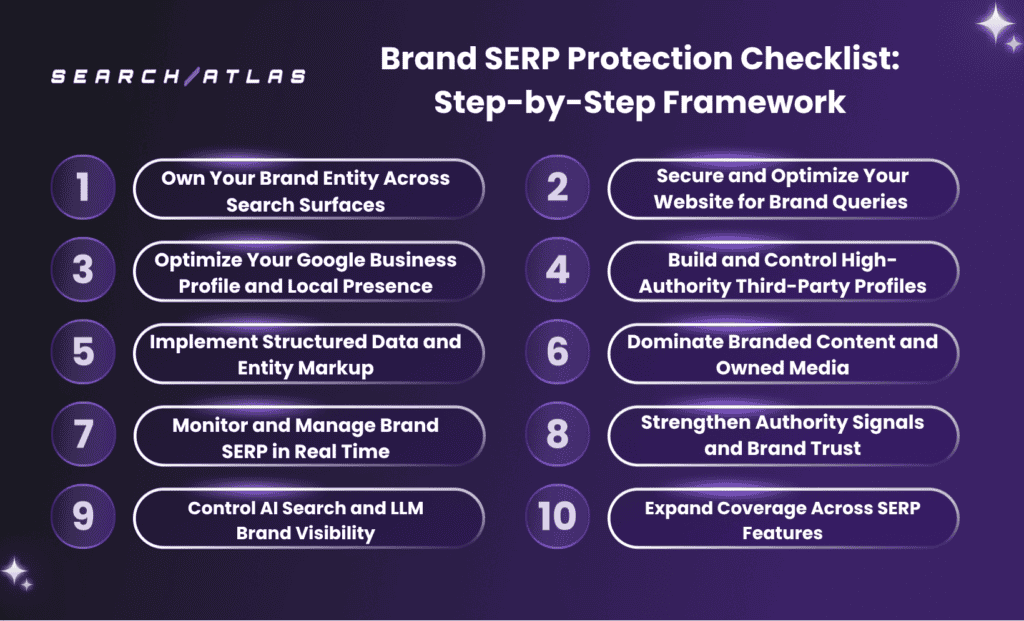
Brand SERP optimization improves visibility by aligning brand assets, entity signals, and trust indicators across every branded search surface. Brand SERP optimization matters because search engines and AI systems evaluate consistency, authority, and corroboration when deciding which brand pages, profiles, and summaries appear first for branded queries.
Strong execution increases owned-result dominance, improves retrieval in branded and AI-driven search, and strengthens trust through accurate, repeated brand signals across websites, profiles, reviews, and structured data.
The 10 ways to optimize Brand SERP control are listed below.
1. Own Your Brand Entity Across Search Surfaces
Owning your brand entity across search surfaces means controlling how search engines and LLMs interpret, connect, and display your brand across the web. This factor matters because brand visibility depends on machine confidence in who the brand is, what the brand does, and which assets belong to the same entity. Strong entity ownership improves Knowledge Panel eligibility, strengthens AI retrieval, and increases trust through repeated, consistent signals across search environments. Businesses apply this by aligning entity details across the website, social profiles, business listings, and structured databases with the same name, description, logo, and official links. Repeated consistency reduces ambiguity and gives Google and AI systems stronger evidence that every reference point is to one verified entity. A practical rule is to treat every profile, page, and citation as part of one entity system rather than separate marketing assets.
2. Secure and Optimize Your Website for Brand Queries
Securing and optimizing your website for brand queries means turning the website into the primary source of truth for branded search visibility. This factor matters because Google and AI systems rely on the website to confirm brand identity, rank official pages, and select trustworthy citations for branded queries. Strong website optimization improves retrieval, stabilizes rankings, and increases trust because the site becomes the clearest source for brand facts and intent matching. Businesses apply this by strengthening the homepage, building a clear About page, and creating branded content hubs that answer brand, product, leadership, and trust-related questions. Internal links need to connect these pages with consistent anchor text and strong semantic relationships. Clear architecture improves interpretation across search systems. A practical rule is to build the site so every important branded query has one obvious, authoritative destination inside the website.
3. Optimize Your Google Business Profile and Local Presence
Optimizing your Google Business Profile (GBP) and local presence means building a complete, accurate, and active local entity across the Google local ecosystem. This factor matters because GBP influences local pack visibility, branded trust signals, and first impressions for branded searches with location intent. Strong profile optimization improves local retrieval and brand credibility because Google uses categories, reviews, photos, attributes, and updates to evaluate legitimacy and relevance. Businesses apply this by selecting precise categories, completing every field, publishing accurate hours, adding services and products, uploading high-quality photos, and responding to reviews consistently. Ongoing updates reinforce activity and trust, while complete attributes improve local understanding. Local presence grows stronger when citations match the exact business details shown in the profile. A practical rule is to treat GBP as a live brand asset that reflects real-world operations at all times.
4. Build and Control High-Authority Third-Party Profiles
Building and controlling high-authority third-party profiles means managing the external platforms that validate brand legitimacy beyond owned properties. This factor matters because branded search often includes a verification layer where users and search systems look for independent confirmation of trust, authority, and relevance. Strong third-party profiles improve SERP dominance and AI trust signals because platforms with established authority reinforce the brand through repeated, credible references. Businesses apply this by creating and optimizing profiles on platforms that shape brand perception, which often include LinkedIn, Crunchbase, and Wikipedia when eligibility exists. Each profile needs aligned naming, messaging, descriptions, logos, and official links so search systems interpret them as part of one entity. Consistent message alignment prevents confusion and strengthens corroboration. A practical rule is to treat every third-party profile as a verification asset that confirms the same brand story across multiple trusted environments.
5. Implement Structured Data and Entity Markup
Implementing structured data and entity markup means giving search engines and AI systems machine-readable signals that define the brand with precision. This factor matters because structured data improves Knowledge Panel understanding, strengthens AI retrieval, and reduces ambiguity in how machines connect brand assets, people, and properties. Strong markup improves visibility and trust because search systems rely on explicit entity definitions instead of guesswork across unstructured content. Businesses apply this by using schema types that define the entity and its relationships, which often include Organization, Person, and SameAs markup tied to official pages and trusted profiles. These relationships clarify ownership, identity, and corroboration across the web. Clean implementation across key pages gives search systems a stable entity framework. A practical rule is to use structured data to connect the website, founder profiles, business listings, and external references into one coherent entity map.
6. Dominate Branded Content and Owned Media
Dominating branded content and owned media means filling branded search results with controlled pages that define the brand narrative directly. This factor matters because Brand SERP control depends on occupying multiple branded positions with accurate, useful, and intent-matched content rather than leaving space for third-party interpretation. Strong branded content improves rankings and AI citation potential because search systems prefer clear, relevant, and repeated content tied to the official entity. Businesses apply this by publishing branded pages that cover the company, leadership, products, pricing, reviews, comparisons, careers, and FAQs in a structured way. Each page needs to target one branded intent variation while maintaining consistent messaging across the site. Query variation coverage expands visibility and reduces reliance on external sources. A practical rule is to build content so every major branded search has an owned page ready to rank, explain, and reinforce the brand position.
7. Monitor and Manage Brand SERP in Real Time
Monitoring and managing Brand SERP in real time means tracking branded search results continuously to detect shifts, threats, and new opportunities. This factor matters because Brand SERPs change as Google updates rankings, third-party pages gain visibility, and AI systems select new sources for summaries or citations. Strong monitoring improves response speed and protects visibility because early detection allows brands to correct issues before negative or irrelevant assets gain traction. Businesses apply this by tracking core branded queries, reviewing results, SERP features, knowledge panels, and AI-generated brand mentions on a consistent schedule. Tools, alerts, and manual reviews reveal ranking changes, profile edits, review spikes, and new competitor pages. Volatility detection matters because even stable Brand SERPs shift fast under pressure. A practical rule is to monitor branded queries weekly and investigate any major movement immediately before a minor issue becomes a visibility problem.
8. Strengthen Authority Signals and Brand Trust
Strengthening authority signals and brand trust means building the proof points that show search systems and AI systems the brand deserves visibility. This factor matters because rankings, citations, and brand selection depend on evidence of trust across the web rather than self-published claims alone. Strong authority signals improve retrieval and AI inclusion because mentions, links, reviews, and consistent engagement reinforce that the brand is credible, recognized, and relevant. Businesses apply this by earning links from trusted sources, building positive review volume, increasing brand mentions, and publishing content that attracts expert references. These signals work together because each external validation strengthens the same brand narrative across multiple surfaces. Repetition from independent sources increases confidence in the entity. A practical rule is to treat every high-quality mention, link, and review as an authority layer that reinforces rankings, trust, and brand stability over time.
9. Control AI Search and LLM Brand Visibility
Controlling AI search and LLM brand visibility means shaping how generative systems retrieve, summarize, and cite the brand in AI-generated answers. This factor matters because zero-click search behavior keeps growing, and brand perception increasingly forms inside AI summaries before users reach a website. Strong AI visibility improves retrieval, citation eligibility, and trust because brands that appear in generated answers gain authority at the earliest decision stage. Businesses apply this by publishing concise definitions, clear entity language, strong corroboration, and structured Q&A-style content that AI systems extract accurately. Content needs factual consistency, trustworthy citations, and stable entity relationships across the web to improve summarization quality. GEO alignment matters because AI systems prefer sources that are clear, verifiable, and easy to reuse. A practical rule is to create content that answers branded questions directly in language that AI systems retrieve without ambiguity.
10. Expand Coverage Across SERP Features
Expanding coverage across SERP features means occupying multiple branded visibility layers beyond the standard organic listing. This factor matters because Brand SERP control improves as the brand captures more page space through features that shape trust and attention before a click occurs. Strong feature coverage improves visibility and perceived authority because sitelinks, knowledge panels, People Also Ask results, review snippets, and image or video elements reinforce the same brand narrative across the page. Businesses apply this by structuring pages clearly, implementing schema, publishing question-based content, and strengthening entity signals that qualify pages for enhanced result formats. Each feature adds another controlled entry point into the Brand SERP. Full-page dominance matters because every owned feature reduces room for competitors or irrelevant sources. A practical rule is to optimize for every branded feature opportunity so the first page reflects one connected and authoritative brand system.
What Are the Most Common Brand SERP Protection Mistakes?
Common Brand SERP Protection mistakes show how brands lose control of branded search results through weak execution, inconsistent signals, and incomplete coverage. These mistakes matter because search systems and AI systems evaluate accuracy, authority, and corroboration, which means weak brand control reduces visibility, trust, and retrieval performance.
The 9 most common Brand SERP Protection mistakes are listed below.
1. Failing to define and control the brand entity. A brand appears across websites, profiles, databases, and citations without a consistent identity system. This mistake creates entity confusion, which weakens Knowledge Panel eligibility, AI retrieval, and branded search trust.
2. Treating the website as a brochure instead of the source of truth. A website lacks strong brand pages, clear entity language, and structured internal paths for branded queries. This mistake reduces ranking strength and makes it harder for search engines to confirm official brand information.
3. Ignoring GBP and local brand signals. A brand leaves the profile incomplete, outdated, or inactive, even though branded searches often trigger local trust checks. This mistake weakens credibility, reduces local pack visibility, and creates gaps in branded search results.
4. Relying on weak or inconsistent third-party profiles. A brand leaves LinkedIn, Crunchbase, directories, or other authority platforms incomplete, inconsistent, or unmanaged. This mistake reduces external validation, which weakens SERP dominance and lowers trust signals for search and AI systems.
5. Skipping structured data and entity markup. A website publishes brand information without a schema that defines the organization, people, and official relationships. This mistake forces search systems to infer meaning without clear machine-readable signals, which reduces entity understanding and rich result opportunities.
6. Publishing thin branded content or leaving branded intents unanswered. A brand has no strong pages for reviews, comparisons, leadership, services, pricing, or brand questions. This mistake leaves space for third-party pages to rank for branded queries that the brand failed to address directly.
7. Neglecting authority signals and external trust proof. A brand has weak backlinks, limited mentions, poor review volume, or no strong off-page validation. This mistake reduces perceived credibility, which lowers ranking stability and makes AI systems less likely to select the brand as a trusted source.
8. Ignoring AI search and SERP feature control. A brand focuses only on ten blue links and ignores AI summaries, People Also Ask, sitelinks, review snippets, and knowledge panels. This mistake reduces search real estate, weakens narrative control, and gives competitors or third-party sources room to shape brand perception.
9. Failing to audit the Brand SERP consistently. A brand notices problems only after negative pages, incorrect profiles, or competitor content gain visibility. This mistake slows response time, which allows small SERP shifts to become larger trust and traffic losses.
These mistakes show that Brand SERP Protection fails through weak control of identity, assets, and trust signals. Strong Brand SERP Protection avoids these patterns by building consistent entity signals, expanding owned visibility, and reinforcing authority across every branded search surface.
How To Audit Your Brand SERP Protection Effectiveness?
Brand SERP audit improves visibility by systematically checking how a brand appears, ranks, and controls first-page results for branded queries. This process matters because search systems and AI systems prioritize accuracy, authority, and consistency, which means structured audits reveal gaps that reduce trust and control. Strong execution increases owned-result dominance, improves retrieval, and strengthens trust across search and AI-driven environments.
Brand SERP audit starts by identifying and searching priority branded queries across different variations of the brand name. Queries include brand name, brand reviews, brand alternatives, and brand plus service modifiers, which reveal how search results shift based on intent. This step improves coverage because it exposes all entry points where users evaluate the brand.
Brand SERP audit continues by capturing the full first page of results in a neutral environment without personalization bias. Search in incognito mode and record all visible elements, which include organic results, paid ads, AI summaries, knowledge panels, and People Also Ask features. This capture improves accuracy because it reflects real search visibility instead of personalized results.
A brand SERP audit requires categorizing every result into owned, third-party, competitor, or unknown sources. Owned results include official website pages and controlled profiles, while third-party results include reviews, directories, and media mentions. This classification improves control because it shows how much of the SERP the brand actually owns versus external sources.
Brand SERP audit evaluates entity consistency and brand accuracy across all visible results. Check naming, descriptions, logos, and messaging across listings, profiles, and pages to ensure alignment. This evaluation improves trust because consistent entity signals strengthen recognition and reduce ambiguity across search systems.
Brand SERP audit measures SERP feature presence and AI-driven visibility across branded queries. Identify features (AI Overviews, knowledge panels, sitelinks) and analyze whether they reflect accurate brand information. This step improves exposure because optimized features increase visibility without requiring clicks.
Brand SERP audit analyzes third-party validation and authority signals that influence rankings and AI selection. Review profiles, mentions, backlinks, and review platforms to confirm alignment and sentiment. This analysis improves credibility because strong external validation reinforces trust across search environments.
Brand SERP audit uses SEO tools to track rankings, SERP features, and competitor overlap across branded queries. The tool for tracking (Search Atlas) provides structured data on visibility, feature ownership, and keyword performance, which improves decision-making through measurable insights.
Brand SERP audit identifies competitor presence and paid overlap across branded results. Analyze ads, comparison pages, and alternative listings that appear for brand queries. This step improves defense because it highlights where competitors capture branded traffic and visibility.
Brand SERP audit tracks changes over time through repeated checks and consistent monitoring schedules. Perform weekly manual reviews and compare results across time periods to detect volatility. This tracking improves response time because early detection prevents loss of control.
Brand SERP audit ends by prioritizing actions based on gaps, risks, and opportunities identified across the SERP. Focus on replacing weak results, strengthening owned assets, and improving entity consistency across platforms. This prioritization improves effectiveness because structured action transforms insights into measurable Brand SERP control.
What metrics indicate strong brand SERP control?
Brand SERP control metrics measure how effectively a brand dominates, aligns, and protects its presence across branded search results and AI-driven environments. These metrics matter because search systems evaluate visibility, authority, and consistency, which means strong metrics indicate stable rankings, accurate representation, and high trust. Brand SERP control improves when metrics show consistent ownership of results, strong engagement signals, and aligned entity data across all surfaces.
Brand SERP control metrics include organic visibility and ranking stability across branded queries. High rankings for brand name and brand modifiers indicate that owned pages dominate the results page, which increases trust and reduces reliance on third-party sources. Strong visibility improves retrieval because search systems consistently surface official assets first.
Brand SERP control metrics include SERP feature ownership across branded results. Features (sitelinks, knowledge panels, People Also Ask, AI Overviews) indicate how much search real estate the brand occupies. Strong feature presence improves exposure because multiple entry points reinforce the same brand narrative directly on the results page.
Brand SERP control metrics include brand mention volume and sentiment across third-party platforms. Positive mentions, high review ratings, and strong sentiment signals indicate external validation of the brand. These signals improve trust because search systems rely on independent confirmation to reinforce credibility.
Brand SERP control metrics include click-through rate and engagement signals from branded queries. High CTR and strong engagement indicate that search results align with user expectations and intent. These signals improve performance because search systems interpret engagement as relevance and authority.
Brand SERP control metrics include entity consistency and Knowledge Panel accuracy across search results. Consistent naming, descriptions, and linked profiles indicate strong entity alignment. This consistency improves trust because search systems confidently connect all assets to one verified brand entity.
Brand SERP control metrics include technical SEO health and crawlability across owned assets. Metrics (indexation rate, crawl errors, Core Web Vitals) indicate whether search systems access and evaluate content effectively. Strong technical health improves visibility because accessible pages rank and appear more consistently.
Brand SERP control metrics include content coverage across branded intents and query variations. Coverage across brand queries, reviews, comparisons, and FAQs indicates how well the brand answers user intent. Strong coverage improves control because owned content replaces third-party pages across multiple query types.
Brand SERP control metrics include authority signals from backlinks, mentions, and external references. High-quality links and frequent mentions indicate strong brand authority across the web. These signals improve ranking stability because search systems associate authority with trust and relevance.
Brand SERP control metrics include AI visibility and citation frequency across generated answers. Presence in AI summaries and citations indicates that content meets retrieval and summarization requirements. Strong AI visibility improves perception because users encounter the brand directly inside generated responses.
Brand SERP control metrics include competitive positioning and SERP share across branded queries. Low competitor presence and high owned-result dominance indicate strong control of the results page. This positioning improves performance because fewer external sources compete for user attention.
Brand SERP control metrics indicate strength when visibility, consistency, authority, and engagement align across every branded search surface. Brands that track these metrics continuously maintain control, adapt to changes, and reinforce trust at every stage of search interaction.
How do you measure visibility across organic, local, and AI search?
Visibility measurement evaluates how a brand appears, ranks, and gets selected across organic results, local listings, and AI-generated answers. This measurement matters because modern search spans multiple surfaces where users interact without clicking, which means visibility depends on presence, coverage, and authority across all environments. Strong measurement improves control because it reveals where the brand dominates, where gaps exist, and how search systems interpret brand signals.
Visibility measurement tracks organic search performance across branded and non-branded queries to evaluate ranking position and result ownership. Rankings, impressions, and click-through rate indicate how often the brand appears and attracts interaction. Strong organic visibility improves retrieval because search systems consistently surface owned pages for high-intent queries.
Visibility measurement tracks local search presence through map results, local pack rankings, and business profile interactions. Metrics (calls, direction requests, review volume) indicate how users act directly from search results without visiting a website. Strong local visibility improves conversion efficiency because users complete actions at the moment of intent.
Visibility measurement tracks AI search presence through inclusion, citation, and prominence across generated answers. AI visibility measurement evaluates how often a brand appears in responses across platforms (ChatGPT, Perplexity, and AI Overviews). Metrics (visibility score, citation rate, share of voice, sentiment) indicate how frequently and how positively the brand appears. A visibility score reflects the percentage of tracked prompts that include the brand, which shows overall presence in AI-generated narratives.
Visibility measurement tracks AI referral traffic to understand how generated answers drive users to a website. Traffic from AI platforms appears in analytics tools and indicates engagement beyond visibility. This measurement improves insight because high-converting visits reveal which prompts and answers influence user action.
Visibility measurement uses SEO tools to track rankings, SERP features, and AI visibility across all search environments. LLM Visibility inside Search Atlas measures brand presence, citations, and share of voice across AI systems, which provides structured tracking of AI search performance. This measurement improves accuracy because it combines organic, local, and AI data into one visibility framework.
Visibility measurement identifies gaps and inconsistencies across search surfaces that reduce control and trust. Missing rankings, weak local signals, or absent AI citations indicate where optimization is required. This identification improves strategy because brands focus on expanding coverage across every search layer.
Visibility measurement indicates strength when a brand appears consistently across organic results, local listings, and AI-generated answers with high coverage and positive sentiment. Brands that measure across all three environments maintain control, increase exposure, and align visibility with how modern search behavior operates.
Do AI Overviews Replace Brand SERPs?
No. AI Overviews do not replace Brand SERPs but reshape how Brand SERPs display, compress, and deliver brand information directly on results pages. This distinction matters because AI Overviews change interaction patterns while Brand SERPs remain the core evaluation layer for branded queries. Brand SERPs still control how users verify identity, trust signals, and intent alignment across search results.
AI Overviews reshape Brand SERPs by summarizing brand information into a single generated response that appears above traditional listings. This placement matters because it reduces reliance on clicks and increases reliance on immediate interpretation of brand data. Visibility shifts toward inclusion in summaries rather than only ranking positions, which changes how brands capture attention and influence perception.
AI Overviews reshape Brand SERPs by increasing competition for limited visibility inside generated answers. AI systems select a small set of sources and synthesize information, which means brands not included lose presence entirely for that query. This selection process matters because Brand SERP control now depends on citation eligibility, entity clarity, and content structure rather than only rankings.
AI Overviews reshape Brand SERPs by reducing traditional website traffic while increasing zero-click exposure. Users receive answers, comparisons, and brand context directly in the overview, which limits on-site engagement but increases exposure at the moment of intent. This shift matters because performance moves from clicks toward visibility, trust, and recall inside search results.
AI Overviews reshape Brand SERPs by expanding into commercial, transactional, and navigational queries beyond informational intent. This expansion matters because branded queries increasingly trigger summaries that influence purchase decisions and brand comparisons. Brand SERPs still anchor identity, but AI layers now interpret and present that identity dynamically.
AI Overviews reshape Brand SERPs by increasing dependence on structured data, consistent entity signals, and authoritative sources. Search systems require clear, verifiable information to generate accurate summaries, which means weak or inconsistent signals reduce inclusion. This dependency matters because Brand SERP optimization now directly influences AI-generated outputs.
AI Overviews do not replace Brand SERPs because branded queries still rely on multiple result types that confirm identity and trust. Results (website listings, profiles, reviews, knowledge panels) provide validation that AI summaries alone cannot replace. This persistence matters because users still scan multiple signals before making decisions.
AI Overviews do not replace Brand SERPs because Brand SERPs define the data layer that AI systems use to generate summaries. AI systems extract, combine, and present information from existing search results, which means Brand SERP strength directly affects AI output quality. This relationship matters because controlling Brand SERPs improves both traditional and AI-driven visibility.
AI Overviews do not replace Brand SERPs because search behavior continues to include verification, comparison, and navigation across multiple results. Users often move beyond summaries to confirm trust, explore details, or validate claims. This behavior matters because Brand SERPs remain the foundation for full brand evaluation.
AI Overviews and Brand SERPs operate together as a combined system where summaries interpret, and Brand SERPs validate. Brands that optimize for both layers increase visibility, control narrative, and maintain trust across evolving search environments.
What is the Future of Brand SERP Protection in AI Search?
The future of Brand SERP Protection in AI search is defined by entity-driven systems that evaluate trust, authority, and consistency before displaying or summarizing brand information. This shift matters because visibility, retrieval, and perception now depend on how accurately AI systems interpret brand entities instead of relying on static rankings. Brand SERP Protection evolves from ranking control to narrative control, where AI systems select, summarize, and present brands based on verified data and contextual relevance.
How does AI reshape Brand SERP Protection? AI reshapes Brand SERP Protection by prioritizing entity clarity, structured data, and multi-source validation over traditional ranking signals. AI systems fail when brand data remains inconsistent across platforms, which creates uncertainty about identity and credibility. This requirement increases the importance of aligned profiles, structured schema, and consistent messaging across all assets. Brands apply this shift by standardizing entity signals, strengthening corroboration, and maintaining accurate data across owned and third-party sources.
What future requirements will define Brand SERP Protection systems? Future Brand SERP Protection systems require real-time data consistency, entity relationship depth, and continuous validation across multiple platforms. These requirements matter because AI systems process and compare data dynamically across sources at scale. Real-time consistency ensures brand information reflects current positioning, while entity relationships strengthen trust through connected data points. Brands adopt these systems by integrating structured data, maintaining profile alignment, and reinforcing authority signals across the web.
What is the current state of Brand SERP Protection? The current state shows a transition from traditional SEO-driven SERPs toward hybrid environments that combine organic results, SERP features, and AI-generated summaries. Many brands still focus on rankings, backlinks, and keywords, but these signals alone no longer secure visibility. This gap limits control because incomplete entity signals reduce AI confidence in selecting and summarizing brand information. Brand SERP Protection improves this limitation by aligning content, entity data, and third-party validation into a unified system.
How will Brand SERP Protection evolve in the next phase? Brand SERP Protection evolves toward AI-mediated discovery, where search results become direct answers instead of lists of links. Future systems interpret intent, compare brands, and recommend a limited set of options based on authority and relevance. This evolution improves efficiency because users receive immediate, summarized brand evaluations without navigating multiple pages. Brands apply this shift by optimizing for AI retrieval, strengthening entity authority, and expanding presence across all searchable platforms.
The future of Brand SERP Protection favors systems that unify entity data, validate authority, and control narrative across both search results and AI-generated answers. AI systems that understand brand relationships, trust signals, and contextual relevance will dominate because Brand SERP control now depends on how machines interpret and present brand information across every search surface.