Search Atlas vs HubSpot Breeze comes down to what each system was built to watch. HubSpot Breeze is a set of AI agents that live inside HubSpot's CRM and act on deal stages, support tickets, and contact records. Search Atlas is an agentic growth engine that watches search rankings, backlinks, technical site health, and AI citations, then fixes what breaks on its own. Both use AI agents that work from a chat interface, but they reason over different data and solve different problems for a marketing team.
What HubSpot Breeze is actually built to do
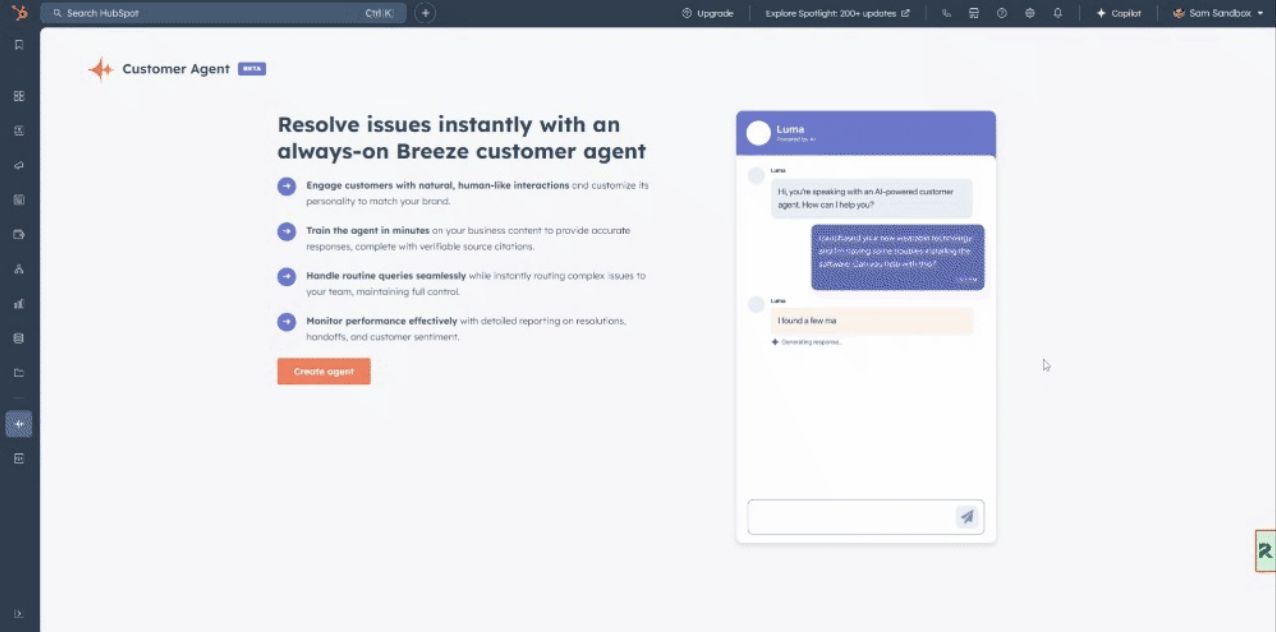
HubSpot Breeze is HubSpot's AI layer, built around three parts: Breeze Assistant, Breeze Agents, and Breeze Intelligence. Breeze Assistant is the conversational copilot embedded across the CRM, drafting emails, summarizing records, and now generating charts or documents in a canvas panel. Breeze Agents are the autonomous workers that complete tasks without a person walking through every step. Breeze Intelligence is the data layer underneath both, enriching contact and company records from a database of more than 200 million profiles.
HubSpot ships seven core Breeze Agents, with more than 20 total available through Breeze Studio once you count narrower, purpose-built variants. The core seven cover Content (drafts blog posts, landing pages, and case studies), Social (writes and schedules social posts), Prospecting (researches leads and personalizes outreach), Customer (resolves support conversations across nine channels including SMS and voice), and Data (enriches and cleans CRM records), plus newer additions rounding out the set.
HubSpot moved its agents to GPT-5 in 2026 and added Audit Cards, a timestamped log of exactly which CRM properties an agent changed and what data drove the decision.
The gap shows up in what Content Agent is not connected to. It drafts a blog post inside HubSpot's CMS, but it has no organic keyword index behind it, no rank tracker watching how that post performs once it is live, and no technical SEO audit layer checking whether the page can actually get crawled and indexed well. The draft is a document, not a piece of content built against live search competition.
What Search Atlas is actually built to do
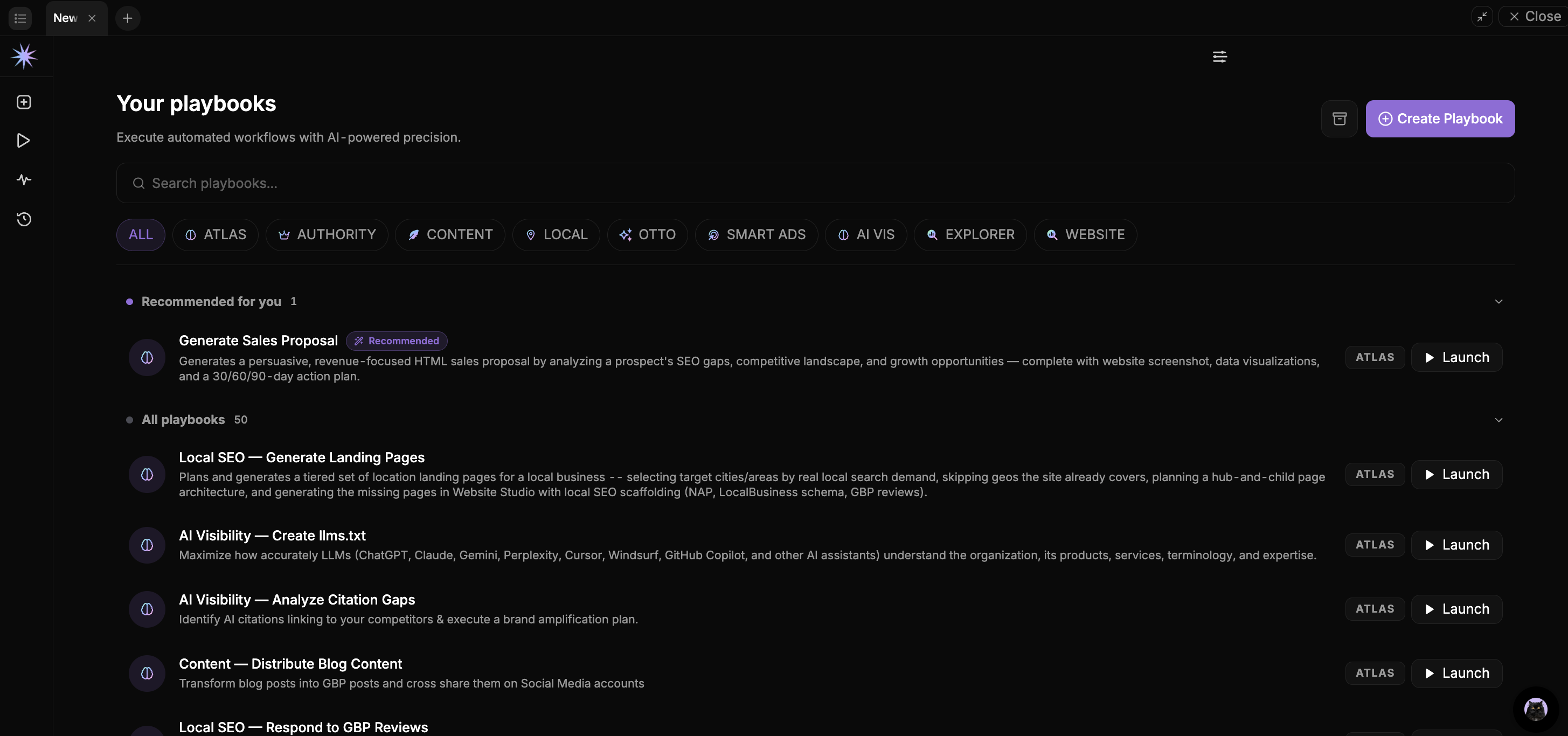
Search Atlas is an agentic marketing platform built around one job: getting a brand found, ranked, and cited everywhere a buyer searches, from Google's organic results to the answer a chatbot gives when someone asks for a recommendation. Where HubSpot Breeze starts from CRM records, Search Atlas starts from live search and AI-answer data, the same territory increasingly described under the AI CMO platform label, and runs the work needed to move it.
OTTO SEO installs as a single JavaScript pixel on any CMS, audits the domain, and deploys fixes to titles, headings, schema, internal links, and technical issues without a developer touching code. It prioritizes what to fix using Google Search Console data, meaning it reacts to actual query performance rather than a generic checklist.
The Search Atlas Coworker is the workspace layer that carries this execution into Slack, Microsoft Teams, and ClickUp. It runs on Atlas Agent, the conversational engine inside the Search Atlas dashboard, and can execute anything Atlas Agent or OTTO SEO can do from inside a chat thread. It also connects to more than 3,000 external tools, including HubSpot itself, so a team already living in HubSpot for sales does not have to abandon that system to add search execution on top.
That execution runs on a five-stage loop: it senses a change on a live surface, detects where that surface has drifted from the brand's current positioning, proposes a fix, waits for a human to approve it, then heals the surface and resumes watching. Nothing ships unseen, but nothing waits for someone to notice the problem first. Search Atlas frames this as multiplayer marketing, a shared system that keeps healing itself instead of a single tool a person has to keep opening.
CRM-native AI vs search-performance-native AI
HubSpot Breeze reasons over CRM data. Search Atlas reasons over search-performance data. Breeze's agents read and write to deal stages, support tickets, contact history, and enrichment records. Search Atlas's agents read and write to SERP positions, backlink profiles, Google Search Console queries, site-crawl results, and AI-citation data. That distinction is also why agentic marketing differs from marketing automation, one plans and adapts on its own, the other only runs pre-set rules.
Neither gap is a flaw in the other product. A CRM-native agent has no reason to know why a page dropped from position 4 to position 11, and a search-performance agent has no reason to know why a deal has stalled in negotiation. Each system was built to be good at a specific job, and the mismatch only becomes a problem when a team expects one to quietly cover the other's territory.
Search Atlas vs HubSpot Breeze at a glance
The fastest way to see the difference is side by side: HubSpot Breeze covers CRM, support, and sales-adjacent content, while Search Atlas covers organic search, technical SEO, and AI-answer visibility.
| Dimension | HubSpot Breeze | Search Atlas | Winner |
|---|---|---|---|
| Category | AI agent layer inside a CRM | Agentic search-performance platform | Depends on the job |
| Core data source | Deal stages, tickets, contact records | SERP data, backlinks, GSC queries, crawl results | Depends on the job |
| Organic SEO | No dedicated rank tracking or technical audit | OTTO SEO audits and deploys live fixes | Search Atlas |
| AI-answer visibility | Free one-time AEO Grader (brand perception only) | Continuous LLM Visibility tracking with citation sources | Search Atlas |
| Content creation | Content Agent drafts from a prompt | Content Genius grades drafts against the live SERP | Search Atlas |
| Workspace | HubSpot interface | Slack, Microsoft Teams, ClickUp via Search Atlas Coworker | Tie |
| Pricing | Outcome-based per agent, full access from roughly $450/month | Flat plans from $99 to $399 a month | Search Atlas |
Content creation: Content Agent vs. Content Genius
Content Agent is HubSpot Breeze's drafting agent, and it writes blog posts, landing pages, and case studies from a prompt in the brand's existing voice. It pulls tone and formatting from content already stored in the CMS, which makes early drafts sound consistent with what a company has already published. What it does not do is check that draft against what is currently ranking for the target query, because Content Agent has no live SERP data to draw from.
Content Genius is Search Atlas's content editor, and it engineers copy by pulling real-time SERP extraction, entity-weighted keyword research, and passage-level scoring into the same draft as it is written. Every output gets a Live Content Score covering keyword placement, heading coverage, and contextual completeness, so a writer sees where a draft is thin against the pages actually ranking before it publishes rather than after.
The difference is what each tool checks a draft against. Content Agent checks a draft against a company's own past content and brand voice. Content Genius checks a draft against the ten or so pages a search engine currently considers the best answer to that query, then scores the gap between them.
Winner: Search Atlas. Content Agent is a useful drafting shortcut, but a draft with no signal for how it stacks up against live search competition still has to clear that bar somewhere before it publishes. Content Genius builds that check into the writing process instead of leaving it for later.
Pricing: what each platform actually charges for
HubSpot Breeze charges per outcome for two of its highest-use agents, on top of a Hub subscription that already runs into the hundreds of dollars a month. As of April 2026, the Customer Agent costs $0.50 per resolved conversation and the Prospecting Agent costs $1 per recommended lead, a change from HubSpot's earlier flat per-seat and per-contact fees.
Full multi-agent access sits inside HubSpot's Professional Hub, which runs from roughly $450 to $800 a month, with Enterprise tiers from $1,500 to $3,600 a month for higher agent volume and more advanced controls.
Search Atlas publishes flat plans instead of per-action metering. The Starter plan runs $99 a month for one OTTO SEO project, 2,000 tracked keywords, and 2 user seats. Growth runs $199 a month with 3,500 tracked keywords and 3 seats, and Pro runs $399 a month with 6,000 tracked keywords, 5 seats, and a full white-label dashboard. Enterprise pricing is custom, and every plan includes a 7-day free trial with full platform access.
The two pricing models are metering different things. HubSpot Breeze's per-action fees track how much CRM and support activity ran through the system in a given month. Search Atlas's flat plans track how many projects, keywords, and seats a team needs to run search execution at its current scale, which makes the monthly bill predictable even as usage inside that scope grows.
Winner: Search Atlas. A flat, published price is easier to budget against than a per-action fee that scales with support and prospecting volume, and Search Atlas's entry plan costs less than a third of HubSpot's Professional Hub before any Breeze Agent usage is even added on top.
The AI-visibility gap most comparisons miss
Answer engine optimization, or AEO, is the practice of structuring a brand's content and data so AI systems like ChatGPT and Perplexity cite it correctly when someone asks a related question. It sits next to traditional SEO rather than replacing it, because ranking on Google and getting cited inside an AI answer are measured differently and often reward different signals.
HubSpot has moved on this front too. Its AEO Grader is a free, one-time brand-perception check across GPT-5.2, Perplexity, and Gemini, scoring sentiment, recognition, share of voice, and market positioning from a single scan. It answers "how do AI models perceive my brand," which is a narrower question than "where is my content actually getting cited."
Search Atlas's LLM Visibility module answers the second question on an ongoing basis. It monitors a domain, brand, or topic across ChatGPT, Claude, Gemini, and Perplexity, and returns visibility percentages, sentiment evaluations, citation sources, and competitor benchmarks that update as the AI-answer landscape shifts.
That distinction matters because the landscape moves fast. Recent citation research covering hundreds of millions of AI responses found that Perplexity averages roughly 21.9 citations per response against ChatGPT's 10.4, and that only about 11 percent of domains get cited by both engines. A one-time brand check cannot follow a gap that shifts week to week, which is the reason a continuous answer-engine optimization workflow exists as a discipline of its own.
Winner: Search Atlas. A single scan is useful as a baseline, but citation sources shift week to week, and only a monitoring system built to run continuously can catch a gap while it is still cheap to fix.
Where HubSpot Breeze actually makes sense
HubSpot Breeze fits a team that already runs its sales and support motion inside HubSpot and wants that motion to move faster. A sales rep who needs a follow-up email drafted in seconds, a support lead who wants routine tickets resolved without a human touching every one, or an ops person who wants CRM records enriched automatically all get real value from Breeze because the work they need done already lives in HubSpot's data.
The tradeoff shows up the moment the job moves outside the CRM. A Content Agent draft still needs someone (or another system) to check it against what is actually ranking, and a Prospecting Agent recommendation still depends on the accuracy of the enrichment data feeding it. Breeze is strongest exactly where HubSpot already holds the source data, and weaker anywhere that data does not reach.
Where Search Atlas actually makes sense
Search Atlas fits a team that wants to grow or protect its visibility in organic search and AI answers without adding headcount to watch it manually. A marketing lead sees a Slack message flagging a keyword that just dropped out of the top 10, along with the fix Search Atlas already proposed. A content team sees a landing page rewritten to match a competitor's stronger schema markup, queued for approval before it ships.
Teams that already run HubSpot for sales do not need to give it up. Because Search Atlas Coworker connects to HubSpot as a data source, a team can keep HubSpot as its system of record for deals and support while adding search execution on top of it rather than replacing anything. The two systems end up covering different halves of the funnel instead of competing for the same job.
Can Search Atlas and HubSpot Breeze work together?
Yes, and for a lot of marketing teams that pairing is the more realistic outcome than choosing one over the other. A team can run HubSpot Breeze for CRM enrichment, support resolution, and sales outreach, while Search Atlas runs technical SEO fixes, content optimization against live SERPs, and AI-citation monitoring in parallel.
The connection runs through Search Atlas Coworker's native HubSpot integration, which pulls contact counts, segment data, and campaign performance into a chat thread without switching tools, the same stacking pattern covered in building an AI marketing stack. The pairing only breaks down when a team tries to make one product cover the other's job, asking Breeze to track rankings it has no data for, or asking Search Atlas to manage a sales pipeline it was never built to read.
Frequently asked questions
Does HubSpot Breeze include SEO tools?
HubSpot Breeze does not include a dedicated rank tracker or a technical SEO audit layer. Its assistants can suggest on-page changes like meta descriptions inside a page a team is already editing, but nothing in Breeze monitors live keyword positions, crawls a site for technical issues, or deploys fixes without a person making the edit. OTTO SEO fills that exact gap, auditing a domain and deploying live technical fixes without a developer, for a team that wants to keep HubSpot for its CRM.
Can HubSpot Breeze track AI search visibility in ChatGPT or Perplexity?
HubSpot Breeze covers part of this through its free AEO Grader, but the coverage is a one-time snapshot rather than ongoing monitoring. The AEO Grader scores how GPT-5.2, Perplexity, and Gemini currently perceive a brand's sentiment and market position from a single scan. It does not track specific citation sources on a continuing basis or benchmark that visibility against named competitors the way a dedicated AI-visibility module does. Search Atlas's LLM Visibility module is built for that ongoing layer, tracking citation sources and competitor benchmarks as the AI-answer landscape shifts rather than scoring it once.
Is Search Atlas a replacement for HubSpot's CRM?
No, Search Atlas is not built to replace a CRM and does not store deal stages or a sales pipeline. It connects to HubSpot as an external data source through Search Atlas Coworker, pulling contact and campaign data into a chat thread, while the actual CRM system of record stays inside HubSpot.
Which is cheaper, Search Atlas or HubSpot Breeze?
Search Atlas is cheaper for a team that only needs search execution, since its flat plans start at $99 a month against HubSpot's roughly $450 a month for full Breeze Agent access on the Professional Hub. The comparison changes once a team already pays for HubSpot Professional or Enterprise for CRM reasons unrelated to Breeze, because in that case the Breeze agent costs are additive to a bill the team was paying anyway.