An AI CMO for technical SEO continuously monitors a site's technical health, prioritizes the fixes that matter most, executes routine improvements, and keeps teams informed about what changed and why. In Search Atlas, that experience is delivered by the Search Atlas Coworker, powered by Atlas Agent, the execution engine running behind the scenes.
Technical SEO includes the elements that determine how search engines discover, crawl, index, and understand a website, from redirects and structured data to crawl directives and site architecture. While many improvements can be executed autonomously, teams can choose to review changes before deployment when additional oversight is needed. Every completed action is recorded, making it easy to understand what changed and how it affected site performance.
What an AI CMO for technical SEO actually does
An AI CMO for technical SEO continuously monitors website health, prioritizes technical improvements, executes the work, and measures the results without relying on scheduled audits or manual coordination.
Technical SEO has become too dynamic to manage through periodic checklists alone. Rankings change, new pages are published, site updates introduce unexpected issues, and search engines constantly evolve. Keeping up requires continuous execution rather than occasional maintenance.
Search Atlas Coworker brings that approach to life together with Atlas Agent, which continuously identify technical opportunities, execute improvements, and measure their impact over time.
The technical SEO delegation map
An AI CMO for technical SEO relies on a delegation map to balance autonomous execution with team oversight across different types of technical SEO work. Rather than approaching every optimization the same way, it applies the appropriate execution model to each category of work.
The sections below explain the most common technical SEO task types and how they fit into an AI-driven technical SEO workflow.
Schema markup deployment
Schema markup deployment is well suited to autonomous execution after the initial implementation has been reviewed. Once a schema template is validated, applying that same markup to similar pages becomes a repeatable, low-risk workflow.
Schema markup helps search engines understand what a page contains, such as a product, article, recipe, local business, or event. Before a new schema type is deployed broadly, teams should confirm that its properties accurately reflect the visible content on the page and follow Google's structured data guidelines.
After that validation, the same implementation can scale confidently across pages that use the same template, allowing the AI CMO to keep structured data consistent without requiring manual updates for every new page.
Structured data at scale
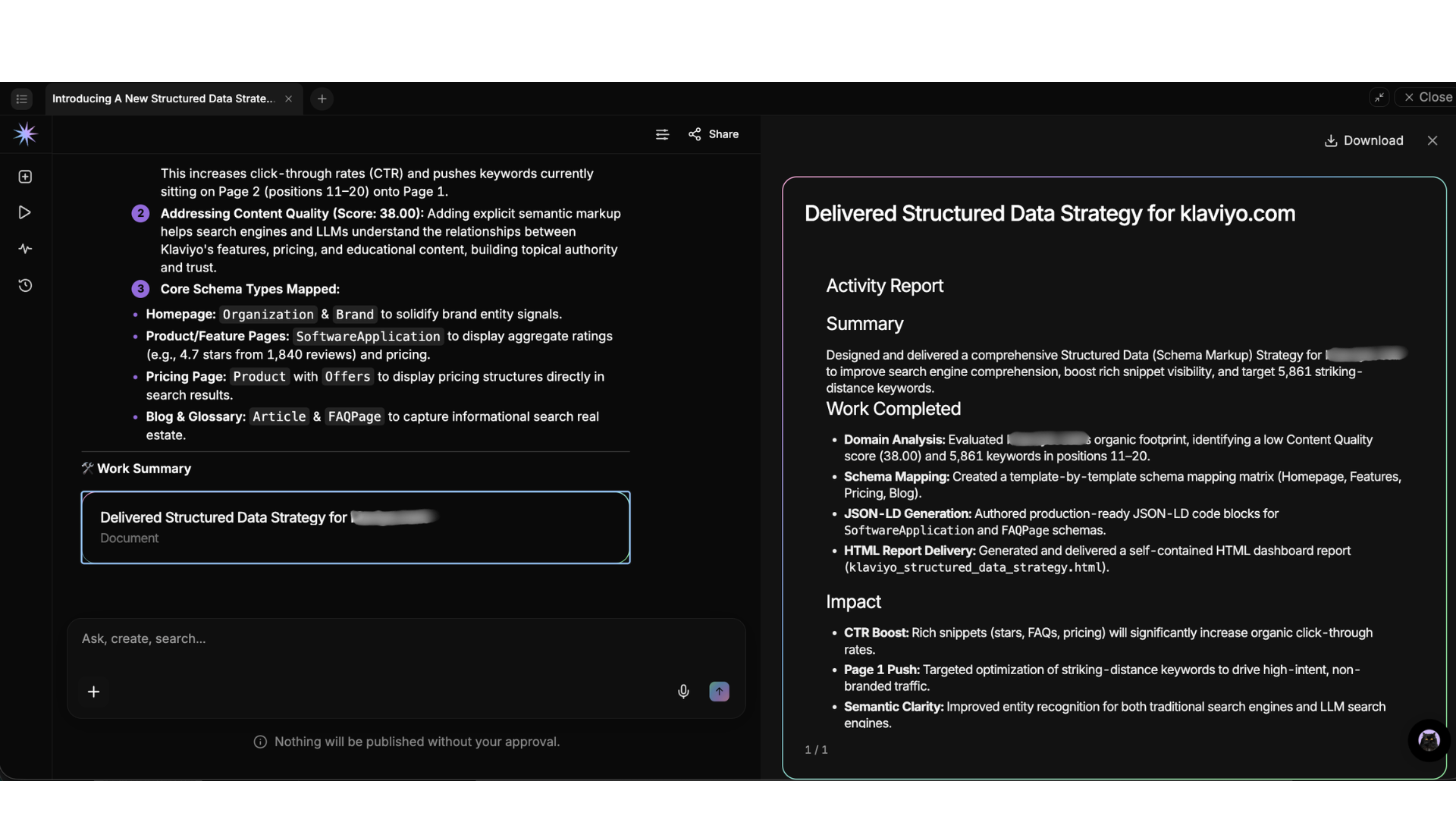
Site-wide structured data changes benefit from review before deployment because they affect multiple page types at the same time. Unlike template-level updates, these changes can influence how an entire website is interpreted by search engines.
Examples include:
- Updating organization or product schema across every page.
- Changing schema properties shared by multiple templates.
- Introducing a new structured data strategy across the site.
Instead of treating structured data as a one-time implementation, Atlas Agent keeps those optimizations moving alongside the rest of the marketing workflow. That continuous execution helps websites maintain rich result eligibility while reducing the operational work required to keep structured data aligned across hundreds or thousands of pages.
Redirect chains and canonicalization
Redirects and canonicalization benefit from controlled execution because they influence how search engines consolidate and index URLs across a website. As websites evolve, these elements help preserve authority, reduce duplicate content, and maintain a clean site architecture.
Typical work includes:
- Creating redirects after URL changes
- Removing redirect chains and loops
- Updating canonical tags
- Consolidating duplicate pages
- Resolving conflicting canonical signals
Unlike page-level optimizations, these changes can affect multiple URLs at once. An AI CMO continuously identifies opportunities to improve site architecture while keeping redirect and canonical management aligned as the website grows.
Robots.txt and crawl directives
Robots.txt and crawl directives require greater oversight because they determine how search engines access and crawl a website. These settings influence how search engines discover content and allocate crawl resources across the site.
Common updates include:
- Adjusting robots.txt rules
- Updating meta robots directives
- Refining crawl paths
- Controlling indexation for specific sections
- Managing crawler access for new site areas
Because these changes can influence entire sections of a website, they are typically handled with more oversight than routine technical SEO tasks. Even so, they remain part of the same continuous optimization cycle, with the AI CMO monitoring crawl health and identifying new opportunities as the site evolves. Furthermore, as search shifts toward generative answer engines, understanding how LLMs are trained on web corpora informs modern crawl permissions. Aligning technical accessibility with structured entity data enables brands to get cited by AI models across ChatGPT Search, Perplexity, and Google AI Overviews.
Core Web Vitals fixes
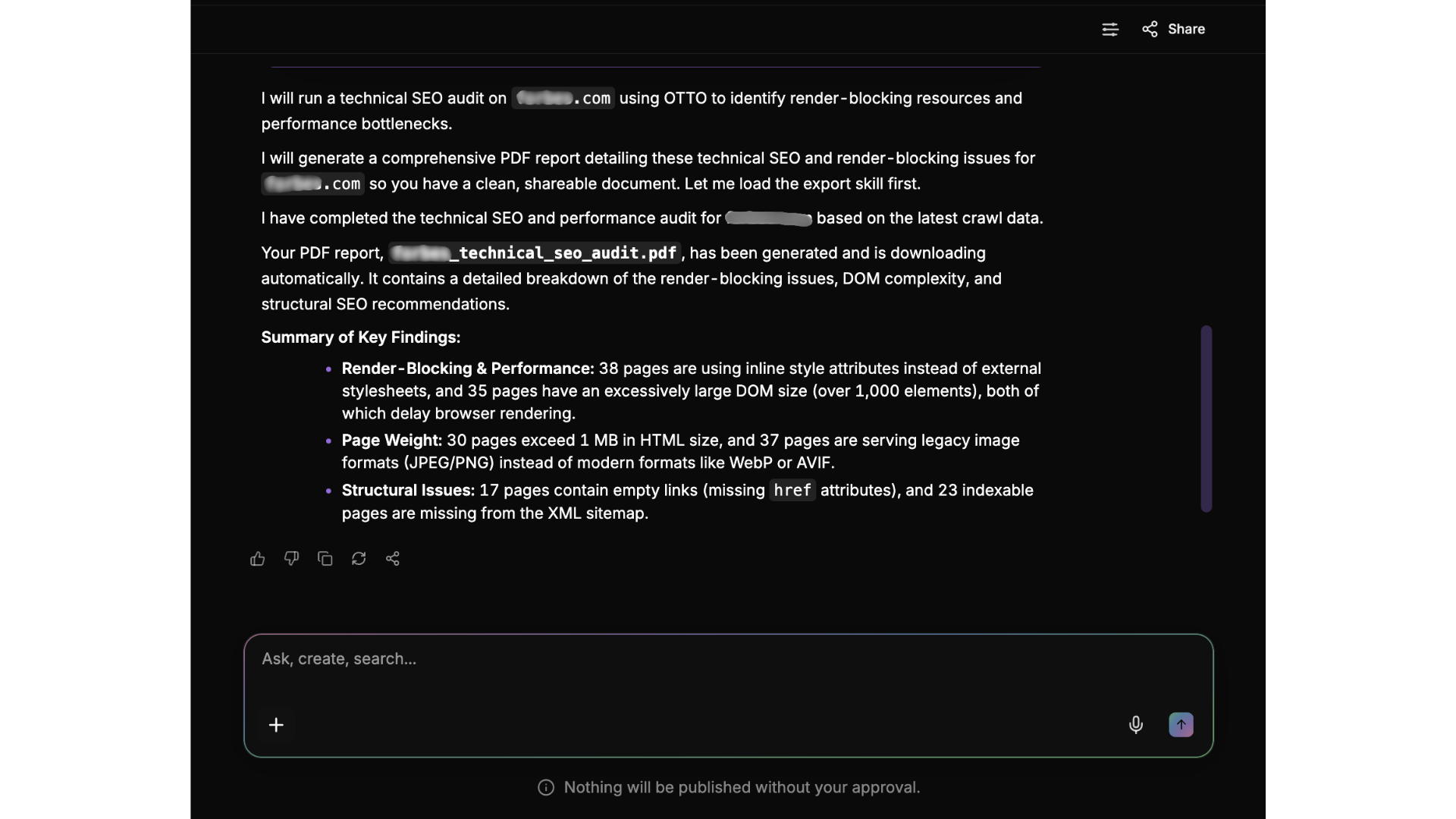
Core Web Vitals improvements combine routine optimizations with broader performance updates that keep websites fast and responsive. An AI CMO continuously identifies opportunities to improve loading speed, responsiveness, and visual stability as websites evolve.
Typical improvements include:
- Optimizing image delivery
- Improving lazy loading
- Refining font loading
- Reducing layout shifts
- Identifying render-blocking resources
Some improvements affect individual pages, while others involve shared layouts or reusable components across the site. As performance changes over time, the AI CMO continues monitoring Core Web Vitals and prioritizing the next opportunities to improve the user experience and search performance.
Internal linking at scale
Internal linking is well suited to continuous automation because it strengthens site architecture as new content is created. Rather than treating internal links as a one-time optimization, an AI CMO keeps the website connected as it grows.
Common internal linking tasks include:
- Adding links to newly published pages
- Strengthening topical clusters
- Improving orphan page coverage
- Updating anchor text
- Replacing outdated internal links
Because each update affects a limited number of pages, internal linking can be expanded continuously without interrupting the broader website. As new content is published and search demand changes, the AI CMO keeps the internal linking structure aligned with the site's evolving topical authority.
Log-file-driven crawl budget changes
Log file analysis and crawl budget optimization benefit from additional oversight because they influence how search engines discover and revisit content across an entire website.
Log files show exactly how search engine crawlers move through a website, revealing which pages receive the most crawl activity and where crawl resources are underused or wasted. That information helps identify opportunities to improve crawl efficiency, especially on large websites.
Unlike page-level optimizations, crawl budget decisions depend on business priorities as much as technical signals. Improving crawl efficiency is often straightforward, but deciding which sections deserve more crawl attention requires an understanding of the website's broader goals.
That makes crawl budget optimization a technical SEO task where an AI CMO can surface opportunities and support execution while leaving strategic prioritization aligned with business objectives.
JS rendering and indexability fixes
JavaScript rendering and indexability improvements help ensure search engines can discover, render, and index website content correctly. Modern websites often rely on JavaScript to load content, but rendering issues can prevent search engines from seeing the same information users see.
Common improvements include:
- Detecting rendering issues
- Identifying blocked or hidden content
- Improving page indexability
- Resolving rendering inconsistencies
- Monitoring rendering performance over time
Rendering issues often affect shared templates and site architecture rather than individual pages. An AI CMO continuously monitors those signals, identifies opportunities for improvement, and keeps technical SEO aligned as the website evolves.
Site migrations
Site migrations require end-to-end coordination because they affect nearly every part of a website's search performance. Whether moving to a new domain, redesigning a website, changing a CMS, or restructuring URLs, migrations involve hundreds or thousands of interconnected pages that need to move together.
An AI CMO can support the migration by:
- Mapping old URLs to new destinations
- Generating redirect plans
- Comparing page inventories before and after launch
- Detecting missing or broken pages
- Monitoring search performance after the migration
While much of the preparation can be automated, migrations combine technical SEO with business, engineering, and product decisions. That makes them one of the most collaborative workflows in technical SEO rather than a routine optimization.
Hreflang and international SEO
Hreflang helps search engines serve the correct language or regional version of a page to each audience. International websites often contain multiple versions of the same content, making accurate language and regional targeting essential for search visibility and user experience.
An AI CMO can continuously support international SEO by:
- Detecting missing hreflang annotations
- Identifying conflicting language references
- Monitoring regional coverage
- Finding inconsistencies between language versions
- Tracking international search performance
Because hreflang connects multiple versions of the same content across an entire website, even small inconsistencies can affect how search engines match pages to users in different markets. Maintaining those relationships over time becomes an ongoing part of technical SEO rather than a one-time implementation.
Why technical SEO needs different levels of autonomy
Technical SEO needs different levels of autonomy because not every optimization has the same scope or impact. Some improvements affect a single page, while others influence how search engines crawl, index, and understand an entire website.
Applying the same execution model to every technical SEO task creates unnecessary tradeoffs. Requiring oversight for every optimization slows progress, while treating site-wide technical changes like routine updates can introduce avoidable risk.
An AI CMO solves that by matching the execution model to the type of work being performed. Routine optimizations can continue running as part of an ongoing technical SEO workflow, while broader infrastructure changes receive the additional visibility they deserve.
That balance allows technical SEO to operate as a continuous system instead of a series of isolated audits, helping teams spend less time coordinating execution and more time improving search performance.
Where Atlas Agent already runs this today
Atlas Agent already applies this execution model across SEO, content, paid media, authority building, local SEO, and AI search inside Search Atlas. Instead of stopping at recommendations, it carries out marketing work, measures the results, and keeps the optimization cycle moving.
Teams interact with that execution through the Search Atlas Coworker, which brings completed work, new priorities, and ongoing updates into Slack, Microsoft Teams, and ClickUp. Rather than checking multiple dashboards throughout the day, marketers can collaborate with their AI CMO from the workspace they already use.
Depending on how a workspace is configured, teams can review work before it is deployed or allow routine execution to run autonomously. Every completed action is recorded, making it easy to understand what changed, when it happened, and how it affected performance.
Together, Atlas Agent and the Search Atlas Coworker turn technical SEO from a series of manual projects into a continuous workflow that keeps improving as websites, search engines, and customer demand evolve.
Keeping an audit trail: what a CMO actually reviews weekly
A working delegation model needs a change log a CMO can scan in minutes, not a raw activity feed that requires digging to find what matters. The weekly review for technical SEO delegation should cover four things: what deployed autonomously this week and on which task types, what sat in the review queue and how long it waited, what got rejected or rolled back and why, and whether any task type's rejection rate has climbed enough to tighten its gate back up.
That last point matters more than teams initially expect. A task type earning autopilot status isn't a permanent grant. If a site redesign changes how templates are built, or a new content type gets added that the schema logic hasn't seen before, the conditions that made a task type safe to automate can shift.
The review cadence exists to catch that shift before a task type that used to be low-risk starts behaving like a high-risk one. That's a different failure mode from getting the initial delegation call wrong, it's drifting out of the conditions that made the original call correct.
AI CMO for technical SEO FAQ
Can an AI CMO run technical SEO on its own? An AI CMO can run many technical SEO workflows autonomously, but not every technical task should follow the same execution model. Routine optimizations can run continuously, while broader infrastructure changes often benefit from additional oversight because they affect larger parts of a website.
What technical SEO tasks are best suited for autonomous execution? Tasks with a limited scope and repeatable implementation are generally the best candidates for autonomous execution. Examples include internal linking, schema deployment across validated templates, metadata improvements, and other recurring optimizations that keep websites healthy as they grow.
Why do some technical SEO tasks require more oversight? Some technical SEO changes influence shared templates, site architecture, or how search engines crawl and index an entire website. Because those updates can affect many pages at once, teams often prefer greater visibility before they are deployed.
How does technical SEO fit into the broader AI CMO role? Technical SEO is one part of a much broader marketing workflow. An AI CMO also runs content optimization, authority building, paid media, AI search visibility, local SEO, and ongoing website improvements, allowing teams to execute marketing across every channel from a single system.