LLM training is a multi-stage process that teaches a large language model to understand patterns, acquire knowledge, follow instructions, and generate responses. The process moves through pre-training, supervised fine-tuning, and reinforcement learning from human feedback, with each stage producing a different capability. This progression transforms a neural network from a collection of random parameters into a model capable of answering questions, generating content, and performing complex language tasks.
LLM training matters because training data, training methods, and alignment processes determine what a model knows and how it behaves. Models learn facts, relationships, reasoning patterns, and response preferences during training, which influence every output generated after deployment. These decisions shape response quality, factual accuracy, instruction following behavior, and overall usefulness.
LLM training affects AI search visibility because training processes influence which sources, entities, and facts appear in generated answers. Models develop stronger representations for information that appears frequently and consistently during training, which increases the likelihood that certain topics, brands, and sources appear in responses. This influence connects model training directly to citation behavior and AI search visibility.
LLM training requires multiple stages because no single training method produces both knowledge and alignment. Pre-training develops language understanding and factual knowledge, supervised fine-tuning develops instruction following behavior, and reinforcement learning develops response preferences. The combination of these stages creates models that are knowledgeable, responsive, and aligned with human expectations.
What Is LLM Training?
LLM training is the process of teaching a large language model to understand patterns in language and generate text through repeated exposure to massive datasets. LLM training begins with random parameters and improves prediction accuracy through billions of training iterations. The process transforms raw data into a model that generates coherent responses, follows instructions, and performs language tasks across domains.
What does LLM training produce? LLM training produces a sequence of increasingly capable model artifacts rather than a single final system. Each training stage creates a different model with distinct behaviors and deployment purposes. The progression typically moves from a base model to an instruction-following model and then to a preference-aligned model optimized for real-world interactions.
How does LLM training create language capability? LLM training creates language capability through continuous prediction and correction. The model processes text, predicts missing or next tokens, measures prediction errors, and adjusts internal parameters after each learning step. These adjustments accumulate across billions of examples, which enables the model to recognize concepts, relationships, facts, reasoning patterns, and language structures.
Why Is LLM Training Important?
LLM training is important because it determines what information a model learns, how accurately it generates responses, and which sources influence its outputs. Training decisions shape factual knowledge, reasoning ability, instruction following behavior, and response quality. Large Language Model (LLM) training teaches a neural network to recognize language patterns, understand context, and generate coherent responses. The quality of training directly affects the quality, reliability, and usefulness of every answer the model generates.
The 5 main reasons LLM training is important are listed below.
1. Determines the knowledge available to the model. LLM training determines the knowledge available to the model by exposing it to large datasets containing facts, concepts, language patterns, and relationships. The model learns statistical representations of this information during training, which creates its knowledge base. This knowledge base influences every response the model generates after deployment.
2. Shapes reasoning and problem-solving ability. LLM training shapes reasoning and problem-solving ability through repeated exposure to examples, patterns, and logical relationships. Training data teaches the model how information connects across different contexts and domains. These connections influence how effectively the model analyzes questions and generates useful responses.
3. Controls instruction following behavior. LLM training controls instruction following behavior through supervised fine-tuning and alignment processes. Training examples teach the model how to respond to prompts, follow directions, and maintain conversational context. This behavior determines whether the model produces relevant and accurate outputs.
4. Influences response accuracy and reliability. LLM training influences response accuracy and reliability because training quality affects output quality. High-quality datasets produce stronger factual performance and greater consistency across tasks. Low-quality datasets introduce errors, inconsistencies, and knowledge gaps that reduce response quality.
5. Defines AI search visibility and citation potential. LLM training defines AI search visibility and AI citation potential because training data influences which entities, facts, and sources become part of the model’s knowledge. Information included during training gains a greater chance of appearing in generated responses. This influence affects brand visibility, source recognition, and citation frequency across AI systems.
What Are the Stages of Training a Large Language Model?
The stages of training an LLM are pre-training, supervised fine-tuning (SFT), and reinforcement learning from human feedback (RLHF). Each stage performs a different function during model development. Each stage builds on the output of the previous stage and uses different datasets, objectives, and optimization methods. Together, these stages transform a neural network from a random statistical system into an instruction-following language model.
The 3 main stages of training a large language model are listed below.
- Pre-training on Unlabeled Data.
- Supervised Fine Tuning (SFT).
- Reinforcement Learning from Human Feedback (RLHF).
1. Pre-training on Unlabeled Data
Pre-training is the first stage of LLM training because it teaches the model the statistical structure of language. Pre-training exposes the model to massive amounts of unlabeled text and trains it to predict the next token in a sequence. This process allows the model to learn grammar, facts, concepts, and relationships from the training corpus.
How does pre-training teach a model a language? Pre-training teaches a model a language through next token prediction. The model receives a sequence of tokens and predicts the most likely token that follows. Prediction errors generate a training signal that updates model parameters through gradient descent. These updates gradually improve the model’s ability to represent language patterns.
What data does pre-training use? Pre-training uses large-scale unlabeled datasets collected from books, websites, articles, research papers, and other text sources. Modern foundation models process trillions of tokens during this stage. Larger datasets expose the model to more concepts, facts, and linguistic patterns.
What is the output of pre-training? The output of pre-training is a base model. A base model possesses extensive knowledge about language and factual relationships but lacks instruction following behavior. This limitation means the model generates text effectively but does not consistently produce useful responses for real-world tasks.
2. Supervised Fine Tuning (SFT)
Supervised fine-tuning is the second stage of LLM training because it teaches the model how to respond to instructions. Supervised fine-tuning trains the base model on curated prompt and response pairs that demonstrate desired behavior. This training transforms a base model into an instruction-following model.
How does supervised fine-tuning work? Supervised fine-tuning works by presenting the model with examples that contain both instructions and ideal responses. The model learns to imitate these responses through continued optimization. This learning process establishes the instruction response structure expected by end users.
Why is dataset quality important during SFT? Dataset quality determines how effectively the model follows instructions. High-quality datasets contain accurate responses, diverse tasks, and consistent formatting. Poor-quality datasets introduce unreliable behaviors that reduce model performance.
What is the output of supervised fine-tuning? The output of supervised fine-tuning is an instruction model. An instruct model follows prompts more effectively than a base model and produces responses that align with expected formats. This alignment improves usability but does not fully calibrate response preferences.
3. Reinforcement Learning from Human Feedback (RLHF)
Reinforcement learning from human feedback is the third stage of LLM training because it aligns model outputs with human preferences. RLHF uses human evaluations to teach the model which responses people prefer. This process improves helpfulness, safety, and response quality.
How does RLHF use human feedback? RLHF uses human feedback by collecting rankings for multiple model responses. Human evaluators compare outputs and identify preferred answers. These preferences create training data that guides future model behavior.
What role does the reward model play in RLHF? The reward model predicts which responses humans prefer. The reward model learns from human rankings and assigns scores to generated outputs. These scores provide the optimization target used during alignment training.
What is the output of RLHF? The output of RLHF is an aligned language model. An aligned language model produces responses that better match human expectations for quality, usefulness, and safety. This alignment often creates greater improvements in user preference than increasing model size alone.
What Is the Difference Between Pre-Training and Fine-Tuning?
The difference between pre-training and fine-tuning lies in their purpose, scale, data requirements, and outcomes during LLM development. Pre-training builds general language understanding and factual knowledge from large-scale datasets, while fine-tuning adapts a pre-trained model to specific behaviors, tasks, or domains. This distinction determines whether a model acquires foundational knowledge or learns how to apply that knowledge effectively.
Pre-training establishes the model’s understanding of language, facts, and relationships through exposure to trillions of tokens. Fine-tuning modifies the behavior of an existing model through smaller, curated datasets that demonstrate desired outputs. This contrast explains why pre-training creates knowledge while fine-tuning shapes behavior.
The core differences between pre-training and fine-tuning are below.
| Aspect | Pre Training | Fine Tuning |
| Purpose | Builds general language and factual knowledge. | Adapts model behavior for specific tasks or objectives. |
| Primary goal | Learn language patterns and world knowledge. | Learn preferred responses and task-specific behavior. |
| Starting point | Begins with randomly initialized model weights. | Begins with an existing pre-trained model. |
| Training data | Uses trillions of tokens from raw text datasets. | Uses thousands to millions of curated examples. |
| Dataset structure | Relies on unlabeled text. | Relies on labeled instruction and response data. |
| Compute requirements | Requires massive computational resources. | Requires substantially less computation. |
| Knowledge acquisition | Acquires new factual knowledge and language understanding. | Refines existing capabilities and behaviors. |
| Model output | Produces a base model. | Produces an instruction following or a domain-adapted model. |
| Training duration | Often requires weeks or months of training. | Often requires hours or days of training. |
| Business outcome | Establishes model intelligence and capabilities. | Improves usefulness, alignment, and task performance. |
What does pre-training do in LLM development? Pre-training teaches a model language patterns, factual relationships, and contextual understanding through large-scale text exposure. This training creates the foundational knowledge the model uses during inference. This foundation determines what information the model knows and how effectively it understands language.
What does fine-tuning do in LLM development? Fine-tuning teaches a model how to respond according to specific objectives, instructions, or domain requirements. This training adjusts model behavior without rebuilding foundational language knowledge. This adjustment improves task performance, response quality, and instruction adherence.
Why is pre-training required before fine-tuning? Pre-training creates the knowledge base that fine-tuning depends on. Fine-tuning modifies behavior using knowledge that already exists inside the model. This dependency means fine-tuning cannot replace the foundational learning process performed during pre-training.
Can fine-tuning add new factual knowledge? Fine-tuning modifies behavior more effectively than it adds new factual knowledge. Research indicates that fine-tuning on facts outside a model’s existing knowledge range often increases hallucinations instead of improving accuracy. This limitation makes pre-training the primary stage for knowledge acquisition and fine-tuning the primary stage for behavioral alignment.
What Data Is Used to Train LLMs?
LLMs are trained on large datasets that contain text, code, images, audio, video, and human preference data. This data teaches models language patterns, factual relationships, reasoning processes, and response behaviors. The composition of the training dataset directly influences what a model knows, what it does not know, and where it produces errors.
LLMs are trained on large-scale pre-training datasets collected from websites, books, academic papers, reference materials, code repositories, and other public or licensed sources. These datasets contain trillions of tokens that expose the model to language structures, facts, concepts, and relationships. This exposure allows the model to develop broad language understanding and general world knowledge.
LLMs are trained on filtered and processed datasets rather than raw internet content. Training pipelines remove duplicate content, low-quality text, spam, and unsafe material before model training begins. This filtering improves data quality, which improves the accuracy and reliability of model outputs.
LLMs are trained on specialized datasets that strengthen specific capabilities. Mathematics datasets improve reasoning performance, code datasets improve programming ability, and multilingual datasets improve language coverage. This specialization expands model capabilities beyond general language generation.
LLMs are trained on multimodal datasets in modern training pipelines. Multimodal datasets combine text, images, audio, and video within a unified training process. This combination allows models to understand and generate information across multiple content formats instead of text alone.
LLMs are trained on human preference datasets during alignment stages. Human evaluators compare model responses and rank them according to quality, usefulness, and accuracy. These rankings create preference data that shapes which outputs the final model favors during response generation.
LLMs are trained on different datasets during different stages of development. Pre-training relies on massive unlabeled datasets that build language understanding and factual knowledge. Fine-tuning and alignment rely on smaller curated datasets that shape behavior, instruction following, and response preferences. This separation explains why knowledge acquisition and behavioral alignment occur during different training stages.
Why Does LLM Training Matter for AI Search Visibility?
LLM training matters for AI search visibility because training decisions influence what information AI systems retrieve, cite, and prioritize in generated answers. Training data shapes model knowledge, source familiarity, and entity recognition, which directly affects whether brands, topics, and facts appear in AI-generated responses. This relationship makes LLM training a foundational factor in AI search visibility.
How Does Training Data Determine What an LLM Cites?
Training data determines what an LLM cites by shaping the relationships between entities, facts, sources, and concepts during model training. Sources that appear frequently, consistently, and with strong contextual signals create stronger representations inside the model. These representations increase the likelihood that a source, brand, or fact appears in generated responses.
Training data influences citation behavior because LLMs learn patterns from the information present in their training corpus. This learning creates associations between sources and topics, which allows models to reference certain entities more often than others. This influence makes training data a foundational factor in AI visibility and source recognition.
How does training data influence LLM citations? Training data influences LLM citations through repeated exposure to entities, sources, and factual relationships. Models learn which sources frequently appear alongside specific topics, which strengthens those associations over time. This reinforcement increases the probability that those sources appear in generated outputs.
Why do some sources appear more often in LLM responses? Some sources appear more often because they have stronger representation in the training data. Strong representation comes from high content volume, broad distribution, and consistent topical coverage. These characteristics create stronger learned signals that increase source visibility in model outputs.
How do LLMs reference sources without a search index? LLMs reference sources through learned patterns rather than traditional document retrieval. Models generate text based on relationships stored within model parameters, which originate from training data exposure. This process means source references emerge from learned associations instead of real-time indexing systems.
What types of sources create stronger citation signals? Sources create stronger citation signals when they publish high-quality content, maintain consistent terminology, and establish clear entity associations. Strong signals reinforce topic expertise within the training corpus, which increases source recognition during response generation. This recognition improves the likelihood of appearing in AI-generated answers.
How Does RLHF Affect Which Answers Get Surfaced?
RLHF affects which answers get surfaced by teaching a model which responses humans prefer. Human evaluators rank multiple outputs, and those rankings train the model to favor certain response characteristics over others. This process influences which answers appear more frequently in AI-generated responses.
RLHF influences answer selection because the training process rewards outputs that receive stronger human preference signals. These signals shape model behavior after pre-training and supervised fine-tuning, which makes RLHF a major factor in response quality and presentation. This influence determines how a model prioritizes competing answers.
How does RLHF teach a model that answers to prefer? RLHF teaches a model which answers to prefer through human feedback. Human evaluators compare multiple responses and rank them according to quality, usefulness, and accuracy. These rankings create preference signals that guide future model behavior.
What characteristics receive stronger preference signals during RLHF? Stronger preference signals typically favor answers that are clear, specific, organized, and factually grounded. Human evaluators consistently rank these responses above vague, incomplete, or poorly structured alternatives. This preference encourages the model to generate similar responses in future interactions.
Why does RLHF influence which answers appear in AI responses? RLHF influences answer visibility because model optimization shifts output probabilities toward preferred response patterns. Responses that align with learned preference signals become more likely to appear during generation. This shift increases the frequency of answers that match human quality expectations.
What does RLHF mean for content creators and SEO professionals? RLHF means that content structure, clarity, and specificity influence alignment with model preferences. Content that presents information directly, uses strong organization, and communicates factual details mirrors characteristics that human evaluators frequently reward. This alignment increases the likelihood that similar information gets surfaced in AI-generated answers.
How Does LLM Training Work Technically?
LLM training works technically through prediction, error measurement, and parameter updates inside a transformer neural network. This process matters because every capability a language model develops originates from repeated training cycles. Training gradually improves the model’s ability to predict language patterns, relationships, and contextual information.
LLM training works technically through forward passes that generate predictions from input data. A transformer processes tokenized text and calculates the probability of possible next tokens. These predictions create the outputs that the training system evaluates against the correct targets.
LLM training works technically through loss calculation that measures prediction accuracy. The training system compares model predictions against expected outputs and calculates an error score called loss. This score quantifies how far the model’s predictions deviate from the correct answers.
LLM training works technically through backward passes that distribute error signals across the network. Backpropagation calculates how much each parameter contributed to the prediction error and assigns corresponding gradients. These gradients provide the information required for parameter adjustment.
How Do Tokenization and Embeddings Work?
Tokenization and embeddings work by converting text into numerical representations that a language model processes. Tokenization breaks text into smaller units called tokens, while embeddings transform those tokens into dense mathematical vectors. This conversion allows neural networks to analyze language as numerical data instead of raw text.
Tokenization and embeddings form the foundation of LLM training because models cannot process words directly. Training systems first convert text into tokens and then convert tokens into vector representations. This process creates the structured inputs required for transformer architectures.
How does tokenization convert text into tokens? Tokenization converts text into tokens by splitting words, subwords, punctuation, and symbols into smaller units. Most modern LLMs use Byte Pair Encoding (BPE), which builds a vocabulary by merging frequently occurring token pairs. This approach balances vocabulary size with efficient language representation.
Why do modern LLMs use Byte Pair Encoding? Byte Pair Encoding reduces vocabulary complexity while preserving language information. GPT, Llama, Gemma, and Qwen models use BPE-based tokenization because it represents common words efficiently and handles rare terms without creating unknown tokens. This efficiency improves training and inference performance.
How do embeddings transform tokens into vectors? Embeddings transform token IDs into dense numerical vectors through an embedding matrix. Each token receives a high-dimensional representation that captures semantic relationships and contextual meaning. These representations allow the model to identify similarities, differences, and connections between tokens.
How does a model understand token position within a sequence? Models understand token position through positional embeddings added to token vectors. Positional embeddings encode where each token appears within a sequence, which allows the model to distinguish between different word orders. This distinction preserves meaning and sentence structure during processing.
What is the output of tokenization and embeddings? The output of tokenization and embeddings is a sequence of dense vectors that contain both semantic and positional information. Transformer attention layers process these vectors to identify patterns, relationships, and contextual dependencies. This processing enables the model to understand and generate language effectively.
How Does Backpropagation Adjust Model Parameters?
Backpropagation adjusts model parameters by calculating how much each parameter contributes to prediction errors and then updating those parameters to reduce future errors. This process matters because language models improve only when training systems identify mistakes and adjust model weights accordingly. Backpropagation provides the mechanism that enables learning during LLM training.
Backpropagation adjusts model parameters through loss gradients generated after each forward pass. The training system compares predicted outputs against the correct next tokens and calculates a loss value. This loss value measures prediction error, which creates the signals required for parameter updates.
Backpropagation adjusts model parameters by propagating gradients backward through the network. The chain rule of calculus calculates how each parameter influences the final prediction error. These calculations identify both the magnitude and direction of the updates required to improve model performance.
Backpropagation adjusts model parameters through optimization algorithms that apply gradient updates. The Adam optimizer uses gradient information to modify model weights while maintaining adaptive learning rates for individual parameters. This approach improves training stability and accelerates convergence across large neural networks.
Backpropagation adjusts model parameters through teacher forcing during training. The model receives ground truth tokens as context instead of its own generated predictions. This approach produces more stable gradients and reduces the accumulation of prediction errors across long sequences.
Backpropagation adjusts model parameters through billions of repeated updates across the training corpus. Each update reduces error slightly and improves future predictions. This accumulation transforms a randomly initialized neural network into a model capable of understanding and generating language.
What Is a Reward Model and What Does It Do?
A reward model is a neural network that scores LLM responses according to human preferences. This model matters because reinforcement learning from human feedback relies on reward scores to determine which outputs the model favors. Reward models translate human judgments into numerical signals that guide model behavior.
A reward model learns from human preference data collected during the RLHF process. Human evaluators compare multiple responses and rank them according to quality, usefulness, accuracy, or safety. These rankings teach the reward model, which responses receive higher scores and which receive lower scores.
A reward model functions as a proxy for human judgment during alignment training. Human evaluators cannot review every response generated during optimization, so the reward model predicts how humans would likely rank each output. This prediction allows training systems to scale preference learning across millions of examples.
A reward model guides policy optimization by assigning scores to generated responses. Optimization algorithms use these scores as training objectives and adjust model behavior toward higher-scoring outputs. This guidance increases the likelihood that future responses align with human preferences.
A reward model influences which response characteristics become more common over time. Responses that receive higher reward scores appear more frequently during training, while lower-scoring responses become less likely. This influence shapes qualities (clarity, usefulness, factuality, and safety).
A reward model separates evaluation from generation during advanced alignment systems. Some training pipelines use multiple reward models that evaluate different objectives independently. Llama 2, for example, used separate reward models for helpfulness and safety. This separation allows training systems to balance multiple goals without relying on a single evaluation signal.
How to Fine-Tune an LLM on Your Own Data
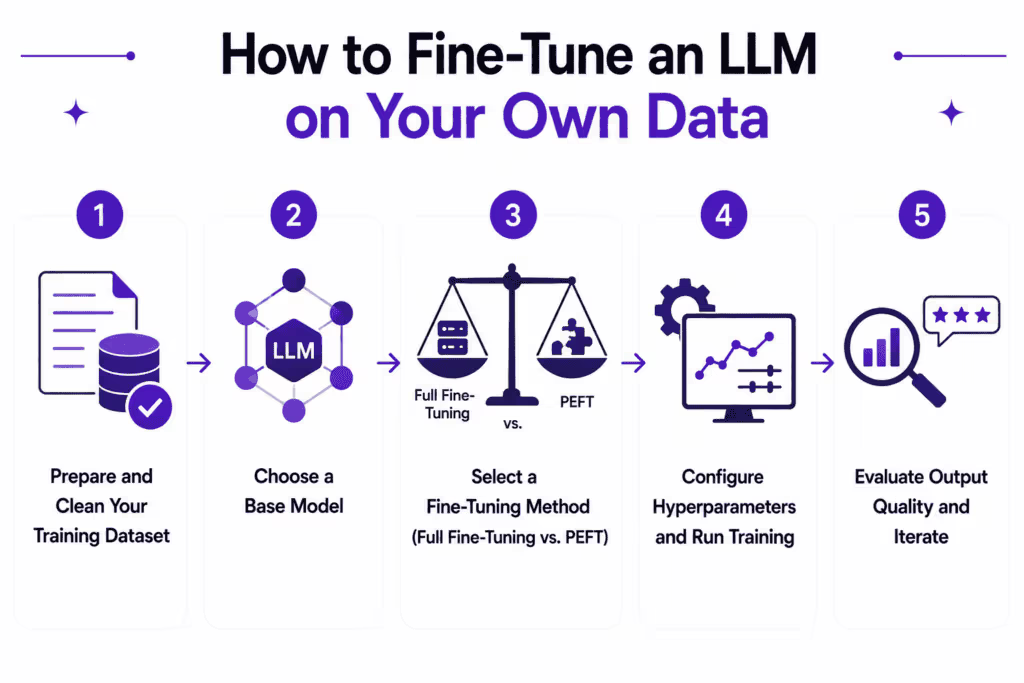
Fine-tuning an LLM on your own data means adapting a pre-trained model to follow specific instructions, perform specialized tasks, or operate within a defined domain. This process matters because fine-tuning improves relevance, response quality, and task performance without requiring full model training from scratch. Effective fine-tuning combines high-quality data, appropriate model selection, efficient training methods, and rigorous evaluation to produce reliable results.
The 5 steps to fine-tune an LLM on your own data are listed below.
1. Prepare and Clean Your Training Dataset
Training dataset preparation means collecting, organizing, and validating examples that represent the behavior you want the model to learn. This step matters because dataset quality influences model quality more than any other factor in the fine-tuning process. High-quality datasets contain accurate, diverse, and consistent examples that reflect real deployment scenarios.
Organizations prepare datasets by removing duplicates, correcting errors, verifying facts, and standardizing formatting. Instruction tuning datasets use prompt and response pairs, while preference optimization datasets use chosen and rejected responses. A practical rule is that 1,000 high-quality examples often outperform 100,000 low-quality examples.
2. Choose a Base Model
Base model selection means identifying a pre-trained model that already performs well on tasks related to your target domain. This step matters because fine-tuning improves existing capabilities rather than creating entirely new ones. Strong base models produce stronger fine-tuned results and require less training effort.
Organizations commonly start with models (Llama, Mistral, or Gemma) because these models provide open access and strong general performance. Smaller models reduce training costs, while larger models often improve output quality. A practical rule is to select a model that already demonstrates competence in tasks adjacent to your use case.
3. Select a Fine-Tuning Method
Fine-tuning method selection means choosing how the model will learn from new data. This step matters because training methods determine resource requirements, training speed, and deployment complexity. Different methods balance performance and efficiency in different ways.
Organizations frequently use Parameter Efficient Fine Tuning (PEFT) methods (LoRA) because these methods train a small number of additional parameters instead of updating the entire model. This approach reduces hardware requirements while maintaining strong performance. A practical rule is to start with LoRA before considering full fine-tuning.
4. Configure Hyperparameters and Run Training
Hyperparameter configuration means defining the settings that control the training process. This step matters because training settings influence convergence, stability, and final model quality. Poor settings reduce performance even when the dataset and model are strong.
Organizations configure learning rates, batch sizes, training epochs, and adapter settings before training begins. Validation monitoring identifies overfitting and prevents unnecessary training cycles. A practical rule is to start with established defaults and adjust one parameter at a time during testing.
5. Evaluate Output Quality and Iterate
Model evaluation means measuring how effectively the fine-tuned model performs on unseen data. This step matters because training metrics alone do not guarantee useful outputs. Evaluation identifies weaknesses that require additional training, data refinement, or parameter adjustments.
Organizations test fine-tuned models against held-out prompts and review responses for accuracy, consistency, instruction adherence, and hallucination rates. Evaluation results guide future improvements and training iterations. A practical rule is to adjust training settings first, review dataset quality second, and retrain only after identifying the root cause of performance issues.
What Can Go Wrong When Training or Fine-Tuning an LLM?
Common problems during LLM training and fine-tuning show how model quality degrades when data, training methods, or optimization processes introduce errors. These problems matter because training mistakes reduce accuracy, reliability, and real-world performance. Poor training decisions create issues that persist after deployment and affect every generated response.
The 7 most common problems during LLM training and fine-tuning are listed below.
1. Catastrophic forgetting. A fine-tuned model loses capabilities learned during pre-training after excessive adaptation to a narrow dataset. This problem reduces performance on general tasks and weakens broad language understanding.
2. Hallucinations. A model generates confident but incorrect information that does not exist in the training data or source material. This problem reduces factual accuracy and increases reliability risks in production environments.
3. Data bias. A training dataset contains systematic imbalances that influence model behavior and outputs. This problem produces skewed responses that reflect dataset limitations rather than objective information.
4. Overfitting. A model memorizes training examples instead of learning general patterns. This problem improves training performance while reducing performance on new or unseen inputs.
5. Low-quality training data. A dataset contains inaccurate, inconsistent, duplicated, or poorly formatted examples. This problem transfers data quality issues directly into model behavior and output quality.
6. Insufficient domain coverage. A dataset fails to represent the full range of inputs encountered after deployment. This problem creates performance gaps when the model receives uncommon, complex, or edge case requests.
7. Training instability. Training settings produce unstable optimization behavior that prevents effective learning. This problem causes poor convergence, inconsistent results, and wasted computational resources.
What Is Catastrophic Forgetting in Fine-Tuning?
Catastrophic forgetting occurs when fine-tuning improves performance on new tasks while reducing performance on tasks learned previously. Catastrophic forgetting matters because models lose valuable capabilities during adaptation, which reduces reliability and consistency across different use cases.
Catastrophic forgetting occurs because gradient updates modify parameters that contain knowledge from earlier training stages. Fine-tuning shifts model weights toward the new training distribution, which weakens representations that previously enabled other capabilities. This shift causes performance declines on tasks that the model handled successfully before adaptation.
Catastrophic forgetting occurs most often during sequential fine-tuning across multiple tasks. A model fine-tuned on task A and then task B often performs worse on task A after the second training cycle. This pattern remains difficult to detect unless evaluation includes both old and new tasks.
Catastrophic forgetting occurs less frequently when training systems preserve knowledge from previous tasks. Elastic Weight Consolidation (EWC) reduces parameter updates for weights that contribute strongly to existing capabilities. This restriction protects important representations and reduces performance loss during adaptation.
Catastrophic forgetting occurs less frequently when training incorporates replay data from earlier tasks. Replay buffers mix historical examples with new training examples, which reinforces previously learned knowledge during optimization. This reinforcement improves retention across multiple training stages.
Catastrophic forgetting occurs less frequently when fine-tuning methods limit parameter changes. LoRA adapts models through lightweight adapter layers while leaving base model weights unchanged. This approach reduces disruption to existing knowledge and preserves performance across previously learned tasks.
What Causes Hallucinations in LLMs and Can Training Fix Them?
Hallucinations occur when an LLM generates information that sounds correct but is factually inaccurate. Hallucinations matter because inaccurate outputs reduce trust, reliability, and usefulness across real-world applications. Training influences hallucination rates, but training alone does not eliminate hallucinations.
Hallucinations occur because pre-training data contains gaps, inconsistencies, or incorrect information. Models learn patterns from their training corpus, which means incomplete or unreliable data creates incomplete or unreliable representations. These representations become a primary source of factual errors during generation.
Hallucinations occur because fine-tuning sometimes pushes models beyond their existing knowledge boundaries. Fine-tuning teaches behavioral patterns effectively, but fine-tuning does not reliably create new factual knowledge. Models often generate confident responses for topics that lack strong knowledge representations, which increases hallucination risk.
Hallucinations occur because reinforcement learning from human feedback rewards qualities beyond factual accuracy. Human evaluators frequently prefer responses that are clear, organized, and confident. These preferences encourage models to produce fluent answers even when factual grounding remains weak.
Hallucinations occur because language models predict likely token sequences rather than verify facts against external sources. Prediction systems generate responses from learned statistical relationships, which means plausible statements sometimes replace accurate statements. This limitation exists even in highly capable models.
Hallucinations decrease when external retrieval systems provide factual grounding during generation. Retrieval Augmented Generation (RAG) supplies information from external documents at inference time instead of relying entirely on model memory. This grounding improves factual accuracy more effectively than post-training alignment methods alone.
How Does Biased Training Data Affect Model Outputs?
Biased training data affects model outputs by transferring imbalances, omissions, and skewed patterns from training datasets into generated responses. Biased training data matters because models learn from the information they receive during training. These learned patterns influence how models represent people, topics, locations, and viewpoints during generation.
Biased training data affects model outputs because frequently represented perspectives create stronger internal representations. Models learn statistical relationships from repeated examples, which makes common patterns more influential than uncommon patterns. This imbalance increases the likelihood that overrepresented viewpoints appear in generated responses.
Biased training data affects model outputs because missing information creates knowledge gaps. Models learn weak representations for topics, communities, or perspectives that appear infrequently in training datasets. These weak representations reduce accuracy and consistency when the model encounters related prompts.
Biased training data affects model outputs because fine-tuning amplifies patterns present in specialized datasets. Narrow datasets concentrate learning on a limited set of examples, which shifts model behavior toward those examples. This shift becomes particularly significant in domains that require consistent judgments across diverse situations.
Biased training data affects model outputs because preference data influences which responses receive positive reinforcement. Human feedback datasets shape model behavior during alignment training, which means biases present in preference rankings influence future outputs. These influences affect response style, framing, and prioritization.
Biased training data affects model outputs unless organizations evaluate datasets before training begins. Dataset audits, source diversity reviews, demographic representation analysis, and adversarial testing identify imbalances before deployment. These practices reduce bias propagation and improve output quality across a broader range of inputs.
Can You Revert a Fine-Tuned Model to Its Base State?
Reverting a fine-tuned model to its base state depends on the fine-tuning method used during training. Fine-tuning methods matter because some approaches modify the original model directly, while others keep the original model unchanged. This difference determines whether reverting remains possible after training.
Reverting a fully fine-tuned model to its base state is generally not possible without access to the original base model checkpoint. Full fine-tuning updates the model’s weights directly, which replaces the parameter values learned during earlier stages. These updates make it impossible to separate pre-training changes from fine-tuning changes after training ends.
Reverting a LoRA fine-tuned model to its base state is straightforward because LoRA keeps the original model weights frozen. LoRA stores task-specific changes inside separate adapter layers rather than modifying the base model itself. Removing the adapter restores the original model state immediately.
Reverting a fine-tuned model is easier with Parameter Efficient Fine Tuning (PEFT) methods because these methods isolate task-specific changes from the base model. Separate adapters remain independent artifacts that organizations store, replace, activate, or remove as needed. This separation improves flexibility and reduces operational risk.
Reverting a fine-tuned model becomes difficult when the original checkpoint is unavailable. Models trained through full fine-tuning require the original checkpoint to recover the pre-training state accurately. Organizations that fail to preserve this checkpoint often need to download the original model again and treat the fine-tuned version as a separate artifact.
Reverting a fine-tuned model illustrates one of the main advantages of PEFT methods. PEFT methods preserve the original model while storing customizations independently. This architecture simplifies experimentation, deployment, and model management across multiple tasks and domains.