Brand mentions are references to a company, product, executive, or brand entity across online content without requiring a hyperlink. The meaning of brand mentions explains how search engines and AI systems recognize, categorize, and associate brands with specific topics, products, and industries. This recognition defines how brand mentions contribute to entity authority, search visibility, and AI citations.
Brand mentions matter because search engines evaluate entities through references, context, and relationships across the web. Systems that process brand mentions analyze authority, topical relevance, sentiment, and consistency, which influence how brands appear in search results and AI-generated answers. This evaluation explains why brand mentions matter for SEO, where entity recognition increasingly complements traditional backlink signals.
Brand mentions create measurable benefits for businesses operating in search and AI-driven environments. Brand mentions strengthen entity authority, increase branded search demand, improve E-E-A-T signals, and expand citation opportunities across AI platforms. Brands that earn consistent mentions across publications, communities, reviews, and industry websites build stronger visibility than brands that rely only on backlinks or owned content.
Brand mention growth requires a structured strategy built around original research, digital PR, community participation, customer advocacy, and industry partnerships. Growth strategies that generate independent references create stronger authority signals than direct promotion alone. The ability to earn, monitor, and expand brand mentions ensures long-term visibility across search engines, AI systems, and emerging discovery platforms.
What Is a Brand Mention?
A brand mention is any reference to a company, product, organization, or person associated with a brand within online content, whether or not a hyperlink exists. Brand mentions connect brands to topics, entities, products, and conversations across the web. Search engines use brand mentions to understand brand relevance, topical associations, and entity relationships. Brand mentions appear in editorial articles, news publications, forums, reviews, podcasts, videos, social media platforms, and community discussions. Brands use brand mentions to strengthen entity recognition and expand visibility across search engines and AI systems.
What forms does a brand mention take? Brand mentions appear across many content formats that search engines and AI systems process. Editorial articles mention brands while discussing industry topics. News publications mention brands while reporting events and announcements. Forums, reviews, podcasts, social media posts, video descriptions, and community discussions mention brands during conversations and recommendations. Each format creates a different level of authority and contextual relevance, but every public reference qualifies as a brand mention.
How does a brand mention differ from a backlink? A brand mention references a brand by name, while a backlink connects two pages through a hyperlink. A backlink transfers measurable authority between domains and remains part of Google’s ranking systems. A brand mention creates an entity association between a brand, a topic, and a context. Search engines use backlinks to evaluate authority transfer. Search engines use brand mentions to evaluate entity relationships, topical relevance, and brand prominence. Both signals influence visibility through different mechanisms.
What makes a brand mention SEO relevant instead of invisible to search engines? A brand mention becomes SEO relevant when it appears inside publicly accessible and indexable content. Search engines process mentions that exist on crawlable URLs and accessible web pages. Search engines ignore mentions hidden behind login walls, private communities, restricted platforms, or non-indexed resources. Context around the mention influences how search engines interpret the signal. Domain authority, topical relevance, surrounding entities, and sentiment shape the meaning of each mention and determine its contribution to entity recognition.
Why do brand mentions matter for search engines and AI search systems? Brand mentions matter because search engines and AI systems use mentions to build entity understanding. Entity understanding connects brands to industries, products, people, and topics. Search engines analyze mention frequency, mention context, and mention quality to evaluate brand prominence. AI systems use the same signals to identify authoritative sources when generating answers. Strong brand mention profiles increase the likelihood that search engines and AI platforms recognize a brand as a trusted entity within its market.
What Counts as an Implied Brand Mention?
An implied brand mention is a reference that search engines associate with a brand even without an exact brand name appearing in the content. Implied brand mentions rely on contextual signals, unique terminology, products, people, or concepts strongly connected to a specific entity. Search engines analyze these signals to identify brands through association rather than direct naming. Implied brand mentions expand entity recognition because entity recognition depends on relationships, not only exact text matches.
What is an implied brand mention? An implied brand mention occurs when content references a brand indirectly through unique identifiers or closely associated terms. A reference to “Domain Power” or “OTTO SEO” creates an entity connection with Search Atlas because those terms belong to the same brand ecosystem. Search engines evaluate terminology, surrounding context, and entity relationships to determine the most likely brand association. This entity association allows brands to earn recognition even when authors omit the company name.
How does Google’s NLP interpret implied mentions? Google’s natural language processing systems analyze meaning, context, and relationships across entire documents. Models (BERT) evaluate how words connect to entities instead of evaluating isolated keywords. A reference surrounded by relevant industry language creates a stronger entity signal than a reference placed inside unrelated content. Context quality, topical relevance, and domain authority influence how Google interprets each association. These factors determine the strength of the entity connection and the confidence of the entity match.
Does the Google “implied links” patent confirm brand mentions as a ranking factor? Google’s implied links patent discusses references to resources without explicit hyperlinks, but the patent does not confirm textual brand mentions as direct ranking factors. The patent focuses on implied references and navigational signals connected to resources. This distinction matters because backlinks remain confirmed authority signals, while brand mentions function through entity understanding and contextual association. Search engines treat these signals differently because each signal contributes to a different part of the ranking and retrieval process.
Why do implied mentions matter if they are not confirmed ranking inputs? Implied mentions matter because implied mentions strengthen entity recognition within Google’s knowledge systems. Knowledge systems connect brands to products, topics, industries, and areas of expertise. Consistent associations across authoritative content create a stronger entity footprint than isolated references. This entity footprint influences how Google understands brand relevance and topical authority. Strong entity understanding increases the likelihood that a brand appears in AI Overviews, knowledge panels, People Also Ask results, and AI-generated answers.
How do implied mentions strengthen topical authority? Implied mentions strengthen topical authority by reinforcing repeated associations between a brand and a specific subject area. Repeated associations create entity consistency across multiple sources. Entity consistency gives search engines stronger evidence about what a brand represents and where it belongs within a topic hierarchy. Brands that appear repeatedly in authoritative conversations build stronger topical authority than brands that rely only on direct links or explicit mentions.
What Are the Different Types of Brand Mentions?
The different types of brand mentions are linked mentions, unlinked mentions, and implied mentions. These mention types define how brands appear across websites, search engines, and AI systems. Brand mentions influence entity recognition, topical associations, and brand visibility. Each mention type contributes a different signal, which affects how search engines and AI platforms understand a brand.
Brand mentions matter because search engines evaluate entities through links, references, and contextual associations. These entity signals strengthen brand recognition, reinforce topical authority, and influence AI-generated answers. Different mention types contribute different levels of authority, relevance, and entity understanding.
The 3 main types of brand mentions are listed below.
1. Linked mentions. Linked mentions create direct connections between a brand reference and a destination URL, which strengthens authority signals. Linked mentions occur when content references a brand and includes a hyperlink to the brand’s website. This connection passes referral traffic, reinforces entity relationships, and contributes to link-based authority evaluation.
2. Unlinked mentions. Unlinked mentions create entity associations without transferring link authority, which strengthens brand recognition signals. Unlinked mentions occur when content references a brand name without a hyperlink. This reference helps search engines connect brands with topics, products, industries, and conversations across the web.
3. Implied mentions. Implied mentions create contextual associations, which expand entity recognition beyond exact brand name references. Implied mentions occur when content references a brand through unique terminology, products, people, or descriptions. This association allows search engines to identify brands through context rather than direct naming.
What Additional Dimensions Affect How Brand Mentions Are Classified?
Additional dimensions that affect brand mention classification are sentiment, platform type, and specificity. These dimensions determine how search engines and AI systems interpret the quality, context, and relevance of each mention. Mention classification extends beyond link status because context influences entity understanding.
The 3 main dimensions of brand mention classification are listed below.
1. Sentiment. Sentiment creates quality signals, which influence how search engines evaluate brand perception. Sentiment appears as positive, neutral, or negative references across content. This perception affects how entity systems interpret reputation and authority.
2. Platform type. Platform type creates contextual signals, which influence the authority and relevance of a mention. Platform types include editorial publications, forums, review platforms, and social media networks. This context determines whether a mention appears in an authoritative, community-driven, or user-generated environment.
3. Specificity. Specificity creates entity precision, which determines what aspect of a brand receives reinforcement. Specificity appears through brand names, product names, executives, founders, or proprietary technologies. This precision strengthens either a single entity attribute or the broader parent brand.
What Is the Difference Between a Linked and Unlinked Brand Mention?
The difference between a linked brand mention and an unlinked brand mention lies in hyperlink presence, authority transfer, and SEO function. A linked brand mention references a brand and includes a hyperlink, while an unlinked brand mention references a brand without a hyperlink. This distinction determines whether the mention transfers link equity or functions primarily as an entity signal.
Linked brand mentions strengthen authority through backlinks, which contribute to ranking systems and authority evaluation. Unlinked brand mentions strengthen entity recognition, which contributes to brand understanding and AI visibility. This difference explains why linked mentions and unlinked mentions occupy separate roles within modern search and AI search strategies.
The core differences between linked brand mentions and unlinked brand mentions are below.
| Aspect | Linked Brand Mention | Unlinked Brand Mention |
| Definition | References a brand and includes a hyperlink. | References a brand without a hyperlink. |
| Hyperlink presence | Contains a clickable link to a website or page. | Contains no link to a website or page. |
| Primary function | Transfers authority and reinforces entity associations. | Reinforces entity associations and brand recognition. |
| Link equity | Passes PageRank and authority signals. | Passes no PageRank or authority signals. |
| Entity recognition | Creates entity signals through context and references. | Creates entity signals through context and references. |
| AI search impact | Contributes authority and citation signals. | Contributes entity visibility and citation signals. |
| Backlink value | Functions as a backlink. | Functions as a brand reference only. |
| Outreach opportunity | Existing link already exists. | Creates a potential link acquisition opportunity. |
| SEO focus | Strengthens authority distribution and backlink profiles. | Strengthens entity recognition and brand awareness. |
| Outcome | Improves authority, visibility, and referral traffic. | Improves entity understanding and brand prominence. |
What is a linked brand mention? A linked brand mention is a reference to a brand that includes a hyperlink pointing to a website or specific page. This hyperlink creates a direct connection between the referring page and the destination page. The connection transfers authority signals, reinforces topical associations, and strengthens backlink profiles. This combination makes linked mentions the strongest type of brand mention from a traditional SEO perspective.
What is an unlinked brand mention? An unlinked brand mention is a reference to a brand that appears without a hyperlink. The brand name appears inside articles, reviews, forums, social discussions, podcasts, or other content formats without directing visitors to a website. This reference contributes no link equity, but it strengthens entity recognition and topical associations. These associations influence how search engines and AI systems understand a brand.
How does SEO value differ between linked and unlinked mentions? Linked mentions pass direct authority through hyperlinks, while unlinked mentions reinforce brand and entity signals through contextual references. Authority transfer strengthens backlink-driven ranking factors. Entity reinforcement strengthens topical relevance and brand understanding. Research from Onely found a 0.664 correlation between brand mentions and AI Overview visibility, compared to 0.218 for backlinks. This finding highlights the growing importance of entity signals in AI search environments.
What is the practical difference in how you act on each type? Linked mentions require monitoring for backlink quality, anchor text relevance, and authority distribution. These evaluations determine whether the backlink strengthens topical authority. Unlinked mentions require identification and outreach. High authority unlinked mentions create opportunities to request backlinks from publishers who already reference the brand. Both mention types contribute to visibility, but each type requires a different optimization process.
How Do Brand Mentions Affect SEO and Search Rankings?
Brand mentions affect SEO and search rankings by strengthening entity recognition, increasing branded search demand, and reinforcing topical authority. Brand mentions do not function as confirmed direct ranking factors in the same way backlinks do. Brand mentions influence several systems that search engines use to evaluate brands, topics, and authority. These systems create indirect ranking effects, which shape visibility across organic search and AI-generated results.
Brand mentions strengthen SEO performance because search engines evaluate entities alongside links, content, and user behavior signals. This evaluation connects brands with topics, products, and expertise areas. Brand mentions create stronger entity associations, which improve brand recognition and increase the likelihood of appearing in search results and AI answers.
How Do Search Engines Detect and Weight Brand Mentions?
Search engines detect and weigh brand mentions by analyzing entities, context, authority, user behavior, and sentiment. Search engines do not evaluate brand mentions as isolated words. Search engines evaluate the surrounding content, the source of the mention, and the relationships between entities. This evaluation determines how much authority, relevance, and trust each mention contributes to a brand’s overall entity profile.
Brand mentions influence search visibility because search engines build knowledge systems around entities and their relationships. These knowledge systems connect brands to topics, products, industries, and areas of expertise. Strong entity associations create stronger authority signals, which increase visibility across search results and AI-generated answers.
How does Google detect brand mentions across the web? Google detects brand mentions through natural language processing and entity recognition systems. These systems analyze billions of web pages to identify brands, people, products, organizations, and locations. Models (BERT) evaluate entire passages instead of individual keywords. This analysis allows Google to understand what a brand is, what topics it relates to, and how it connects to other entities.
Google records several contextual signals when a brand mention appears. These signals include topic relevance, nearby entities, content quality, and source authority. This information contributes to Google’s entity model, which expands Google’s understanding of a brand over time.
What is NavBoost, and how does it connect to brand mentions? NavBoost is a Google ranking system that evaluates user interaction signals. These signals include clicks, engagement patterns, and navigational searches. Brand mentions increase awareness across the web, which increases branded search demand. Increased branded search demand generates stronger navigational signals, which contribute to ranking evaluation.
This relationship matters because brand visibility influences search behavior. Search behavior influences user interaction signals. Strong user interaction signals strengthen a site’s authority profile and visibility across search results.
How does mention quality differ from mention volume? Mention quality and mention volume contribute different types of entity signals. Mention volume measures how often a brand appears across the web. Mention quality measures the authority, relevance, and context of each mention. Both factors matter, but mention quality carries greater weight in authority evaluation.
A single mention on an authoritative industry publication often contributes more entity value than dozens of mentions on unrelated websites. Authority determines weight, while volume determines breadth of recognition.
What role does sentiment play in how search engines process brand mentions? Sentiment influences how search engines and AI systems interpret brand mentions. Sentiment classification identifies whether a mention appears in a positive, neutral, or negative context. This classification becomes part of the entity signal attached to the mention.
Positive mentions reinforce expertise, authority, and trust associations. Neutral mentions reinforce awareness and entity recognition. Negative mentions reinforce associations with criticism, controversy, or product issues. Search engines still recognize all mention types, but sentiment affects how those mentions contribute to reputation and recommendation systems.
AI systems place particular importance on sentiment because recommendation engines evaluate both relevance and reputation. Strong positive sentiment strengthens citation potential, while persistent negative sentiment weakens trust signals across AI-generated answers.
How Do Brand Mentions Influence AI Search and LLM Visibility?
Brand mentions influence AI search and LLM visibility by strengthening entity recognition, increasing citation likelihood, and expanding a brand’s presence across training data and retrieval systems. AI platforms identify brands through repeated references across websites, forums, reviews, news publications, and community discussions. These references create entity associations that determine whether a brand appears in AI-generated answers. Strong mention coverage increases visibility, while limited mention coverage reduces the likelihood of citation and recommendation.
Brand mentions matter more in AI search because AI systems generate answers instead of ranking links. Answer generation depends on entity understanding, source confidence, and topical relevance. These factors determine whether a brand appears inside the answer itself, which makes brand mentions a critical visibility signal.
How do LLMs determine which brands to surface in generated answers? Large language models determine which brands to surface by learning patterns from large collections of text. These patterns connect brands to products, services, industries, and topics. Frequent and consistent mentions create stronger entity representations inside the model. Stronger entity representations increase the likelihood that a brand appears when the model generates an answer.
Brand coverage across multiple content sources strengthens this process. Editorial publications, forums, reviews, and community discussions create a broader entity footprint than content published only on a brand’s website. This broader footprint increases entity familiarity and topical relevance inside AI systems.
How does Gemini’s citation behavior differ from ChatGPT and Perplexity? Gemini, ChatGPT, and Perplexity use different citation patterns when selecting sources. Gemini relies more heavily on brand-owned content and official websites. This approach resembles traditional search engine source evaluation. ChatGPT and Perplexity reference a wider mix of editorial content, reviews, forums, and community discussions.
This difference affects brand visibility strategies. Strong brand-owned content increases visibility within Gemini. Strong editorial coverage, community discussions, and third-party mentions increase visibility within ChatGPT and Perplexity. Different systems evaluate different source ecosystems, which creates different citation opportunities.
Why does AI search amplify the importance of brand mentions relative to backlinks? AI search amplifies the importance of brand mentions because AI generated answers prioritize entity selection rather than link rankings. Traditional search visibility depends on ranking pages within search results. AI visibility depends on appearing directly inside generated responses.
This shift changes how visibility works. A backlink strengthens authority and rankings. A brand mention strengthens entity recognition and citation potential. Entity recognition determines whether AI systems reference a brand at all. Visibility depends on mention presence because mention presence determines inclusion in generated answers.
How do brand mentions feed into AI Overview citations specifically? Brand mentions feed into the AI Overview citations through entity consistency and repeated associations. Repeated associations signal that a brand is relevant to a topic across multiple sources. These signals increase confidence in the brand’s authority and recognition.
Brands that appear consistently across editorial sites, forums, review platforms, and community discussions create stronger entity patterns. Stronger entity patterns increase citation frequency across AI Overviews and other AI-powered search features.
Why do community mentions matter for LLM visibility? Community mentions matter because community platforms contain large volumes of user-generated discussions that AI systems frequently analyze. Discussions on forums, review platforms, and question and answer communities create independent validation signals. These signals reinforce brand recognition and topical associations.
Brands with strong visibility across community platforms build broader entity footprints than brands with limited discussion activity. Broader entity footprints increase trust, familiarity, and citation potential across AI-generated answers.
Why Do Brand Mentions Matter Beyond Backlinks?
Brand mentions matter beyond backlinks because brand mentions strengthen entity authority, increase branded search demand, build E-E-A-T signals, and create long-term visibility growth. Backlinks transfer authority between pages, but brand mentions expand recognition across search engines, AI systems, communities, and media platforms. This recognition creates entity signals that backlinks alone cannot create. Strong entity signals increase brand visibility across traditional search and AI-generated answers.
The 4 main reasons brand mentions matter beyond backlinks are listed below.
1. Build entity authority and recognition. Brand mentions build entity authority by connecting a brand with specific topics, products, and industries across the web. Search engines analyze these associations to understand what a brand represents and where it belongs within a topic ecosystem. Repeated mentions across independent sources strengthen entity recognition, which increases confidence in a brand’s relevance and expertise. Strong entity recognition improves visibility across organic search, AI Overviews, and AI-generated answers.
2. Increase branded search volume and demand. Brand mentions increase branded search volume by exposing a brand to new audiences across articles, reviews, forums, and community discussions. Exposure creates awareness, which encourages people to search directly for a brand name later. These branded searches generate navigational signals that reinforce demand and recognition. Increased demand strengthens brand visibility, which creates additional exposure and generates more branded searches over time.
3. Strengthen E-E-A-T signals. Brand mentions strengthen E-E-A-T signals by creating external validation from trusted sources. References from industry publications, research studies, expert communities, and respected organizations reinforce authority and trustworthiness. These references demonstrate that independent sources recognize the brand within a topic area. Strong external validation creates stronger authority signals than on-site optimization alone.
4. Create long-term compounding visibility growth. Brand mentions create compounding visibility growth because each mention increases the probability of future mentions. Editorial coverage introduces brands to journalists researching future stories. Community discussions introduce brands to people who create additional discussions. Research citations introduce brands to analysts and publishers who reference the same sources later. This cycle expands mention frequency over time, which strengthens authority, recognition, and visibility across search and AI systems.
What do brand mentions accomplish that backlinks do not? Brand mentions accomplish something backlinks do not because brand mentions demonstrate independent awareness and discussion. A backlink creates a technical connection between websites. A brand mention demonstrates that people reference the brand within conversations, recommendations, reviews, and industry discussions. Search engines and AI systems interpret these independent references as evidence of relevance and recognition. This evidence strengthens entity authority even when no hyperlink exists.
How do brand mentions contribute to branded search volume? Brand mentions contribute to branded search volume by increasing awareness across multiple channels. People encounter a brand name while reading content, participating in discussions, or researching solutions. Awareness leads to direct searches for the brand later. These searches strengthen navigational demand signals and reinforce entity recognition. Strong demand signals increase visibility, which creates additional awareness and expands branded search growth.
How do brand mentions affect E-E-A-T signals? Brand mentions affect E-E-A-T signals because E-E-A-T depends partly on external recognition. External recognition appears when authoritative sources discuss, reference, recommend, or cite a brand. These references demonstrate expertise and authority within a topic area. Search engines use these patterns to evaluate trustworthiness and reputation. Strong mention profiles create stronger E-E-A-T signals than isolated on-site content.
What is the long-term compounding effect of brand mention growth? The long-term compounding effect of brand mention growth comes from increasing visibility and increasing discoverability. Each mention creates opportunities for additional mentions. Additional mentions expand awareness and attract new references from publishers, communities, and researchers. This cycle creates sustained growth in entity authority and brand recognition. Sustained growth strengthens visibility across search engines, AI systems, and industry conversations.
How to Increase Brand Mentions
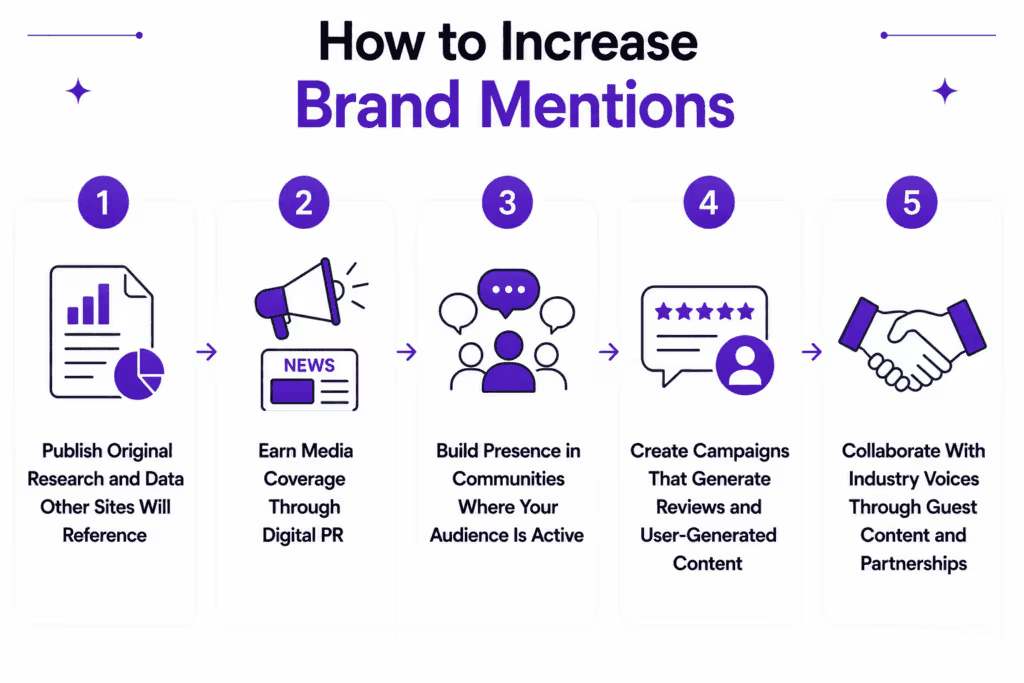
Brand mention growth comes from earning references across publications, communities, review platforms, and industry channels. Brand mentions matter because search engines and AI systems use mentions to evaluate entity authority, topical relevance, and brand recognition. Strong mentions growth increases visibility across search results, AI Overviews, and AI-generated answers by expanding a brand’s presence beyond its own website.
Brand mentions strengthen SEO performance because search engines evaluate independent references alongside backlinks and content quality. These references create entity signals, which improve authority, strengthen topic associations, and increase citation frequency in AI systems.
1. Publish Original Research and Data Other Sites Will Reference
Original research generates brand mentions because publishers need credible statistics and unique findings. Journalists, bloggers, researchers, and analysts regularly cite original datasets when supporting claims. Every citation creates a brand mention connected to the topic covered by the research. This connection strengthens entity associations and reinforces topical authority. Research studies, benchmark reports, industry surveys, and proprietary datasets attract high authority mentions because competing publishers cannot find the same information elsewhere. Annual updates increase citation frequency because publishers return to the newest version whenever they need current statistics.
2. Earn Media Coverage Through Digital PR
Digital PR generates brand mentions by placing a brand inside editorial coverage on third-party publications. Editorial coverage creates stronger authority signals because independent publications control the content and distribution. Journalists reference brands that contribute original research, expert commentary, newsworthy developments, or unique industry insights. These references strengthen entity authority because they appear on trusted websites with established audiences. Consistent media coverage expands recognition across multiple domains and increases the likelihood that search engines and AI systems associate the brand with a specific topic area.
3. Build Presence in Communities Where Your Audience Is Active
Community participation generates brand mentions through discussions, recommendations, and peer conversations. Forums, Reddit communities, Quora discussions, LinkedIn groups, and professional communities contain conversations about products, services, and industry challenges. Members naturally reference brands they know and trust when answering questions or sharing experiences. These mentions create strong entity signals because they originate from independent individuals rather than from the brand itself. Community mentions influence AI visibility because AI systems frequently retrieve information from large discussion platforms when generating answers.
4. Create Campaigns That Generate Reviews and User-Generated Content
Reviews and user-generated content generate brand mentions through authentic customer experiences. Reviews appear on trusted platforms where search engines and AI systems evaluate reputation and trust signals. User-generated content expands mention coverage across social media platforms, forums, videos, tutorials, and community discussions. These references strengthen entity recognition because they connect the brand with real outcomes and real customer experiences. Consistent review generation and content sharing create a broad mention footprint across multiple domains, which reinforces authority and trust.
5. Collaborate With Industry Voices Through Guest Content and Partnerships
Guest content and partnerships generate brand mentions by placing a brand inside third-party publications and collaborative projects. Guest articles create mentions through author biographies, editorial content, and industry expertise. Co-authored research and partnerships generate broader visibility because multiple organizations distribute the same asset across different audiences. These collaborations strengthen authority because recognized experts and organizations associate their reputation with the content. Long-term partnerships create recurring mentions across multiple channels, which reinforces entity recognition and increases brand visibility over time.
How to Find and Track Brand Mentions
Finding and tracking brand mentions requires monitoring every reference to your brand, products, executives, and proprietary terms across the web. Brand mention tracking matters because mentions influence entity authority, reputation, branded search demand, and AI visibility. A structured monitoring process identifies new opportunities, detects reputation risks, and measures whether brand awareness efforts produce measurable growth.
Brand mention tracking strengthens SEO and AI search performance because search engines and AI systems evaluate brand visibility through references across multiple sources. These references reveal how frequently a brand appears, where it appears, and what context surrounds each mention. Consistent monitoring turns brand mentions into actionable data instead of isolated observations.
The 3 main ways to find and track brand mentions are listed below.
1. Set Up Brand Mention Alerts
Brand mention alerts identify new references as soon as they appear in indexed content. Alert systems monitor brand names, product names, executive names, and proprietary terminology across websites and publications. Early detection allows brands to identify media coverage, monitor reputation, and discover potential outreach opportunities. Google Alerts provides a free starting point for monitoring brand references across the web. Platform searches on LinkedIn, Reddit, and other networks provide additional visibility into mentions that appear inside community discussions.
2. Use Dedicated Brand Monitoring Tools
Brand monitoring Tools track mentions across news websites, blogs, forums, reviews, and social platforms. These Tools capture data that basic alerts often miss, which creates a more complete view of brand visibility. Effective monitoring systems record the source URL, domain authority, publication date, sentiment, and link status of each mention. This information allows brands to prioritize outreach opportunities, evaluate reputation trends, and measure mention growth over time. Tools that combine mention discovery with sentiment analysis provide a clearer picture of how audiences perceive a brand.
Search Atlas provides brand monitoring through its LLM Visibility and AI Search monitoring capabilities. The platform tracks brand citations, share of voice, sentiment, and visibility across ChatGPT, Gemini, Perplexity, and Google AI Overviews. These insights reveal where brands appear, which sources generate citations, and which topics drive visibility across AI search platforms. This visibility data allows brands to identify mention gaps, strengthen entity authority, and improve citation frequency across AI-generated answers.
3. Track AI Search and Citation Visibility
AI search monitoring tracks how often AI systems reference, cite, or recommend a brand. AI visibility matters because users increasingly discover brands through AI-generated answers instead of traditional search results. Monitoring AI visibility reveals whether a brand appears in platforms (ChatGPT, Gemini, Perplexity, and AI Overviews). These insights identify citation gaps, topic gaps, and visibility opportunities. Consistent AI monitoring ensures that brand mention growth translates into a stronger presence across emerging search experiences.
What information should a brand mention tracking system capture? A brand mention tracking system captures five core data points: source URL, domain authority, sentiment, publication date, and link status. Source URLs identify where the mention appears. Domain authority indicates the strength of the referring website. Sentiment reveals whether the mention appears in a positive, neutral, or negative context. Publication dates track mention velocity over time. Link status determines whether the mention includes a backlink or functions solely as an entity reference.
These data points transform mention tracking into a measurable visibility system. Visibility systems reveal which channels generate authority, which publications create opportunities, and which mention patterns contribute most to search and AI visibility growth.
What Tools Are Used to Monitor Brand Mentions?
Brand mention monitoring Tools identify where brands appear across websites, news publications, forums, reviews, social platforms, and AI search systems. These Tools capture references, measure sentiment, track visibility trends, and reveal opportunities for outreach and reputation management.
The 5 best brand mention monitoring Tools are Search Atlas, Brand24, Google Alerts, Ahrefs, and Semrush.
1. Search Atlas. Search Atlas tracks brand visibility across traditional search engines and AI search platforms. The platform provides visibility monitoring through LLM Visibility, Site Explorer, competitor analysis, and authority tracking features. Teams monitor citations, share of voice, sentiment, ranking performance, and brand visibility across ChatGPT, Gemini, Perplexity, and Google AI Overviews. This visibility matters because brand mentions increasingly influence AI-generated answers alongside traditional rankings. Search Atlas connects mention visibility with Domain Power, content performance, and ranking data, which creates a complete view of brand authority and search presence.
2. Brand24. Brand24 specializes in social listening and real-time mention monitoring. The platform tracks references across social media networks, blogs, forums, review websites, and online publications. Brand24 includes sentiment analysis, reach estimation, and alert systems that identify unusual spikes in mention activity. These capabilities make it valuable for reputation management and community monitoring. Teams that prioritize social visibility and public perception often use Brand24 as a primary monitoring solution.
3. Google Alerts. Google Alerts provides free brand mention monitoring through email notifications. The Tool sends alerts whenever Google indexes content that contains selected keywords or brand names. This monitoring creates a simple way to discover new references without investing in a paid platform. Google Alerts works best for basic monitoring because it lacks sentiment analysis, authority metrics, and advanced reporting capabilities. The Tool remains useful as an entry point for organizations beginning their brand mention tracking efforts.
4. Semrush. Semrush combines brand monitoring with keyword tracking, backlink analysis, and competitive research. The platform captures mentions across the web and connects those mentions with broader SEO performance data. This connection allows teams to evaluate how brand visibility aligns with rankings, authority, and competitive positioning. Semrush includes sentiment analysis features that classify mentions as positive, neutral, or negative. These classifications provide additional context about reputation trends and audience perception.
5. Ahrefs. Ahrefs monitors brand mentions alongside backlink and authority data. The platform identifies whether mentions include hyperlinks and reveals the authority of the referring domains. This information helps identify unlinked mention opportunities that become backlinks through outreach. Ahrefs Content Explorer enables large-scale mention discovery across historical content, which makes it valuable for finding references that accumulated over time. The platform works particularly well for teams focused on SEO, authority growth, and link acquisition.
How to Turn Unlinked Brand Mentions Into Backlinks
Turning unlinked brand mentions into backlinks increases authority by converting existing brand references into direct links. Unlinked mention outreach works because the publisher has already referenced the brand inside published content. This existing reference removes much of the friction associated with traditional link building and creates a higher probability of success.
Turning unlinked brand mentions into backlinks improves SEO performance because backlinks transfer authority while brand mentions alone do not. Search engines already associate the brand with the content through the mention. Adding a hyperlink strengthens that association and creates a direct authority signal that contributes to rankings and visibility.
Turning unlinked brand mentions into backlinks improves outreach efficiency because relevance already exists. Traditional link building requires establishing relevance before requesting a link. Unlinked mention outreach starts with a page that already references the brand, product, executive, or proprietary technology. This existing relevance makes the request more natural and increases conversion rates.
Turning unlinked brand mentions into backlinks improves link quality because mentions often appear on contextually relevant websites. Relevant websites discuss topics connected to the brand’s products, services, or industry. These topical associations create stronger authority signals than links acquired from unrelated sources. Strong topical alignment increases the SEO value of each acquired backlink.
Turning unlinked brand mentions into backlinks improves scalability because every new mention becomes a potential outreach opportunity. Brand monitoring systems continuously identify new references across publications, forums, reviews, and community platforms. Each reference creates a new opportunity to request a link addition. This process transforms brand awareness efforts into a repeatable link acquisition channel that grows alongside overall brand visibility.
How Do You Find Unlinked Mentions at Scale?
Finding unlinked mentions at scale requires identifying pages that reference your brand without linking to your website. Unlinked mention discovery matters because these pages represent high probability link acquisition opportunities. The publisher already knows the brand and considers it relevant enough to mention. This existing relationship makes outreach significantly easier than traditional cold link building.
Finding unlinked mentions at scale remains possible through Google search operators. Searches that combine a brand name with exclusions for the brand’s own domain reveal external pages that reference the brand. This approach uncovers publicly indexed mentions without requiring dedicated software. Manual review remains necessary because search operators do not distinguish linked references from unlinked references.
Finding unlinked mentions at scale requires filtering opportunities by authority and relevance. High authority websites contribute stronger ranking signals than low authority websites. Topically relevant websites contribute stronger entity associations than unrelated websites. Prioritizing mentions based on authority and relevance ensures outreach efforts focus on the opportunities most likely to improve visibility and rankings.
Finding unlinked mentions at scale requires evaluating mention specificity before outreach begins. Generic references provide weaker outreach opportunities than detailed references about products, services, or proprietary technologies. Detailed references indicate stronger familiarity with the brand, which increases the likelihood that a publisher accepts a request to add a link.
Finding unlinked mentions at scale produces better results when monitoring runs continuously. New brand mentions appear every day across publications, forums, reviews, and community discussions. Continuous monitoring transforms mention discovery into a recurring link acquisition channel rather than a one-time campaign. This consistency creates a steady pipeline of relevant backlink opportunities as brand visibility grows.
What Are Common Mistakes That Limit Brand Mention Growth?
Brand mention growth mistakes happen when brands focus on short-term visibility instead of long-term entity building. These mistakes reduce authority, limit recognition, and weaken visibility across search engines and AI systems. Brand mention growth requires consistency because search engines and AI platforms evaluate brands through repeated references across multiple sources over time.
There are 10 main brand-mention growth mistakes to avoid.
1. Treating brand mention growth as a one-time campaign. Treating brand mention growth as a one-time campaign creates temporary visibility without lasting authority. One research study, one PR campaign, or one outreach initiative generates a short-term increase in mentions before visibility returns to previous levels. Consistent mention growth requires ongoing publishing, outreach, community participation, and relationship building. Sustained activity creates the compounding effects that strengthen an entity’s authority over time.
2. Ignoring community platforms. Ignoring community platforms reduces exposure where audiences actively discuss products, services, and recommendations. Communities on Reddit, Quora, LinkedIn, and industry forums generate large volumes of independent brand references. These references strengthen entity recognition and influence AI citation systems. Limited community participation reduces opportunities for organic mention growth.
3. Publishing content without original insights. Publishing content without original insights reduces the likelihood of earning citations from other websites. Generic content provides little reason for journalists, researchers, or publishers to reference a brand. Original research, proprietary data, expert analysis, and unique perspectives create stronger mention opportunities. Distinct information generates references because the information cannot be found elsewhere.
4. Focusing only on backlinks. Focusing only on backlinks limits entity growth across search and AI systems. Backlinks transfer authority, but brand mentions expand recognition and topical associations. A backlink strategy without a mention strategy creates technical authority without broad entity visibility. Search engines and AI systems evaluate both signals when understanding brands.
5. Maintaining inconsistent brand messaging. Inconsistent brand messaging weakens entity associations across the web. Different descriptions, positioning statements, and value propositions create confusion about what a brand represents. Consistent messaging strengthens entity recognition because search engines repeatedly encounter the same topical associations. Strong consistency improves authority and relevance signals.
6. Ignoring branded search demand. Ignoring branded search demand reduces one of the strongest indicators of brand awareness. Brand mentions increase branded searches when audiences encounter a company name across publications and communities. Strong branded search demand reinforces entity recognition and user interest. Weak branded demand limits the visibility benefits generated by mentions.
7. Neglecting reputation management. Neglecting reputation management allows negative sentiment to accumulate unchecked. Negative references influence how search engines and AI systems interpret brand reputation. Active monitoring identifies issues before they spread widely. Strong reputation management preserves trust and authority signals.
8. Failing to build media relationships. Failing to build media relationships reduces opportunities for recurring editorial coverage. Journalists frequently reference sources they already know and trust. Strong relationships increase the likelihood of future mentions across news stories, research articles, and industry coverage. Weak relationships limit long-term mention velocity.
9. Overlooking user-generated content. Overlooking user-generated content reduces authentic third-party references. Reviews, tutorials, social posts, and community discussions create strong trust signals because customers create them independently. These references expand coverage across multiple platforms. Limited user participation reduces mention growth potential.
10. Measuring volume without measuring quality. Measuring volume without measuring quality creates misleading visibility assessments. High mention counts on irrelevant websites contribute less value than mentions on authoritative and topically relevant publications. Authority, relevance, sentiment, and context determine the true value of a mention. Quality evaluation produces a more accurate brand visibility analysis.
Does the platform where a mention appears affect its SEO value?
Yes. The platform where a mention appears affects its SEO value because search engines evaluate accessibility, authority, and context when processing brand references. Mention platforms matter because not every reference contributes equally to entity recognition and topical authority. Search engines assign more value to mentions that appear on trusted, crawlable, and relevant websites than mentions that appear in private or inaccessible environments.
Mention platforms affect SEO value because search engines process indexed content differently from non-indexed content. A mention published on a crawlable website becomes part of the search engine’s entity understanding process. A mention hidden behind login walls, private communities, or inaccessible systems contributes little or no entity signal. This difference affects how much authority and recognition a mention creates.
Mention platforms affect SEO value because domain authority influences the strength of the entity signal. A mention in a respected industry publication creates stronger topical associations than a mention on a low-quality or unrelated website. Stronger associations improve entity recognition because search engines view authoritative sources as more reliable indicators of expertise and relevance.
Mention platforms affect SEO value because topical relevance influences how search engines interpret brand associations. A mention on a website closely related to the brand’s industry reinforces expertise and authority within that topic area. A mention on an unrelated website creates weaker associations because the contextual connection is less clear. This difference influences the strength of the resulting entity signal.
Mention platforms affect SEO value because different platforms contribute different visibility benefits. Editorial publications create strong entity recognition and authority signals through indexed content. Community platforms create awareness and discussion signals that influence AI systems and branded search behavior. Social platforms increase exposure and brand discovery, which often generates branded searches and additional mentions elsewhere. Each platform contributes value, but indexed and authoritative content produces the strongest direct SEO impact.
Negative brand mentions and search visibility?
Negative brand mentions affect search visibility and AI visibility because search engines and AI systems evaluate sentiment alongside entity recognition. Negative mentions contribute to a brand’s entity footprint, but they associate the brand with criticism, complaints, or poor experiences. These associations influence how search systems interpret brand reputation.
Negative brand mentions affect search visibility because search engines classify sentiment within the surrounding context. Repeated negative references about a product, service, or topic weaken positive associations and reduce perceived authority. This pattern influences how search engines understand brand quality within a category.
Negative brand mentions affect AI visibility because AI systems evaluate both relevance and reputation when selecting brands to cite or recommend. Brands with persistent negative sentiment across reviews, forums, and community discussions are less likely to appear in recommendation-based answers. Reputation management remains important because negative mentions do not disappear simply because positive mentions exist.
How quickly do brand mentions impact SEO rankings?
Brand mentions impact SEO rankings gradually because brand mentions influence rankings through entity recognition, branded search demand, and authority accumulation rather than direct ranking signals. Search engines process these signals over time, which means ranking improvements typically appear months after mention growth begins.
Brand mentions impact branded search volume faster than they impact rankings. Increased visibility across publications, communities, and reviews exposes more people to a brand. This exposure increases branded searches, which often become measurable within two to four months of a sustained brand mention campaign.
Brand mentions impact entity recognition through crawling, indexing, and knowledge graph updates. Search engines need time to process new references, evaluate entity associations, and strengthen topical connections. This process occurs gradually as mentions accumulate across multiple sources and domains.
Brand mentions impact organic rankings over a longer timeframe because authority builds through repeated signals. Consistent references across authoritative and relevant websites strengthen brand recognition and topical authority. Most brands observe ranking improvements from entity authority growth after six to twelve months of sustained mention generation and visibility building.
Brand mentions impact SEO most effectively when they occur consistently across trusted publications, communities, reviews, and industry websites. Consistency strengthens entity signals over time, which creates stronger visibility gains than short-term mention spikes that disappear after a single campaign.