Source authority weighting in large language models (LLMs) is the process AI systems use to evaluate, prioritize, and cite information sources within generated answers. Source authority weighting determines which domains appear in LLM-generated citations, and brands can track their own authority presence using Search Atlas LLM Visibility. explains how LLMs select sources based on trust, semantic clarity, entity consistency, and verifiable evidence rather than traditional ranking metrics alone. This process clarifies how AI systems move from retrieving information to deciding which sources influence or receive attribution inside the final response.
Source authority weighting matters because AI search visibility depends on citation, inclusion, and reuse inside generated answers. LLMs prioritize sources that appear consistent across documents, define entities clearly, and provide structured information that machines verify. This evaluation shifts visibility away from ranking position and toward being recognized as a trusted source inside synthesized answers.
Source authority weighting creates measurable risks and opportunities for brands competing in AI search environments. Sources with unclear entities, weak corroboration, or poor structure receive lower visibility, even when traditional SEO performance looks strong. Sources with consistent third-party mentions, structured data, and cross-document agreement increase citation probability because AI systems interpret and validate them with less uncertainty.
Source authority weighting requires optimization through entity clarity, structured content, corroborated claims, and continuous provider measurement. Brands improve AI visibility by aligning facts across owned pages, third-party profiles, review platforms, and knowledge graph references. Strong source authority comes from repeated, verifiable, and machine-readable signals that help LLMs select the brand as a reliable source during answer generation.
What Is Source Authority Weighting in LLMs?
Source authority weighting is a mechanism in LLMs that assigns trust levels to sources based on semantic clarity, consistency, and verifiable structure. Source authority weighting explains how models prioritize information during answer generation, where semantic alignment, entity definition, and factual repetition replace backlinks and ranking metrics as core signals. This mechanism defines how LLMs select, compare, and surface sources inside generated responses.
Source authority weighting addresses a core limitation in traditional ranking systems. Ranking systems evaluate popularity signals, while LLMs evaluate evidence quality and semantic trust. This shift changes how visibility works because AI systems generate answers instead of listing pages. Source authority weighting resolves this gap by selecting sources that provide clear meaning, structured data, and consistent validation across documents.
Source authority weighting operates across what systems? Source authority weighting operates across parametric memory, retrieval systems, and reinforcement learning layers. These systems combine stored knowledge, external retrieval, and feedback signals into a unified evaluation process. This connection explains how models move from static training data toward dynamic source selection during answer generation.
Parametric memory stores learned patterns from training data, which define baseline trust signals. Retrieval systems inject external context from indexed sources, which adds freshness and specificity. Reinforcement layers refine outputs through feedback and evaluation signals, which adjust how models prioritize and cite sources over time.
What does source authority weighting evaluate inside LLMs? Source authority weighting evaluates semantic alignment, entity clarity, and structural evidence across documents. These factors determine how strongly a source influences the generated answer. Sources with clear entity definitions, consistent naming, and structured relationships receive higher weighting because they reduce ambiguity during interpretation.
Semantic alignment measures how closely content matches the meaning of the query. Entity clarity ensures that names, attributes, and relationships remain consistent across sources. Structural evidence refers to machine-readable formats that define content explicitly. This evaluation replaces traditional ranking logic with evidence-based selection, where meaning and verification control visibility.
What are the main components of source authority weighting systems? There are 3 main components of source authority weighting systems. The 3 main components are two-stage evaluation filters, evidence weighting mechanisms, and contradiction resolution processes.
Two-stage evaluation filters control which sources enter and exit the retrieval pipeline. Gate 1 filters low-quality or irrelevant domains before retrieval begins, while Gate 2 prioritizes structured and verifiable content for citation. This filtering ensures that only credible and well-structured sources reach the answer layer.
Evidence weighting mechanisms evaluate document structure, entity identifiers, and data relationships across sources. Sources with consistent entity identifiers, schema markup, and structured relationships receive higher weighting. This weighting increases confidence because machine-readable signals strengthen verification across documents.
Contradiction resolution processes resolve conflicts through weighted consensus across multiple sources. A claim repeated across several strong sources outweighs conflicting claims with weaker evidence. This resolution ensures that repeated and validated information dominates the final generated answer.
What are the key attributes of source authority weighting in LLMs? There are 3 main attributes of source authority weighting in LLMs. The 3 main attributes are semantic evaluation, structured data impact, and entity strength.
Semantic evaluation prioritizes sources with clear concepts, deep coverage, and strong contextual alignment. Content that explains entities with depth receives higher weighting because meaning alignment improves accuracy and reduces ambiguity.
Structured data impact increases weighting through machine-readable formats that define entities and relationships explicitly. Structured content improves interpretation, which increases citation likelihood and strengthens cross-document validation.
Entity strength increases weighting through consistent brand associations and clear topical identity across sources. Entities that appear repeatedly with the same attributes gain stronger recognition. This recognition allows smaller domains with strong entity clarity to compete against larger but inconsistent sources.
How does source authority weighting relate to the broader LLM system? Source authority weighting depends on parametric memory, retrieval layers, and reinforcement signals to learn and apply trust patterns. These dependencies connect training data, real-time retrieval, and feedback into a unified evaluation system that governs answer generation.
Source authority weighting enables accurate and trustworthy AI-generated answers by prioritizing semantic evidence instead of popularity signals. This shift explains why domains with strong structure, clear entities, and consistent validation achieve higher visibility inside LLM-generated responses.
Why Does Source Authority Weighting Matter for AI Search Visibility?
Source authority weighting matters for AI search visibility because it determines which sources appear inside AI-generated answers instead of ranked link lists. Source authority weighting shifts visibility from ranking position to citation inclusion, which defines whether a brand exists inside the response itself. Source authority weighting transforms AI search into a trust-based selection system.
How does AI prioritization of trustworthiness and citability impact visibility? AI systems select a small set of trusted sources instead of listing many results. AI excludes sources that lack credibility, which removes them from answers entirely. This selection process favors sources that feel safe to reuse as direct answers. This shift means visibility depends on trust decisions rather than ranking positions.
Why do strong authority signals improve business outcomes? Strong authority signals place brands inside AI-generated answers where high-intent users already trust the information. This placement attracts prequalified prospects, which shortens sales cycles and reduces price resistance. A dataset of 2,014 companies shows a 26 times gap in AI visibility between high and low authority tiers. High authority brands outperform lower authority brands even with weaker GEO signals.
What makes entity clarity across independent sources a primary driver of visibility? Entity clarity across independent sources creates consistent descriptions that AI interprets as consensus signals. Consensus signals increase trust because multiple sources confirm the same entity definition. One SaaS company achieved consistent mentions across ChatGPT and Perplexity within 8 weeks by aligning descriptions across external profiles. This alignment improved visibility without adding new on-site content.
How does cross-platform consistency and third-party mentions enhance AI visibility? Cross-platform consistency increases repeated mentions across independent sources, which strengthens trust signals inside AI systems. Nearly 48% of AI citations come from user-generated sources. External mentions produce measurable lifts in visibility. Web mentions increase visibility by +0.180, YouTube mentions by +0.174, and news mentions by +0.139. These mentions function as authority signals inside AI environments.
Why is structured content and knowledge graph integration crucial for AI citation? Structured content enables AI systems to extract answers quickly and accurately from well-organized data. Knowledge graph integration connects entities through machine-readable relationships. Content knowledge graphs improve response accuracy by up to 300 percent. Structured implementations with Schema.org markup increase citation probability and produce measurable traffic growth between 20 and 40 percent.
Source authority weighting defines the foundation of AI search visibility. Source authority weighting determines which brands appear inside answers, which makes authority the primary driver of presence in AI-generated results.
How Do LLMs Weight Sources Across the Answer Generation Process?
LLMs weigh sources across the answer generation process through pretraining, retrieval, reranking, and synthesis. Source weighting determines which information enters the answer, which passages gain priority, and which sources receive attribution at generation time.
Source weighting matters because LLMs combine stored knowledge with retrieved evidence. Stored knowledge comes from pretraining, while retrieved evidence comes from search indexes, vector databases, and RAG systems. This combination allows models to answer from internal patterns and external information at the same time.
LLMs require core systems to weigh sources effectively. These systems include model weights, context windows, retrieval pipelines, rerankers, and citation mechanisms. Model weights store general knowledge. Context windows hold the prompt and retrieved evidence. Retrieval pipelines fetch candidate sources. Rerankers score passages before synthesis. Citation mechanisms assign attribution to selected sources.
The 4 main stages of source weighting across answer generation are listed below.
1. Pretraining: Frequency and Corpus Presence
Pretraining shapes source weighting before an LLM retrieves any external source. Pretraining exposes the model to large corpora, which teach language patterns, entity relationships, factual associations, and topic structures. Sources, entities, and claims that appear repeatedly across high-quality datasets become stronger internal signals inside the model’s parametric memory.
Pretraining creates the model’s baseline understanding of entities, topics, and relationships. This baseline affects whether the model recognizes a brand, connects a source to a topic, or treats a claim as familiar during generation. A source mentioned across books, academic papers, Wikipedia, documentation, and trusted web pages gains stronger recognition than a source with a limited corpus presence.
Pretraining weights sources through frequency, consistency, and corpus quality. Frequency means the model sees the same entity or claim multiple times. Consistency means different documents describe the entity in similar terms. Corpus quality means the surrounding documents contain structured, reliable, and information-rich language. These signals influence how confidently the model recalls concepts without real-time retrieval.
How does corpus presence affect source authority? Corpus presence affects source authority because repeated mentions create stronger entity memory. A brand, author, product, or publication gains recognition when multiple independent documents use the same name, category, and description. This repetition trains the model to associate the entity with a specific subject area.
Pretraining does not create a perfect source authority. The model learns patterns from training data, not live verification. This limitation means pretraining establishes recognition, but retrieval and citation require fresh evidence in later stages. A source influence synthesis through parametric memory without receiving visible attribution.
Pretraining defines the first layer of source weighting because it determines what the model already knows before retrieval starts. This layer matters because familiar entities require less contextual explanation during generation. Strong corpus presence increases recognition, while weak corpus presence makes retrieval and structured evidence more important.
2. Retrieval: Index Ranking and Embedding Similarity
Retrieval weights sources after the model decides it needs external information. Retrieval systems search indexes, vector databases, or live web sources to find documents that match the user’s query. This stage moves source weighting from stored memory into real-time evidence selection.
Retrieval determines which sources enter the answer pipeline. Sources with strong topical relevance, clear structure, accessible HTML, and direct answers gain higher retrieval probability. Sources with buried answers, blocked content, unclear headings, or inconsistent entity language lose visibility before synthesis begins.
Retrieval uses index ranking and embedding similarity to compare queries with documents. Index ranking evaluates keyword relevance, URL freshness, accessibility, and source quality. Embedding similarity converts queries and documents into numerical vectors, then measures semantic closeness between meanings. This combination allows systems to retrieve documents that match both exact words and related concepts.
What does embedding a similarity measure in retrieval? Embedding measures how closely a document matches the meaning behind a query. A page about “LLM citation selection” matches a query about “how AI chooses sources” if both share semantic relationships. This matching expands retrieval beyond exact keyword overlap.
Retrieval often uses fan-out queries to broaden source discovery. A single prompt becomes multiple related searches that capture subtopics, comparisons, definitions, and use cases. A source gains retrieval strength when it appears across multiple query paths. This repeated appearance signals broad topical coverage and improves its chance of entering the context window.
Retrieval quality directly affects answer quality. Irrelevant retrieval introduces weak evidence into the context window. Strong retrieval provides focused evidence that the model uses during synthesis. This stage explains why content structure matters for AI search visibility. Clear sections, direct answers, structured data, and consistent entity descriptions make documents easier to retrieve.
Retrieval defines the second layer of source weighting because it selects candidate evidence. Pretraining creates recognition, while retrieval selects current sources that match the prompt. Strong retrieval increases citation opportunity because uncaptured sources cannot influence the final answer.
3. Reranking: Passage Scoring Before Synthesis
Reranking weights retrieved passages before the model writes the final answer. Retrieval collects candidate documents, while reranking decides which passages deserve priority. This stage functions as a second evaluation layer that separates broadly relevant content from evidence that directly answers the query.
Reranking matters because it places the strongest evidence closest to the model working context. Strong passage scoring reduces irrelevant context, lowers hallucination risk, and improves the chance that the model uses accurate source material.
Rerankers evaluate passages through semantic fit, evidence strength, entity clarity, and query alignment. Semantic fit measures how directly a passage answers the prompt. Evidence strength measures whether the passage contains specific facts, identifiers, examples, or data. Entity clarity measures whether brands, people, products, and concepts appear with stable names. Query alignment measures whether the passage addresses the exact user intent.
What does passage scoring evaluate in source weighting? Passage scoring evaluates whether the retrieved text deserves influence during synthesis. A document ranks well during retrieval but loses priority during reranking if its relevant answer sits buried inside a weak context. A lower-ranking document gains priority if it provides a clear, direct, and verifiable answer.
Reranking improves source weighting because it reviews passages at a deeper level than initial retrieval. Initial retrieval often favors recall, which means it gathers many possible candidates. Reranking favors precision, which means it identifies the best evidence among those candidates. This precision matters because LLMs process limited context, even with large context windows.
Reranking affects citation likelihood. Passages placed higher in the context window receive stronger influence during synthesis. Passages with clear claims, structured facts, and strong entity signals become easier to cite. Passages with vague wording, weak attribution, or scattered context lose citation potential.
Reranking defines the third layer of source weighting because it prioritizes evidence before generation. Pretraining builds recognition. Retrieval selects candidates. Reranking scores the strongest passages. This stage determines which source fragments shape the model’s final answer most directly.
4. Synthesis: Citation and Attribution at Generation Time
Synthesis weights sources during final answer construction. The model combines internal knowledge from pretraining with external evidence from retrieval and reranking. This stage turns weighted evidence into natural language, citations, mentions, or unattributed synthesis.
Synthesis determines whether a source becomes a visible citation, a background influence, or no attribution at all. Sources with clear entities, strong evidence, structured data, and repeated validation receive higher citation likelihood. Sources with weak structure or unclear identity influence wording without earning visible credit.
Synthesis uses the context window as the working memory for answer generation. The context window contains the prompt, retrieved passages, reranked evidence, and the answer generated so far. The model predicts each next token based on this context and its internal weights. This process means citation decisions happen while the answer forms, not after the answer finishes.
What makes a source citable during synthesis? A source becomes citable when it provides a clear claim, a stable entity, and verifiable evidence. The model needs enough information to connect the claim to the source confidently. Structured identifiers, named authors, publication dates, schema markup, and consistent brand descriptions reduce uncertainty.
Synthesis resolves contradictions through weighted evidence. A claim repeated across trusted and semantically aligned sources receives stronger treatment than an isolated or conflicting claim. The model favors sources that confirm one another across independent contexts. This consensus shapes which answer appears most reliable.
Citation and attribution do not happen for every influence. A source shapes the answer through pretraining or synthesis without visible credit. Citation appears most often when retrieval provides explicit source text, and the model attaches a claim to that source. This distinction explains the gap between being used and being cited.
Synthesis defines the final layer of source weighting because it converts evidence into the answer. Strong synthesis depends on the previous stages. Pretraining creates recognition, retrieval selects sources, reranking prioritizes passages, and synthesis assigns final influence and attribution.
Where Does Authority Weighting Actually Happen Inside an LLM?
Authority weighting happens across training, retrieval, evidence scoring, synthesis, and feedback layers inside an LLM. Authority weighting does not happen in one visible location because LLMs combine internal parameters, retrieved sources, entity signals, and reinforcement patterns during answer generation.
Authority weighting begins in model weights. LLM weights are billions of numerical parameters learned during training, then frozen during inference. These parameters store language patterns, entity associations, reasoning patterns, and general knowledge. This layer shapes what the model already recognizes before it evaluates live sources.
How do LLM weights influence authority weighting? LLMs weights influence authority weighting by storing repeated patterns from training data. Sources, entities, and claims that appear consistently across trusted datasets become easier for the model to recognize. This recognition increases the chance that the model treats a source or concept as familiar.
Authority weighting continues during retrieval. Retrieval systems decide whether the model answers from internal knowledge or searches external sources. Case L uses learned data only, while Case L+O adds online research or document retrieval. This decision depends on confidence, freshness needs, query specificity, and topic complexity.
How do LLMs decide to perform external research? LLMs decide to perform external research when internal confidence falls below a threshold. The model retrieves external evidence if the question requires freshness, verification, comparison, or niche information. This retrieval expands the source pool beyond parametric memory.
Authority weighting becomes stronger during evidence scoring. Evidence scoring evaluates document architecture, entity clarity, structured data, topical alignment, source diversity, and confirmation frequency. Sources with Q-IDs, sameAs properties, @id values, and schema markup receive stronger weighting because these signals reduce ambiguity.
Where does evidence weighting happen in Case L+O? Evidence weighting happens after retrieval and before final synthesis. LLMs score external sources through an evidence matrix that compares structure, trust, relevance, and entity verification. This matrix determines whether a source becomes a mention, recommendation, or citation.
Entity recognition plays a central role in authority weighting. LLMs identify brands, products, people, organizations, and topics, then connect them to structured references. Clear entities increase confidence because the model understands what the source represents. Fuzzy entities reduce confidence because the model struggles to verify identity.
How does entity clarity influence LLM source selection? Entity clarity influences LLM source selection by making sources easier to connect across documents. Consistent names, schema, knowledge graph links, and third-party mentions strengthen entity confidence. Strong entity confidence increases citation probability.
Authority weighting appears again during synthesis. Synthesis combines internal knowledge with retrieved evidence, resolves contradictions, and chooses which claims enter the final answer. Claims with stronger evidence scores receive priority. Claims with weak confirmation lose influence or remain unattributed.
How do LLMs prioritize claims during synthesis? LLMs prioritize claims through authority weighting inside the evidence matrix. Claims confirmed by multiple clear, structured, and trusted sources receive greater influence. Conflicting claims lose priority when a stronger consensus exists.
Authority weighting is reinforced through fine-tuning and reward modeling. Fine-tuning teaches the model to behave as an assistant. Reward modeling teaches the model what answers humans prefer. These processes influence tone, safety, citation behavior, and response quality.
Authority weighting actually happens across the full LLM pipeline. Model weights create recognition. Retrieval selects sources. Evidence scoring ranks trust. Entity linking verifies identity. Synthesis assigns final influence. Feedback loops refine the process when evidence appears weak or unclear.
Do LLMs Use Domain Authority, PageRank, Domain Rating, or Backlinks?
No. Large Language Models (LLMs) do not use Domain Authority, PageRank, Domain Rating, or backlinks as direct ranking signals. LLMs generate answers instead of ranking pages, which means they rely on semantic evidence, entity clarity, and source consistency rather than SEO metrics.
LLMs do not read Domain Authority or Domain Rating scores because these metrics exist as SEO tools, not internal model signals. LLMs do not calculate PageRank or backlink strength during answer generation. This limitation means traditional ranking metrics do not directly control visibility inside AI-generated answers.
Why do LLMs not use Domain Authority or PageRank? LLMs prioritize semantic alignment, factual consistency, and entity verification instead of link-based popularity signals. AI systems evaluate whether a source provides clear, structured, and verifiable information. This evaluation replaces ranking formulas with evidence-based selection.
LLMs do not use backlinks as direct authority signals because backlinks reflect web popularity rather than semantic reliability. A page with many backlinks still lacks clear entities, structured data, or factual precision. This mismatch reduces its influence inside AI-generated answers.
Traditional authority metrics continue to indirectly influence LLM visibility. High-authority domains appear more frequently across the web, which increases their presence in training data and retrieval systems. This presence creates stronger recognition patterns during pretraining and higher-retrieval probability during search.
How do Domain Authority and backlinks indirectly affect LLM visibility? Domain Authority and backlinks increase exposure across datasets and external sources. Websites (Wikipedia, major universities, and medical institutions) appear often in training corpora and retrieval indexes. This repetition strengthens entity recognition and trust signals inside the model.
Indirect influence happens through frequency, consistency, and external validation. High-authority sites receive more mentions, more citations, and more consistent descriptions across independent sources. These signals align with LLM weighting systems, which favor repeated and verified information.
Low-authority domains face challenges because limited exposure reduces recognition and retrieval probability. Content from these domains requires stronger structure, clearer entities, and better semantic alignment to compete. Strong entity clarity and structured data offset weaker traditional authority signals.
LLMs use trust patterns learned from data instead of explicit SEO metrics. Domain Authority and backlinks shape those patterns indirectly through visibility, not through direct scoring. This distinction explains why smaller sites with strong semantic signals appear inside AI-generated answers.
This retrieval-driven inconsistency shows up directly in the data. A comparative analysis of LLM citation behavior across Gemini, OpenAI, and Perplexity found structural differences in how each model selects and attributes external sources, shaped heavily by whether the model has live retrieval access at all.
What Signals Predict Whether an LLM Weighs Your Source Highly?
The signals that predict whether an LLM weights your source highly are cross-document agreement, entity clarity and disambiguation, structured data and verifiable identifiers, brand search volume and parametric presence, and retrieval index ranking inheritance. These signals define how LLMs identify trustworthy sources, connect entities, verify claims, and select evidence for generated answers.
LLMs weight sources based on semantic trust rather than a traditional ranking metric. A source gains stronger weighting when multiple independent documents confirm the same facts, describe the same entity clearly, and present information in machine-readable formats.
The 5 main signals that predict high LLM source weighting are listed below.
1. Cross-document agreement. Cross-document agreement strengthens source weighting because repeated claims across independent sources create consensus. Cross-document agreement occurs when multiple reputable pages describe the same brand, entity, or claim in similar terms. This consistency increases trust because LLMs treat repeated evidence as less risky than isolated claims.
2. Entity clarity and disambiguation. Entity clarity and disambiguation strengthen source weighting because LLMs need to identify exactly what a source represents. Entity clarity occurs when names, categories, relationships, and descriptions remain consistent across a website, review profiles, knowledge graphs, and third-party mentions. This clarity reduces misattribution and increases confidence during source selection.
3. Structured data and verifiable identifiers. Structured data and verifiable identifiers strengthen source weighting because machine-readable signals reduce interpretation work. Structured data uses JSON-LD, Schema.org markup, @id, sameAs, and Q IDs to connect entities across documents. These identifiers improve verification because LLMs match sources to stable external references.
4. Brand search volume and parametric presence. Brand search volume and parametric presence strengthen source weighting indirectly because repeated brand exposure increases recognition. Parametric presence develops when a brand appears across trusted datasets, publications, reviews, and comparison pages. This presence helps the model associate the brand with a category, problem, or use case.
5. Retrieval index ranking inheritance. Retrieval index ranking inheritance strengthens source weighting because LLMs often depend on retrieval systems before synthesis. Retrieval systems select documents through index ranking, embedding similarity, freshness, and accessibility. A source gains influence when it appears across multiple retrieval paths and provides clear passages for reranking.
These 5 signals predict source weighting because they reduce uncertainty inside the answer generation process. Cross-document agreement validates claims. Entity clarity confirms identity. Structured data improves machine readability. Parametric presence builds recognition. Retrieval inheritance increases entry into the context window.
How Does Source Authority Weighting Differ Across AI Providers?
Source authority weighting differs across AI providers through ChatGPT source selection, Perplexity source selection, Gemini source selection, Claude source selection, and Google AI Overviews source selection. Source authority weighting defines how AI systems retrieve, evaluate, and prioritize information during answer generation.
Source authority weighting affects AI outputs because each system uses different retrieval pipelines, trust filters, and ranking logic. These differences change which sources influence answers, which sources receive citations, and which sources remain unused during synthesis.
Source authority weighting relies on core system mechanisms. Source authority weighting uses retrieval pipelines for document selection, reranking systems for relevance scoring, and safety filters for risk control. These mechanisms shape how each provider evaluates credibility, relevance, and usability of information.
The 5 main AI provider source selection methods are listed below.
1. ChatGPT Source Selection
ChatGPT source selection prioritizes semantic clarity, entity consistency, and low-risk information patterns, which increases safe answer generation. ChatGPT source selection operates through parametric memory and optional retrieval layers, which evaluate patterns learned during training and supplement them with external data. This method favors structured content, clear definitions, and consistent entity references, which reduce ambiguity during synthesis. ChatGPT emphasizes answerability over ranking signals, which means sources that provide direct, extractable answers receive higher weighting. This process increases reliability because the system avoids uncertain or weakly supported claims.
2. Perplexity Source Selection
Perplexity source selection prioritizes recency, credibility, and multi-source verification, which increases research accuracy and citation density. Perplexity source selection operates through live web retrieval, followed by multi-stage reranking systems that filter and validate sources. This method favors recently updated content, authoritative publications, and corroborated information across multiple documents. Perplexity enforces strict quality thresholds, which remove weak or promotional sources before answer generation. This process increases trust because only validated and up-to-date sources contribute to the final response.
3. Gemini Source Selection
Gemini source selection prioritizes search alignment, structured data, and topical completeness, which increases consistency with the Google ecosystem. Gemini source selection operates through Google’s indexing systems, knowledge graph integration, and query decomposition techniques. This method favors pages that rank well in search results, demonstrate E-E-A-T signals, and provide comprehensive topic coverage. Gemini inherits ranking signals from Google Search, which strengthens authority weighting through established infrastructure. This process increases inclusion because high-quality indexed pages receive priority during synthesis.
4. Claude Source Selection
Claude’s source selection prioritizes instruction alignment, reasoning coherence, and constraint adherence, which increases structured and reliable outputs. Claude source selection operates through prompt interpretation layers, which evaluate constraints, format requirements, and logical consistency. This method favors internally consistent information rather than external ranking signals, which differentiates Claude from retrieval-heavy systems. Claude applies conservative filtering to avoid unsupported claims, which reduces hallucination risk. This process increases output quality because the system focuses on coherent reasoning over broad citation coverage.
5. Google AI Overviews Source Selection
Google AI Overviews source selection prioritizes indexed authority, structured formatting, and extractable answers, which increases citation efficiency. Google AI Overviews source selection operates through query fan-out retrieval, which gathers and synthesizes information from multiple indexed sources. This method favors authoritative domains, strong backlink profiles, and content with clear structure and schema markup. Google AI Overviews selects sources that provide concise, verifiable answers, which simplifies synthesis. This process increases citation likelihood because structured and authoritative pages are easier to validate and summarize.
How Do LLMs Handle Conflicting Sources?
LLMs handle conflicting sources through probabilistic weighting, pattern matching, and synthesis rules rather than strict truth verification. LLM conflict handling defines how models choose, merge, or ignore competing information during answer generation.
LLM conflict handling affects output quality because models do not store ground truth or explicit source trust hierarchies. This limitation creates blended answers, biased selections, and inconsistent reasoning when multiple sources disagree.
LLM conflict handling relies on core internal behaviors. LLM conflict handling uses parametric memory for learned patterns, retrieval context for external evidence, and attention mechanisms for token prioritization. These mechanisms determine which information receives a stronger influence during generation.
LLMs do not resolve conflicts through explicit logic systems. LLMs resolve conflicts through statistical likelihood, semantic coherence, and repetition frequency. This process favors information that appears more consistent, more frequent, or more aligned with the prompt.
LLMs favor parametric knowledge during conflicts. LLMs prefer memorized patterns when retrieved sources contradict internal knowledge. This preference occurs because internal representations carry stronger baseline weighting, which increases reliance on pretraining data.
LLMs favor semantically coherent information during conflicts. LLMs prioritize sources that align with the prompt context and surrounding text. This behavior increases selection probability for information that fits the narrative flow, even if it is incorrect. LLMs favor repeated information during conflicts. LLMs increase weighting for claims that appear multiple times across documents. This repetition bias strengthens perceived reliability, which amplifies widely repeated but potentially incorrect information.
LLMs favor recent or prominent context during conflicts. LLMs assign closer attention to later tokens or more visible positions in the context window. This positional bias changes which source influences the final answer. LLMs blend conflicting information during synthesis. LLMs merge elements from multiple sources into a single response. This blending creates “false reconciliation,” where incompatible claims appear as one coherent answer.
LLMs ignore contradictions under certain conditions. LLMs fail to detect conflicts when contradictions require multi-step reasoning or entity tracking. This limitation produces outputs that contain unresolved inconsistencies. LLMs struggle with multi-hop conflict reasoning. LLMs lose accuracy as the number of conflicting steps increases. This degradation occurs because attention spreads across multiple relationships, which weakens precise conflict resolution.
LLMs show confirmation bias during conflicts. LLMs prefer information that matches existing internal patterns. This bias reinforces prior knowledge even when new evidence contradicts it. LLMs degrade under conflicting evidence overload. LLMs produce unstable outputs when too many conflicting sources appear simultaneously. This overload reduces coherence, increases hallucination risk, and weakens final answer reliability.
How to Audit and Improve How LLMs Weight Your Domain?
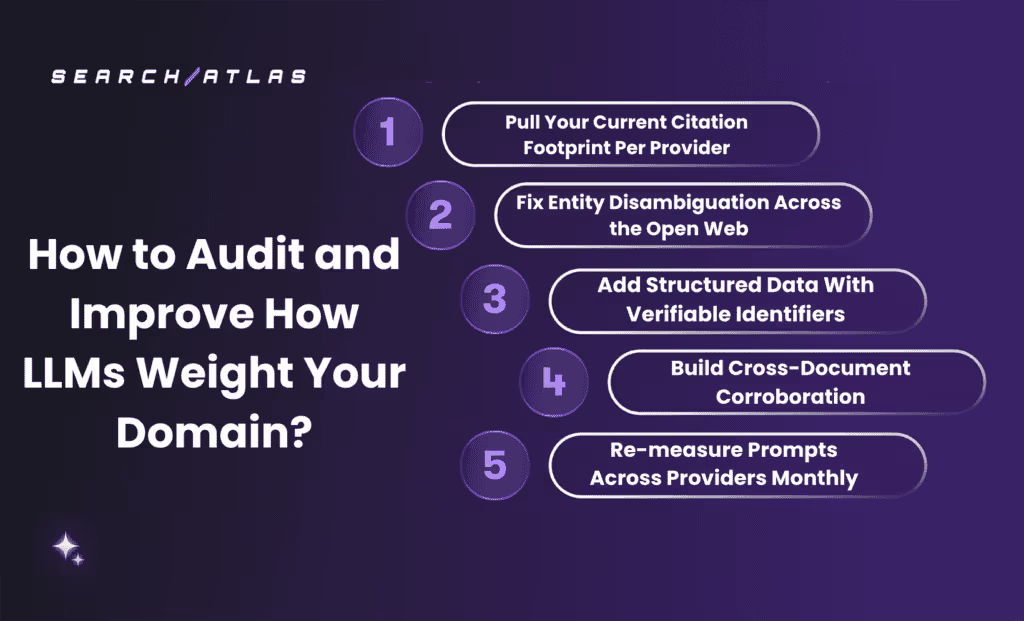
LLM domain weighting is audited and improved through structured analysis of citations, entities, structured data, corroboration, and prompt measurement. LLM domain weighting defines how often a domain is selected, cited, and reused inside AI-generated answers across systems.
LLM domain weighting matters because AI systems replace rankings with inclusion and citation. Content that LLMs do not select or trust does not appear in generated answers, which removes visibility across generative search environments.
The 5 steps to audit and improve LLM domain weighting are listed below.
- Pull Your Current Citation Footprint Per Provider.
- Fix Entity Disambiguation Across the Open Web.
- Add Structured Data With Verifiable Identifiers.
- Build Cross-Document Corroboration.
- Re-measure Prompts Across Providers Monthly.
1. Pull Your Current Citation Footprint Per Provider
Citation footprint per provider is the process of measuring how often a domain appears, gets cited, or influences answers across AI systems. Citation footprint defines real visibility in generative search because LLMs expose selected sources inside answers instead of ranking pages in lists. This footprint transforms AI visibility into measurable signals that reflect actual inclusion across different systems.
Citation footprint matters because LLMs operate on selective inclusion. AI systems choose a limited number of sources per answer, which concentrates visibility into a small citation set and excludes most content entirely. A domain that does not appear inside these answers effectively has zero visibility, regardless of strong rankings in traditional search engines.
Citation footprint impacts visibility, authority, and competitive positioning. A strong footprint increases inclusion frequency across answers, which reinforces perceived authority and strengthens entity trust signals. A weak footprint reduces presence, which limits influence and removes the domain from AI-driven discovery channels.
Citation footprint implementation starts with provider segmentation. The system separates analysis across providers (ChatGPT, Perplexity AI, and Google AI Overviews). Each provider uses different retrieval pipelines, ranking logic, and citation behaviors, which creates different visibility outcomes for the same domain.
Citation footprint implementation requires prompt dataset creation. The dataset defines the queries used to test visibility. A strong dataset contains 100 to 500 prompts across informational, comparison, and transactional intents. This dataset captures how the domain performs across different query contexts and user needs.
Citation footprint implementation requires repeated prompt execution. Each prompt runs multiple times per provider to capture output variability. LLM outputs change across runs due to probabilistic generation, so repetition reveals stable citation patterns instead of one-time noise.
Citation footprint implementation requires citation extraction. The system identifies whether the domain appears as a citation, a mention, or not at all. Direct citations indicate strong authority weighting. Indirect mentions indicate partial recognition without attribution. Absence indicates that the domain is not considered a reliable or relevant source.
Citation footprint implementation requires classification of citation roles. Citation roles define how the domain contributes to answers. Roles include primary source, supporting source, and contextual mention. Primary sources shape the answer directly, while supporting sources reinforce claims, and contextual mentions provide a weak presence.
Citation footprint implementation requires visibility scoring. Visibility scoring measures mention rate, citation rate, and share of answer. Mention rate tracks the frequency of appearance. Citation rate tracks attributed references. Share of answer measures how much of the generated response originates from the domain.
Citation footprint implementation requires competitor benchmarking. The system compares citation performance against competing domains that appear for the same prompts. Benchmarking reveals which domains dominate citations and which structural patterns lead to consistent inclusion.
Citation footprint implementation requires source mapping. Source mapping identifies which URLs receive citations and which content formats perform best. This mapping shows whether LLMs prefer blog content, documentation pages, or structured guides.
Citation footprint systems address invisible content problems. Content that ranks well in search sometimes never appears in AI outputs. Citation auditing exposes this gap and shifts optimization focus from rankings to inclusion.
Citation footprint systems fail when prompt datasets lack coverage, extraction methods are inconsistent, or provider differences are ignored. Poor measurement produces misleading conclusions and weak optimization strategies.
A practical insight for citation footprint auditing is to treat prompts as a visibility index. Continuous measurement across the same dataset reveals whether optimization improves inclusion over time.
2. Fix Entity Disambiguation Across the Open Web
Entity disambiguation is the process of ensuring that a domain is recognized as a single, consistent entity across all sources. Entity disambiguation defines how LLMs connect mentions, references, and data points into a unified understanding across documents.
Entity disambiguation matters because LLMs operate on entity graphs rather than isolated pages. AI systems aggregate information across multiple sources, which requires clear entity identity to avoid confusion, duplication, or incorrect attribution.
Entity disambiguation impacts recognition, trust, and citation probability. Clear and consistent entities increase selection frequency because LLMs prefer sources with unambiguous identity and stable attributes across multiple contexts.
Entity disambiguation implementation starts with entity definition. The system defines a canonical entity with a clear name, category, and purpose. This definition establishes a single reference point that all content aligns with.
Entity disambiguation implementation requires naming consistency. The entity name needs to appear consistently across all pages, platforms, and mentions. Variations, abbreviations, and alternate spellings weaken recognition and create ambiguity.
Entity disambiguation implementation requires identifier consistency. Identifiers include URLs, schema IDs, and external references. Consistent identifiers connect mentions across sources and reinforce entity linking across the web.
Entity disambiguation implementation requires contextual reinforcement. Content needs to repeatedly include key attributes (industry, function, and relationships). These attributes clarify meaning and strengthen semantic connections across documents.
Entity disambiguation implementation requires external validation. Independent mentions across third-party platforms confirm entity existence and attributes. These mentions act as trust signals that increase entity confidence in AI systems.
Entity disambiguation implementation requires knowledge graph alignment. The entity connects to systems (Google Knowledge Graph). This alignment strengthens relationships and ensures consistent interpretation across AI systems.
Entity disambiguation implementation requires link consistency. Internal and external links need to reinforce the same entity identity. Inconsistent linking patterns create fragmented signals that weaken entity recognition. Entity disambiguation systems address ambiguity problems. Ambiguous entities reduce trust, confuse retrieval systems, and decrease citation probability.
Entity disambiguation systems fail when naming varies, identifiers conflict, or contextual signals are weak. These failures prevent LLMs from confidently selecting the domain as a source.
A practical insight for entity disambiguation is to treat the entity as a system, not a label. Every mention needs to reinforce the same identity to build strong recognition.
3. Add Structured Data With Verifiable Identifiers
Structured data with verifiable identifiers is the process of encoding content into machine-readable formats with unique, persistent references. Structured data defines explicit meaning for entities, attributes, and relationships, while identifiers connect that meaning across systems, which allows AI models to interpret and reuse information with precision.
Structured data matters because AI systems cannot reliably interpret unstructured content at scale. Plain text requires inference, which introduces ambiguity, misinterpretation, and inconsistent extraction. Structured data solves this limitation by defining entities, relationships, and attributes explicitly, which reduces uncertainty and improves selection confidence in LLM outputs.
Structured data impacts interpretability, retrieval accuracy, and citation likelihood. A well-structured page allows AI systems to extract precise facts instead of approximating meaning from paragraphs. This precision increases inclusion probability because LLMs prefer content that is easy to parse, verify, and reuse without transformation. Structured data improves consistency because the same entity definition appears across multiple contexts.
Structured data implementation starts with schema selection. The system defines schema types that represent the core entities of the domain. These schemas include organization, article, product, author, and service entities. Each schema type encodes attributes (name, description, relationships, and identifiers), which provide a structured representation of content.
Structured data implementation requires JSON-LD formatting. JSON-LD creates a graph-based structure that connects entities and attributes within and across pages. This format allows AI systems to interpret relationships directly instead of inferring them from text structure. JSON-LD supports extensibility, which enables additional attributes without breaking compatibility.
Structured data implementation requires identifier assignment. Each entity needs to have a unique identifier that persists across pages and systems. These identifiers include canonical URLs, UUIDs, and graph-based IDs. Identifier consistency ensures that AI systems recognize the same entity across multiple documents instead of treating each mention as a separate object.
Structured data implementation requires relationship mapping. Relationships connect entities into a structured network. Properties (“sameAs,” “isPartOf,” “author,” and “publisher”) define how entities relate to each other. These relationships create a knowledge graph that improves contextual understanding and retrieval accuracy.
Structured data implementation requires external linking. External links connect entities to authoritative sources, which validate identity and improve trust signals. These sources include Wikipedia, Wikidata, and official profiles. External linking reinforces entity alignment across systems and reduces ambiguity.
Structured data implementation requires metadata enrichment. Metadata includes attributes (publication date, author credentials, organization details, and content type). Rich metadata improves filtering, ranking, and retrieval because AI systems use these attributes to evaluate relevance and authority.
Structured data implementation requires validation and testing. Validation ensures that the schema follows standards and contains no errors. Testing tools detect missing properties, incorrect formats, and broken relationships. Continuous validation ensures that structured data remains accurate as content evolves.
Structured data implementation requires synchronization with content. Structured data needs to match visible content exactly. Mismatched data creates trust issues and reduces selection probability. Synchronization ensures that structured definitions reflect actual page content.
Structured data systems address machine readability problems. AI systems require structured signals to interpret content consistently. Structured data replaces ambiguity with explicit meaning, which improves extraction and reuse.
Structured data systems address entity fragmentation problems. Without identifiers, the same entity appears as multiple disconnected references. Structured data connects these references into a unified entity representation.
Structured data systems fail when the schema is incomplete, inconsistent, or outdated. Missing attributes reduce interpretability. Conflicting identifiers create duplication. An outdated schema introduces incorrect signals. These failures reduce citation probability and weaken domain weighting.
A practical insight for structured data is to treat the schema as a persistent knowledge layer. This layer defines how AI systems understand, connect, and trust content across the web.
4. Build Cross-Document Corroboration
Cross-document corroboration is the process of reinforcing claims across multiple independent sources. Corroboration defines how AI systems evaluate truth by comparing consistency, repetition, and agreement across documents. This process determines whether information is reliable enough to include in generated answers.
Corroboration matters because LLMs prioritize consensus over isolation. AI systems reduce risk by selecting information that appears consistently across multiple sources. A single claim without external confirmation carries higher uncertainty, which lowers its probability of being selected.
Corroboration impacts trust, authority, and citation probability. Content that appears across multiple independent sources receives higher weighting because it signals reliability and reduces hallucination risk. This repeated validation increases the likelihood that LLMs include the domain in generated answers.
Corroboration implementation starts with claim identification. The system identifies key facts, definitions, and insights that represent the domain’s authority. These claims need to be consistent, specific, and verifiable to support cross-source validation.
Corroboration implementation requires claim distribution. These claims need to appear across multiple pages within the domain and across external platforms. Distribution ensures that the same information is reinforced across different contexts and sources.
Corroboration implementation requires external mentions. Independent websites need to reference the same claims. These mentions include blogs, media sites, forums, and documentation platforms. External validation strengthens trust because AI systems prefer independent confirmation over self-referenced content.
Corroboration implementation requires consistency across sources. All references to the same claim need to align in meaning, wording, and data points. Inconsistent claims create conflicting signals, which reduce trust and lower selection probability.
Corroboration implementation requires citation density. Content needs to include references, statistics, and verifiable data points. High citation density signals credibility and increases the likelihood that AI systems reuse the information.
Corroboration implementation requires multi-format presence. Claims need to appear across different content formats (articles, videos, and discussions). Multi-format presence increases exposure and strengthens validation across different retrieval systems.
Corroboration implementation requires temporal reinforcement. Claims need to persist over time across updates and new content. Temporal consistency strengthens trust because AI systems prefer stable information over transient claims.
Corroboration systems address isolated content problems. Content that exists only in one location lacks validation and carries higher uncertainty, which reduces its inclusion probability.
Corroboration systems address misinformation risk. Conflicting or unsupported claims create uncertainty, which leads AI systems to exclude content entirely from answers.
Corroboration systems fail when claims lack external validation, sources conflict, or entity references are inconsistent. These failures break the consensus signal and reduce domain weighting.
A practical insight for corroboration is to treat trust as a distributed system. Authority increases when multiple independent sources confirm the same claim consistently over time.
5. Re-measure Prompts Across Providers Monthly
Prompt re-measurement is the process of continuously testing domain visibility across AI systems using a fixed and controlled set of queries. Prompt measurement defines how domain weighting evolves as models, data, and retrieval systems change.
Prompt re-measurement matters because LLM outputs are dynamic. AI systems update frequently through model changes, training data updates, and retrieval improvements. These changes alter citation patterns, which require continuous monitoring to maintain visibility.
Prompt re-measurement impacts optimization, tracking, and strategic decision-making. Continuous measurement reveals whether content improvements increase inclusion, identifies new visibility gaps, and detects regressions caused by external changes.
Prompt re-measurement implementation starts with prompt standardization. A fixed prompt dataset ensures comparability across time periods. This dataset acts as a benchmark for measuring changes in visibility and citation performance.
Prompt re-measurement implementation requires multi-provider testing. Prompts need to run across systems (ChatGPT, Perplexity AI, and Google AI Overviews). Each provider produces different outputs, which require independent evaluation.
Prompt re-measurement implementation requires repeated execution. Each prompt needs to run multiple times to capture variability in outputs. Repetition ensures that measurement reflects stable patterns instead of random variation.
Prompt re-measurement implementation requires metric tracking. Metrics include mention rate, citation frequency, share of answer, and sentiment. These metrics quantify how often and how strongly the domain appears in AI outputs.
Prompt re-measurement implementation requires segmentation. Prompts need to be grouped by intent, topic, and audience. Segmentation isolates performance differences and identifies which areas require improvement.
Prompt re-measurement implementation requires trend analysis. Results need to be compared across time periods to detect improvements, declines, and stability. Trend analysis reveals whether optimization efforts produce a measurable impact.
Prompt re-measurement implementation requires regression detection. Regression detection identifies drops in visibility caused by content changes, model updates, or competitor improvements. Early detection prevents long-term visibility loss.
Prompt re-measurement implementation requires competitor tracking. Competitor presence needs to be measured alongside the domain. This tracking reveals shifts in authority and identifies which competitors gain or lose visibility.
Prompt re-measurement implementation requires dataset evolution control. The prompt dataset needs to remain stable over time. Changes to the dataset break comparability and reduce measurement accuracy. Prompt evaluation systems address volatility problems. AI outputs change frequently, which makes static analysis unreliable. Continuous measurement captures real performance trends.
Prompt evaluation systems address blind spot problems. Without measurement, domains cannot detect missing visibility or misinterpretation by AI systems.
Prompt evaluation systems fail when datasets change, metrics areninconsistent, or measurement frequency is low. These failures produce unreliable insights and weaken optimization strategies.
A practical insight for prompt re-measurement is to treat visibility as a time series system. Consistent tracking across stable prompts reveals patterns, trends, and causal impact that single tests cannot detect.
How Do You Measure How a Specific LLM Weighs Your Domain Right Now?
You measure how a specific LLM weighs your domain by tracking mentions, citations, source position, sentiment, and citation accuracy across controlled prompts and repeated evaluations. Domain weighting shows whether an LLM recognizes your domain as a trusted source, selects it during retrieval, and includes it in generated answers. This measurement reflects how AI systems prioritize sources during synthesis, not how search engines rank pages in traditional SERPs.
Domain weighting matters because AI visibility operates under different rules than traditional search visibility across modern generative environments. A page ranks first in Google and still receives zero citations from ChatGPT, Perplexity, Gemini, Claude, or Google AI Overviews. This difference shows that ranking does not guarantee inclusion, and inclusion depends on trust signals, entity clarity, and cross-source agreement rather than link authority alone.
Search Atlas measures domain weighting through its LLM Visibility system and its Domain Power (DP) authority model across AI-driven environments. LLM Visibility tracks how often AI systems mention and cite a brand inside generated answers across multiple providers and prompt types. Domain Power measures a domain’s real authority based on performance signals, which reflect how search engines and AI systems interpret trust, relevance, and authority beyond backlink volume alone.
LLM weighting measurement starts with provider separation across ChatGPT, Perplexity, Gemini, Claude, and Google AI Overviews because each system uses different retrieval and synthesis logic. Each provider applies different ranking signals, context windows, and retrieval pipelines, which creates different citation behaviors across identical prompts. This separation reveals whether a domain performs consistently or depends on specific model architectures or retrieval strategies.
LLM weighting measurement requires a structured prompt set that reflects real-world query patterns across informational, commercial, and navigational intents. The prompt set needs to include category-level queries, comparison queries, and problem-based queries to test coverage across the full decision journey. This structure ensures that measurement reflects real user behavior instead of artificial test conditions that do not match production environments.
LLM weighting measurement requires repeated execution across identical prompts because LLM outputs vary due to probabilistic generation and retrieval fluctuations. Running each prompt multiple times reveals stable citation patterns and removes noise from one-off outputs that do not represent true weighting. Stable repetition signals strong domain recognition, while inconsistent appearance signals weak or unstable weighting across model runs.
LLM weighting measurement requires mention rate tracking across the full prompt set to quantify visibility across AI-generated answers. Mention rate measures how often the domain appears across prompts and reveals whether the model recognizes the domain across multiple contexts. A high mention rate signals strong parametric knowledge or retrieval inclusion, while a low mention rate signals weak presence or low trust signals across sources.
LLM weighting measurement requires citation rate tracking to measure how often the domain receives explicit attribution in generated answers. Citation rate matters because models often use information without citing sources, which reduces measurable visibility and brand impact. High citation rates indicate that the model trusts the domain enough to surface it directly as a source, which strengthens authority perception and traceability.
LLM weighting measurement requires position tracking to evaluate where the domain appears inside AI-generated answers across different prompts and providers. Position tracking identifies whether the domain appears as the primary source, a supporting reference, or a secondary mention inside long-form answers. Higher placement indicates stronger weighting because the model prioritizes those sources during synthesis and answer construction.
LLM weighting measurement requires sentiment analysis to evaluate how the model describes the domain across generated responses and prompt variations. Sentiment reveals whether the model associates the domain with authority, neutrality, or negative positioning across different contexts. Positive sentiment strengthens trust and increases the likelihood of future selection, while negative sentiment reduces weighting and inclusion probability.
LLM weighting measurement requires citation accuracy validation to confirm whether the cited content supports the generated claim or context. Citation accuracy matters because incorrect citations reduce trust and signal weak alignment between the retrieval and generation stages. Accurate citations indicate strong alignment between source content and model output, which improves reliability and reinforces domain authority.
LLM weighting measurement requires competitor comparison across identical prompts to identify which domains receive priority over your domain in AI-generated answers. Competitor comparison reveals relative weighting by showing which sources the model selects first and most often across different query types. This comparison identifies gaps in authority, content coverage, and entity clarity across competing domains.
LLM weighting measurement requires source type analysis to understand which content formats receive priority during retrieval and synthesis processes. Source type analysis identifies whether models favor documentation, blog content, landing pages, third-party mentions, or aggregated review sources. This insight guides content strategy decisions by aligning output formats with model selection preferences.
LLM weighting measurement requires prompt-level scoring to connect visibility performance with specific query types and user intent categories. Prompt-level scoring reveals whether the domain performs well for branded queries but fails for non-branded discovery queries. This gap highlights weaknesses in topical authority, entity recognition, or semantic coverage across the domain.
LLM weighting measurement requires time-based tracking across monthly intervals to identify trends, improvements, or declines in AI visibility and citation patterns. Time-based tracking matters because LLMs update frequently, and citation behavior changes as models ingest new data or adjust retrieval systems. Consistent tracking reveals whether optimization efforts increase inclusion across providers.
Traditional evaluation metrics fail to measure domain weighting because they focus on text similarity instead of source selection and authority signals. Metrics (BLEU, ROUGE, and perplexity) measure linguistic performance, not citation inclusion or trust. Domain weighting requires metrics that reflect visibility inside AI answers rather than similarity to reference text.
RAG-based metrics improve weighting analysis by measuring how retrieval systems influence answer generation and source inclusion across AI systems. Metrics (faithfulness, context relevance, and citation accuracy) reveal whether the model retrieves correct sources and uses them correctly. These metrics connect retrieval quality with domain inclusion inside AI-generated answers.
LLM-as-a-Judge evaluation adds a qualitative assessment by scoring whether the model treats the domain as authoritative, relevant, and trustworthy across outputs. Judge-based evaluation uses structured rubrics to assess answer quality, source trust, and domain positioning across responses. This method complements quantitative metrics by capturing nuanced evaluation signals that numeric metrics miss.
Search Atlas centralizes domain weighting measurement through LLM Visibility and Domain Power, which combine citation tracking and authority scoring into one system. LLM Visibility shows where the domain appears across AI systems, while Domain Power shows whether the domain has enough authority to influence selection. This combination provides a complete view of how AI systems interpret and prioritize the domain.
The strongest measurement system combines provider testing, structured prompts, repeated execution, citation extraction, competitor comparison, and time-based tracking across all AI environments. This system reveals how a specific LLM weighs your domain right now and how that weighting evolves. Continuous measurement ensures that optimization aligns with real AI behavior instead of assumptions based on traditional SEO signals.
Does Structured Data Get 2 to 3 Times More Weight Inside an LLM?
No. Structured data does not receive “2 to 3 times more weight” inside an LLM because no verified scoring system supports that claim. LLMs do not expose weighting multipliers for schema, markup, or structured fields during answer generation. LLMs generate responses based on semantic understanding and retrieval signals, not fixed numerical boosts tied to structured data formats.
LLMs do not apply explicit weighting to structured data because structured data is not processed as a privileged ranking layer inside the model architecture. Most LLMs are trained primarily on unstructured text, which means they interpret meaning through language patterns rather than database-style relationships. This limitation reduces the direct impact of structured formats (schema markup or relational data).
Why do LLMs not assign higher weight to structured data? LLMs prioritize semantic clarity, contextual completeness, and cross-source agreement instead of data format. AI systems evaluate whether information is clear, consistent, and verifiable across sources. This evaluation replaces format-based weighting with evidence-based selection during retrieval and generation.
Structured data does not translate directly into embeddings because embeddings represent meaning, not structure or relationships between fields. Vector embeddings flatten structured relationships into semantic space, which removes hierarchical or relational metadata. This transformation limits the ability of LLMs to fully preserve structured relationships during retrieval.
Structured data improves how content appears inside AI-generated answers. Structured content increases snippet length, improves answer completeness, and creates more consistent outputs across prompts. These improvements affect output quality, not internal weighting, which explains why structured content performs better without receiving explicit scoring boosts.
How does structured data influence LLM outputs indirectly? Structured data improves clarity, organization, and entity definition across content, which increases retrieval precision. Well-structured pages make it easier for models to extract relevant facts, which increases the likelihood of inclusion inside generated answers.
Structured data increases snippet length because clearly defined sections provide more extractable information during generation. Product schema, recipe schema, and API-style documentation often produce longer summaries because the model identifies distinct fields and relationships. This clarity allows the model to expand responses without introducing ambiguity.
Structured data improves contextual relevance because defined fields guide how information connects across the answer. Recipe schema reinforces ingredients and steps, while product schema reinforces features and specifications. This reinforcement increases consistency across outputs, which strengthens perceived authority without changing internal weighting.
Structured data improves consistency across repeated prompts because structured formats reduce ambiguity in interpretation. Ambiguous content creates variation across outputs, while structured content stabilizes extraction patterns. This stability increases the probability of repeated inclusion across multiple runs.
Structured data does not guarantee visibility because LLMs still require strong entity signals and cross-source validation. A page with schema markup but weak entity clarity or low external references will still struggle to appear. Structured data improves readability, but authority depends on broader signals.
LLMs rely on trust patterns learned from repeated, consistent, and verifiable information across the web. Structured data contributes to these patterns by making information easier to interpret, but it does not act as a standalone authority signal. This distinction explains why structured content performs better without receiving a measurable weighting multiplier.
What Is the Future of Source Authority Weighting in LLMs?
The future of source weighting in LLMs is defined by semantic authority, entity clarity, and cross-source validation instead of traditional SEO metrics. This shift matters because LLMs generate answers from trusted patterns, not ranked link lists. Source weighting evolves into a probabilistic trust system based on consistency, structure, and verifiable meaning across the web.
Source weighting in LLMs depends on how often information appears, how consistently it appears, and how clearly entities connect across sources. This pattern replaces static authority scores with dynamic trust signals learned during training and reinforced during retrieval. Systems prioritize information that aligns semantically, repeats across independent sources, and maintains structural clarity.
How does source weighting change in generative search? Source weighting changes in generative search because visibility shifts from ranking positions to citation presence inside AI-generated answers. This shift redefines success as inclusion and reuse inside responses rather than click-based ranking outcomes. Generative systems select sources that provide direct, structured, and verifiable answers.
Generative search increases competition at the answer level instead of the page level. Only a limited number of sources appear inside each generated response. This limitation increases the importance of clarity, completeness, and entity consistency because ambiguous or weakly structured content fails selection.
What signals define future authority weighting? Future authority weighting depends on semantic alignment, entity consistency, and cross-document corroboration. These signals matter because LLMs evaluate meaning, identity, and agreement instead of link popularity. Strong alignment across these signals increases selection probability inside generated outputs.
Semantic alignment ensures content matches user intent and query meaning. Entity consistency ensures names, attributes, and relationships remain stable across sources. Cross-document corroboration ensures multiple independent sources confirm the same facts. Together, these signals create a reinforced trust pattern that LLMs prioritize.
How do LLMs evaluate sources during training and retrieval? LLMs evaluate sources during training by learning frequency, agreement, and context patterns across large datasets. High-frequency, well-structured, and consistent information receives stronger representation inside model weights. This representation influences how models generate answers without explicit ranking formulas.
LLMs evaluate sources during retrieval by selecting content that matches query intent and passes relevance and trust filters. Retrieval systems rank candidate passages based on semantic similarity and contextual fit. Reranking systems refine this selection by prioritizing clarity, completeness, and corroboration across sources.
What role does structured content play in future weighting? Structured content increases weighting because it improves machine readability and reduces ambiguity during parsing and retrieval. Clear headings, schema markup, and consistent formatting create stronger signals for entity extraction and relationship mapping. This clarity improves selection probability during answer generation.
Structured content aligns with how LLMs process information internally. Models prefer content that separates concepts, defines entities explicitly, and organizes information logically. This structure reduces interpretation errors and increases confidence during synthesis.
How do entities and knowledge graphs influence weighting? Entities and knowledge graphs influence weighting by defining relationships between concepts, brands, and topics across the web. Strong entity signals create consistent identity patterns that LLMs recognize and reuse. This recognition increases trust and improves citation likelihood.
Knowledge graphs connect entities through attributes, relationships, and contextual links. These connections allow LLMs to validate information across multiple sources. Consistent entity representation across pages, platforms, and documents strengthens this validation process.
What strategies align with future source weighting? Future source weighting aligns with strategies that improve clarity, consistency, and corroboration across content ecosystems. Content needs direct answers, structured formatting, and strong entity definitions. This structure increases machine understanding and improves selection probability.
Cross-source consistency strengthens authority because repeated, aligned information builds trust patterns. External validation through mentions, citations, and references reinforces these patterns. Continuous optimization ensures content remains current, accurate, and aligned with evolving retrieval systems.
What risks will shape future source weighting? Future source weighting faces risks from repetition bias, misinformation amplification, and inconsistent entity signals. Repetition bias increases weighting for frequently repeated information, even when accuracy remains weak. This bias creates the risk of incorrect source prioritization.
The future of source weighting in LLMs favors systems that combine semantic clarity, structured knowledge, and cross-source validation. LLMs reward content that remains consistent, verifiable, and aligned across the web. Search Atlas strengthens this process by measuring real citation behavior and optimizing content for AI-driven retrieval and selection.