LLMs.txt is a proposed markdown file published at the root of a website that provides AI systems with a curated summary of the site’s purpose, content, and most important resources. The definition of LLMs.txt explains how website owners communicate context directly to language models through a structured content guide rather than relying on AI systems to infer meaning from raw HTML. This explanation clarifies what LLMs.txt is and how it functions within AI retrieval workflows.
LLMs.txt matters because language models operate differently from traditional search engine crawlers. Search engines discover and index content across thousands of pages over time, while language models often need to understand a website during a single retrieval or inference session. This difference creates a need for structured guidance that identifies important content, explains website expertise, and improves content discovery. The format addresses this challenge by presenting website information in a clean markdown structure optimized for AI consumption.
LLMs.txt creates value for websites that publish documentation, educational resources, technical content, and authoritative reference material. The file improves content orientation by directing AI systems to the pages that best represent expertise and subject-matter coverage. This guidance reduces retrieval inefficiency and improves contextual understanding during AI-assisted workflows. Organizations use LLMs.txt to provide a clearer representation of their content without requiring language models to process entire websites.
LLMs.txt requires implementation through thoughtful curation, clean markdown formatting, and ongoing maintenance. Effective files prioritize authoritative sources, organize content into logical sections, and provide concise descriptions explaining why each resource matters. Websites that maintain accurate and up-to-date files provide stronger guidance for AI systems and improve the likelihood that important content receives attention during retrieval and inference processes.
What Is LLMs.txt?
LLMs.txt is a proposed website file that provides large language models with a structured summary of a site’s content, purpose, and most important pages. LLMs.txt appears at the root of a domain as /llms.txt and uses markdown formatting for readability. LLMs.txt gives AI systems direct context about a website instead of forcing those systems to interpret navigation menus, JavaScript elements, and page templates. The file functions as a content guidance document rather than an indexing, crawling, or access control mechanism.
What does an LLMs.txt file contain, and what is it designed to do? An LLMs.txt file contains a curated overview of a website, key sections, important resources, and recommended pages for AI systems to review. The file organizes information in plain markdown, which reduces structural noise and presents content in a format that LLMs process efficiently. Website owners use LLMs.txt to highlight priority content and establish a clear topical context. The context improves content discovery by directing AI systems toward the most relevant pages instead of relying entirely on automated interpretation of website architecture.
Who created LLMs.txt, and what was the original rationale? LLMs.txt originated with Jeremy Howard, co-founder of fast.ai and Answer.AI, in September 2024. Howard introduced the proposal after observing that modern websites contain large amounts of interface code, navigation elements, cookie notices, and template structures that consume valuable context window space. His proposal established a simplified entry point that presents the most important website information in a clean markdown format. This format removes unnecessary page elements and gives language models direct access to the content that matters most.
What is the current status of LLMs.txt, and is it an official web standard? LLMs.txt remains a proposed convention rather than an official web standard. The specification is maintained by Answer.AI through llmstxt.org and remains open to community feedback. No standards organization has formally ratified the specification, and no major search engine requires its implementation. Adoption remains voluntary across the web. Voluntary adoption means website owners choose whether to publish the file, while AI platforms choose whether to reference it.
What is the Difference Between LLMs.txt and robots.txt?
The difference between LLMs.txt and robots.txt lies in their purpose within website communication. robots.txt controls crawler access to website content, while LLMs.txt provides content guidance for AI systems. This distinction defines how websites manage crawler behavior and how websites communicate context to language models.
The core differences between LLMs.txt and robots.txt are below.
| Aspect | robots.txt | LLMs.txt |
| Purpose | Controls crawler access to website resources. | Provides structured content guidance for AI systems. |
| Primary goal | Restricts or permits crawler access to specific URLs and directories. | Highlights important content and explains the website’s purpose. |
| Communication method | Uses directives (Disallow and Allow). | Uses markdown summaries, descriptions, and recommended resources. |
| Function | Operates as an access management protocol. | Operates as a content discovery and context file. |
| Enforcement | Relies on crawler compliance with established standards. | Provides recommendations without enforcement mechanisms. |
| Audience | Search engine crawlers and automated bots. | Large language models and AI assistants. |
| Standardization | Formal web standard documented in RFC 9309. | Community-driven proposal with voluntary adoption. |
| Outcome | Controls what crawlers access. | Influences how AI systems understand website content. |
What does robots.txt do that LLMs.txt does not? robots.txt controls crawler access through explicit instructions that define which resources bots access. The protocol works through directives that permit or restrict crawling activity across specific URLs, folders, and website sections. Search engines and reputable AI crawlers use these directives to determine crawl eligibility before requesting content. LLMs.txt performs no equivalent function because it contains no access permissions, no crawl restrictions, and no enforcement capabilities.
What does LLMs.txt do that robots.txt does not? LLMs.txt provides content context through curated descriptions, summaries, and recommended resources. The file explains what a website covers and identifies the pages that best represent expertise and authority. This guidance reduces the need for AI systems to infer website purpose from navigation structures and page templates. robots.txt does not provide content explanations because its role focuses exclusively on crawler access management.
How do LLMs.txt and robots.txt use different communication models? robots.txt communicates through restriction and permission directives. LLMs.txt communicates through recommendations and contextual summaries. This difference creates two distinct communication models. robots.txt answers which content a crawler accesses. LLMs.txt answers, whose content best represents the website and deserves attention from language models.
How do LLMs.txt and robots.txt work together on the same website? LLMs.txt and robots.txt function as complementary files that address different requirements. robots.txt manages access to private, administrative, staging, and restricted resources. LLMs.txt highlights public resources that provide the strongest representation of website expertise. A blocked page need not appear inside LLMs.txt because the recommendation conflicts with the access restriction. Crawl directives belong in robots.txt, while content guidance belongs in LLMs.txt.
What is the shared limitation of LLMs.txt and robots.txt? Neither file guarantees compliance from every automated system. robots.txt depends on crawler cooperation because malicious or noncompliant bots ignore published directives. LLMs.txt carries even fewer controls because it functions entirely as a recommendation document. Website owners who require strict protection of content rely on authentication systems, server controls, and access restrictions rather than on any one file alone.
What Is the Difference Between LLMs.txt and Sitemap.xml?
The difference between LLMs.txt and sitemap.xml lies in their role within website discovery and content understanding. sitemap.xml helps search engines discover and index URLs, while LLMs.txt helps AI systems understand website content and identify important resources. This distinction separates search engine indexing workflows from AI content interpretation workflows.
The core differences between LLMs.txt and sitemap.xml are below.
| Aspect | Sitemap.xml | LLMs.txt |
| Purpose | Enables URL discovery and indexing. | Provides content context and guidance for AI systems. |
| Primary goal | Lists URLs that search engines need to crawl and index. | Highlights the most important pages and explains their relevance. |
| Content scope | Comprehensive coverage of indexable URLs. | Curated selection of priority content. |
| Audience | Search engine crawlers. | Large language models and AI assistants. |
| Format | XML. | Markdown. |
| Information type | URLs and crawl metadata. | URLs, summaries, and content descriptions. |
| Search impact | Contributes to content discovery and indexing. | Has no direct impact on indexing or rankings. |
| Outcome | Improves crawl coverage and URL discovery. | Improves content understanding and contextual interpretation. |
What is sitemap.xml designed to do, and who reads it? sitemap.xml provides a structured inventory of indexable URLs for search engines. The file helps crawlers discover pages that website owners want included in search indexes. Search engines use sitemap.xml during crawl cycles to identify new content, updated content, media assets, and alternate language versions. The sitemap prioritizes completeness because its purpose focuses on URL discovery across the entire website.
How does LLMs.txt differ from sitemap.xml in purpose and intended audience? LLMs.txt focuses on content understanding rather than URL discovery. The file contains selected pages accompanied by descriptions that explain content value and topical relevance. This approach differs from sitemap.xml because the objective centers on guidance rather than completeness. Search crawlers read sitemap.xml to locate content, while language models read LLMs.txt to understand content.
Why does sitemap.xml include every important URL while LLMs.txt includes only selected pages? sitemap.xml attempts to represent the full scope of a website. Large websites often contain thousands or millions of URLs that require discovery and indexing. LLMs.txt focuses on a smaller collection of pages that best represent expertise, authority, and subject matter coverage. This selective structure directs AI systems toward high-value resources instead of presenting an exhaustive URL inventory.
Does implementing LLMs.txt make sitemap.xml unnecessary? No. LLMs.txt and sitemap.xml address different systems and different objectives. sitemap.xml remains necessary for search engine discovery and indexing workflows. LLMs.txt provides contextual guidance for AI systems that evaluate website content. Search engines rely on sitemap.xml to discover URLs, while language models use LLMs.txt to understand website priorities. The two files operate in separate processing pipelines.
What is the format difference between LLMs.txt and sitemap.xml? sitemap.xml uses XML markup with structured tags that define URLs, modification dates, and other crawl-related attributes. LLMs.txt uses markdown formatting with descriptive text and annotated links. This difference changes how information appears within each file. XML prioritizes machine-readable URL data, while markdown prioritizes human-readable context and explanations.
Which file contains more contextual information? LLMs.txt contains significantly more contextual information than sitemap.xml. A sitemap entry typically consists of a URL and supporting metadata. An LLMs.txt entry pairs a URL with a written explanation that describes page content and importance. This additional context provides language models with a clearer understanding of page relevance, topic coverage, and website expertise.
How Does LLMs.txt Work and What Format Does It Use?
LLMs.txt works by providing AI systems with a structured summary of a website in a format optimized for language model processing. LLMs.txt uses markdown syntax to organize website information, important resources, and content descriptions into a single machine-readable document. This structure reduces processing overhead and gives AI systems direct access to high-value content without requiring full website crawling or HTML interpretation.
What format does an LLMs.txt file use, and why is markdown the chosen syntax? LLMs.txt uses plain markdown as its standard format. Markdown provides a lightweight structure that language models process efficiently while remaining easy for content teams to create and maintain. Traditional web pages contain navigation elements, scripts, banners, and interface components that add complexity without contributing meaningful content. Markdown removes that complexity and presents information in a clean format focused entirely on content and context.
How does markdown improve content processing for AI systems? Markdown improves content processing by reducing structural noise and increasing informational density. AI systems spend fewer resources separating content from presentation because markdown contains minimal formatting overhead. This efficiency creates faster content interpretation and more accurate topic understanding. The simplified structure gives language models direct access to the information that matters most.
What structural elements does a valid LLMs.txt file contain? A valid LLMs.txt file follows a defined organizational structure. The file begins with an H1 heading that identifies the website or organization. A summary often follows to explain the website’s purpose, audience, and primary subject matter. The remaining sections organize content into groups that contain markdown links and optional descriptions. These descriptions provide additional context that explains why each resource matters.
How are pages organized inside an LLMs.txt file? Pages are organized into thematic sections that group related resources together. Each section contains links to important pages accompanied by concise explanations of content relevance. This organization creates a structured navigation layer for AI systems. The navigation layer allows language models to identify priority resources without evaluating every page on the website.
How does an AI system use an LLMs.txt file during inference? AI systems often retrieve LLMs.txt before accessing individual website pages. The file provides an overview that helps the system identify relevant resources for a specific task. This process reduces unnecessary content retrieval because the model receives guidance before requesting additional information. Documentation assistants, coding agents, and research tools frequently follow this workflow when interacting with large documentation websites.
Why does LLMs.txt reduce token consumption and retrieval costs? LLMs.txt reduces token consumption because AI systems retrieve summarized guidance instead of processing large volumes of unrelated content. Fewer page requests produce lower retrieval overhead and faster decision-making. This efficiency becomes particularly valuable on websites with thousands of pages, where full crawling requires significantly more processing resources than reviewing a curated content map.
Why Was LLMs.txt Proposed and What Problem Does It Solve?
LLMs.txt was proposed to solve the content discovery and context limitations that language models face when interacting with websites. Traditional web protocols were designed for search engine crawlers that index content over time, while language models often need to understand a website during a single retrieval or inference session. This difference creates a gap between how search engines discover information and how AI systems interpret information.
LLMs.txt solves the context window problem by providing a curated summary of a website’s most important content. Language models operate within limited context budgets, which means they cannot efficiently process thousands of pages, navigation elements, and supporting resources during every interaction. A structured content guide improves efficiency because AI systems receive direct access to the pages that best represent a site’s expertise and subject matter.
LLMs.txt solves the lack of semantic guidance found in existing web protocols. Sitemap.xml helps search engines discover URLs, but does not explain what those URLs contain or why they matter. robots.txt controls crawler access but provides no information about the website’s purpose, audience, or expertise. This limitation leaves AI systems responsible for inferring context from raw content and site structure. LLMs.txt fills this gap by providing descriptions, priorities, and organizational context.
What Makes Raw HTML Difficult for LLMs to Consume?
Raw HTML is difficult for LLMs to consume because most of the information on a modern web page is structural rather than informational. Navigation elements, scripts, layout containers, tracking tags, and interface components occupy significant space without contributing meaningful content. This structure forces language models to process large amounts of noise before reaching the information they actually need.
Raw HTML creates retrieval and context challenges because language models operate within finite context windows. Large websites contain thousands of pages and substantial amounts of markup that cannot be processed efficiently during a single interaction. This limitation makes content prioritization and guidance increasingly important for AI systems.
What percentage of a typical web page’s HTML constitutes actual content? For most modern websites, only a small portion of the HTML represents the primary content of the page. Navigation menus, footers, cookie banners, scripts, social sharing elements, and layout structures often occupy far more space than the content itself. A documentation page with hundreds of words of useful information surrounded by thousands of lines of markup. This imbalance causes language models to spend context on structure rather than knowledge.
How do context window limitations affect an AI system’s ability to use a website? Context window limitations restrict how much information a language model processes during a single interaction. Large websites contain more content than any model that is consumed at once, which forces the system to decide what information deserves retrieval. Without a curated entry point, models rely on search results, crawl patterns, or sequential retrieval strategies that do not always reflect the site’s most authoritative resources. This process increases inefficiency and reduces the likelihood of reaching the most relevant content quickly.
What happens when an LLM infers site context from raw HTML without guidance? Language models often build incomplete or inaccurate representations of a website when no guidance exists. A model prioritizes highly linked pages over authoritative resources, overlooks specialized documentation, or interprets outdated content as current information. These errors occur because the model infers importance from structure rather than from editorial signals. The result is weaker content understanding and less accurate retrieval outcomes.
Why is markdown better for LLMs to process than HTML? Markdown provides a cleaner representation of content structure without the overhead introduced by HTML. Headings, paragraphs, links, and code blocks remain easy to interpret while avoiding the large volume of tags and layout elements found on most websites. Language models encounter markdown frequently across repositories, documentation platforms, and technical resources, which improves parsing consistency. LLMs.txt uses markdown because it reduces processing overhead and gives AI systems direct access to content and context.
Which AI Platforms and Tools Currently Recognize LLMs.txt?
AI platform and tool support for LLMs.txt remains uneven across the industry. Some developer-focused tools actively retrieve and use LLMs.txt files during documentation and coding workflows, while many consumer-facing AI platforms have not confirmed support. This difference matters because the value of LLMs.txt depends on whether the tools interacting with a website actually read the file during retrieval and inference.
Developer-focused AI tools currently represent the strongest area of LLMs.txt adoption. Coding assistants, documentation agents, and AI-powered developer environments benefit from structured content guidance because they frequently retrieve information from technical documentation. These workflows make LLMs.txt particularly useful for software companies, API providers, and documentation-heavy websites.
Which categories of AI tools currently use LLMs.txt files most actively? IDE-based coding agents are the most active users of LLMs.txt files. Tools (Cursor, Windsurf, Claude Code, GitHub Copilot, Cline, and Aider) use the file to identify relevant documentation before retrieving individual pages. This process improves efficiency because the tools access a curated content map instead of crawling an entire documentation website. Frameworks and infrastructure projects have adopted similar approaches. LangChain introduced mcpdoc, which exposes LLMs.txt files to AI agents and reinforces the convention’s role within documentation retrieval workflows.
Which organizations have published their own LLMs.txt files? A growing number of technology companies have published LLMs.txt files across documentation and product websites. Confirmed examples include Anthropic, Cloudflare, Perplexity, Hugging Face, Stripe, Zapier, ElevenLabs, Pinecone, Cursor, Windsurf, and Bolt.new, Raycast, and Yoast. Documentation platforms have accelerated adoption through automated generation features. Mintlify expanded adoption significantly by introducing automatic LLMs.txt generation across hosted documentation websites. Publishing a file demonstrates adoption of the convention, although it does not automatically confirm that the same company reads LLMs.txt files from external websites.
Has Google Search expressed any position on LLMs.txt? Google Search ignores LLMs.txt, and a June 2026 guidance update clarified that position. Google confirms that Google Search, including AI Overviews and AI Mode, does not read the file as a ranking, indexing, or retrieval signal, and that publishing one neither helps nor hurts visibility or rankings in Google Search. The same update added that it is “completely fine” to create and maintain LLMs.txt files for other services or systems that use them. The practical takeaway is that LLMs.txt is not a Google ranking factor, but it remains a valid tactic for AI surfaces outside Google that read the file.
What does uneven platform adoption mean for implementation decisions? Uneven adoption means LLMs.txt functions as a targeted optimization rather than a universal visibility solution. Organizations with technical documentation, API references, developer portals, and educational resources receive the most direct value because the tools their audiences use actively read the file. Organizations focused primarily on consumer-facing AI search visibility need to view LLMs.txt as a supplemental tactic rather than a primary strategy. AI citations, mentions, and visibility across consumer AI platforms depend more heavily on content quality, topical authority, source credibility, and retrieval systems that operate independently of LLMs.txt.
How to Create and Implement LLMs.txt
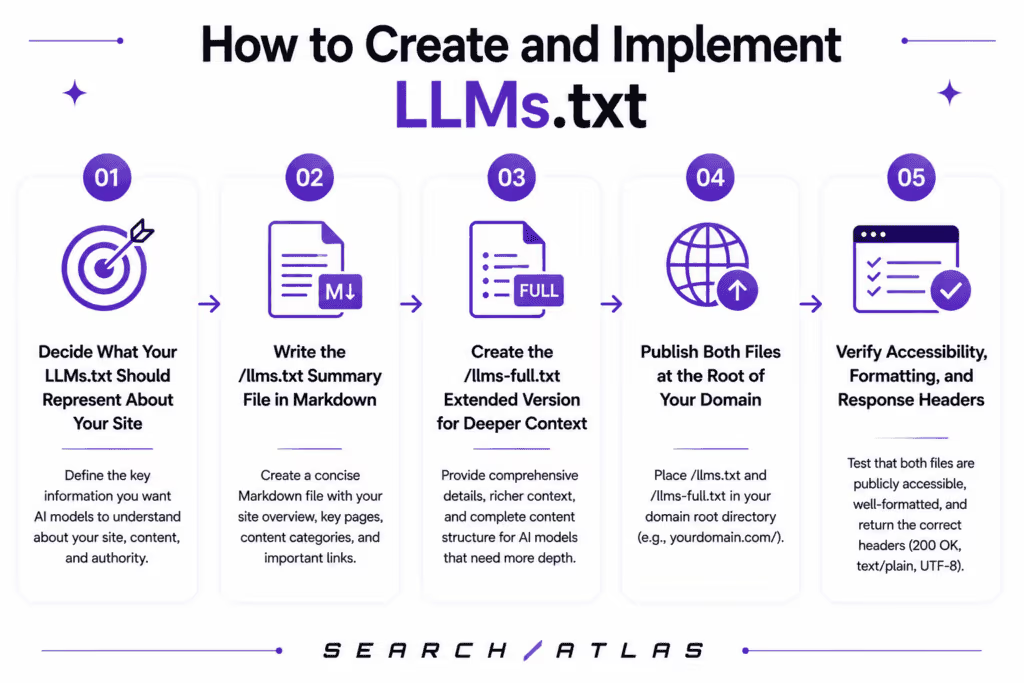
Creating and implementing LLMs.txt requires strategic content selection, structured documentation, and proper technical deployment. The process focuses on identifying the content that best represents a website and organizing that content into a format that AI systems understand efficiently. A well-implemented LLMs.txt file improves content discovery, strengthens contextual understanding, and gives language models a clearer representation of website expertise.
The 5 steps to create and implement LLMs.txt are listed below.
1. Define What Your LLMs.txt file needs to represent
Defining what the file needs to represent establishes the foundation for every decision that follows. This planning stage identifies the website’s purpose, audience, and most authoritative content areas. A clear definition improves consistency because every section, description, and linked resource reflects the same editorial priorities. Documentation websites often organize content around products, features, and APIs. Content publishers often organize content around primary topic clusters and areas of expertise.
What decisions need to be made before creating an LLMs.txt file? Every implementation requires three decisions. The first decision identifies the primary purpose of the website. The second decision identifies the intended audience. The third decision identifies the content that best represents expertise and topical authority. These decisions shape the opening summary, section structure, and page selection throughout the file.
How do websites with broad content coverage approach content selection? Broad websites require stronger editorial curation than narrowly focused websites. Equal representation across hundreds of topics reduces clarity and weakens orientation. Strong LLMs.txt files prioritize the content areas that best reflect expertise and authority. This prioritization creates a clearer understanding of website focus and subject matter specialization.
What is the outcome of the planning stage? The planning stage produces two deliverables. The first deliverable is a concise description of the website’s purpose and audience. The second deliverable is a prioritized list of important content sections and pages. These deliverables guide every subsequent implementation step and prevent the file from becoming an unstructured collection of URLs.
2. Create the /llms.txt Summary File
Creating the summary file establishes the primary entry point for AI systems. The summary file provides a structured overview of website content and directs language models toward the most important resources. A concise summary improves efficiency because AI systems receive context before retrieving individual pages.
What elements need to the /llms.txt file contain? Every summary file requires an H1 heading, a short website description, and organized content sections. The heading identifies the organization or website. The description explains the purpose and audience. The sections contain markdown links accompanied by short explanations that describe page relevance and topic coverage.
What role does the opening description play? The opening description provides critical context before AI systems evaluate individual links. Specific descriptions improve interpretation because language models understand the website’s industry, audience, and subject matter immediately. Strong descriptions establish a context that influences how every linked resource is evaluated.
How do pages need to be organized inside the summary file? Pages need to be grouped into logical sections that reflect major content categories. Category-based organization improves navigation because related resources appear together. Most implementations perform best with three to six representative links per section. This structure creates clarity without overwhelming the file with excessive detail.
3. Build the /llms-full.txt Extended File
Building the extended file provides a deeper context for AI systems that require detailed information. The extended file compiles important content into a single markdown document. This compilation gives language models direct access to knowledge without requiring multiple page requests.
What is the purpose of /llms-full.txt? The purpose of /llms-full.txt is to provide comprehensive content access within one document. The summary file points toward important resources, while the extended file contains the content itself. This distinction creates separate workflows for quick orientation and detailed analysis.
What content belongs inside /llms-full.txt? The strongest candidates include authoritative guides, documentation, educational resources, and foundational content. High-quality content strengthens contextual understanding because it reflects expertise and accuracy. Thin content, temporary campaigns, deprecated resources, and outdated information reduce quality and need to remain excluded.
How do /llms.txt and /llms-full.txt work together? The two files perform different functions within the same system. /llms.txt provides direction and prioritization. /llms-full.txt provides depth and comprehensive information. This division creates a layered approach that balances efficiency with content completeness.
4. Publish Both Files at the Domain Root
Publishing both files at the domain root ensures consistent accessibility across AI systems and developer tools. Standard placement improves discoverability because tools expect the files in predefined locations. Proper deployment removes unnecessary barriers between the file and the systems that consume it.
Where do LLMs.txt files need to be published? The files belong at the root of the website. Standard implementations place them at /llms.txt and /llms-full.txt. Root placement improves compatibility because AI tools frequently check these locations automatically during retrieval workflows.
What server configuration requirements matter most? The files need to return a successful HTTP response and remain accessible without authentication barriers. Plain text delivery improves compatibility because AI systems retrieve content directly without rendering page templates or executing scripts. Consistent delivery improves reliability across different retrieval environments.
What deployment mistakes commonly create accessibility issues? Incorrect placement, login restrictions, redirect chains, and template rendering issues create the most common deployment failures. These failures prevent AI systems from retrieving content efficiently. Direct file access remains the most reliable implementation approach.
5. Verify Accessibility and Maintain the Files
Verifying accessibility confirms that the implementation works as intended. Ongoing maintenance preserves accuracy as website content evolves. Regular reviews prevent outdated information from reducing file quality and usefulness.
How do website owners need to verify LLMs.txt deployment? Verification begins with checking accessibility, response status, and file formatting. Successful verification confirms that the file loads correctly and presents content in valid markdown format. Regular testing identifies technical issues before they affect retrieval workflows.
What formatting elements require review before publication? Review headings, links, descriptions, and markdown syntax before publication. Consistent formatting improves readability and reduces parsing inconsistencies. Clean markdown structures produce predictable results across different AI systems.
Why does ongoing maintenance matter? Website content changes over time through new publications, product updates, and content restructuring. Regular maintenance keeps linked resources current and removes outdated references. Current content improves contextual accuracy because AI systems receive information that reflects the present state of the website.
What Are the Best Practices for Writing an Effective LLMs.txt?
Writing an effective LLMs.txt file requires strong editorial judgment, clear organization, and ongoing maintenance. Effective LLMs.txt files provide meaningful orientation for AI systems instead of functioning as simplified sitemaps. Strong implementations improve contextual understanding because language models receive curated guidance about a site’s purpose, expertise, and most important resources.
The 6 best practices for writing an effective LLMs.txt file are listed below.
1. Open With a Direct Description of What Your Site Is and Who It Serves
**A direct description establishes the interpretive framework for the entire LLMs.txt file. **Language models process the opening description before evaluating links, sections, and resources throughout the document. Strong descriptions identify the organization, explain what it offers, and define the intended audience with clear and specific language. Specificity improves content interpretation because AI systems understand industry context before processing individual pages. Generic statements weaken orientation because they fail to distinguish a website from competing resources. A practical rule is to describe the site’s products, services, content, and audience instead of relying on promotional claims or broad marketing language.
2. Use Clean Markdown That an LLM Can Parse Without Ambiguity
Clean markdown improves readability and reduces interpretation errors across AI systems. Standard elements (headings, paragraphs, blockquotes, and markdown links) create a predictable structure that language models process consistently. Consistent formatting improves retrieval because important sections and resources remain easy to identify. Complex tables, nested structures, custom formatting, and HTML markup introduce ambiguity that reduces parsing reliability. Formatting mistakes weaken effectiveness because AI systems rely entirely on the structure provided within the file. A practical rule is to use the simplest markdown syntax necessary to communicate information clearly.
3. Link Only to Your Most Authoritative and Contextually Complete Pages
Authoritative pages provide the strongest representation of website expertise and subject matter coverage. Comprehensive resources improve contextual understanding because they answer questions thoroughly without requiring excessive navigation across supporting pages. High-quality documentation, cornerstone content, and detailed guides are strong candidates for inclusion. Thin pages, temporary campaigns, and outdated resources reduce value because they consume context without improving understanding. Every link communicates editorial priorities to AI systems. A practical rule is that every page included in the file needs to earn its position through authority, completeness, and relevance.
4. Keep the File Updated as Your Site’s Content and Scope Change
Regular maintenance preserves the accuracy and usefulness of an LLMs.txt file over time. Websites evolve through product launches, content updates, documentation changes, and audience shifts. Outdated files weaken orientation because AI systems receive an inaccurate representation of current expertise and content priorities. Broken links, deprecated resources, and superseded content reduce reliability and create confusion during retrieval. Scheduled reviews improve accuracy by ensuring that linked resources remain relevant and authoritative. A practical rule is to review the file quarterly and after any major change to content structure, product offerings, or documentation.
5. Use /llms.txt for the Summary and /llms-full.txt for Extended Content
The summary file and extended file perform different functions within the same content guidance system. The /llms.txt file provides orientation by highlighting the most important resources and content areas. The /llms-full.txt file provides depth by compiling the content itself into a single markdown document. This separation improves efficiency because AI systems retrieve only the level of information required for a specific task. Overloading the summary file with excessive detail reduces its usefulness and turns it into a compressed sitemap. A practical rule is to use the summary file for navigation and the extended file for comprehensive content access.
6. Do Not Replicate robots.txt Logic
LLMs.txt provides content guidance, while robots.txt manages crawler access and indexing behavior. Confusing these responsibilities creates implementation mistakes that reduce the effectiveness of both files. Access control directives belong in robots.txt because crawlers recognize and process those instructions through established protocols. Content descriptions, resource recommendations, and contextual summaries belong in LLMs.txt because AI systems use that information for orientation and content discovery. Mixing these functions creates false assumptions about content protection and crawler behavior. A practical rule is to treat robots.txt as the access layer and LLMs.txt as the guidance layer.
What Tools Help Generate or Validate LLMs.txt?
The tools that help generate or validate LLMs.txt create structured content guidance files, verify formatting accuracy, and simplify implementation across different website environments. LLMs.txt tools matter because manually creating and maintaining these files becomes difficult as websites grow in size and complexity. These tools automate file creation, identify structural issues, and improve the quality of content guidance provided to AI systems.
The 10 best tools that help generate or validate LLMs.txt are Search Atlas, Firecrawl, AIOSEO, Mintlify, GitBook, Fern, Rankability, Answer.AI, FreshJuice Tools, and Datastrive.
1. Search Atlas
Search Atlas helps validate the effectiveness of LLMs.txt implementations through AI visibility measurement, citation tracking, and brand monitoring across major AI platforms. Search Atlas evaluates how brands appear in AI-generated responses and identifies visibility opportunities after implementation. This evaluation matters because publishing an LLMs.txt file does not guarantee citations, mentions, or retrieval by AI systems. Search Atlas LLM Visibility tracks brand presence across ChatGPT, Gemini, Perplexity, and Claude, which provides a direct view of AI search performance. Businesses use Search Atlas to measure the real-world impact of their AI visibility strategy and identify opportunities to improve brand representation across AI ecosystems.
2. Firecrawl
Firecrawl generates both /llms.txt and /llms-full.txt files by crawling websites and extracting important content automatically. The platform scans site structure, identifies key resources, and converts that information into markdown files aligned with the LLMs.txt specification. This automation improves efficiency because website owners avoid building files manually from large content inventories. Firecrawl works particularly well for websites with extensive documentation or frequently updated content. Businesses use Firecrawl to accelerate implementation and establish a starting point for editorial review and refinement.
3. AIOSEO
AIOSEO generates LLMs.txt files directly within WordPress environments. The plugin integrates file creation into existing SEO workflows, which reduces deployment complexity for content teams and site administrators. This integration improves accessibility because website owners manage LLMs.txt alongside other optimization settings without additional development work. WordPress websites use AIOSEO to simplify implementation and maintain content guidance files through a familiar interface. The platform is particularly valuable for organizations that rely heavily on WordPress for content publishing and site management.
4. Mintlify
Mintlify automatically generates /llms.txt and /llms-full.txt files for documentation websites hosted on its platform. The system uses existing documentation structures to create organized content maps without requiring manual configuration. This automation improves consistency because documentation updates are reflected directly within generated files. Software companies use Mintlify to provide AI systems with structured access to product documentation, guides, and technical references. The platform is widely associated with early adoption of the LLMs.txt convention across developer-focused websites.
5. GitBook
GitBook generates LLMs.txt files from hosted documentation libraries and knowledge bases. The platform organizes content into structured sections that language models process efficiently. This structure improves contextual understanding because AI systems receive clear navigation paths across documentation resources. Organizations use GitBook to maintain synchronized documentation and content guidance files without managing separate workflows. The result is a more consistent representation of technical content across AI retrieval environments.
6. Fern
Fern generates LLMs.txt files from API documentation and developer resources. The platform focuses on technical documentation environments where language models frequently retrieve information during coding and implementation tasks. This specialization improves relevance because generated files reflect documentation hierarchies and product structures. Software companies use Fern to improve content accessibility for AI coding assistants and developer-focused retrieval systems. Strong documentation organization increases the value of generated files and improves contextual accuracy.
7. Rankability
Rankability combines LLMs.txt generation and validation within a single workflow. The platform evaluates file structure while generating content recommendations and organizational improvements. This dual approach improves quality because structural issues are identified before deployment. Website owners use Rankability to create files that align with emerging implementation standards while maintaining clear content hierarchies. The platform is particularly useful for organizations seeking both automation and quality control.
8. Answer.AI llms-txt
Answer.AI maintains the open-source llms-txt repository that provides reference tooling for file generation and processing. The repository includes command-line utilities that create, convert, and manage LLMs.txt implementations. This tooling improves flexibility because developers customize workflows according to their own requirements. Technical teams use the repository as a reference implementation when building custom solutions or integrating LLMs.txt into larger content management processes. The project remains closely connected to the original proposal behind the standard.
9. FreshJuice Tools
FreshJuice Tools generates LLMs.txt files from existing website structures and sitemap data. The platform identifies important pages and organizes them into markdown output designed for AI retrieval systems. This process reduces manual effort while creating an initial content framework for further refinement. Website owners use FreshJuice Tools to accelerate implementation and establish a baseline file before applying editorial review. The generated output provides a practical starting point for content curation.
10. Datastrive
Datastrive creates LLMs.txt files through automated website analysis and page categorization. The platform organizes content into logical groups and generates structured markdown files for AI systems. This organization improves discoverability because important resources appear within clear topical categories. Businesses use Datastrive to simplify implementation and reduce the time required to build content guidance files manually. Automated categorization provides a useful foundation for ongoing optimization and maintenance.
How Do LLMs.txt Generators Work and What Do They Miss?
LLMs.txt generators work by crawling websites, extracting content signals, and converting that information into a structured markdown file. These generators accelerate implementation because they automate page discovery, section organization, and description creation. Auto-generated files provide a useful starting point, but they often lack the editorial judgment required to create an effective LLMs.txt file. The result is a file that follows the specification while failing to communicate the site’s most important expertise, priorities, and content strengths.
LLMs.txt generators work by crawling sitemaps and website structures to identify pages for inclusion. Most tools extract URLs, page titles, metadata, and content summaries before organizing those resources into sections based on categories or URL hierarchies. This automation improves efficiency because large websites generate files in minutes rather than hours. The generated output follows the correct format and includes real content references. The limitation is that the organization reflects crawl patterns and metadata structures rather than strategic editorial decisions about which pages deserve attention.
LLMs.txt generators miss accurate positioning and audience context. Most tools build opening descriptions from title tags, meta descriptions, or other existing page elements. These descriptions often reflect marketing objectives rather than clear explanations of what the website does and who it serves. Weak descriptions reduce orientation because AI systems receive incomplete or generic context before evaluating the rest of the file. Strong LLMs.txt implementations require descriptions that accurately define expertise, audience, and purpose.
LLMs.txt generators miss editorial prioritization and content selection. Automated systems typically include pages based on crawl accessibility, sitemap inclusion, or URL hierarchy. This process creates comprehensive coverage but does not identify which pages provide the strongest representation of expertise and authority. High-value guides, cornerstone content, and authoritative resources deserve greater prominence than thin pages or low-priority content. Effective curation depends on human judgment because importance cannot be determined entirely through crawl data.
LLMs.txt generators miss scope control and long-term maintenance planning. Auto-generated files often include too many pages, which causes the file to resemble a compressed sitemap rather than a curated content guide. Excessive page inclusion weakens orientation because AI systems receive more information without receiving better guidance. The files are frequently generated once and published without an established review process. This approach reduces accuracy over time as websites add new content, retire outdated resources, and change strategic priorities.
LLMs.txt generators create syntactically correct files, but manual review improves contextual accuracy and content quality. Metadata-driven descriptions often inherit generic marketing language that provides little informational value for AI systems. Link selections frequently reflect crawl order instead of authority, relevance, or strategic importance. Reviewing the opening description, refining section organization, and validating page selection significantly improve the final result. The strongest LLMs.txt files combine automated generation with human editorial oversight.
What Are Common Mistakes When Implementing LLMs.txt?
Common mistakes when implementing LLMs.txt show how websites reduce the effectiveness of the file despite following the basic specification. These mistakes matter because LLMs.txt depends on content quality, editorial judgment, and ongoing maintenance rather than technical deployment alone. Poor implementation reduces orientation value, weakens content guidance, and limits the usefulness of the file for AI systems and developer tools.
The 8 most common mistakes when implementing LLMs.txt are listed below.
1. Publishing an auto-generated file without manual review. A website generates the file through an automated tool and publishes it without reviewing descriptions, sections, or page selection. This mistake creates a technically valid file that reflects metadata and crawl patterns instead of editorial priorities.
2. Using LLMs.txt as a compressed sitemap. A website includes every available URL instead of selecting the pages that best represent expertise and authority. This mistake reduces orientation value because AI systems receive volume instead of curation.
3. Writing a vague opening description. A file begins with generic language that fails to explain what the website does and who it serves. This mistake weakens contextual understanding because language models lack a clear interpretive framework before processing links and content sections.
4. Linking to low-value or outdated pages. A file prioritizes thin content, temporary campaigns, deprecated resources, or pages with limited informational value. This mistake wastes context capacity and reduces the quality of information available to AI systems.
5. Failing to create the /llms-full.txt extended file. A website publishes only the summary file despite maintaining extensive documentation or authoritative content. This mistake limits access to deeper context and reduces the usefulness of the implementation for advanced retrieval workflows.
6. Neglecting file maintenance after website changes. A file remains unchanged while content, products, documentation, and site structure evolve. This mistake creates an inaccurate representation of the website and increases the likelihood that AI systems retrieve outdated information.
7. Duplicating robots.txt logic inside LLMs.txt. A file contains access control directives, crawl restrictions, or user-agent instructions that belong in robots.txt. This mistake creates confusion because AI systems treat the content as guidance rather than executable instructions.
8. Treating LLMs.txt as a one-time deployment. A website publishes the file and assumes the implementation is complete. This mistake reduces long-term accuracy because the file becomes increasingly disconnected from the current state of the website as new content is published and older content changes.
These mistakes show that effective LLMs.txt implementation depends on curation, maintenance, and content quality rather than file existence alone. Strong implementations avoid these patterns by prioritizing accurate descriptions, authoritative content, ongoing updates, and clear separation between content guidance and access control.
Does LLMs.txt Affect SEO or Search Engine Rankings?
LLMs.txt does not affect SEO or search engine rankings. Search engines do not use LLMs.txt as a ranking signal, indexing signal, or crawling directive. The file exists to provide content guidance for AI systems rather than influence traditional search algorithms. This distinction matters because many website owners assume that AI-related technologies automatically improve rankings. Current evidence indicates that LLMs.txt contributes to content organization and AI accessibility, but not to search visibility in Google or other major search engines.
LLMs.txt does not influence Google Search rankings because Google has publicly stated that Googlebot does not use the file. Google representatives have confirmed that the convention carries no ranking weight and does not affect indexing, crawling, or visibility within traditional search results. This position places LLMs.txt in a category similar to informational metadata that exists without influencing ranking systems. Website owners publish the file without risk, but they do not expect ranking improvements from implementation alone.
Confusion exists because different Google products and teams have referenced LLMs.txt in different contexts. A brief appearance of an LLMs.txt file within Google documentation created speculation about official support. Experimental browser audits related to agentic browsing created additional uncertainty about Google’s position. These references led some publishers to assume that Google Search actively evaluates the file. Public statements from Google’s Search team have consistently clarified that LLMs.txt is not part of ranking or indexing systems.
LLMs.txt contributes to AI visibility differently than it contributes to SEO. The file provides context that helps AI systems understand website purpose, content organization, and important resources during retrieval and inference workflows. Better organization improves how AI systems navigate a website, but improved navigation does not guarantee citations, mentions, or inclusion in AI-generated responses. AI visibility depends primarily on content quality, topical authority, source credibility, and inclusion within the retrieval systems that AI platforms use to generate answers.
LLMs.txt needs to be viewed as one component of a broader AI visibility strategy rather than a standalone optimization tactic. Content quality, expertise, authority, and information accuracy remain the primary factors that influence representation across AI platforms. Publishing the file creates a structured path for AI systems to understand content, but the file does not place content into training datasets, guarantee retrieval, or increase citation frequency on its own. Measuring actual AI visibility requires monitoring AI citations, mentions, sentiment, and brand representation across platforms (ChatGPT, Gemini, Claude, and Perplexity).
Is LLMs.txt an Official Standard or a Proposed Convention?
LLMs.txt is a proposed convention rather than an official web standard. The specification was introduced by Jeremy Howard and is maintained by Answer.AI as a community-driven initiative. Unlike established web standards, LLMs.txt has not been formally adopted by organizations responsible for the Internet and web protocols. This distinction matters because adoption remains voluntary, platform support varies, and no AI system or search engine is required to implement the convention.
Official web standards receive formal recognition from established standards organizations and follow structured adoption processes. Standards (robots.txt and sitemap.xml) achieved broad support because they were documented through recognized specifications and implemented consistently across major platforms. This formalization creates predictable behavior because participating systems follow the same requirements and expectations. LLMs.txt does not have equivalent recognition, which means implementation decisions remain independent across AI platforms, developer tools, and search providers.
LLMs.txt operates as a proposed convention because adoption depends entirely on voluntary participation. Developers, documentation platforms, and AI tool providers choose whether to implement support based on their own priorities and use cases. This flexibility encourages experimentation and innovation, but it creates uneven adoption across the ecosystem. Some platforms actively read and use the file, while others ignore it completely. The result is a convention that provides value in specific environments without functioning as a universal requirement.
The lack of formal standardization affects how website owners need to evaluate implementation. A correctly implemented LLMs.txt file does not guarantee support from every AI platform or search provider. The benefits appear primarily in environments where tools actively use the file during retrieval and inference workflows. Developer documentation websites, API providers, and technical knowledge bases often receive the most practical value because many developer-focused AI tools have adopted the convention. This targeted value differs from standards (robots.txt), which receive broad support across the web.
The proposed convention status does not reduce the usefulness of LLMs.txt for organizations whose audiences rely on AI-assisted tools. The specification remains well documented, widely discussed within developer communities, and supported by a growing collection of platforms and tooling providers. These factors make implementation practical despite the absence of formal standardization. Organizations need to communicate the convention accurately to stakeholders by emphasizing that LLMs.txt represents a voluntary community standard rather than a universally recognized web protocol.
LLMs.txt needs to be viewed as an emerging convention with evolving adoption rather than a finalized industry standard. Future outcomes include formal standardization, continued voluntary adoption, or replacement by alternative approaches. Current implementation decisions need to focus on present-day value rather than future speculation. Websites that benefit from AI-assisted documentation discovery and developer workflows often find value today regardless of how the convention evolves.
Do All AI Platforms Read LLMs.txt Files?
No, not all AI platforms read LLMs.txt files. LLMs.txt adoption remains uneven across the AI ecosystem, with some developer-focused tools actively using the file while many major consumer-facing AI platforms have not confirmed support. This uneven adoption affects implementation value because the benefits depend on whether the AI systems interacting with a website actually use the file during retrieval and inference workflows.
LLMs.txt is designed to provide AI systems with a structured summary of a website’s most important content. AI platforms use retrieval systems, indexing pipelines, and inference workflows to discover and process information. These differences explain why support varies across platforms and why the presence of an LLMs.txt file does not guarantee that every AI system will read or use it.
Google has publicly stated that it does not use LLMs.txt within its search ecosystem. Google representatives have confirmed that Google Search, AI Overviews, and AI Mode do not rely on the file as part of indexing, crawling, or ranking processes. This position is significant because Google remains the largest search platform and one of the most influential sources of web content discovery. Current guidance from Google does not identify LLMs.txt as a visibility signal for search performance or AI-generated search experiences.
Developer-focused AI tools represent the strongest area of confirmed adoption. Coding assistants and documentation agents benefit directly from structured content guidance because they frequently retrieve information from technical documentation during active sessions. Tools (Cursor, Windsurf, Claude Code, Cline, and Aider) have demonstrated consistent use of LLMs.txt files when interacting with documentation websites. This behavior provides measurable value for API documentation, developer portals, and technical knowledge bases where efficient navigation is essential.
LLMs.txt delivers the greatest value for websites whose audiences rely heavily on developer tools and AI-assisted workflows. Documentation websites, software platforms, API providers, and technical education resources benefit because the tools their audiences use are known to read the file. This alignment increases the likelihood that AI systems retrieve relevant documentation and navigate content efficiently during coding and research tasks.
LLMs.txt needs to be viewed as a targeted optimization rather than a universal AI visibility solution. The implementation cost remains low, which makes adoption practical for most websites. The expected return varies significantly depending on audience type and platform usage patterns. Technical websites often gain the most value because developer-focused AI tools actively use the file. Consumer-focused websites need to treat LLMs.txt as a supplemental tactic rather than a primary strategy for improving AI visibility or citation frequency.
Should LLMs.txt Include Everything on Your Site or Just Key Pages?
LLMs.txt needs to include key pages rather than every page on a website. The purpose of the file is to provide AI systems with a curated overview of the content that best represents a site’s expertise, products, and resources. This approach improves efficiency because language models operate within context limitations and cannot evaluate an entire website during every retrieval session. Effective LLMs.txt files prioritize quality, relevance, and authority rather than comprehensive URL coverage.
LLMs.txt focuses on key pages because the convention was designed to address context limitations within language models. AI systems need a concise overview of what a website offers without processing thousands of pages individually. Curation improves orientation because language models receive a carefully selected collection of resources that accurately represent the site’s primary topics and expertise. A file that lists every URL provides little advantage over an existing sitemap and reduces the value of editorial selection.
LLMs.txt improves content understanding by prioritizing authoritative and representative resources. Comprehensive guides, cornerstone content, product documentation, and permanent reference materials provide stronger signals about expertise than large collections of thin or repetitive pages. These resources improve contextual understanding because they explain topics thoroughly and reflect the site’s most important knowledge areas. Strong curation creates a clearer picture of the website’s purpose and subject matter coverage.
LLMs.txt and /llms-full.txt performs different roles within the content guidance process. The summary file typically contains a curated collection of the most important pages, often between ten and forty resources, organized into logical sections. The extended file provides greater depth by compiling authoritative content into a single document. Large websites benefit from maintaining this distinction because category pages, cornerstone resources, and reference materials provide more value than thousands of individual products, articles, or listings.
LLMs.txt becomes less effective when it attempts to include everything on a website. Excessive page inclusion increases file size, reduces clarity, and weakens the orientation value that the convention was designed to provide. Large files begin functioning as compressed sitemaps rather than curated guides. This shift reduces efficiency because AI systems need to process significantly more information without receiving better guidance about what matters most.
LLMs.txt performs best when every included page contributes meaningfully to content understanding. Pages deserve inclusion when they improve a language model’s understanding of the site’s expertise, products, services, or subject matter coverage. Comprehensive resources strengthen orientation because they provide accurate and complete representations of important topics. Thin content, outdated resources, redundant pages, and low-value promotional content reduce effectiveness because they consume context without improving understanding. The strongest LLMs.txt files prioritize editorial judgment over URL volume.