Multi-touch attribution is a conversion measurement method that assigns fractional credit to each recorded touchpoint in a conversion path. A single-session path gets one touchpoint. A 6-session path gets six. The model (last-touch, first-touch, linear, time-decay, position-based, or data-driven) determines how credit is divided across those sessions.
AI influence is the effect that AI citations have on user awareness, brand recall, and downstream conversion behavior, regardless of whether any click occurred. An AI assistant recommends a page. The user reads the recommendation. No click follows. That event shifts purchase intent without creating a session record, and no multi-touch model scores it.
The zero-click attribution gap is the structural difference between how many conversions AI citations influence and how many of those conversions analytics traces back to an AI session. The gap exists because attribution requires a session, and a session requires a click. Citations that satisfy the user’s need inside the AI response never generate that click.
The touchpoint visibility problem is resolved before model selection matters. There are 6 standard attribution models in GA4. All 6 distribute credit across the sessions they observe. For an AI citation that produced no session, all 6 models produce the same result. Zero credit is assigned to AI. Choosing a more sophisticated model on incomplete data produces a more sophisticated version of the same wrong answer.
Why Standard Multi-Touch Attribution Models Miss AI Influence?
Standard multi-touch attribution models miss AI influence because they require a session record to assign credit, and AI citations frequently produce no session record. A touchpoint in any multi-touch model is an individual session tied to a specific channel. Every model distributes credit across the sessions it observes. Sessions reach analytics only when a user clicks a link and a referrer header passes to the destination.
What happens when an AI assistant cites a page without the user clicking? When an AI assistant cites a page in a response and the user reads that answer without clicking, no visit occurs. No session enters the analytics system. The citation shifts awareness, brand recall, or purchase intent without generating a single data point for any attribution model process.
What makes AI influence structurally different from other attribution challenges? AI influence differs from dark traffic or other data gaps because the underlying event (the citation) occurs in a closed system tthat he destination site cannot observe. Dark traffic describes clicks where the referrer header is stripped. Zero-click AI influence describes citations where no click ever occurs. These are different phenomena with different measurement requirements.
What does model selection depend on before it becomes meaningful? Model selection depends on whether AI citations appear as named touchpoints in the conversion path. Without that condition, every model (last-touch, first-touch, linear, time-decay, position-based, data-driven) produces the same result. The nearest recorded touchpoint receives credit that belongs to the invisible AI citation upstream. Changing the model does not fix attribution when the input data is incomplete.
What Multi-Touch Attribution Requires to Assign Credit?
Any attribution model requires a session record as the unit of a touchpoint before it is assigned conversion credit. The model then applies a weighting rule across those recorded sessions. Without a session, no rule applies. A session record is created when a user clicks a link, the destination server receives the HTTP request, and a referrer header identifies the originating source. GA4 reads that referrer header and maps it to a channel. A channel group configured to catch AI-platform referrers (chat.openai.com, perplexity.ai, claude.ai, gemini.google.com) labels those sessions as AI traffic.
What prevents AI traffic from creating complete session records? AI traffic fails to create complete session records for 2 reasons. Firstly, some AI platforms strip the referrer header before the click reaches the destination, creating a session with no identifiable source. These sessions enter analytics as direct or unassigned traffic rather than AI referral traffic. Secondly, many AI citations never produce a click because the user finds the answer within the AI response and does not continue to the source.
What is the measurement consequence of incomplete session records? The measurement consequence is that GA4 session counts for AI-referred traffic represent a lower bound, not a complete count. A custom channel group built on AI referrer patterns captures only sessions where the referrer header passed through intact. Sessions where the header was stripped count toward direct traffic. That gap cannot be resolved through model selection; it requires a tracking fix.
The Zero-Click Attribution Gap in AI Search
The zero-click attribution gap is the difference between the influence an AI citation has on user awareness and the session data that attribution models actually observe. An AI assistant cites a page. The user reads the citation and forms an impression of the brand. No click occurs. The session count stays at zero. The attribution model has no record to process.
What types of AI interactions most frequently produce zero-click gaps? Three AI interaction types most frequently produce zero-click attribution gaps. Firstly, question-answer queries where the AI response contains the full answer and no follow-up visit is needed. Secondly, comparative queries where the AI summarizes multiple options and the user selects one without visiting individual pages. Thirdly, brand recall queries where the AI mentions a brand as part of a broader recommendation, and the user later searches for that brand directly.
What is the result of a zero-click attribution gap at the model level? At the model level, a zero-click attribution gap means the AI citation is structurally absent from every conversion path. The model distributes credit across the recorded sessions only. The branded search session, the organic session, or the direct session that follows days or weeks later receives full or fractional credit as if no upstream influence existed. The model is not wrong by its own logic; it simply cannot score what it cannot see. This is the same structural divide that separates measurable AI traffic from AI influence more broadly.
Why Do AI Citations Often Never Become Recorded Touchpoints?
An AI citation becomes a recorded touchpoint only when the cited URL is clicked, and the destination analytics system receives a session with an identifiable referrer. Both conditions are met. A click without a recognizable AI referrer enters analytics as direct or unassigned traffic and never reaches a custom AI channel group.
What are the 4 conditions that prevent an AI citation from becoming a recorded touchpoint? The 4 conditions that prevent AI citations from becoming recorded touchpoints are listed below.
- The user reads the AI response and absorbs the citation without clicking the source link.
- The AI platform redirects the click through an intermediate URL that strips the original referrer header.
- The user copies and manually visits the URL in a new session, generating a direct visit rather than an AI referral.
- The AI platform surfaces a page excerpt or summary that satisfies the user’s need without requiring a visit.
What does referrer stripping mean for AI channel measurement? Referrer stripping means that GA4 session counts for AI-referred traffic represent a floor, not a full count. The gap between true AI-referred visits and measured AI-referred visits cannot be resolved through model selection; it requires a tracking correction.
The Delayed Conversion Path From AI Citation to Branded Search
The delayed conversion path describes the sequence where an AI citation creates brand awareness, the user does not immediately visit the site, and a branded search or direct visit occurs days or weeks later as the user acts on the earlier impression. This sequence is attribution’s most difficult AI scenario because the influence event and the measurable event are separated in time.
How long is the typical delay between an AI citation and a downstream branded search? The typical delay between an AI citation and a downstream branded search ranges from 2 to 6 weeks for content-led conversion paths. The delay reflects how AI influence works. It creates awareness during a research phase, and the user converts during a later decision phase. A 7-day or 14-day attribution window misses this gap entirely and credits the downstream session as if no prior influence existed.
What attribution window captures delayed AI influence? An attribution window of at least 30 days captures the full range of delayed AI influence for most content-led conversion paths. GA4 allows attribution windows up to 90 days. For high-consideration purchases with longer research phases, a 60-day or 90-day window is more accurate. The default 30-day GA4 window is a starting floor, not a ceiling.
Why does the delayed conversion path make attribution window configuration critical? The delayed conversion path makes window configuration critical because a narrow window systematically excludes the AI touchpoint even when the AI session generated a click. A 7-day window means an AI session from Day 1 receives zero credit for a conversion on Day 14. The last-click touchpoint within the window (a branded search on Day 13) receives full or disproportionate credit. The error is not in the model logic. It is in the window configuration.
Why Standard Analytics Credits the Wrong Touchpoint by Default?
GA4’s default attribution model is data-driven attribution (DDA), but DDA falls back to last-click silently when conversion volume drops below the minimum threshold. Most content teams with moderate traffic volumes hit this fallback without knowing it. The result is a last-click model reporting inside a data-driven label, which systematically credits the final branded search or organic session before conversion.
What is the minimum conversion threshold for GA4 data-driven attribution? GA4 data-driven attribution requires a minimum of 400 conversions per month across the selected conversion event to remain active. Below that threshold, the model silently reverts to last-click. The reporting interface does not flag the fallback. Teams with fewer than 400 monthly conversions run last-click attribution while believing they run DDA.
Why does last-click fail for AI-influenced conversion paths specifically? Last-click fails for AI-influenced conversions because it credits the touchpoint immediately before the conversion, which is where the user lands after the actual influence has already occurred. AI citations operate at the awareness stage. Last-click credits the decision stage. The branded search or direct session that follows an AI citation is a consequence of the AI influence, not its cause. Last-click inverts the credit.
What does crediting the wrong touchpoint by default mean for reporting accuracy? Crediting the wrong touchpoint by default means that the reported contribution of AI channels to conversion systematically understates actual AI influence. Every report, every channel comparison, and every budget decision built on that data reflects a model that does not account for the upstream AI touchpoint. The undercount is not random noise; it is a structural bias that grows larger as AI citations become more common.
What Happens When the AI Touchpoint Is Missing From the Conversion Path?
When the AI touchpoint is missing from the conversion path, every standard attribution model distributes credit across the remaining recorded sessions. The downstream touchpoints that benefit from AI influence (branded search, direct, organic) receive the credit. The model does not produce an error. It produces a confidently wrong answer.
What happens when the AI touchpoint is missing is listed below.
- Last-Touch Attribution Overcredits Organic and Direct Traffic
- First-Touch Attribution Still Misses Invisible AI Citations
- Linear Attribution Cannot Credit Unrecorded Sessions
- Time-Decay Models Undercount Long-Latency AI Influence
- Position-Based Models Better Reflect Awareness-Stage Influence
- Data-Driven Attribution Requires Named AI Channels and High Conversion Volume
Last-Touch Attribution Overcredits Organic and Direct Traffic
Last-touch attribution credits the final recorded session before conversion with 100% of the conversion credit. When an AI citation produces a zero-click interaction or a stripped-referrer session, the final branded search or direct session receives that full credit. The AI citation receives nothing.
What conversion path example shows last-touch overcrediting downstream channels? A 4-touchpoint path illustrates the problem. The path includes an AI citation on Day 1 (zero-click), an organic visit on Day 8, a branded search on Day 14, and a conversion on Day 15. Last-touch attributes 100% of the credit to the branded search. The organic session and the AI citation receive nothing. The report shows branded search as the primary driver. Budget decisions informed by that report will underinvest in AI-citation content and overinvest in branded search campaigns.
What is the specific danger of last-touch as the default model for AI attribution? The specific danger is that last-touch is the most likely model to be active by default via GA4’s DDA fallback. Teams that believe they run DDA but fall below the 400-conversion threshold are actually running last-touch. The combination of a wrong default model and an invisible fallback means last-touch errors accumulate in reporting without the team recognizing them. For a deeper comparison of these two single-touch models specifically, see first-touch vs last-touch attribution for AI sources.
First-Touch Attribution Still Misses Invisible AI Citations
First-touch attribution credits the first recorded session in the conversion path with 100% of the conversion credit. When the AI citation produces no click, the first recorded session is whatever organic, direct, or paid visit followed the AI interaction. First-touch assigns full credit to that session, skipping the AI citation entirely.
When does first-touch attribution accidentally capture AI influence? First-touch captures AI influence only when the AI session is both the first touchpoint and produces a click with an intact referrer header. In that narrow scenario, the AI-referred session receives 100% credit as the path entry point. That outcome depends on two conditions that frequently fail. The click occurs, and the referrer passes through intact.
What is the core limitation of first-touch for longer AI-influenced paths? First-touch ignores all middle and final touchpoints, which means it cannot reflect paths where AI influence occurs at a middle or late stage. For content pages that receive AI citations mid-funnel, first-touch misses the influence entirely if the user entered via organic or direct first. The model is accurate only when the AI session is demonstrably the path entry point.
Linear Attribution Cannot Credit Unrecorded Sessions.
Linear attribution distributes conversion credit equally across all recorded sessions in the path. For a path containing 4 recorded sessions, each receives 25% credit. The AI citation, absent from the recorded path, receives 0%. Linear attribution does not produce a worse answer than last-touch or first-touch for the AI session it sees; it simply cannot compensate for sessions it cannot see.
What is the value of linear attribution when AI sessions are recorded? Linear attribution is appropriate when all touchpoints are recorded, and no single stage deserves disproportionate weight. For AI-influenced paths where the AI session appears as a named channel, linear attribution distributes credit without penalizing early or late positions. This makes it more accurate than last-touch or time-decay for multi-stage paths where the AI session arrived early.
What is the primary limitation of linear attribution for AI influence measurement? The primary limitation of linear attribution is that equal weighting ignores the awareness-stage role that AI citations typically play. AI citations are disproportionately influential at the start of a research journey. Linear attribution treats an AI citation at path entry the same as a direct visit 30 minutes before conversion. For AI influence, that equivalence produces a systematic undercount of the citation’s actual contribution.
Time-Decay Models Undercount Long-Latency AI Influence
Time-decay attribution assigns higher credit to touchpoints closer in time to the conversion. An AI-referred session from Day 1 that contributed to a conversion on Day 30 receives a fraction of the credit given to a branded search session from Day 29. The weighting function penalizes early touchpoints regardless of their actual influence.
Why does time-decay attribution specifically fail for AI-influenced conversions? Time-decay fails for AI-influenced conversions because AI influence operates at the awareness stage, which is structurally early in the conversion path. The model’s weighting logic is designed for paths where recency correlates with purchase intent. That assumption does not hold for AI citations, which create awareness weeks before a decision-stage visit occurs. The model penalizes the most influential touchpoint for arriving early.
What is the practical result of time decay for AI influence reporting? The practical result is a systematic undercount of AI channel contribution to conversions. Teams running time-decay attribution see AI-referred sessions with a lower attributed conversion value than their actual influence warrants. The model makes AI content appear less effective than it is, leading to underinvestment in AI citation strategies.
Position-Based Models Better Reflect Awareness-Stage Influence
Position-based attribution assigns weighted credit to specific positions in the conversion path rather than distributing credit equally or by recency. The U-shaped model assigns 40% to the first touchpoint and 40% to the last touchpoint, with 20% distributed across middle sessions. The W-shaped model adds a third concentration at the lead creation event. Both models give more weight to path entry, which is where AI-referred sessions appear when trackable.
Which position-based model fits AI-influenced conversions better? W-shaped attribution fits AI-influenced conversions better than U-shaped attribution when AI sessions appear at path entry and a distinct lead creation event is present. The W-shaped model’s three credit concentrations (path entry, lead creation, conversion) map more accurately to the typical AI-influenced journey. An AI citation drives the initial visit, a form submission or email signup marks the lead creation point, and a direct or branded search session triggers the final conversion.
What is the limitation of position-based attribution for AI influence? Position-based attribution still requires AI sessions to appear as recorded touchpoints to assign them credit. For zero-click scenarios, neither U-shaped nor W-shaped attribution credits the AI citation. The position-based advantage over last-touch and time-decay applies only when the AI session is visible to the model.
Data-Driven Attribution Requires Named AI Channels and High Conversion Volume
Data-driven attribution (DDA) uses machine learning to calculate the marginal contribution of each touchpoint to conversion probability. The algorithm analyzes all recorded conversion paths and counterfactual paths (paths that did not convert) to estimate the incremental value each channel adds. GA4 DDA uses Shapley values from cooperative game theory to distribute credit proportionally to each channel’s measured contribution.
What does data-driven attribution require that other models do not? Data-driven attribution requires 2 specific inputs that other models do not need. Firstly, a minimum of 400 conversions per month on the selected conversion event to train the model reliably. Secondly, the AI channel appears as a named, recognized channel with sufficient conversion path data for the algorithm to learn its marginal contribution. Without these inputs, DDA reverts to last-clicking silently.
Why can DDA be the most accurate model for AI influence when conditions are met? DDA is the most accurate model for AI influence when conditions are met because it does not impose a fixed weighting rule. Last-touch, first-touch, linear, and time-decay all apply predetermined credit formulas regardless of how each channel actually influences conversion. DDA learns the actual contribution pattern from observed path data. For teams where AI is a high-volume named channel, DDA recognizes that AI sessions at path entry increase downstream conversion probability and credits them accordingly.
Which Multi-Touch Attribution Models Work Best for AI-Influenced Conversions?
The correct sequence is to fix touchpoint visibility first, then select a model based on the available data. A model chosen before the AI touchpoint is visible produces confidently wrong results regardless of model type. Model selection is a data question. Touchpoint visibility is a measurement question that precedes it. The multi-touch attribution models are listed below.
- First-Touch Attribution for AI Discovery Journeys
- Position-Based Attribution for Awareness-Stage AI Influence
- Data-Driven Attribution for High-Volume AI Conversion Paths
- Custom Hybrid Attribution Models for AI-Assisted Journeys
1. First-Touch Attribution for AI Discovery Journeys
First-touch attribution is best suited for AI discovery journeys where the AI-referred session is demonstrably the path entry point. For content-led funnels where AI citations drive top-of-funnel awareness for audiences with no prior brand exposure, first-touch captures the AI session’s role as the initiating event. The model gives 100% credit to the starting touchpoint, which reflects the awareness contribution of the AI citation.
What are the 3 conditions under which first-touch is appropriate for AI traffic? The 3 conditions under which first-touch is appropriate for AI traffic are listed below.
- The AI-referred session is consistently the first recorded session in conversion paths.
- The conversion volume is below the DDA threshold, making algorithmic models unavailable.
- The reporting goal is to quantify awareness contributions rather than full-path influence.
What is the risk of using first-touch for broader AI influence measurement? The risk is that first-touch ignores middle and late-funnel touchpoints entirely. For multi-session journeys where the AI citation appears after an initial organic discovery, first-touch misattributes the discovery to the earlier organic session. First-touch is a partial answer, not a complete attribution solution for AI-influenced paths.
2. Position-Based Attribution for Awareness-Stage AI Influence
Position-based attribution is the right choice when AI sessions are identifiable, consistently appear at or near path entry, and the conversion volume is below the DDA threshold. W-shaped attribution rewards path entry and lead creation, which maps to the role AI citations play in awareness-stage journeys. This makes it more accurate than linear or time-decay for most content-led AI influence scenarios.
What conversion volume range is position-based attribution best suited for? Position-based attribution is best suited for teams with monthly conversion volumes between 50 and 400 conversions per tracked event. Below 50 conversions, no model produces statistically reliable results. Above 400 conversions with AI as a named channel, DDA becomes available and more accurate. The 50-to-400 range is where position-based models offer the best trade-off between accuracy and data availability.
What does position-based attribution report that other models miss? Position-based attribution reports higher credit to AI-referred sessions at path entry than time-decay or last-touch assigns. For a path where the AI session is first, a W-shaped position-based approach gives it approximately 30% of conversion credit. Last-touch gives it 0%. Time decay gives it the smallest fractional share. The difference in reported AI attribution value is significant for any business case built on content-led AI visibility.
3. Data-Driven Attribution for High-Volume AI Conversion Paths
Data-driven attribution is more accurate because it learns the actual contribution pattern from observed conversion path data rather than applying a fixed rule. For teams with high conversion volumes and AI as a named channel, DDA calculates how much more likely a path is to convert when it includes an AI-referred session. That learned probability becomes the credit assigned to the AI channel.
What is the minimum conversion volume for reliable data-driven attribution in GA4? GA4 requires a minimum of 400 conversions per month on the selected conversion event for DDA to operate reliably. This threshold applies to each conversion event independently. A team tracking both a lead form event and a purchase event meets the 400-conversion threshold for each event separately. Missing the threshold on one event causes DDA to revert to last-click for that event while remaining active for others.
What does data-driven attribution produce that position-based attribution cannot? Data-driven attribution produces credit weights that reflect observed path data rather than assumed positions. For an AI channel that consistently appears at path entry and is followed by higher-than-average conversion rates, DDA assigns that channel a credit weight that exceeds the 40% U-shaped or 30% W-shaped cap. Position-based models cap credit at the predetermined weights regardless of the channel’s actual influence. DDA removes that ceiling.
4. Custom Hybrid Attribution Models for AI-Assisted Journeys
A custom hybrid attribution model combines a standard session-based MTA layer with a branded search proxy overlay to produce an estimated floor and ceiling for AI contribution. The floor is the session-based model output (position-based or linear) applied to recorded AI sessions. The ceiling adds the estimated AI influence derived from branded search lift and direct traffic spikes on AI-cited pages. The hybrid approach acknowledges that complete AI attribution is not achievable and quantifies the range instead.
Why does a hybrid model produce more defensible reporting than a single model? A hybrid model produces more defensible reporting because it separates what is measured from what can only be estimated. Reporting a single attribution number for AI influence implies more precision than the data supports. A floor-and-ceiling range explicitly communicates the measurement uncertainty while still providing a basis for channel comparison and budget decisions.
What are the 3 components of a custom hybrid attribution model? The 3 components of a custom hybrid attribution model are listed below.
- A session-based MTA layer using position-based or linear attribution for recorded AI sessions.
- A branded search lift overlay measuring the increase in branded query volume on AI-cited pages over a comparable period.
- A direct traffic pattern analysis identifying spikes on deep-content pages that correlate with AI citation activity.
AI Attribution Models Compared
The 6 standard attribution models produce significantly different credit distributions for AI-influenced conversion paths. The differences are largest when the AI session is at path entry (first-touch and position-based perform best), when a long delay separates the AI session from conversion (time-decay performs worst), and when the AI session is absent entirely (all models fail equally).
| Model | Credit when the AI session is missing | Credit when an AI session is present | Fit for AI influence |
| Last-touch | 100% to the final organic or direct session | 100% to the final session (rarely the AI session) | Poor — always credits downstream |
| First-touch | 100% to the first recorded session | 100% to the AI session if first | Moderate — depends on path position |
| Linear | Equal credit to all recorded sessions | Equal credit, including an AI session | Low — no awareness weighting |
| Time-decay | Highest credit to sessions closest to conversion | Penalizes early AI session | Poor — long-latency influence undercounted |
| Position-based (W-shaped) | Credits first and key middle sessions | Credits AI session if at entry or key middle | Good — awareness weighting matches AI role |
| Data-driven (DDA) | Credit distributed by observed conversion probability | AI channel weighted by observed probability | Best — when volume and visibility thresholds are met |
Last-Touch Attribution and AI Influence
Last-touch attribution assigns 100% of conversion credit to the session immediately before the conversion event. For AI-influenced paths, this session is typically branded search or direct, because those are the channels users access during the decision stage after the AI citation has already influenced their awareness. Last-touch credits the decision stage and ignores the awareness stage entirely.
What is the specific failure mode of last-touch for AI attribution? The specific failure mode is that last-touch treats the downstream behavioral consequence of AI influence as the cause of the conversion. The branded search exists because an AI citation created awareness. Last-touch credits the search and ignores the citation, systematically misidentifying the influence chain. Reports built on last-touch data will always show AI as a minor channel regardless of its actual contribution.
What does last-touch attribution produce for a 30-day AI-influenced path? For a 30-day path where an AI citation on Day 1 drives awareness and a branded search on Day 29 precedes the conversion, last-touch assigns 100% credit to the branded search. The AI session, even if it was recorded with an intact referrer, receives 0% credit. The data-driven report built on this output will show branded search as the dominant channel and AI as negligible. Budget allocation based on that output underinvests in AI citation content.
First-Touch Attribution and AI Discovery
First-touch attribution assigns 100% of conversion credit to the first session in the conversion path, making it the only rule-based model that fully credits an AI-referred session at path entry. For new-audience acquisition journeys where an AI citation introduces a brand to a user with no prior exposure, first-touch accurately reflects the discovery contribution.
What does first-touch miss for AI-influenced paths with multiple sessions? First-touch misses the contribution of every middle and final touchpoint in multi-session paths. For paths with 3 or more sessions, first-touch ignores all sessions that moved the user from initial awareness to conversion. The model treats the conversion as fully determined by the first session, which is accurate for simple paths but increasingly wrong as path complexity grows.
When is first-touch the best available model for AI attribution? First-touch is the best available model when AI-referred sessions are consistently first in recorded paths, conversion volumes are below the DDA threshold, and the reporting goal is channel-level awareness measurement. In these conditions, first-touch is transparent, auditable, and provides a reasonable credit estimate for the AI channel’s discovery role. It does not capture multi-touch influence, but it does not misrepresent it either.
Linear Attribution and AI-Assisted Paths
Linear attribution is appropriate for AI-assisted conversion paths when no single stage has a demonstrably larger influence on the outcome. For even-distribution paths where each session reflects a distinct research step and no step is clearly more influential than others, linear attribution produces a fair distribution. This scenario is plausible for low-consideration, multi-touchpoint journeys.
What does linear attribution miss that position-based captures? Linear attribution misses the higher weight that awareness-stage touchpoints deserve for AI-influenced journeys. AI citations create the initial condition for all subsequent sessions. A model that treats the first session (AI citation) the same as the last session (branded search 30 minutes before conversion) ignores the qualitative difference in those sessions’ contributions. Position-based models correct this by concentrating credit at path entry and key conversion events.
What is the one scenario where linear attribution outperforms position-based for AI paths? Linear outperforms position-based attribution when AI-referred sessions appear consistently throughout the middle of a conversion path rather than at path entry. For paths where a user returns to AI-sourced content multiple times during a long research phase, linear attribution distributes credit across all those sessions proportionally. Position-based attribution would concentrate credit at the first and last sessions, underweighting the multiple mid-path AI sessions.
Time-Decay Attribution and Long Conversion Delays
The structural problem is that time-decay’s weighting logic (closer sessions receive higher credit) directly contradicts how AI influence operates (earlier sessions carry the awareness contribution). Time decay was designed for multi-channel paths where recency correlates with intent. AI citations are awareness signals, not intent signals, and time-decay systematically discounts them.
What conversion path scenario illustrates time decay’s failure for AI influence? A 3-session path illustrates time decay’s failure clearly. The path includes an AI citation on Day 1 that shifts brand awareness, an organic search on Day 20 for a category keyword, and a branded search on Day 28 that precedes a conversion on Day 29. Time-decay assigns the highest credit to the Day 28 branded search, moderate credit to Day 20 organic, and negligible credit to Day 1 AI. The model credits the intent signal and discards the awareness signal, producing a report that shows branded search as the dominant channel.
What is the half-life effect in time-decay attribution for AI sessions? The half-life effect in standard time-decay models (typically configured at 7 days) means an AI session from Day 1 on a 30-day conversion path receives approximately 1% of the credit given to a same-day session. A 14-day gap produces approximately 13% of same-day credit. The longer the conversion path, the more severely time decay penalizes the AI session at path entry. For 6-week AI-influenced paths, the Day 1 AI session receives negligible credit regardless of its actual influence contribution.
How to Surface AI Influence as a Trackable Touchpoint?
The 3 methods for surfacing AI influence as a trackable touchpoint are listed below.
- Method 1. GA4 custom channel group for AI-attributed sessions.
- Method 2. Branded search lift as a proxy touchpoint signal.
- Method 3. Citation monitoring to annotate conversion windows.
What does Method 1 (GA4 custom channel group) capture? A GA4 custom channel group captures AI-referred sessions by matching referrer patterns from known AI platforms. The channel group uses regex to match session sources (chat.openai.com, perplexity.ai, claude.ai, gemini.google.com, copilot.microsoft.com) and assigns them to a named AI channel. This is the floor of AI traffic measurement. It captures only the sessions where a click occurred, and the referrer passed through intact.
What does Method 2 (branded search lift) capture? Branded search lift captures the increase in branded query volume that correlates with AI citation activity on specific pages. When an AI assistant begins citing a page, branded searches for the site or brand name rise in the queries that the AI answers. This lift is measured in Google Search Console by filtering for branded queries and comparing volume before and after citation activity began. Branded search lift is a proxy signal, not a session-level touchpoint, and it estimates zero-click influence that the GA4 channel group cannot see.
What does Method 3 (citation monitoring) capture? Citation monitoring tracks when and where an AI assistant cites specific pages and maps that citation activity to a conversion timeline. For pages cited by AI platforms, citation monitoring records the date the citation began, the platform citing it, and the frequency of citation appearances. That data is overlaid on the conversion path timeline to identify whether conversion rates or branded search volume rose after citations increased. This method produces inference-level evidence, not session-level data.
What tool provides citation monitoring for AI platforms? Search Atlas’s LLM Visibility Tool m****onitors brand mentions and citations across ChatGPT, Claude, Gemini, and Perplexity. The tool tracks visibility percentages, sentiment evaluations, citation sources, and competitor benchmarks. For attribution purposes, the relevant output is the citation source data. Which pages are being cited, on which platforms, and with what frequency? That output is aligned against the GA4 conversion timeline to build an annotated path model.
Why does citation monitoring produce inference rather than proof? Citation monitoring produces inference rather than proof because it documents that a citation occurred, but cannot establish a direct causal link to a specific conversion. A citation observed in the LLM Visibility Tracker on Day 1 has or has not been seen by the specific user who converted on Day 30. The connection is probabilistic. The inference is strengthened when citation activity is high and branded search lift occurs within a correlated time window, but it remains an estimate, not a measured touchpoint.
What is the combined output of all 3 methods? The combined output of all 3 methods is a two-layer measurement system. Layer one uses the GA4 custom channel group to capture the floor. The verified AI-referred sessions that appear as named touchpoints in attribution models. Layer two uses branded search lift and citation monitoring to estimate the ceiling. The additional AI influence that never produces a session record. Reporting both layers produces a range that is more accurate and more defensible than a single session count.
How to Configure Attribution for AI-Influenced Journeys?
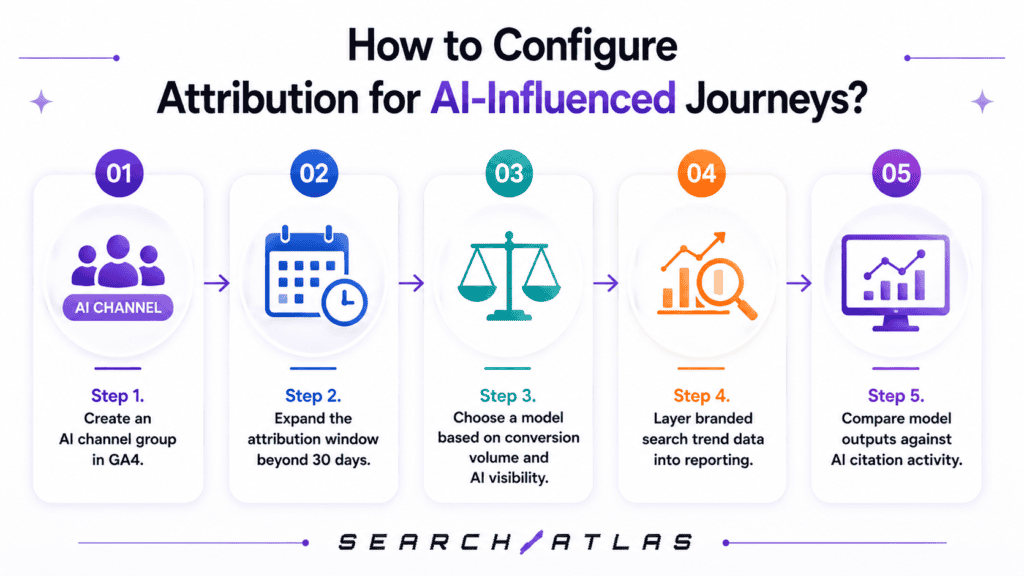
The 5 steps for configuring attribution to capture AI-influenced conversions are listed below.
- Step 1. Create an AI channel group in GA4.
- Step 2. Expand the attribution window beyond 30 days.
- Step 3. Choose a model based on conversion volume and AI visibility.
- Step 4. Layer branded search trend data into reporting.
- Step 5. Compare model outputs against AI citation activity.
Step 1: Create an AI Channel Group in GA4
Creating an AI channel group in GA4 consolidates all AI-platform referral sessions into a named channel that attribution models score. Without a custom channel group, GA4 maps AI-referred sessions to the Referral or Organic Social channels depending on the source. The AI channel group separates those sessions so attribution models treat AI traffic as a distinct, measurable input.
How is an AI channel group created in GA4? The AI channel group is created in GA4 Admin under Data display, then Channel groups. In the channel group editor, create a new channel named “AI Referral” with conditions that match the referrer field against a regex pattern for AI platform domains. The regex pattern covers the primary AI platforms (chat.openai.com, perplexity.ai, claude.ai, gemini.google.com, copilot.microsoft.com) and requires updates as new platforms gain adoption.
What is the effect of the AI channel group on attribution model outputs? The AI channel group causes attribution models to recognize AI-referred sessions as a distinct channel and assign them credit separately from Organic or Referral. Before the channel group, AI traffic was absorbed into broader channels, and no model reported its contribution. After the channel group, any model (last-touch, first-touch, linear, position-based, DDA) reports an “AI Referral” line in the attribution report that shows its assigned credit.
Step 2: Expand the Attribution Window Beyond 30 Days
An attribution window of at least 60 days is the recommended setting for content-led AI influence, with 90 days preferred for high-consideration purchases. GA4’s attribution window controls the lookback period within which touchpoints qualify for credit. Narrow windows (7 days, 14 days) exclude AI sessions that occurred early in the research phase, assigning their credit to later touchpoints.
Where is the attribution window configured in GA4? The attribution window is configured in GA4 Admin under Attribution settings. GA4 provides 3 lookback window options for engagement events. The default is 30 days. For AI-influenced journeys with typical delays of 2 to 6 weeks between citation and conversion, setting the window to 60 days or 90 days captures a significantly higher proportion of upstream AI sessions.
What happens to attribution accuracy when the window is too narrow? When the attribution window is too narrow, AI sessions that occurred outside the window are excluded from every conversion path. The model receives an incomplete path and distributes credit among the touchpoints that remain within the window. This produces an accurate result for the data the model sees, but the reported AI channel contribution is lower than the actual contribution. Widening the window does not change what happened; it changes how much of what happened the model is allowed to score.
Step 3: Choose a Model Based on Conversion Volume and AI Visibility
W-shaped position-based attribution is the primary model for AI influence for teams with fewer than 400 monthly conversions. Position-based attribution requires no minimum conversion volume and gives disproportionate credit to path entry, where AI-referred sessions appear when trackable. It is the most accurate rule-based model available for teams below the DDA threshold.
What model fits teams with more than 400 monthly conversions? Teams with more than 400 monthly conversions and AI as a named channel use data-driven attribution as the primary model. DDA learns the AI channel’s marginal contribution from path data and assigns it credit without a predetermined weighting rule. This produces more accurate results than any rule-based model when the input data meets the minimum volume requirements.
What model fits teams with very low conversion volumes? Teams with fewer than 50 monthly conversions on the target event use first-touch attribution when AI sessions consistently appear at path entry. Below 50 conversions, statistical noise in the path data renders any model unreliable. First-touch applies a consistent, transparent rule that the team audits and explains. DDA and position-based modeling are deferred until volume increases.
Step 4: Layer Branded Search Trend Data Into Reporting
Layering branded search trend data into attribution reporting adds an estimated ceiling to the session-based attribution floor. The GA4 model output (floor) shows attributed conversions from recorded AI sessions. The Google Search Console branded query trend data shows whether branded search volume rose in correlation with AI citation activity. The gap between floor and ceiling is the estimated zero-click influence that no model directly captures.
How is branded search trend data extracted from Google Search Console? Branded search trend data is extracted from Google Search Console by filtering the Performance report for queries containing the brand name and comparing weekly or monthly query volume across periods before and after AI citation activity increased. For pages that receive new AI citations, the comparison period is the 30 days before and 30 days after citation activity began. An increase in branded query volume for those pages during that window is the proxy signal for zero-click AI influence.
What does branded search lift indicate for attribution reporting? Branded search lift indicates that AI citations are influencing user behavior beyond what session-level attribution observes. A 20% increase in branded queries for a cited product page during the 30 days following a new AI citation suggests that the citation is driving brand recall and deferred visits. That signal, layered over the GA4 attribution output, extends the model’s view of AI influence without requiring session-level data for zero-click interactions.
Step 5: Compare Model Outputs Against AI Citation Activity
Comparing model outputs against AI citation activity reveals whether the attribution model is capturing the AI channel’s contribution in proportion to its actual citation presence. A model that reports low AI channel contribution during a period of high citation activity suggests the touchpoint visibility problem is not fully resolved. A model that shows AI contribution rising in correlation with rising citation activity suggests that the tracking and model configuration are working together.
What data is needed to run this comparison? The 3 data inputs needed to compare model outputs against citation activity are listed below.
- GA4 attribution report segmented by the AI channel group, showing monthly attributed conversion credit.
- Search Atlas LLM Visibility Tool output showing citation volume, visibility percentage, and citation source trends by month.
- Google Search Console branded query volume trends for the same pages and time periods.
How is the comparison structured? The comparison is structured as a 3-column timeline. Column 1 shows monthly AI channel attribution credit from GA4. Column 2 shows citation volume from the Search Atlas LLM Visibility Tool. Column 3 shows branded search volume from Google Search Console. When all 3 columns rise together, the attribution model is capturing the AI effect. When citation volume rises, but attribution credit does not, the touchpoint visibility problem requires attention.
How Attribution Windows Affect AI Influence Reporting?
An attribution window is the time range within which a recorded session qualifies as a touchpoint toward a specific conversion event. Any session outside the window is excluded from the conversion path and receives no credit from any model. For AI-influenced journeys with delayed conversions, an undersized attribution window systematically excludes early AI sessions and reallocates their credit to later touchpoints.
What are the 4 attribution window settings available in GA4? The 4 attribution window settings available in GA4 are listed below.
- 1 day (acquisition events only, for experimental use cases).
- 30 days (GA4 default for engagement events).
- 60 days (recommended for content-led AI influence).
- 90 days (recommended for high-consideration purchases with extended research phases).
How does a 30-day window compare to a 60-day window for AI-influenced paths? A 30-day window excludes AI sessions from weeks 5 through 8 of a conversion journey that took 60 days from the first AI citation to conversion. A 60-day window includes those sessions. The difference in reported AI channel attribution credit between a 30-day and 60-day window is directly proportional to the number of AI sessions that fell between Days 31 and 60 of the conversion path. For audiences in a long research phase, this difference is substantial.
What is the relationship between attribution window length and the delayed conversion path? The attribution window is at least as long as the median delay between an AI citation and the downstream conversion for the model to capture the AI session reliably. A team that knows its AI-influenced conversion delay is typically 5 weeks requires a window of at least 35 days, preferably 60 days, to ensure the AI session falls within the lookback period. Using a shorter window means accepting a known undercount.
Why do most teams use an undersized attribution window for AI-influenced content? Most teams use an undersized attribution window because the GA4 default is 30 days, and attribution settings are rarely revisited after initial setup. The 30-day default was appropriate for shorter-cycle performance marketing paths where the gap between a session and a conversion is typically measured in hours or days, not weeks. Content-led AI influence operates on a different timescale, and the default setting does not accommodate it.
What is the practical effect of a 7-day window on AI attribution? A 7-day window makes AI influence attribution nearly impossible for content-led funnels. For a path where an AI citation on Day 1 leads to a conversion on Day 12, the AI session falls entirely outside the 7-day lookback window. The model attributes 100% of the conversion to the session on Day 12 (the conversion session) or Day 11 (a branded search). The AI citation receives no credit in any model. The 7-day window produces reports that are accurate for paid search and shopping campaigns, and wrong for content-led AI influence.
When to Use Position-Based vs Data-Driven Attribution for AI Influence?
The primary decision factor is monthly conversion volume on the target event. Data-driven attribution requires 400 monthly conversions to remain active in GA4. Below that threshold, DDA falls back to last-click. Position-based attribution has no minimum volume requirement. The model choice is not a preference. It is determined by the data available. The situations are listed below.
- Position-Based Attribution for Low- and Mid-Volume Teams
- Data-Driven Attribution for High-Volume Conversion Paths
- Minimum Conversion Thresholds for Reliable Data-Driven Attribution
- When GA4 Falls Back From Data-Driven Attribution to Simpler Models
Position-Based Attribution for Low- and Mid-Volume Teams
Position-based attribution is the appropriate choice for teams with monthly conversion volumes between 50 and 399 conversions per tracked event. In this range, DDA is either unavailable (below 400 conversions) or unreliable (marginal 400-to-499 range). Position-based models apply a transparent, consistent weighting rule that produces auditable, explainable attribution without requiring a machine learning minimum.
What does a position-based attribution report for AI-influenced paths mean in practical terms? For a 4-session path where the AI session is first and a branded search is last, W-shaped position-based attribution assigns approximately 30% credit to the AI session, 30% credit to the branded search, 30% credit to the lead creation event, and 10% distributed across the remaining middle session. Last-touch would assign 100% to the branded search and 0% to the AI session. The difference in reported AI contribution between the two models is the business case for choosing position-based over last-touch.
Why is W-shaped attribution more accurate than U-shaped for content-led AI funnels? W-shaped attribution is more accurate than U-shaped for content-led AI funnels because it adds a third credit concentration at the lead creation event. Content-led funnels often include an explicit lead creation step (email signup, demo request, form submission) between the initial AI citation and the final conversion. U-shaped (40-20-40) compresses the lead creation event into the 20% middle allocation. W-shaped gives the lead creation event its own credit block, producing a more accurate path model for content-led journeys.
Data-Driven Attribution for High-Volume Conversion Paths
Data-driven attribution learns the incremental conversion probability contribution of the AI channel from observed high-volume path data. The Shapley value algorithm compares paths that include AI-referred sessions against paths that do not and calculates how much higher the conversion rate is for paths with an AI session. That incremental probability becomes the AI channel’s credit weight, adjusted dynamically as new data accumulates.
What is the advantage of DDA over position-based attribution for high-volume teams? The advantage of DDA over position-based attribution is that DDA’s credit weights are empirically derived rather than assumed. Position-based models assume that path entry deserves 40% (U-shaped) or 30% (W-shaped) credit. DDA calculates the actual contribution weight from conversion path data. For high-volume teams where AI sessions appear across diverse path positions, DDA produces more accurate weights than any fixed-position model.
What type of AI influence is DDA best at identifying? DDA is best at identifying AI influence that is consistent, high-frequency, and distributed across diverse path positions. When AI-referred sessions appear early in some paths, in the middle of others, and occasionally at the end, rule-based models assign credit based on position rules that fit only one of those patterns. DDA learns all three patterns from the data and assigns credit weights that reflect the actual distribution. This is DDA’s structural advantage over any fixed-weight model.
Minimum Conversion Thresholds for Reliable Data-Driven Attribution
GA4 requires a minimum of 400 conversions per month per conversion event for data-driven attribution to remain active and reliable. This threshold applies independently to each conversion event. A purchase event with 450 monthly conversions runs DDA. A lead form event with 150 monthly conversions falls back to last-click. The two events in the same property run different attribution models simultaneously without any interface warning.
What happens to model accuracy between 400 and 600 monthly conversions? Between 400 and 600 monthly conversions, DDA operates but trains on a relatively small dataset. The model’s credit weights are more volatile in this range because small path-level changes (a new campaign, a seasonal shift in channel mix) significantly alter the learned weights. Teams in this conversion volume range monitor DDA outputs for unusual swings and compare against position-based attribution as a stability check.
What is the practical implication of the 400-conversion threshold for the AI attribution strategy? The 400-conversion threshold means that most small-to-mid-size content teams run position-based attribution rather than DDA for AI channel measurement. The threshold is per event, not per site, so teams with high traffic but low conversion events (newsletter signups, micro-conversions) have ample traffic but insufficient conversion data. This is a structural reason why position-based attribution is the default recommendation for content-led AI attribution, not a fallback.
When GA4 Falls Back From Data-Driven Attribution to Simpler Models
GA4 falls back from DDA to last-click attribution when the monthly conversion volume for a specific event drops below 400 conversions. This fallback occurs silently. The attribution settings page still shows “Data-driven” as the selected model, but the reports reflect last-click weights. There is no notification, no footnote, and no change in the interface to indicate the fallback has occurred.
How is the DDA fallback detected? The DDA fallback is detected by comparing the AI channel’s attribution credit in the model comparison report against what a last-click model would produce. For a functioning DDA model, the “Data-driven” column in the model comparison produces different credit weights from the “Last click” column, especially for early-path channels. For a model in fallback, both columns match exactly. Identical columns indicate last-click is running.
What action corrects the situation when GA4’s DDA falls back to last-click? The correction is to switch the reporting model explicitly to W-shaped position-based attribution. Running reports on a labeled “Data-driven” model that is actually last-click is more misleading than running last-click explicitly, because it implies algorithmic accuracy that the data cannot support. Switching to position-based attribution makes the model choice transparent and produces more accurate AI channel credit than last-click.
How to Compare Attribution Models When AI Touchpoints Are Incomplete?
The correct approach is to compare model outputs across 3 data states. They are all sessions present, AI sessions absent, and AI sessions partially tracked. Running the model comparison across these 3 states shows how much the model’s credit distribution changes as AI visibility improves. This comparison reveals whether improving touchpoint visibility changes the attribution result materially, or whether the AI channel’s contribution is too small to register, regardless of model choice.
What does the model comparison report in GA4 show? The GA4 model comparison report shows how 3 attribution models (last-click, first-click, and a third model of the user’s choice) distribute conversion credit across all channels simultaneously. The report allows direct comparison of how much credit the AI channel receives under each model. For teams troubleshooting AI attribution, the relevant comparison is between last-click (the likely fallback) and W-shaped position-based attribution.
What does a large gap between last-click and position-based attribution indicate? A large gap between last-click and position-based attribution indicates that AI-referred sessions consistently appear early in conversion paths and receive credit only under models that weight path entry. The gap quantifies the attribution difference. A 20-percentage-point gap means that position-based attribution assigns the AI channel 20 points more conversion credit than last-click. That 20-point difference is the correction applied by choosing a model appropriate for AI influence.
What does a small or zero gap between last-click and position-based attribution indicate? A small or zero gap indicates that AI-referred sessions are not appearing early in conversion paths, or that the AI channel group is not capturing AI sessions. When all models produce the same result for the AI channel, the touchpoint visibility problem has not been resolved. Model selection cannot fix what the model input does not contain.
What is the correct response when the model comparison shows no improvement for AI channels? The correct response is to investigate the channel group configuration before comparing additional models. Check that the GA4 custom channel group regex matches the current AI platform domain patterns. Verify that the AI channel group is receiving sessions by checking the acquisition report for AI Referral traffic in the previous 30 days. A channel group that produces zero sessions for 30 days indicates a regex configuration error or a complete absence of AI-referred clicks during that period.
What Are the Best Practices for AI Influence Attribution?
The 6 best practices for AI influence attribution are listed below.
- Fix touchpoint visibility before comparing models.
- Separate recorded AI sessions from estimated AI influence.
- Use position-based attribution for awareness-led journeys.
- Extend attribution windows for content-led conversion paths.
- Combine GA4 attribution with citation monitoring.
- Validate attribution results against branded search trends.
1. Fix Touchpoint Visibility Before Comparing Models
Fixing touchpoint visibility is the priority because no model produces accurate results for a touchpoint that does not exist in the session data. Every attribution model distributes credit among the sessions it observes. A missing AI touchpoint is not a modeling problem; it is a data collection problem. Choosing a better model on incomplete data produces a more sophisticated version of the same wrong answer.
What are the 3 touchpoint visibility fixes that precede model selection? The 3 touchpoint visibility fixes that precede model selection are listed below.
- Create a GA4 custom channel group with a regex pattern matching AI platform referrers.
- Set the attribution window to 60 or 90 days to capture delayed conversions from early AI sessions.
- Verify that the AI channel group is receiving sessions by checking the GA4 acquisition report for AI Referral traffic in the previous 30 days.
What does verifying the channel group tell the team? Verifying the channel group output tells the team whether AI-referred sessions are being captured at all. A channel group with 0 sessions over 30 days indicates one of 3 conditions. No AI-referred clicks occurred, the regex pattern is incorrect, or AI clicks are arriving but being categorized under a higher-priority channel group that matches first. Each condition requires a different fix, and all three are ruled out before model selection becomes meaningful.
2. Separate Recorded AI Sessions From Estimated AI Influence
Recorded AI sessions are visits where an AI platform referrer was identified and a session was created in GA4. Estimated AI influence includes the additional zero-click and stripped-referrer effects that produce branded search lift and direct traffic patterns without generating a recognized session. These two categories require different measurement approaches and are reported separately, not combined into a single number.
Why does combining recorded sessions with estimated influence produce misleading reports? Combining recorded sessions with estimated influence produces misleading reports because the confidence level of the two categories is different. Recorded sessions are data. The estimated influence is inferred from proxy signals. Adding them produces a number that looks like a session count but includes an inference-level estimate. Stakeholders reading that number cannot distinguish the measured from the estimated portion. Reporting them separately makes the uncertainty visible and the estimate defensible.
What is the recommended reporting structure for separating the two categories? The recommended reporting structure uses a two-row table. The first row shows GA4 attribution data: AI channel sessions, attributed conversions, and attributed conversion value. The second row shows proxy signal data. Branded search volume change, direct traffic change on cited pages, and the estimated influence range derived from those signals. The two rows are presented as “Measured (floor)” and “Estimated (ceiling)” respectively.
3. Use Position-Based Attribution for Awareness-Led Journeys
An awareness-led journey begins with a brand discovery event (AI citation, organic content visit, or social impression) and ends with a decision-stage event (branded search, direct visit, or paid click) after a research phase. A performance-led journey begins with immediate purchase intent and ends with a same-day or next-day conversion. Attribution model choice depends on which journey type dominates the traffic.
Why is position-based attribution better than linear for awareness-led journeys? Position-based attribution is better than linear for awareness-led journeys because linear treats all sessions equally and discards the qualitative difference between a discovery session and a conversion session. For awareness-led journeys, the discovery session (AI citation) is the event that initiates the path. Giving it the same credit as a 2-minute branded search session 4 weeks later misrepresents how the conversion happened. W-shaped attribution assigns higher credit to path entry, which reflects the awareness session’s initiating role.
What is the signal that a team is running the wrong model for awareness-led AI journeys? The signal is that the GA4 attribution report shows AI channel sessions rising, but the AI channel attributed conversion credit is staying flat. This pattern indicates that AI sessions are being recorded in the channel group, but the model is not assigning them credit because it does not weight early-path sessions highly. Switching from last-touch to W-shaped position-based attribution in this scenario will produce a visible increase in reported AI channel conversion credit without any change in the underlying data.
4. Extend Attribution Windows for Content-Led Conversion Paths
The recommended attribution window for content-led AI conversion paths is 60 days as the default, with 90 days for high-consideration purchases. Content-led AI influence typically operates over a research phase of 2 to 6 weeks. A 60-day window ensures that AI sessions from the start of a 6-week research phase are included in the conversion path. A 30-day window cuts off the first 2 weeks of a 6-week path.
What is the risk of extending the attribution window too far? The risk of extending the window too far is that old sessions from unrelated research phases begin appearing in conversion paths. A user who visited an AI-cited page 89 days ago for a different research task does not represent the same purchase intent as the conversion. Extending to 90 days captures those sessions and potentially overcredits channels that influenced a prior decision. The recommended approach is 60 days as a default and 90 days only for categories where research cycles are demonstrably long.
How does extending the attribution window interact with model choice? Extending the attribution window increases the number of early-path AI sessions that become eligible for credit, but only produces higher AI attribution credit when combined with a model that weights early-path sessions. A 90-day window with last-touch attribution still assigns all credit to the final session. A 60-day window with W-shaped position-based attribution assigns 30% to the first session within that window. Window extension and model selection work together; neither alone resolves the AI attribution undercount.
5. Combine GA4 Attribution With Citation Monitoring
Combining GA4 attribution with citation monitoring produces a two-layer view of AI influence. They are a session-level floor from GA4 and an annotation-level ceiling from citation data. The floor is the attribution credit assigned to the AI channel in the selected model. The ceiling is the estimated additional influence from citations that did not produce a session. Together, the two layers quantify the range of AI contribution rather than a single imprecise point.
How is citation monitoring data connected to the GA4 attribution timeline? Citation monitoring data is connected to the GA4 attribution timeline by aligning citation start dates from Search Atlas’s LLM Visibility Tool with the conversion timeline from GA4. For each cited page, the citation start date is annotated on the GA4 report as a vertical marker. Changes in conversion rate, branded search volume, or direct traffic that follow the citation start date are flagged as correlation-level evidence of AI influence. This annotation does not produce a session-level touchpoint; it provides context for interpreting the attribution model output.
What output does the Search Atlas LLM Visibility Tool provide for this alignment? The LLM Visibility Tool provides citation source data (which pages are cited on which platforms), visibility percentage trends over time, and citation frequency data. The citation frequency data is the primary input for the attribution alignment. A sustained increase in citation frequency on a specific page, mapped to a 30-day window on the GA4 conversion timeline, provides the correlation basis for estimating upstream AI influence. The tool’s cross-model data (ChatGPT, Claude, Gemini, Perplexity) allows the alignment to cover citations across platforms rather than just one AI source.
6. Validate Attribution Results Against Branded Search Trends
Validating attribution results against branded search trends involves comparing the AI channel’s attributed conversion credit in GA4 against the branded query volume trend in Google Search Console for the same pages and time periods. When AI attribution credit and branded search volume rise, the attribution model is capturing the AI effect. When citation activity rises but neither attribution credit nor branded search volume rises, the tracking setup requires investigation.
What are the 3 outcomes of the validation comparison, and what do each indicate? The 3 outcomes of the validation comparison are listed below.
- Attribution credit rises with branded search volume. The channel group is working, and the model is capturing the AI effect accurately.
- Attribution credit is flat, but branded search volume rises. AI sessions are occurring but not being captured in the channel group, likely due to referrer stripping.
- Both attribution credit and branded search volume are flat despite rising citation activity. The citations are not producing user behavior changes, or the pages are being cited in contexts that do not reach the target audience.
What action follows each outcome? Each outcome maps to a different action. For the first outcome, no action is needed. The setup is working. For the second outcome, the priority is expanding the channel group regex and investigating whether AI platforms are routing clicks through referrer-stripping intermediaries. For the third outcome, the priority is auditing the citation content itself. The cited pages’ ability to convert AI-referred traffic from awareness to action, and whether the AI citation context matches the target audience’s query intent.
What Are the Limitations of Multi-Touch Attribution for AI Influence?
Multi-touch attribution has 4 fundamental limitations that apply specifically to AI-influenced conversion paths. These limitations are structural and cannot be resolved by model selection alone. They are listed below.
- The first limitation is the zero-click attribution gap. AI citations that produce noclicksk cannot be scored by any session-based model. Attribution requires a session. A zero-click citation leaves no session. No model type (rule-based or algorithmic) assigns credit to an interaction that the session-based system did not record. This limitation is inherent to how web analytics works and cannot be removed by choosing a different model.
- The second limitation is the referrer stripping problem. AI platforms vary in how reliably they pass referrer headers. Sessions arriving from AI platforms without an intact referrer appear as direct or unassigned traffic and cannot be isolated in a custom channel group. The proportion of AI traffic lost to referrer stripping is unknown and varies by platform, browser, and link type. This produces a floor-only view of AI traffic, not a complete count.
- The third limitation is the minimum volume requirement for algorithmic attribution. DDA requires 400 monthly conversions per event and falls back to last-click silently when that threshold is not met. For most content-led teams with moderate conversion volumes, the only reliable model options are rule-based. Rule-based models impose predetermined credit weights that do not reflect the actual contribution pattern of the AI channel.
- The fourth limitation is the attribution window constraint. Even with correct tracking and an expanded window, conversions that occur beyond the maximum 90-day window receive no credit from any session before that point. For high-consideration B2B purchases where research cycles extend beyond 90 days, the attribution model will systematically undercount AI influence from early research-phase sessions. The 90-day maximum is a GA4 platform constraint.
What is the appropriate reporting posture given these limitations? The appropriate posture is to report an estimated range (floor from session-based attribution, ceiling from proxy signals) rather than a single precise figure. Complete attribution for AI-influenced conversions is not achievable with current analytics tools. A well-configured GA4 setup with the correct model, an expanded window, and a branded search overlay produces a defensible range, not a definitive count. Overstating attribution precision is a credibility risk in any stakeholder report.
What Common Mistakes Break AI Attribution Reporting?
The 6 most common mistakes that break AI attribution reporting are listed below.
- Treating model selection as the primary fix before resolving touchpoint visibility.
- Running data-driven attribution without checking whether the conversion volume threshold is met.
- Using a 7-day or 14-day attribution window for content-led AI influence.
- Conflating dark traffic with zero-click AI influence in reporting.
- Using last-touch attribution as a simplification for stakeholder reports.
- Treating branded search lift as a direct session-level touchpoint.
What is the result of treating model selection as the primary fix? Treating model selection as the primary fix produces a more sophisticated version of the wrong answer. For an AI touchpoint absent from the session data, no model (last-touch, first-touch, linear, position-based, DDA) assigns it credit. Switching from last-touch to W-shaped position-based attribution without fixing the channel group produces identical results for AI, because both models distribute credit among the same incomplete set of recorded sessions.
What is the result of running DDA without checking the volume threshold? Running DDA without checking the volume threshold means the reports reflect last-click weights while displaying “Data-driven” as the model. The GA4 interface does not flag the fallback. Teams reading a “Data-driven” report below the 400-conversion threshold are reading a last-click report and making budget decisions on the assumption that marginal contributions have been calculated. The error is invisible until the model comparison report is consulted.
What is the result of using a narrow attribution window? Using a 7-day or 14-day attribution window for content-led AI influence means that AI sessions from the awareness phase are excluded from every conversion path. The model distributes credit among shorter-window sessions only, producing an attribution report where branded search and direct sessions appear to drive nearly all conversions. The AI channel shows low or zero contribution, not because it has low influence, but because its sessions fall outside the measurement window.
What is the difference between dark traffic and zero-click AI influence? Dark traffic is a session where a click occurred, but the referrer header was stripped before reaching the destination analytics system. Zero-click AI influence is the behavioral effect of an AI citation where no click occurred. These are different phenomena. Dark traffic is an undercount of AI-referred sessions. Zero-click influence is an unmeasured behavioral effect that never becomes a session regardless of tracking configuration. Conflating them produces a reporting category that mixes sessions (dark traffic) with inferences (zero-click influence) into a single undifferentiated number.
Why is last-touch attribution a damaging simplification for AI-influenced paths? Last-touch attribution is a damaging simplification because it systematically credits the decision-stage touchpoint (branded search, direct) and discards the awareness-stage touchpoint (AI citation) that enabled the decision. Presenting last-touch data as a simplified stakeholder report embeds a model bias that, over time, causes underinvestment in content strategies that drive AI citations and overinvestment in branded search campaigns that capture conversions the AI citations already influenced.
Why is branded search lift not a direct session-level touchpoint? Branded search lift is a proxy signal, not a session-level touchpoint, because it cannot be associated with a specific conversion path. Branded search volume rises when AI citations increase. That correlation is evidence of AI influence at the population level. It does not identify which sessions were influenced by which citations. A single branded search session in GA4 cannot be labeled “AI-influenced” based on the branded search lift signal alone. The signal belongs in the overlay layer of the hybrid model, not in the session-level attribution model.
Does Time-Decay Attribution Undercount AI Influence?
Yes. Time-decay attribution systematically undercounts AI influence because it assigns higher credit to touchpoints closer in time to the conversion, and AI citations operate at the awareness stage, which is structurally early in the conversion path. An AI citation from Day 1 receives a fraction of the credit given to a branded search on Day 29 under time-decay weighting. The model’s recency assumption directly contradicts the temporal position of AI’s influence contribution.
What is the magnitude of time-decay undercounting for AI influence? The magnitude depends on the gap between the AI session and the conversion. For a 30-day conversion path, an AI session at Day 1 under a standard time-decay model (7-day half-life) receives approximately 1% of the credit given to a same-day session. For a 14-day gap, the Day 1 session receives approximately 13% of the same-day credit. The longer the conversion path, the more severely time decay penalizes the AI session.
What model replaces time decay for AI influence measurement? W-shaped position-based attribution replaces time decay for AI influence measurement for teams with conversion volumes below 400 per month. Position-based attribution gives approximately 30% credit to path entry, 30% to lead creation, and 30% to conversion, regardless of when those events occurred. The AI session at path entry receives 30% whether it occurred 2 days or 60 days before conversion. This time-neutral weighting is more accurate for AI-influenced paths than time decay’s recency bias.
Is Data-Driven Attribution Better Than Position-Based Attribution for AI Influence?
Data-driven attribution is more accurate than position-based attribution for AI influence when the minimum conversion volume threshold is met, and AI is a named, high-volume channel. Below the 400-conversion threshold, DDA falls back to last-click, which is worse than position-based attribution. Above the threshold with sufficient AI-channel data, DDA’s empirically derived weights outperform position-based attribution’s fixed weights because DDA learns the actual contribution pattern from path data.
What is the practical decision rule for choosing between DDA and position-based? The practical decision rule is conversion volume. Teams with fewer than 400 monthly conversions per event use W-shaped position-based attribution. Teams with 400 or more monthly conversions use data-driven attribution. Teams between 400 and 600 conversions use data-driven attribution but monitor for volatility and cross-check against position-based as a stability reference.
When is position-based attribution preferred over DDA even at high volume? Position-based attribution is preferred over DDA at high volume when the reporting audience requires a transparent, explainable credit distribution. DDA’s Shapley value calculations are not directly explainable to a non-technical stakeholder. W-shaped position-based attribution produces a simple, auditable distribution (approximately 30-10-30-30 across a 4-touchpoint path) that stakeholders verify and challenge. For reporting to executives or clients who need to understand the methodology, position-based attribution’s transparency is a practical advantage over DDA’s accuracy.