First-touch and Last-touch attribution for AI sources are attribution models that assign conversion credit to different stages of AI-influenced customer journeys. First-touch attribution credits the earliest recorded interaction, while Last-touch attribution credits the final measurable session before conversion. This distinction explains how attribution models interpret conversational AI discovery, branded search behavior, and downstream conversion activity across analytics systems.
First-touch and Last-touch attribution matter because conversational AI platforms influence customer journeys differently from traditional search channels. Platforms (OpenAI ChatGPT, Anthropic Claude, and Perplexity AI) frequently generate awareness before measurable website visits occur. Analytics systems that rely on session data struggle to connect those conversational discovery interactions with later branded searches, direct traffic sessions, and conversions. This attribution challenge changes how teams measure SEO performance, AI visibility, and customer acquisition impact.
First-touch and Last-touch attribution create measurable reporting differences across AI-influenced journeys. First-touch attribution improves visibility into conversational discovery when referral data remains preserved, while Last-touch attribution emphasizes closing interactions instead of upstream awareness generation. Referral stripping, zero-click behavior, and invisible AI interactions reduce attribution accuracy across both models because analytics platforms record only measurable sessions. This limitation weakens visibility into how conversational AI systems contribute to revenue and conversion activity.
First-touch and Last-touch attribution require measurement frameworks that combine attribution reporting, AI visibility tracking, proxy signals, and behavioral analysis together. Attribution models alone cannot expose invisible conversational interactions that never generated measurable sessions. Accurate AI attribution analysis depends on structured tracking, custom AI channel groupings, branded search monitoring, direct traffic analysis, and conversational citation visibility across AI platforms. This combined approach improves visibility into how AI-generated discovery influences awareness, engagement, and long-term customer acquisition.
What Is First-Touch Attribution for AI Sources?
First-touch attribution for AI sources assigns 100% of conversion credit to the first AI interaction in a customer journey. First-touch attribution measures how AI platforms introduce brands before direct visits, organic searches, or paid clicks occur. First-touch attribution reflects how discovery changes inside AI-driven search environments, where platforms (OpenAI ChatGPT, Anthropic Claude, and Perplexity AI) generate answers that expose users to brands before traditional website visits happen.
First-touch attribution in AI search focuses on discovery instead of the final conversion step. First-touch attribution differs from Last-touch attribution because the model tracks the original awareness source instead of the final interaction before conversion. First-touch attribution improves visibility analysis by connecting AI-generated discovery with later conversions, branded searches, and direct visits.
What does First-touch attribution measure when an AI platform is involved? First-touch attribution measures the first recorded interaction between a user and a brand across the entire customer journey. First-touch attribution credits AI platforms when an AI-generated response introduces a product, article, company, or service before any other channel interaction occurs. First-touch attribution records discovery events from AI systems that recommend brands through summaries, citations, comparisons, and conversational answers.
AI discovery creates a different attribution sequence than traditional search discovery. Traditional search discovery usually begins with a visible search result click from organic rankings or paid ads. AI discovery begins inside conversational systems where users consume recommendations before clicking anything. This behavioral shift changes how attribution models interpret awareness and intent.
How do AI systems create First-touch discovery before website visits occur? AI systems create First-touch discovery through generated recommendations, cited sources, and conversational answers that expose users to brands before direct engagement happens. A user reads a product recommendation inside ChatGPT, searches the brand later, and converts during a different session. The original AI interaction initiated awareness, even though analytics platforms frequently fail to record the first exposure.
How does First-touch attribution apply to AI-generated discovery? First-touch attribution for AI-generated discovery tracks whether AI systems initiated awareness before other traffic sources appeared. First-touch attribution attempts to identify AI exposure as the starting point of the customer journey. First-touch attribution becomes difficult because many AI platforms remove or obscure referral data before traffic reaches analytics systems.
AI referral loss creates major attribution gaps inside analytics platforms. Analytics platforms often classify AI traffic as direct traffic because HTTP referrer data disappears during the transition from the AI interface to the website session. This classification hides the original discovery source and disconnects conversions from the AI interaction that initiated awareness.
How does referral stripping affect AI attribution data? Referral stripping changes how attribution data appears inside platforms (Google Analytics 4). A user clicks a cited source inside ChatGPT and lands on a website without referral metadata attached. GA4 records the visit as direct traffic instead of AI referral traffic, which hides the original discovery source from attribution reports.
Why Does First-touch Attribution Matter for Brands Investing in AI Visibility?
First-touch attribution matters because AI visibility increasingly influences brand discovery before traditional search interactions happen. First-touch attribution connects AI-generated awareness to downstream revenue and conversion activity. First-touch attribution reveals whether AI mentions contribute to pipeline growth, assisted conversions, and branded demand generation.
Brands investing in AI visibility require attribution models that recognize discovery across conversational systems. AI visibility creates measurable business impact through citations, recommendations, and entity recognition inside generated answers. Revenue attribution becomes incomplete when analytics systems ignore those discovery events.
How does missing AI attribution distort marketing measurement? Missing AI attribution distorts marketing measurement by overvaluing direct traffic, branded search, and returning sessions. Analytics platforms misclassify AI-influenced journeys because hidden AI interactions remain unattributed. This measurement gap weakens strategic decisions around AI visibility campaigns, citation optimization, and AI search performance analysis.
What Is Last-Touch Attribution for AI Sources?
Last-touch attribution for AI sources assigns 100% of conversion credit to the final recorded interaction before conversion. Last-touch attribution measures which channel closed the conversion instead of which channel created awareness earlier in the journey. Last-touch attribution reflects the structure of traditional analytics systems, where direct visits, branded searches, and final landing pages receive full conversion credit.
Last-touch attribution in AI search environments focuses on the closing interaction instead of the discovery interaction. Last-touch attribution differs from First-touch attribution because the model ignores earlier awareness events that influenced the user before conversion occurred. Last-touch attribution remains common across analytics platforms because the model simplifies conversion reporting and campaign measurement.
What does Last-touch attribution credit mean when a user converts after engaging with AI? Last-touch attribution credits the final measurable interaction before a conversion event fires. Last-touch attribution records whichever channel generated the last session before the purchase, signup, or lead submission occurred. Last-touch attribution gives full credit to direct traffic, branded search, email campaigns, or paid ads, even when AI systems influenced the journey earlier.
AI discovery frequently appears earlier in the customer journey instead of the final step. A user reads a product recommendation inside Perplexity AI, leaves the platform, returns later through a branded search, and converts during that second session. The branded search receives full attribution credit even though the AI recommendation initiated awareness and influenced the decision process.
How do AI-generated journeys change attribution behavior? AI-generated journeys separate discovery from conversion across multiple sessions and channels. Traditional attribution models expect measurable click paths between discovery and conversion. AI discovery creates invisible awareness events that shape user decisions before analytics systems record direct engagement.
How does Last-touch attribution distort AI contribution to conversions? Last-touch attribution distorts AI contribution by systematically undercounting AI-driven discovery events. Last-touch attribution ignores earlier interactions that influenced awareness because only the final measurable touchpoint receives conversion credit. Last-touch attribution reduces AI visibility inside analytics reports even when AI systems generated the original demand.
AI interactions rarely appear as the final touchpoint before conversion happens. Users often consume AI-generated answers, evaluate recommendations, and return later through organic search, branded search, or direct navigation. This delayed behavior disconnects AI exposure from the final session that receives attribution credit.
How does missing AI attribution affect marketing analysis? Missing AI attribution inflates the importance of lower funnel channels while hiding upstream discovery sources. Direct traffic, branded search, and returning sessions appear stronger because attribution systems fail to connect earlier AI interactions with eventual conversions. This distortion creates incomplete reporting around AI search visibility, citation performance, and AI-influenced revenue generation.
Why Does Last-touch Attribution Matter Despite AI Blind Spots?
Last-touch attribution matters because the model accurately identifies which interaction closed the conversion. Last-touch attribution reveals which landing pages, campaigns, and traffic sources generated the final conversion session. Last-touch attribution remains the default model inside many analytics configurations because the model simplifies reporting and conversion analysis.
SEO teams still rely on Last-touch attribution to evaluate conversion-focused landing pages and transactional content. Conversion reports identify which pages generate leads, purchases, or signups during the final interaction. This data improves landing page optimization, conversion path analysis, and campaign prioritization.
How do teams analyze AI influence alongside Last-touch attribution? Teams analyze AI influence by combining Last-touch attribution with indirect behavioral signals that reveal earlier discovery activity. Branded search growth, direct traffic increases, and AI citation tracking expose patterns that Last-touch attribution alone fails to capture. This combined analysis creates a clearer picture of how AI-generated discovery contributes to downstream conversions.
What Are the Different Attribution Models for AI Traffic?
Attribution models for AI traffic define how analytics systems assign conversion credit across AI-influenced customer journeys. Attribution models determine whether discovery, engagement, or closing interactions receive credit after a conversion occurs. Attribution models shape how teams measure AI visibility, AI-driven awareness, and downstream revenue impact across search and analytics systems.
AI traffic attribution differs from traditional attribution because AI platforms frequently obscure or remove referral data before sessions reach analytics tools. Referral loss creates incomplete customer journeys where AI-generated discovery influences conversions without appearing in attribution reports. Attribution models distribute credit only across measurable interactions, which means AI-influenced paths often contain missing touchpoints.
The 3 main attribution models for AI traffic are listed below.
1. First-touch Attribution.
2. Last-touch Attribution.
3. Multi-Touch Attribution.
1. First-touch Attribution
First-touch attribution assigns 100% of conversion credit to the earliest recorded session in the customer journey. First-touch attribution identifies which source initiated measurable awareness before later interactions and conversion events occurred. First-touch attribution focuses entirely on discovery instead of closing activity.
How does a first-touch model calculate which source receives conversion credit? First-touch attribution identifies the first recorded session in a conversion path and assigns full credit to that session source and medium. First-touch attribution does not distribute credit across later sessions. First-touch attribution records whichever measurable interaction appeared first inside the analytics platform.
How does AI referral stripping affect First-touch attribution accuracy? AI referral stripping affects attribution accuracy because AI platforms frequently remove HTTP referrer data before traffic reaches analytics systems. A user reads a recommendation inside OpenAI ChatGPT, returns later through direct traffic, and converts during that later session. Analytics systems credit the direct session because the earlier AI interaction left no measurable attribution signal.
What is the practical use case for First-touch attribution in AI traffic reporting? First-touch attribution measures whether AI-visible content creates new audience entry points before downstream conversions happen. First-touch attribution identifies whether structured content, cited pages, and AI retrievable assets generate measurable discovery sessions. First-touch attribution becomes useful when analytics systems classify AI referrals into dedicated AI traffic channels instead of grouping them under direct or unassigned traffic.
Custom channel groupings improve attribution visibility for AI-generated discovery. AI referrals that preserve referrer signals appear as measurable entry points inside attribution reports. This visibility creates evidence that AI citations generate top funnel acquisition activity before branded searches, direct visits, or conversions occur later.
2. Last-touch Attribution
Last-touch attribution assigns 100% of conversion credit to the final recorded interaction before conversion occurs. Last-touch attribution measures which source closed the conversion instead of which source generated awareness earlier in the journey. Last-touch attribution remains the default reporting model across many analytics platforms because the model simplifies conversion measurement.
How does a Last-touch model determine which channel receives credit? Last-touch attribution records the source of the final measurable session before a conversion event fires. Last-touch attribution assigns full credit to the last recorded channel regardless of earlier interactions. Platforms (Google Analytics 4) use Last-touch attribution as the default model for many standard conversion reports.
How does Last-touch attribution structurally exclude AI traffic? Last-touch attribution structurally excludes AI traffic because AI discovery usually happens before the closing session occurs. A user discovers a SaaS platform through a Perplexity AI answer, returns later through branded search, and converts during the branded session. The branded search receives full credit while the earlier AI interaction remains invisible inside attribution reports.
How do SEO teams misread Last-touch attribution data when AI traffic is present? SEO teams misread Last-touch attribution by attributing branded search growth and direct traffic increases to unrelated channels or offline activity. Last-touch attribution hides upstream AI-generated discovery because only the final session receives conversion credit. This reporting structure obscures how AI citations influence awareness, branded intent, and downstream conversion behavior.
AI visibility frequently appears indirectly through behavioral patterns instead of direct attribution signals. Branded search increases, direct traffic spikes, and returning visitor growth often correlate with expanding AI citation visibility across conversational platforms. Last-touch attribution records the closing interaction but fails to explain the earlier awareness source that influenced the customer journey.
3. Multi-Touch Attribution
Multi-touch attribution distributes conversion credit across multiple recorded sessions instead of assigning full credit to a single interaction. Multi-touch attribution measures how different channels contribute across the entire customer journey. Multi-touch attribution attempts to balance discovery, engagement, and closing activity within one attribution framework.
What does multi-touch attribution do differently from single-touch models? Multi-touch attribution distributes conversion credit across multiple touchpoints instead of assigning all credit to the first or final interaction. Multi-touch attribution uses several distribution approaches to calculate channel influence across the customer journey. Linear attribution distributes equal credit across all sessions. Time decay attribution increases credit for sessions closer to conversion. Position-based attribution prioritizes the first and last interactions while distributing partial credit across middle sessions.
How does multi-touch attribution handle AI-generated discovery? Multi-touch attribution handles AI-generated discovery only when analytics systems record the AI interaction as a measurable session. AI responses that generate awareness without clicks remain invisible because no measurable session exists inside the attribution path. Multi-touch attribution distributes credit only across observable interactions, which means AI-influenced journeys remain partially hidden even inside advanced attribution systems.
What configuration improves multi-touch attribution for AI traffic analysis? Multi-touch attribution requires custom channel groupings that classify AI referrals into dedicated traffic categories. Multi-touch attribution becomes unreliable when analytics systems group AI traffic under direct, referral, or unassigned channels. Dedicated AI traffic channels improve visibility into how AI-influenced sessions contribute across conversion paths. For a full breakdown of which multi-touch model fits AI-influenced journeys best, see what multi-touch attribution model works best for AI influence.
Assisted conversion reports inside GA4 expose the sequence of recorded sessions that influenced conversions before the final interaction occurred. Analysts use these reports to identify whether AI referrals appear earlier in the customer journey before branded search or direct traffic sessions close the conversion. This visibility creates a more accurate understanding of AI-driven discovery across complex customer journeys.
What Is the Difference Between First-Touch and Last-Touch Attribution When AI Sources Are Involved?
The difference between First-touch and Last-touch attribution lies in which interaction receives full conversion credit across AI-influenced customer journeys. First-touch attribution credits the earliest recorded session, while Last-touch attribution credits the final recorded session before conversion. This distinction changes how analytics systems measure AI-generated discovery, branded search growth, and downstream conversion activity.
First-touch attribution focuses on awareness generation, while Last-touch attribution focuses on conversion closure. First-touch attribution attempts to identify which channel introduced the brand first. Last-touch attribution attempts to identify which channel completed the conversion path. This contrast becomes critical in AI search environments because AI systems frequently influence the beginning of the journey instead of the final session.
The core differences between First-touch and Last-touch attribution for AI traffic are below.
| Aspect | First-touch Attribution | Last-touch Attribution |
| Conversion credit | Assigns 100% of credit to the first recorded session. | Assigns 100% of credit to the final recorded session before conversion. |
| Primary focus | Measures discovery and awareness generation. | Measures conversion, closure, and final engagement. |
| AI visibility | Captures AI discovery only when referral data remains visible. | Rarely captures AI influence because AI interactions happen earlier. |
| Attribution logic | Prioritizes entry channels. | Prioritizes closing channels. |
| AI traffic accuracy | Improves visibility into AI-generated awareness. | Underrepresents AI-generated discovery. |
| Dependency on referral data | Requires preserved AI referral signals for accurate attribution. | Depends mainly on measurable closing sessions. |
| Common reported channels | AI referrals, organic search, referral traffic. | Branded search, direct traffic, email, paid campaigns. |
| SEO reporting value | Reveals acquisition entry points from AI citations. | Reveals which pages and channels close conversions. |
| Main limitation | Misses invisible AI interactions without referral tracking. | Ignores earlier AI-driven awareness events entirely. |
| Strategic outcome | Increases visibility into top funnel AI influence. | Concentrates on reporting around bottom funnel conversion activity. |
What does First-touch attribution reveal about AI-generated discovery? First-touch attribution reveals whether AI systems initiated measurable awareness before later conversions occurred. First-touch attribution identifies which channels generated the earliest recorded interaction across the customer journey. This visibility improves understanding of how AI citations contribute to top funnel acquisition.
AI discovery becomes measurable when referral data survives the transition from the AI interface to the website session. A cited recommendation inside OpenAI ChatGPT or Perplexity AI creates a trackable First-touch interaction when analytics systems preserve referral metadata correctly. This tracking exposes AI-generated awareness that traditional attribution models frequently miss.
What does Last-touch attribution reveal about AI-influenced conversions? Last-touch attribution reveals which measurable interaction completed the conversion journey before the final action occurred. Last-touch attribution identifies the landing pages, campaigns, and traffic channels that generated the closing session. This visibility strengthens conversion-focused reporting and campaign performance analysis.
AI-influenced journeys rarely end with AI as the final interaction. A user discovers a brand through an AI-generated answer, leaves the platform, returns later through branded search, and converts during the later session. Last-touch attribution credits the branded search because the model ignores earlier discovery interactions that occurred outside the final session.
How does attribution model selection change SEO reporting conclusions? Attribution model selection changes how SEO teams interpret the business impact of AI visibility and AI-generated discovery. Teams relying entirely on Last-touch attribution frequently conclude that AI citations produce minimal revenue impact because AI interactions rarely appear inside final conversion sessions. Teams using First-touch attribution with dedicated AI channel tracking identify AI as a measurable acquisition source for some converting users.
What do both attribution models fail to capture in AI search environments? Both attribution models fail to capture zero-click AI interactions that influence awareness without generating measurable sessions. Zero-click AI interactions occur when users read AI-generated answers, form opinions about brands, and return later through unrelated traffic sources. These interactions leave no direct attribution signal inside analytics systems.
Invisible AI influence creates major measurement gaps across session-based attribution reporting. Analysts cannot directly observe awareness generated through conversational summaries, cited recommendations, or AI-generated comparisons when users never click links during the original interaction. This limitation reduces attribution accuracy across both First-touch and Last-touch models.
How do analysts estimate invisible AI influence that attribution models miss? Analysts estimate invisible AI influence through indirect behavioral signals and supplementary measurement systems. Branded search growth, direct traffic increases, self-reported attribution surveys, and AI citation tracking expose patterns linked to AI-generated awareness. These methods approximate the AI influence that traditional attribution systems cannot directly observe.
How Does AI-Referred Traffic Break Traditional Attribution Models?
AI-referred traffic breaks traditional attribution models by removing or obscuring referral data before analytics platforms process conversion paths. AI-referred traffic enters analytics systems without accurate source information, which causes attribution models to assign credit incorrectly across customer journeys. Traditional attribution models depend on source and medium values, which means missing referral signals distort every downstream attribution report.
AI-referred traffic differs from traditional referral traffic because conversational AI platforms frequently strip HTTP referrer headers before users reach external websites. Analytics systems classify sessions without referral signals as direct traffic, which disconnects AI-generated discovery from measurable attribution paths. This disconnection creates structural attribution gaps across SEO, AI visibility, and conversion reporting systems.
What mechanism causes AI-referred traffic to appear incorrectly in attribution reports? AI-referred traffic appears incorrectly because AI platforms remove HTTP referrer headers before users arrive on external websites. Platforms (OpenAI ChatGPT, Anthropic Claude, and Perplexity AI) frequently pass traffic without referral metadata attached. Analytics platforms interpret those sessions as direct traffic because no measurable referral source exists during session processing.
Analytics systems rely on referral data to classify traffic channels accurately. A session without referral metadata and without UTM parameters defaults to the direct traffic category inside platforms (GA4). This classification error occurs before attribution models assign conversion credit, which means the attribution problem begins at the data collection stage instead of the attribution calculation stage.
How does referrer stripping affect attribution models downstream? Referrer stripping affects every attribution model because attribution systems depend entirely on recorded source and medium values. Referrer stripping corrupts attribution inputs before First-touch, Last-touch, or multi-touch models calculate conversion credit. Attribution models distribute credit across observable sessions only, which means inaccurate source data creates inaccurate attribution results.
First-touch attribution credits the wrong discovery channel when AI-generated awareness appears as direct traffic. Last-touch attribution assigns conversion credit to direct sessions that originated from invisible AI interactions earlier in the journey. Multi-touch attribution distributes credit across incomplete session paths because AI-influenced interactions never entered the measurable attribution chain.
How does inaccurate source data distort reporting accuracy? Inaccurate source data distorts reporting accuracy by inflating direct traffic metrics while hiding AI-generated discovery activity. Direct traffic appears stronger because attribution systems misclassify AI-referred visits into direct channels. This distortion weakens visibility into how AI citations influence awareness, engagement, and downstream conversions.
What makes AI attribution structurally different from social or email attribution? AI attribution differs from social and email attribution because AI platforms lack standardized campaign tracking infrastructure and referral preservation systems. Social platforms and email campaigns frequently preserve attribution visibility through UTM tagging conventions, campaign parameters, and advertising integrations. AI-generated answers do not contain equivalent attribution infrastructure.
Advertisers cannot attach campaign tracking parameters directly to AI-generated recommendations inside conversational interfaces. AI platforms operate independently from traditional advertising ecosystems, which removes incentives to preserve referral visibility for marketers and analytics platforms. This structural separation creates attribution blind spots that standard analytics configurations cannot solve through normal campaign tagging workflows.
How does missing tracking infrastructure affect AI visibility reporting? Missing tracking infrastructure limits the ability to measure AI-generated discovery accurately across analytics systems. Teams cannot consistently identify whether AI citations generated awareness, traffic, or downstream conversions because AI interactions frequently disappear before attribution processing begins. This limitation creates incomplete reporting across SEO, AI visibility, and customer acquisition analysis.
How does growing AI search usage amplify attribution distortion? Growing AI search usage amplifies attribution distortion because more customer journeys begin with invisible AI interactions that analytics systems fail to record correctly. AI-influenced discovery increases as conversational platforms handle larger portions of informational search behavior. Attribution distortion expands alongside that growth because more sessions lose referral visibility before entering analytics systems.
Direct traffic growth frequently reflects hidden AI influence instead of purely brand-driven navigation behavior. Teams observing rising direct traffic and branded search volume without equivalent referral growth frequently misinterpret those patterns as offline brand strength or traditional marketing success. AI-generated awareness often creates the hidden discovery layer behind those behavioral shifts.
How does attribution distortion change long-term SEO reporting? Attribution distortion changes long-term SEO reporting by weakening visibility into which discovery channels generate awareness before conversion occurs. Organic search, referral traffic, and AI visibility appear weaker than their actual influence because direct traffic absorbs invisible AI interactions. This reporting imbalance becomes more severe as AI platforms handle a larger share of informational discovery journeys.
Why Is Attribution Unreliable for AI Sources?
Attribution is unreliable for AI sources because AI platforms frequently remove referral data and obscure the original discovery interaction before analytics systems process sessions. AI attribution depends on measurable referral signals, but conversational AI platforms often generate traffic without preserving those signals. This referral loss creates incomplete attribution paths, which disconnect AI-generated awareness from downstream conversions and reporting systems.
AI attribution becomes unreliable because analytics platforms depend on source and medium values to assign conversion credit accurately. Sessions arriving without referral metadata appear as direct traffic instead of AI-referred traffic, which distorts attribution reporting across First-touch, Last-touch, and multi-touch models. AI-generated discovery influences customer journeys before conversion occurs, but attribution systems frequently fail to capture those earlier interactions.
Why Is AI Traffic Misclassified as Direct Traffic in GA4?
AI traffic is misclassified as direct traffic in GA4 because AI platforms remove referral data before sessions reach analytics systems. AI traffic enters GA4 without HTTP referrer headers or tracking parameters, which causes GA4 to classify those visits as direct traffic instead of AI-referred traffic. This classification disconnects AI-generated discovery from measurable attribution reporting across SEO and analytics systems.
AI traffic becomes direct traffic in GA4 because the platform depends on referral signals to classify traffic sources accurately. GA4 assigns sessions to the direct traffic channel when no referral source or UTM parameter exists during session processing. A user clicks a cited link inside OpenAI ChatGPT, Anthropic Claude, or Perplexity AI, but the platform removes the referral header before the request reaches the destination website. GA4 receives the visit without source information and routes the session into the direct traffic category.
AI traffic misclassification affects attribution accuracy because direct traffic absorbs sessions that originated from AI-generated discovery. Attribution models process whatever source data enters the analytics system first. Missing referral metadata causes First-touch, Last-touch, and multi-touch attribution models to assign credit incorrectly across customer journeys. This distortion weakens visibility into how AI-generated recommendations contribute to awareness, engagement, and downstream conversions.
AI platforms strip referral headers because conversational systems prioritize privacy policies and application architecture over attribution transparency. Some AI platforms enforce strict referrer policies that prevent platform URLs from passing into external websites. Other platforms operate through embedded application environments or progressive web app structures, where referral preservation does not occur automatically.
Referral stripping creates the same reporting outcome regardless of the technical reason behind the behavior. Sessions arrive inside GA4 without measurable source information, which forces analytics systems to classify them as direct traffic. Analysts lose visibility into the original discovery interaction even though the AI platform initiated the customer journey earlier.
AI traffic misclassification remains difficult to measure because the attribution problem hides the original traffic source itself. Analysts cannot calculate total AI-influenced sessions accurately because invisible AI interactions disappear before attribution systems record them. This invisibility prevents industry-wide reporting around total AI referral loss.
AI traffic misclassification becomes visible when teams configure custom AI referral channel groupings inside GA4. Custom channel groupings identify measurable sessions from domains (openai.com, perplexity.ai, and claude.ai) that previously appeared under direct traffic. These discoveries reveal that part of the reported direct traffic actually originates from AI-generated discovery pathways.
AI traffic misclassification grows alongside AI search adoption across informational customer journeys. Brands with strong AI visibility, structured content, and high citation frequency frequently experience larger attribution gaps because more discovery interactions begin inside conversational AI systems. Direct traffic growth often reflects invisible AI-generated awareness instead of purely branded navigation behavior.
How Does Zero-Click AI Search Remove Touchpoints from the Funnel?
Zero-click AI search removes touchpoints from the funnel because users complete discovery interactions without generating measurable website sessions. Zero-click AI search occurs when users read AI-generated answers, recommendations, or comparisons and leave the interaction without clicking external links. This behavior removes the original discovery touchpoint from analytics systems, which disconnects AI-generated awareness from attribution reporting and conversion path analysis.
Zero-click AI search changes attribution visibility because analytics platforms depend entirely on session-level interactions. Platforms (GA4) reconstruct customer journeys using measurable visits, referral signals, and tracked sessions. A user reads a recommendation inside OpenAI ChatGPT, forms an opinion about a SaaS platform, and returns days later through branded search without ever clicking the original AI citation. GA4 records only the latter-branded session because the earlier AI interaction never generated measurable traffic.
Zero-click AI interactions remove attribution touchpoints because the interaction ends before referral data reaches analytics systems. No session is created during the original AI interaction. No referral header reaches the destination website. No attribution signal enters the analytics platform. The customer journey begins psychologically for the user, but remains invisible technically inside reporting systems.
Zero-click AI behavior weakens conversion path accuracy because attribution models reconstruct journeys from incomplete session data. Conversion path reports inside GA4 display only measurable interactions that generated sessions before conversion occurred. Invisible AI discovery interactions never appear inside those reports, which creates simplified customer journeys that overcredit direct traffic, branded search, and returning visits.
Zero-click AI-influenced journeys frequently appear as single-session conversions even when earlier AI discovery shaped the decision process. A user discovers a product through a comparison answer inside ChatGPT, leaves without clicking, searches for the brand later, and converts during the branded session. GA4 records a single branded organic conversion because the original AI interaction left no measurable attribution trace. This missing touchpoint differs from a reporting omission because the analytics platform never observed the interaction itself.
Zero-click AI influence becomes measurable indirectly through behavioral patterns and proxy signals instead of direct attribution reporting. Growth in branded search volume without equivalent growth in non-branded organic traffic frequently indicates rising AI-generated awareness. Direct traffic increases during periods of growing AI citation visibility expose similar behavioral patterns. Self-reported attribution surveys mentioning AI platforms create additional evidence that conversational systems influence discovery before measurable sessions occur. This is the same structural gap that separates measurable AI traffic from AI influence more broadly.
Proxy signals strengthen AI attribution analysis when multiple behavioral patterns increase simultaneously. Rising branded search demand, increasing direct traffic sessions, and growing AI citation visibility together create defensible evidence of zero-click AI influence across customer journeys. AI visibility monitoring platforms (Search Atlas) track citation frequency and share of voice across conversational AI systems, which provides the upstream discovery signals needed to interpret downstream attribution behavior accurately.
How to Set Up Attribution Tracking for AI Sources
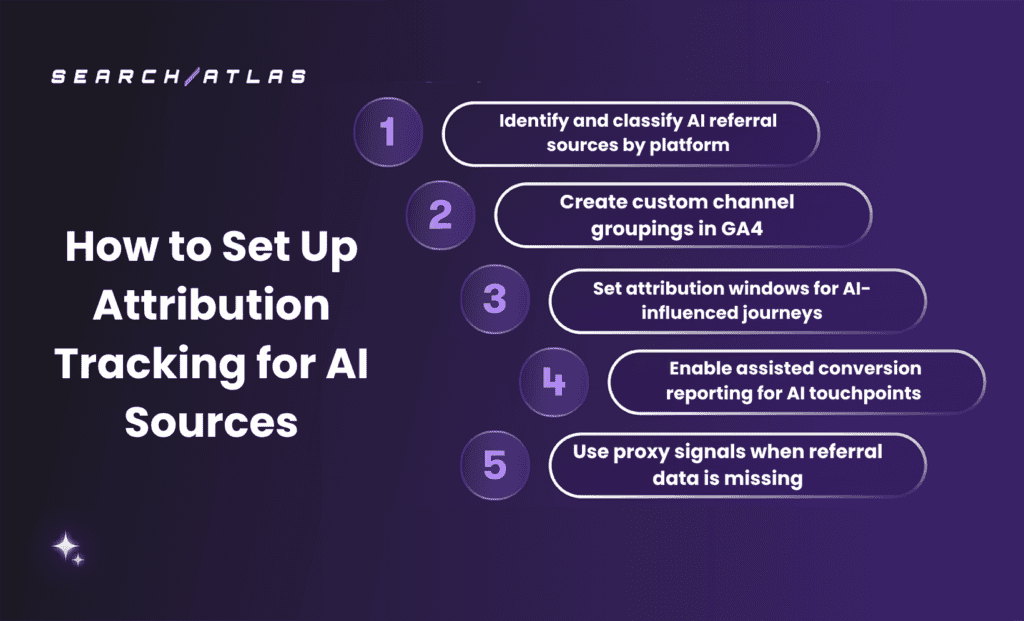
Businesses set up attribution tracking for AI sources by identifying AI referrals, configuring custom analytics channels, extending attribution windows, enabling assisted conversion analysis, and monitoring proxy signals. Attribution tracking improves visibility into how conversational AI platforms influence awareness, engagement, and downstream conversions across customer journeys.
The 5 main methods for setting up attribution tracking for AI sources are listed below.
1. Identify and classify AI referral sources by platform.
2. Create custom channel groupings in GA4.
3. Set attribution windows for AI-influenced journeys.
4. Enable assisted conversion reporting for AI touchpoints.
5. Use proxy signals when referral data is missing.
1. Identify and Classify AI Referral Sources by Platform
Identifying and classifying AI referral sources establishes which conversational platforms generate measurable traffic sessions. AI referral classification improves attribution visibility by separating AI traffic from generic referral or direct traffic categories. Platforms (OpenAI ChatGPT, Anthropic Claude, Perplexity AI, and Microsoft Copilot) generate referral traffic under specific interaction conditions where referral metadata remains visible.
AI referral discovery begins inside traffic acquisition reporting within GA4. Source exploration reports reveal measurable AI domains that appear inside recorded session data. These reports expose only sessions where referral signals survived the transition from the AI platform to the destination website. Referral stripping limits total visibility, which means recorded AI traffic represents only a partial sample of actual AI-influenced sessions.
AI referral classification requires ongoing maintenance because the AI platform’s behavior changes continuously. New AI products, referral structures, and citation formats appear regularly across conversational search environments. Quarterly review cycles improve attribution accuracy by updating referral domain lists as new platforms gain adoption and referral behavior evolves.
2. Create Custom Channel Groupings in GA4
Creating custom channel groupings in GA4 separates AI-referred sessions from generic referral and direct traffic categories. Custom channel groupings improve attribution visibility by assigning measurable AI sessions into dedicated reporting segments. Default GA4 channel structures do not contain AI-specific traffic categories, which causes measurable AI referrals to appear under broad referral or unassigned buckets.
AI channel configuration depends on matching known AI referral domains inside GA4 channel rules. Teams configure custom channel groups under GA4 Admin > Data Display > Channel Groups and create rules that match AI referral domains directly. Channel names “AI Referral” or “AI Sources” create dedicated attribution segments that appear across acquisition and conversion reporting.
Custom channel groupings improve classification accuracy only for measurable AI sessions that preserve referral metadata. Referral stripping continues affecting sessions where conversational platforms remove source information before analytics systems process the visit. AI-generated traffic without measurable referral data still appears as direct traffic because classification rules require observable source values to function correctly.
3. Set Attribution Windows for AI-influenced Journeys
Setting attribution windows for AI-influenced journeys improves visibility into longer customer decision cycles. Attribution windows define the maximum period during which touchpoints remain eligible for conversion credit inside analytics systems. AI-influenced journeys frequently span longer research periods because users interact with conversational systems early in the buying process before converting later through branded search or direct visits.
Longer attribution windows improve visibility into B2B customer journeys influenced by AI-generated discovery. B2B SaaS purchasing cycles involve evaluation periods, stakeholder discussions, product comparisons, and internal approvals that extend conversion timelines significantly. A user discovering a platform through ChatGPT in week one frequently converts weeks later, after additional research and evaluation activity. Attribution windows between 60 and 90 days align more effectively with these longer decision cycles.
GA4 attribution window settings control how historical touchpoints receive conversion credit across reporting systems. Teams configure attribution windows inside GA4 Admin > Attribution Settings and apply separate rules for acquisition and conversion events. Attribution window adjustments affect future reporting structures, which means analytics teams require alignment before implementation to avoid reporting inconsistencies.
4. Enable Assisted Conversion Reporting for AI Touchpoints
Enabling assisted conversion reporting exposes AI touchpoints that influenced conversions without closing them directly. Assisted conversion reports improve attribution analysis by displaying every measurable session that contributed to the conversion path. Standard conversion reports prioritize Last-touch attribution, which hides earlier AI interactions that generated awareness before conversion occurred later through other channels.
Assisted conversion reports inside GA4 reveal whether AI referrals appear earlier in customer journeys. Reports located under Advertising > Attribution > Conversion Paths display the sequence of measurable sessions that preceded conversions. AI-referred sessions appear within these paths when custom channel groupings classify AI traffic correctly, and referral metadata remains preserved.
AI-assisted conversion reporting creates the closest approximation to multi-touch AI attribution inside standard GA4 reporting. Assisted conversion counts reveal how frequently AI referrals influenced customer journeys before final conversion sessions occurred. These counts remain conservative estimates because zero-click AI interactions and referral stripped sessions never enter measurable attribution paths.
5. Use Proxy Signals When Referral Data Is Missing
Using proxy signals improves AI attribution analysis when direct referral measurement becomes impossible. Proxy signals estimate AI-influenced discovery through indirect behavioral patterns instead of direct session tracking. Referral stripping and zero-click AI interactions prevent analytics systems from measuring large portions of AI-influenced journeys directly.
Branded search growth functions as a strong proxy signal for AI-generated awareness. Users discovering brands through conversational AI platforms frequently return later through branded Google searches instead of revisiting the original AI interface. Branded search growth without corresponding increases in non-branded traffic or paid campaigns frequently indicates rising AI-generated discovery activity.
Direct traffic growth and self-reported attribution surveys strengthen AI attribution analysis further. Direct traffic increases often correlate with growing AI visibility across conversational systems because invisible AI interactions appear later as direct sessions. Self-reported surveys capture discovery interactions that never generated measurable traffic by asking users directly how they first encountered the brand. Combined proxy signals create stronger evidence of AI influence than isolated metrics analyzed independently.
What are the best practices for Measuring AI Source Attribution?
Best practices for measuring AI source attribution combine AI****I visibility tracking, attribution configuration, proxy signal analysis, and multi-touch reporting to measure how conversational AI platforms influence awareness and conversions. AI source attribution requires indirect measurement methods because conversational platforms frequently strip referral data and generate zero-click interactions that never appear inside analytics systems.
The 6 best practices for measuring AI source attribution are listed below.
1. Establish baseline visibility across AI platforms before measurement begins.
2. Track citation frequency, position, and share of voice continuously.
3. Measure indirect impact through branded search and direct traffic growth.
4. Optimize structured content and schema for AI retrieval systems.
5. Analyze citation accuracy, authority, and context quality.
6. Use multi-touch attribution frameworks for AI-influenced journeys.
1. Establish Baseline Visibility Across AI Platforms Before Measurement Begins
Establishing baseline visibility creates the reference point required for accurate AI attribution analysis. Attribution analysis depends on measuring changes over time, which means teams require historical visibility benchmarks before attribution configuration begins. Citation frequency, branded search demand, direct traffic share, and measurable AI referral sessions form the baseline layer that later attribution comparisons depend on.
AI visibility baselines require both citation metrics and downstream behavioral metrics together. Citation frequency across OpenAI ChatGPT, Anthropic Claude, and Perplexity AI reveals how often brands appear inside conversational responses. Branded search volume and direct traffic levels reveal whether AI visibility changes correlate with downstream awareness growth.
Monthly baseline refreshes improve attribution accuracy because AI platform behavior changes continuously. Conversational systems update retrieval logic, training data, and citation behavior irregularly across different models and platforms. Citation visibility gains or losses frequently appear after those updates. A practical takeaway involves refreshing AI visibility baselines monthly and comparing those changes against branded search and direct traffic movement during the same reporting period.
2. Track Citation Frequency, Position, and Share of Voice Continuously
Tracking citation frequency, position, and share of voice reveals how often and how prominently AI systems mention a brand across conversational search environments. Citation tracking improves attribution analysis because citation visibility functions as the upstream discovery signal that later influences branded search, direct traffic, and conversions.
Citation frequency measures how often AI-generated responses mention a brand across targeted query sets. Increased citation frequency frequently correlates with higher brand exposure and stronger downstream awareness activity. Citation frequency alone lacks context because brands appearing occasionally as primary recommendations often outperform brands appearing frequently as secondary mentions.
Citation position changes the visibility and commercial value of AI-generated recommendations. Brands appearing as the first recommendation inside conversational responses receive stronger click probability, recall, and conversion influence than brands listed lower inside comparison sections or supporting references. Position tracking improves attribution analysis by distinguishing high-impact recommendations from low-visibility mentions.
Share of voice contextualizes citation visibility against competitors operating inside the same topic environment. A brand appearing in 40% of relevant AI responses controls more conversational visibility than a competitor appearing in 10% of equivalent responses. A practical takeaway involves tracking citation frequency, citation position, and AI share of voice together instead of analyzing citation count alone.
3. Measure Indirect Impact Through Branded Search and Direct Traffic Growth
Measuring branded search and direct traffic growth reveals indirect evidence of AI-generated awareness across customer journeys. Conversational AI platforms frequently influence users before measurable sessions occur, which means downstream behavioral patterns expose AI impact more reliably than direct attribution reports alone.
Branded search growth frequently reflects AI-influenced discovery behavior. Users discovering brands through conversational systems often return later through branded Google searches instead of revisiting the original AI interface. Branded search increases without corresponding paid brand campaign growth frequently indicate rising AI-generated awareness activity.
Direct traffic growth exposes invisible AI interactions that analytics systems fail to classify correctly. Users recalling brand names from AI-generated recommendations frequently type URLs directly into browsers instead of clicking referral links. Analytics platforms record those visits as direct traffic because no measurable referral source exists during session processing.
Correlated movement across AI visibility, branded search, and direct traffic creates stronger attribution evidence than isolated metrics alone. Citation growth followed by rising branded search and direct traffic within two to four weeks frequently signals AI-influenced awareness expansion. A practical takeaway involves building monthly attribution reports that place citation frequency, branded search volume, and direct traffic sessions side by side for lag-based trend analysis.
4. Optimize Structured Content and Schema for AI Retrieval Systems
Optimizing structured content and schema improves the likelihood that AI retrieval systems select and cite a brand in generated responses. Conversational AI systems prioritize content with strong structural clarity, direct answers, and explicit entity references during retrieval and synthesis workflows.
Structured formatting improves retrieval probability because AI systems parse scannable information more efficiently than unstructured narrative content. Clear headings, concise answers, tables, lists, and explicit entity references improve extractability during conversational response generation. FAQ driven content structures align closely with how AI systems construct direct answers for users.
Schema markup strengthens attribution visibility by clarifying entities, relationships, and topical context for retrieval systems. HowTo schema and Article schema expose structured metadata that retrieval systems interpret without processing entire pages manually. An organization schema with accurate brand definitions improves attribution consistency across conversational platforms.
AI retrieval optimization prioritizes answer clarity and extractable information at the paragraph level. AI systems favor concise sections that resolve specific questions directly instead of long narrative passages without clear answer structures. A practical takeaway involves writing standalone answer sections with explicit entity references, structured formatting, and schema markup that retrieval systems parse easily.
5. Analyze Citation Accuracy, Authority, and Context Quality
Analyzing citation accuracy, authority, and context quality improves understanding of whether AI visibility generates commercially valuable brand exposure. Citation volume alone fails to reveal whether conversational systems describe products accurately or position brands positively in generated responses.
Citation accuracy measures whether AI-generated descriptions match actual product capabilities, pricing, and positioning. Incorrect citations create awareness that leads users toward inaccurate expectations and weaker conversion quality. Accurate recommendations improve conversion alignment because AI-generated descriptions reflect real product experiences more closely.
Citation context quality reveals how conversational systems frame a brand relative to competitors and user intent. Brands appearing as primary recommendations inside high-intent queries generate stronger commercial influence than brands appearing as secondary references or cautionary examples. Query context determines whether conversational visibility creates meaningful buying intent or low-value awareness.
Primary citations carry stronger attribution value than indirect references derived from third-party sources. AI systems drawing directly from brand-owned content signal stronger authority than AI responses referencing external sites that mention the brand indirectly. A practical takeaway involves monitoring not only citation volume but citation framing, recommendation quality, and source authority during AI visibility analysis.
6. Use Multi-Touch Attribution Frameworks To Connect AI Discovery With Conversion Outcomes
Using multi-touch attribution frameworks improves visibility into how AI-influenced sessions contribute across conversion journeys. Multi-touch attribution distributes conversion credit across every measurable interaction instead of assigning all credit to the first or final session only.
Multi-touch attribution improves AI measurement because measurable AI referrals receive partial conversion credit instead of zero attribution. Position-based and linear attribution models inside GA4 assign fractional credit to AI-referred sessions that appear earlier in the customer journey. This structure improves attribution visibility for conversational discovery interactions that influenced conversion paths indirectly.
Multi-touch attribution remains limited by the quality of underlying session data. Referral stripped AI sessions, zero-click interactions, and sessions occurring outside attribution windows remain invisible because attribution systems distribute credit only across recorded touchpoints. Attribution improvements remain meaningful but incomplete because invisible AI interactions never enter measurable reporting structures.
Conversion path analysis reveals whether AI-influenced users behave differently from other customer segments. AI-influenced journeys frequently contain longer research cycles, higher intent signals, or stronger conversion quality compared with non-AI journeys. A practical takeaway involves filtering conversion paths that contain AI sessions and comparing average order value, path length, and conversion timing against non-AI paths to evaluate the commercial impact of conversational visibility.
What Tools Help Attribute Conversions to AI Sources?
The best tools for attributing conversions to AI source track AI visibility, classify conversational referrals, connect multi-touch journeys, and measure downstream conversion behavior across analytics systems. These tools combine referral analysis, AI citation monitoring, multi-touch attribution, and behavioral analytics to expose AI-influenced customer journeys.
The 7 best tools for attributing conversions to AI sources are Search Atlas, Google Analytics 4, Dreamdata, HubSpot, Ruler Analytics, Semrush, and Brand24.
1. Search Atlas. Search Atlas tracks AI visibility, citation frequency, share of voice, branded search growth, and downstream attribution signals. Search Atlas LLM Visibility monitors brand mentions and citations across OpenAI ChatGPT, Anthropic Claude, Perplexity AI, and other conversational systems that influence customer discovery. Search Atlas connects citation growth with branded search movement, direct traffic changes, and AI visibility trends, which improve attribution analysis for AI-influenced journeys. This visibility matters because conversational platforms frequently remove referral data before analytics systems process sessions.
2. Google Analytics 4. Google Analytics 4 measures sessions, conversion paths, attribution windows, and assisted conversions across measurable customer journeys. The platform classifies traffic sources, records conversion activity, and exposes conversion path sequences across First-touch, Last-touch, and multi-touch attribution models. GA4 supports custom channel groupings that classify measurable AI referrals into dedicated AI traffic categories instead of generic referral buckets. This classification matters because AI-referred traffic frequently appears as direct traffic when referral metadata disappears before session processing.
3. Dreamdata. Dreamdata tracks B2B customer journeys across multiple channels and attribution touchpoints to expose how discovery interactions influence revenue outcomes. The platform connects CRM data, marketing activity, and session-level attribution into unified conversion paths that reveal long sales cycle behavior. Dreamdata improves attribution visibility for AI-influenced B2B journeys because conversational discovery frequently occurs weeks before conversion activity happens. This visibility matters because B2B SaaS purchasing cycles involve multiple evaluation stages, stakeholder reviews, and delayed conversions that standard attribution windows fail to capture.
4. HubSpot. HubSpot tracks chatbot interactions, session attribution, and conversion activity across inbound marketing and conversational engagement workflows. The platform records First-touch and Last-touch attribution data while connecting chatbot conversations directly with lead generation and CRM activity. HubSpot improves attribution visibility for brands using conversational AI bots, AI assistants, or automated lead qualification systems on their websites. This visibility matters because conversational interactions frequently influence conversions before direct sales engagement begins.
5. Ruler Analytics. Ruler Analytics tracks visitor-level attribution across online and offline conversion journeys by connecting marketing touchpoints directly with CRM and revenue systems. The platform records measurable interactions across calls, forms, sales activity, and session-level attribution paths. Ruler Analytics improves attribution visibility because AI-influenced discovery frequently contributes to offline sales activity that standard analytics systems fail to connect directly with marketing sessions. This connection matters because AI-generated awareness often influences long customer journeys before measurable conversions occur.
6. Semrush. Semrush tracks brand visibility, search performance, and online mentions across search and digital PR environments. The platform monitors where brands appear across web content, media coverage, and conversational search visibility signals tied to AI discoverability. Semrush improves attribution visibility because AI systems frequently cite authoritative pages and widely referenced content across search ecosystems. This visibility matters because stronger brand visibility across search and digital PR environments frequently increases conversational citation frequency inside AI-generated responses.
7. Brand24. Brand24 tracks online brand mentions, conversational visibility, and sentiment signals across digital platforms and public web discussions. The platform monitors how brands appear across discussions, articles, and conversational references that influence AI-generated recommendations and visibility. Brand24 improves attribution visibility because conversational AI systems frequently synthesize information from publicly discussed and frequently cited sources. This visibility matters because stronger brand mention frequency frequently increases the probability of conversational AI citation and recommendation behavior.
How Do Attribution Tools Measure Impact Without Click-Level Data?
Attribution tools measure impact without click-level data by combining session data, proxy metrics, citation visibility, and survey responses to estimate AI-influenced customer journeys. Attribution tools reconstruct partial attribution paths from observable behavioral signals because conversational AI platforms frequently strip referral data and generate zero-click interactions. This reconstruction creates directional attribution visibility instead of exact click-level measurement.
Attribution tools measure impact by aggregating measurable signals that remain visible after AI interactions occur. Session-level referral data, branded search growth, direct traffic increases, and self-reported attribution surveys expose patterns connected with conversational AI discovery. Attribution systems combine these signals into unified reporting frameworks that approximate how AI visibility influences awareness and conversions across customer journeys.
Attribution tools compensate for missing AI referral data by analyzing correlated behavioral patterns instead of relying on exact click paths. A user discovers a brand inside OpenAI ChatGPT, returns later through branded search, and converts during a separate session. Analytics systems fail to capture the original AI interaction directly because no measurable referral data survived the journey. Attribution tools estimate AI influence by connecting increases in conversational citations with later changes in branded search and direct traffic behavior.
GA4 functions as the foundational session collection layer for measurable AI attribution analysis. Google Analytics 4 records measurable AI-referred sessions that preserve referral metadata and expose those sessions across attribution reports, assisted conversions, and conversion path analysis. Custom AI channel groupings improve visibility by separating measurable AI referrals from generic referral or direct traffic buckets. GA4 improves attribution reporting for observable AI sessions, but cannot recover referral data that disappeared before session processing began.
GA4 attribution limitations emerge because conversational AI interactions frequently occur without measurable sessions. Zero-click AI discovery, stripped referral metadata, and delayed branded search behavior create invisible interactions that never appear inside session-level reporting systems. Attribution reports process only measurable sessions, which means invisible AI touchpoints remain absent from recorded conversion paths.
Search Atlas AI visibility monitoring improves attribution analysis by measuring citation frequency and conversational visibility across AI platforms. Search Atlas tracks how often brands appear inside generated responses from Perplexity AI, ChatGPT, Claude, and other conversational systems. Citation frequency and share of voice metrics expose upstream discovery visibility before measurable traffic sessions occur. This visibility matters because attribution analysis requires understanding what generated awareness before conversions happened later.
Citation tracking makes proxy signal analysis interpretable by connecting visibility changes with downstream behavioral movement. Rising AI citation frequency, followed by increases in branded search demand and direct traffic, creates defensible evidence of AI-influenced discovery activity. Citation visibility functions as the causal candidate that explains otherwise unattributed behavioral changes across analytics systems.
Self-reported attribution surveys improve AI attribution analysis by capturing invisible interactions that session tracking misses completely. Surveys ask converting users how they originally discovered the brand and include conversational AI platforms as selectable discovery sources. Survey responses expose zero-click AI journeys that never generated measurable sessions because attribution relies on user recall instead of referral metadata.
Attribution tools create the strongest AI measurement frameworks when multiple indirect signals move together across the same reporting period. Citation growth, branded search increases, direct traffic spikes, and survey responses together create stronger attribution evidence than isolated metrics analyzed independently. A practical takeaway involves building unified monthly attribution dashboards that combine AI visibility tracking, branded search trends, direct traffic analysis, and survey data into one reporting environment.
What Are Common Tracking Gaps for AI Traffic in GA4?
Common tracking gaps for AI traffic in GA4 show how conversational AI interactions disappear, misclassify, or lose attribution visibility inside analytics systems. These gaps matter because AI-influenced journeys frequently begin outside traditional referral environments, which weakens attribution accuracy, conversion path visibility, and channel reporting. Missing attribution signals reduce visibility into how conversational AI platforms influence awareness, branded search, and downstream conversions.
The 7 most common tracking gaps for AI traffic in GA4 are listed below.
1. Referrer stripping that routes AI sessions into direct traffic.
2. Zero-click AI interactions that generate no measurable sessions.
3. Missing default AI channel groupings inside GA4.
4. AI referred sessions to unassigned traffic channels.
5. Short attribution windows that exclude delayed AI-influenced conversions.
6. Invisible AI-assisted conversions inside standard reporting views.
7. Lack of self-reported attribution data inside native analytics reporting.
1. Referrer stripping that routes AI sessions into direct traffic. Platforms (OpenAI ChatGPT, Anthropic Claude, and Perplexity AI) frequently remove HTTP referrer headers before users reach external websites. GA4 receives those visits without source metadata and classifies them as direct traffic automatically. This routing hides the original conversational discovery source and inflates direct traffic reporting.
2. Zero-click AI interactions that generate no measurable sessions. Users frequently read conversational AI responses, remember brand recommendations, and return later through branded search or direct navigation without clicking the original citation. No measurable session occurs during the initial AI interaction, which removes the discovery touchpoint completely from attribution reporting.
3. Missing default AI channel groupings inside GA4. GA4 default traffic channel structures do not contain dedicated AI traffic categories. Measurable AI referrals frequently appear under generic referral buckets or unrelated traffic classifications instead of clearly separated AI channels. This structure reduces visibility into how conversational systems contribute to conversion activity.
4. AI referred sessions to unassigned traffic channels. Some conversational platforms pass incomplete or inconsistent referral metadata that fails to match existing GA4 channel classification rules. Those sessions route into the unassigned traffic category because GA4 cannot determine the correct source classification automatically. Reviewing source values inside unassigned traffic frequently reveals conversational referral domains that require custom AI channel rules.
5. Short attribution windows that exclude delayed AI-influenced conversions. Conversational AI systems frequently influence awareness early in the customer journey before conversions occur weeks later through branded search or direct visits. Default 30-day attribution windows undercount AI influence in B2B SaaS, enterprise software, and longer research-driven purchase cycles where conversion delays exceed one month.
6. Invisible AI-assisted conversions inside standard reporting views. AI-referred sessions appearing earlier in the customer journey receive no visibility when another channel closes the conversion later. Assisted conversion reporting inside GA4 Advertising > Attribution exposes those earlier conversational touchpoints more accurately across measurable paths.
7. Lack of self-reported attribution data inside native analytics reporting. Users frequently remember conversational AI discovery interactions that never generated measurable analytics sessions. GA4 cannot connect those invisible touchpoints with attribution reporting automatically because native analytics systems process only recorded behavioral data instead of user recall or survey responses.
How Long Should the Attribution Window Be for AI-Driven Conversions?
The attribution window for AI-driven conversions needs to match the actual time between conversational discovery and conversion activity instead of relying on default analytics settings. Attribution window length determines how long a touchpoint remains eligible for conversion credit inside analytics systems. AI-influenced journeys frequently begin earlier in the buying process than traditional search journeys, which means short attribution windows systematically undercount conversational AI influence.
Short attribution windows weaken AI attribution accuracy because conversational discovery frequently occurs weeks before conversion. Platforms (OpenAI ChatGPT and Perplexity AI) often influence early research, evaluation, and comparison behavior before measurable conversion activity happens later. GA4 defaults to a 30-day attribution window, which aligns more closely with shorter ecommerce decision cycles than longer B2B or SaaS purchasing journeys.
How long should attribution windows be for e-commerce and shorter consideration journeys? E-commerce brands and lower consideration products frequently perform well with 30-day attribution windows effectively because users convert quickly after discovery interactions. Consumer products, transactional searches, and direct purchase behavior create shorter customer journeys with fewer delays between AI exposure and conversion activity. Thirty-day attribution windows capture most measurable conversion paths accurately in these environments.
How long should attribution windows be for B2B SaaS and enterprise conversions? B2B SaaS platforms and enterprise-focused services frequently require attribution windows between 60 and 90 days because customer journeys involve longer research and evaluation cycles. Decision makers frequently discover brands through conversational AI systems weeks before requesting demos, starting trials, or contacting sales teams. Longer attribution windows improve AI attribution accuracy because more AI-influenced sessions remain eligible for conversion credit throughout extended decision processes.
Longer attribution windows improve attribution visibility for free trials, demo requests, and enterprise lead generation activity. These conversion events frequently represent mid-funnel buying intent instead of immediate purchase completion. Enterprise buying journeys involve stakeholder reviews, vendor comparisons, and approval processes that extend the delay between AI discovery and measurable conversion activity. Short attribution windows remove earlier AI touchpoints before conversion paths close.
The correct attribution window depends on actual conversion timing patterns instead of fixed industry assumptions. Teams improve attribution accuracy by analyzing median and 90th percentile time to conversion across recorded customer journeys inside GA4. Attribution windows aligned with real customer behavior expose conversational AI influence more accurately across different industries and funnel stages.
Attribution windows require periodic review because AI-driven customer behavior changes alongside conversational search adoption. Faster AI-assisted research workflows frequently shorten some conversion paths while complex B2B buying cycles remain extended. A practical takeaway involves reviewing time to conversion data quarterly and adjusting attribution windows based on real conversion behavior instead of maintaining static attribution settings indefinitely.
Does the Right Attribution Window Change by AI Platform?
The right attribution window changes by AI platform because different conversational systems generate different user intent patterns and conversion speeds. Attribution windows determine how long a touchpoint remains eligible for conversion credit inside analytics systems. AI platforms influence users at different stages of the buying journey, which means a single attribution window does not reflect every conversational discovery pattern accurately.
AI platform behavior affects how quickly users move from discovery to conversion activity. Users interacting with Perplexity AI frequently perform high-intent research and comparison activity before making decisions. These users often convert within shorter timeframes because the platform emphasizes direct answers, citations, and decision-focused information retrieval. Shorter attribution windows frequently capture these journeys more accurately.
General-purpose conversational AI platforms frequently generate longer and less direct customer journeys. Users interacting with OpenAI ChatGPT encounter brands across broader educational, exploratory, and conversational contexts that do not always indicate immediate purchase intent. Brand exposure frequently occurs earlier in the research process, which creates longer gaps between AI discovery and measurable conversion behavior.
Platform-specific conversion timing becomes measurable through segmented conversion path analysis inside analytics systems. Teams segment GA4 conversion path data by First-touch AI referral source and calculate median time to conversion across different conversational platforms. Faster conversion paths indicate stronger transactional intent, while longer conversion paths indicate educational or exploratory discovery behavior.
Platform-level attribution analysis improves attribution window accuracy because different AI systems influence different stages of the funnel. Specialized research platforms frequently influence lower funnel activity, while broader conversational systems frequently influence earlier awareness generation. Attribution windows aligned with platform-specific behavior expose AI influence more accurately across different customer journey types.
Platform-specific attribution windows improve multi-touch reporting and AI conversion analysis over time. Shorter windows improve measurement for high-intent research-driven AI sessions. Longer windows improve visibility into delayed B2B and educational discovery journeys influenced by conversational systems.
Does Self-Reported Attribution Fill the Data Gap Left by AI Sources?
Self-reported attribution partially fills the data gap left by AI sources because users report discovery interactions that analytics systems never recorded. Self-reported attribution captures conversational AI touchpoints that disappeared from session-based analytics due to zero-click behavior and referral stripping. This reporting method improves visibility into AI-influenced customer journeys that platforms cannot measure directly.
Self-reported attribution captures invisible AI discovery by asking users directly how they first encountered a brand. Users completing surveys or post conversion forms frequently remember interactions with OpenAI ChatGPT, Anthropic Claude, or Perplexity AI, even when those interactions never generated measurable sessions. Survey responses expose awareness touchpoints that traditional attribution systems failed to capture.
Self-reported attribution contains accuracy limitations because users frequently simplify or compress their actual decision journeys. Users often remember the most recent interaction, the most memorable recommendation, or the most emotionally significant touchpoint instead of the full chronological path. Self-reported attribution creates approximate behavioral visibility rather than exact attribution accuracy. Despite those limitations, survey data remains the only scalable method for exposing zero-click AI interactions directly.
Self-reported attribution becomes more valuable when integrated with measurable GA4 conversion and attribution data. Comparing survey responses against recorded First-touch sessions reveals the difference between observable attribution and actual user experience. A user reports discovering a brand through ChatGPT while GA4 records branded search as the first measurable session. This mismatch exposes the portion of AI-influenced journeys that analytics systems misclassified or failed to observe completely.
The gap between self-reported AI discovery and recorded AI sessions exposes hidden conversational influence across customer acquisition funnels. Higher percentages of self-reported AI discovery compared with measurable AI First-touch attribution indicate widespread referral stripping and invisible conversational awareness. This comparison improves attribution interpretation by revealing how much AI influence traditional session-based reporting fails to capture.
Self-reported attribution works most effectively alongside AI visibility tracking, branded search analysis, and conversion path reporting. Combined measurement frameworks create stronger attribution visibility because each method exposes different layers of conversational influence.
Can Data-Driven Models Account for Invisible AI Touchpoints?
No, data-driven attribution models cannot fully account for invisible AI touchpoints because conversational AI interactions frequently occur without measurable session data. Data-driven attribution distributes conversion credit using machine learning models trained on recorded customer journeys. Invisible AI interactions never enter the training dataset, which prevents attribution systems from assigning conversion credit to those touchpoints.
Data-driven attribution models calculate credit allocation by analyzing patterns across measurable conversion paths. Platforms (GA4) compare converting and non-converting journeys to determine which touchpoints correlate most strongly with conversion outcomes. Data-driven attribution differs from First-touch and Last-touch attribution because the model distributes partial credit dynamically instead of applying fixed attribution rules across every journey.
Data-driven attribution improves accuracy only for measurable sessions that analytics systems successfully record. A measurable AI referral from Perplexity AI or ChatGPT enters the attribution model when referral metadata remains preserved during the session. The model evaluates that session alongside other measurable interactions and distributes conversion credit based on statistical conversion patterns observed across recorded journeys.
Invisible AI interactions remain absent from Data-driven attribution models because no measurable signal exists during training. Zero-click AI discovery and referral stripped sessions generate no observable touchpoints inside analytics systems. Machine learning models cannot infer the influence of interactions that never appeared inside conversion path data because attribution logic depends entirely on recorded session history.
Data-driven attribution inherits the same structural attribution limitations affecting every session-based attribution framework. Missing referral metadata, invisible AI discovery, and delayed branded search behavior disconnect conversational influence from measurable conversion paths. Data-driven attribution improves credit distribution across observable sessions but cannot reconstruct invisible AI interactions that analytics systems never captured.
Observable AI attribution requires measurable signals that conversational platforms currently fail to preserve consistently at scale. Preserved referral metadata, outbound UTM parameters, or identity-based tracking systems would create measurable AI touchpoints that Data-driven attribution models process directly. Major conversational AI platforms do not currently provide those attribution signals consistently across customer journeys.
Data-driven attribution functions most effectively when combined with AI visibility monitoring and proxy signal analysis. Citation tracking, branded search growth, and direct traffic analysis expose behavioral patterns that attribution systems fail to capture directly. A practical takeaway involves treating Data-driven attribution as one layer inside a broader AI measurement framework instead of relying on attribution models alone.
Is First-Touch Attribution Ever More Accurate Than Last-Touch for AI Sources?
First-touch attribution becomes more accurate than Last-touch attribution for AI sources when conversational AI platforms generated the original discovery interaction before conversion occurred later. First-touch attribution identifies which channel introduced the brand first, while Last-touch attribution credits only the final measurable interaction before conversion. AI-influenced journeys frequently begin with conversational discovery and end through branded search or direct traffic, which makes First-touch attribution more effective for measuring AI-generated awareness.
First-touch attribution improves AI attribution accuracy when measurable AI referral sessions remain visible inside analytics systems. A user clicks a cited recommendation inside Perplexity AI, lands on a website with preserved referral metadata, and converts later through another channel. First-touch attribution correctly credits the AI referral as the discovery source because the measurable AI session initiated the recorded customer journey. Last-touch attribution ignores that earlier discovery interaction and credits the final conversion session instead.
First-touch attribution becomes unreliable when the recorded session history differs from the actual customer decision journey. A user visits a website through organic search months earlier, encounters the brand again through an AI-generated recommendation later, and converts afterward. First-touch attribution credits the earlier organic session because analytics systems process recorded session order instead of psychological buying behavior.
First-touch attribution functions more effectively as a directional signal than a complete AI attribution framework. Missing referral data, zero-click interactions, and delayed conversions exclude many AI-influenced journeys from measurable attribution reporting. First-touch attribution exposes only the subset of AI journeys where conversational discovery generates observable session data. First-touch attribution improves long-term AI trend analysis when teams compare attribution movement across consistent reporting periods. Rising First-touch AI conversions frequently correlate with growing conversational visibility, branded search demand, and direct traffic growth. A practical takeaway involves combining First-touch attribution with AI visibility monitoring and assisted conversion reporting instead of relying on attribution data alone.