Topic saturation analysis is the process of measuring how completely a topic is covered across entities, subtopics, and intents in SEO, AEO, and GEO systems. Topic saturation analysis explains how content strategies shift from publishing more pages to expanding meaningful coverage that search engines and AI systems recognize as complete. Topic saturation reflects how modern search rewards entity depth, semantic connections, and citation presence instead of raw content volume.
Topic saturation analysis matters because search and AI systems evaluate topical completeness across entire content clusters, not isolated pages. Search engines assess whether a topic resolves all relevant queries, entities, and follow-up questions before ranking or citing content. Generative engines evaluate whether a source contributes unique, extractable information before including it in answers. Incomplete coverage creates gaps where competitors gain visibility, while redundant coverage creates overlap without increasing authority.
Topic saturation analysis improves performance by identifying coverage gaps, weak subtopics, and missing entity relationships that limit visibility. Content expansion guided by saturation analysis increases rankings, improves internal linking strength, and raises citation probability inside AI-generated answers. Pages that fill true gaps gain visibility faster because they introduce new information rather than repeating existing content. Topic saturation analysis transforms content strategy into a precision system that targets what is missing instead of producing more of the same.
Topic saturation analysis measures saturation through 3 core dimensions (SERP coverage, AI citation presence, and entity-level completeness). SERP coverage evaluates how many subtopics and intents are already dominated by competitors. AI citation presence measures how often a domain appears inside generative answers for relevant queries. Entity-level completeness evaluates whether all related concepts, attributes, and relationships are fully defined and connected. These three dimensions determine whether a topic still contains expansion opportunities or has reached diminishing returns.
Topic saturation analysis applies across blogs, SaaS platforms, marketplaces, and enterprise sites where content scales continuously. Topic saturation analysis ensures that expansion focuses on gaps, not duplication, which strengthens authority and improves crawl efficiency. Topic saturation analysis works through structured workflows that map subtopics, analyze competitors, and track citation share over time.
What is Topic Saturation Analysis?
Topic saturation analysis is a search and content optimization framework that determines when a topic reaches full coverage across SEO, Answer Engine Optimization (AEO), and Generative Engine Optimization (GEO) systems. Topic saturation analysis explains how content loses ranking and citation potential because authoritative sources already cover the topic with complete entity depth, semantic relationships, and repeated factual patterns. This definition shows what topic saturation analysis means in modern search environments where visibility depends on coverage rather than keyword repetition.
Topic saturation analysis connects search visibility to content completeness across search engines, answer engines, and AI-generated responses. Topic saturation analysis shifts optimization from producing more content toward identifying gaps, expanding entities, and increasing semantic depth. This shift explains why new pages fail because saturated topics contain stable patterns that search systems repeatedly select.
Topic saturation analysis operates across what systems? Topic saturation analysis operates across traditional search engines, direct-answer engines, and generative AI systems. These systems evaluate coverage by comparing entities, topics, and relationships across multiple sources and selecting the most complete and authoritative content.
Topic saturation analysis defines the point where additional content produces no new ranking value or citation opportunity. Topic saturation analysis identifies repetition across competing pages, which signals that content themes, entities, and structures have reached stability. This condition shows that new pages fail because existing content already satisfies search demand.
What does topic saturation analysis evaluate in search environments? Topic saturation analysis evaluates entity coverage, topical depth, and content redundancy across competing sources. This evaluation determines whether new content introduces unique value or repeats existing structures, which directly affects ranking and citation potential.
Topic saturation analysis originates from qualitative research through the work of Barney Glaser and Anselm Strauss, where it is defined as when data collection stops because no new insights emerge. Topic saturation analysis adapts this principle to SEO and AI search, where content stops expanding value once coverage becomes redundant across sources.
What makes topic saturation analysis different from keyword-based optimization? Topic saturation analysis focuses on semantic completeness and entity relationships, while keyword optimization focuses on term frequency and placement. This difference shows that saturation analysis measures coverage depth instead of surface-level keyword signals.
What models define topic saturation analysis in search? Topic saturation analysis operates through theoretical saturation, inductive thematic saturation, a priori thematic saturation, and data saturation. Theoretical saturation defines full entity and concept development, inductive thematic saturation defines repetition of patterns across content, a priori thematic saturation defines complete coverage of predefined topics, and data saturation defines informational redundancy across sources without new variation.
What are the key characteristics of topic saturation analysis? Topic saturation analysis is context-dependent, incremental, and used as a quality indicator. Context dependency means saturation appears at different stages based on topic complexity and competition, incremental progression means new content produces fewer unique insights over time, and quality indication means saturation confirms complete topical coverage across sources.
What does topic saturation analysis depend on in search optimization? Topic saturation analysis depends on comprehensive competitive analysis, accurate entity mapping, and systematic content evaluation across sources. These conditions ensure saturation reflects real coverage completeness rather than limited analysis or missing data.
What does topic saturation analysis enable in search optimization? Topic saturation analysis enables gap identification, content differentiation, and expansion into unsaturated subtopics. This enablement improves ranking potential because new content targets missing coverage instead of repeating existing structures.
Topic saturation analysis shows consistent patterns across search results and AI-generated outputs. Saturation appears once top-ranking pages share the same entities, structures, and answers across multiple sources. This pattern explains why content fails because systems prioritize established, repeated, and validated information over new but redundant pages.
How Does Topic Saturation Work in AI Answer Engines?
Topic saturation works by increasing the co-occurrence frequency between a Brand Entity and a Target Topic until AI systems treat that relationship as the default answer. Topic saturation explains how AI answer engines select sources because repeated entity associations, semantic coverage, and consistent factual patterns define what gets retrieved and cited. This mechanism shows how topic saturation works in AI-driven search, where visibility depends on statistical preference, not rankings.
How does topic saturation establish brand preference in AI answer engines? Topic saturation establishes brand preference by reinforcing entity associations across large volumes of content that repeat the same topic connection. A brand appears alongside a target topic across many documents. AI systems detect this repetition and treat the brand as the most probable answer source. This repetition creates stable visibility because AI models prioritize consistent and repeated patterns.
How do AI answer engines evaluate topic saturation signals? AI answer engines evaluate topic saturation signals by analyzing entity frequency, semantic depth, and cross-document agreement across indexed content. A brand that appears across many high-depth pages gains stronger association strength. Stronger association strength increases AI citation probability because models rely on repeated and validated patterns during answer generation.
How does competitor content influence topic saturation thresholds? Competitor content defines topic saturation thresholds by setting the baseline for content volume, entity coverage, and semantic depth within a topic. A competitor publishes 200 high-quality pages on a topic. A competing brand exceeds that volume with deeper coverage. AI systems shift preference because higher coverage creates stronger statistical signals.
How does content volume contribute to topic saturation? Content volume contributes to topic saturation by increasing the total number of indexed documents that reinforce the same entity-topic relationship. A brand publishes hundreds of pages connected to one topic. AI systems detect dense coverage across documents. Dense coverage increases retrieval likelihood because more documents confirm the same association.
How does content depth influence topic saturation outcomes? Content depth influences topic saturation outcomes by expanding entity relationships, subtopics, and contextual explanations within each page. A deep article answers expert-level questions and covers edge cases. AI systems prioritize that article because it satisfies more semantic conditions. This depth improves citation selection during synthesis.
How does content structure improve topic saturation performance? Content structure improves topic saturation performance by making entity relationships explicit and easy to extract during crawling and indexing. A page uses clear headings, direct answers, and a structured schema. AI systems parse entities faster. Faster parsing improves retrieval accuracy because structured data reduces ambiguity.
How does entity optimization strengthen topic saturation? Entity optimization strengthens topic saturation by ensuring consistent naming, clear definitions, and repeated references across all content assets. A brand uses the same terminology across pages. AI systems recognize the entity consistently. Consistent recognition increases knowledge graph alignment and improves citation probability.
How does continuous publishing maintain topic saturation over time? Continuous publishing maintains topic saturation by refreshing content, expanding coverage, and reinforcing entity associations across new and existing pages. A brand updates articles with new data and examples. AI systems detect freshness signals. Freshness increases relevance because newer information receives higher weighting.
How do internal linking and content networks affect topic saturation? Internal linking and content networks affect topic saturation by connecting related pages into a unified semantic structure that reinforces topic authority. A site links a pillar page with 25 supporting articles. AI systems detect strong topical clusters. Strong clusters increase authority because relationships between pages confirm expertise.
Which Sources AI Engines Repeatedly Cite for a Topic?
AI engines repeatedly cite sources that demonstrate authority, consistency, and repeated validation across multiple documents for the same topic. AI engines select sources through model-native synthesis or retrieval-augmented generation, which determines whether answers rely on learned patterns or retrieved documents. These sources define which domains appear consistently in AI-generated answers because repeated selection signals trust, relevance, and factual stability.
AI engines prioritize sources that appear frequently across independent documents because repetition strengthens probabilistic selection during answer generation. This repetition creates citation preference because AI systems rely on cross-document agreement, entity clarity, and semantic completeness to determine which sources represent the most reliable information. Sources that consistently reinforce the same facts across multiple contexts become default references.
The 10 main sources AI engines repeatedly cite for a topic are listed below.
1. Wikipedia. Wikipedia provides structured, entity-focused information, which increases citation frequency across model-native systems. Wikipedia appears frequently because it offers consistent definitions and high entity clarity across topics.
2. Reddit. Reddit provides community-driven discussions, which reflect real-world usage and diverse perspectives. Reddit appears frequently because AI engines value authentic, experience-based content that shows consensus and disagreement.
3. YouTube. YouTube provides multimodal content, which combines text, audio, and visual explanations. YouTube appears frequently because AI engines process multimodal signals and extract structured information from transcripts and metadata.
4. Review platforms. Review platforms (G2, Clutch, Trustpilot) provide aggregated opinions and comparisons. Review platforms appear frequently because they validate products and services through repeated user feedback and structured ratings.
5. Publisher sites. Publisher sites (Forbes, Business Insider, Reuters) provide editorial content and reporting. Publisher sites appear frequently because they maintain authority, editorial standards, and high domain trust.
6. Professional networks. Professional networks (LinkedIn, Medium, Substack) provide expert-driven content. Professional networks appear frequently because they connect content to identifiable authors and professional credibility.
7. Official brand websites. Official brand websites provide primary information about products and services. Official brand websites appear frequently because they define original facts, although AI engines verify these facts through external sources.
8. Research and data pages. Research and data pages provide original statistics and studies. Research pages appear frequently because AI engines prioritize unique data that other sources reference.
9. Community Q&A platforms. Community Q&A platforms (Quora, Stack Overflow, GitHub) provide direct answers and technical discussions. Community Q&A platforms appear frequently because they contain problem-solution patterns that match user queries
10. Industry publications. Industry publications provide niche expertise and specialized knowledge. Industry publications appear frequently because they cover topics with depth and authority that general sites do not match.
What source characteristics drive repeated AI citations? Source characteristics that drive repeated AI citations include authority, freshness, factual density, and cross-source validation. Authority increases trust because established domains appear across many documents. Freshness increases relevance because newer content receives higher weighting. Factual density increases extractability because structured facts improve retrieval. Cross-source validation increases confidence because multiple sources confirm the same information.
What are the long-term citation patterns across AI engines? Long-term citation patterns show that a small group of domains dominates visibility across AI-generated answers. These domains appear repeatedly because they combine authority, consistency, and external validation across multiple systems. This repetition creates stable citation loops, where the same sources continue to reinforce their dominance over time.
Why Does Topic Saturation Analysis Matter?
Topic saturation analysis matters for SEO, AEO, and GEO because topic saturation analysis defines content completeness, entity coverage, and citation probability across search systems. Topic saturation analysis increases visibility, improves ranking stability, and strengthens AI citation potential because search engines and AI systems select content that demonstrates full topical coverage. Topic saturation analysis explains why content succeeds because complete coverage signals authority, relevance, and trust.
How does topic saturation analysis improve content visibility in SEO? Topic saturation analysis improves visibility by ensuring pages cover all relevant entities, subtopics, and relationships within a topic. Complete coverage increases ranking potential because search engines prioritize pages that satisfy full search intent. This coverage reduces gaps because competing pages fail to match the same depth and breadth.
Why does topic saturation analysis define authority in AEO? Topic saturation analysis defines authority in AEO by ensuring content answers repeated questions with consistent and structured responses. AI answer systems extract direct answers from content that shows repeated patterns and stable information. This repetition increases answer selection because systems prioritize consistent and validated responses.
What role does topic saturation analysis play in GEO targeting? Topic saturation analysis removes ambiguity in GEO targeting by reinforcing entity relationships across multiple documents and contexts. Repeated entity associations increase statistical preference during AI answer generation. This reinforcement improves targeting precision because generative systems select sources with the strongest entity-topic connections.
How does topic saturation analysis increase citation probability in AI-generated answers? Topic saturation analysis increases citation probability by aligning content with repeated patterns that AI systems detect across multiple sources. Content that appears frequently with the same entities gains stronger selection signals. This alignment improves citation likelihood because AI systems rely on repetition and cross-source agreement.
Why does topic saturation analysis improve content efficiency? Topic saturation analysis improves efficiency by identifying when additional content stops creating new value or visibility. Content production stops once patterns stabilize across top-ranking pages. This efficiency reduces wasted effort because new pages no longer expand coverage or ranking potential.
How does topic saturation analysis strengthen trust and credibility in search systems? Topic saturation analysis strengthens trust by confirming that content covers all critical entities, questions, and relationships within a topic. Complete coverage signals reliability because no major gaps remain. This completeness improves credibility because search systems detect consistent and comprehensive information.
Why does topic saturation analysis prevent content failure in competitive topics? Topic saturation analysis prevents content failure by identifying saturated topics where new pages repeat existing structures without adding value. Repetition lowers ranking potential because search systems ignore redundant content. This prevention improves the strategy because content shifts toward unsaturated opportunities.
How does topic saturation analysis impact long-term visibility across SEO, AEO, and GEO? Topic saturation analysis impacts long-term visibility by creating stable content patterns that search engines and AI systems repeatedly select. Stable patterns maintain rankings and citations over time. This stability improves performance because content remains relevant across evolving search systems.
What is the Difference Between Topic Saturation and Content Saturation?
The difference between topic saturation and content saturation lies in scope, focus, and impact on visibility across SEO, AEO, and GEO systems. Topic saturation defines how fully a specific subject is covered, while content saturation defines the total volume of content competing across platforms. This distinction explains whether visibility loss comes from overcoverage of a topic or overwhelming content volume across the entire ecosystem.
Topic saturation limits differentiation within a subject because all entities, subtopics, and relationships already appear across competing pages. Content saturation limits visibility across platforms because excessive content volume reduces discovery and attention. This contrast shows why topic saturation blocks uniqueness while content saturation blocks reach.
The core differences between topic saturation and content saturation are below.
| Feature/Aspect | Topic Saturation | Content Saturation |
| Definition | Full coverage of a topic where entities, subtopics, and relationships repeat across sources. | Excessive volume of content across platforms that reduces visibility and attention. |
| Scope | Focused on a single topic or cluster of related entities. | Broad across all topics, formats, and content types. |
| Primary Cause | High overlap of entities, questions, and semantic structures across competing pages. | Mass content production that exceeds audience consumption capacity. |
| Impact on Visibility | Reduces ranking and citation potential due to redundancy. | Reduces discoverability due to volume competition. |
| SEO Impact | Limits ranking because new content repeats existing coverage. | Limits traffic because content struggles to surface. |
| AEO Impact | Reduces answer selection because responses show no new variation. | Reduces extraction because too many sources compete. |
| GEO Impact | Reduces citation probability because entity relationships stabilize. | Reduces citation distribution because AI filters large volumes. |
| Content Strategy Focus | Expand entities, deepen coverage, target adjacent subtopics. | Improve distribution, format diversity, and audience reach. |
| Risk Level | High risk of redundancy and lack of differentiation. | High risk of invisibility and low engagement. |
| Outcome | Stable patterns where new content adds no unique value. | A crowded ecosystem where content struggles to be seen. |
What does topic saturation do in SEO, AEO, and GEO? Topic saturation defines when a subject reaches full semantic coverage across competing sources. This coverage creates repetition signals, which reduce ranking, answer selection, and citation probability. This reduction forces expansion into new entities and deeper topic layers.
What does content saturation do in SEO, AEO, and GEO? Content saturation increases competition across all channels and formats, which reduces visibility and engagement. This competition creates discovery limitations, which lower traffic and impressions. This limitation shifts strategy toward stronger distribution and promotion.
Why is topic saturation different from content saturation? Topic saturation focuses on depth within a subject, while content saturation focuses on volume across the ecosystem. This difference defines strategy direction because one requires new ideas and deeper coverage, while the other requires improved reach.
When does topic saturation replace content saturation as the main problem? Topic saturation becomes the main problem when content repeats the same entities, questions, and structures across competing pages. This repetition signals full coverage, which blocks differentiation. This condition shifts strategy toward new angles and adjacent topics.
When does content saturation remain the main problem instead of topic saturation? Content saturation remains the main problem when unique content fails to gain visibility despite strong coverage. This failure signals distribution limitations instead of topic exhaustion. This condition shifts strategy toward promotion channels and format diversification.
What is the Difference Between Topic Saturation and Topical Authority?
The difference between topic saturation and topical authority lies in depth, structure, and trust across SEO, AEO, and GEO systems. Topical authority defines recognized expertise within a subject, while topic saturation defines excessive or redundant coverage without strong authority signals. This distinction explains whether content builds trust and rankings or creates dilution and stagnation.
Topical authority strengthens visibility because content demonstrates deep, structured, and validated expertise across a topic. Topic saturation weakens visibility because content repeats ideas without a clear structure or external validation. This contrast shows why authority increases rankings while saturation limits growth.
The core differences between topical authority and topic saturation are below.
| Feature/Aspect | Topical Authority | Topic Saturation |
| Definition | Demonstrated expertise and credibility across a specific topic through deep and structured content. | Excessive or redundant content coverage without sufficient depth, structure, or validation. |
| Scope | Focused on one niche with strong entity relationships and clear topic boundaries. | Often spreads across too many topics or repeats the same topic without depth. |
| Primary Goal | Build trust, authority, and consistent recognition across search systems. | Increase content volume without strengthening authority signals. |
| Content Quality | High-quality, original, and comprehensive content covering all key entities and subtopics. | Thin, repetitive, or poorly structured content with limited new insights. |
| Structural Coherence | Strong internal linking and clear topic clusters that reinforce semantic relationships. | Weak structure with disconnected pages and unclear topic relationships. |
| External Validation | Backlinks, mentions, and citations from trusted external sources confirm expertise. | Limited or missing external validation, which reduces credibility signals. |
| SEO Impact | Improves rankings, increases traffic, and builds long-term visibility. | Causes ranking stagnation and limits growth on competitive queries. |
| AEO Impact | Increases answer selection due to consistent and structured responses. | Reduces answer selection due to repetition and lack of clarity. |
| GEO Impact | Increases citation probability through strong entity associations and validation. | Reduces citation probability due to weak or redundant entity signals. |
| Outcome | Establishes a site as a trusted source consistently selected by search and AI systems. | Creates diluted authority where content exists but fails to perform. |
What does topical authority do in SEO, AEO, and GEO? Topical authority establishes a site as a trusted source across search engines and AI systems. This trust increases rankings, answer selection, and citation frequency because systems prioritize consistent and validated expertise.
What does topic saturation do in SEO, AEO, and GEO? Topic saturation creates redundant coverage without increasing authority signals. This redundancy reduces visibility because search systems ignore repeated content that does not expand semantic depth or value.
Why is topical authority different from topic saturation? Topical authority focuses on depth, structure, and validation within a topic, while topic saturation focuses on volume without effective organization. This difference defines success because authority builds trust, while saturation creates dilution.
When does topical authority outperform topic saturation? Topical authority outperforms topic saturation when content clusters show clear structure, deep coverage, and external validation across a focused topic. This structure increases trust because systems recognize consistent expertise.
When does topic saturation become a problem instead of topical authority? Topic saturation becomes a problem when content volume increases without improving structure, depth, or validation. This imbalance reduces performance because content fails to signal expertise to search and AI systems.
How Do You Know if a Topic is Saturated?
A topic is saturated when search results, AI answers, and demand signals repeat the same sources, facts, and answer structures across multiple queries. Topic saturation matters because SEO, AEO, and GEO systems prioritize differentiated content, clear entity expansion, and new information rather than repeated coverage.
Topic saturation gives content teams a clear framework for deciding whether to create new content, consolidate existing pages, or expand into adjacent subtopics. Topic saturation appears through consistent patterns across search engines and AI systems.
The 3 main signals of topic saturation are listed below.
1. Measuring SERP Overlap And Answer Redundancy
The SERP overlap layer shows topic saturation by measuring how often the same URLs appear across related search queries. High SERP overlap indicates that Google treats multiple keywords as the same intent and serves nearly identical results. This overlap matters because repeated ranking pages show that the topic already has stable and consolidated coverage across search results.
SERP overlap identifies topic saturation by comparing shared URLs across top-ranking results for related queries. A 50% SERP overlap means half of the ranking pages repeat across two keywords. This repetition signals that search engines already consider the topic fully covered, which limits opportunities for separate pages to rank independently.
2. Measuring AI Answer Coverage And Citation Concentration
The AI citation layer shows topic saturation by measuring how often AI engines repeat the same answers and cite the same domains across prompts. Citation concentration indicates that ChatGPT, Perplexity, Gemini, and AI Overviews rely on a small group of trusted sources. This concentration matters because AI systems prioritize consistent, validated information when generating answers.
AI citation concentration identifies topic saturation by tracking repeated domains, repeated facts, and repeated answer formats across multiple prompts. A saturated topic shows the same sources cited across many related questions. This pattern reduces citation opportunities for new content unless that content introduces stronger evidence, clearer structure, or original insights that satisfy fact-grounding optimization requirements at the passage level.
3. Evaluating Demand-To-Supply Ratio
The demand layer shows topic saturation by comparing search demand with the volume of existing content supply. High supply combined with flat or declining demand indicates saturation because too many pages compete for the same queries. Balanced or low supply with strong demand indicates an opportunity because gaps still exist.
Demand-to-supply ratio identifies topic saturation by comparing keyword volume, ranking difficulty, content volume, and citation competition. A saturated topic shows high competition, repeated SERP results, and limited growth in search demand. An unsaturated topic shows active demand, lower redundancy, and clear opportunities for new content to gain visibility.
How Do You Run a Topic Saturation Analysis Step by Step?
Businesses run a topic saturation analysis by evaluating search results, AI answers, entity coverage, and demand signals to determine whether a topic still offers visibility opportunities. Topic saturation analysis aligns content strategy with how SEO, AEO, and GEO systems interpret completeness, authority, and differentiation. Effective analysis improves ranking potential, answer selection, and citation probability instead of producing redundant content.
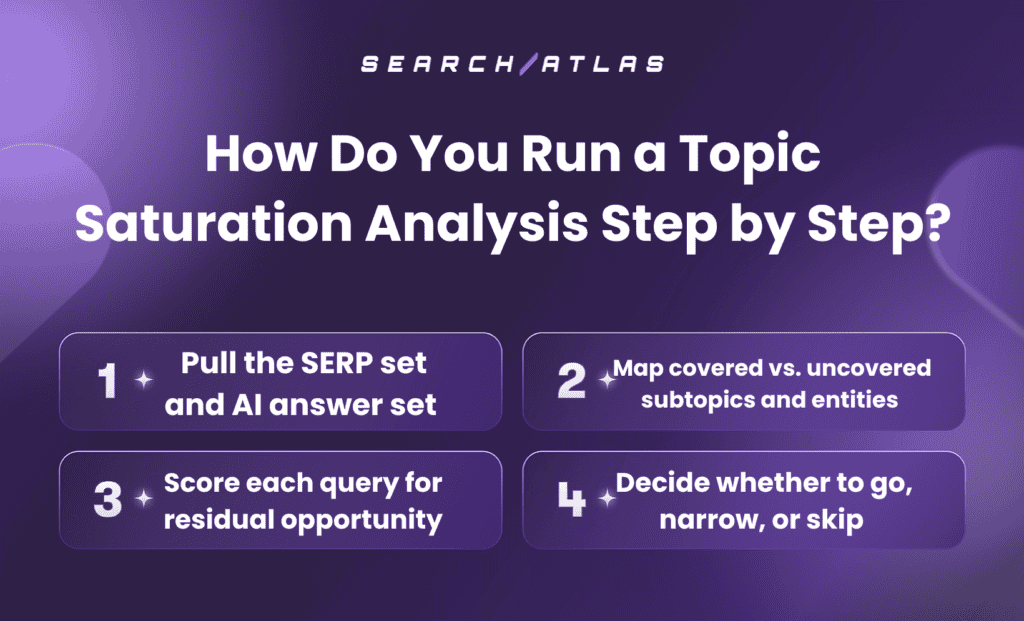
The 4 steps to run a topic saturation analysis are listed below.
1. Pull the SERP set and AI answer set. 2. Map covered vs. uncovered subtopics and entities. 3. Score each query for residual opportunity. 4. Decide whether to go, narrow, or skip.
1. Pull the SERP Set and AI Answer Set
Pulling the SERP set and AI answer set ensures that topic saturation analysis starts with real visibility data across search engines and AI systems. Search engines and generative engines reveal trusted sources through ranking positions, featured snippets, People Also Ask results, and AI citations. These surfaces define how Google, ChatGPT, Perplexity, and Gemini interpret authority and relevance for a topic. Content that appears repeatedly across these surfaces signals stable coverage, which indicates that the topic already has dominant sources.
Search engines no longer rely only on rankings. Search engines now combine traditional results with AI summaries, zero-click answers, and citation layers. This combination creates a multi-surface environment where visibility spreads across different formats instead of a single ranking position. AI engines rely on these same sources to generate answers. This overlap means SERP analysis and AI answer analysis need to run together instead of separately.
How do SERP and AI answer sets define topic saturation? SERP and AI answer sets define topic saturation by showing repeated URLs, repeated domains, repeated structures, and repeated facts across multiple queries. A saturated topic shows the same pages ranking for variations of the same keyword. A saturated topic shows the same domains cited across AI answers. This repetition confirms that search systems already trust a fixed set of sources.
Content format patterns provide additional signals. Featured snippets show which paragraph structures win extraction. AI answers show which sentence formats and entity definitions get reused. Tables, lists, and definition blocks appear frequently in saturated topics because they match extraction patterns. This pattern shows that format plays a role in saturation, not only content.
A practical takeaway involves collecting the top 10 to 20 SERP results, identifying AI Overview citations, running prompts across ChatGPT and Perplexity, and logging repeated sources. This dataset creates a visibility baseline. This baseline shows which sources dominate, which formats repeat, and where variation still exists.
2. Map Covered vs. Uncovered Subtopics and Entities
Mapping covered vs. uncovered subtopics and entities ensures that topic saturation analysis identifies what the existing content landscape already explains and what remains missing. Search systems evaluate semantic completeness through entity relationships, subtopics, attributes, and supporting data instead of keyword presence alone. Content that covers all major entities and relationships signals completeness, while missing elements signal opportunity.
Search engines build understanding through entities and relationships. Entities define concepts, products, services, and ideas. Relationships connect those entities through attributes, comparisons, and context. AI systems use these relationships to generate answers. A page that covers entities without connections lacks depth. A page that connects entities across subtopics builds semantic strength.
How does entity and subtopic mapping define saturation? Entity and subtopic mapping defines saturation by identifying which elements repeat across ranking pages and AI answers. Repeated definitions, repeated examples, repeated questions, and repeated comparisons signal that the topic already has stable coverage. Missing definitions, missing examples, missing questions, and missing relationships signal gaps.
Subtopic mapping expands this analysis. A topic contains multiple layers (definitions, use cases, comparisons, benefits, limitations, and examples). Saturated topics show consistent coverage across all these layers. Unsaturated topics show weak coverage in one or more layers. This imbalance creates opportunities for new content.
Entity depth matters more than content count. A site publishes many pages without increasing coverage if those pages repeat the same entities. A single page outperforms many pages if it expands entity relationships and covers missing subtopics. This principle aligns with GEO systems that prioritize semantic completeness over volume.
A functional approach involves building a topic map that lists core entities, related entities, questions, comparisons, and supporting data. This map then compares against competitor pages and AI answers. Covered elements receive confirmation marks. Missing elements become content opportunities.
3. Score Each Query for Residual Opportunity
Scoring each query for residual opportunity ensures that topic saturation analysis prioritizes topics based on remaining visibility potential instead of search volume alone. Search systems evaluate demand, competition, repetition, and authority together. A query with high demand but strong repetition offers less opportunity than a query with moderate demand and clear gaps.
Residual opportunity represents the difference between existing coverage and potential coverage. High residual opportunity means content gaps exist, weak answers exist, or AI systems show inconsistent citation patterns. Low residual opportunity means strong incumbents dominate, answers repeat across systems, and coverage appears complete.
How does residual opportunity scoring define content potential? Residual opportunity scoring defines content potential by combining demand signals with saturation signals. Demand signals include search volume, query frequency, and user intent consistency. Saturation signals include SERP overlap, citation concentration, entity repetition, and content quality.
SERP overlap acts as a primary indicator. High overlap means multiple queries return the same results, which signals saturation. Citation concentration acts as a second indicator. A small set of domains dominating AI answers signals a limited opportunity. Content quality acts as a third indicator. Weak, outdated, or shallow pages signal opportunity even inside competitive topics.
Freshness and data density influence scoring. AI systems prefer updated data and clear facts. A topic with outdated statistics or missing data points creates an opportunity, even if coverage exists. A topic with current, structured, and detailed data shows lower opportunity.
A practical takeaway involves assigning scores to each query based on demand, overlap, citations, quality gaps, and entity gaps. Queries with high demand and low saturation signals receive higher scores. Queries with high repetition and strong incumbents receive lower scores. This scoring creates a prioritized list of content opportunities.
4. Decide Whether to Go, Narrow, or Skip
Deciding whether to go, narrow, or skip ensures that topic saturation analysis leads to clear execution decisions. Content strategies fail when teams create content without validating the opportunity. Topic saturation analysis prevents wasted effort by filtering topics based on measurable signals.
A go decision applies when demand exists, and gaps remain. These gaps appear as missing entities, weak answers, inconsistent citations, or low-quality competitors. These signals show that new content competes and gains visibility across SEO, AEO, and GEO systems.
A narrow decision applies when broad topics show saturation,n but subtopics remain open. Broad queries often show high SERP overlap and strong incumbents. Long-tail queries often show lower overlap and weaker answers. Narrowing focuses on these smaller opportunities. This approach builds authority gradually while avoiding direct competition with saturated pages.
A skip decision applies when topics show full saturation. Full saturation appears through repeated SERP results, repeated AI citations, complete entity coverage, and strong content quality. New content in these conditions adds no new value. Search systems ignore redundant pages because they do not expand semantic coverage.
How does the go, narrow, or skip decision improve content strategy? The decision framework improves content strategy by aligning effort with opportunity. Go decisions drive growth through new coverage. Narrow decisions build depth through focused expansion. Skip decisions prevent wasted resources on saturated topics.
Execution depends on consistency. Teams apply the same framework across topics to maintain quality and efficiency. This consistency ensures that every new pagetargets as measurable opportunity instead of repeating existing content.
A functional approach involves reviewing residual scores, identifying gaps, and assigning each topic to go, narrow, or skip categories. This classification turns analysis into action and ensures content strategy focuses on areas with real ranking, answer, and citation potential.
How Do You Compete on a Saturated Topic?
Businesses compete on a saturated topic by reducing broad competition, adding measurable information gain, and structuring content for higher citation probability. Saturated topics already contain repeated answers, stable ranking pages, and concentrated AI citations across SEO, AEO, and GEO systems. Effective competition improves visibility by creating a clearer reason for search engines and AI systems to select the content.
The 3 methods to compete on a saturated topic are listed below.
1. Reduce competition through intent segmentation. 2. Create measurable information gain. 3. Structure content for higher citation probability.
1. Reduce Competition Through Intent Segmentation
Reducing competition through intent segmentation narrows a saturated topic into a specific search need with clearer ranking potential. This method segments the topic by audience, use case, funnel stage, pain point, comparison angle, or query format. This segmentation matters because broad topics attract stronger competitors, while narrow intents often reveal gaps in SERPs and AI answers.
Intent segmentation works by separating broad demand from specific demand. A broad query often returns high-authority guides, directories, and large publisher pages. A segmented query often returns weaker results because fewer pages answer the exact need. This gap creates room for a focused page to rank, appear in answer engines, and earn AI citations.
A practical takeaway involves turning one saturated topic into several intent-specific angles. Segment the topic by beginner intent, comparison intent, implementation intent, industry intent, and decision-stage intent. Then choose the angle with enough demand, weaker results, and clearer missing answers.
2. Create Measurable Information Gain
Creating measurable information gain gives search engines and AI systems a reason to select new content over existing content. This method adds original data, clearer frameworks, updated facts, expert commentary, stronger examples, or deeper entity coverage. This information gain matters because saturated topics already repeat the same definitions, lists, and explanations.
Information gain works by comparing what competitors already say against what the new content adds. Repeated ideas show low gain because they do not expand the topic. New facts, unique frameworks, and original examples show high gain because they add value to the existing content set. AI systems favor this added value because it improves answer quality and source usefulness.
A practical takeaway involves auditing top-ranking pages and AI answers before writing. List the repeated points, missing points, weak examples, outdated data, and unsupported claims. Then create content that fills those gaps with specific facts, original insights, and stronger explanations.
3. Structure Content for Higher Citation Probability
Structuring content for higher citation probability makes saturated-topic content easier for search engines and AI systems to extract and reuse. This method uses clear headings, direct answers, tables, schema, concise paragraphs, consistent terminology, and entity-rich explanations. This structure matters because AEO and GEO systems prefer content that answers questions clearly and reduces interpretation errors.
Citation structure works by placing answer-ready information where extraction systems expect it. Question-based headings create clear query alignment. Short, direct answers create reusable passages. Schema clarifies entity identity, page type, and relationships.
A practical takeaway involves adding a 40 to 60-word answer under each important heading. Follow each answer with supporting details, examples, and data points. Use the FAQ schema, Article schema, and Organization schema when relevant. This structure increases the chance that the content appears in snippets, AI Overviews, and generated answers.
What Tools Support Topic Saturation Analysis?
The best tools for topic saturation analysis identify coverage gaps, map entities, and measure topical authority across SEO, AEO, and GEO systems. Topic saturation analysis depends on keyword clustering, semantic mapping, and competitive gap detection, which define how completely a topic is covered.
The 10 best tools for topic saturation analysis are Search Atlas, Semrush, Ahrefs, MarketMuse, Clearscope, Surfer SEO, Frase, RankDots, Topical Map AI, and Keywordly.
- Search Atlas. Search Atlas measures topic saturation through Topical Dominance, Content Genius, and LLM Visibility systems. Search Atlas maps entities, clusters, and topics, and identify missing coverage across SEO, AEO, and GEO environments. Search Atlas connects analysis with execution by generating content updates, internal links, and technical fixes directly from detected gaps. This execution layer makes Search Atlas the most complete platform for topic saturation because it moves from analysis to deployment in one workflow.
- Semrush. Semrush measures topic saturation through keyword clustering, topic research, and content gap analysis. Semrush identifies missing queries, overlapping coverage, and competitor-owned clusters across SERPs and AI surfaces. Semrush focuses on keyword-level and SERP-level saturation, which defines where coverage exists and where gaps remain. Semrush fits teams that prioritize competitive benchmarking and large-scale keyword mapping.
- Ahrefs. Ahrefs measures topic saturation through Content Gap, Site Explorer, and keyword clustering features. Ahrefs identifies which topics competitors cover that a site does not, which exposes saturation gaps at the query and entity level. Ahrefs integrates backlink data with topic coverage, which connects authority signals with saturation analysis. Ahrefs fits teams that combine link authority with topical expansion strategies.
- MarketMuse. MarketMuse measures topic saturation through topic modeling, content scoring, and domain-wide gap analysis. MarketMuse evaluates how deeply a site covers a topic and highlights missing subtopics that reduce authority. MarketMuse uses AI-driven scoring to prioritize which content to create or update, which improves topical completeness.
- Clearscope. Clearscope measures topic saturation through semantic coverage scoring and content optimization. Clearscope compares content against top-ranking pages and identifies missing terms, entities, and questions. Clearscope improves AEO and GEO readiness because it structures content for extraction and citation in AI-generated answers.
- Surfer SEO. Surfer SEO measures topic saturation through SERP-based clustering and content editor recommendations. Surfer groups keywords by SERP similarity and suggests headings, entities, and questions to include. Surfer focuses on on-page completeness, which ensures each page contributes to overall topic saturation.
- Frase. Frase measures topic saturation through AI-driven content briefs, question extraction, and SERP analysis. Frase identifies questions, entities, and subtopics that appear across top results, which define coverage expectations. Frase fits workflows focused on AEO because it structures answers for question-based queries and AI summaries.
- RankDots. RankDots measures topic saturation through AI clustering and growth prediction models. RankDots identifies underdeveloped topic clusters and predicts which clusters offer the highest visibility gain. RankDots focuses on expansion opportunities, which helps prioritize new content creation.
- Topical Map AI. Topical Map AI measures topic saturation through visual clustering and semantic mapping. Topical Map AI generates hundreds of related keywords and organizes them into structured topic clusters. Topical Map AI focuses on visualization, which helps plan full-topic coverage across content systems.
- Keywordly. Keywordly measures topic saturation through end-to-end topical mapping, content briefs, and publishing workflows. Keywordly connects clustering, drafting, and publishing into a single system, which ensures identified gaps turn into published content. Keywordly focuses on full workflow execution from map to live content.
Among available tools, Search Atlas provides the most complete topic saturation workflow because it combines entity mapping, content optimization, and execution across SEO, AEO, and GEO systems in one platform.
What Are Common Mistakes in Topic Saturation Analysis?
Topic saturation analysis mistakes happen when coverage decisions ignore search intent, entity depth, and competitive reality across SEO, AEO, and GEO systems. These mistakes reduce visibility, fragment authority, and limit inclusion in AI-generated answers instead of expanding coverage. Topic saturation requires precision because every decision affects how search engines and AI systems interpret topical completeness and authority signals.
There are 10 main topic saturation analysis mistakes to avoid.
1. Treating saturation as a fixed endpoint. Treating saturation as a fixed endpoint creates incomplete coverage because topics expand through new queries, entities, and user intents over time. Topic saturation operates as a continuous state where coverage evolves as search demand evolves. Declaring a topic “done” too early limits expansion into long-tail queries, follow-up questions, and adjacent entities. Saturation requires continuous monitoring because search systems constantly introduce new interpretations, formats, and answer pathways that reshape coverage expectations.
2. Ignoring search intent segmentation. Ignoring search intent segmentation leads to shallow coverage because different intents require different pages, formats, and explanations. Informational, navigational, and commercial intents each require distinct structures and content depth. Combining all intents into one page reduces clarity and limits ranking potential across multiple query types. Intent segmentation ensures each query type receives precise coverage, which strengthens both SEO rankings and AEO extraction in AI-generated answers.
3. Measuring coverage only with keywords. Measuring coverage only with keywords creates false completeness because keywords represent surface-level signals rather than full semantic relationships. Topic saturation depends on entities, relationships, and contextual meaning, not only keyword presence. Pages that include keywords without covering related entities remain incomplete in semantic systems. Entity-level mapping ensures deeper coverage because AI systems interpret topics through relationships, not isolated terms.
4. Ignoring entity relationships and knowledge graphs. Ignoring entity relationships weakens topical authority because search systems organize knowledge through connected entities. Topics exist inside networks of related concepts, attributes, and references that define meaning. Pages that fail to connect entities remain isolated and harder to interpret. Entity schema modeling strengthens contextual clarity by structuring those relationships explicitly, which improves retrieval, ranking, and citation across generative engines.
5. Overlooking AI answer coverage and citation presence. Overlooking AI answer coverage limits visibility because modern search includes AI-generated summaries, not only traditional rankings. Topic saturation requires presence in AI Overviews, ChatGPT responses, and other generative systems. Pages that rank without being cited miss significant exposure opportunities. Citation tracking reveals whether content reaches true saturation across AI environments, not only SERPs.
6. Failing to analyze competitor coverage depth. Failing to analyze competitor coverage creates blind spots because competitors define current saturation levels across a topic. High-performing competitors often cover subtopics, entities, and formats that define expected completeness. Ignoring these patterns leads to underdeveloped content clusters. Competitive analysis identifies gaps where competitors dominate or where opportunities remain underserved.
7. Producing overlapping content without consolidation. Producing overlapping content fragments is problematic because multiple pages compete for the same intent and dilute ranking signals. Search engines struggle to select a primary page, which reduces visibility across all competing pages. Consolidation merges overlapping content into stronger resources that capture full authority and improve ranking stability. Topic saturation requires structured clustering, not duplication.
8. Ignoring internal linking and topical structure. Ignoring internal linking breaks topical flow because search systems rely on internal connections to understand content relationships. Topic clusters require clear linking between pillar pages and supporting pages to signal coverage depth. Weak internal linking creates isolated pages that fail to contribute to overall authority. Structured linking reinforces hierarchy and strengthens semantic coverage across the topic.
9. Expanding breadth without depth. Expanding breadth without depth creates shallow coverage because adding more pages does not guarantee stronger authority. Topic saturation depends on depth within each subtopic, not only the number of pages. Pages that lack detailed explanations, examples, and supporting entities fail to meet coverage expectations. Depth strengthens authority because it signals expertise and completeness within each topic segment.
10. Failing to monitor performance after expansion. Failing to monitor performance prevents optimization because saturation analysis requires feedback from rankings, traffic, and citations. New content needs evaluation to confirm whether it improves coverage or creates redundancy. Without monitoring, ineffective pages remain unchanged, and opportunities remain undiscovered. Continuous tracking ensures topic saturation evolves based on real performance data rather than assumptions.
What is the Future of Topic Saturation in SEO and AI Search?
The future of topic saturation in SEO and AI search is defined by entity-driven coverage, continuous expansion, and citation-based visibility across generative engines. This shift matters because saturation no longer depends on how many pages exist, but on how completely a topic is understood by machines. Topic saturation evolves from content volume into a dynamic system that measures entity depth, semantic relationships, and inclusion across SEO, AEO, and GEO environments.
How do AI systems reshape topic saturation in SEO and AI search? AI systems reshape topic saturation by requiring complete entity coverage, consistent relationships, and structured clarity before ranking or citing content. Systems fail when content covers keywords without defining entities and connections across pages. This requirement increases the importance of semantic completeness because retrieval depends on how well topics are mapped as networks, not isolated articles. Organizations improve outcomes by building interconnected content clusters that reinforce entity meaning and remove ambiguity across search and AI-generated answers.
What future requirements will define topic saturation in AI search? Future topic saturation requires continuous expansion, entity consistency, and cross-platform visibility across search engines and generative systems. These requirements matter because AI search operates in environments where new queries, formats, and interpretations emerge daily. Saturation depends on maintaining updated coverage that reflects evolving user intent and expanding entity relationships. Systems that integrate SEO, AEO, and GEO signals into one framework achieve stronger visibility because coverage remains aligned across all discovery channels.
What is the current state of topic saturation in SEO? The current state shows widespread content production, yet most topics remain superficially covered due to weak entity mapping and fragmented content structures. Many sites produce large volumes of content without building connected topical systems, which limits authority and reduces visibility. Topic saturation improves this limitation by organizing content into structured clusters that align subtopics, entities, and intent pathways into one coherent system. This structure increases both ranking stability and AI citation probability.
How will topic saturation evolve in the next phase of AI search? Topic saturation evolves toward dynamic, intent-driven systems that expand continuously based on search demand, AI retrieval patterns, and user behavior signals. Future systems rely on real-time analysis of gaps, citations, and entity coverage to determine where expansion is required. This evolution transforms topic saturation into an operational process rather than a one-time analysis. Content strategies shift from publishing isolated pages to maintaining adaptive topic ecosystems that grow as new questions and entities emerge.
What risks will shape the future of topic saturation in SEO and AI search? Key risks include content overproduction without differentiation, inconsistent entity coverage, and reliance on keyword-based strategies that ignore semantic depth. These risks matter because AI systems prioritize clarity, trust, and completeness when selecting sources. Content that repeats existing information without adding value fails to gain visibility in both search rankings and AI-generated answers. Organizations mitigate risk through structured topic mapping, continuous gap analysis, and alignment between content, entities, and intent signals.
The future of topic saturation in SEO and AI search favors systems that expand coverage continuously, connect entities clearly, and align content with how AI systems interpret and reuse information. AI search rewards content that demonstrates complete understanding without ambiguity, which makes topic saturation a core system for visibility, authority, and long-term performance.
Why Citation Slots Replace Ranking Positions?
Citation slots replace ranking positions because AI Overviews answer queries before users reach traditional organic results. Citation slots replace ranking positions because AI systems select and display source passages inside the answer layer, which becomes the first visibility surface. This shift reduces the value of ranking alone because users often form trust, preference, and intent inside AI-generated results.
Citation slots replace ranking positions by moving visibility from blue links into AI-generated summaries. Pages ranking in position 1 lose clicks when AI Overviews appear above them. A cited source inside the AI Overview receives stronger visibility than a higher-ranking page that receives no citation.
Citation slots replace ranking positions by changing how users interact with search results. Users read summarized answers before scrolling to organic listings, which means the cited sources shape the first impression. This behavior makes citation presence more important because users often receive enough information without clicking.
Citation slots replace ranking positions by increasing zero-click search behavior across informational queries. AI Overviews reduce clicks because they satisfy intent directly on the results page. This reduction means brands need presence inside the answer, not only placement beneath it.
Citation slots replace ranking positions by making passage selection as important as page ranking. AI systems cite the passage that resolves the query fastest, even when the page does not rank first. This selection rewards clear answers, structured facts, and entity-rich explanations.
Citation slots replace ranking positions by changing the core SEO metric from average position to citation share. Citation share measures how often a domain appears in AI-generated answers for tracked queries. This metric matters because AI visibility depends on inclusion inside the answer layer, not only rank position in traditional listings.
Citation slots replace ranking positions by connecting SEO, AEO, and GEO into one visibility system. SEO earns crawlability and authority. AEO structures direct answers. GEO increases citation probability inside generative results. This combined system determines whether a brand appears where searchers now form decisions.
Why Citation Selection Defines Saturation Instead Of Ranking Depth?
Citation selection defines saturation instead of ranking depth because AI systems measure coverage based on what they extract, not where pages rank. Citation selection defines saturation because generative engines evaluate whether a topic is fully resolved across sources before selecting passages to include in answers. This shift replaces ranking depth with citation presence as the primary signal of topical completeness across SEO, AEO, and GEO environments.
Citation selection defines saturation by prioritizing extractable answers over full-page rankings. AI systems scan multiple sources and select specific passages that resolve the query directly. Pages that rank deeply but lack clear, quotable answers fail to receive citations, which limits visibility. Saturation occurs when content consistently provides extractable answers across all relevant subtopics and entities.
Citation selection defines saturation by measuring coverage through citation diversity across queries and intents. AI systems pull from multiple sources to validate accuracy and completeness before generating responses. A topic reaches saturation when the same set of sources repeatedly appears across different prompts, variations, and follow-up questions. This repetition signals that the topic has limited remaining information gain.
Citation selection defines saturation by rewarding entity clarity and relationship consistency instead of keyword depth. AI systems interpret topics through entities and their connections, not keyword frequency alone. Content that defines entities clearly and connects them across contexts receives more citations. Saturation occurs when entity coverage becomes consistent across sources, and no new entities expand the topic meaningfully.
Citation selection defines saturation by shifting evaluation from page-level authority to passage-level usefulness. AI systems select the most useful passage regardless of the page’s overall ranking position. A lower-ranked page receives citations if it provides a clearer answer than higher-ranked competitors. Saturation occurs when the best passages across a topic repeat without introducing new insights.
Citation selection defines saturation by aligning visibility with answer-layer inclusion rather than link-layer position. AI Overviews and generative systems display answers before organic listings, which makes citation slots the primary visibility surface. Pages that are not cited remain invisible in the most important interaction layer. Saturation reflects whether a topic is fully represented inside these answer layers.
Citation selection defines saturation by introducing citation share as the core measurement of topical completeness. Citation share tracks how often a domain appears across AI-generated answers for a defined set of queries. A high citation share indicates strong coverage and authority across a topic. Saturation occurs when increasing content volume no longer increases citation share because coverage is already complete.
Citation selection defines saturation by connecting SEO, AEO, and GEO into one evaluation system based on inclusion, not ranking depth. SEO establishes crawlability and authority. AEO structures clear answers for extraction. GEO increases citation probability across generative engines. Saturation occurs when content consistently appears across these systems without requiring deeper ranking expansion.