Machine learning is a branch of artificial intelligence that enables computer systems to learn patterns from data and improve predictions without explicit programming. The definition of machine learning explains how algorithms transform historical data into predictions, classifications, recommendations, and automated decisions. This process defines how machine learning powers modern software systems.
Machine learning matters because organizations generate vast amounts of data that traditional rule-based systems cannot analyze efficiently. Machine learning identifies patterns, predicts outcomes, and automates decisions across healthcare, finance, retail, manufacturing, and technology. This capability explains why machine learning remains one of the most widely adopted artificial intelligence technologies.
Machine learning creates measurable business value through automation, pattern detection, scalability, and personalization. Machine learning improves fraud detection, customer recommendations, predictive maintenance, medical diagnosis, and demand forecasting. These applications allow organizations to improve accuracy, reduce operational costs, and make faster data-driven decisions.
Machine learning requires an understanding of models, algorithms, training processes, evaluation methods, and deployment challenges. Learning how machine learning works clarifies the differences between supervised learning, unsupervised learning, reinforcement learning, deep learning, and generative AI. This understanding provides the foundation for building, evaluating, and applying machine learning systems effectively.
What Is Machine Learning?
Machine learning is a branch of artificial intelligence that enables computer systems to learn patterns from data and make predictions without relying on fixed, manually programmed rules. Machine learning uses algorithms to identify relationships inside large datasets, then converts those relationships into predictive models. These models make decisions about new information based on patterns learned during training rather than instructions written for every possible scenario.
Why does the definition of machine learning matter for practitioners? The definition matters because machine learning solves problems that traditional programming struggles to address. Many real-world problems contain thousands of variables, changing conditions, and relationships that developers cannot describe with explicit rules. A spam detection system demonstrates this difference. A traditional system requires developers to continually create new detection rules. A machine learning system adjusts its model after analyzing new examples, which allows the model to recognize emerging patterns without constant manual updates.
What role does data play in making machine learning work? Data functions as the foundation of every machine learning system. Machine learning depends on data because algorithms learn patterns directly from training examples. High-quality data produces stronger predictions, while incomplete or biased data creates unreliable outputs. This relationship makes data quality one of the most important factors in machine learning performance.
Why is data quality important in machine learning? Data quality determines how accurately a machine learning model represents real-world conditions. A model trained on incomplete customer records produces incomplete predictions. A model trained on biased historical information reproduces those biases in future decisions. Data preparation addresses these risks through data collection, cleaning, validation, and structuring. Many organizations spend more time preparing data than selecting algorithms because data quality directly influences model accuracy.
How does machine learning create value from data? Machine learning transforms raw data into predictions, classifications, recommendations, and insights. Businesses use machine learning to detect fraud, forecast demand, personalize content, and automate decision-making. These applications depend on the same principle. Machine learning identifies patterns inside historical data, then applies those patterns to future situations. This ability to learn from data and generalize knowledge defines machine learning and distinguishes it from traditional software systems.
How Does Machine Learning Work?
Machine learning works by learning patterns from data through repeated prediction, evaluation, and adjustment. Machine learning algorithms analyze training data, generate predictions, measure prediction errors, and update internal parameters to improve accuracy. This process continues until the model reaches a stable level of performance and identifies reliable relationships within the data.
What is the core computational process that makes machine learning possible? The core computational process consists of prediction, loss calculation, and parameter optimization. A machine learning model first generates a prediction from input data. A loss function then measures the difference between the prediction and the correct answer. An optimization algorithm adjusts the model’s parameters to reduce that difference. Gradient descent performs this task in many machine learning systems by identifying the direction that reduces prediction error most effectively. This cycle repeats across thousands or millions of examples until the model minimizes loss and improves predictive accuracy.
Why does machine learning rely on repeated adjustments? Repeated adjustments allow machine learning models to gradually improve performance. Early predictions often contain substantial errors because the model begins with random or incomplete parameter values. Each adjustment reduces those errors by refining the relationships the model learns from data. These refinements strengthen useful patterns and weaken inaccurate patterns. The learning process continues until additional adjustments produce only minor improvements.
How does a machine learning system handle inputs it has not seen before? A machine learning system applies learned patterns to new data through a process called generalization. Generalization allows machine learning models to make predictions without relying on memorized answers. An email spam filter demonstrates this process clearly. The spam filter learns patterns from previously labeled emails, then evaluates new emails based on those learned patterns. The filter identifies suspicious messages even when the wording differs from anything present in the training data.
What determines whether machine learning generalizes effectively? Training data quality determines how effectively machine learning generalizes. Representative training data exposes the model to a broad range of real-world situations. Incomplete training data limits the model’s understanding of future inputs. A customer recommendation model trained on diverse customer behavior produces more accurate recommendations than a model trained on narrow or biased datasets. Strong generalization depends on accurate, complete, and representative data.
What separates training from inference in machine learning? Training and inference represent the two primary stages of machine learning. Training adjusts model parameters using historical data and known outcomes. Inference applies those learned parameters to new inputs and generates predictions. Training requires significant computational resources because the model continuously updates itself. Inference requires fewer resources because the model only evaluates new information using existing parameters.
Why is the distinction between training and inference important? The distinction matters because training and inference perform different functions inside machine learning systems. Training builds the predictive model. Inference uses the predictive model. A recommendation engine illustrates this distinction. The recommendation engine trains on historical user activity over several hours or days. The same recommendation engine performs inference in milliseconds whenever a visitor loads a page. This separation allows machine learning systems to learn from large datasets while maintaining fast responses in production environments.
What Is the Training Process in Machine Learning?
Machine learning works by learning patterns from data through repeated prediction, evaluation, and adjustment. Machine learning algorithms analyze training data, generate predictions, measure prediction errors, and update internal parameters to improve accuracy. This process continues until the model reaches a stable level of performance and identifies reliable relationships within the data.
What is the core computational process that makes machine learning possible? The core computational process consists of prediction, loss calculation, and parameter optimization. A machine learning model first generates a prediction from input data. A loss function then measures the difference between the prediction and the correct answer. An optimization algorithm adjusts the model’s parameters to reduce that difference. Gradient descent performs this task in many machine learning systems by identifying the direction that reduces prediction error most effectively. This cycle repeats across thousands or millions of examples until the model minimizes loss and improves predictive accuracy.
Why does machine learning rely on repeated adjustments? Repeated adjustments allow machine learning models to gradually improve performance. Early predictions often contain substantial errors because the model begins with random or incomplete parameter values. Each adjustment reduces those errors by refining the relationships the model learns from data. These refinements strengthen useful patterns and weaken inaccurate patterns. The learning process continues until additional adjustments produce only minor improvements.
How does a machine learning system handle inputs it has not seen before? A machine learning system applies learned patterns to new data through a process called generalization. Generalization allows machine learning models to make predictions without relying on memorized answers. An email spam filter demonstrates this process clearly. The spam filter learns patterns from previously labeled emails, then evaluates new emails based on those learned patterns. The filter identifies suspicious messages even when the wording differs from anything present in the training data.
What determines whether machine learning generalizes effectively? Training data quality determines how effectively machine learning generalizes. Representative training data exposes the model to a broad range of real-world situations. Incomplete training data limits the model’s understanding of future inputs. A customer recommendation model trained on diverse customer behavior produces more accurate recommendations than a model trained on narrow or biased datasets. Strong generalization depends on accurate, complete, and representative data.
What Is a Machine Learning Model?
A machine learning model is a mathematical representation of patterns learned from data that transforms inputs into predictions, classifications, or probability scores. A machine learning model stores the relationships discovered during training and applies those relationships to new data during inference. These learned relationships allow the model to make decisions without relying on manually programmed rules.
What exactly is a machine learning model? A machine learning model consists of learned parameters and computational logic that map inputs to outputs. The model begins with randomly initialized parameter values or predefined starting values. Training adjusts those values until the model captures meaningful patterns from the data. The final model stores those learned patterns inside a structured file that contains parameter values and the operations required to process future inputs.
How does a machine learning model learn patterns? A machine learning model learns patterns by comparing predictions against known outcomes and reducing prediction errors. Each training cycle updates the model’s internal parameters to improve accuracy. These updates strengthen useful relationships and reduce inaccurate relationships. The resulting model captures statistical patterns that connect input data to expected outputs.
What types of outputs do machine learning models produce? Machine learning models produce three primary output types. These output types are regression outputs, classification outputs, and probability outputs.
- Regression output predicts a continuous numerical value. A house price prediction model demonstrates regression because the model estimates a specific price based on property characteristics. Financial forecasting systems and demand prediction systems frequently use regression outputs for numerical predictions.
- Classification output. A classification output assigns data to predefined categories. An image recognition model demonstrates classification because the model identifies whether an image contains a cat, dog, vehicle, or another object. Email spam detection and medical diagnosis systems frequently use classification outputs.
- Probability output. A probability output estimates the likelihood of different outcomes. A fraud detection model demonstrates probability prediction because the model assigns a risk score to each transaction. Organizations use probability scores to establish decision thresholds based on acceptable risk levels.
How does model complexity relate to model performance? Model complexity determines the range of patterns a machine learning model represents. Simple models capture straightforward relationships, while complex models capture highly nonlinear relationships. This relationship between complexity and representation directly influences prediction accuracy, computational requirements, and interpretability.
What happens when a machine learning model has low complexity? Low complexity models contain fewer learnable parameters and simpler mathematical structures. A linear regression model demonstrates low complexity because the model represents relationships through straight line calculations. These models train quickly, require less data, and provide greater transparency into decision-making.
What happens when a machine learning model has high complexity? High complexity models contain large numbers of learnable parameters and advanced computational structures. A deep neural network demonstrates high complexity because the network processes information through multiple interconnected layers. These models capture intricate relationships in images, language, speech, and other complex datasets.
Why is selecting the right level of complexity important? Model selection requires balancing complexity, accuracy, and generalization. Excessively simple models fail to capture important patterns. Excessively complex models memorize training data rather than learning general relationships. Effective machine learning projects select a level of complexity that matches the problem, the available data, and the desired business outcome. This balance allows machine learning models to produce accurate predictions while maintaining reliable performance on new data.
What Are the Different Types of Machine Learning?
The different types of machine learning are supervised learning, unsupervised learning, semi-supervised learning, and reinforcement learning. These machine learning types define how algorithms learn from data, which determines the training process, data requirements, and prediction capabilities.
Machine learning types differ based on the feedback available during training. Some machine learning types learn from labeled examples, while other machine learning types discover patterns independently or learn through interaction. This difference determines how machine learning systems solve business and technical problems.
There are 4 main types of machine learning listed below.
1. Supervised learning. Supervised learning uses labeled training data, which creates direct feedback during model training. Supervised learning learns by comparing predictions against known outcomes and reducing prediction errors. This approach produces strong predictive accuracy for classification and regression tasks.
2. Unsupervised learning. Unsupervised learning uses unlabeled data, which allows algorithms to discover hidden structures and relationships. Unsupervised learning identifies clusters, patterns, and distributions without predefined categories. This approach supports customer segmentation, anomaly detection, and exploratory analysis.
3. Semi-supervised learning. Semi-supervised learning combines labeled data and unlabeled data, which reduces the need for extensive manual labeling. Semi-supervised learning strengthens model performance by extracting patterns from larger unlabeled datasets. This approach improves accuracy in domains where labeled data remains limited.
4. Reinforcement learning. Reinforcement learning learns through rewards and penalties, which creates an interaction-based training process. Reinforcement learning trains agents to select actions that maximize long-term outcomes. This approach drives applications in robotics, game-playing systems, and decision optimization.
What Is Supervised Learning?
Supervised learning is a machine learning method that trains models on labeled data to predict known outcomes. Supervised learning receives input examples paired with correct answers. These correct answers provide direct feedback, which allows the model to improve prediction accuracy during training.
What makes supervised learning effective? Supervised learning benefits from clear feedback because every training example contains a known label. This feedback allows supervised learning models to identify relationships between inputs and outputs with high accuracy. The main limitation involves labeled data because creating labels often requires significant time, expertise, and cost.
There are 2 main supervised learning tasks. First, classification. Classification predicts discrete categories, which assign each input to a specific class. Spam detection, medical diagnosis, and sentiment analysis rely on classification models. Second, regression. Regression predicts continuous numerical values, which estimate measurable outcomes. Revenue forecasting, demand prediction, and house price estimation rely on regression models.
Where does supervised learning create value? Supervised learning creates value in image recognition, fraud detection, credit scoring, customer churn prediction, and document classification. These applications depend on historical examples with known outcomes, which allow models to learn accurate prediction patterns.
What limits supervised learning performance? Distribution shift limits supervised learning performance because production data changes over time. A distribution shift occurs when new inputs differ significantly from training data. This difference reduces accuracy and requires retraining with updated datasets.
What Is Unsupervised Learning?
Unsupervised learning is a machine learning method that identifies patterns in unlabeled data. Unsupervised learning discovers relationships without predefined answers. These relationships reveal structure, similarity, and organization within datasets.
There are 2 main unsupervised learning techniques. First, clustering. Clustering groups similar data points, which reveals natural segments inside a dataset. Customer segmentation and anomaly detection frequently use clustering algorithms. Second, Dimensionality reduction. Dimensionality reduction compresses large datasets, which simplifies analysis while preserving important relationships. Principal Component Analysis represents one of the most widely used dimensionality reduction methods.
Where does unsupervised learning create value? Unsupervised learning creates value in recommendation systems, customer segmentation, anomaly detection, and data compression. These applications benefit from discovering patterns before labels become available.
What is semi-supervised learning?
Semi-supervised learning is a machine learning method that combines small labeled datasets with large unlabeled datasets. Semi-supervised learning reduces labeling requirements while improving predictive performance. This combination addresses situations where labeled data remains scarce and expensive.
How does semi-supervised learning work? Semi-supervised learning begins with labeled examples, then extends learning through unlabeled examples. Many systems generate pseudo labels for unlabeled data and incorporate those predictions into future training cycles. This process strengthens learned representations across larger datasets.
Where does semi-supervised learning create value? Semi-supervised learning creates value in medical imaging, speech recognition, and document classification. These domains generate large amounts of unlabeled data while maintaining limited expert-labeled examples.
What Is Reinforcement Learning?
Reinforcement learning is a machine learning method that trains agents through rewards and penalties. Reinforcement learning learns through interaction rather than labeled examples. This interaction teaches agents which actions produce favorable outcomes over time.
How does reinforcement learning work? Reinforcement learning follows a cycle of observation, action, reward, and policy improvement. The agent observes the environment, selects an action, receives feedback, and updates future behavior. This cycle repeats until the agent maximizes cumulative rewards.
Where does reinforcement learning create value? Reinforcement learning creates value in robotics, recommendation systems, industrial automation, and game-playing systems. These environments provide measurable outcomes that guide continuous learning.
What limits reinforcement learning adoption? Environmental complexity limits reinforcement learning adoption because training requires extensive interaction data or accurate simulations. This requirement increases implementation costs and technical complexity compared to supervised learning approaches.
What Is the Difference Between Machine Learning, AI, and Deep Learning?
The difference between machine learning, AI, and deep learning lies in their scope and learning methods. Artificial intelligence is the broadest field, machine learning is a subset of artificial intelligence, and deep learning is a subset of machine learning. This hierarchy defines how intelligent systems progress from rule-based automation to advanced pattern recognition.
AI, machine learning, and deep learning address different levels of computational intelligence. Artificial intelligence focuses on creating systems that perform tasks associated with human intelligence. Machine learning focuses on learning patterns from data. Deep learning focuses on learning complex patterns through multi-layer neural networks.
The core differences between AI, machine learning, and deep learning are below.
| Aspect | Artificial Intelligence | Machine Learning | Deep Learning |
| Scope | Broad field of intelligent systems. | Subfield of artificial intelligence. | Subfield of machine learning. |
| Learning method | Rules, logic, search, optimization, and machine learning. | Learns patterns from data. | Learns patterns through neural networks. |
| Data requirements | Low to moderate. | Moderate to high. | High to very high. |
| Feature creation | Often manually defined. | Often manually selected or engineered. | Automatically learned from data. |
| Interpretability | High in rule-based systems. | Moderate. | Lower due to model complexity. |
| Best suited for | Automation and decision making. | Prediction and classification. | Images, speech, language, and unstructured data. |
| Examples | Expert systems, planning systems, virtual assistants. | Fraud detection, churn prediction, and recommendation engines. | ChatGPT, image recognition, speech recognition. |
How Is Machine Learning Different from Traditional Programming?
The difference between machine learning and traditional programming lies in how rules are created. Traditional programming relies on rules written by developers, while machine learning learns rules directly from data. This distinction determines how systems handle complexity, change, and prediction tasks.
The core differences between machine learning and traditional programming are below.
| Aspect | Traditional Programming | Machine Learning |
| Rule creation | Developers create rules manually. | Models learn rules from data. |
| Input requirements | Inputs and rules produce outputs. | Inputs and outputs produce learned rules. |
| Adaptability | Requires manual updates. | Improves through retraining. |
| Complexity handling | Struggles with a large number of conditions. | Learns complex relationships automatically. |
| Transparency | Logic remains visible and traceable. | Logic exists inside learned parameters. |
| Best suited for | Fixed processes and business rules. | Prediction and pattern recognition. |
What is the fundamental structural difference between machine learning and traditional programming? Traditional programming transforms inputs into outputs through predefined logic. Machine learning transforms data into learned patterns that generate future outputs. A traditional spam filter depends on manually written rules. A machine learning spam filter learns decision patterns from thousands of labeled examples. This learning process removes the need to define every possible rule in advance.
Why does machine learning scale better for complex problems? Machine learning scales because data replaces manual rule creation. Complex systems contain thousands of variables, exceptions, and interactions. Manual rule creation becomes difficult as complexity increases. Machine learning identifies patterns automatically, which allows models to adapt to situations that developers never explicitly defined.
What does machine learning sacrifice compared to traditional programming? Machine learning sacrifices transparency in exchange for adaptability. Traditional programming provides a clear decision path because developers define every rule. Machine learning stores decision logic inside learned parameters rather than human-readable instructions. This structure creates interpretability challenges in highly regulated industries.
How Does Deep Learning Relate to Machine Learning?
The relationship between deep learning and machine learning is hierarchical. Deep learning represents a specialized branch of machine learning that uses neural networks with multiple layers. These layers allow deep learning systems to learn complex representations directly from raw data.
The core differences between deep learning and classical machine learning are below.
| Aspect | Classical Machine Learning | Deep Learning |
| Architecture | Statistical models and decision trees. | Multi-layer neural networks. |
| Feature extraction | Manual feature engineering. | Automatic feature learning. |
| Data requirements | Moderate datasets. | Large datasets. |
| Compute requirements | Lower. | Higher. |
| Training speed | Faster. | Slower. |
| Best suited for | Structured data. | Unstructured data. |
| Examples | Random forests, logistic regression, gradient boosting. | CNNs, RNNs, transformers. |
What distinguishes deep learning from classical machine learning? Deep learning learns features automatically through multiple neural network layers. Classical machine learning often depends on manually engineered features before training begins. A classical image classification model requires predefined visual features. A deep learning model learns visual features directly from raw pixels. This automatic learning process allows deep learning to process large volumes of unstructured data.
When does deep learning outperform classical machine learning? Deep learning outperforms classical machine learning on large datasets with complex relationships. Image recognition, speech recognition, and natural language processing demonstrate this advantage. These domains contain highly nonlinear patterns that neural networks capture effectively through layered representations.
Is classical machine learning preferable to deep learning? Classical machine learning remains preferable for smaller datasets, limited computing resources, and high interpretability requirements. Gradient boosted decision trees often produce strong results on structured business data. Regulatory environments frequently prefer classical machine learning because decision factors remain easier to explain and audit.
What Is the Difference Between Machine Learning and Generative AI?
The difference between machine learning and generative AI lies in their primary objectives. Machine learning focuses on prediction, classification, and decision making, while generative AI focuses on creating new content. This distinction defines how organizations use each technology to solve different business and technical problems.
Machine learning and generative AI operate within the same technology hierarchy. Generative AI exists as a specialized category of deep learning, while deep learning exists as a subset of machine learning. This relationship means every generative AI system uses machine learning, but not every machine learning system performs generative AI tasks.
The core differences between machine learning and generative AI are below.
| Aspect | Machine Learning | Generative AI |
| Primary objective | Predicts outcomes and identifies patterns. | Creates new content and generates outputs. |
| Main outputs | Predictions, classifications, probability scores. | Text, images, audio, video, code. |
| Training goal | Learn relationships between inputs and outputs. | Learn patterns that generate new data. |
| Typical data | Structured and unstructured data. | Large collections of content and media. |
| Common applications | Fraud detection, forecasting, and recommendations. | Content creation, chatbots, image generation. |
| Business function | Decision making and prediction. | Content generation and language interaction. |
How does generative AI relate to the machine learning hierarchy? Generative AI represents a specialized branch of machine learning focused on content generation. Machine learning models often predict categories, scores, or outcomes. Generative AI models produce entirely new outputs that resemble training data. This capability allows generative AI to create text, images, audio, video, and software code from prompts or instructions.
What makes generative AI different from traditional machine learning models? Traditional machine learning models identify patterns and produce predictions. Generative AI models identify patterns and produce original content. A fraud detection model predicts whether a transaction appears fraudulent. A generative AI model creates a written fraud investigation summary based on transaction data. This difference separates prediction tasks from content generation tasks.
What technical architecture powers most generative AI systems? Transformer architectures power most modern generative AI systems. Transformer architectures use self-attention mechanisms that evaluate relationships across entire sequences of information. Large language models train on vast collections of text and learn patterns related to grammar, facts, reasoning, and language structure. These learned patterns allow transformer models to generate coherent responses from natural language prompts.
Why do transformer models perform well in generative AI applications? Transformer models process context efficiently across large amounts of information. This contextual understanding allows transformer models to maintain consistency, recognize relationships, and generate relevant outputs. Chatbots, AI assistants, content generators, and coding assistants depend on transformer architectures for this reason.
What is the practical difference between machine learning and generative AI in business applications? Machine learning addresses prediction and decision-making tasks, while generative AI addresses content creation and language-based tasks. Organizations use machine learning to forecast sales, detect fraud, evaluate risk, and recommend products. Organizations use generative AI to draft documents, summarize reports, answer questions, and create marketing content.
Can machine learning and generative AI work together? Machine learning and generative AI frequently operate within the same workflow. A machine learning model calculates a risk score from financial data. A generative AI model converts that risk score into a written explanation. This combination connects predictive analytics with natural language communication, which creates more accessible outputs for employees and customers.
What Are the Most Common Machine Learning Algorithms?
The most common machine learning algorithms are linear regression, logistic regression, decision trees, random forests, support vector machines, k-means clustering, and neural networks. These machine learning algorithms define how models identify patterns, generate predictions, classify information, and discover relationships in data.
Machine learning algorithms solve different types of problems based on data structure and learning objectives. Some machine learning algorithms predict numerical values, while other machine learning algorithms classify data, identify clusters, or learn complex representations. This distinction determines which algorithm performs best for a specific task.
The 7 most common machine learning algorithms are listed below.
1. Linear regression. Linear regression predicts continuous numerical values, which makes it one of the most widely used supervised learning algorithms. Linear regression identifies relationships between input variables and a numerical outcome through a best-fit line. This approach performs well in forecasting, pricing models, and trend analysis.
2. Logistic regression. Logistic regression predicts probabilities, which makes it a common classification algorithm. Logistic regression uses a logistic function to estimate whether an input belongs to a specific category. This approach performs well in credit scoring, fraud detection, and medical diagnosis.
3. Decision trees. Decision trees create rule-based prediction paths, which makes model decisions easier to interpret. Decision trees split data into branches based on feature values and continue splitting until they reach a prediction outcome. This structure provides transparency and straightforward decision logic.
4. Random forests. Random forests combine multiple decision trees, which improves prediction accuracy and reduces overfitting. Random forests train each tree on different subsets of data and aggregate the results into a final prediction. This ensemble approach produces more reliable results than a single decision tree.
5. Support vector machines. Support vector machines create optimal decision boundaries, which improve classification performance in complex datasets. Support vector machines maximize the separation between classes by identifying the widest possible margin. This separation improves generalization on unseen data.
6. K-means clustering. K-means clustering groups similar data points, which reveals hidden patterns in unlabeled datasets. K-means clustering assigns observations to cluster centers and continuously refines those centers during training. This process creates meaningful customer segments, document groups, and behavioral categories.
7. Neural networks. Neural networks learn complex nonlinear relationships, which enable advanced prediction and recognition capabilities. Neural networks process information through interconnected layers that adjust during training. This architecture forms the foundation of deep learning systems.
Which machine learning algorithms work best for prediction tasks? Linear regression, random forests, and neural networks frequently perform well for prediction tasks. These algorithms identify relationships between variables and estimate future outcomes. Organizations use these algorithms for forecasting revenue, predicting demand, and estimating risk.
Which machine learning algorithms work best for classification tasks? Logistic regression, decision trees, random forests, and support vector machines frequently perform well for classification tasks. These algorithms assign data points to predefined categories. Organizations use these algorithms for spam detection, fraud detection, and customer segmentation.
Which machine learning algorithms work best for unsupervised learning? K-means clustering represents one of the most widely used unsupervised learning algorithms. K-means clustering identifies natural groupings without requiring labeled examples. Organizations use this algorithm for exploratory analysis and pattern discovery.
Which machine learning algorithms power modern AI systems? Neural networks power most modern AI systems because neural networks learn highly complex relationships from large datasets. Large language models, image recognition systems, and speech recognition systems rely on neural network architectures. This capability makes neural networks the foundation of modern generative AI and deep learning applications.
Where Is Machine Learning Used in the Real World?
Machine learning is used across healthcare, finance, retail, manufacturing, logistics, marketing, cybersecurity, and technology. These machine learning applications transform historical data into predictions, classifications, recommendations, and automated decisions. This capability allows organizations to improve efficiency, reduce costs, and identify patterns that traditional analysis often misses.
The 8 most common real-world applications of machine learning are listed below.
1. Healthcare. Machine learning improves diagnosis, medical imaging analysis, and patient risk prediction, which increases clinical decision accuracy. Machine learning identifies patterns in scans, patient records, and treatment outcomes. This analysis allows healthcare providers to detect conditions earlier and improve treatment planning.
2. Finance. Machine learning improves fraud detection, credit scoring, and risk assessment, which strengthens financial decision-making. Machine learning evaluates large volumes of transaction data and identifies unusual behavior patterns. This capability reduces fraud and improves lending accuracy.
3. Retail. Machine learning improves product recommendations, inventory forecasting, and customer segmentation, which increases operational efficiency. Machine learning analyzes customer behavior, purchasing patterns, and demand trends. This analysis creates more personalized shopping experiences.
4. Manufacturing. Machine learning improves predictive maintenance, quality control, and production forecasting, which reduces operational downtime. Machine learning identifies equipment failure patterns before breakdowns occur. This prediction improves reliability and maintenance scheduling.
5. Logistics. Machine learning improves route optimization, demand forecasting, and supply chain planning, which increases transportation efficiency. Machine learning evaluates traffic patterns, shipment data, and inventory movements. This evaluation improves delivery performance and resource allocation.
6. Marketing. Machine learning improves audience targeting, customer segmentation, and campaign optimization, which increases marketing performance. Machine learning identifies behavioral patterns across customer interactions. This analysis improves personalization and campaign effectiveness.
7. Cybersecurity. Machine learning improves threat detection, anomaly detection, and fraud prevention, which strengthens digital security. Machine learning identifies suspicious activities that differ from normal system behavior. This detection reduces response times and security risks.
8. Technology. Machine learning improves search engines, recommendation systems, virtual assistants, and generative AI platforms, which enhance digital experiences. Machine learning processes large volumes of data and continuously refines predictions. This refinement improves relevance, accuracy, and automation.
What Industries Use Machine Learning Today?
The industries that use machine learning today include healthcare, financial services, manufacturing, and retail. These industries use machine learning to improve predictions, automate decisions, identify patterns, and optimize operations. This adoption continues to expand as organizations collect larger volumes of structured and unstructured data.
Machine learning adoption remains strongest in data-intensive industries because machine learning depends on large datasets for training and optimization. Healthcare organizations analyze patient records. Financial institutions analyze transactions. Manufacturers analyze sensor data. Retailers analyze customer behavior. This data creates the foundation for machine learning systems.
The 4 major industries that use machine learning today are listed below.
1. Healthcare. Healthcare uses machine learning for diagnostic imaging, disease prediction, drug discovery, and hospital resource management. Machine learning analyzes medical scans, patient histories, and treatment outcomes to identify patterns that improve clinical decisions. This analysis allows healthcare providers to detect diseases earlier and improve patient care.
2. Financial services. Financial services use machine learning for fraud detection, credit risk assessment, algorithmic trading, and anti-money laundering compliance. Machine learning evaluates transactions in real time and identifies suspicious behavior patterns. This evaluation improves fraud prevention and financial risk management.
3. Manufacturing. Manufacturing uses machine learning for predictive maintenance, quality control, and demand forecasting. Machine learning analyzes equipment sensors, production data, and operational performance to identify potential failures before downtime occurs. This analysis improves reliability and production efficiency. Computer vision systems inspect products with greater consistency than manual inspections, which improves quality assurance across production lines.
4. Retail and e-commerce. Retail and e-commerce use machine learning for recommendation engines, inventory optimization, demand forecasting, and dynamic pricing. Machine learning analyzes customer interactions, purchase history, and product data to predict future behavior. This prediction improves personalization and inventory management. Dynamic pricing systems continuously adjust prices based on demand, competition, and inventory conditions.
What Are Practical Examples of Machine Learning Applications?
Practical examples of machine learning applications include email spam filtering, customer churn prediction, and sentiment analysis. These machine learning applications transform large volumes of data into predictions, classifications, and business insights. This capability allows organizations to automate decisions and identify patterns at a scale that manual analysis cannot achieve.
Machine learning applications appear in both consumer and business environments because machine learning excels at processing large datasets. Some machine learning applications focus on classification tasks, while other machine learning applications focus on prediction, recommendation, or language understanding. This flexibility explains why machine learning appears across nearly every major industry.
The 3 most common machine learning applications are listed below.
1. Email spam filtering. Email spam filtering classifies incoming messages as spam or legitimate, which protects users from unwanted and malicious communications. Email spam filtering analyzes sender reputation, message content, subject lines, and metadata to identify suspicious patterns. This analysis allows spam filters to adapt as attackers change tactics. Machine learning improves spam filtering because the model continuously learns from new examples rather than relying on static keyword lists.
2. Customer churn prediction. Customer churn prediction identifies accounts that are likely to cancel or stop using a product, which improves customer retention efforts. Customer churn prediction analyzes signals (login frequency, feature adoption, support interactions, and renewal history). This analysis produces risk scores that highlight accounts requiring attention. B2B software companies frequently use churn prediction models to prioritize customer success initiatives and reduce revenue loss.
3. Sentiment analysis. Sentiment analysis classifies text as positive, negative, or neutral, which allows organizations to understand customer opinions at scale. Sentiment analysis evaluates reviews, social media posts, survey responses, and support conversations. This evaluation reveals trends that would be difficult to identify through manual review. Modern sentiment analysis systems frequently use transformer-based models that understand context and language nuances more effectively than earlier approaches.
What Are the Benefits of Machine Learning?
The benefits of machine learning are automation, pattern detection, scalability, and personalization. These machine learning benefits allow organizations to process large volumes of data, improve decision-making, and identify opportunities that traditional methods often miss. This capability explains why machine learning adoption continues to increase across industries.
Machine learning creates value because machine learning systems learn from data and improve decision processes at scale. Traditional workflows depend heavily on manual review and predefined rules. Machine learning replaces many of these limitations with automated analysis and predictive capabilities.
The 4 main benefits of machine learning are listed below.
1. Automation. Automation increases efficiency, which allows organizations to process decisions without continuous human review. Machine learning automates tasks (fraud detection, loan approval screening, content moderation, and customer support classification). This automation improves consistency because every decision follows the same learned criteria. Organizations process millions of records without increasing the proportion of review teams.
2. Pattern detection. Pattern detection identifies relationships that remain difficult to discover through manual analysis. Machine learning analyzes large numbers of variables simultaneously and identifies hidden connections between them. Fraud detection systems demonstrate this capability by identifying suspicious combinations of behaviors that appear normal when viewed individually. This analysis improves accuracy and early risk identification.
3. Scalability. Scalability allows machine learning systems to process growing data volumes efficiently. Machine learning models evaluate new records through computation rather than manual review. This approach allows organizations to expand from thousands of records to millions of records without proportional increases in staffing requirements. Scalability reduces operational costs while maintaining performance.
4. Personalization. Personalization improves user experiences through individual-level recommendations and predictions. Machine learning evaluates behavior patterns, preferences, and interactions for each user. Recommendation engines demonstrate this capability by presenting different products, content, or services to different individuals. This personalization increases relevance and engagement.
Why is automation one of the most important machine learning benefits? Automation reduces the need for repetitive manual decision-making. Machine learning evaluates transactions, applications, and content continuously without fatigue or inconsistency. This consistency improves operational efficiency and decision quality.
Why does machine learning excel at pattern detection? Machine learning excels at pattern detection because machine learning evaluates relationships across large datasets and multiple variables simultaneously. Human analysts often miss subtle patterns hidden inside complex data. Machine learning identifies these patterns and converts them into actionable predictions.
What Are the Limitations and Challenges of Machine Learning?
The limitations and challenges of machine learning are bias, overfitting, distribution shift, data quality issues, and interpretability gaps. These machine learning challenges reduce prediction accuracy, create fairness concerns, and limit reliability in production environments. This impact makes ongoing monitoring and model evaluation essential for successful machine learning deployments.
Machine learning systems depend on data, model design, and real-world conditions. Problems occur when data contains errors, environments change, or models learn patterns that fail to generalize. These challenges affect performance, trust, and long-term business value.
The 5 main limitations and challenges of machine learning are listed below.
1. Bias. Bias creates unfair or inaccurate outcomes, which affect specific groups disproportionately. Bias occurs when training data contains historical inequalities, underrepresented populations, or systematic measurement errors. This imbalance transfers directly into model predictions and increases error rates for affected groups.
2. Overfitting. Overfitting reduces generalization, which causes models to perform poorly on new data. Overfitting occurs when a model memorizes training examples instead of learning broader patterns. This memorization creates high training accuracy but weak production performance.
3. Distribution shift. Distribution shift reduces prediction reliability, which occurs when real-world data changes over time. Distribution shift appears when customer behavior, market conditions, or operational environments differ from training conditions. This change gradually decreases model accuracy.
4. Data quality issues. Data quality issues weaken machine learning performance, which limits the quality of learned patterns. Data quality issues occur through incomplete records, inaccurate labels, missing values, and inconsistent formatting. This poor data creates unreliable predictions and unstable outcomes.
5. Interpretability gaps. Interpretability gaps reduce transparency, which makes model decisions difficult to explain. Interpretability gaps occur when complex models rely on internal parameters that humans cannot easily understand. This limitation creates challenges in regulated industries that require decision accountability.
What Causes Bias in Machine Learning Models?
Bias in machine learning models originates from unrepresentative, inaccurate, or historically skewed training data. Bias enters machine learning systems when datasets fail to reflect the populations or situations that models encounter in production. This imbalance causes systematic differences in prediction accuracy across groups.
How does bias affect machine learning predictions? Bias affects machine learning predictions because models learn patterns directly from training data. A hiring model trained primarily on historical data from one demographic group learns patterns that favor that group. These learned patterns influence future decisions and reinforce existing imbalances.
Why does bias remain difficult to detect? Bias remains difficult to detect because aggregate accuracy often hides subgroup performance differences. A model achieves strong overall accuracy while producing weaker results for underrepresented populations. This disparity remains invisible without subgroup-level evaluation.
How do organizations reduce bias in machine learning? Organizations reduce bias through data auditing, balanced sampling, fairness constraints, and subgroup evaluation. Data auditing identifies representation gaps. Balanced sampling improves dataset diversity. Fairness constraints reduce unequal error rates. Subgroup evaluation measures performance across different populations instead of relying on overall averages.
What Is Overfitting and Why Does It Matter?
Overfitting occurs when a machine learning model memorizes training data instead of learning general patterns. Overfitting creates strong performance on training datasets and weak performance on new datasets. This difference limits the practical value of machine learning systems.
What causes overfitting in machine learning models? Overfitting occurs when model complexity exceeds the amount of available training data. Large models with many parameters learn noise and random variations rather than meaningful relationships. Small datasets increase this risk because the model has fewer examples from which to learn generalizable patterns.
Why does overfitting reduce machine learning performance? Overfitting reduces machine learning performance because memorized patterns rarely appear exactly the same in production data. A model that memorizes historical examples struggles when it encounters new situations. This struggle creates lower accuracy outside the training environment.
How Do You Build and Train a Machine Learning Model?
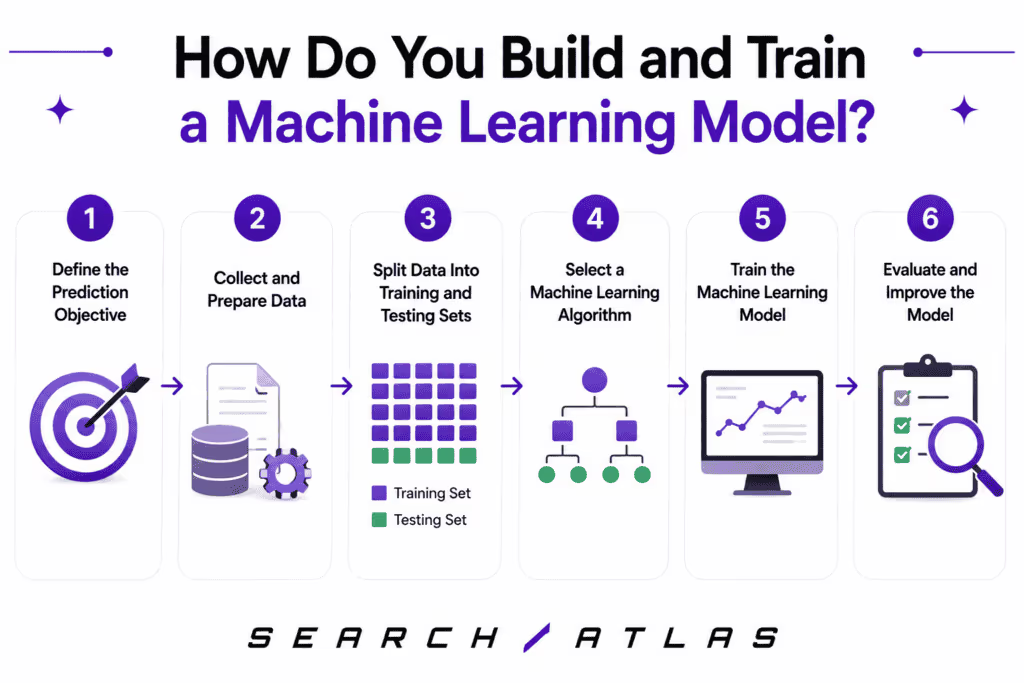
Building and training a machine learning model involves defining a prediction objective, preparing data, selecting an algorithm, training the model, evaluating performance, and refining the system until it reaches deployment quality. This process matters because machine learning performance depends on data quality, algorithm selection, and continuous optimization rather than model training alone.
The 6 steps to build and train a machine learning model are listed below.
1. Define the Prediction Objective
A prediction objective establishes what the machine learning model needs to predict, classify, or estimate. This step improves model development because the objective determines the type of data, algorithm, and evaluation metrics required. Organizations define objectives for tasks (customer churn prediction, fraud detection, demand forecasting, or image recognition). A clear objective creates alignment between business requirements and machine learning outcomes. A practical rule is to define the target outcome before collecting or preparing data.
2. Collect and Prepare Data
Data collection and preparation create the foundation of machine learning performance. This step improves model accuracy because machine learning systems learn directly from training data. Organizations gather data from databases, applications, sensors, APIs, and business systems. Preparation involves removing duplicates, correcting errors, handling missing values, and converting information into machine-readable formats. Strong data preparation improves model reliability because clean data produces more accurate learning signals. A practical rule is to spend more time validating data than selecting algorithms.
3. Split Data Into Training and Testing Sets
Data splitting separates learning data from evaluation data. This step improves model validation because the model needs to demonstrate performance on unseen examples rather than memorized examples. Organizations typically divide data into training, validation, and testing datasets. The training dataset teaches the model. The validation dataset guides optimization decisions. The testing dataset measures final performance. A practical rule is to keep testing data isolated until evaluation begins.
4. Select a Machine Learning Algorithm
Algorithm selection determines how the model learns patterns from data. This step improves performance because different algorithms solve different types of problems. Linear regression predicts numerical values. Decision trees create interpretable decision paths. Random forests improve prediction stability. Neural networks learn complex relationships from large datasets. Strong algorithm selection aligns model complexity with available data and business requirements. A practical rule is to begin with simpler models before moving to more complex architectures.
5. Train the Machine Learning Model
Model training adjusts internal parameters until the model learns useful relationships from the data. This step improves predictive capability because the model continuously reduces prediction errors during training. Training involves processing examples, measuring performance, and updating parameters through optimization algorithms. Multiple training cycles improve the model until performance stabilizes. A practical rule is to monitor both training accuracy and validation accuracy throughout the training process.
6. Evaluate and Improve the Model
Model evaluation measures how effectively the machine learning model performs on unseen data. This step improves production readiness because evaluation reveals weaknesses that training data alone cannot expose. Organizations evaluate models using metrics (accuracy, precision, recall, and prediction error). Evaluation often identifies data quality issues, overfitting problems, or algorithm limitations that require refinement. A practical rule is to retrain and reevaluate until the model achieves consistent performance across different datasets.
What Data Do You Need to Train a Machine Learning Model?
Training data needs to be representative, sufficiently large, correctly labeled, and properly prepared before model training begins. These data requirements matter because machine learning models learn patterns directly from training examples rather than predefined rules. Strong training data improves prediction accuracy, model reliability, and generalization across real-world environments.
Training data determines machine learning performance because models inherit the strengths and weaknesses of the data they learn from. Poor data creates poor predictions. High-quality data creates stronger predictions. This relationship makes data one of the most important components of every machine learning project.
Training data needs to be representative because machine learning models learn from historical examples. Representative data reflects the full range of situations that the model will encounter in production. A model trained on customer data from one region often performs less accurately in a different region. This limitation occurs because the training data does not reflect the deployment environment.
Training data needs to be sufficiently large because model complexity increases data requirements. Simple machine learning models learn effectively from smaller datasets. Complex machine learning models require significantly larger datasets. A logistic regression model often performs effectively with a few thousand examples. A deep learning model for image recognition often requires tens of thousands or millions of examples. This difference occurs because larger models contain more learnable parameters.
Training data needs to be correctly labeled because supervised machine learning depends on accurate outcomes. Correct labels provide the feedback that machine learning models use during training. Incorrect labels introduce noise and reduce learning quality. This reduction decreases prediction accuracy and weakens model performance in production.
Training data needs preprocessing because raw datasets often contain errors and inconsistencies. Data preprocessing prepares information for machine learning algorithms through cleaning and standardization. Missing values, duplicate records, inconsistent formats, and corrupted entries create training problems. This preparation improves reliability and prevents avoidable model errors.
Data preprocessing includes handling missing values because incomplete records reduce data quality. Missing values create gaps that distort learned patterns. Data preprocessing replaces, removes, or corrects these gaps before training begins. This correction improves model stability and prediction consistency.
Data preprocessing includes encoding categorical variables because machine learning algorithms process numerical information. Categorical variables contain labels rather than numerical values. Data preprocessing converts categories into numerical representations that algorithms interpret correctly. This conversion allows models to learn from non-numerical information.
Data preprocessing includes normalizing numerical features because inconsistent scales affect model performance. Numerical variables often use different measurement ranges. Data preprocessing standardizes these ranges and prevents larger values from dominating model training. This standardization improves learning efficiency and model accuracy.
Data preprocessing includes removing duplicate and corrupted records because duplicate information distorts learning patterns. Duplicate records increase the influence of repeated examples. Corrupted records introduce inaccurate information into training datasets. This distortion reduces prediction quality and weakens model reliability.
Training data quality matters more than training data quantity because machine learning models learn directly from available information. Large datasets with inaccurate, incomplete, or biased information create unreliable predictions. Smaller datasets with accurate, representative, and well-prepared information often produce stronger machine learning outcomes. This relationship makes data quality a critical factor in machine learning success.
How Do You Evaluate Machine Learning Model Performance?
Machine learning model performance is evaluated using classification metrics, regression metrics, and cross-validation. These evaluation methods measure prediction quality, generalization ability, and real-world reliability. This evaluation determines whether a machine learning model is ready for deployment.
Machine learning model evaluation matters because training accuracy alone does not measure production performance. A model performs well on training data while performing poorly on new data. This difference makes evaluation essential before deployment.
Classification metrics evaluate classification models because classification tasks predict categories rather than numerical values. Classification metrics include accuracy, precision, recall, F1 score, and AUC ROC. These metrics measure overall correctness, positive prediction quality, positive case detection, balanced performance, and class separation ability.
Regression metrics evaluate regression models because regression tasks predict continuous numerical values. Regression metrics include Mean Absolute Error, Mean Squared Error, Root Mean Squared Error, and R-squared. These metrics measure prediction error and determine how closely predictions match actual values.
Cross-validation evaluates model generalization because it measures performance across multiple train-test splits. Cross-validation reduces evaluation bias and provides a more reliable estimate of production performance. Five-fold and ten-fold cross-validation represent the most common evaluation approaches.
What Tools and Frameworks Are Used in Machine Learning?
The tools and frameworks used in machine learning include Python, scikit-learn, TensorFlow, PyTorch, Keras, MLflow, Weights & Biases, AWS SageMaker, Google Vertex AI, and Azure Machine Learning. These tools and frameworks support data preparation, model training, experiment tracking, deployment, and monitoring. This ecosystem allows machine learning teams to manage the entire model lifecycle.
The 5 main machine learning tools and frameworks are listed below.
1. Python. Python provides the foundation for machine learning development, which makes it the most widely used programming language in the field. Python includes libraries for data processing, visualization, model training, and deployment. This ecosystem allows practitioners to manage the entire machine learning workflow within a single language.
2. Scikit-learn. Scikit-learn provides classical machine learning algorithms, which makes it one of the most widely used machine learning frameworks. Scikit-learn includes linear regression, logistic regression, decision trees, support vector machines, and clustering algorithms. This framework performs well for structured datasets and traditional machine learning tasks.
3. TensorFlow. TensorFlow provides deep learning infrastructure, which makes it suitable for large-scale machine learning systems. TensorFlow supports neural networks, distributed training, and production deployment. This framework powers many enterprise machine learning applications.
4. PyTorch. PyTorch provides flexible deep learning development, which makes it popular in machine learning research and experimentation. PyTorch uses dynamic computation graphs that simplify debugging and model development. This flexibility makes PyTorch a leading framework for advanced AI research.
5. Keras. Keras provides a simplified neural network interface, which reduces development complexity. Keras operates on top of TensorFlow and PyTorch and simplifies model creation and training. This simplicity makes Keras a common starting point for deep learning projects.
6. MLflow and Weights & Biases. MLflow and Weights & Biases track experiments, which improves reproducibility and model comparison. These platforms record parameters, metrics, and training results across multiple runs. This tracking improves model development and evaluation.
7. AWS SageMaker, Google Vertex AI, and Azure Machine Learning. Cloud machine learning platforms provide managed infrastructure, which simplifies model training and deployment. These platforms handle compute resources, model serving, monitoring, and lifecycle management. This infrastructure reduces operational complexity for production machine learning systems.
8. Feature stores. Feature stores manage machine learning features, which improves consistency between training and production environments. Feature stores (Feast and Tecton) centralize feature computation and delivery. This consistency reduces prediction errors caused by differences between training data and production data.
How much data does machine learning actually need?
Machine learning does not require a fixed amount of data because data requirements depend on model complexity, task difficulty, data quality, and accuracy requirements. Data volume matters because machine learning models learn patterns from examples, but the number of examples needed varies significantly across different applications.
Machine learning does not require millions of examples because simple models often perform effectively with relatively small datasets. A logistic regression model predicting customer churn from a handful of features often learns useful patterns from a few thousand records. This outcome occurs because simple models contain fewer parameters and require less information to learn stable relationships.
Machine learning does not require small datasets because complex models need substantially more training examples. A deep learning model classifying thousands of image categories often requires hundreds of thousands or millions of labeled examples. This requirement exists because larger models contain more parameters and learn more complex patterns.
Machine learning data requirements depend on task complexity because different problems contain different levels of variability. A binary classification problem with clearly separated categories often requires fewer examples. An image recognition system distinguishing hundreds of similar objects requires significantly more examples. This difference increases the amount of data needed for reliable predictions.
Machine learning data requirements depend on data quality because high-quality data contains stronger learning signals. A smaller dataset with accurate labels and representative examples often outperforms a larger dataset with errors, bias, or missing information. This relationship makes data quality as important as data quantity.
Machine learning data sufficiency is measured through learning curves because learning curves reveal whether additional data improves performance. Learning curves compare model accuracy against training dataset size. A performance plateau indicates that additional data provides limited improvement. Continued performance gains indicate that the model remains data-limited. This measurement provides a more reliable assessment than fixed rules about minimum dataset sizes.
Can machine learning work without labeled data?
Yes, machine learning works without labeled data because several machine learning approaches learn patterns directly from raw information. Unlabeled data matters because labeled datasets require significant time, cost, and expertise to create, while organizations often possess large volumes of unlabeled information.
Machine learning works without labeled data because unsupervised learning identifies patterns, clusters, and relationships without predefined answers. Unsupervised learning analyzes the structure of raw data and discovers similarities between observations. This approach powers applications (customer segmentation, anomaly detection, and recommendation systems.
Machine learning works without labeled data because self-supervised learning generates training signals from the data itself. Self-supervised learning hides part of the input and trains the model to predict the missing information. This approach allows large language models to learn grammar, context, facts, and relationships from massive text collections without manual labeling.
Machine learning works without labeled data because contrastive learning learns similarities and differences between inputs. Contrastive learning moves related examples closer together and unrelated examples farther apart within a representation space. This structure improves pattern recognition without requiring labeled examples.
Machine learning works without labeled data because modern AI systems often learn general knowledge before task-specific training begins. Large language models train on vast amounts of unlabeled text and learn language patterns during pretraining. This process creates strong foundational knowledge before specialized training occurs.
Machine learning works without labeled data because self-supervised pretraining reduces the amount of labeled data needed later. A model that already understands language, images, or other data types requires fewer labeled examples during fine-tuning. This reduction lowers training costs and improves performance in situations where labeled data remains limited.
Is deep learning always better than machine learning?
No, deep learning is not always better than machine learning because performance depends on data size, data type, computational resources, and business requirements. Deep learning matters because it achieves exceptional results on complex tasks, but classical machine learning often performs better in situations with limited data or strict interpretability requirements.
Deep learning is not always better than machine learning because deep learning requires large datasets to reach its full potential. Deep learning models learn complex patterns from images, audio, and natural language by automatically extracting features from raw data. This capability allows deep learning to outperform traditional machine learning on image recognition, speech recognition, and large language models.
Deep learning is not always better than machine learning because deep learning depends heavily on data volume. A deep learning model often requires tens of thousands or millions of examples to learn effectively. This requirement increases training costs and computational demands compared to classical machine learning approaches.
Deep learning is not always better than machine learning because classical machine learning frequently outperforms deep learning on structured tabular datasets. Algorithms (XGBoost, LightGBM, decision trees, and logistic regression) often achieve equal or better results on business, financial, and healthcare datasets. This advantage appears especially on datasets containing fewer than 100,000 records.
Deep learning is not always better than machine learning because classical machine learning provides stronger interpretability. Decision trees and logistic regression models connect predictions directly to input features. This transparency improves trust, auditing, and regulatory compliance in industries that require explainable decisions.
Deep learning is not always better than machine learning because model selection depends on the problem rather than the technology. Deep learning performs best on large unstructured datasets. Classical machine learning performs best on many structured datasets with limited training examples. This distinction makes both approaches valuable in modern machine learning systems.
What programming language is most used in machine learning?
Python is the most widely used programming language in machine learning because Python combines simple syntax, extensive libraries, and broad industry adoption. Python matters because nearly every stage of the machine learning workflow depends on Python-based tools and frameworks. This adoption makes Python the standard language for machine learning development in 2025.
Python is the most widely used programming language in machine learning because major machine learning frameworks rely on Python. TensorFlow, PyTorch, scikit-learn, Keras, NumPy, and Pandas all use Python as their primary language. This ecosystem allows practitioners to manage data processing, model training, evaluation, and deployment within a single environment.
Python is the most widely used programming language in machine learning because Python dominates education, research, and industry adoption. Python appears in most machine learning job postings, machine learning courses, and machine learning projects. This popularity creates a large community, extensive documentation, and a broad collection of learning resources.
Python is the most widely used programming language in machine learning because Python balances accessibility and capability. Python provides readable syntax for beginners while maintaining the flexibility required for advanced machine learning systems. This balance contributes to Python’s continued dominance across the field.
Python is not the only programming language used in machine learning because alternative languages address specific requirements. R remains popular in statistics, academic research, and bioinformatics. Julia attracts attention in scientific computing and numerical optimization. Java and C++ appear in enterprise systems and high-performance environments. These alternatives fill specialized roles but do not match Python’s ecosystem breadth.
Python remains the most widely used programming language in machine learning because no alternative language combines community adoption, framework availability, educational resources, and end-to-end workflow coverage at the same scale. This combination continues to make Python the default choice for machine learning practitioners.
Does machine learning require a background in math or statistics?
Yes, machine learning requires a background in math or statistics because machine learning algorithms, evaluation methods, and optimization techniques depend on mathematical concepts. Math and statistics matter because they explain how models learn patterns, make predictions, and measure performance. This knowledge improves model selection, troubleshooting, and decision-making.
Machine learning requires a background in math or statistics because core machine learning concepts rely on linear algebra, calculus, probability, and statistics. Linear algebra explains matrix operations used in machine learning models. Calculus explains optimization and parameter updates. Probability explains uncertainty and prediction confidence. Statistics explains sampling, evaluation, and model validation.
Machine learning requires a background in math or statistics because mathematical knowledge improves problem-solving. Practitioners with stronger mathematical foundations identify model failures, evaluate performance more accurately, and understand algorithm behavior more deeply. This understanding improves machine learning outcomes and reduces reliance on trial and error.
Machine learning does not require advanced mathematical expertise for every role because modern frameworks automate many technical details. A practitioner training models with scikit-learn often focuses on data preparation, train-test splits, feature engineering, and hyperparameter tuning. This workflow requires practical statistical knowledge rather than advanced mathematical theory.
Machine learning requires deeper mathematical knowledge because advanced machine learning development involves custom algorithms, neural network architectures, and research-level innovation. Researchers and machine learning engineers often rely on advanced optimization, probability theory, and statistical modeling. This expertise allows them to design new approaches and understand cutting-edge research.
Machine learning requires some mathematical understanding because mathematical concepts explain why models succeed or fail. The amount of math required depends on the complexity of the work. Practical machine learning projects require foundational knowledge, while advanced machine learning research requires significantly deeper expertise.