Sentiment analysis is the process of identifying, classifying, and measuring emotional tone within written language. The meaning of sentiment analysis explains how natural language processing (NLP), machine learning, and artificial intelligence evaluate text and assign positive, negative, or neutral sentiment classifications. This process reveals how people express opinions, reactions, and attitudes toward brands, products, services, topics, and experiences across large volumes of content.
Sentiment analysis matters because organizations need to understand audience perception beyond traffic, engagement, and keyword data. Reviews, comments, surveys, support tickets, and social media conversations contain valuable opinions that remain difficult to analyze manually at scale. Sentiment analysis transforms this unstructured language into measurable insights that improve content strategy, reputation management, customer experience, product development, and business decision-making.
Sentiment analysis creates measurable value for businesses operating in search, marketing, customer experience, and AI-driven environments. Sentiment analysis identifies emerging reputation risks, uncovers customer pain points, reveals content opportunities, and highlights competitive advantages hidden within audience conversations. These insights strengthen decision-making because organizations gain visibility into how people feel rather than simply what they discuss.
Sentiment analysis works through structured language processing, contextual interpretation, and sentiment classification models that evaluate meaning across text. Different sentiment analysis methods measure sentiment at the document, sentence, aspect, and entity levels to provide varying degrees of detail. The ability to classify sentiment accurately enables organizations to convert audience language into actionable intelligence that improves visibility, trust, customer satisfaction, and long-term growth.
What is sentiment analysis?
Sentiment analysis is a natural language processing (NLP) technique that identifies and classifies the emotional tone of text as positive, negative, or neutral. Sentiment analysis evaluates language patterns, syntax, context, and semantic relationships to determine how people express opinions about a brand, product, topic, or experience.
Sentiment analysis transforms large volumes of unstructured text into measurable sentiment signals, which allows organizations to understand public perception without manually reviewing every mention. Businesses use sentiment analysis to evaluate customer feedback, monitor brand reputation, identify emerging concerns, and measure audience reactions across digital channels.
How does sentiment analysis determine emotional tone? Sentiment analysis determines emotional tone by analyzing word relationships, sentence structure, contextual signals, and linguistic patterns. Modern sentiment models examine entire phrases rather than isolated terms, which improves interpretation accuracy. A sentence containing positive words does not always express positive sentiment, and a sentence containing negative words does not always express negative sentiment. Context determines the final classification.
Why does sentiment analysis matter for brand monitoring? Sentiment analysis reveals how audiences perceive a brand across thousands or millions of conversations. Brand monitoring becomes more accurate because sentiment analysis measures opinion rather than visibility alone. A brand with high mention volume does not necessarily receive positive attention. Sentiment analysis distinguishes positive reactions, negative reactions, and neutral discussions, which creates a clearer picture of brand perception.
What role does sentiment analysis play in AI and search intelligence? Sentiment analysis provides emotional context for customer intelligence, market research, and AI-driven analytics systems. AI systems use sentiment signals to identify trends, detect reputation risks, evaluate customer satisfaction, and measure audience response to products or campaigns. Search intelligence platforms combine sentiment analysis with entity recognition, topic classification, and behavioral data to build a more complete understanding of audience perception.
What Are the Different Types of Sentiment Analysis?
The different types of sentiment analysis are document-level sentiment analysis, sentence-level sentiment analysis, aspect-level sentiment analysis, polarity-based sentiment analysis, and fine-grained sentiment analysis. These sentiment analysis methods define how sentiment models classify opinions across different levels of text, which affects the accuracy, granularity, and business value of sentiment insights.
Sentiment analysis improves opinion detection because different text sources contain different levels of emotional detail. Some sentiment analysis methods measure overall sentiment across an entire document, while other methods identify sentiment within sentences, attributes, or intensity levels. These classification methods improve sentiment measurement across reviews, surveys, social media conversations, and customer feedback datasets.
The 5 main types of sentiment analysis are listed below.
1. Document-level sentiment analysis. Document-level sentiment analysis creates an overall sentiment score, which measures the emotional direction of an entire document. Document-level sentiment analysis treats the complete text as a single unit of opinion and assigns one polarity label across all content. This approach works best for reviews, articles, and posts where the primary goal involves identifying overall sentiment rather than detailed sentiment variation.
2. Sentence-level sentiment analysis. Sentence-level sentiment analysis creates sentence-specific sentiment classification, which identifies emotional changes throughout a document. Sentence-level sentiment analysis evaluates each sentence independently and assigns sentiment labels at the sentence level. This classification reveals positive, negative, and neutral shifts that disappear when systems average sentiment across the full document.
3. Aspect-level sentiment analysis. Aspect-level sentiment analysis creates attribute-specific sentiment measurement, which evaluates opinions toward individual features or characteristics. Aspect-level sentiment analysis classifies sentiment for specific aspects rather than the overall document. This approach identifies differences between opinions about product quality, customer service, pricing, usability, or other attributes mentioned within the same text.
4. Polarity-based sentiment analysis. Polarity-based sentiment analysis creates categorical sentiment classification, which organizes opinions into positive, negative, or neutral categories. Polarity-based sentiment analysis focuses on directional sentiment rather than sentiment intensity. This classification provides a straightforward method for measuring approval, dissatisfaction, or neutral language across large text collections.
5. Fine-grained sentiment analysis. Fine-grained sentiment analysis creates intensity-based sentiment measurement, which distinguishes weak opinions from strong opinions. Fine-grained sentiment analysis expands traditional polarity categories into multiple levels, commonly strong negative, negative, neutral, positive, and strong positive. This additional detail improves customer experience analysis, satisfaction monitoring, and trend measurement across large datasets.
What Is the Difference Between Sentiment Analysis and Opinion Mining?
The difference between sentiment analysis and opinion mining lies in how some NLP frameworks define the stages of subjective text analysis. Sentiment analysis classifies the emotional direction of an opinion, while opinion mining identifies and extracts the opinion itself. This distinction separates opinion discovery from sentiment classification, although most modern platforms combine both functions into a single workflow.
Sentiment analysis and opinion mining overlap because both processes analyze subjective language and interpret human opinions from text. Most NLP tools, research papers, and commercial platforms treat sentiment analysis and opinion mining as equivalent concepts. This overlap creates terminology differences rather than functional differences across most real-world applications.
The core differences between sentiment analysis and opinion mining are below.
| Aspect | Sentiment Analysis | Opinion Mining |
| Purpose | Classifies the emotional direction of an identified opinion. | Identifies and extracts opinions, viewpoints, and subjective statements. |
| Primary goal | Determines whether sentiment is positive, negative, or neutral. | Determines whether an opinion exists and identifies its target. |
| Workflow process | Evaluates polarity, intensity, and emotional orientation. | Detects subjective content and extracts opinion entities or topics. |
| Key data focus | Focuses on sentiment labels and emotional classification. | Focuses on opinion presence, opinion holders, and opinion targets. |
| Typical output | Positive, negative, neutral, or fine-grained sentiment scores. | Extracted opinions, entities, attributes, and subjective statements. |
| Role in NLP pipelines | Acts as the classification phase. | Acts as the extraction phase. |
| Relationship | Builds on extracted opinions to assign sentiment. | Supplies the opinions that sentiment analysis classifies. |
What does sentiment analysis do in NLP? Sentiment analysis classifies the emotional orientation of text after identifying subjective content. Sentiment analysis assigns polarity labels that indicate positive, negative, or neutral sentiment. This classification transforms opinions into structured sentiment data for reporting, monitoring, and decision-making.
What does opinion mining do in NLP? Opinion mining identifies opinions, viewpoints, and subjective statements within text. Opinion mining determines whether a piece of content contains an opinion and identifies the subject of that opinion. This extraction process creates the foundation for sentiment classification and deeper language analysis.
Why do sentiment analysis and opinion mining often mean the same thing? Sentiment analysis and opinion mining often describe the same process because modern NLP systems execute extraction and classification together. Most commercial tools identify opinions and classify sentiment within a single workflow. This integration removes the practical distinction that appears in some academic definitions.
How do sentiment analysis and opinion mining work together in practice? Sentiment analysis and opinion mining operate as connected phases inside one unified NLP workflow. Opinion mining identifies the opinion, the opinion holder, and the opinion target. Sentiment analysis evaluates the extracted opinion and assigns emotional classification. Modern sentiment platforms combine both phases to transform unstructured text into actionable sentiment insights.
How Does Sentiment Analysis Affect Content Strategy and Brand Decisions?
Sentiment analysis affects content strategy and brand decisions by revealing how audiences perceive topics, products, services, and brands across large volumes of text. Sentiment analysis transforms reviews, comments, social media posts, and survey responses into measurable opinion signals that guide content planning, messaging, positioning, and reputation management. This process replaces assumptions with evidence, which creates more accurate content strategies and stronger brand decisions.
Sentiment analysis matters because audience perception influences content performance, brand reputation, and market positioning. A brand that understands why audiences express positive or negative opinions gains direct insight into customer priorities. These insights identify content opportunities, reveal emerging concerns, and expose competitive advantages that remain hidden inside raw text data.
How does sentiment analysis influence content topic decisions? Sentiment analysis influences content topic decisions by identifying the subjects, attributes, and concerns that generate strong audience reactions. Reviews, comments, and discussion forums reveal which aspects of a topic audiences praise or criticize. Positive and negative sentiment patterns expose content opportunities, which allow teams to prioritize topics based on observed audience interests rather than assumptions.
How does sentiment analysis improve brand monitoring? Sentiment analysis improves brand monitoring by measuring the emotional direction of brand mentions rather than counting mention volume alone. Brand monitoring classifies mentions as positive, negative, or neutral, which creates a clearer understanding of audience perception. Frequency tracking measures how often people discuss a brand, while sentiment analysis reveals how audiences feel about that brand. This distinction creates more informed reputation management and communication decisions.
How does sentiment analysis identify content gaps and customer concerns? Sentiment analysis identifies content gaps and customer concerns through aspect-level sentiment classification. Aspect-level sentiment analysis isolates opinions about specific attributes rather than evaluating only overall sentiment. Negative sentiment around onboarding, pricing, customer service, or product features reveals areas that require additional content, clarification, or positioning. These insights guide tutorials, FAQ pages, comparison content, and educational resources that address audience concerns directly.
How does sentiment analysis strengthen competitive positioning? Sentiment analysis strengthens competitive positioning by comparing audience opinions across competing brands. Competitive sentiment analysis reveals the attributes where competitors receive negative feedback and highlights the areas where a brand receives stronger sentiment signals. These differences create positioning opportunities across content, messaging, and search visibility strategies. Brands use these insights to emphasize strengths that audiences already recognize and value.
How does sentiment analysis improve brand decision-making? Sentiment analysis improves brand decision-making by transforming unstructured audience feedback into measurable business intelligence. Sentiment trends reveal shifts in customer perception, identify emerging reputation risks, and uncover opportunities for product improvement. These insights create a direct connection between audience opinion, content strategy, and long-term brand growth.
Why Is Sentiment Analysis Relevant in Marketing and SEO?
Sentiment analysis affects content strategy and brand decisions by revealing how audiences perceive products, services, topics, and brands through their own language. Sentiment analysis converts reviews, comments, social media posts, survey responses, and discussion forum conversations into measurable opinion data. This data identifies audience priorities, content opportunities, reputation risks, and competitive positioning advantages that influence marketing and business decisions.
Sentiment analysis matters because audience perception directly influences content performance, brand trust, customer retention, and market positioning. Keyword data explains what people discuss, while sentiment data explains how people feel about those discussions. This emotional context creates a stronger foundation for content planning, messaging development, and strategic decision-making.
The 4 main ways sentiment analysis affects content strategy and brand decisions are listed below.
1. Improves content topic selection and content planning. Sentiment analysis improves content planning by identifying the topics, concerns, and attributes that generate strong audience reactions. Reviews, comments, and forum discussions reveal which subjects receive positive or negative attention. These sentiment patterns create data-driven content opportunities that align with audience interests and concerns.
2. Strengthens brand monitoring and reputation management. Sentiment analysis strengthens brand monitoring by measuring the emotional direction of brand mentions across digital channels. Positive, negative, and neutral classifications reveal how audiences perceive a brand over time. This visibility enables faster identification of reputation risks and emerging perception changes.
3. Identifies content gaps and customer pain points. Sentiment analysis identifies content gaps through aspect-level evaluation of specific attributes, features, and experiences. Negative sentiment concentrated around onboarding, pricing, customer service, or product functionality highlights areas that require additional education or clarification. These insights guide the creation of tutorials, FAQs, comparison pages, and support content.
4. Improves competitive positioning and messaging strategy. Sentiment analysis improves competitive positioning by comparing audience opinions across competing brands. Competitive sentiment patterns reveal strengths, weaknesses, and differentiation opportunities within a market. These insights strengthen messaging strategies by highlighting the attributes audiences value most and the attributes competitors struggle to satisfy.
What Role Does NLP Play in Sentiment Analysis?
Natural language processing (NLP) plays a foundational role in sentiment analysis by converting human language into structured data that machines interpret and classify. Sentiment analysis depends on NLP to identify language patterns, grammatical relationships, contextual meaning, and entity references before assigning positive, negative, or neutral sentiment labels. Without NLP, sentiment analysis cannot distinguish meaning, context, or emotional intent within text.
NLP matters because raw text exists as unstructured data that computers cannot interpret directly. Sentiment analysis requires structured representations of language before classification occurs. NLP creates these representations by processing words, phrases, entities, and contextual relationships that determine how sentiment models interpret emotional meaning.
NLP plays a role in sentiment analysis through several core language processing functions.
- NLP enables text preprocessing and language understanding. NLP enables sentiment analysis by preparing text for classification through tokenization, part-of-speech tagging, and language normalization. Tokenization separates text into individual units that the model processes. Part-of-speech tagging identifies grammatical roles, which improves the detection of sentiment-carrying words and contextual modifiers.
- NLP connects sentiment to specific entities. NLP connects sentiment to brands, products, people, and organizations through named entity recognition (NER). Named entity recognition identifies entity mentions and associates sentiment with the correct subject. This connection transforms general sentiment classification into entity-level analysis, which improves brand monitoring, product evaluation, and competitive research.
- NLP provides contextual understanding for sentiment classification. NLP provides contextual understanding by identifying relationships between words, phrases, and sentence structures. Context determines whether a statement expresses positive, negative, or neutral sentiment. Contextual analysis enables sentiment models to interpret phrases “not great” and “not bad” accurately, rather than relying on isolated keywords.
- NLP powers modern transformer-based sentiment models. NLP powers advanced sentiment analysis through transformer architectures that evaluate entire text sequences simultaneously. Models (BERT, RoBERTa, and DeBERTa) analyze relationships between all tokens within a sentence or document. This architecture improves sentiment accuracy because models evaluate meaning through context rather than individual words in isolation.
- NLP improves sentiment accuracy across complex language patterns. NLP improves sentiment accuracy by identifying negation, sarcasm, modifiers, and multi-entity discussions that traditional keyword methods struggle to process. These language patterns frequently change the emotional meaning of text. NLP captures these changes and enables sentiment models to produce classifications that align more closely with human interpretation.
How Do Sentiment Analysis Models Detect Meaning in Text?
Sentiment analysis models detect meaning in text by analyzing words, phrases, grammatical relationships, and contextual patterns that indicate emotional orientation. Sentiment analysis models transform unstructured language into structured representations and then evaluate those representations to classify text as positive, negative, or neutral. Different sentiment analysis models use different methods to identify meaning, ranging from predefined lexical dictionaries to machine learning systems and large language model transformers.
Meaning detection matters because sentiment does not exist at the word level alone. The same word carries different sentiments depending on the surrounding context, sentence structure, and linguistic modifiers. Sentiment analysis models improve accuracy by identifying these relationships and interpreting language in ways that reflect how people communicate.
The 4 main approaches sentiment analysis models use to detect meaning in text are listed below.
1. Lexical rule models assign meaning through predefined sentiment dictionaries. Lexical rule models detect meaning by matching words and phrases against dictionaries that contain predefined sentiment scores. Each term receives a positive, negative, or neutral value that contributes to the final classification. This approach creates fast and interpretable sentiment analysis, but struggles with context-dependent language, negation, and complex sentence structures.
2. Machine learning models detect meaning through statistical language patterns. Machine learning models detect meaning by learning relationships between words, positions, and sentiment labels from large training datasets. These models identify patterns associated with positive and negative sentiment and apply those patterns to previously unseen text. This learning process enables broader language coverage and stronger performance on complex linguistic constructions than dictionary-based approaches.
3. Hybrid models combine rule-based and machine learning approaches. Hybrid models detect meaning by combining lexical sentiment rules with statistical pattern recognition. Lexical systems provide a consistent interpretation of explicit sentiment terms, while machine learning systems evaluate ambiguous or context-dependent language. This combination improves classification accuracy across different text formats and reduces the limitations associated with either approach individually.
4. Transformer models detect meaning through contextual language representations. Transformer models detect meaning by evaluating relationships between all words within a sequence simultaneously. Models (BERT, RoBERTa, and DeBERTa) generate contextual representations that change according to surrounding language. This contextual understanding enables transformers to distinguish between phrases that contain similar words but express different meanings. A transformer interprets “not bad” differently from “bad” because it evaluates the relationship between both terms within the complete sentence rather than processing each word independently.
How to Run Sentiment Analysis on Your Content or Brand Data
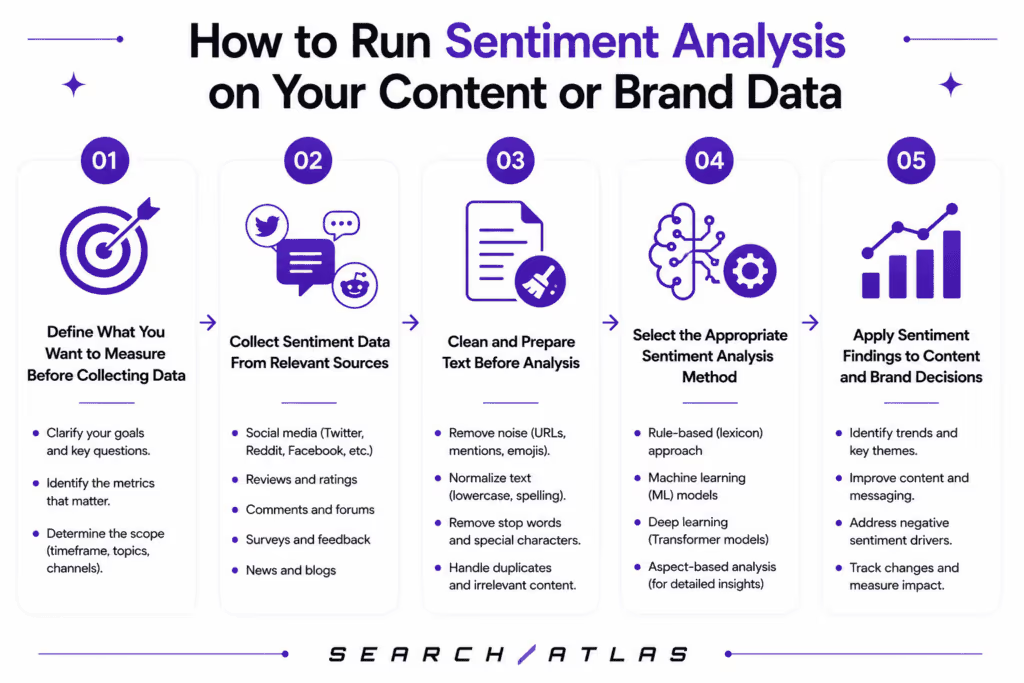
Running sentiment analysis on your content or brand data means collecting audience language, classifying emotional signals, and translating those signals into actionable business insights. This process matters because sentiment analysis reveals how customers perceive products, brands, and topics beyond what keyword frequency or traffic data alone show. Effective sentiment analysis improves content planning, reputation management, customer research, and competitive positioning through direct analysis of audience opinions.
The 5 ways to run sentiment analysis on your content or brand data are listed below.
1. Define What You Want to Measure Before Collecting Data
Defining the measurement goal establishes which data sources, sentiment methods, and output formats produce useful results. A clear objective prevents collecting large volumes of sentiment data that never influence a business decision. Teams define whether the analysis focuses on brand perception, product feedback, content performance, customer experience, or competitive intelligence before gathering text. Strong scope definition improves relevance because every later step connects directly to a specific outcome. A practical rule is to identify the business decision first and collect sentiment data second.
2. Collect Sentiment Data From Relevant Sources
Collecting relevant data creates the foundation for accurate sentiment analysis. Reviews, social media mentions, survey responses, support tickets, comment sections, and discussion forums contain direct expressions of audience opinion. Different sources contain different types of sentiment signals and different levels of noise. Selecting data sources that match the analysis objective improves reliability and reduces interpretation errors. A practical rule is to prioritize sources where audiences express opinions naturally in their own language.
3. Clean and Prepare Text Before Analysis
Preparing text removes noise that interferes with sentiment classification. Cleaning typically removes duplicate entries, formatting artifacts, irrelevant metadata, and platform-specific elements that do not contribute meaningful sentiment signals. Clean data improves classification accuracy because sentiment models process relevant language rather than unnecessary information. Consistent preprocessing improves reliability across large datasets. A practical rule is to remove anything that does not contribute to the opinion being measured.
4. Select the Appropriate Sentiment Analysis Method
Selecting the correct sentiment analysis method determines the quality and usefulness of the final output. Lexical models work well for straightforward sentiment classification and transparent scoring. Machine learning models perform better on domain-specific language and complex phrasing. Aspect-level sentiment analysis identifies opinions about specific attributes, while document-level analysis measures overall sentiment. Method selection improves accuracy because different business questions require different levels of analysis. A practical rule is to match the sentiment method to the decision that the analysis informs.
5. Apply Sentiment Findings to Content and Brand Decisions
Applying sentiment findings transforms sentiment analysis from a reporting activity into a decision-making process. Positive sentiment reveals the themes and attributes audiences value most. Negative sentiment identifies content gaps, customer frustrations, and reputation risks that require attention. Competitive sentiment analysis highlights positioning opportunities by comparing audience perceptions across brands. Strong implementation improves business outcomes because decisions reflect documented audience opinions rather than assumptions. A practical rule is to connect every sentiment finding to a specific content, product, or marketing action.
What Are the Best Practices for Using Sentiment Analysis Accurately?
Using sentiment analysis accurately requires clean data, appropriate models, contextual understanding, reliable tools, and continuous performance monitoring. Sentiment analysis accuracy depends on the quality of both the input data and the classification method. Strong sentiment analysis practices reduce classification errors, improve reliability, and create insights that reflect actual audience opinions rather than model limitations.
Sentiment analysis accuracy matters because inaccurate classifications lead to incorrect content, marketing, product, and brand decisions. Models that process noisy data, ignore context, or operate outside their training domain produce misleading outputs. Following established best practices improves sentiment quality and increases confidence in the resulting insights.
The 5 best practices for using sentiment analysis accurately are listed below.
1. Improve text preprocessing before sentiment classification. Text preprocessing improves sentiment analysis accuracy by removing noise and standardizing language before classification begins. Cleaning text typically involves removing formatting artifacts, duplicate entries, unnecessary metadata, and irrelevant characters that do not contribute meaningful sentiment signals. Normalization improves consistency by reducing vocabulary variation across similar terms and phrases. Preserving negation words remains especially important because negation directly changes sentiment polarity and influences classification accuracy.
2. Select the appropriate sentiment analysis technique. Selecting the appropriate sentiment analysis technique improves classification quality by matching the method to the data and business objective. Lexical approaches work well for transparent and interpretable sentiment analysis tasks. Machine learning models perform better on domain-specific language and complex text patterns. Aspect-level sentiment analysis provides attribute-specific insights that document-level analysis cannot capture. Matching the technique to the use case produces more reliable results and reduces systematic classification errors.
3. Account for context and language nuances. Context improves sentiment analysis accuracy because sentiment depends on meaning rather than individual words. Negation, sarcasm, modifiers, and domain-specific vocabulary frequently alter sentiment direction. A phrase that appears positive in isolation often expresses negative sentiment within a larger context. Models that account for contextual relationships produce classifications that align more closely with human interpretation and reduce errors caused by literal word matching.
4. Utilize advanced sentiment analysis platforms and models. Advanced sentiment analysis platforms improve accuracy through contextual language processing, entity recognition, and transformer-based classification models. Modern architectures evaluate relationships between words across entire text sequences rather than processing terms independently. Enterprise platforms combine preprocessing, sentiment classification, entity linking, and reporting into integrated workflows that improve scalability and consistency. Strong platform selection increases the quality and usefulness of sentiment insights.
5. Monitor performance and continuously improve sentiment models. Performance monitoring improves sentiment analysis accuracy by identifying classification drift and emerging language patterns over time. Language evolves continuously as new terminology, product categories, and audience behaviors appear. Periodic evaluation reveals when sentiment models no longer align with current data distributions. Retraining and recalibration maintain accuracy by adapting sentiment models to changing vocabulary, context, and domain-specific language patterns.
What Tools Perform Sentiment Analysis?
The best sentiment analysis tools identify emotional patterns in text and classify opinions as positive, negative, or neutral across reviews, social media conversations, customer feedback, surveys, and other text sources. These tools analyze language, context, entities, and sentiment signals to transform unstructured text into actionable insights for marketing, SEO, customer experience, and reputation management.
The 7 best sentiment analysis tools are Search Atlas, Brandwatch, Meltwater, Sprout Social, Google Cloud Natural Language, Amazon Comprehend, and VADER.
1. Search Atlas. Search Atlas performs sentiment analysis through review monitoring, Google Business Profile management, AI brand visibility tracking, and Atlas Agent workflows. The platform tracks review sentiment across business locations and identifies positive, negative, and neutral customer feedback patterns. Search Atlas evaluates sentiment signals across AI search platforms, which reveal how systems (ChatGPT, Claude, Gemini, and AI Overviews) represent a brand. Atlas Agent enables sentiment analysis through conversational prompts, which simplifies audience research, reputation monitoring, and competitor analysis. This visibility matters because sentiment directly influences brand perception, customer trust, and local search performance.
2. Brandwatch. Brandwatch analyzes sentiment across social media, forums, blogs, review sites, and online news sources. The platform processes large volumes of audience conversations and classifies sentiment trends over time. Brandwatch connects sentiment signals to topics, entities, and audience segments, which reveals how public perception changes across campaigns and events. This analysis matters because brands require continuous visibility into customer opinions and reputation shifts.
3. Meltwater. Meltwater measures sentiment across earned media, social media, and digital publications. The platform combines sentiment analysis with media monitoring and competitive intelligence workflows. Meltwater identifies positive and negative trends across brand mentions and compares sentiment performance against competitors. This comparison matters because sentiment often influences brand positioning and market perception.
4. Sprout Social. Sprout Social performs sentiment analysis across social media conversations and audience interactions. The platform classifies sentiment within comments, mentions, replies, and direct engagement channels. Sprout Social organizes sentiment trends alongside audience growth and engagement metrics, which creates a broader view of brand perception. This integration matters because social sentiment frequently reflects customer reactions in real time.
5. Google Cloud Natural Language. Google Cloud Natural Language provides sentiment analysis through a cloud API that processes text and returns structured sentiment scores. The service evaluates emotional polarity and magnitude across documents, sentences, and entities. Google Cloud Natural Language fits organizations that require sentiment analysis inside custom applications and automated workflows. This flexibility matters because developers often need sentiment capabilities without adopting a complete enterprise platform.
6. Amazon Comprehend. Amazon Comprehend performs sentiment analysis through machine learning models trained on large language datasets. The platform identifies sentiment, entities, key phrases, and language characteristics within submitted text. Amazon Comprehend integrates with cloud infrastructure and data processing workflows, which makes sentiment analysis scalable across large datasets. This scalability matters because organizations often process millions of customer interactions and feedback records.
7. VADER. VADER performs sentiment analysis through a lexical and rule-based model designed for social media and conversational language. The tool assigns sentiment scores based on predefined dictionaries and linguistic rules. VADER processes informal language, punctuation patterns, capitalization, and emphasis markers more effectively than many traditional lexical approaches. This specialization matters because social media sentiment frequently contains language patterns that standard dictionaries struggle to interpret accurately.
How Do Sentiment Analysis Tools Process and Score Text?
Sentiment analysis tools process and score text by transforming unstructured language into structured sentiment classifications that identify positive, negative, or neutral opinions. Sentiment analysis tools evaluate words, phrases, context, entities, and language patterns before assigning polarity scores and confidence values. Sentiment scoring enables organizations to measure audience perception, monitor brand reputation, and analyze customer feedback at scale.
Sentiment analysis tools process text through a sequence of language analysis stages that convert raw text into interpretable sentiment data. Different tools use different architectures, but most platforms follow a similar workflow that combines text preparation, language understanding, sentiment classification, and score generation.
- Sentiment analysis tools process text through preprocessing and tokenization. Sentiment analysis tools begin by cleaning and organizing text before classification. Preprocessing removes irrelevant formatting, duplicate elements, and unnecessary characters that interfere with language analysis. Tokenization divides text into smaller language units that models use during classification. This preparation improves data quality and creates a structured foundation for sentiment evaluation.
- Sentiment analysis tools process meaning through embeddings and contextual analysis. Sentiment analysis tools transform words and phrases into numerical representations that capture meaning and context. Machine learning and transformer models evaluate relationships between tokens rather than analyzing words independently. This contextual processing improves the interpretation of negation, modifiers, and multi-word expressions that influence sentiment direction.
- Sentiment analysis tools generate polarity classifications and confidence scores. Sentiment analysis tools assign positive, negative, or neutral sentiment labels after evaluating text patterns and contextual signals. Most platforms generate confidence metrics alongside polarity classifications to indicate classification certainty. These scores provide a standardized method for measuring sentiment across large collections of text.
- Sentiment analysis tools connect sentiment to entities and topics. Sentiment analysis tools identify brands, products, people, and topics through entity recognition systems. Entity linking associates sentiment with the correct subject rather than assigning sentiment only at the document level. This capability improves brand monitoring, competitive analysis, and customer feedback evaluation by revealing sentiment toward specific entities within the same text.
- Sentiment analysis tools aggregate individual scores into actionable insights. Sentiment analysis tools combine individual classifications into larger trend analyses and reporting dashboards. Aggregation transforms thousands of sentiment scores into measurable patterns that reveal audience perception changes over time. These insights enable organizations to track reputation, identify emerging issues, and evaluate the impact of marketing, content, and customer experience initiatives.
What Are Common Examples of Sentiment Analysis in Practice?
Sentiment analysis examples appear anywhere organizations need to understand opinions, emotions, and audience perception from large volumes of text. Businesses use sentiment analysis to classify customer feedback, monitor brand reputation, improve products, guide content strategy, and identify emerging trends. These applications transform unstructured language into measurable insights that influence marketing, SEO, customer experience, and business decisions.
Sentiment analysis matters because audience opinions rarely exist in structured formats. Reviews, comments, surveys, social media posts, and support conversations contain valuable feedback that becomes difficult to analyze manually at scale. Sentiment analysis organizes these opinions into actionable patterns that reveal what customers think, feel, and prioritize.
There are 10 main examples of sentiment analysis in practice.
1. Analyzing product reviews. Product review analysis identifies the features and attributes that generate positive and negative customer feedback. Aspect-level sentiment analysis reveals which product characteristics drive satisfaction or dissatisfaction beyond aggregate ratings. This visibility improves product development, quality control, and customer experience decisions.
2. Monitoring brand reputation. Brand reputation monitoring tracks positive, negative, and neutral sentiment across social media, reviews, forums, and news coverage. Sentiment shifts reveal changes in public perception before they become larger reputation issues. This monitoring enables faster response to emerging concerns and public discussions.
3. Improving customer support operations. Customer support teams use sentiment analysis to identify frustration, satisfaction, and urgency within support tickets and customer conversations. Negative sentiment highlights recurring issues and service gaps. This analysis improves prioritization and customer experience management.
4. Guiding content strategy and editorial planning. Content teams analyze sentiment in comments, reviews, and search behavior to identify audience concerns and interests. Sentiment patterns reveal which topics, arguments, and perspectives generate strong reactions. These insights improve content planning and audience alignment.
5. Evaluating social media conversations. Social media sentiment analysis measures audience reactions to campaigns, announcements, products, and brand messaging. Sentiment trends reveal how audiences respond across platforms and communities. This visibility improves communication and engagement strategies.
6. Identifying content gaps and customer pain points. Sentiment analysis exposes recurring complaints, confusion, and unmet expectations within customer feedback. Negative sentiment clusters often reveal information gaps or unresolved problems. These findings guide content creation, documentation, and educational resources.
7. Supporting product development decisions. Product teams analyze sentiment data to understand which features customers value and which create frustration. Positive and negative patterns reveal opportunities for product improvement and innovation. This analysis grounds product decisions in customer feedback rather than assumptions.
8. Conducting competitive analysis. Competitive sentiment analysis compares audience opinions across competing brands, products, and services. Sentiment differences reveal strengths, weaknesses, and positioning opportunities within a market. These insights strengthen messaging and differentiation strategies.
9. Tracking customer satisfaction trends. Customer satisfaction analysis measures changes in sentiment over time across reviews, surveys, and feedback channels. Trend monitoring reveals whether perception improves, declines, or remains stable. This visibility enables organizations to evaluate the impact of business decisions and customer experience initiatives.
10. Detecting reputation risks and emerging issues. Sentiment analysis identifies unusual increases in negative sentiment before problems escalate. Real-time monitoring reveals emerging complaints, product issues, and public concerns as they develop. Early detection improves response speed and reduces the impact of negative narratives on brand perception.
What Does a Sentiment Score Mean and How Is It Calculated?
A sentiment score is a numerical value that represents the emotional direction and classification strength of a piece of text. Sentiment scores indicate whether language expresses positive, negative, or neutral sentiment and quantify how strongly a sentiment analysis model associates the text with that classification. Different sentiment analysis tools use different scoring systems, which means score interpretation depends on the methodology, scale, and classification thresholds used by the model.
Sentiment scores matter because they transform subjective language into measurable data that organizations analyze at scale. Reviews, comments, survey responses, and social media conversations contain opinions that are difficult to compare manually across thousands of records. Sentiment scores create a consistent framework for measuring audience perception, monitoring trends, and evaluating changes in customer sentiment over time.
Sentiment scores measure polarity and classification confidence. Sentiment scores represent the direction of sentiment and the strength of the model’s classification. Positive scores indicate favorable sentiment, negative scores indicate unfavorable sentiment, and neutral scores indicate little or no detectable emotional orientation. Higher absolute values generally indicate stronger sentiment signals, while values closer to neutral indicate weaker sentiment classification.
Sentiment scores are calculated from language patterns and contextual signals. Sentiment analysis models calculate scores by evaluating words, phrases, grammatical relationships, contextual meaning, and linguistic modifiers. Rule-based systems calculate sentiment through predefined lexical scores, while machine learning systems calculate sentiment through statistical relationships learned from training data. Both approaches transform language into numerical representations that generate sentiment classifications.
Sentiment scores account for modifiers, negation, and emphasis. Sentiment scoring systems adjust calculations when text contains intensifiers, negation terms, punctuation patterns, or emphasis markers. The phrase “very good” receives a stronger positive score than “good,” while “not good” receives a negative classification despite containing a positive term. These adjustments improve accuracy because sentiment depends on context rather than individual words alone.
Sentiment scores vary across sentiment analysis tools. Sentiment analysis tools use different scales, scoring formulas, training datasets, and classification thresholds. Some tools calculate sentiment on a scale from negative 1 to positive 1, while others use percentage-based confidence scores or proprietary scoring systems. These differences mean a sentiment score from one platform does not automatically correspond to the same sentiment strength in another platform.
Sentiment scores require tool-specific interpretation. Sentiment score interpretation depends on the scoring framework used by the underlying model. A score gains meaning only when evaluated against the scale, thresholds, and classification methodology of the tool that produced it. Accurate analysis requires understanding how the platform calculates sentiment and where it defines positive, negative, and neutral boundaries.
Does Sentiment Analysis Understand Sarcasm or Negation?
Sentiment analysis generally understands simple negation patterns, but struggles with sarcasm and complex contextual language. Modern sentiment analysis models identify many common polarity reversals created by words “not,” “never,” and “hardly.” Sarcasm remains significantly more difficult because sarcastic language often expresses the opposite of its literal meaning. This limitation affects both rule-based systems and machine learning models, although advanced transformer architectures perform better than earlier approaches.
Sentiment analysis accuracy depends on how well a model interprets context rather than individual words. Negation changes the direction through grammatical structure, while sarcasm changes the direction through implied meaning. Models process these language patterns differently, which explains why negation detection generally achieves higher accuracy than sarcasm detection.
Sentiment analysis handles simple negation through polarity reversal rules. Rule-based sentiment models detect negation markers and adjust the sentiment of nearby words accordingly. Terms “not,” “never,” and “hardly” reverse the polarity of words that follow them. This approach improves classification accuracy for phrases “not good” and “not satisfied.” Performance declines when negation spans long phrases or complex sentence structures because the relationship extends beyond the model’s predefined scope.
Sentiment analysis uses contextual models to improve negation detection. Machine learning and transformer models identify negation through contextual language understanding rather than fixed rules alone. These models evaluate relationships between words across an entire sentence, which improves the interpretation of complex polarity shifts. Contextual processing enables stronger performance on natural language patterns that lexical systems frequently misclassify.
Sentiment analysis struggles with sarcasm because sarcasm reverses literal meaning. Sarcasm expresses sentiment through implied intent rather than direct language. A phrase “great, another outage” contains positive vocabulary but communicates negative sentiment. Literal word analysis fails because the emotional meaning depends on the context that exists beyond the words themselves. This mismatch creates one of the most persistent challenges in sentiment analysis.
Sentiment analysis improves sarcasm detection through specialized training data. Sentiment models improve sarcasm recognition when trained on datasets labeled specifically for sarcasm, irony, and implied meaning. These datasets teach models to recognize patterns that frequently signal sarcastic language. Performance improves substantially compared to general sentiment models, but accuracy remains lower than standard sentiment classification because sarcasm varies significantly across audiences, industries, and communication styles.
Sentiment analysis performs best when sarcasm and negation are evaluated with context. Context provides the information required to interpret implied meaning, emotional intent, and polarity shifts accurately. Models that analyze surrounding language, entity relationships, and broader conversation history produce stronger results than models that evaluate words independently. This contextual understanding remains essential for accurately interpreting both negation and sarcasm in real-world text.
Is Sentiment Analysis Reliable Across Different Languages?
Yes, but reliability varies significantly by language, training data quality, and model architecture. Sentiment analysis performs most accurately in languages with large labeled datasets and extensive model training resources. Performance declines in languages with limited training data, fewer linguistic resources, or complex grammatical structures. Modern multilingual models improve cross-language sentiment analysis, but language-specific models typically achieve higher accuracy.
Language reliability matters because sentiment analysis depends on understanding vocabulary, grammar, cultural context, and emotional expression patterns. Models trained primarily on one language often struggle to interpret sentiment accurately in another language. This limitation affects sentiment classification quality and influences the reliability of business decisions based on multilingual sentiment data.
Sentiment analysis performs best in languages with extensive training data. Most sentiment analysis models learn from large collections of labeled text that teach the relationship between language patterns and emotional meaning. English contains substantially more labeled sentiment datasets than most other languages, which creates stronger sentiment classification performance. Languages with fewer training resources often experience lower classification accuracy because models encounter fewer examples during training.
Sentiment analysis accuracy decreases when models rely on English-centric training. General-purpose sentiment models trained primarily on English data struggle to interpret sentiment accurately in other languages. Vocabulary, sentence structure, and polarity patterns differ significantly across languages. These differences reduce classification quality because the model applies relationships learned from English to language patterns it has not fully learned.
Sentiment analysis improves through multilingual transformer models. Multilingual models (XLM-R) extend sentiment analysis capabilities across dozens of languages through multilingual training corpora. These models learn language representations that improve sentiment classification beyond traditional translation-based approaches. Multilingual transformers provide broad language coverage, but accuracy typically remains lower than models trained specifically for a single language.
Sentiment analysis achieves the highest accuracy through language-specific training. Language-specific sentiment models outperform general multilingual models because they learn sentiment patterns directly from native language datasets. Fine-tuning on domain-specific content further improves classification quality by adapting the model to industry terminology, local expressions, and audience language patterns. This specialization creates stronger sentiment detection across both general and professional contexts.
Sentiment analysis reliability depends on cultural and linguistic context. Sentiment expression differs across languages and cultures. The same phrase structure, adjective, or emotional expression often carries different sentiment implications depending on cultural norms and communication styles. Models that incorporate language-specific context and localized training data produce more reliable sentiment classifications than models that apply the same sentiment framework across all languages.
Is AI-generated content analyzable for Sentiment?
Yes. Sentiment analysis analyzes AI-generated content because sentiment models evaluate the language contained within a text rather than the identity of its author. AI-generated content passes through the same sentiment analysis process as human-written content, which enables models to classify tone, emotional direction, and polarity. The resulting sentiment score reflects the sentiment expressed in the text itself, not the opinion of a human writer.
AI-generated content presents a unique challenge because sentiment analysis measures language patterns rather than authentic human emotions. A positive sentiment score in AI-generated content indicates that the text contains positive language, but it does not indicate that a real person holds a positive opinion. This distinction determines whether sentiment analysis provides meaningful insights for a particular use case.
Sentiment analysis processes AI-generated text and human-written text in the same way. Sentiment analysis models evaluate token sequences, contextual relationships, and language patterns without distinguishing whether the content originated from a human or an AI system. The classification pipeline applies the same preprocessing, language analysis, and sentiment scoring methods regardless of authorship. This consistency enables sentiment analysis tools to evaluate AI-generated content without requiring specialized workflows.
Sentiment analysis often assigns positive scores to AI-generated content. AI-generated content frequently receives positive sentiment classifications because many generative models produce language with a neutral to positive tone by default. Training processes encourage clarity, helpfulness, and constructive communication, which creates language patterns associated with positive sentiment. Sentiment analysis models interpret these patterns as positive emotional signals and often generate higher sentiment scores as a result.
Sentiment analysis measures tone rather than authentic opinion in AI-generated content. Sentiment analysis evaluates the emotional register of AI-generated text rather than the beliefs, experiences, or opinions of a real individual. The sentiment score reflects how the content reads, not how anyone feels. This distinction is important because sentiment analysis measures audience perception in one context and content tone in another.
Sentiment analysis provides value for AI content quality control. Sentiment analysis improves AI content workflows by evaluating whether generated content aligns with the intended tone and brand voice. Marketing teams, content teams, and brand managers use sentiment analysis to verify consistency across AI-generated articles, social media posts, customer communications, and marketing materials. This evaluation creates a measurable method for maintaining tone standards before publication.
Sentiment analysis provides limited value for measuring audience opinion through AI-generated text. AI-generated content does not represent real customer feedback, audience reactions, or consumer sentiment. Sentiment analysis on AI-generated text, therefore, cannot reveal authentic public opinion or customer perception. Organizations seeking audience insights must analyze reviews, surveys, comments, social media discussions, and other forms of human-generated content rather than AI-produced text.