Artificial intelligence (AI) is a branch of computer science that creates systems capable of performing tasks that typically require human intelligence. The definition of artificial intelligence explains how machines analyze information, identify patterns, learn from data, and generate outputs across language, vision, reasoning, and decision-making tasks. This definition establishes what artificial intelligence is and how it functions in modern technology.
Artificial intelligence matters because organizations use artificial intelligence to process data, automate workflows, generate content, predict outcomes, and improve decisions at a scale that exceeds manual processes. Search engines, recommendation systems, healthcare platforms, financial institutions, and business applications rely on artificial intelligence to interpret information and produce actionable outputs. This adoption demonstrates how artificial intelligence has become a foundational technology across industries.
Artificial intelligence encompasses multiple approaches and capabilities that define how systems learn, reason, and interact with information. Narrow AI, generative AI, machine learning, deep learning, and agentic AI each represent different implementations of artificial intelligence with distinct strengths and limitations. These categories explain the different types of artificial intelligence and the roles they perform across commercial and research environments.
Artificial intelligence operates through training data, mathematical models, and computational architectures that transform inputs into predictions, classifications, recommendations, and generated content. Systems learn patterns from historical information and apply those patterns to new situations. This process explains how artificial intelligence works and why model performance depends on data quality, model design, and ongoing evaluation.
Artificial intelligence creates significant opportunities and challenges across business, healthcare, search, content creation, and society. Artificial intelligence improves efficiency, scalability, and automation while introducing concerns related to bias, transparency, accountability, regulation, and responsible use. Understanding artificial intelligence, its types, and its operating principles enables organizations to deploy artificial intelligence effectively while managing associated risks.
What Is Artificial Intelligence (AI)?
Artificial intelligence (AI) is a branch of computer science that builds systems capable of performing tasks that typically require human cognitive abilities (pattern recognition, language processing, decision-making, and problem-solving). Artificial intelligence analyzes data, identifies patterns, and generates outputs without relying on explicit instructions for every scenario.
The field originated in 1955, when John McCarthy introduced the term “artificial intelligence” and described it as the science and engineering of building intelligent machines. Modern artificial intelligence extends beyond that definition and encompasses systems that simulate learning, reasoning, creativity, and autonomous decision-making across digital and physical environments.
What tasks does artificial intelligence perform today? Artificial intelligence performs tasks across four main functional categories (perception, language, prediction, and autonomous action). Perception systems recognize objects, faces, and spoken words from visual and audio inputs. Language systems generate text, answer questions, summarize information, and translate content between languages. Prediction systems estimate future outcomes, identify risks, and forecast trends from historical data. Autonomous action systems execute decisions in real time, which include routing vehicles, adjusting advertising bids, and managing industrial processes. Each category relies on specialized models trained for specific types of inputs and outputs.
What does intelligence mean in the context of artificial intelligence? Intelligence in artificial intelligence refers to the ability to process information, recognize patterns, and generate accurate outputs across new situations. Artificial intelligence demonstrates intelligence through performance rather than consciousness, awareness, or intent. A model qualifies as intelligent when it successfully applies knowledge from training data to unseen examples. Researchers measure this capability through benchmarks, accuracy scores, and task completion rates. This definition focuses on measurable performance instead of philosophical questions about machine consciousness.
What is the current scope of artificial intelligence as a field? Artificial intelligence encompasses five major disciplines. These disciplines are machine learning, natural language processing, computer vision, robotics, and planning systems. Machine learning develops models that learn patterns from data. Natural language processing analyzes and generates human language. Computer vision interprets images and video. Robotics controls movement, navigation, and physical interaction. Planning systems evaluate possible actions and select optimal outcomes. These disciplines share the goal of replicating cognitive tasks through computational methods. This shared objective makes artificial intelligence one of the broadest and fastest-growing fields in modern technology.
How Does AI Work?
Artificial intelligence works by processing data through trained mathematical models that convert inputs into predictions, classifications, decisions, or generated outputs. Artificial intelligence receives information, analyzes patterns inside that information, and produces results based on relationships learned during training. These relationships do not come from manually written rules. The relationships come from a training process where the model adjusts internal parameters until its outputs align with expected results. This process enables artificial intelligence to perform complex tasks across language, vision, prediction, and automation.
How does an artificial intelligence system process information and produce outputs? An artificial intelligence system transforms raw inputs into usable outputs through a mathematical model. The model receives data, processes that data through learned parameters, and generates a result. These parameters determine how the model interprets information and which patterns influence the final output. A language model, for example, receives text and predicts the most relevant words. An image recognition model receives pixels and predicts the object shown in the image. The quality of the result depends on how accurately the model learned patterns during training.
What is the general process by which artificial intelligence produces a result? Artificial intelligence follows three main stages. These stages are encoding, computation, and decoding. The encoding stage converts raw information into numerical representations that the model understands. Text becomes tokens, images become pixel values, and audio becomes numerical waveforms. The computation stage applies learned parameters through multiple mathematical operations that identify patterns and relationships. The decoding stage converts the computed result into a usable output. This output generally is a generated sentence, a classification label, a recommendation, or an automated action. Output quality depends on training data quality, training data volume, and model architecture.
What keeps an artificial intelligence model from producing random results? Artificial intelligence models produce consistent results because training establishes stable internal parameters. These parameters store statistical relationships learned from large datasets. A model begins with randomly initialized parameters and generates meaningless outputs. Training improves those outputs through repeated exposure to examples and correct answers. The model compares its prediction against the expected result and calculates the error. The model then adjusts its parameters to reduce that error. Researchers refer to this adjustment process as backpropagation. Thousands or millions of training iterations gradually reduce prediction errors and improve accuracy.
Why do trained artificial intelligence models produce predictable outputs on new data? Trained artificial intelligence models generalize patterns learned during training and apply those patterns to unseen inputs. Generalization enables the model to recognize similarities between previous examples and new information. A trained model does not memorize every example. The model learns underlying relationships that connect examples. These relationships enable artificial intelligence to produce reliable outputs when new inputs resemble the data used during training. This ability to generalize distinguishes artificial intelligence from traditional software and forms the foundation of modern machine learning systems.
What Role Does Training Data Play in AI?
Training data is the collection of examples that artificial intelligence models use to learn patterns, relationships, and behaviors during training. Training data functions as the foundation of every AI system because it determines what the model learns, what the model predicts, and where the model makes mistakes. Artificial intelligence models begin with random parameters and no knowledge of the task. Training data provides the information required to adjust those parameters and create useful outputs. The quality, diversity, and scale of training data directly influence model performance across classification, prediction, and content generation tasks.
Why is training data important in artificial intelligence? Training data teaches artificial intelligence how inputs relate to outputs. Artificial intelligence learns by processing examples and identifying patterns that connect those examples. A spam detection model learns the difference between spam and legitimate emails through thousands of training examples. An image recognition model learns visual characteristics through labeled images. A language model learns grammar, facts, and language structure through large collections of text. Training data shapes the behavior of the model because the model reflects the information present in the dataset.
What is the difference between supervised and unsupervised training data? There are three main types of training approaches in modern artificial intelligence. These approaches are supervised learning, unsupervised learning, and self-supervised learning. Supervised learning uses input and output pairs where each example contains a correct answer. A spam classifier, for example, learns from emails already labeled as spam or not spam. Unsupervised learning uses unlabeled data and identifies patterns without predefined answers. A clustering model groups similar data points based on statistical relationships. Self-supervised learning generates labels from the data itself. Large language models follow this approach by predicting the next word in a sequence based on previous words.
Why does training data quality affect artificial intelligence accuracy? Training data quality determines accuracy because artificial intelligence learns exactly what exists inside the dataset. Incorrect labels create incorrect predictions. Missing information creates gaps in model performance. Limited representation creates weaker performance across underrepresented groups or scenarios. A model trained on outdated information generates outdated outputs. A model trained on incomplete information struggles with unfamiliar situations. Data quality influences model behavior more directly than many architectural improvements because the model depends on the examples used during training.
How much training data does an artificial intelligence model require? Training data requirements depend on task complexity, model size, and data quality. Simple classification models often achieve strong performance with tens of thousands of examples. More advanced models require millions of examples to learn complex relationships. Large language models train on hundreds of billions of tokens collected from books, websites, academic content, and software code. Larger models generally require larger datasets because additional parameters need more examples to learn meaningful patterns.
How do modern artificial intelligence systems reduce training data requirements? Modern artificial intelligence systems reduce training data requirements through transfer learning and few-shot learning. Transfer learning starts with a pretrained model that already understands general patterns from large datasets. Developers adapt that pretrained model to specialized tasks through smaller domain-specific datasets. Few-shot learning enables models to perform new tasks after receiving only a small number of examples. These approaches improve efficiency and reduce the amount of task-specific data required for deployment.
What Are the Different Types of AI?
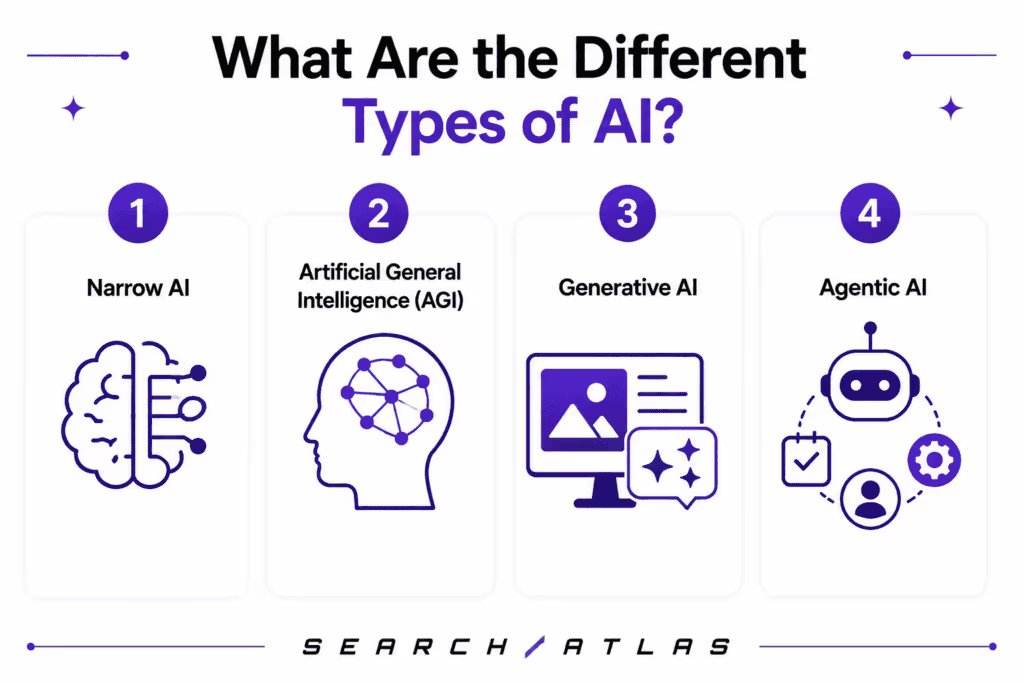
The different types of AI are narrow AI, artificial general intelligence (AGI), generative AI, and agentic AI. These types classify artificial intelligence based on capability, autonomy, and task scope. AI classifications define what a system accomplishes, how broadly it applies knowledge, and how independently it operates. These distinctions matter because each type has different technical limitations, business applications, and risk profiles.
AI classifications shape deployment decisions because different AI systems solve different categories of problems. AI classifications determine whether a system performs a single specialized task, generates new content, or executes multi-step workflows. Organizations use these classifications to evaluate capabilities, establish governance requirements, and align AI systems with operational goals.
The 4 main types of AI are listed below.
1. Narrow AI. Narrow AI performs specific tasks within defined boundaries, which makes it the dominant form of artificial intelligence today. Narrow AI operates within a limited domain and cannot transfer knowledge beyond its training objective. Recommendation systems, search algorithms, fraud detection systems, and large language models all fall into this category. This specialization creates strong performance on targeted tasks but prevents broader reasoning across unrelated domains.
2. Artificial General Intelligence (AGI). Artificial general intelligence performs intellectual tasks across multiple domains, which creates human-level adaptability and reasoning. AGI applies knowledge from one area to another without retraining for each task. Researchers view AGI as a theoretical goal rather than an existing technology. This capability would enable systems to solve unfamiliar problems, learn independently, and operate across diverse environments.
3. Generative AI. Generative AI creates new content, which enables text generation, image creation, audio synthesis, and video production. Generative AI learns patterns from large datasets and produces original outputs that resemble training examples. Popular AI chatbots, image generators, and content creation platforms rely on generative models. This generation capability has transformed content production, software development, and knowledge work.
4. Agentic AI. Agentic AI executes goals through planning, decision making, and autonomous action, which extends artificial intelligence beyond content generation. Agentic AI evaluates objectives, selects actions, and performs tasks across connected systems with limited human intervention. Agentic systems often combine large language models, memory systems, external tools, and workflow automation. This autonomy enables artificial intelligence to manage complex processes that require multiple decisions and actions.
Why do AI-type classifications matter? AI type classifications establish realistic expectations about system capabilities and limitations. AI-type classifications prevent organizations from assigning tasks beyond the capabilities of current technology. Most artificial intelligence systems in production today belong to the narrow AI category, despite rapid advances in generative and agentic systems. This distinction improves deployment decisions, risk management, and governance planning across artificial intelligence initiatives.
What Is Narrow AI (Weak AI)?
Narrow AI, often called weak AI, is an artificial intelligence system designed to perform a specific task or a closely related group of tasks within a defined domain. Narrow AI focuses on specialized objectives rather than broad reasoning across unrelated activities. Narrow AI dominates modern artificial intelligence because nearly every commercial AI system operates within a predefined scope. The term “weak AI” does not indicate poor performance. Narrow AI frequently exceeds human performance within the task it was trained to perform.
Narrow AI remains limited to its training domain because narrow AI does not transfer knowledge across unrelated tasks. A facial recognition system identifies faces but does not translate languages. A recommendation engine predicts viewing preferences but does not analyze medical images. This task specialization defines narrow AI and separates it from the theoretical concept of artificial general intelligence.
Narrow AI includes image recognition models, large language models, recommendation engines, fraud detection systems, speech recognition platforms, and navigation algorithms. These systems operate within defined boundaries because each system learns patterns related to a specific objective. A large language model processes and generates text. A navigation system calculates routes and traffic patterns. A fraud detection model identifies suspicious transactions. These capabilities demonstrate high performance without creating general intelligence.
Narrow AI remains the foundation of modern artificial intelligence because even advanced generative AI systems belong to this category. Models (GPT and Claude) perform a wide range of language tasks, but these tasks remain connected to language processing. This language specialization places generative AI within the narrow AI category despite its broad commercial applications.
Narrow AI has a fundamental limitation because performance declines when inputs differ significantly from training data. A medical imaging model trained on one population produces weaker results on underrepresented populations. A text classification model trained on formal documents produces weaker results on informal social media content. These limitations result from task-specific training rather than software defects. Ongoing retraining and evaluation improve performance, but the underlying limitation remains.
Narrow AI represents the dominant form of artificial intelligence in commercial deployment today because virtually every AI product and service relies on specialized capabilities. Voice assistants, search algorithms, content moderation systems, email filters, autonomous driving perception systems, and advertising platforms all operate as narrow AI. This widespread adoption demonstrates the commercial value of narrow AI even though the technology remains limited to specific domains.
What Is Artificial General Intelligence (AGI)?
Artificial General Intelligence (AGI) is a theoretical form of artificial intelligence that matches or exceeds human cognitive abilities across all intellectual tasks. AGI performs reasoning, learning, problem solving, creativity, and adaptation across multiple domains without requiring task-specific retraining. AGI differs from narrow AI because AGI transfers knowledge between unrelated activities and applies existing knowledge to unfamiliar situations. Researchers view AGI as a future goal rather than an existing technology because no AGI system exists today.
AGI would demonstrate broad cognitive flexibility because AGI learns new skills from limited examples and adapts to changing environments. A true AGI system would solve mathematical problems, learn new languages, navigate physical environments, and perform scientific research without requiring separate models for each activity. This adaptability distinguishes AGI from current artificial intelligence systems that operate within predefined domains.
AGI does not exist today because current artificial intelligence architectures remain specialized rather than general. Large language models generate text and perform language-related reasoning. Computer vision systems analyze images and video. Robotics systems control physical movement and navigation. These systems achieve strong performance within specific domains but do not transfer capabilities across unrelated domains. This lack of generalization remains one of the largest unsolved challenges in artificial intelligence research.
AGI differs from current large language models because large language models operate through pattern recognition rather than general intelligence. Large language models generate outputs by predicting sequences based on training data. These models do not learn new capabilities during conversations, independently update their underlying parameters, or develop a broad understanding across all cognitive domains. This limitation places large language models within the narrow AI category despite their advanced capabilities.
AGI requires capabilities that current artificial intelligence systems do not possess. These capabilities include autonomous learning, cross-domain reasoning, knowledge transfer, and independent adaptation. Autonomous learning enables a system to acquire new skills without extensive retraining. Cross-domain reasoning enables a system to apply knowledge from one field to another. Knowledge transfer enables a system to solve unfamiliar problems using previous experience. Independent adaptation enables a system to adjust to new environments and objectives. These capabilities remain active areas of research rather than commercial realities.
AGI remains important because the concept establishes a clear distinction between theoretical artificial intelligence and deployed artificial intelligence. Organizations that treat narrow AI as AGI often assign responsibilities beyond the capabilities of current systems. These expectations create predictable failures because existing models remain dependent on training data, domain-specific optimization, and human oversight. The distinction between AGI and narrow AI defines what modern artificial intelligence accomplishes today and what researchers continue to pursue in the future.
What Is Generative AI?
Generative AI is a type of artificial intelligence that creates new content by learning patterns from existing data and generating original outputs. Generative AI produces text, images, audio, video, and code rather than assigning labels or selecting predefined answers. Generative AI differs from traditional AI because generative AI creates new material instead of classifying information. This content generation capability has made generative AI one of the fastest-growing areas of artificial intelligence.
Generative AI creates original outputs because it learns statistical relationships from large datasets during training. These learned relationships enable the model to generate content that resembles training examples without directly copying them. A classification model identifies whether an email belongs to a spam category. A generative AI model writes an entirely new email. This generation process separates generative AI from earlier artificial intelligence systems focused on prediction and classification.
Generative AI relies primarily on transformer models because transformer architectures process sequences of information and predict what comes next. Transformer models analyze relationships between words, images, sounds, or other data elements across large datasets. This architecture enables generative AI systems to understand context, maintain coherence, and generate complex outputs across multiple content formats.
Large language models generate text by predicting one token at a time based on probability. A prompt enters the model as a sequence of tokens. The model evaluates relationships between those tokens and predicts the most likely next token. The model repeats this prediction process until it completes a response. This token-by-token generation creates fluent text that appears conversational, contextual, and responsive to user input.
Generative AI differs from earlier artificial intelligence systems because generative AI operates within an open-ended output space. Traditional AI systems select answers from predefined categories. Generative AI systems create responses from a virtually unlimited set of possibilities. This flexibility enables document creation, image generation, software development, and creative production. This same flexibility introduces reliability challenges because generative AI sometimes generates inaccurate information that appears convincing.
There are four main generative AI modalities in commercial use today. These modalities are text generation, image generation, code generation, and multimodal generation.
- Text generation. Text generation creates articles, summaries, reports, conversations, and other written content. Large language models process language patterns and generate human-readable responses. This modality powers chatbots, writing assistants, and search experiences.
- Image generation. Image generation creates visual content from text prompts or other inputs. Image generation models learn visual patterns and produce original graphics, illustrations, and photographs. This modality powers design tools, creative applications, and marketing workflows.
- Code generation. Code generation creates software code, scripts, and technical documentation. Code generation models learn programming patterns from software repositories and generate functional code. This modality accelerates software development and debugging workflows.
- Multimodal generation. Multimodal generation processes and produces combinations of text, images, audio, and video. Multimodal systems understand multiple forms of information within a single model. This capability expands the range of tasks that a single artificial intelligence system performs.
Generative AI continues to expand across new content formats because video generation, audio synthesis, and multimodal reasoning remain active areas of development. This expansion positions generative AI as one of the most influential technologies in modern artificial intelligence.
What Is Agentic AI?
Agentic AI is a type of artificial intelligence that plans, executes, and manages multi-step workflows to achieve a defined goal with limited human intervention. Agentic AI moves beyond content generation because agentic AI takes actions, uses tools, evaluates outcomes, and continues working until it completes an objective or reaches a stopping condition. This goal-oriented behavior distinguishes agentic AI from traditional AI systems that generate a single response and stop.
Agentic AI operates through action loops because agentic AI breaks large objectives into smaller tasks and executes those tasks sequentially. An agentic AI system receives a goal, creates a plan, selects tools, performs actions, reviews results, and adjusts the plan when necessary. This process enables agentic AI to handle complex workflows that require multiple decisions rather than a single response.
Agentic AI differs from standard chatbots because agentic AI continues working after generating an initial response. A chatbot answers a question and ends the interaction. An agentic system receives an objective, performs research, accesses tools, executes tasks, verifies outcomes, and reports completed work. This workflow-driven architecture enables agentic AI to function as an autonomous operator rather than a conversational interface.
Four main capabilities define agentic AI. These capabilities are tool use, multi-step planning, memory, and goal decomposition.
- Tool use. Tool use enables agentic AI to interact with external systems and resources. Agentic systems access web browsers, databases, APIs, software applications, and code execution environments. This access expands capabilities beyond information contained within the model itself.
- Multi-step planning. Multi-step planning enables agentic AI to organize actions into logical sequences. Each action depends on the results of previous actions. This planning process enables agentic systems to complete objectives that require multiple stages of execution.
- Memory. Memory enables agentic AI to retain context throughout a workflow. Agentic systems reference previous actions, outcomes, and decisions while completing a task. This retained context improves consistency and continuity across long workflows.
- Goal decomposition. Goal decomposition enables agentic AI to transform broad objectives into manageable tasks. A high-level objective becomes a sequence of smaller actions that contribute to the outcome. This decomposition process enables agentic systems to address complex objectives efficiently.
Agentic AI relies on these capabilities because systems that lack planning, memory, tool use, or goal decomposition function as automation workflows rather than true agents. These capabilities create the autonomy that defines agentic artificial intelligence.
Agentic AI introduces risks because autonomous workflows amplify mistakes across multiple actions. An error during an early step influences every subsequent step that depends on that result. This cascading effect increases the impact of inaccurate decisions. Actions that modify databases, send communications, or execute transactions create additional operational risk because reversing those actions often requires manual intervention.
Agentic AI requires governance controls because autonomous systems operate with reduced human involvement during execution. Organizations implement approval checkpoints, action limits, monitoring systems, and audit logs to maintain oversight. These controls reduce operational risk while preserving the efficiency benefits of autonomous execution.
Agentic AI has become one of the fastest-growing areas of artificial intelligence because organizations increasingly seek systems that complete work rather than generate recommendations. This shift moves artificial intelligence from information generation toward autonomous task execution across business, software, marketing, and operational workflows.
What Is the Difference Between AI, Machine Learning, and Deep Learning?
The difference between artificial intelligence, machine learning, and deep learning lies in scope, methodology, and learning architecture. Artificial intelligence is the broadest category, machine learning is a subset of artificial intelligence, and deep learning is a subset of machine learning. This hierarchy defines how intelligent systems process information, learn from data, and perform cognitive tasks across different levels of complexity.
Artificial intelligence encompasses all systems that perform tasks associated with human cognition, whether those systems rely on rules, logic, or learning. Machine learning focuses specifically on learning patterns from data rather than following manually programmed instructions. Deep learning focuses on neural networks that automatically learn complex representations from large datasets. This progression moves from broad intelligence concepts toward increasingly specialized learning methods.
The core differences between artificial intelligence, machine learning, and deep learning are below.
| Aspect | Artificial Intelligence | Machine Learning | Deep Learning |
| Definition | A broad field that creates systems capable of performing cognitive tasks. | A subset of AI that learns patterns from data. | A subset of machine learning that uses multi-layer neural networks. |
| Scope | Broadest category. | Narrower category within AI. | Most specialized category within machine learning. |
| Learning requirement | Operates through rules, logic, learning, or combinations of methods. | Learns from training data. | Learns from training data through neural networks. |
| Human involvement | Requires extensive rule creation in some systems. | Requires data preparation and feature selection. | Learns many features automatically during training. |
| Data dependency | Functions with or without training data. | Depends on the training data. | Depends on large training datasets. |
| Feature engineering | Relies heavily on manual design in traditional systems. | Often requires human-selected features. | Learns features automatically from raw data. |
| Common methods | Expert systems, rule engines, search algorithms. | Decision trees, linear regression, and support vector machines. | Neural networks, transformers, and convolutional networks. |
| Typical use cases | Planning, reasoning, automation, decision making. | Prediction, classification, and recommendation systems. | Language models, image recognition, speech generation. |
What does artificial intelligence do? Artificial intelligence performs cognitive tasks through rules, logic, statistical models, or learning systems. Artificial intelligence includes expert systems, planning systems, recommendation engines, and machine learning models. This broad scope makes artificial intelligence the parent category for many different approaches to intelligent behavior.
What does machine learning do? Machine learning learns patterns from data and uses those patterns to make predictions or decisions. Machine learning replaces manually programmed rules with statistical learning processes. A spam filter built with machine learning learns spam characteristics from examples rather than relying on predefined keyword lists. This learning capability enables machine learning systems to adapt more effectively to changing inputs.
What does deep learning do? Deep learning learns complex patterns through neural networks with multiple hidden layers. Deep learning automatically discovers relationships and features within data during training. A deep learning model trained on financial transactions identifies important fraud indicators without requiring analysts to define every feature. This automatic feature learning makes deep learning highly effective for text, images, audio, and other unstructured data types.
How does natural language processing fit into artificial intelligence, machine learning, and deep learning? Natural language processing functions as an application area rather than a separate layer in the hierarchy. Natural language processing uses artificial intelligence techniques to understand and generate human language. Early natural language processing systems relied on rules and dictionaries. Modern natural language processing systems rely on deep learning architectures, particularly transformer models. Large language models such as GPT, Claude, and Gemini represent advanced natural language processing systems built on deep learning foundations.
What Are Examples of AI in Use Today?
Artificial intelligence is used today across healthcare, financial services, retail, manufacturing, logistics, customer service, and search. These applications use artificial intelligence to analyze data, identify patterns, generate predictions, and automate decisions at a scale that exceeds human capabilities. Artificial intelligence has expanded rapidly through machine learning and generative AI, which has increased adoption across both consumer and enterprise environments.
Artificial intelligence creates value because it processes large volumes of structured and unstructured data with speed and consistency. Organizations use artificial intelligence to improve decision-making, automate repetitive tasks, identify anomalies, and generate content. This combination of automation and pattern recognition has made artificial intelligence one of the most widely deployed technologies in modern business operations.
The 7 main examples of artificial intelligence in use today are listed below.
1. Healthcare. Artificial intelligence analyzes medical images, predicts health risks, and assists clinical decision-making. Healthcare systems use artificial intelligence to identify abnormalities in scans, evaluate patient records, and improve diagnostic accuracy. This analysis improves efficiency and accelerates medical workflows.
2. Financial services. Artificial intelligence detects fraud, evaluates risk, and automates financial decisions. Financial institutions use artificial intelligence to monitor transactions, identify suspicious activity, and assess creditworthiness. This monitoring improves security and reduces financial losses.
3. Retail. Artificial intelligence personalizes recommendations, forecasts demand, and optimizes inventory management. Retail platforms use artificial intelligence to analyze customer behavior and recommend relevant products. This personalization improves customer experiences and increases operational efficiency.
4. Manufacturing. Artificial intelligence monitors equipment, predicts failures, and improves production processes. Manufacturing systems use artificial intelligence to analyze sensor data and identify maintenance requirements before breakdowns occur. This prediction reduces downtime and improves productivity.
5. Logistics. Artificial intelligence optimizes routes, predicts delivery times, and manages supply chains. Logistics companies use artificial intelligence to evaluate traffic conditions, shipment data, and operational constraints. This optimization improves delivery performance and resource allocation.
6. Customer service. Artificial intelligence powers virtual assistants, automated support systems, and conversational interfaces. Customer service platforms use artificial intelligence to answer questions, resolve issues, and process requests across large volumes of interactions. This automation improves response times and service consistency.
7. Search and content generation. Artificial intelligence improves search results, generates content, and processes natural language queries. Search platforms use artificial intelligence to understand intent and rank relevant information. Generative AI systems create text, images, code, audio, and video from user prompts. This capability has expanded artificial intelligence into content creation, software development, and knowledge management workflows.
Artificial intelligence connects these applications through a shared capability. Artificial intelligence analyzes data, identifies patterns, and generates outputs that inform decisions or trigger actions. A fraud detection system evaluates millions of transactions.
A recommendation engine personalizes results for millions of users. A medical imaging model reviews scans with consistent accuracy. These applications differ by industry and data type, but each relies on scalable pattern recognition applied to decision-critical information.
How Is AI Used in Business?
Businesses use artificial intelligence to automate decisions, analyze large datasets, generate content, detect fraud, optimize operations, and improve customer experiences. Artificial intelligence processes operational data and generates predictions, classifications, or recommendations that improve efficiency and scalability. These capabilities have made artificial intelligence a core technology across customer service, sales, finance, logistics, and business intelligence.
Artificial intelligence creates business value because it performs tasks that previously required large amounts of human analysis. This automation enables organizations to process more data, respond faster, and make decisions with greater consistency. This scalability explains why artificial intelligence adoption has accelerated across industries.
How is artificial intelligence applied in business operations? Artificial intelligence applies machine learning models and generative AI systems to operational workflows. These systems analyze historical data, identify patterns, and generate outputs that inform decisions or trigger automated actions. Common business applications include customer service automation, document processing, sales forecasting, predictive maintenance, dynamic pricing, and operational optimization. This combination of automation and prediction improves productivity across departments.
How is artificial intelligence used in customer service? Artificial intelligence uses large language models and conversational systems to manage customer interactions. These systems answer common questions, classify requests, route complex issues, and generate responses from company knowledge bases. Intent recognition determines customer needs, while retrieval systems access relevant information before generating responses. This process improves response speed and increases service consistency across large volumes of interactions.
How is artificial intelligence used in fraud detection? Artificial intelligence uses machine learning models to identify suspicious transactions and assign risk scores in real time. These models analyze transaction history, spending patterns, geographic activity, and behavioral signals. High-risk transactions trigger reviews, alerts, or temporary restrictions. This analysis enables organizations to evaluate millions of transactions within milliseconds and reduce fraud-related losses.
How is artificial intelligence used in supply chain and logistics? Artificial intelligence predicts demand, optimizes delivery routes, manages inventory levels, and automates warehouse operations. Forecasting models analyze sales history, seasonal trends, weather conditions, and economic indicators to estimate future demand. Route optimization systems calculate efficient delivery sequences across large transportation networks. This optimization reduces costs, improves delivery performance, and increases operational efficiency.
How is artificial intelligence used in sales and forecasting? Artificial intelligence analyzes customer behavior, historical sales data, and market trends to predict future outcomes. Forecasting models identify purchasing patterns and estimate revenue opportunities. Lead scoring systems evaluate potential customers and prioritize sales efforts based on conversion probability. This analysis improves resource allocation and increases forecasting accuracy.
How is artificial intelligence used in content generation and document processing? Artificial intelligence generates reports, summaries, marketing content, and business documentation. Generative AI systems create drafts from prompts, while document processing systems extract information from contracts, invoices, and forms. This automation reduces manual workloads and accelerates information processing across business operations.
Artificial intelligence connects these applications through a common capability. Artificial intelligence transforms large volumes of operational data into actionable outputs. Fraud detection systems evaluate transactions. Customer service systems process requests. Forecasting systems predict outcomes. Logistics systems optimize deliveries. This pattern recognition at scale enables businesses to operate faster, more accurately, and more efficiently.
How Is AI Used in Healthcare?
Artificial intelligence is used in healthcare for diagnostic imaging, drug discovery, clinical documentation, genomics, and patient outcome prediction. Healthcare organizations use artificial intelligence to analyze medical data, identify patterns, accelerate research, and improve clinical workflows. These applications have expanded rapidly as machine learning and generative AI systems have achieved higher accuracy across medical and scientific tasks.
Artificial intelligence improves healthcare because it processes large volumes of clinical information faster than traditional methods. Healthcare systems use artificial intelligence to assist medical professionals, accelerate research, and reduce administrative workloads. This combination of analytical capability and automation has made artificial intelligence one of the fastest-growing technologies in modern healthcare.
How is artificial intelligence applied in healthcare? Artificial intelligence applies machine learning models, deep learning systems, and generative AI tools across clinical and research environments. These systems analyze medical images, predict outcomes, identify treatment candidates, process genomic data, and automate documentation. This broad adoption has expanded the role of artificial intelligence across patient care, medical research, and healthcare operations.
How is artificial intelligence used in diagnostic imaging? Artificial intelligence analyzes X-rays, MRI scans, CT scans, and pathology images to identify patterns associated with diseases and medical conditions. Diagnostic imaging models highlight regions of interest, classify abnormalities, and provide additional analysis for medical professionals. This assistance improves screening efficiency and enables faster review of large volumes of imaging data. Healthcare providers use these systems as clinical decision support tools rather than replacements for radiologists and specialists.
How is artificial intelligence used in drug discovery? Artificial intelligence predicts molecular interactions, identifies candidate compounds, and models biological processes involved in disease treatment. Drug discovery systems analyze large chemical libraries and evaluate potential therapies before laboratory testing begins. This analysis accelerates early-stage research and reduces the time required to identify promising treatment candidates. Artificial intelligence has become increasingly important in genomic research, protein modeling, and pharmaceutical development.
How is artificial intelligence used in clinical documentation? Artificial intelligence transcribes patient conversations, generates clinical notes, and extracts structured information from medical interactions. Clinical documentation systems convert speech into text and organize information into diagnoses, medications, treatment plans, and follow-up recommendations. This automation reduces administrative workloads and enables healthcare professionals to spend more time with patients. Healthcare organizations increasingly integrate these systems into electronic health record workflows.
How is artificial intelligence used in genomics and precision medicine? Artificial intelligence analyzes genetic information to identify disease risks, predict biological outcomes, and discover potential treatment pathways. Genomic models process large datasets containing DNA, RNA, and protein information. This analysis improves understanding of rare diseases and enables more personalized treatment strategies. Artificial intelligence has expanded the ability of researchers to evaluate genetic data at a scale that would be impractical through manual analysis.
How is artificial intelligence used in patient outcome prediction? Artificial intelligence evaluates patient records, medical histories, laboratory results, and clinical indicators to estimate future health outcomes. Prediction models identify risk factors, forecast complications, and prioritize patients who require additional attention. This predictive capability improves resource allocation and enables earlier clinical interventions. Healthcare providers use these insights to improve decision-making and patient management.
Artificial intelligence connects these healthcare applications through a common capability. Artificial intelligence analyzes complex medical data and generates actionable insights for clinicians, researchers, and healthcare organizations. Diagnostic systems identify abnormalities. Drug discovery systems evaluate treatments. Documentation systems automate records. Genomic systems analyze biological data. Prediction systems estimate outcomes. This combination of analysis and automation continues to transform healthcare delivery and medical research.
How Is AI Used in Content and Search?
Artificial intelligence is used in content and search to generate content, analyze search intent, identify content opportunities, optimize pages, and automate SEO workflows. Content teams use artificial intelligence to accelerate research, drafting, optimization, and publishing processes. Search teams use artificial intelligence to improve technical performance, expand keyword coverage, and increase visibility across traditional search engines and AI-driven search experiences.
Artificial intelligence improves content and search because it automates repetitive tasks that previously required significant manual effort. This automation enables teams to focus on strategy, expertise, accuracy, and differentiation. This efficiency has made artificial intelligence a core component of modern SEO and content marketing workflows.
How is artificial intelligence applied in content creation and SEO workflows? Artificial intelligence analyzes keywords, search intent, competitor content, and ranking patterns to improve content production. Content creation systems generate outlines, build briefs, draft articles, and identify content gaps. SEO systems analyze websites, detect optimization opportunities, and recommend improvements. This combination of content generation and optimization reduces production timelines and increases content output.
How do OTTO SEO and Content Genius use artificial intelligence in SEO and content production? OTTO SEO uses artificial intelligence to monitor websites, identify optimization opportunities, and deploy technical SEO improvements automatically. OTTO SEO evaluates site health, analyzes performance signals, and implements changes without requiring manual execution for every task. This automation improves technical SEO efficiency and maintains optimization across large websites.
Content Genius uses artificial intelligence to generate content briefs, create drafts, and optimize content based on search data. Content Genius analyzes ranking patterns, search intent, and competitor coverage to align content with search demand. This analysis improves content relevance and accelerates content production workflows.
How does artificial intelligence affect content production for SEO teams? Artificial intelligence reduces the time required to move from keyword research to published content. SEO teams often identify more keyword opportunities than available production resources. Artificial intelligence narrows this gap by generating outlines, briefs, and draft content that editors refine and expand. This process increases content output without requiring proportional increases in team size.
Artificial intelligence does not replace editorial review because generated content requires validation and refinement. Editors verify facts, strengthen expertise, improve differentiation, and maintain quality standards. This combination of automation and human oversight creates more efficient content production workflows.
How does artificial intelligence optimize content for AI-driven search surfaces? Artificial intelligence-driven search surfaces prioritize content that presents information clearly, directly, and structurally. Search experiences(AI Overviews and answer engines) extract information from pages that answer questions immediately and organize information logically. This extraction process favors content with direct answers, clear entities, descriptive headings, and factual depth.
Content optimized for AI-driven search focuses on question-based structures where each section addresses a specific query. The first sentence provides the answer. The remaining sentences expand the answer with context and supporting details. This structure improves extractability and increases the likelihood of citation within AI-generated responses.
Artificial intelligence connects content creation and search optimization through a shared objective. Artificial intelligence transforms search data into actionable content recommendations and optimization opportunities. Content systems generate drafts. SEO systems improve performance. AI search systems evaluate extractability. This combination enables organizations to create, optimize, and scale content more efficiently across modern search environments.
What Are the Advantages and Disadvantages of AI?
The advantages of artificial intelligence include speed, scalability, consistency, automation, adaptability, and cost efficiency. The disadvantages of artificial intelligence include inaccuracies, bias, limited reasoning, dependency on data quality, reduced transparency, and operational risks.
These advantages and disadvantages determine how organizations deploy artificial intelligence and where human oversight remains necessary. Artificial intelligence creates significant efficiency gains, but artificial intelligence introduces limitations that affect reliability, accountability, and decision quality.
Artificial intelligence improves performance because it processes information at a scale and speed that exceeds human capabilities. Artificial intelligence creates challenges because it depends on training data, model design, and operational controls. This balance between capability and limitation shapes the practical use of artificial intelligence across industries.
There are 6 main advantages of artificial intelligence.
1. Speed and scalability. Artificial intelligence processes massive volumes of information in seconds, which enables organizations to analyze data at scale. Fraud detection systems evaluate millions of transactions in real time. Search systems analyze billions of pages across large indexes. This processing capability improves operational efficiency and decision speed.
2. Consistency. Artificial intelligence applies the same decision criteria repeatedly, which reduces variation across tasks. Diagnostic imaging models evaluate every scan using the same analytical framework. Customer service systems respond consistently regardless of time or workload. This consistency improves standardization across high-volume operations.
3. Automation of repetitive tasks. Artificial intelligence automates routine activities that require significant manual effort. Document processing systems extract information from forms and contracts. Customer service systems manage common support requests. This automation reduces administrative workloads and increases productivity.
4. Adaptability. Artificial intelligence identifies patterns from data and applies those patterns to new situations. Machine learning systems classify previously unseen examples based on similarities to training data. This adaptability enables artificial intelligence to perform effectively across changing environments.
5. Improved decision-making. Artificial intelligence analyzes large datasets and identifies relationships that are difficult to detect manually. Forecasting systems predict demand. Risk models evaluate financial transactions. This analysis improves the quality and speed of operational decisions.
6. Cost efficiency. Artificial intelligence reduces costs associated with repetitive cognitive tasks. Organizations use artificial intelligence to automate support, content generation, forecasting, and monitoring activities. This efficiency enables businesses to manage larger workloads without proportional increases in operational expenses.
There are 4 main disadvantages of artificial intelligence.
1. Inaccuracies and hallucinations. Artificial intelligence generates incorrect outputs despite appearing confident and authoritative. Generative AI systems sometimes produce inaccurate information that resembles factual content. These errors require human review and validation.
2. Bias in outputs. Artificial intelligence reflects patterns present in training data, which creates biased outcomes when datasets contain imbalances. Biased training data produces biased predictions and recommendations. This limitation affects fairness and decision quality.
3. Limited reasoning outside training domains. Artificial intelligence performs best within the domains represented in training data. Performance declines when inputs differ significantly from previous examples. This limitation restricts the ability of artificial intelligence to handle unfamiliar situations reliably.
4. Dependence on data quality. Artificial intelligence learns from the information used during training. Poor-quality data produces weaker results and increases error rates. Data quality directly influences model performance and reliability.
What advantages does artificial intelligence provide over rule-based automation? Artificial intelligence adapts to new inputs through learned patterns, while rule-based systems depend on predefined instructions. Rule-based systems fail when unexpected scenarios appear. Artificial intelligence evaluates similarities between new inputs and historical examples. This adaptability reduces maintenance requirements and improves performance across diverse situations.
What economic advantages does artificial intelligence provide in business environments? Artificial intelligence reduces costs, accelerates decisions, and increases operational capacity. Organizations use artificial intelligence to automate customer support, process large datasets, detect fraud, and generate content. These applications create the greatest value in environments with high data volume and repetitive decision processes. This concentration of value explains why artificial intelligence adoption continues to expand across business operations.
How Is AI Changing SEO and Search?
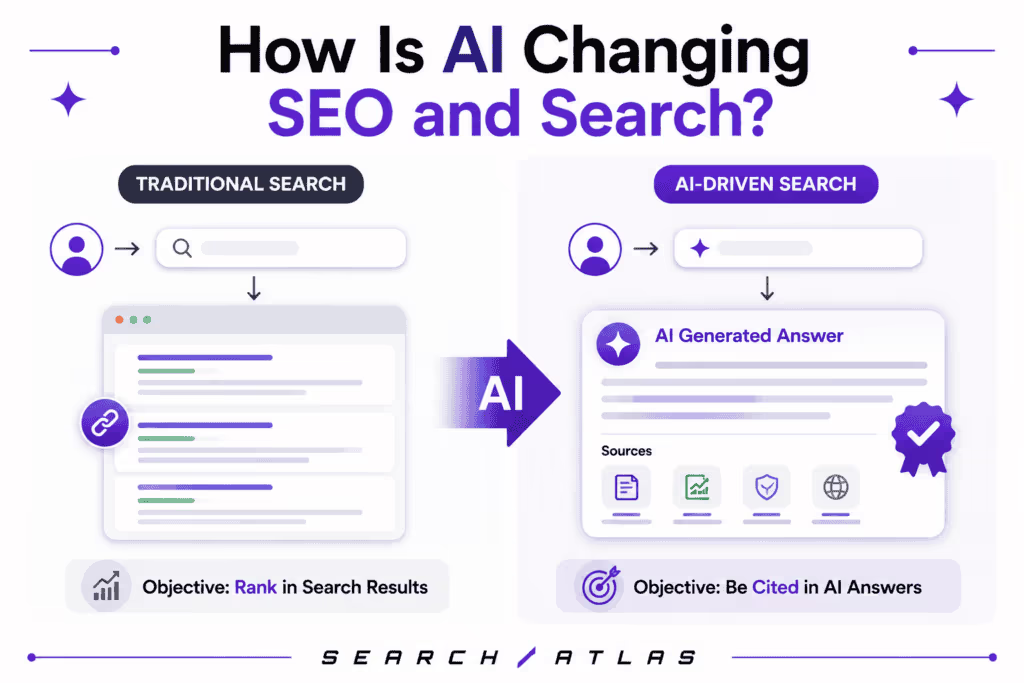
AI is changing SEO and search by shifting search experiences from link-based results to AI-generated answers. Search engines and answer engines increasingly generate direct responses that synthesize information from multiple sources before presenting results to users. This shift changes the primary objective of SEO from ranking in search results to becoming a cited source within AI-generated answers.
AI introduces a synthesis layer between user queries and traditional search results. Search systems no longer function only as retrieval engines that present links. Search systems now analyze information, generate summaries, and deliver direct answers. This change alters how users discover information and how publishers earn visibility.
Google AI Overviews represent one of the most significant examples of this transition. AI Overviews generate answers from indexed content and display those answers above traditional organic listings. Answer engines (Perplexity and Microsoft Copilot) follow a similar model. These platforms retrieve information, synthesize responses, and present citations as supporting references rather than primary destinations. This structure reduces the importance of simple rankings and increases the importance of citation visibility.
User behavior drives the adoption of artificial intelligence in search because users prefer immediate answers over navigating multiple pages. Traditional search often required users to compare several sources before finding a complete answer. AI-powered search systems perform this synthesis automatically. This automation reduces effort and provides faster access to information.
Large language models accelerate this shift because they combine information from multiple sources into coherent responses. These models analyze context, identify relevant information, and generate summaries that address user intent directly. This capability enables search platforms to function as answer engines rather than collections of links.
AI-generated answers create significant implications for publishers and SEO professionals. Research across tens of thousands of queries has shown that AI Overviews reduce organic click-through rates across many search categories. Search systems increasingly consume content to generate answers rather than directing traffic to sources. This change increases competition for citations and decreases the value of ranking positions alone.
SEO strategies now extend beyond traditional ranking objectives because visibility depends on citation eligibility and answer extraction. Content that provides direct answers, clear entity references, strong factual coverage, and logical structure increases the likelihood of citation within AI-generated responses. This evolution expands SEO from search ranking optimization into search answer optimization.
What Is AI-Powered Search?
AI-powered search is a search system that uses artificial intelligence and large language models to generate direct answers from retrieved information instead of displaying only a ranked list of links. AI-powered search analyzes content from multiple sources, synthesizes information, and presents a unified response with citations. This approach changes the search from a retrieval experience into an answer generation experience.
AI-powered search has expanded rapidly through platforms (Google AI Overviews, Perplexity, and Microsoft Copilot). These systems retrieve relevant content, process that content through large language models, and generate responses that address user intent directly. This process reduces the number of steps required for users to find information.
AI-powered search relies on retrieval augmented generation because it combines search retrieval with language model generation. The system identifies relevant sources, extracts useful information, and uses that information as context for answer generation. This method improves factual grounding and increases the relevance of generated responses.
Google AI Overviews selects sources primarily from high-ranking organic search results. Research has shown that the vast majority of AI Overview citations originate from pages that already rank within the top 20 organic positions. This relationship demonstrates that traditional SEO remains the foundation of AI search visibility. Strong rankings increase the probability of citation because ranking pages enter the retrieval pool used during answer generation.
Content structure influences citation frequency because AI-powered search systems favor content that is easy to extract and summarize. Pages with direct answers, clear entity references, descriptive headings, and factual depth provide stronger signals for retrieval and synthesis. Strong expertise, experience, authoritativeness, and trustworthiness signal a further increase in AI citation potential.
AI-powered search differs from traditional search because AI-powered search generates a synthesized response instead of presenting multiple competing results. Traditional search distributes visibility across numerous rankings. AI-powered search concentrates visibility within a single answer and a small set of citations. This concentration increases competition because only a limited number of sources appear within generated responses.
Answer engines create a different visibility model because answer engines prioritize citations rather than rankings. Traditional search users review multiple pages before selecting a source. Answer engine users often consume information directly from the generated response. This shift increases the importance of citation optimization and decreases reliance on click-based discovery.
Standalone answer engines differ from Google AI Overviews because standalone platforms use generated answers as the entire search experience. Google AI Overviews appear above traditional search results, which gives users access to both AI-generated answers and organic listings. Platforms such as Perplexity and Microsoft Copilot place the generated response at the center of the experience. This structure makes citation visibility the primary mechanism for discovery.
AI-powered search changes SEO because visibility depends on both rankings and citation eligibility. Content requires strong organic performance to enter retrieval systems and a clear structure to increase citation likelihood. This shift expands SEO beyond ranking optimization and introduces a growing focus on AI search visibility.
How Does AI Affect Content Rankings?
AI affects content rankings by increasing the importance of topical depth, direct answers, entity clarity, content structure, and trust signals. Search systems increasingly evaluate whether content provides information that artificial intelligence retrieves, understands, and cites within generated answers. This shift changes ranking priorities and increases the value of content designed for both human readers and AI-driven search systems.
AI-driven search favors content that communicates information clearly and directly. Search systems increasingly synthesize information into summaries and generate responses. This synthesis process rewards content that presents facts, definitions, and explanations in a format that artificial intelligence can extract and reference.
Content rankings increasingly depend on topical depth because search systems evaluate how comprehensively a page covers a subject. Comprehensive content addresses definitions, related concepts, supporting details, and user questions within a single resource. This coverage improves relevance signals and increases the likelihood of citation within AI-generated answers.
Content rankings increasingly depend on direct answer clarity because AI systems prioritize content that answers questions immediately. A paragraph that begins with a clear definition or factual statement provides stronger extraction signals than a paragraph that delays the answer. This structure improves readability and increases citation potential across AI search experiences.
Content rankings increasingly depend on entity clarity because artificial intelligence uses entities to understand relationships between topics, people, organizations, products, and concepts. Explicit entity references improve contextual understanding and strengthen retrieval signals. This clarity enables search systems to connect content more accurately with user queries.
Content rankings increasingly depend on structured content formats because artificial intelligence extracts information at the paragraph level rather than summarizing entire pages. Question and answer structures, definition first paragraphs, descriptive headings, and clearly organized sections improve extractability. This organization increases visibility within AI-generated answers and answer engines.
What Are the Ethical and Legal Issues Around AI?
The ethical and legal issues around artificial intelligence include bias, discrimination, accountability, privacy, surveillance, labor displacement, and regulatory compliance. These issues affect how artificial intelligence is developed, deployed, and governed across business, healthcare, finance, education, and public services. Ethical and legal concerns have become increasingly important as artificial intelligence systems influence decisions that affect people’s opportunities, rights, and access to resources.
Artificial intelligence raises ethical concerns because it produces outcomes that impact individuals and communities at scale. These concerns extend beyond technical performance and focus on fairness, transparency, responsibility, and social impact. Governments and regulators increasingly address these risks through laws, standards, and compliance frameworks.
There are 6 main ethical and legal issues around artificial intelligence.
1. Bias and discrimination. Bias occurs when artificial intelligence produces unfair outcomes for certain groups. Biased training data creates biased predictions, recommendations, and decisions. This issue affects hiring, lending, healthcare, and other decision-making systems.
2. Accountability. Accountability determines who is responsible when artificial intelligence causes harm. Developers, vendors, deployers, and organizations often share responsibility for outcomes. This shared responsibility creates legal and governance challenges.
3. Privacy. Privacy concerns arise because artificial intelligence systems often require large amounts of personal and behavioral data. Data collection, storage, and processing create risks related to misuse, unauthorized access, and loss of personal information.
4. Surveillance. Surveillance concerns emerge when artificial intelligence enables large-scale monitoring of individuals and populations. Facial recognition, behavioral tracking, and biometric systems increase concerns about civil liberties and personal freedom.
5. Labor displacement. Labor displacement occurs when artificial intelligence automates tasks previously performed by humans. Automation increases efficiency but creates concerns about workforce disruption and changing job requirements across industries.
6. Regulatory compliance. Regulatory compliance requires organizations to meet legal obligations related to fairness, transparency, safety, and accountability. Laws (EU AI Act) establish requirements for high-risk artificial intelligence systems and impose penalties for violations.
Ethical concerns differ from technical limitations because ethical concerns focus on the impact of artificial intelligence on people and society. Technical limitations affect system performance and reliability. Ethical concerns affect fairness, rights, accountability, and appropriate use. This distinction is important because improving technical performance does not automatically resolve ethical or legal risks.
Artificial intelligence adoption continues to expand across industries, which increases the importance of responsible governance. Organizations address both technical limitations and ethical concerns to reduce risk and maintain public trust.
What Is AI Bias and Why Does It Matter?
AI bias is a systematic distortion in artificial intelligence outputs that creates unfair outcomes for specific individuals or groups. AI bias occurs when training data contains imbalances, historical discrimination, or missing representation. Artificial intelligence learns these patterns and applies them to future predictions, classifications, and decisions. AI bias matters because artificial intelligence increasingly influences hiring, lending, healthcare, and public services.
AI bias develops because artificial intelligence learns from historical data rather than the objective truth. Historical data often reflects existing inequalities and demographic imbalances. These patterns become part of the model’s behavior and affect future outputs.
How does AI bias affect hiring systems? AI bias affects hiring systems when candidate screening tools favor one group over another. Hiring models learn patterns from historical recruitment data and reproduce those patterns during future evaluations. This behavior creates unfair barriers for qualified candidates.
How does AI bias affect facial recognition systems? AI bias affects facial recognition systems when error rates vary across demographic groups. Models trained on unbalanced datasets perform more accurately for overrepresented populations. This disparity increases misidentification risks for underrepresented groups.
Why is AI bias difficult to detect? AI bias is difficult to detect because bias exists within learned patterns rather than explicit rules. Organizations test outputs across different demographic groups to identify disparities and measure their impact.
Why is AI bias difficult to correct? AI bias is difficult to correct because bias often originates from training data. Correcting bias requires improvements in data collection, representation, testing, and validation rather than simple model adjustments.
Why does AI bias matter? AI bias matters because artificial intelligence influences decisions that affect people’s opportunities, finances, and access to services. Biased systems scale unfair outcomes across large populations. Reducing bias improves fairness, accuracy, and trust in artificial intelligence systems.
What Regulations Govern AI?
AI regulations govern how organizations develop, deploy, and monitor artificial intelligence systems. AI regulations establish legal requirements for transparency, safety, accountability, privacy, and risk management. These regulations have expanded rapidly as artificial intelligence adoption has increased across healthcare, finance, hiring, education, and public services.
How is artificial intelligence regulated globally? Artificial intelligence regulation currently combines comprehensive legislation, executive actions, and industry-specific oversight. The European Union enforces the EU AI Act through a phased rollout that includes restrictions on prohibited practices and transparency requirements for general-purpose AI systems. The United States regulates artificial intelligence through agencies such as the FTC, FDA, and SEC, which oversee consumer protection, healthcare applications, and financial services.
Why do artificial intelligence regulations matter? Artificial intelligence regulations matter because they establish compliance obligations and legal accountability. Organizations that use artificial intelligence in hiring, lending, healthcare, or law enforcement face increased regulatory scrutiny because these applications directly affect individuals and communities. Regulatory violations result in significant financial penalties and legal consequences.
How do regulations affect organizations using artificial intelligence? Regulations require organizations to document AI systems, evaluate risks, maintain transparency, and implement governance controls. These requirements increase oversight and reduce the likelihood of harmful or discriminatory outcomes. Organizations that fail to meet these standards face legal, financial, and reputational risks.
What is the goal of artificial intelligence regulation? The goal of artificial intelligence regulation is to balance innovation with safety, fairness, and accountability. Regulations encourage responsible deployment while reducing risks related to bias, privacy, discrimination, and public harm. This balance enables artificial intelligence adoption while protecting individuals and society from misuse.
What Is the EU AI Act?
The EU AI Act is the European Union’s regulatory framework for artificial intelligence that classifies AI systems according to risk and applies compliance requirements based on potential harm. The regulation establishes rules for how organizations develop, deploy, and manage artificial intelligence across different industries. The EU AI Act is currently the most comprehensive artificial intelligence law in force globally.
The EU AI Act organizes artificial intelligence systems into four risk categories. These categories are prohibited risk, high risk, limited risk, and minimal risk. Higher risk classifications face stricter compliance requirements because these systems have a greater potential impact on individuals and society.
Prohibited AI systems include applications considered unacceptable under European law. These applications include government social scoring systems, certain forms of real-time biometric identification, and systems designed to manipulate vulnerable groups. These prohibitions became enforceable in 2025.
High-risk AI systems include technologies used in employment, education, credit scoring, healthcare, and law enforcement. These systems require extensive oversight because their decisions significantly affect people’s opportunities, rights, and access to services. Organizations deploying high-risk systems complete conformity assessments, maintain technical documentation, and register qualifying systems in designated databases.
The EU AI Act requires organizations to classify artificial intelligence systems according to risk before deployment. Organizations document training data, model behavior, system capabilities, and risk management procedures. These requirements increase transparency and improve accountability throughout the artificial intelligence lifecycle.
General-purpose AI providers face additional transparency and safety obligations. These obligations include documenting model capabilities, communicating limitations, and implementing safeguards for deployment. These requirements became effective during the phased rollout of the regulation.
The EU AI Act includes substantial financial penalties for noncompliance. Violations involving prohibited practices carry fines of up to €35 million or 7% of global annual turnover. High-risk compliance violations carry fines of up to €15 million or 3% of global annual turnover. These penalties make artificial intelligence governance a major legal and operational priority for organizations operating within the European Union.
Who Is Responsible When AI Makes a Mistake?
Humans and organizations are responsible when artificial intelligence makes a mistake because artificial intelligence is not recognized as a legal entity. Current legal frameworks assign responsibility to the individuals, companies, and institutions that develop, deploy, or use artificial intelligence systems. Liability follows existing laws related to negligence, product liability, discrimination, and professional responsibility.
Organizations remain accountable for artificial intelligence decisions because artificial intelligence functions as a tool rather than an independent legal actor. A company that deploys a biased hiring system remains responsible for discriminatory outcomes. A healthcare provider that relies on inaccurate diagnostic recommendations remains responsible for patient care decisions. Responsibility stays with the people and organizations that implement the technology.
Artificial intelligence accountability becomes more complex because multiple parties often contribute to a single system. Developers create models, vendors distribute products, organizations deploy systems, and employees use outputs in decision-making. Each participant influences the outcome and shares responsibility when harm occurs.
Regulations increasingly define responsibilities across the artificial intelligence lifecycle. The EU AI Act, for example, assigns separate obligations to providers that build artificial intelligence systems and deployers that operate them. This distinction improves accountability and clarifies compliance requirements.
Artificial intelligence continues to raise new legal and ethical questions, but existing laws generally place responsibility on the humans and organizations behind the technology. This approach ensures that accountability remains connected to the parties that design, manage, and deploy artificial intelligence systems.