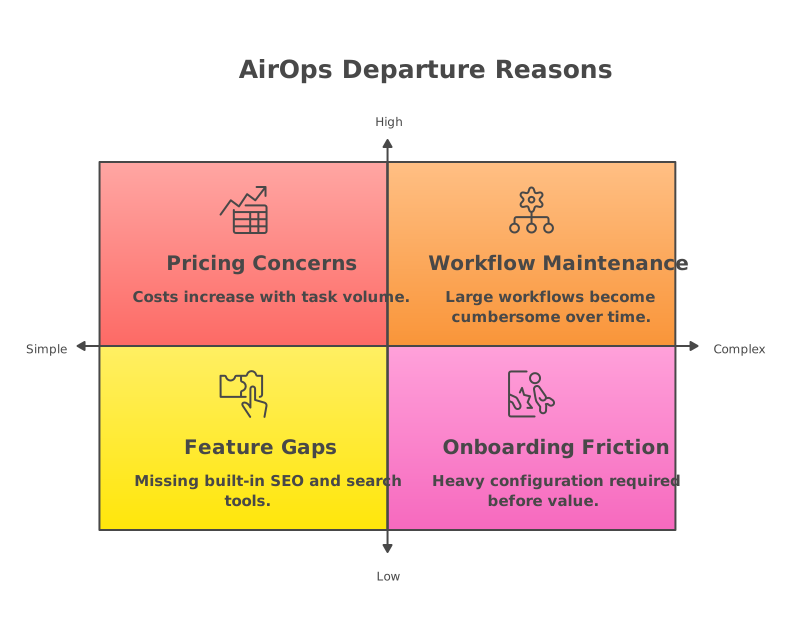
AirOps is a strong platform for large, workflow-heavy content teams that want to visually orchestrate research, drafting, and approvals across a growing library of custom workflows. Teams start evaluating AirOps alternatives when the meter keeps moving: billing runs on usage-based pricing, so costs climb as task volume grows. Two other frictions come up often: the platform assumes you will build the SEO layer yourself, since it ships without technical audits, rank tracking, or AI visibility reporting, and most of the configuration effort lands on your team before workflows pay off. Reviews also note that big workflows become cumbersome to maintain.
The strongest alternatives cover the four gaps above. Search Atlas executes SEO end to end, from content and technical fixes to rank tracking and AI search visibility, with published pricing from $99/month and no per-seat add-on fees. Frase combines research, briefs, and optimization from $39/month with unlimited AI words, while NeuronWriter starts at $19/month with internal linking suggestions connected to Google Search Console. Jasper supports 25+ languages for high-volume marketing copy with a 7-day free trial, Copy.ai offers a free plan and 90+ content templates, and MarketMuse provides content intelligence with a free plan of 10 queries/month. Semrush adds an AI Visibility Toolkit and a database of 43 trillion backlinks for teams that want a full marketing platform.
For SEO-specific execution, Search Atlas is the best AirOps alternative because it pairs Content Genius and the OTTO optimization engine with QUEST, which tracks brand visibility across ChatGPT, Claude, Gemini, Perplexity, and Google AI Overviews. The full Search Atlas vs AirOps comparison breaks down more than 100 feature rows, pricing, and a verdict by team type.
Why Look for an AirOps Alternative?
AirOps sells orchestration. You get a canvas where research, drafting, enrichment, and approval steps connect into a repeatable graph, and that graph runs on demand across a content library. The reason teams shop for something else is rarely that the orchestration fails. It is that orchestration turns out to be a smaller share of the job than expected, and the parts it does not cover still need buying.
What Does AirOps Do Well?
AirOps handles branching logic that most content tools cannot express at all. A workflow can pull a keyword set, route each item down a different drafting path based on intent, enforce Brand Kit rules mid-run, and hold output for a named reviewer before anything publishes. For an organization coordinating dozens of contributors across regions or product lines, that governance is real and hard to replicate with a stack of point tools.
Seat economics also favor large teams. Pro and Enterprise tiers include unlimited seats, so occasional contributors, legal reviewers, and regional editors cost nothing to add. In a 60-person marketing organization where most people touch content twice a month, that structure beats per-seat pricing by a wide margin.
Where Does AirOps Fall Short?
Three gaps show up consistently once a team is past the first quarter.
Billing tracks consumption, not headcount, so the invoice grows exactly when the program starts working. The free Solo plan caps at 100 prompts and 20,000 tasks per month; past that, Pro and Enterprise are custom-priced against task volume. A workflow that was cheap during a 10-article pilot behaves differently at 200 articles a month, and the cost curve steepens at the moment volume justifies the investment.
The SEO layer is not included. AirOps produces content; it does not audit a site, deploy schema, track rankings, or measure whether a brand appears in AI-generated answers. Every one of those still needs a separate subscription and a separate integration, which puts the assembly work back on the team that bought a platform to reduce assembly work.
Time-to-value is long. Workflows have to be designed, tested, and tuned before they return anything, and that design work lands on the people who were already the bottleneck. Teams that expect output in week one usually find the first useful run lands somewhere in month two.
Who Should Skip AirOps Entirely?
Skip it if your constraint is execution rather than coordination. A five-person team that needs pages fixed, briefs written, and rankings tracked does not have an orchestration problem, and a workflow canvas adds a configuration burden without addressing anything on that list. The same is true for any team whose SEO work is currently blocked on technical debt: no amount of content orchestration moves a site with broken canonicals or missing schema.
What Does AirOps Cost in 2026?
AirOps does not publish a full price list. What is public: a free Solo tier with 100 prompts and 20,000 tasks per month, then Pro and Enterprise quoted against expected task volume, both with unlimited seats.
That structure has two practical consequences when you budget against it.
The first is variance. A task is consumed per workflow step, so a single article moving through research, drafting, enrichment, and review burns several. Two months with identical article counts can bill differently if one month's pieces ran through longer workflow paths. Forecasting requires modeling steps, not outputs.
The second is the negotiation. Because Pro and Enterprise are quoted rather than listed, the price depends on volume you have to estimate before you have run anything at scale. Teams that overestimate overpay for headroom; teams that underestimate hit the ceiling mid-quarter.
Flat per-plan pricing inverts both problems. Search Atlas publishes plans from $99/month, Frase from $39/month, and NeuronWriter from $19/month, and none of the three change if a given month runs heavy.
What Are the Best AirOps Alternatives?
The 14 best AirOps alternatives are listed below, ranked on pricing transparency, SEO coverage, and how much configuration stands between signup and useful output.
| # | Tool | Best for | Entry price | Top-tier price | Free trial |
|---|---|---|---|---|---|
| 1 | Search Atlas | End-to-end SEO execution and AI visibility | $99/mo (Starter) | $999/mo (Agency) | 7-day, full access |
| 2 | Frase | Research-to-brief editorial flow | $39/mo | Not published | Yes |
| 3 | Surfer SEO | On-page optimization against live SERPs | ~$89/mo | Not published | Money-back window |
| 4 | Semrush | Full marketing stack with AI visibility | Paid tiers | Not published | 7-day |
| 5 | Jasper | Multilingual marketing copy at volume | Paid tiers | Not published | 7-day |
| 6 | Clearscope | Editorial governance and trust | ~$129/mo | Not published | None |
| 7 | MarketMuse | Inventory-wide content strategy | Free (10 queries/mo) | Not published | Free plan |
| 8 | NeuronWriter | Budget optimization with GSC linking | $19/mo | Not published | Yes |
| 9 | Copy.ai | Prebuilt GTM workflows and templates | Free plan | Not published | Free plan |
| 10 | Writesonic | SEO-checked drafting inside the editor | Paid tiers | Not published | Yes |
| 11 | Contentpen | Predictable per-article pricing | $39/mo (10 articles) | $199/mo (100 articles) | 7-day |
| 12 | Content Harmony | Standardized briefs for writing teams | ~$50/mo | Not published | 7-day |
| 13 | ContentMonk | Long-form drafting with a knowledge base | Free (1 article) | $49/mo (5 articles) | 14-day Pro |
| 14 | ChatGPT | Flexible drafting at minimal cost | Free tier | $20/mo | Free tier |
Where a top-tier price reads "not published," the vendor quotes it on request rather than listing it.
What Are the Best AirOps Alternatives in 2026?
Each tool below is assessed on the same four questions: how it compares to AirOps, what it costs, who it fits, and where it gives something up.
1. Search Atlas
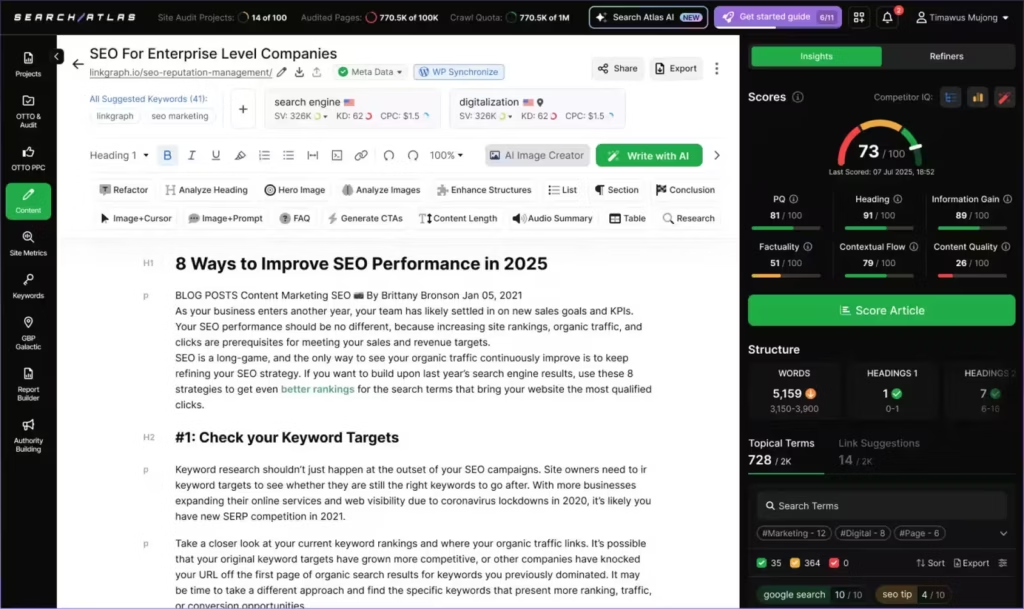
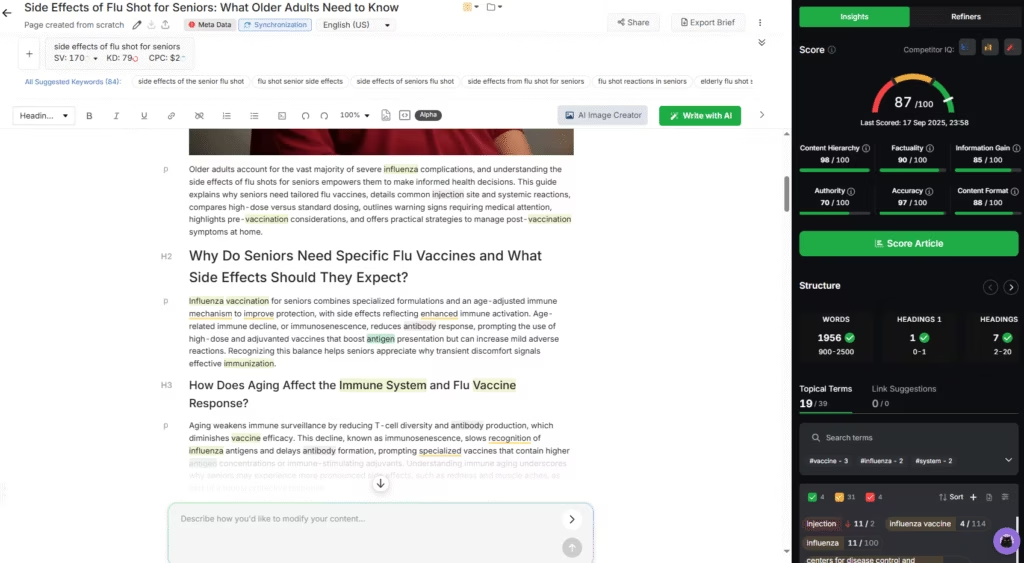
Search Atlas is an agentic SEO and content platform that executes search work end to end: keyword research, Content Genius drafting, OTTO technical optimization deployed through a single pixel, rank tracking, and QUEST visibility monitoring across ChatGPT, Claude, Gemini, Perplexity, and Google AI Overviews.
How does Search Atlas compare to AirOps?
The two platforms answer different questions. AirOps asks how content gets produced and approved; Search Atlas asks whether the site ranks and gets cited. OTTO deploys fixes, schema, and content directly to a live site through one pixel, and every change can be reviewed, edited, or rolled back from the dashboard. The Coworker runs audits, content, and reporting from Slack, Teams, or ClickUp, which removes the "log into the platform" step that workflow tools depend on.
What does Search Atlas cost in 2026?
Published pricing from $99/month, with 1 seat on Starter, 3 on Growth, 5 on Pro, and 10 on Agency, topping out at $999/month. There are no per-seat add-on fees, and the number does not move with task volume.
Who is Search Atlas best for?
Teams whose bottleneck is execution rather than coordination, and anyone who currently pays for a content tool plus a technical SEO tool plus a rank tracker plus an AI visibility tracker. Explore Content Genius and OTTO SEO, or read the detailed Search Atlas vs AirOps breakdown.
What are the pros and cons of Search Atlas?
Pros: SEO executed rather than recommended, published flat pricing, AI search visibility included, changes reversible from one dashboard. Cons: it does not offer AirOps-style visual workflow design, so an organization whose real requirement is a conditional approval graph across many contributors will find that specific capability missing.
2. Frase
Frase is a research-first content platform that integrates research, briefs, writing, and optimization, supports 100+ languages, includes unlimited AI words on all plans, and tracks AI search visibility across five platforms including ChatGPT and Gemini.
How does Frase compare to AirOps?
Frase compresses the research-to-draft path that AirOps asks you to assemble. Where AirOps gives a canvas to build a briefing workflow, Frase ships the briefing workflow already opinionated, which trades flexibility for a much shorter setup.
What does Frase cost in 2026?
From $39/month, flat, with unlimited AI words on every plan rather than a word or task allowance.
Who is Frase best for?
Editorial teams that work brief-first and want research, outline, and optimization in one pass without designing the pipeline themselves.
What are the pros and cons of Frase?
Pros: low flat entry price, unlimited AI words, broad language support, AI visibility tracking included. Cons: no technical SEO layer, and the fixed editorial flow cannot be reshaped the way an AirOps graph can.
3. Surfer SEO
Surfer SEO is a content optimization platform that scores drafts against live SERP competitors and guides structure, entities, and keyword coverage in real time.
How does Surfer SEO compare to AirOps?
Surfer's guidance comes from pages that currently rank, not from logic a team encoded in a workflow. That makes it stronger on on-page depth and weaker on everything upstream of the draft.
What does Surfer SEO cost in 2026?
Around $89/month for the standard entry plan, priced flat rather than per task.
Who is Surfer SEO best for?
Teams whose drafts are fine but underperform on-page, and writers who want live SERP feedback inside the editor.
What are the pros and cons of Surfer SEO?
Pros: SERP-grounded recommendations, fast to adopt, no configuration phase. Cons: optimization only, with no orchestration, no technical fixes, and no rank tracking. The side-by-side is in Search Atlas vs Surfer SEO.
4. Semrush
Semrush is an all-in-one marketing platform with an AI Visibility Toolkit, a backlink database of 43 trillion links, and a Writing Assistant that grades drafts inside Google Docs, WordPress, and Microsoft Word.
How does Semrush compare to AirOps?
Semrush is broader and shallower on content production. It will not orchestrate a drafting pipeline, but it covers SEO, PPC, and competitive research in one subscription, which is the surface AirOps deliberately leaves to other vendors.
What does Semrush cost in 2026?
Paid tiers with a 7-day trial. Pricing is published per plan rather than quoted on volume.
Who is Semrush best for?
Teams that want one subscription spanning search, paid, and competitor intelligence, and that treat content as one workstream among several.
What are the pros and cons of Semrush?
Pros: enormous data footprint, AI visibility tracking, breadth across channels. Cons: content production is assistive rather than automated, and the platform's size means paying for modules a content team may never open. The head-to-head is in Search Atlas vs Semrush.
5. Jasper
Jasper is an AI content generation platform aimed at marketing teams that produce a high volume of brand-consistent copy across campaigns, ads, and editorial calendars, with support for 25+ languages and a 7-day free trial.
How does Jasper compare to AirOps?
Both care about brand consistency at volume, but they enforce it differently. AirOps enforces it through Brand Kit rules inside a workflow; Jasper enforces it through brand voice controls applied at generation time. Jasper reaches usable output faster; AirOps holds up better when the rules are complex and legally consequential.
What does Jasper cost in 2026?
Paid tiers with a 7-day free trial. Pricing is per plan rather than per task.
Who is Jasper best for?
Marketing teams writing across many formats and languages that do not need multi-step data pipelines.
What are the pros and cons of Jasper?
Pros: strong multilingual coverage, mature brand voice controls, quick to production. Cons: no SEO execution layer, and no conditional routing for teams that genuinely need it. For a wider field, see the best Jasper alternatives.
6. Clearscope
Clearscope is an editorial content governance tool that analyzes the top 30 ranking articles for keyword and entity suggestions, built for teams with strict editorial standards that want high-trust guidance over volume.
How does Clearscope compare to AirOps?
Clearscope aligns a large editorial team on what "good" means without anyone building a review workflow, because the recommendation itself is the standard. AirOps enforces standards procedurally; Clearscope enforces them evidentially.
What does Clearscope cost in 2026?
Around $129/month at entry, flat.
Who is Clearscope best for?
Publishers and in-house teams where editorial quality control matters more than throughput.
What are the pros and cons of Clearscope?
Pros: every recommendation maps to currently ranking pages, excellent for consistency across many writers. Cons: higher entry price than peers, narrow scope, no automation or technical SEO.
7. MarketMuse
MarketMuse is a content intelligence platform used by larger enterprises and brands including Discover, The Motley Fool, and Lionbridge, offering personalized metrics, deep content analysis, inventory-wide planning, and a free plan with 10 queries/month.
How does MarketMuse compare to AirOps?
MarketMuse decides what to write; AirOps decides how it gets written. For a team with a large existing inventory, the prioritization question usually pays back faster than the production question.
What does MarketMuse cost in 2026?
A free plan with 10 queries per month, then paid tiers quoted per organization.
Who is MarketMuse best for?
Enterprises with substantial published inventory that need to know which pages to build, merge, or retire before adding more.
What are the pros and cons of MarketMuse?
Pros: inventory-wide strategic view, enterprise track record, free entry point for evaluation. Cons: planning rather than production, and paid pricing is not published.
8. NeuronWriter
NeuronWriter is a budget content optimizer with plans from $19/month, full article drafting, user intent analysis, multi-language optimization, and internal linking suggestions connected to Google Search Console data.
How does NeuronWriter compare to AirOps?
NeuronWriter removes the pricing risk that sends most teams looking. It delivers optimization and GSC-connected internal linking at a fixed low monthly cost, with none of AirOps' orchestration and none of its volume exposure.
What does NeuronWriter cost in 2026?
From $19/month, the lowest flat entry point in this list.
Who is NeuronWriter best for?
Cost-conscious teams and solo operators who want optimization plus internal linking guidance grounded in their own Search Console data.
What are the pros and cons of NeuronWriter?
Pros: lowest price of any paid option here, GSC-connected linking suggestions, no usage-based billing. Cons: a lighter interface and smaller support surface than enterprise-tier tools.
9. Copy.ai
Copy.ai is a GTM-focused AI workflow and copywriting platform with 90+ content templates and a free plan, popular with lean teams automating emails, ads, and short-form marketing content.
How does Copy.ai compare to AirOps?
Copy.ai is the closest thing on this list to AirOps' workflow concept, shipped prebuilt. Teams get go-to-market automations out of the box rather than a canvas to build them on, which suits organizations that would otherwise spend a quarter designing their first graph.
What does Copy.ai cost in 2026?
A free plan, then paid tiers. The free entry point makes trialing it essentially costless.
Who is Copy.ai best for?
Lean GTM and demand-gen teams automating short-form output across email, ads, and social.
What are the pros and cons of Copy.ai?
Pros: free to start, large template library, workflows that run without setup. Cons: shallow on long-form SEO content, and prebuilt workflows cannot be reshaped as deeply as an AirOps graph. The deeper comparison lives in our Copy.ai alternatives roundup.
10. Writesonic
Writesonic is an AI writing platform that blends rapid drafting with SEO-focused refinement for blogs, landing pages, ads, and product descriptions, with dedicated long-form generators and an optimizer that checks keyword coverage, headings, and semantic signals.
How does Writesonic compare to AirOps?
Writesonic collapses drafting and optimization into a single pass. Where AirOps would route a draft to a separate optimization step, Writesonic runs the SEO check inside the editor, which suits teams whose bottleneck is publication-ready output rather than governance.
What does Writesonic cost in 2026?
Paid tiers, published per plan.
Who is Writesonic best for?
Teams shipping a steady volume of blog and landing-page copy that want SEO checks without a second tool.
What are the pros and cons of Writesonic?
Pros: drafting and optimization in one flow, broad format coverage. Cons: no workflow governance, no technical SEO, and no rank tracking.
11. Contentpen
Contentpen is an AI blog writing platform that generates SEO-optimized drafts in one shot, with keyword research, SEO scoring, and SERP analysis built into the editor and direct publishing to WordPress, Webflow, Ghost, Wix, and Shopify.
How does Contentpen compare to AirOps?
Contentpen's per-article billing is the direct answer to AirOps' per-task billing. You buy a number of articles and that is the bill, regardless of how much processing each one required.
What does Contentpen cost in 2026?
Output-based plans: $39/month for 10 articles, $79 for 30, $199 for 100, with a 7-day trial.
Who is Contentpen best for?
Small teams that publish on a predictable cadence and want the invoice to be predictable with it.
What are the pros and cons of Contentpen?
Pros: genuinely predictable cost, direct CMS publishing, low friction. Cons: no multi-step conditional orchestration and a narrower feature surface than platform-tier tools.
12. Content Harmony
Content Harmony is a content brief and workflow platform from about $50/month with a 7-day free trial, built around community-driven insights and structured briefs that standardize what writers receive before drafting.
How does Content Harmony compare to AirOps?
Both standardize the handoff to writers. Content Harmony does it with an opinionated brief format that works on day one; AirOps does it with a workflow you build. The trade is customization for immediacy.
What does Content Harmony cost in 2026?
About $50/month with a 7-day free trial.
Who is Content Harmony best for?
Teams with freelance or distributed writers where brief quality is the main determinant of output quality.
What are the pros and cons of Content Harmony?
Pros: strong standardized briefs, quick adoption, fair mid-range price. Cons: briefing only, so drafting, optimization, and technical work all live elsewhere.
13. ContentMonk
ContentMonk is a long-form AI writer with a built-in knowledge base that grounds drafts in your own documents, per-article pricing, and built-in repurposing that turns finished articles into LinkedIn posts.
How does ContentMonk compare to AirOps?
ContentMonk removes the canvas entirely: brief, draft, edit, all in one editor. Its knowledge base covers the grounding use case that teams often build a multi-step AirOps workflow to achieve.
What does ContentMonk cost in 2026?
A free plan with one AI-generated article, paid plans from $49/month for five articles, and a 14-day Pro trial with no credit card.
Who is ContentMonk best for?
Teams producing a small number of long, well-grounded pieces rather than high-volume output.
What are the pros and cons of ContentMonk?
Pros: document-grounded drafting, simple to learn, built-in repurposing. Cons: low article allowances at entry tiers and no room for custom multi-step orchestration.
14. ChatGPT
ChatGPT is a conversational AI with a free tier and paid plans from $20/month, capable of drafting, rewriting, and outlining long-form content while adapting to context across an entire piece.
How does ChatGPT compare to AirOps?
It is the floor of the market: no setup, no workflow, no platform. For teams whose AirOps usage amounted to drafting with extra steps, that comparison is uncomfortable and worth making honestly.
What does ChatGPT cost in 2026?
Free tier available, paid plans from $20/month.
Who is ChatGPT best for?
Individuals and small teams whose need is drafting help, with SEO handled elsewhere or not at all.
What are the pros and cons of ChatGPT?
Pros: near-zero cost, no configuration, strong contextual reasoning across long pieces. Cons: zero SEO infrastructure, zero measurement, zero governance, and no memory of your brand standards between sessions unless you rebuild that context each time.
How We Tested These AirOps Alternatives
Every tool above was assessed against the four gaps that actually drive teams off AirOps, because a feature list ranks tools well and predicts satisfaction badly.
Pricing transparency and predictability. We recorded whether entry and top-tier prices are published, and whether the monthly figure moves with usage. A tool quoting on volume was not penalized for being expensive, only for being unforecastable.
SEO coverage out of the box. We checked which of four capabilities ship without a second subscription: technical auditing and deployment, rank tracking, backlink or competitive data, and AI search visibility. Only two tools in this list cover more than two of the four.
Time to first useful output. We separated tools that produce something usable in the first session from tools requiring a configuration phase. This is where AirOps loses most evaluations and where several cheaper tools win on merit rather than on price.
Where AirOps still wins. Each entry names what you give up. A roundup that finds no reason to stay is not an evaluation, and workflow orchestration at multi-contributor scale is a genuine capability that most tools here do not attempt.
Which Tool Replaces the Most of the AirOps Stack?
Search Atlas, because the four-part SEO gap is the part AirOps explicitly does not fill and the part most teams are separately paying for. Replacing AirOps with a drafting tool leaves that gap open; replacing it with a platform that audits, deploys, tracks, and measures closes it.
Which Tool Offers the Best Value at the Low End?
NeuronWriter at $19/month, with Frase at $39/month a close second for teams that need research and briefing rather than optimization alone. Both remove usage-based billing risk entirely.
Which Tool Fits Teams That Genuinely Need Orchestration?
Copy.ai, for prebuilt go-to-market workflows, is the nearest substitute. If the requirement is truly conditional multi-step routing with enforced compliance rules across many contributors, no tool in this list matches AirOps, and staying is the correct call.
Why Do Teams Look for AirOps Alternatives?
Why does AirOps pricing push teams to alternatives? AirOps bills by usage, so the monthly number moves with every task and user you add, which makes budgets hard to hold as an operation grows. The platform's own Solo tier caps at 20,000 tasks per month, and everything beyond it is custom-priced Pro and Enterprise territory, so the pricing curve steepens right when volume grows. Flat per-plan pricing, like Search Atlas plans from $99/month or Frase from $39/month, is easier to budget for a growing content operation.
What does AirOps lack out of the box? AirOps focuses on AI-driven content workflows rather than direct optimization, so teams still need separate tooling for technical SEO, rank tracking, backlink intelligence, and AI search visibility. Platforms that bundle those capabilities reduce the integration work that AirOps shifts onto your stack.
Who should stay on AirOps? AirOps is built for large organizations with workflow-heavy content operations that need conditional logic, approval chains, and Brand Kit compliance rules enforced inside every workflow. If your bottleneck is orchestrating many contributors rather than executing SEO itself, AirOps remains a legitimate choice, and the alternatives above are ranked with that trade-off in mind. Its Pro and Enterprise tiers also include unlimited seats, a real advantage for organizations with many occasional contributors.
Which AirOps Alternative Is Best in 2026?
Match the tool to the job AirOps was doing for you, not to its feature list.
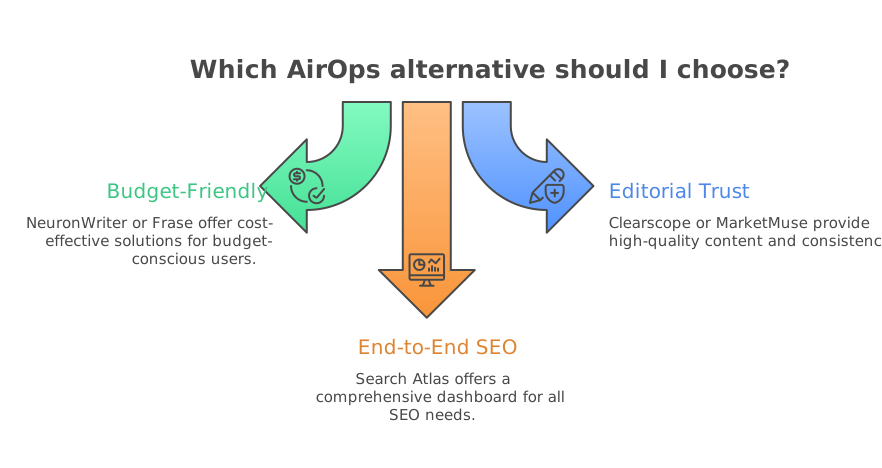
If the deciding factor is budget, start with NeuronWriter at $19/month or Frase at $39/month. If it is editorial trust and consistency across many writers, weigh Clearscope or MarketMuse. If it is prebuilt automation without a build phase, Copy.ai is the shortest path. If it is shipping SEO work end to end, with technical fixes, rank tracking, and AI visibility in one subscription, Search Atlas covers the most ground from a single dashboard.
And if what you actually valued was the workflow canvas itself, conditional routing, enforced compliance, unlimited seats across a large contributor pool, then the honest recommendation is to keep AirOps and buy the SEO layer separately.
FAQ: AirOps Alternatives
What is the best AirOps alternative overall?
Search Atlas is the best AirOps alternative for most teams because it executes SEO end to end, from content and technical fixes to rank tracking and AI search visibility, with published pricing from $99/month. AirOps remains the stronger fit for large organizations that need to visually orchestrate approval chains and compliance rules across custom content workflows.
Why do teams switch away from AirOps?
Four reasons come up repeatedly: costs that grow with usage instead of holding flat, thin out-of-the-box SEO that leaves technical audits, rank tracking, and AI visibility to other tools, a heavy configuration phase before the platform pays off, and workflows that get cumbersome to maintain as they grow.
How much does AirOps cost?
AirOps offers a free Solo plan with 100 prompts and 20,000 tasks per month, while Pro and Enterprise plans are custom-priced around task volume and include unlimited seats. Because billing scales with task consumption rather than a flat rate, the monthly total depends on how much work the platform runs for you.
Is there a free AirOps alternative?
Yes. Copy.ai offers a free plan with 90-plus content templates, ChatGPT has a free tier with paid plans from $20/month, and MarketMuse includes a free plan with 10 queries per month. AirOps itself has a free Solo plan with 100 prompts and 20,000 tasks per month.
Which AirOps alternative is best for enterprise content governance?
MarketMuse targets larger enterprises and brands that need content intelligence, while Jasper supports brand voice across high-volume production. For governed execution of live SEO changes rather than workflow design, Search Atlas routes every automated optimization through an approve, edit, or roll back review flow.
What is the cheapest AirOps alternative?
NeuronWriter starts at $19/month and Frase at $39/month, compared with AirOps usage-based pricing that scales with tasks. Copy.ai and ChatGPT both have free entry points, while Search Atlas starts at $99/month with published per-plan pricing and no per-seat add-on fees.
Can you move AirOps workflows to another platform?
Not directly. Visual workflow graphs do not export between platforms, so the practical path is to list what each workflow produces, such as briefs, drafts, internal links, or optimization passes, and map each output to a feature in the replacement tool. Content, briefs, and knowledge sources all move over; the orchestration layer is rebuilt once rather than migrated.