The best SEO books cover the fundamentals that remain useful even as search evolves, including keyword research, search intent, technical SEO, content strategy, site architecture, and link building. Beginners should start with practical, foundational guides, while experienced SEOs can move into deeper topics such as information retrieval, topical authority, experimentation, and how modern search engines discover, evaluate, and rank content.
This list covers 12 books worth reading in 2026, chosen for practical depth over recycled tips rather than sheer volume. Each one targets a different stage of SEO knowledge, from publishing your first optimized page to running SEO across an enterprise team. Start with whichever one solves the problem you're actually stuck on.
What are SEO books?
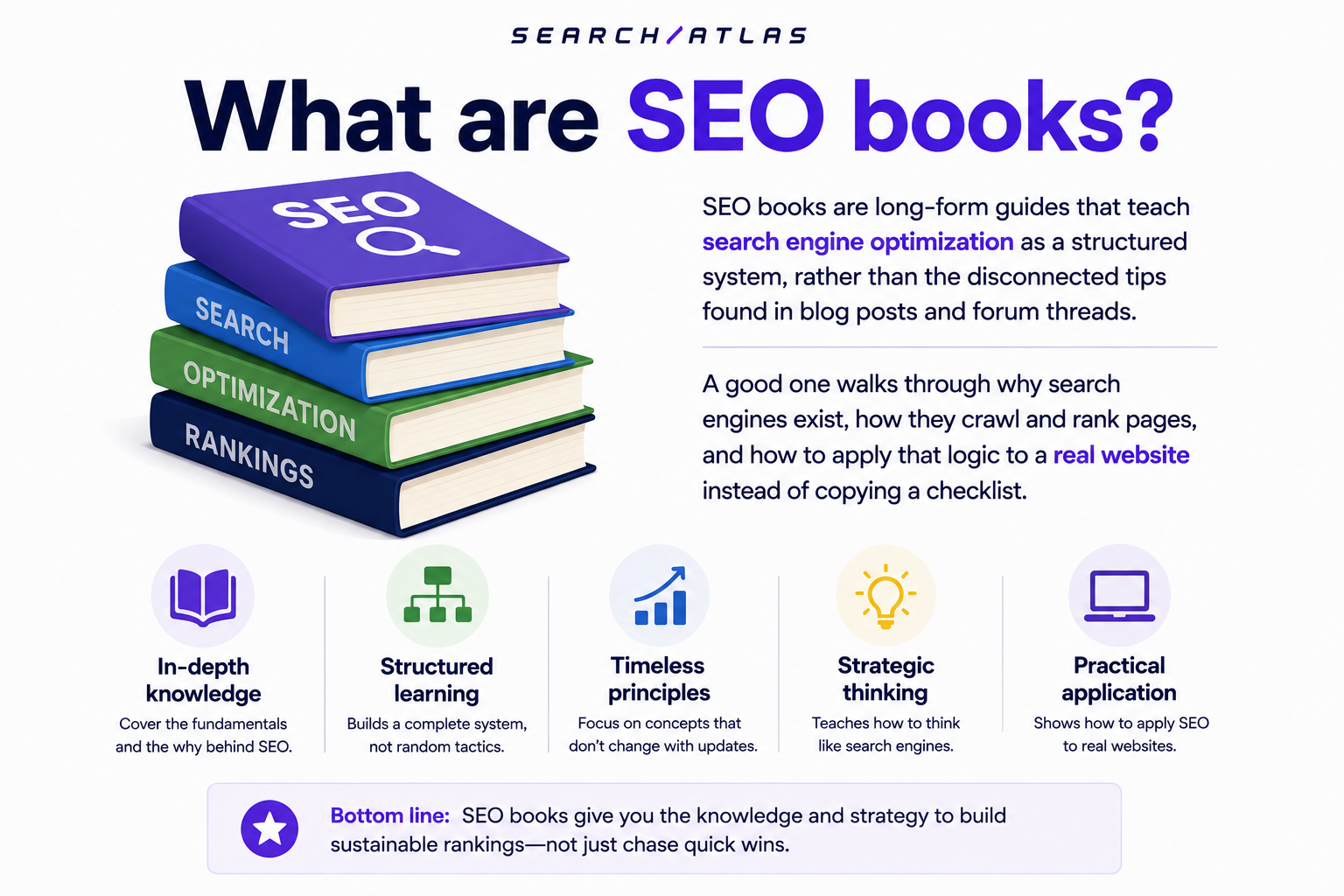
SEO books are long-form guides that teach search engine optimization as a structured system, rather than the disconnected tips found in blog posts and forum threads. A good one walks through why search engines exist, how they crawl and rank pages, and how to apply that logic to a real website instead of copying a checklist.
Most start with fundamentals: why SEO matters, how ranking algorithms weigh signals, and how to do basic keyword research. From there they move into on-page optimization, site structure, and technical SEO, the behind-the-scenes work of making a site easy for search engines to crawl and index.
The stronger, more current titles go further. They cover off-page strategy like backlinks and digital PR, content systems that scale past a single writer, and, increasingly, how large language models select and cite sources when someone asks ChatGPT or Perplexity a question instead of typing it into Google.

Why read SEO books in 2026?
SEO books give you structured, expert-vetted knowledge in one sitting, instead of piecing a strategy together from dozens of contradictory blog posts. A book has to hold together as a coherent argument from chapter one to the last page, so it forces an author to actually explain the reasoning behind a tactic, not just list it.
A few concrete reasons this still beats scattered content, even with AI search summarizing everything for you:
- Depth over fragments. Books walk through a full strategy end to end, with the reasoning and the exceptions, not just the headline tactic.
- Vetted expertise. The best authors have run SEO for real companies for a decade or more, so the advice has already survived contact with actual traffic and revenue.
- Coverage of what's actually changed. 2026's strongest titles address how ranking works alongside how AI answer engines pick sources, a distinction that barely existed in SEO books published before 2024.
- Self-paced and revisitable. You can reread a chapter on link building six months later when you're actually doing it, which is harder to do with a scattered stack of bookmarked articles.
Search engines used to be the only gatekeeper between a website and a searcher. Now ChatGPT, Perplexity, Gemini, and Google's AI Overviews summarize answers directly, and some of that traffic never reaches a website at all. The books below vary in how directly they address this, and that's one of the filters used to build this list.
12 best SEO books for boosting your strategy in 2026
This list includes foundational SEO guides, more specialized books on topics like link building and ecommerce, and a comprehensive reference covering multiple areas of SEO in greater depth.
1. SEO 2026 by Adam Clarke

SEO 2026 is Adam Clarke's annually revised guide to ranking a website in Google, and now, in AI answer engines. Clarke updates this book every year rather than letting it go stale, and the 2026 edition folds in the June 2025 and March 2025 core updates along with new material on showing up in ChatGPT, Gemini, and Claude answers.
The book stays focused on fundamentals: how Google's algorithm actually evaluates a page, how to do keyword research without expensive software, and how to structure on-page SEO so it holds up across algorithm updates rather than chasing the latest trick.
What you'll learn:
- How Google's ranking algorithm weighs on-page and off-page signals
- Keyword research and on-page optimization from the ground up
- What changed in the most recent core updates and how to respond
- How to get cited in AI answers from ChatGPT, Gemini, and Claude, alongside traditional rankings
Best for: complete beginners who want a single book that gets re-issued every year instead of going stale.
2. The Art of SEO (4th Edition) by Eric Enge, Stephan Spencer, and Jessie Stricchiola
The Art of SEO is the industry's most comprehensive single reference on search engine optimization, running close to 1,000 pages across crawling, indexing, technical SEO, content strategy, link building, analytics, and building an SEO team. It has been a standard recommendation since its first edition, and the fourth adds a dedicated chapter on generative AI and answer engines.
Where most books on this list pick one angle, this one tries to cover the whole discipline, which makes it dense but also the closest thing to a textbook this list has room for.
What you'll learn:
- How crawling, indexing, and ranking actually work at a mechanical level
- Technical SEO, content strategy, and link building as one connected system
- How generative AI and answer engines are changing what search visibility means
- How to structure an SEO team and measure its output
Best for: anyone who wants one exhaustive reference instead of several shorter books, especially team leads building a training curriculum.
3. SEO Entrepreneur by Nathan Gotch

SEO Entrepreneur by Nathan Gotch takes a different angle than most SEO books, it treats SEO knowledge as raw material for a business rather than a skill to master for its own sake. Gotch built Gotch SEO into an agency and training company, and the book leans on that experience instead of generic advice.
Rather than promising quick wins, the book argues for compounding, long-term SEO systems, then walks through how to package that knowledge into services, courses, or an agency. It reads less like a how-to and more like a playbook for turning expertise into recurring revenue.
What you'll learn:
- How to turn SEO skill into a scalable service or agency business
- Why long-term, compounding SEO systems outperform quick-win tactics
- Positioning and pricing SEO services so they don't compete on price alone
- Common mistakes that keep solo SEO consultants stuck trading time for money
Best for: solopreneurs and consultants who want to build a business around their SEO skill, not just apply it to one site.
4. Ultimate Guide to Link Building by Garrett French and Eric Ward

The Ultimate Guide to Link Building, now updated into a second edition, is a focused deep dive into earning backlinks rather than a general SEO overview. At roughly 270 pages it's shorter than The Art of SEO, but it doesn't try to cover everything, it covers link building well.
French and Ward break the topic into link-worthy content, qualifying an opportunity before pursuing it, and separating genuinely valuable links from ones that waste outreach time. The authors' qualifier framework alone is worth the read for anyone doing manual outreach.
What you'll learn:
- How to identify link-worthy content before trying to promote it
- A framework for qualifying link opportunities so outreach time isn't wasted
- How to distinguish high-value backlinks from low-quality ones
- Practical outreach tactics that hold up across industries
Best for: anyone running manual link building or outreach who wants a system instead of a spreadsheet of cold guesses.
5. The SEO Blueprint by Ryan Stewart

The SEO Blueprint by Ryan Stewart focuses on systemizing SEO work rather than theorizing about it, aimed squarely at agencies and consultants doing client SEO. Stewart draws on running The Blueprint Training, and the book reflects that operator's mindset throughout.
Instead of hiring in-house writers or developers for every task, Stewart lays out how to structure an SEO operation around outsourced specialists and shared systems, including using tools as simple as Google Sheets to run entire campaigns without expensive software.
What you'll learn:
- How to structure an SEO team without full-time in-house writers or developers
- Running SEO campaigns and reporting with lightweight tools like spreadsheets
- A repeatable, sprint-based process for scaling client SEO work
- When and how to outsource tactical work like link building and content production
Best for: agency owners and consultants who need to productize SEO delivery instead of custom-building every client engagement.
6. The Fundamentals of Brand SERPs for Business by Jason Barnard

The Fundamentals of Brand SERPs for Business is Jason Barnard's case for treating your brand's search results, and now its presence in AI answers, as a managed asset instead of an afterthought. Barnard, known in the industry as "The Brand SERP Guy," focuses on what appears when someone searches your brand name directly, not your product keywords.
As AI Overviews and chatbots increasingly answer questions about companies without a click-through, what those systems know about a brand's identity, reputation, and entities matters as much as its keyword rankings. Barnard's book stays practical rather than theoretical about that shift.
What you'll learn:
- Why brand-name search results deserve their own strategy, separate from keyword SEO
- How entity SEO shapes what AI systems say about a brand
- Practical steps for managing online reputation across owned and earned results
- How to audit and improve a brand's current SERP presence
Best for: marketers and founders who need their brand's search presence to hold up under scrutiny, not just their product pages.
7. SEO for Growth by John Jantsch and Phil Singleton
SEO for Growth argues that SEO only works when it's tied to the rest of a business's marketing, not run as an isolated technical project. Jantsch, known for Duct Tape Marketing, and Singleton, an SEO practitioner, connect SEO to content marketing, sales, and social media rather than treating it as a silo.
The book is written for business owners and marketing generalists rather than SEO specialists, so it trades deep technical detail for practical, connected strategy: content calendars that support SEO goals, and a way to think about search as one channel among several instead of the whole plan.
What you'll learn:
- How to connect SEO goals to broader business and marketing strategy
- Building content calendars that serve both SEO and sales
- Where SEO fits alongside social media and other acquisition channels
- Practical starting points for business owners without a dedicated SEO team
Best for: small business owners and marketing generalists who need SEO to fit into a bigger plan, not become the whole plan.
8. Product-Led SEO by Eli Schwartz

Product-Led SEO by Eli Schwartz makes the case for building a product worth ranking before optimizing it to rank. Schwartz, a well-known SEO expert who has driven SEO for Quora, SurveyMonkey, and Zendesk, argues that chasing high-competition keywords without solving a real user problem rarely produces lasting traffic.
The book spends real time on SEO audits, positioning against competitors using what Schwartz calls a blue ocean strategy, and building an internal SEO team that product managers actually listen to, not one that gets treated as an afterthought.
What you'll learn:
- Why product quality and user problem-solving outperform keyword-chasing long term
- How to run a meaningful SEO audit on an existing product or site
- A blue ocean approach to finding underserved search opportunities
- How to build an SEO function that product teams actually respect
Best for: SaaS founders, product managers, and in-house SEOs who need buy-in from a product organization, not just a marketing team.
9. Data-Driven SEO With Python by Andreas Voniatis

Data-Driven SEO with Python teaches SEO professionals to solve ranking problems with data science techniques instead of manual spreadsheet work. Voniatis walks through applying Python, basic machine learning, and natural language processing to SEO tasks that would otherwise take hours of manual analysis.
As the volume of data from search engines, mobile behavior, and social platforms keeps growing, manually reviewing spreadsheets stops scaling. This book is the most technical entry on this list, and it assumes some comfort with code, but it pays off in automation most SEOs never attempt.
What you'll learn:
- Using Python to automate repetitive SEO analysis and reporting
- Where machine learning and NLP genuinely help with SEO problems, and where they don't
- Building data-driven recommendations instead of relying on gut instinct
- Practical scripts for common technical SEO audits
Best for: SEOs with basic Python knowledge who want to automate the analysis work that eats most of a workweek.
10. The Executive SEO Playbook by Jessica Bowman

The Executive SEO Playbook by Jessica Bowman addresses a problem most SEO books skip entirely, getting SEO taken seriously inside a large organization. Bowman spent over two decades running in-house SEO at the enterprise level, and the book reflects the internal politics that actually determine whether SEO recommendations ship.
She draws a distinction between what she calls "SEO Pacesetters," teams that build SEO into projects from day one, and "SEO Avoiders," teams that treat it as a fire to put out after launch. Most of the book is about closing that gap.
What you'll learn:
- How to get non-SEO teams and executives to buy into SEO recommendations
- Building SEO into project planning instead of fixing problems after launch
- Structuring an in-house SEO team inside a large, siloed organization
- How to avoid the retroactive-fix cycle that burns out enterprise SEO teams
Best for: in-house SEOs at mid-size to enterprise companies who need organizational buy-in more than another tactic.
11. Content Machine by Dan Norris

Content Machine by Dan Norris isn't an SEO book in the strict sense, it's a content marketing book that happens to double as one of the better arguments for content creation as an organic growth engine. Norris grew his own WordPress support business to a seven-figure annual run rate using content as the primary channel, with no paid advertising.
The book is built around frameworks rather than theory: how to pick topics that compound instead of going stale, how to keep publishing consistently without burning out a small team, and the specific mistakes that quietly kill most content marketing efforts before they gain traction.
What you'll learn:
- A repeatable framework for choosing content topics that keep paying off
- How to sustain a publishing cadence without a large content team
- Common mistakes that kill content marketing momentum before it compounds
- How content marketing and organic search growth reinforce each other
Best for: bloggers, founders, and content marketers who want a business-building lens on content, not just an SEO checklist.
12. Ecommerce SEO Book Mastery by Kristina Azarenko

Ecommerce SEO Book Mastery is a dedicated guide to the SEO problems specific to online stores, written by an ecommerce SEO specialist who has worked with Fortune 500 retailers and contributed to tools like Hotjar and Semrush. General SEO books tend to gloss over the specific mess of duplicate product variants and thin category pages that ecommerce sites create, and Azarenko's book doesn't.
The book focuses on optimizing product and category pages, using structured data to help search engines and AI systems understand product details, and turning user-generated content like reviews into an SEO asset instead of ignoring it.
What you'll learn:
- How to fix thin content and duplicate-variant problems specific to product pages
- Structured data and schema markup for ecommerce product visibility
- Turning customer reviews and user-generated content into SEO assets
- A prioritized list of technical and content fixes for online stores
Best for: ecommerce site owners and in-house SEOs dealing with large, templated product catalogs.
How to apply what you learn from the best SEO books
Reading these books gets you the strategy, applying it is the part that actually moves rankings. Whether the gap in your SEO is technical, on-page, content, local, or ecommerce-specific, the next step after finishing any of these books is turning the framework into a list of fixes on your actual site, then working through it in priority order.
That's where most of the manual effort described in these books, auditing pages, fixing schema, restructuring internal links, updating metadata, can get handed off instead of done by hand. OTTO SEO is Search Atlas's AI agent for exactly that work: install one pixel on a site, and it audits the domain, finds the same kinds of technical and on-page gaps these books teach you to look for, and deploys the fixes live, with review and rollback controls if you want to check its work first.
None of that replaces understanding why a fix matters, which is what a good book is actually for. But once you know what "good" looks like, running that checklist manually across a growing site is exactly the kind of work worth automating instead of repeating by hand every quarter.